Improving outcomes for children with hypoplastic left heart syndrome has become a strategic priority and performance benchmark. Despite advances in surgical technique and perioperative care, early mortality following stage 1 palliation has remained at 5–15% and 1-year transplant-free survival at 65–80%. Reference Ghanayem, Allen and Tabbutt1,Reference Newburger, Sleeper and William Gaynor2 Mortality has been associated with surgical technique, presence of post-operative residual lesions including atrioventricular valve insufficiency, arrhythmias, decreased ventricular function and intercurrent illness. Reference Ghanayem, Allen and Tabbutt1,Reference Simsic, Bradley, Stroud and Atz3– Reference Furck, Uebing and Hansen5 The ideal surgical strategy remains elusive, as the Paediatric Heart Network sponsored Single-Ventricle Reconstruction trial suggested that the survival advantage of the right ventricle to pulmonary artery conduit may not extend beyond the first year or second year of life. Reference Newburger, Sleeper and William Gaynor2 Recent efforts targeting post-operative afterload reduction and dedicated interstage home surveillance programmes have gained traction but failed to demonstrate a definitive survival advantage across institutions. Reference Dobrolet, Nieves and Welch6–Reference Ghanayem, Cava, Jaquiss and Tweddell8 Although a single predictor has not been identified to improve survival, the importance of practice variability is highlighted by the wide variability of survival across institutions. Reference Pasquali, Ohye and Lu9,Reference Eckhauser, Pasquali and Ravishankar10
In response to the emerging evidence, our institution undertook a comprehensive review of our management strategy for all patients undergoing the Norwood procedure. A specialised single-ventricle team was introduced to oversee the standardisation of surgical approach and to coordinate an interstage home surveillance programme; a consistent intraoperative and post-operative goal-directed haemodynamic approach was also employed. The goal of the current study is to evaluate the impact of the aforementioned comprehensive management strategy on 1-year transplant-free survival with preserved ventricular and atrioventricular valve function. We hypothesised that a survival advantage would be seen with the implementation of standardised perioperative care with surveillance by a specialised team.
Materials and methods
This retrospective, single-centre cohort study included neonates undergoing the Norwood procedure for palliation of single-ventricle heart disease. All patients at the Hospital for Sick Children who underwent the Norwood procedure from May, 2004 to June, 2015 with available post-operative haemodynamic data were eligible for inclusion. Patients older than 30 days at the time of the Norwood operation or who underwent a primary transplant without undergoing the Norwood procedure were excluded. Patients who underwent a hybrid operation were excluded because there was not a reliable mechanism to identify those in whom the indication for the hybrid was a bridge to biventricular repair. Patients who underwent the Norwood procedure following the implementation of the comprehensive programme (C2) from December, 2012 to June, 2015 were compared historical controls (C1) from May, 2004 to November, 2012. The study protocol was approved by the Hospital Ethics Committee and patient-level consent was waived.
Outcomes
The primary outcome in this study was 1-year transplant-free survival with preserved ventricular function and atrioventricular valve function. Ventricular dysfunction was defined as moderate or more ventricular dysfunction as reported by echocardiogram; atrioventricular valve dysfunction was defined as moderate or more atrioventricular valve regurgitation as reported by echocardiogram. Ventricular and atrioventricular valve function was collected at the following time points: prior to the stage one Norwood procedure, intraoperatively following the Norwood procedure, prior to discharge from the Cardiac Critical Care Unit, prior to the stage two operation, at 1 year of age and prior to death, if applicable. Secondary outcomes included the individual components of the primary outcome – 1-year transplant-free survival and ventricular and atrioventricular valve dysfunction frequency – necrotising enterocolitis, renal dysfunction (defined as a creatinine ≥1.5 upper limit of normal) and infection following stage one Norwood procedure, and mortality. Infection was defined as confirmed bacteremia and the presence of clinical symptoms including temperature instability, unexplained tachycardia and haemodynamic instability. The diagnosis of necrotising enterocolitis was made by the treating team and was based on clinical symptoms, including abdominal distension, haematochezia, vomiting and haematemesis, feed intolerance and fever, and is supported by radiological evidence of pneumatosis, portal venous gas and pneumoperitoneum. Mortality was delineated at multiple time points: 30-day mortality, defined as any death within 30 days of the stage one Norwood operation, stage one hospital mortality, defined as during the hospital admission for the stage one Norwood operation, interstage mortality, defined as the timepoint from discharge from the hospital following the stage one Norwood operation until admission to hospital for the stage two operation and post-stage two mortality, defined as following the completion of stage two operation until 1 year of life.
Management strategy employed for C1
All neonates with a duct-dependent systemic circulation were admitted to the Cardiac Critical Care Unit as soon as possible after diagnosis or delivery. Pre-operative management was left to the discretion of the attending physician. Our approach for stable patients during the study period was to allow them to be self-ventilating in room air. The use of non-invasive positive pressure ventilation, intubation, and/or afterload reduction was introduced only with evidence of poor systemic circulation or respiratory failure. Surgical strategy, which included Norwood with Blalock–Taussig (BT) shunt or right ventricle to pulmonary artery conduit, hybrid procedure (pulmonary artery banding and stenting of arterial duct) or primary cardiac transplantation, was determined by the cardiac team in discussion with parents. During the period covered by this analysis, an institutional practice favoured the Norwood procedure with BT shunt. Post-operative haemodynamic management prioritised maximising systemic cardiac output by lowering systemic vascular resistance even at the expense of perfusion pressure with no specific haemodynamic targets. Post-operative monitoring, management and discharge were left to the discretion of the attending medical staff. Following discharge, all patients were followed by the primary paediatric cardiologist.
Management strategy for C2
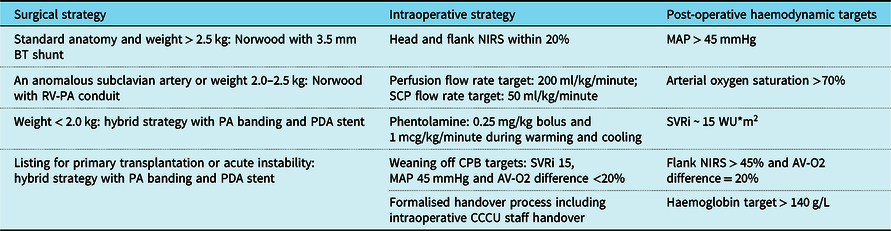
Pre-operative management for patients in C2 was identical to that, described above, for C1. Both cohorts received protocolised pre-operative methylprednisolone: 10 mg/kg 12 and 2 hours pre-operatively and 30 mg/kg intraoperatively, prior to circulatory arrest. The updated, standardised surgical approach is described in Table 1. All patients underwent Norwood procedure with a BT shunt unless they weighed less than 2.5 kg or had an anomalous right subclavian artery, in which cases, a right ventricle to pulmonary artery conduit was used to provide pulmonary blood flow. The hybrid procedure was used exclusively to rescue patients who weighed less than 2 kg, who were critically unstable, or who had contraindications for cardiopulmonary bypass. The perfusion strategy targetted high perfusion flow rates (200 ml/kg/minute) and low systemic vascular resistance. Chest closure was delayed for all patients and was attempted in the Cardiac Critical Care Unit once 24 hours of haemodynamic stability was achieved. Standardised post-operative monitoring and goal-directed management were introduced (Table 1). Haemodynamic goals aimed to balance total systemic cardiac output and perfusion pressure. Transition from the Cardiac Critical Care Unit was restricted to Monday through Thursday and was triggered only by the following criteria: 48 hours free from respiratory support, 24 hours free from inotropes and vasopressors and 24 hours free from medications adjustments. In order to qualify for discharge from the hospital, patients had to meet the following criteria: a saturation between 75 and 85% for 48 hours, a proven nutrition plan, a furosemide dose less than 2 mg/kg/day, an established clonidine dose between 3 and 10 mcg/kg/day, an accepted anticoagulation plan, a completed occupational therapy assessment, the absence of significant ventricular dysfunction and cardiology and paediatric follow-up plans. A proven nutrition plan was defined as tolerance of a minimum daily intake of 100 kilocalories per kilogram and demonstration of daily weight gain of at least 20 g for 3 consecutive days. In addition, parents had to complete a minimum of 24 hours of care-by-parent prior to discharge. If these criteria were not met, the patient remained admitted until stage two operation. Following discharge, all patients were followed by a dedicated interstage home surveillance programme which included two dedicated nurse practitioners, biweekly clinical assessments, monthly echocardiograms, home saturation monitoring and weekly interdisciplinary clinical rounds.
Standardised surgical and post-operative management in cohort 2

AV-O2 = arteriovenous oxygen; BP = blood pressure; CPB = cardiopulmonary bypass; MAP = mean arterial pressure; MVO2 = mixed venous oxygen saturation; NIRS = Near-Infrared Spectroscopy; PA = pulmonary artery; PDA = patent ductus arteriosus; RV-PA = right ventricle to pulmonary artery; SVRi = systemic vascular resistance indexed to body surface area
Predictors of interest
Post-operative haemodynamic assessment by respiratory mass spectrometry (AMIS 2000, Innovision A/S, Odense, Denmark) was available to patients based on equipment and technician availability. Reference Mouzaki, Schwartz and Mtaweh11 Respiratory mass spectrometry was connected in line with the ventilator and provided continuous measurement of oxygen consumption and carbon dioxide production according to a previously described protocol. Reference Li, Schulze-Neick and Lincoln12 The Fick equation was used with the respiratory mass spectrometry data in combination with clinical and laboratory assessments to calculate oxygen delivery, systemic and pulmonary blood flows and total cardiac output. The frequency of haemodynamic measurements varied as it was recorded only at the time of each clinical blood draw.
Data analysis
Data are reported as median with interquartile range or mean with standard deviation for continuous variables and frequency with proportions for categorical variables. All haemodynamic variables were expressed as time-based means and calculated as the area under the curve of the function over the 72 hours observation; this was done to account for non-standardised, intermittent measurements and to minimise sampling bias. The area under the curve was the sum of the mean value of each haemodynamic variable and the time (in hours) for each sampling interval recorded over the first 72 hours in the Cardiac Critical Care Unit. Fourteen-day freedom from open chest, 30-day freedom from ventilation and 100-day freedom from hospitalisation were used as composite outcomes as they combine mortality and the duration of the interested variable. Reference Rubenfeld, Angus, Pinsky, Curtis, Connors and Bernard13,Reference Schoenfeld, Bernard and Network14 Patients who died prior to the duration of interest were ascribed 0 days.
The two cohorts were compared using Mann–Whitney U test for continuous variables (non-parametric data) and Chi-square analysis or Fisher’s exact method for categorical variables. Analysis of risk factors for outcome measures was completed using logistic regression. Predictors demonstrating collinearity were removed from analyses. Any variable whose p-value below 0.2 was eligible for the final multivariable logistic regression analysis. Treatment strategy was included in the final models, independent of the strength of association. Variable selection for final multivariable models was developed based on a change-in-estimate strategy with a cutoff of 10% used to identify confounders. Survival function was expressed in Kaplan–Meier curves, specifically for transplant-free survival segregated based on the original cohorts as well as segregated based on the presence of atrioventricular valve and ventricular dysfunction. Statistical analysis was completed using IBM SPSS™ Statistics Version 23 (SPSS, Inc, Chicago, IL, USA).
Results
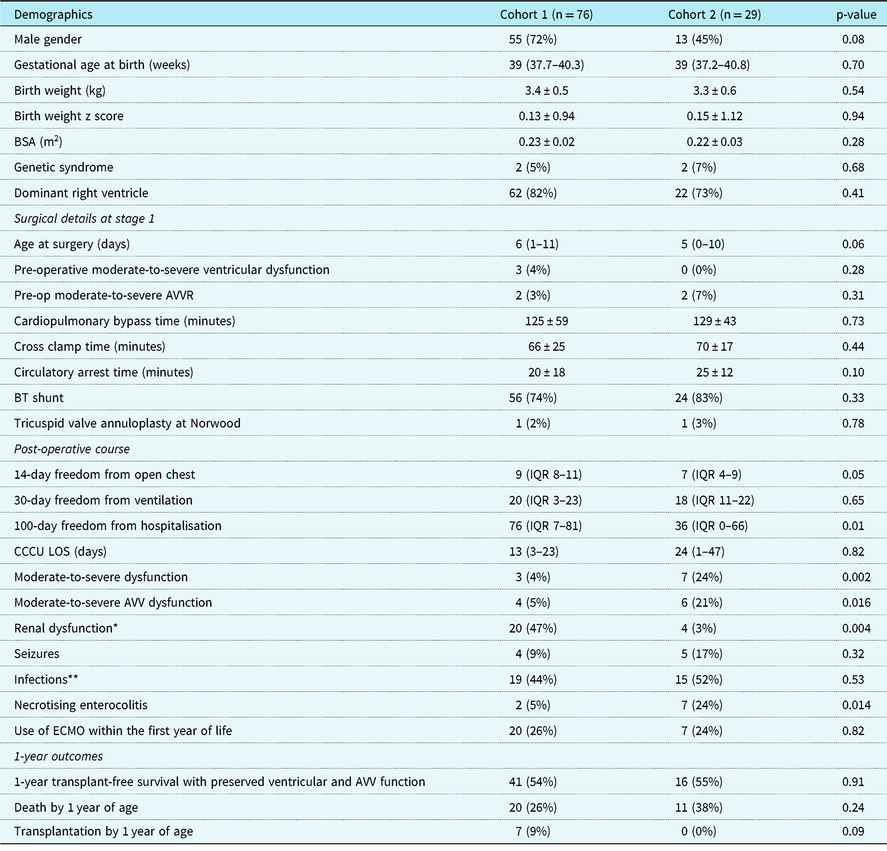
A total of 119 patients underwent a Norwood operation during the study period, of whom fourteen were older than 30 days and excluded. There were 80 hybrid operations and 10 primary transplantations in C1 and 13 hybrid operations and 0 primary transplantations in C2, all of which were excluded. Of the remaining 105, patients in C1 (n = 76) and C2 (n = 29) had similar demographics, cardiac anatomy and operative strategy (Table 2), with the exception that those in C1 trended to undergo surgery at an older age (median (IQR) 6 (1–11) in C1 versus 5 (0–10) in C2, p = 0.06) and to have a higher proportion of males (55 (72%) in C1 versus 13 (45%) in C2, p = 0.08). Most patients had a dominant right ventricle (62 (82%) in C1 versus 22 (73%) in C2, p = 0.41) with preserved ventricular function (73 (96%) in C1 versus 29 (100%) in C2, p = 0.28) and preserved atrioventricular valve function (74 (97%) in C1 versus 27 (93%) in C2, p = 0.31) prior to surgery. At stage 1, a BT shunt was used in the majority of patients (56 (74%) in C1 versus 24 (83%) in C2, p = 0.33) and a right ventricle to pulmonary artery conduit was used in the remainder. Respiratory mass spectrometry data were available for 43 (57%) of C1 and all C2 patients.
Baseline demographics and surgical and post-operative characteristics
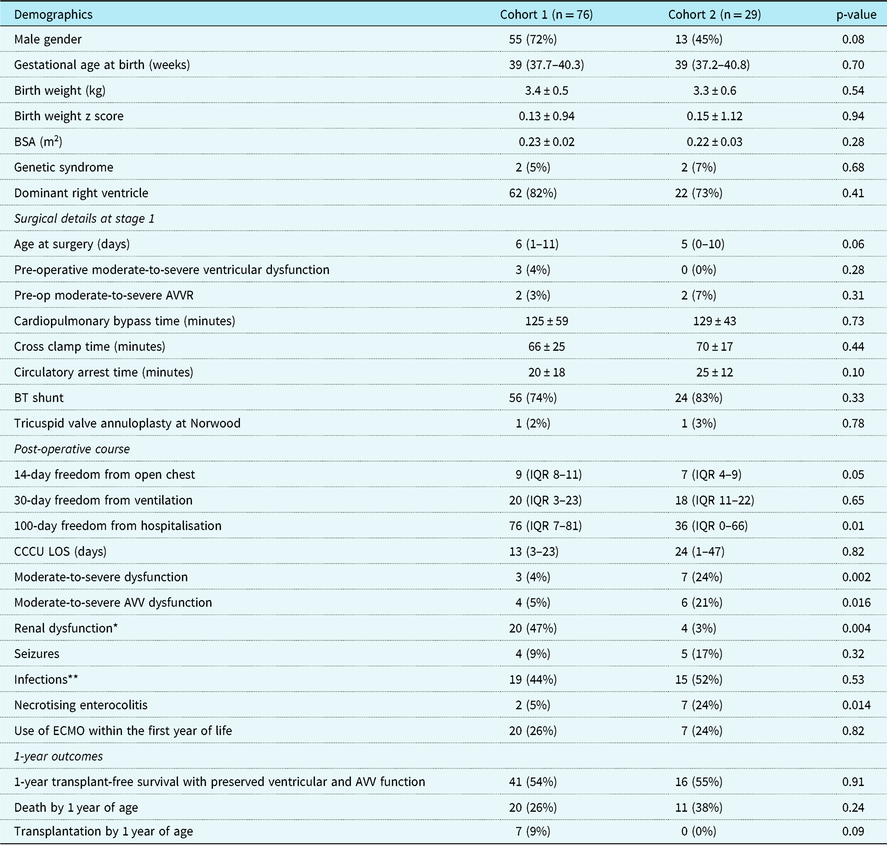
AVV = atrioventricular valvar; BSA = body surface area; CCCU = cardiac critical care unit; ECMO = extracorporeal membrane oxygenation; IQR = interquartile range; LOS = length of stay.
* Renal dysfunction was defined as a creatinine > 1.5 upper limit of normal.
** Infection was defined as the presence of confirmed bacteremia and clinical symptoms such as temperature instability, unexplained tachycardia or haemodynamic instability. Continuous variables are expressed as mean with standard deviation or median with interquartile range according to distribution.
Outcomes
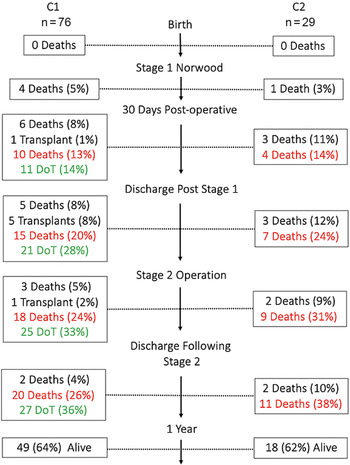
The primary outcome of 1-year transplant-free survival with preserved atrioventricular valve and ventricular function was similar across both groups with 41 patients (54%) in C1 and 16 patients (55%) in C2 (p = 0.91). At 1-year follow-up the groups had comparable rates of death (C1 20 (26%) versus C2 11 (38%), p = 0.24), ventricular dysfunction (C1 1 (1%) versus C2 0%, p = 0.72) and atrioventricular valve dysfunction (C1 5 (11%) versus 2 (11%)%, p = 0.96). More patients in C1 underwent transplantation (C1 7 (9%) versus C2 0, p = 0.09). Mortality rates were also similar at every interval of care (Fig 1) but tended to occur earlier in C1 (median (interquartile range) 120 (49–166) days versus C2 158 (100–245) days, p = 0.09). Three patients died following transplantation and within the first year of life in C1; they were censored at the time of transplantation.
Flow diagram of discrete and cumulative mortality and transplantation rates.

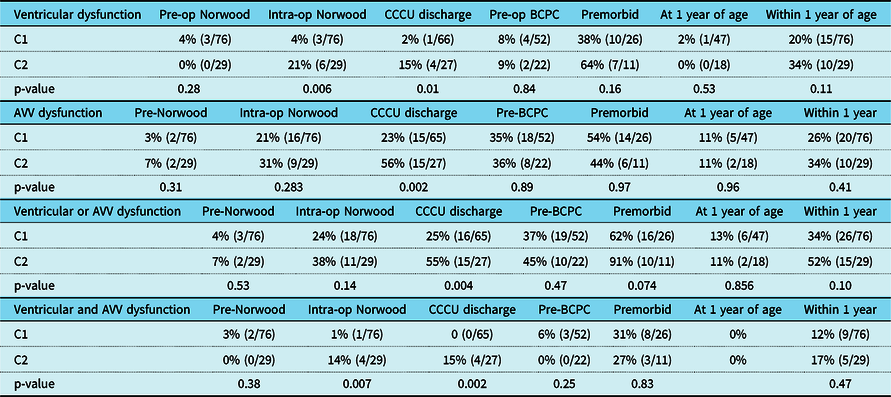
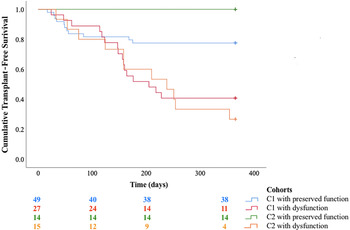
Rates of ventricular and atrioventricular valve dysfunction in the first year following the Norwood procedure are shown in Table 3. Compared to C2, the incidence of ventricular and atrioventricular valve dysfunction was lower for C1 only at the time of discharge from the Cardiac Critical Care Unit, but remained similar in both groups at all other time points. Ventricular and atrioventricular valve dysfunction was strongly associated with 1-year mortality, particularly in C2. Patients with preserved ventricular and atrioventricular valve function had a 1-year transplant-free survival of 88 and 100% in C1 and C2 (log rank p = 0.06), respectively (Fig 2).
Moderate-to-severe atrioventricular valve and ventricular dysfunction over time

BCPC = bidirectional cavopulmonary connection; CCCU = cardiac critical care unit; Intra-op = intraoperative as evaluated by transesophageal echocardiogram; Pre-op = within 1 week pre-operative, as evaluated by transthoracic echocardiogram.
Cumulative transplant-free survival stratified by cohort and by the presence of ventricular or atrioventricular valve dysfunction.

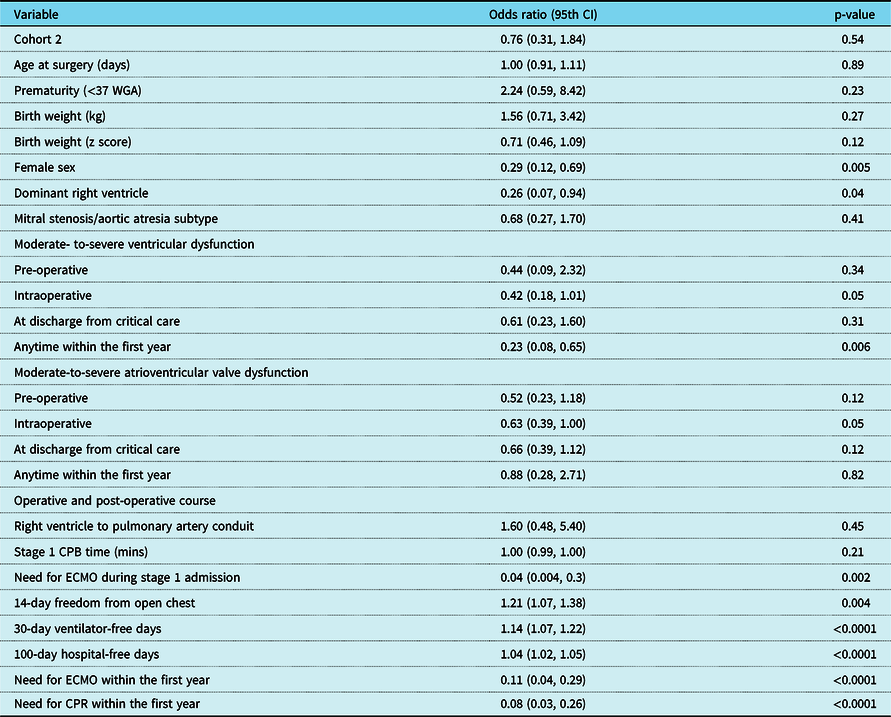
1-year transplant-free survival was strongly associated with male gender, left ventricular dominance, need for CPR and ECMO and longer intervals of care in univariate logistic regression analysis; no association was found with chronological age, birth weight, anatomical subtype, type of shunt or cardiopulmonary bypass time (Table 4). When accounting for study cohort and 100-day hospital-free days, male gender (odds 3.7, p = 0.01), ventricular dysfunction at any time within the first year of life (odds 0.21, p = 0.02), CPR within the first year (odds 0.11, p = 0.002) and need for ECMO support (odds 0.15, p = 0.001) continued to be associated with 1-year transplant-free survival on multivariable models.
Univariable regression analysis modeling 1-year transplant-free survival

CPB = cardiopulmonary bypass; ECMO = Extracorporeal membrane oxygenation; CPR = cardiopulmonary resuscitation.
Analysis of the comprehensive management strategies on the discrete phases of care
Post-operative haemodynamics and course
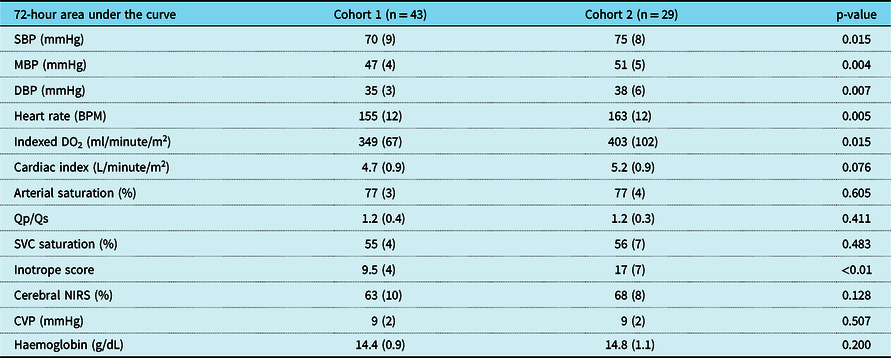
Patients treated according to the haemodynamic management strategy in C2 received more inotrope support and had higher measures of indexed oxygen delivery, systolic blood pressure, mean blood pressure, diastolic blood pressure and heart rate (Table 5). Despite higher overall cardiac output during the first 72-hour post-operative period (C1 4.7 ± 0.9 L/minute/m2 versus C2 5.2 ± 0.9 L/minute/m2, p = 0.076), there were no differences observed in the ratio of pulmonary blood flow to systemic blood flow or arterial or superior vena cava saturations.
Time-weighted average for haemodynamic variables

All data are presented as time-weighted means over 72 hours with standard deviations. BPM = beats per minute; CVP = central venous pressure; DBP = diastolic blood pressure; DO2 = delivery of oxygen; MPB = mean blood pressure; NIRS = Near-infrared spectroscopy; Qp/Qs = the ratio of pulmonary blood flow to systemic blood flow; SBP = systolic blood pressure; SVC = superior vena cava.
Patients in C2 experienced fewer episodes of renal dysfunction (20 (47%) in C1 versus 4 (14%) in C2, p = 0.004) with more episodes of necrotising enterocolitis (2 (5%) in C1 versus 7 (24%) in C2, p = 0.014). The C2 post-operative strategy was associated with longer intervals of care: lower 14-day freedom from open chest (10 days in C1 versus 7 days in C2, p = 0.049) and lower 100-day freedom from hospitalisation days (78 days in C1 versus 54 days in C2, p = 0.01). Similar CPR rates were observed in the first 30 days (2 (5%) in C1 versus 2 (7%) in C2, p = 0.68) and during the stage 1 admission (9 (21%) in C1 versus 7 (24%) in C2, p = 0.75) but C2 had an increase of extracorporeal membrane oxygenation use within the first 48 hours (5 (7%) in C1 versus 7 (24%) in C2, p = 0.035) with no difference in extracorporeal membrane oxygenation within 30 days (7 (9%) in C1 versus 7 (24%) in C2, p = 0.11) and during the post-operative admission (10 (13%) in C1 and 7 (24%) in C2, p = 0.17). Five patients in C1 (7%) and in C2 (20%, p = 0.1) were not discharged between their stage one and stage two operations.
Interstage period
During the interstage period, there were similar rates of CPR (12 (28%) in C1 and 6 (26%) in C2, p = 0.48), extracorporeal membrane oxygenation (6 (14%) in C1 and 6 (21%) in C2, p = 0.45) and death and transplantation (10 (13%) in C1 and 3 (10%) in C2, p = 0.79) across both cohorts. Patients in C2 were more likely to receive additional surgical or percutaneous interventions outside of the standard palliative surgeries (C1 12 (15%) versus C2 17 (61%) C2, p < 0.001), but those requiring interventions in C1 were more likely to have multiple interventions. Additional procedures included BT shunt intervention (C1 4 (7%) versus C2 7 (26%), p = 0.008), atrioventricular valve surgery (C1 0 (0%) versus C2 4 (15%), p = 0.001), coil occlusion of collaterals (C1 1 (1%) versus C2 15%, p = 0.02) and arch interventions (C1 2 (5%) versus C2 3 (11%), p = 0.28).
Bidirectional cavopulmonary shunt
A similar frequency of interventions was completed during the stage two operation (C1 25 (58%) versus C2 22 (79%), p = 0.08), including pulmonary artery angioplasty (C1 22 (30%) versus C2 19 (68%), p = 0.001) and atrioventricular valve operations (C1 6 (12%) versus C2 6 (25%) in C2, p = 0.10).
Discussion
Despite improved survival following the Norwood procedure, children with hypoplastic left heart syndrome continue to experience a high burden of morbidity and mortality, particularly during the first year of life. Reference Ghanayem, Allen and Tabbutt1,Reference Furck, Uebing and Hansen5,Reference Wernovsky, Kuijpers and Van rossem15 Wide practice variability, stemming from incremental changes to perioperative and interstage management, highlights the potential role for programme improvement and motivated a shift in our institutional strategy. Reference Ghanayem, Allen and Tabbutt1,Reference Azakie, Merklinger and McCrindle4,Reference Rudd, Frommelt and Tweddell7,Reference Baker-Smith, Neish and Klitzner16–Reference De Oliveira, Ashburn and Khalid22 This study showed that the implementation of a standardised perioperative management strategy, based primarily on using a BT shunt, targeting higher post-operative perfusion pressure and implementing a dedicated surveillance programme, was not associated with a change to 1-year transplant-free survival with preserved ventricular and AVV function. The presence of moderate post-operative ventricular dysfunction or atrioventricular valve regurgitation was the strongest predictor of 1-year mortality.
The review of our single-ventricle management strategy was undertaken as a collaborative quality improvement initiative, aimed to increase survival to stage two palliative surgery by reducing provider variability. A single-ventricle team was formed, with representation from medical, surgical, anaesthesiology and nursing disciplines. This team developed a common institutional approach to the perioperative, post-operative and interstage management, informed by emerging science and progressive practices. The Norwood-BT shunt was chosen based on surgical preference and supported by research outlining similar long-term outcomes compared to the alternatives. The right ventricle to pulmonary artery conduit and hybrid procedure were used as alternatives when the standard approach was not possible. This process appeared to formalise the prevailing intraoperative practice as similar rates of BT shunts and operative predictors were seen across the study period.
Post-operative management underwent a major revision. Chest closure was electively delayed to optimise post-operative haemodynamics and respiratory stability. Reference Tabbutt, Duncan, McLaughlin, Wessel, Jonas and Laussen23,Reference Hakimi, Walters, Pinsky, Gallagher and Lyons24 Haemodynamic targets were changed from prioritising maximal vasodilatation in order to increase systemic cardiac output in our historical cohort, to striving for a balance between achieving effective afterload reduction and maintaining a minimal driving pressure to ensure end-organ perfusion in our modern cohort. Reference Azakie, Merklinger and McCrindle4,Reference Furck, Uebing and Hansen5,Reference Hoffman, Mussatto and Brosig20–Reference De Oliveira, Ashburn and Khalid22,Reference Hoffman, Tweddell and Ghanayem25,Reference Hansen, Schlangen and Voges26 The desired shift in post-operative haemodynamic priorities were accomplished with the strategies introduced: time-weighted blood pressure measurements and oxygen delivery were higher in C2 while, unsurprisingly, receiving more vasopressor-inotropic support. Achieving these haemodynamic goals, within the context of implementing the broader post-operative care bundle, was associated with decreased end-organ dysfunction, exemplified by a lower frequency of acute kidney injury, at a cost of a longer duration with open chest and Cardiac Critical Care Unit and hospital length of stay. The increased frequency of nectrotising enterocolitis seen in the implementation cohort could be due to changes in the splanchnic circulation, a lower threshold for diagnosis or changes in broader practices, such as feeding strategies, that may affect the gut microbiome. While better organ function is preferred, this did not translate to a higher transplant-free survival rate at any time point within the first year for the modern cohort.
The introduction of a standardised interstage home monitoring programme, including oxygen saturation monitoring and regular visitations, delivered by a dedicated single-ventricle team was another shift in our treatment strategy. Dedicated interstage surveillance programmes have recently been widely adopted based on early studies suggesting improved outcomes at stage two palliation Reference Ghanayem, Cava, Jaquiss and Tweddell8,Reference Hansen, Furck and Petko27,Reference Siehr, Norris and Bushnell28 and improved 1-year survival. Reference Petit, Fraser, Mattamal, Slesnick, Cephus and Ocampo29 Interstage care was endorsed as a major component of care by the National Paediatric Cardiology Quality Improvement Collaborative, a large multi-institution network aiming to improve survival and quality of life following the Norwood procedure. Reference Petit, Fraser, Mattamal, Slesnick, Cephus and Ocampo29 Although the adoption of an interstage surveillance programme was not independently associated with a survival advantage, participating in the collaborative was associated with a reduction in interstage mortality from 10 to 5%. Reference Anderson, Beekman and Kugler30 Specifically, the use of oxygen saturation monitoring was not associated with any change in mortality or hospitalisation, whereas weight monitoring programmes were associated with better growth albeit with no observed reduction in interstage mortality. Reference Oster, Ehrlich and King31 The implementation of our comprehensive surveillance programme was not associated with a change in mortality during or after the interstage period. The potential impact of this team on other markers of health, including growth, development, hospitalisation and quality of life, was not evaluated.
Tricuspid regurgitation and ventricular dysfunction have been recognised as important risk factors for mortality in the hypoplastic left heart syndrome population. Reference Altmann, Printz, Solowiejczky, Gersony, Quaegebeur and Apfel32–Reference Kulkarni, Patel, Singh, Mossialos and Mehra36 The present study further highlights the detrimental impact of ventricular and atrioventricular valve dysfunction as both variables emerged as the most important determinants of 1-year survival in our regression analysis. In the modern cohort, there were no deaths or transplantations observed in patients with preserved atrioventricular valve and ventricular function; in contrast, there was less than 25% survival observed in patients with ventricular or atrioventricular valve dysfunction. Examining only the subgroups with preserved ventricular and valvar function, there was a survival advantage observed in the modern cohort, an observation that supports the importance of quality improvement initiatives for patients who avoid ventricular or valvar dysfunction. Reference Newburger, Sleeper and William Gaynor2,Reference Furck, Uebing and Hansen5,Reference Sano, Huang, Kasahara, Yoshizumi, Kotani and Ishino35,Reference Kulkarni, Patel, Singh, Mossialos and Mehra36 Identifying the drivers and contributors of dysfunction is paramount to improving outcomes for this vulnerable group and should be a major focus of future investigation. The increased incidence of valve and ventircular dysfunction in our modern cohort suggests that targeting a higher perfusion pressure in the post-operative period may have detrimental myocardial effects that are long lasting. Further advances are also needed to increase our ability to rescue patients affected by dysfunction. In the past, care of these patients has been redirected towards transplantation; however, despite listing, none of the patients in the modern cohort received a transplant, an observation that underscores the limitation posed by poor organ availability. Waiting list attrition may be reduced through improvement in ventricular assist devices or other haemodynamic supports.
This study has a number of important limitations. Clinical echocardiogram reports were used to capture the presence and severity of ventricular dysfunction and atrioventricular valve regurgitation. The use of semi-quantitative categorisation of these endpoints introduced potential inter-observer variability and may have lacked discrimination for a more nuanced assessment of cardiac function and atrioventricular valve regurgitation on outcomes; nevertheless, it provided a framework that is readily generalisable across the clinical practice. The retrospective nature of this study and small sample size also precluded the identification of specific factors, anatomical or functional, or complex multivariable relationships that may have contributed to the frequency of observed dysfunction. Ideally, universal use of respiratory mass spectroscopy would have increased the sample size and strengthened our assessment of the relationship between treatment strategy, haemodynamic variables and outcomes. Finally, although the new single-ventricle strategy was not associated with an overall change in outcome, the simultaneous introduction of all components limits our ability to identify if certain elements were beneficial while others were detrimental.
Acknowledgements
None.
Financial Support
This research received no specific grant from any funding agency, commercial or not-for-profit sectors.
Conflicts of Interest
None.