

Introduction
Criminal offences in the field of professional activity violate the established procedure for the exercise of functions and duties by officials and cause harm to the rights, duties or freedoms of individuals, legal entities, associations or the state. The effective investigation of criminal offences depends on many factors, including the readiness of law enforcement agencies to engage in multi-level and interdisciplinary cooperation. As of 2024, in Ukraine, there is a gap between the number of offences in the reporting period and the number of offences in which individuals have been served with a notice of suspicion, for example, in the activities of the National Anti-Corruption Bureau of Ukraine (NABU), the gap is 49 to 1; this means that a significant percentage of criminal offences in the official sphere have gone unpunished. Studying the European experience in investigating criminal offences will help reduce the gap and create favourable conditions for the effective implementation of official activities.
Osipenko and Kostyuchenko (Reference Osipenko and Kostyuchenko2023) highlighted the importance of investigating criminal offences in the context of official activities, emphasizing the discrepancies between official statistics from law enforcement agencies and the actual state of affairs regarding the investigation and prosecution of such offences. Analysing police experience, Vovchenko (Reference Vovchenko2024) concluded that criminal offences in the field of official activity are often the result of such unlawful actions as insufficient clarity in the regulation of official powers of various categories of officers and concealment of evidence of offences, which indicates the systemic nature of the problem under study. Articles 364–370 of the Criminal Code of Ukraine (2001) distinguish several types of criminal offences in the area of official activity: offences committed exclusively in public authorities, local self-government bodies and legal entities under public law; offences committed exclusively in legal entities under private law; offences committed in legal entities under both public and private law; and offences in the area of professional activity in the provision of public services.
Druzhinin (Reference Druzhinin2024) examined the trend of a decrease in the number of detected criminal offences in the field of economic activity and concluded that a possible reason may be bias in statistical data regarding naturally occurring crimes. In other words, the methods of documenting and further investigating criminal offences need to be revised. A similar conclusion was reached by Stepaniuk, Kikinchuk, and Shcherbakovskyi (Reference Stepaniuk, Kikinchuk and Shcherbakovskyi2021), who studied 200 criminal proceedings on unlawful benefit considered by the courts of Ukraine in 2015–2019 and proved that the process of investigating criminal offences and prosecuting is affected by procedural and tactical errors, as well as abuses by the prosecutor’s office, which lead to shortcomings in the process of proving the guilt of officials in committing corruption offences. Doroshenko (Reference Doroshenko2023) analysed empirical studies on abuse of office and concluded that the effectiveness of a criminal investigation largely depends on cooperation between investigators and other bodies and units at different levels of the law enforcement hierarchy. The researcher also emphasized that, despite reform attempts, such cooperation remains insufficient. Amelin et al. (Reference Amelin, Kyslyi, Pidpalyi, Rovnyi and Surzhyk2024) suggested that prosecution for crimes in the official sphere is also due to differences in the independence of judges and prosecutors within the national justice system. In contrast to judges, who demonstrate impartiality towards any party, prosecutors cannot be fully independent due to the need to present the prosecution. The cited sources confirm the existence of numerous factors that influence the investigation and prosecution of criminal offences related to public office.
A review by Amelin (Reference Amelin2021) concluded that the integration of the Ukrainian law enforcement system into the European space involves the application of the principle of independence in the judicial process, encompassing all its dimensions. Drawing on the experience of Germany, the United States, the United Kingdom and Lithuania, Bozhyk et al. (Reference Bozhyk, Vlasova, Stryzhevska and Tsymbal2023) concluded that the crime investigation systems in the United States and European Union (EU) countries are much more effective than in Ukraine due to more systematic legislation and a clear structure of law enforcement agencies and intelligence services. The researchers also emphasized the clear specialization of intelligence services, which increases the percentage of solving certain crimes. A comparative analysis of the practices of the Ukrainian and European law enforcement systems conducted by Polianskyi and Juodkaitė-Granskienė (Reference Polianskyi and Juodkaitė-Granskienė2021) concluded that more effective investigation of crimes in official activities in the EU countries is due to the cooperation of law enforcement agencies with specially authorized bodies, such as forensic institutions, to conduct forensic examinations. The researchers emphasized that interaction between law enforcement and specially authorized bodies is possible due to the creation of an appropriate administrative and legal framework. Drozd et al. (Reference Drozd, Hahach, Demenko, Leliuk and Skichko2024) emphasized that interdisciplinary cooperation between law enforcement agencies can be effective in the Ukrainian context, where its planning should include a combination of factors: the nature of the criminal offence; the availability of necessary resources; the competence of the parties; as well as the conditions and timing of the investigation. As of 2024, numerous studies have been conducted to demonstrate the effectiveness of the European experience in investigating offences, which can be adapted to Ukrainian realities.
Although most of the cited studies emphasize the importance of European experience, the integration of this experience in Ukraine remains insufficient. The study aimed to examine the European experience of investigating criminal offences in the course of official duties and to explore the possibilities of its use in Ukraine. The objectives of this study were: to provide a contextual analysis of offence in the official sphere investigations in Ukraine; to compare the peculiarities of offence in the official sphere investigations in France, Germany and Poland; and to develop recommendations for the integration of European experience into offence in the official sphere investigations in Ukraine.
Materials and Methods
The following sources were used as research materials: Criminal Code of Ukraine (2001); Criminal Procedure Code of Ukraine (2013); Law of Ukraine No. 1698-VII “On the National Anti-Corruption Bureau of Ukraine” (2014); Law of Ukraine No. 580-VIII “On the National Police” (2015); Law of Ukraine No. 794-VIII “On the State Bureau of Investigation” (2016); Law of Ukraine No. 1697-VII “On the Prosecutor’s Office” (2015); Law of Ukraine No. 2135-XII “On Operational and Investigative Activities” (1992); and Law of Ukraine No. 1700-VII “On Prevention of Corruption” (2014). The comparative analysis also used materials from the document “Letter of Rights and Obligations of the Suspect in Criminal Proceedings” (Informative Police Service 2024), which is in force in Poland. These documents were analysed to formulate the state policy on investigating criminal offences in official activities and to identify strategies and tools for conducting such investigations.
For a more thorough analysis of the peculiarities of investigating criminal offences in the context of official activity, a combination of research methods was employed, including content analysis, case study method, formal legal method, comparative legal method, contextual analysis and PESTEL (political, economic, social, technological, environmental and legal) analysis. The content analysis method was employed when examining legal acts and documents governing the investigation of criminal offences related to official activity in Ukraine. The method involved identifying the document and the state body whose activities it regulates, and highlighting the key provisions related to the investigation of criminal offences in an official capacity.
The case study method was used to analyse specific examples of successful investigations of offences in the official sphere in Ukraine and EU countries. An example of a case used in this paper is the investigation of forgery in public procurement that took place in the Kharkiv Regional Military Administration starting in March 2022, which was analysed in the Shadow Report presented by Transparency International (2023).
The formal legal method was employed to determine the internal form of legal phenomena and processes, facilitating the further formulation of concepts and their definitions. The primary task of the chosen method was to examine the Ukrainian legal framework and its alignment with international standards. The formal legal method was employed in conjunction with content analysis, the primary task of which was to evaluate the practice of court decisions and the activities of anti-corruption bodies.
In addition to these methods, a contextual analysis was conducted to examine the state of crime investigation in the official sphere in Ukraine and the EU. The contextual factors were assessed using the PESTEL analysis, which aims to evaluate external factors influencing the investigation of offence in the official sphere. The use of PESTEL analysis was based on the idea that the functioning of an enterprise, institution or a particular sector is influenced by a combination of factors: political, economic, social, technological, environmental and legal (Kung Reference Kung2023). Based on the analysis, the identified groups of factors were further classified into two categories: factors that facilitate the investigation of offences in the official sphere; and factors that reduce the effectiveness of such an investigation.
A comparative analysis was conducted to highlight the specifics of criminal investigations in certain EU countries, specifically Germany, France and Poland. These countries were chosen due to the high efficiency of their criminal investigation systems, particularly the established interaction between actors at all stages of the investigation. The identified features were compared with the peculiarities of criminal investigation and prosecution in Ukraine.
Results
Ukrainian Experience in Investigating Criminal Offences in the Sphere of Official Activities
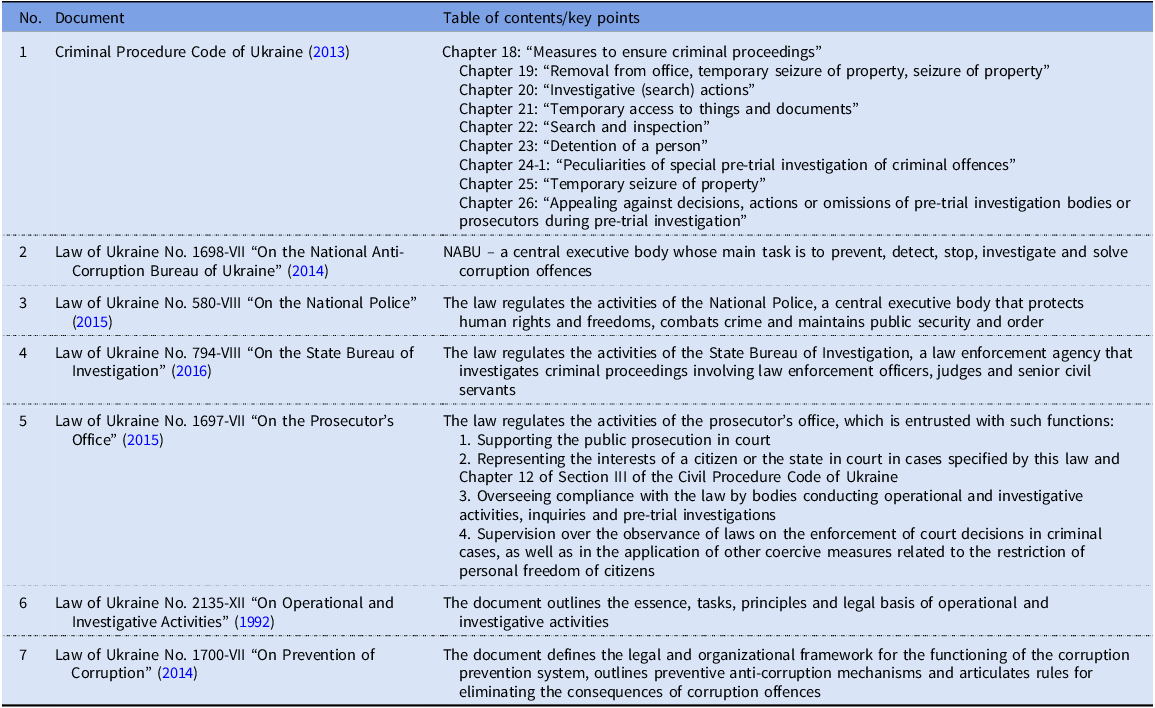
Investigations and prosecutions for offences related to official activity in Ukraine are conducted in accordance with relevant laws and regulations. The results of the content analysis of the selected acts and documents are presented in Table 1.
Content analysis of regulatory and legal acts governing the investigation of criminal offences in the sphere of official activities in Ukraine

NABU, National Anti-Corruption Bureau of Ukraine.
Source: compiled by the authors.
Table 1 illustrates that Ukraine has a comprehensive legal and regulatory framework designed to prevent, investigate, prosecute and remedy the consequences of crime in the official sphere. Despite their differences, these documents share a common goal: to reduce the number of offences in the official sphere and to investigate offences that could not be prevented effectively. A common problem of these bodies is the discrepancy between the number of registered offences and the number of persons who have been notified of suspicion of committing them. Such a discrepancy may indicate difficulties in investigating criminal offences in the course of official duties.
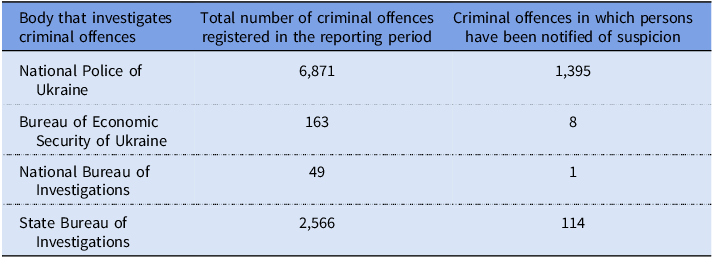
The discrepancy is evident, particularly when comparing the number of registered offences in the reporting period with the number of offences in which individuals were served with a notice of suspicion. Based on the information from the Unified Register of Pre-trial Investigations (2024), a comparative analysis of criminal investigations by different authorized bodies was conducted from July 2023 to provide the most up-to-date information. The results are presented in Table 2.
Dynamics of the investigation of criminal offences in the field of official activity by various authorized bodies since July 2023

Source: compiled by the authors.
This data shows that the current system of investigating crime in the official sphere is inefficient. Based on Table 2, the Bureau of Economic Security of Ukraine and the NABU are the most inefficient in investigating offences in the official sphere. The inefficiency of these agencies can be attributed to the complexity of the crimes they investigate, a lack of qualified and motivated staff, insufficient resources for investigation and a bureaucratic system that leads to delays in investigations, data loss and other issues.
An example of an ineffective investigation that resulted in time and financial losses is the investigation of forgery in public procurement at the Kharkiv Regional Military Administration, which took place in March 2022. At that time, the Kharkiv Regional State Administration, Ukrzaliznytsia (Ukrainian Railways) and a private company entered into a trilateral agreement for the supply of humanitarian goods to residents of Kharkiv region affected by the full-scale military aggression of the Russian Federation. On 13 February 2023, NABU detectives served a notice of suspicion to the Chief of Staff of the Kharkiv Regional State Administration, the director of a private company and deputy, as well as the director of a regional department of a private company, accusing them of embezzling 15 million Ukrainian hryvnias (UAH) through misuse of procurement of food. According to the investigation, the suspects allegedly forged documents for the purchase of 235 tonnes of products, based on which Ukrzaliznytsia transferred 15 million UAH to the private company (Interfax 2024; Transparency International 2023). A statement by the Specialized Anti-Corruption Prosecutor’s Office (SAPO) published on its official Facebook page stated that only after it became known that criminal proceedings were underway under Articles 191 (part 5), 358 (part 4) and 366 (part 1) of the Criminal Code of Ukraine (2001) did the suspects deliver the products, while forging documents about their storage in other warehouses. As of February 2024, no suspicions have been served on the officials of the Kharkiv Regional Military Administration, and the Regional Military Administration continues to function as normal. The following factors can explain the lack of progress in the investigation of the analysed case: insufficient coordination between the National Bureau of Investigations, the SAPO and the police could lead to difficulties in interaction and information exchange; in a case involving representatives of the regional administration, there are high risks of political influence on the course of the investigation; and there is a high probability of problems with the evidence base due to the possible destruction, forgery or concealment of documents.
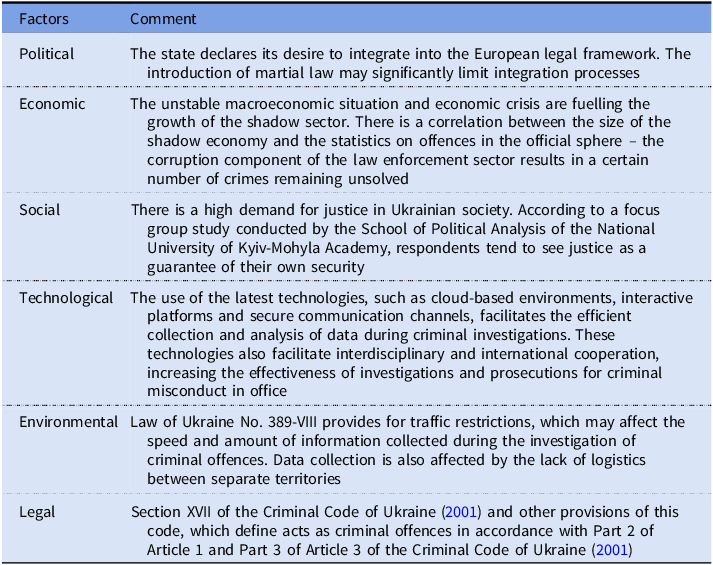
The investigation of crime in official institutions in Ukraine is influenced by a range of factors identified and analysed through the PESTEL analysis, the results of which are presented in Table 3.
PESTEL (political, economic, social, technological, environmental and legal) analysis of factors influencing the investigation of criminal offences in the field of official activity

Source: compiled by the authors based on Law of Ukraine No. 389-VIII “On the Legal Regime of Martial Law” (2015), Osipenko and Kostyuchenko (Reference Osipenko and Kostyuchenko2023), Cherniavskyi (Reference Cherniavskyi2023) and ZMINA (2024).
The presented analysis indicates that the process of investigating criminal offences is influenced by a set of factors that can be conditionally attributed to one of the six categories. The effectiveness of investigating and prosecuting criminal offences in official activities largely depends on whether these factors are forces that facilitate or, conversely, hinder positive changes in the legal segment. The quantitative preponderance of external factors that can be identified as drivers promotes positive changes towards social justice, while the preponderance of constraints reduces the probability of positive changes in the segment under analysis. As of 2025, the number of factors hindering the investigation of criminal offences significantly exceeds the number of positive factors. The negative factors include economic instability and the related corruption component of investigating offences. Legal and environmental constraints also hinder investigations, as evidence collection, witness interviews and interagency cooperation often require travelling to other parts of the country. During the martial law regime, business trips may be restricted due to a ban on certain areas, or a specific location in a war zone or temporarily occupied territories.
The limiting factors can be minimized by properly selected strategies for investigating criminal offences in the official sphere. The effectiveness of the initial stage of a criminal offence investigation also depends on the type of investigative situation. Based on the analysis of sources, including Gupta and Bhadauria (Reference Gupta and Bhadauria2024) and Johnson (Reference Johnson2024), three types of investigative situations were identified. The first type of situation is the most favourable, as it involves the detention of a criminal who has fully admitted guilt. In investigative situations of the second type, the offender has been detained but denies guilt. In the third type of investigative situation, the offender has not been identified or is a fugitive from justice. The type of investigative situation determines the details of further investigative actions aimed at conducting and completing the pre-trial investigation, as stipulated in Article 283 of the Criminal Procedure Code of Ukraine (2013). If the offender is identified, the pre-trial investigation ends with the submission of an indictment to the court.
The next stage involves collecting sufficient evidence to bring to justice the person who committed the criminal offence in the field of official activity. Gathering evidence involves a range of actions, which primarily include searches at the suspect’s place of residence and other locations, interrogations of the suspect and witnesses, conducting investigative experiments, seizing photographs, video and audio recordings for further examination, and covert investigative (detective) actions. At the investigation stage, it is also necessary to compensate the victim for moral and material damage.
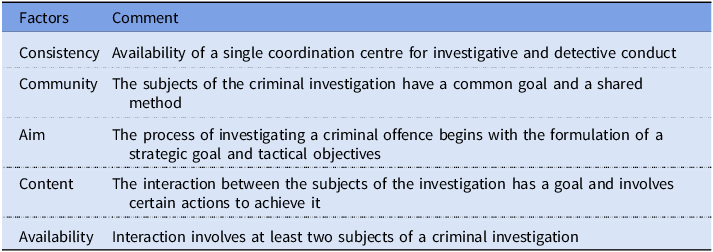
In addition to these factors, the effectiveness of investigating criminal offences depends on the effective interaction of participants in the investigative process (Furger Reference Furger2024). Depending on the type of criminal offence, these actors include operational officers, investigators, prosecutors, investigating judges, experts and employees of financial institutions, among others. Effective interaction of these actors requires the creation of an interdisciplinary network to respond promptly to any changes in the investigation of criminal offences. Analysis of sources, including de Jonge (Reference De Jonge2020) and Horodetska et al. (Reference Horodetska, Zarubei, Dulskyi, Kamyshanskyi and Morgun2023), identified the factors that influence the interaction of subjects of criminal investigation. The analysis of the identified factors is presented in Table 4.
Factors influencing the interaction between the subjects of criminal investigation

Source: compiled by the authors based on de Jonge (Reference De Jonge2020) and Horodetska et al. (Reference Horodetska, Zarubei, Dulskyi, Kamyshanskyi and Morgun2023).
The analysis concluded that a combination of factors influences the interaction of participants in the investigation of criminal offences, the absence of one or more of which may become an obstacle to achieving the key goal. An example is the lack of unity resulting from the lack of coordination between detective and investigative agencies, which may cause some of the collected information to be lost or transferred in an improper form. Some information may also be lost due to an overly complex organization of interaction, which involves the creation of a cumbersome hierarchical system and a slow process of receiving and transmitting data.
Thus, the current system of criminal investigation in Ukraine appears to be simple and logical. The functioning of this system is influenced by a combination of factors that facilitate or hinder the investigation process. Analysis of international experience can identify strategies to increase the effectiveness of the former factors and minimize the impact of the latter.
International Experience in Investigating Criminal Offences in the Sphere of Official Activities
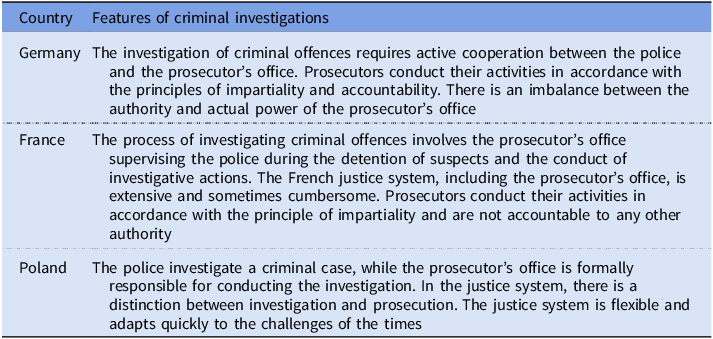
EU countries, in particular Germany, France and Poland, have accumulated experience in investigating criminal offences in an official capacity. The analysed features of the investigation revealed strategies aimed at mitigating the impact of negative external factors, including corruption risks, bureaucratic inefficiencies and ineffective interagency cooperation. The analysis of the investigation strategies presented in Table 5 concluded that their implementation is possible in Ukraine.
Peculiarities of the investigation of criminal offences in the sphere of official activity in Germany, France and Poland

Source: compiled by the authors based on Boskovic and Kostic (Reference Boskovic and Kostic2024), de Jonge (Reference De Jonge2020), Furger (Reference Furger2024) and Jaremba and Krommendijk (Reference Jaremba and Krommendijk2024).
In the German legal system, the preliminary investigation of a criminal case is the responsibility of prosecutors, who work on a duty basis, meaning that a search warrant can be obtained at any time of day or night. The prosecutor’s work involves reviewing the case file, issuing orders for witness interviews or searches, closing criminal proceedings and drawing up an indictment. On behalf of the prosecutor’s office, the prosecutor makes a final plea at the end of a court case.
The peculiarity of the investigation and prosecution in Germany lies in the impartiality of the prosecutor’s office, whose representatives act as opponents of the defendant during the court hearing. Unlike, for example, France, where the prosecutor is responsible for presenting all relevant evidence to the prosecution, the prosecutor in Germany also considers evidence that may exonerate the defendant. The impartiality of prosecutors is a key feature of the investigation and prosecution of criminal offences in Germany. The accountability of prosecutors to the relevant authorities, such as ministers of justice, is also an essential feature. The accountability of prosecutors is unique in most EU countries, where the prosecution service is formally independent of the executive branch.
In contrast to most EU countries, the German prosecution system has a certain imbalance between the authority and power of the judiciary. On the one hand, the authority of representatives in this sector is very high in society, as the appointment to the position of prosecutor involves a rigorous selection process that guarantees candidates possess the relevant knowledge and skills, as well as certain moral and ethical qualities. On the other hand, prosecutors in Germany have rather limited rights; for example, they cannot appeal against a final court decision and have to report to specific ministries.
Similar to Germany, France has an extensive and powerful system for investigating and prosecuting criminal offences. One of the peculiarities of the French justice system is the extensive and hierarchical structure of the Public Prosecutor’s Office, which is part of the Ministry of Justice. The Prosecutor General of the French Court of Cassation heads it. At the lowest level of this hierarchy are the prosecutors general of the courts of appeal. The lowest level of the system consists of the district offices, which are managed by district prosecutors and their deputies, who have powers over prosecutors and perform functions in the courts of first instance. The key advantage of the hierarchical structure is the high level of organization of pre-trial investigation and prosecution of offences. However, this system has several potential disadvantages, including bureaucratic procedures for interaction or a lack of interaction between certain levels of the system.
The French law enforcement system is characterized by a well-established interaction between the actors involved in investigating criminal offences in the official sphere. The police, who have discretionary powers, such as coercive powers, must always apply to the prosecutor’s office, which is the sole authority that decides whether to refer a case for further consideration. A comparative analysis has revealed similarities between the powers of prosecutors in Germany and France to authorize certain investigative actions or to classify an offence as criminal. In contrast to Germany, prosecutors in France do not work full time, which may slow down the investigation process of a criminal offence.
Interaction between the subjects of a criminal investigation can also be observed through cooperation between the police and prosecutors. In France, the police have the power to stop, search and arrest a suspected offender, but only for a period of up to 24 hours. During this time, the judicial police officer must notify the prosecutor’s office of the arrest and request permission to hold the suspect in custody for the next 24 hours. It is the duty of the district prosecutor to visit places of detention of suspects to supervise the activities of the police or gendarmerie.
As in Germany, the main duty of French prosecutors is to provide the evidence used to make the relevant judgment. Unlike in Germany, French prosecutors are only responsible for providing evidence to support the public prosecution in court proceedings. Another significant difference is the formal independence of French prosecutors and their exemption from reporting to certain judicial authorities.
Similar to Germany and France, the investigation of criminal offences in Poland involves cooperation between the police and the prosecutor’s office. The specifics of such interaction are stipulated in the document “Letter of Rights and Obligations of the Suspect in Criminal Proceedings” of the Republic of Poland (Informative Police Service 2024) and stipulate that the police conduct most activities related to the investigation of a criminal offence, while the prosecution authorities may conduct additional investigations. A relationship exists between the police and the prosecutor’s office, where the former investigates the crime, while the latter is responsible for managing the case. The ambiguity of this relationship lies in the fact that, although it can delegate responsibilities, it does not establish a basis for effective cooperation between the investigating parties.
A feature of the Polish system is the distinction between two forms of pre-trial investigation: inquiry (śledztwo) and investigation (dochodzenie), which was not noticed in the analysis of the German or French law enforcement contexts. In Poland, an investigation (dochodzenie) concerns less serious crimes. It is usually conducted by the police under the procedural supervision of the prosecutor. In contrast, an inquiry (śledztwo) is conducted in respect of serious crimes and is more formalized under the direct supervision of the prosecutor’s office. In any case, the indictment (akt oskarżenia) is drawn up and signed exclusively by the prosecutor. This approach can be effective in terms of promptly apprehending potential offenders; however, there is a risk of abuse by investigating authorities, which may lead to a decrease in public trust.
The similarity of the Polish criminal investigation system to the French system lies in the formal independence of the prosecutor’s office from other state institutions. The similarity between the Polish prosecutor’s office and those in Germany and France also lies in their hierarchical structure, which enables the functioning of legal institutions at the district, county and other levels. A key feature of the Polish law enforcement system is its ability to adapt to constant change, including through the integration of international best practices.
Peculiarities of Integration of International Experience into the System of Investigation of Criminal Offences in the Field of Official Activity in Ukraine
The integration of European experience into the system of investigating crime in the official sphere involves improvement of the interaction between the subjects of the investigation. Improved communication is possible through the adaptation of the German experience, which involves prosecutors being on constant duty and authorizing certain investigative actions at any time of day. As of 2025, the prosecutor’s office in Ukraine operates only during the daytime, resulting in a loss of efficiency, particularly in investigating high-profile cases. The French experience is also recommended, as it provides for constant interaction between the police and prosecutors to ensure that the rights of citizens detained on charges of a crime and the proper conditions of detention are respected. In contrast to the Polish law enforcement system, where the interaction between the police and prosecutors is mostly formal, the value of the German and French experiences includes interagency and interdisciplinary cooperation designed for the prompt investigation and prosecution of criminal offences. A substantial aspect of cooperation is also cross-controlled by the subjects of the investigation, which contributes to the impartiality of the process and the fairness of the verdict.
The Ukrainian law enforcement system may also benefit from drawing on international experience in holding accountable those involved in criminal investigations. The results of the PESTEL analysis revealed the growth of the shadow economy and the associated increase in the number of abuses and criminal offences, some of which remain unsolved. Increasing the transparency of the system means that the investigating authorities should report on their actions during the investigation of a criminal offence. In addition to their actions, investigators should also be held accountable for their inaction or sabotage of other actors, as the impact of such behaviour can be as devastating as intentional harm.
From the perspective of increasing system transparency, the German experience is useful, as it provides for the accountability of prosecutors to certain authorities, such as the Minister of Justice. The Polish experience is also substantial, as it proves that the introduction of electronic document management significantly increases the transparency of the criminal process. As of 2021, the collection, processing and use of information in the Republic is conducted mainly electronically on secure digital platforms (Mazurik Reference Mazurik2021). The link between the transition to electronic document management and the transparency of the law enforcement system is due to the rapid exchange of data and instant access to this data by those investigating a criminal offence. In contrast to paper documents, electronic media are less vulnerable to environmental factors, and lost data can be quickly restored due to the existence of backups. As of 2025, the electronic document flow in the investigation of crime in the official sphere in Ukraine is limited, the connection between electronic data storage platforms is sporadic, and the number of specialists trained to address these platforms is limited. Therefore, the adaptation of European experience is appropriate and recommended.
The first attempts to switch to electronic document management were made relatively recently, dating back to 2021, when criminal proceedings involving the NABU, SAPO and the High Anti-Corruption Court were registered in the country using eCase. The work with eCase is regulated by Article 106-1 of the Criminal Procedure Code of Ukraine (2013), which specifies mandatory and optional users of the system, presents the general procedure for exchanging copies and copies of materials, defines the legal status of electronic documents signed in the system, and determines the procedure for addressing gaps in the legal regulation of the system and protecting it from unauthorized interference. The features of working with the system have also been approved.
Being at the beginning of the path to electronic document management in national criminal procedure legislation, Ukraine can learn from the experience not only of Poland, but also from other EU countries and the West, where such practices are already quite common. A successful example is the Czech Republic, where electronic criminal proceedings based on the eCase Management System model have been in place since 2006. The peculiarity of this system is that it operates not through the global Internet system, but through the local Intranet system, which significantly increases the protection of the materials placed in it. Since 2016, the electronic criminal proceedings system has been in place in the Republic of Lithuania, known as Integruotos baudžiamojo proceso informacinės sistemos. The processing of materials in the Integruotos baudžiamojo proceso informacinės sistemos is regulated by Article 8-1 of the Criminal Procedure Code of Ukraine (2013), developed by the Minister of Internal Affairs of the Republic of Lithuania and the Prosecutor General of the Republic with the approval of the Council of Judges and the Bar Council of the country. The number of actors involved in the development of the relevant article of the Code underscores the importance of interdisciplinary cooperation in enhancing the quality of investigation and prosecution of criminal offences, including those committed in an official capacity.
In addition to the examples cited above, it is worth noting the functioning of electronic criminal proceedings in France and Germany, a significant aspect of which is the use of artificial intelligence tools to identify crime factors. The use of artificial intelligence enhances efficiency and accelerates the investigation process, as the search is conducted across various databases and the Internet. Thanks to the use of machine-learning tools, such a system can be effective not only in investigating already committed offences, but also in predicting new ones. An in-depth study of international experience in the field of electronic criminal proceedings is useful for increasing the transparency and accountability of the national law enforcement system.
Despite the importance of these strategies, effective investigation of criminal offences in the public service is impossible without competent and motivated professionals. In view of this, it is recommended to adapt the German experience, which provides for a multi-level rigorous selection for prosecutorial and other positions in the criminal justice system. The competitive selection system adopted in Germany ensures that prosecutors are appointed to positions with a sufficient level of knowledge and high motivation. The high social prestige of the profession, combined with accountability to other authorities, ensures that experts fill the position with individuals of impeccable moral character who are committed to serving the public through the effective investigation of criminal offences. The Polish experience may also be recommended for adaptation, which provides for the motivation of the subjects of criminal investigation by guaranteeing the autonomy of their actions. The motivation and efficiency of the investigators increase if they do not encounter artificial difficulties and bureaucratic obstacles on the way to fulfilling their professional duties.
It is possible to argue that the Ukrainian law enforcement system is prepared to integrate international experience, aligning existing practices of criminal investigation with European standards. The experiences of Germany, France, Poland and other EU countries can be adapted to improve interaction between the actors involved in investigating criminal offences and to increase the transparency of the process and the accountability of the parties involved. International experience can also be applied in the implementation and adjustment of electronic criminal proceedings, which not only increases the efficiency of investigating crimes already committed but can also be used to analyse existing dynamics and prevent new violations. The introduction of international experience is also substantial for increasing motivation and enhancing the moral and volitional qualities of those involved in investigating criminal offences.
Discussion
The study proposes the idea of the importance of reform processes in investigating criminal offences in the official sphere, which resonates with the results of previous studies. Holodnyk (Reference Holodnyk2023) emphasized that since 1991, Ukraine has been conducting ongoing reforms, including judicial reforms. One of the tasks of the reform is to increase the level of public trust and support for the law enforcement system, which varies across different human rights structures. To support this point, Holodnyk (Reference Holodnyk2023) quoted a study by the Kyiv International Institute of Sociology, according to which, since the beginning of full-scale military aggression against Ukraine, the level of public trust in the Security Service of Ukraine has increased from 7% to 54%, and in the National Police, from 14% to 45%. The balance of public trust in judges and prosecutors is the lowest, at 9% and 11%, respectively. According to a study by Jaremba and Krommendijk (Reference Jaremba and Krommendijk2024) on the European law enforcement space, the level of public trust in the law enforcement system largely depends on the transparency of criminal investigations and the accountability of the responsible authorities. The link between the individual elements of an effective law enforcement system, in particular, transparency, accountability, interdisciplinary cooperation and public trust, has also been confirmed by Magalhaes and Garoupa (Reference Magalhaes and Garoupa2023) in an analysis of data from 32 EU countries. The European experience underscores the need for reforming Ukraine’s system for investigating criminal offences related to official activity.
The discrepancy between the number of registered offences and the number of offences for which charges were brought, as cited in this paper, has proved the need to reform the national system of investigating abuse and other crimes in public office. This requires improvement in the work of key investigative bodies, such as the National Bureau of Investigations, the State Bureau of Investigations and the National Police of Ukraine. The need to reform these bodies stems from the following key problems: insufficient coordination between law enforcement agencies, which leads to duplication of investigative actions and delays in investigations; lack of prompt exchange of information between the National Bureau of Investigations, the State Bureau of Investigations, the Prosecutor’s Office and the National Police, which hinders effective response to cases of abuse of office; insufficient independence of investigators from political influence and interference in investigative processes and imperfect procedural regulation, which limits the possibility of quick access to information and financial data of suspects.
The importance of reforming the national justice system was emphasized by Khotynska-Nor, Bakaianova, and Kravchenko (Reference Khotynska-Nor, Bakaianova and Kravchenko2023), noting that although the onset of the Russian full-scale invasion shifted the focus of state authorities and institutions, they quickly adapted to the changed conditions to ensure the smooth functioning of state institutions, including the justice system. Based on a comparative study of four regional prosecutor’s offices representing the north, south, east and west of Ukraine, Khotynska-Nor et al. (Reference Khotynska-Nor, Bakaianova and Kravchenko2023) concluded that the reform of the system for investigating offences depends on a combination of external factors, including territorial ones. According to the researchers, the most significant positive changes were observed in regions located at a sufficient distance from the areas of hostilities. There was also a general tendency to perceive the war as a catalyst for polarizing phenomena, such as the strengthening of civic positions in opposition to the aggressor, as well as the erosion of professional and behavioural standards among representatives of the justice system. The study of Khotynska-Nor et al. (Reference Khotynska-Nor, Bakaianova and Kravchenko2023) underscores the relevance of the presented work, which emphasizes the need for change by adapting international experience in investigating criminal offences in the official sphere. Changes in the national justice system can and should take place despite the challenges of wartime.
Boskovic and Kostic (Reference Boskovic and Kostic2024) used the EU experience to outline the most relevant changes, exemplified by optimizing the prosecution service, which involved creating a legal framework for structuring employee responsibilities and differentiating between their various types. Emphasizing the key role of prosecutors in ensuring fundamental human and civil rights, the researchers proposed the creation of a strategy for a gradual transition to a separate, independent prosecutor’s office to guarantee equal and objective treatment for everyone seeking legal protection. There is a correspondence between the strategies outlined by Boskovic and Kostic (Reference Boskovic and Kostic2024) and the recommendations proposed in this paper on adapting the French experience of ensuring the autonomy of prosecutorial activity and guaranteeing the observance of the rights of persons suspected of criminal offences.
The present study demonstrates the need to adapt European experiences, particularly those of Germany, France and Poland, in investigating criminal offences related to official activities. The importance of adapting international experience has also been confirmed in earlier studies, for instance, by Yang and Tan (Reference Yang and Tan2024), who examined the prospects for cooperation between the International Criminal Court and Ukraine, which became a party to the Rome Statute in 2024. Since 2014–2015, Ukraine has been requesting the recognition of the International Criminal Court’s special jurisdiction on its territory, which would enhance the effectiveness of criminal investigations.
It is also worth noting the correspondence between the recommendations presented in this paper to improve the effectiveness of criminal investigations and the results of previous studies. Demeke (Reference Demeke2024) emphasized the need to improve the interaction between participants in the investigation of criminal offences. Although the researchers’ work focused on investigating financial crimes only, this recommendation is also relevant to the investigation of other types of offences.
The importance of the coordinated work of investigators was also confirmed by Wickenheiser (Reference Wickenheiser2023) in a study examining individual aspects within the context of the proactive crime scene response model. Following the study, coordinated investigation efforts reduce the risk of losing evidence and promote interdisciplinary interaction for its full and objective interpretation. The study of Wickenheiser (Reference Wickenheiser2023) confirms the opinion presented in this paper that the dispersion of investigative and detective centres is a pressing issue in the Ukrainian system of investigating offences related to official activity, a problem that requires adapting international best practices. The study by Wickenheiser (Reference Wickenheiser2023) also underlined the expediency of the recommendation to integrate German experience in investigating criminal offences. An essential aspect of this experience is the constant interaction between the police and prosecutors, which provides instant access to information. Constant interaction between the investigating parties also facilitates the immediate receipt of relevant permits, which significantly reduces the risk of flight of persons suspected of committing criminal offences.
Continuous interaction between the subjects of the investigation can occur through electronic document management, which is proposed in this paper for the national investigation system. The effectiveness of using electronic databases in the investigation of criminal offences has been confirmed in previous studies, particularly by Malhotra (Reference Malhotra2024), who notes that the use of electronic databases is designed to address evidence processing, including that collected at the crime scene. The use of databases helps to meet the numerous needs of law enforcement agencies, which Malhotra (Reference Malhotra2024) identified as resource, organizational and regulatory.
Wahab (Reference Wahab2024) emphasized that the use of electronic databases is effective in the investigation of financial crimes. The use of certain tools, particularly artificial intelligence, enables the rapid processing of data sets for the prompt investigation of criminal offences. This conclusion aligns with the idea presented in this paper that the use of modern digital technologies not only solves crimes that have already been committed but also prevents new ones through trend analysis.
Chen et al. (Reference Chen, Lysaght, Lim, Toh and Savulescu2024) emphasized that although the use of electronic databases is an effective tool in investigating crimes, it raises certain ethical dilemmas, particularly regarding the right to personal data protection. Chen et al. (Reference Chen, Lysaght, Lim, Toh and Savulescu2024) emphasize the importance of the moral and ethical aspects of using electronic resources in the investigation of criminal offences, which are not covered in the proposed study. Based on the cited studies, it is possible to argue that the use of electronic tools in investigating offences has several aspects that require further analysis. Improving the communication of the subjects of investigation using digital platforms should be considered from a pragmatic perspective, which involves analysing the comparison of the advantages and disadvantages of the proposed approach, as well as assessing the costs of implementing the relevant tools and minimizing possible challenges. The proposed study also does not fully cover the aspect of training specialists in the use of electronic document management and digital tools for investigating criminal offences in the context of official activities. Studying this aspect involves analysing the necessary knowledge and competencies, as well as assessing the motivation of the subjects of the investigation to interact through digital technologies.
Conclusions
The study analysed the possibilities and peculiarities of implementing international experience in the investigation of criminal offences in the official sphere. Based on the contextual analysis, it is concluded that since gaining independence, Ukraine has been in a state of constant reform, which has also included the investigation of crime in the official sphere, potentially hindering the country’s development in various sectors. A key challenge is to increase the effectiveness of criminal investigations by reducing the gap between the number of offences registered by the relevant authorities and the number of suspicions reported. The existing gap may indicate a corrupt component to the current investigation system, driven by economic instability and related crises. The country’s aspirations to integrate into European society require the study of international experience to further organize the investigation of offences in accordance with international standards.
After analysing the experience of the EU member states of Germany, France and Poland, the author concludes that the effectiveness of investigating criminal offences in the public service is determined by a combination of factors, including well-organized interaction between the subjects of the investigation, quick access to criminal proceedings, transparency of the investigation and accountability of its subjects, and the availability of tools and platforms for data processing and interdisciplinary cooperation. Despite the positive dynamics that have been evident since the start of the full-scale invasion, there is a problem of low public trust in certain actors in the investigation system. The study recommended increasing the transparency of criminal investigations by adapting the German experience, which involves making investigators, such as prosecutors, accountable to individual authorities. The French experience, which provides for cross-checking of the investigating authorities, including the police and the prosecutor’s office, is also appropriate. To improve interaction between individual investigative actors, it was proposed to adapt the German experience of round-the-clock interaction between the police and the prosecutor’s office, which ensures quick access to case files and facilitates the obtaining of permits for certain investigative actions.
The recommended approach reduces the risk of losing case files, suspects fleeing and other negative impacts on the investigation. To improve coordination between the subjects of the investigation, it was also proposed to study the Polish experience of electronic criminal proceedings. Adapting international experience is a substantial step for Ukraine, where the use of digital tools in the investigation system is limited. The prestige of certain actors, such as prosecutors, who have the lowest level of public trust among all parts of the justice system, can be enhanced by adapting the German experience. Adopting this experience would involve introducing a strict selection system that ensures that only motivated candidates with impeccable moral and ethical qualities are appointed.
This study has several limitations, including a small sample of countries to analyse the specifics of investigating crime in the official sphere. In a future study, this limitation could be overcome by expanding the list of countries whose criminal investigation systems can be assessed as effective. It is also recommended to expand the geography of the analysis to include not only EU member states but also the United States, Canada, Australia and other relevant countries.
Competing interests
The authors declare that there are no competing interests.
Oleksandr Yu. Amelin, PhD, is an Associate Professor at the Prosecutor General’s Office (Ukraine) and a researcher at the Interregional Academy of Personnel Management (Ukraine).
Ruslan Pyniaha, PhD, is a researcher at the Interregional Academy of Personnel Management (Ukraine).
Roman Zaloznyi, PhD, is a researcher at the Interregional Academy of Personnel Management (Ukraine).
Olga Dmytrova, PhD, is a researcher at the Interregional Academy of Personnel Management (Ukraine).
Serhii Kryvoshlykov, PhD, is a researcher at the Interregional Academy of Personnel Management (Ukraine).