In federal systems, subnational governments have the potential to operate as policy laboratories, experimenting with new ideas, abandoning failures and exporting successes to other governments. A key component of the spread or diffusion of successful policies from one subnational government to the next is the ability of policymakers to learn from others’ experiments and adapt policies to meet different circumstances at home. When policymakers in one state observe that another state has had success dealing with a policy problem, they may choose to enact policies similar to those found in the successful state.
States may vary, however, in the extent to which they draw upon the policy experiences of other states, with features of a state’s institutional and policy environment influencing the extent to which it learns from the actions of others. In particular, the experience and expertise of policymakers may affect whether and how they learn about policy successes elsewhere. To begin with, state legislators differ in their political expertise, based, among other considerations, on whether lawmakers meet year round, hold other jobs as well as being legislators or have substantial staffs to aid in the acquisition of information and expertise. In addition, states vary considerably in their policy expertise regarding a particular issue in question. Notably, given the multiple levels of government in American federalism, expertise may be gained through experience at the local level, where localities can conduct their own policy experiments.
We argue that expertise facilitates learning, with experts relying on their own knowledge and past experiences to adapt policies found elsewhere to circumstances at home. Thus, the diffusion of successful public policies is not universal, but rather is a conditional process, with some governments choosing policies that have been proven effective and others not learning from such successes. That learning-based diffusion depends fundamentally on policymakers’ expertise suggests the need for a shift in our understanding of the benefits of decentralised policymaking. States have the opportunity to act as policy laboratories, but whether they seize that opportunity depends on their ability and willingness to acquire needed expertise.
Put simply, learning requires the time and ability both to gather relevant information and to process it in a way that is appropriate and meaningful. Learning about the success of other governments’ policies requires these skills at a high level. Whether policymakers have the capacity to engage in such learning will dictate whether learning-based policy diffusion is simply an intriguing theoretical concept or actually lives up to its promise.
In order to explore whether learning affects policy adoption and how expertise affects the learning process, we utilise a comprehensive data set of laws from the 1990s and early 2000s that aim to limit youth access to cigarettes. The findings from our analysis contribute to the understanding of policy diffusion in two ways. First, we show that states learn from other states that have demonstrated policy success. States whose policies resulted in the greatest reduction in teen smoking rates were much more likely to be emulated than were less successful states.
Second, and more importantly, we show that the influence of learning is indeed conditional, with both the political expertise and the policy expertise within each state enhancing the degree to which states emulate successful policies found elsewhere. To an extent, this latter finding is surprising. Rather than substitutes, internal state expertise and external learning are complements. Expertise, both politically and in a policy context, is required to take full advantage of the lessons available from other states’ experiments.
Diffusion, learning and success
The literature on policy diffusion is vast and expanding rapidly. Fortunately, there are now a number of useful and recent literature reviews on this topic (e.g. Karch Reference Karch2007b in the American politics literature; Meseguer and Gilardi Reference Meseguer and Gilardi2009 in comparative politics; Simmons et al. Reference Simmons, Dobbin and Garrett2006 in international relations; and Graham et al. Reference Graham, Shipan and Volden2013 across subfields). Especially to the extent that they cover the literature on diffusion across American states, these reviews identify seminal studies (e.g. Crain Reference Crain1966; Walker Reference Walker1969; Gray Reference Gray1973), important methodological innovations (e.g. Berry and Berry Reference Berry and Berry1990; Berry and Baybeck Reference Berry and Baybeck2005) and conceptual advances (e.g. Braun and Gilardi Reference Braun and Gilardi2006; Shipan and Volden Reference Shipan and Volden2008).
Although our study draws on numerous insights from these earlier analyses, it moves beyond most of them with its focus on the role played by success and its investigation of the ways in which learning from the success of others is conditional.Footnote 1 Previous studies have not ignored the concept of learning – indeed, thorough consideration and discussion of what it means for one government to learn from another, and how this process occurs, can be found throughout the literature (e.g. Mossberger Reference Mossberger1999; Boehmke and Witmer Reference Boehmke and Witmer2004; Grossback et al. Reference Grossback, Nicholson-Crotty and Peterson2004; Berry and Baybeck Reference Berry and Baybeck2005; Weyland Reference Weyland2006; Shipan and Volden Reference Shipan and Volden2006; Reference Shipan and Volden2008). But, only a handful of studies (e.g. Meseguer Reference Meseguer2006; Volden Reference Volden2006; Gilardi et al. Reference Gilardi, Füglister and Luyet2009; Gilardi Reference Gilardi2010) have conducted systematic, large-N analyses of the effect of success on diffusion. And, although one study – Gilardi’s (Reference Gilardi2010) insightful analysis of unemployment benefits in OECD countries – has explicitly focused on the conditional nature of learning, none have considered the relationship between learning and expertise.
Instead, scholars generally have taken one of three approaches to deal with the role that learning plays in diffusion. First, some studies simply have asserted that diffusion takes place due to some combination of mechanisms – usually learning, economic spillovers and imitation – but have not attempted to disentangle these mechanisms (e.g. Berry and Berry Reference Berry and Berry1990; Karch Reference Karch2007a). Second, other studies have measured learning indirectly, either by utilising a proxy measure to identify the situations in which learning is likely to take place (e.g. Boehmke and Witmer Reference Boehmke and Witmer2004; Shipan and Volden Reference Shipan and Volden2008) or by trying to pin down the effect of other mechanisms, such as economic spillovers, and then treating learning as the residual category (e.g. Berry and Baybeck Reference Berry and Baybeck2005). Third, studies have relied on in-depth analyses of specific cases (e.g. Weyland Reference Weyland2006), which can provide a rich understanding of these cases, but which may raise questions about generalisability. Here, we move beyond these earlier studies by providing systematic evidence of learning and by identifying the conditions under which it occurs.
Specifically, we argue that the clearest evidence of learning arises when the success of policies helps to determine whether or not they spread from one government to another. Evidence merely of similar adoption patterns across states often fails to rule out the possibility of independent policy adoptions rather than learning-based diffusion (Volden et al. Reference Volden, Ting and Carpenter2008). That said, policy success is not always easily detected, either by scholars or by policymakers themselves. When success can be uncovered systematically, however, it presents researchers with the opportunity to study learning and policy diffusion much more cleanly than can be accomplished through the three approaches above. In the area of youth access to cigarettes, success measures are readily available, and we use them (as detailed below) to further understand the nature of learning-based policy diffusion.
Hypotheses
We start with the classic learning concept that holds that a state can learn from other states. Although policymakers can learn any number of things from other states, here we focus on one central feature of learning: whether policies found in other states are associated with success. If a state observes such success elsewhere, then it engages in policy learning (Gilardi Reference Gilardi2010) and is more likely to adopt the policies found in these successful states.
Consider first the easiest hypothetical case of learning, one with a single policy and a single outcome: State A is trying to decide whether or not to adopt a specific policy, X, in order to improve some policy condition, Y. If State A observes that State B has a desirable value of Y, and knows that State B has adopted X, this will increase the odds that State A will also adopt X.Footnote 2 State A has, in effect, learned from State B’s success with X, and based on this learning has decided to adopt the policy found in that other state. In addition, learning can cut in the opposite direction: states may be less likely to adopt a policy found in an unsuccessful state.
Most public policies, however, are not as simple as a single policy producing a single outcome. Still, even in more complex (and more realistic) cases, states can learn. The starting point occurs when a state wants to take some action or actions to address a policy problem, but is uncertain about which actions to take. In its attempt to figure out what to do, the state may observe that other states have been effective in their attempts to deal with this policy problem. Furthermore, it may see that each of these other states has adopted a set of policies – what we call a policy profile – and thus it can see what types of policies successful states have adopted. Based on this observation, the state learns, from the experience of other states, that certain policies are associated with better policy outcomes. In the simple case above, a state could learn that policy X produces outcome Y, and then adopt policy X. In this more realistic version, however, with multiple policies that could affect each outcome, it may be too difficult for the state to learn about the effect of each specific law. But, a state can still see which set of policies is associated with better outcomes, decide which of these policies is most likely to be effective at home and then adopt only those policies. Although this may not be highly sophisticated learning where the state can learn exactly what outcome each policy will produce, it is learning nonetheless (e.g. Rogers Reference Rogers1995). Our first hypothesis captures this view of success-based learning.
Learning Hypothesis: States are more likely to adopt policies found in other states that have demonstrated policy success.
The modifying effect of political expertise
The Learning Hypothesis posits a very direct, simple relationship, where one government learns about policy from another successful government. Not all policymakers, however, are the same. One key aspect on which they vary is the amount of expertise they possess. In this paper, we explore two forms of expertise: political and policy.
Political expertise may vary substantially across state legislatures. For example, some states pay their legislators well and provide them with large staffs that can help them handle the duties of their jobs; other states pay little, or even nothing, and provide minimal help in the way of staff. Some states have well-developed committee systems, while others do not. And, some state legislatures meet year round, while others meet only a few weeks a year or only every other year.
These differences across state legislatures are manifestations of legislative professionalism, where legislatures that meet more frequently, pay higher salaries and have better support structures in terms of staff and committees are characterised as more professional than other legislatures. As Squire has observed, professionalism is a form of political expertise that affects a legislature’s “capacity to generate and evaluate information in the policymaking process” (Reference Squire2008, 223).Footnote 3
How might this type of political expertise affect the ability of one state to learn from the success of other states? We argue that such expertise will increase the likelihood that a state will follow the lead of other, more successful, states. To begin with, state legislatures that are more professional will be more likely to have the capability to identify both which other states have had policy successes and what policies those states have passed. In addition, the staffers and committees in highly professional legislatures will be better able to evaluate the policy experiments found in other states and determine whether those successful experiments will work in their own states. Finally, these highly professionalised legislatures will be more likely to have the time and other resources needed to pass new laws that are based on the insights they have gained when learning about other states’ policy experiments.
In this account, then, political expertise, as measured by legislative professionalism, should increase the likelihood of learning from success, largely because – as Squire notes in his definition – more professionalised legislatures have higher evaluative capacities. Thus, the Political Expertise Hypothesis modifies the Learning Hypothesis:
Political Expertise Hypothesis: Political expertise will enhance the likelihood of adopting policies found in successful states.
The Political Expertise Hypothesis lays out the logic for expertise leading to greater use of information from other states. At the same time, we acknowledge that a plausible case can also be made for an alternative hypothesis, one in which political expertise diminishes the likelihood of adopting policies that are found in successful states. As Squire notes, highly professionalised legislatures may be better able to generate their own information. Thus, they may not need to look elsewhere for evidence of success, because they can produce their own ideas about which policies are likely to work in their own states, and can do so without reference to what has happened in other states. In this account, it is the less professionalised legislatures (which lack these abilities) that are precisely the ones that benefit from the experiments conducted in other states and that are therefore more likely to learn from successes in these other states. While a positive relationship between the level of legislative professionalism in a state and the likelihood of adopting policies found in more successful states would provide support for the Political Expertise Hypothesis, a negative relationship would provide support for this alternative view.
The modifying effect of policy expertise
Policymakers vary not only in the political expertise found within their legislatures; they vary also in the policy expertise they have attained through prior experience within each policy area. Most notably, in federal systems, even before an upper-level government experiments with policies, lower-level governments may have adopted policies. Thus, state policymakers can draw on experiences with policy adoptions within the state by considering policy adoptions at the local (e.g. city or county) level. Based on a series of interviews with policymakers, Jacobson et al. (Reference Jacobson, Wasserman and Raube1993) suggest just such an effect, with strong local antismoking ordinances playing an important role in policy deliberations at the state level.
When this sort of internal expertise exists, there should be a complementary effect, where the effect of external success increases as state lawmakers gain more policy expertise. Knowledge about policies, including which policies have succeeded at the local level and why, provides policymakers with a foundation from which to search for the best form of such laws, which can be found in successful states. Greater internal experience may lead to greater attention to external success, because states need to have their own foundations of policy expertise in order to know what will, or will not, work in their state; this in turn lets them know which other states to emulate. The following hypothesis sums up this view.
Policy Expertise Hypothesis: States with a greater degree of policy expertise are more likely to adopt policies found in successful states.
Once again, a case could be made that the effect of expertise might cut in the opposite direction. Rather than a complementary effect, such as our Policy Expertise Hypothesis suggests, there could be a substitution effect, where information obtained from internal experience – laws passed at the local level – can substitute for that obtained from other governments. In this account, policymakers with expertise gained from observing internal experimentation with a policy may have less of a need to rely on external sources of information, as they already have first-hand knowledge of both the policy and the political effects of adopting laws. Consequently, states with higher levels of policy expertise may be less likely to emulate the approaches taken by other states that have demonstrated policy success.Footnote 4 As with the Political Expertise Hypothesis, a positive relationship between expertise and the adoption of policies found in successful states would indicate support for our hypothesis, while a negative relationship would provide support for the alternative view.
Youth access laws
To examine these hypotheses, we draw upon a set of antismoking restrictions known as youth access laws. These laws attempt to reduce youth smoking rates, either indirectly or directly. Laws geared towards making it more difficult for children to purchase cigarettes include minimum age requirements for the purchase of cigarettes, restrictions on the location of vending machines and penalties for establishments that sell cigarettes to minors. Laws directly targeting youths include education and awareness programmes aimed at teenagers and other children.
The effects of these laws can be measured in two ways. First, with the passage of the Synar Amendment in 1992, Congress required all states to monitor and reduce youth access rates over time. Under this amendment, administered by the Substance Abuse and Mental Health Services Administration (SAMHSA), a division of Health and Human Services, states must actively demonstrate progress in reducing these rates in order to qualify for federal funds under the Substance Abuse Prevention and Treatment (SAPT) block grant programme. In effect, states must conduct sting operations (or other similar approaches), organised according to specific protocols, to determine the rate at which teens are able to purchase cigarettes. Beginning in 1996 or 1997 (depending on the state), all were required to report the results of these sting operations to SAMHSA. Since the SAPT funds from the federal government have totalled between $1.5 and $2 billion per year, states have a strong financial incentive to participate, and all states have reported the findings of their investigations annually.
Second, since 1991, the Centers for Disease Control and Prevention (CDC) has completed and maintained the Youth Risk Behavior Surveillance System (YRBSS). As part of this system, the CDC conducts the Youth Risk Behavior Survey on a variety of teenagers’ activities, including smoking.Footnote 5 The data from this survey are amassed at the state level.
These measures – in compliance with the Synar Amendment and the YRBSS data on smoking rates – give us two separate indicators of state policy success. Reducing the rates at which teens are able to purchase cigarettes and lowering smoking rates among teens are clearly the goals of these programmes; thus, our measures provide objective indicators of success, which other states can observe. Furthermore, there is evidence that youth access laws help states achieve these goals. In addition to the prima facie case that it will be more difficult for minors to purchase cigarettes when there are laws that require purchasers to show identification or that restrict the placement of vending machines to establishments that minors do not frequent (e.g. bars), studies show that these sorts of laws can change the behaviour of retailers, making it less likely that they will sell cigarettes to people who are younger than the legal age (e.g. Forster and Wolfson Reference Forster and Wolfson1998). In addition, public health scholars have found strong evidence that tobacco control policies aimed at teenagers do reduce rates of smoking in this age group (e.g. Luke et al. Reference Luke, Stamatakis and Brownson2000; Ross and Chaloupka Reference Ross and Chaloupka2004, although see Lantz et al. Reference Lantz, Jacobson, Warner, Wasserman, Pollack, Berson and Ahlstrom2000) and that limiting sales to minors also lowers the prevalence of youth smoking (e.g. Dent and Biglan Reference Dent and Biglan2004). Given the plausible case that youth access laws are effective, this policy area provides an ideal setting in which to test our hypotheses.Footnote 6
Methods and data
As we discussed earlier, there are few large-N studies of the role that success can play in the diffusion of public policies. Here we draw on a major exception, Volden’s (Reference Volden2006) pioneering study of the Children’s Health Insurance Program.Footnote 7 Building on Berry and Berry’s (Reference Berry and Berry1990) introduction of event history analysis as a way to study diffusion, as well as studies that analyse dyadic relationships between countries, Volden constructs a series of yearly state-level dyads. Thus, each year of the data set contains observations corresponding to each state (State A) paired with each other state (State B).Footnote 8 This approach thus allows for the possibility that each state can learn from every other state in the political system. Hence, we can examine not only whether a state learns from its geographic neighbours, but also whether it learns from those states that are similar in other ways or that have shown particular success.
We follow Volden’s technique, albeit with two alterations. First, Boehmke (Reference Boehmke2009) demonstrates that, under certain conditions, the dyadic approach can produce estimates that lead to spurious evidence of policy diffusion. More specifically, he shows that a failure to control for the opportunity to emulate another state’s policy can result in misleading estimates. Fortunately, he also identifies a straightforward remedy for this potential problem: conditioning on the opportunity to emulate. In our analysis, therefore, we eliminate all observations in which State A does not have the opportunity to adopt State B’s policies, which occurs when State A has already adopted all of the youth access provisions found in State B. Second, because our focus is on the extent to which adopters learn from other states under varying conditions, we limit our analysis solely to those observations and cases where State A has made some policy change in the current year.Footnote 9 Thus, our analysis reveals not which states adopt any policy change, but rather, conditional on a state making a policy change, whether that state learns about policy successes elsewhere and whether such learning is enhanced or diminished based on political and policy expertise.
Conditioning the analysis on the adoption of a policy change is not a decision that should be taken lightly. If the variables capturing political expertise or policy expertise predict whether or not a state adopts a policy change, then our approach may suffer from selection bias, and our results may therefore be brought into question. Moreover, it is theoretically possible that observing a failure in State B may discourage State A from making any policy change at all. To explore these concerns, we modelled the choice of whether State A adopted any change or not. Our analyses showed no significant effect of the expertise variables on this initial decision, thus ameliorating selection bias concerns. In addition, replicating the analyses reported below with the inclusion of the non-adoption observations yields the same support for hypotheses that we describe below.Footnote 10
Dependent variable
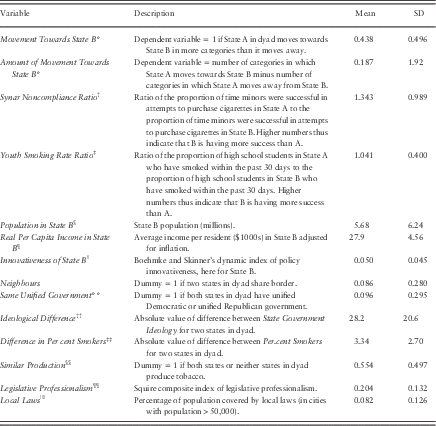
To develop a measure of state-level youth access laws, we began by identifying 16 different youth access laws adopted across the states.Footnote 11 For our dependent variable, we need to measure the extent to which each state moves towards each other state’s policy profile – that is, towards the set of policies that the other state has previously adopted – in any given year. To determine the complete list of youth access policies that each state has adopted, as well as the year in which they were adopted, we relied on the State Cancer Legislative Database (SCLD), a compilation of all state-level antismoking laws.Footnote 12 We collected this information for all states over the entire period of our study, which runs from either 1992 or 1997 (depending on which measure of success we use) through 2002, the time period of the most dramatic change in state youth access policies and the period that contains the best available policy success information.
Next, in each of the 16 categories of laws, we determine whether State A adopts a policy change in a given year and, if so, whether that change moves State A towards or away from State B. We then sum the number of categories in which State A moves towards State B and also the number of categories in which it moves away from State B.Footnote 13 For example, consider a dyad that consists of Missouri and Iowa in 2001. In that year, Missouri passed a comprehensive youth access law that included seven new policy components of the 16 we study. Compared with the policies that Iowa had at the start of 2001, five of Missouri’s adoptions moved it towards policies in Iowa (youth penalties, vending machine restrictions, location restrictions, behind-the-counter-sales requirements and random inspections) and two moved it away (out-of-package sales restrictions and delivery/shipping restrictions).
To begin, we create a simple, dichotomous measure that accounts for whether State A in the dyad has moved towards State B on more policy dimensions than it has moved away from State B. In our example above, the dependent variable, Movement Towards State B, takes a value of 1 for the 2001 Missouri-Iowa dyad. More generally, whenever the movement towards State B exceeds the movement away from State B, this dependent variable takes on a value of 1; otherwise, the dependent variable takes a value of 0.Footnote 14
We also code a second dependent variable using this same information. However, instead of treating the dependent variable as a dichotomous measure, for this measure we look at the amount of movement. In the example given above, where Missouri moves towards Iowa in five categories and away from it in two, this variable, Amount of Movement Towards State B, takes a value of 3 (i.e. 5−2). This more nuanced measure captures not only the direction of movement, but also the extent to which State A follows (or retreats from) State B.Footnote 15
Independent variables: measures of success and other State B characteristics
Of the variables characterising conditions in State B, those most crucial to testing our hypotheses are measures of success. The first of our success variables incorporates information about whether states have prevented minors from purchasing cigarettes, which is the goal that the Synar Amendment imposed on the states. We construct this measure to take into account the relative success of each state, based on the logic that states looking to improve their performance in the area of limiting youth access are more likely to imitate states that have a better track record than they do. For example, a state with a noncompliance rate of 20% may feel it has much to learn from a state with a noncompliance rate of only 10%, but little to learn from a state with a higher, and thus worse, noncompliance rate of 40%.
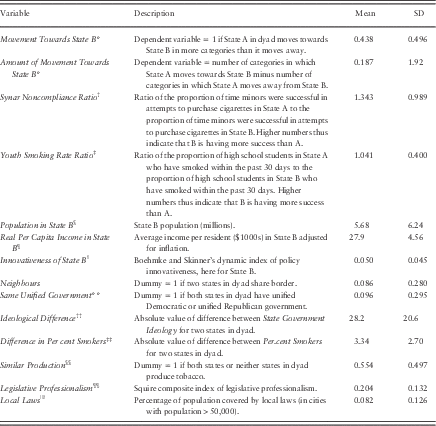
To create the Synar Noncompliance Ratio, we take the proportion of minors who were able to purchase cigarettes during compliance tests in State A and divide this by the proportion of minors who were able to purchase cigarettes during compliance tests in State B. Thus, this measure captures the success of State B relative to State A. Values greater than 1 for this variable indicate that State B has had relatively greater success at keeping tobacco out of the hands of children. In 2001, for example, minors in Connecticut were able to overcome legal obstacles and purchase cigarettes 18.1% of the time, while minors in New Jersey obtained cigarettes 24.6% of the time. The Synar Noncompliance Ratio value for New Jersey in the New Jersey-Connecticut dyad in 2001 is thus 1.36 (0.246/0.181), indicating that Connecticut was more successful than New Jersey in limiting the ability of minors to purchase cigarettes, and implying that New Jersey could potentially learn from Connecticut’s greater success. The data for the Synar Noncompliance Ratio are available starting from 1997.Footnote 16
Our second measure of success, the Youth Smoking Rate Ratio, is based on the proportion of high school students who reported that they smoked within the past 30 days. Again, this value compares the relative rate of success in the two states in a dyad, with the rate in State A divided by the rate in State B. In Michigan in 1999, for example, 34.1% of high school students reported having smoked within the past 30 days, compared with 40.3% of students in Ohio. Thus, the value of the Youth Smoking Rate Ratio for Michigan in 1999 is 0.846 (0.341/0.403); since this value is <1, it indicates that Michigan may have less to learn from Ohio in terms of reducing youth smoking rates than it would from a state with a lower youth smoking rate.Footnote 17 Because these surveys are not conducted in each year in each state, we interpolate the missing values. We do so by inserting the most recent survey results for each year and for each state, as these would be the best data available to policymakers in other states at the times of their decisions.Footnote 18
Positive coefficients on these success measures would support the Learning Hypothesis. Beyond this initial hypothesis, our first conditional hypothesis holds that learning from success may be contingent on the level of political expertise within each state’s legislature. To measure political expertise, we rely on a standard measure, Squire’s (Reference Squire2007) Professionalism Index.Footnote 19 This measure compares each state legislature, at various points in time, to the US Congress along each of three dimensions – legislators’ salaries, the number of days in session per year and the number of staffers – and then creates a single index to capture this comparison. States with higher scores, such as Wisconsin, New York and California, are considered to be more like Congress and thus more professionalised, whereas states with lower scores, such as Wyoming, North Dakota and New Hampshire, are less professionalised. To test the Political Expertise Hypotheses, we interact our success measures with State A’s Legislative Professionalism.Footnote 20
Our next hypothesis, the Policy Expertise Hypothesis, predicts that the effect of learning is conditional on the degree of experience that states have had with the policy area. To capture such internal policy expertise, we generate Local Adoptions, measured as the population in cities within the state that are covered by local youth access laws, divided by the total population of the state.Footnote 21 Again, we interact our success measures with this State A variable to test whether the effect of policy success elsewhere is contingent on expertise.Footnote 22
We also include three other control measures for State B. Because larger and wealthier states are more likely to be seen as leaders (Walker Reference Walker1969; Grupp and Richards Reference Grupp and Richards1975), these governments are more likely to be imitated than are smaller and poorer states. Hence, we include Population in State B (in millions) and Real Per Capita Income in State B (in thousands of inflation-adjusted dollars), with positive coefficients expected for these larger and wealthier states. In addition, Boehmke and Skinner (Reference Boehmke and Skinner2012) create a dynamic index of state innovativeness. Innovativeness of State B should exhibit a positive coefficient if more innovative states are more likely to be emulated.
Independent variables: interstate relational characteristics
Beyond the conditions in State B that might entice State A to adopt its policies, we also control for the relationships between states.Footnote 23 The classic story in the policy diffusion literature is about geography, with policies spreading from one neighbour to the next (Walker Reference Walker1969). We capture this relationship through the variable Neighbours, which takes a value of 1 if the two states in the dyad share a common border, and 0 otherwise.
Scholars have recently moved beyond geographic diffusion to explore whether ideological, demographic or other similarities affect the spread of policies (e.g. Grossback et al. Reference Grossback, Nicholson-Crotty and Peterson2004; Volden Reference Volden2006). Although some adoptions of similar policies by similar states may be independent of policy diffusion (Volden et al. Reference Volden, Ting and Carpenter2008), or may be due to other mechanisms of diffusion such as economic competition (Berry and Baybeck Reference Berry and Baybeck2005), similar-state adoption is at least consistent with learning-based diffusion.
To capture political similarity, we create Same Unified Government, which takes on a value of 1 if both states have a unified Republican government or both states have a unified Democratic government. Because the partisan differences captured by Same Unified Government might fail to capture some differences in preferences, we also create Ideological Difference, which is the absolute value of the difference in each state’s government ideology as measured by Berry et al. (Reference Berry, Ringquist, Fording and Hanson1998). In addition, we create Difference in Per cent Smokers and Similar Production, where the former is the absolute value of the difference in smoking rates across the two states and the latter is a dichotomous variable that takes a value of 1 when both states are tobacco producers or neither is a tobacco producer. To the extent that similarity should increase the likelihood that State A will follow State B and adopt its policies, we expect Neighbours, Same Unified Government and Similar Production to have positive coefficients, while Ideological Difference and Difference in Per cent Smokers should have negative coefficients.Footnote 24 We also include our modifying variables – Legislative Professionalism and Local Laws – as controls.Footnote 25 All variables, along with their sources and summary statistics, are detailed in Appendix.
Results
We begin our dyad-year event history analysis by testing the Learning Hypothesis. Since the dependent variable in our first test, Movement Towards State B, is dichotomous, we rely on logit estimation. In addition, to control for the possible lack of independence across observations – particularly because there may be features of State B that we are not capturing in our models and that will influence whether other states will imitate it – we cluster by State B, an approach that adjusts the standard errors to account for any discerned non-independence and for possible heteroskedasticity concerns (e.g. Primo et al. Reference Primo, Jacobsmeier and Milyo2007).Footnote 26 To control for further possible temporal dependence in the hazard rates of the adoption of State B’s policies, we include year dummies (Beck et al. Reference Beck, Katz and Tucker1998). Also, as mentioned above, we limit the data set to observations in which State A makes some policy change and in which State B has already adopted youth access policies not yet found in State A, thereby presenting an opportunity for emulation (Boehmke Reference Boehmke2009). Finally, to account for further limits on the ability to emulate others once State A has already adopted many youth access restrictions, we include a Previous Laws Adopted control variable that accounts for the number of previous youth access policy components already in place in State A.Footnote 27
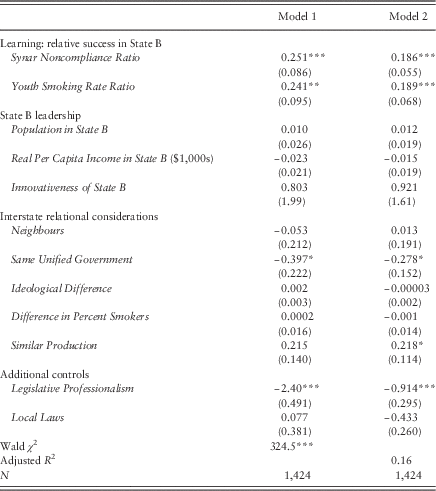
Model 1 of Table 1 presents the logit results for our Learning Hypothesis. The key variables of interest for this initial hypothesis are the measures of relative success in State B – Synar Noncompliance Ratio and Youth Smoking Rate Ratio. These baseline results provide strong evidence that states are more likely to shift their policy profiles towards others that have been successful. Both Synar Noncompliance Ratio and Youth Smoking Rate Ratio have the predicted positive sign, and their coefficients are highly significant. In addition, both coefficients are substantively significant. Holding all other variables at their mean, the predicted probability that Movement Towards State B will take on a value of 1 increases from 0.38 when Synar Noncompliance Ratio is one standard deviation below its mean to 0.51 when the success measure is one standard deviation above its mean. Similarly, the predicted probability changes from 0.42 to 0.47 when Youth Smoking Rate Ratio increases from one standard deviation below its mean to one standard deviation above its mean. Finally, the probability moves from 0.36 to 0.54 when both success variables move from one standard deviation below to one standard deviation above their means.Footnote 28
Learning for state youth access adoptions
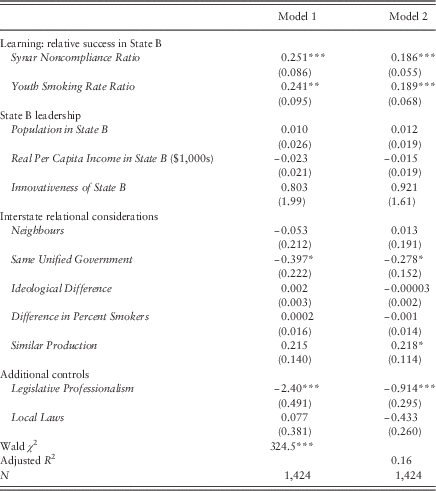
Notes: Robust standard errors in parentheses, clustered by State B. Constant, year dummies and previous laws adopted variables are included in regression but with results omitted from table due to space considerations.
Model 1 dependent variable is Movement Towards State B; Model 2 dependent variable is Amount of Movement Towards State B. Model 1 uses logit; Model 2 uses OLS.
***p<0.01, **p<0.05, *p<0.1 (two-tailed tests).
Thus, the policies of the most successful states, defined as one standard deviation or more above the mean, are emulated in a majority of policy changes, whereas the policies of the least successful states are emulated only about one-third of the time. It may seem surprising that less successful states are emulated at all. Such a finding may be due to states weighing the preponderance of the evidence, where a policy that succeeds in twice as many states as those in which it fails may be a good bet. Yet, it will appear as the emulation of the failing states as well as the successful states. Moreover, learning may not be the only diffusion process taking place in antismoking policymaking (e.g. Shipan and Volden Reference Shipan and Volden2008). There is also the possibility that states may be imitating each other or even competing with each other to some extent, and adopting poorly performing policies as a result.
Turning to our control variables, we find no evidence that Population in State B, Real Per Capita Income in State B or Innovativeness in State B increase the likelihood that State A will copy State B’s policies; however, in subsequent models below, innovativeness is positive and statistically significant. Looking at the results for interstate relational considerations, we find little evidence that states are more likely to follow the lead of similar states, with only Similar Production having the expected sign and approaching statistical significance.Footnote 29 Although it was important to control for State B’s leadership characteristics and for similarities across states, these sparse statistical patterns indicate that most of the story about which states are emulated is based on learning from successes rather than fads across similar states. The control for previous laws adopted is negative and significant, as expected. Finally, although the coefficient for Local Laws is insignificant, the coefficient on Legislative Professionalism is negative and strongly significant, suggesting that more professionalised legislatures are, all else equal, less likely in general to copy other states.
Although Model 1 supports the Learning Hypothesis, the use of a dichotomous dependent variable ignores relevant information. Suppose, for example, that Indiana and Iowa had no youth access laws at all in a given year, and Illinois had eight laws at that time. Now, suppose that in the next year Indiana adopts one law that is found in Illinois, while Iowa adopts six of the eight laws that are already in effect in Illinois. Clearly, Iowa has moved more towards Illinois than has Indiana; yet, the dependent variable in Model 1 treats Iowa and Indiana equivalently. More generally, with more than a dozen different youth access policies that states can adopt, one state could move only slightly towards another, or could take many more steps towards that other state.
Model 2 of Table 1 uses this additional information with Amount of Movement Towards State B as the dependent variable. Because our dependent variable is no longer dichotomous, but rather can take a range of values, we use ordinary least squares for our analysis.Footnote 30 The results again show strong support for the Learning Hypothesis. Both Synar Noncompliance Ratio and Youth Smoking Rate Ratio are positive and strongly significant (p<0.01, two-tailed tests). A one standard deviation increase in Synar Noncompliance Ratio is associated with an additional 0.18 components of State B’s laws adopted by each State A. A similar calculation for Youth Smoking Rate Ratio shows a movement of 0.08 components towards a more successful State B. In addition, such effects accumulate over time and through compounded learning as other states experience success with these youth access policies.
Political expertise and learning from success
As discussed earlier, we hypothesise that political expertise will increase the effect of success, with more professional legislatures being better able to learn about and adopt policies found in successful states. To test this hypothesis, we interact both Synar Noncompliance Ratio and Youth Smoking Rate Ratio with Legislative Professionalism, and add these interaction terms (in separate equations) to Model 2.Footnote 31 A positive coefficient on these terms would indicate support for the hypothesis.
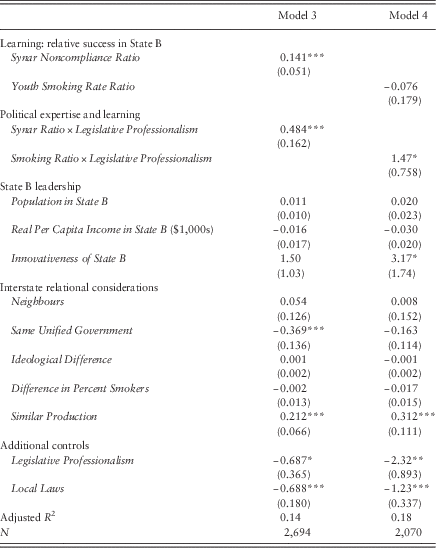
Table 2 displays the results of our tests of the Political Expertise Hypothesis. The results using the Synar measure, presented in Model 3, show that the interaction term is positive and highly significant (p=0.004). Similarly, for smoking rates, as presented in Model 4, the interaction term is positive and significant, albeit at a more lenient standard (p=0.060).Footnote 32
Political expertise and state youth access adoptions
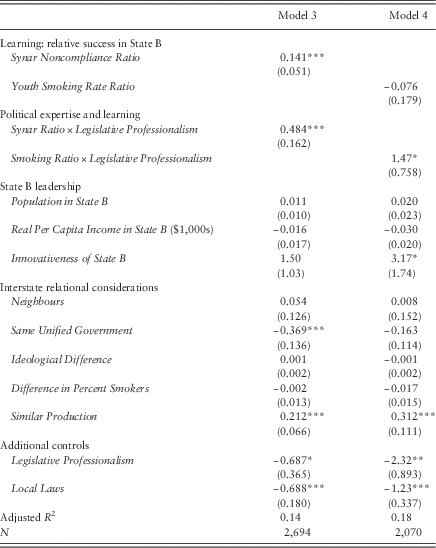
Robust standard errors in parentheses, clustered by State B. Constant, year dummies and previous laws adopted variables are included in regression but with results omitted from table due to space considerations. Models are OLS; dependent variable is Amount of Movement Towards State B.
***p<0.01, **p<0.05, *p<0.1 (two-tailed tests).
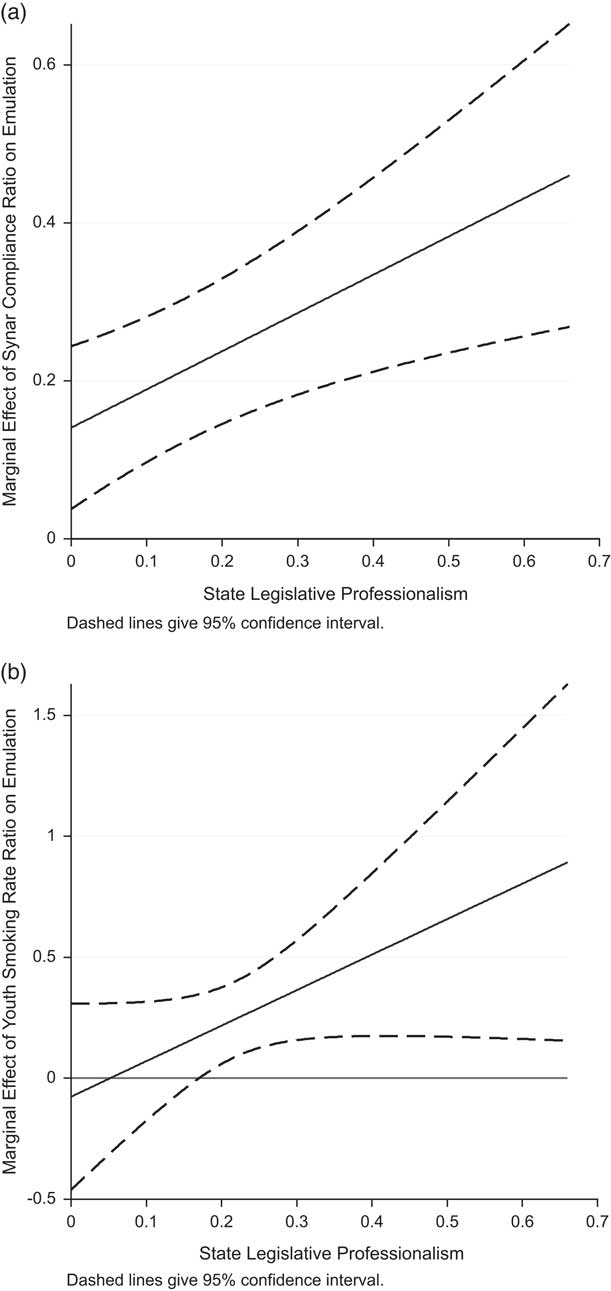
Figures 1a and 1b, which show the marginal effects of each success measure for different values of Legislative Professionalism, allow us to better interpret the interactive effects.Footnote 33 The two figures tell a similar story. First, for Synar Noncompliance Ratio, we see that the effect of success in other states is positive for all values of Legislative Professionalism. This indicates that, regardless of State A’s level of professionalism, an increase in our success measure causes State A to move towards State B’s policy profile. Thus, both low- and high-professional legislatures appear to learn from the policy successes of other states, and are more likely to adopt policies found in other states that are relatively more successful at making it more difficult for teens to buy cigarettes. Second, the marginal effect of Youth Smoking Rate Ratio (seen in Figure 1b) is positive for all values of Legislative Professionalism >0.17. Since the mean value of this measure is 0.20, this finding indicates that legislatures that are average or above average in terms of capacity are more likely to adopt policies found in another state if that state has had success at reducing youth smoking. Third, the positive slope of the marginal effects line indicates that highly professionalised legislatures are more likely to follow the lead of other states that are more successful than they are.
(a) Learning (Synar compliance) conditional on political expertise. (b) Learning (smoking rates) conditional on political expertise.
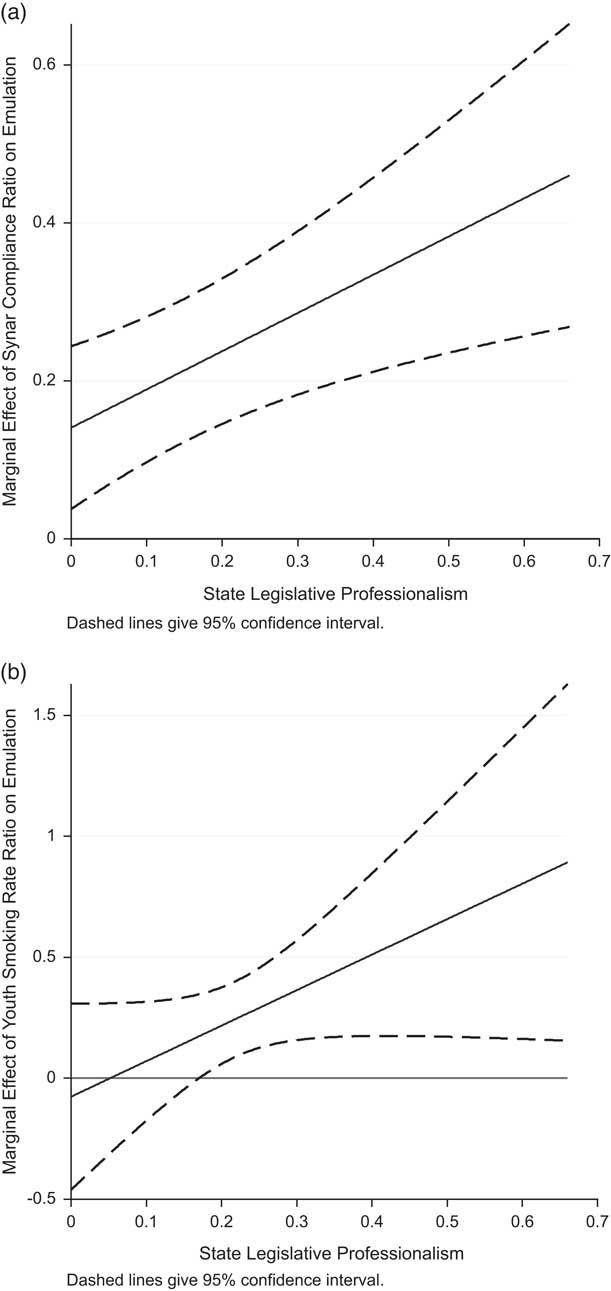
More specifically, as Kam and Franzese (Reference Kam and Franzese2007) demonstrate, a significant coefficient on the interaction term indicates that the marginal effect of the variable of interest – here, our success measures – differs significantly at high and low values of the modifying variable – here, Legislative Professionalism. The results thus provide strong support for the Political Expertise Hypothesis, showing that, although all legislatures are likely to adopt policy profiles that are more like those found in successful states, legislatures with higher levels of political expertise and institutional capacity, as measured by their professionalism scores, are significantly more likely to do so. The size of the conditional effect is quite large as well. For instance, the effect of relative Synar compliance in State B is three times greater if State A’s legislature has a high level of professionalism than if it has a low level of professionalism. And, for the measure of success based on smoking rates, the least professional states do not even seem to have sufficient political expertise to learn from successes found elsewhere.
Policy expertise and learning from success
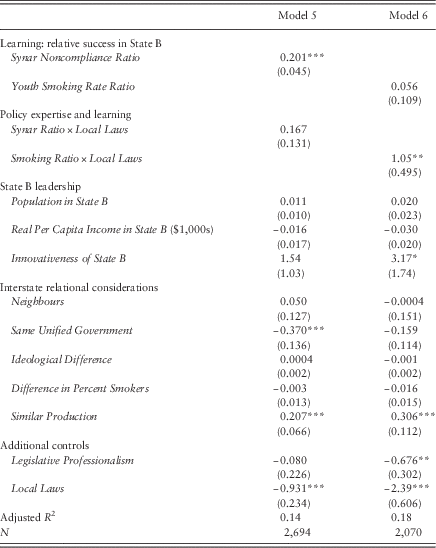
The results in Table 2 and Figure 1 clearly indicate that the effect of success increases for policymakers with greater political expertise. To test whether the same pattern holds for policy expertise, we follow the same approach that we used above. Our measure of policy expertise makes use of information gleaned from policy experiments at the local level – namely, we rely upon Local Laws, which is the percentage of the population that is covered by local-level youth access laws. We interact Local Laws with both Synar Noncompliance Ratio and Youth Smoking Rate Ratio and again add these interaction terms to Model 2.
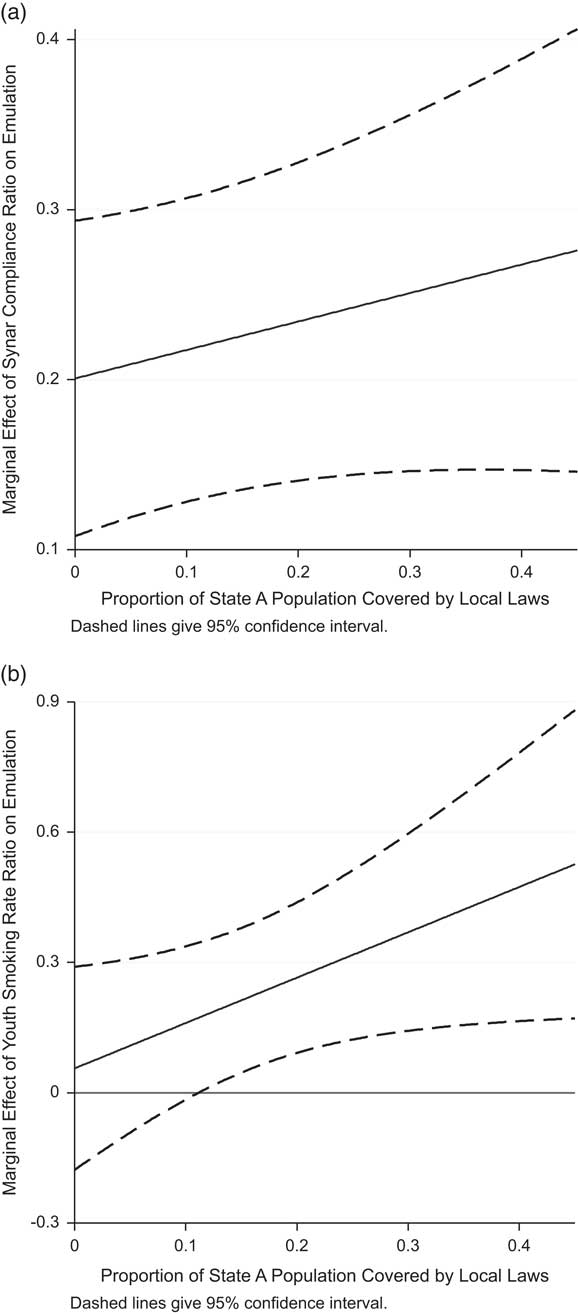
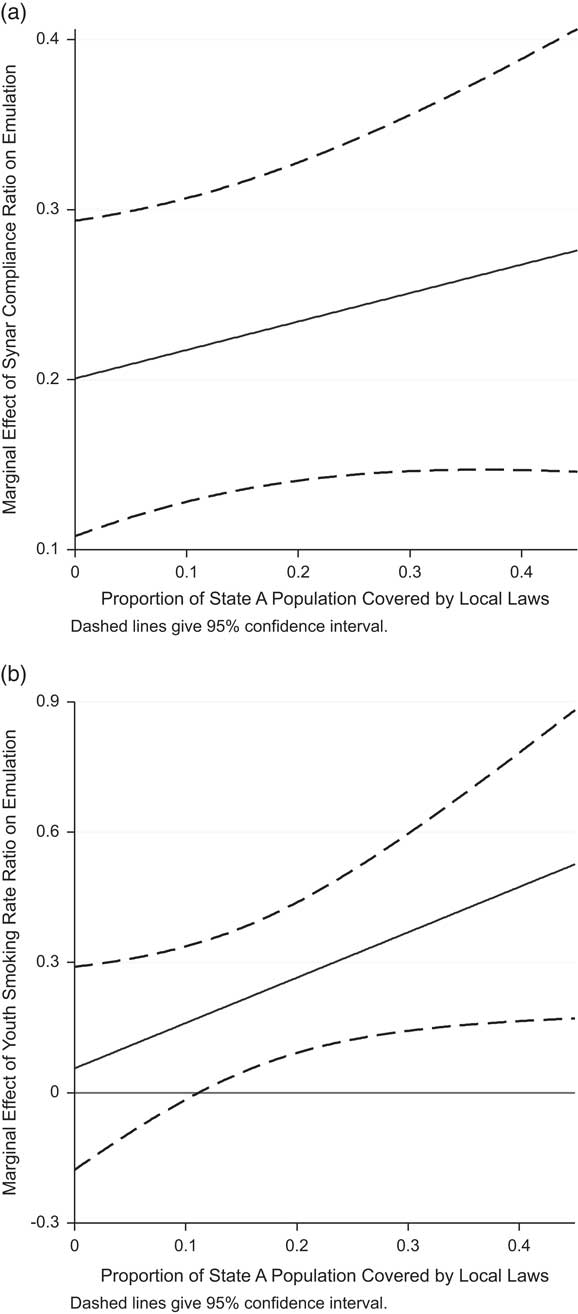
The results, reported in Table 3 and illustrated in Figures 2a and 2b, provide strong support for the Policy Expertise Hypothesis. In Figure 2a, we see that the marginal effect of Synar Noncompliance Ratio is positive across all values of Local Adoptions, indicating that the more successful State B, the more likely it is that State A will adopt the types of policies found in State B. Figure 2b shows a comparable pattern, although the effect of Youth Smoking Rate Ratio becomes significant just above the mean value of Local Laws for our sample (0.082). In addition, both figures show that the marginal effect of success is increasing in Local Laws, although this trend is significant only for Youth Smoking Rate Ratio (p=0.041). Thus, the data show support for states with a greater degree of policy expertise as being more likely to draw upon external learning – in other words, internal expertise and external learning are complementary – and show no evidence that states substitute internal learning for external learning. Taken together, then, the results in Tables 2 and 3 show that, as state policymakers increase either their political or policy expertise, they are more likely to learn from and emulate the successes of others.Footnote 34
(a) Learning (Synar compliance) conditional on political expertise. (b) Learning (smoking rates) conditional on political expertise.
Policy expertise and state youth access adoptions
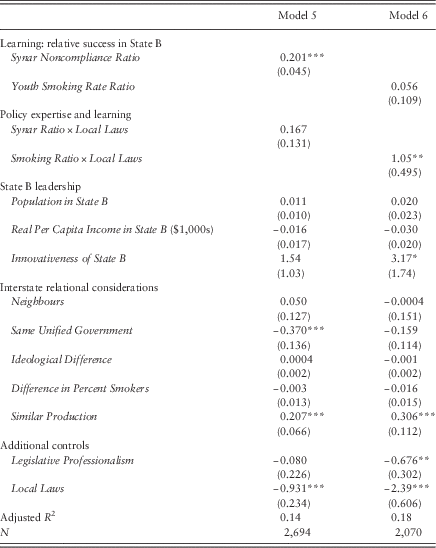
Robust standard errors in parentheses, clustered by State B. Constant, year dummies and previous laws adopted variables are included in regression but with results omitted from table due to space considerations. Models are OLS; dependent variable is Amount of Movement Towards State B.
***p<0.01, **p<0.05, *p<0.1 (two-tailed tests).
Interestingly, the negative coefficients on the non-interacted Legislative Professionalism and Local Laws variables in Tables 2 and 3 seem to point to a generally lower likelihood of emulation by states with political and policy expertise, in the absence of evidence of policy success. This finding is consistent with states with internal expertise foregoing their role as “leaders” or “early adopters” when given the opportunity to learn.Footnote 35 To explore the temporal nature of learning further, we subdivided our data set into early and late eras at the median year of the data (such subsequent analyses are not shown here in detail due to space considerations). Doing so reveals that learning takes time and is therefore much stronger in later years, consistent with the findings of Gilardi et al. (Reference Gilardi, Füglister and Luyet2009) and Shipan and Volden (Reference Shipan and Volden2008). Moreover, this late learning behaviour is especially strong among states possessing internal political and policy expertise. They seemingly prefer to be “learners” rather than “leaders”.
Conclusion
When state policymakers decide whether or not to adopt certain policies, they can rely on their own information or they can try to learn from the experiences of others. Our analysis shows that these two factors – internal expertise and external learning – are not substitutes for one another, but rather are complements. Policymakers lacking expertise are ill-suited to take advantage of the opportunities to learn from others’ policy successes. They do not receive the benefits of learning-based policy diffusion.
In particular, in the policy area of youth antismoking initiatives, we establish that policymakers are more likely (on average) to adopt policy profiles found in other states that have demonstrated policy success. This average effect is interesting in its own right; but, it also provides a baseline for a more intriguing and novel set of results. Specifically, we find that, although states frequently learn from other successful states, this effect is not equal across all states. First, our evidence strongly suggests that states featuring greater political expertise – namely, those that have more professional legislatures – are more likely to learn from successful states and adopt the policies found in those states. This result has both positive and normative aspects. Positively, it indicates a very specific, institutional consideration that influences the ways in which some policies – in particular, policies of successful states – diffuse. Normatively, it suggests that, whatever other virtues they may have, less professional legislatures may be less likely, or perhaps even unable, to emulate the policy successes of other states. The notion of state-level experimentation is a fundamental aspect of our federal system; but, to the extent that some states have institutions limiting the expertise and learning capacity of lawmakers while others have highly professional legislative institutions, the former may be hindered in their attempts to benefit fully from experimentation.
Second, as noted, we also find that policy expertise complements learning, showing that states with expertise brought about through internal experimentation are more likely to emulate successful states. The issue of external learning versus internal policy expertise is not just a point of academic interest, but rather is one with major substantive implications. Governments in federal systems are constantly assessing whether to decentralise policymaking authority, in part to help unleash learning within and across states. As we uncover here, states that have robust internal experiments at the local level are able to acquire the needed expertise to learn from experiments elsewhere. Indeed, it may even be necessary for states to allow local experimentation of their own in order to draw upon successful experimentation elsewhere. Uncovering these sorts of effects therefore is important in determining the costs and benefits of devolution decisions.
One may question the generalisability of our results. Given that there is very little political contestation of youth access laws – few politicians or interest groups want to be known for taking a strong stand in favour of youth smoking! – does this present a particularly “easy” case, one in which learning is more likely to occur than in other areas? Although this is a reasonable characterisation of this issue, it does not lessen the value of our findings. Indeed, this is a particularly good issue precisely because it is such a clean case. We do not, for example, need to worry about disentangling learning from a significant degree of economic competition. By examining this area and finding evidence of learning, we provide, at minimum, a foothold for the idea that success matters, and that it matters more under certain institutional conditions. Furthermore, we offer an approach and way of thinking about this issue that scholars can now extend to other areas.
Taken together, our findings portray a complex relationship among states and localities, with states learning both horizontally (from other states) and vertically (from policy adoptions within their state), with the exact nature of learning dependent on both political and policy expertise. Moreover, these results need not only apply within American federalism. Within the comparative politics literature, for example, there is significant evidence emerging of countries learning from one another’s experiences (see Graham et al. Reference Graham, Shipan and Volden2013). The research here indicates that learning in comparative contexts might likewise differ depending on the political institutions that cultivate expertise among policymakers. For example, politicians in countries with unitary systems may not gain the policy expertise arising from the subnational experiments of federalist countries, which serve as helpful precursors to learning from outside the country.
Acknowledgements
An earlier draft of this paper was presented at the Annual Meeting of the American Political Science Association, Chicago, IL, 2007. The authors thank the Robert Wood Johnson Foundation for financial support, Jamie Chriqui for providing us with the updated version of the National Cancer Institute’s State Cancer Legislative Database and Fred Boehmke, Rob Franzese, Fabrizio Gilardi, George Krause, Paula Lantz, seminar participants at the University of Chicago, the University of Michigan, the University of Pittsburgh, Stanford University, the University of Texas and the University of Virginia, anonymous reviewers and JPP editor Tony Bertelli for helpful comments and guidance. In addition, local tobacco control ordinance data were provided by the American Nonsmokers’ Rights Foundation Local Tobacco Control Ordinance Database©.
Variable descriptions, summary statistics, sources