During the Great Depression, banks failed in larger numbers than at any other time in United States history. Economists have long debated the reasons for the banking system's collapse. A traditional school of scholarship maintains that the underlying causes were withdrawals of deposits, illiquidity of assets, and the Federal Reserve's reluctance to act.1
Friedman and Schwartz, Monetary History; and Wicker, Banking Panics.
Temin, Did Monetary Forces; and Calomiris and Mason, “Fundamentals.”
These opposing views exist for many reasons. A principal reason is differences in data sources. Scholars in the traditional school analyze data aggregated at the national or regional level. These data reveal bank suspensions clustered in space and time, often coinciding with turning points in macroeconomic time-series such as indices of industrial production, the money multiplier, interest rates, and the deflation rate. Narrative sources from the 1930s characterize these clusters as banking panics. Scholars in the revisionist school analyze data at lower levels of aggregation, such as the state or county level, or panels of microdata, such as samples of national banks, or panels of banks from within individual cities, states, or Federal Reserve districts.3
White, “Reinterpretation,” pioneered this line of research by examining a panel of data drawn from national banks. Calomiris and Mason, “Fundamentals,” which is the most recent and comprehensive work, analyzes a panel of data for all Federal Reserve member banks.
This essay examines a new body of evidence that provides such a comprehensive perspective. The new source indicates the cause of suspension for all banks—including Federal Reserve members and nonmembers, national and state, incorporated and private—that suspended operations from the onset of the contraction in 1929 until the national banking holiday in March 1933. These data come from the archives of the Federal Reserve Board, whose Division of Bank Operations tracked changes in the status of all banks operating in the United States, analyzed the cause of each bank suspension, and recorded its conclusions and financial information for each bank on the St. 6386 series of forms. The complete series of St. 6386 forms survives in the National Archives of the United States.4
For a detailed description of the Federal Reserve's archives and the St. 6386 database, see Richardson, “Records,” “Bank Distress … New Evidence,” “Bank Distress … Illiquidity-Insolvency Debate,” and “Quarterly Data.”
This new source indicates that the payment system played a critical, but as of yet unnoted, role in the propagation of banking panics during the Great Depression. At that time, three check-clearing systems operated in the United States. Clearing houses cleared checks for banks belonging to their organizations; the Federal Reserve cleared checks for members of its system; and, correspondents cleared checks for all other banks.
The initial banking crisis began during November 1930, when the Bank of Tennessee, a subsidiary of Caldwell and Company in Nashville, ceased operations. Its failure triggered a chain-reaction. The ensuing collapse of its correspondent network forced scores of banks to suspend operations. Aftershocks radiated from the locus of this counter-party cascade. Runs forced hundreds of banks to close their doors and induced other banks in the region to slow the conversion of deposits to currency through means short of suspension. Several smaller correspondent chains with no connection to Caldwell also collapsed around that time.
Later banking crises also involved collections of correspondent banks. In the spring of 1931, for example, correspondent groups centered in Chicago suffered substantial declines in deposits and suspended operations after depleting their cash reserves. Overall, banks that cleared checks via correspondents failed at rates much higher than banks that cleared via other systems.
A comparison of the three check-clearing systems reveals reasons why correspondent networks collapsed like dominos at the onset of the banking crisis. Correspondent banks resembled central banks. Deposits in correspondents counted as a portion, often the preponderance, of a respondent's reserves. When a correspondent closed, these reserves disappeared, and the respondent had to suspend operations. If in turn, the respondent served as a correspondent to other institutions, then those second-tier respondents may have had to suspend operations as well.
A ubiquitous feature of predepression correspondent-clearing networks may have exacerbated the situation. To facilitate bookkeeping, correspondents immediately credited checks deposited by respondent banks. Respondents treated checks working their way through the correspondent-clearing system as entering their reserve accounts immediately upon deposit, or if the checks were deposited through the postal system, at the time the checks were handed to the postmaster. Checks traveling through the correspondent-clearing system usually traveled through the hands of at least two banks before being redeemed at the bank on which they were drawn. The reserves of banks using the correspondent-clearing system consisted, therefore, partially of checks in transit, and this float was magnified by a multiple depending upon time in transit and the number of banks through which checks passed.
Contemporary critics of the correspondent-clearing system called these reserves fictitious, because they consisted of bookkeeping entries on the balance sheets of banks, which were not fully backed by funds and lacked the liquidity normally associated with readily available reserves. Fictitious reserves peaked during the fall harvest season, when the flow of funds through correspondent networks to country banks and their agricultural clients peaked. The evidence suggests that the share of reserves that were fictitious rose rapidly during the 1920s and peaked in fall of 1930, immediately preceding the onset of banking panics.5
Note on terminology. Commentators on the twentieth-century correspondent banking system used the term “fictitious reserves” to describe reserves arising from crediting uncollected checks. This essay uses the term “fictitious reserves” in that sense. Commentators on the postbellum national banking system used the term “fictitious reserves” in a related but distinct sense. Under the national banking system, banks could count some deposits with other banks as reserves. However, the banks that held these reserve balances held only fractional reserves against them. Total reserves therefore exceeded cash reserves. Commentators labeled this excess of total over cash as “fictitious.”
THE THREE CHECK-CLEARING SYSTEMS
At the onset of the Great Depression, three check-clearing systems operated in the United States.6
Additional information about the evolution and operation of the check clearing systems can be found in Richardson, “Correspondent Clearing.”
Talbert, “Clearing,” pp. 204–06.
Young, “Enlargement.” See also Preston, “Federal Reserve,” p. 568.
In addition to the primary function of facilitating check transactions, clearing houses helped members attain numerous collective goals, such as maintaining confidence in the strength of local banks. Bankers recognized that “no bank can be in an unsound position without hurt to the whole local banking community.”9
Young, “Enlargement,” p. 608.
Young, “Enlargement,” p. 608. Note that some clearing house examination bureaus also monitored borrowers within their communities to detect duplications of borrowings by the same client at different banks and, to alleviate adverse selection among borrowers, by collecting detailed information on loan applicants and disseminating it to all institutions, ensuring that borrowers could not refuse to provide information or security to an individual institution by threatening to borrow elsewhere. Young, Enlargement, pp. 130–13, describes such a system but writes that “little has yet been said of the possibility of further development through such an office … with regard to the question of credit information.” I have found little additional information on the practice.
Another common goal was the provision of liquidity, particularly during periods of panic, when depositors withdrew funds en masse, forcing banks to scramble for cash. In such circumstances, clearing houses eased the pressure on bank balance sheets by issuing clearing house certificates. These substitutes for currency circulated between banks and among their better customers, usually bigger businesses, alleviating the pressure to sell assets at depressed prices.11
Talbert, “Clearing,” p. 195.
At the end of 1929 clearing houses operated in 45 states and the District of Columbia, as indicated by Table 1. Each day, the 349 clearing houses processed transactions totaling billions of dollars.12
Andrews, “Operation,” pp. 587–88.

The Federal Reserve operated the second check-clearing system. Federal Reserve member banks forwarded checks to the nearest Federal Reserve check-processing facility, which cleared checks drawn on member banks within its district and forwarded checks drawn on banks in other districts to the pertinent processing center. Banks that belonged both to the Federal Reserve and to a clearing house employed both clearing systems. Regulations required Federal Reserve members to process local transactions through the clearing house and out-of-town checks through the Federal Reserve System. Clearing house members often settled daily transaction balances by transfers on the books of the Federal Reserve, by telephoning or telegraphing the debits and credits to the Federal Reserve at the end of each business day.13
Andrews, “Operation,” p. 595.
The Federal Reserve cleared checks drawn on nonmember state banks using procedures similar to those which clearing houses used to clear items drawn on country banks. The Federal Reserve shipped batches of checks to banks on which they were drawn, either via private messenger or the postal services, and awaited the return of funds (usually in the form of a draft drawn on an account of a Federal Reserve member or a money center bank). The Federal Reserve did not immediately credit out-of-town checks to the accounts of banks that deposited them. The Federal Reserve imposed a waiting period whose length was based on the typical length of time that it took for a check drawn on a type of bank in a particular location to remit funds. The waiting periods lasted up to eight business days depending on the distance involved and the type of bank on which the draft was drawn. Clearing houses imposed similar waiting times on outside checks.14
Each issue of the Rand McNally Bankers' Directory reports the time schedule for crediting deposits for each Federal Reserve District.
The third system for clearing checks was correspondent banking. The typical situation involved a bank outside a reserve city (called a country bank) that deposited funds in a bank in a reserve city (called a city bank) and received services in return. The bank making the deposit was referred to as the respondent. The bank providing the services was called the correspondent. When a country bank received out-of-town checks from depositors, rather than mailing the checks directly to the banks on which they were drawn, the country bank deposited the checks in its city correspondent. The correspondent then cleared the checks through the most convenient method, either through a clearing house, through the Federal Reserve System, or by directly contacting the institution on which the checks were drawn. Country banks found the services of city correspondents economical because it enabled them to clear all of their checks by making a daily deposit via the United States postal service, rather than employing a staff of clerks to handle the correspondence needed to send each check directly to the bank on which it was drawn. Correspondent clearing also enabled country banks to avoid exchange charges.
In addition to cashing checks, correspondents offered respondents an array of financial services.15
Rand McNally Bankers Directory reveals the services provided by the principal correspondent banks.
On the eve of the Great Depression, correspondent networks formed a complex web of interbank relationships anchored by banks in large commercial centers. A country bank often had a correspondent located in a nearby town, which was a member of the Federal Reserve, and therefore, could conveniently supply it with cash and clear many of its checks. A country bank also often possessed at least one correspondent in a financial center, where it held the bulk of its banker's balances, which usually comprised a substantial share of its financial reserves.
Country banks employed the services of correspondents because they provided greater benefits at lower costs than the alternatives of operating in isolation or joining the Federal Reserve System. The correspondent banking system, however, had weaknesses. One was the potential for a chain reaction. Deposits in correspondents counted as a portion, often substantial, of a respondent's reserves. When a correspondent closed, its respondents' reserves disappeared, placing pressure on other sources of reserves, such as vault cash and liquid assets. Thus, the closure of a large correspondent could force its respondents to suspend operations. Another weakness arose from the competing needs of correspondents and respondents. During panics, both needed cash, but correspondents could slow respondents' withdrawals by invoking contractual clauses limiting amounts that could be withdrawn each day, by requiring advanced notice of withdrawals, and by slowing the processing of withdrawal requests. Correspondents could also refuse requests for credit, and in extreme situations, call in loans. Thus during panics, when correspondents faced demands on many fronts, the deposits that they held lacked the liquidity normally associated with bank reserves.
Although the closure of a large correspondent could precipitate suspensions among respondent banks, an accounting convention may have made the depression era correspondent-clearing system particularly susceptible to panics. The seventh edition of a popular banker's manual described the arrangement in these terms.
The country banker uses his reserve agent both as reserve agent and collecting agent, depositing his items both for credit and collection, the items so sent … becoming part of his lawful reserve…. As soon as the letter dispatched the country banker, therefore, regards the amount as added to his balance…. In the aggregate the total [of these reserve balances] is enormous.16
Kniffin, “Practical Work,” p. 312.
In other words, a country (a.k.a. respondent) bank considered checks mailed to its correspondent as a portion of its financial reserves and immediately indicated so on its balance sheet. The correspondent bank itself carried the float. Academic and professional writings from the era warned of dangers inherent in this practice.
It has long been recognized that the chief defense of the plan was its convenience. A country bank in this way knew how its reserve account stood. No checks were charged until the country bank remitted, and checks sent to the city correspondent were counted as available reserve as soon as put into the mail. In this way a fictitious reserve was created. A check in the mail for several days might later be returned for want of funds. All of this time the various banks that had handled it would count as reserve these unavailable funds.17
Preston, “Federal Reserve,” p. 567.
Yet, regulatory authorities in most states approved of this long-standing practice because its convenience seemed to offset potential disadvantages, such as allowing customers to write checks against uncollected funds. Moreover, “rural states adopted liberal bank incorporation laws that reduced minimum capital requirements to a fraction of the federal threshold and so spurred the formation of state-chartered banks in smaller cities and towns.”18
James and Weiman, “Drafts,” p. 8.
This common practice linked correspondent clearing and bank reserves in a dangerous manner: Reserves in the correspondent system were inflated by a multiple of the volume of checks in transit. Each check in transit was counted as part of the reserve of every bank through which it passed, until the check was redeemed, and the funds flowed backwards through the system, and the cycle unwound.
Seasonal flows of funds from crop-growing regions exacerbated the situation. Agricultural states possessed large numbers of small rural banks that relied on correspondents to clear checks. Transactions peaked during the harvest and planting seasons, when it would not be unusual for an institution in a small town to process checks equal to its required reserves within each week. If those checks took a week to clear through correspondents (also a typical period), then the bank's possessed no actual reserves, because the “float” exceeded the “reserves” that they carried on their books.
For these reasons, the connection between clearing and reserves placed the correspondent system in a perilous position. A large portion of the reserves of the correspondent system consisted of bankers' balances. Much of those balances consisted of checks in transit. A substantial share of the reserves of the correspondent system, therefore, consisted of fictitious reserves equal to a multiple of the volume of checks in transit. These reserves appeared to expand (but in reality did not change) whenever the volume of checks in transit increased. An event, such as a banking panic, that forced banks to convert reserves into cash, would reveal that the much of the reserves in any correspondent chain consisted of fictitious figures rather than real resources.
Precise data on the quantity of fictitious reserves do not exist, but extant sources yield closely related statistics. One is the ratio of checks in transit to bankers' balances for state commercial banks. Figure 1 displays the ratio for 1 July of each year from 1913 to 1940. The ratio peaked in 1930, when float approached 60 percent of bankers' balances. This peak was nearly twice the proportion prevailing during the preceding decade. The peak was more than four times the proportion prevailing following the trough of the contraction.

FIGURE 1 CHECKS IN TRANSIT AND BANKERS' BALANCES, 1913–1939
The ratio can be used to estimate levels of apparent, actual, and fictitious reserves. The estimation requires knowledge of the relationship between checks in transit and fictitious reserves. That relationship depended upon the speed at which checks passed through the correspondent system and the number of corresponding banks that simultaneously counted checks as reserves on their balance sheets. Those parameters remain unobserved. Safe assumptions, however, facilitate a reasonable estimate: fictitious reserves amounted to approximately 150 percent of checks in transit from banks that cleared via correspondents.19
The assumption are (i) the volume of checks in transit was constant; (ii) the correspondent networks for the states for which I have comprehensive data (New York and Mississippi) were representative of correspondent networks throughout the nation; (iii) all banks routed all checks through the system via the most direct route to a correspondent that belonged either to the New York Clearing House or the Federal Reserve System; and (iv) funds returned via drafts at the same rate that checks moved through the system.
This formula yields estimates of apparent (C + B), actual (A), and fictitious (1.5*T) reserves. Figure 2 plots the ratio of actual to apparent reserves on June 30 of each year from 1913 through 1939. The data cover all commercial banks, including those that cleared via correspondents, clearing houses, and the Federal Reserve. The inclusion of data on banks that cleared clearing houses and the Federal Reserve biases the estimate upward. This bias implies that for typical country banks, the ratio of actual to apparent reserves was lower than the figure suggests. The figure indicates that the share of actual reserves fell (and the share of fictitious reserves rose) during the 1920s, as the volume of check transactions increased, and checks in the process of collection became an ever larger entry on banks' balance sheets. For example, on 30 June 1913, state commercial banks listed a total of $195,000,000 of checks in the process of collection. Seventeen years later, on 30 June 1930, state commercial banks listed a total of $1,851,000,000 checks in the process of collection.20
Board of Governors, All Bank Statistics, table A-4, p. 43.
Board of Governors, All Bank Statistics, table A-4, p. 43.
Board of Governors, All Bank Statistics, table A-4, p. 43.

FIGURE 2 ACTUAL RESERVES AS A FRACTION OF APPARENT RESERVES
Figure 3 examines the implications of these patterns by plotting apparent and actual reserves on 30 June of each year as a fraction of apparent reserves held by banks in 1913. The figure illuminates an important point. During the 17 years following the founding of the Federal Reserve, apparent reserves doubled, while actual reserves fell by half.

FIGURE 3 ACTUAL AND APPARENT RESERVES OVER TIME
Figure 4 reinforces this message by plotting apparent and actual reserves as a function of total assets. The figure shows that in 1913, actual reserves amounted to 14 percent of total assets, and in 1917, actual reserves peaked at 16 percent of total assets. Actual reserves declined steadily thereafter, as banks substituted checks in collection for cash in the vault. When the banking panics began, actual reserves amounted to roughly 3 percent of all assets. Note that apparent reserves also fell during the Roaring '20s, as banks worried less about liquidity and more about profits.

FIGURE 4 ACTUAL AND APPARENT RESERVES RELATIVE TO TOTAL ASSETS
SOURCES OF DATA
Where does this evidence come from? Information about the three payment systems comes from the professional and academic literature of the era, information available in bankers' handbooks and manuals, and contemporary sources widely available at the time. For example, data on clearing houses, reserve cities, reserve requirements, and correspondent linkages comes from Rand McNally's Bankers Directory. Data on banks' balance sheets come from the compendium All Bank Statistics.23
Board of Governors, All Bank Statistics.
The remainder of this essay is based on a new and unique source. From 1929 through 1933 the Federal Reserve Board's Division of Bank Operations recorded information about changes in a bank's status on three forms. Form St. 6386a reported bank consolidations. Form St. 6386b reported bank suspensions. Form St. 6386c reported all other bank changes. These forms provide uniform and comprehensive information about changes of status for all banks operating in the United States—national and state, member and nonmember, public and private. The complete series of forms survives in the National Archives of the United States.24
The forms may be found in the National Archives and Record Administration [hereafter NARA], Record Group 82, Federal Reserve Central Subject File, file number 434.-1, “Bank Changes 1921–1954 Districts 1929–1954 - Consolidations, Suspensions and Organizations-St. 6386 a,b,c, (By States) 1930–1933” [hereafter Bank Changes]. The forms are filed alphabetically by state, name of town or city, and name of bank. Multiple entries for individual banks appear in chronological order.
As part of its ongoing data collecting endeavors, the Federal Reserve Board developed a lexicon for classifying changes in bank status and the causes of bank suspensions. In this lexicon, a suspension was a bank that closed its doors to depositors and ceased conducting normal banking business for at least one business day. Some, but not all, suspended banks reopened for business. A liquidation was a permanent suspension. A liquidating bank closed its doors to the public, surrendered its charter, and repaid depositors, usually under the auspices of a court appointed officer known as a receiver. A voluntary liquidation was a category of closure in which banks ceased operations and rapidly arranged to repay depositors the full value of their deposits. Voluntary liquidations did not require the services of receivers and were not classified as suspensions. A consolidation (or merger) was the corporate union of two or more banks into one bank that continued operations as a single business entity and under a single charter. The categories of bank distress were typically construed to be temporary suspensions, terminal suspensions (i.e., liquidations), voluntary liquidations, and consolidations due to financial difficulties.
The Federal Reserve attributed most bank suspensions to one of five common causes. The first was slow, doubtful, or worthless paper. The term worthless paper indicated an asset with little or no value. The term doubtful paper meant an asset unlikely to yield book value. The term slow paper meant an asset likely to yield full value in time, but whose repayment lagged or which could not be converted to full cash value at short notice. The second common cause of suspension was heavy withdrawals, the typical example being a bank run. The third was failure of a banking correspondent. Correspondents were banks with ongoing relationships facilitated by deposits of funds. A typical example is a county bank (the respondent) that kept its reserve deposits within and cleared its checks through a national bank in a reserve city (the correspondent). The fourth common cause was mismanagement. The fifth was defalcation, a monetary deficiency in the accounts of a bank due to fraud or breach of trust.25
Richardson, “Bank Distress … New Evidence” and “Quarterly Data,” discuss the construction and quality of these classifications.
When determining the causes of failures, the Federal Reserve Board sought to gather information about suspensions from the man on the spot who knew the facts of the issue at hand. The Board gathered information from examiners, receivers, correspondents, state banking departments, court officers, the bank's own management, and local and national publications. These sources, now no longer extant, provided the Federal Reserve Board with an array of information, now unavailable to economic researchers, such as the health of a bank's assets on the date of suspension, the deposits lost by the bank in the period preceding suspension, the lawsuits (or criminal charges) pending against bank management, and the links that the failed bank had to other financial institutions. Federal Reserve agents at that time could determine whether a bank experienced a run, failed to maintain cash flow, or feared impending insolvency; whether a bank's correspondent(s) closed; or whether a bank's management embezzled money. Modern scholars have difficulty detecting these phenomena in the extant evidence. Phenomena such as correspondent closures and bank runs remain unobservable.
The data demonstrate that for the contraction as a whole, asset problems were the primary cause of about half of all bank liquidations (i.e., terminal suspensions) and a contributing cause of another one-quarter. The share of liquidations due primarily to problems on the asset side of the balance sheet fell until the summer of 1931, rose in 1932, and fell again in 1933. The share of liquidations due primarily to withdrawals varied in the opposite chronological pattern. The share rose during the second half of 1930 and fell during the later half of 1931.26
For additional information, see Richardson, “Records,” “Bank Distress … New Evidence,” “Bank Distress … Illiquidity-Insolvency Debate,” and “Quarterly Data”; and Richardson and Troost; “Monetary Intervention.”
For temporary suspensions, the pattern was different. Temporary suspensions typically occurred when banks lacked enough cash on hand to satisfy depositors' demands. Heavy withdrawals were the primary cause of more than a half of all temporary suspensions. Temporary suspensions due to bank runs and heavy withdrawals rose during 1930 (particularly during the last three months) and peaked in 1931. The closure of counterparties caused a sixth of all temporary suspensions. The share of temporary suspensions due to the closure of correspondents peaked during the fall of 1930.27
For additional information, see Richardson, “Records,” “Bank Distress … New Evidence,” “Bank Distress … Illiquidity-Insolvency Debate,” and “Quarterly Data”; and Richardson and Troost; “Monetary Intervention.”
As this essay focuses on suspensions due to the closure of correspondents, it is worth discussing the nature of these events and how Federal Reserve agents determined them to be the cause of a suspension. The typical case involved a respondent bank that received notice that its correspondent had suspended operations. Respondents located near their correspondent usually received these notices via messengers. Respondents located far from their correspondents usually received these notices via telegram. The respondent's manager ordered the staff to close the bank's doors and summoned the board of directors. The directors met and voted to keep the doors closed on the following morning. The Federal Reserve classified events of this type, where a respondent bank suspended operations immediately after the receipt of information about the closure of a correspondent, as a suspension due to the closure of correspondent. Federal Reserve agents also classified as a suspension due to the closure of a correspondent a bank that closed soon (for example, several days) after learning of its correspondent's closure, if no other factors appeared to precipitate its suspension.28
This note indicates the prevalence of the archetypical case. During the fall of 1930, 61 percent of the banks that suspended operations due to the loss of correspondent linkages did so on the same day that their correspondent closed. Twenty-three percent suspended operations from one to three days later. Sixteen percent suspended operations from four to seven days later. Seven percent suspended operations from one week to one month later. Only one bank suspended operations more than a month later.
Related events received different classifications. For example, Federal Reserve agents classified as a suspension due to heavy withdrawals a bank whose correspondent closed, but which remained in operation for several days thereafter, during which depositors withdrew sums so substantial that the bank had to suspend operations. In such cases, comments written by the Federal Reserve agents often attributed the run on the bank to news of the correspondent's closure.29
See for example NARA, Bank Changes, American Exchange Trust Company, Little Rock, AR, 17 November 1930, or NARA, Bank Changes, National Bank of Kentucky, Louisville, KY, 17 November 1930.
I emphasize that I make no judgments about the reasons why particular banks failed. Those judgments were made by contemporary experts possessing far more information about each event than is available to scholars today. This essay merely reports the experts' conclusions.
CORRESPONDENT NETWORKS AND THE INITIAL PANIC OF THE DEPRESSION
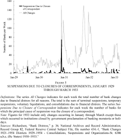
The correlation between suspensions and the closure of correspondents was particularly pronounced during the initial banking panic of the depression. Figure 5 plots the number of suspensions each week due to the closure of correspondents (and for sake of comparison also plots total changes due to financial distress). The typical week witnessed few, if any, suspensions from correspondents. The weekly mode and median were zero. The weekly number rose during July of 1929, when a Mediterranean fruit fly epidemic produced a banking panic in Florida, and the suspension of banks in Tampa, which served as the principal correspondents for banks in central Florida, forced the banks to suspend operations throughout the region, but remained near zero until November 1930, when it spiked sharply upwards.

FIGURE 5 SUSPENSIONS DUE TO CLOSURES OF CORRESPONDENTS, JANUARY 1929 THROUGH MARCH 1933
In a two week period, more than 120 banks suspended operations due to the closure of correspondents. The event is an obvious outlier. Never before or since have so many financial institutions fallen in a counterparty cascade. It does not seem surprising that this event, the worst chain reaction in United States financial history, marked the onset of the worst period of bank distress and most catastrophic financial contraction in United States financial history. In the immediate aftermath, bank runs radiated from the locus of the counterparty cascade, forcing hundreds of banks to close their doors to depositors.
The archival evidence enables us to describe this banking crisis in detail. Before mid-October, the pattern of bank suspensions resembled the pattern of failures throughout the 1920s. Banks failed at a steady rate. The principal cause was problems with asset quality. The pattern changed dramatically in November 1930, when the rate of suspension rose suddenly. Contagion through correspondent chains caused the initial increase. Thereafter, runs (and fear of runs) forced scores of banks to close their doors, and adverse circumstances pushed many weak banks into insolvency.
Comments written on the St. 6386 forms tell the tale. On 7 November the Bank of Tennessee (Nashville), a subsidiary of Caldwell and Company, closed due to “depreciation in the value of securities” and irregularities that left it with “bills payable of $2,887,100.00” and debts “on real estate of $260,079.20” on a deposit base of $10,000,000.30
NARA, Bank Changes, Bank of Tennessee, Nashville, TN, 7 November 1930.
NARA, Bank Changes, Holston-Union Bank, Knoxville, TN, 12 November 1930.
On 17 November Armageddon arrived. The National Bank of Kentucky (Louisville) suspended operations because of “heavy withdrawals and affiliation with the Caldwell Chain.”32
NARA, Bank Changes, National Bank of Kentucky, Louisville, KY, 17 November 1930.
NARA, Bank Changes, Louisville Trust Company, Louisville, KY, 17 November 1930.
NARA, Bank Changes, American Mutual Savings Bank, Louisville, KY, 17 November 1930; First Standard Bank, Louisville, KY, 18 November 1930; Bank of Sturgis, Sturgis, KY, 16 December 1930; Peoples Bank, Sulphur, KY, 18 November 1930; Jackson Township Bank, Corydon Junction, IN, 21 November 1930; Hopkins County Bank, Madisonville, KY, 21 November 1930; Bank of St. Helens, Shively, KY, 18 November 1930; Old Capital Bank and Trust Company, Corydon Junction, IN, 20 November 1930; Crawford County State Bank, English, IN, 21 November 1930; Liberty State Bank, New Albany, IN, 20 November 1930; Citizens State Bank of Orleans, Orleans, IN, 25 November 1930; Bank of Caneyville, Caneyville, KY, 19 November 1930; Leavenworth State Bank, Leavenworth, IN, 21 November 1930; American Bank and Trust Company, New Albany, IN, 21 November 1930; Title Guarantee and Trust Company, Louisville, KY, 23 June 1931.
The American Exchange Trust Company (Little Rock, AR) also suspended operations due to “heavy withdrawals due to rumors caused by failure of Caldwell and Company [in] Nashville.”35
NARA, Bank Changes, American Exchange Trust Company, Little Rock, AR, 17 November 1930.
NARA, Bank Changes, Corning Bank and Trust, Corning, AR, 15 November 1930; Peoples Bank, McRae, AR, 17 November 1930 Merchants and Planters Bank, Humphrey, AR, 17 November 1930; Bank of Altheimer, Altheimer, AR, 17 November 1930; Northern Arkansas Bank, Batesville, AR, 17 November 1930; Bank of Bauxite, Bauxite, AR, 17 November 1930; Benton Bank and Trust Company, Benton, AR, 17 November 1930; Arkansas State Bank, Carlisle, AR, 17 November 1930; Bank of Carthage, Carthage, AR, 17 November 1930; Farmers Bank, Casa, AR, 17 November 1930; Bank of Clarendon, Clarendon, AR, 17 November 1930; Farmers Bank, Danville, AR, 17 November 1930; Exchange Bank and Trust Compnay, Dermott, AR, 17 November 1930; Peoples State Bank, Devall's Bluff, AR, 17 November 1930; Eudora Bank and Trust Company, Eurdora, AR, 17 November 1930; Bank of Fordyce, Fordyce, AR, 17 November 1930; Hampton State Bank, Hampton, AR, 17 November 1930; Bank of Harrisburg, Harrisburg, AR, 17 November 1930; Clebourne County Bank, Heber Springs, AR, 17 November 1930; Merchants and Planters Bank, Helena, AR, 17 November 1930; Bradley County Bank, Hermatage, AR, 17 November 1930; Arkansas Bank and Trust Company, Hope, AR, 17 November 1930; Bank of Houston, Houston, AR, 17 November 1930; Merchants and Farmers Bank, Junction City, AR, 17 November 1930; Cleveland County Bank, Kingsland, AR, 17 November 1930; Chicot Trust Company, Lake Village, AR, 17 November 1930; State Bank of Leola, Leola, AR, 17 November 1930; First State Bank, Morrilton, AR, 17 November 1930; Arkansas Trust Company, Newport, AR, 17 November 1930; First State Bank, Osceola, AR, 17 November 1930; Bank of Pangburn, Pangburn, AR, 17 November 1930; Perry State Bank, Perry, AR, 17 November 1930; Merchants and Planters Bank and Trust, Pine Bluff, AR, 17 November 1930; Bank of Salem, Salem, AR, 17 November 1930; Grant Country Bank, Sheridan, AR, 17 November 1930; Victoria Bank, Strong, AR, 17 November 1930; First State Bank, Stuttgart, AR, 17 November 1930; Bank of Wabbeseka, Wabbeseka, AR, 17 November 1930.
NARA, Bank Changes, Bald Knob State Bank, Bald Knob, AR, 20 November 1930; Citizens Bank, Bald Knob, AR, 20 November 1930; Montgomery County Bank, Mt. Ida, AR, 20 November 1930; Bank of Oak Grove, Oak Grove, LA, 21 November 1930; Citizens Bank, Thorton, AR, 28 November 1930.
NARA, Bank Changes, Peoples Bank, McRae, AR, 17 November 1930; Citizens Bank, Thorton, AR, 28 November 1930.
One respondent of the American Exchange Trust Company remained in operation for a month. The Citizens Bank and Trust Company (Harrison, AR) endured by calling on the resources of the A. T. Hudsputh Chain, for which it was the principal bank. But on 17 December, when those resources ran thin and the loss of funds on deposit in the American Exchange Trust Company appeared irreversible, the Citizens Bank threw in the towel.39
NARA, Bank Changes, Citizens Bank and Trust Company, Harrison, AR, 17 December 1930.
NARA, Bank Changes, Bank of Alpena, Alpena Pass, AR, 17 December 1930; Bank of Northern Arkansas, Everton, AR, 17 December 1930; Bank of Lead Hill, Lead Hill, AR, 17 December 1930; American Exchange Bank, Leslie, AR, 17 December 1930; First State Bank, Marshall, AR, 17 December 1930; Citizens Bank, Yellville, AR, 17 December 1930; Citizens Bank, Saint Joseph, AR, 17 December 1930.
The archival evidence cited attributes the suspension of the Caldwell conglomerate's principal banks to either: financial difficulties directly attributed to Caldwell's demise, or runs because of the banks known connection to Caldwell and Company. The archival evidence attributes the suspension of nearly 100 additional banks to: the severing of correspondent links to institutions, such as the Bank of Tennessee, controlled by the Caldwell conglomerate, runs due to known affiliations with the Caldwell organization, or runs due to geographic proximity to Caldwell controlled institutions or geographic proximity to banks undergoing runs.
Similar events occurred in Illinois, where correspondent chains without connection to Caldwell collapsed. On 8 November Quincy-Ricker National Bank and Trust Company (Quincy, IL) suspended operations due to the collapse its largest borrower, the “Smith and Ricker Land and Cattle Company, of Kansas City, Missouri.”41
NARA, Bank Changes, Quincy-Ricker National Bank and Trust Company, Quincy, IL, 8 November 1930.
NARA, Bank Changes, Exchange State Bank, Golden, IL, 8 November 1930; Bank of Green City, Green City, MO, 13 November 1930; Bartlett and Wallace Savings Bank, Clayton, IL, 15 November 1930; State Bank of Brashear, Brashear, MO, 24 November 1930.
NARA, Bank Changes, State Savings Loand and Trust Company, Quincy, IL, 14 November 1930.
NARA, Bank Changes, South Side State Savings Bank, Quincy, 14 November 1930; Payson State Saving Bank, Payson, IL, 14 November 1930; Timewell State Bank, Timewell, IL, 15 November 1930; Downing State Bank, Downing, MO, 17 November 1930; LaBelle Savings Bank, LaBelle, MO, 17 November 1930; Rutledge Exchange Bank, Rutledge, MO, 17 November 1930; Bank of Edina, Edina, MO, 21 November 1930; Farmers Exchange Bank, Silex, MO, 13 December 1930. Farmers and Merchant Bank, LaGrange, MO, 17 November 1930.
The effects of these suspensions spread across state lines. On 20 November the Hannibal Trust Company (Hannibal, MO) suspended operations due to “heavy withdrawals due to closing of a number of banks in their section at Quincy, Illinois.”45
NARA, Bank Changes, Hannibal Trust Company, Hannibal, MO, 20 November 1930.
NARA, Bank Changes, Farmers Bank, Oakwood, MO, 20 November 1930.
During December 1930 similar dominoes of collapsing correspondent networks radiated out from Sioux City, Iowa and Clarksdale and Tupelo, Mississippi. On 6 December both the Sioux City National Bank and the First National Bank in Sioux City suspended operations due to “slow, doubtful, or worthless paper.”47
NARA, Bank Changes, Sioux City National Bank, Sioux City, IA, 6 December 1930; First National Bank, Sioux City, IA, 6 December 1930.
NARA, Bank Changes, Leeds Bank, Sioux City, IA, 8 December 1930.
NARA, Bank Changes, Exchange Bank, Marcus, IA, 12 December 1930.
NARA, Bank Changes, Alvord Bank, Alvord, IA, 17 December 1930.
NARA, Bank Changes, Farmers National Bank, Inkwood, IA, 17 December 1930; First National Bank, Rock Rapids, IA, 17 December 1930; Savings Bank, Larchwood, IA, 17 December 1930.
On 24 December the Peoples Bank and Trust Company (Tupelo, MS) suspended operations due to “excessive bills payable” and “slow, doubtful, and worthless assets.”52
NARA, Bank Changes, Peoples Bank and Trust Company, Tupelo, MS, 24 December 1930.
NARA, Bank Changes, Itawamba Company Bank, Fulton, MS, 24 December 1930; Bank of Guntown, Guntown, MS, 24 December 1930; Bank of Saltillo, Saltillo, MS, 24 December 1930; Bank of Shannon, Shannon, MS, 24 December 1930; Bank of Sherman, Sherman, MS, 24 December 1930; Planters Trust and Savings Bank, Clarksdale, MS, 30 December 1930.
NARA, Bank Changes, Peoples National Bank, Clarksdale, MS, 30 December 1930; Planters Trust and Savings Bank, Clarksdale, MS, 30 December 1930; Peoples Banks, Jonestown, Mississippi, 30 December 1930.
CORRESPONDENT-CLEARING AND BANK CLOSURES DURING 1931 AND 1932
The previous section showed the banking crisis in the fall of 1930 began with a counter-party cascade. This section shows correspondent networks played roles later in the contraction. An example is an event that Milton Friedman and Anna Schwartz named the Second Banking Crisis. During this surge of suspensions in the spring of 1931, many of the banks that failed belonged to banking groups.55
NARA, Bank Changes, Nashville Trust Company, Nashville, TN, 5 May 1931; First National Bank, Hendricks, MN, 11 May 1931; Capital City Trust Company, Trenton, NJ, 18 May 1931; Hanover Trust Company, Trenton, NJ, 18 May 1931; Pontiac Commercial and Savings Bank, Pontiac, MI, 13 June 1931; Broadway Merchants Trust Co, Camden, NJ, 15 June 1931; First and Tri State National Bank and Trust Company of Fort Wayne, Fort Wayne, IN, 24 June 1931; First National Bank, Royal Oak, MI, 27 June 1931.
Group failures were most prominent in the city of Chicago, where between 6 and 10 June, 25 banks failed. Nineteen of those banks belonged to groups. Eleven belonged to the John Bain Group. Seven belonged to the Foreman Group. One belonged to the Ralph E. Ballou and E. L. Wagner Group. Additional banks in all three groups failed in the days preceding and following the panic.56
NARA, Bank Changes, Commerce Trust and Savings Bank, Chicago, IL, 28 May 1931; South Side Savings Bank and Trust Company, Chicago, IL, 6 June 1931; Inland-Irving National Bank, Chicago, IL, 8 June 1931; Washington Park National Bank, Chicago, IL, 8 June 1931; Foreman-State National Bank, Chicago, IL, 8 June 1931; Foreman-State Trust and Savings Bank, Chicago, IL, 8 June 1931; Second North Western State Bank, Chicago, IL, 9 June 1931; North-Western Trust and Savings Bank, Chicago, IL, 9 June 1931; Armitage State Bank, Chicago, IL, 9 June 1931; Auburn Park Trust and Savings Bank, Chicago, IL, 9 June 1931; Brainerd State Bank, Chicago, IL, 9 June 1931; Chatham State Bank, Chicago, IL, 9 June 1931; Chicago Lawn State Bank, Chicago, IL, 9 June 1931; Elston State Bank, Chicago, IL, 9 June 1931; Ridge State Bank, Chicago, IL, 9 June 1931; Stony Island State Savings Bank, Chicago, IL, 9 June 1931; West Englewood Trust and Savings Bank, Chicago, IL, 9 June 1931; West Highland State Bank, Chicago, IL, 9 June 1931; West Lawn Trust and Savings Bank, Chicago, IL, 9 June 1931; Cragin State Bank, Chicago, IL, 10 June 1931; Fullerton State Bank, Chicago, IL, 14 June 1931; First National Bank, Downers Grove, IL, 17 June 1931.
Each of these banking groups was a collection of independently chartered institutions operating under the auspices of a corporate conglomerate, which owned the majority of the capital stock in each of the banks, and by appointing directors and hiring managers, controlled the bank's affairs. The leading bank of each of group served as the correspondent for the subordinate institutions. The groups were relatively recent innovations. They had grown during the 1920s, as correspondent banks in Chicago took control over respondent banks.
These groups magnified the weaknesses of the correspondent clearing system. The subordinate banks considered checks in transit as financial reserves. So did the controlling bank. The group as a whole, therefore, overstated its reserves. It is not surprising, therefore, that when depositors withdrew funds in large quantities, banking groups rapidly ran out of cash.
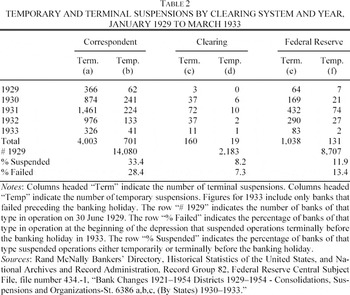
Table 2 examines the relationship between clearing systems and bank closure for the contraction as a whole. The table indicates the number of banks that suspended operations temporarily and terminally in three groups: first, banks that cleared checks solely through correspondents; second, banks that belonged to clearing houses (but not the Federal Reserve System); and third, banks that belonged to the Federal Reserve System (including those that also belonged to clearing houses). The table shows that the preponderance of banks that suspended operations cleared checks via correspondents. About a fifth belonged to the Federal Reserve System. Only a small fraction belonged to clearing houses.

Across these categories, the percentage of banks that suspended operations temporarily or terminally varied. Of all banks that cleared checks via correspondents, over one-third temporarily suspended operations at some point during the depression, and over one-fourth departed permanently from the banking business. These failure rates were four times higher than those of clearing-house members and two-and-one half times larger than those of Federal Reserve members. The failure of the later two types was concentrated during the three months following Britain's abandonment of the gold standard in the fall of 1931, to which the Federal Reserve reacted by contracting the money supply and raising interest rates. That reaction changed fundamentals in a way that burdened money center banks. So did later periods of contractionary policy. Outside of those periods, banks that cleared checks via correspondents failed at rates much higher than banks that cleared checks through clearing houses or the Federal Reserve.
These raw correlations do not, of course, reveal why banks that cleared via correspondents failed at such high rates. Banks that cleared via correspondents differed from clearing-house and Fed-member banks along many dimensions, such as location, size, investment opportunities, customer base, regulatory environment, access to the discount window, and management expertise. Those dimensions undoubtedly influenced banks' prospects for success (or failure).
DISCUSSION
The correspondent check-clearing system played a hitherto unrecognized role in the collapse of the banking system during the Great Depression. The initial banking crisis began when correspondent systems collapsed. A large literature discusses this event. Friedman and Schwartz attributed the crisis to the loss of depositor confidence after the failure of The Bank of United States.57
Friedman and Schwartz, Monetary History.
McFerrin, Caldwell; and Wicker, “Reconsideration.”
Temin, Did Monetary Forces; White, Reconsideration; and Calomiris and Mason, Fundamentals.
Two new observations complement McFerrin and Wicker's conjecture. First, soon after Caldwell's collapse, several correspondent chains independent of Caldwell imploded. Second, the simultaneous implosion of independent correspondent networks suggests that in addition to problems particular to Caldwell, some unrecognized malady afflicted correspondent chains in general. Fictitious reserves are a candidate for this general cause.
Correspondent-clearing also played a part in the second banking crisis. That crisis began during the spring of 1931 when runs struck banking groups in Chicago. These groups formed correspondent networks whose leading institution had purchased controlling shares of stock in their respondent banks. Little scholarship exists concerning the cause of this crisis. Friedman and Schwartz attribute its onset to runs on banks in Illinois. Friedman and Schwartz do not explain why depositors drained funds from banks at that time or why this drainage drove the banks out of business. This essay provides a potential explanation. Depositors observed the weakness of correspondent networks during preceding months, and precipitously withdrew funds from correspondent groups in Chicago when fears about their safety arose. Once runs began, these groups lacked reserves sufficient to weather the storm, because much of their reserves consisted of checks in the process of collection, which they double or even triple counted, when a bank within the group served as a correspondent for the others.
Correspondent clearing may have played a broader role in the collapse of the banking system. From 1929 through 1933 banks that cleared via correspondents failed at rates higher than banks that cleared via other channels. The cause of this correlation remains unclear. I argue that the cause may have been correspondent networks inherent vulnerability to cascades accentuated by their practice of treating float as reserve. But, banks that cleared via correspondents differed along many dimensions from banks that cleared checks via the Federal Reserve System or metropolitan clearing houses. When compared to the later, on average, banks that cleared via correspondent possessed less capital, lower deposits, and fewer assets; operated in more rural areas; invested more in agriculture; diversified investments less across industries; and employed smaller staffs with less experience. These factors may be the reason that banks clearing via correspondents failed at higher rates from the summer of 1931 through the winter of 1933. Determining which was the most important requires the collection of additional data and the development of techniques to distinguish the effects of contagion through correspondent networks from other factors influencing banks' fates.
Why did correspondent chains collapse so suddenly and severely early during the depression? Correspondent networks were vulnerable to counter-party cascades. Correspondents and respondents formed lines like dominoes. One bank held deposits for another bank, which in turn, held deposits for a third. These deposits comprised the preponderance of the respondents' reserves (both required and excess). When one domino toppled, the reserves of the next domino disappeared, and it suspended operations also, which forced additional dominoes to fall.
Counter-party cascades of this type have long worried regulators. The systemic risk of correspondent linkages remains high on scholars' research agenda and regulators' list of concerns. Debate revolves around the question: are some banks too big to fail? Could the closure of large institutions drive substantial numbers of their respondents out of business or cause a crisis of confidence that spills over to other banks and financial institutions? This phenomenon manifested itself in 1984, when Continental Illinois, then one of the ten largest banks in the United States, became insolvent.60
Mishkin, “How Big is Too Big.”
Effective intervention may have been difficult. Fictitious reserves made depression-era correspondent networks particularly vulnerable to counter-party cascades. The quantity of fictitious reserves peaked just before banking panics began in 1930. In such circumstances, it is not surprising that correspondent chains collapsed so suddenly, that depositor confidence declined so dramatically, that runs struck so many institutions located near the locus of correspondent cascades, or that banks held such sizeable reserves for the next decade.
The evidence presented in this essay only suggests, but does not prove, the existence of sizeable fictitious reserves. Additional research is required. Lack of data will hinder progress. Few sources contain the requisite information. High frequency data concerning checks clearing via correspondents are not extant and may not exist. Few publications of state banking bureaus report the quantities of checks in the process of collection on state-bank balance sheets. Federal Reserve call reports contain figures for checks undergoing collection, but for nationally chartered banks, only two call reports for the period 1929 through 1933 survive, and nationally chartered banks did not clear through the correspondent system. So, data on their checks in the process of collection shed little light on the key issue.
Though difficult, research on fictitious reserves could be consequential. If fictitious reserves were large, then fictitious reserves may have had macroeconomic consequences beyond their effects on bank stability. One possible channel is by inversely linking the volume of check transactions with the level of bank reserves. An increase in the volume of check transactions increased reserves listed on balance sheets by increasing fictitious reserves. This fictitious increase enabled banks to reduce real reserves, or synonymously, this fictitious increased acted like a decrease in the legal reserve requirement. A change in the volume of check transactions, in other words, had an unintended consequence that resembled one of the principal levers of monetary policy. Via this channel, a change in the volume of check transactions could have altered the deposit-reserve ratio, which is a principal component of the money multiplier, and altered the supply of money, thereby influencing the interest rate and price level.
If the quantity of fictitious reserves expanded substantially during the 1920s and contracted during the 1930s, as the preliminary evidence presented in this essay suggests, then fictitious reserves may have accentuated the macroeconomic forces propelling the economic expansion of the Roaring '20s and economic contraction of the early '30s. This possibility raises another issue. Scholastic studies of these events rely on figures for bank reserves, money multipliers, and monetary aggregates constructed without accounting for the fact that banks that cleared via correspondents counted checks in transit like cash reserves, while banks that cleared checks in other ways did not. This means that those statistical series may have systematic biases correlated with both the volume of checks in transit, the size of various banking systems, and economic aggregates. Finally, the problem of fictitious reserves during the contraction of the early 1930s may be one reason that banks held such sizeable excess reserves during the recovery of the later 1930s. Bankers may have realized that the reserve balance on their books did not reflect the resources actually available during panics. To account for that fact, bankers held reserves larger than those legally required.
I thank colleagues, friends, participants in the conference Economics of Payments II, participants in a seminar at UC Berkeley, three anonymous referees, and the editor of this Journal for comments, advice, and encouragement. I thank Francesca Labordo for exceptional research assistance. A comment from Peter Temin inspired the article's title. This material is based upon work supported by the National Science Foundation under Grant No. 0551232. Any opinions, findings, and conclusions or recommendations expressed in this material are those of the author and do not necessarily reflect the views of the National Science Foundation.