Introduction
Subjective cognitive decline is defined as perceptions of cognitive decline but with no objective signs of cognitive impairment. Cognitive complaints such as recalling recent events or names of people occur frequently in elderly people and have attracted interest as a risk factor for dementia and cognitive decline. Studies with long follow-up intervals (more than three years) have indicated that reports of cognitive decline may be an important risk factor for future dementia or cognitive decline (Reid and Maclullich, Reference Reid and Maclullich2006). Recently, the working group of the Subjective Cognitive Decline Initiative has published research criteria for subjective cognitive decline in mild cognitive impairment (MCI)/preclinical Alzheimer's disease (AD) (Jessen et al., Reference Jessen2014) and subjective cognitive impairment may be an important marker for AD because subjective cognitive decline is correlated with AD biomarkers such as gray matter volume loss (Saykin et al., Reference Saykin2006), cerebral hypometabolism (Scheef et al., Reference Scheef2012), cerebrospinal fluid markers (Visser et al., Reference Visser2009) and amyloid accumulation (Perrotin et al., Reference Perrotin, Mormino, Madison, Hayenga and Jagust2012).
Systematic interview on subjective cognitive complaints may contribute to the diagnostic evaluation of patients referred to a memory clinic (Salem et al., Reference Salem, Vogel, Ebstrup, Linneberg and Waldemar2015). However, findings between subjective cognitive complaints and cognitive functioning in memory clinic settings are conflicting (Jonker et al., Reference Jonker, Launer, Hooijer and Lindeboom1996; Vestberg et al., Reference Vestberg, Passant, Risberg and Elfgren2007). Some studies suggest that subjective cognitive complaints are related to cognitive performance (Lam et al., Reference Lam, Lui, Tam and Chiu2005; Jessen et al., Reference Jessen2007). Others have not found such a relationship (Reid and Maclullich, Reference Reid and Maclullich2006). This may be explained by different methodological approaches in relation to clarifying the complaints by a single question or a scale (Abdulrab and Heun, Reference Abdulrab and Heun2008) and whether the complaints are solicited or volunteered. Some studies used a dichotomous variable approach (and group differences were assessed), whereas a continuous variable was used in other studies (and correlations were investigated). The types of questionnaires used to measure subjective decline are different. Some measure memory, others measure subjective cognition in general. Importantly, reports of cognitive impairment may be related to factors other than cognitive impairment including affective symptoms, certain personality traits and a high level of physical morbidity (Jonker et al., Reference Jonker, Geerlings and Schmand2000; Jessen et al., Reference Jessen2007; Elfgren et al., Reference Elfgren, Gustafson, Vestberg and Passant2010; Montejo et al., Reference Montejo, Montenegro, Fernandez and Maestu2011; Singh-Manoux et al., Reference Singh-Manoux2014).
The aim of this study was to investigate the association between two scales for subjective cognitive decline in a mixed memory clinic population. Further, we aimed to investigate the association between age, cognitive impairment, and depressive symptoms on each of the scales for subjective cognitive impairment.
Methods
Patients
Patients were recruited from the Copenhagen University Hospital Memory Clinic at Rigshospitalet, which is a combined secondary and tertiary out-patient clinic based in a neurology setting. The clinic offers diagnostic evaluation and treatment of cognitive disorders and dementia, and receives primary, secondary, and tertiary referrals from general practitioners, private consultants in neurology and psychiatry and other hospitals. Patients with rare (such as genetic disorders) or uncertain etiology are referred from other Danish regions. All patients underwent the following investigations: Detailed medical history was obtained; cognitive functions were assessed with the Mini-Mental State Examination (MMSE) and the Danish version of Addenbrooke's Cognitive Examination (ACE) (Stokholm et al., Reference Stokholm, Vogel, Johannsen and Waldemar2009). Physical and neurological examination, routine laboratory tests, and ECG were performed. Structural CT or MRI of the brain was also performed. Other supplemental tests were performed if clinically relevant (fludeoxyglucose positron emission tomography (18FDG-PET), examination of cerebrospinal fluid, electroencephalography, psychiatric evaluation, neuropsychological assessment). After completion of the initial study program, the multidisciplinary staff established a standardized consensus report for each patient. The consensus report contained a classification of the cognitive profile, the primary underlying cause, and concomitant conditions.
The patients included in this study came from study on subjective cognitive complaints in 307 patients from a mixed memory clinic (Salem et al., Reference Salem, Vogel, Ebstrup, Linneberg and Waldemar2015). Inclusion criteria were as follows: (1) referral to the Copenhagen Memory Clinic for diagnostic evaluation of cognitive or behavioral symptoms; (2) a diagnostic conclusion was available; (3) the patient was native Danish speaking; (4) assessment of depressive symptoms with the Major Depression Inventory (MDI) (Bech et al., Reference Bech, Rasmussen, Olsen, Noerholm and Abildgaard2001). (In some patients — exact number not known — MDI was not administered due to time constraints); (5) MMSE score above 12.
Procedures
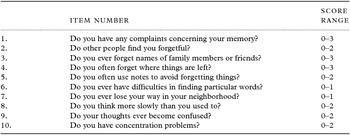
At the first visit in the clinic, the SMC (Schmand et al., Reference Schmand, Jonker, Hooijer and Lindeboom1996) was applied by a specialist nurse (in interview-format) at the beginning of the interview with the patient. The SMC includes ten items concerning difficulties in daily-life memory tasks, with total scores (SMC total) ranging from 0 (no complaints) to 21, see Table 1. The SMC scale measures memory as well as non-amnestic complaints and was originally designed to investigate subjective cognitive complaints in a population-based study on cognitive decline and dementia. The specialists who later examined the patients were blinded to the results of the SMC scale and the SMC results were not used for diagnostic classification.
Items of the subjective memory complaints scale (Schmand et al., Reference Schmand, Jonker, Hooijer and Lindeboom1996)

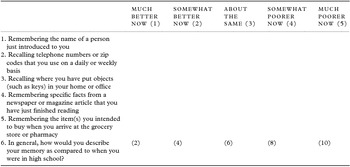
The MAC-Q (Crook, III et al., Reference Crook, Feher and Larrabee1992) is a short memory scale consisting of six items where the participant answers questions comparing the current memory functioning as compared to when they were young (in this study they were asked to compare to when they were 20 years old). The items are shown in Table 2. Each item is rated on a 5-point Likert scale from “much better now” to “much worse now.” Scores are summed (MAC-Q total), with double weighting for the final item (a comparison of general memory abilities). The score range is 7–35; higher scores indicate greater self-reported decline. This scale was originally developed to assess age-related memory decline and validated in persons meeting diagnostic criteria for age-associated memory impairment.
Items of the Memory Complaint Questionnaire (Crook, III et al., Reference Crook, Feher and Larrabee1992)

The MAC-Q was administered to all patients who were examined by a neuropsychologist. The MAC-Q was applied at the neuropsychological examination (typically two weeks after the first visit) before any tests had been administered. The neuropsychologist was blinded to the results from SMC. Neuropsychological assessment is usually done in all patients with MMSE score ≥ 22 on initial visit in the clinic, but patients with lower MMSE scores may be examined if relevant.
Assessment of depressive symptoms
Depression was assessed by the MDI which was applied at the initial visit to the clinic. The physician administering MDI was blinded to SMC results. The MDI consists of 12 items answered by choosing one of six response options from “At no time” (=0) to “All the time” (=5). When using the MDI as a depression rating scale 10 of the 12 items are used for the total score. Only the highest score on the items 8a and 8b and items 10a and 10b is included. Subsequently, a sum score is formed ranging from 0 to 50. Scores on this scale could lead to the following classification of depression: “no depression” (score of 0–19), “mild depression” (score of 20–24), “moderate depression” (score of 25–29), and “severe depression” (score of 30–50) (Bech et al., Reference Bech, Rasmussen, Olsen, Noerholm and Abildgaard2001). A diagnosis of depression was based on clinical evaluation and fulfillment of international criteria for depression and not solely based on MDI score. However, the MDI score (as opposed to results from measures on subjective cognitive decline) was included as part of the diagnostic process.
A total of 121 patients were included in the study (full data set for the subjective cognitive scales), and these were classified in four diagnostic categories to investigate if some of these were driving the associations in the total group:
1. Dementia
Patients in this group had significant impairment in instrumental activities of daily living (IADL) and significant impairment in at least two cognitive domains. For the specific dementia diseases, international consensus criteria were used, with the most common being dementia due to AD (McKhann et al., Reference McKhann2011), vascular dementia (Roman et al., Reference Roman1993), dementia with Lewy bodies (McKeith et al., Reference McKeith2005), dementia in Parkinson's disease (Emre et al., Reference Emre2007), and frontotemporal dementia (McKhann et al., Reference McKhann, Albert, Grossman, Miller, Dickson and Trojanowski2001).
2. MCI, amnestic, or non-amnestic
MCI patients met the criteria described by Petersen (Reference Petersen2004). Patients (or informants) described cognitive decline, but patients did not meet the criteria for dementia and had essentially normal functional activities. Amnestic MCI was defined when the patient's memory domain score was below −1.5 SD, whereas performances in other cognitive domains were above −1.5 SD. Non-amnestic MCI was defined as an impairment in one cognitive other than memory (defined as domain scores below −1.5 SD).
3. Affective disorders
Patients in this group had diseases in the affective spectrum (mild/moderate depression, bipolar affective disorder, reaction to severe stress, adjustment disorder, or anxiety disorder). All patients were diagnosed according to ICD-10 criteria, many by a specialist in psychiatry.
4. No cognitive impairment
Patients in this group had no significant cognitive impairment on either cognitive screening tests or neuropsychological examination, and there were no other investigations indicating possible cognitive disorders. Some of these patients were healthy worriers while others could have other neurological disease. None of these patients had affective disorders.
Ethics
The research project was approved by the Danish Data Protection Agency and the National Board of Health (j.nr. 2007-58-0015). Approval of the study was not required by the Ethical Committee of Copenhagen County (j.nr. 2011–296).
Statistical analysis
The level of significance in group by group comparisons was investigated with independent sample t-test for quantitative variables with normal distribution. One way analysis of variance (ANOVA) with post hoc Bonferroni corrected group comparisons was used to investigate the significance of differences between the diagnostic groups. Associations between variables were investigated using Pearson product-moment correlations. Lastly, two stepwise linear regression analyses were used with MAC-Q total and SMC total as dependent variables. Age and scores on MDI, MMSE, and ACE were independent variables. Plots of residuals were used as model control. The level of significance was set at p ≤ 0.05.
Results
Background data and diagnostic classification
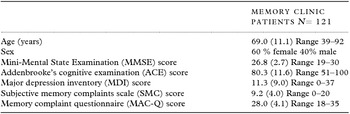
Background data and results from clinical variables are shown in Table 3. The mean MMSE was 26.8 (SD = 2.7); 22.3% scored below 25 and 58.7% had scores of 27 or above. A wide range of scores was also found for MDI (see Table 3). In this mixed memory clinic cohort, 55 patients met the criteria for dementia, the criteria for MCI were met in 25 patients, 30 had affective disorders, and 11 were classified in the group without cognitive impairment. The frequencies of underlying diseases in the dementia group were: 31 AD, 12 vascular dementia, 8 unspecified dementia, 2 frontotemporal dementia, 1 dementia with Lewy bodies, 1 normal pressure hydrocephalus. The patients with affective disorders were significantly younger (M = 59.8, SD = 11.4) than patients with MCI or dementia (M = 72.7, SD = 8.9).
Background data and test results. Results are presented as mean (SD), unless stated otherwise

SMC and MAC-Q results and correlations with clinical variables
Both SMC total and MAC-Q total are shown for all patients in Table 3. The overall correlation between SMC total and MAC-Q total was statistically significant but moderate (r = 0.44, N = 121, p = 0.015). In general, wide distributions of results were found for both scales tapping subjective cognitive decline in this mixed memory clinic population. There were no significant group differences for gender for SMC total (t (119) = 0.48, p = 0.63) or MAC-Q total (t (119) = −0.61, p = 0.54).
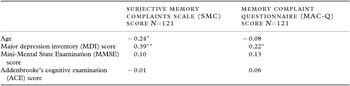
The correlations between results from the measures on subjective cognitive impairment and age, MDI scores, MMSE scores, and ACE scores are shown in Table 4. Based on the results from all 121 patients, there were no significant correlations between cognitive test performances (MMSE/ACE) and subjective cognitive scales. There was a significant effect of age on SMC total, but age and MAC-Q total were not significantly correlated. Thus, SMC total decreases with age in a mixed memory clinic population. MDI scores were significantly correlated to both SMC total and MAC-Q total, demonstrating that subjective memory problems increase with an increase in depressive symptoms.
Pearson product moment correlations coefficients between subjective memory results and clinical variables

*Significant correlation (p < 0.05).
**Significant correlation (p < 0.005).
To assess which clinical variables (age, MDI scores, MMSE score, ACE score) had the highest association with the two scales measuring subjective cognitive decline, stepwise linear regression models were used. MDI had a significant impact on the variance in SMC total [r 2 = 0.15, F (1,117) = 20.9, p < 0.001] and on the variance in MAC-Q [r 2 = 0.05, F (1,117) = 5.8, p = 0.02]. Other variables (age, MMSE score and ACE score) did not have an additional significant contribution on the variance in the subjective memory measures to that of MDI. Thus, depressive symptoms had the highest association with degree of subjective complaints.
Association between subjective cognitive decline and clinical variables in diagnostic subgroups
In the subgroup of patients categorized with dementia (N = 55) there was a significant correlation between SMC total and MAC-Q total (r = 0.29, p = 0.03) but none of the scales were significantly correlated to age, MDI score, or cognitive performances (MMSE/ACE) in this subgroup of patients (data not shown). For MCI patients (N = 25), the same pattern was found: an overall correlation of r = 0.36 between the two subjective memory scales, but probably due to the smaller number of patients this result did not reach statistical significance (p = 0.07). The scales were not significantly correlated to age, MDI score, or cognitive performances (MMSE and ACE) (data not shown) in this subgroup of patients. For patients with affective disorders, a significant correlation was found between the two scales measuring cognitive decline (r = 0.36, p = 0.049), and none of these scales were significantly correlated to age or cognitive test results (data not shown). For the patients with affective disorders (N = 30), a significant correlation was found between SMC total and MDI score (r = 0.37, p = 0.04), whereas MDI scores and MAC-Q total were not significantly correlated (r = 0.21, p = 0.26). For the small group of patients categorized with no cognitive impairment (N = 11), a significant correlation was found between MAC-Q total and age (r = 0.62, p = 0.04) but not between age and SMC total (r = 0.37, p = 0.27). In this subgroup, the two scales measuring subjective decline were not significantly correlated, and none of the scales were significantly correlated to MDI scores or cognitive test results.
Discussion
This study investigated whether different methodological approaches may affect the measurement of subjective cognitive decline in a mixed memory clinic population. Two commonly used scales for measuring subjective cognitive impairment were only moderately correlated in this patient group and age had different impact on the level of subjective cognitive decline depending on the selected scale for assessment. Thus, different scales measuring subjective complaints are not interchangeable when used in memory clinic cohorts.
The degree of depressive symptoms was the factor in this study which contributed the most to the variance in subjective cognitive decline, and age and cognitive status did not have additional association with results from subjective memory scales, when depressive symptoms were accounted for. A strong relation between subjective cognitive complaints and depressive symptoms has been established in several studies (Abdulrab and Heun, Reference Abdulrab and Heun2008; Lehrner et al., Reference Lehrner2013) and a significant correlation between younger age and depressive symptoms in memory clinic patients has previously been found (Knapskog et al., Reference Knapskog, Barca and Engedahl2014). Previously, we have shown that in patients referred to our memory clinic young patients with an affective disorder had the highest level of subjective cognitive complaints (Salem et al., Reference Salem, Vogel, Ebstrup, Linneberg and Waldemar2015).
Overall, a wide range of scores was found on both SMC and MAC-Q and results from both scales were not associated with the degree of cognitive impairment on testing. This implies that in a mixed memory clinic cohort, the intensity of cognitive complaints by itself is not helpful information in reaching a diagnosis. An important finding from a previous study investigating different approaches to assessing subjective cognitive decline is that results from questionnaires with fixed questions were not associated with performances on memory tests but that an open-ended questions approach may be predictive of actual impairment (Mattos et al., Reference Mattos, Lino, Rizo, Alfano, Araujo and Raggio2003). In a recent population-based study, it was found that participants reported more cognitive complaints when filling out questionnaires relative to spontaneous reports and that structured assessments may overlook some subjective complaints that people find even more distressing than items typically assessed by questionnaires (Burmester et al., Reference Burmester, Leathem and Merrick2015). From these studies it seems that questionnaires are relevant to use when merely investigating the presence of subjective cognitive impairment but that spontaneous reports may be more relevant when examining which complaints have the highest impact on daily functioning (Apolinario et al., Reference Apolinario2013).
In this mixed memory clinic cohort lower age was significantly associated to higher subjective scores as opposed to findings from population-based studies where subjective symptoms increase with age (Bassett and Folstein, Reference Bassett and Folstein1993; Montejo et al., Reference Montejo, Montenegro, Fernandez and Maestu2011). Two factors seem important here. The first is the inclusion of younger patients with depression (which was the group of patients with most complaints may explain this result). Second, the reliability of self-reported memory problems in patients with dementia is questionable, because some patients have impaired insight of memory problems, and this may affect ratings of subjective memory problems (Salem et al., Reference Salem, Vogel, Ebstrup, Linneberg and Waldemar2015).
Subgroup analysis showed that the significant correlation between MDI and SMC could only be found in patients with affective disorders but not in patients with MCI or dementia. Patients with affective disorders were much younger than patient with MCI or dementia, and the MAC-Q may be more “age-resistant” because it requires the patients to compare their memory to a time when they were young (20 years). This may not change significantly with age for patients over 60 years (the majority of included patients were older than 60 years). Further, the items in MAC-Q only taps memory related issues, whereas a broader spectrum of cognitive complaints are examined with the SMC (including concentration problems, slow thinking, prospective memory), which are cognitive deficits more commonly found and reported in depression. Thus, the subsample with affective symptoms and the highest degree of complaints may have a particular effect on SMC results because this scale may be more sensitive to cognitive complaints in depression (Glodzik-Sobanska et al., Reference Glodzik-Sobanska2007). Further, when comparing the nature of the scales the MAC-Q appears more “situation based” and specific whereas the SMC asks about “concentration problems” in general and invokes more individual understanding and application of this concept.
Comparison of different scales is difficult because if applied directly after one another, the patient may be biased when answering the scale administered last. The timing between the administration of the two scales is an important limitation in this study, since the time gap may have affected the patients’ answers (and thereby the reliability). Another key limitation to this study is that different interviewers administered the scales (in interview format), and the inter-rater reliability of the scales is not known. Also the study could have profited from inclusion of measures for lack of insight and also from other types of measures for subjective cognitive decline (e.g. spontaneous reports).
Relating to some issues, results from scales measuring subjective cognitive impairment are comparable, but the results from this study to some degree raise more questions than they provide answers. The major issue raised by this study is whether it will be possible to identify specific subjective perceptions of cognitive change that will have a high diagnostic validity in the assessment of AD and (also potentially) other neurodegenerative dementia diseases. An important issue will therefore be to refine which questions to ask when assessing subjective cognitive decline and to investigate to what degree information from caregivers could be helpful. Careful consideration to these issues should be taken when operationalizing subjective cognitive decline in clinical practice and research e.g. as in the recently published research criteria for subjective cognitive decline in MCI/preclinical AD (the working group of the Subjective Cognitive Decline Initiative) (Jessen et al., Reference Jessen2014) and in the criteria for Subjective Cognitive Impairment (Reisberg and Gauthier, Reference Reisberg and Gauthier2008; Reisberg et al., Reference Reisberg2008).
Acknowledgments
The authors would like to thank the Danish Research Foundation for a scholarship to LCS and the Danish Health Foundation and the Danish Ministry of Health for support to the Danish Dementia Research Centre.
Description of authors’ roles
AV was responsible for conceptualization, design, data analysis, and writing the paper. LCS and BBA were responsible for the implementation of the SMC scale in the diagnostic workup and gave valuable suggestions that helped in conceptualizing the paper. GW contributed to the study design and reviewed the paper. All authors have read and approved the manuscript.
Conflict of interest
None.