Introduction
Gallica (http://gallica.bnf.fr) has been declared by the Bibliothèque nationale de France as ‘one of the most important digital libraries freely accessible on the Internet’.Footnote 1 Certainly it is one of the richest online resources currently available to musicologists and the general public. This repository has been designed to give users unlimited access to nearly three million digitized and downloadable documents that are in the public domain or whose rights have been negotiated. That figure is continually growing, and in December of 2013, according to data available on the Gallica site, there were 475,761 books,Footnote 2 65,937 maps, 43,178 manuscripts (of which 2,977 are musical), 997,281 images (of which more than 14,000 are associated with music), 21,356 scores, 3,265 sound recordings,Footnote 3 and 1,282,724 newspaper files and periodicals. Obviously, Gallica offers a wealth of material relating to French music, but those pursuing research on other musical topics will find it valuable too.
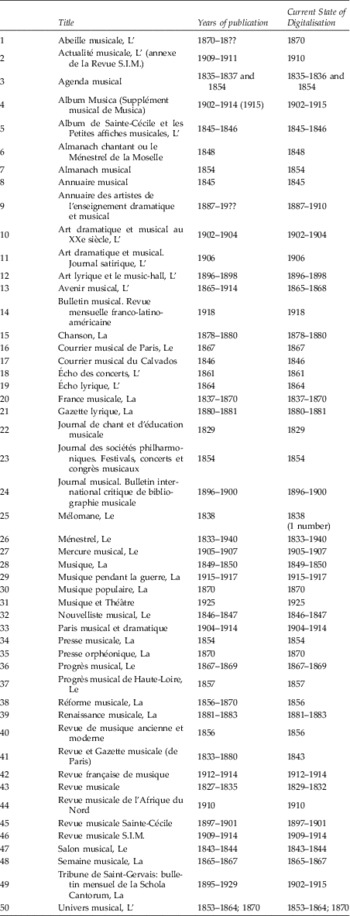
Among the collections of documents in Gallica's catalogue that are most interesting and useful for musicologists are its digitized music journals and periodicals. A simple search returned 1,249 journal titles in connection with music. But the actual number of musical journals is much smaller, because this figure includes literary and theatre (spectacle) journals in which one finds articles relating to music. For the researcher, however, it is difficult to establish precisely the total number of music journals and periodicals available on Gallica.Footnote 4 No list of these publications may be readily found, nor is there any ideal filter in the core of the search engine that permits identifying and isolating all of them. Of the 71 items returned by the search engine when given the term ‘musical’, 40 of these are periodicals that contain the words ‘musical’, ‘musicale’ or ‘musique’ in their principal title.Footnote 5 To this list must be added the journals catalogued under the subject of ‘music’, like Le Ménestrel, Les Tablettes de la Schola Cantorum and La Revue musicale S.I.M. Thus it appears that the corpus of Gallica's journals dedicated specifically to music consists of nearly 50 French-language periodicals, which have been listed in the appended table. However, this list is not exhaustive.
Some of the documents available through Gallica, however, do not actually belong to the Bibliothèque nationale itself. The development of Gallica came about not only by the digitization of the collections within the walls of the BnF, but also by linking users with already digitized collections of other institutions that are relevant to the mission of the digital library. The Gallica site thus gives easy access to collections made available by providers of electronic databases and other French libraries. With respect to music, for instance, it is the case of the sound recordings where 76 of 918 musical titles belong to the collections of the Bibliothèque municipale of Toulouse. In regard to Gallica's collection of scores, 21,510 come from the Bibliothèque nationale, 681 from the digitized patrimony of Besançon, 285 from the Bibliothèque municipale of Toulouse, and 85 from the Bibliothèque municipale of Versailles.
For the librarians responsible for Gallica, their objective is to provide an ‘encyclopedic and systematic library, representative of the great French authors, as well as of the trends of research and thought across the centuries’Footnote 6 . In Gallica's mission statement, it is further declared that ‘the enrichment of Gallica must result from a dialectic between demand and supply’.Footnote 7 Thus, the development of the digital collections proceeds according to a unique dynamic, which, since 2007, combines the parameters of conservation (because certain documents must be digitized for preservation) with the systematic enhancement of certain collections. It seeks to offer researchers some ‘consistent data sets on an author, a trend of thought or a given subject’.Footnote 8 But the conception of this digital library exceeds the relatively traditional notion of corpus about an author or a subject to achieve larger data collections. The recent development of Gallica is characterized by the construction of important research collections formed from the mass of processed documents most likely to meet the needs of researchers from different backgrounds as well as the general public. This explains the considerable effort made to scan the French daily press of the nineteenth and twentieth centuries.Footnote 9 This campaign of digitization, without being exhaustive, is on an unparalleled scale. It is an achievement of great value to the research community, which now has most of the French daily newspapers between 1830 and 1940 in a downloadable format! Such a set of sources allows extensive studies on a variety of topics, opening new research perspectives. Therefore, in this review, attention will be focused on the digitized daily press available on the Gallica site, as well as music journals and periodicals.
Newspapers Available on Gallica
For musicians, the usefulness of Gallica is not limited just to the documentary resources related to the specialized musical press (music-themed journals and periodicals), which are not as well developed as that of the daily press, or that of the literary journals or magazines of general interest, but includes its vast collection of digitized newspapers. To a certain extent, these general resources are just as important as the music press for the music researcher when taking into account the large amount of data about music they contain, and the capacity that one has to go and search through it all, thanks to the online information system. The availability of daily newspapers in digital format allows one to accomplish research on a grand scale with very little delay, and without cost or the inconvenience of travel. Furthermore, online consultation also avoids the difficulties that arise during the systematic and intensive scrutiny of large masses of data within tight restraints imposed by a trip abroad.
With respect to the French daily press, the digital library Gallica is without equal. Most major newspapers from the nineteenth and twentieth centuries are now readily accessible on line. Le Temps, Le Figaro, L'Aurore, L’Écho de Paris, La Lanterne, La Croix, Le Gil Blas, Le Journal des débats, Le Matin, L'Action française and L'Humanité, to name just a few, constitute an inexhaustible fount of information, but also are remarkable for the many images with which some of these daily newspapers were abundantly illustrated. Among the famous examples of these, for instance, there is Le Petit Journal illustré and Le Petit Parisien illustré.Footnote 10 This does not include the many general magazines, such as Les Annales politiques et littéraires, La Revue des deux mondes (one of the most visited on the site) or the more specialized journals like the literary revues Le Mercure de France and La Revue blanche. Although this huge set is not specifically devoted to music, as already mentioned, it is particularly valuable because it contains a considerable number of music reviews, opinion pieces and essays on music that is now very easy to comb thanks to the keyword search (author, title, subject) and plain text. One thinks, for instance, of ‘les feuilletons’ (serials) in Le Temps devoted to music, like those written by the famous music critic Pierre Lalo starting 1898,Footnote 11 as well as the often-cited musical criticism of Claude Debussy that appeared in La Revue blanche and Gil Blas. Perhaps less known, though not necessarily of less value, are the 77 musical chronicles that Charles Koechlin published in La Chronique des arts et de la curiosité, supplement to the Gazette des Beaux-Arts, between 1909 and 1921, and the reviews published by Georges Auric in Les Nouvelles littéraires (1922–58).Footnote 12 Thus, musicians are likely to find many valuable texts in Gallica whose presence has been unsuspected until now, especially since so many daily newspapers and specialized journals published in Paris and the provinces have been impractical to scrutinize because of limited accessibility, time constraints and uncertain results. Gallica now permits easy discovery of nearly everything of significance written on music in the French press, especially in the nineteenth century.
The musical press
So far, the campaign of digitizing musical journals and periodicals in Gallica has not seemed to follow a very systematic process. Certain very important journals, like the Revue et Gazette musicale (1827–80) founded by François-Joseph Fétis, has not been digitized (with the exception of the years 1829–32 and 1843, under the name La Revue musicale),Footnote 13 nor have Le Courrier musical (1899–1935) or Le Monde musical (1889–1940). These journals are essential tools for musicological research because of the wealth of content, both in terms of musical life (reviews of books, operas, concerts, competitions, publications) as well as the evolution of musical thought (articles in history, aesthetics, teaching, inquiry, etc.). Thus, it is to be hoped that these reviews will be very soon available on Gallica. Clearly, however, digitization efforts have focused on non-specialized music journals directed toward amateur music-lovers and concentrated on general information. Up until this point, the efforts of digitization seem to have been carried on in favour of the nineteenth century, since more than 70 per cent of the musical titles listed concern journals published before 1900. However, with the exception of La France musicale (1837–70) and of Le Ménestrel, which has the longest span of musical journals in this period, since its publication ranged from 1833 to 1940 (with an interruption during the First World War), the corpus of nineteenth-century materials is constituted of numerous more or less scattered titles, whose existence was generally quite brief. That is the case with La Revue de musique ancienne et moderne (1856), L’Écho des concerts (1861), La Semaine musicale (1865–67), La Presse orphéonique and the Journal de musique et d'enseignement populaire (1870). In other instances, the digitized collections are incomplete in comparison with their full extent according to the catalogue of the BnF. An example is La Tribune de Saint-Gervais: bulletin mensuel de la Schola Cantorum, which was published between 1895 and 1929; the present state of the digitized collection does not include the period 1902–1915, even though the BnF possesses all of the volumes. Despite its shortcomings, the corpus of musical journals and periodicals available through Gallica already is considerable. Thereby it is essential to the conduct of research on musical life between 1830 and 1940. It allows one to acquire a broader perspective of the environment, and a better understanding of the historical, sociological and technical issues that drive the music business in the periods concerned.
Manuscripts, Books and other Unique Materials
Gallica holds many wonderful surprises for musicologists. For instance, one's attention might be drawn by manuscript collections of French songs and dances dating from the twelfth to the seventeenth centuries, or perhaps by the ‘Journal de régie’ (Journal of Management) released by the Paris Opéra from the years 1831 to 1871. There also is a body of interesting autograph letters relating primarily to artists of the nineteenth century, including Hector Berlioz (549), Giacomo Meyerbeer (338), Félicien David (180), Charles Gounod (154) and Pauline Viardot (76).Footnote 14 With more than 21,000 scores, Gallica gives the researcher access to a great diversity of serious and popular music.Footnote 15 The scores online date primarily from the seventeenth through the nineteenth centuries and were published in France, although there are some original English, German and Austrian editions.Footnote 16 Among the most remarkable sets available on Gallica are the collections of ballets by Lully (69) and Rameau (59). Advanced research will uncover many works by lesser-known musicians who nevertheless were important to the musical life of the nineteenth century, including the pianist and composer Jean-Louis Adam (1758–1848) who was a professor at the Conservatoire from 1797 to 1842 (!), or the violinist and composer Pierre Baillot (1777–1842), also a professor at the Conservatoire. With respect to manuscript scores, the sampling offered by Gallica is large. Thus, for instance, we find sketches of the Ninth Symphony and sonatas op. 110 and 111 of Beethoven, as well as a manuscript of the symphony with viola solo Harold en Italie, by Hector Berlioz. In addition, there is a growing number of autograph scores of French composers, among which the best known are those of Debussy (25 manuscripts), Caplet (23 manuscripts) and Fauré (9 manuscripts). The iconographic section is particularly interesting. There are posters and prints on musical subjects, but also a large number of photographs, such as the 30 photographs taken during rehearsals of Gabriel Fauré's Prométhée at the Arènes de Bézier in 1900. Finally, Gallica also permits online consultation of certain reference works dating from before World War II, like the monumental Encyclopédie de la musique of Albert Lavignac and Lionel de La Laurencie, which was published between 1920 and 1930.
Research Using Gallica
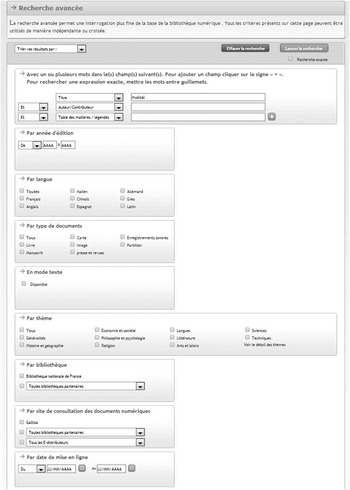
The search engine of Gallica is relatively standard.Footnote 17 On the home page, it is possible to choose the category of documents searched (books, manuscripts, maps, images, newspapers and journals, sound recordings, scores, etc.) and to enter one or more keywords in the field provided for this purpose. The search results will not be very precise, and one must manually sort the entries. An ‘advanced search’ (recherche avancée) page permits the definition of a series of parameters to narrow the search (see Figure 1).
Gallica, recherche avancée page.

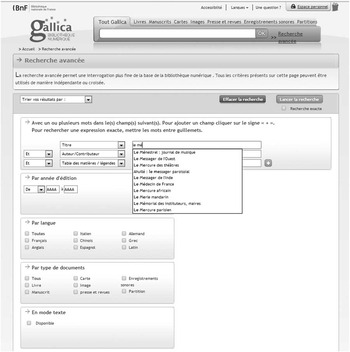
When the title of the document is known, it is often very easy to find, and Gallica's interface incorporates some helpful features. For instance, when one starts to type a keyword of the title sought, a list of documents appears that may be related to it, and, in general, the document sought usually appears therein (see Figure 2).
Gallica, recherche avancée, showing auto-complete feature.

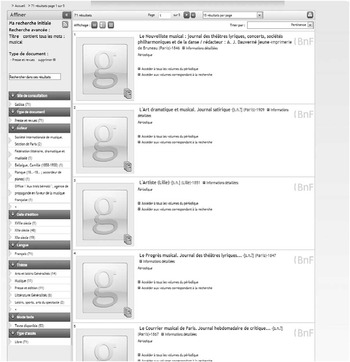
When one wishes a series of documents from keywords, the ‘advanced search’ page offers excellent filters that can display a set of pertinent results. A search that combines some keywords in the ‘title’ and ‘subject’ fields, for example, will display a great number of documents. The system, despite the limitations placed on research (dates, languages, subjects, etc.), also returns hits for keywords found in full texts. In the two cases, the results may require manual sorting by the researcher. In all cases, the results are displayed on the right in the form of a list of pages with illustrations when necessary (for maps, drawings, photos, etc.). On the left, one has access to a tool to ‘refine’ the search. The researcher then has two ways to proceed. The first of these depends on keywords to undertake a full-text search. The second is based on preset filters in the system, which act upon the initial search result: the site consulted (the BnF or other), the name of the author (if applicable), date of edition, language or subject (Figure 3).
Sample search results page.

In my experience, as well as that of several of my students, research among the digitized newspapers in Gallica can be a problem when it comes to assembling a complete bibliography of articles of an author. The OCR (optical character recognition) system cannot always identify the search terms in the documents surveyed. It still depends a lot on the print quality of the original document and on the various defects of paper and printing on a given document. If a stray mark or tiny thread modifies the word being searched, this word will not be recognized as the desired term, and that's not counting the various spellings of words. Accordingly, searches on Gallica sometimes oblige the researcher to have recourse to the good old method of systematic analysis where each volume is scanned through from the first to the last page. But, even in that case, Gallica allows the researcher to work from downloaded files and thus avoid what could be a time-consuming task in the library. To summarize, the research interface of Gallica is powerful and offers many ways to address the contents of the digital library, permitting one to find what is sought quickly. However, it is necessary to remain cautious regarding the relevance of the results delivered by the search engine.
Closing thoughts
Despite the reservations expressed above, the digital library Gallica is a remarkable tool for research in music. The section dedicated to newspapers certainly is one of the richest and most useful I know. Gallica's digitized journals, used in conjunction with the resources of the archive.org site, offer the researcher an extraordinary mirror of musical life in France between 1830 and 1914. Complementing the Bibliothèque nationale's physical holdings, including its musical scores, sound recordings and manuscripts, Gallica is a little like Ali Baba's cave, with the difference being that it can contribute to the accumulation of new treasures as well as offer its own. However, as Gallica's mission statement suggests, ‘the teams charged with enriching Gallica works … in concert with researchers to support current mainstream research’.Footnote 18 Consequently, it falls to researchers to initiate new campaigns of digitization from their projects and thus actively contribute to the expansion of one of the most important currently available digital libraries on the Web.
Principal Musical Journals Available on Gallica.