Etienne-Jules Marey consistently distanced himself from cinema. Marey replied to a journalist who asked him about cinema, “Do not enmesh me, my dear friend, in cinematography; the exercises of the ‘biograph’ are a sport quite different from those that I studied on occasion” (Marey in 1902, quoted in Mannoni Reference Mannoni, Font-Réaulx, Lefebvre and Mannoni2006, 32). This statement can serve as an emblem of the wary relationship between the sciences and moving-image technologies. To the extent that the history of science and cinema has been investigated, the cinema's role often has been understood in terms of Foucauldian discipline, with the scientific use of cinema involving regulation and control (Cartwright Reference Cartwright1995). Marey's homme squelette is a well-known example of the scientific management of cinematic technology. Marey's images transformed the human form in motion into a schematic outline that consisted of a series of static data points, and a general principle that can be taken from this specific example is that in order to make motion pictures useful for scientific inquiry, the reproduction of motion has to be regulated, if not completely ignored. An emphasis on how scientific uses of cinema have placed a premium on manageability and analysis can lead to the categorical assertion that cinema and science are antithetical, if “cinema” is understood as a technology for producing the “illusion of motion.”Footnote 1
A series of dichotomies emerges from this approach: science/cinema; analysis/synthesis; motion/stillness; objectivity/subjectivity; rationality/entertainment. These oppositions helpfully organize scientific approaches to the moving image, but they also oversimplify and obscure certain aspects of this field. The last dyad, rationality/entertainment, for instance, has a long history of conjunction prior to the twentieth century.Footnote 2 As Hannah Landecker has noted, the “assumption of a radical bifurcation of scientific imaging of movement and entertainment cinema” has “encouraged a retrospective and artificially stark distinction” (Landecker Reference Landecker2006, 123).Footnote 3
The synthesis of movement was, in fact, a widespread scientific practice, embraced for a number of different, often overlapping reasons. The moving image could serve as a mode of verification of an analytic process, as in the use of the zoetrope to reconstruct chronophotographically decomposed movements. Moving images made time-based phenomena portable and repeatable, allowing investigators to circulate a record of an observation. Instead of having to perform the same experiment repeatedly, a moving image could preserve it; repeatability was especially valuable in cases of rare phenomena, such as certain pathological movements, microscopic observations, or unusual surgeries.Footnote 4 Additionally, sharing an observation via a moving image allowed for a significant amount of variation in the size of the audience. Finally, moving images could manipulate the temporal dimension of the recorded event via the procedures of slow motion and time lapse.
The concept of education unites these various capabilities, encompassing both the moving image's ability to reproduce and circulate phenomena as well as its place in a dialectic between still and moving images.Footnote 5 All the understandings of education discussed below view the reproduction of motion as more than an illusionistic epiphenomenon. In these examples, the moving image is understood as itself something scientifically useful, whether in training observers or in disseminating knowledge. The moving image's educational potential thus also connects professional and popular forms of science, providing knowledge that delivered a form of insight unavailable or not as effective as when presented in other ways.
The field of microbiology provides a particularly fertile field for understanding how motion pictures proved instructive at the turn of the twentieth century.Footnote 6 The views afforded by the microscope were a frequent subject for early scientific moving pictures. The concept of “swarming” recurs as a way to describe the impression of microscopic life.Footnote 7 Swarming indicates qualities particular to the moving image, and it constitutes a form of shorthand for the moving image's ability to convey complex movement as well as the ability to make that movement portable.Footnote 8
Swarming movement represented, in a sense, a continuation of a problem that had already been encountered in the medium of photography, namely, excessive detail. An editorial in the British Medical Journal bemoaned this aspect of the photographic medium, “photographs of diseased viscera often fail to instruct the observer, but rather remind him of Ovid's description of chaos” (Anon. 1886).Footnote 9 The familiar reaction to this incoherent mass of detail was to tame it with analysis and abstraction. The visual impression of complex movement also had an instructive benefit, however. The depiction of such movement played a positive role either by fascinating and provoking further observation or by constituting precisely the movement that was deemed instructive. In this sense, the scientific interest in the motion picture that this essay traces is related to the well-known reactions of early audiences to the first public projections of motion pictures, where viewers expressed astonishment at reproduction of such complex movements as that of the wind rustling through the leaves of a tree, a puff of dust caused by the demolition of a wall, or the movement of the waves on a stormy sea.Footnote 10
“The True Sensation of Movement”: Mareyian Synthesis
Etienne-Jules Marey's skeptical if not downright hostile attitude towards commercial cinema has led accounts of his work to draw a sharp distinction between scientific uses of moving-picture technology and the sphere of illusion and entertainment. In the words of one biographer, “Marey . . . had no interest in constructing an illusion of movement, or any other illusion. . . . Marey's cinematic inventions were an extension of his attempt to analyze movements in real time; he never desired to reproduce what the eye could already see” (Braun, Reference Braun1992, 150–1).Footnote 11 The characterization of Marey's work as devoid of applications for the synthesis of motion was helpful in differentiating Marey from Muybridge, since the two figures frequently had been lumped together as similar if not identical “pioneers of cinema,” but it overstates the case. While Marey certainly was not interested in commercial applications of moving images, he did, however, have an interest in reproducing “what the eye could already see.”
Marey's use of the zoetrope can serve as an initial indication of this interest, which he used as a means of verifying his graphic inscriptions beginning in the 1870s.Footnote 12 Marey's interest in the synthesis of movement went beyond verification, however, which is evident in a letter he wrote to La Nature, occasioned by the publication of Eadward Muybridge's chronophotographic studies of horse movement. “And then what beautiful zoetropes he [Muybridge] could give us; we would see there in their true gaits every conceivable animal; it will be animated zoology. As for the artists, it is a revolution for them, since it will provide them the true positions of movement, the positions of the body in unstable equilibrium that cannot be posed by a model” (Marey Reference Marey1878; emphasis in original). This letter is characteristic of Marey's broader interest in the recreation of movement, which is manifest in two ways. On the one hand, the phrase “animated zoology,” which anticipates a formulation frequently employed in the cinema's first decade, that of “animated photography,” demonstrates how part of what fascinated Marey about Muybridge's work was how it aided the project of cataloging all forms of earthly movement. Thus zoology's novelty lay precisely in the animation of what had previously been static. On the other hand, Marey's mention of beauty, as well as his claim that this kind of imaging would provide a “revolution for [the artists],” points to his acknowledgment of aesthetic uses of his work.Footnote 13 These two aspects of the moving image indicate that for Marey the ability to recreate movements was useful for what it could contribute to the expansion of visual knowledge, both as a storage medium and as a source of accurate reference.
Another dimension of Marey's interest in the synthesis of movement becomes evident in his experiments with chronophotography of microrganisms. In a note to the Académie des sciences, he wrote, “On these chronophotographs, movements, their nature and their speed can be deduced by the changes in position of the objects presented in successive images. This determination, while very precise because it allows to be known the fraction of the thousandth of the millimeter of which the object has moved at each tenth of a second, speaks rather more to the mind [l'esprit] than to the senses [aux sens]” (Marey Reference Marey1892, 990). This dichotomy distinguishes between the analytic, still image, which appeals to “the mind,” and the moving image, which appeals to “the senses.” In other places in Marey's writings, this distinction privileges chronophotography's ability to break down movement with precision over the moving image's appeal to sensory perception.Footnote 14 As the note continues, however, it becomes clear that Marey's interest did not lie primarily with the work of analysis in this case.
But it is possible to give to the eye the true sensation of movement by projecting these images successively upon a screen, by means of an apparatus that I will have the honor to present to the Academy in a future meeting. This apparatus is based on the properties of the analyzer; I call it the chronophotographic projector. It makes it possible to show to a large audience the completely natural movements of objects of which one has collected successive images with chronophotography. (Ibid.)
Marey wanted to present “the true sensation of movement by projecting these images successively upon a screen.” The chronophotograph's ability to analyze becomes secondary, and the primary interest is to show “the true sensation of movement” to a large audience.
A similar dynamic appears in the final chapter of Marey's La Mouvement (Reference Marey1894), “Synthesis of Movements Analyzed by Chronophotography.”Footnote 15
When chronophotography translates successive positions of a moving object, it shows them to us completely differently from how our eyes see them. In each of these positions, the object appears immobile, and the actions that are produced in successive moments are brought together in a series of images as if they were simultaneous. These images therefore appeal more to the mind [à l'esprit] than to the senses [aux sens]. They prepare us, it is true, to observe nature better and to seek out, for example, in an animal in movement, positions that we have not yet perceived. But this education of our eye can be made even more complete if, in presenting the images to it in a certain manner, one renders to it the impression of movement in the conditions to which it is accustomed to capturing them. (Marey Reference Marey1894, 297)
In other words, chronophotography's education of the eye contains both the operation of chronophotographic analysis as well as that of synthesis (be it via a zoetrope or projected image). The synthesis of movement, the duplication of normal perception, emerges not as a subsidiary, uninteresting illustration, but as a final step in a multi-stage process, the completion of an educative dialectic. The eye, instructed by the analytic images, carries that knowledge into “the conditions to which it is accustomed to capturing them [the images].” This use of the moving image goes beyond verification; it represents the completion of a process whereby normal vision is enhanced by contact with the insights of analysis. The technological reproduction of movement allows for the enrichment of perception; vision is transformed by a theoretical position, by an educative process.Footnote 16 While going beyond the other examples of educative moving images in its reliance on a dialectic between still and moving image, this instance of Mareyian synthesis nonetheless deserves mention among the various approaches that saw in the moving image a resource for instruction.Footnote 17
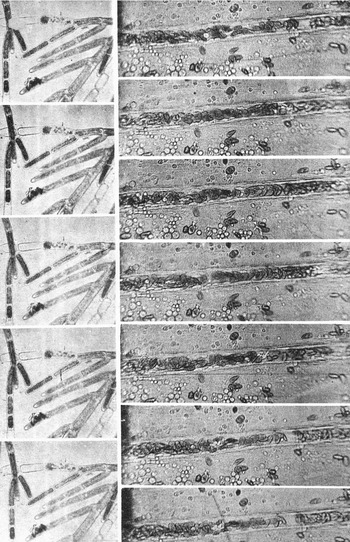
Finally, Marey continually used the projection of moving images, especially in public presentations of his research. As early as 1867, Marey gave a lecture at the Sorbonne that involved wiring himself to a “projection polygraph” to demonstrate in real time the graphic traces generated by his respiratory movements, his heartbeat, and his muscular contractions (see Mannoni Reference Mannoni, Font-Réaulx, Lefebvre and Mannoni2006, 32). He staged an elaborate and lengthy presentation to the Collège de France in 1891 entitled, “A New Method for Analyzing Movement in the Natural and Physical Sciences,” where he demonstrated the many applications of chronophotography that he had developed (Marey Reference Marey1891, 689). One section of this presentation concerned experiments Marey had undertaken by taking chronophotographs through the microscope. He was interested in visualizing the high-speed movements of infusoria. Frame-by-frame analysis of the chronophotographic record figured importantly as part of this work, allowing, among other things, the calculation of the speed of blood flow in the capillary vessels of a newt. This calculation could correct the misleading visual impression of the flow as a “torrent,” since in fact the flow was quite slow (fig. 1).
Two different uses of chronophotography. Plate 3 from E-J Marey, Le Mouvement (Reference Marey1894).

The moving images of microscopic movement were also useful since they served as a way of cataloging unusual forms of movement. As Marey wrote, “There are an infinity of the most curious movements in the field of the microscope” (ibid., 716). Regarding his series of images that represented the movements of zoospores, also called swarm spores, in the cells of the water weed, Marey wrote, “These small organisms, which also contain chlorophyll, bustle about in all directions; their movement is conveyed in the series of images by the different positions that they occupy inside their mother cell. But nothing can render, for one who has not seen it, the peculiar activity that reigns at the interior of this cell and that does not cease until all the zoospores have succeeded in escaping” (Marey Reference Marey1894, 294). Marey notes how the series of images can “convey” the movement, but the precise qualities of that movement escape such a mode of presentation. Marey is concerned here with a quality of observation that stems from the unique visual impression of these unusual movements.
The singularity of this movement is something that only can be rendered by the kind of vision emulated by the synthesis of chronophotographic projection.Footnote 18 Here, side-by-side on the same plate, two rather different uses of chronophotography are juxtaposed; on the one hand, in the images of the circulation of blood, the emphasis is on the use of precise measurement to counteract a misleading visual impression. On the other hand, in the images of the zoospores, there is a record whose primary interest is the impression of (unusual) movement that cannot be properly appreciated as a static image. Taken together, these uses of the moving image indicate a dimension of Marey's project that contained an appreciation for how moving images could verify, demonstrate, and educate. The moving image, in other words, participated in instead of opposed his scientific project.
“Extremely Instructive Demonstrations”: Wilhelm Pfeffer and Robert Watkins
Wilhelm Pfeffer and Robert Watkins did not have much in common: Pfeffer was an internationally renowned research scientist in the field of physiological botany while Watkins was an American physician whose research had little to no impact. Both men, however, held similar views on the moving image's utility as a means to disseminate knowledge about movements seen with the microscope. In 1900 Pfeffer published a lengthy article that detailed his experiences with projection devices in the university lecture hall. His premise was “that it is extremely instructive and important to demonstrate to the audience in a directly visible manner growth and other movement processes” (Pfeffer Reference Pfeffer1900, 711).Footnote 19 This emphasis on the instructiveness of presenting movement in a “directly visible manner” recalls Marey's characterization of his projections as creating the “true sensation of movement.” Pfeffer's use of optical projection technologies also invokes the concept of Anschauung, a prevalent component of nineteenth-century rationales that argued for the benefits of visual education.Footnote 20 Indeed, by uniting the instructive and the entertaining as well as placing an emphasis on the visual, Anschauung forms a functional equivalent to the concept of “education.”
Most of Pfeffer's projections of microscopic preparations were achieved without the use of cinematic technology, which he reserved for making time-lapse records of plant growth.Footnote 21 Pfeffer's lectures involved projections that ranged from the macroscopic, as in episcopic projections of the mimosa's movement, to the microscopic, and they were a crucial method for demonstrating the manifold varieties of plant movement. One type of microscopic projection Pfeffer used demonstrated “swarming movements” (Schwärmbewegungen) of various microorganisms (he recommended either the Paramecium Aurelia or the Pandorina morum, but he also described projections of the zoospores of the water-weed similar to those discussed by Marey). His use of projection exemplified not only how nineteenth-century demonstration techniques and cinema coexisted, but also how film's status was not that of an heir apparent in the realm of the visual but rather that of an expensive and minor add-on.Footnote 22 For university-based lecturers, established demonstration techniques were perfectly adequate. In Pfeffer's case, cinema provided a new possibility that was superior in certain cases, but often nothing special.Footnote 23 Pfeffer's article described a projection practice that involved multiple technological bases for producing the moving image. As in Marey's work, where the moving image could be produced by a zoetrope or a projector, for Pfeffer the appearance of movement on a screen could come about via the projection of living organisms or via the projection of a time-lapse film. This equivalence among media counters the tendency to read the history of the moving image and science as the history of cinema and science. Cinema was one technology among several at the turn of the nineteenth century, and while it assumed a dominant position in the course of the twentieth century, its emergence was imbricated in a number of other media histories.Footnote 24
The equivalence among media is particularly evident in the following passage where Pfeffer links the magnification of space to the magnification of time.
In fact humanity would have developed a different and much more correct representation of the lively activities in the plant if all or the majority of vegetable organisms carried out directly perceptible movements, as, for example, the Mimosa pudica, or if it were possible for every human from childhood onwards to observe nature, even if only occasionally, magnified 50,000 times or to see plants in vivid moving activity by the compression of their time of development (as in the aforementioned presentations). (Pfeffer Reference Pfeffer1900, 743)
What links these demonstrations, then, is not a particular device but rather a shared notion of magnification.Footnote 25 Whether optical or temporal, magnification made movements visible that otherwise would have remained hidden, from the streaming of protoplasm to geotropism. Above all, these techniques made visible the “vivid moving activity” – both the movement in plants as well as the movement of plants – whose optical presentation formed the basis of an instructive experience. Pfeffer's projections are in line with the use of botanical illustrations and projections as discussed by Anne Secord, “The aim [of projected botanical illustrations] was not to teach beginners how to look at pictures but, rather, how to use pictures to develop the observational skills necessary for looking at plants and other objects of nature” (Secord Reference Secord2002, 32). The appeal to visual pleasure, which Secord links to the needs of ascendant groups “to stimulate the pursuit of science in all sections of society,” draws in the uninitiated (Secord's metaphors for this operation are alternately gustatory and aquatic, with images functioning as an “appetizer” or as “waterwings”), enticing observers with the ultimate aim of teaching them how to think (ibid., 30)
Alongside the use of the living image for demonstration purposes, Pfeffer's projections also involved the demonstration of death. A perennial problem with the projection of living microscopic organisms was that of reducing the amount of light/heat, which turned living organisms into dead objects rather quickly. Pfeffer described what by that time had become standard methods of absorbing heat, but he also recommended killing organisms as a demonstration as well, “By removing the iron solution, the death of the organisms can be induced and demonstrated” (Pfeffer Reference Pfeffer1900, 713). The demiurgic quality of this kind of demonstration includes both the ability to show living motion on the screen as well as the ability to make it cease.Footnote 26
The moving image functioned for Pfeffer as an important device for showing living processes, and one of the most widespread of such processes, the movement of blood, quickly became a mainstay of microcinematic representations. Robert L. Watkins, a New York physician, demonstrated a particularly early interest in using the cinema to capture microscopic movement.
For more than a year I have been trying in various ways to present living microscopic objects on a screen . . . . By using from 50 to 150 feet of the vitascopic film, and taking a series of impressions in sufficiently rapid succession, I have been able to secure pictures which when passed through a lantern at the same rate of speed will present on a screen all the motions of the objects photographed. (Watkins Reference Watkins1897, 857)
Watkins saw in microscopic observation of living blood samples a superior method for the diagnosis of illnesses, and he saw in cinema an ideal method for preserving and sharing his observations.
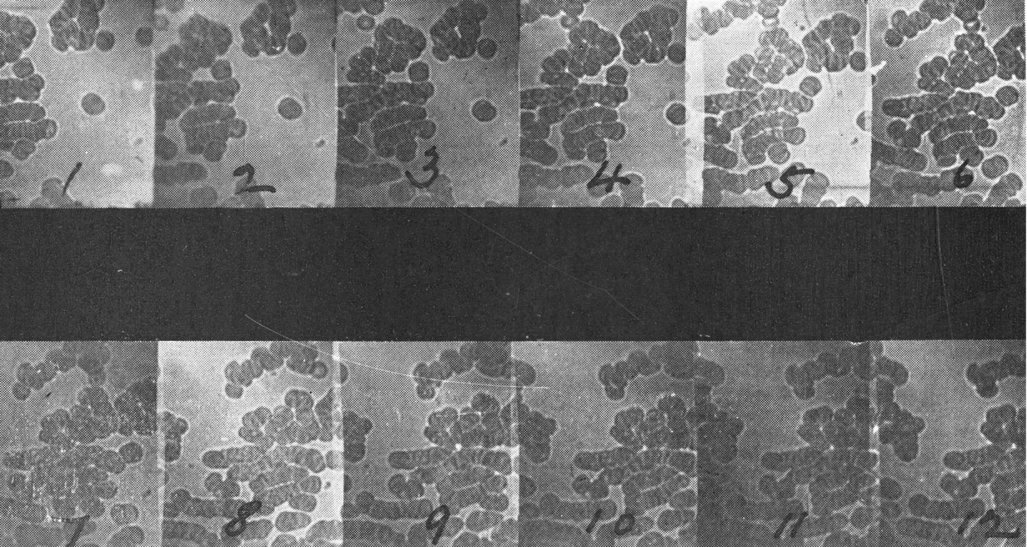
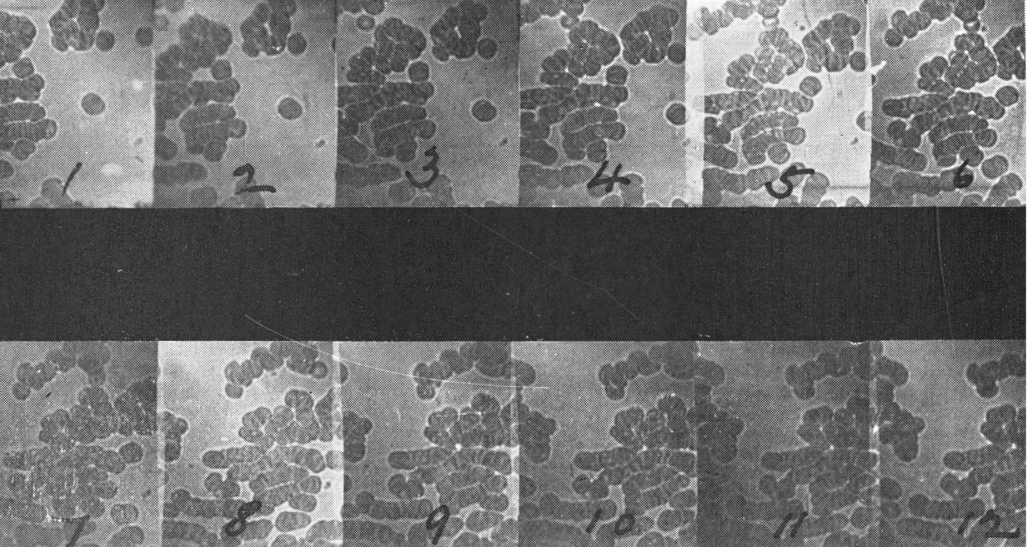
On the one hand Watkins imagined that this method would “help us to get one step nearer the ultimate processes of life.” More practically, however, the “micromotoscope,” as he called his contraption, allowed him to study “the ameboid motion of the leucocyte,” and proved useful in the “study of the life of microbes in stale urine and other fermenting fluids” (ibid.). The thread that connected all of his remarks about the photographic moving image was its value in education, “The value of this discovery cannot be overestimated, not only for the use of the scientist in studying the vital processes of microscopic life, but also as a method for teaching these facts to students and the public” (ibid.). Writing about his use of the micro-motoscope to film syphilitic blood, he asserted, “Until the author adopted the vitascope to microscopic photography, it was impossible to photograph this germ so that it could be made plain to the student” (Watkins Reference Watkins1902, 246). He also suggested that the micro-motoscope would be a good way to demonstrate the generation of red blood cells “to an audience of physicians” (ibid., 277) (fig. 2).
Blood under the microscope; reproduction of successive film frames. From Robert Watkins, Diagnosis by Means of the Blood (Reference Watkins1902).
Near the end of his book, Watkins quoted from an article that appeared in the Photograms of the Year (Reference Watkins1897), which singled him out for praise,
Dr. Watkins . . . combined kinetography and photomicrography, so as to be able to record and reproduce the movements of objects so small as corpuscles, rotifers, microbes. This power of studying the motion of the corpuscles is expected to prove of infinite value in the diagnosis of certain diseases. From this it will be seen that kinetography, which commenced in a scientific industry, has made distinct steps in scientific progress, in addition to captivating public taste. (Ibid., 368)Footnote 27
This connection between cinema's genesis in “scientific industry” and its subsequent “captivating” of “public taste” marks a recurring tendency of the moving picture in the service of science, namely, its transit among exhibition contexts.Footnote 28 Motion pictures of microscopic objects constitute a particularly mobile form of knowledge, not only depicting complex movement but also moving among various contexts, from the scientific congress to the music-hall turn. This mobility is a function of both the moving image's medial nature as well as its appeal to the senses, its spectacular qualities. The rhetoric of education often draws on precisely these qualities of the moving image – its vividness, its ability to produce a memorable experience – and these “exoteric” qualities link scientific and non-scientific audiences.Footnote 29
“Almost Magical Images of the Highest Scientific Interest”: The Microcinematographic Films of F. Martin Duncan and Jean Comandon
The two first major cycles of popular science film, both of which commenced with microcinematographic series, further demonstrate this kind of mobility of the moving image. In 1903 a series of films appeared in England that constituted the first sustained attempt at scientific education via cinema when Charles Urban hired Francis Martin Duncan to produce films on various natural history subjects.Footnote 30 Duncan, the son of Dr. P. Martin Duncan, a multifaceted scientist and popularizer, had previously worked in popular science publishing; prior to working for Urban he wrote First Steps in Photo-Micrography: A Hand-Book for Novices (1902) and contributed to the journal of the Quekett Microscopical Club. Duncan experimented with mounting photographs of microscopic organisms onto a zoetrope in the early 1890s, which aligns him with other nineteenth-century scientific investigators and their interest in synthesizing movement (while also suggesting how commonplace this procedure was) (Anon. 1908).
Duncan wrote a programmatic article before the release of the first series of his films, which concisely posited a series of arguments about cinema's usefulness, both drawing on previous arguments about the qualities of visual education while extending this line of thought to include the new medium. “‘Knowledge,’ says Plato, ‘is nothing else but to remember.’ Now the eye is of the greatest importance and assistance to the brain in storing up knowledge, in a word, the keener the power of perception and observation, the easier the gaining of knowledge (i.e., the power of remembrance)” (Duncan Reference Duncan1903, 550). Duncan saw a particular future for the cinema, “in a very short space of time animated photography will no longer be a mere pastime, but a vital necessity; and we shall see not only every theater and music hall, but every school, college, technical institution, hospital, laboratory, academy, and museum fully equipped with apparatus for projecting animated pictures” (ibid., 549).Footnote 31 The fields he envisioned as being taught by these means included “medical teaching,” “the study of bacteria,” “keeping a truthful record in scientific research work,” agricultural propaganda, and the following school subjects: history, astronomy, biology, zoology, geology, mechanics, and botany.
The first series of Duncan's films premiered at the Alhambra Theater in London on 17 August 1903 under the title “The Unseen World: A Series of Microscopic Studies, Photographed by Means of the Urban-Duncan Micro-Bioscope.”Footnote 32 The series presented all manner of microscopic movements, from the infamous Cheese Mites, which were said to “creep and crawl in all directions,” to Circulation of the Blood in the Frog's Foot; The Volvox Globator; Ciliary Movement of the Gills of a Mussel; the first cinematographic records of living typhoid bacteria; and The Circulation of Protoplasm in the Waterweed. The educational value of these films lay not only in their visualization of microscopic phenomena but also in the moving image's ability to make phenomena portable and hence shareable, thus allowing for the circulation of knowledge. In a comment echoing Marey's words about how his projector would show movement to a large audience, a journalist commented: “[Urban/Duncan] has succeeded in making a number of cinematographic records of microscopic observations, so that it is now possible to watch upon the screen the actual processes of protoplasmic life, and show a large audience what has hitherto only been observable by the scientist” (Anon. 1903a). Another journalist's reaction to the film of protoplasmic circulation, which was practically identical to Marey's remark about the importance of seeing for oneself the movement of the zoospores, further suggested the affinities between Marey's demonstrations and Duncan's shows, “The representation of protoplasmic circulation in a leaf must be seen to be appreciated” (Anon. 1903b).Footnote 33
The second major flourishing of popular science film took place in France at the turn of the 1910s. The initiator of this cycle, Jean Comandon, came from the burgeoning ranks of professionally trained scientists who saw in cinematic technology a research tool. Comandon was trained as a microbiologist in the laboratories of Dr. Paul Gastou at the Hôpital St. Louis and Dr. Albert Dastre of the Faculté de médecine de Paris. He specialized in syphilis research, and his area of expertise involved using the ultramicroscope to study the movements of Treponema pallidum, the syphilis spirochete. Comandon's research inherited the Mareyian tradition of movement analysis, as he himself acknowledged, “In thus studying each image individually, one can analyze the movements of microorganisms, as Marey has done so successfully with the human gait and the flight of birds” (Comandon Reference Comandon1909b, 843).
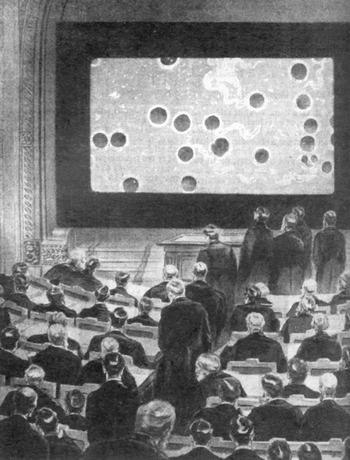
Comandon also inherited the tradition of using the moving image to share the sight of rare movements with an audience (fig. 3).Footnote 34 Comandon's article in La Presse médicale, which appeared at the same time as his presentation at the Académie des sciences, contained thoughts about how his films were destined for an educational context: “Projected on the screen at the same speed [at which they were taken], these photographs allow the real appearance [l'aspect réel] of the preparations to be reproduced. They can be therefore, we believe, of a great usefulness for teaching and scientific popularization” (ibid.). An accompanying article announcing a special screening for the magazine's subscribers echoed this opinion, “the cinematograph will soon assert itself as a marvelous method of instruction” (Desfosses Reference Desfosses1909, 914).
An image of Jean Comandon's lecture at the Académie de médécine. From Je Sais Tout, 15 May 1914.

The use of the word “marvelous” is telling; Comandon's films sparked their viewers’ imaginations. One reason for this power was the particular qualities of the ultramicroscopic image, which makes the objects being observed appear luminous against a dark background. Comandon analogized this appearance by comparing the images on the one hand to “a starry sky” (Comandon Reference Comandon1910, 319), and on the other hand to something magical, “Everyone who has worked with this mode of examination, against the black background, knows how beautifully certain preparations can appear. They doubtlessly have regretted not being able to preserve these almost magical images of the highest scientific interest [ces images presque féeriques et du plus haut intérêt scientifique]” (Comandon Reference Comandon1909b, 841).Footnote 35 The associative qualities of the images emerged in a different register in Comandon's description of the appearance of the trypanosome that causes sleeping sickness.
It is particularly interesting to watch the swarming [grouillement] of these parasites in the blood of a sick rat. They have a string-like form, an undulating membrane runs along the length of their body. These small, flexible beings circulate between the blood cells with an extraordinary rapidity and agility. The jostled red blood cells are deformed, bounce back, but thanks to their elasticity, soon resume their basic appearance. In several days these microbes multiply in a prodigious fashion, becoming more numerous than even the red blood cells, and it is a veritable nightmare vision that presents itself in the feverish wriggling of these organisms in fantastic forms seemingly evolving in a vast aquarium that is nevertheless only the fifty-thousandth part of a drop of blood. (Comandon Reference Comandon1910, 328)
In this passage Comandon moves from a sober description of parasitic morphology to the ekphrasis of a Bosch painting. The words “prodigious,” “veritable nightmare vision,” and “fantastic” belong to a tradition of analogizing the microscopic view, transforming the unusual appearance and movements visible in it into a world of monsters. This recourse to the appeals of scientific showmanship is something that Comandon developed for the remainder of his long career and that allowed him to inhabit a position that moved between research science and popularization.
The microcinematographic films at Pathé launched a vogue for popular science films in France at the turn of the 1910s, which was part of a wider interest in the possibility of deploying cinema as an educational medium. One example of this interest was Emile Brucker, a teacher at the Lycée Hoche at Versailles, who wrote about introducing “the swarming [le grouillement] of life” into his classes by means of cinema (Brucker, quoted in Delmeulle Reference Delmeulle1999, 46). Brucker had a disdain for stuffed or otherwise prepared animal specimens, which he thought “give the idea of the animal world as a cemetery gives the idea of human society” (Delmeulle Reference Delmeulle1999, 46). The importance of seeing things in motion, which was often signaled with the adjective “vivid,” linked the cultures of professional science and popularization via the concept of education. The swarming movement that the microscope frequently revealed is a figure for the challenges and pleasures of the moving image in science more generally. In its fascinating profusion, swarming was a phenomenon that the moving image could both tame through analysis as well as vividly recreate, allowing for a sensual experience that either could stand by itself or could serve as an initiation into the pleasures of analysis.
Acknowledgments
I was given the time to write this article thanks to a study leave provided by Temple University during the academic year 2008–09. From January 2009 to June 2009, I was a Visiting Researcher in Department II at the Max Planck Institute for the History of Science, where most of the article was written. The Institute's convivial and stimulating atmosphere was conducive to my work, and I benefited in particular from conversations with Andreas Mayer, Tania Munz, Henning Schmidgen, and Jeff Schwegmann. In the process of revising the article, I benefited from the comments of the journal's two anonymous reviewers as well as Hannah Landecker's helpful feedback.