Introduction
Species of gall-forming Braconidae are intrinsically fascinating, since the family is mostly comprised of parasitic species and plant-feeding braconids are comparatively rare (Marsh, Reference Marsh1991, Reference Marsh2002; Shaw, Reference Shaw, Hanson and Gauld1995). In this paper, we describe three new species of gall-associated Allorhogas from Costa Rica, where 18 species have been described (Marsh, Reference Marsh2002; Chavarría et al., Reference Chavarría, Hanson, Marsh and Shaw2009; Centrella and Shaw, Reference Centrella and Shaw2010). The genus Allorhogas is distinguished by its having an excavated frons and a curved hindwing vein m-cu. The genus is of particular interest because of the intriguing discovery that several species are phytophagous and sometimes even primary gall formers (Marsh, Reference Marsh2002; Wharton and Hanson, Reference Wharton, Hanson, Raman, Schaefer and Withers2005; Chavarría et al., Reference Chavarría, Hanson, Marsh and Shaw2009; Centrella and Shaw, Reference Centrella and Shaw2010).
The genus Allorhogas was described almost a century ago by Gahan (Reference Gahan1912), yet detailed biology has been lacking for many years (Chavarría et al., Reference Chavarría, Hanson, Marsh and Shaw2009). The first published observations of phytophagous behaviour in Allorhogas were in A. dyspistus Marsh from Brazil, which forms galls in the seeds of Pithecellobium tortum Mart. (Fabaceae) (Macêdo and Monteiro, Reference Macêdo and Monteiro1989; Marsh, Reference Marsh1991; Macêdo et al., Reference Macêdo, Pimentel and Vieira1998). Later, two more species of Allorhogas from Brazil were found to form galls in the seeds of Fabaceae (Marsh et al., Reference Marsh, Macêdo and Pimental2000): A. brasiliensis Marsh on Balizia pedicellaris (Dc.) Barneby & Grimes (cited as Pithecellobium) and A. spermaphagus Marsh on Stryphnodendron polyphyllum Martius. In Costa Rica, Allorhogas argentinus Marsh is known to make galls in the seeds of Abarema macradenia (Pittier) Barneby & Grimes (cited as Pithecellobium), and Allorhogas hansoni Marsh is associated with Inga vera Willd. (Marsh, Reference Marsh2002). The aforementioned five species all have biological associations on trees in the plant family Fabaceae. Allorhogas mendocinus (Kieffer & Jörgensen) was hypothesized to be a bud gall inducer on Lycium chilense Miers ex Bertero (Solanaceae) in Argentina, although more data are necessary (Martinez et al., Reference Martinez, Zadivar-Riverón and Sáez2008). Costa Rican Allorhogas conostegia is named after an association with the fruits of that genus Conostegia in the family Melastomataceae (Chavarría et al., Reference Chavarría, Hanson, Marsh and Shaw2009). More recently, Costa Rican Allorhogas minimus Centrella & Shaw has been described as phytophagous on fruit galls on the plant Miconia longifolia (Aubl.) DC (Melastomataceae) (Centrella and Shaw, Reference Centrella and Shaw2010).
All three new species can be keyed to Allorhogas ardisia Marsh at the first part of couplet eleven (11) in the key to Allorhogas species by Marsh (Reference Marsh2002), and also to the same couplet in the revised key provided by Centrella and Shaw (Reference Centrella and Shaw2010). The three new species can be separated from A. ardisia by the following short key insert:
11(10) Propodeum coriaceous laterally, at most weakly rugulose above hind coxa:
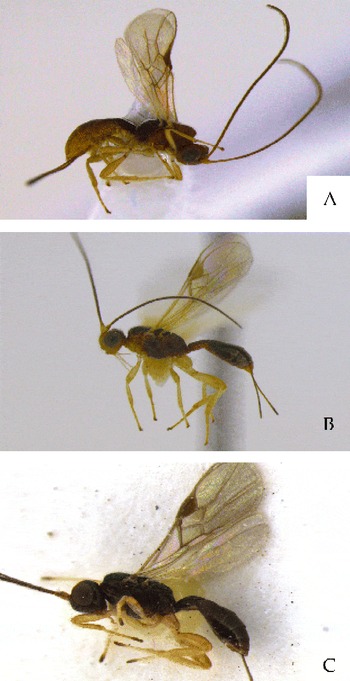
11a Body mostly dark brown or black (Fig. 1C), face black; smooth circle present in the centre of its face; median mesonotal lobe anteriorly with a distinct longitudinal groove (Fig. 2B); coriaceous triangular area present on T1 anteromedially, bordered by strong carinae; hindwing veins basally ‘crunched’ (Fig. 3C); associated with Psychotria (Rubiaceae) fruit galls …… triopsis Centrella and Shaw, NEW SPECIES
– Body mostly yellow or light brown (as in Fig. 1A and B), face yellow or light brown; face coriaceous and lacking a central smooth area; median mesonotal lobe anteriorly without a longitudinal groove (as in Fig. 2D); T1 and wings not as above; associated with other plants ……………………………………………… 11b
11b Mesonotum, including median mesonotal lobe, evenly covered with long dense setae; malar space 0.53 × eye height; ocell-ocular distance 1.67 × the diameter of lateral ocellus; associated with leaf galls on Protium panamense Rose (I.M. Johnston) (Burseraceae) ………………………… crinitus Centrella and Shaw, NEW SPECIES
– Mesonotum with long setae concentrated along margins of notauli, and with median mesonotal lobe lacking long dense setae; malar space shorter, 0.31–0.33 × eye height; ocell-ocular distance broader, 2.33–3.0 × the diameter of lateral ocellus; associated with other plants…………………………………………………………… 11c
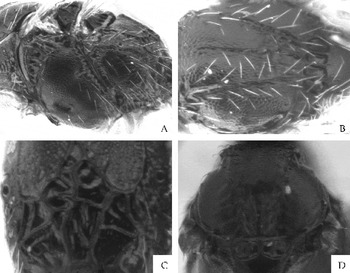
11c Sternaulus pit-like (Fig. 2A); associated with galls on Melastomataceae …………………………… lacuna Centrella and Shaw, NEW SPECIES
– Sternaulus broader, smooth and shallow, not pit-like; associated with leaf galls on Ardisia (Myrsinaceae) …………………………………………………………………… ardisia Marsh, Reference Marsh2002
(colour online) Habitus of female: (A) Allorhogas crinitus; (B) Allorhogas lacuna; (C) Allorhogas triopsis.

(A) Allorhogas lacuna mesonotum, dorsal view; (B) Allorhogas triopsis mesonotum, dorsal view; (C) A. lacuna propodeum, dorsal view; (D) A. lacuna mesosoma, lateral view

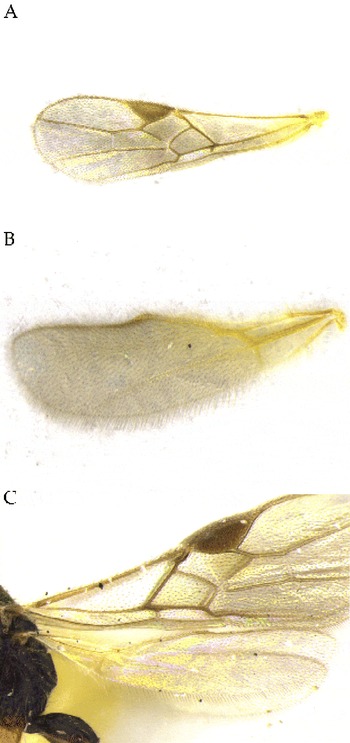
(colour online) (A) Allorhogas lacuna forewing; (B) A. lacuna hindwing; (C) Allorhogas triopsis fore- and hindwings, lateral view.

The first species described in this paper, Allorhogas crinitus NEW SPECIES, has been reared from leaf galls found on P. panamense. This is the first time any Allorhogas species has been associated with the plant family Burseraceae. These leaf galls are detachable and spherical, almost more cylindrical in shape and about 3 mm high and 3–4 mm wide with a concave apex; light green when young, brown when old (P. Hanson, personal communication). The primary former of these galls is a so far undetermined species of Cecidomyiidae (Diptera). It is unknown whether Allorhogas is a parasitoid of the flies inside the galls or if it is inquiline, and phytophagous on the gall itself. If the wasp is inquiline, this would be the first phytophagous association of Allorhogas on the plant family Burseraceae. If A. crinitus NEW SPECIES is a parasitoid, this would be the third possible parasitoid in the genus Allorhogas. The others are A. hansoni Marsh, which is associated with I. vera (L.) Britton. (Fabaceae) fruit galls and is either an inquiline or a possible parasitoid of tanaostigmatid wasps (Marsh, Reference Marsh2002), and Allorhogas ingavera Marsh, which is found in leaf galls on the plant for which it is named, I. vera. These galls are caused by an undescribed cecidomyiid, much similar to that in A. crinitus NEW SPECIES, so the wasp might either be a parasitoid on the dipteran or an inquiline (Marsh, Reference Marsh2002).
The second species we describe here, Allorhogas lacuna NEW SPECIES, is associated with leaf galls on plants in the family Melastomataceae. The wasp is not suspected to be the primary gall former (P. Hanson, personal communication) and is possibly phytophagous. The genus and species of the melastomes from which the wasp was reared were not determined. Despite the lack of host data, this species is the most thoroughly described of the three new ones in this paper because of the larger number of specimens. This is the third association of Allorhogas with plants in Melastomataceae, the first being A. conostegia Chavarría et al. (Reference Chavarría, Hanson, Marsh and Shaw2009) and the most recent being A. minimus Centrella and Shaw (Reference Centrella and Shaw2010).
The third proposed new species, Allorhogas triopsis NEW SPECIES, was discovered in fruit galls on Psychotria spp. (Rubiaceae), making it the first Allorhogas species associated with the plant family Rubiaceae. It is possible that Allorhogas is the primary gall former, though this needs confirmation. If A. triopsis NEW SPECIES is the primary gall former, its biology will be much similar to that of A. conostegia Chavarría et al. (Reference Chavarría, Hanson, Marsh and Shaw2009), which is a primary gall former on plants in Melastomataceae.
Materials and methods
Specimens of all the three species were determined as genus Allorhogas new species near ardisia Marsh using the genus and species keys of Marsh (Reference Marsh2002) for Costa Rican Doryctinae. Specimens of the new species were compared directly with the holotype and paratype specimens of A. ardisia Marsh deposited at the University of Wyoming Insect Museum (UWIM). Morphological terminology is based on Sharkey and Wharton (Reference Sharkey, Wharton, Wharton, Marsh and Sharkey1997) and Marsh (Reference Marsh2002). Microsculpture terminology follows Harris (Reference Harris1979). The specimens were observed using a Leica M80 microscope and pictures were taken using a Leica N205C microscope with Leica Application Suite Automontage Software. For details on wing-vein terminology and placement, refer to the A. minimus paper (Centrella and Shaw, Reference Centrella and Shaw2010).
Specimens examined are in the UWIM, in Laramie, WY.
Results
Allorhogas crinitus NEW SPECIES
Description of holotype female
Colour: body light brown; petiole and propodeum dark brown, posterior margins of terga 2+3 and terga 4 dark brown; dorsal metasoma and scutellum yellow; flagella, scape and pedicel brown; tegula white; legs yellow infused with white.
Body length: 1.78 mm.
Head: frons excavation without distinct margins near the eyes; face finely coriaceous; frons, vertex and temple finely coriaceous; malar space 0.53 eye height; ocell-ocular distance 1.67 × the diameter of lateral ocellus; 21 antennomeres.
Mesosoma: pronotum finely coriaceous, pronotal groove weakly scrobiculate; mesosoma finely coriaceous, scrobiculate medially where notauli meet; notauli scrobiculate, deep anteriorly and shallow posteriorly; mesosoma covered in bristle-like setae at a frequency of about 20 per mesonotal lobe, setae are 0.2 × the length of the mesonotum; scutellum finely coriaceous medially, laterally defined by two areolate areas composed of honeycomb-like chambers; scutellar sulcus deep; mesopleuron coriaceous, subalar groove scrobiculate, epicnemial carina scrobiculate, sternaulus weakly scrobiculate, slightly longer than half the length of the mesopleuron; propodeum coriaceous, areolate laterally and basally in a ring-like pattern around the margin of propodeum; metapleuron finely coriaceous; ovipositor 0.66 × the length of the metasoma.
Wings: forewing vein r about 0.33 × the length of vein 3RSa, vein r-m spectral, vein RS+Mb absent; hindwing veins 1M and 2M, and veins SC+R, and RS fused, fused veins SC+R, RS and vein 1A spectral, veins r-m, m-cu and R absent.
Metasoma: T1 twice as long as apical width, longitudinally costate rugulose; T2 longitudinally finely costate rugulose; T3 finely costate rugulose apically, smooth distally; T2 and T3 separated by weak transverse carina; remainder of terga smooth and shining; about two bristle-like setae present per terga.
Holotype data
Costa Rica: Heredia Providence, La Selva, La Selva Biological Station, 75 m, 10 26′N, 84 01′W. November 1994. Ex. Protium leaf galls. Detachable, spherical. Paul Hanson, collector.
Etymology
Crinitus means ‘hairy’ in Latin and refers to the long and dense setae found on the mesonotum of this species, which are significantly longer and denser than those of A. ardisia and other species in this genus.
Discussion
This new species is defined by its differential spacing of the eyes, its scrobiculate sternaulus, its scrobiculate area where the notauli meet, petiole length being twice as long as apical width, the morphology of T3 and the presence of long, dense setae on the mesonotum.
Allorhogas crinitus NEW SPECIES differs from A. ardisia by the body being light brown, as opposed to A. ardisia's brown colouration. The scape and pedicel and flagella are darker than the overall body colour in A. crinitus, while in A. ardisia, the scape and pedicel are lighter or the same colour as the body. A. ardisia has a body length of 2.0–2.5 mm, while A. crinitus has a slightly smaller body length, 1.78 mm. The ocell-ocular distance in A. crinitus is 1.67 × the diameter of the lateral ocellus, while in A. ardisia, the ocell-ocular distance is 3 × the diameter of the lateral ocellus. The malar space compared with the eye height in A. crinitus is larger, 0.53, when compared with 0.33 in A. ardisia. The sternaulus is scrobiculate in A. crinitus and smooth in A. ardisia. The mesonotum is scrobiculate where the notauli meet in this new species, while it is rugose in A. ardisia. There are about 20 coarse setae present per mesonotal lobe (including the median lobe) in A. crinitus, when compared with 8–12 setae per lateral lobe in A. ardisia (with few on the median lobe). Also, the bristles in this new species are proportionately longer, about 0.2 × the length of the mesonotum, while in A. ardisia, they are 0.05 × the length of the mesonotum. There is a significant difference in the morphology of the propodeum between these species. A. ardisia has the propodeum coriaceous laterally, areolate medially and rugose apically, while in A. crinitus, the propodeum is coriaceous medially and areolate both apically and laterally. The first tergum in A. crinitus is twice as long as its apical width, while it is only slightly longer than its apical width in A. ardisia. T3 is finely costate rugulose apically in A. crinitus, while it is smooth and shining in A. ardisia.
Allorhogas lacuna NEW SPECIES
Description of holotype female
Colour: body brown; face and pronotum yellow; scape and pedicel yellow, flagellum brown; legs yellow, tarsi and tarsal claws brown apically; venter of metasoma yellow; wings hyaline, veins brown; tegula yellow; petiole light brown anteriorly; posterior margin of tergum 3 light brown; scutellum and metasoma light brown posteriorly; palpomeres and labial palpi white.
Body length: 2.65 mm
Head: frons excavation without distinct margins near eyes; face finely coriaceous throughout; malar space 0.31 × eye height; ocell-ocular distance 2.33 × the diameter of lateral ocellus; 21 antennomeres.
Mesosoma: pronotum coriaceous, scrobiculate posteriorly; mesonotum coriaceous; median mesoscutal lobe costate posteriorally; scutellar sulcus smooth and well defined, elevated medially; notauli weakly scrobiculate and well defined, not meeting, ending at transcutal articulation (Fig. 2D); scutellum finely coriaceous; mesopleuron coriaceous; subalar groove scrobiculate; sternaulus a smooth, circular pit (Fig. 2A); propodeum acinose anteriorly, smooth in areolar area; areolar area composed of numerous striations, not well defined, pockets formed by carina differ in size and shape (Fig. 2C); propodeum laterally acinose; metapleuron foveate ventrally, weakly acinose dorsally.
Wings: forewing vein r about 0.33 × the length of vein 3RSa, r-m spectral, 2cu-a absent, vein RS+Mb absent (Fig. 3A); hindwing vein RS spectral, SC+R and 1A absent, r-m and R fused, M+CU equal in length to 1M (Fig. 3B).
Metasoma: T1 longer than apically wide, carinate rugulose, median area indistinctly defined by complete carinae; T2 finely carinate rugulose longitudinally, punctate to foveolate posteriorly, defined apically by acute transverse line; T3 and T4 basally weakly coriaceous; remainder of terga smooth and shining; ovipositor 0.78 × the length of the metasoma.
Female variation
Colour: face and pronotum often yellow to light brown; scape and pedicel yellow to light yellow; posterior margin of terga 3 light brown to brown medially.
Body length: 2.65–2.73 mm
Head: malar space 0.31–0.45 × eye height; ocell-ocular distance 2.33–2.67 × the diameter of lateral ocellus; 21–24 antennomeres.
Mesosoma: notauli scrobiculate; sternaulus sometimes slightly elongated, scutellum finely coriaceous to smooth.
Wings: forewing vein 2cu-a spectral to absent.
Metasoma: first tergum sometimes only slightly longer than apical width, ovipositor 0.73–0.78 × the length of metasoma.
Male variation
Essentially as in female except head with ocell-ocular distance 2.0 times the diameter of lateral ocellus.
Holotype data
Costa Rica. Alajuela San Ramon, R.F. Alberto Brenes, Sector Rio San Lorecinto, 800–1000 m, June 1995, ex: Melastome gall.
Paratype data
Costa Rica: Alajuela Province, San Ramon: three females, one male, same data as holotype.
Etymology
The specific epithet lacuna means ‘hole’ or ‘pit’ in Latin and refers to the pit-like sternaulus distinct to this species (Fig. 2A).
Discussion
This new species is best characterized by its pit-like sternaulus (Fig. 2A), its propodeal sculpturing (Fig. 2C), the sculpturing on the second terga, its well-defined scutellar sulcus (Fig. 2D) and the absence or spectral nature of many of its wing veins (Fig. 3A and B).
Allorhogas lacuna is distinct from A. ardisia in several ways. With respect to the metasoma, A. lacuna has a light brown stripe defining the posterior margins of terga 2 and 3, while A. ardisia does not. Also, tergum 2+3 in A. ardisia is mostly smooth and shining posteriorly, while it has more discernible sculpture: finely carinate rugulose longitudinally and punctate to foveolate posteriorly, in A. lacuna. In A. lacuna, there are two forewing veins that are spectral (r-m and 2cu-a) and one that is absent (RS+Mb). Hindwing vein RS is spectral, SC+R and 1A are absent, and R and r-m are fused, in A. lacuna. In A. ardisia, all of these veins are visible, present and not fused. The palpomeres and labial palpi of A. lacuna are white, while they are yellow in A. ardisia. The ocell-ocular distance in A. ardisia is longer, proportionately 3 × the diameter of the lateral ocellus, than it is in A. lacuna, where it is 2.33–2.67 × the diameter of the lateral ocellus. Some key structural feature differences in this species are its well-defined scutellar sulci and its pit-like sternaulus. These features are less defined in A. ardisia. The sternaulus and sulci are both shallower and less noticeable. Conversely, some features are more defined in A. ardisia than they are in this species. Allorhogas ardisia has a lattice work, areolate pattern on its propodeum with distinct carinae. This species does not have a very strict pattern on the propodeum and its carinae are not well defined. Also, the notauli in this new species fail to meet before the scutellum, while they do meet in A. ardisia. The body length of Allorhogas lacuna is 2.65–2.73 mm, while A. ardisia does not exceed 2.5 mm.
Allorhogas triopsis NEW SPECIES
Description of holotype female
Colour: body black; flagellum dark brown; scape and pedicel yellow; head black, dark brown in the median area of the face; pronotum brown; propleuron dark brown basally and ventrally; tegula yellow; propodeum dark brown medially; legs yellow; wings hyaline; stigma brown; terga 2 yellow laterally; T3 and T4 brown anteriorly, black posteriorly; venter of metasoma white.
Body length: 2.0 mm
Head: face finely areolate; smooth circular patch in the centre of the face; frons excavation with distinct margins near the eyes; vertex, frons and temple finely coriaceous, vertical orbit coriaceous; malar space 0.2 × eye height; ocell-ocular distance 1.2 × the diameter of the lateral ocellus; 19 antennomeres.
Mesosoma: pronotum coriaceous; notauli scrobiculate, deep, well defined, joining in oval-shaped smooth pit near the base of the mesonotum (Fig. 2B); mesoscutum coriaceous; median lobe of the mesoscutum transected by shallow, longitudinal groove joining the notauli near the base of the mesopleuron; small areolate rectangle posterior to meeting of the notauli and by the scutellum; scutellar sulcus well defined; mesosoma coriaceous laterally, scrobiculate along sutures; sternaulus about half the length of the mesopleuron, smooth; area posterior to scutellum uniformly weakly areolate; propodeum coriaceous, areolate medially in a diamond shape area defined by carinae on its perimeter, weakly areolate posteriorly.
Wings: forewing vein r about 0.33 × the length of vein 3RSa, vein RS+Mb absent, veins m-cu and 2RS aligned with each other intersect the aligned veins RS+Ma and 2M perpendicularly, forming a cross; hindwing vein 1M 0.33 × the length of vein M+CU, vein SC-R same length as vein R, vein 2M 3.69 × the length of 1M, veins m-cu and cu-a spectral, small sclerotized portion of vein cu-a apically, vein 1A spectral to absent, veins m-cu, r-m and R ‘pushed’ basally down wing (Fig. 3C).
Metasoma: first tergum slightly shorter than apical width; T1 coriaceous medially, carinate rugulose laterally and posteriorly; T2 mostly finely carinate rugulose, coriaceous posteriorly; T3 finely coriaceous anteriorly; smooth posteriorly; remainder of terga smooth and shining; ovipositor 0.75 × the length of metasoma.
Female variation
Colour: clypeus and labrum brown; face brown; propleuron black; pronotum brown and sometimes yellow in the anterior margin; speculum and tegula light yellow to white; coxa white; legs yellow; T2 white to yellow laterally and apically.
Body length: 1.77–2.15 mm
Head: face weakly punctate; smooth patch in the centre of the face presently but weakly defined; malar space 0.2–0.26 eye height; ocell-ocular distance 1.2–2.4 × the diameter of lateral ocellus; 16–22 antennomeres.
Mesosoma: areolate rectangle on mesonotum weakly defined.
Metasoma: T1 finely coriaceous medially, in triangle-like pattern, tapering posteriorly, bordered laterally by carina, carinate rugulose laterally; T2 finely carinate rugulose laterally, carinate rugulose medially; T3 weakly coriaceous to smooth anteriorly. Ovipositor 0.64–0.77 × the length of the metasoma.
Holotype data
Costa Rica: Heredia Province. Puerto Viejo, OET La Selva Biological Station, 75 m, 10 26′N, 84 01′W, 100 m, 1X. 1992, Hanson & Godoy. Ex: Psychotria fruits. Deposited in UWIM.
Paratype data
Two females, same data as holotype. Deposited in UWIM.
Etymology
The specific epithet triopsis means ‘three eyes’ in Greek. This refers to the circular and smooth patch on the face of this wasp. When looking at it head-on, it appears to be pit-like and reminds the first author of the third eye associated with many Hindu deities (sometimes represented on the foreheads of those of the Hindu faith, as the red dot or tilaka).
Discussion
This species is defined by the smooth circle in the centre of its face, its distinct longitudinal groove in the median mesonotal lobe (Fig. 2B), the triangular area with coriaceous morphology present on T1 and the basal ‘crunching’ of the hindwing veins (Fig. 3C).
Allorhogas triopsis is darker and blacker than A. ardisia, which is brown. Allorhogas ardisia does not have distinct margins near its eyes, while this new species has well-defined margins. This new species has a smooth, circular patch in the centre of its face that is not present in A. ardisia. In A. triopsis, the ocell-ocular distance is 1.2–2.4 × the diameter of the lateral ocellus, while it is 3 × in A. ardisia. Also, the malar space is 0.20–0.26 × the eye height in A. triopsis, but it is 0.33 × the eye height in A. ardisia.
There are other distinct differences in morphology, as well. The median mesonotal lobe has a distinct median longitudinal groove in A. triopsis, while there is none in A. ardisia. The notauli and median groove are more well defined and deeper in A. triopsis than in A. ardisia. Also, the notauli in this new species meet in a smooth patch, whereas this area is defined by rugose morphology in A. ardisia. Posterior to this meeting of the notauli and anterior to the scutellum, there is an areolate, rectangular region in the new species, while there is nothing defining about this area in A. ardisia. The propodeum in A. ardisia is ‘coriaceous laterally, rugose apically and in areolar area, basal median areas weakly coriaceous or smooth’ (Marsh, Reference Marsh2002). This new wasp, however, has a distinct diamond shape in the medial area of the propodeum that is areolate. The propodeum is otherwise coriaceous and weakly areolate basally. An additional morphological distinction between these two species is found in the metasoma. In A. triopsis, there is often a triangle of finely coriaceous morphology on the first terga that is bordered by carinae laterally. T1 is also carinate rugulose laterally in A. triopsis. In A. ardisia, the entire first tergum is longitudinally costate rugulose and the median area is only indistinctly defined by carinae.
The forewing veins m-cu and 2RS are aligned in this new species, while they are not perfectly in-line in A. ardisia. Finally, we see a difference in the hindwing in this new species. Hindwing vein 1M is 0.33 × the length of vein M+CU, while these two veins are equal in length in A. ardisia. Vein SC+R has the same length as vein R in the new species, while it is twice the length of R in A. ardisia. Vein 2M is only 3.69 × the length of 1M, while it is 5.56 × the length of 1M in A. ardisia. These data illustrate that the hindwing veins in this new species are all present more basally, proportionately, than they would be in A. ardisia.
Conclusions
Allorhogas lacuna is the third species that is known to have an interaction with the plant family Melastomataceae. These are the first records of Allorhogas associated with the plant families Rubiaceae (A. triopsis) and Burseraceae (A. crinitus). This study leads to future work. It would be desirable to determine whether A. crinitus is inquiline or a parasitoid. Also, it would be desirable to try to deduce whether A. triopsis is the primary gall former. If so, it could offer the biocontrol of Psychotria fruit populations.
Acknowledgements
Special thanks go to Professor Paul E. Hanson (Universidad de Costa Rica) for sampling the specimens in this study, for his detailed records of the biology of gall-forming wasps and his interest in Allorhogas, and in adding to the scientific knowledge. We thank Miranda Bryant Talluto for her advice with microscopy, helping with Adobe Photoshop, assisting with arrangement of plates and support as a friend and mentor. We also thank the UW Honors Program Director Duncan Harris for inspiring undergraduate research and supporting this work via the Honors Program Wyoming's Experimental Program to Stimulate Competitive Research (EPSCoR) through its Undergraduate Fellowship. This research was supported partly by the National Science Foundation grant DEB-10–20751 and NSF Research Experience for Undergraduates (REU) supplemental grant DEB-10-26103. Any opinions, findings and conclusions expressed are those of the authors and do not necessarily reflect the views of the National Science Foundation.