


INTRODUCTION
Traditionally, multiple invasions (MIs) of erythrocytes in malaria and malaria-like diseases have been considered as a by-product of higher parasite densities as shown by studies on infections in both human and non-humans (Wang, Reference Wang1970; Fallis and Desser, Reference Fallis, Desser and Kreir1977; Valkiūnas, Reference Valkiūnas2005; Martínez-de la Puente et al. Reference Martínez-de la Puente, Merino, Tomás, Moreno, Morales and Lobato2006). However, in recent years, other host- and parasite-related factors have been also considered as determinants of the occurrence of MIs. For example, Jovani (Reference Jovani2002) proposed that MIs composed of male and female gametocytes could be a random phenomenon that could increase the transmission success in malaria parasites. Under this assumption, a ‘parasite adaptive hypothesis’ of MIs was proposed by Martínez-de la Puente et al. (Reference Martínez-de la Puente, Merino, Tomás, Moreno, Morales and Lobato2006), suggesting that parasites could promote MIs to increase their probability to be paired into the vector and thus to increase their possibilities of successful transmission.
Alternatively, MIs could be induced by host-related factors. Studies in the laboratory have found clear associations between host immune defences and the occurrence of MIs (Miller et al. Reference Miller, David, Hudson, Hadley, Richards and Aikawa1984; Franzén et al. Reference Franzén, Wahlin, Wahlgren, Aslund, Perlmann, Wigzell and Pettersson1989; Ramasamy et al. Reference Ramasamy, Yasawardena, Kanagaratnam, Buratti, Baralle and Ramasamy1999). Miller et al. (Reference Miller, David, Hudson, Hadley, Richards and Aikawa1984) found that the presence of monoclonal antibodies (mAb) to Plasmodium knowlesi reduced the total number of infected cells and increased the number of MIs. Later, Franzén et al. (Reference Franzén, Wahlin, Wahlgren, Aslund, Perlmann, Wigzell and Pettersson1989) found an increase in both the number of single invasions and MIs by P. falciparum parasites in cultures when a mAb to an asparagine-rich protein of P. falciparum was added to the medium. More recently, Ramasamy et al. (Reference Ramasamy, Yasawardena, Kanagaratnam, Buratti, Baralle and Ramasamy1999) in an in vitro study also found an increase in the number of MIs when a specific antibody against P. falciparum was present. However, contrary to Franzén et al. (Reference Franzén, Wahlin, Wahlgren, Aslund, Perlmann, Wigzell and Pettersson1989), Ramasamy et al. (Reference Ramasamy, Yasawardena, Kanagaratnam, Buratti, Baralle and Ramasamy1999) found that the increase in the number of MIs was not always accompanied by a change in the total number of infections. In addition, Ramasamy et al. (Reference Ramasamy, Yasawardena, Kanagaratnam, Buratti, Baralle and Ramasamy1999) also found that the presence of IgG at concentrations of 20–200 μg/ml from hosts previously infected with Plasmodium significantly increased the occurrence of MIs with respect to similar concentrations of IgG from pre-immunized animals, suggesting that the same process could also occur in vivo (Ramasamy et al. Reference Ramasamy, Yasawardena, Kanagaratnam, Buratti, Baralle and Ramasamy1999).
According to a host adaptive hypothesis of MIs, the increase in the number of MIs by the effect of host immune system may benefit hosts if they reduce the number of infected cells and consequently the anaemia provoked by the rupture of infected erythrocytes. At the same time, due to the difficulties suffered by parasite gametocytes to reach maturity in MIs (Ahmed and Mohammed, Reference Ahmed and Mohammed1978; Inselburg, Reference Inselburg1983; Martínez-de la Puente et al. Reference Martínez-de la Puente, Merino, Tomás, Moreno, Morales and Lobato2006), hosts could therefore affect the parasite transmission success reducing the probability of infection or re-infections in their population as well as the number of parasite reservoirs.
The aim of this study was to investigate whether the level of total immunoglobulins is involved in the occurrence of MIs in nature, as has been proposed here according to previous studies in the laboratory.
MATERIALS AND METHODS
This study was conducted during the spring of 2004 using a wild population of blue tits Cyanistes caeruleus breeding in nest-boxes in Valsaín, near Segovia, central Spain (40°53′N, 4°01′W). Adult birds were captured at 2 different stages of reproduction, first when attending nestlings of 3 days of age (initial capture) and 10 days later (final capture). On each capture, a blood sample was obtained from the brachial vein. One drop of the blood sample was immediately smeared, air-dried and fixed with absolute ethanol. The rest of the blood was conserved in a cold-box to minimize protein degradation until centrifugation in the laboratory (on the same day) to separate sera and cellular fractions and, later, frozen until molecular analyses. After the initial blood sample was obtained, as a part of a previous study on MIs (Martínez-de la Puente et al. Reference Martínez-de la Puente, Merino, Tomás, Moreno, Morales and Lobato2006), birds were assigned to either medicated or control groups. Medicated birds were injected subcutaneously with 0·1 ml of the anti-malarial drug primaquine diluted in saline solution (concentration 1 mg⋅ml−1; Sigma, St Louis, MO, USA) and controls were injected with the same volume of saline solution. Ten days later, birds were recaptured to obtain the final blood samples that were handled as described above. However, samples differ between the previous (Martínez-de la Puente et al. Reference Martínez-de la Puente, Merino, Tomás, Moreno, Morales and Lobato2006) and the present study because we failed to get enough blood for immunoglobulin analyses from some birds in that study but here we have included other birds that were not recaptured. Brood size was quantified at each capture.
Blood smears from both captures were stained with Giemsa (1/10 v/v) for 45 min and scanned for parasites under the microscope at 100× magnification. The density of infection by Haemoproteus majoris gametocytes was calculated as the number of infected cells per 2000 red blood cells (Godfrey et al. Reference Godfrey, Fedynich and Pence1987). Smears from infected individuals were selected to determine the presence or absence of MIs for the same number of erythrocytes. Serum was employed to quantify the level of total immunoglobulins by a direct enzyme-linked immunosorbent assay (ELISA), using polyclonal rabbit anti-chicken immunoglobulins conjugated with peroxidase (Sigma, St Louis, MO, USA). Absorbances were measured using a plate spectrophotometer at λ=405 nm. Details and validation of the method have been described by Martínez et al. (Reference Martínez, Tomás, Merino, Arriero and Moreno2003).
The density of infection at each capture was log-transformed to normalize the distribution. For each sex, the effect of the treatment was analysed using repeated-measures ANOVA including the initial and final density of Haemoproteus in the blood as dependent variables (repeated-measures) and medication treatment as factor. The rest of the statistical analyses were performed by generalized linear models (GLZ) for binomial distributions. For initial capture, analyses were performed including the presence/absence of MIs in smears from infected hosts as dependent variable and the level of total immunoglobulins and the density of the parasite as continuous variables. For the final capture, the presence/absence of MIs was included as dependent variable, the density of the parasite and the level of total immunoglobulins were included as continuous variables and medication treatment as factor.
RESULTS
Females showed a significantly reduced density of infection by Haemoproteus majoris when medicated (F1,57=5·81, P=0·02). By contrast, the primaquine injection did not reduce significantly the density of infection by Haemoproteus in medicated males with respect to controls (F1,53=0·32, P=0·57). In addition, the level of total immunoglobulins was significantly higher in females than males at initial capture (F1,127=15·01, P<0·001). This was not the case for final samples (F1,107=1·80, P=0·18). Brood size is not significantly correlated with immunoglobulins in males or females (P>0·07 in all cases).
Female hosts
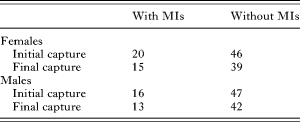
A total of 66 and 54 females infected by Haemoproteus were trapped on the initial and final capture respectively and their level of immunoglobulins measured (sample sizes are shown in Table 1). At initial capture, the presence of MIs was significantly and positively related to both the density of infection and the immunoglobulin level (Fig. 1A; density of infection: Wald=11·21, P<0·001; immunoglobulin level: Wald=4·03, P=0·045). This was also true for the final capture (Fig. 1B; density of infection: Wald=12·66, P<0·001; immunoglobulin level: Wald=4·70, P=0·03). In females, the presence of MIs was not associated with the primaquine treatment at final capture (Wald=0·68, P=0·41).
Female initial (A) and final (B) immunoglobulin levels in relation to the presence of MIs. Graphs represent the associations between both variables after statistical control for the effect of the parasite density of infection (initial and final levels respectively) and the primaquine treatment (for final samples). Bars show standard error.

Sample sizes of Haemoproteus hosts of both sexes, with and without MIs, tramped at each capture
Male hosts
A total of 63 and 55 males infected by Haemoproteus were trapped on the initial and final capture respectively and their level of immunoglobulins measured (sample sizes are shown in Table 1). On the initial capture, the presence of MIs was significantly and positively related to the density of infection (Wald=12·04, P<0·001). No association between the presence of MIs and the immunoglobulin levels was found (Wald=0·02, P=0·89). At final capture, the presence of MIs was positively associated with the density of infection in males (Wald=11·22, P<0·001). No association between the presence of MIs and immunoglobulin levels was found (Wald=0·18, P=0·67). The presence of MIs was associated with the primaquine treatment (Fig. 2; Wald=4·05, P=0·044), medicated males presenting more MIs than controls.
Effect of primaquine injection on the occurrence of multiple invasions in host males after statistical control for the final parasite density of infection and the immunoglobulin levels. Bars show standard error.

There was also no significant association between brood size and parasite density or MIs (P>0·09, data not shown), except for a positive correlation between final density and brood size for males once controlled for treatment effect (brood size: F1,53=4·07, P=0·049; treatment: F1,53=2·24, P=0·14). However, brood size was not significant when introduced in analyses presented in this work and the rest of the significant results were maintained, except for the relationship between medication and MIs which changed from P=0·044 to P=0·11 when brood size was included.
DISCUSSION
Usually, studies in human and non-human malaria and related diseases have reported that the occurrence of MIs is tightly associated with elevated parasitaemias (Wang, Reference Wang1970; Fallis and Desser, Reference Fallis, Desser and Kreir1977; Ahmed and Mohammed, Reference Ahmed and Mohammed1978; Valkiūnas, Reference Valkiūnas2005) independently of the host sex (Martínez-de la Puente et al. Reference Martínez-de la Puente, Merino, Tomás, Moreno, Morales and Lobato2006, this study). However, according to the studies of Miller et al. (Reference Miller, David, Hudson, Hadley, Richards and Aikawa1984) and Ramasamy et al. (Reference Ramasamy, Yasawardena, Kanagaratnam, Buratti, Baralle and Ramasamy1999) the host immune system could be also involved in the occurrence of MIs. Our results in female blue tits clearly support this possibility, although this was not the case for males. It is known that sexual differences in behaviour, physiology and, especially, immune defence are important factors determining sexual differences in host parasite load (Zuk and McKean, Reference Zuk and McKean1996). In addition, the fact that males had lower immunoglobulin levels than females could be the reason, at least in part, for the absence of its effect on promoting MIs in males.
Different possibilities have been proposed to explain the mechanisms whereby antibodies promote MIs. Miller et al. (Reference Miller, David, Hudson, Hadley, Richards and Aikawa1984) proposed that MIs could be caused by a weak agglutination of merozoites by monoclonal antibodies after the rupture of infected blood cells. Later Ramasamy et al. (Reference Ramasamy, Yasawardena, Kanagaratnam, Buratti, Baralle and Ramasamy1999) suggested that cross-linked parasites by bivalent antibodies can recognize erythrocyte ligands and complete invasion together or following dissociation from the antibody in close proximity to the erythrocyte previous to independent invasion of the cell.
In addition, our results imply a differential effect of the primaquine treatment with respect to host sex. Several factors may account for the differential efficacy of the primaquine treatment between sexes that could affect the efficacy of the drug reducing the intensity of infection. Many other reports in medical and veterinarian literature have identified host sex as a key factor affecting drug pharmacokinetics at two different levels, the absorption and the metabolism of drugs (Gordi et al. Reference Gordi, Huong, Hai, Nieu and Ashton2002; Pinsonneault and Sadeé, Reference Pinsonneault and Sadée2003; Klein, Reference Klein2004) although, in humans there are no differences in the kinetic parameters of primaquine between sexes (Elmes et al. Reference Elmes, Bennett, Abdalla, Carthew and Edstein2006). Also, other factors tightly related to sexual characteristics, such as hormone concentrations and genetic differences, may be involved in the influence of sex on drug pharmacokinetics (Pinsonneault and Sadeé, Reference Pinsonneault and Sadée2003). In addition, males are slightly larger and heavier than females but were treated with the same dose of medication, which may account for the differential effect of primaquine between sexes. Although the effect of primaquine in reducing the density of infection in males could be effective for a shorter period in male versus female hosts, it could be possible that medication benefits males for a longer period if the higher number of MIs contribute to reducing the number of single infected erythrocytes. In this respect, although in females the immunoglobulin level was positively associated with the occurrence of MIs independently of the medication treatment, in males, the drug may be directly involved in the production of MIs or alternatively may induce male natural immunity other than immunoglobulin levels to promote MIs. However, the effects of medication on promoting MIs in males should be taken with caution since, when reproductive effort measured as brood size is included in analysis, the relationship between MIs and medication is no longer significant. To conclude, our results represent the first evidence for the role of the host immune system in promoting the occurrence of MIs in nature, as was expected according to a host adaptive hypothesis of MIs induction.
The study was financially supported by projects BOS2003-05724 to S. M. and J. M. and CGL2004-00787/BOS to J. M. Martínez-de la Puente is supported by an ‘El Ventorrillo’ field station grant. J. M. and E. L. are supported respectively by FPI and FPU grants from M. E. C. We thank Javier Martínez and two anonymous reviewers for enlightening discussions on the themes developed in this paper. We also thank T. Calvo and E. Sánchez for their help in the field and in the laboratory. We were authorized by J. Donés, Director of ‘Centro Montes de Valsaín’ to work in the study area. Dirección General del Medio Natural – Junta de Castilla y León authorized the capture and ringing of birds. This paper is a contribution from the field station ‘El Ventorrillo’.


