Introduction
In modular metazoans a colony represents a dynamic system permanently changing the parameters of its performance in accordance with its developmental programme and in response to the changing environment. The major activities performed by modules (zooids) are feeding, budding (ensuring colony growth), sexual reproduction and rejuvenation, which is closely connected with dormancy. These interdependent processes co-occur and are performed by different or the same zooids sequentially or simultaneously, permanently or periodically, thus reflecting the intracolonial pattern of energy allocation. The distribution of resources to various processes is influenced by both extrinsic and intrinsic factors: food availability, substrate type and size, space competition, predation, colony age and size, etc. (Ryland, Reference Ryland, Russell and Yonge1976; Harvell & Grosberg, Reference Harvell and Grosberg1988; Hughes, Reference Hughes1989b, Reference Hughes2005; Seed & Hughes, Reference Seed and Hughes1992). Quantifying such dynamics in natural conditions based on seasonal fluctuations in main zooidal activities is technically complicated (e.g. Dyrynda & Ryland, Reference Dyrynda and Ryland1982). Nonetheless, this approach enables describing the life history of modular organisms with much better resolution and reveals crucial details on the dynamics in colony sexual structure and zooidal performances that normally escape standard ecological monitoring. This approach also provides a basis for comparing the life histories of modular and solitary organisms (Jackson & Coates, Reference Jackson and Coates1986; Hughes, Reference Hughes2005).
Modular invertebrates prevail in shallow-water benthic communities and are a major component of global biodiversity (Jackson, Reference Jackson1977; Hughes, Reference Hughes2005). The phylum Bryozoa comprises colonial, mostly marine filter-feeding epibionts and is one of the dominating groups in many bottom biotopes (Hyman, Reference Hyman1959; Ryland, Reference Ryland1970, Reference Ryland and Woess2005; McKinney & Jackson, Reference McKinney and Jackson1989; Taylor, Reference Taylor and Savazzi1999, Reference Taylor, Taylor and Lewis2005; Nielsen, Reference Nielsen2013). Different bryozoan species have contrasting reproductive strategies and life-history traits, different colony sexual structure, number, timing and duration of reproduction period(s) with peaks of larval production and settlement, colony growth rate, annual number of generations, longevity, etc., also displaying a variety of modes of oogenesis and larval types. In addition, their reproductive patterns differ in the timing of sperm production and fertilization as well as in the presence/absence of embryonic incubation and (if present) its mode (reviewed in Ryland, Reference Ryland1970, Reference Ryland, Russell and Yonge1976; Franzén, Reference Franzén, Woollacott and Zimmer1977; Reed, Reference Reed and Strathmann1987, Reference Reed1988, Reference Reed, Giese, Pearse and Pearse1991; Nielsen, Reference Nielsen, Adiyodi and Adiyodi1990; Seed & Hughes, Reference Seed and Hughes1992; Mukai et al., Reference Mukai, Terakado, Reed and Harrison1997; Woollacott, Reference Woollacott, Knobil and Neill1999; Ostrovsky, Reference Ostrovsky2013). The traditional focus of life-history studies in marine bryozoans is on the terms and duration of reproductive period(s) and recognition of the peaks in larval settlement. While initially yielding very general data (Pace, Reference Pace1906; Orton, Reference Orton1914), this simple approach often encompassed a large number of species (Marcus, Reference Marcus, Grimpe and Wagler1926; Gautier, Reference Gautier1962; Gordon, Reference Gordon1970; Médioni, Reference Médioni1972, see also Ryland, Reference Ryland1967). More detailed (in some cases, experimental) investigations additionally considered colony growth, lifespan and, sometimes, annual number of generations (Friedl, Reference Friedl1925; Grave, Reference Grave1930, Reference Grave1933; Kuznetzov, Reference Kuznetzov1941; Eggleston, Reference Eggleston1963, Reference Eggleston1972; see also Supplementary material 1) as well as relationships between colony size and fecundity (Gordon, Reference Gordon1970; Hayward & Ryland, Reference Hayward and Ryland1975; Wood & Seed, Reference Wood and Seed1992). A number of studies was accompanied by observations on the gametic and polypide cycles and on details of larval incubation (Silén, Reference Silén1945; Corrêa, Reference Corrêa1948; Mawatari, Reference Mawatari1951; Dudley, Reference Dudley1973; Dyrynda, Reference Dyrynda, Larwood and Nielsen1981; Nielsen, Reference Nielsen1981; Dyrynda & King, Reference Dyrynda and King1982, Reference Dyrynda and King1983; Cancino, Reference Cancino1986; Hughes, Reference Hughes1987; Cancino & Hughes, Reference Cancino and Hughes1987, Reference Cancino and Hughes1988; Cadman & Ryland, Reference Cadman, Ryland, Gordon, Smith and Grant-Mackie1996; Ostrovsky, Reference Ostrovsky1998; Nekliudova et al., Reference Nekliudova, Schwaha, Kotenko, Gruber, Cyran and Ostrovsky2019, reviewed in Reed, Reference Reed, Giese, Pearse and Pearse1991 and Ostrovsky, Reference Ostrovsky2013). A few life-history works also focused on asexual reproduction by fragmentation (e.g. Winston, Reference Winston1983; O'Dea, Reference O'Dea2006; O'Dea et al., Reference O'Dea, Jackson, Taylor and Rodríguez2008, Reference O'Dea, Ostrovsky and Rodrígues2010).
In bryozoan colonies, only some feeding modules (autozooids) are active at any given time. They provide and send nutrients to gonads and to zones of zooidal budding (Lutaud, Reference Lutaud, Nielsen and Larwood1985; Best & Thorpe, Reference Best and Thorpe1985, Reference Best, Thorpe, Wyse Jackson, Buttler and Spencer Jones2001). They also provision temporarily non-feeding modules, which undergo periodic degeneration and regeneration (rejuvenation, also called recycling) of the polypide (Gordon, Reference Gordon, Woollacott and Zimmer1977), i.e. the retractile tentacle crown associated with the U-shaped gut and certain muscular bands. The proportion of feeding vs non-feeding modules changes considerably during the colony life, and the same holds true for zooidal budding and gamete production. Overall colony performance is thus expressed in a permanent and interdependent change in different zooidal activities. Importantly, the major aspects of this dependence and its connection with seasonality are relatively unknown in Bryozoa. Borg (Reference Borg1947) was the first to combine observations on seasonal life-history phenomena in the cheilostome Einhornia crustulenta (as Electra) with the relationships between colony growth, polypide recycling and sexual reproduction. Dyrynda & Ryland (Reference Dyrynda and Ryland1982) supplemented this approach by quantifying the seasonal fluctuations in polypide performance (development, feeding, recycling) and describing the correlation between polypide and sexual cycles in autozooids through the year in the cheilostomes Chartella papyracea and Bugulina flabellata (as Bugula).
We applied such a multivariate approach to reconstruct the life history of the common boreal-Arctic cheilostome bryozoan Cribrilina annulata (Fabricius, Reference Fabricius1780) in the White Sea, and this was the main aim of our research. This species has been recorded from the intertidal down to 170 m depth on stones and shells as well as down to 20 m on algae (Kluge, Reference Kluge1975; Gostilovskaya, Reference Gostilovskaya1978; Grishankov et al., Reference Grishankov, Ninburg and Shkljarevitch2000). Earlier studies in the North, White and Barents Seas provide important background information on its reproductive pattern (Ostrovsky, Reference Ostrovsky1998; see also Ryland, Reference Ryland1963), early astogeny (Ostrovsky, Reference Ostrovsky1998; Yagunova, Reference Yagunova2005a) and the variability of zooidal size (Yagunova, Reference Yagunova2005b; Shunkina, Reference Shunkina2008; Shunkina & Yagunova, Reference Shunkina and Yagunova2008; Yagunova & Ostrovsky, Reference Yagunova and Ostrovsky2008), as well as on differences in the reproductive output of the colonies living on the red algae and stones (Yagunova & Ostrovsky, Reference Yagunova and Ostrovsky2010). The latter paper was the first to compare this bryozoan's life-history traits on various substrates, and revealed the substantial differences in its sexual reproduction.
Further developing this idea, we compared colonies living on two contrasting algal substrates: kelps and red algae. The red algae fronds in the White Sea persist for several years, whereas distal parts of kelp fronds are destroyed and torn off during autumn storms each year together with their epifauna, and only the young frond parts overwinter (Makarov & Shoshina, Reference Makarov and Shoshina1996; Shoshina, Reference Shoshina1998). On the other hand, the kelp blades are much longer and wider (0.15–0.2 m wide and up to 4 m long) than those in red algae (0.01–0.05 m wide and 0.3 m long) (e.g. AlgaeBase, 2018). Colonies on stones were rare in the study area (see also Yagunova & Ostrovsky, Reference Yagunova and Ostrovsky2010) that prevented us from using them in our analysis.
Our simple initial hypothesis was that some life-history traits should differ in the colonies living on different substrates (see above). For example, we expected colonies on red algae to live and reproduce longer than those living on kelps, where, in contrast, larger colonies would form (with correspondingly more numerous reproducing zooids).
To test our hypothesis, we studied changes in the state of C. annulata colonies through the ice-free season by quantifying the percentage of zooids performing feeding, sexual reproduction and polypide recycling as well as counting non-active (dormant/senescent or ‘empty’) zooids. This work was supplemented by observations on colony size and changes in sexual structure as well as timing of reproduction on different substrates currently being the most detailed study in this respect. This approach also enabled us to recognize the number of generations during a reproductive season on both substrata, and to determine differences in their performance. In its turn, this allowed us to reconstruct the life history of this species in detail and reveal key factors shaping it.
Materials and methods
Colonies of Cribrilina annulata living on kelps (Saccharina latissima species-complex) and red algae (Odonthalia dentata, Phycodrys rubens, Phyllophora interrupta) were collected in the ice-free period from 5–10 m depth by boat dredging and scuba-diving near Matrenin Island (Chupa Inlet, Kandalaksha Bay, White Sea), close to the Educational and Research Station ‘Belomorskaia’, Saint Petersburg State University.
Seventeen samples from kelps were collected from May to October 2009, at intervals of 3–12 days. Larger gaps between sampling reflect rough weather conditions. Two additional samples were taken in May and June 2010. Colonies inhabiting red algae were mostly collected in June–September 2012 (13 samples, at intervals of 3–9 days); two additional samples were taken in May 2011 and March 2015 (under ice) to obtain information about overwintered colonies (Supplementary material 2: Table 1, Supplementary Figure 1).
Colonies were numerous on kelps, and ~30–40 colonies from each sample were randomly chosen for the analysis; all colonies collected on red algae were analysed. In a few cases, data on colonies collected on closely adjoining dates were pooled because differences between them were expected to be minor. Altogether, data on 1209 colonies were analysed (Supplementary material 2).
Since the sampling on different substrates was performed in different years (2009 and 2012), differences in colony performances might to some extent be attributed to year-specific climatic conditions, an influence described in bryozoans (Wood & Seed, Reference Wood and Seed1992). Nevertheless, sporadic additional sampling in 2010 and 2011 showed that the variability of the studied characters in colonies collected in different years did not exceed from within-sample variability (see below). Moreover, colonies collected from kelps during a preliminary study from mid-June to late August 2008 (six samples, not included in the current analysis) showed similar trends in their state (Shunkina, Reference Shunkina2010; Supplementary material 4). This supports the validity of our data.
Colonies were fixed and decalcified in Bouin's fluid. After dehydration in an ethanol series they were embedded in resin (Epon 812) to make total preparations. Some were used to make semi-thin sections by standard methods to check for the presence/absence of spermatogenic tissue and ovaries (described and illustrated in Ostrovsky, Reference Ostrovsky1998). This enabled determining changes in colony sexual structure (succession in development and functioning of sterile and fertile zooids – gonochoristic and hermaphroditic, defining the sexual state of a colony) during its life. Total preparations of decalcified colonies were photographed with a Leica M205C photocamera attached to a Leica DFC420 stereo-microscope for future analysis.
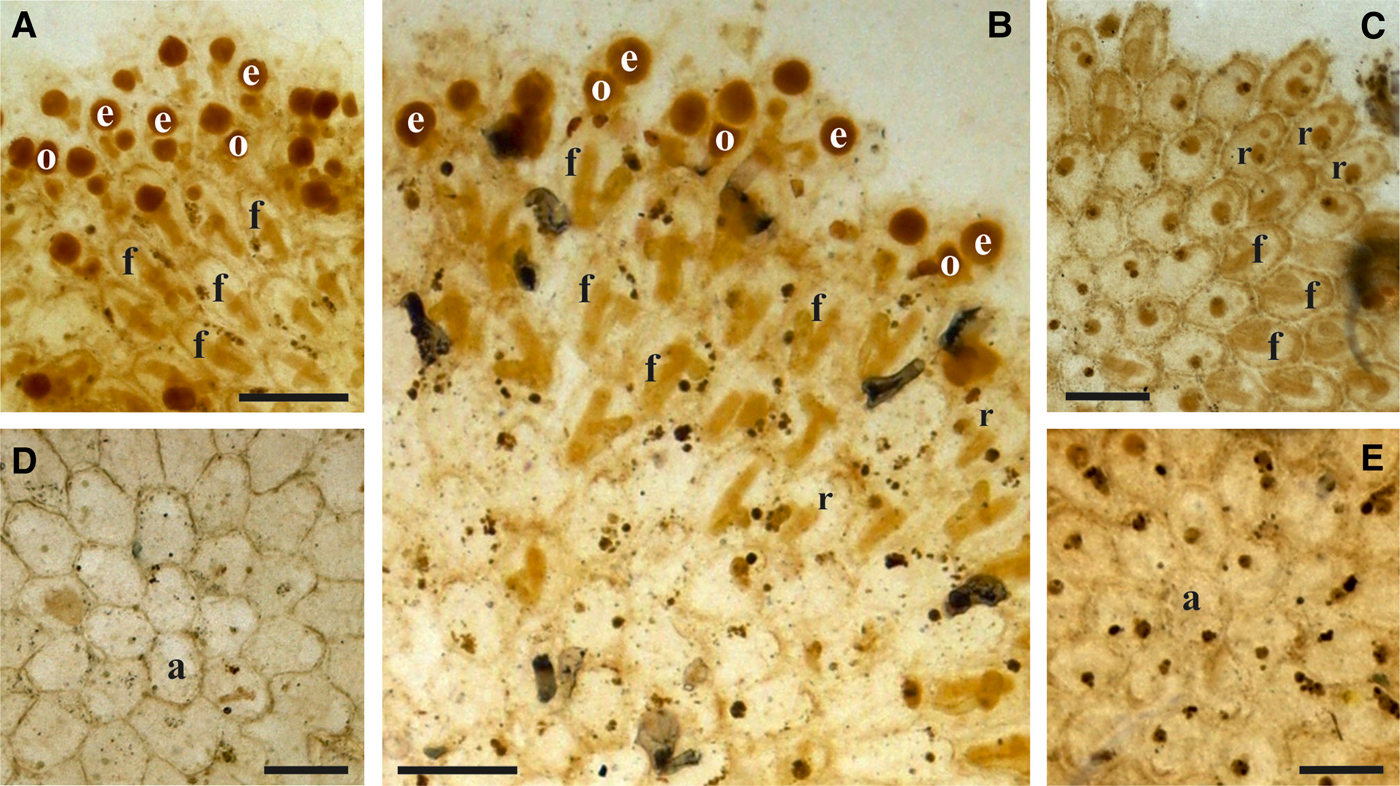
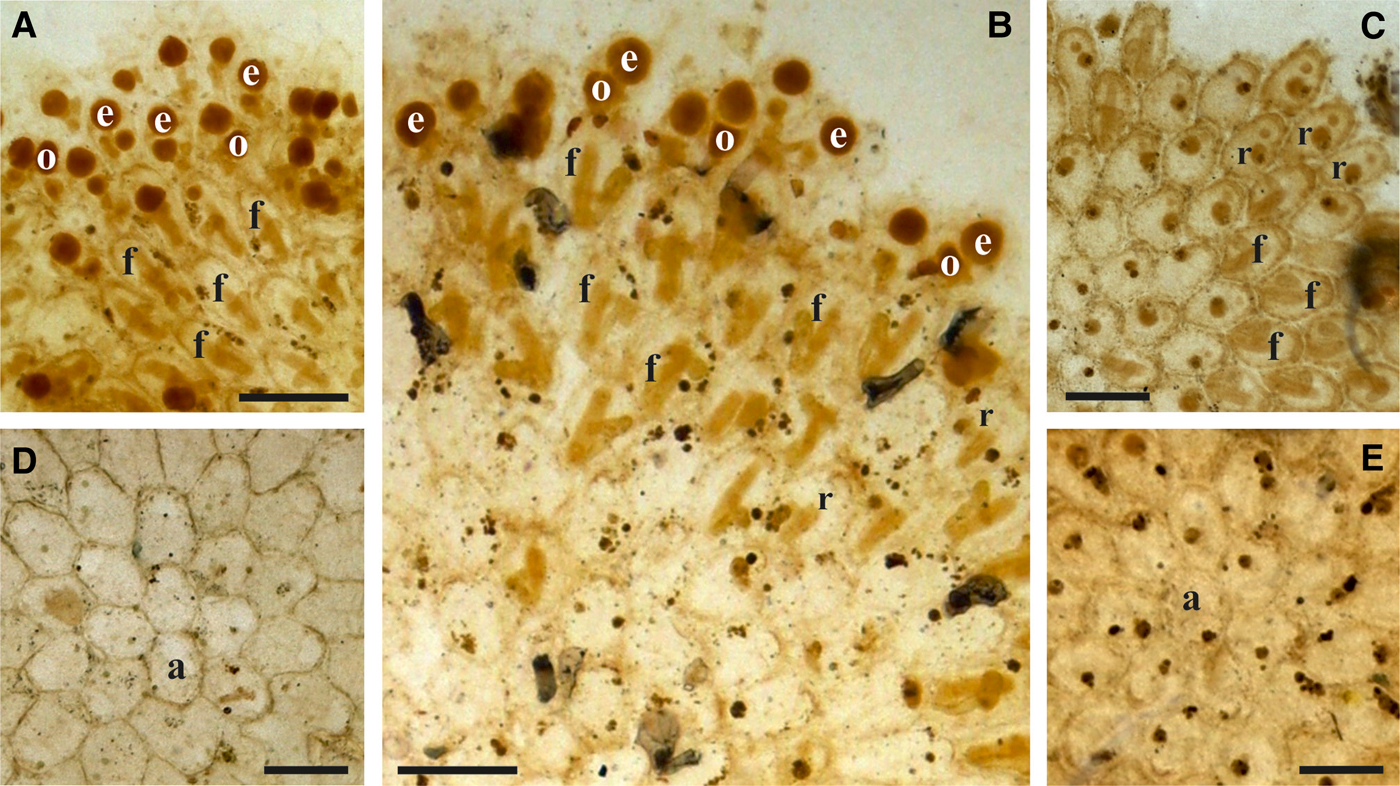
For each colony, we recorded the substrate (kelps, red algae), total zooid number (‘colony size’), and the number of zooids (1) with oocytes and/or embryos (‘reproductive’), (2) with functional polypides (‘feeding’), (3) with degenerating or regenerating polypide (‘recycling’) and (4) without polypides (‘empty’) that may contain remnants of a degenerated polypide traditionally termed ‘brown body’ (Figures 1 & 2). The latter category reflects the dormant state of a zooid; this can be temporary or permanent, in the latter case meaning zooidal senescence or even death.
Total mounts of decalcified colonies of Cribrilina annulata. Peripheral (A–C) and central (ancestrular) (B, D, E) colony areas showing various zooidal categories: reproductive (A–C), feeding (A–C), with regenerating polypide (C) as well as ‘empty’ zooids with brown body and without it (B–E). In C, degenerated polypides (brown bodies) are visible as larger dark circles in proximal position, and regenerating polypide buds as smaller circles positioned distally. Only ‘empty’ zooids without brown bodies are seen in D. Ordinary (A) and smaller-sized (B) hermaphrodite autozooids on colony periphery. Abbreviations: a, ancestrula; e, embryo, f, functional polypide, o, mature oocyte; r, regenerating polypide, Scale bars: A, 0.5 mm, B, 0.6 mm, C–E, 0.4 mm.
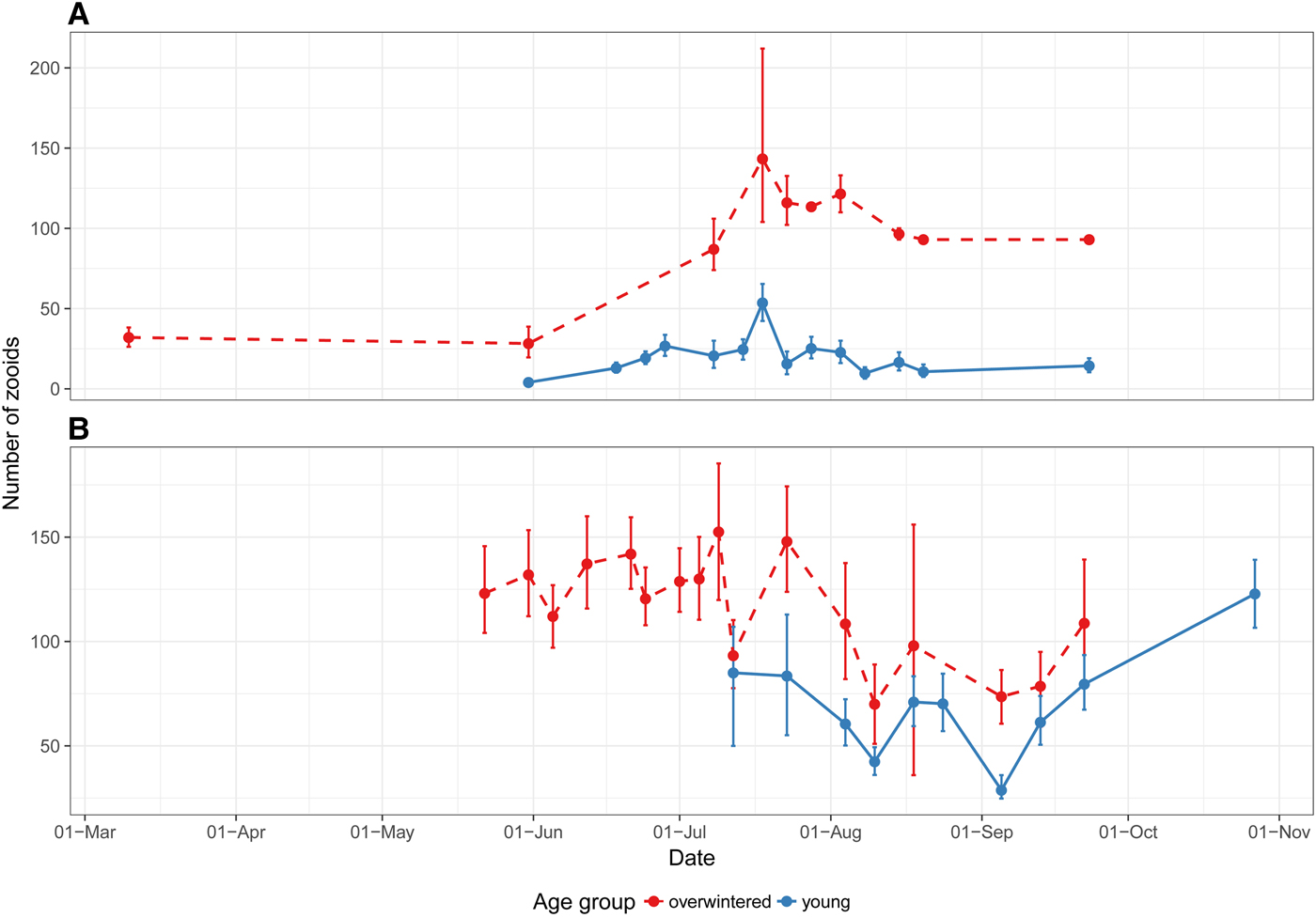
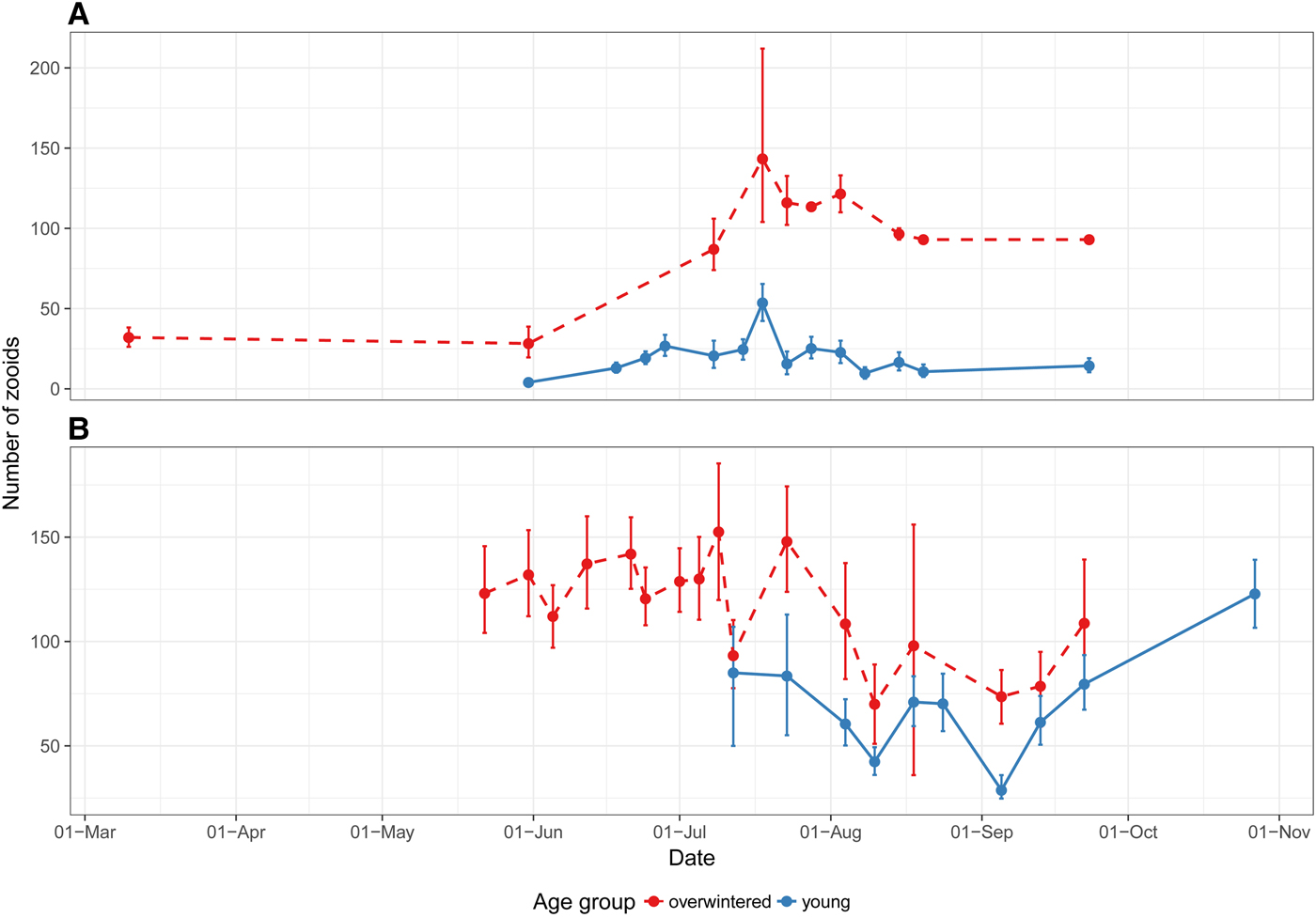
Cribrilina annulata colony size (mean number of zooids) in young and overwintered generations living on red algae (A) and kelps (B). Horizontal axis: sampling day number in a year; vertical axis: mean number of zooids ± 95% bootstrap confidence interval.
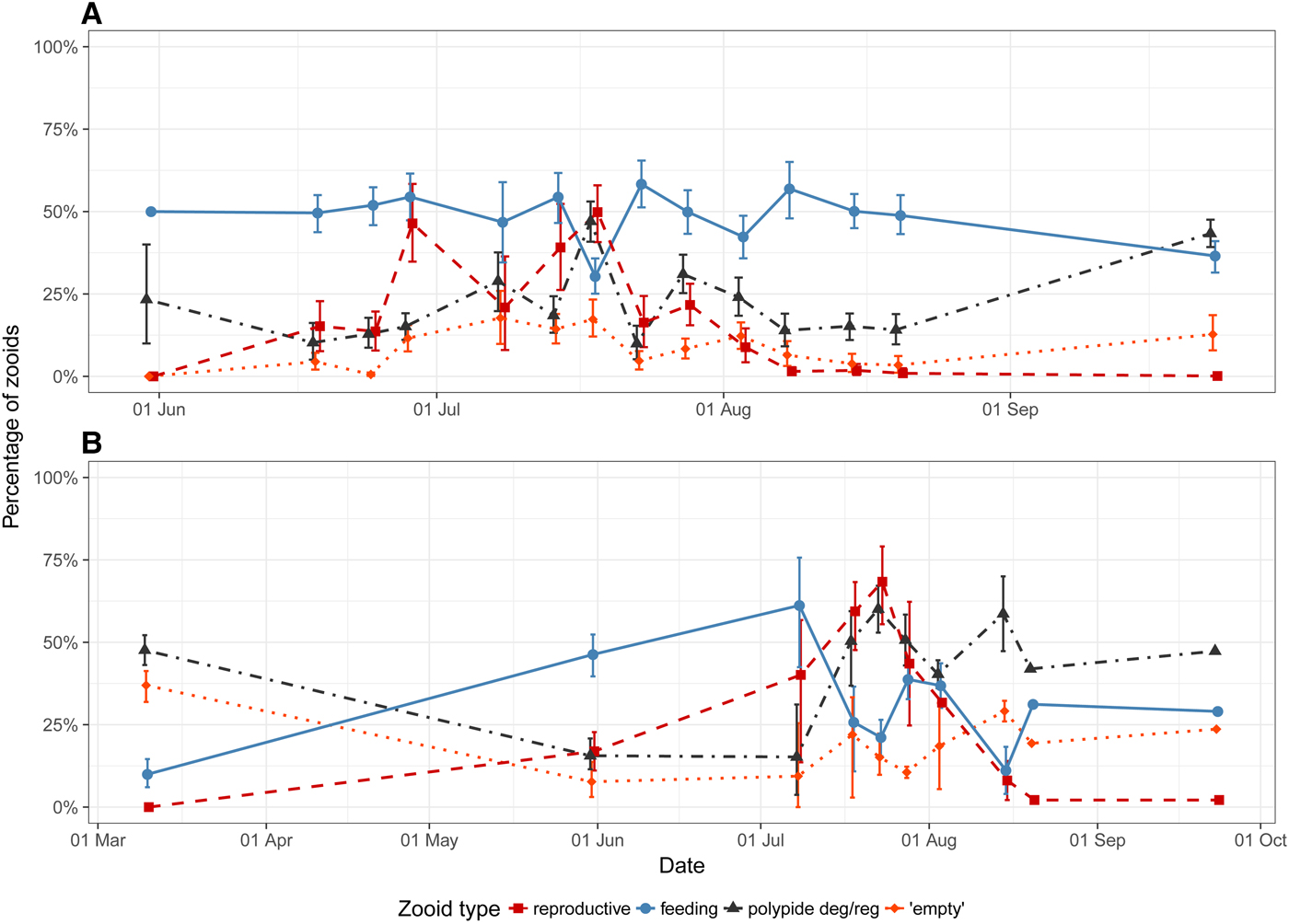
The proportions of zooids of these categories were calculated for each colony separately. Only zooids containing oocytes and/or brooding embryos in a skeletal brood chamber (ovicell) were counted as ‘reproductive’: the presence/absence of spermatogenic tissue was not considered in distinguishing zooid categories. Zooids containing oocytes and/or embryos and functional polypides were counted in both ‘reproductive’ and ‘feeding’ categories (Figures 3–8; Supplementary material 3: Matrix 1). Zooidal buds were not considered here because the common fusion of developing buds reduces count accuracy.
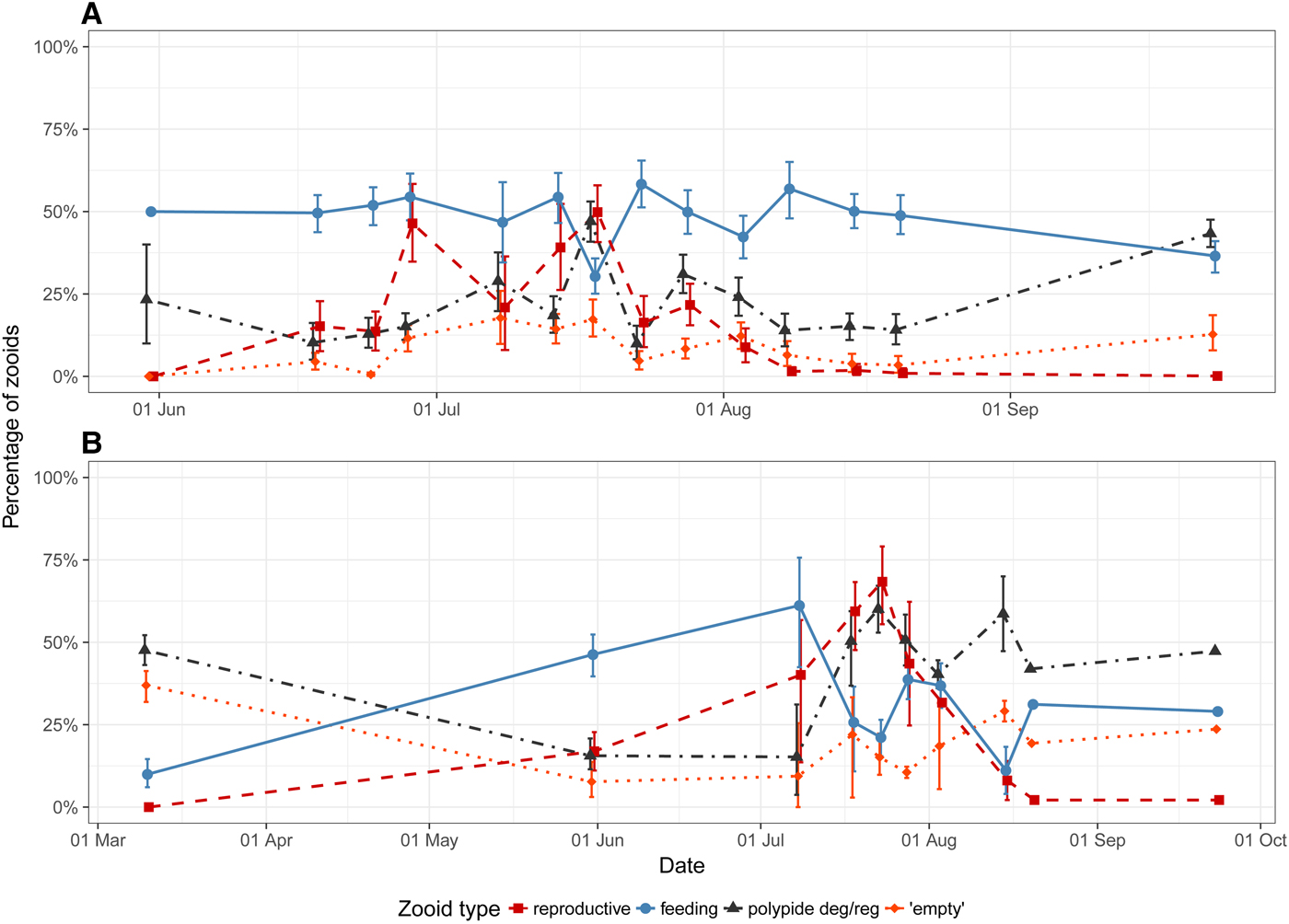
Ratio of zooids of different categories in the colonies of Cribrilina annulata living on red algae: young (A) and overwintered (B) colonies. Horizontal axis: sampling day number in a year; vertical axis: mean per cent of zooids ± 95% bootstrap confidence interval.
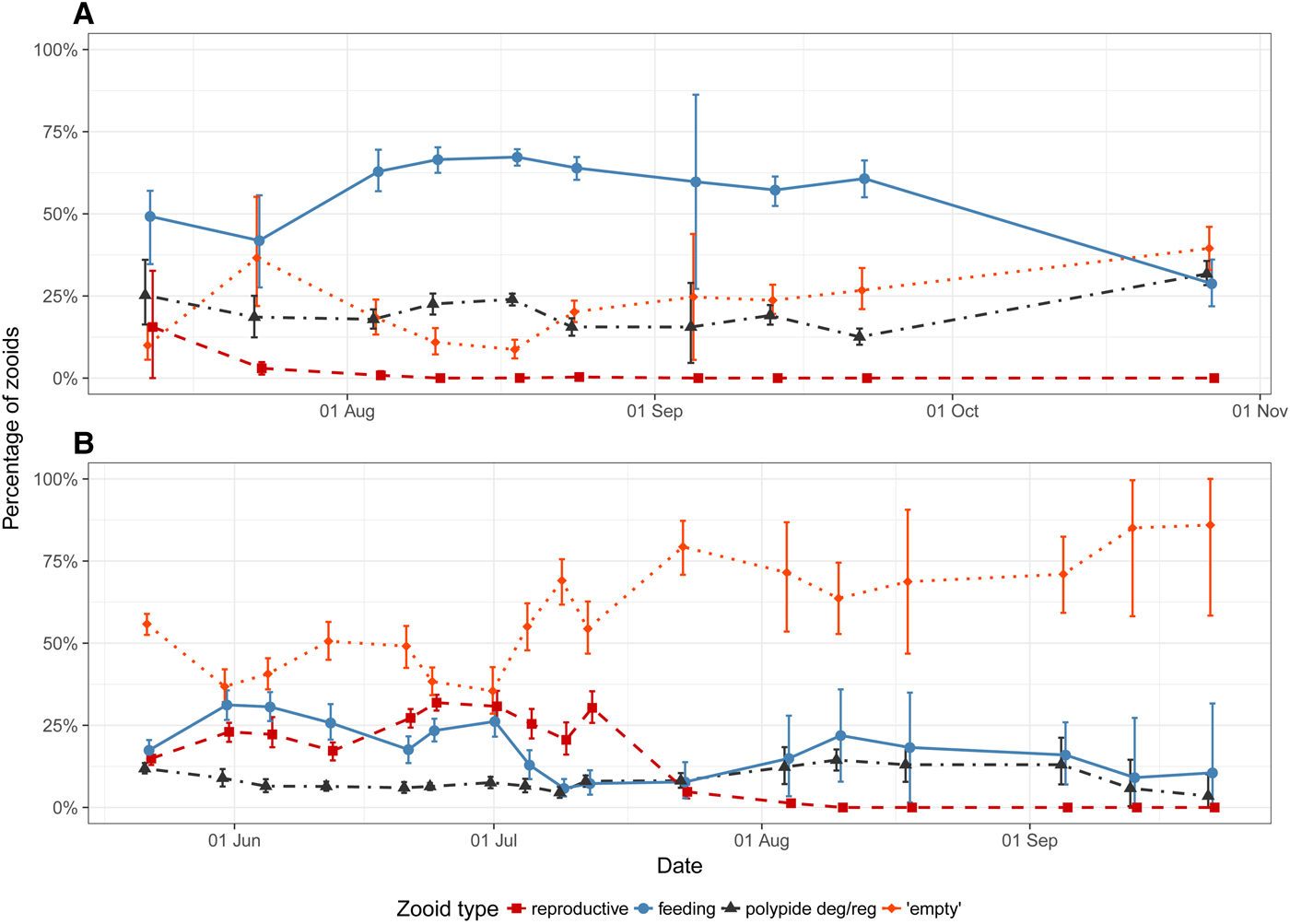
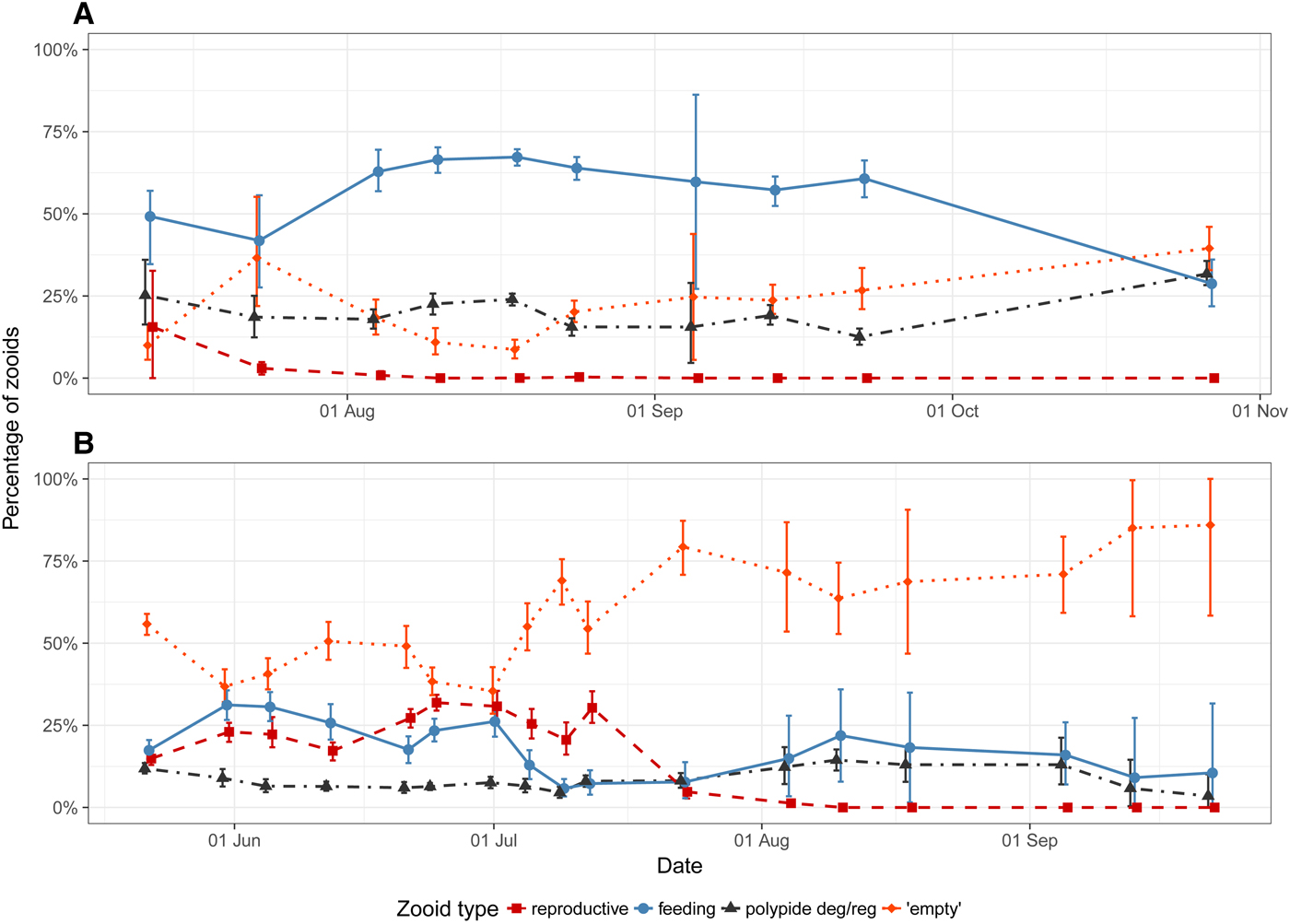
Ratio of zooids of different categories in the colonies of Cribrilina annulata living on kelps: young (A) and overwintered (B) colonies. Horizontal axis: sampling day number in a year; vertical axis: mean per cent of zooids ± 95% bootstrap confidence interval.
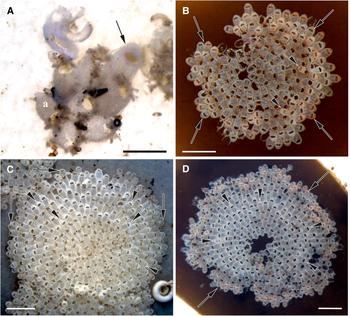
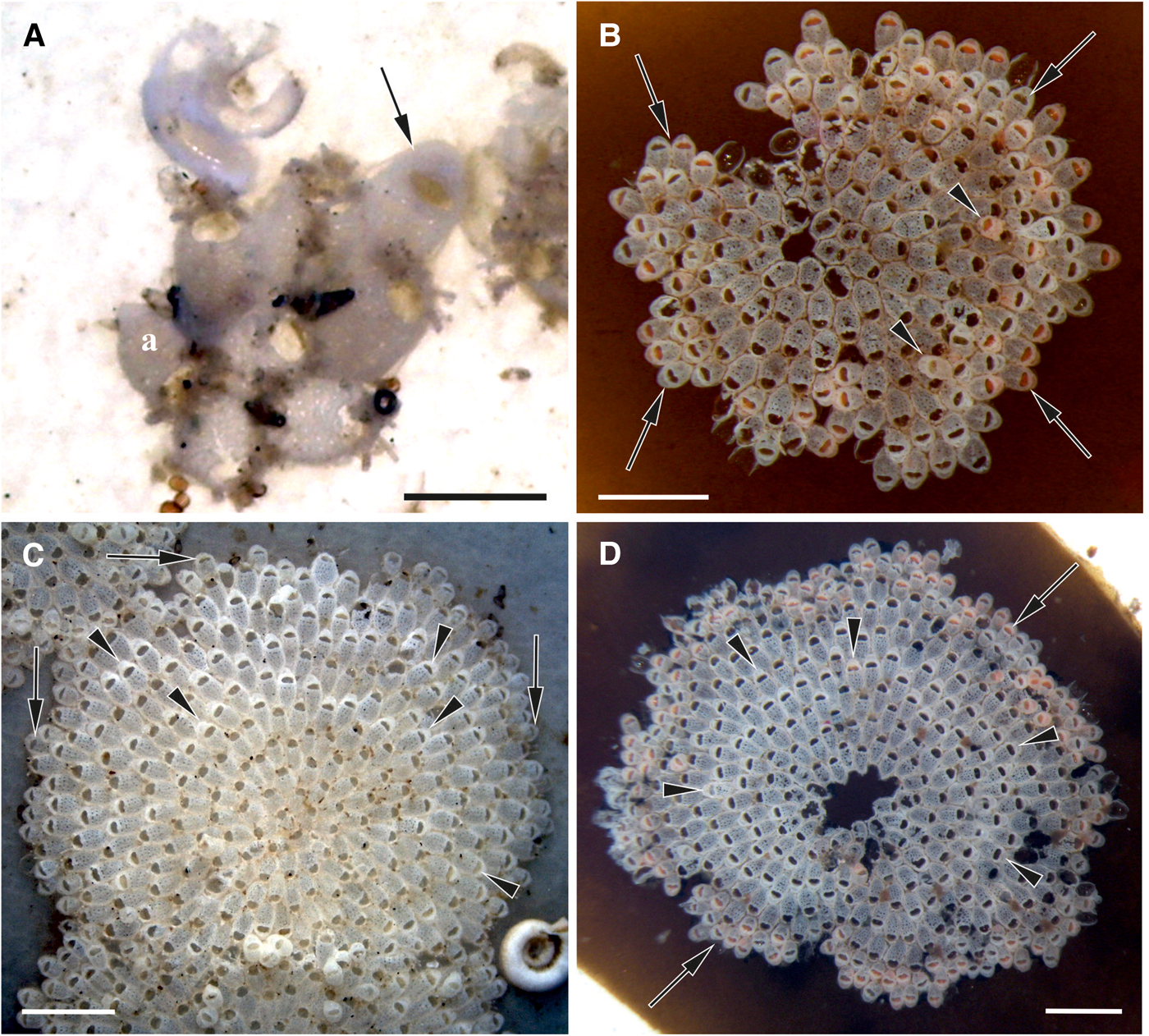
Reproductive Cribrilina annulata colonies on kelp frond. (A) early colony of the second cohort consisting of ancestrula (a) and seven zooids, one ovicellated (arrow) (collected 5 July 2009). (B) overwintered colony with peripheral zone of smaller (arrows) and frontal ‘dwarf’ ovicellate zooids (arrowheads) (July 2009); this colony did not reproduce the previous year. (C, D) overwintered colonies with two ‘rings’ of ovicellate zooids (i.e. reproducing during two consecutive years) – more central ordinary (shown by arrowheads, one zooid with embryo) and peripheral smaller (arrows) (in D the central ancestrular zone is destroyed); ovicellate frontal ‘dwarf’ zooids visible in both colonies (12 July and 5 July 2009, respectively). Reddish embryos predominantly restricted to peripheral zooids. Scale bars: A, 0.4 mm, C–E, 1 mm.
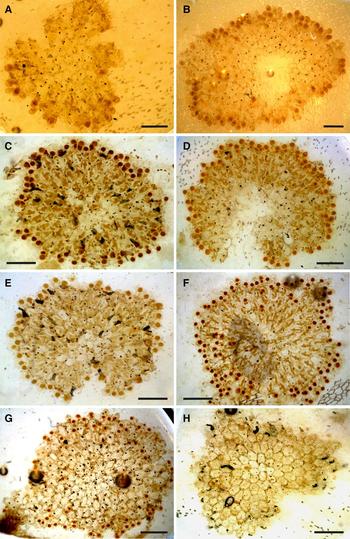
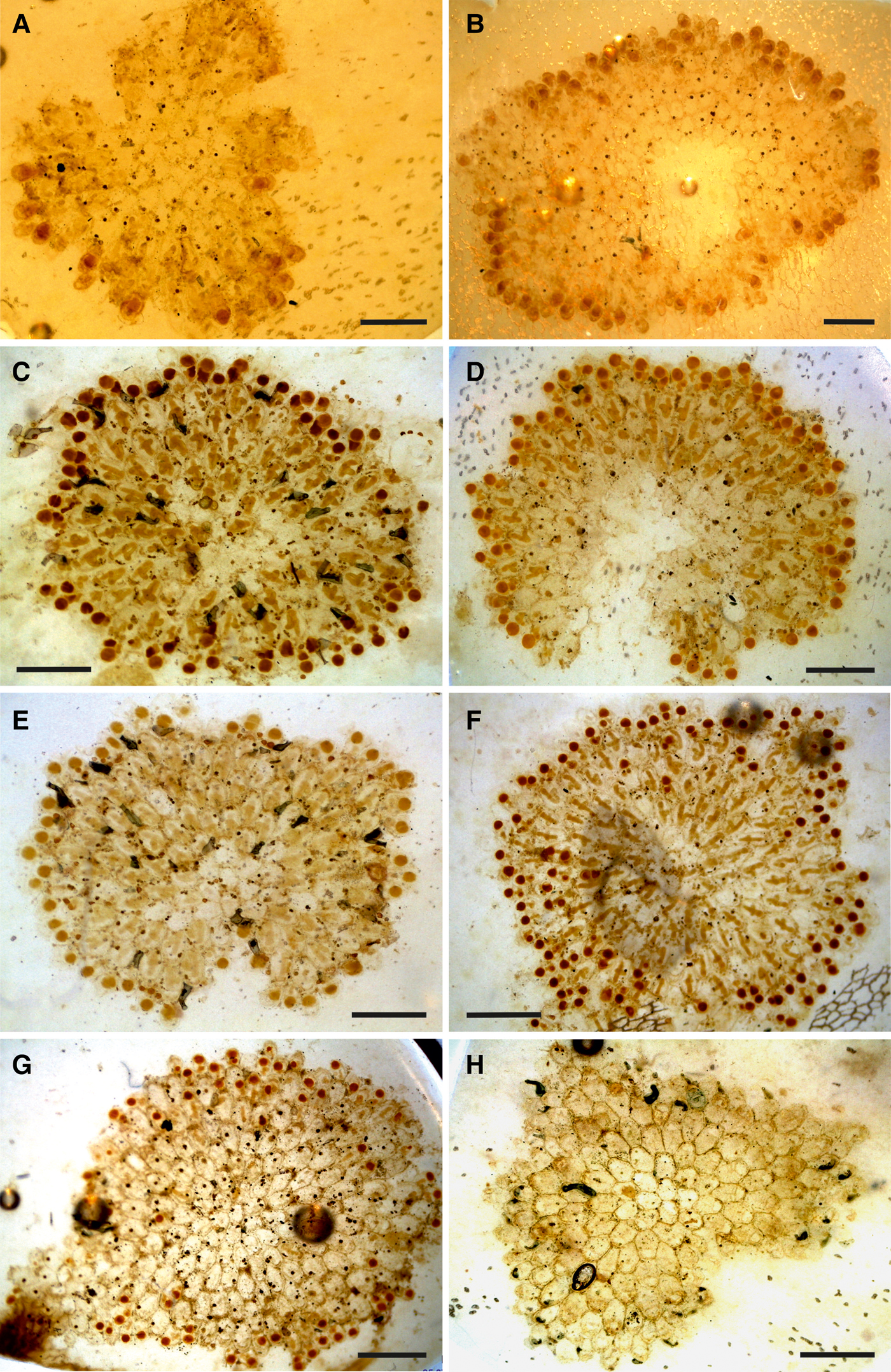
Total mounts of decalcified overwintered colonies of Cribrilina annulata collected on kelps from May to September, showing their state through the season. (A, B) colonies early in their active state with feeding and smaller ovicellate zooids containing embryos on the periphery; most zooids have brown bodies or possess a regenerating polypide; in B, central colony part destroyed during winter (collected 22 May 2010). (C–F) actively feeding and reproducing colonies with most zooids possessing functional polypide (C, D, 31 May 2009; E, 5 June 2009; F, 21 June 2009); in D, central colony part destroyed during winter. G, colony with embryos still numerous, but with few feeding zooids; while some zooids are regenerating their polypide, most are ‘empty’ or contain brown body (5 July 2009). H, dying colony (5 September 2009). Scale bars: A, C–H, 1 mm, B, 1.5 mm.
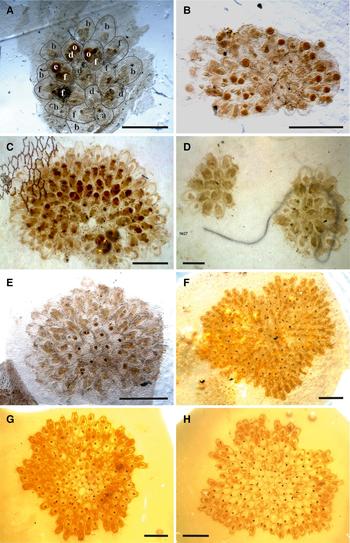
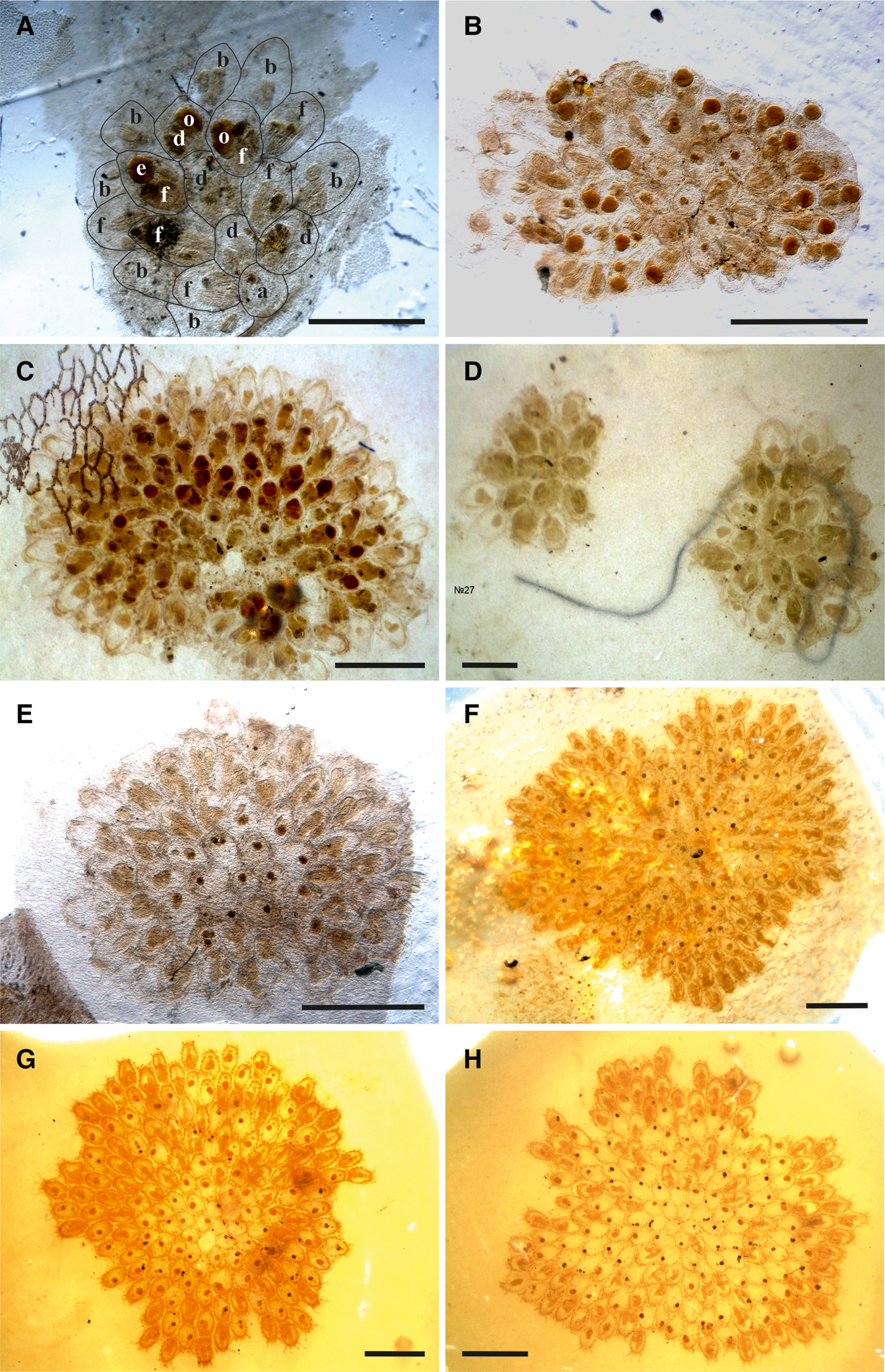
Total mounts of decalcified young colonies of Cribrilina annulata collected on red algae and kelps from June to October, showing their state through the season. (A–C) early colonies of second generation that reproduce this year, (D–H) colonies of second and third generations that will reproduce next year. A, small colony of 19 autozooids and zooidal buds early in its reproduction: first ovicellate zooid appeared when colony consisted of 8–10 zooids only (collected 23 June 2012, on red algae); zooidal walls shown by outline (abbreviations: a, ancestrula with brown body, b, zooidal bud, d, zooid with degenerating polypide, e, embryo, f, zooid with functional polypide, o, oocyte). B, C, larger colonies with a ‘ring/arch’ of ordinary hermaphrodite zooids and peripheral zone of zooidal buds (B, 22 July 2012, on red algae; C, 12 July 2009, on kelps). D, two young colonies (10 August 2009, on kelps). E–G, actively feeding colonies with few ‘empty’ zooids in centre (E, 25 August 2013, on red algae; F, 22 September 2009, on kelps; G, 27 October 2009, on kelps). H, colony with feeding zooids only on periphery (27 October 2009, on kelps). Scale bars: A, E, 0.5 mm, B–D, F–H, 1 mm.
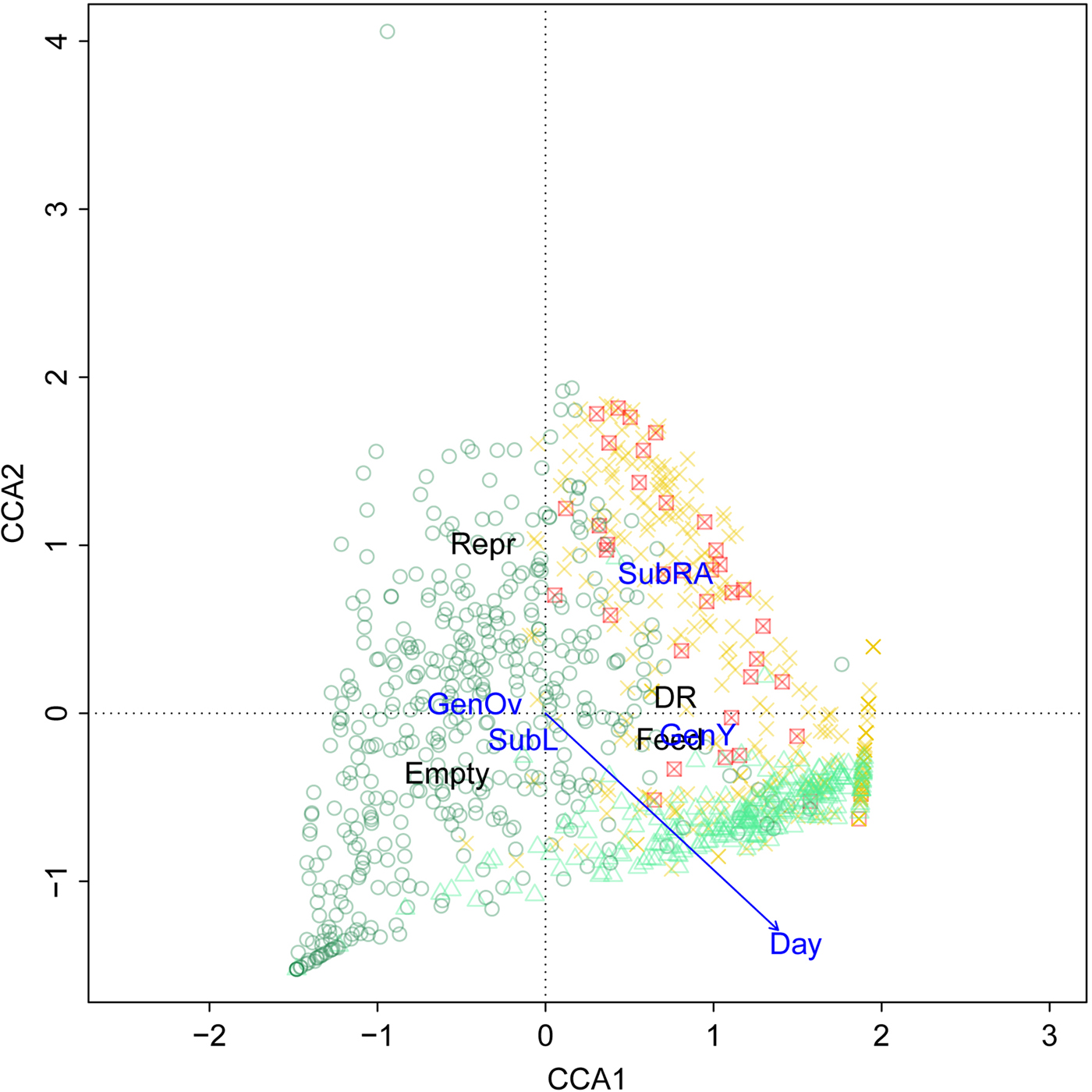
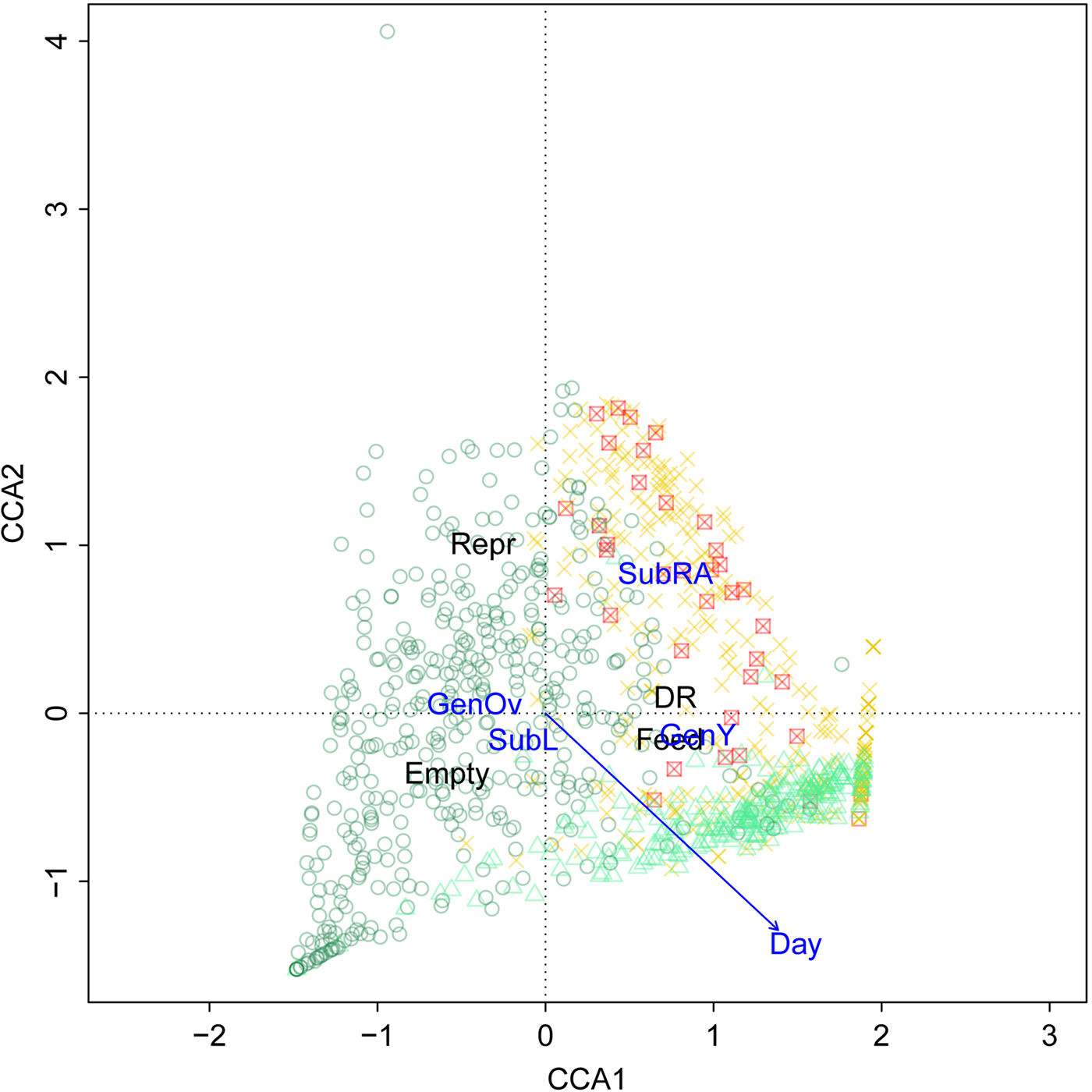
Canonical correspondence analysis (CCA) of Cribrilina annulata colony composition. Symbols correspond to individual colonies: dark green circles – overwintered colonies on kelps; light green triangles – young colonies on kelps; red crossed squares – overwintered colonies on red algae; yellow crosses – young colonies on red algae. Text in black denotes colony properties: Repr – percentage of reproductive zooids; Feed – percentage of feeding zooids; DR – percentage of zooids with degenerating/regenerating polypides; Empty – percentage of zooids without polypides. Constraining variables shown in blue: Day – day number; GenY and GenOv – age group (Y, young, Ov, overwintered); SubL and SubRA – substrate type (L, Laminaria, RA, red algae).
To facilitate our analysis we formally divided all collected material into two age groups that noticeably differed in appearance (Figures 5–7): old overwintered colonies formed in the previous year/ice-free period, and young colonies formed during the current year. In contrast with the latter, the old overwintered colonies were larger and their central-most part was typically destroyed. They also differed in the type of brooding zooids (see below) and were often overgrown by various microalgal and protist epibionts. The old colonies were recorded from March to September–October, the young colonies were absent in March. We estimated the average colony size and its composition for these two groups separately by calculating the mean percentage of zooids of different categories for each sampling date (Supplementary material 3: Matrix 1).
For further analysis we combined the data obtained during consecutive years on colonies from the same substrate (2009 + 2010, kelps, and 2011 + 2012 + 2015, red algae) to describe the species' life history during the entire ice-free period. The graphs display the sampling dates as Julian day numbers in a year to yield a common continuous scale for different years (Supplementary material 2: Table 2). The averages are depicted with their bootstrap confidence intervals. We applied Canonical Correspondence Analysis (CCA, Legendre & Legendre, Reference Legendre and Legendre2012) using the vegan package (Oksanen et al., Reference Oksanen, Blanchet, Friendly, Kindt, Legendre, McGlinn, Minchin, O’Hara, Simpson, Solymos, Stevens, Szoecs and Wagner2017) in the R-environment (R Core Team, 2017) to examine the ordination of the colonies and their characteristics depending on external variables. The main CCA assumption was fulfilled because counts of zooid types varied with time unimodally. The ordination was performed on the matrix of percentages of different zooidal categories (‘reproductive’, ‘feeding’, with regenerating/degenerating polypide, ‘empty’). Substrate type (kelps or red algae), age group (young or overwintered) and date of sampling (day number in a year) were used as external variables. Monte Carlo permutation tests with 999 permutations were used to test significance of canonical axes and the marginal effects of constraining variables (Figure 8).
Results
Colony sexual structure and polypide recycling
Cribrilina annulata is a spring- to autumn-reproducing species (May–September) in the study area. Mature colonies are protandrous hermaphrodites consisting of three types of autozooids: (1) sterile (without gonads), (2) males with temporarily developed spermatogenic tissue (having no special features in external morphology) and (3) hermaphrodites possessing two types of gonads and forming an ovicell. Hermaphrodite autozooids (also referred as ovicellate in the text) can be of two size categories – ordinary (mean size 0.60 × 0.33 mm) in the colonies of summer generations (Figures 1A, 5A & 7A–C) and of a smaller mean size (0.45 × 0.28 mm) in the overwintered colonies (Figures 1B, 5B–D & 6A–G). The latter can be placed either ‘basally’, i.e. on the substrate in-between neighbour autozooids, or ‘frontally’, partially lying on the upper surface of the neighbours. Such ‘frontal’ zooids have a ‘hidden’ elongated proximal part and short distal part forming the ovicell. Since only this small distal part is visible from above on the colony surface, these ‘frontal’ zooids are often termed ‘dwarfs’ (Figure 5B–D).
The young colonies established from May to mid-July (Figures 5A & 7A–C) are initially sterile and consist of ancestrula and first zooids budded from it. Histological sections showed that male zooids appear next in a colony, interspacing between sterile ones. Then, ordinary hermaphrodite zooids with ovicells develop on the colony periphery, forming a ring zone that, in turn, may bud sterile zooids (Figures 1A & 7A–C). The onset of male zooid formation coincides with the start of polypide degeneration in the colony's central ancestrular zone (Figure 7A). It spreads centrifugally and is followed by polypide regeneration (Figure 1C), although the latter never occurs in the central-most colony part, which may disintegrate later on (Figures 1B–E, 5B, D, 6 & 7B–C, G–H). Early degeneration/dissipation of the spermatogenic tissue in both male and hermaphrodite zooids transforms colonies into females. In late autumn, the colonies become sterile before overwintering: sectioned ovicellate zooids did not contain gonads.
The young colonies established after June (Figure 7D–H) mostly remain sterile, starting sperm and oocyte production next spring, and developing the ring zone of the smaller-sized basal ovicellate zooids (Figures 1B, 5B & 6A–G) that also can bud sterile zooids (Figures 1B, 5B & 6C, D, F). Moreover, ovicellate frontal dwarfs are often developed in these colonies during the entire reproductive period (Figure 5B). The patterns of polypide recycling and zooid disintegration in the central part of the colony are the same as described above (Figures 5B & 6).
Thus, most colonies participating in larval production have only one ring zone of basal ovicellate zooids – ordinary (Figures 1A, 5A & 7A–C) or smaller-sized (Figures 1B, 5B & 6A–G) depending on their time of establishment. In a few overwintered colonies, however, two ring zones of basal ovicellate zooids were recorded: a peripheral zone with smaller-sized ovicellate zooids and a ring of ordinary ovicellate zooids closer to the colony centre with a ring zone of non-ovicellate zooids in-between (Figure 5C, D). This demonstrates two cycles of reproduction in a colony during consecutive years in the study area (see also below).
Seasonal dynamics in colony size
Overwintered colonies were larger than the young ones in all samples (Figure 2). Colonies on kelps had a larger mean size than those on red algae (105.4 ± 1.2 vs 25.2 ± 0.6). During summer, the maximum mean colony size calculated for both age groups together, was recorded in July on both substrates (152.5 ± 17.5 and 65.8 ± 9.5 on kelps and red algae, respectively) (Figure 2; Supplementary material 3: Matrices 2, 3, Supplementary Figures 2–4).
Young colonies are established from May to September on both substrates (see below), with two peaks on red algae: during the first half of June and in mid-July (Supplementary Figure 3). After the active growth period during the first half of summer (reaching 60–80 zooids in mid-July), the mean zooid number in young colonies showed two drops corresponding to the progressive appearance of small, newly established colonies from late July to early September on both algal substrata. The zero or negligible recruitment in population resulted in the rapid increase of the mean zooid number in young colonies from September to October on kelps. In contrast, on red algae, while young colonies continued to bud new zooids in September, no size increase was detected because new colonies were established (Figure 2; Supplementary Figures 2 & 3).
Similarly, the mean size of overwintered colonies grew during the first half of the summer on both substrata, reaching the maximal mean zooid number up to 145 zooids on red algae and about 155 zooids on kelps in July. Thereafter, their mean size declined, beginning to increase again on kelps in late August–September (Figure 2; Supplementary Figures 2 & 4).
In overwintered colonies size decline detected after the mid-summer is explained by loss of central colony parts which is not sufficiently compensated for by zooidal budding. The slight ‘enlargement’ of old colonies on kelps in late September is presumably because some smaller overwintered colonies died and the larger ones persisted longer (Supplementary Figure 4). Thus, the observed declines in young colony size depend on the repeated establishment of many young recruits, whereas in the overwintered colonies such a decline is apparently related to the breakage of old zooids. Paradoxically, in both cases the declines are accompanied by zooidal budding.
No colony growth probably occurs during winter.
Seasonal dynamics in colony state and zooidal performance
Overwintered colonies on red algae under the ice in the first half of March 2015, already resumed their activity after hibernation, possessing zooids with functional and regenerating polypides (while still containing more than one third ‘empty’ zooids). No signs of sexual reproduction were detected, however (Figure 3B).
In the Chupa Inlet, ice usually melts in mid-May. In the colonies collected on kelps soon after melting (22 May 2010), reproducing zooids with oocytes and embryos in the ovicells were present (Figures 4B & 6A, B). Accordingly, reproduction starts early, at least in the first half of May under ice when the percentage of feeding zooids is still rather low (~15%). Surprisingly, larval production was not postponed until most zooids possessed functional polypides.
Colonies of the second generation (progeny of overwintered colonies) collected in late May 2011 on red algae consisted of zooids with functional and recycling polypides; no ‘empty’ and reproducing zooids were present (Figure 3A). Reproduction started in June (Figure 7A). No data are available on young colonies on kelps in May and June 2009 (see above), but we suggest that they could behave similarly.
In July, the cumulative reproductive effort of both overwintered (Figures 5B–D & 6D) and the (reproducing colonies of) second cohorts (Figure 7B, C) led to a massive foundation of morphologically non-distinguishable, mostly non-reproducing colonies of the second and the third cohorts on both substrates. Thus, during August and the first half of September when reproduction is generally ceased, the young part of the population is represented by actively growing and feeding colonies, probably reflecting resource accumulation for winter hibernation (Figure 7D–F). Old colonies mostly show the signs of senescence in this time (Figure 6H).
Sexual reproduction
In summer, both old and young colonies actively produced larvae (Figures 1A, B & 5–7), with the percentage of reproductive zooids (ovicellate zooids containing oocytes and/or embryos) increasing prominently and peaking in late June–mid-July (Figures 3 & 4). In August the proportion of reproductive zooids declined sharply to zero on kelps and to very small numbers on red algae. Nonetheless, a few newly established young colonies were detected on both substrata in September (up to mid-September on red algae) (Supplementary Figures 3 & 4). Of note, colonies on red algae (which were smaller than those on kelps) had a higher ratio of reproductive zooids (Figures 3 & 4).
Feeding
On red algae the proportion of feeding zooids (i.e. with functional polypides) was ~50% during the first half of the summer in both overwintered and young colonies (Figure 7A), with a drop in mid-July. This value increased anew in early August and dropped again in late August in both cases (Figure 3). On kelps the mean percentage of feeding zooids in young colonies increased until mid-August, reaching ~70% (Figure 7C), followed by a decline (Figure 4A). In overwintered colonies the values fluctuated between 7% and 30% (generally being higher in June), gradually declining during the observation period (Figures 4B & 6). Note that, even in October, all young colonies (as well as overwintered ones on red algae) had more than 25% feeding zooids (Figures 3, 4A & 7G, H).
On both substrates, active nourishment ensured a high reproduction rate, increasing during June and peaking around mid-July (see above). Interestingly, a decline in the percentage of feeding zooids in the first half of July coincided with a corresponding increase in the proportion of reproductive zooids in overwintered colonies (compare Figures 3B and 4B). We explain this seemingly puzzling contradiction by more frequent polypide recycling in the reproductive zooids. Indeed, the percentage of such zooids increased in mid-July. The same correlation was recorded in young colonies on red algae (Figure 3A).
Polypide recycling
The mean percentage of zooids with degenerating/regenerating polypides on red algae strongly fluctuated during the summer in both age groups, peaking at almost 50% (young) and even 60% (old colonies) in mid- and late July, respectively; the values began to increase again in late July–August (Figure 3). On kelps, the proportion of such zooids (Figure 1C) in both young and old colonies was rather low (<25%) and stable throughout the summer and early September, when it began to increase in young colonies and decline in the old ones (Figure 4).
Zooidal dormancy
On red algae the mean percentage of ‘empty’ zooids in young colonies increased to ~20% in the first half of July, showing two prominent drops in July and August and a further gradual increase in autumn (Figure 3A). In overwintered colonies this proportion was about 40% in March, dropping to <10% in May and fluctuating during summer with an increase in September (Figure 3B). On kelps, the value of ‘empty’ zooids (Figure 1B–E) in young colonies grew to almost 40% in July, declined in mid-August and then continuously increased (Figure 4A). In overwintered colonies, the proportion was much higher: from June on it displayed fluctuating values from ~40% to 85% in September (Figure 4B).
Canonical correspondence analysis of colony state
Canonical correspondence analysis (Figure 8) proved that colony zooid composition not only differed between age groups (F = 312, P = 0.01) and among colonies from different substrates (F = 147, P = 0.01), but also underwent significant temporal changes during the ice-free period (F = 108, P = 0.01). These factors together explained 40% of the total variability of colony composition. All canonical axes were significant; the first two (age group and substrate type) being the most informative and explaining 26% and 10% of total variability, respectively.
Overwintered colonies inhabiting kelps (left part of the ordination) had a high proportion of reproductive zooids early in the season, whereas later the proportion of ‘empty’ zooids increased. Young colonies on kelps (see lower right part of graph) appeared in our samples later in the season and contained mostly ‘feeding’ zooids. They also had a lower proportion of ‘empty’ zooids than the overwintered ones.
Young and overwintered colonies inhabiting red algae group together in the upper right part of the ordination. They initially contained a relatively high proportion of reproductive zooids but, with time, the reproductive activity declined. Towards the end of the observation period, similar to young colonies on kelps, the colonies on red algae had a low proportion of ‘empty’ zooids and a high percentage of ‘feeding’ ones and those with degenerating/regenerating polypides (Figures 3 & 4).
Number of generations
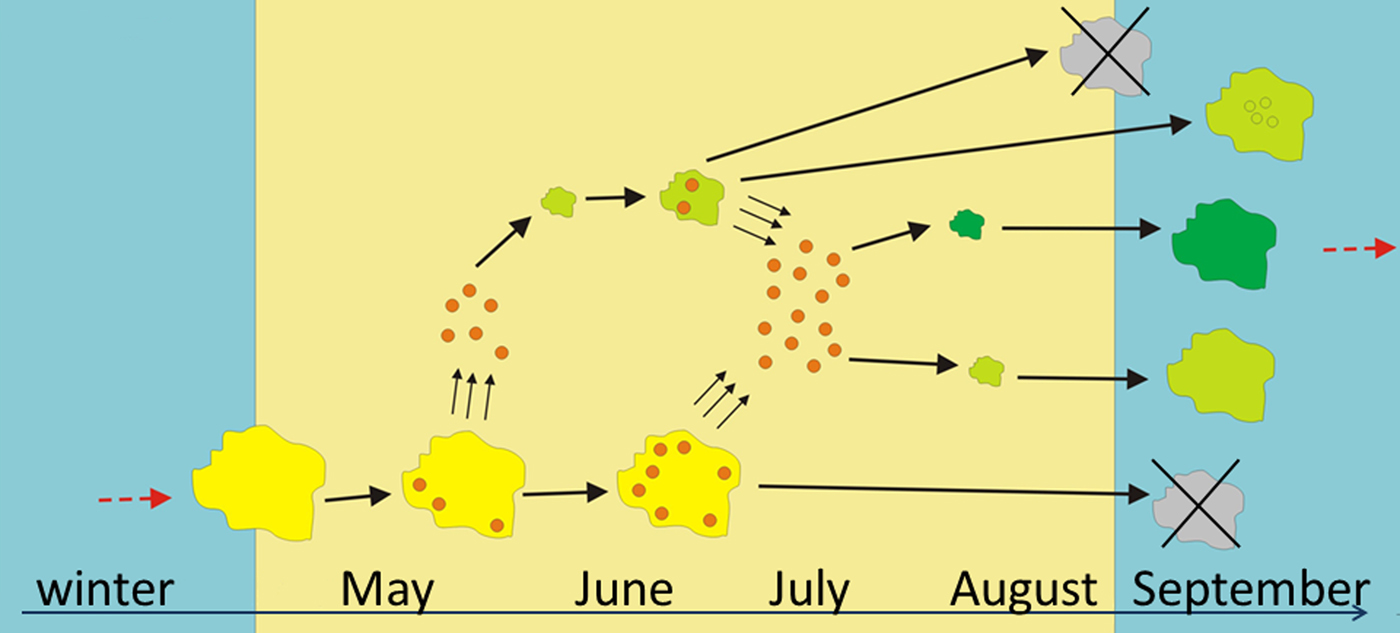
Initially we distinguished two age groups among the studied Cribrilina annulata colonies, young and overwintered (see above). The detailed analysis revealed a more complex picture. In fact, the colonies collected on both algal substrates actually represent at least three cohorts: (1) first (parental, overwintered) – all the colonies that survived hibernation and reproduce through the summer (Figures 5B–D & 6); (2) their descendants – second (daughter) cohort consisting of the (2a) reproducing colonies establishing predominantly from May to August and starting propagation in June (Figures 5A & 7A–C), and (2b) non-reproducing colonies establishing predominantly from July to mid-September; and (3) third (granddaughter) cohort (progeny of the reproducing colonies of the second cohort), establishing from late June to mid-September, mostly non-reproducing that year and morphologically indistinguishable from the non-reproducing colonies of the second cohort (Figure 7D–H). Colonies of daughter and granddaughter cohorts (2a + 2b + 3) hibernate and constitute the overwintered (parental) age group next spring (Figure 9; Supplementary material 2, Table 3).
Schematic representation of the life-history of Cribrilina annulata in the Chupa Inlet, White Sea. In yellow: overwintered colonies reproducing through the ice-free period and dying in late autumn; red circles: larvae; light green: colonies of second generation producing larvae (some of them also die in winter) and non-reproducing (hibernate together with colonies of third generation (dark green)). Overwintered colonies of second and third generations will represent the overwintered age group in the following spring.
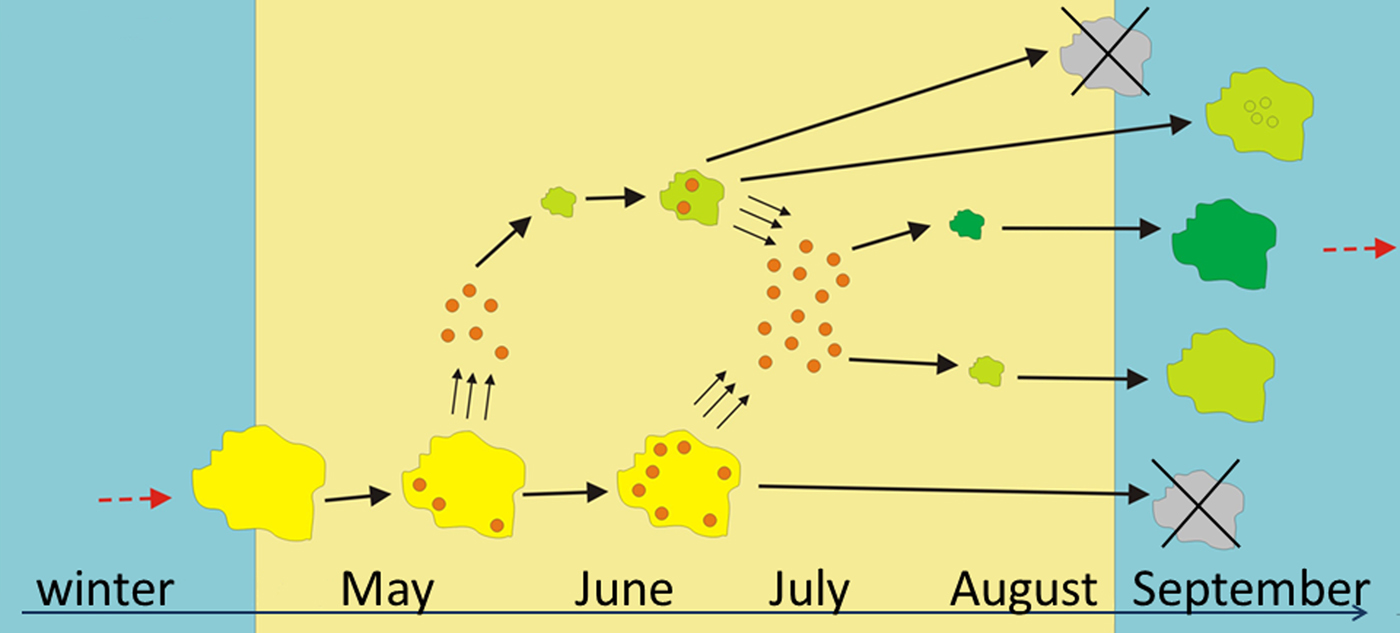
In May the overwintered colonies start reproduction, forming a peripheral zone of small-sized basal ovicellate zooids (Figures 5B & 6A–G). Colony size in the second cohort (2b) and granddaughter colonies (third cohort) formed last year varies from 25–40 (on red algae) to 110–155 zooids (on kelps) (Figure 2). Some survivors represent colonies of the second cohort that produced larvae last year (2a). They are normally larger (up to 358 zooids on kelps, and 116 on red algae) and have two ring zones of basal ovicellate zooids (Figure 5C, D). Notably, we detected repeated development of embryos (and, thus, ovaries) in the ordinary ovicellate zooids situated in the central part of such colonies (Figure 5D). Only few overwintered colonies were detected in late September on both substrates, and none were found in late October 2009 on kelps.
The earliest daughter colonies (second cohort) were found on 31 May 2011, on red algae. They were small (two to six zooids), sterile and undamaged. By mid-June such colonies grew up to 20–30 zooids and formed a ring zone of ordinary ovicellate zooids that continued budding. Judging from their small size, such colonies were established in late May and started reproducing very early (Figure 7C). Of note, the smallest ovicellate colonies of the second generation consisted of 7–9 zooids only (Figure 5A). Small reproducing colonies of 7–12 zooids were detected in the population up to the first decade of August. We do not know whether male zooids are formed in them, because potentially they might form only sterile and hermaphrodite zooids. The above-mentioned small fertile colonies could either belong to the second generation with late time of establishment or, potentially, to the third generation starting reproduction before overwintering. The latter would represent an opportunity for a fourth generation.
Larvae are produced and new colonies established during the rest of the summer until mid-September (Supplementary Figures 3 & 4), yielding mostly non-reproducing colonies of the second and the third generations.
Discussion
Dynamics of colony state and resource allocation
As colonies grow, mature, prepare for overwintering or senesce, their zooidal performances show prominent similarities and differences between generations living on either the same or different algal substrates. On kelps, colonies of two age groups differ noticeably (Figure 8). Larger overwintered colonies have a higher proportion of reproductive zooids and increasingly more ‘empty’ zooids towards the end of the season, while the young colonies mostly consist of feeding zooids. On red algae, colonies of both age groups behave similarly. Early in the season they show high reproductive activity, like overwintered colonies on kelps. At the end of the season they contain fewer ‘empty’ zooids and more feeding zooids and those with degenerating/regenerating polypides (similar to young colonies on kelps). Differences in the colony performance of different generations in some colonial invertebrates, including bryozoans, were described by Kuznetzov (Reference Kuznetzov1941), who studied epibiotic communities on stones in the Barents Sea. Direct comparisons, however, are problematic because Kuznetzov mainly focused on the timing of colony growth, reproduction and senescence based on skeletal characters. He also did not compare the performance of co-existing generations.
Regardless of the algal substrate and colony age/size and generation, the reproduction activity increased from May to mid-July with further decline. We relate this pattern with changes in feeding activity (possibly reflecting food availability) during the ice-free period (see also Dyrynda & Ryland, Reference Dyrynda and Ryland1982). The increase in larval production was accompanied by a high percentage of feeding zooids in June–July. The proportion of the latter dropped at about mid-July, however, probably reflecting the higher rate of polypide recycling. The second increase in feeding zooids proportion occurred in late July–early August. In contrast with the first half of summer, it was accompanied by a sharp decline in reproduction. We therefore conclude that food provisioning is not the only factor limiting reproduction: the low or zero reproduction here has other explanations, e.g. senescence in old colonies and transition to the resource accumulation based on a shift in the genetic programme in young ones. We are unaware of similar examples in the literature.
Beginning in July, the overwintered colonies already showed signs of ageing (more pronounced on kelps), which effects are normally reflected in age-related declines in both fecundity and survival (Stearns, Reference Stearns2000). The proportion of ‘empty’ zooids increased, accompanied by decreases in the percentage of reproductive zooids as well as of zooids containing functional and degenerating polypides. At the same time, young colonies, while ceasing larval production, consisted mostly of zooids with functioning polypides, maintaining their high proportion until late October. Also, they possessed zooidal buds, i.e. they actively grew during the entire ice-free period. Such a state of young colonies in August–autumn illustrates the aforementioned shift in resource allocation from larval production to somatic growth and nutrient storage for winter hibernation.
Role of seasonality in colony life
Numerous studies have described an influence of seasonal fluctuations of water temperature, light, salinity and other factors including phytoplankton abundance on the feeding, reproduction and growth of Bryozoa (Friedl, Reference Friedl1925; Borg, Reference Borg1947; Gautier, Reference Gautier1962; Eggleston, Reference Eggleston1963, Reference Eggleston1972; Gordon, Reference Gordon1970; Dyrynda & Ryland, Reference Dyrynda and Ryland1982; Yoshioka, Reference Yoshioka1982; Seed & Hughes, Reference Seed and Hughes1992; Barnes & Clarke, Reference Barnes and Clarke1995, Reference Barnes and Clarke1998; Sokolover et al., Reference Sokolover, Ostrovsky and Ilan2018). Food availability and space for larval settlement seem to be the major factors explaining seasonal growth and reproduction in temperate, boreal and polar waters. In contrast, periods of lower food supply commonly coincide with low/negligible rates of activity (Dyrynda & Ryland, Reference Dyrynda and Ryland1982; Hughes, Reference Hughes1989a; Barnes & Clarke, Reference Barnes and Clarke1995, Reference Barnes and Clarke1998). Nonetheless, differences in the performance of colonies of different generations require consideration. For instance, growth, gametogenic activity and massive polypide regeneration in overwintered colonies of the cheilostome Chartella papyracea in spring coincided with increased phytoplankton abundance, whereas young colonies established in early autumn predominantly performed growth activity (Dyrynda & Ryland, Reference Dyrynda and Ryland1982).
We expected Cribrilina annulata to show a similar pattern, and, indeed, active feeding and growth along with larval production lasted from the late spring to mid-summer when phytoplankton levels are highest in the Chupa Inlet (Khlebovitch, Reference Khlebovitch1974; Iliash et al., Reference Iliash, Zhitina and Fedorov2003). In August, however, when phytoplankton is still plentiful, reproduction ceased (on kelps) or decreased to a minimum (on red algae), whereas the proportion of feeding zooids increased (see above). Such behaviour differs drastically from that in other bryozoan species often inhabiting the same microbiotopes: they reproduce throughout the summer and September (at least) in the White Sea, i.e. as long as food is available (Nekliudova et al., Reference Nekliudova, Schwaha, Kotenko, Gruber, Cyran and Ostrovsky2019; Shevchenko, unpubl. data). Even more striking examples were described by Kuznetzov (Reference Kuznetzov1941) in the Barents Sea, where some epibionts maintained reproduction in autumn and winter despite the strong decrease in larval survival and settlement due to low water temperatures and storms. For instance, peak of larval settlement of the cheilostome Microporella sp. (as ciliata) was recorded in August–October.
Instead of the prolonged reproductive season, C. annulata displays two strategies to intensify larval production during the period of maximal food intake (when offspring survival is also higher). Powell (Reference Powell1967) suggested that the formation of frontal dwarf zooids in the related Cribrilina corbicula promotes a rapid increase in larval production. We concur, assuming that all smaller (and, thus, more quickly developing) ovicellate zooids jumpstart reproduction in overwintered C. annulata colonies. The second strategy is early start of reproduction in young colonies of the second cohort (see below), although such colonies are not numerous.
In October, polypides degenerate in most zooids, and brown body formation is accompanied by the development of ‘nutrient storage tissue’ filling zooids in young colonies (Shunkina, Reference Shunkina2010). We assume this tissue to be an energy resource, promoting colony survival in winter (November–March). Similarly, the accumulation of non-specified ‘resources’ in October was mentioned by Friedl (Reference Friedl1925) in the cheilostome Schizoporella sanguinea from the Adriatic Sea.
The state of the colonies collected in March 2015 indicated a dormant phase in winter. A few zooids potentially retain a functioning polypide, providing minimal nutrient supply, but this needs to be confirmed. Indirect evidence for cessation of reproduction in winter in polar seas is available. During year-round monitoring in Spitsbergen, the latest bryozoan ancestrulae were detected on settlement panels in November, and no meroplanktonic larvae were detected during the winter months (from January to late March) (Kuklinski et al., Reference Kuklinski, Berge, McFadden, Dmoch, Zajaczkowski, Nygård, Piwosz and Tatarek2013a). Marked seasonality in growth, polypide recycling and sexual reproduction were also demonstrated in three species of erect Antarctic cheilostomes (Barnes & Clarke, Reference Barnes and Clarke1998). All three completely ceased polypide activity in mid-winter (June–August): almost no polypides were classified as active, with most having degenerated to the brown-body stage.
Influence of substrate on colony performance
In the White Sea, Cribrilina annulata inhabits various substrates including stones, mollusc shells, and red and brown algae. The literature repeatedly suggests that the life histories of sedentary organisms living on stable vs ephemeral substrates differ (Ryland, Reference Ryland1963; Eggleston, Reference Eggleston1972; Cancino, Reference Cancino1986; Seed & Hughes, Reference Seed and Hughes1992; Williams & Seed, Reference Williams, Seed, Hawkins, John and Price1992; Yagunova & Ostrovsky, Reference Yagunova and Ostrovsky2008, Reference Yagunova and Ostrovsky2010). On one hand, kelps provide the largest area for bryozoan colonies to develop. Accordingly, the mean size of C. annulata colonies inhabiting fronds of Saccharina latissima spp. was almost twice that on red algae. On the other hand, kelps are prone to substantial destruction due to seasonal storms (see e.g. Eggleston, Reference Eggleston1972; Cancino, Reference Cancino1986; Makarov & Shoshina, Reference Makarov and Shoshina1996). They also emit chemical substances (Soule & Soule, Reference Soule, Soule, Woollacott and Zimmer1977; Conolly & Drew, Reference Conolly and Drew1985) including those influencing larval choice of substrate during settlement (Todd, Reference Todd1998) and, possibly, the colonies inhabiting them. Cancino (Reference Cancino1986) assumed that species whose lifespan exceeds the longevity of the substrate avoid settlement there.
Eggleston (Reference Eggleston1972) described the life history of the cheilostome Membranipora membranacea living on kelps (as Laminaria digitata and L. hyperborea): while overwintered colonies on the old parts of fronds often died in autumn storms, the colonies on the remaining old fronds overwinter and start growing (in proximal direction) in spring, actively covering the newly grown parts of the fronds and ‘anticipating’ a destruction of the old algal parts in April–May. Thus, successful colonization of ephemeral substrates deals with the periods of active growth or destruction of the substrate. In the White Sea, growth of Saccharina latissima spp. correlates with the level of photosynthetically active radiation, which peaks in July and August (Vozzhinskaya, Reference Vozzhinskaya1977). Active larval production occurs about the same time in C. annulata. Importantly, larval settlement takes place across the entire frond surface, but substrate selection is an important factor as only a few larvae attach to the eldest, distalmost parts. Young colonies formed from such larvae perish in winter together with overwintered colonies due to kelp destruction. In contrast, the young colonies developed on the middle (formed in the previous year) and proximal (grown this year) kelp parts can overwinter and reproduce the following year. Moreover, the old parts of the kelp fronds differ significantly from the young ones in both the composition of the chemical substances emitted (Conolly & Drew, Reference Conolly and Drew1985) and surface characteristics. The oldest parts are often wrinkled or ‘bubbled’, also becoming cracked after spore seeding in July–August (Vozzhinskaya, Reference Vozzhinskaya1977). Stebbing (Reference Stebbing1972), studying settlement of bryozoan and serpulid larvae, showed their ability to select the younger parts of Laminaria digitata fronds providing a stable substratum with less intense space competition for the longer period (see also Cancino, Reference Cancino1986). Since biochemical and structural properties of substrates affect larval settlement (Soule & Soule, Reference Soule, Soule, Woollacott and Zimmer1977; Todd, Reference Todd1998), we suggest these factors may influence substrate selection by C. annulata larvae too.
As our sampling of colonies inhabiting the two algal substrates was performed in different years, we cannot postulate that differences in the state of colonies between these two groups are explained by effect of substrate exclusively. Additional samples, however, did not show strong inter-annual shifts in state (see also Materials and methods). These and literature data listed in this section lead us to suggest an influence of substrate type on the growth as well as reproductive and feeding performances of Cribrilina annulata. Firstly, colonies on red algae, while often overgrowing both sides of the narrow thalli, are much smaller than those growing on Saccharina latissima spp. Secondly, although the trends in colony performances on different algal substrates were similar, the percentage of zooidal categories differed considerably, especially in overwintered colonies. Colonies on red algae invariably showed higher reproductive and recycling activities, while colonies on kelps had a higher percentage of ‘empty’ zooids. At the same time, they were larger and could have increased larval production.
Finally, the contrasting colony size on different substrata reflects differences in the relative investment into budding and sexual reproduction, as noted repeatedly for bryozoans (Herrera et al., Reference Herrera, Jackson, Hughes, Jara and Ramose1996; O'Dea et al., Reference O'Dea, Ostrovsky and Rodrígues2010). Accordingly, Yagunova & Ostrovsky (Reference Yagunova and Ostrovsky2010), studying C. annulata colonies on stones and red algae in the Barents and White Seas, determined that colonies on red algae begin reproducing at a smaller size and exhibit a higher reproductive input than colonies on stones. In the present study the early-reproducing colonies of 7–8 zooids were found on both algal substrates, but the percentage of reproductive zooids in larger colonies was markedly higher on red algae.
Dynamics of colony sexual structure
With one possible exception (Filicrisia geniculata, see Jenkins et al., Reference Jenkins, Bishop and Hughes2015), bryozoans have monoecious colonies consisting of sterile and sexual zooids, either gonochoristic or hermaphroditic that could be protandrous, protogynous or simultaneous hermaphrodites (Reed, Reference Reed, Giese, Pearse and Pearse1991; Ostrovsky, Reference Ostrovsky2013). Thus, initially sterile, a colony could continue as male, female or hermaphrodite. This picture then changes depending on the duration of gonadal functioning and the appearance of additional sexual zooids. In Chartella papyracea, for example, colonies are first sterile, then become male and hermaphrodite due to the successive (and seasonal) formation of the male and female zooids. In contrast, young sterile colonies of Bugulina flabellata (as Bugula) transform to female first and then hermaphrodite due to formation of protogynous hermaphrodite zooids (Dyrynda & Ryland, Reference Dyrynda and Ryland1982). The timing of gonad formation and functioning is presumably species-specific, but seasonal observations in nature or aquaria have been undertaken in only a handful of species (reviewed in Ostrovsky, Reference Ostrovsky2013).
In Cribrilina annulata, colonies are established sterile, then become male, hermaphroditic, female and, if they hibernate, sterile again. While this sequence of sexual states persists, colonies of different age groups show variation in the size of hermaphrodite zooids: colonies develop ordinary ovicellate zooids if they reproduce during the summer in which they were established, and smaller ovicellate zooids (basal and, sometimes, ‘dwarfs’) after overwintering. Such variation was recorded for the first time in Bryozoa.
Colonies of the second and the third generations established after mid-summer mostly postpone maturation until next spring. If such a colony survives winter, it begins reproduction the following spring, repeating the same sequence of sexual states (including formation of male gonads in some non-ovicellate zooids). Why these colonies do not participate in reproduction during the first months of their life (i.e. at a time when most colonies are sexual) remains enigmatic.
Start of reproduction
Many long-lived clonal organisms with potentially indeterminate growth delay reproduction until attaining some minimum size. From this perspective, some bryozoans start embryo production only upon reaching a defined size, e.g. 20–30 zooids for Callopora craticula in the White Sea (Shevchenko, unpubl. data); 80 zooids in Fenestrulina malusii, 130 zooids in Eurystomella foramenigera and 56 zooids for Crassimarginatella papulifera in New Zealand (Gordon, Reference Gordon1970). In the Caribbean the minimum colony-area necessary for reproduction ranged from 30 (in Drepanophora sp.) to 2700 zooids (in Steginoporella sp.) (Jackson & Wertheimer, Reference Jackson, Wertheimer, Nielsen and Larwood1985). Finally, in the Barents Sea, colonies of Microporella sp. (as ciliata) start reproduction in their second spring, being 1.5 years old and reaching size in about 800 zooids (Kuznetzov, Reference Kuznetzov1941).
Nonetheless, the timing of sexual maturity is often phenotypically plastic and regulated by complex interactions between intrinsic (size, age, physiological condition) and extrinsic (density, food availability, physical disturbance) factors (Harvell & Grosberg, Reference Harvell and Grosberg1988). For example, C. annulata displays high flexibility regarding sexual maturation, either postponing reproduction until next spring or starting larval production when still very young. This is related to the time of colony establishment. While most colonies of the second (daughter) generation formed in the first half of the summer began larval production at a size of 20–40 zooids, some sexually mature colonies were much smaller. We found young ovicellate colonies of C. annulata comprising only seven to eight zooids on both substrates (e.g. Figure 5A). Such a small size at maturation was previously known for interstitial bryozoans (Håkkanson & Winston, Reference Håkkanson, Winston, Larwood and Nielsen1985; Winston & Håkkanson, Reference Winston and Håkkanson1986). Cribrilina annulata sometimes shows an even more extreme condition: ovicellate zooids that budded from ancestrula were recorded in some colonies earlier (Ostrovsky, Reference Ostrovsky1998). Similarly, a few-days-old fertile colonies of Membranipora serrilamella (diameter 5 mm), Hippothoa sp. and Lichenopora sp. were also detected by Yoshioka (Reference Yoshioka1973) and Bernstein & Jung (Reference Bernstein and Jung1979) in California. The latter authors suggested that the relatively short lifespan of the kelp imposes the upper limit of the epiphyte lifespan, and that the early start of reproduction is a response to this. Hughes (Reference Hughes1989a), based on experiments on Celleporella hyalina, speculated that early reproduction should be characteristic for colonies established in spring and thus having the shortest lifespan because of substrate destruction (see also Cancino, Reference Cancino1986). In contrast, the colonies established in autumn delay reproduction until next spring in favour of reaching larger size because they live on the algal parts that survive longer. Finally, Seed & Hughes (Reference Seed and Hughes1992) suggested the presence of summer and winter generations inhabiting the ephemeral and long-living substrates and selected for maximal (and fast) and adjustable (optimizing colony growth and reproduction) sexual allocation, respectively.
Thus, the early start of reproduction can be explained by the influence of various extrinsic factors. In interstitial colonies (see above) it probably reflects the space limitations and high risk of breakage during life in-between small gravel particles. In colonies inhabiting algae, the longevity of the substrate as well as its metabolic properties should be considered. Interestingly, we found early-reproducing colonies of C. annulata from June to August on both algal substrata – kelps and more long-lived red algae – indicating that the substrate is not always crucial (see also below). Here, particularly favourable conditions for larval settlement and colony development could additionally promote early reproduction. Genetic differentiation within the population could also play a role (Yagunova & Ostrovsky, Reference Yagunova and Ostrovsky2010).
Lifespan and colony ageing
In August the old parts of kelp fronds begin to crumble in the White Sea. Stagnation of overwintered colonies on them began at about the same time, and by late September they consisted almost exclusively of ‘empty’ zooids. Thus, old colonies on kelps probably die before the ultimate destruction of the substrate. On the other hand, Cancino (Reference Cancino1986) and Hughes with co-authors (Hughes et al., Reference Hughes, Manríquez, Bishop and Burrows2003), studying bryozoan Celleporella hyalina on kelps, concluded that seasonal substrate disintegration is the main mortality factor for this species. Experimental colonies living on artificial permanent substrates survived up to 18 months, whereas their maximum lifespan on algae was 6–7 months (Cancino, Reference Cancino1986; Cancino & Hughes, Reference Cancino and Hughes1987).
Overwintered colonies on red algae contained almost one third feeding zooids and about one half recycling ones in the last week of September, which points to the longer colony life on them. Since no colonies were found to overwinter the second time on the red algae, however, they should senesce and die off even if that substrate is more stable than kelps, yet does crumble gradually irrespective of season (Shoshina, Reference Shoshina1998).
Although modular organisms can rejuvenate themselves by colony fragmentation and regeneration, as experimentally shown by Hughes (Reference Hughes2005) for C. hyalina, without fragmentation a colony becomes analogous to aclonal/solitary animal and likewise should senesce. O'Dea et al. (Reference O'Dea, Ostrovsky and Rodrígues2010) drew similar conclusions regarding cupuladriid bryozoans. They suggested that species which regularly clone through fragmentation experience senescence at the level of the zooid, whereas species that preferentially propagate sexually tend to senesce like solitary organisms. In Cribrilina annulata, for which colony fragmentation is not characteristic, the percentage of reproductive zooids dropped distinctly, accompanied by the prevalence of ‘empty’ zooids and those with degenerating polypide in overwintered colonies in autumn on both substrates. This points to colony senescence and possible death even before substrate disintegration. On the other hand, colonies of this species lived more than three years on the artificial panels near Spitsbergen (Kuklinski et al., Reference Kuklinski, Sokolowski, Ziolkowska, Balazy, Novosel, Barnes, Ernst, Schäfer and Scholz2013b), thus suggesting possible influence of the algal substrate to the colony lifespan.
Our observations therefore allow us to estimate the approximate colony lifespan of the studied population on algae in the studied area. Because embryos were present in the overwintered colonies in the last half of May on both algal substrates, and young colonies of various sizes were present on red algae in late May–early June, we conclude that the earliest colonies of the second generation are formed in mid-May. Among these, those developing on old kelp frond parts should survive no longer than 4–5 months because of the autumn storms, whereas colonies on young parts could live up to 17 months (from mid-May to mid-October of the following year). The presence of overwintered colonies with two ring zones of ordinary and smaller ovicellate zooids proves this assumption. The colonies of the second and third generations established in July–August live 2–3 months less, yielding a maximal lifespan of 14–15 months. On red algae the colonies potentially could survive longer, e.g. up to 18 months (Supplementary material 2: Table 3; Figure 9). Thus, according to classification of the bryozoan life-histories by Eggleston (Reference Eggleston1972), Cribrilina annulata should be classified among annuals and biennials.
Supplementary material
The supplementary material for this article can be found at https://doi.org/10.1017/S0025315419000286
Author ORCIDs
Andrew N. Ostrovsky, 0000-0002-3646-9439
Acknowledgements
This study was performed using the laboratories and equipment of the Educational and Research Station ‘Belomorskaia’ and the Centre for Molecular and Cell Technologies, Saint Petersburg State University. Ms O.N. Kotenko and E.T. Shevchenko, Dept. of Invertebrate Zoology, Saint Petersburg State University, kindly helped to collect material. Mr A.A. Miroliubov, Zoological Institute, Russian Academy of Sciences, Saint Petersburg, kindly collected material under ice. We thank Dr M. Stachowitsch, University of Vienna, who revised an early draft of the manuscript and improved its English. We are also deeply indebted to two anonymous reviewers, whose constructive criticism and advice helped to improve the manuscript.
Financial support
This study was funded by the Saint Petersburg State University (grants 1.38.233.2015 and 1.42.1493.2015) (field collecting and material processing); the Russian Foundation for Basic Research (grant 16-04-00243-a) (histological work); and the Russian Science Foundation (grant 18-14-00086) (statistical analysis).