

Introduction
The relationship between Myrsine L. and its satellites (inter alia Rapanea Aubl. and Suttonia A.Rich.) has been a historical focal point for taxonomic contention within the Myrsinaceae. Many regional authorities have defended positions on either side of a debate which continues to the present.
Mez (Reference Mez and Urban1901, Reference Mez and Engler1902) was the first to state a credible rationale for the separate recognition of Myrsine and Rapanea (viz. the presence of a well-defined style and filaments in Myrsine and their absence in Rapanea). This established the basis for all subsequent interpretations of generic delimitations. When accepting their separation, Smith (Reference Smith1973) added a qualifying note that the filaments in Myrsine are connate into an apically free ‘flange’, while in Rapanea the filaments are completely fused to the corolla, the anthers thus appearing epipetalous. Fosberg & Sachet (Reference Fosberg and Sachet1975, Reference Fosberg and Sachet1980) acknowledged the difference in staminal structure, but believed the distinction was not of sufficient importance for recognising two genera. Using similar arguments, various authors have taken positions for one or the other genus. Within the Pacific region, the authorities supporting separation have included Degener (Reference Degener1939), Oliver (Reference Oliver1951), Smith (Reference Smith1973, Reference Smith and Smith1981), Royen (Reference Royen1982), Sleumer (Reference Sleumer1986) and Larsen & Hu (Reference Larsen, Hu and Larsen1996). However, Hosaka (Reference Hosaka1940), Backer & Bakhuizen van den Brink (Reference Backer and Bakhuizen van den Brink1965), Fosberg & Sachet (Reference Fosberg and Sachet1975, Reference Fosberg and Sachet1980), Sachet (Reference Sachet1975), Li (Reference Li, Li, Liu, Huang, Koyama and Devol1978), Wagner et al. (Reference Wagner, Herbst and Sohmer1990), Pipoly & Chen (Reference Pipoly and Chen1995), Pipoly (Reference Pipoly1996, Reference Pipoly, Marshall and Beehler2007) and Jackes (Reference Jackes2005) have favoured assimilation of Rapanea into the older name Myrsine.
Based on examination of representative taxa throughout the palaeotropics, it is now apparent that staminal variation in Myrsine embraces many previously unreported character states. These recently documented observations include: (i) the presence of rudimentary filaments in pistillate flowers; (ii) intergradations (between species) in the degree of filament connation; (iii) the co-occurrence (within species) of staminate flowers with distinct filaments, and pistillate flowers with filaments adnate to the corolla (i.e. the male flowers conforming to Myrsine but the female ones conforming to Rapanea), and (iv) intergradations in the degree of staminal adnation to corolla tubes and/or their lobes within the same individual (see Pipoly, Reference Pipoly1991, Reference Pipoly1992a, Reference Pipoly1992b, Reference Pipoly1996). Far from being composed of discrete elements, the androecium variation is actually a continuum of morphotypic states, represented primarily by taxa with completely free filaments (Myrsine sensu stricto) and those where a staminal tube is fully adnate to the corolla (Rapanea sensu stricto), but also including many intermediate forms between these endpoints. Similar patterns of intergrading variation have been discerned in the styles and stigmas of neotropical Myrsine (Pipoly, Reference Pipoly1991, Reference Pipoly1992a). With respect to the criteria traditionally used to distinguish them, Rapanea and Myrsine should thus be regarded as one genus.
Papuasian Rapanea were treated comprehensively by Sleumer (Reference Sleumer1986), and its alpine species were also reviewed by Royen (Reference Royen1982). Due to the retention of Rapanea by these investigators, there is a complete set of east Malesian binomials for Rapanea, and hardly any for Myrsine. Many regional floras have similar nomenclatural imbalances as a result of past geographically-restricted assessments.
Pipoly (Reference Pipoly1996) published a revision of Philippine Myrsine prior to an intended treatment of all Malesian congeners, but the wider study was placed in abeyance following a change in his organisational affiliation. As part of earlier preparations for the deferred revision, Pipoly began (in around 2006) an informal transfer of names from Rapanea to Myrsine (e.g. the Rapanea collections at LAE were labelled with appropriate Myrsine binomials). However, 18 of the intended transfers are still unpublished.
With the discovery of a new Myrsine in Papua New Guinea, formal publication of these transfers is now needed. There are only three Myrsine names currently available as substitutes for the Rapanea species accepted by earlier authorities in our region. Instead of using the existing nomenclature, it is more appropriate to establish a congeneric foundation of binomials, for the immediate purpose of recognising Myrsine warrae, but also to acknowledge the latest taxonomic evidence. The necessary transfers are made in the following section.
Nomenclatural Transfers in Papuasian Myrsine
1. Myrsine acrosticta (Mez) Pipoly, comb. nov. – Rapanea acrosticta Mez, Bot. Arch. 2: 259 (1922). – Type: Papua New Guinea, East Sepik, Hunstein Mts, viii 1912, C. Ledermann 8510 (lecto K [chosen in Sleumer, Reference Sleumer1986]).
2. Myrsine arfakensis (Kaneh. & Hatus.) Pipoly, comb. nov. – Rapanea arfakensis Kaneh. & Hatus., Bot. Mag. Tokyo 57: 230, fig. 20 (1943). – Type: W New Guinea, Angi District, forests on eastern slope of Lake Gita, 2000 m, 5 iv 1940, R. Kanehira & S. Hatusima 13521 (holo FU; iso A, BO).
3. Myrsine augustae (Mez) Pipoly, comb. nov. – Rapanea augustae Mez, Bot. Arch. 2: 212 (1922). – Type: Papua New Guinea, West Sepik, Felsspitze, vii–viii 1913, C. Ledermann 12488 & 12506 (syn B, destroyed).
4. Myrsine cacuminum (Mez) Pipoly, comb. nov. – Rapanea cacuminum Mez, Bot. Arch. 6: 232 (1924). – Type: W New Guinea, Oranje Mts, top of Mt Wichmann, 3100 m, ii 1913, A. Pulle 1044 (holo B, destroyed).
5. Myrsine clemensiae (Sleumer) Pipoly, comb. nov. – Rapanea clemensiae Sleumer, Blumea 31: 254 (1986). – Type: Papua New Guinea, Morobe District, Sattelberg, Sambanga, 6000 ft (1830 m), 1 x 1937, M.S. Clemens 7238 (holo L; iso A, B).
6. Myrsine coriifolia (Sleumer) Pipoly, comb. nov. – Rapanea coriifolia Sleumer, Blumea 31: 248 (1986). – Type: Papua New Guinea, Morobe Province, Bulolo Watut Divide, 12 km SW of Bulolo, Castanopsis dominated ridge, 07°17′S, 146°34′E, 1520 m, 8 x 1982, H. Streimann 8613 (holo L; iso A, BFC, K, LAE, UPNG).
7. Myrsine dicksonii (P.Royen) Pipoly, comb. nov. – Rapanea dicksonii P.Royen, Alpine Flora of New Guinea 3: 1969, fig. 602 F–J (1982). – Type: Papua New Guinea, Goilala Subdistrict, between Mt Dickson and Kuputivava, moss forest, 08°10′S, 147°10′E, c.9000 ft (2745 m), 12 ii 1964, T.G. Hartley 13022 (holo L; iso CANB).
8. Myrsine gomphostigma (Mez) Pipoly, comb. nov. – Rapanea gomphostigma Mez, Bot. Arch. 6: 232 (1924). – Type: W New Guinea, Vogelkop Peninsula, Arfak Mts, 2300 m, iv–v 1912, K. Gjellerup 1201 (holo B, destroyed).
9. Myrsine inaequalis (Kaneh. & Hatus.) Pipoly, comb. nov. – Rapanea inaequalis Kaneh. & Hatus., Bot. Mag. Tokyo 57: 232, fig. 21 (1943). – Type: W New Guinea, Angi District, mossy forests, 1800 m, 15 iv 1940, R. Kanehira & S. Hatusima 13440 (holo FU).
10. Myrsine involucrata (Mez) Pipoly, comb. nov. – Rapanea involucrata Mez, Pflanzenreich 9: 370 (1902). – Type: Papua New Guinea, Owen Stanley Range, Mt Scratchley, 10000–13000 ft (3000–4000 m), anno 1896, A. Giulianetti s.n. (holo K; iso L [fragment]).
11. Myrsine lamii (Sleumer) Pipoly, comb. nov. – Rapanea lamii Sleumer, Blumea 31: 264 (1986). – Type: W New Guinea, N of Depapre, 120 m, 15 x 1954, H.J. Lam 7815 (holo L).
12. Myrsine leucantha (K.Schum.) Pipoly, comb. nov. – Rapanea leucantha K.Schum., Fl. Deutsch. Schutzgeb. Südsee, Nachtr. 345 (1905). – Type: Papua New Guinea, Morobe District, Sattelberg, 850 m, vii 1899, E. Nyman 715 (holo B, destroyed; iso S, WRSL [fragment]).
13. Myrsine minutifolia (Knoester, Wijn & Sleumer) Pipoly, comb. nov. – Rapanea minutifolia Knoester, Wijn & Sleumer, Blumea 31: 252 (1986). – Type: W New Guinea, Kebar Valley, Nettoti Mt, secondary forest on stony clay, 1940 m, 29 xi 1960, Chr. Versteegh BW 10368 (holo L).
14. Myrsine revoluta (Kaneh. & Hatus.) Pipoly, comb. nov. – Rapanea revoluta Kaneh. & Hatus., Bot. Mag. Tokyo 57: 233, fig. 23 (1943). – Type: W New Guinea, Angi District, Mt Koebre, 2400 m, 9 iv 1940, R. Kanehira & S. Hatusima 14068 (holo FU).
15. Myrsine rhombata (P.Royen) Pipoly, comb. nov. – Rapanea rhombata P.Royen, Alpine Flora of New Guinea 3: 1976, fig. 606 (1982). – Type: Papua New Guinea, Eastern Highlands District, Mt Wilhelm, E slopes, 28 vii 1959, L.J. Brass 30757 (holo L; iso A).
16. Myrsine tempampan (P.Royen) Pipoly, comb. nov. – Rapanea tempampan P.Royen, Alpine Flora of New Guinea 3: 1983, fig. 607 G–I (1982). – Type: Papua New Guinea, Morobe District, Saruwaget Range, Tempampan, upper edge of montane cloud forest, 3415 m, 18 ix 1964, R.D. Hoogland 9866 (holo L; iso CANB).
17. Myrsine velutina (Knoester, Wijn & Sleumer) Pipoly, comb. nov. – Rapanea velutina Knoester, Wijn & Sleumer, Blumea 31: 251 (1986). – Type: Papua New Guinea, Eastern Highlands District, Chimbu Subdistrict, Mt Wilhelm, Lake Aunde, edge of forest above swampy glen, 05°45′S, 145°05′E, 12000 ft (3655 m), 24 ix 1962, A.N. Millar & P. Royen NGF 14678 (holo L; iso LAE).
18. Myrsine womersleyi (Sleumer) Pipoly, comb. nov. – Rapanea womersleyi Sleumer, Blumea 31: 266 (1986). – Type: Papua New Guinea, Morobe District, Wau Subdistrict, Mt Kaindi summit, Edie Creek, 10 miles from Wau, 07°25′S, 146°45′E, 7200 ft (2195 m), 31 viii 1961, J.S. Womersley & H. Sleumer NGF 13926 (holo L; iso LAE).
Description
Species haec inter speciebus congeneribus Papuasiae singularis fructibus valde rostratus usque ad 9.6 × 6.2 mm statim distinguitur. – Type: Papua New Guinea, Morobe Province, Bowutu Range, buttress ridge to Blue Mt, Nembebah, natural-growth hill forest on ultrabasics, 07°17′41″S, 147°05′38″E, 625 m, 27 ii 2005, Takeuchi & Ama 18923 (holo LAE; iso A, BISH, K, L, MO).
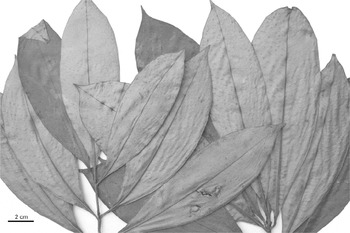
Myrsine warrae W.N.Takeuchi & Pipoly. Unmounted duplicate from the type collection. The large leaves are often arranged in apically-crowded pseudowhorls (Takeuchi & Ama 18923).

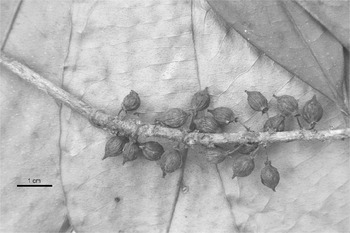
Myrsine warrae, fruit detail. Fruits are reddish-brown, furrowed, and distinctively beaked (Takeuchi, Jisaka, Towati & Ama 18992).

Subarborescent shrubs or trees to 10 m in height, terrestrial, glabrous. Branchlets terete, (1.5–)2.5–5(–7) mm diameter, lax, apical bud conoid-subulate; surfaces nigrescent, brunnescent, or greyish, dull, striate, not lenticellate, prominently marked by fusiform-lunate abscission scars; periderm crustaceous, flaky; internodes 0.1–4.1 cm. Leaves alternate, spiral, crowded, often 3–5-pseudowhorled; petioles 5–12(–16) × 1–3 mm, broadly channelled on upper side, rounded beneath, longitudinally rugose, black; leaf blades elliptic or oblanceolate, (6.8–)11.3–23(–27) × (1.6–)4.2–6.6(–8.8) cm, subcoriaceous; surfaces opaque, adaxially fuliginous, abaxially brown or tawny-brown, bifacially black-pusticulate in reflected light, pellucid punctate under transmitted light, glandular lines absent; lamina base cuneate-attenuate; margin reflexed; apex abruptly or gradually acuminate, acumen to c.2 × 1.5 cm; venation eucamptodromous, secondaries (11–)15–22(–29) per side, 1–21(–27) mm apart, inconspicuous, at the lamina centre diverging (40–)55–80° from midribs, turned abruptly 1–7 mm before the margin, closing by periclinally looping nerves or not, partial intersecondary veins numerous; midribs impressed above, strongly raised below, higher-order nervation bifacially prominulous; reticulum irregular, finely areolate. Inflorescence not seen. Infructescence below the leaves, fasciculate; peduncle callose, globuliform or discoid-cylindrical, 0.8–3(–3.4) × 1.2–3(–3.5) mm, perennating; peduncle bracts deltoid, to 1.8 × 1.6 mm, congested, imbricated, spiral, obscuring surfaces, persisting, scarious or thickened, rarely fimbriolate; pedicels (1–)2.5–5.2(–6.1) × 0.2–0.7 mm, ebracteate, non-articulate, smooth; calyx 4-partite, lobes triangular, (0.6–)0.9–1.2 × (0.7–)1–1.3 mm, laxly spotted, ciliolate. Fruits (after drying) solitary or up to 5 together on the peduncle summit, ovoid-globose or ellipsoid, (6–)8.2–9(–9.6) × (3.5–)4.8–6.2 mm inclusive of the (0.8–)1.2–2(–2.5) × 1–2.1 mm beak; rostellum abruptly conoid, crowned by a 4-lobulate stigma; exocarp red, reddish-brown, or black, irregularly furrowed, set with glandular spots and lines; endocarp usually 7–8.5 × 5–5.7 mm when mature, 0.5–0.9 mm thick, rostrate, crustaceous; seed single, apically inserted on the free-central column, endosperm not ruminate.
Field notes. Stems unbuttressed, without exudate, outer bark ± smooth, sapwood straw; leaf blades fleshy-coriaceous, dark green above, pale green beneath, bifacially punctate, midribs red; infructescence fragile, easily dislodged by handling; fruits green or light brown, epicarp marked by red spots and streaks.
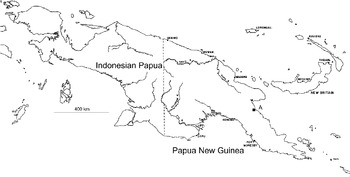
Distribution. Currently known only from the type locality in the Bowutu Mts of Morobe Province (Fig. 3).
Island of New Guinea. A, Nembebah, type locality for Myrsine warrae.

Habitat. Hill forest on ultrabasics, 625–825 m elevation.
Phenology. Fruiting in late February to early March.
Etymology. Named after forester Terry Warra, former managing director of the PNG National Forest Authority, and a long-serving director of the PNG Forest Research Institute in Lae.
Additional specimen examined. Papua New Guinea. Morobe Province, Bowutu Range, buttress ridge to Blue Mt, stunted Massenerhebung forest on ultrabasics, 07°17′12″S, 147°04′08″E, 825 m, 1 iii 2005, Takeuchi, Jisaka, Towati & Ama 18992 (A, BO, L, LAE).
Notes
1 Myrsine warrae is immediately and uniquely identified by its conspicuously rostrate fruits. This feature is not an artefact of drying, the endocarp having the same shape as the dried mericarp. Although the inflorescence is unknown, fruiting calyces and stigmas are always tetramerous in the specimens at hand.
2 With leaf blades to 27 × 8.8 cm, Myrsine warrae has longer leaves than any Papuasian congener. Only Myrsine coriifolia (Sleumer) Pipoly has comparably sized blades, but in that species the reproductive structures are pentamerous, and the globose fruits (though crowned by subconical-apiculate stigmas) are not rostrate.
3 Using the current Rapanea revision (Sleumer, Reference Sleumer1986), Myrsine warrae will key without result to couplets 18–21. Royen's (1982) key breaks down at couplet 8, mainly due to the large leaves on the new plant and the predominance of small-leaved taxa in Royen's alpine treatment.
4 In Malesian environments, Myrsine densiflora Scheff. is found primarily on ultrabasic soils behind the mangrove zone or in lowland regrowth (Sleumer, Reference Sleumer1986; Pipoly, Reference Pipoly1996), a pattern also seen along the Bowutu coastline (Takeuchi, pers. obs.). Myrsine warrae is known only from the ultrabasic terrain adjoining these M. densiflora habitats. Judging from the substrate preferences of Philippine congeners (Pipoly, Reference Pipoly1996), the new species is probably a genuine ultrabasic specialist in the manner of Myrsine densiflora.
Acknowledgements
The Bowutu montane surveys were funded by the National Science Foundation (grant DEB 0315930), the Arnold Arboretum, and the Harvard University Herbaria. Logistical assistance was received from the Village Development Trust and the PNG Forest Research Institute.