

INTRODUCTION
Scholars are increasingly conceptualizing social movement actors as knowledge producers (Reference BrownBrown, 1992; Reference EpsteinEpstein, 1995; Reference FischerFischer, 2000; Reference Brown, Zavestoski, McCormick, Mayer, Morello-Frosch and AltmanBrown et al., 2004; Reference McCormickMcCormick, 2006; Reference GullionGullion, 2015; Reference Luke, Rasch, Evensen and KöhneLuke et al., 2018; Reference Ganz and SouleGanz & Soule, 2019; Reference Choudry and TrifonasChoudry, 2019). While social movement actors produce various insights, what has received the most scholarly attention is a particular type of knowledge that centers around social movement actors' expertise in certain policy areas. Activists seek to establish authority and wield policy influence through their contributions to knowledge, which entails producing and interpreting new evidence (Reference Brown, Zavestoski, McCormick, Mayer, Morello-Frosch and AltmanBrown et al., 2004; Reference EpsteinEpstein, 1995; Reference FischerFischer, 2000), contesting existing knowledge (Reference BrownBrown, 1992; Reference GullionGullion, 2015; Reference McCormickMcCormick, 2006), unearthing hidden information (Reference Cox and FominayaCox & Fominaya, 2009; Reference MoriMori, 2022; Reference Richter, Cordner and BrownRichter et al., 2018), and disseminating their findings to the public (Reference MoriMori, 2022). Environmental movements, for example, emphasize their “issue expertise” by creating or mobilizing scientific evidence to shape policy (Reference Ganz and SouleGanz & Soule, 2019). However, since scientific data are often expensive or hard to access, many social movements struggle to credibly establish their expertise and, by extension, authority and policy influence (Reference ThorneThorne, 1975). Movements concerned with high-profile foreign policy issues, such as anti-war and peace movements, struggle to access information for different reasons; documents are often kept secret by state authorities (Reference GiugniGiugni, 2004, p. 228; Reference MoriMori, 2022). Such knowledge imbalances relative to the state are only exacerbated by perceptions that the movements are driven more by ideology than by objective information (Reference GullionGullion, 2015; Reference KawatoKawato, 2015; Reference Luke, Rasch, Evensen and KöhneLuke et al., 2018; Reference Moon and KimMoon, 2003).
We draw on studies of social movement knowledge production and legal mobilization to show how institutional tactics enable even those social movements that are conventionally seen as ideologically driven, and therefore least associated with knowledge production, to contribute to public knowledge. With a focus on the generation of new knowledge and discovery of hidden information, we argue that social movements can leverage features of the process of legal mobilization to become producers of public knowledge. In particular, movements use court-recognized standing, legal framing, judges' examination of evidence, the rhythm of court proceedings, and rulings to gain authority, bring information to light, and thereby reshape public knowledge. By identifying the causal mechanisms activated by legal strategies, this paper increases our understanding of how legal mobilization processes facilitate social movement knowledge production.
Activism challenging environmental concerns associated with the U.S. military footprint in Japan and South Korea (hereafter Korea) offers an analytically interesting example in which environmental causes (i.e., causes often associated with science-driven expertise) (Reference Ganz and SouleGanz & Soule, 2019; Reference McCormickMcCormick, 2006) merge with anti-war and peace causes (i.e., causes often seen as more ideologically driven and thus biased as sources of information) (Reference Amenta, Caren, Chiarello and YangAmenta et al., 2010, p. 295; Reference GiugniGiugni, 2004). In generating public knowledge about environmental pollution associated with the U.S. military, Korean and Japanese movements that historically used disruptive action and fiery rhetoric have increasingly opted for institutional claims-making, most notably via similar lawsuits over noise pollution associated with U.S. military bases, as well as official information requests concerning unknown cases of environmental contamination at U.S. military sites. We leverage the fact that they face similar knowledge gaps vis-à-vis their targets and institutional hurdles to legal mobilization to identify and illustrate the mechanisms through which activists contribute to public knowledge. Our analysis of these “hard cases” draws on 11 semi-structured interviews, participant observation during fieldwork, movement publications such as newsletters and reports, and news coverage of the movements (see Appendix). Compared to extant research on anti-base activism in the region, we pay closer attention to legal processes, including transnational ones like FOIA requests in the United States. We also add to the emerging literatures on litigation in social movement knowledge production (Reference Setzer and VanhalaSetzer & Vanhala, 2019) and on legal mobilization in East Asia (Reference ArringtonArrington, 2019a, Reference Arrington2019b; Chua 2014; Reference SternStern, 2013), which was traditionally seen as inhospitable to legal strategies.
This article begins by theorizing how—and through what mechanisms—the process of legal mobilization facilitates social movement knowledge production. It then outlines the noise pollution lawsuits and information disclosure requests and lawsuits on which we base our findings. Our empirical analysis focuses on identifying and illustrating five mechanisms through which legal mobilization related to noise pollution and contamination around U.S. military bases in Japan and Korea bolstered movements' credibility and ability to contribute to public knowledge. We conclude with implications for future research.
KNOWLEDGE GAPS AND LEGAL MOBILIZATION
Social movements aim to raise public awareness, garner support for their cause, and influence policy outcomes. To pursue these aims, they adopt diverse tactics, often in combination, ranging from attention grabbing extra-institutional protests to “political action ‘inside the system’”—or activism that taps into institutionalized, “proper” channels, such as lobbying and litigation (Reference BursteinBurstein, 1991, p. 1203). Especially with institutional tactics, social movements' influence and efficacy depends at least in part on their reputation for “authoritative knowledge,” or “excellent knowledge of the issue-area” (Reference Risse, Carlsnaes, Risse and SimmonsRisse, 2013, p. 434). Research on framing similarly indicates that factors like claims' empirical credibility, the issue's salience, and frame articulators' credibility enhance the likelihood of frame resonance (Reference Benford and SnowBenford & Snow, 2000, pp. 619–622). Moreover, by establishing themselves as “lay experts,” or those capable of creating valuable and credible knowledge, social movement actors are sometimes invited to join elite-dominated policy decision-making processes (Reference EpsteinEpstein, 1995). Yet most social movements begin from positions of disadvantage in terms of knowledge and credibility compared to state authorities. Not only do state actors know more and have better access to documents, but they are also considered more authoritative by the media and public (Reference BennettBennett, 1990). While studies on social movements are increasingly exploring how social movement actors develop expertise and become credible knowledge producers (Reference BrownBrown, 1992; Reference Brown, Zavestoski, McCormick, Mayer, Morello-Frosch and AltmanBrown et al., 2004; Reference Choudry and TrifonasChoudry, 2019; Reference EpsteinEpstein, 1995; Reference FischerFischer, 2000; Reference Ganz and SouleGanz & Soule, 2019; Reference GullionGullion, 2015; Reference Luke, Rasch, Evensen and KöhneLuke et al., 2018; Reference McCormickMcCormick, 2006), they have paid insufficient attention to legal strategies.
We argue that the process of legal mobilization activates mechanisms that can help alleviate information disadvantages vis-à-vis state authorities, bolster the credibility of social movement actors, and thereby facilitate social movements' contributions to public knowledge. We follow Lehoucq and (Reference Lehoucq and TaylorTaylor 2020, p. 168) in conceptualizing legal mobilization as “the use of law in an explicit, self-conscious way through the invocation of a formal institutional mechanism.” To unpack the mechanisms activated by legal strategies, this article analyzes two types of legal mobilization: civil and administrative lawsuits and information disclosure requests and related administrative law proceedings. Compared to disruptive tactics involving direct physical action, institutional tactics like these may be perceived as less confrontational (Reference ChuaChua, 2012) and less likely to alienate the authorities and the public (Reference Marshall, Sarat and ScheingoldMarshall, 2006, p. 165). However, legal mobilization also occurs in some of the most structured of institutional settings with steep barriers to entry. Claims must be framed according to existing laws, and only affected parties can bring claims. Navigating these rules and procedures requires legal knowledge and resources. Indeed, scholars concur that litigants need “support structures” encompassing lawyers, advocacy organizations, and funding to effectively mobilize the law (Reference CichowskiCichowski, 2007; Reference ConantConant, 2016; Reference EppEpp, 1998).
Nonetheless, we contend that legal mobilization can provide significant opportunities for social movement actors to demonstrate and develop their expertise and credibly add to public knowledge. Our argument builds on legal mobilization scholarship, which has long viewed law and society as mutually constitutive (Reference McCannMcCann, 1996). For example, Marc (Reference Galanter, Boyum and MatherGalanter 1983, p. 118) recommended studying not just “the centripetal flow of cases into courts” but also “the centrifugal flow of influence from the courts.” Courts' messages mingle with others in society to shape shared understandings of a problem and appropriate policy solutions. In her study of anti-tobacco litigation in the United States, Lynn (Reference MatherMather 1998) similarly argued that lawsuits had both causal impact, such as the disclosure of incriminating documents and legislative changes, and constitutive effects, such as raising public knowledge about smoking's health consequences and solidifying narratives of tobacco companies' wrongdoing and liability. Likewise, Whitney (Reference TaylorTaylor 2020) traced how the interaction of legal claims-making and judicial receptivity socially constructs what issues are considered “legally grievable.” In and around court, diverse actors contest issue framing, the definition of the problem, what counts as credible evidence, who can produce sound science, and how to assess it. Indeed, Lisa (Reference VanhalaVanhala 2020, p. 106) recently noted that knowledge is both an “input” to legal cases and an “output” of legal mobilization. Legal mobilization is thus entwined with knowledge production. Our analysis elucidates the mechanisms at work, specifying how parts of the legal mobilization process can help social movements assert expertise, access and publicize information, reshape narratives, and gain external validation.
We identify and illustrate the mechanisms through which legal mobilization facilitates social movement knowledge production by analyzing the “hard cases” of environmental activism against U.S. military bases in Korea and Japan. On the one hand, they are hard cases because social movements working in areas of military affairs and foreign policy face particularly wide knowledge gaps vis-à-vis policy elites (Reference Amenta, Caren, Chiarello and YangAmenta et al., 2010, p. 295; Reference GiugniGiugni, 2004). Knowledge gaps develop because the authorities deem certain domains of knowledge “organizationally circumscribed” or “inaccessible” (Reference Frickel, Bess Vincent and KiefferFrickel and Vincent 2013, pp.12–13). As noted in the next section, for anti-base movements in Korea and Japan, not only their own governments but also the U.S. government and military restrict information and physical access, which frustrate both collecting onsite data about environmental contamination and accessing documents about bases' environmental impact. Information asymmetries stemming from government secrecy thus compound the usual knowledge disadvantages that social movement actors face when trying to gain access to scientific data, which can be expensive or proprietary.
On the other hand, they are hard cases because surmounting such information asymmetries is particularly critical for environmental activists, who, by virtue of being “forced to deal with science more than others,” must credibly mobilize convincing data in a complex and relatively new field (Reference McCormickMcCormick, 2006). Research shows that environmental activists' “scientific expertise” translates into “perceived legitimacy” and policy influence (Reference Ganz and SouleGanz & Soule, 2019). Even non-career activists, such as local residents affected by environmental policies, often claim to be lay experts by engaging in citizen research (Reference GullionGullion, 2015; Reference Marshall, Sarat and ScheingoldMarshall, 2006, p. 173). For these nonprofessional activists, who are wary of being seen as “biased, leftist, and non-neutral,” producing “‘objective’ and ‘neutral’ knowledge” bolsters credibility (Reference Luke, Rasch, Evensen and KöhneLuke et al., 2018, p. 531; see also Reference GullionGullion, 2015, p. 116). Sociolegal scholarship has long analyzed how environmental policy issues get legally contested around the world (Reference Kidder and MiyazawaKidder & Miyazawa, 1993; Reference SternStern, 2013; Reference VanhalaVanhala, 2022). But questions of expertise and knowledge production remain understudied (Reference Setzer and VanhalaSetzer & Vanhala, 2019, p. 10; but see Reference Marshall, Sarat and ScheingoldMarshall, 2006).
By highlighting the mechanisms through which institutional tactics—specifically, legal strategies—can be productive for social movements, we do not deny that legal strategies sometimes have drawbacks. For example, tensions may develop between activists and lawyers, who may dominate or moderate movement goals (McReference McCann, Silverstein, Sarat and ScheingoldCann & Silverstein, 1998). Legal action is also costly, time-consuming, and difficult—often a last resort. Yet, as Anna-Maria Marshall's research on the U.S. environmental justice movement demonstrates, lawyers can also facilitate grassroots activists' involvement, “unleash[ing] the participatory potential of litigation” (Reference Marshall, Sarat and ScheingoldMarshall, 2006). Moreover, legal strategies can broaden the menu of policy options or reshape societal understandings of an issue (Reference MatherMather, 1998; Reference McCannMcCann, 1994). Our article builds on such research to unpack how legal mobilization can be productive, sharpening the focus on the challenges of surmounting knowledge gaps and movements' contributions to public knowledge. Doing so sheds light on why social movements adopt institutional tactics.
Causal mechanisms
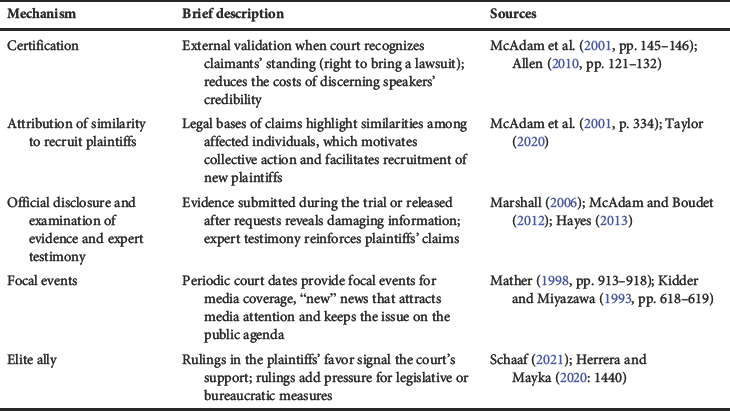
To elucidate how legal mobilization can facilitate social movements' efforts to build expertise and influence public knowledge, we theorize several causal mechanisms that are activated by specific features of “the process of legal mobilization” (Reference ArringtonArrington, 2019b, p. 333). Causal mechanisms are “relatively abstract [and portable] concepts or patterns of action … that explain how a hypothesized cause creates a particular outcome in a given context” (Reference Falleti and LynchFalleti & Lynch, 2009, p. 1145). Mechanisms do not always produce the same outcomes because they “play out differently depending on their sequence, combination, and context” (Reference McAdam, Tarrow and TillyMcAdam et al., 2001, p. 306). But analytically clarifying mechanisms enriches our understanding of why social movements might adopt institutional tactics such as litigation and how doing so facilitates knowledge production. The mechanisms discussed below relate to court-recognized standing, the articulation of grievances as legal claims, recruiting plaintiffs, the official receipt and examination of documentary evidence, expert testimony, the schedule and performance of court dates, and court rulings. Table 1 summarizes the five mechanisms.
Summary of causal mechanisms.

First, social movements gain official certification when courts recognize their standing (locus standi) to file lawsuits. McAdam, Tarrow, and (Reference McAdam, Tarrow and TillyTilly 2001, pp. 145–146) define certification as the validation of a group and its right to make claims by external authorities—in our case the courts. A court's acknowledgment of claimants' standing bolsters the movement's credibility (Reference HandlerHandler, 1978, pp. 217–218; Reference HolzmeyerHolzmeyer, 2009, p. 293). For movements' target audiences, such external validation lowers the costs of discerning the credibility of the movement and its claims (Reference Allen and SaratAllen, 2010; Reference McPhersonMcPherson, 2016). Scholarship on social movements and environmental litigation has focused on increasing claims-making, as courts in the United States and Europe have expanded rules on standing to permit NGOs to sue (Evans Reference Evans Case and GivensCase, 2010; Reference VanhalaVanhala, 2012, pp. 536–539; Cichowski & Stone Reference Cichowski, Stone Sweet, Cain, Dalton and ScarrowSweet, 2003, p. 208–216). But they have paid less attention to the other benefits social movements can reap by gaining standing. Being plaintiffs makes social movement actors more readily identifiable, credible sources for journalists, who can publish or broadcast personalized accounts of what the lawsuits are about. It also gives them a new shared collective identity from which to build solidarity and recruit other plaintiffs.
Making legal claims thus catalyzes a second mechanism: attribution of similarity to recruit plaintiffs. Articulating individuals' past experiences in terms of discrete legal categories highlights commonalities among disparate aggrieved individuals and frequently encourages mobilization as other affected people label their injurious experience and realize the potential for collective action through the courts (Reference Galanter, Boyum and MatherGalanter, 1983, p. 123; Reference ScheingoldScheingold, 2004, p. 132). This process is akin to framing and has the potential to also shift public perceptions of the problem by naming the justiciable rights violations or illegal actions. Recruiting more plaintiffs to file additional collective lawsuits (shūdan soshō in Japanese and jipdan sosong in Korean) is a common tactic for building pressure and momentum in legal mobilization campaigns in the absence of U.S.-style class action (Reference ArringtonArrington, 2019b). As more people bring similar claims, the movement's numbers and thus also its credibility increase; Charles (Reference TillyTilly 2008, p. 120) posited that bystander audiences evaluate a movement's “worthiness, unity, numbers, and commitment (WUNC).”
Third, courts officially accept, examine, and assess evidence and expert testimony, which increases publicly available information about a problem. Indeed, litigation entails a process of investigation and information disclosure that is empowering but understudied in sociolegal scholarship. Long before a ruling, plaintiffs collect and submit documents and engage in “citizen research” to muster “facts that vividly illustrate [U.S. military and host] governmental wrongdoing” in order to make their case and reshape public perceptions (Reference Marshall, Sarat and ScheingoldMarshall, 2006, p. 173). Although Japanese and Korean courts lack U.S.-style discovery powers, judges can still order defendants to release documents that the plaintiffs know exist and can specifically name (Reference PardieckPardieck, 2021). In addition, information disclosure requests and related lawsuits, by forcing the authorities to release official documents, supplement activists' research and contribute to public knowledge. Furthermore, court cases may involve expert witnesses, who are “capable of endowing claims with credibility as they are transported across different cultures of production and interpretation” from science to the courtroom (Reference Jasanoff and JasanoffJasanoff, 2004, p. 5). Expert witnesses do not just convey knowledge but package and frame it in ways that make it relevant to the dispute being adjudicated (Reference HayesHayes, 2013, p. 214). Once accepted by the court, evidence and testimony have heightened visibility and an imprimatur of official validity (Reference WebsterWebster, 2018). Thus, fact-finding and witness testimony offer social movements opportunities for uncovering new information, vindicating claims, and capturing media attention.
Fourth, the schedule and performative dimensions of court dates create focal events that attract media attention (Reference McCannMcCann, 1994, pp. 58–59; Reference MatherMather, 1998, pp. 913–918). In Korea and Japan, courts hear cases only sporadically, about once every 4 to 6 weeks. Dating back at least to the environmental pollution cases of the late 1960s and 1970s, Japanese lawyers have experience organizing press conferences and rallies on court dates to sustain commitment among movement participants, recruit new supporters, and broadcast their interpretation of the unfolding court drama (Reference Kidder and MiyazawaKidder & Miyazawa, 1993, pp. 618–619). Korean plaintiffs and lawyers similarly organize press conferences and rallies for movement adherents on court dates (Reference ArringtonArrington, 2019b). Beyond the rhythm of court proceedings, the drama of courtroom disputes and plaintiffs' personalized stories appeal to news outlets' bottom line (Reference GitlinGitlin, 1980). For instance, in post-war compensation litigation, the defendants' repeated denials of liability substantiated claimants' narratives of Japanese injustice for the Korean media and public (Reference WebsterWebster, 2018, pp. 195–199). Plaintiffs and their lawyers also capitalize on the media's interest in personalizing issues by giving interviews that supply dramatic details of their suffering or courtroom impressions (Reference ArringtonArrington, 2019a).
Fifth, rulings in the plaintiffs' favor signal official support and turn judiciary into an “elite ally” for social movements vis-à-vis other branches of government (Reference McAdam, McCarthy and ZaldMcAdam et al., 1996, p. 55; Reference SchaafSchaaf, 2021, pp. 150–151). The conclusions contained in rulings can transform societal understandings of an issue. As Marc (Reference Galanter, Boyum and MatherGalanter 1983, p. 126) observed, “courts produce not only decisions but messages… [which] parties use in envisioning, devising, pursuing, negotiating, and vindicating claims.” Moreover, favorable rulings “signal… responsiveness” on the part of those in power and “create a pattern of potential [institutional] responses to challengers,” thereby incentivizing others to adopt similar tactics (Reference Meyer and BoutcherMeyer & Boutcher, 2007, pp. 81–84). Court rulings can pressure other branches of government to conduct investigations, implement programs, or design new legislation to address an issue (Reference Herrera and MaykaHerrera & Mayka, 2020, p. 1440).
Usually, legal mobilization is just one part of a multipronged strategy of seeking publicity and broader public and elite support for a movement's cause. Multiple interrelated lawsuits create sustained pressure on the authorities and cultivate publicity. Consequently, litigants leverage the legal mobilization process for broader effects, rather than merely to secure judicial victories. By theorizing mechanisms linking legal mobilization to social movement knowledge production, we illuminate “the creative and generative processes” through which law is leveraged to tackle environmental challenges (Reference VanhalaVanhala, 2022, p. 1).
CASE SELECTION, METHODS, AND DATA
In the pages that follow, we examine environmental legal mobilization related to U.S. military bases in East Asia. These “hard cases” are analytically useful for specifying mechanisms because the movements make similar claims in most similar systems. Japanese and Korean legal institutions are highly similar for historic reasons dating back to Japan's colonial rule over the peninsula (1910–1945), and both follow the civil law tradition with American influences and similar judicial reforms at the turn of the millennium (Reference Choi and RokumotoChoi & Rokumoto, 2007). Institutional disincentives to legal mobilization were long alike. State-set quotas made lawyers scarce (albeit less so in the past two decades), damages are capped, trials are heard discontinuously once every few months, discovery powers are limited, and judges had conservative reputations (Reference HaleyHaley, 1978; Reference YangYang, 1989). As elaborated below, Japanese and Korean citizens have similarly incipient domestic information disclosure procedures but enjoy access to extraterritorially available Freedom of Information (FOIA) procedures in the United States.
Furthermore, base-related claims face analogous constraints because Japan and Korea have signed Status of Forces Agreement (SOFA) agreements with the United States, which define the legal status of U.S. forces overseas. These agreements present hurdles to host state populations seeking to access information about the U.S. military in their backyards. According to critics, the SOFA “grants extraterritorial rights to America's overseas bases” and “reinforces … nontransparency” (Reference Dower, Orange and MitchellDower, 2020, p. xi). Under the SOFAs with Japan and Korea, the U.S. military is not obligated to abide by the environmental law of its host states and is legally shielded from damage claims. Moreover, the SOFAs prohibit the allies from releasing information on environmental accidents in the absence of a mutual agreement. Even when bases are closed, the U.S. military has no responsibility to restore base sites to their original condition.
The activists we examine are also similarly situated in their domestic contexts. Japan and Korea are two of the largest hosts of U.S. military bases overseas and are treaty-bound U.S. allies where anti-American, anti-U.S. military activism was long equated with radicalism. Despite lingering regional security threats that justify the continued American presence, the two countries have seen vigorous anti-U.S. military base activism, a subset of which has recently taken an institutional turn. At first glance, these activists may appear to be poorly positioned to contribute to knowledge production. If anything, U.S. military issues remain the policy area “least conducive to democratic participation” in many host states (Reference Moon and KimMoon, 2003, p. 155). Activists face a severe information gap when compared to American base officials and, to a lesser degree, host state authorities. Rare opportunities to obtain information regarding environmental pollutants housed at U.S. military bases, for example, come only “when an (environmental) accident happens” (Japan Environmental Council, 2006, p. 18)—that is, if military officials report such accidents to the host state, and if the host state authorities decide to publicly release such information. As one activist noted, anti-U.S. military claimants are usually “cut off” from possible “avenues of information access” and physical access to the polluted site (Interview with Noh Suntag, July 27, 2016). What is more, these activists, long associated with radical anti-Americanism, face a credibility deficit because they had a reputation for being “heavy on rhetoric (nationalist and anti-imperialist) and light on empirical research” (Reference Moon and KimMoon, 2003, p. 147). Many of their nationalistic and ideological demands fell flat, partially because of their apparent lack of credibility in the eyes of the policymakers (Reference KawatoKawato, 2015). As a result, they are “hard cases” in terms of knowledge production.
The movements we examine have filed civil tort and injunction suits related to noise pollution from U.S. military bases in Japan and Korea and administrative lawsuits and information disclosure requests regarding environmental contamination at U.S. military bases. They seek to hold both their own government and the United States (which is harder) accountable. Activists behind these initiatives include those who are fundamentally interested in environmental causes and those who view institutional tactics as a means to the bigger goal of challenging the U.S. military presence, allowing for alliance building between antimilitarist and environmental activists (C. J. Reference KimKim, 2023). In pursuing legal mobilization, however, they invariably emphasize how the U.S. bases affect local residents and the local environment.
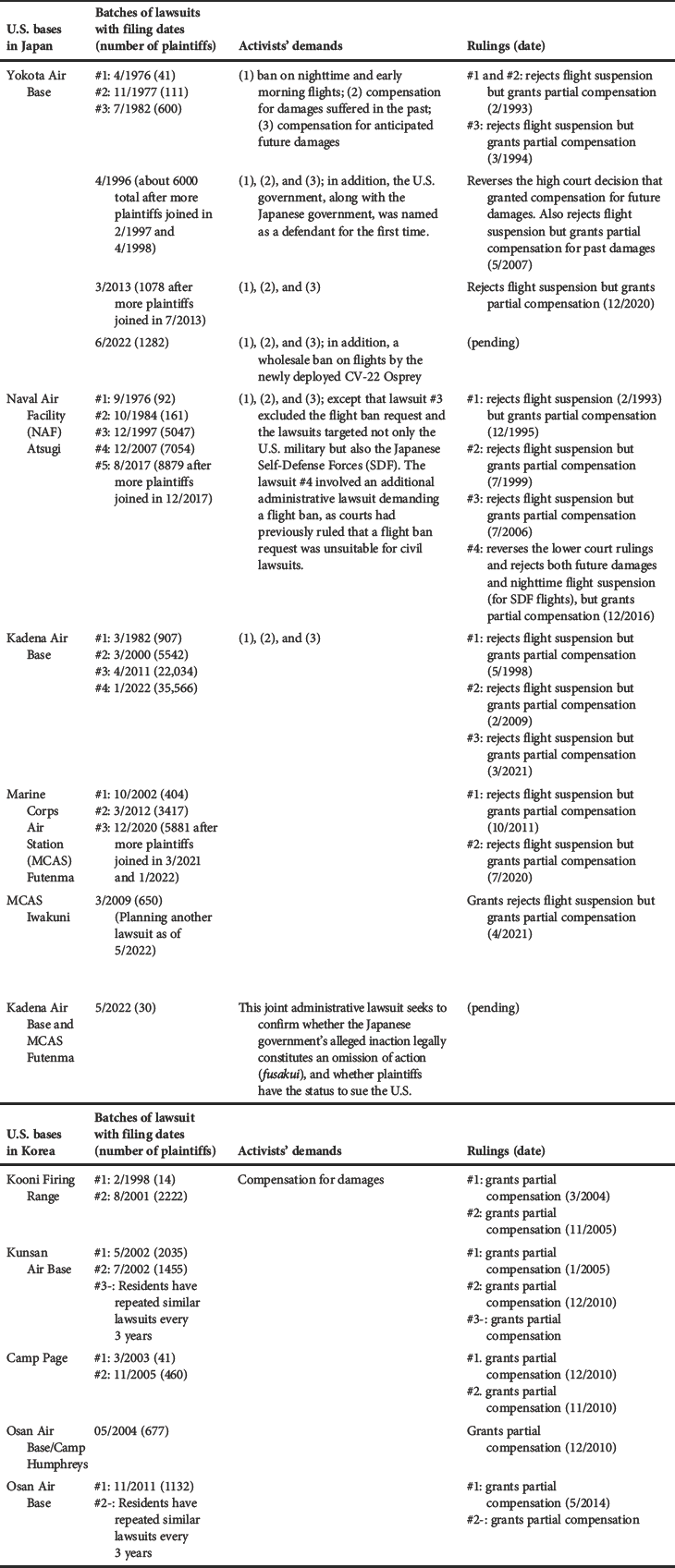
The first type of claims are noise pollution lawsuits related to U.S. military bases filed in Japanese and Korean courts (see Table 2). Plaintiffs sue their own government for noise pollution at U.S. bases, although some Japanese activists have tried—and failed—to hold the U.S. accountable in Japanese courts. These collective lawsuits seek to generate new public knowledge by officially establishing that the noise pollution produced by U.S. military aircraft—or “explosive noise” (bakuon in Japanese and pogeum in Korean), as activists call it—is illegal under domestic law. Two major demands from Japanese activists are a ban on nighttime and early morning flights (e.g., from 9 p.m. to 7 a.m.), and compensation for both past and future damages, such as hearing loss, high blood pressure, and chronic stress. (The first demand, which judges regard as outside Japanese jurisdiction under the SOFA and the Japan-U.S. security treaty, has never succeeded in court.) Lawsuits in Korea have comparatively limited aims, with compensation for damages—both physical and psychological—being the primary goal. In every case, courts ordered at least some compensation, with the amounts depending on the plaintiffs' noise exposure levels (e.g., 4000–12,000 yen ($30–90) per month in Japan and 30,000–60,000 won ($25–50) per month in Korea). Some plaintiffs are excluded from compensation altogether on the grounds that their geographic location minimizes their exposure to noise. Under the SOFAs between the host states and the United States, the governments of Japan and Korea, not the United States, are responsible for compensation.Footnote 1
Noise pollution lawsuits.

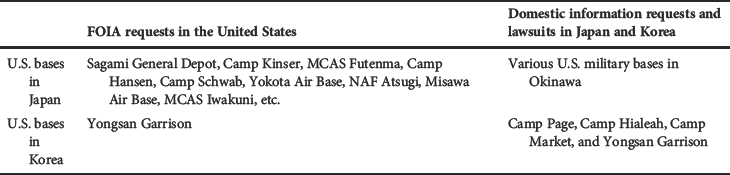
The second type of claims—official informational disclosure requests regarding contamination at U.S. military bases—are detailed in Table 3. Filing FOIA requests in the United States, as well as domestic information disclosure requests in Japan and more recently Korea, has become an important tactic for unearthing records about environmental contamination at U.S. bases, because Japanese and Korean courts lack discovery. U.S. FOIA requests, which can be made by citizens and noncitizens alike, help surmount the massive knowledge gaps created by the secrecy surrounding U.S. military bases overseas and enable transnational legal mobilization (Reference HolzmeyerHolzmeyer, 2009). Although Korean anti-base movements only really emerged after the country's democratization in 1987, they have embraced FOIA requests as a tactic recently. Korea managed to add an environmental clause to its SOFA in 2001, under which the U.S. military is responsible for remedying cases of contamination determined to be a “known, imminent, and substantial endangerment (KISE) to human health and safety.” Despite the addition, itself a result of environmental activism that involved misconduct on the part of a Yongsan base employee, it is easy for U.S. authorities to claim that environmental contamination on a base—if it becomes known at all—does not constitute a KISE. U.S. authorities can also prevent host state authorities from entering U.S. bases for on-site inspections, which adds to the knowledge asymmetry (C. J. Reference KimKim, 2018, p. 346). As a result, activists have turned to filing FOIA requests in the United States to access evidence of contamination.
Official information requests.

Domestic information disclosure requests targeting host governments, meanwhile, have become another way to close the knowledge gap and bring new and hidden evidence to light. Japan and Korea established their own FOIA-like processes with the enactment of information disclosure laws in 1999 and 1996, respectively (Reference Maclachlan and SmithMaclachlan, 2000; S.-T. Reference KimKim, 2009). This created another institutional channel that activists could use. When the host state government withholds information, activists can also file an administrative lawsuit, asking the court to order its release. Thus, information disclosure requests and lawsuits constitute a further type of legal mobilization we analyze.
Our findings are based on analysis of noise pollution lawsuits and information disclosure requests and lawsuits related to contamination at U.S. bases in both countries. We collected all known cases, which, to the best of our knowledge, constitute the universe of cases. Though we do not consider cases that never mobilized, we do not think this biases our findings. This article's focus is less on explaining the outcomes of legal strategies than on illuminating how they enable activists to tap into mechanisms that facilitate knowledge production. The fieldwork was conducted by one of us as part of a larger study of anti-U.S. military activism, and qualitative analysis of diverse documents. We present evidence from 11 in-person, semi-structured interviews with activists involved in noise pollution lawsuits and formal information disclosure requests in both countries, as well as findings from participant observation (see Appendix).Footnote 2 In addition, we draw on movement publications (e.g., newsletters and reports) and general news coverage of the movements. While we present parallel cases from two East Asian democracies, the cases we analyze are not fully independent because there is learning both within country and transnationally (Reference ArringtonArrington, 2014). Accordingly, we opt for process-driven explanations, rather than a variable-driven approach that seeks to prove causation (Reference McAdam, Tarrow and TillyMcAdam et al., 2008). More specifically, we excavate how the various mechanisms that are triggered in the legal mobilization process contribute to knowledge production, both directly and indirectly.
RESHAPING PUBLIC KNOWLEDGE THROUGH LEGAL MOBILIZATION
This section illustrates five causal mechanisms activated through legal mobilization with examples from Korean and Japanese anti-U.S. base movements' noise pollution lawsuits and information disclosure requests, both in the United States via FOIA requests and in Japan and Korea. The five mechanisms are external validation by gaining standing, attribution of similarity to recruit plaintiffs, the examination of evidence and expert testimony, the rhythm of court dates, and courts as elite allies. We trace how specific features of judicial procedures contribute to movement knowledge production.
Although we analytically separate the mechanisms for clarity, they often interrelate in reality. For example, gaining certification from a court when it recognizes claimants' standing was a process started because litigants attributed similarity between their cause and that of victims of domestic airports' noise pollution. Japanese and Korean anti-base activists learned from noise pollution lawsuits against civilian airports that they too had a right to try similar lawsuits against U.S. military bases. In 1975, for example, the Osaka High Court ordered a flight ban at Osaka International Airport from 9 p.m. to 7 a.m., as well as compensation for past and future damages. “The Osaka ruling … was a new development … that raised our hope,” anti-base activists recall (Atsugi Alliance, 2010, p. 40). Similarly, in Korea in 1988, the movement against noise pollution from Seoul's Gimpo International Airport inspired local residents opposing Kooni Firing Range, an American live-fire range later shut down in 2005. The thought of demanding compensation from the government over noise pollution had never occurred to them before then (Korean Federation for Environmental Movement, 2002). A lawyer representing the Kooni case, for his part, engaged in transnational learning when gaining inspiration from the Yokota noise pollution lawsuits, especially from a lower court verdict in 1989 (Weekly Kyunghyang, 2006). To cite another example, the disclosure of new information about a problem or rulings that show the courts' support can catalyze attribution of similarity and help recruit additional plaintiffs. Yet, by analytically distinguishing these mechanisms, we elucidate how the process of legal mobilization bolsters activists' credibility, creates opportunities for them to uncover and interpret new documents and scientific data, and thereby helps movements contribute to public knowledge about U.S. military bases' environmental impact.
Standing as certification
When agreeing to hear noise pollution lawsuits without dismissing them outright, courts officially recognize the right of activists and local residents to bring legal claims—their standing. While external validation is not readily measurable, our qualitative evidence shows that courts' external validation provided a tactical breakthrough, publicity, and legitimacy for claimants. It helped different audiences evaluate their credibility and supplied a new and official forum for expressing longstanding grievances.
Activists describe how gaining standing from courts came as a major breakthrough in their decades-long efforts to be heard and considered legitimate voices in policy discussions related to U.S. military bases. For example, residents opposing NAF Atsugi in Japan established the Alliance for the Prevention of Explosive Noise at Atsugi Base (Atsugi kichi bakuon bōshi kiseidōmei, hereafter Atsugi Alliance) as early as 1960. Initially, they spent years pleading with the authorities about noise pollution, and then spent more years protesting, before they finally turned to lawsuits in 1976 (Interview with Kaneko Tokio, October 10, 2016). The association describes the first 15 years of activism as a test of patience. “We petitioned, we complained, and we made requests,” the group recalled. “But in the end, we were tossed out while still waiting [for a response] … we were treated like dirt” (Atsugi Alliance, 2010, p. 40). After a period of “direct action struggle” (jitsuryoku tōsō), with confrontational tactics like burning tires to ground flights, did little to stop the ear-splitting noise, activists turned to the courts (Interview with Ōnami Shūji, October 14, 2016). Gaining standing, and thus embarking on what some called the “trial struggle” (saiban tōsō), revitalized the movement. “Lawsuits were chosen as a strategy … designed to surmount the situation where we couldn't fathom how to solve our problem” (Atsugi Alliance, 2010, p. 41). Though litigation was a “last resort,” plaintiffs demanded that their rights be “recovered, guaranteed, and fulfilled through legal procedures” (Atsugi Alliance, 2021b, p. 47). By having their standing to bring lawsuits recognized by the court, activists strove to establish “the meaning and legitimacy (shusi to seitōsei) of their claims” (Atsugi Alliance, 2021b, p. 47).
A parallel case from Korea's Kooni Firing Range likewise highlights how gaining courts' recognition of standing heralded a breakthrough after repeated failures to be heard. For years, the movement had similarly relied on disruptive action—breaking into the firing range, throwing Molotov cocktails, and wielding sickles—to no avail. After the Pollution Expulsion Coalition Movement (Gonghaechubang undongyeonhap), a national environmental coalition, joined the anti-Kooni campaign, a “change in tactics” toward information-reliant institutional contestation ensued. Recognizing that “litigation requires evidence,” the alliance with environmental activists gave them ready access to lawyers, medical experts, and scientists who helped gather such information, which ultimately led to two rounds of successful noise pollution lawsuits in 1998 and 2001 (Weekly Kyunghyang, 2006). “We were [previously] ignorant about the law… We never imagined we'd win a lawsuit,” Chun Man-kyu, an anti-Kooni activist who later embraced litigation, told the media (Pressian, 2005). Chun added, “We thought publicizing our situation to the outside world through litigation would be a big achievement on its own” (Pressian, 2005). Indeed, courts' recognition of plaintiffs' standing certified movement activists as credible sources for journalists, increasing activists' access to media channels through which to bring new evidence to light and close knowledge gaps. “Foreign correspondents would chase after me, even following me to the bathroom,” says Chun, who also repeatedly appeared on local television news (Interview, August 5, 2016).
Furthermore, gaining standing from courts enabled activists to forge a new and less radical collective identity as plaintiffs, which helped bolster their credibility and the relevance of their claims for local publics, as discussed in the next subsection. The de-radicalizing effect of framing grievances as legal claims and using institutional channels is particularly useful for anti-base activists, whose cause against the U.S. military is often considered radical in the domestic contexts of Japan and Korea. Demanding “environmental rights” and “the right to live as human beings” (Atsugi Alliance, 2021b, p. 47), for example, are less controversial than chanting “Yankee go home.” Chun Man-kyu recalls that his neighbors saw him as a reckless radical—a “commie” (ppalgaengi). Most local residents, he says, were opposed to the lawsuit until an “unexpected win” the lower court resulted in compensation (Interview, August 5, 2016). Similarly, anti-base movements in Japan strategically emphasize their identity as plaintiffs to bolster their credibility and downplay their radical roots. Anti-noise lawsuits that began in the 1970s in Japan were “decisively different” from other anti-base movements at the time in that they “derived their legitimacy from … actual damage, rather than ideology” (Reference HayashiHayashi, 2009, p. 27). Even as many activists maintain their radical, distant goal of eventually shutting down U.S. bases (Interviews with Fukumoto Michio, October 11, 2016; Taira Shinchi, September 21, 2016), they consistently frame their activities as educational and informational in nature. Plaintiffs often hold “study sessions” (gakushūkai), “monitoring” sessions, and “field inspections” of noise levels (Atsugi Alliance, 2021a).
Recruiting plaintiffs
Litigation turned aggrieved individuals into plaintiffs as they articulated their longstanding grievances in the language of legal rights. Such legal categorization or labeling facilitated the attribution of similarity among other affected people and helped recruit additional claimants, as can be seen in the generally increasing numbers of plaintiffs over time in Table 2 above. Strategically, movements aimed to recruit more plaintiffs because greater numbers enhanced the empirical credibility and perceived relevance of the movement's claims.
Activists saw recruiting more plaintiffs as a means to build up their movement and raise awareness of the issue. Initially, in 1976, the aforementioned Atsugi Alliance only allowed its members to join the lawsuit. To “broaden the movement base,” however, activists lowered the hurdle to becoming a plaintiff by expanding both the geographical area and the social network from which they recruited. One no longer had to be a labor unionist or affiliated with any other progressive NGOs, for example, to be allowed to join the anti-Atsugi lawsuits. Anyone living in the affected municipalities could become a plaintiff and thus spread local awareness of the noise pollution issue via word of mouth (Atsugi Alliance, 2010, pp. 40–51). Local bystander publics also came to perceive the movement less as radicals and more as neighbors. One Japanese activist noted that the “lawsuits have become something any ordinary citizen can join … Any family member, from a baby to a grandfather, can join them” (Interview with Kaneko Tokio, October 10, 2016).
Early lawsuits that involve at least a partial victory, most typically monetary compensation in our cases, provide especially credible information about the legitimacy of plaintiffs' claims and incentivize bystanders to become plaintiffs. For example, in the anti-Kooni lawsuit discussed above, which began in 1998 with just 14 plaintiffs, a partially favorable ruling resulted in a follow-on lawsuit involving 2222 plaintiffs, or almost the entire population of the rural village that hosted the live-fire range. “Chun [who was branded as a “commie”] fought alone for a long time,” activist Kim Yong-han recalls, but the court victory helped win over the entire community, and locals “apologized for doubting Chun” (Interview, July 3, 2016). Newly emboldened, the amount of compensation sought also doubled to 20 million won ($18,000) per plaintiff. Activists in Japan similarly note that their proven track record of winning compensation has been a major draw for many plaintiffs, including those who are otherwise politically inactive (Interviews with Taira Shinchi, September 21, 2016; Takahashi Toshio, September 3, 2016). Broadening the base of the movement with more plaintiffs and expanding the types of people involved in litigation enhances the credibility of activists, making it more likely that the information they share is accepted as believable and unbiased by the public.
Recruiting additional batches of plaintiffs also signaled the movement's worthiness and helped build pressure on the target authorities. Anti-Atsugi activists said that the Japanese government often pointed out the fact that the number of plaintiffs paled in comparison to the number of residents living in the affected areas. The message was clear, according to Kaneko Tokio, a Sagamihara city councilman who also led lawsuits: “You are the only ones complaining” (Interview, October 10, 2016). Takahashi Toshio, who led similar lawsuits against MCAS Futenma, recalled that activists were once derided for the small number of lawsuit participants (Interview, September 3, 2016). They proudly pointed to a steadily increasing number of plaintiffs: from 92 in 1976 to 8879 in 2017 for NAF Atsugi, and 404 in 2002 and 5846 in 2020 for MCAS Futenma. Litigation targeting Kadena Air Base in Japan, which began in 1982 with 907 residents, now boasts a record number of plaintiffs: 35,566. For elected officials, such burgeoning numbers translate into votes, which put political pressure on the authorities to respond to the movements.
Official disclosure and examination of evidence and expert testimony
In civil litigation, the judges typically collect and examine evidence from the parties and hear testimony by “neutral experts” (McReference McAdam and BoudetAdam & Boudet, 2012, p. 178), who sometimes bring evidence to light or introduce new data that reinforce the movement's claims. This process of official investigation creates opportunities for movements to participate in knowledge production. Movement actors' formal information disclosure requests further enable them to enrich public knowledge.
Anti-base litigants leverage scientific data and experts to back up their claims and supply evidence for adjudication. For example, the Liaison Council for Military Base Noise Pollution Lawsuit Plaintiffs (Zenkoku kichi bakuon soshō genkokudan renraku kaigi), a coalition of Japanese plaintiff groups, regularly invites outside experts to discuss ways to incorporate scientific evidence in their legal claims. An invited lecture given by an environmental engineering professor in 2019 sums up the nature of this fact-finding mission: “how to use scientific knowledge in noise pollution lawsuits” (Kanagawa Shimbun, 2019). Activists and sympathetic scientists, in both Japan and Korea, also collected noise level data and reported findings to journalists, using WECPNL (Weighted Equivalent Continuous Perceived Noise Level) and Ldn (Day Night Average Sound Level) values because they are objective and internationally recognized measures of noise. For example, anti-Kooni activists recruited an environmental engineering professor to measure noise levels and used the numbers in their first-ever lawsuit against a U.S. military base in Korea. By accepting such measures as evidence, the courts gave the indicators a degree of official recognition. The court then further validated the evidence by appointing another professor, an expert on environmental pollution and preventive medicine, as a third-party examiner. The lower court verdict in 2001, which ordered compensation to residents, confirmed activists' claims by citing the figures from his investigation. Such scientific data and expertise not only help persuade judges but can also shift public understandings about U.S. military bases' local impacts because the data discussed in court are more likely to receive media coverage.
In addition, judges can validate plaintiffs' claims through their actions and words during the trial, making plaintiffs more influential in knowledge production processes. Anti-Atsugi lawsuits, for example, involved “on-site verification” (genchi kenshō) by judges, who visited two Japanese cities jointly hosting the naval air base and observed American and Japanese aircraft taking off and landing (Kanagawa Shimbun, 2022). Activists amusingly recall a moment when a judge, upon hearing the noise from fighter jets on-site, said “this is terrible”—a moment of vindication for the activists, which they say made for a nice “contrast” with a “glum-faced” Japanese bureaucrat who also attended the inspection (Atsugi Alliance, 2021b, p. 51). Korean courts have conducted similar inspections. A Seoul court ruled on the Kunsan Air Base case in 2004: “This court, based on its on-site inspection results, can verify findings from a [separate] noise examination,” which the plaintiffs cited in their lawsuit (Seoul Central District Court Decision: 2002 Gahap 33132, 2004).
In addition to scientific data, anti-base activists aim to uncover documentary evidence about wrongdoing, coverups, or negligence by the base authorities and host governments. While litigants in the United States have access to courts' discovery procedures, Japanese and Korean courts have limited evidence-production powers. Hence, Japanese and Korean activists have turned to FOIA requests in the United States, as well as official information disclosure requests in Japan and Korea. In Japan, longstanding anti-base groups and individual pioneers have incorporated the use of FOIA requests in the United States in their activism since the late 1980s. Some of the earliest efforts came from groups like Rimpeace, a civic group whose stated mission is to trace the movements of U.S. Forces Japan. In the city of Sagamihara, where residents once staged a sit-in to physically block the American tanks used in Vietnam, Rimpeace activists have taken an institutional turn with their FOIA requests regarding environmental contamination at U.S. military facilities in the town (Reference KanekoKaneko, 2000). More recently, Jon Mitchell, a Japan-based investigative journalist, has spearheaded a series of FOIA requests. According to him (Reference MitchellMitchell, 2020a, p. 128), the U.S. military “works hard to conceal information related to its contamination,” but FOIA “offers one way to cleave through such secrecy.” Korean activists behind the first-ever FOIA request on U.S. base contamination in 2017 similarly describe the power of information disclosure procedures. “We are going to use [FOIA] as our new weapon (mugi),” said Kim Eun-hee, who leads a community group in Yongsan, a Seoul district that was, until recently, home to the U.S. army's Yongsan Garrison. (The base was relocated south of Seoul.) Based on documents obtained via FOIA, activists formulated new demands that (1) all U.S. bases be investigated for contamination, and (2) local governments officially confirm whether they were informed of environmental accidents at base sites (Interview, July 27, 2016). Most FOIA requests filed in the United States by Japanese and Korean activists have succeeded in obtaining inside documents.
The tactic has thus produced new knowledge, most of which is embarrassing to the U.S. military and the host states, credible because it was obtained officially through FOIA processes, and therefore likely to gain media attention. In Japan, FOIA requests have revealed numerous cases of environmental accidents and contamination at U.S. military bases. After Sagami General Depot, a U.S. army installation in the city of Sagamihara, was revealed to have stored materials tainted with hazardous PCBs (polychlorinated biphenyls), local activists used FOIA to obtain extensive records on PCBs and other toxic chemicals found at the installation (Reference KanekoKaneko, 1999). The episode ultimately made international news after Canada, and then ironically the United States, refused the entry of a cargo ship carrying the PCB-contaminated waste from Sagamihara. More recently, Mitchell's FOIA requests led to new revelations (Reference MitchellMitchell, 2020b): Agent Orange dioxin at Camp Kinser; 270 environmental accidents at MCAS Futenma, Camp Hansen, and Camp Schwab between 2002 and 2016; and harmful chemical spills at Yokota Air Base, MCAS Futenma, NAF Atsugi, Misawa Air Base, and MCAS Iwakuni. The list goes on. Exemplifying nontransparency surrounding the environmental conduct of the U.S. military and testifying to the ability of social movement actors to uncover hidden information, the Japanese government was aware of only 6 of the 270 aforementioned accidents (Reference MitchellMitchell, 2020b, p. 131). Thus, the disclosure of information can give movement actors leverage over U.S. authorities and their own governments.
A parallel case from Korea has revealed equally incriminating evidence against the U.S. military. In 2017, the very first FOIA request by activists revealed 84 cases of oil leaks at Yongsan Garrison between 1990 and 2015. The 84 cases, including seven that involved the spill of more than 3.7 tons of oil each time, far exceeded the total of five oil leaks that the Korean government was already aware of (Green Korea United, 2017). “To obtain information, civil society organizations had no choice but to resort to the American FOIA, rather than go through the Korean government or the U.S. military,” activists explained (Green Korea United, 2017).
Activists also target their own governments in their information disclosure requests, which contribute to public knowledge about the host government's lax oversight of U.S. bases. An Okinawan NGO called the Informed-Public Project, which researches toxic chemicals—particularly PFOS (perfluorooctane sulfonate) and PFOA (perfluorooctanoic acid)—at U.S. bases in Okinawa, uses even Japan's weaker information disclosure procedures (The Informed-Public Project Okinawa, 2019). “Our new strategy is more investigative … We [gradually] gather documents, analyze and then compile them into reports,” the group says (Reference MitchellMitchell, 2016). In this way, anti-base movements compile and make publicly available evidence of environmental degradation.
When the host state government withholds information, which is frequently the case in Korea when it comes to allegations of environmental contamination at U.S. military bases, activists proceed to sue the government. Korean activists filed the first suit against the Ministry of Environment in 2006 over its refusal to disclose information on environmental contamination at Camp Page, a U.S. base that closed in 2005. Other environmentalists followed suit in Busan (Camp Hialeah), Incheon (Camp Market), and Seoul (Yongsan Garrison). Then, in 2017, facing government stonewalling even after a court decision, Korean activists at Green Incheon (Incheon noksaegyeonhap) used an additional legal process known as ganjeop gangje sincheong (roughly translated as compulsory enforcement request)—through which the ministry is ordered to pay 3 million won ($2700) for each day past 30 days that it fails to comply with the request (Segye Ilbo, 2019). That finally did the trick. One lawyer's explanation reflects how effective the tactic is: “we never lose these [information disclosure] lawsuits” concerning U.S. base contamination… “the government knows it will always lose, although they appeal anyway” (Interview with Kweon Jung-ho, August 3, 2016). The uncovered information combined with evidence from lawsuits to gradually reshape public perceptions about the U.S. military bases. In a 2006 poll, for example, 92.7 percent of the respondents said the U.S. military should disclose information contamination at returned base sites, and 79.1 percent believed the U.S. military should also pay for remediation (Kyunghyang Sinmun, 2006).
Activists also note that the new knowledge they create through legal mobilization forever remains in the public record, especially recognizing harm and blame. In 2011, for example, they celebrated a court verdict that found that noise from Kunsan Air Base caused the deaths in 2008 of some 400 rabbits. “We feel proud that our case left a legal precedent,” says an activist who supported the lawsuit. “Even if we were to receive just one cent in compensation, we wanted to have it in writing that the rabbits died because of the noise” (Interview with Goo Joong-suh, June 13, 2016). Likewise, successful information disclosure requests move previously restricted government and military documents into the public realm. In Korea, newspaper editorials have repeatedly pointed to the contamination at Yongsan Garrison, uncovered via FOIA requests, in expressing concerns over the longstanding government plan to turn the site into a park (Hankook Ilbo, 2017; Kukmin Ilbo, 2017). Similarly, in Okinawa, local newspaper editorials have highlighted environmental contamination at U.S. military bases citing information obtained via FOIA requests—including ones that the newspapers themselves filed (Ryukyu Shimpo, 2021; Okinawa Times, 2020).
Focal events and the timeline of court proceedings
Periodic court dates provide a timeline with scheduled moments of interaction, and court proceedings offer a form of “public performance and institutionalized ritual” that helps keep the issue alive (Reference MatherMather, 1998, p. 932; Reference ArringtonArrington, 2019a, p. 25). As activists, lawyers, and journalists gather to celebrate, condemn, and publicize court proceedings, trial dates create focal events for emphasizing facets of the unfolding legal drama to capture media attention and strategically release information.
Lawyers in Japan and Korea design performative and informative events around court dates to gain media coverage. Japanese plaintiffs and their lawyers typically march into the courthouse for photo-ops and hold kekki shūkai—literally, a rally designed to demonstrate their resolve. In addition, press conferences, by definition, seek media coverage, which in turn helps sustain issue salience in the eyes of the public. But they need to be justified by “new” news or events; the timeline of court proceedings provides such scheduled events. Even before rulings, the plaintiffs' lawyers can convey information about judges' examinations of evidence or tone in trial proceedings to sway public perceptions (Reference BennettBennett, 1993; Reference EdelmanEdelman, 1988). Plaintiffs' testimonies and emotional appeals in the courtroom and at related press conferences also make headlines because the media are attracted by the personal drama of the legal process. For example, Stars and Stripes, a U.S. military newspaper, took an interest in how one Okinawan plaintiff described the noise: “For someone like me who had a narrow escape from the war, it makes me feel that the aircraft is coming to attack me” (Reference SumidaSumida, 2003). Moreover, Japanese lawyers customarily summarize and publicly announce court rulings—“noise condemned as illegal” (bakuon ihō to danzai), for example—on big, white banners they dramatically unfurl in front of cameras. The rhythm and ritual of trial dates give observers, including journalists, signals from which to infer whether the court is leaning in the plaintiffs' favor or not.
Plaintiffs and their lawyers may strategically link other events with legal mobilization to attract publicity, as well. For instance, in the aforementioned case of contamination at Yongsan Garrison, the stark gap between the real number of oil leaks and the number of previously acknowledged cases attracted widespread media attention in 2017. Major news outlets, including Korea's public broadcaster KBS, produced dozens of reports on the press conference by the anti-Yongsan activists. When President Yoon Suk-yeol announced the relocation of his office to Yongsan in 2022, activists again capitalized on media coverage of the relocation to renew awareness of the contamination cases at the former U.S. base. In Japan, similarly, Mitchell's FOIA-driven journalism won him the Foreign Correspondents' Club of Japan's lifetime achievement award for press freedom in 2015. This created opportunities for the anti-base activists to highlight how his research relates to ongoing legal mobilization regarding environmental pollution in and around U.S. bases. Okinawan activists regularly invite Mitchell to their events—lectures, conferences, and “study sessions”—on U.S. base contamination. Their latest event, focused on PFAS contamination at MCAS Futenma, attracted a crowd of 400 Okinawans (Ryukyu Shimpo, 2022). As with key dates in the litigation process, such events help keep the issue alive.
Elite ally
Finally, legal mobilization helps activists win elite allies, including the courts. Support from a branch of government bolsters activists' credibility and access to decision-makers, as well as creates pressure for more government fact-finding.
Favorable court rulings have turned the judiciary into an ally with consequences for public knowledge and policy outcomes. In 2015, for instance, Korea's Ministry of Environment had an extremely rare opportunity to conduct on-site inspections into groundwater contamination at Yongsan Garrison. When the ministry acquiesced to the U.S. military's request that it withhold findings, activists responded by suing the ministry. The legal standoff over Yongsan Garrison lasted for 2 years, as the government continued to cite diplomatic concerns and refused to make the information public. During this process, courts became an ally of the activists. The Seoul Administrative Court, for example, noted in its 2016 decision: “The inspection results are nothing more than an objective indicator of groundwater contamination levels and do not contain any value judgment” (Seoul Administrative Court Decision: 2015 Guhap 72610, 2016). The Supreme Court went on to dismiss the government's appeal in 2017. President Moon Jae-in even sided with the activists who won against the government. In the future, when the government loses court cases despite its “absolute information advantage,” he said in 2017, it should refrain from appealing (Yonhap News Agency, 2017). Anti-Atsugi activists, for their part, believe that decades of “trial struggle” contributed to the decision by the United States and Japan to relocate Carrier Air Wing 5 from NAF Atsugi to MCAS Iwakuni, as part of their noise reduction efforts (Atsugi Alliance, 2021b, p. 65).
Even when judges do not embrace all of activists' claims, they sometimes recommend new investigations, creating further opportunities to bring new findings to light. Japan's High Court, for example, recommended in 2019 that the government conduct a “large-scale investigation” into noise complaints over U.S. military aircraft newly introduced at Yokota Air Base and release the findings (Reference KusumotoKusumoto, 2019). Similarly, although Korean activists lost their lawsuit in 2010 against the construction of a second runway at Osan Air Base, which they saw as an additional source of noise pollution, the court did concur with the activists that the U.S. military should have conducted an environmental assessment (Yonhap News Agency, 2011).
In ordering compensation, courts have also officially established that noise levels exceeding domestic legal thresholds constitute legitimate grievances that require redress and thus raised the profile of medical knowledge about the health consequences of noise. “Court rulings have helped raise awareness of noise pollution problems—that this explosive noise is actually illegal,” says Ōnami Shūji, a Yamato city councilman leading anti-Atsugi lawsuits. He describes the “trial struggle” as a process that helps “legally clarify” the health effects of noise pollution and “make them known” to the public (Interview, October 14, 2016). Indeed, a typical court ruling includes technical details that vindicate activists' scientific claims. As the court verdict on a case against Kunsan Air Base in Korea notes: “Noise levels above 80 WECPNL exceed the generally accepted limit and therefore constitute an illegality” (Seoul Central District Court Decision: 2002 Gahap 33132, 2004). Such rulings consolidate perceptions that the courts are sympathetic to the claimants.
Favorable court rulings and the embarrassing evidence that activists uncover put pressure on other branches of government to address base-related grievances, and some even become elite allies for anti-base activists. In a recent development that reflects longstanding demands of the activists, Korea's National Assembly enacted a new domestic law on noise pollution at military bases (both Korean and American) in 2019.Footnote 3 As a result, those living near Osan Air Base and Kunsan Air Base, among others, can now get compensated without having to resort to lawsuits. Local governments long demanded such legislation, citing how local residents, including those in Gunsan and Pyeongtaek, were forced to “repeat lawsuits every three years” (Governors Association of Korea, 2012). Similarly, in Okinawa, Japanese governors have issued statements in support of the plaintiffs (Reference OnagaOnaga, 2015). Japanese activists, for their part, make annual trips to Tokyo for “negotiations with the government” (seifu kōshō). Plaintiff groups and their lawyers hold meetings with officials from the government ministries that they believe are responsible for redressing their grievances: the Ministry of Foreign Affairs, the Ministry of Defense, the Ministry of the Environment, and the Ministry of Land, Infrastructure, Transport and Tourism. Conducted “in the shadow of the law” (Reference Mnookin and KornhauserMnookin & Kornhauser, 1979), these meetings serve as a venue to air grievances and press government officials into making additional pledges to improve the situation (Participant observation, June 7, 2017). Details from the meetings are also made public and often leveraged to draw media attention to the government's failure to address environmental concerns, which contributes to public knowledge of the issue and broadens the range of policy options. This evidence-based, institutionalized activism also goes beyond domestic borders. Kadena and Futenma plaintiffs, along with the Informed-Public Project, jointly submitted a report to the United Nations for consideration for its Universal Periodic Review. Their report, which includes information on noise pollution and contamination at U.S. bases in Okinawa, makes such information publicly available in English and puts additional pressure on the government to act (Okinawa Environmental Network et al., 2017). Thus, the process of legal mobilization facilitates social movement knowledge production.
CONCLUSION
This article fills several gaps in the literature. First, we bring the disparate literatures on legal mobilization and social movement knowledge production into conversation. Despite ample research on legal mobilization and its implications for social movement activity, relatively little examines how legal processes yield new forms of expertise and information. The present study fills this gap by theorizing the mechanisms through which the process of legal mobilization facilitates social movement knowledge production. Similarly, despite growing interest in social movement knowledge production, few have studied knowledge production in the context of legal strategies. This study shows that social movement actors—including those that are deemed least inclined to use institutional tactics—can meaningfully engage with legal channels to overcome at least some of the information asymmetries that stymie their activity. We thereby bridge the literatures on social movements and legal mobilization. Methodologically, our analysis based on diverse qualitative evidence offers rare examples of “hard cases” taking place in most similar systems. Empirically, this article presents the first systematic study of institutional tactics employed by anti-base activists in East Asia. In doing so, it brings East Asian cases to the legal mobilization literature, which has focused on the west (but see Reference ArringtonArrington, 2019a; Reference Arrington2019b; Reference ChuaChua, 2012; Reference Kidder and MiyazawaKidder & Miyazawa, 1993; Reference SternStern, 2013).
Our findings demonstrate how various mechanisms triggered in the process of mobilizing the law enable social movement actors to surmount knowledge gaps and to contribute to public knowledge. Based on an analysis of noise pollution lawsuits and information disclosure requests and lawsuits, we identify five such mechanisms: external validation by gaining standing, attribution of similarity to recruit plaintiffs, the examination of evidence and expert testimony, the rhythm of court dates, and courts as elite allies. These mechanisms enhance movements' expertise, bolster their credibility, provide opportunities for creating new knowledge, reveal hidden information, and thereby facilitate social movements' contributions to knowledge production processes. Our analysis of these mechanisms highlights oft-overlooked points of resonance between studies of social movements and studies of legal mobilization to encourage greater synergy between these literatures. While the mechanisms we discuss are not fully independent, they nonetheless elucidate multiple, underexamined pathways through which social movement actors can leverage legal processes to reshape public knowledge, both directly and indirectly. Through these processes, anti-base activists in East Asia have successfully collected new information about bases' environmental impact and uncovered documentation jealously guarded by the U.S. military and host state authorities. If the harshest critics of the U.S. military are right about its “obsessive secrecy, institutionalized mendacity, [and] habitual stonewalling” (Reference Dower, Orange and MitchellDower, 2020: xi), activists have found a way to cope with these challenges by using institutional tactics. Legal mobilization helped level the playing field.
To be sure, by highlighting the positive effects of legal strategies for social movements, we do not mean to dismiss their limitations, which will be familiar to sociolegal scholars. For instance, noise pollution lawsuits and information disclosure requests, by design, lead to retrospective findings of damages already done. Although courts continue to order sizable compensation for noise pollution that they officially rule illegal, they simultaneously reject other demands, such as flight ban requests and compensation for anticipated future damages. Similarly, information disclosure requests may close the information gap on environmental harm already done, but not necessarily prevent recurrences of environmental accidents. Rather than explain judicial outcomes, this article focused on identifying and illustrating the mechanisms through which social movement actors, despite the enormous knowledge gaps they face vis-à-vis the authorities and despite the steep barriers to legal claims-making in their domestic contexts, are still able to use legal mobilization to build credibility, uncover information, and contribute to public knowledge.
Future research might further contribute to bridging the two literatures by testing the broader applicability of the five mechanisms with cases drawn from other issue areas or contexts. Findings from movements operating in different legal and political opportunity structures, for example, may help identify scope conditions for the mechanisms activated through legal mobilization. Another avenue of research might focus on limitations of legal mobilization in achieving activists' ultimate, distant goals—in the case of some anti-base activists we discuss in this article, shutting down U.S. military bases. In addition, future research should explore potential reverse mechanisms, such as when litigants face judicial hostility or counter-lawsuits. On balance, however, our research indicates that anti-base activism in East Asia has diversified its tactics toward institutional contention, at least in part to leverage the law in creative and productive ways.
ACKNOWLEDGMENTS
We thank Anna-Maria Marshall, Jai Kwan Jung, Teresa Wright, Virge Salazar, and the three anonymous reviewers for very helpful comments on earlier drafts. We also thank our interviewees for their time and insights. This work was supported by the Core University Program for Korean Studies of the Ministry of Education of the Republic of Korea, Korean Studies Promotion Service at the Academy of Korean Studies (AKS-2021-OLU-2250001), and a research fellowship from the Alexander von Humboldt Foundation.
A.1. Interviews (in-person, semi-structured)
• Goo Joong-suh, June 13, 2016 (Gunsan, North Jeolla Province, Korea)
• Kim Yong-han, July 3, 2016 (Pyeongtaek, Gyeonggi Province, Korea)
• Noh Suntag, July 27, 2016 (Seoul, Korea)
• Kim Eun-hee, July 27, 2016 (Seoul, Korea)
• Kweon Jung-ho, August 3, 2016 (Seoul, Korea)
• Chun Man-kyu, August 5, 2016 (Hwaseong, Gyeonggi Province, Korea)
• Takahashi Toshio, September 3, 2016 (Ginowan, Okinawa Prefecture, Japan)
• Taira Shinchi, September 21, 2016 (Okinawa City, Okinawa Prefecture, Japan)
• Kaneko Tokio, October 10, 2016 (Sagamihara, Kanagawa Prefecture, Japan)
• Fukumoto Michio, October 11, 2016 (Fussa, Western Tokyo, Japan)
• Ōnami Shūji, October 14, 2016 (Yamato, Kanagawa Prefecture, Japan)
A.2. Participant observation
• Seifu kōshō (negotiations with the government) at the Ministry of Foreign Affairs, the Ministry of Defense, the Ministry of the Environment, and the Ministry of Land, Infrastructure, Transport and Tourism, June 7, 2017 (Tokyo, Japan)
A.3. Websites of plaintiffs' associations
• Yokota Air Base: https://3rd.yokota-kougai.com; https://www.2nd.yokota-kougai.com/
• Naval Air Facility Atsugi: https://atsugibakudou.com; https://bakuon.org/
• Kadena Air Base: https://kadena-bakuon.jp/
• Marine Corps Air Station Futenma: https://futenma-bakuon.jp/
A.4. Sources for data presented in Table 2
1. Yokota Air Base (Western Tokyo, Japan)
• Arai, Tomokazu, 2007. “Zainichi Beigun Yokota kichi shozai chiiki ni okeru gunyōki sōon mondai. Journal of Geography (Chigaku Zasshi) 116 (2): 275–286.
• Yokota Plaintiffs' Association, n.d. “Yokota kichi to soshō undō no keika,” https://3rd.yokota-kougai.com/outline/timeline/#toc1 (accessed November 25, 2020).
• Tokyo Chuo Law Offices, 2013. “Yokota kichi kōgai soshō” https://www.chuolaw.com/letter/letter70/letter70-004/ (accessed July 10, 2022).
• NHK, 2020. “Yokota kichi soshō jūmin jōkoku kikyaku hikō sashitome mitomezu kakutei,” December 11. https://www.nhk.or.jp/politics/articles/statement/49935.html (accessed July 10, 2022).
• Kanagawa Shimbun, 2015. “4-ji Atsugi soshō, 2-shin mo Jieitaiki sashitome shōraibun baishō mo hajimete mitomeru Tōkyō kōsai hanketsu,” July 30. https://www.kanaloco.jp/news/social/entry-62969.html (accessed July 1, 2022).
• Tokyo Shimbun, 2022. “‘Nani to shite mo sōon nakusu’ Yokota kichi shūhen jūmin ga ‘3-ji soshō’ Osupurei hikō sashitome mo motomeru,” June 22. https://www.tokyo-np.co.jp/article/184621 (accessed July 1, 2022).
2. Naval Air Facility Atsugi (Kanagawa Prefecture, Japan)
• Atsugi Alliance (Alliance for the Prevention of Explosive Noise at Atsugi Base), https://atsugibakudou.com
• Plaintiffs' Association for the Fifth Lawsuit against Explosive Noise at Atsugi Base, https://bakuon.org/
• Alliance for the Prevention of Explosive Noise at Atsugi Base. 2010. “Gojū-nen no kiseki: heiwa de shizukana sora o motomete gojū-nen.”
3. Kadena Air Base (Okinawa Prefecture, Japan)
• Plaintiffs' Association for the Lawsuit against Explosive Noise at Kadena Base, https://kadena-bakuon.jp/
• Ryukyu Shimpo, 2022. “Dai-4-ji Kadena bakuon soshō kyō teiso genkoku 3-man 5566-nin, kichi sōon soshō de kokunai saidai,” January 28. https://ryukyushimpo.jp/news/entry-1461489.html (accessed July 17, 2022).
• Nihon Keizai Shimbun, 2017. “Kadena sōon soshō kuni ni baishō meirei, chisai shibu hikō sashitome mitomezu,” February 23. https://www.nikkei.com/article/DGXLASJC23H1F_T20C17A2000000/ (accessed July 17, 2022).
• Hiroshima Peace Media Center, 2022. “Iwakuni bakuon 2-ji teiso e kansaiki itengo ni ‘akka’ genkokudan no kessei junbi” https://www.hiroshimapeacemedia.jp/?p=118872 (accessed July 17, 2022).
4. Marine Corps Air Station Futenma (Okinawa Prefecture, Japan)
• Plaintiffs' Association for the Lawsuit against Explosive Noise at Futenma Base, https://futenma-bakuon.jp/
• Futenma Beigun kichi kara bakuon o nakusu soshōdan. 2014. “Shizukana hibi o kaese dai-5-shū”
• Asahi Shimbun, 2022. “Kadena, Futenma no shūhen jūmin, hatsu no gōdō teiso Beigunki no sōon meguri,” May 16. https://www.asahi.com/articles/ASQ5J66QRQ5JTIPE00T.html (accessed July 17, 2022).
• Ryukyu Shimpo, 2022. “Futenma bakuon dai-3-ji soshō, genkoku 5846-nin ni 508-nin tsuika teiso, saita e,” January 21. https://ryukyushimpo.jp/news/entry-1457569.html (accessed July 17, 2022).
• Ryukyu Shimpo, 2020. “Dai-ni-ji Futenma bakuon soshō, jūmin no jōkoku kikyaku hikō sashitome mo shirizoke, dai-san-ji teiso e,” July 10. https://ryukyushimpo.jp/news/entry-1153897.html (accessed July 17, 2022).
5. Marine Corps Air Station Iwakuni (Yamaguchi Prefecture, Japan)
• Asahi Shimbun, 2022. “‘Iwakuni bakuon soshō’ 2-ji teiso e kansaiki ichū no sōon-zō uttae,” May 2. https://www.asahi.com/articles/ASQ526HPBQ52TIPE001.html (accessed July 1, 2022).
6. Marine Corps Air Station Futenma and Kadena Air Base (Okinawa Prefecture, Japan)
• Asahi Shimbun, 2022. “Kadena, Futenma no shūhen jūmin, hatsu no gōdō teiso Beigunki no sōon meguri,” May 16. https://www.asahi.com/articles/ASQ5J66QRQ5JTIPE00T.html (accessed July 1, 2022).
• Okinawa Times, 2022. “Shasetsu: bakuon gōdō soshō shin no higai kyūsai e michi ake,” May 19. https://www.okinawatimes.co.jp/articles/-/960646 (accessed July 1, 2022).
7. Kooni Firing Range (Gyeonggi Province, Korea)
• Seoul Central District Court Decision: 2001 Gahap 48625. 2006.
• Supreme Court Decision: 2002 Da 14242. 2004.
• Chosun Ilbo, 2001. “Seouljibeop ‘Maehyangni soeum’ gukgabaesang pangyeol,” April 11. https://www.chosun.com/site/data/html_dir/2001/04/11/2001041170253.html (accessed July 1, 2022).
• Weekly Kyunghyang, 2006. “Hwangyeongundong 25-nyeon: seungnihaetjiman hal iri ajik itda,” August 22. http://weekly.khan.co.kr/khnm.html?mode=view&dept=115&art_id=12631 (accessed October 31, 2020).
• Green Korea United, 2005. “Seoulminsabeobwon, Maehyangni jumin soeumpihae sonhaebaesangcheonggu seungso mit chong 100-eogwon–130-eogwon baesang pangyeol,” January 13. https://www.greenkorea.org/activity/peace-and-ecology/army/11320/ (accessed October 31, 2020).
• Dong-a Ilbo, 2001. “Maehyangni jumin 2222-myeong gukgae 444-eok yogu,” August 13. https://www.donga.com/news//article/all/20010813/7725941/1 (accessed October 31, 2020).
• Gyeonggi Ilbo, 2005. “Gukga, Maehyangni jumine 81-eok 5-cheonmanwon baesanghara,” January 14. https://www.kyeonggi.com/20563 (accessed October 31, 2020).
8. Kunsan Air Base (North Jeolla Province, Korea)
• Seoul Central District Court Decision: 2002 Gahap 33,132. 2004.
• Green Korea United, 2002. “Gunsan migonggungiji soeumpihae jipdansosong jegi, chong 302-eogwon sonhaebaesang cheonggu,” May 27. https://www.greenkorea.org/activity/peace-and-ecology/army/10674/ (accessed July 1, 2022).
• Green Korea United, 2015. “Gun soeum munje, daechaek maryeoni sigeupada,” September 22. https://www.greenkorea.org/activity/peace-and-ecology/army/49023/ (accessed July 1, 2022).
• Chamsori, 2004. “Migonggungiji soeumpihae jumin 22eok baesang pangyeol,” December 4. http://cham-sori.net/news/9395 (accessed July 1, 2022).
• Dong-a Ilbo, 2004. “Gunsan mibihaengjang soeumpihae jumine 22-eok baesang,” December 5. https://www.donga.com/news/article/all/20041205/8135608/1?comm (accessed July 1, 2022).
• SBS, 2005. “Gunsan migungiji soeum hangsosim chugajigeup pangyeol,” January 28. https://news.sbs.co.kr/news/endPage.do?news_id=N03117136712 (accessed July 1, 2022).
9. Camp Page (Gangwon Province, Korea)
• Yonhap News Agency, 2010. “Daebeop migungiji helgisoeum juminpihae injeong,” December 9. https://www.yna.co.kr/view/AKR20101209179000062 (accessed July 10, 2022).
• Yonhap News Agency, 2010. “Chuncheon migungiji helgisoeum pihae jumin sanggo pogi,” November 18. https://www.yna.co.kr/view/AKR20101118214500062 (accessed July 10, 2022).
• Gangwon Domin Ilbo, 2008. “Gu kaempeu peiji helgi soeum simgak,” May 7. https://www.kado.net/news/articleView.html?idxno=362366 (accessed July 10, 2022).
• Gangwon Domin Ilbo, 2003. “Chuncheon judun migunbudae helgi soeum cheukjeong gukga chamyeo,” June 10. https://www.kado.net/news/articleView.html?idxno=95389 (accessed July 10, 2022).
• Kookmin Ilbo, 2010. “Daebeop ‘Chuncheon migungiji helgisoeum jumin pihae injeong’,” December 9. https://m.kmib.co.kr/view.asp?arcid=0004418102 (accessed July 10, 2022).
10. Osan Air Base and Camp Humphreys (Gyeonggi Province, Korea)
• Pyeongtaek Times, 2006. “Pyeongtaek migungiji soeum sosong 4eok baesang pangyeol,” December 20. https://www.pttimes.com/news/articleView.html?idxno=12451 (accessed July 10, 2022).
11. Osan Air Base (Gyeonggi Province, Korea)
• Gyeonggi Times, 2014. “Osan migunbihaengjang jeontugi soeum 1-cheon 132-myeong pihaee 8-eok baesang pangyeol,” May 27. https://www.ggtimes.co.kr/news/articleView.html?idxno=48138 (accessed July 17, 2022).
• Yonhap News Agency, 2016. “Beobwon, Osan bihaengjang soeum pihae 7-eok gukga baesang pangyeol,” July 15. https://www.yna.co.kr/view/AKR20160714173000004 (accessed July 17, 2022).
• Pyeongtaek Times, 2016. “Songtan migonggungiji soeum pihae gukga baesang banneunda,” July 20. https://www.pttimes.com/news/articleView.html?idxno=39229 (accessed July 17, 2022).
• Green Korea United, 2015. “Gun soeum munje, daechaek maryeoni sigeupada,” September 22. https://www.greenkorea.org/activity/peace-and-ecology/army/49023/ (accessed July 1, 2022).
A.5. Sources for data presented in Table 3
1. U.S. military bases in Japan
• Mitchell, Jon. 2016. “Informed-Public Project Seeks Environmental Justice on Okinawa.” The Japan Times, November 19. https://www.japantimes.co.jp/news/2016/11/19/national/informed-public-project-seeks-environmental-justice-okinawa/ (accessed November 19, 2020).
• Mitchell, Jon. 2020a. “PFAS Contamination from US Military Facilities in Mainland Japan and Okinawa.” The Asia-Pacific Journal: Japan Focus 18 (16).
• Mitchell, Jon. 2020b. Poisoning the Pacific: The US Military's Secret Dumping of Plutonium, Chemical Weapons, and Agent Orange. Lanham, MD: Rowman & Littlefield.
• Kaneko, Tokio. 1999. “Sagami hokyūshō no PCB hokan mondai.” Rimpeace. May 22. http://www.rimpeace.or.jp/jrp/riku/pcb/kaneron995.html (accessed November 21, 2020).
2. Camp Hialeah (Busan, Korea; base closed in 2006)
• Seoul High Court Decision: 2010 Nu 36420. 2011.
3. Camp Page (Chuncheon, Korea; base closed in 2005)
• Seoul High Court Decision: 2006 Nu 29470. 2007.
• Base Peace Network and Korea-Okinawa People's Solidarity, 2018. “The 11th International Symposium on U.S. Military Bases in East Asia.”
4. Camp Market (Incheon, Korea; base closed in 2021)
• Incheon Chapter of the Korean Federation for Environmental Movement, 2021. “Kaempeumaket toyangoyeom jeonghwawa yeoksamunhwa bojeon, jigeumkkajicheoreom hamnijeogin nonuireul gidaehamnida,” October 21. http://inchon.ekfem.or.kr/archives/34257 (accessed July 1, 2022).
5. Yongsan Garrison (Seoul, Korea; base closure in progress)
• Seoul Administrative Court Decision: 2015 Guhap 72610. 2016.
• Base Peace Network and Korea-Okinawa People's Solidarity, 2018. “The 11th International Symposium on U.S. Military Bases in East Asia.”