Implications
We investigated the association between ultrasonographically assessed machine milking-induced short-term changes and the teat characteristics of teat-end shape in cows milked three times daily. Under the same liner and milking machine conditions, short-term changes were different among teats with different teat-end shape with most parameters showing the largest change for round teats. Recovery time exceeded the 7 h of observation in flat and round teats. Teat-end shape may contribute to the severity of machine milking-induced changes in teat tissue and should be considered in the prevention of machine milking-induced changes in teat tissue condition.
Introduction
Despite the widespread implementation of mastitis control programs and comprehensive research within the last decade, mastitis is still considered to be the most common and costly disease of dairy cows worldwide (Ruegg, Reference Ruegg2012) and accounts for the majority of antimicrobial treatments in the US dairy industry (Pol and Ruegg, Reference Pol and Ruegg2007). Because infections with pathogenic bacteria entering the mammary gland through the teat canal are the most common cause of mastitis, sustaining the integrity of the teat canal and its adjacent tissues is critical to resist infection (Mein, Reference Mein2012).
There is a broad consensus that machine milking induces changes in teat condition (Hamann and Mein, Reference Hamann and Mein1990; Zwertvaegher et al., Reference Zwertvaegher, De Vliegher, Verbist, Van Nuffel, Baert and Van Weyenberg2013; Guarín and Ruegg, Reference Guarín and Ruegg2016), which can be differentiated into short-term and long-term changes (Mein et al., Reference Mein, Neijenhuis, Morgan, Reinemann, Hillerton, Baines, Ohnstad, Rasmussen, Timms, Britt, Farnsworth, Cook and Hemling2001). Long-term changes in teat condition are adaptations of the teat tissue to machine milking over weeks and include the degree of teat-end callosity thickness and teat-end callosity roughness (Neijenhuis et al., Reference Neijenhuis, Barkema, Hogeveen and Noordhuizen2000).
Machine milking-induced short-term changes in teat condition (STC) are defined as tissue responses to a single milking (Mein et al., Reference Mein, Neijenhuis, Morgan, Reinemann, Hillerton, Baines, Ohnstad, Rasmussen, Timms, Britt, Farnsworth, Cook and Hemling2001) and can be differentiated into congestion (intravascular accumulation of fluids) and edema (extravascular accumulation of fluids (Hamann and Mein, Reference Hamann and Mein1990)). Short-term changes in teat tissue condition and teat tissue recovery after machine milking have been investigated with multiple techniques, including a modified spring-loaded caliper (Hamann and Mein, Reference Hamann and Mein1990), radiography (McDonald, Reference McDonald1975), IR thermography (Paulrud et al., Reference Paulrud, Clausen, Andersen and Rasmussen2005) and ultrasonography (Neijenhuis et al., Reference Neijenhuis, Klungel and Hogeveen2001a; Gleeson et al., Reference Gleeson, O’Callaghan and Rath2004). However, in contrast to long-term changes, their association with teat characteristics, such as teat-end shape, has not been established by rigorous methods. Machine milking-induced short-term changes may be associated with the risk of new intramammary infection. An increase of more than 5% in machine milking-induced teat-end thickness as measured with a modified spring-loaded caliper significantly increased teat canal colonization (Zecconi et al., Reference Zecconi, Hamann, Bronzo and Ruffo1992) and new infection risk (Zecconi et al., Reference Zecconi, Bronzo, Piccinini, Moroni and Ruffo1996). Furthermore, Zwertvaegher et al. (Reference Zwertvaegher, De Vliegher, Verbist, Van Nuffel, Baert and Van Weyenberg2013) reported an association between the relative (postmilking compared with premilking) change of the teat barrel diameter and quarter level somatic cell count.
Traditionally, cows are milked twice a day, and most modern dairy farming systems still deploy a twice-daily milking schedule (Stelwagen et al., Reference Stelwagen, Phyn, Davis, Guinard-Flament, Pomies, Roche and Kay2013). Hence, most recent studies investigating STC have been performed on herds with a twice-daily milking schedule (Neijenhuis et al., Reference Neijenhuis, Klungel and Hogeveen2001a; Zwertvaegher et al., Reference Zwertvaegher, De Vliegher, Verbist, Van Nuffel, Baert and Van Weyenberg2013; Guarín and Ruegg, Reference Guarín and Ruegg2016). However, it is common to increase the milking frequency in modern dairy operations. This is reflected by the National Animal Health Monitoring System report of the United States Department of Agriculture (2016) that indicates that most (56.8%) large operations (⩾500 cows) milk cows thrice daily. Because the magnitude of STC and recovery of teat tissue after machine milking are inevitably associated with parlor management, including the milking machine settings and milking frequency, we investigated the association between teat-end shape and STC in cows milked three times per day. We tested the hypothesis that ultrasonographically assessed machine milking-induced changes in teat tissue condition are associated with teat-end shape. In addition, we describe possible differences in the recovery time of teat tissue after machine milking in teats with different teat-end shapes.
Material and methods
Animals and housing
This observational study was conducted between December 2015 and April 2016 at the Teaching Dairy Barn of the College of Veterinary Medicine, Cornell University (Ithaca, NY, USA). All lactating animals (n=160) were housed in free-stall pens with sand bedding and received the same total mixed ration, which was consistent with the National Research Council (2001) requirements and was delivered daily from a commercial farm located near Ithaca, NY. All cows were milked three times daily at 0400 (milking 1), 1100 (milking 2) and 1900 (milking 3) h. Cows received a subcutaneous injection of recombinant bovine somatotropin (Posilac, Elanco Animal Health, Greenfield, IN, USA) every 14 days starting between 57 and 70 days after calving according to the label directions. All cow characteristics, such as parity, stage of lactation (days in milk) and 305-day mature equivalent milk yield, were obtained from a dairy management software program (Dairy Comp 305, Valley Agricultural Software, Tulare, CA, USA). All lactating cows ⩾30 days in milk that were free of clinical mastitis for the previous 4 weeks; had no udder abnormalities, such as nonlactating quarters or teat injuries; and were free of lameness were eligible for enrollment. A total of 128 eligible cows were randomly assigned in blocks of eight for a total of four milking sessions (observational milking) on 4 consecutive days. To adapt cows to the tie-stall barn where measurements were performed, cows were moved to the facility for a period of 30 min on the day before data collection began. To minimize interference with the dairy’s milking schedule, study cows were milked 30 min before milking 2 at 1030 h.
Milking system
Milking was performed in a double 10 parallel milking parlor (P2100; DeLaval International AB, Tumba, Sweden). The milking unit was composed of the milking cluster MC70 (weight: 2.1 kg; DeLaval International AB) and Clover liner (Clover SR 12 mm, 834138901; DeLaval International AB). The design characteristics of the milking liner were as follows: mouthpiece depth: 27 mm; mouthpiece bore diameter: 20.3 mm; barrel shape: concave; barrel length: 113 mm; and barrel diameter at 75 mm (calculated as follows: circumference/pi): 22.6 mm. The long milk tube was a silicone milk tube (90843501; DeLaval International AB) with an inner diameter of 19 mm. The milk line was installed 75 cm below cow standing level. The pulsator (EP100, 96679084; DeLaval International AB) was set at a pulsation rate of 60 cycles/min, pulsation ratio of 65/35 and left-right alternating pulsation. The pulsation phases were as follows: a-phase: 120; b-phase: 530; c-phase: 90; and d-phase: 260 ms. The system vacuum was adjusted to 46 kPa, yielding an average claw vacuum of 39 kPa during the peak milk flow period. The cup remover take-off milk flow threshold was set at 1.3 kg/min (delay time: 0 s).
Premilking udder preparation
The premilking udder preparation and teat sanitization procedures consisted of precleaning the teats with a cloth towel, followed by dipping with an iodine-based teat dip (Udderdine110; BouMatic, Madison, WI, USA). Forestripping of teats was commenced ~30 s after dipping. All four teats were forestripped sequentially, with three strips per teat, ensuring a forestripping time of ~12 s. Thereafter, teats were thoroughly dried with a clean cloth towel.
Ultrasonographic technique
Ultrasonography of the left front and right hind teat were performed with a portable ultrasound device (IbexPro; E.I. Medical Imaging, Loveland, CO, USA) and a 6.5 to 10 MHz linear array transducer (L8.0; E.I. Medical Imaging). To avoid teat deformation, the teat was immersed in a warm (35°C) teat dip solution (Udderdine110) as described by Bruckmaier and Blum (Reference Bruckmaier and Blum1992). Ultrasound gel (Aurora Pharmaceutical, Northfield, MN, USA) was used as a coupling medium. Teat scans were taken before milking (t−1) and after unit detachment (t 0) in the milking parlor. Because teat dimensions are influenced by the intramammary (i.e. intracisternal) pressure (Hamann and Mein, Reference Hamann and Mein1990), ultrasonographic scanning at t−1 was commenced 90 s after the initiation of forestripping to achieve a consistent intracisternal pressure within cows during the 4 consecutive days of data collection. The average duration of teat scanning at t−1 was 57 s (range: 43 to 188). Teat scanning and subsequent drying of teats resulted in an average preparation lag time of 153 s (range: 137 to 289) from the first strip until milking unit attachment. Teat scanning after milking at t 0 was completed within an average of 90 s (range: 65 to 197) after unit detachment. Cows were milked sequentially in pairs of two to facilitate compliance to the time schedule.
To ascertain that teat scans were taken from the same site, a squared container was used, ensuring that the transducer was held in the same position (caudocranial direction). The longitudinal axis of the teat canal was used for orientation and centered at the distal end of the teat scan. Proximally, the smallest diameter of the caudal teat wall (the teat wall close to the transducer) was targeted 1 cm above the proximal end of the teat canal. Postmilking teat dip was applied before cows were moved to the adjacent tie-stall barn, where repeated ultrasonographic scanning of the left front and right hind teat was performed at 1, 3, 5 and 7 h (t 1, t 3, t 5 and t 7) after unit detachment. Because the teat is subject to physiological muscular contractions of ~5 s of duration that influence its dimensions (Hamann and Mein, Reference Hamann and Mein1990), teat scans at t−1, t 1, t 3, t 5 and t 7 were always taken at the same stage of the contraction cycle (maximal relaxation).
Ultrasonographic image analysis
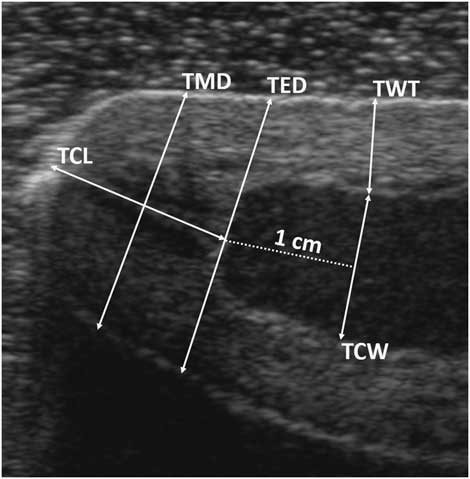
Ultrasound-based measurements were performed by the principal investigator and a trained person following completion of teat scanning at the end of each study day using the integrated software program on stored images. Teat parameters measured were teat canal length (TCL), teat-end diameter at the aspect of the proximal end of the teat canal (TED), teat wall thickness (TWT) and teat cistern width (TCW) 1 cm above the proximal end of the teat canal as described by Neijenhuis et al. (Reference Neijenhuis, Klungel and Hogeveen2001a). In addition, we measured the teat-end diameter at the midpoint between the distal and proximal ends of the teat canal (TMD). Measurements were performed according to a standard operating procedure as described in the Supplementary Material S1. Figure 1 illustrates the measured teat parameters.
Ultrasonographic measurements of the teat parameters in cows. TCL=teat canal length; TMD=teat-end diameter at the midpoint between the distal and the proximal ends of the teat canal; TED=teat-end diameter at the proximal end of the teat canal; TCW=teat cistern width 1 cm above the proximal end of the teat canal; TWT=teat wall thickness 1 cm above the proximal end of the teat canal.

Teat characteristics
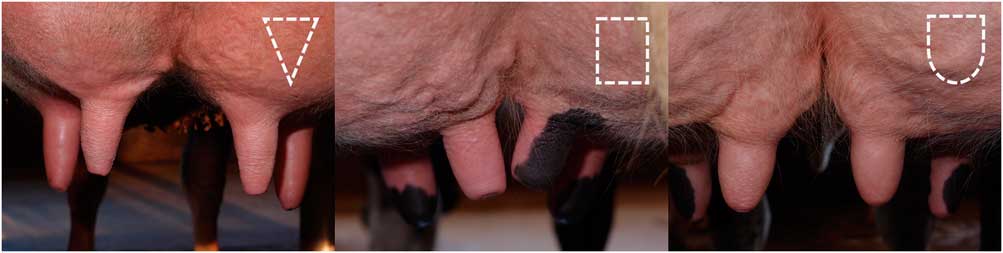
Teat dimensions (teat length and teat diameter) were assessed with a digital depth gauge (SKU 303–1752, Shars Tool Company, St. Charles, IL, USA) and digital caliper (75-TM54006; Vernier, Beaverton, OR, USA). Teat length was measured from the teat base to the teat-end, whereas teat diameter was assessed at the midpoint between the teat base and teat-end. Measurements were performed before milking unit attachment but after completion of premilking udder preparation. Each measurement was obtained three times on 3 consecutive days before enrollment. The average of the three measurements was calculated for subsequent analyses. Supplementary Material S2 describes the assessment of the repeatability of triplicate measurements. The teat-end shape was recorded during milking immediately before unit attachment and classified into one of three categories as previously described (Wieland et al., Reference Wieland, Nydam and Virkler2017): pointed, flat and round (Figure 2). All of the teat characteristics were recorded with a digital voice recorder (ICD-UX533BLK; Sony, San Diego, CA, USA) and subsequently entered into Excel (version 2013; Microsoft Corp., Redmond, WA, USA).
Classification of teat-end shapes in cows as previously reported by Wieland et al. (Reference Wieland, Nydam and Virkler2017): pointed, flat and round.

Milking characteristics
The total milk yield (kg), average milk flow rate (kg/min), peak milk flow rate (kg/min), average milk flow rate between 60 and 120 s after start of milking (kg/min) and milking unit-on time (s) were assessed at each of the three milking sessions during the 4 days of data collection with automatic milk meters (MM27; DeLaval International AB) and recorded using the herd management system ALPRO (DeLaval International AB). All of the milking system settings were verified and assessed by the investigators before the study.
Analytical approach
The relative change (RC; %) of the measured teat parameters compared with the premilking values at t−1 was calculated as follows:
 $$\eqalignno{ \hskip -26pt {\rm Relative}\,{\rm change}\,{\rm of}\,{\rm teat}\,{\rm parameter}\,{\rm (PA)}{\equals} \cr \left[ {\left( {{\rm PA}_{{(t_{0} -t_{7} )}} -{\rm PA}_{{(t{\minus}1)}} } \right)\,/\,{\rm PA}_{{(t{\minus}1)}} } \right]{\times}100.$$
In addition, the relative change (%) of the ratio of TWT divided by TCW compared with the ratio immediately before unit attachment (RCTWCR) was calculated as follows:
 $$\eqalignno{ \hskip -12pt {\rm RCTWCR}{\, \equals \,}\cr {{\left[ {\left( {{\rm TWT}_{{(t_{0} -t_{7} )}} \,/\,{\rm TCW}_{{(t_{0} -t_{7} )}} } \right){\minus}\left( {{\rm TWT}_{{(t{\minus}1)}} \,/\,{\rm TCW}_{{(t{\minus}1)}} } \right)} \right]}} \cr {\mathord{\left/ {\vphantom {{\left[ {\left( {{\rm TWT}_{{(t_{0} -t_{7} )}} \,/\,{\rm TCW}_{{(t_{0} -t_{7} )}} } \right){\minus}\left( {{\rm TWT}_{{(t{\minus}1)}} \,/\,{\rm TCW}_{{(t{\minus}1)}} } \right)} \right]} {\left[ {{\rm TWT}_{{({\rm t}{\minus}1)}} \,/\,{\rm TCW}_{{(t{\minus}1)}} } \right]}}} \right. \kern-\nulldelimiterspace} {\left[ {{\rm TWT}_{{({\rm t}{\minus}1)}} \,/\,{\rm TCW}_{{(t{\minus}1)}} } \right]}}{\times}100.$$
Descriptive statistics of the baseline characteristics were generated with PROC MEANS and PROC FREQ in SAS (SAS 9.4; SAS Institute Inc., Cary, NC, USA). To test the hypothesis that teat-end shape was associated with STC as defined by the outcome variables of interest (TCL (RCTCL), TED (RCTED), TMD (RCTMD), TWT (RCTWT) and RCTWCR), separate general linear mixed models for each dependent variable were generated using PROC MIXED in SAS. The initial model is described by the following equation:
 $$\eqalignno{ \hskip -6pt {\rm RCPA}{\equals}\beta _{0} {\plus}\beta _{1} {\times}{\rm TES}{\plus}\beta _{2} {\times}{\rm TIME}{\plus}\beta _{3} {\times}\left( {{\rm TES}{\times}{\rm TIME}} \right)\cr \hskip 18pt {\plus} \beta _{4} {\times}{\rm L}{\plus}\beta _{5} {\times}{\rm D}{\plus}\beta _{6} {\times} {\rm P}{\plus}\beta _{7} {\times}{\rm MUT}{\plus}\beta _{8} {\times}{\rm PA}_{{t{\minus}1}} {\plus}{\epsilon}$$
where RCPA is the relative change of the teat parameter, β
0 the y-intercept, β
1 the partial regression coefficient of teat-end shape, β
2 the partial regression coefficient of time, β
3 the partial regression coefficient of the interaction term between teat-end shape and time, β
4 the partial regression coefficient of teat length (mm), β
5 the partial regression coefficient of teat diameter (mm), β
6 the partial regression coefficient of the quarter position, β
7 the partial regression coefficient of milking unit-on time (s), β
8 the partial regression coefficient of the premilking value at t−1 of the teat parameter and ɛ the error term.
Teat-end shape, time and the interaction term between teat-end shape and time were forced into all models. To control for potential confounding, teat length, teat diameter, quarter position (left front v. right hind), milking unit-on time and the respective premilking value were also included in each initial model as potential covariates. Multicollinearity among all of the independent variables was assessed by calculating Spearman correlation coefficients with PROC CORR in SAS. No multicollinearity was observed among independent variables (correlation coefficients⩽|0.51|). Backward stepwise selection was performed until each of the covariates had a P-value<0.05. Confounding effects were monitored by observing regression coefficient changes. Variables that modified the regression coefficients by >20% were considered confounding factors. No confounding factors were observed. To account for repeated measurements over time, time for quarter position nested within cow and day of observational milking was included in the REPEATED statement. To account for unequally spaced measurements over time, four covariance structures were tested for each dependent variable analyzed (unstructured, spatial power law, Gaussian and spherical). The covariance structure with the smallest Akaike’s information criterion was selected. Enrollment block was included as a random effect.
This analysis was followed by multiple comparisons between the teat-end shapes at time point t 0. A Bonferroni correction for three comparisons was applied.
To test the hypothesis that the recovery time of teat tissue after machine milking differed among teats with different teat-end shapes, differences in the relative change of measured teat parameters were assessed by comparison of all postmilking LSM values (t 0, t 1, t 3, t 5, t 7) derived from the above described statistical models with the premilking value for each outcome using 95% confidence intervals (CI). Recovery time was defined as the time until the postmilking values were not different from 0 at a significance level of 0.05. For all final models, the assumptions of homoscedasticity and normality of residuals were assessed by inspection of plots of residuals versus corresponding predicted values and examination of quantile-quantile plots of residuals.
Results
Description of study population
A total of 128 cows were enrolled in the study. Two cows were excluded during the first observational milking day as they demonstrated excessive defensive movements during ultrasonographic scanning. Another cow had to be excluded at the second observational milking day because of clinical mastitis of the right front quarter. In total, 16 ultrasound images were missing. Total milk yield and milking characteristics from four observational milkings (32 milking observations) were missing because data were not recorded or transferred by the milking point controller. Furthermore, the milking characteristics from one milking observation were excluded from the final analysis as the recorded data were erroneous (average milk flow rate=0 kg/min).
Baseline characteristics
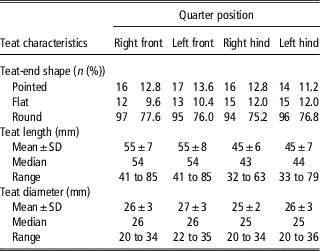
The mean±SD (median; range) 305-day mature equivalent milk yield of all 125 cows included in the final analysis was 14 056±2546 (14 293; 7570 to 19 133) kg. The mean±SD days in milk at the day of enrollment was 201±88, ranging from 56 to 528 days. The average parity was 2.2 and distributed as follows: 47 (37.6%) were in first, 33 (26.4%) were in second, 21 (16.8%) were in third, 17 (13.6%) were in fourth and 7 (5.6%) animals were in fifth lactation. The mean±SD (median; range) values of the milking characteristics per milking during the four observational milkings were: total milk yield, 8.0±3.2 (8.2; 0.8 to 16.1) kg; average milk flow rate, 2.7±1.1 (2.8; 0.4 to 6.0) kg/min; peak milk flow rate, 3.9±1.3 (4.0; 0.7 to 8.7) kg/min; average milk flow rate between 60 and 120 s after start of milking, 2.7±1.5 (2.9; 0.1 to 6.5) kg/min; and milking unit-on time, 181±51 (173; 86 to 373) s. The descriptive statistics of the milking characteristics during the 4 consecutive days of data collection stratified by milking session are provided in the Supplementary Table S1. The mean±SD (median; range) teat length and teat diameter were 50.1±8.5 (49.7; 32.3 to 85.0) and 26.0±2.7 (25.7; 19.7 to 36.3) mm, respectively. Table 1 provides the frequency distribution of teat-end shape and descriptive statistics of teat length and teat diameter stratified by quarter position.
Frequency distribution of the number (n, %) of teats by teat-end shape and descriptive statistics of teat length (mm) and teat diameter (mm) stratified by quarter position in 125 cows

Association of machine milking-induced short-term changes in teat tissue and teat-end shape
Machine milking-induced short-term changes in teat tissue were evaluated based on the five ultrasonographically assessed outcomes: RCTCL, RCTED, RCTMD, RCTWT and RCTWCR. Descriptive statistics and the association as well as recovery time of RCTCL, and RCTWT with teat-end shape are described separately below. The RCTED, RCTMD and RCTWCR results are provided in Supplementary Material S3 and Supplementary Figure S1, S2 and S3, respectively.
Teat canal length
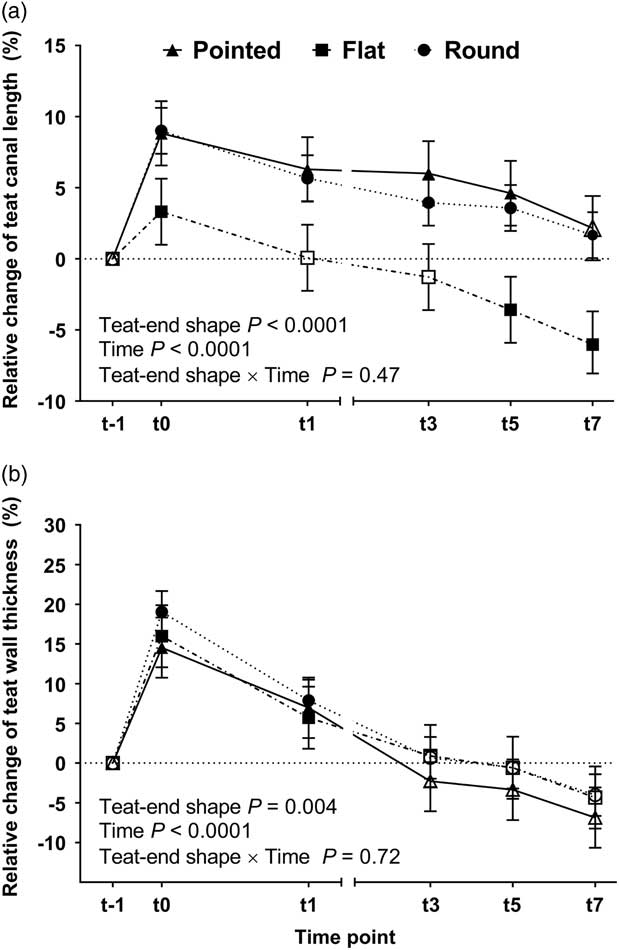
The mean±SD (median; range) TCL was 14.2±2.2 (14.0; 8.0 to 23.0) mm. The final multivariable model for RCTCL contained teat-end shape (P<0.0001), time (P<0.0001), the interaction term between teat-end shape and time (P=0.47), teat diameter (P=0.0005), milking unit-on time (P=0.009) and the premilking value at t−1 (P<0.0001). A 1 mm increase in teat diameter decreased the RCTCL by 0.2% (95% CI −0.3 to −0.1). A 60 s increase in milking unit-on time decreased the RCTCL by 0.4% (95% CI −0.8 to −0.1). A 1 mm increase in TCL at t−1 decreased the RCTCL by 2.6% (95% CI −2.7 to −2.4). The RCTCL (LSM, 95% CI) at t 0 was 8.8 (6.6 to 11.1), 3.3 (1.0 to 5.6) and 9.0 (7.4 to 10.6) % in teats with pointed, flat and round teat-end shapes, respectively, and was different between teats with pointed and flat (P=0.0003) and flat and round (P=0.0003) teat-end shapes. The recovery time for RCTCL was 7 h in teats with pointed and 1 h in teats with flat teat-end shapes, whereas it was greater than 7 h in teats with a round teat-end shape (Figure 3a).
Relative change of the teat canal length (a) and teat wall thickness (b) of the left front and right hind teat in 125 cows measured immediately after milking (t 0), and 1, 3, 5 and 7 h after milking (t 1, t 3, t 5, t 7) compared with the measurement immediately before milking unit attachment (t−1). The results are stratified according to teat-end shape (pointed, flat and round). Filled symbols indicate differences from 0 at the level of P<0.05. The results are presented as the least squares means (%). Error bars show the 95% confidence intervals.

Teat wall thickness
The mean±SD (median; range) TWT was 6.8±1.3 (7.0; 3.0 to 12.0) mm. The final multivariable model for RCTWT contained teat-end shape (P=0.004), time (P<0.0001), the interaction term between teat-end shape and time (P=0.72), teat length (P<0.0001), teat diameter (P=0.0006), quarter position (P=0.0004), milking unit-on time (P<0.0001) and the premilking value at t−1 (P<0.0001). A 1 mm increase in teat length decreased the RCTWT by 0.4% (95% CI −0.5 to −0.3). A 1 mm increase in teat diameter decreased the RCTWT by 0.4% (95% CI −0.6 to 0.2). Controlling for all other variables included in the model, the RCTWT in front teats was 2.2% (95% CI 1.0 to 3.5) higher compared with that in hind teats. For every 60 s increase in milking unit-on time, RCTWT increased by 1.6% (95% CI 1.0 to 2.1). A 1 mm increase in TWT at t−1 decreased the RCTWT by 10.2% (95% CI −10.5 to −9.8). The RCTWT (LSM, 95% CI) at t 0 was 14.5 (10.7 to 18.3), 16.0 (12.0 to 19.9) and 19.0 (16.4 to 21.7) % in teats with pointed, flat and round teat-end shapes, respectively, and was different between teats with pointed and round teat-end shapes (P=0.02). Recovery time for RCTWT was 3 h in teats with pointed, flat and round teat-end shapes, respectively (Figure 3b).
Discussion
The primary objective of our study was to investigate the association of STC as assessed by ultrasonography and teat-end shape. We were also interested in the interactive effects of teat-end shape and the recovery time of teat tissue after machine milking. The study population was obtained from a high producing herd with a thrice daily milking schedule to more closely reflect milking practices in modern dairy herds in the United States.
To our knowledge, no study has investigated the association of STC and teat-end shape in Holstein dairy cows with a thrice-daily milking schedule. Our results show that STC were associated with teat-end shape. We observed differences in the magnitude of STC immediately after milking (t 0) among teats with different teat-end shapes, such that RCTCL, RCTWT and RCTWCR were most severe in teats with a round teat-end shape, whereas RCTED and RCTMD were most severe in pointed and flat teats, respectively. In addition, our data show that the recovery of teat tissue parameters after machine milking was different among teats with different teat-end shapes and exceeded the 7 h of observation in flat (i.e., RCTMD) and round (i.e., RCTCL and RCTMD) teats. We conclude that milking cows with the same milking liner and identical machine settings may fail to accommodate requirements of cows with different teat characteristics and possibly has a detrimental effect on the condition of teat tissue. The variability of the teat characteristics within and between cows has been demonstrated previously (Neijenhuis et al., Reference Neijenhuis, Barkema, Hogeveen and Noordhuizen2001b; Guarín and Ruegg, Reference Guarín and Ruegg2016; Guarín et al., Reference Guarín, Paixão and Ruegg2017). Our results extend the existing literature and suggest that these characteristics may predispose teats to varying degrees of teat tissue alterations. Shorter intervals between milking may result in incomplete teat tissue recovery and an accumulation of tissue alterations, which is consistent with previous studies (Ipema and Benders, Reference Ipema and Benders1992; Neijenhuis et al., Reference Neijenhuis, Klungel and Hogeveen2001a).
Several possible factors may underlie the observed differences between different teat-end shapes. These include differences in milk flow, liner fit and inherent teat tissue vulnerability. In a recent study, we documented that cows with a flat teat-end shape had higher milk flow rates (i.e., 2-min milk yield) compared with cows with a pointed or round teat-end shape (Wieland et al., Reference Wieland, Nydam and Virkler2017). The vacuum load at the teat-end (i.e. average claw vacuum) is a function of the milking system vacuum and milk flow rate, such that higher milk flow rates result in a smaller vacuum load (Bade et al., Reference Bade, Reinemann, Zucali, Ruegg and Thompson2009). The liner fit may differ between teats with different teat-end shapes, which could lead to varying degrees of liner compression. The liner fit as a function of teat-end shape has not been investigated, but could play a role in STC. Differences in teat anatomy may influence the susceptibility to STC. However, we did not investigate the teat tissue composition and vascularization, which may contribute to the increased susceptibility to STC of teats with certain teat-end shapes. To the best of our knowledge, there is no data available that compares these characteristics.
Teat length and teat diameter were associated with STC. An increase in teat length decreased the magnitude of the RCTED, RCTMD, RCTWT and RCTWCR, whereas an increase in teat diameter reduced the magnitude of the RCTCL, RCTED, RCTWT and RCTWCR. A possible explanation may be that the relatively longer and wider teats within the study population were exposed to a lower mouthpiece chamber vacuum, for example, due to a better liner fit. Differences in penetration depth into the milking liner and discrepancies in teat diameter could lead to variations in the seal between the teat and barrel of the milking liner. This is consistent with previous results by Borkhus and Rønningen (Reference Borkhus and Rønningen2003), who recorded a higher mouthpiece chamber vacuum in narrow and short teats. A higher mouthpiece chamber vacuum has recently been shown to be associated with the congestion of teat tissue (Penry et al., Reference Penry, Upton, Mein, Rasmussen, Ohnstad, Thompson and Reinemann2017). Liner compression may differ in teats that are too short in relation to the milking liner so that they do not reach the collapsing point of the milking liner. This can result in an insufficient relief of teat-end congestion during the d-phase of the pulsation cycle (Williams and Mein, Reference Williams and Mein1982). This possible explanation stands in contrast with the observed effect of teat diameter on the RCTMD, which is an unexpected finding and difficult to explain.
As previously demonstrated (Hamann and Mein, Reference Hamann and Mein1990), milking unit-on time was associated with STC, such that an increase in the milking unit-on time resulted in an increase in RCTMD and RCTWT. By contrast, an increase in the milking unit-on time yielded a decrease in RCTCL, which is an unexpected finding and difficult to explain. Finally, our results show that STC were associated with quarter position. The RCTED, RCTWT and RCTWCR were more severe in front teats compared with hind teats. Differences in milk production between front and hindquarters in the presence of udder-level automatic cluster remover units may predispose front teats to overmilking (Tančin et al., Reference Tančin, Ipema, Hogewerf and Mačuhová2006), which has been associated with STC in previous work (Mein et al., Reference Mein, Neijenhuis, Morgan, Reinemann, Hillerton, Baines, Ohnstad, Rasmussen, Timms, Britt, Farnsworth, Cook and Hemling2001; Paulrud et al., Reference Paulrud, Clausen, Andersen and Rasmussen2005).
Several studies have investigated the effect of machine milking on ultrasonographically assessed STC (Neijenhuis et al., Reference Neijenhuis, Klungel and Hogeveen2001a; Gleeson et al., Reference Gleeson, O’Callaghan and Rath2002 and Reference Gleeson, O’Callaghan and Rath2004; Paulrud et al., Reference Paulrud, Clausen, Andersen and Rasmussen2005). We observed a relative increase of TCL of 3.3% to 9.0%, whereas previous studies reported an increase of 12% (Neijenhuis et al., Reference Neijenhuis, Klungel and Hogeveen2001a) and 30% to 41% (Paulrud et al., Reference Paulrud, Clausen, Andersen and Rasmussen2005). In the current study, recovery time of TCL was 7 h in pointed, 1 h in flat, and greater than 7 h in round teats, whereas recovery time of TCL exceeded the 8 h (Neijenhuis et al., Reference Neijenhuis, Klungel and Hogeveen2001a) and 5 h (Gleeson et al., Reference Gleeson, O’Callaghan and Rath2002) of observation, respectively. The RCTCL may have resulted from vacuum induced forces during milking which fracture the keratin layer and expand the tissue surrounding the teat canal. Vacuum induced congestion and edema of tissue surrounding the teat canal may have impeded the elastic recoil of the pliable teat-end tissue after milking (Williams and Mein, Reference Williams and Mein1982).
Similarly, TWT increased by 14.5% to 19% in the present study compared with 34% (Neijenhuis et al., Reference Neijenhuis, Klungel and Hogeveen2001a) and 20% to 50% (Paulrud et al., Reference Paulrud, Clausen, Andersen and Rasmussen2005) in previous ones. Recovery of TWT after machine milking in the current study occurred after 3 h compared with 6 h (Neijenhuis et al., Reference Neijenhuis, Klungel and Hogeveen2001a) and 5 h (Gleeson et al., Reference Gleeson, O’Callaghan and Rath2002). The differences in the observed values could be due to the choice of ultrasonographic technique, study population, milking machine settings and milking liner, as well as resulting differences in milking unit-on time. One of the most remarkable differences in the current study was the cup remover take-off milk flow threshold (i.e., 1.3 kg/min, delay: 0 s) compared with those from previous studies (Neijenhuis et al., Reference Neijenhuis, Klungel and Hogeveen2001a; Gleeson et al., Reference Gleeson, O’Callaghan and Rath2004; Paulrud et al., Reference Paulrud, Clausen, Andersen and Rasmussen2005). Those studies employed a threshold of 0.2 kg/min (Neijenhuis et al., Reference Neijenhuis, Klungel and Hogeveen2001a; Gleeson et al., Reference Gleeson, O’Callaghan and Rath2004) and 0.3 kg/min (Paulrud et al., Reference Paulrud, Clausen, Andersen and Rasmussen2005), respectively.
Most teats in this study had a round teat-end shape, which is consistent with previous studies, which showed a higher proportion of round teats when investigating the association with milking characteristics (Seykora and McDaniel, Reference Seykora and McDaniel1985; Wieland et al., Reference Wieland, Nydam and Virkler2017), somatic cell count (Seykora and McDaniel, Reference Seykora and McDaniel1985; Chrystal et al., Reference Chrystal, Seykora and Hansen1999) and machine milking-induced long-term changes (Neijenhuis et al., Reference Neijenhuis, Barkema, Hogeveen and Noordhuizen2001b).
The association between teat-end shape and performance parameters, such as milking performance and udder health, in dairy cows remains controversial. Recently, we showed that the milking unit-on time is shorter in cows with flat teats, indicating the potential to increase parlor efficiency (Wieland et al., Reference Wieland, Nydam and Virkler2017). Contrary to this potential benefit, Guarín and Ruegg (Reference Guarín and Ruegg2016) demonstrated that the risk of acquiring clinical mastitis increases as the diameter of the teat apex increases. Quarters with flat teats also had higher somatic cell counts than quarters with pointed and round teats (Seykora and McDaniel, Reference Seykora and McDaniel1985). This stands in contrast with more recent studies from several authors who reported that teat-end shape (Chrystal et al., Reference Chrystal, Seykora and Hansen1999) or teat shape (Guarín et al., Reference Guarín, Paixão and Ruegg2017) was not associated with the somatic cell count. Furthermore, Neijenhuis et al. (Reference Neijenhuis, Barkema, Hogeveen and Noordhuizen2001b) found that pointed teats had the highest teat-end callosity thickness and roughness, which was positively associated with the incidence of clinical mastitis. In summary, no clear advantage of certain teat-end shapes over others has been identified.
Our study was designed to best represent current milking practices. However, when interpreting the findings, several limitations should be considered. Study cows were milked 30 min before the regular start time of milking. Cows also remained in the parlor for a longer period of time than usual while teat ultrasonography was performed. Cows were then confined in tie-stalls for the remaining measurements instead of returning to the free-stall barn. These factors may have contributed to the negative effect on milk production observed for the observational milkings and potentially influenced our results. All study animals were exposed to the same milking machine settings, which were kept consistent throughout the study period. Therefore, individual udder or teat characteristics likely account for the greatest variability in STC. However, we cannot rule out that the results may have been influenced by the particular liner chosen in this study and the resulting differences in liner fit. Ultrasonographically assessed teat parameters differed in the greatest degree of relative change for each teat-end shape, with most parameters showing the largest change for round teats. It remains to be determined whether the statistically significant differences are biologically relevant and which of the assessed parameters are most suitable to predict risk for teat canal penetrability. Therefore, future studies should determine the biological relevance of each parameter and their individual association with susceptibility to new intramammary infection.
In conclusion, STC were associated with teat-end shape. The recovery time after machine milking was different among teats with different teat-end shapes and exceeded the 7 h of observation in flat and round teats. In addition to teat length and teat diameter, teat-end shape may be a risk factor for the magnitude of STC and recovery time of teat tissue after machine milking in dairy cows.
Acknowledgments
This project was supported by the Clinical Fellowship Program from Cornell University, College of Veterinary Medicine. The authors thank the staff at the Cornell Teaching Dairy Barn (Ithaca, NY). The authors also thank Jaclyn Marie Melvin for her invaluable assistance with data collection. Figure 2 has been previously published in Wieland et al. (Reference Wieland, Nydam and Virkler2017). The authors gratefully acknowledge Elsevier, Amsterdam, The Netherlands for permission to re-use this figure. This project was financially supported by DeLaval International AB (Tumba, Sweden).
Declaration of interest
The authors declare no conflicts of interest.
Ethics statement
All procedures were reviewed and approved by the Cornell University Institutional Animal Care and Use Committee (protocol no. 2015–0116).
Software and data repository resources
All data generated or analyzed for this study are available from the corresponding author on reasonable request.
Supplementary material
To view supplementary material for this article, please visit https://doi.org/10.1017/S1751731118001246