INTRODUCTION
Extra pulmonary small cell carcinoma is a rare but aggressive tumour. It was first described by Duguid KennedyReference Duguid and Kennedy1 and since then been documented in a number of sites including the head and neck, oesophagus, stomach, pancreas, gallbladder, uterine cervix, kidney, urinary bladder, and prostate. Unlike small cell carcinoma of the lung which comprises of about 20% of all lung cancers, extra-pulmonary small cell is rare with an overall incidence of approximately 0.1% to 0.4% in non-pulmonary sites.
Neuroendocrine small cell carcinoma of the cervix (NSCC) represents about 1% of all cases of cervical carcinoma, the first recognised report being in 1976.Reference Albores-Saavedra, Larraza, Poucell and Rodriguez Martinez2 Diagnosis requires expert pathological review, with the presence of small round cells with scanty cytoplasm, hyperchromatic nuclei.Reference McCluggage, Kennedy and Busam3 Clinical course is aggressive. In a study of 2,201 patients, spanning 23 years, van Nagell et al. identified 25 cases of small cell carcinoma (1.1%). These patients had a higher frequency of lymphatic invasion, a higher extra pelvic recurrence rate, and a shorter overall survival time, when compared with two groups of 25 matched patients with large cell non-keratinizing cancer and keratinizing squamous cell cancer.Reference Van Nagell, Powell and Gallion4
Given that NSCC has a high risk of distant metastasis local therapy alone will not achieve long-term control. Given its rarity, there have been no prospective trials and management decisions are based on retrospective case series and extrapolation from small cell cancer of lung studies. The use of systemic chemotherapy with local treatment, either surgery, radiotherapy or both has been reported and shown to improve survival.Reference Cohen, Kapp and Shin5 Optimal local therapy, either radical surgery or radiotherapy, has not been defined. In this paper we retrospectively review the outcome of patients diagnosed with neuroendocrine small cell carcinoma of the cervix in a single region over a 10-year period.
METHODS
The case notes of all patients diagnosed with NSCC of cervix at the Northern Ireland radiotherapy centre were retrospectively reviewed. Since 1999 all cases of NSCC were referred to the regional centre and reviewed at the regional gynaecological multidisplinary team meeting. Details of stage of disease at diagnosis, treatment including surgery, chemotherapy and radiotherapy were recorded. All patients had complete blood count, electrolytes and creatinine, liver function tests, computed tomography (CT) scan of the chest and abdomen and Magnetic Resonance Imaging (MRI) of pelvis at diagnosis. Patients were staged clinically, according to the International Federation of Gynaecology and Obstetrics (FIGO) staging system. Diagnosis was made on biopsy or surgical specimen. Pathology was reviewed by a pathologist specialising in gynaecological pathology. Date and site of first recurrence, subsequent management and date of death were also recorded. Overall survival (OS) was defined as the time from diagnosis to last follow-up or death. Disease-free survival (DFS) was defined as the time from diagnosis to first recurrence or progression of disease. Kaplan Meier estimates were used for survival outcomes.
RESULTS
Fifteen patients diagnosed with neuroendocrine small cell carcinoma of cervix were identified between 1999 and 2010. Median age at diagnosis was 32 years (range 23–66 years). Median follow-up time (or time to death) was 29.4 months (range, 5–116 months). Two patients had a modified radical hysterectomy, with the diagnosis of small cell carcinoma only made after surgery. If a diagnosis of small cell carcinoma was made on initial biopsy, patients would proceed to systemic chemotherapy or radiotherapy, or chemoradiotherapy. Twelve patients were diagnosed on biopsy alone. All histological specimens were reviewed centrally by a gynaecological pathologist using immunohistochemistry in the majority of cases to help confirm diagnosis. The results of this pathological review have been published previously.Reference McCluggage, Kennedy and Busam3 Cases were stained with AE1/3, chromogranin, CD56, synaptophysin, PGP9.5, TTF1, p16, p63, CK7, CK20, neurofilament, and CD99.
Twelve had disease confined to the pelvis at diagnosis, 4 had FIGO Stage 1B1, 5 had Stage 1B2, 2 had Stage 2A and 1 had Stage 3a. Three patients had metastatic disease at diagnosis. Serum sodium was within normal range for all patients at diagnosis.
Two of the 12 patients with localised disease had a radical hysterectomy and pelvic lymph node dissection followed by 6 cycles of cisplatin (80 mg/m2)/etoposide (360 mg/m2) chemotherapy and pelvic radiotherapy, 45Gy/25 fractions.
The other 10 patients with pelvic confined disease had induction chemotherapy, cisplatin (80 mg/m2)/etoposide(360 mg/m2) for 2–4 cycles followed by pelvic radiotherapy concurrent with weekly cisplatin (40 mg/m2) followed by a further 2 cycles of cisplatin/etoposide. Granulocyte colony stimulating factor (GCSF) support was routinely given as primary prophylaxis during chemotherapy only.
The dose of pelvic radiotherapy ranged from 45–50.4 Gy in 1.8Gy fractions, using 15MV photons. Radiotherapy was initially planned on 2D orthogonal images using bony landmarks. After 2003 radiotherapy was conformally planned using CT. The upper border of the radiotherapy field was the L4/L5 interspace. The para-aortic nodes were not prophylactically irradiated in any patient.
Eight patients had brachytherapy, six had Low Dose Rate (LDR) with a dose of 24–27 Gy to point A and two had High Dose Rate (HDR), 19–21 Gy to point A in 3 fractions. Seven patients received prophylactic cranial irradiation (PCI); dose either 25Gy/10 fractions, 24 Gy/12 fractions or 36 Gy/18 fractions.
Overall the combination of chemotherapy and chemoradiotherapy was tolerated well. Two patients had a neutropenic sepsis episode during cycle 5, and received a dose reduction of 20% for cycle 6. One patient developed grade-3 mucositis after cycle 1, and subsequently had a dose reduction of 20%.
Recurrence was recorded in 4 of the 12 patients with localised disease, 3 at the para-aortic nodes and 1 within the liver. Median time from initial diagnosis to relapse was 13.2 months (range 7.1–29.3 months). These 3 patients were subsequently rechallenged with cisplatin/etoposide. and. 2 patients also received liposomal doxorubicin. All 3 patients died of their disease. Median time from date of relapse to death was 9.29 months (range 2.3–10.6months).
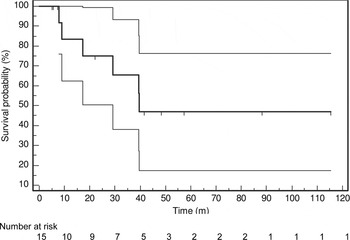
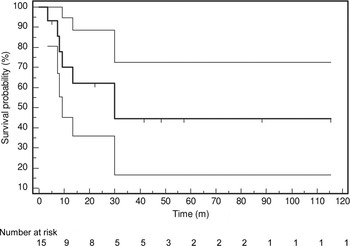
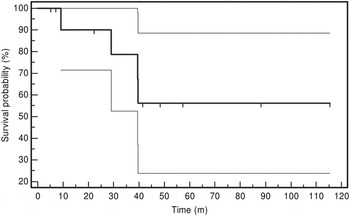
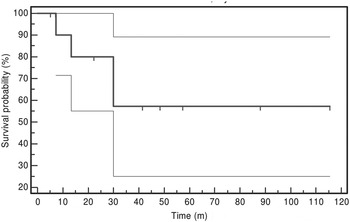
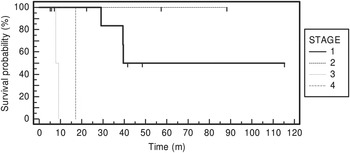
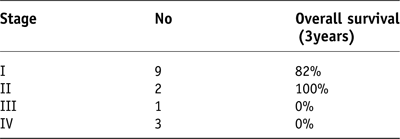
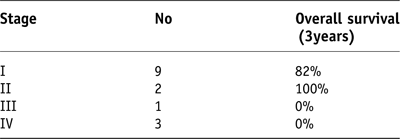
Three-year overall survival (OS) for all patients was 65% and disease-free survival was (DFS) 45% for all patients (Figures 1 & 2). In patients with pelvic confined disease 3-year overall survival was 79% and disease-free survival was 57% (Figure 3 & 4). Survival curves plateaued after 40 months, which is a similar finding to previous studies, suggesting that if patients are disease-free at this point long-term control can be achieved. Median disease-free and overall survival is 30 and 39.6 months respectively. Stage of disease at diagnosis was the main determinant of survival (Table 1/Figure 5).
Overall survival – All Patients (with 95% confidence limits).

Disease-free survival (DFS) all patients (with 95% confidence limits).

Overall survival pelvic confined disease (with 95% confidence limits).

Disease-free survival pelvic confined disease (with 95% confidence limits).

Overall survival by FIGO stage.

Stage of disease at diagnosis and overall survival.
Three patients had metastatic disease at presentation. They received 4–6 cycles of isplatin/etoposide chemotherapy. One patient also received palliative pelvic radiotherapy because of local symptoms. All 3 patients died of their disease. Median time from diagnosis to death was 7.32 months (range 6.7–16.8 months).
DISCUSSION
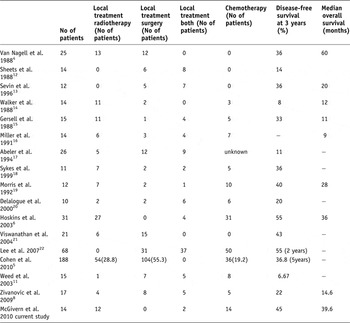
Neuroendocrine small cell carcinoma of the cervix remains a rare condition with treatment poorly defined. The Gynaecological Oncology Group (GOG) attempted a study but due to poor accrual it was abandoned, as a result treatment decisions have been based on single institution studies, and have extrapolated treatment approaches from the management of small cell cancer of the lung. Table 2 summarises the available cases series published in the literature. Comparing each series is difficult as patient groups are heterogeneous and different parameters are measured. In this paper we present a series of patients who were in majority treated with a combination of platinum-based chemotherapy and pelvic radiotherapy. Our principal of treatment was to proceed with prompt induction chemotherapy for systemic control followed by pelvic radiotherapy to optimise local control, followed by further consolidation chemotherapy.
Published case series.

Consistent with other series our report demonstrates that the stage at diagnosis is an important prognostic factor. Cohen et al. have reported the largest series with 188 patients combining their own patient experience with a number of published case series. They report 5-year survival for I-IIA disease of 36.8% compared with 9.8% for those with stage IIB-IVA and 0.0% for those with stage IVB disease.Reference Cohen, Kapp and Shin5
As neuroendocrine small cell carcinomas have a tendency to early systemic spread local treatment alone is inadequate to achieve long-term control. Similar to small cell carcinoma of the lung systemic therapy is required. The use of platinum-based chemotherapy either neo-adjuvant or adjuvant to radical surgery or radiotherapy has been widely reported and accepted as an integral component of treatment. In the large series by Cohen chemotherapy (as primary, adjuvant, or with concurrent radiation) was associated with improved survival in stage IIB-IVA disease compared with those who did not receive chemotherapy (3-year survival: 17.8% vs 12.0%; P<.043).Reference Cohen, Kapp and Shin5
What is less clear is what local treatment should be carried out in early stage disease, radical hysterectomy, radical radiotherapy or a combination of the two. Surgical resection plays a limited role in the treatment of small cell lung cancer. Reviewing Cohen’s series the 5-year survival for stage I-IIA patients who received a radical hysterectomy was 38.2% compared with 23.8% for those who did not(P < .001). This is the first demonstration of a benefit of radical surgery in early disease. This paper is however limited by the fact that the majority of patients were extracted from a number of small case series. Central pathology review was lacking and there may be selection bias of patients, coming only from published studies that tend to demonstrate positive results.
Hoskins et al. report single institution experience of the use of etoposide/cisplatin chemotherapy plus pelvic radiotherapy without the routine use of surgery. The 3-year OS and DFS rates for all patients were 60% and 57%, respectively. Pelvic failure rate without the use of surgery was only 13%.Reference Hoskins, Swenerton, Pike, Lim, Aquino-Parsons, Wong and Lee6 The figures from our series compare favourably with OS and DFS with 3 year 65% and 45% respectively. These are amongst the best reported in the literature (Table 2).Their protocol which is similar to our own allows the early introduction of chemotherapy which could be delayed if major surgery is performed first. Early chemotherapy allows early management of micro-metastatic disease which is important as most patients who succumb to their disease, die of uncontrolled systemic disease not pelvic disease. In our series local control was excellent, again comparing to pelvic control rates reported in the literature. Despite only 2 patients having undergone a hysterectomy there were no pelvic recurrences. Three recurrences were at the para-aortic nodes and one within the liver. Hoskins et al. reported a local failure rate of 13%.
If we exclude patients with metastatic disease and look at those with pelvic confined or limited stage disease we see 3 year overall survival of 79% and disease-free survival was 57%. Median disease-free and overall survival is 30 and 39.6 months respectively. These results of limited disease compare similarly to a series by Ham Kim et al. who report their experience of extra pulmonary small cell carcinomas over a 10 year period. NSCC confined to the uterine cervix showed a favorable clinical course. Seven patients had limited stage cervical NSCC, with 5 patients are disease-free with a median follow-up of 36 months. These patients were treated with a combination of chemotherapy, radiotherapy and surgery.Reference Kim, Lee and Park7 In a series by Zavanoic et al. patients with early disease (Stages IA2– IB2) had a median DFS of 10.8 months and 3 year overall of survival of 83%.Reference Zivanovic, Leitao, Park, Zhao and Diaz8 In the large series by Cohen et al.Reference Cohen, Kapp and Shin5 the 5-year disease survival for patients with stage I-IIa was 36.8%.
The para-aortic nodes were not routinely irradiated in our institution. Despite these failures at the para-aortic nodes we have not yet considered routine prophylactic irradiation. This would certainly greatly increase toxicity in the combination with both systemic and concurrent chemotherapy. Should these patients however have their para-aortic nodes laproscopically sampled or dissected routinely, as is now standard in our institution in these patients with locally advanced squamous cell carcinoma of cervix?
Eight patients in this series received prophylactic cranial irradiation (PCI). There were no documented intra cranial recurrences either in those who received PCI or those who did not. The use of PCI in limited stage small cell lung cancer is well established. In patients who receive a complete response to chemotherapy the addition of PCI improves overall survival from 16 to 21% at 3 years.Reference Auperin, Arriagada and Pignon9 Differences in the frequency of brain metastases between extra pulmonary small cell carcinoma (EPSCC) and SCLC however may exist. A retrospective single centre study evaluated 65 SCC cases, including 11 cases of EPSCC and 54 cases of SCLC. None of the EPSCC patients had brain metastasis at diagnoses compared to 11 (20%) in SCLC.Reference Cicin, Karagol and Uzunoglu10 Weed et al. reported, however, a 25% incidence of isolated relapse within the brain in their series on cervical small cell carcinoma.Reference Weed, Graff, Shoup and Tawfik11 The role of PCI in EPSCC remains controversial with no firm evidence to dictate its use. On follow up at our institution we have not detected any significant neurocognitive deficit in those patients treated with PCI.
The strength of this report is that chemotherapy used was uniformly platinum and etoposide-based and that pathology review assured that all cases included met strict histo-pathologic criteria for the diagnosis of NSCC. The study is limited by its retrospective nature and the relatively small number of patients allows limited conclusions to be drawn. However disease-free survival and overall survival compare favourably with previous reported series. As with other studies stage of disease at diagnosis is the main predictor of outcome. Patients with pelvic confined disease can achieve long-term control and should therefore be treated aggressively.