

Introduction
New Zealand's supply-side reforms of the 1980s are widely recognised as one of the most radical programmes of economic restructuring ever implemented in any OECD country. The Labour government in power from 1984 to 1990 introduced a set of neo-liberal reforms that included trade liberalisation, floating of the exchange rate, deregulation of product and financial markets, corporatisation and privatisation of parts of the state, and low-rate broad-base tax reform (see Bollard, Reference Bollard1994). These reforms generated a whole body of academic writings on the causes of radical economic policy change. New Zealand's economic reforms were held up as evidence for the importance of economic crisis (Sandford, Reference Sandford1993; Castles et al., Reference Castles, Gerritsen and Vowles1996), political institutions without veto points (Bollard, Reference Bollard1994; Nagel, Reference Nagel1998; Quiggin, Reference Quiggin1998) and political leadership (Sandford, Reference Sandford1993; Castles et al., Reference Castles, Gerritsen and Vowles1996) for radical policy change.
In 2010, New Zealand again introduced major neo-liberal reform in the field of tax policy (Buckle, Reference Buckle2010; Gemmell, Reference Gemmell2010). We identify neo-liberal tax reform with the lowering of rates, the broadening of bases and more neutral taxation (i.e. a tax system that discriminates less between economic choices). The 2010 reform involved a “tax switch” from personal income to consumption – implying lower tax rates on labour income and a higher rate of value-added tax – as well as rate cuts and base-broadening in corporate taxation. This reform was hardly as radical as the tax policy changes of the 1980s. Yet the magnitude of the reform was remarkable given that there did not seem to be an urgent need for tax policy change in New Zealand. For instance, a 2007 OECD review had found the New Zealand tax system to be “one of the most efficient within the OECD” (OECD, 2007: 107). What is puzzling is that this reform was made although the factors deemed crucial for major policy change in the 1980s appear to have been weaker or absent in 2010. The 2010 tax reform was not intimately linked to the economic crisis, it was made by a coalition government elected through a proportional representation (PR) electoral system, and it was not fronted by a strong political figure.
What, then, explains major neo-liberal economic reform? We attempt to address the question through a comparative qualitative investigation of these two cases of tax reform, i.e. in the 1980s and in 2008–10. While the reforms of the 1980s have been studied extensively, this is the first in-depth examination of the 2010 reform. The analysis draws on 20 qualitative interviews with policy-making elites conducted in New Zealand in February and March 2011. These two cases are selected for substantive not strategic reasons. The goal is not theory-testing in a strict sense, but rather to employ and develop theory to illuminate empirical cases (cf. Skocpol and Somers, Reference Skocpol and Somers1980), that is, to understand two instances of neo-liberal tax reform in New Zealand. In order to make inferences about the causes of reform, we exploit the contrasts between the cases but also rely heavily on within-case analysis by tracing the policy processes as explained below (cf. Collier, Reference Collier1993: 112).
We contend that the two rounds of neo-liberal tax reform in New Zealand are best understood as the product of autonomous bureaucratic action. This argument draws on earlier contributions about the influence of neo-liberal ideas through strategically located institutions in New Zealand (Boston, Reference Boston1989, Reference Boston1992; Nagel, Reference Nagel1998; Goldfinch, Reference Goldfinch2000). However, we develop a more theoretical argument about bureaucratic action in this article.
The explanatory framework builds on the state-centred literature, which claimed that states could be potent and autonomous actors in economic and social policy-making (Skocpol, Reference Skocpol1985; Nordlinger, Reference Nordlinger1988). The framework offered here responds to two major criticisms raised against the state-centred literature, namely that “the state” was too broad and vague as a concept (Almond, Reference Almond1988) and that the literature failed to explain the preferences of the state (Hall, Reference Hall1993; Steinmo, Reference Steinmo1993).
First of all, we avoid the sometimes unclear notion of the state by focusing specifically on bureaucrats. We identify autonomous bureaucratic action with a policy process in which the goals and ideas for neo-liberal tax reform came from bureaucratic organisations rather than politicians, bureaucrats took an activist role in policy-making and bureaucrats strongly influenced the policy preferences of politicians through this advocacy.Footnote 1 Second, we offer an explicit explanation of the preferences of the bureaucracy. We argue that bureaucratic goals and ideas were a product of how structural features of the bureaucracy shaped the development of economic ideas. In particular, two dimensions of the bureaucratic structure are seen as important: the organisation of the responsibility for economic policy advice (exclusive vs split) and training (specialist in economics vs generalist). Our contention is that the goals and ideas that dominated tax reform were a product of developments within rather than outside the bureaucracy. Finally, we argue that the role and influence of bureaucrats in the tax policy-making process can be attributed to a combination of strong expertise and strong policy-specific ideologies, rather than to the organisation of expertise as argued by Jonathan Boston (Reference Boston1989).
To evaluate the utility of the theoretical argument for understanding the empirical cases, we rely on a methodology of process-tracing (see George and Bennett, Reference George and Bennett2005: Chapter 10). This implies developing theoretical expectations about the links in the causal chain that leads from our independent variables to the outcome on the dependent variable (i.e. neo-liberal reform) and confronting them with the empirical evidence. We thus generate and evaluate specific arguments about the different stages of the policy process, i.e. the formation of economic ideas, the formulation of reform goals and solutions, the advocacy of reform solutions and the impact on the policy preferences of politicians. The observations at these different stages must be connected in particular ways to constitute an explanation of the outcome (George and Bennett, Reference George and Bennett2005: 206–7).
The article is structured as follows. In the first section, we describe the tax policy changes in New Zealand and put this development in comparative perspective. Following this, we discuss the conventional explanations for major neo-liberal economic reform and present an alternative explanatory framework based on autonomous bureaucratic action in economic policy. Then we apply the theoretical framework to the two periods of major tax reform in New Zealand. In the final section, we spell out some implications of the findings and conclude.
Tax policy in New Zealand
The New Zealand tax system in comparative perspective
The New Zealand tax system stands out in comparative perspective. Over the last three decades, New Zealand arguably moved further than any other advanced economy in neo-liberal tax reform, i.e. in the direction of low rates, broad bases and neutral taxation. “Recognising that a ‘broad base, low rate’ (BBLR) tax system provides a useful rule of thumb for an efficient tax system in practice […] New Zealand was seen as having adopted the closest to a BBLR system of any OECD country” writes Norman Gemmell (Reference Gemmell2010: 66) with reference to the reforms in the 1980s. According to the OECD, “the NZ tax system has long been regarded as one of most efficient within the OECD” (OECD, 2007: 107), and the reform in 2010 pushed tax policy even further in this direction. We can demonstrate the remarkably broad bases and low rates of the New Zealand tax systemFootnote 2 by looking at personal income taxation and value-added taxation – the two most important forms of taxation in revenue terms.
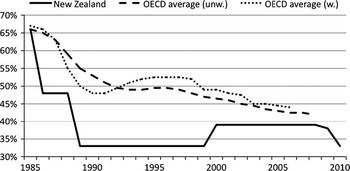
Figure 1 shows that New Zealand made greater cuts in top personal income tax rates than the OECD average over the period 1985 to 2010. If we take into account that most OECD countries also levy sizeable employees’ and employers’ social security contributions on wage income (such taxes are absent in New Zealand), the top rates on labour income in New Zealand are extraordinarily low by international standards. Moreover, New Zealand's personal income tax has been levied on a very broad base ever since the reforms of the 1980s. Unlike most countries, New Zealand has had no standard allowance, no mortgage interest deduction, no tax deductions for private health insurance and no tax incentives for specific investments.Footnote 3
Trends in top personal income tax rates, 1985–2010 Sources: Loretz (Reference Loretz2008) for OECD averages – unweighted (unw.) and weighted (w.); White (Reference White2009) for New Zealand numbers. Note: Average top personal income tax rates among the OECD countries are not available for 2009 and 2010.

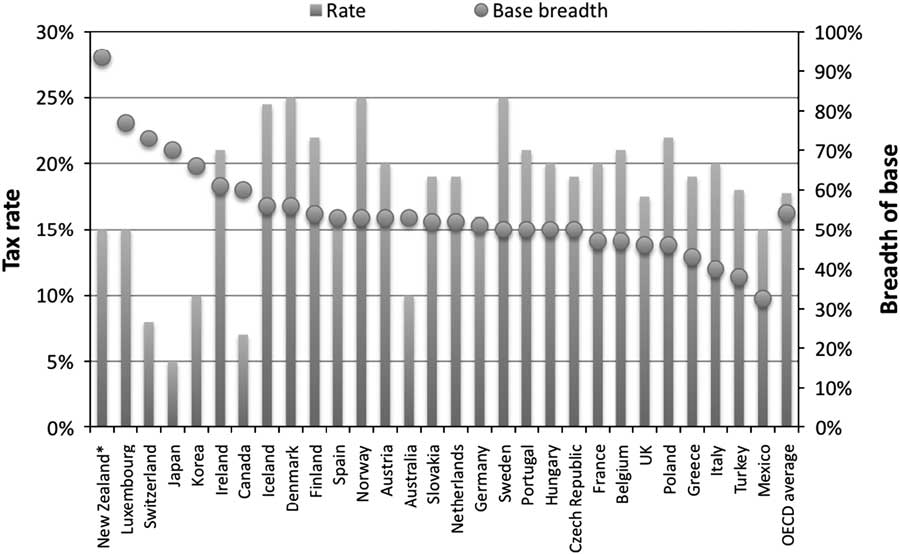
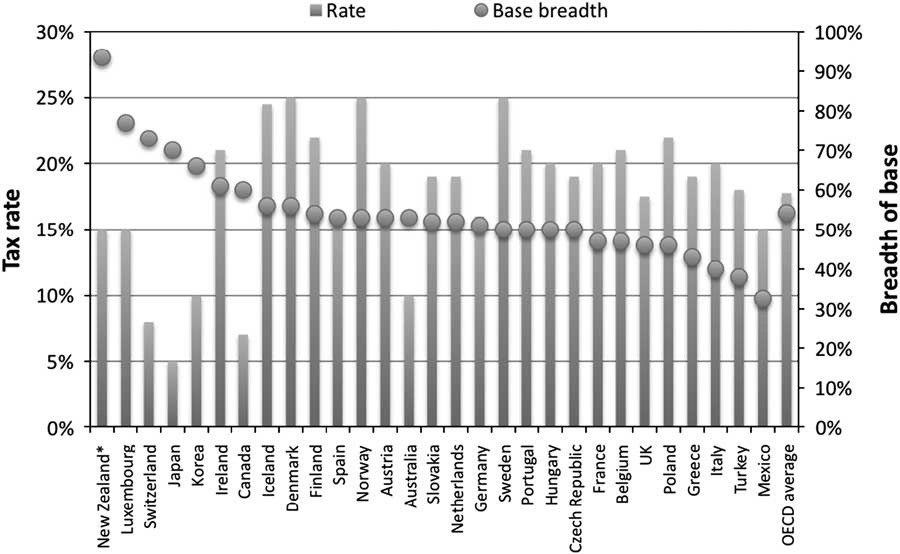
As for consumption taxation, Figure 2 shows that in 2006 New Zealand's value-added tax (VAT), the Goods and Services Tax (GST), applied to a tax base that was far broader than in any other OECD country. The tax rate also remained relatively low by international standards even after the increase from 12.5 per cent to 15 per cent in 2010.
Value added tax (VAT) rates and base breadth in OECD countries, 2006 Explanation: The breadth of the tax base is measured by the “C-efficiency” ratio, which is the revenue collected from VAT as a proportion of the revenue that would be collected if the standard rate of VAT were applied to all consumption. A proportion of 100 per cent means that all consumption is taxed at the standard rate. Note: The New Zealand tax rate is updated to reflect the rate increase from 12.5 per cent to 15 per cent in 2010. Source: Adapted from IRD (2008): 25, Figures 6 and 7.
Finally, the taxation of savings in New Zealand serves as an example of the system's strong neutrality with regard to economic choices. A comparative study from 2005 by economists Yoo and de Serres showed that New Zealand was the only OECD country that taxed pension savings at the same effective rate as other types of savings. While all other countries used tax incentives to encourage private pension savings, New Zealand's completely “neutral tax treatment of pension savings relative to other forms of savings” (Yoo and de Serres, Reference Yoo and de Serres2005: 92) made it an extreme case of neo-liberal tax policy (see also Marriott, Reference Marriott2008).
The evolution of tax policy 1984–2010
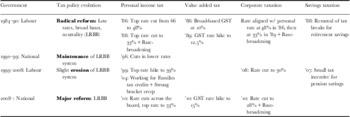
How did New Zealand move so far in the direction of low-rate, broad-based and neutral taxation? Table 1 provides an overview of the tax policy changes made between 1984 and 2010.
Overview of tax policy changes in New Zealand, 1984–2010

In the 1970s and early 1980s, New Zealand pursued highly protectionist and interventionist economic policies that gave rise to large fiscal deficits and low productivity rates (Bollard Reference Bollard1994: 75). The New Zealand National Party – a conservative party – was in power from 1975 to 1984 and used tax policy actively as a lever of economic management, directing economic choices through differentiated rates and tax breaks for particular sectors and activities. New Zealand's tax system was characterised by relatively high rates, very narrow tax bases and a plethora of specific tax incentives. A fundamental weakness of the system was its low capacity to raise revenue, as the sales tax only applied to about one third of consumption and tax expenditures eroded the income tax base (Treasury, 1984: 213).
In the 1984 elections, Labour won an absolute majority in parliament. Minister of Finance Roger Douglas immediately embarked on tax reform as part of a radical programme of micro-economic restructuring. Between 1984 and 1990, Labour introduced what has been described as “the most radical tax reform programme ever implemented by a western government” (Kay and King, Reference Kay and King1990: 219). The tax policy changes went very far in terms of lower rates, broader bases and neutrality. The most important changes were the reduction of the top personal income tax rate from 64 per cent to 33 per cent, the introduction of a broad-based value-added tax (the GST) at a rate of 12.5 per cent, and the elimination of virtually all tax deductions in the personal income tax base including the large tax concessions for retirement savings (see Table 1).
The National governments from 1990 to 1999 were committed to the low-rate, broad-base tax system. During these years there were no significant changes to the rate structure or the objectives of tax policy, only tweaking around the edges. From 1999 to 2008, Labour was in power at the head of various coalitions. While these governments did not introduce any fundamental reforms of the tax system, they made a number of smaller changes that ran counter to the approach of low rates, broad bases and neutrality. Labour raised the top personal income tax rate to 39 per cent, introduced tax credits for families and instituted a small tax incentive for pension savings. They also permitted considerable bracket creep, meaning that a large portion of taxpayers came to face a higher marginal tax rate (Treasury, 2009a: 5).
National came back to power in 2008 and introduced a reform in the 2010 Budget that moved the New Zealand tax system further in the direction of low rates, broad bases and neutrality. The core of the reform was a tax switch from personal income taxes to taxes on consumption. All personal income tax rates were lowered significantly – the top rate dropping from 38 to 33 per cent – while the GST rate was raised from 12.5 to 15 per cent (see Treasury, 2010). The reform also brought the tax rates on corporations and on various savings vehicles down from 33 or 30 per cent to 28 per cent, as well as removing generous depreciation allowances for buildings within the income tax.
Theory
Conventional explanations
What explains major neo-liberal economic reform? A useful starting point is the body of academic work about New Zealand's economic reforms of the 1980s, which put forward three main explanations.
Firstly, major neo-liberal economic reform in New Zealand was linked to economic crisis (Sandford, Reference Sandford1993; Castles et al., Reference Castles, Gerritsen and Vowles1996). Castles and colleagues argued that the fundamental cause of the radical economic restructuring in New Zealand was the economic crisis brought about by the failure of interventionist economic policy. As they put it, the “economic crisis in the early 1980s demonstrated the bankruptcy of the traditional economic policy settlement in Australia and New Zealand, leading to a thoroughgoing overhaul of economic institutions” (Castles et al., Reference Castles, Gerritsen and Vowles1996: 214).
There is little doubt that the pathologies of economic policy of the 1970s and early 1980s motivated economic rethinking and that the crisis in 1984 gave policy-makers an opportunity to implement changes quickly. Yet, an important theoretical objection is that while economic crisis can account for the breakdown of a policy regime, it cannot explain the new policies that arise in its place (Blyth, Reference Blyth2002). We thus need other factors to understand why economic policy changed in a neo-liberal direction.
In the 2010 tax reform process, economic crisis played a significant, albeit restricted, role. The global economic downturn had an impact on tax reform in two specific ways. On the one hand, it disrupted the National Party's initial plans for tax cuts. The worsening fiscal situation prompted National to scale back its initial proposals for tax cuts before the 2008 election and a year later to cancel two of the three planned tranches of tax cuts. By blocking the way for outright tax cuts, the crisis opened the door to other types of tax policy change. On the other hand, the economic downturn provided National with a justification for breaking its 2008 election promise not to raise the GST rate. This made it easier for the National leadership to endorse the tax switch that was at the core of the reform. However, the economic crisis did not determine the content of the reform.
Secondly, radical economic policy change was attributed to New Zealand's majoritarian political institutions (Bollard, Reference Bollard1994; Nagel, Reference Nagel1998; Quiggin, Reference Quiggin1998). With a first-past-the-post electoral system and a unicameral parliament, the New Zealand political system of the 1980s was characterised by strong concentration of power and a lack of effective veto points. The argument was that this paved the way for radical unilateral government action.
However, majoritarian political institutions can only be a permissive condition for reform, not its cause. As Béland and Hacker point out, “the [institutional] perspective is better at specifying the opportunities and constraints that political institutions create than at explaining the policy choices that occur within this ‘political opportunity structure’” (Béland and Hacker, Reference Béland and Hacker2004: 45). In other words, it is difficult to see how the lack of veto points can account either for policy-makers’ initial goal to introduce tax reform or for the neo-liberal content of reform.
We can also question the importance of majoritarian political institutions for major economic reform on empirical grounds. New Zealand moved to a proportional representation (PR)Footnote 4 electoral system in 1996, and the tax reform in 2010 was passed by a National minority government with confidence and supply agreements with three small parties. We should be careful not to overstate these differences. In practice, National had great leverage within the government, as the coalition was oversized and none of the three small parties by itself could block National's proposals. However, the responsibility for tax policy was in fact divided between a finance minister from the National Party and a minister of revenue who represented the centrist United First Party. It is thus fair to say that although political institutions remained permissive of policy change, political power in the tax area was somewhat more dispersed than in the 1980s.
Finally, neo-liberal policy change in New Zealand was ascribed to the political leadership of Roger Douglas, Labour's Minister of Finance from 1984 to 1988 (Sandford, Reference Sandford1993; Castles et al., Reference Castles, Gerritsen and Vowles1996). The more general argument was that a political “champion” with a strong political will was necessary to drive through major reform. Apart from the theoretical problems with such an explanation, the emphasis on political leadership can be challenged on empirical grounds. The 2010 tax reform had no evident political champion. In fact, the ministers involved were not convinced from the outset about the need for reform (see discussion at the end of “The formulation of goals and ideas for tax reform” below).
It needs to be stressed that we do not reject these conventional explanations altogether. Permissive political institutions and the presence of economic crisis do not stand in contradiction to the explanation proposed in this article. Rather the upshot of the discussion above is that the conventional explanations fail to account for important aspects of the reforms – in particular their content – and run into trouble when applied to the 2010 reform.
A state-centred explanatory framework
The shortcomings of conventional accounts lead us to advance a different explanation for major neo-liberal policy change. We contend that the neo-liberal tax reforms in New Zealand are best understood as the product of autonomous bureaucratic action. This argument draws on earlier contributions about the influence of neo-liberal ideas in strategically located institutions in New Zealand (Boston, Reference Boston1989, Reference Boston1992; Nagel, Reference Nagel1998; Goldfinch, Reference Goldfinch2000). However, we develop a more theoretical argument about bureaucratic action. Our explanatory framework builds on the state-centred literature, which claims that states can be potent and autonomous actors in economic and social policy-making (Skocpol, Reference Skocpol1985; Nordlinger, Reference Nordlinger1988).
The first important question when studying public policy reform is who formulates the goals and ideas for reform. As a response both to the society-centred literature and to the Marxist notion of the state as the instrument of the ruling class, the new theories of the state in the 1980s stressed the concept of “state autonomy”, i.e. that states “may formulate and pursue goals that are not simply reflective of the demands or interests of social groups, classes, or society” (Skocpol, Reference Skocpol1985: 9). The state is not simply an arena for struggles between interests in society; it is an actor in its own right, able to set goals independent of politicians and interest groups.
The state theorists Theda Skocpol and Eric Nordlinger both point to bureaucratic organisations as the principal source of autonomous state action. Skocpol argues that policy initiatives will come from “organizationally coherent collectivities of state officials” (Skocpol, Reference Skocpol1985: 9), while Nordlinger places “public officials” forming and acting on their own policy preferences at the “core of the statist perspective” (Nordlinger, Reference Nordlinger1988: 881). In other words, when these authors talk about the state as actor, they are essentially referring to bureaucrats. In the case of strongly autonomous state action, we would thus expect that the goals of and ideas for reform come predominantly from bureaucratic institutions, not from politicians.
The second question is how the ideas and preferences of bureaucrats may come to influence policy. Essentially, this question concerns the role and influence of bureaucrats in the policy-making process. The broad answer of the state-centred literature is that bureaucrats not only formulate their own goals, they also actively pursue these goals (Skocpol, Reference Skocpol1985: 9). Nordlinger identifies this with the state acting on its preferences despite their divergence from those of other powerful actors (Nordlinger, Reference Nordlinger1988: 881).
Our theoretical expectations on this point can be developed further. First of all, the state literature's conception of bureaucratic policy advocacy suggests that public officials take an activist role in policy-making. Rather than playing a passive or reactive role in relation to politicians, bureaucrats actively push their own policy agenda vis à vis elected officials. In addition to exploiting existing mechanisms of bureaucratic influence, this might entail searching for or even inventing new ways of promoting their policy agenda.
Moreover, the policy advocacy of the bureaucracy must bring about changes in the policy preferences of the other main actors (cf. Nordlinger, Reference Nordlinger1988). In the case of strongly autonomous bureaucratic action, we would expect to see an initial difference in policy preferences between bureaucrats and politicians, and a subsequent convergence on the policy preferences of officials as a result of bureaucratic policy activism. In other words, officials succeed in persuading ministers about the merits of their policy proposals.
If policy is driven by bureaucratic discretion, what explains the preferences of bureaucrats? And how do we account for their role in policy-making? Both Skocpol (Reference Skocpol1985) and Nordlinger (Reference Nordlinger1988) stress that there is variation across countries and policy areas in the preferences of the state, as well as in the scope for autonomous state action. However, the state literature was criticised for its inability to account for this variation, in particular regarding state preferences. “What motivates the actions of the state, if it is not the factors previously identified by pluralist analysis?” asks Peter Hall in a critique of the theories of the state (Hall, Reference Hall1993: 275). Similarly, Sven Steinmo argues that the state-centred literature fails to explain “why state actors have certain preferences” and “why these preferences can vary” (Steinmo, Reference Steinmo1993: 6).
Steinmo goes on to develop an institutional explanation, arguing that policy preferences are shaped by political institutions (Steinmo, Reference Steinmo1993: 7). Hall, on the other hand, offers an ideational explanation based on the notion of “policy paradigms” (Hall, Reference Hall1993: 279). He links major policy change to paradigm shifts in economic thinking, which he argues are driven by politicians and media rather than by bureaucrats (Hall, Reference Hall1993: 287). In other words, Hall sees major shifts in state preferences as the result of society-wide debates, rather than of developments within the confines of the state.
However, these explanations miss important aspects of how bureaucratic preferences are formed. Steinmo's institutional explanation is underspecified, in the sense that it does not tell us exactly which institutions matter and how they shape preferences. And the problem with Hall's ideational explanation is that it downplays the role of bureaucratic structures.
We therefore propose an explanation of state preferences that brings the attention back to developments within the bureaucracy. The main inspiration is drawn from Weir and Skocpol (Reference Weir and Skocpol1985), who show how state structures conditioned the influence of Keynesian economic ideas on responses to the Great Depression in the US, the UK and Sweden. They argue that “various specific structures of states pattern the ways in which experts and their ideas enter into public policy making”, thereby affecting “the possibilities for new economic ideas to be formulated and applied to innovative government policies” (Weir and Skocpol, Reference Weir and Skocpol1985: 119). In this regard, the crucial feature of states is the normal institutional mechanisms for incorporating economic expertise in policy-making (p. 120).
We share Weir and Skocpol's fundamental argument about the conditioning impact of state structures on the development of ideas. However, our explanation emphasises other features of state structures. Our contention is that bureaucratic preferences are a product of how economic ideas are conditioned by two dimensions of bureaucratic structures: the organisation of bureaucratic responsibility for a policy area (exclusive or split) and the training of bureaucrats (generalist or specialist, i.e. in economics). Importantly, these structural features are not static; they change over time as a result of organisational reform as well as endogenous dynamics.
We expect those organisations that have sole responsibility for policy advice in an economic area and are dominated by economists to be most receptive to new ideas that emerge within the economics discipline. In other words, these would be the most favourable conditions for a “paradigm shift” in economic thinking within the bureaucracy. By contrast, we expect bureaucracies where responsibility is shared or generalists dominate to be less receptive to new economic ideas.
Finally, how can we account for variation in the role and influence of bureaucrats in the policy-making process? A central theme in the bureaucracy literature is that the power of public officials in policy-making is a function of expertise (Heclo, Reference Heclo1974; Boston, Reference Boston1989, Reference Boston1992; Marier, Reference Marier2005; Peters, Reference Peters2010). The argument is that the ability of the bureaucracy to set the agenda as well as to counter the policy proposals of politicians increases with its level of analytical expertise. Expertise is intimately related to the training of bureaucrats (e.g. Peters, Reference Peters2010: 198–9). We expect expertise to be stronger in organisations dominated by specialists (economists) than in agencies dominated by generalists, and to increase with the level of specialist training (e.g. PhD training compared to undergraduate studies). We expect this relationship to work both through an exogenous mechanism (i.e. specialists carry professional skills with them into the organisation) and an endogenous mechanism (i.e. the dominance of specialists gives rise to more intense internal development of expertise) (cf. Carpenter, Reference Carpenter2001: 28–29).
Furthermore, Jonathan Boston argues that bureaucratic power in policy-making depends on how this expertise is organised, i.e. on the institutional arrangements for providing expertise. He links policy influence to the degree of monopoly a bureaucratic institution has in providing policy advice, which follows from the number of departments with responsibility for a policy area (Boston, Reference Boston1989: 79–82). The argument is that the absence of other bureaucratic bodies with competing expertise forces politicians to rely on the single stream of advice offered by an organisation, giving it great leverage on policy.
However, we propose an alternative argument that is not about institutional arrangements but about the ideas of the people inhabiting them. We contend that bureaucratic power in policy-making can be attributed to a combination of strong expertise and strong ideology. The argument draws inspiration from B. Guy Peters (Reference Peters2010), who sees “policy-specific ideologies” as a weapon of the bureaucracy in the struggle between officials and politicians over policy-making power. According to Peters,
the existence of such an ideology is important for the success of the agency in dealing with political institutions. Political actors rarely have a ready reply to such policy-specific ideologies. They labor under a number of disadvantages in competing with the bureaucrats, not the least of which is a frequent lack of any specific policy ideas (Peters, Reference Peters2010: 213).
The intuition is that the presence of clear policy ideas gives officials the upper hand in the policy-making process by increasing their agenda-setting power. In organisations with strong analytical expertise and a strong ideology, officials not only have the ability derived from expertise to set the agenda, they also have the substantive ideas and the ideological motivation for doing so. Following Peters, we define “policy-specific ideologies” as “well-developed ideas about what government should do [in] the narrow area of expertise of the agency” (2010: 198).
We acknowledge that circularity represents a major challenge when trying to evaluate this argument. A strong policy-specific ideology can easily be conflated with policy activism. It is thus worth underlining that while the former is a question of ideas, the latter is a question of actions. In order to avoid mixing up the two, we determine the presence of a policy-specific ideology based on the judgements of other actors expressed in the interviews (e.g. what Treasury officials say about the thinking in the Inland Revenue Department), while we assess policy activism mainly on the basis of the bureaucracy's manifest production of policy documents, role within investigative commissions and interaction with politicians (e.g. whether officials produced background documents for and were represented on a public tax commission).
Analysis
The formulation of goals and ideas for tax reform
The first question we address empirically is who formulated the goals and ideas for tax reform in New Zealand. A close look at the reform processes reveals that during both periods (1980s and 2008–10) the reform objectives and solutions came mainly from the bureaucracy rather than from politicians. In the 1980s, the goals and ideas for tax reform were formulated in the Treasury; in the late 2000s, the reform ideas stemmed from the Inland Revenue Department (IRD) and the Treasury.
1980s. It is widely recognised that the main goal of tax reform in New Zealand in the 1980s was to improve the efficiency of the economy, and that the core idea for doing so was to lower tax rates, broaden bases and increase neutrality in taxation (Bollard, Reference Bollard1994: 77; Marriott, Reference Marriott2008; White, Reference White2009). These goals and principles can be traced back to theoretical developments within economics in the 1970s (see “Explaining the policy preferences of the bureaucracy” below) that were taken up by the New Zealand Treasury as part of its shift towards micro-economic thinking in the late 1970s and early 1980s. The Treasury's proposals for tax reform in New Zealand were first articulated in the 1982 McCaw review of the tax system (NZ Task Force on Tax Reform 1982) and then became an integral element of Economic Management – the Treasury's radical programme for supply-side reform that was presented to Roger Douglas, the incoming Minister of Finance in 1984 (Treasury, 1984).
The basic argument put forward by the Treasury was that the narrow tax base and the high marginal and average tax rates of the existing system represented serious problems in terms of efficiency, equity and revenue-raising. The emphasis was clearly on the former, with equity and revenue arguments mostly used to back up the concerns about efficiency (see Marriott, Reference Marriott2008: 271–4). In order to increase economic efficiency, the reports recommended “extending the base, lowering rates, and achieving a uniform rate structure for comparable income”, as well as establishing a system that was “neutral with respect to business decisions, such as investment choices or methods of finance” (Treasury, 1984: 213, 220).
Roger Douglas also had strong ideas about tax policy prior to becoming Minister of Finance in 1984. Douglas took a particular personal interest in taxation and gave the issue extensive treatment in his 1980 pamphlet “There's got to be a better way!” (Douglas, Reference Douglas1980). Yet it must be stressed that Douglas's ideas at this point were rather incoherent and eclectic. For example, Douglas's original proposal for a reduction of income taxes accompanied by the introduction of a spending tax was indeed a core element of the reforms of the 1980s. But other ideas stand in sharp contrast to the principles of base-broadening and neutrality that characterised the later reforms. These include the proposals for a large standard allowance in the personal income tax and tax credits for saving and investment in “priority industries”.
Hugh Oliver (Reference Oliver1989) argues that Roger Douglas's definitive turn to neo-liberal economic ideas occurred as late as 1983. In an analysis of Douglas's economic ideas, Oliver finds a “rapid shift from interventionist to free market positions in late 1983” (p. 11), through which Douglas “moved into line with Treasury thinking” (p. 19). Oliver suggests that this shift was a product of exposure to the economic thinking in the Treasury, as it “coincided with a period of close collaboration between Douglas and a Treasury adviser seconded to the Opposition” (pp. 11–12). There are thus clear traces of Treasury influence on Douglas's thinking, while we have not come across any evidence that Douglas shaped Treasury thinking prior to 1984. It is therefore fair to conclude that the overarching goal and ideas for tax reform in the 1980s predominantly came from the New Zealand Treasury.
2010. The intellectual impulse for the 2010 tax reform also came from officials rather than from politicians. This time around, the goals and ideas for reform were formulated by the Inland Revenue Department (IRD) and the Treasury. From 2005 onwards, officials issued a series of policy documents that voiced concerns about the state of the New Zealand tax system and put forward proposals for change (see IRD, 2005 and 2008; Treasury, 2009a). Although the problem definition differed somewhat between the IRD and the Treasury,Footnote 5 both departments were fundamentally motivated by micro-economic concerns and advocated tax reform as a means to improve economic efficiency, either in a static or a dynamic sense. In terms of policy solutions, both departments’ key piece of advice to ministers was to cut personal income tax rates. Moreover, officials suggested that personal income tax rates could be lowered as part of a switch from taxes on labour income to taxes on consumption (see Treasury, 2009a: 1; IRD, 2008: 44). Officials were thus thinking seriously about a tax switch already in 2008.
By contrast, politicians initially had no ambition or clear ideas about tax reform. To be sure, the National government wanted to cut personal income taxes and had proposed a three-step tax cut package for the period 2008–2011. Yet the planned tax reductions were modest in scope, and only the first tranche was actually implemented. Beyond these minor tax cuts the government was not planning to make significant changes to tax policy. This point was emphasised by a number of senior tax policy bureaucrats and sources close to the government. “In the government, there was not a groundswell of interest for tax reform, nor a sense of urgency to revise tax policy. Tax reform was simply not on the agenda”, commented one central actor.Footnote 6 The Minister of Revenue confirmed this account: “I think it's fair to say that we didn't have clear and formed ideas [about what to do in tax policy]. I don't think the government quite envisaged the scope of the changes in 2008.”Footnote 7
Explaining the policy preferences of the bureaucracy
The second question is what determined the goals and ideas of the bureaucrats. In this section, we argue that the prominence of efficiency goals in both reform periods can be attributed to the way in which bureaucratic structures shaped the development of economic ideas over time. In the late 1970s and 1980s, the concentration of economic policy advice and dominance of economists in the Treasury made it particularly receptive to the new micro-economic ideas from abroad. In the 1990s and 2000s, organisational reform and personnel changes in the tax policy bureaucracy gave rise to two distinct efficiency-based perspectives on taxation.
1980s.
What was unique about the New Zealand tax reforms was that they were very heavily driven by micro-economic reasoning. And sure the revenue was important. But whenever a trade-off between efficiency and revenue came up, we generally went for the efficiency rather than the revenue.Footnote 8 (Graham Scott, Secretary to the Treasury, 1986–93.)
Tax reform in the 1980s was an integral part of the Treasury's broad programme of economic restructuring that was strongly inspired by micro-economic thinking (Bollard, Reference Bollard1994; McKinnon, Reference McKinnon2003: 325–6; Goldfinch, Reference Goldfinch2000: 4–6). The Treasury's emphasis on micro-economic thinking in tax policy-making can be seen as the product of three factors: the unitary organisation of the economic bureaucracy, the growing domination of economists in the Treasury, and the new theoretical ideas that emerged internationally within the economics discipline in the 1970s.
Firstly, a crucial structural feature of the New Zealand bureaucracy throughout the 1960s, 1970s and 1980s was the concentration of responsibility for economic policy advice in one ministry: the Treasury (see Boston, Reference Boston1989: 79–80). By contrast, in other small countries such as Australia and Denmark bureaucratic responsibility for economic policy was spread between two or more ministries. The unitary organisation of economic policy advice in New Zealand appears to have facilitated the development of economic thinking within the bureaucracy. The first expression of this development was the “re-invention” of the Treasury under Henry Lang, Secretary to the Treasury 1968–77 (see McKinnon, Reference McKinnon2003: 227, 272). Lang's ambition was a greater role for the Treasury in economic policy-making based on economic expertise. A key element of this re-invention was the strategy of recruiting high-achieving graduates to serve as policy advisors, mostly (but not exclusively) from economics (Boston, Reference Boston1992: 197). The result was a strengthening of the qualifications of the staff and a growing dominance of economists within the Treasury.
The establishment of an internal think tank in the Treasury in 1977 under the name of Economics II was a further step in this direction. Economics II was set up to improve the strategic thinking about the problems of existing economic policy as well as possible new policies for growth (McKinnon, Reference McKinnon2003: 285). The staff of Economics II had a “strong professional identification as economists” (McKinnon, Reference McKinnon2003: 298), counted several PhDs and espoused more theoretical and ideological economic thinking than the regular divisions of the Treasury.
These structural features of the Treasury – its exclusive responsibility for economic policy advice and the dominance of highly qualified economists – appear to have made it particularly receptive to the new ideas that emerged within the economics discipline in the 1970s and 1980s. The paradigmatic shift from Keynesianism to neo-classical perspectives had a massive impact on the thinking in the Treasury. The main channel of influence was Economics II, which actively advocated ideas from the multiple streams of neo-classical economic thought (Goldfinch, Reference Goldfinch2000: 12). Among these were the new economic ideas about low-rate, broad-based taxation.Footnote 9 The neo-classical approach promoted by Economics II quickly became the dominant perspective within the Treasury (McKinnon, Reference McKinnon2003: Chapter 7). The result was that, by the time Labour came to power in 1984, the Treasury had developed a skeptical attitude towards the value of active macro-economic policy and advocated a strong micro-economic focus in economic policy in general and in tax policy in particular (Bollard, Reference Bollard1994: 94; see also Treasury, 1984).
Hence, the drivers of the paradigm shift in economic thinking in New Zealand are very different from those described by Peter Hall (Reference Hall1993). Whereas a paradigm shift for Hall is a society-wide affair driven by politicians and public debate, we find that fundamental change in economic ideas took place within the confines of the state and was contingent upon structural features of the bureaucracy.
2010. Micro-economic efficiency also constituted the primary goal of the state in the 2010 tax reform. More specifically, the reform was motivated by two slightly different efficiency views held by the IRD and the Treasury. While the IRD was concerned about the efficiency of the tax system in a static sense, the Treasury advocated a dynamic efficiency view with more emphasis on the relation between taxes and growth (see Treasury, 2009b). Again, revenue and equity concerns were not the motivation for policy change; they rather worked as constraints on the design of reform.Footnote 10
The double efficiency goal that dominated tax policy-making in the late 2000s can be seen as the product of the complex organisational evolution of the New Zealand tax policy bureaucracy during the 1990s and 2000s. Most importantly, the Treasury's effective monopoly in the provision of tax policy advice ended in 1995 when this task was split between the Treasury and the IRD.Footnote 11 A special tax policy advice division was set up inside the IRD, while the tax policy division in the Treasury was slimmed down. However, the split did not imply the death of the Treasury way of thinking about tax policy. Rather, the old tax policy group from the Treasury was reborn in the IRD. The head of the new IRD division Robin Oliver and his deputy both had Treasury backgrounds, so did several of the economists that joined the division then and later. According to Oliver, they “essentially moved the operating model for tax policy development from the Treasury to the IRD and continued business there. The economic thinking and the way of approaching things were the same.”Footnote 12
The IRD was regarded as the dominant force in tax policy advice over the next 10 to 15 years (see Marriott, Reference Marriott2008: 141). Although the responsibility for tax policy formally was shared with the Treasury, the IRD was “the main intellectual driver in the collaboration”.Footnote 13 The IRD continued to advocate a highly orthodox, theoretical and principle-based way of thinking about tax policy. The IRD insisted on the benefits of the “perfectly” aligned tax system (that is, where the top rate on labour is equal to the corporate rate and the rates on capital), reflecting a static view of efficiency in tax policy.
The Treasury, on the other hand, lost staff and tax economic expertise in the organisational split in 1995. The Treasury tax team was left with little capacity for strategic, long-term thinking and lost influence internally. On tax issues, it mostly went along with IRD's views.Footnote 14 However, the Treasury reasserted itself in the tax area from about 2007. This was closely related to the strengthening of the tax policy section with academic tax economic expertise from abroad. Based on these intellectual impulses, the Treasury carved out a new tax policy position that put more weight on growth and dynamic efficiency.Footnote 15 We thus see how organisational changes shaped the evolution of the state's ideas about tax policy over the period 1990–2010, conditioning the further development of the policy ideas of the 1980s and giving rise to two distinct efficiency-based perspectives on taxation.
The role and influence of bureaucrats in policy-making
While the previous sections concerned the state's formulation of goals, we now turn to the pursuit of these goals. We are interested in the bureaucracy's advocacy of its ideas and the resulting influence on the policy preferences of ministers. During both periods of tax reform, we see bureaucrats taking an activist role in the promotion of their efficiency-based agenda. In the recent reform, this went as far as the invention of a new policy advice institution. Moreover, officials largely succeeded in influencing the tax policy views of ministers through this policy advocacy. In both periods, we see how the policy preferences of ministers changed between the beginning and the end of the process.
Bureaucratic activism in the 1980s. It is widely recognised in the literature that the New Zealand Treasury took an activist policy-making role in the economic reforms of the 1980s (Boston, Reference Boston1992; Nagel, Reference Nagel1998; McKinnon, Reference McKinnon2003). Jack Nagel puts it particularly well:
[D]uring the reform years, the conventional relationship between elected governments and bureaucratic advisers in a Westminster system was to a great extent reversed. The Treasury became the principal initiator; to know what governments would do, one had to read the Treasury's briefing papers, not party programmes. (Nagel, Reference Nagel1998: 243)
Tax policy was no exception in this regard. On issues such as consumption tax and taxation of savings, officials were very active in advocating their policy ideas vis à vis the minister (e.g. Marriott, Reference Marriott2008: 244–7). One central official put this succinctly:
There is no denying that the traditional boundaries observed by public servants in the policy arena were crossed from time to time in the interest of gaining a particular desired state of affairs” (Dickson, Reference Dickson2007: 51).
In other words, bureaucrats were willing to stretch norms of appropriate behaviour far in order to gain support for their policy ideas. This approach partly reflected a new attitude to policy advice advocated by the internal think tank Economics II, which implied a greater willingness to offer “free and frank” advice regardless of what politicians wanted to hear (McKinnon, Reference McKinnon2003: 300).
Bureaucratic influence on policy preferences in the 1980s. Moreover, we see that officials strongly influenced the tax policy preferences of the Minister of Finance through this policy advocacy. In the period 1984–88, tax policy was formulated through direct interaction between Roger Douglas and a small group of Treasury officials.Footnote 16 Although both Douglas and the Treasury wanted to change tax policy, their motivations and initial preferences were somewhat different. Douglas's motivation for economic liberalisation was practical – he wanted to free up enterprise in the economy (Bollard, Reference Bollard1994: 94). Hence, his primary objective in tax policy was to reduce personal income tax rates. By contrast, the Treasury's rationale for reform was theoretical, with micro-economic efficiency as the all-important goal. Efficiency arguments did not only point in the direction of lowering tax rates in order to reduce tax wedges on labour; they also implied a strong preference for base-broadening and neutral taxation to ensure an efficient allocation of resources.
In tax policy-making, Douglas relied on the Treasury to find policy solutions that would allow him to achieve his goal of lower tax rates. Officials convinced Douglas of the benefits of base-broadening and greater neutrality, since removing tax deductions raised revenue that would permit tax rate cuts. Douglas was thus more interested in neutrality as an instrument than as an end in itself. Or as he put it himself: “Neutrality was fundamental for being able to lower tax rates. You couldn't do one without the other”.Footnote 17
The strong influence of the Treasury on the policy preferences of the minister – and hence on the tax policies adopted – is evident both from the GST reform in 1986 and the removal of tax concessions for pensions and life insurance in 1988. In the first case, the advice and extensive documentation presented by the Treasury convinced Douglas to introduce a value-added tax (GST) instead of the retail sales tax he had originally wanted (Douglas, Reference Douglas2007: 4; Dickson, Reference Dickson2007: 49). In the second case, Lisa Marriott finds that the Treasury was “highly influential” in persuading Douglas to abolish all tax concessions for retirement and life insurance savings (Marriott, Reference Marriott2008: 246). The influence of the Treasury thus meant that the tax reforms not only lowered rates, but also went very far in terms of broader bases and neutrality.
Bureaucratic activism in 2008–10. Officials also took an activist role in the lead-up to the 2010 tax reform. The IRD and the Treasury had brought attention to the problems of the tax system and the need for reform in their 2008 Briefings to the Incoming Minister (BIMs). However, the BIMs failed to create any political interest in reform. Frustrated by the lack of traction for their policy ideas, officials started looking for ways to raise the tax issue on the agenda. The first initiative was an international tax conference organised in February 2009 by the Victoria University of Wellington in cooperation with the IRD and the Treasury.Footnote 18 The conference stimulated the interest of the ministers of finance and revenue in looking into tax reform for the longer term. “We came to the conclusion, partly driven by the global crisis and partly by a sense that we were making changes at the margin, that we needed a more fundamental look [at tax policy],” related the Minister of Revenue.Footnote 19
The ministers endorsed a working group composed of officials, tax practitioners, business people and academics to be set up at the Victoria University to look into tax policy issues for the medium term (see Gemmell, Reference Gemmell2010). The Tax Working Group constituted “a new policy advice ‘institution’” (Gemmell, Reference Gemmell2010: 63) – it was formally independent and did not have the status of an official commission of enquiry. The independent status proved to be convenient, as it increased the group's credibility and allowed ministers to avoid responsibility for its proposals.
The IRD and the Treasury had a clear idea about where they wanted the Group to end up. The background documents prepared for the Group by the ministries expressed a strong preference for a tax switch (see Treasury and IRD, 2009a and 2009b). The final recommendations of the working group strongly reflected the policy views of officials. The Group proposed to reduce top (and, if possible, all) personal income tax rates and increase the GST rate to 15 per cent, combined with base-broadening measures (see Tax Working Group, 2010: 10–11). It thus appears that officials used the TWG as a vehicle for transporting their tax policy ideas into the public sphere – that is, “to socialize and road-test their proposals”.Footnote 20 As one central participant pointed out, “the New Zealand review was probably more weighted towards generating and influencing public debate around tax reform” than normal tax reviews (Gemmell, Reference Gemmell2010: 85; see also Buckle, Reference Buckle2010). In other words, the TWG process was more about bureaucratic policy advocacy than about policy development.
Bureaucratic influence on policy preferences in 2008–10. Through this policy advocacy process, officials strongly influenced the policy preferences of central ministers in the National government. As shown in “The formulation of goals and ideas for tax reform” below, National did not have any ambition for tax reform upon taking power in 2008.Footnote 21 The initial plan of the government was to shave a few points off the personal income tax rates (NZ Herald, 2008), as it started to do in Budget 2009.
Yet the government's preferences regarding tax reform changed during 2009 and the early months of 2010 (Buckle, Reference Buckle2010: 130). The tax conference and Tax Working Group process convinced ministers that reform along the lines of a tax switch was both advantageous and possible. Interviews with centrally placed actors suggest that the Minister of Finance Bill English and the Minister of Revenue Peter Dunne were won over fairly early in the process on the basis of economic arguments. Prime Minister John Key was initially more reluctant, mainly because of his 2008 election promise not to raise the GST. However, the international economic downturn provided Key with a justification for increasing the GST.Footnote 22 At the same time, the government's political calculations were influenced by the fact that the debate raised by the TWG had increased the public acceptance for tax reform.Footnote 23 By the end of 2009, the premier appears to have been persuaded. In his opening speech to parliament in January 2010, Key endorsed some of the main recommendations of the TWG. In the following months, the ministers of finance and revenue together with Treasury and IRD officials hammered out the tax policy package.
The tax reform adopted in the Budget in May 2010 followed the recommendations of the Tax Working Group to a remarkable extent. As proposed, personal income tax rates were slashed, the GST rate raised to 15 per cent, and overly generous depreciation allowances for buildings removed. Politicians left their mark on the reform mainly by ruling certain things out (e.g. a land tax or a capital gains tax) and by spreading the personal income tax cuts more evenly across the rates (Gemmell, Reference Gemmell2010: 83).
We thus see a clear line running from the IRD and Treasury 2008 ministerial briefings, through their background documents for the Tax Working Group and the group's final recommendations, all the way to tax policy changes in the 2010 Budget. This shows that bureaucrats had strong influence on the tax reform adopted by the National government in 2010.
Explaining the policy role and influence of bureaucrats
How can we explain that bureaucratic organisations in New Zealand took an activist role in tax policy-making and strongly influenced the policy preferences of ministers? The evidence suggests that, in the 1980s, the Treasury's high level of economic expertise, its effective monopoly in policy advice and its strong ideology all contributed to its major influence on tax policy. However, in the 2008–10 reform process bureaucrats had great policy leverage despite the dissolution of the Treasury's monopoly in policy advice. The power of officials over policy in this case seemed to derive from a combination of a strong economic expertise and clear policy-specific ideologies.
1980s. The Treasury's strategy from the late 1960s onwards of recruiting the best and brightest graduates boosted its economic expertise and allowed it to “build up a team of policy analysis unrivalled by any other department” (Boston, Reference Boston1992: 210). The existing literature mentions the Treasury's expertise as one reason for its strong policy influence in the 1980s. For instance, Jonathan Boston argues that “the Department's intellectual resources have placed it in a powerful position relative to other actors in the policy process” (Boston, Reference Boston1992: 210).
The evidence from the tax area supports this assertion, as it shows how the economic expertise of the Treasury shaped the interaction between bureaucrats and politicians. The GST process is a case in point. Based on the expertise built up in the area of consumption taxation officials produced a series of detailed analyses that convinced Douglas of the merits of a value-added tax (Dickson, Reference Dickson2007: 49). Had Douglas encountered a treasury without this expertise, he would likely have pushed forward with his initial idea of a retail sales tax.
Moreover, the Treasury's sole responsibility for economic policy throughout the 1960s, 1970s and 1980s led to an extreme concentration of economic expertise in the department. The Treasury's influence in the 1980s has often been attributed to this monopoly on expertise (see Boston, Reference Boston1989, Reference Boston1992; Nagel, Reference Nagel1998; Goldfinch, Reference Goldfinch2000). The argument is that the “the near-monopoly position of the Treasury with respect to economic policy advice” (Nagel, Reference Nagel1998: 242) and the absence of bureaucratic rivals with competing expertise amplified the Treasury's policy leverage.
In the tax area, the broad lines of policy were formulated through the close interaction between Douglas and a restricted group of Treasury officials, or what one participant described as “a very small number of people working long hours making big decisions”.Footnote 24 Reforms were thus based on a single stream of tax policy advice.Footnote 25 The absence of competing advice in the New Zealand tax policy process is also emphasised by Lisa Marriott in her comparison of retirement savings taxation in Australia and New Zealand (Marriott, Reference Marriott2008: 220). The evidence from tax policy-making in the 1980s thus supports the argument that monopoly on expertise increased the influence of officials.
Finally, the existing literature emphasises the strong ideology of the New Zealand Treasury in the 1980s (see also “Explaining the policy preferences of the bureaucracy” above). Jack Nagel links the Treasury's influence to the presence of an intellectually convicted group of people with “a zealous, cohesive commitment to free-market economic doctrines” (Nagel, Reference Nagel1998: 242–3). Moreover, in a survey carried out by Shaun Goldfinch policy elites emphasised the “highly theoretical nature” of the economic ideas exposed by the Treasury (Goldfinch, Reference Goldfinch2000: 9).
In tax policy, the Treasury had a strong policy-specific ideology of low rates, broad bases and neutrality.Footnote 26 Lisa Marriott notes the extent to which the Treasury's approach was “theoretically driven” and how it was “ideologically determined” to remove tax incentives (Marriott, Reference Marriott2008: 275). One of the main conclusions from her study of the taxation of retirement savings is that “the presence of a strong ideological position facilitated imposition of the policy reforms” (Marriott, Reference Marriott2008: 291). The Treasury's ideological commitment to the principle of neutrality prompted it to take extreme tax policy positions, which defined the agenda and shaped the policy priorities of Roger Douglas. Thus, a strong ideology also seems to have contributed to the influence of officials on tax policy in the 1980s.
2010. The economic expertise of officials was also a major factor in the process that led to the 2010 tax reform. Both the IRD and the Treasury had solid units for economic policy analysis and tax economists with prior academic careers in key positions – in the Treasury's case, at least from 2007 onwards. In particular, the analytical strength of the New Zealand IRD stands out in international perspective with a tax policy division that counts 40 people and undertakes extensive economic analysis.Footnote 27 This is partly a product of the organisational reform in 1995, which relocated the tax policy expertise of the Treasury to the IRD.
In the 2008–10 tax reform process, economic expertise served as the basis of legitimacy for officials. It gave credibility to their proposals both with ministers and the public, thereby allowing officials to define the reform agenda throughout the process. The policy documents produced by the Treasury and the IRD relied heavily on tax economic analysis (see e.g. Treasury, 2009a), and the organisation of a conference with leading international tax economists also reflected the emphasis on expertise.
However, due to the organisational split there was no longer a monopoly in tax economic expertise like in the 1980s. The Treasury and the IRD shared the responsibility for tax policy and offered competing policy advice to ministers, meaning that the government was not reliant on a single stream of advice. Yet this competition did not lessen the policy influence of officials, as we would expect from Boston's argument about the importance of monopoly in expertise. The role of bureaucrats in tax policy-making remained strong despite the changes in institutional arrangements. To understand this we need to turn to ideational factors.
The organisational reform in 1995 not only relocated the Treasury's tax economic expertise to the IRD, but also its economic thinking (see “Explaining the policy preferences of the bureaucracy” above). The IRD preserved and cultivated the old Treasury's highly orthodox, theoretical and principle-based way of thinking about tax policy. A centrally placed official described it this way:
The IRD tax policy division is more of a theoretical thinking unit with a high emphasis on tax theory and a clear perspective on tax policy. They are fairly dogmatic in terms of tax policy design. Their theoretical analysis directly shapes their policy recommendations – they follow what the model says.Footnote 28
Most importantly, the IRD upheld an “ideological position” on the alignment of tax rates, leading it to oppose any policy solutions that would undermine the perfectly aligned tax system.Footnote 29
The Treasury also developed a clear and coherent perspective on tax policy in the late 2000s that was founded on economic theory about taxes and growth (see “Explaining the policy preferences of the bureaucracy” above). The Treasury's view was distinct from the IRD's, yet the two perspectives were situated safely within the same neo-classical framework that emphasised low rates, broad bases and neutrality. The tax switch from labour from consumption was something both agencies were whole-heartedly behind.
The two departments thus had “policy-specific ideologies” that led them to prescribe particular policy solutions and motivated them to actively advocate these solutions. This gave rise to an agenda for tax reform that – buttressed by the authority derived from the departments’ economic expertise – was eventually endorsed and turned into policy by the government.
Conclusion
How can we account for major neo-liberal economic reform? In this article, we have argued that the neo-liberal tax reforms in New Zealand in the 1980s and in 2010 are best understood as the product of autonomous bureaucratic action. In both reform processes, we found that the goals and ideas for reform came from bureaucratic organisations rather than from politicians, that bureaucrats took an activist role in policy-making, and that the policy preferences of politicians changed considerably as a consequence of bureaucratic policy advocacy. The ideas, role and influence of bureaucrats were thus the most important factors for explaining that New Zealand moved very far in the direction of low rates, broad bases and neutrality in tax policy.
We can draw the conclusion that even in the neo-liberal era and in a very liberal market economy, state bureaucrats can still be a potent and autonomous actor in economic policy. This speaks to a growing body of literature which argues that the state as actor has been forgotten for way too long and needs to be brought back into analyses of economic and social policy (Marier, Reference Marier2005; Levy, Reference Levy2006; Schmidt, Reference Schmidt2009).
Moreover, we found that both the preferences of the bureaucracy and its policy role and influence largely can be accounted for by developments within the state, rather than by external factors. Changes in organisational structures and in the training of bureaucrats conditioned both the development of economic expertise and the evolution of policy-specific ideologies, which again shaped the policy preferences of officials and their influence in policy-making.
The general implication of this finding is that in order to explain economic policy output, we need to pay greater attention to the people who make economic policy. Processes of professional and ideational change that unfold over time within administrative structures shape bureaucrats as policy-makers, defining their capabilities, their policy preferences and their approach to policy advocacy. As a result, the official in charge of economic policy can be anyone from an activist neo-liberal economist to a generalist without a particular policy ideology, a difference that may have a profound impact on what kind of policies are chosen.
Acknowledgements
I would like to thank Vanessa Borg, David White and everyone else at the Center for Accounting, Governance and Taxation Research (CAGTR) at the Victoria University of Wellington for hosting me in the most generous way while I carried out research for this article.