A burgeoning body of research suggests that party-level variables such as (formal and informal) recruitment rules and party ideology influence the variation in the share of women in parliament (e.g., Bjarnegård and Zetterberg Reference Bjarnegård and Zetterberg2017; Bjarnegård and Kenny Reference Bjarnegård and Kenny2015; Caul Reference Caul1999; Cheng and Tavits Reference Cheng and Tavits2011; Erzeel and Celis Reference Erzeel and Celis2016; Kenny and Verge Reference Kenny and Verge2016; Paxton and Kunovich Reference Paxton and Kunovich2003). Others have suggested that the gender composition of party gatekeepers—those responsible for candidate recruitment—determines women's interest in running (Cheng and Tavits Reference Cheng and Tavits2011). However, how parties select their candidates and recruitment practices remain a largely private affair (Gallagher and Marsh Reference Gallagher and Marsh1988; Kenny Reference Kenny2013) and “parties do not like the odours of the electoral kitchen to spread to the outside world” (Duverger Reference Duverger1954, 354).
Candidate selection reflects and defines the character of a party and its internal power struggles (Hazan and Rahat Reference Hazan and Rahat2010). Inglehart and Norris contend, “Islamic religious heritage is one of the most powerful barriers to the rising tide of gender equality” (Reference Inglehart and Norris2003, 71). In other words, parties with Islam as their ideology are less likely to support women's political participation. However, in many Muslim-majority countries, increasing numbers of Islamist parties have been recruiting and nominating women to parliament, sometimes even in higher proportions than their secular and more liberal counterparts (Tajali Reference Tajali2015, Reference Tajali2017). Albeit, these dynamics in which Islamist parties are shaping women's political nomination to legislatures remain an understudied topic.
This article fills this gap by revisiting the “black box” of candidate selection (Kenny and Verge Reference Kenny and Verge2016) and exploring how Islamist and non-Islamist or pluralist parties are nominating female candidates. This analysis is the first to use data from Indonesia, home to the largest Muslim population in the world, to empirically investigate the trends and obstacles faced by parties in promoting women's parliamentary representation. As discussed by Gallagher and Marsh, the ideal research method in explaining the dynamics of candidate selection process would probably be to conduct in-depth interviews with all those involved: “central party officers, deputies, selected candidates, unsuccessful aspirants, local party elites, and ordinary branch members and so on” (1988, 6). Yet, given limited time and resources, this approach is not realistic. In this study, I observed only the first three key components: central party officers, deputies, and selected candidates.Footnote 1 This series of interviews, all conducted in Jakarta, can be separated into two groups: (a) interviews with legislators and selected candidates and (b) interviews with central party officers.
In the first group of interviews, a total of 20 deputies and selected candidates participated following an open invitation distributed in January 2016. The interviews were conducted between February and July 2016. Respondents were asked to reflect upon questions like, but not limited to, “What makes you decided to run for parliament?” and “How strongly do you think the party is supporting your candidacy?” The interviews in the second group, with central party officers and faction leaders, were held between June and August 2018. Respondents in this group were purposefully selected and invited because they represented the seven parliamentary parties that participated in the previous three general elections (2004, 2009, and 2014) and were planning to run in the 2019 elections. These parties are PPP (Partai Persatuan Pembangunan, United Development Party), PKS (Partai Keadilan Sejahtera, Prosperous Justice Party), PKB (Partai Kebangkitan Bangsa, National Awakening Party), PAN (Partai Amanat Nasional, National Mandate Party), Golkar (Golongan Karya, Functional Groups Party), PDI-P (Partai Demokrasi Indonesia-Perjuangan, Indonesian Democratic Party of Struggle), and PD (Partai Demokrat, Democrats Party).
Following the party classification provided by previous studies (see Aspinall et al. Reference Aspinall, Fossati, Muhtadi and Warburton2018 and Mujani and Liddle Reference Mujani and William Liddle2009), I combined seven parliamentary parties into three groups: (a) Islamist parties, which include PPP and PKS, (b) Islamic social organizations,Footnote 2 which include PKB and PAN, and (c) pluralistFootnote 3 parties, which include Golkar, PDI-P, and PD. Each party is represented by the head of the campaign team and the head of the women's organization within the party or head of faction. I asked interviewees in the first group to elaborate on questions such as “How did your party nominate women for DPR?” “How do Islamic teachings affect the recruitment system and campaign strategies for female candidates in your party?” and “What are the key impediments faced by your party in nominating women into parliament?” To complement this qualitative approach, I examined the statistical data trends from seven major parties in terms of female candidates’ nomination and women's position in the candidates list. This analysis also covers the 2019 elections. For these calculations, I used raw data available from the Indonesian Electoral Commission (KPU) website (www.kpu.go.id).
My analysis of these findings suggests that Islamic ideology plays no obvious role in limiting female participation in legislative elections because Islamist and pluralist parties do a similarly good job at recruiting females and a similarly poor job at putting them first on the party list. Furthermore, potential female aspirants are difficult to recruit for all parties in the context of the open-list proportional representation (PR) system, where costs have sky-rocketed and it is harder for women to raise the necessary capital because of a host of other structural inequalities experienced by women. Confirming a common assumption in the literature surrounding the importance of institutional approach, the Indonesian case demonstrates that although the provision of gender quotas in the open-list PR electoral system had resulted in more women being nominated, this did not automatically translate into significant improvement in the women's electability.
FEMALE POLITICIANS AND THE INDONESIAN PARTY SYSTEM
The two main Islamist parties in Indonesia are the United Development Party (Partai Persatuan Pembangunan or PPP) and the Prosperous Justice Party (Partai Keadilan dan Sejahtera or PKS). The PPP party was established in 1973 in a merger of four Islamist parties: the Nahdlatul Ulama Party (NU), the Indonesian Islamic Union Party (Partai Serikat Islam Indonesia or PSII), the Union of Tarbiyah Islamiyah (Persatuan Tarbiyah Islamiyah or Perti), and Parmusi. The merger was part of Suharto's plan to simplify the party system in Indonesia during the New Order era. PPP has a special branch for women called the United Development Women (Wanita Persatuan Pembangunan or WPP).
The PKS party, on the other hand, was first created in 1998 as the Justice Party (Partai Keadilan or PK) in the wake of the Reformasi era. This party was declared by veterans of Tarbiyah groups and calls itself a da'wa party, that is, a party of Islamic propagation. In Arabic, tarbiyah means “education,” but it can also mean religious studies (often arranged for students of secular universities or colleges) and building an Islamic society through a transformative process (Machmudi Reference Machmudi2006; Permata and Kailani Reference Permata and Kailani2010). To accommodate female cadres, the PKS has a special department labelled as “women and family resilience.”
The National Awakening Party (Partai Kebangkitan Bangsa or PKB) is the official party affiliated with the Nahdlatul Ulama (NU), Indonesia's largest Islamic organization, which has approximately 50 million Indonesian members (Fionna and Arifianto Reference Fionna, Arifianto and Fionna2015). The PKB was founded in 1998 by Abdurrahman Wahid, the former NU chairman who went on to become Indonesia's first democratically elected president. The PKB's vote share has declined since the 1999 parliamentary election from 12.6% in 1999 to 4.9% in 2009 but recovered to 9.04% in 2014. The PKB has Perempuan Bangsa (National Women)—in addition to Muslimat Nahdlatul Ulama (Muslimat NU) and Fatayat NU—as a party wing organization overseeing women's issues.
Next in this group is the National Mandate Party (Partai Amanat Nasional or PAN). Although it lists Pancasila as its ideology, PAN is officially affiliated with the Muhammadiyah, Indonesia's second largest Islamic organization, which claims approximately 30 million members. Founded by Amien Rais, the former Muhammadiyah chairman who was a leading opposition figure under Suharto, its vote share has been stable around 6%–7%. The party wing organization specially dedicated for women is called National Mandate Women (Perempuan Amanat Nasional or PUAN).
Pluralist parties, including PDI-P, Golkar, and PD, have each been the winners of legislative elections in post-Suharto times. The PDI-P was the party with the most votes in 1999 and 2014, whereas Golkar won in the 2004 elections and PD dominated in 2009. The PDI-P has been the only party led by a woman since 1993; its current chair Megawati Sukarnoputri is also former president Sukarno's daughter. The PDI-P became the ruling party in 2001 when Megawati succeeded the impeached President Wahid. She lost her re-election bid in 2004, and the party stood in opposition until 2014, when Joko Widodo became president. The PDI-P has a Department of Women's Empowerment Affairs (Departemen Urusan Pemberdayaan Perempuan or DUPP), which is used to recruit female groups for electoral purposes.
Golkar, once a political machine used by Suharto to stay in power, remains one of the best-organized parties in Indonesia, thanks to its extensive network built under the New Order regime (1966–1998) (Tomsa Reference Tomsa2008). Like many parties in Indonesia, Golkar also has an established women's department. The department is known as the Golkar Party Women's Union (Kesatuan Perempuan Partai Golkar or KPPG), and its recommendations on potential female aspirants are used to develop the party list.
The last pluralist party is Partai Demokrat or PD, known for its slogan Nasionalis Religius (Nationalist Religious), was created in 2001. The chairman is Susilo Bambang Yudhoyono (known as SBY), who was also the first directly elected president in Indonesia from 2004 until 2014. His strong personal grip and leaning toward dynastic politics have resulted in the absence of an obvious successor. Perempuan Demokrat or Democrat Women is the PD party wing specifically concerned with women's issues.
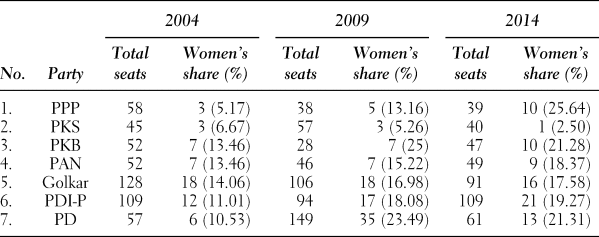
In the three elections since 2004, the seven parties observed in this study have made unsteady progress in minimizing gender disparity in parliament. Table 1 lists parliamentary seats and women's share by parties. In the latest election, the Islamist PPP party achieved a new record of women's representation, with slightly more than one in every four elected deputies being women. This was closely followed by PKB and PD, each with approximately 21% of party seats occupied by women. The number of PPP female legislators has grown five-fold since the 2004 election. In contrast, another Islamist party (PKS) has displayed rather poor performance in promoting gender equality, with only one woman elected to the Indonesian House of Representatives (Dewan Perwakilan Rakyat or DPR).
Parliamentary seats won and women's share by party.

Compared with the Islamist parties, parties based on Islamic social organizations and pluralist parties demonstrate more stable attainment of women's share in their parliamentary seats, always surpassing 10%. Islamist parties have been less successful in getting women elected into parliament. Women's low electability is in line with the general failure suffered by Islamist parties. Possible reasons for this include the historical pattern of religious pluralism, with a large majority of moderate Muslim voters (Mujani and Liddle Reference Mujani and William Liddle2004, Reference Mujani and William Liddle2009; Liddle and Mujani Reference Liddle and Mujani2007), internal conflicts among parties and Islamic social organizations (Miichi Reference Miichi, Miichi and Farouk2015), the idea that Islamic piety does not entail support for political Islam (Pepinsky, Liddle, and Mujani Reference Pepinsky, William Liddle and Mujani2012), and the state's domination of the provision of social welfare facilities making Islamic social organizations less important (Hicks Reference Hicks2012). The literature on Indonesia's society and politics says that Islam has a growing influence on sociopolitical life. Islamic symbols and practices are being integrated into mainstream politics by all parties and are no longer the monopoly of Islamist parties. These factors explain why Islamist parties do not do well in a majority Muslim country.
Also, some scholars have argued that Indonesian politics are dominated by a “cartel” of parties characterized by their common desire to gain power rather than by ideological or policy differentiation (Ambardi Reference Ambardi2008; Buehler Reference Buehler2012; Choi Reference Choi2007; Tomsa Reference Tomsa2018). Differences between Islamist and pluralist parties have become blurred and “the political influence of traditional religious authority has been decreasing” (Miichi Reference Miichi, Miichi and Farouk2015, 131). The PKS, as the largest Islamist party in Indonesia, has adopted a strategic behavioral moderation approach in national and local politics since 2004, joining the catch-all party bandwagon (Buehler Reference Buehler2012; Tanuwidjaja Reference Tanuwidjaja2012; Tomsa Reference Tomsa2012).
A survey of 508 randomly selected members of Indonesian provincial legislatures (DPRD) corroborated these assertions; parties showed ideological convergence across a range of issues (Aspinall et al. Reference Aspinall, Fossati, Muhtadi and Warburton2018). Regarding women's political emancipation, most parties claimed to be emancipatory, including the Islamist parties. This finding offers some support to Seguino (Reference Seguino2011), who argues that no single religion stands out as more gender inequitable than others. It also supports Schnabel (Reference Schnabel2016), who asserts that the more the greatest distinction is not among the three largest faiths (Christianity, Islam, and Hinduism) but rather among the more nonreligious people in a country, the more gender equal that country tends to be.
WOMEN IN INDONESIA'S PARLIAMENT: TRENDS OVER TIME
Women constitute half of the national population in Indonesia, and all parties in Indonesia have a women's department (sayap) that is used to recruit female cadres for electoral purposes. In addition to these internal pools of potential female politicians, recruitment of female aspirants can also be achieved through various networks of women's nongovernmental organizations (NGOs) and professional organizations. However, Puspitasari (2018) reveals that most political parties in Indonesia are not being transparent in terms of inviting and selecting potential candidates. By observing 16 national participating parties in the 2019 elections, her study concludes that only PD and the Indonesian Solidarity Party (Partai Solidaritas Indonesia or PSI) provide open recruitment registrations online along with detailed registration and selection guidelines. Most parties only promote their chairperson's activities and rhetoric, and very little information on policy debates or electoral strategies is available.
A candidate gender quota policy in Indonesia has been implemented since the 2004 elections in which parties need to consider women's representation at a minimum of 30%. This institutional requirement was first constituted in Law Number 12 of 2003 on the General Elections, which was enacted in preparation for the 2004 election. Article 65 states, “Every political party in the election may propose candidates for members of the national, provincial and local parliaments for each electoral district with consideration for at least 30% of women's representation.” Law Number 2 of 2008 on Political Parties required parties to appoint women to at least 30% of its national managerial positions and a similar share for the party's regional boards as a prerequisite to participate in elections.
Furthermore, Law Number 8 of 2008 on General Elections stipulated that 30% female candidates is compulsory, despite no clear sanctions being mentioned. The zipper requirement (i.e., for each three candidates there should be at least one female nominee) was also introduced in the 2009 elections. Thus, Law Number 8 of 2012 on General Elections stated that parties must nominate candidates with at least 30% women using the zipper system or be disqualified from running. The latter institutional requirement was stipulated by the Indonesian Elections Commission (KPU) as its Regulation Number 7 of 2013. Numerous women's rights activists from Islamic organizations and NGOs had been lobbying the parliament to pass the quota as an institutional intervention on the basis of equality of opportunity (Bylesjo and Seda Reference Bylesjo and Seda2006; Siregar Reference Siregar2005; Soetjipto Reference Soetjipto2005). Female sitting lawmakers were also very active in persuading their colleagues by arguing that unlike men, women had a later start in the political arena and, therefore, the quota was expected to redress these differences in a short time.
In the 2019 elections, candidate gender quotas continue to be one of the key requirements for parties to participate in the race. Respondents in this study claim that all parties adhere to quota requirements because they have become binding laws and a prerequisite for parties to be able to participate in elections. “Gender quota is not seen as something that is contrary to Islamic teachings, instead PPP and PKS have urged that the quota provisions be used as the basis for election regulations,” said Sahfan Badri Sampurno, a former PKS national election manager. Similarly, lawmakers from PAN and PKB assert that the provision of gender quotas is not in discord with Islam. Interviewees representing Golkar, PDI-P, and PD also claim the same narrative. Melchias Mekeng, the chairman of the Golkar Party faction at the House of Representatives (DPR) said, “For us, the gender quota is good, because we really want women to participate in politics. The problem is that not many women are interested in running, as we can only nominate 37% (of women) this year.”
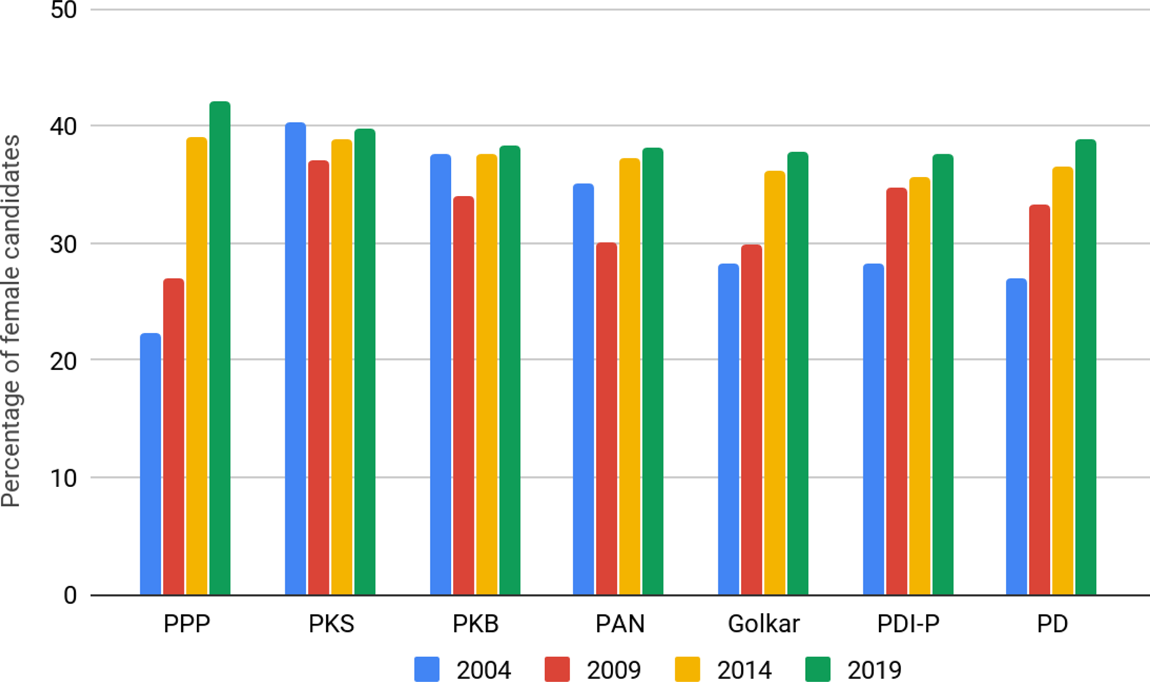
Figure 1 depicts the share of female candidates by party since 2004. From the Islamist parties group, it is evident that the PPP has been consistently improving the proportion of women nominees. Compared to the 2004 elections, the women's share has almost doubled in 2019, reaching slightly more than 42% and making PPP the party with the biggest proportion of female candidates among all parties. This development is very promising; in the 2004 and 2009 elections, this party assigned less than 30% female candidates.
Female candidates’ nomination by party.

The chairman of the PPP faction at the DPR, Reni Marlinawati, claims that her party has been at the forefront in women's representation by being the first party to achieve a minimum of 30% women seated as the party's national managers. “The gender quotas policy imposed on party management structures and on electoral candidates has never evoked a tough debate in the PPP since the party is fully encouraging women's participation in politics.” She further said the PPP has three recruitment sources of viable female candidates: (a) the chairperson of the PPP Women's Empowerment Department, (b) female party officers, and (c) external resources by which any woman who has the credibility and capacity to run for office is welcome to represent the PPP.
Like most parties in Indonesia, the recruitment mechanism in the PPP is heavily centralized via the Candidate Appointment Committee (Lajnah Penetapan Calon or LPC) which consists of seven members, two of whom are women. Some interviewees for this article suggested that the nomination hike in 2014 was partly because of the composition of the LPC and the fact that the party's national election manager at that time was a woman; the PPP was the only party with a female national campaign manager in 2014. This finding supports Cheng and Tavits (Reference Cheng and Tavits2011), who suggest that the gender of party gatekeepers (male or female) is playing a crucial role in either encouraging or discouraging women candidates to run for office.
Meanwhile, the PKS has been very steady in ensuring a better gender ratio; the proportion of women among their candidates is always close to or slightly more than 40%. On average, women's nominations from PKS have been the highest in four consecutive elections (38.99%). One possible explanation is that PKS is a cadre party and is much better organized than most other Indonesian parties (Mujani and Liddle Reference Mujani and William Liddle2009). In addition, since 2010, PKS has amended the party's organizational statutes to accommodate non-Muslims so they can run for office and take leadership positions within the party (Tomsa Reference Tomsa2012).
“We never had an issue with finding female candidates, really. As a cadre party, we have enough stock. And these women will not be resistant regarding which electoral district they will be placed or in whatever ballot position,” said Sahfan Badri Sampurno. He further argues the entire legislative candidates are trained and selected by an institution called the Cadres Characterization and Recruitment Institute (Lembaga Penjaringan Penokohan Kader or LPPK). This ad hoc entity works under the direct leadership of the head of the shura council, and this institute selects cadres based on their competencies for both legislative and regional head elections. The candidate nomination process in PKS consists of two directions: bottom-up and top-down. The first approach capitalizes on the small groups of party members called the Cadres Development Unit (Unit Pembinaan Kader or UPK), in which cadres with high potential are detected and from which members are promoted as legislative candidates. The latter method comes from party officials who can nominate national Muslim figures if they are keen to run for PKS.
Next, in the second cluster of observed parties, those based on Islamic social organizations, PKB and PAN display a similar trend as their share of female candidates experienced a significant drop in 2009 before bouncing back in the following elections. Both parties had been fulfilling the suggested candidate gender quota minimum of 30% women since 2004. The average women's nomination proportion from the PKB is 36.87%, and that for PAN stands at 35.10%.
“This year we have received 620 applicants, while we only need 575. The first filter for our selection process is their CVs, and we invite them to meet us; some directly meeting with the Chairman, and others with the National Campaign Team (Komite Pemenangan Pemilu Nasional/KPPN),” said the chairwoman of PAN for Women's Empowerment Department, Euis F. Fatayati.
She further contributes, “In 2004, it was still easy to invite women to run for office. At that time, we had the closed-list electoral system, where list position determined electability. Things were getting difficult in 2009 because all that mattered was garnering the most votes. Those who failed twice in their bids felt discouraged, hence it became harder for us to nominate female aspirants.”
On the other hand, secular parties are showing a gradual growth in promoting women into political office. Unlike PKB and PAN, parties in this third group never underwent a reduction in the percentage of female candidates. The sharpest hike in women's share as candidates for PDI-P and PD took place in 2009; meanwhile Golkar experienced the increase in 2014. The average percentage of female candidates from this group is 33%–34%.
“We have internal guidelines in recruiting legislative candidates. Through Party Regulation Number 025A, we only allow two persons from a family (i.e., husband and wife) to run for PDI-P, and they cannot be aiming for the same level of parliament,” said Head of the PDI-P Campaign Team, Bambang DH. He suggests that these rules are set to ensure equal opportunity for anyone who wishes to represent the party in the race.
Golkar has been recruiting female aspirants from its women's organization called the Women's Association of Golkar (Kesatuan Perempuan Partai Golkar or KPPG). “It is assumed that if they are active in KPPG, they have political intentions. We also promote female figures in the regions, who might not be active in KPPG but have potential to represent Golkar,” said Melchias Mekeng.
These findings surrounding internal mechanisms in recruiting, selecting, and nominating female candidates indicate that parties have adopted the affirmative action policy designed through electoral laws and regulations. These institutional requirements have been embedded and have become a necessity for parties to compete. But do all politicians share the same view about gender quotas? Prihatini (Reference Prihatini2018a) suggests that legislators share different perceptions on gender quotas, in which men are more negative and less supportive compared to female MPs. Thus, although female respondents are eager to use strategies to nominate more women running as candidate number one, the vast majority of male deputies disagree that such approach will equalize the playing field between men and women in electoral politics.
LIST POSITIONS AND WITNESS FEES
Many scholars highlight the importance of the ballot position effect because electoral success is heavily influenced by name order on the list (e.g., Jankowski Reference Jankowski2016; Lutz Reference Lutz2010; van Erkel and Thijssen Reference van Erkel and Thijssen2016). In fact, research on Indonesian elections demonstrates the crucial aspect of women being nominated as candidate number one (e.g., Dettman, Pepinsky, and Pierskalla Reference Dettman, Pepinsky and Pierskalla2017; Shair-Rosenfield Reference Shair-Rosenfield2012; Siregar Reference Siregar2006; Soetjipto and Adelina Reference Soetjipto and Adelina2012). For every additional lower rank in the nomination list in the 2014 elections, the odds of winning for women is reduced by 63.5% and lower ballot list position creates a bigger disadvantage for women than men (Prihatini Reference Prihatini2019a).
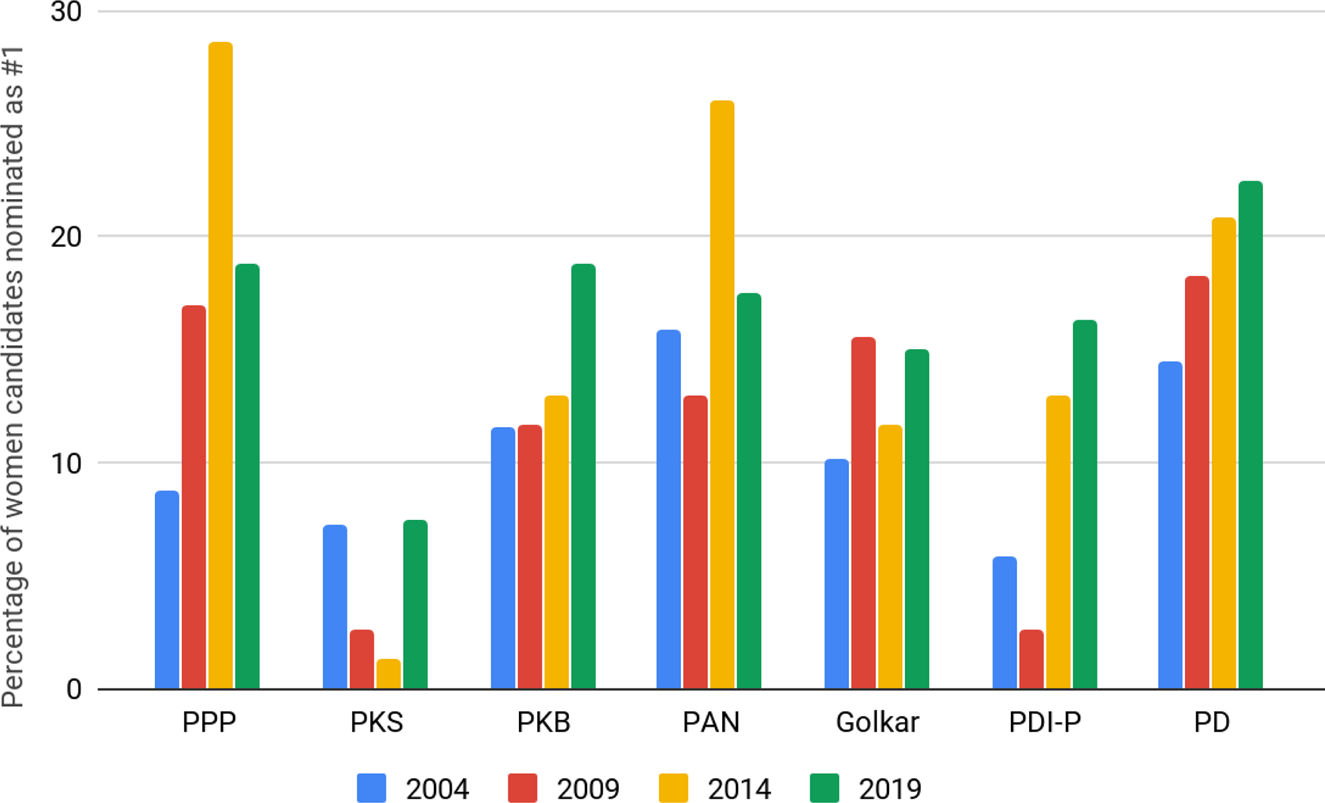
Figure 2 exhibits the women's share of candidate number one positions by party since 2004. The tabulation was obtained by dividing the number of women sitting on the top of the party ticket with the total number of electoral districts.Footnote 4 Islamist parties show a contrasting track record in assigning women as the leader on the ballot paper. In the last three elections, the PPP has increased the number of women running as candidate number one, and the peak occurred in 2014, when 22 of 77 districts were led by female aspirants. The PKS, in contrast, has been reducing women's share as candidate number one since 2004. For 2019, six women are sitting on the top of the ballot list, a new record for the PKS. Compared with other parties, women in the PKS are far less likely to receive the advantage of running with the most winnable ballot position. This finding gives a contradictory impression because the PKS has been promoting more women aspirants than any other party, yet the PKS has assigned only a handful of female candidates to lead the name order.
Women's share as candidate number 1 by party in elections from 2004 to 2019.

“In the PKS, we have Pemira where we test one's electability internally. Those who had been working closely in the party structure would receive the strongest support from cadres, and hence are usually placed in list positions one, two, and three,” said Sahfan Badri Sampurno. This approach reaffirms the importance of career tracks in a cadre for candidacy in PKS; hence, future research could further examine why women's internal electability is not as high as men's.
“List position in the PKB is a matter of negotiation. I have told the party that I will only run if they assign me as candidate number one or two, and they've approved it by giving me the second spot. Two incumbents were assigned to numbers one and three, and both of them didn't get elected,” said a female MP who claims that 70% of her campaign expenses were paid by the party. Another female legislator from PKB provided another insight: all potential candidates’ electabilities were surveyed by a political consultancy company. Accordingly, the list position was formulated based on the survey.
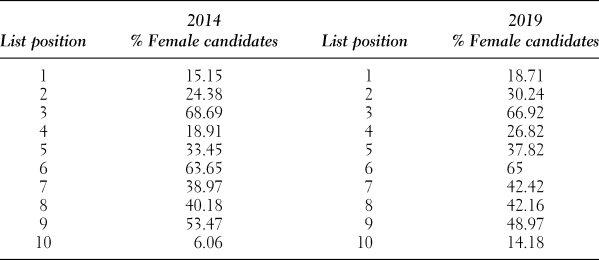
In the 2019 election, just more than 40% of all candidates are women. Exceeding the 30% benchmark by 10% may look like a remarkable achievement, but the experience from previous elections suggests that it is highly unlikely for most of these candidates to actually be elected (Prihatini Reference Prihatini2019b). One key impediment for electoral success is that male candidates continue to enjoy the advantage of running as candidate number one, whereas women are mainly slotted in at numbers three and six, following the so-called zipper system (Table 2).
Distribution of list position in the 2014 and 2019 elections

In line with previous studies (e.g., Puspitasari Reference Puspitasari2018; Bjarnegård and Kenny Reference Bjarnegård and Kenny2015; Dettman, Pepinsky, and Pierskalla Reference Dettman, Pepinsky and Pierskalla2017; Shair-Rosenfield Reference Shair-Rosenfield2012), in the present study, ballot list position formulation, similar to the recruitment and selection process, is far from public scrutiny. This “black box” of political nomination processes indicates that female candidates being nominated might not have the quality to win the race, yet parties still need to nominate these women so they can participate in the election. Women candidates might be more likely than men to be “sacrificial lambs” who serve as party standard bearers in districts where their party has little chance to win (Thomas and Bodet Reference Thomas and Bodet2013). Therefore, the increase of women's share as candidates with gender quotas has not been reflected in more women getting elected.
More specifically, the PKS has been nominating many female candidates, but few are elected. The problem seems to be with the PKS electorate and not with the party leadership. PKS executive Ledia Hanifa Amaliah disagrees with the claim that the PKS treats women candidates like “sacrificial lambs” more than other parties, yet she admits that male cadres are often more successful in garnering electoral support and thus the party tends to put more men in the top position on party tickets.
Respondents in my interviews only disclosed generic mechanisms in the determination of party list position: loyalty, activism, and dedication to the party. “Candidate number one should be the ‘magnet.’ He or she must have something special. Aside from popularity, their quality needs to be top-notch too,” said Bambang DH. Meanwhile, Melani Leimena Suharli from PD noted, “We are giving incumbency our highest priority. An incumbent will be appointed as candidate number one, but if the incumbent is a male, then the female gets the second spot if not the third.”
Despite the effort to conceal it, it has now become public knowledge that parties are asking for a sort of dowry money (mahar) from legislative candidates. This contribution is to pay what is called a “witness fee,” in which parties need to hire a witness for each of 809,500 polling stations spread throughout the country.Footnote 5 If one witness is rewarded with an honorarium of IDR 100,000 (USD 7), parties need to pay up to IDR 80 billion (USD 5.66 million). Hence, those who are interested in the top position are required to pay a significant contribution to the party. Although the amount of money is different for each party, the PPP, for example, has set IDR 500 million (USD 35,400) as the price tag for the top spot on the party ticket (BBC News Indonesia 2018; Firmanto Reference Firmanto2018).
Stephen Sherlock rightly suggests that favorable position on the party list on the ballot paper is “a commodity to be bought and sold to boost the party's election campaign coffers” (Reference Sherlock2012, 563). As expected, this “commercialization of electoral politics” has resulted in a surge in the number of wealthy entrepreneurs running for parliament and has hindered party cadres to occupy the top seat on ballot papers (Tomsa Reference Tomsa, Aspinall and Mietzner2010). Interestingly, Lena Maryana Mukti, an incumbent representing the PPP, admitted that she did not object to the conditions of witness fee contributions imposed by her party. “I think that is the reality faced by all parties and legislative candidates, because they need their own witness as the potential for fraud is just extraordinary. Witnesses are needed so that the votes are not stolen by other parties or other candidates,” said Lena.
Most respondents interviewed in this study shared similar accounts of rampant vote calculation fraud starting from the lowest to the highest level. This poor accountability and integrity of the officers in the fieldFootnote 6 has become one of the most difficult challenges for legislative candidates, as explained by a female lawmaker representing Golkar. “I experienced it in 2014. If you don't have our own witness (to closely monitor the process), it is very likely that you will get sabotaged. I didn't sleep for days until I was certain that my votes would not get rigged.”
Likewise, Ledia Hanifa Amaliah said, “I was approached by some men who claimed to be working for Panwaslu, and they were offering their ‘help’ in securing my votes up to the national level. In return, they were asking for a significant amount of money. Every time they came to me, I always rejected their proposal.” She further claims that the PKS has its own supervisory system supported by cadres and collectively funded by legislators. As an incumbent, Ledia admits that she has been contributing regularly to her party for election and nonelection purposes.
This trouble with electoral fraud is a serious threat to Indonesian democracy and more specifically to women's political representation: it impedes people's interest in running for office. The component of hiring witnesses at the polling stations adds to the cost of the campaign, which is already immensely expensive (Anung Reference Anung2013). If parties set an exorbitant price for running as candidate number one, whereby nearly 70% of those elected are sitting on the top of the list (Wardani Reference Wardani2013), then it is fair to predict that only women with strong capital will dominate the race. These ever-increasing campaign costs dampen both the public's euphoria and women's interest in participating as legislative candidates, and this matter is further discussed in the following section.
CHALLENGES OF GETTING WOMEN INTO PARLIAMENT
Women's interest in running for office (supply) and institutional requirements placed upon parties to nominate female candidates (demand) partly explain the electoral dynamics which result in gender disparity in parliament (Lovenduski Reference Lovenduski2016; Norris and Lovenduski Reference Norris and Lovenduski1995). This interactive process of supply and demand, even in the United Kingdom, is obscure, “a matter of largely unregulated internal party rules, informal processes and hidden power relationships” (Lovenduski Reference Lovenduski2016, 518). Still, most interviewees complained about the difficulty of attracting viable women who wish to run for office. Some complaints were implicit, and others were straightforward.
Golkar national campaign manager Andi Sinulingga argues, “… women are demanding a 30% quota, urging affirmative action so that more women can participate in politics. But the reality we have is far from this. Women's interest in running is just low and not as great as it should be to meet their demands for a minimum gender quota of 30%.” In Sinulingga's account, Golkar encounters this obstacle persistently, “Hence, I would say those women who are demanding gender quotas are not truly representing women, because apparently women's political participation is far lower than 30%. The party is continuously told to nominate female candidates, yet it turns out viable and winnable women very rarely.”
A study observing the demographic characteristics of more than 6,000 legislative candidates who participated in the 2014 general elections suggests that women, the younger generation, and people from outer Java continue to be in the minority and poorly represented (Prihatini Reference Prihatini2019a). The electoral success of female candidates is strongly associated with experience in political office, age, and list position on the ballot sheet. Kinship and political dynasty continue to determine women's political nomination. Almost half of the women elected in the 2014 come from a political dynasty in which they were married to or were blood relations of male political leaders.
One female professional-turned-politician from Golkar concedes that her decision to participate in politics was influenced by the level of support from the party leader. “I think it remains essential for parties to promote women's interests by helping them in their first steps. For my first candidacy, I received financial support from the party of around IDR 50 million (USD 3,600). It was not much, but it helps me printing banners and stickers,” she said. A similar experience was related by a PKB lawmaker who argued her party reduced hesitation from the supply side by offering financial support to women with a strong electability. “I wasn't from a rich family, and campaign costs were notoriously expensive. So, I've sold my house and everything. Luckily, my party leader provided a soft loan so I can finance my campaign,” she explains.
These experiences in the Golkar and PKB parties confirm that recruitment policies can greatly influence the interest of women running for parliament. Political parties play a crucial role in inviting potential women to become candidates, and this likely has implications for the supply–demand explanation. As the key gatekeepers of elected positions (Kenny Reference Kenny2013; Luhiste Reference Luhiste2015), parties are shaping the supply of women candidates as their gender regime molds candidate recruitment (Verge Reference Verge2015). In other words, the demand for a party to nominate women creates its own supply of aspirants.
However, comparing women's nominations since 2004, Lena Maryana Mukti of the PPP asserts that women's interest in running for office is now at the lowest, “Almost all parties had difficulties in recruiting candidates due to high-cost campaigns and elections. And the fact that women have limitations in accessing capital, this hinders them from pursuing a political career.” Reni Marlinawati echoed this view by asserting that “because people are very aware of how rampant money politics practices were in the previous elections, that MPs were being arrested by the Corruption Eradication Commission (Komisi Pemberantasan Korupsi or KPK), one of which was related to regional election funds. I think all of these are deterring women from running for office.”
PKB senior politician Ida Fauziyah, who once chaired the Women's Caucus at the House of Representatives (DPR), suggests that both men and women are facing similar challenges, but the most serious obstacle is what she calls “voter pragmatism.” Because men, in general, have a better access to capital, voter pragmatism has become a huge stumbling block for women. The voters’ demand for patronage and the damaging impacts are vividly discussed in various studies (e.g., Aspinall Reference Aspinall2014; Aspinall and Sukmajati Reference Aspinall and Sukmajati2015; Shin Reference Shin2015). The deterrence effect of exploding campaign costs, which often leads to corruption, is obvious and should no longer be ignored (Sundström and Wängnerud Reference Sundström and Wängnerud2016). Although the supply-and-demand explanation is helpful in explaining women's political nomination in Indonesia, political integrity issues (including electoral counting fraud and the expensive campaign cost) are also pivotal in explicating the dynamics of candidate recruitment.
CONCLUSIONS
This analysis clearly shows that all parties in Indonesia, regardless of their ideology, have responded to the provision of gender quotas by compliantly fulfilling the provisions of female nominations of at least 30%. Thus, as of 2019, the women's nominations for legislative elections since 2004 have increased to an average of 40%. In the 2014 elections, the PPP gender ratio in parliament grew five-fold compared to 2004. In contrast, the Islamist PKS party has been displaying a rather poor performance in promoting gender equality, with only one woman elected to the DPR.
This study demonstrates that Islam, as a party's ideology, is not more gender inequitable (Seguino Reference Seguino2011); Islamist parties tend to nominate more women than pluralist ones. One possible explanation for this phenomena is that gender quotas, designed through electoral laws and regulations, have been embedded and have become a necessity for parties to compete. However, the insincerity of parties toward women's political advancement can be seen from ballot list positioning, in which men continue to dominate the prime spots and run as candidate number one and two. Being nominated as candidate number one or two is crucial for women's electability, because nearly 70% of elected MPs are from this ballot position. Ignoring the importance of ballot position undermines the effectiveness of gender quotas.
Furthermore, although women's nomination by parties is not strongly influenced by a party's religious ideology, their success in the polling stations is more likely affected by the overall party's performance in garnering electoral support. Women running for PPP and PKS have low electability, and this result is in line with the general failure suffered by political Islam: Islamic piety and symbols are no longer the monopoly of Islamist parties. The fact that the PKS nominates many female candidates but few are elected indicates that the problem seems to be with the PKS electorate and not with the party leadership.
Recruitment and selection processes occur far from public scrutiny (Bjarnegård and Kenny Reference Bjarnegård and Kenny2015; Dettman, Pepinsky, and Pierskalla Reference Dettman, Pepinsky and Pierskalla2017; Puspitasari Reference Puspitasari2018; Shair-Rosenfield Reference Shair-Rosenfield2012). This “black box” of political nomination processes (Kenny and Verge Reference Kenny and Verge2016) indicates that female candidates being nominated might not have the quality to win the race. However, gender quotas have given parties a hefty shove to nominate these women so they can participate in the election. Therefore, the increase in women's share as candidates with gender quotas has not resulted in more women being elected (Franceschet, Krook, and Piscopo Reference Franceschet, Krook and Piscopo2012; Hughes et al. Reference Hughes, Paxton, Clayton and Zetterberg2019; Prihatini Reference Prihatini2019a).
Lastly, although the supply-and-demand explanation (Lovenduski Reference Lovenduski2016; Norris and Lovenduski Reference Norris and Lovenduski1995) is helpful in explaining women's political nomination in Indonesia, political integrity issues (including electoral counting fraud and expensive campaign costs) are also pivotal in the dynamics of candidate recruitment. This study highlights the urgent need for Indonesia to mitigate the rampant corruption practices in electoral settings (Aspinall and Sukmajati Reference Aspinall and Sukmajati2015). These issues pose a real threat to the democracy, and more specifically to women's political representation (Bjarnegård, Yoon, and Zetterberg Reference Bjarnegård, Yoon, Zetterberg, Stensöta and Wängnerud2018).
Some caveats to this study need to be acknowledged. One limitation is that the study has heavily relied on admissions from party elites. Future research should consider analyzing parties’ written documents, witnessing nomination meetings or discussions within the party, and interviewing candidates who have participated in the election but lost in their bids. Despite its limitations, this study contributes to an understanding of how Islamist and pluralist parties are promoting gender equality in Asian settings (Prihatini, Reference Prihatini2018b). More research is needed to observe how Islamist parties in other Muslim countries are responding to gender quotas or how similar institutional approaches are aiming to improve women's participation in politics.