

Pb is a neurotoxic non-essential metal that is widespread in the environment. Bans on Pb in petrol, paint and food cans, and replacement of Pb water pipes, have led to a decline in blood Pb levels in the UK( Reference Delves 1 ), so that diet is now thought to be the main contributor to exposure to Pb in the European Union( 2 ).
Pb bullets and Pb gunshot fragment on impact, leading to high Pb levels in the resulting game meat (exceeding the European Union maximum limit for other types of meat)( Reference Pain, Cromie and Newth 3 ), and it is known that frequent game consumption is associated with higher blood Pb levels in hunting communities( Reference Iqbal, Blumenthal and Kennedy 4 , Reference Bjerregaard, Johansen and Mulvad 5 ). Game is increasingly being promoted as a healthy and ethical choice( 6 ) and is increasingly available in supermarkets( 7 ); however, there is concern that an increase in the consumption of game killed with Pb shot or bullets may have a detrimental effect on blood Pb levels and associated health outcomes, including intelligence quotient and educational measures in children, miscarriage in pregnant women, and chronic kidney disease and increased blood pressure in adults( Reference Green and Pain 8 ).
Pb is transferred freely to the fetus through the placenta; as the fetus and growing child are especially sensitive to the neurotoxic effects of Pb, pregnant women and young children are particularly vulnerable. The Food Standards Agency in the UK has recently recommended that pregnant women, women planning to become pregnant, and toddlers and children should avoid eating Pb-shot game( 9 ). Germany and Spain offer similar advice, but are more specific about the age of the children (<6 and <7 years, respectively)( 10 , 11 ). All three countries also advise people who are frequent consumers of game to reduce their consumption. To assess the extent of any potential problem at a population level, it is necessary to have up-to-date data on game consumption: to our knowledge there are no recent data available on game consumption in children and pregnant women in the UK. Our aim was to use the most recently available UK National Diet and Nutrition Survey (NDNS; 2008–2010)( 12 ) to determine the consumption of game birds by children and women of childbearing age, as well as in the sample as a whole, and to identify any factors that might be associated with the consumption of game birds.
Methods
The National Diet and Nutrition Survey
The NDNS is a survey of the food consumption, nutrient intakes and nutritional status of people aged ≥1·5 years in private households in the UK. The survey is carried out in all four countries of the UK and is designed to be representative of the UK population. The survey has been described in detail elsewhere( Reference Whitton, Nicholson and Roberts 13 ).
In brief, the study sample was randomly drawn from the postcode address file, which is a list of all the addresses in the UK. The addresses were clustered into primary sampling units (small geographical areas based on postcode sectors, randomly selected from across the UK). A core sample of 3510 addresses was selected from 130 primary sampling units. Twenty-seven addresses were randomly selected from each primary sampling unit. At each address, an interviewer established the number of households, and in cases where there were two or more, the interviewer selected one household at random. The twenty-seven addresses were randomly allocated to one of two groups: adult and child, if present (n 9), and child only (n 18). Information describing the purpose of the study was sent to all selected addresses by post. This was followed by a face-to-face visit by an interviewer to each address to recruit participants in the eligible age range. From the core sample of 3510 addresses, 1031 adults and 1095 children provided complete data including diet diaries.
Interviews and questionnaires
The interview and questionnaire methods have been described in detail elsewhere( 14 ). In brief, each participant had a face-to-face computer-assisted personal interview (for children, the interview was with the parent/guardian). The interviewer collected information on demographic variables such as the age and sex of participants, educational attainment, housing tenure and shopping habits (type of shop used, buying organic meat, etc.) and region of residence based on Government Office Regions created by the UK government for administrative purposes.
Diet diaries
The participants prospectively completed a 4 d diet diary after being given detailed instructions. The parent/carer was asked to complete the diary for children aged 11 years or younger, with help from the child as appropriate. Children aged 12 years and older were asked to complete the diary themselves, but the details were confirmed with their parent/carer as necessary. The participants were asked to describe the quantity or portion size of each food item using household measures, weights from labels, the number of items or picture items that were supplied in the diet diary. After completion, the diary was checked by the interviewer for completeness of information; participants were asked for further information if necessary. Analysis of the diet diaries was carried out as previously described( Reference Whitton, Nicholson and Roberts 13 ).
Ethics approval
The study was conducted according to the guidelines laid down in the Declaration of Helsinki and all procedures involving human subjects were approved by the Oxfordshire A Research Ethics Committee. Informed consent was obtained from all participants.
Data
Data files were obtained from the Economic and Social Data Service( 12 ) and relevant variables were extracted. In addition to data on game bird consumption and total meat intakes obtained from 4 d diet diaries, additional data extracted on demographic variables included the age and sex of participants, educational attainment, housing tenure and shopping habits (type of shop used, buying organic meat, etc.) and region of residence.
The data were used to calculate number of participants who reported eating game birds in the 4 d diet diary. Mean portion sizes for game bird consumers were calculated and this was further examined by age (age groups of ≤6, 6–18, 19–64 and ≥65 years). The prevalence of consumption was also calculated by region of residence to identify parts of the country that might have relatively high consumption of game birds. The effect of the shooting season on game bird consumption was examined by calculating the prevalence of consumption in August to February (encompasses shooting seasons for grouse, pheasant, partridge, ptarmigan and black game in the UK) compared with the prevalence in March to July (out of season for game birds in the UK).
Statistical analysis
A weighting factor adjustment was used to correct for known sociodemographic differences between the composition of the survey sample and the total population of the UK (age by sex and Government Office Region)( Reference Tipping 15 ). This takes account of bias due to non-response and the difference in the probability of households and individuals being selected to take part. Data analysis was carried out using the statistical software package SPSS version 18. The χ 2 test and ANOVA were used to analyse continuous and categorical data, respectively. A P value <0·05 was considered to be statistically significant.
Results
Four-day diet diary
Of the 2126 participants (aged 1·5 to >65 years), fifty-eight (2·7 %) reported eating game birds. The mean intake in consumers was 19·5 (sd 18·1) g/d (median 15·6, range 1·3–92·9 g/d; 95th centile 51·7, 97·5th centile 84·8 g/d). A greater proportion of female than male participants ate game birds (30/1119 (2·7 %) v. 21/1007 (2·1 %), respectively), but the difference was not statistically significant (χ 2 test, P = 0·370, NS). A greater proportion of adults (≥19 years old) ate game birds than children (1·5–18 years old; 35/1031 (3·4 %) v. 16/1095 (1·5 %), respectively; χ 2 test, P = 0·004). The highest prevalence of consumption was recorded in adults aged 19–64 years (34/813 (4·2 %); ANOVA for effect of age group on game bird consumption (yes/no), P = 0·006), but the greatest intakes (g/d) were reported in those aged ≤65 years, although not significantly so (ANOVA for effect of age group on intake of game birds in game bird consumers, P = 0·224, NS; Table 1). Consumption of game bird meat as a proportion of total meat intake was greatest in those aged ≥65 years, but this was not statistically significant (ANOVA for effect of age group on game birds as proportion of total meat intake in game bird consumers, P = 0·406, NS; Table 1).
Prevalence of game bird consumption, portion size and proportion of total meat intake in the UK (NDNS 2008–2010; n 2126, participants aged 1·5 to >65 years)

NDNS, National Diet and Nutrition Survey.
*χ 2 test for effect of age group on game bird consumption (yes/no), P = 0·006.
†ANOVA for effect of age group on intake of game birds in game bird consumers, P = 0·224 (NS).
‡ANOVA for effect of age group on game birds as a proportion of total meat intake in game bird consumers, P = 0·406 (NS).
It was not possible to analyse data specifically for pregnant women as they are excluded from the NDNS. In women of childbearing age (15–45 years), 11/383 (2·9 %) reported eating game birds, with a mean intake of 22·4 (sd 25·8) g/d (median 15·6, range 2·0–92·9 g/d). In children aged ≤6 years, 3/342 (0·9 %) were reported to have eaten game birds, with a mean intake of 6·8 (sd 9·7) g/d (median 2·4, range 1·3–23·2 g/d).
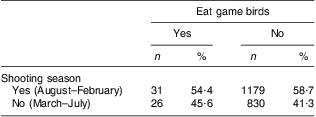
There was no difference in the prevalence of consumption according to whether it was in the shooting season or not (Table 2; χ 2 test, P = 0·516, NS). The prevalence of game bird consumption was greatest in the south of England (including London; ANOVA for effect of region on game bird consumption (yes/no), P = 0·003; Table 3).
Prevalence of game bird consumption according to shooting season for game birds in the UK (NDNS 2008–2010; n 2126, participants aged 1·5 to >65 years)
NDNS, National Diet and Nutrition Survey.
χ 2 test for effect of shooting season v. not shooting season on game bird consumption (yes/no), P = 0·516 (NS).
Prevalence of game bird consumption in six regions of the UK (NDNS 2008–2010; n 2126, participants aged 1·5 to >65 years)

NDNS, National Diet and Nutrition Survey.
ANOVA for effect of region on game bird consumption (yes/no), P = 0·003.
There were no statistically significant associations with education, housing tenure, type of shop used, shopping at an independent butchers, buying organic, buying organic meat, self-assessed general health or ethnicity on reported game bird consumption (χ 2 test, all P > 0·05, NS; data not shown).
Discussion
It is known that Pb gunshot pellets can fragment upon impact; these fragments remain in the meat and are thus ingested, even though larger particles are removed( Reference Pain, Cromie and Newth 3 ). In the study of Pain et al. ( Reference Pain, Cromie and Newth 3 ), a large proportion of the game birds in the UK had Pb levels that exceeded the European Union maximum level of 0·1 mg/kg wet weight for meat of bovine animals, sheep, pigs and poultry. It was recognised, however, that bioavailability may be lower than from endogenous Pb. They calculated that high intakes of some types of game birds could result in the current FAO/WHO Provisional Weekly Tolerable Intake of Pb( 16 ) for adults being exceeded. They noted that this might be of particular concern for children and those eating large amounts of game. In a further analysis, Pain and Green used UK food consumption and Pb concentration data to estimate the potential health risks of game bird consumption. They found that consumption of <1 game bird meal per week may be associated with a 1-point deficit in intelligence quotient in children, and that consumption of 1·2–6·5 game bird meals per week may be associated with adverse health effects in adults, including effects on systolic blood pressure, and the rates of chronic kidney disease and miscarriage( Reference Green and Pain 8 ). Thus even quite modest intakes of Pb-shot game birds could have adverse health effects. However, there are no published data, to our knowledge, on game bird consumption in the UK in pregnant women and children. We have used the best and most recently available data in the UK (NDNS 2008–2010) to determine game bird consumption in the general population and in two vulnerable groups: women of childbearing age (15–45 years old) and children ≤6 years old.
The prevalence of people consuming game birds in the total UK NDNS sample was low (2·7 %), and intakes (range 1·3–92·9 g/d) were also low. Standard portion sizes for game bird meat in adults range from 115 g for pigeon to 430 g for pheasant (meat only, no bones)( 17 ), implying that the diet diary had recorded one game meal only in the 4 d. The values for the whole sample were very similar to those in women of childbearing age (prevalence of consumption 2·9 %, intake range 2·0–92·9 g/d). Although this gives little cause for concern in the sample as a whole, any exposure to Pb in pregnancy should be avoided as this is the only way to minimise in utero transfer of Pb. The prevalence of consumption in children ≤6 years old was much lower (0·9 %) and the maximum intake was very small (23·2 g/d). This is unlikely to contribute greatly to these children's dietary intake of Pb. However, as there is no safe lower limit for blood Pb levels, and adverse effects have been reported at levels previously considered as being of little concern( Reference Chandramouli, Steer and Ellis 18 ), exposure in children should be minimised.
As game bird meat is relatively expensive( 7 ) and was not readily available in supermarkets until recently, we expected that participants of higher educational attainment (reflecting social class) would have a greater prevalence of game bird consumption, but this was not the case. This finding was reinforced by the lack of an effect of housing tenure, type of shop used, shopping at independent butchers, buying organic, buying organic meat, self-assessed general health or ethnicity. It may be that the sample was not large enough to show an effect. However, consumption is known to be high among those who shoot regularly or are associated with shooting( 19 ). It is estimated that 14 % of all game shot in the UK is given away to guns (shooters) and to beaters (employed to walk though woods or over moors and fields to drive game towards the guns) and other shoot employees( 20 ) (these birds are often those that are too badly damaged for sale and may contain more Pb than undamaged birds( Reference Pain, Cromie and Newth 3 )). It was not possible to determine the representation of this group in the sample, but they would be an important group to monitor in future studies.
There was no effect of shooting seasonality on game bird consumption. Shooting seasons vary slightly for different types of birds (for example: pheasant, 1 October–1 February; partridge, 1 September–1 February; grouse, 12 August–10 December). It could be that storage of game birds in freezers and year-round availability in supermarkets erode seasonal effects.
Game bird consumption was most frequent in the south of England, perhaps due to more ready availability in supermarkets and a wider range of shops. The second two most frequent areas were the north of England and Scotland: these are areas in which game bird shooting is popular and so local consumption would be expected to be relatively higher.
There are several limitations to the current study. Caution must be exercised in the use of the 4 d diet diary to assess the consumption of foods that are eaten relatively infrequently, such as game birds. If the data were combined with an FFQ, it would be possible to use statistical analysis tools such as the Multiple Source Method to quantify usual distributions of intake. It is possible that the consumption of game birds has increased since the 2008–2010 NDNS, with wider availability in supermarkets and promotion of the health benefits and ethical aspects of eating game, and so the data reported here may not reflect current consumption. In addition, we were not able to tell if the game birds were Pb-shot or had been farmed. Finally, although the sample is representative of the UK population, a larger sample would enable greater confidence in data obtained from subgroups and their statistical analyses.
Further work should be undertaken to study Pb intakes from game birds and other foods in a larger group of pregnant women and children; diet diaries may not be suitable for this purpose. Trends in consumption of game birds in these groups should be monitored. Other groups who are likely to be eating game birds frequently, such as gamekeepers and employees on game shoots and their families, should also be monitored.
Conclusion
The prevalence of consumption of game birds by women of childbearing age and children ≤6 years old was relatively low and reported intakes were small. There are uncertainties about the ability of the NDNS to capture the consumption of food items that are infrequently consumed and this is likely to result in lower overall levels of reporting than in reality. Alternative methods of capturing these data should be used in future studies. Any exposure to Pb in these two vulnerable groups is undesirable, and it is possible that the prevalence of consumption may have risen in these two groups since the 2008–2010 NDNS.
Acknowledgements
Sources of funding: C.M.T. is supported by a Daphne Jackson Trust Fellowship sponsored by the University of Bristol. The NDNS was funded by the Department of Health. The original data creators, depositors or copyright holders, the funders of the Data Collections and the UK Data Archive bear no responsibility for their further analysis or interpretation. Conflicts of interest: The authors declare that they have no conflicts of interest associated with this manuscript. Authors’ contributions: All authors contributed to the conception, design and interpretation of the study. All authors have approved the final version of the paper.



