Early childhood is a period characterized by rapid growth and brain development. Children's experiences during this period provide the foundation for future life success, and failure to cultivate core (e.g. cognitive, social, and emotional) skills impedes their ability to learn at later ages (Shonkoff et al., Reference Shonkoff, Garner, Siegel, Dobbins, Earls, McGuinn and Care2012). Exposure to maternal depressive symptoms (MDSs) during this sensitive period is adversely associated with children's cognitive outcomes, including academic performance. Systematic reviews report small yet consistent negative effects of early MDSs on later academic performance, with some studies reporting stronger effects in boys (Grace, Evindar, & Stewart, Reference Grace, Evindar and Stewart2003; Liu et al., Reference Liu, Kaaya, Chai, McCoy, Surkan, Black and Smith-Fawzi2017; Sanger, Iles, Andrew, & Ramchandani, Reference Sanger, Iles, Andrew and Ramchandani2015). However, the mechanisms of this association remain unclear.
The developmental ecological model (Bronfenbrenner & Morris, Reference Bronfenbrenner, Morris, Damon and Lerner1998) posits that interactions between the home and school microsystems influence children's development. Experiences within the home microsystem can therefore have an impact on children's interactions with their peers and learning environment within the school microsystem, which subsequently influence children's outcomes. There is evidence that maternal characteristics (e.g. maternal caregiving and mother–child interactions) mediate the association between MDSs and cognitive development in early childhood (Ahun & Côté, Reference Ahun and Côté2019). Beyond early childhood, only a handful of studies have tested potential mediators of this association (Pearson et al., Reference Pearson, Bornstein, Cordero, Scerif, Mahedy, Evans and Stein2016; Psychogiou, Russell, & Owens, Reference Psychogiou, Russell and Owens2019; Yan & Dix, Reference Yan and Dix2014), even though there is clear evidence that children exposed to MDSs in early childhood continue to experience negative outcomes into middle childhood and adolescence (Sanger et al., Reference Sanger, Iles, Andrew and Ramchandani2015). The afore-mentioned studies identified child characteristics (i.e. social withdrawal, executive function, and mental health) as mediators of this association. However, as children grow older and become less dependent on their parents, it is important to understand how formative aspects of children's school experiences – i.e. peer victimization and school engagement – may play a role in this association (Ladd, Ettekal, & Kochenderfer-Ladd, Reference Ladd, Ettekal and Kochenderfer-Ladd2017; Yan, Schoppe-Sullivan, & Feng, Reference Yan, Schoppe-Sullivan and Feng2019).
Children exposed to MDSs in early childhood are more likely to have poorer academic outcomes in later childhood and adolescence compared to non-exposed children (Sanger et al., Reference Sanger, Iles, Andrew and Ramchandani2015). However, evidence regarding sex differences is mixed. Some studies report poorer performance in sons of mothers with depressive symptoms (Hay et al., Reference Hay, Pawlby, Sharp, Asten, Mills and Kumar2001; Murray et al., Reference Murray, Arteche, Fearon, Halligan, Croudace and Cooper2010), others find that daughters have poorer academic outcomes (Paquin et al., Reference Paquin, Côté, Tremblay, Séguin, Boivin and Herba2020; Shen et al., Reference Shen, Magnusson, Rai, Lundberg, Le-Scherban, Dalman and Lee2016), whereas some find no sex differences (Ng-Knight, Shelton, Frederickson, McManus, & Rice, Reference Ng-Knight, Shelton, Frederickson, McManus and Rice2018). None of the studies which examined the mechanisms of this association beyond early childhood tested for sex differences (Pearson et al., Reference Pearson, Bornstein, Cordero, Scerif, Mahedy, Evans and Stein2016; Psychogiou et al., Reference Psychogiou, Russell and Owens2019; Yan & Dix, Reference Yan and Dix2014). Given these mixed findings, it is not clear whether boys or girls are more sensitive to the negative effects of MDSs. In the following paragraphs, we explore potential mechanisms in the school environment through which early exposure to MDSs may influence children's later academic performance. By elucidating the mechanisms of this association, we hope to better understand the different ways in which MDSs are associated with academic performance in boys and girls.
Peer victimization and school engagement are two core aspects of children's school environments (Ladd et al., Reference Ladd, Ettekal and Kochenderfer-Ladd2017) and are associated with both MDSs and children's academic performance (Claessens, Engel, & Curran, Reference Claessens, Engel and Curran2015; Côté et al., Reference Côté, Ahun, Herba, Brendgen, Geoffroy, Orri and Tremblay2018; Nakamoto & Schwartz, Reference Nakamoto and Schwartz2010; Upadyaya & Salmela-Aro, Reference Upadyaya and Salmela-Aro2013). Peer victimization refers to the experience of being bullied or aggressed repeatedly over time by one or more students (Ladd & Kochenderfer-Ladd, Reference Ladd and Kochenderfer-Ladd2002); whereas school engagement reflects students' active investment in their learning activities and is conceptualized as a three-dimensional construct consisting of cognitive (i.e. intellectual effort devoted to learning tasks), behavioral (i.e. constructive or cooperative engagement in classroom activities), and emotional (i.e. feelings about peers, teachers, and schoolwork) engagement (Fredricks, Blumenfeld, & Paris, Reference Fredricks, Blumenfeld and Paris2004).
Exposure to MDSs in early childhood is associated with peer victimization in later childhood (Côté et al., Reference Côté, Ahun, Herba, Brendgen, Geoffroy, Orri and Tremblay2018; Tsypes & Gibb, Reference Tsypes and Gibb2015). Children exposed to MDSs are more likely to experience interpersonal relationship difficulties, lower empathic response, and disrupted emotion regulation as they grow older (Galbally & Lewis, Reference Galbally and Lewis2017; Tsypes & Gibb, Reference Tsypes and Gibb2015; Yap, Pilkington, Ryan, & Jorm, Reference Yap, Pilkington, Ryan and Jorm2014). These difficulties may then set the stage for lower-quality interpersonal peer relationships which can consequently increase a child's risk of being socially excluded or victimized (Hamilton et al., Reference Hamilton, Kleiman, Rubenstein, Stange, Flynn, Abramson and Alloy2016). Mothers experiencing depressive symptoms are also less likely to promote children's learning and cultivate children's academic aspirations (Augustine & Crosnoe, Reference Augustine and Crosnoe2010). Parental involvement in their child's education – particularly in the early years – is instrumental in promoting children's academic success, and lack of involvement undermines children's academic engagement and achievement both at school entry and throughout their academic careers (Pomerantz, Kim, & Cheung, Reference Pomerantz, Kim, Cheung, Harris, Graham, Urdan, Graham, Royer and Zeidner2012). Exposure to MDSs in early childhood may therefore be associated with children's decreased engagement with their learning environment (e.g. lack of persistence in academic tasks and less eagerness to learn) (Claessens et al., Reference Claessens, Engel and Curran2015; Murray et al., Reference Murray, Woolgar, Martins, Christaki, Hipwell and Cooper2006).
With respect to academic performance, children who are more invested in their education on all three dimensions (i.e. cognitive, behavioral, and emotional) of school engagement have better concurrent and subsequent academic performance (Upadyaya & Salmela-Aro, Reference Upadyaya and Salmela-Aro2013). Additionally, girls have been found to have higher levels of engagement than boys, which may explain why girls sometimes outperform boys academically (Pomerantz, Altermatt, & Saxon, Reference Pomerantz, Altermatt and Saxon2002; Upadyaya & Salmela-Aro, Reference Upadyaya and Salmela-Aro2013). Beyond school engagement, interpersonal relationships play an important role in children's academic outcomes. A meta-analysis reported a small but significant negative correlation between the experience of peer victimization and concurrent and subsequent academic achievement (Nakamoto & Schwartz, Reference Nakamoto and Schwartz2010). However, no sex differences were found.
In the current study, we examined the mediating role of school experiences in the association between MDSs and academic performance in boys and girls. Specifically, we tested the mediating role of peer victimization and children's cognitive, behavioral, and emotional school engagement in middle childhood (6–10 years) in the association between early (5 months–5 years) exposure to MDSs and children's academic performance at age 12. We hypothesized that exposure to MDSs in early childhood would be negatively associated with cognitive, behavioral, and emotional engagement, but positively with peer victimization in older children. In turn, cognitive, behavioral, and emotional engagement would be positively associated with academic performance, whereas peer victimization would be negatively associated with performance. Due to evidence suggesting sex differences in the MDSs-academic performance association, we tested mediation models separately by sex. We do not formulate any hypotheses regarding sex differences due to mixed findings in the literature.
Method
Participants were part of the Québec Longitudinal Study of Child Development, a cohort of 2120 families with a 5-month-old infant born in 1997–1998 conducted by the Institut de la Statistique du Québec (ISQ; Québec Institute of Statistics) (Orri et al., Reference Orri, Boivin, Chen, Ahun, Geoffroy, Ouellet-Morin and Côté2020). Our analysis sample consisted of n = 1173 participants with academic performance data. Respondents were parents, teachers, and target children. The research protocol was approved by the ISQ and the Sainte-Justine Hospital Research Centre ethics committees, and informed consent was obtained at each data collection. An exhaustive list of items used is presented in the online Supplementary material (see Supplement 1–3). Sample characteristics are also presented in the online Supplementary Table S1.
MDSs
MDSs during the past week were self-reported by mothers when children were 5 months (Cronbach's α = 0.81), 1½ (0.82), 3½ (0.81), and 5 (0.82) years old using a short version of the Center for Epidemiologic Studies Depression Scale (CES-D) (Radloff, Reference Radloff1977). The CES-D was used dimensionally, with response categories on each item ranging between 0 (none) and 3 (all the time). This validated short CES-D includes 5 to 12 questions from the original at each time of assessment (Poulin, Hand, & Boudreau, Reference Poulin, Hand and Boudreau2005); the five items which were available at all four assessments were used to create mean scores. These scores (standardized on a 0–10 scale) were used to compute the final exposure variable (Pearson's r = 0.35–0.44, p < 0.0001). Using the conventional cut-off from the original CES-D [16/60 which is equivalent to 2.67/10 in these data (Weissman, Sholomskas, Pottenger, Prusoff, & Locke, Reference Weissman, Sholomskas, Pottenger, Prusoff and Locke1977)], 11.5% of mothers in our sample had elevated levels of depressive symptoms.
Academic performance
Every Québec student must write Ministère de l’Éducation et de l'Enseignement Supérieur (Ministry of Education and Teaching) exams at the end of grade 6 (age 12). The following evaluation criteria were used to assess competencies in each subject: mathematics – task comprehension, mobilizing concepts and processes, solution explanation, analysis and making informed choices, applying solutions, and justification; reading – extraction of pertinent explicit and implicit information, text interpretation, and pertinent reactions to literary and informational texts; and writing – relevance and adequacy of ideas, appropriate organization of the text, syntax and punctuation, vocabulary, and spelling. Scores are expressed in percentages. Continuous scores from each exam – mathematics, reading, and writing – were examined as separate outcomes.
Peer victimization
This was assessed using items from an adapted version of the self-report victimization scale (Ladd & Kochenderfer-Ladd, Reference Ladd and Kochenderfer-Ladd2002). The mean of parent (6 years; 3 items), child (6, 7, 8, and 10 years; 3 items), and teacher (6, 7, 8, and 10 years; 3 items) reports of victimization frequency (e.g. name calling and physical aggression) were used to create a latent score using the correlated traits-correlated (methods-minus-one) approach (Papa, Litson, Lockhart, Chassin, & Geiser, Reference Papa, Litson, Lockhart, Chassin and Geiser2015), as research suggests that multi-informant reports provide non-overlapping data on victimization and are better predictors of academic achievement than single-informant reports (Ladd & Kochenderfer-Ladd, Reference Ladd and Kochenderfer-Ladd2002; Nakamoto & Schwartz, Reference Nakamoto and Schwartz2010). The model showed a good fit to the data, RMSEA = 0.02, CFI = 0.99, and SRMR = 0.03. Participants with higher scores were victimized by peers on a more frequent basis. Note that participants in this study attended co-educational day schools.
Cognitive, behavioral, and emotional school engagement
The child's cognitive (6, 7, 8, 10 years; r = 0.49–0.57, p < 0.0001; 10 items) and behavioral (6, 7, 8 years; r = 0.50–0.67, p < 0.0001; 9 items) engagement were teacher-reported using items from the Early Development Instrument (Janus & Offord, Reference Janus and Offord2007). Cognitive engagement was assessed using items such as ‘challenges the teacher in a positive way’, whereas behavioral engagement was conceptualized as the frequency with which children engaged in behaviors such as ‘works autonomously’. Higher scores indicate more frequent cognitive and behavioral engagement behaviors, respectively. Emotional engagement (e.g. ‘I am proud to be studying at this school’) was self-reported at ages 6, 7, and 8 (r = 0.27–0.39, p < 0.0001; 5 items) (Hill & Werner, Reference Hill and Werner2006). Participants with higher scores were more emotionally engaged with their schools. All three measures were assessed on a scale of 0–10.
Covariates
We searched previous literature for variables which could confound the associations between our exposure, mediator, and outcome variables (Augustine & Crosnoe, Reference Augustine and Crosnoe2010; Claessens et al., Reference Claessens, Engel and Curran2015). We selected variables if they were correlated with MDSs and any of the mediators or outcomes. Unless otherwise specified, all covariates were assessed at baseline (i.e. 5 months) according to epidemiological guidelines for modeling longitudinal data whereby – as much as possible – potential covariates are selected at baseline and not at subsequent time points (Greenland & Morgenstern, Reference Greenland and Morgenstern2001; Pearce & Greenland, Reference Pearce, Greenland, Ahrens and Pigeot2005).
The following variables were included as covariates: maternal verbal IQ assessed using the Peabody Picture Vocabulary Test (5 years) (Dunn & Dunn, Reference Dunn and Dunn1981), age (dichotomized as ⩽21 or >21 years because becoming a mother before 21 years is a known risk factor for child outcomes in the Québec population) (Tremblay et al., Reference Tremblay, Nagin, Séguin, Zoccolillo, Zelazo, Boivin and Japel2004), generalized anxiety symptoms assessed using a 10-item screening tool (based on DSM-IV criteria) for parental anxiety in large-scale longitudinal studies (4½ years) [see Shapiro, Seguin, Muckle, Monnier, & Fraser (Reference Shapiro, Seguin, Muckle, Monnier and Fraser2017) for further description], and youth antisocial behavior assessed with five binary questions on conduct problems based on DSM-IV criteria (Zoccolillo, Paquette, & Tremblay, Reference Zoccolillo, Paquette, Tremblay, Pepler, Madsen, Webster and Levene2005), in-home observations of mother–child interactions (stimulation and verbalization) using the Home Observation Measurement of the Environment (Caldwell & Bradley, Reference Caldwell and Bradley1985), mother-reported behavioral and depression and anxiety symptoms in children (1.5 years) (Achenbach, Reference Achenbach1991; Behar & Stringfield, Reference Behar and Stringfield1974; Boyle et al., Reference Boyle, Offord, Racine, Sanford, Szatmari and Fleming1993), children's school readiness (5 years) as assessed by the Lollipop test (Chew, Reference Chew1989), single-parent family, family dysfunction as assessed by the Family Dysfunction Scale (Byles, Byrne, Boyle, & Offord, Reference Byles, Byrne, Boyle and Offord1988), and socioeconomic status (SES; derived from parental education and occupational status and household income). A mean score of parent-reported peer victimization at 3½, 4½, and 5 years was also included as a covariate to account for baseline peer victimization. Further information on the questionnaires and methods of data collection can be found online at https://www.jesuisjeserai.stat.gouv.qc.ca/.
Data analyses
First, covariates were identified on the basis of their correlations with exposure, mediator, and outcome variables (online Supplementary Table S2). All the covariates listed above and reported in online Supplementary Table S2 were retained for all subsequent models. We then used structural equation modeling (SEM) to estimate the direct and indirect (via peer victimization and cognitive, behavioral, and emotional engagement) associations between MDSs and children's academic performance. We adjusted for covariates in the association between MDSs and potential mediators, and between potential mediators and each outcome. Mediation was tested via the significance of the indirect effect from the exposure variable via the mediators to the outcome (Holmbeck, Reference Holmbeck2002). The indirect effect is significant if the product of the coefficient of the pathway from MDSs to the mediator and the coefficient of the pathway from the mediator to the outcome is significant (MacKinnon, Lockwood, Hoffman, West, & Sheets, Reference MacKinnon, Lockwood, Hoffman, West and Sheets2002). We tested whether there were any sex differences in these models by comparing the fit of a freely estimated model (i.e. all estimated parameters allowed to freely vary between sexes) with the fit of a model in which all estimated parameters were constrained to be equal across sexes (Kline, Reference Kline2015).
SEM was performed with Mplus version 8.6 (Muthén & Muthén, Reference Muthén and Muthén2019) using the robust maximum likelihood estimator (MLR). Because bootstrapped confidence intervals of the indirect effect are not available in Mplus for this analysis, the R-Mediation package was used to build unbiased confidence intervals for indirect effects (Tofighi & MacKinnon, Reference Tofighi and MacKinnon2011). Furthermore, differences in fit between the freely estimated and constrained models testing for sex differences were calculated by hand using the equation specified in Satorra and Bentler (Reference Satorra and Bentler2010) given that the likelihood ratio test cannot be used for models estimated with MLR. Missing data in covariates were handled using the full information maximum likelihood. Descriptive statistics, correlations, and unadjusted regressions were obtained using SAS v 9.4 (SAS Institute Inc., 2013).
Results
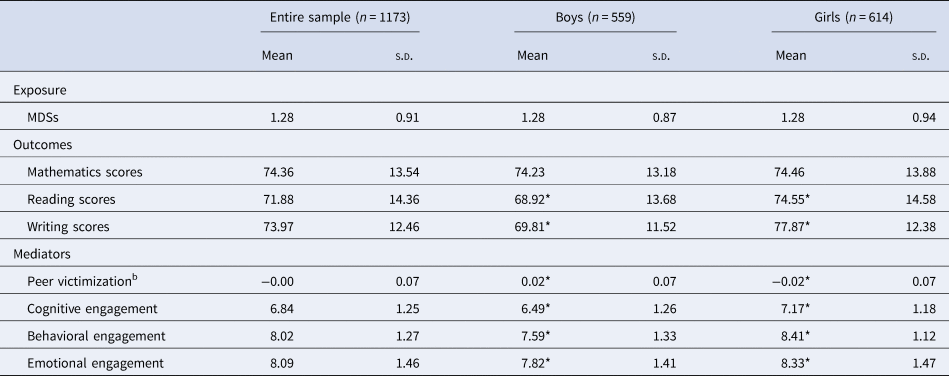
Eighty-four percent of children were Caucasian. The remaining 16% were of African (1%), Native American (3%), and other (12%; including Asian, Arab, and Latinx) ethnic origins. Fifty-two percent of children were girls and only 5% of mothers were 21 years or younger at birth. On average, mothers had low scores of depressive symptoms (median = 1.06 out of 10; online Supplementary Table S1). However, the prevalence of elevated symptoms (11.5%) was comparable to the prevalence of maternal depression in high-income countries (8–13%; Howard et al., Reference Howard, Molyneaux, Dennis, Rochat, Stein and Milgrom2014; Lanes, Kuk, & Tamim, Reference Lanes, Kuk and Tamim2011). Girls had higher reading and writing scores than boys, but mathematics scores were not significantly different across sexes. Boys were victimized by peers more frequently and girls were more cognitively, behaviorally, and emotionally engaged in school (Table 1). Participants without government exam data (n = 947) were more likely to be male, to come from a low SES family, to live in a single-parent household, and to experience higher levels of family dysfunction compared to those in the analysis sample. They also had lower scores on a test of school readiness, received lower levels of verbalization and stimulation in mother–child interactions, and had mothers with higher levels of depressive symptoms and lower levels of verbal IQ (online Supplementary Table S3). Inverse probability weighting, in which weights represent the probability of being included in the analysis sample, were therefore used in all analyses (Seaman & White, Reference Seaman and White2013).
Weight-adjusted mean scores of exposure, mediator, and outcome variablesa

a Data were compiled from the final master file of the Québec Longitudinal Study of Child Development (1998–2010), ©Gouvernement du Québec (Government of Québec), Institut de la Statistique du Québec (Québec Institute of Statistics).
b Latent variable of peer victimization created using parent, teacher, and child-reported peer victimization from 6 to 10 years.
*Significant at p ⩽ 0.05.
In unadjusted regression models, exposure to MDSs was associated with lower mathematics (standardized β = −0.11, p < 0.05), reading (β = −0.09, p < 0.05), and writing (β = −0.20, p < 0.05) exam scores in girls and with lower mathematics scores (β = −0.11, p < 0.05) only in boys. MDSs were negatively associated with cognitive (β = −0.11, p < 0.05) and behavioral (β = −0.09, p < 0.05) engagement in both sexes. MDSs were only associated with emotional engagement (β = −0.10, p < 0.05) and peer victimization (β = 0.10, p < 0.05) in girls. Higher levels of behavioral and cognitive engagement were associated with higher mathematics, reading, and writing exam scores, whereas emotional engagement was not associated with any academic outcomes (data not shown). There were no sex differences in these associations. On the other hand, peer victimization was negatively associated with mathematics (β = −0.18, p < 0.05) scores in both sexes and with, reading (β = −0.16, p < 0.05), and writing (β = −0.26, p < 0.05) scores in girls only.
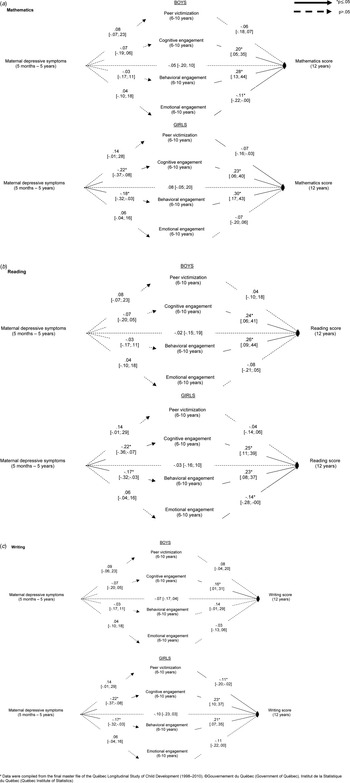
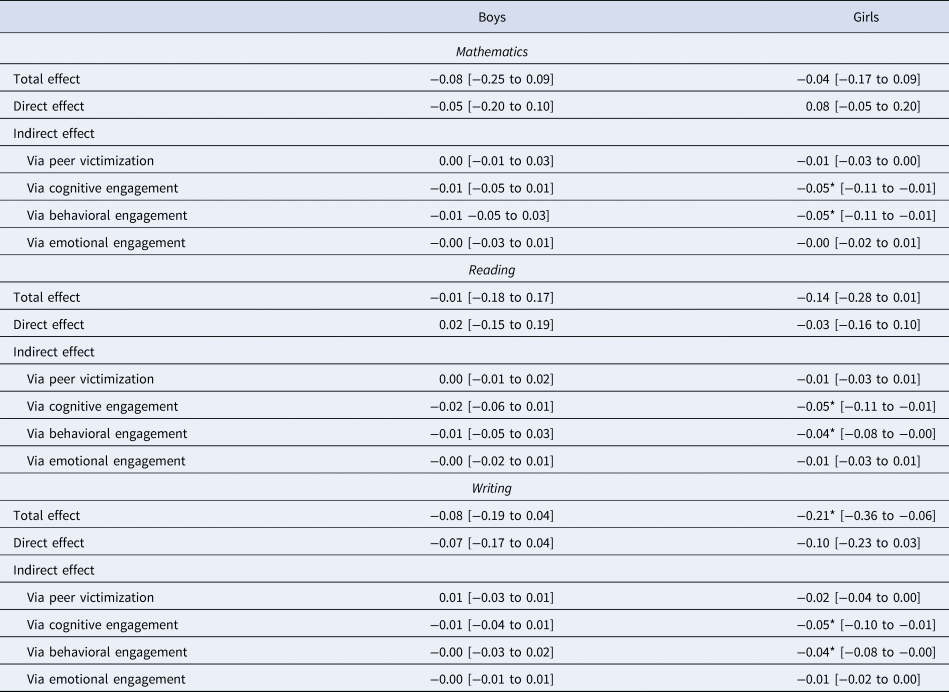
Tests of differences in direct and indirect associations between boys and girls showed that mediation models where parameters were freely estimated for each sex were superior to models with constrained parameters across all outcomes [mathematics (χ2235 = 690.1, p < 0.001), reading (χ2235 = 671.6, p < 0.001), writing (χ2235 = 731.3, p < 0.001)]. The final models were therefore estimated for boys and girls separately. Figures 1a–c illustrate the mediation models including covariates and mediators in the same model for mathematics, reading, and writing exam scores for both sexes. The total and simple direct and indirect effects of each adjusted model are reported in Table 2. The unadjusted mediation models are presented in online Supplementary Fig. S1 and the corresponding effects in online Supplementary Table S4.
Mediation models of the adjusted associations (standardized β [95% confidence intervals]) between exposure to MDSs in early childhood and children's academic performance at 12 years (Data were compiled from the final master file of the Québec Longitudinal Study of Child Development (1998–2010), ©Gouvernement du Québec (Government of Québec), Institut de la Statistique du Québec (Québec Institute of Statistics)). (a) Mathematics, (b) reading, and (c) writing.

Indirect and direct effects (standardized β [95% confidence intervals]) of MDSs on children's academic performance adjusted for covariatesa, b

a SES, mother–child interactions (stimulation and verbalization), family functioning, maternal age, anxiety, antisocial behavior, and verbal IQ, and children's school readiness, depression and anxiety symptoms, hyperactivity, inattention, physical aggression, and peer victimization.
b Data were compiled from the final master file of the Québec Longitudinal Study of Child Development (1998–2010), ©Gouvernement du Québec (Government of Québec), Institut de la Statistique du Québec (Québec Institute of Statistics).
*p ⩽ .05.
In unadjusted models, cognitive and behavioral engagement mediated the association between MDSs and girls' mathematics, reading, and writing scores. The only significant mediator for boys was cognitive engagement in the association with writing scores (online Supplementary Fig. S1 and Table S4). After adjusting for covariates, there were no significant mediators in the association between MDSs and academic performance in boys, although cognitive school engagement was positively associated with mathematics, reading, and writing scores. Girls exposed to higher levels of MDSs had lower levels of cognitive and behavioral engagement. These factors were in turn significantly associated with poorer performance on the mathematics exam (Fig. 1a). Cognitive and behavioral engagement also significantly mediated the association between MDSs and girls' reading (Fig. 1b) and writing (Fig. 1c) scores.
Discussion
This is the first study to examine sex differences in the mediating role of school experiences in the association between early MDSs and subsequent academic performance. In line with our hypotheses, we found that children's school experiences mediated the association between exposure to MDSs in early childhood and academic performance in late childhood. However, this association was only observed in girls. Specifically, cognitive and behavioral school engagement mediated the association between MDSs and mathematics, reading, and writing exam scores. Emotional engagement and peer victimization were not significant mediators. None of the potential mediators explained the association in boys.
In line with findings of Shen et al. (Reference Shen, Magnusson, Rai, Lundberg, Le-Scherban, Dalman and Lee2016), exposure to early MDSs was associated with subsequent lower mathematics, reading, and writing scores in girls and with lower mathematics scores in boys, suggesting more pervasive effects on girls' academic performance. However, these findings diverge from previous studies which found that sons of depressed mothers had poorer cognitive outcomes (Hay et al., Reference Hay, Pawlby, Sharp, Asten, Mills and Kumar2001; Murray et al., Reference Murray, Arteche, Fearon, Halligan, Croudace and Cooper2010). There are a few possible explanations for these sex differences. On one hand, the maturational advantage hypothesis posits that girls may be protected from the impoverishment of social experience associated with MDSs since they tend to be more mature than boys on average, and boys have a propensity to respond negatively to a number of early life stressors (Grace et al., Reference Grace, Evindar and Stewart2003; Hinshaw, Reference Hinshaw2018). This suggests that sons of mothers with depressive symptoms are more likely to be at increased risk of negative outcomes. Conversely, daughters of mothers with depressive symptoms are more likely to experience interpersonal stressors and are more sensitive to the stress context often associated with MDSs (Tsypes & Gibb, Reference Tsypes and Gibb2015). Girls are also more likely to perceive themselves as being less academically competent and to experience higher levels of education-related internal distress (Pomerantz et al., Reference Pomerantz, Altermatt and Saxon2002). Although findings of Murray et al. (Reference Murray, Arteche, Fearon, Halligan, Croudace and Cooper2010) and Hay et al. (Reference Hay, Pawlby, Sharp, Asten, Mills and Kumar2001) support the former hypothesis, our findings support the latter: girls exposed to early MDSs were more likely to experience poorer academic performance, as well as, lower levels of cognitive and behavioral school engagement in later childhood.
Our findings are also in line with previous studies showing an association between exposure to early MDSs and increased risk of peer victimization (Côté et al., Reference Côté, Ahun, Herba, Brendgen, Geoffroy, Orri and Tremblay2018; Tsypes & Gibb, Reference Tsypes and Gibb2015), with the distinction that our findings were only significant in girls. Although the indirect effect from MDSs to academic performance via peer victimization was not significant in our study, peer victimization was significantly associated with girls' academic performance. Given the bi-directional association between academic performance and mental health (Panayiotou & Humphrey, Reference Panayiotou and Humphrey2018), it is plausible that part of the association between peer victimization and mental health is explained by poor academic performance, and vice versa. The finding that poor academic performance exacerbates internalizing symptoms in girls (Panayiotou & Humphrey, Reference Panayiotou and Humphrey2018) supports the hypothesis that girls tend to evaluate themselves more negatively than boys, which can lead to increased distress and internalizing symptoms (Pomerantz et al., Reference Pomerantz, Altermatt and Saxon2002). Overall, these and previous data suggest that reducing peer victimization [e.g. through the use of school-based anti-bullying programs (Gaffney, Ttofi, & Farrington, Reference Gaffney, Ttofi and Farrington2019)] may help mitigate the negative impact of MDSs on child outcomes.
Further research is needed to understand how exposure to MDSs in early childhood is associated with the different dimensions of school engagement. One possible route is via insensitive parenting. Mothers with depressive symptoms use more coercive parenting practices and show less sensitivity when engaging with their children (Goodman, Simon, Shamblaw, & Kim, Reference Goodman, Simon, Shamblaw and Kim2020; Murray et al., Reference Murray, Woolgar, Martins, Christaki, Hipwell and Cooper2006). When asked to help their child solve a mathematics problem, mothers with elevated depressive symptoms used more directions and control, were less emotionally supportive, provided less information to help their child understand the problem, and showed little enthusiasm for problem solving (Murray et al., Reference Murray, Woolgar, Martins, Christaki, Hipwell and Cooper2006). Unsupportive parenting also undermines a child's sense of autonomy and leads to decreased motivation and engagement in school (Pomerantz et al., Reference Pomerantz, Kim, Cheung, Harris, Graham, Urdan, Graham, Royer and Zeidner2012). In this context, children of mothers with depressive symptoms may be less likely to internalize parental values about the importance of academic success and may form less positive relationships with peers and teachers who can be sources of cognitive-motivational and emotional support (Furrer & Skinner, Reference Furrer and Skinner2003). However, this is only one potential mechanism. Exposure to MDSs tends to co-occur with other early-life family risk factors (e.g. family dysfunction) which may explain the association between MDSs and children's later academic outcomes (Ahun & Côté, Reference Ahun and Côté2019).
Our findings have important implications for research and practice. First, our research supports the recent US Preventive Services Task Force statement recommending clinicians to screen for depressive symptoms in the perinatal period and refer women to counseling (Curry et al., Reference Curry, Krist, Owens, Barry, Caughey, Davidson and Kemper2019). This can help improve both maternal and child well-being (Cuijpers, Weitz, Karyotaki, Garber, & Andersson, Reference Cuijpers, Weitz, Karyotaki, Garber and Andersson2015). Second, interventions targeting parenting behaviors in families where the mother has experienced depressive symptoms may have a positive influence on school engagement (Goodman & Garber, Reference Goodman and Garber2017), given that children's sense of relatedness to their parents (e.g. feeling accepted, special, and important) can help them form harmonious peer relationships and engage in classroom activities (Furrer & Skinner, Reference Furrer and Skinner2003). However, since this is only one of many potential routes through which MDSs influences school engagement, further research is needed to identify other avenues of intervention. Third, testing the impact of bullying prevention programs on the association between MDSs and child outcomes can provide information about the putative causal role of peer victimization (Côté et al., Reference Côté, Ahun, Herba, Brendgen, Geoffroy, Orri and Tremblay2018). However, our results on the associations between MDSs, peer victimization, and academic performance were only significant in girls. Further research is needed to improve understanding of the mechanisms of the association between exposure to early MDSs and boys' academic performance. One potential avenue of exploration may be through behavioral problems. Boys are more likely to develop insecure attachment than girls and this may foster behavioral problems which may negatively influence academic performance (Grace et al., Reference Grace, Evindar and Stewart2003; Panayiotou & Humphrey, Reference Panayiotou and Humphrey2018).
This study's strengths include repeated assessments of MDSs over 5 years, thus enabling us to capture the persistence of symptoms over time; detailed multi-informant assessments of peer relations and school engagement across middle childhood (Nakamoto & Schwartz, Reference Nakamoto and Schwartz2010); and inclusion of a wide range of empirically-based covariates in a robust statistical model, thereby providing confidence in the temporality and statistical significance of reported associations.
Nevertheless, we faced some limitations. First, children exposed to MDSs were less likely to have outcome data, resulting in a loss of power for detecting associations. However, the detection of significant associations despite this suggests that its impact was limited. Furthermore, we conducted weight-adjusted analyses to address the potential bias resulting from lack of outcome data. Second, MDSs were self-reported and not clinically assessed, therefore limiting our capacity to make inference to populations with clinically significant levels of depression. Nonetheless, we used a validated instrument for assessing MDSs in population samples, where prevalence of clinically severe mental health problems is relatively low, but prevalence of sub-clinical symptoms is high. Third, even though the associations obtained were generally small, these effects are still relevant for large-scale interventions as small differences at a population level can greatly impact population health (Rose, Reference Rose1985). Nevertheless, it is possible that we did not detect some associations in this sample due to the relatively low scores of MDSs. Fourth, although genetic factors do explain part of the association between MDSs and child outcomes (Goodman, Reference Goodman2020), we were unable to account for gene–environment interactions in this sample due to lack of genetic data. Fifth, we were unable to control for baseline school engagement because it was not assessed prior to age 6 in this sample. Sixth, we chose to use mean score constructs because we were interested in examining their presentation over a specific period of time (e.g. average level of peer victimization in middle childhood). However, this limited our ability to comment on fluctuations in the constructs from one time point to another. Finally, it was not possible to account for fathers' depressive symptoms due to low response rates.
Conclusion
The current study adds to the existing literature by showing that exposure to early MDSs was negatively associated with girls' academic performance via its associations with cognitive and behavioral school engagement. Further research is needed to replicate these findings and to better elucidate the role of sex differences in the mechanisms of these associations.
Supplementary material
The supplementary material for this article can be found at https://doi.org/10.1017/S0033291720004298.
Acknowledgements
We are grateful to the children and parents of the Québec Longitudinal Study of Child Development (QLSCD) and the participating teachers and schools. The QLSCD was supported by funding from the Ministère de la Santé et des Services Sociaux (Ministry of Health and Social Services), the Ministère de la Famille (Ministry of the Family), the Ministère de l’Éducation et de l'Enseignement Supérieur (Ministry of Education and Higher Education), the Lucie and André Chagnon Foundation, the Institut de Recherche Robert-Sauvé en Santé et en Sécurité du Travail (Robert-Sauvé Research Institute of Health and Security at Work), the Research Centre of the Sainte-Justine University Hospital, the Ministère du Travail, de l'Emploi et de la Solidarité Sociale (Ministry of Work, Employment, and Social Solidatity), and the Institut de la Statistique du Québec (Québec Institute of Statistics). Additional funding was received from the Fonds de Recherche du Québec-Santé (FRQS), the Fonds de Recherche du Québec-Societé et Culture (FRQSC), the Social Science and Humanities Research Council of Canada (SSHRC), the Canadian Institutes of Health Research (CIHR), and the Sainte-Justine Research Centre. Ms. Ahun is supported by a Vanier Canada Graduate Scholarship from the SSHRC. Dr Boivin is supported by a Canada Research Chair in Child Development funded by CIHR.
Conflict of interest
None.