Introduction
Crustose Teloschistaceae, or Caloplaca s. lat., includes c. 1000 species (Arup et al. Reference Arup, Søchting and Frödén2013), the majority of which are from temperate regions (Feuerer Reference Feuerer2011). Approximately 18% of this diversity (c. 180 species) is known from Russia (e.g. Urbanavichus Reference Urbanavichus2010; Urbanavichus & Urbanavichene Reference Urbanavichus and Urbanavichene2012; Vondrák et al. Reference Vondrák, Frolov, Říha, Hrouzek, Palice, Nadyeina, Halıcı, Khodosovtsev and Roux2013b, Reference Vondrák, Ismailov and Urbanavichus2017, Reference Vondrák, Frolov, Davydov, Yakovchenko, Malíček, Svoboda and Kubásek2019; Muchnik et al. Reference Muchnik, Wilk, Vondrák and Frolov2014; Frolov & Konoreva Reference Frolov and Konoreva2016) and it makes the family one of the most species-rich in the country (Urbanavichus Reference Urbanavichus, Andreev and Himelbrant2014). The highest number of species of Teloschistaceae are found in regions characterised by dry and warm rocky steppes with base-rich bedrock, namely Southern European Russia, Russian Caucasus, Southern Ural and Southern Siberia (Urbanavichus Reference Urbanavichus, Andreev and Himelbrant2014). Eastern Siberia and the Russian Far East, with mainly boreal and temperate forests and acidic siliceous outcrops, do not have an outstanding diversity of Teloschistaceae. Common European or circumboreal taxa were mainly known from the region until a number of species with Asian distributions were recently described from there (Søchting & Figueras Reference Søchting and Figueras2007; Kondratyuk et al. Reference Kondratyuk, Elix, Galanina, Yakovchenko, Kärnefelt and Thell2011, Reference Kondratyuk, Lőkös, Zarei-Darki, Haji Moniri, Tchabanenko, Galanina, Yakovchenko, Hooshmand, Ezhkin and Hur2013, Reference Kondratyuk, Lőkös, Tschabanenko, Skirina, Galanina, Oh and Hur2014, Reference Kondratyuk, Lőkös, Farkas, Oh and Hur2015). Here we provide further information to show the particular uniqueness of Teloschistaceae diversity in this part of Asia. Over recent years, the authors of the present paper collected lichens in different regions of Siberia covering a huge territory from the Altai Mountains to the Kamchatka Peninsula, and independently found several specimens of Caloplaca s. lat. which were not identified as any of the known taxa. After careful study, these specimens are described here as three new species.
Materials and Methods
Sampling
Lichens were collected by the authors from various localities in Siberia and the Russian Far East between 2013 and 2019 and deposited mainly in LE, PRA and the personal herbarium of IF. LK and SC collected in the Republic of Sakha (Yakutia), Khabarovsk Territory and Trans-Baikal Territory; IF in the Sakhalin Region and the Republic of Tuva; JV in the Republic of Tuva; DH and IS in Kamchatka Territory; ED and LY in Primorye Territory.
Phenotype evaluation
Measurements of morphological characters follow Vondrák et al. (Reference Vondrák, Frolov, Arup and Khodosovtsev2013a). All microscopic observations are based on hand-cut sections mounted in water, mainly without chemical treatments (paraphyses and upper cells of the true exciple were measured in KOH since they were not visible due to anthraquinone crystals). Spores were sometimes vivid (with badly visible septa) and thus measured after heating (Steiner & Peveling Reference Steiner and Peveling1984). Measurements are accurate to 0.5 μm for cells and 5–10 μm for larger structures. Ten measurements per specimen were made for cells (ascospores, conidia, paraphyses etc.) and five for larger structures (hymenium, hypothecium etc.), except for poor specimens with deficient material. Results are given as (min.–) x̄ 1 – x̄ 2 – x̄ 3 (–max.), where min./max. are extremes from all measurements, x̄ 1 is the lowest specimen arithmetic mean observed, x̄ 2 is the arithmetic mean of all observations, and x̄ 3 is the highest specimen arithmetic mean observed. Total number of measurements (n), number of samples assessed (N), and standard deviation from all measurements (SD) are given in square parentheses for each character measured [n, N, SD]. Morphological terminology follows Smith et al. (Reference Smith, Aptroot, Coppins, Fletcher, Gilbert, James and Wolseley2009) and Vondrák et al. (Reference Vondrák, Frolov, Arup and Khodosovtsev2013a).
Chemistry
Composition of secondary metabolites was identified by HPLC analysis of apothecia of one specimen of Orientophila infirma and two specimens of Lendemeriella aureopruinosa. Air-dried lichens were used for the analysis. A crushed portion of a test sample was extracted with 0.1 ml of acetone on constant stirring for 24 h at room temperature. HPLC analyses were performed with an Agilent 1290 Series chromatograph with UV detection. For chromatographic separation, a ZORBAX Eclipse XDB-C18, 80 Å column (150 × 0.5 mm × 5 μm) was used. The mobile phase consisted of (A) aqueous formic acid (0.1%), and (B) acetonitrile. Analyses were performed at 25 °C and at a flow rate of 0.1 ml/min in the isocratic elution mode. The volume of the injected sample was 1 μl. Spectra of eluting substances were recorded under UV at 250 nm. After separation, the samples were also analyzed with a quadrupole time-of-flight mass spectrometer (6538 Series, Agilent, USA). Ionization was achieved by electrospray in the negative mode. Voltage on the capillary was 2.5 kV, capillary temperature 350 °C, atomizing gas pressure 45 psi, desiccant gas (nitrogen) temperature 225 °C, and drying gas flow rate 5 l min−1. Mass spectra were recorded in the range 100–1000 m/z. The resulting chromatograms were processed with the MassHunter WorkStation v. B.04.00 software package (Agilent, USA). The substances were identified based on their chromatographic properties and molecular masses. The identification of insoluble lichen pigments follows the methods described by Meyer & Printzen (Reference Meyer and Printzen2000).
DNA extraction, amplification and sequencing
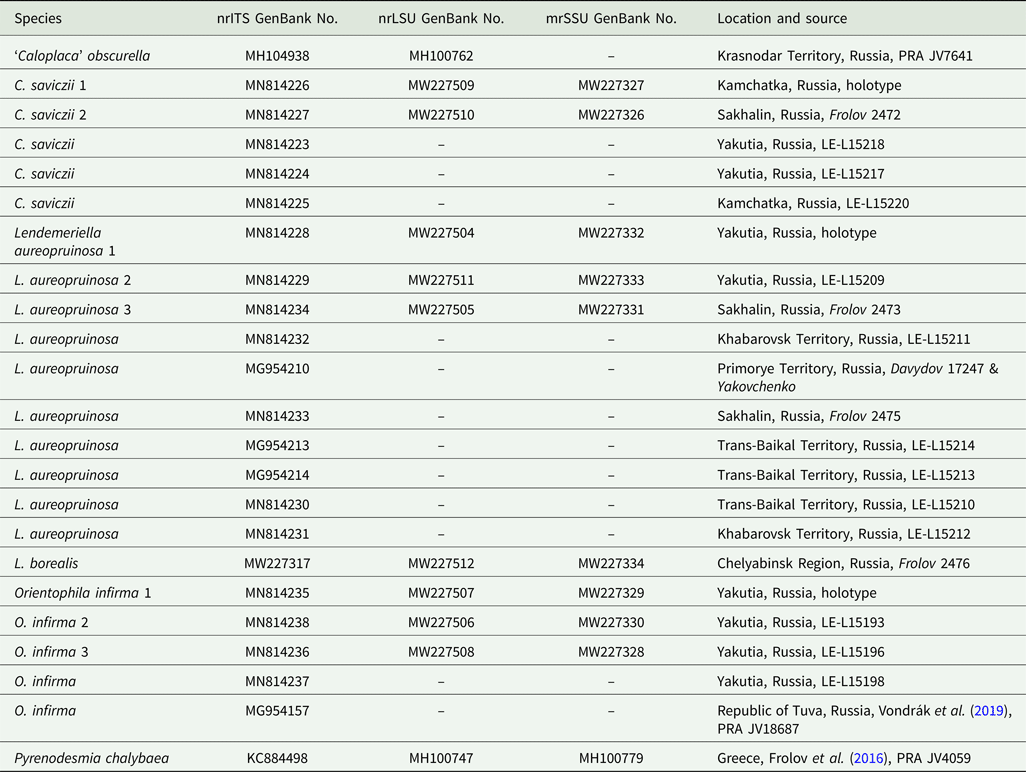
DNA was extracted with a CTAB-based protocol (Aras & Cansaran Reference Aras and Cansaran2006). Amplifications were made of the internal transcribed spacer regions (nrITS) and the large subunit (nrLSU) of the nuclear ribosomal RNA genes, and the small subunit of the mitochondrial ribosomal RNA gene (mrSSU). Primers for PCR amplification were ITS1F (Gardes & Bruns Reference Gardes and Bruns1993) and ITS4 (White et al. Reference White, Bruns, Lee, Taylor, Innis, Gelfand, Sninsky and White1990) for ITS, AL1R (Döring et al. Reference Döring, Clerc, Grube and Wedin2000) and LR5 (Vilgalys & Hester Reference Vilgalys and Hester1990) for nrLSU, and mrSSU1 (Zoller et al. Reference Zoller, Scheidegger and Sperisen1999) and mrSSU7 (Zhou & Stanosz Reference Zhou and Stanosz2001) for mrSSU. The PCR settings followed Ekman (Reference Ekman2001) for ITS and Arup et al. (Reference Arup, Søchting and Frödén2013) for nrLSU and mrSSU. Sequences obtained were uploaded onto the NCBI database (GenBank); Accession numbers are provided in Table 1.
Voucher information and GenBank Accession numbers of the new sequences of Teloschistaceae species obtained in this study.

Alignments and phylogenetic analyses
Newly obtained sequences were edited in FinchTV 1.4.0 (Geospiza Inc., Seattle, Washington, USA; http://www.geospiza.com) and BioEdit 7.2.5 (Hall Reference Hall1999). All datasets were aligned online by MAFFT v.7 (Katoh & Standley Reference Katoh and Standley2013; available at http://mafft.cbrc.jp/alignment/server/) with the L-INS-i and FFT-NS-I methods (Katoh et al. Reference Katoh, Kuma, Toh and Miyata2005) selected automatically by the program for each dataset. To exclude ambiguously aligned positions, alignments were subsequently cleared by the automated1 algorithm as implemented in the trimAl software package (Capella-Gutierrez et al. Reference Capella-Gutierrez, Silla-Martinez and Gabaldon2009). Phylogenetic reconstructions were carried out using Bayesian inference (BI) in MrBayes 3.2.6 (Ronquist & Huelsenbeck Reference Ronquist and Huelsenbeck2003). Analyses were run on the CIPRES Web Portal (http://www.phylo.org/portal2/). Optimum partitioning of the datasets and the optimum substitution models per partition were calculated in PartitionFinder2 using the greedy algorithm and corrected Akaike Information Criterion (AIC) (Lanfear et al. Reference Lanfear, Frandsen, Wright, Senfeld and Calcott2016). For a concatenated alignment of ITS, nrLSU and mrSSU, partitions were created for ITS1, ITS2, 5.8S, nrLSU and mrSSU in the input file for PartitionFinder. PartitionFinder indicated two subsets: i) ITS1, ITS2, and ii) mrSSU, nrLSU, 5.8S, both with the GTR + I + G model. MrBayes analyses were performed using two independent runs with four Markov chain Monte Carlo (MCMC) chains. Trees were sampled after every 500th generation. The prior settings for the combined analysis were the same for both subsets of partitions: rates of reversible rate matrix = Dirichlet (1.00,1.00,1.00,1.00,1.00,1.00); stationary state frequencies = Dirichlet; shape of scaled gamma distribution of site rates = exponential (1.00); proportion of invariable sites = uniform (0.00,1.00); partition-specific rate multiplier = Dirichlet (1.00,1.00); topology = all topologies equally probable a priori; branch lengths = unconstrained: gammadir (1.0,0.1000,1.0,1.0). Rate heterogeneity across partitions was allowed (ratepr = variable). The analyses were stopped when the average standard deviation of split frequencies between the simultaneous runs dropped below 0.01 (370 000 generations in the combined analysis). In the combined analysis, Potential Scale Reduction Factor (PSRF) of the model parameter values ranged from 0.999 to 1.004. The first 25% of trees was discarded as burn-in, and the remaining trees (1112 trees in the combined analysis) were used for construction of a 50% majority-rule consensus tree. The alignments of the three different genes were first analyzed separately to check for incongruence between genes. A conflict was assumed to be significant if two different relationships were both supported with posterior probabilities (PP) ≥ 0.95 (Buckley et al. Reference Buckley, Arensburger, Simon and Chambers2002). Accession numbers of the sequences downloaded from GenBank and used in the analyses are provided in Supplementary Material Table S1 (available online).
Results and Discussion
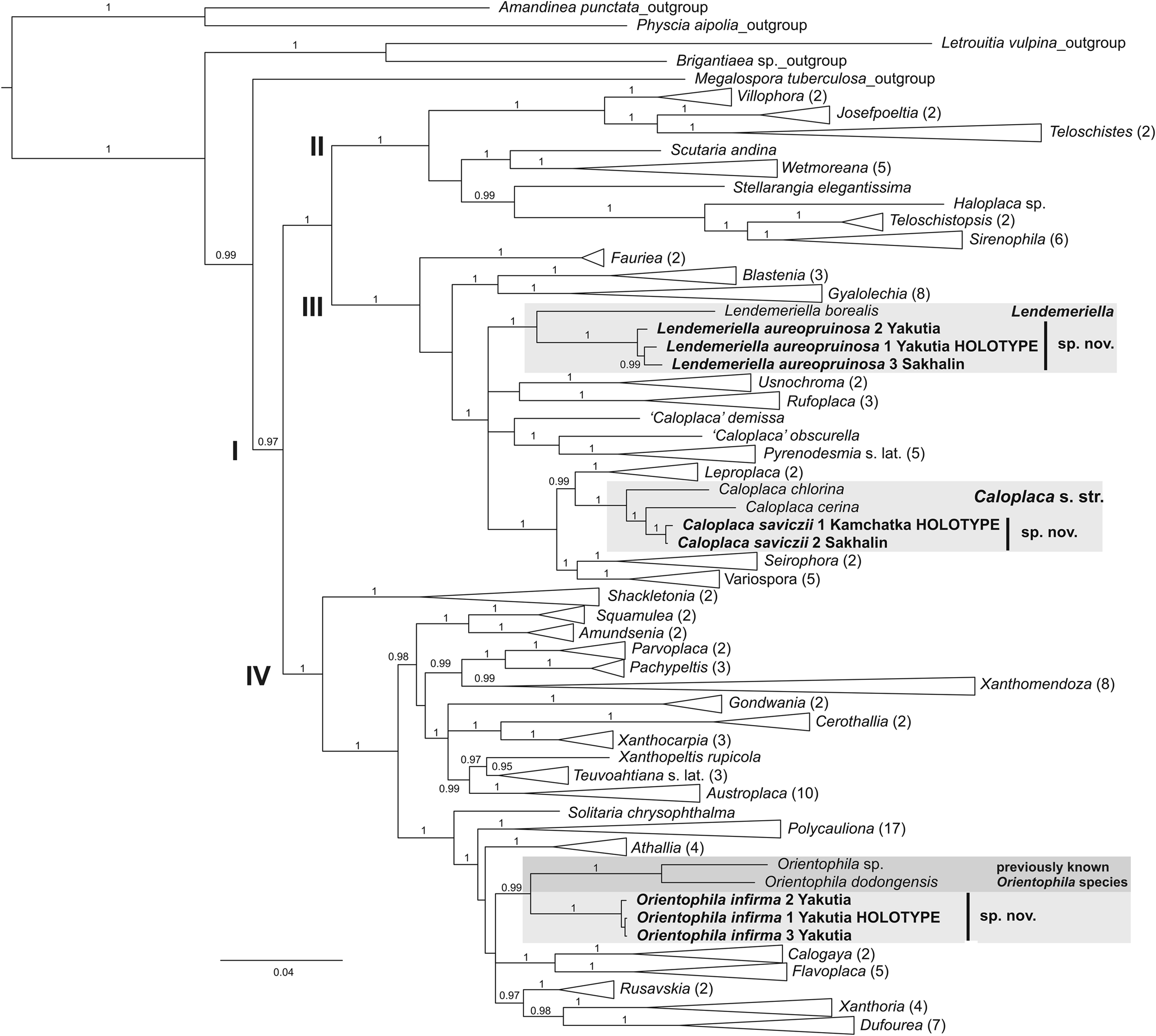
To determine the position of the new species in the phylogeny of Teloschistaceae, we included them in the combined analysis of the nrITS, nrLSU and mrSSU dataset together with the main genera of the family. Initially, the alignments of these genes were analyzed separately to check for incongruence between genes, but no incongruences were found. The combined alignment included 157 terminal species and a total of 2410 positions before trimming and 2093 positions after. The phylogeny was rooted with taxa outside the family following Arup et al. (Reference Arup, Søchting and Frödén2013). The resulting tree is presented in Fig. 1.
Phylogeny of the family Teloschistaceae based on the combined Bayesian analysis of nrITS, nrLSU and mrSSU data. Genera are collapsed into single terminals. Numbers at branches represent posterior probability (PP) values ≥ 0.95. Numbers in parentheses correspond to the number of species of a genus used in the analysis. I = Teloschistaceae; II = Teloschistoideae; III = Caloplacoideae; IV = Xanthorioideae.

The new species belong to the subfamilies Caloplacoideae and Xanthorioideae. One of them (Caloplaca saviczii) is explicitly nested inside the genus Caloplaca s. str. Another (Lendemeriella aureopruinosa) is closely related to the Caloplaca exsecuta group sensu Vondrák et al. (Reference Vondrák, Frolov, Davydov, Yakovchenko, Malíček, Svoboda and Kubásek2019), which is currently included in the genus Lendemeriella (Kondratyuk et al. Reference Kondratyuk, Lőkös, Farkas, Kärnefelt, Thell, Yamamoto and Hur2020). The third taxon (Orientophila infirma) forms a sister lineage to the genus Orientophila and we describe it in that genus. We discuss taxonomic positions of the new species in more detail in their diagnoses below.
We also prepared three separate ITS phylogenies for each of the new species using more sequences of these species and closely related taxa (see Supplementary Material Figs S1–S3, available online). Outgroups were chosen following the results of the combined analysis. The ingroup of the Caloplaca s. str. alignment included 86 sequences belonging to 13 species; five sequences were newly obtained. The ingroup of the Lendemeriella alignment included 27 sequences belonging to six species; 10 sequences were newly obtained. The Orientophila alignment included 17 sequences of nine species of Athallia, Flavoplaca and Orientophila; four sequences were newly obtained. All new species form well-delimited and highly supported clades (see Supplementary Material Figs S1–S3).
Taxonomy
Caloplaca saviczii I. V. Frolov, Himelbrant, Stepanchikova, Konoreva & S. Chesnokov sp. nov.
MycoBank No.: MB 833718
Similar to Caloplaca cerina but differing by the presence of green to grey-green, crater-like soralia with a thin white intact or torn rim. Soredia usually with emerald green pigment. Thallus endophloeodal or of poorly developed scattered beige areoles with unclear margins. Apothecia rare, c. 0.3–0.4 mm diam., with a thalline exciple of the same colour as thallus or darker, when young with thick white pruina on disc and exciple. Ascospores 12–14 × 5–7 μm, with septa 4–5 μm wide.
Type: Russia, Kamchatka Territory, Koryakia, Penzhina District, fluvial valley of River Katal'yanayvayam, left bank of the river, alt. 61 m, 61°24′39.7″N, 165°02′02.9″E, on bark of Populus suaveolens in Chosenia arbutifolia (60 years old) floodplain forest with Populus suaveolens (60 years old), Salix schwerinii, Alnus fruticosa and Calamagrostis purpurea, 21 August 2016, D. Himelbrant Kor-Ichig-34-2016 (LE-L15203—holotype; H—isotype). GenBank Accession numbers of the sequences of the holotype (soralia): MN814226 (nrITS), MW227509 (nrLSU), MW227327 (mrSSU).
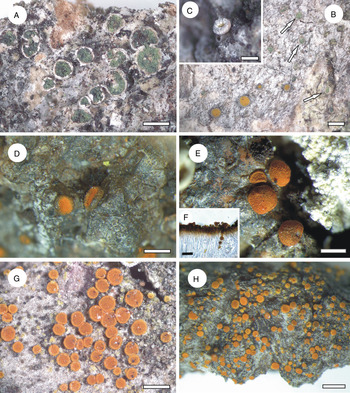
A, Caloplaca saviczii, crowded crater-like soralia (holotype). B, C. saviczii, apothecia and scattered crater-like soralia (arrowed; isotype). C, C. saviczii, a young apothecium with thick white pruina and a soralium on the same areole (holotype). D, Lendemeriella aureopruinosa, apothecia with grey true exciple (holotype). E, L. aureopruinosa, apothecia with true exciple of the same colour as the disc (holotype). F, L. aureopruinosa, epithecium, overlain with granules of epipsamma. G, Orientophila infirma (holotype). H, O. infirma (LE-L15193). Scales: A & C = 0.2 mm; B, D, E, G & H = 0.5 mm; F = 15 μm. In colour online.

Thallus endophloeodal or of poorly developed, scattered, elongated or roundish, slightly convex beige areoles c. 0.25–1.05 × 0.15–0.28 mm with unclear margins fusing with the substratum. Thickness of areoles (45–)45–83–125(–125) μm [7, 6, 27]. Cortex in section colourless to beige, towards areoles surface gradually changed to epinecral layer, thickness of cortex together with epinecral layer (13–)13–26–38(–38) μm [8, 7, 9]. Cortex cells ±spherical, (4.5–)5.4–5.9–6.2(–8.0) μm diam. [21, 3, 0.8], cell wall thickness up to 1.5 μm. Algal layer (25–)25–55–56(–63) μm thick [7, 6, 11]; algal cells globose, (8.0–)12.5–12.9–13.8(–19.0) μm diam. [44, 5, 2.6]. Medulla inconspicuous or algonecral, up to 40 μm thick. Cortex and algal layer sometimes distinguishable also in endophloeodal thalli. Sometimes areoles form pustules (c. 250–360 μm diam.) of the same colour with thick white pruina on top. Pustules covered with paraplectenchymatous cortex c. 45–55 μm in width with ±spherical cells c. 5–9 μm diam., poorly distinguishable due to dense crystals of different form c. 1–8 μm in size, insoluble in K. Pustules comprise circular algal layer c. 40–50 μm wide, enclosing medulla which consists of a small number of solitary algal cells interwoven with fungal hyphae c. 2 μm wide; pustules apparently break into soralia. Soralia green to grey-green, crater-like, (0.11–)0.16–0.23–0.34(–0.56) mm diam. [94, 10, 0.08], with thin white intact or torn rim, one or rarely two per areole, scattered on surface of bark or rarely crowded. Soralia walls (18–)34–48–60(–75) μm wide [24, 12, 13], c. 200 μm high, colourless in section or rarely pale beige, cells undistinguishable or deformed. Soredia usually emerald green (intensifying in K), rarely colourless, (13–)16–18–21(–28) μm diam. [118, 12, 3]; consoredia rare, c. 23–35 μm diam. Fungal cells in soredia (3.0–)3.8–4.3–4.9(–6.5) μm diam. [40, 4, 0.9]; algal cells in soredia (4.0–)5.2–6.9–9.3(–12.0) μm diam. [40, 4, 1.8]. Prothallus usually absent or in the form of a grey film.
Apothecia (0.21–)0.29–0.36–0.45(–0.50) mm diam. [36, 6, 0.07], lecanorine to zeorine (true exciple visible only in cross-section of apothecium), adnate; apothecia rare, observed on c. 50% of the specimens and never abundant on a specimen. Disc orange; thalline exciple of same colour as thallus or darker; thick white pruina present on disc and exciple, especially in immature apothecia. Hymenium (88–)88–93–105(–105) μm high [4, 4, 8], colourless, not glutinized, without extracellular oil drops and crystals; epihymenium golden brown. Hypothecium colourless, in central part above clusters of algal cells or rarely with a central conical extension downward, with or rarely without extracellular oil drops, without extracellular crystals, (35–)35–93–150(–150) μm high [4, 4, 47]; formed of thin-walled cells variable in shape and orientation. Exciple c. 30–80 μm wide, formed of poorly developed true exciple, (0–)7–9–20(–20) μm wide [4, 4, 8], and thalline exciple, (28–)28–47–68(–68) μm wide [4, 4, 20]. Upper part of true exciple of thin-walled cells c. 7 × 3 μm. Thalline exciple with well-developed hyaline cortex, (30–)30–48–58(–58) μm wide (in the widest part) [4, 4, 12]. Cortex cells of two types: i) ±spherical, (5.0)5.3–6.2–7.5(9.0) μm diam. [21, 4, 1.2]; ii) elongated and oriented perpendicular to surface of cortex, (7.0–)9.3–9.8–10.3(–13.0) × (4.0–)5.2–5.2–5.3(–6.0) μm [11, 2, 1.9 & 0.6]; thickness of walls up to 2 μm. Paraphyses c. 2 μm wide in lower part, 1–2 upper cells slightly widened and the widest upper cell (2.0–)2.9–3.3–4.5(–5.5) μm wide [36, 4, 0.8]; often branched in upper part. Asci clavate, (50–)56–56–57(–63) × (13–)16–17–17(–21) μm [10, 2, 4 & 3]. Ascospores 8 per ascus, colourless, polarilocular, (10.0–)11.6–12.0–14.2(–15.0) × (4.5–)5.3–6.1–6.6(–7.5) μm [37, 4, 1.3 & 0.8], with rounded ends. Septa (2.5–)4.1–4.6–5.3(–6.0) μm [37, 4, 0.7]. Ascospore length/width ratio: (1.60–)1.81–2.02–2.20(–2.56) [37, 4, 0.24]. Septum width/ascospore length ratio: (0.25–)0.35–0.37–0.39(–0.45) [37, 4, 0.05].
Pycnidia not observed.
Chemistry
Epihymenium and upper true exciple with anthraquinones, K+ purple. Upper part of cortex of thallus and thalline exciple without anthraquinones, with Sedifolia-grey, K+ violet, or without it, K−. Fungal cells of soredia with an unidentified pigment, insoluble in acetone, emerald green in water, K− or K+ intensifying, C+ orange; in N slowly dark grey with violet tinge (brownish?) and then, after adding K, orange. We did not analyze an anthraquinone chemosyndrome in apothecia of the new species due to the scarcity of material. However, considering the taxonomic position nested in the Caloplaca cerina/C. stillicidiorum-clade, we would expect an ordinary syndrome A (Søchting Reference Søchting1997).
Etymology
Named in honour of Vsevolod Pavlovich Savicz (1885–1972), the first lichenologist to study the lichens of Kamchatka and who described the first Caloplaca s. lat. species from there, C. kamczatika (Savicz Reference Savicz1914).
Phylogeny and taxonomic position
According to the combined phylogeny (Fig. 1), the new species is explicitly nested within the genus Caloplaca s. str. (subfamily Caloplacoideae). The generic affiliation of C. saviczii is also supported by its lecanorine C. cerina-like apothecia. According to the ITS phylogeny (see Supplementary Material Fig. S1, available online), C. saviczii is well delimited from the other sorediate species of Caloplaca s. str. and nested in a large C. cerina/C. stillicidiorum clade that is, however, not supported. In spite of its probable close relationship to C. cerina s. lat. and C. stillicidiorum s. lat., the new taxon deserves a rank of species, since it could be characterized morphologically (peculiar crater-like soralia with an unknown emerald green pigment), ecologically (occurrence in boreal floodplain forests) and geographically (possibly restricted to North-East Asia). All sequences of the new species were obtained from soralia.
Similar taxa
The new species is monophyletic and well delimited based on the molecular results; however, it could be confused with some other epiphytic sorediate Caloplaca s. str. species, among which C. hanneshertelii S. Y. Kondr. & Kärnefelt is morphologically the closest species, bearing similar crater-like soralia with a whitish or greyish rim. The latter species is so far known only from south-eastern Australia and differs in the better developed areoles, the dark bluish coloured soralia which are sometimes flat and not crater-like (always crater-like in C. saviczii), and paraphyses which are more distinctly swollen on the apices, 4–6 μm wide (Kärnefelt & Kondratyuk Reference Kärnefelt and Kondratyuk2004). Other epiphytic sorediate Caloplaca s. str. species (C. chlorina (Flot.) Sandst., C. pinicola H. Magn., C. sterilis Šoun et al. and C. turkuensis (Vain.) Zahlbr.) never form crater-like soralia.
Sterile C. saviczii could be confused with sterile epiphytic Caloplaca s. lat. species with grey or greenish soralia without anthraquinones. Soralia of C. ahtii Søchting are distinctly smaller and dark (bluish) grey, containing Sedifolia-grey, K+ violet. Thalli of C. alstrupii Søchting have bluish black hypothallus borders, much more abundant smaller pustules, 100–250 μm diam., and very pale yellowish green soralia (Søchting Reference Søchting1999). Caloplaca obscurella (J. Lahm) Th. Fr. and C. ulcerosa Coppins & P. James have a thin grey to white, more or less continuous thallus and paler yellowish green, pale green or greyish soralia without emerald green pigment, which are often crater-like but sometimes not and developed along fissures in the thallus (always crater-like in C. saviczii). Caloplaca ulcerosa is a European, mainly maritime species (Vondrák et al. Reference Vondrák, Šoun, Arup, Aptroot and Redchenko2009) and C. obscurella is an inland lichen with no reliable records east of the Urals. Soralia of C. sorocarpa (Vain.) Zahlbr. are barrel-shaped, never crateriform.
Ecology and distribution
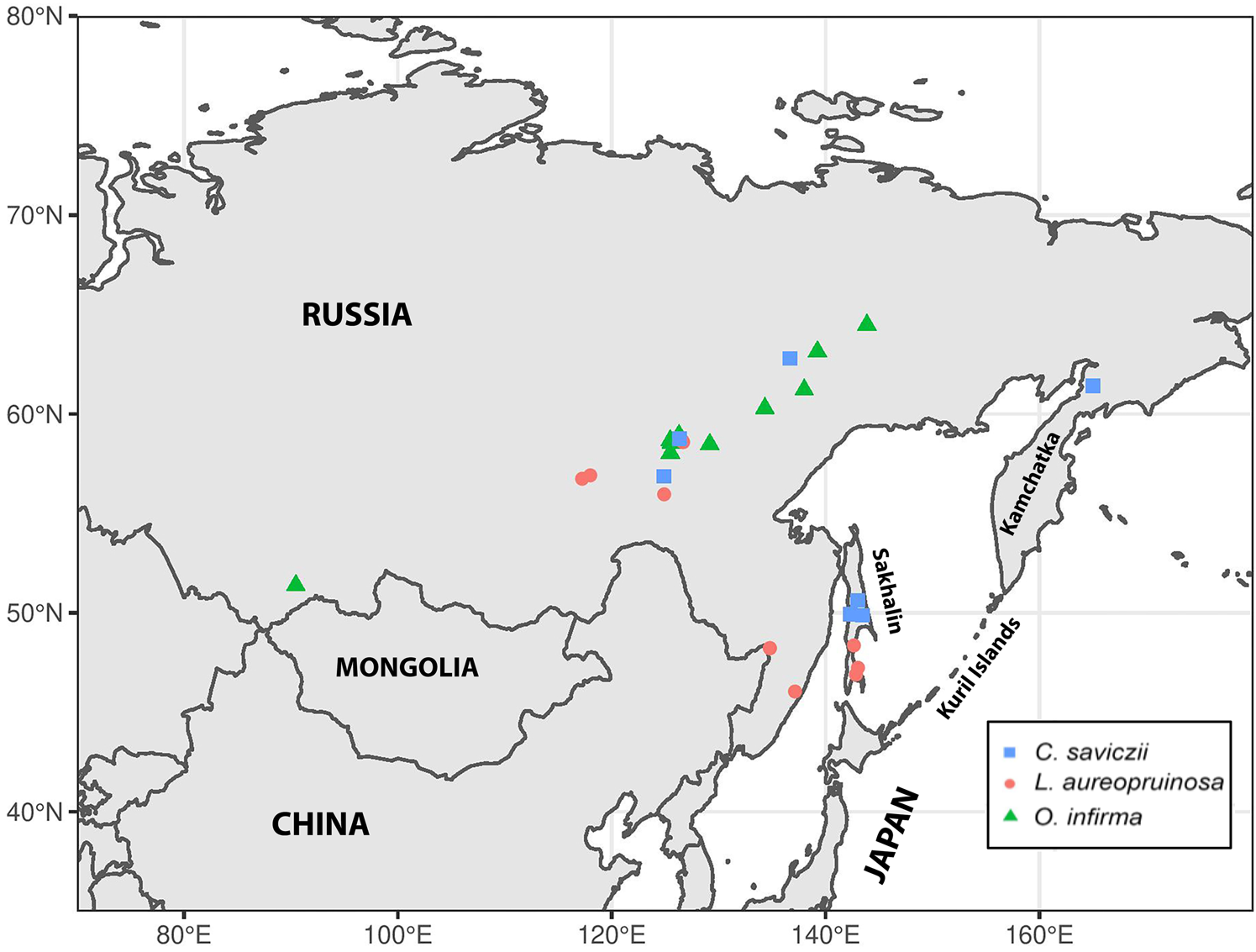
Caloplaca saviczii grows on the bark of trunks of various deciduous trees and shrubs (Chosenia arbutifolia, Fraxinus sp., Populus suaveolens, P. tremula, Salix cardiophylla and other species of Salix, Sambucus sp., Ulmus sp.) in floodplain forests in taiga or rarely in coniferous forests along small streams in taiga or forest-tundra at altitudes 60–650 m above sea level. Co-occurring lichen taxa include Arthrosporum populorum A. Massal., Athallia pyracea (Ach.) Arup et al., Bacidia circumspecta (Norrl. & Nyl.) Malme, Caloplaca ahtii, C. gordejevii (Tomin) Oxner, C. taranii S. Y. Kondr. et al., Catinaria atropurpurea (Schaer.) Vězda & Poelt, Gyalolechia ussuriensis (Oxner et al.) Vondrák, Lecidea erythrophaea Flörke ex Sommerf., Lecidella elaeochroma (Ach.) M. Choisy, Orientophila infirma I. V. Frolov et al., Phaeophyscia kairamoi (Vain.) Moberg, and Physcia alnophila (Vain.) Loht. et al. The species is known from Eastern Siberia (Yakutia, Russia) and the Far East (Kamchatka and Sakhalin, Russia). There it seems quite common in suitable localities, but is inconspicuous and therefore easily overlooked. The known localities are marked on Fig. 3.
Known localities of the newly described lichen species Caloplaca saviczii, Lendemeriella aureopruinosa and Orientophila infirma. In colour online.

Additional material studied
Russia: Kamchatka Territory: Koryakia, Penzhina District, fluvial valley of River Katal'yanayvayam, left bank of the river, 61°24′39.7″N, 165°02′02.9″E, 61 m, 2016, D. Himelbrant Kor-Ichig-34-2016 (LE-L15202); Koryak Nature Reserve, Parapol'sky Dol segment, fluvial valley of River Ichiginynvayam, right bank of the river, 61°24′40.8″N, 165°01′53.5″E, 70 m, 2016, D. Himelbrant Kor-Ichig-24-2016 (LE-L15201; LE-L15204; LE-L15205; LE-L15216; LE-L15220, duplicate in H). Sakhalin Region, Sakhalin Island: Smirnykh District, 16 km SE of Pervomaysk, narrow floodplain of River Vitnica, just below Mt Vayda, 49°52′44.2″N, 143°26′59.3″E, 350 m, 2019, I. Frolov 2467; 15 km SE of Pilvo, near road from Smirnykh to Pilvo, wide floodplain of River Pilevka, 49°56′4.9″N, 142°18′16.0″E, 140 m, 2019, I. Frolov 2468, 2469, 2470; Tymovskoye District, 20 km E of Palevo, wide floodplain of River Tym', 50°37′43.7″N, 143°0′16.3″E, 260 m, 2019, I. Frolov 2471, 2472 (duplicates in GZU, H, LE, LD and PRA). Republic of Sakha (Yakutia): Aldan District, Tommot, River Kurung, 58°44′29″N, 126°21′5″E, 470 m, 2015, L. Konoreva 351 (LE-L15218); Neryungri District, Chul'man, left bank of River Chul'man, 56°51′48.4″N, 124°54′16.2″E, 649 m, 2015, S. Chesnokov 38 (LE-L15222); Tomponsky District, 6.5 km W of town of Tyoply Klyuch, 62°47′04.3″N, 136°40′42.3″E, 295 m, 2016, L. Konoreva J-330 (LE-L15217).
Lendemeriella aureopruinosa I. V. Frolov, Vondrák, Arup, Konoreva, S. Chesnokov, Yakovczenko & Davydov sp. nov.
MycoBank No.: MB 833717
Thallus epilithic, in the form of an inconspicuous grey film or ±well developed, continuous or areolate. Apothecia c. 0.3–0.6 mm diam., disc dark orange to brick colour; thalline exciple absent or inconspicuous, at the base of apothecia; true exciple of the same colour as the disc or dark grey, containing Cinereorufa-green; young apothecia often with aureate epipsamma. Ascospores 11–15 × 6–7 μm, with septa 3–5 μm wide.
Type: Russia, Republic of Sakha (Yakutia), Aldan District, Yllymakh, right bank of River Bes-Yuryakh, near road from Tommot to Yllymakh, alt. 640 m, 58°38′27.0″N, 126°36′38.7″E, on siliceous outcrops in Betula sp.-Alnus sp.-Larix gmelinii forest, 13 July 2015, S. Chesnokov 154 (LE-L15207—holotype; H—isotype). GenBank Accession numbers of the holotype sequences: MN814228 (nrITS), MW227504 (nrLSU), MW227332 (mrSSU).
Thallus epilithic, but usually in form of an inconspicuous continuous or discontinuous, rarely cracked film, greenish grey, whitish grey, brownish grey, grey, forming roundish spots c. 0.7–3.5 cm diam.; sometimes thallus ±well developed, mainly continuous or with a small number of areoles c. 1 × 0.8 mm. Thickness of thallus (88–)88–106–331(–425) μm [8, 5, 106]. Cortex up to 33 μm, colourless or grey in lower part of section, often completely turning into epinecral tissue without cell structure, but sometimes vivid cells up to 5 μm diam. distinguishable in thin lower part of section; sometimes cortex inconspicuous. Algal layer c. 50–90 μm thick; algal cells globose, (4.0–)5.4–10.8–13.6(–18.0) μm diam. [39, 4, 3.7]. Medulla up to 310 μm thick, full of crystals, probably from substratum. Prothallus present, dark grey.
Apothecia (0.20–)0.33–0.47–0.59(–0.90) mm diam. [77, 9, 0.12], biatorine to zeorine, sessile or adnate. Disc dark orange, orange-red or of brick colour; true exciple of the same colour as disc (sometimes paler) or grey or dark grey, thalline exciple absent or inconspicuous, occurring at base of apothecia; apothecial disc and margin typically with thick bright orange-yellow, golden pruina consisting of anthraquinones – epipsamma according to Poelt (Reference Poelt1969), epipsamma especially distinct in young apothecia. Hymenium (70–)72–90–100(–113) μm high [22, 10, 12], in upper part yellowish, sometimes with grey tinge, in lower part colourless, sometimes completely colourless, not glutinized, without extracellular oil drops and crystals; epihymenium dark golden brown. Hypothecium in upper part yellowish, in lower part colourless, with or rarely without extracellular oil drops, without extracellular crystals, (75–)81–112–133(–145) μm high [22, 10, 22], formed of thin-walled cells variable in shape and orientation; algal cells present in clusters or in a layer, or rarely absent below hypothecium, and in the latter case hypothecium forms a central conical extension downward. Exciple c. 10–90 μm wide, formed of true exciple, (5–)13–33–66(–88) μm wide [21, 10, 20]. Thalline exciple rarely present, at base of apothecia, hardly distinguishable from thallus, up to 65 μm wide. True exciple sometimes with epinecral layer c. 5–18 μm wide; upper part of true exciple of thin-walled cells c. (4.0–)5.0–6.5–7.8(–10.0) × (2.5–)2.8–3.4–4.6(–6.0) μm [44, 8, 1.3 & 0.9]; external part of true exciple greenish black with golden brown crystals of anthraquinones on surface or inside, rarely greenish black colour inconspicuous and golden brown colour predominant. Paraphyses c. 2 μm wide in lower part, gradually slightly widening, rarely 2–3 upper cells significantly wider, the widest upper cell (2.0–)2.8–3.4–4.3(–5.0) μm wide [70, 7, 0.8], the uppermost cells rarely small and deformed as in some species of Pyrenodesmia (Frolov et al. Reference Frolov, Vondrák, Fernández-Mendoza, Wilk, Khodosovtsev and Halıcı2016); paraphyses sometimes with intracellular oil drops, not branched or sometimes slightly branched in upper part. Asci clavate, (40–)43–48–54(–65) × (11–)12–15–18(–24) μm [32, 6, 7 & 3]. Ascospores 8 per ascus, colourless, polarilocular, (9.0–)11.5–13.0–14.8(–18.0) × (4.5–)5.9–6.4–7.2(–8.5) μm [78, 9, 1.7 & 0.8], with rounded ends. Septa (3.0–)3.5–4.0–4.3(–7.0) μm wide [78, 9, 0.7]. Ascospore length/width ratio: (1.60–)1.75–2.10–2.42(–3.11) [78, 9, 0.30]. Septum width/ascospore length ratio: (0.20–)0.27–0.30–0.35(–0.50) [78, 9, 0.05].
Pycnidia not observed.
Chemistry
Epihymenium and upper true exciple with anthraquinones, K+ purple, N+ yellow; true exciple also with green-black pigment Cinereorufa-green, which is especially visible as N+ purple substance after removing anthraquinones from apothecium cross-section by KOH treatment. Thalline cortex K−. Apothecia of two specimens (LE-L15208 and IF2475) were analyzed by HPLC, and both contained parietin, parietinic acid, emodin, teloschistin (traces in IF2475) and fallacinal.
Etymology
The epithet reflects the typical presence of bright aureate pruina on young apothecia.
Phylogeny and taxonomic position
Our combined phylogeny (Fig. 1) shows that the recently described genus Lendemeriella from the subfamily Caloplacoideae (Kondratyuk et al. Reference Kondratyuk, Lőkös, Farkas, Kärnefelt, Thell, Yamamoto and Hur2020) is the closest lineage to the new species. Morphologically the new taxon is similar to some species of the Caloplaca exsecuta group sensu Vondrák et al. (Reference Vondrák, Frolov, Davydov, Yakovchenko, Malíček, Svoboda and Kubásek2019), which is now a part of the genus Lendemeriella. For example, L. exsecuta (Nyl.) S. Y. Kondr., L. nivalis (Körb.) S. Y. Kondr. and L. tornoensis (H. Magn.) S. Y. Kondr. have poorly developed thalli and apothecia with yellow-orange epipsamma and Cinereorufa-green. However, according to the ITS phylogeny (see Supplementary Material Fig. S2, available online), the new species is an outgroup to the Caloplaca exsecuta group. In addition, the genus Lendemeriella itself is subject to discussion since the included species differ in their chemistry, geography and ecology. Nevertheless, to avoid taxonomic complications and considering our molecular data we tentatively describe the new species in the genus Lendemeriella.
Similar taxa
The new taxon is monophyletic and well delimited based on the molecular results. Morphologically, however, it is hardly distinguishable from the epilithic Lendemeriella exsecuta, which has very similar apothecia with epipsamma (Hansen et al. Reference Hansen, Poelt and Søchting1987) and contains Cinereorufa-green. The latter species grows in different (but overlapping) ecological conditions; it occurs in zonal tundra and the alpine belt of high mountains and rarely in the upper part of the forest belt, while L. aureopruinosa, on the contrary, grows in the forest belt in mountains and rarely in the alpine belt. In addition, L. exsecuta usually has darker apothecia and contains 7-chloroemodin that corresponds to the chemosyndrome A2 (Søchting Reference Søchting2001). Morphologically the new taxon is also similar to the other two poorly known epilithic species Caloplaca lacinulata (Hue) Zahlbr. and C. hexaspora (Hue) T. Okamoto, described from more southern and warmer regions of South Korea and Japan by Hue (Reference Hue1913). Caloplaca lacinulata, recently rediscovered in South Korea by Joshi et al. (Reference Joshi, Andreev and Hur2011), differs by its narrower ascospores (4.5–8.5 μm vs 7.5–10 μm) and wider hypothecium (75–145 μm vs 30–100 μm). In addition, pycnidia were not observed in L. aureopruinosa, whereas they occur in C. lacinulata. Caloplaca hexaspora has larger apothecia (up to 1.5 mm vs up to 0.9 mm), ascospores with narrower septa (2–2.5 μm vs 3–7 μm) and it develops pycnidia. In contrast to the consistently 8-spored asci of L. aureopruinosa, Hue (Reference Hue1913) reported six (rarely eight) spores per ascus as being a diagnostic feature of C. hexaspora. Although this character was reflected in the epithet ‘hexaspora’, 6-spored asci were observed in numerous Teloschistaceae species (e.g. Vondrák et al. Reference Vondrák, Frolov, Košnar, Arup, Veselská, Halıcı, Malíček and Søchting2020). Both C. lacinulata and C. hexaspora are probably closely related to L. aureopruinosa; however, we are not able to prove this due to a lack of molecular data for these two poorly known species.
Lendemeriella aureopruinosa possibly could be confused with species of the genus Rufoplaca, which have a similar ecology. When in doubt, several (at least ten) spores in more than one apothecium should be measured since septa thickness of Rufoplaca usually does not exceed 3.5 μm. Furthermore, apothecia of Rufoplaca do not bear characteristic epipsamma.
Ecology and distribution
Lendemeriella aureopruinosa grows on siliceous outcrops, mainly in shady conditions of the forest belt in mountains but also on seashores and in the alpine belt above the timberline at altitudes from c. 5 m to 1590 m above sea level. Co-occurring lichen taxa include Calogaya arnoldii (Wedd.) Arup et al., Caloplaca atroflava (Turner) Mong., Lecanora campestris (Schaer.) Hue, Leptogium saturninum (Dicks.) Nyl., Rhizocarpon petraeum (Wulfen) A. Massal., Rhizoplaca subdiscrepans (Nyl.) R. Sant., Rusavskia elegans (Link) S. Y. Kondr. & Kärnefelt, and R. sorediata (Vain.) S. Y. Kondr. & Kärnefelt. The taxon appears quite common in Eastern Siberia (Yakutia and Trans-Baikal Territory, Russia) and the Russian Far East (Khabarovsk Territory, Primorye Territory and Sakhalin Region). The known localities are marked on Fig. 3.
Additional material studied
Russia: Khabarovsk Territory: Khabarovsk District, Bolshekhekhtsirsky Nature Reserve, near lodge ‘kordon Bykovka’, 48°14′31.9″N, 134°47′57.1″E, 559 m, 2018, S. Chesnokov 211 (LE-L15212); Mt Bolshoy Khekhtsir, 48°13′11.2″N, 134°46′53.5″E, 934 m, 2018, L. Konoreva 399 (LE-L15211). Primorye Territory: Terney District, Sikhote-Alin, 50 km WNW of Amgu, 46°01′54″N, 137°06′58″E, 495 m, 2014, E. Davydov 17247 & L. Yakovchenko. Sakhalin Region, Sakhalin Island: Dolinsk District, 19 km SE of Dolinsk, Cape Ostryj, 47°15′03.9″N, 143°01′03.8″E, 5 m, 2019, I. Frolov 2473; SE outskirts of Yuzhno-Sakhalinsk, Mt Medika, 46°54′3.6″N, 142°51′17.5″E, 730 m, 2019, I. Frolov 2474; Makarov District, c. 1 km W of Zaozyornoe, 48°21′56.6″N, 142°39′29.6″E, 30 m, 2019, I. Frolov 2475 (duplicates in PRA and LD). Republic of Sakha (Yakutia): Aldan District, Yllymakh, left bank of River Bol'shoy Yllymakh, 58°35′2″N, 126°41′54″E, 357 m, 2015, L. Konoreva 431 (LE-L15208); Neryungri District, Iyengra, left bank of River Timpton, near road A-360 from Iyengra to Tynda, 55°57′15″N, 124°55′12″E, 843 m, 2015, L. Konoreva 73, 68 (LE-L15209, LE-L15215). Trans-Baikal Territory: Kalarsky District, Kodar Mountains, Novaya Chara, canyon of the first brook to W of River Anarga, 56°55′10″N, 118°00′04″E, 1592 m, 2013, L. Konoreva 230, 239 (LE-L15213, LE-L13214); left bank of River Khadytkanda, 56°44′53.3″N, 117°15′54.0″E, 1229 m, 2015, L. Konoreva 284 (LE-L15210).
Orientophila infirma I. V. Frolov, Vondrák, Konoreva & S. Chesnokov sp. nov.
MycoBank No.: MB 833716
Thallus endophloeodal or sometimes consisting of tiny inconspicuous scattered orange areoles. Apothecia 0.2–0.3 mm diam., zeorine, usually scattered or sometimes more or less crowded and contiguous; disc orange or sometimes yellow in young apothecia; thalline exciple on underside of apothecia and usually inconspicuous. Ascospores 10–13 × 5–7 μm, with septa 4–5 μm wide. Pycnidia immersed between fibres of substratum. Conidia ellipsoid to bacilliform.
Type: Russia, Republic of Sakha (Yakutia), Oymyakon District, Ust-Nera, 1005th km of R504 Kolyma Highway, brook Egelyakh (left tributary of River Nera), alt. 541 m, 64°28′21.2″N, 143°52′25.0″E, on bark of Larix gmelinii in L. gmelinii forest with Vaccinium vitis-idaea, lichens and mosses, 5 July 2016, L. Konoreva J-003 (LE-L15194—holotype; H—isotype). GenBank Accession numbers of the holotype sequences: MN814235 (nrITS), MW227507 (nrLSU), MW227329 (mrSSU).
(Figs 2G & H; fig. 16D in Vondrák et al. (Reference Vondrák, Frolov, Davydov, Yakovchenko, Malíček, Svoboda and Kubásek2019))
Thallus endophloeodal (endoxylic) or sometimes represented by tiny inconspicuous scattered orange areoles c. 0.10–0.16 mm diam. Vegetative diaspores absent. Prothallus absent.
Apothecia (0.13–)0.19–0.24–0.31(–0.40) mm diam. [68, 7, 0.06], zeorine, sessile, usually scattered or sometimes more or less crowded and contiguous. Disc orange or in young apothecia sometimes yellow; thalline exciple occurs on underside of apothecia and usually inconspicuous, but sometimes visible as outer yellow rim, paler than other parts of apothecium; true exciple orange, of the same colour as disc or paler, in young apothecia sometimes yellow. Hymenium (63–)74–78–81(–88) μm high [26, 6, 6], colourless, not glutinized, without extracellular oil drops and crystals; epihymenium golden brown. Hypothecium colourless, delimited by algal layer from below and without central conical extension downwards, with small amount of extracellular oil drops, without extracellular crystals, (10–)18–27–36(–50) μm high [26, 6, 10]; formed of thin-walled cells variable in shape and orientation. Exciple c. 15–55 μm wide, formed of true exciple, (15–)19–28–38(–53) μm wide [26, 6, 8], and thalline exciple, (28–)44–50–58(–100) μm wide [26, 6, 15]. Upper part of true exciple golden brown, of thin-walled ±spherical cells (5.0–)6.0–6.6–7.1(–8.0) μm diam. [51, 6, 0.9]. Thalline exciple with cortex which is usually alveolate, (8–)11–14–17(–23) μm wide [26, 6, 4]; cells of cortex thin-walled ±spherical, (4.0–)5.2–6.6–6.9(–9.0) μm diam. [36, 5, 1.1]. Cortex of thalline exciple sometimes with epinecral layer up to 6 μm wide. Paraphyses c. 2 μm wide in lower part, 2–3 upper cells significantly increased and the widest upper cell (4.5–)5.3–6.0–6.3(–7.0) μm wide [51, 6, 0.7]; often branched in upper part. Asci clavate, (35–)41–45–49(–58) × (11–)12–14–16(–18) μm [33, 6, 5 & 2]. Ascospores 8 per ascus, colourless, polarilocular, (9.0–)10.1–11.0–12.3(–13.0) × (4.5–)5.3–5.6–7.3(–8.0) μm [51, 7, 1.0 & 0.6], with rounded ends. Septa (3.5–)3.9–4.4–5.3(–5.5) μm [51, 7, 0.6]. Ascospore length/width ratio: (1.63–)1.70–1.98–2.13(–2.56) [51, 7, 0.21]; septum width/ascospore length ratio: (0.29–)0.34–0.40–0.43(–0.50) [51, 7, 0.05].
Pycnidia immersed between fibres of substratum, of the same colour as apothecial discs, c. 55–85 μm wide. Conidia ellipsoid to bacilliform, (2.5–)2.9–3.2–3.5(–4.0) × (1.0–)1.5–1.7–2.0(–2.0) μm [20, 2, 0.4 & 0.3].
Chemistry
Epihymenium, upper true exciple, cortex of thalline exciple, pycnidia and areoles with anthraquinones, K+ purple. Apothecia (specimen LE-L15193) contain parietin, parietinic acid, emodin, teloschistin and fallacinal, which corresponds to chemosyndrome A of Søchting (Reference Søchting1997).
Etymology
The epithet reflects the ‘weak’ habitus of the lichen: often it consists of tiny, scattered apothecia which could be overlooked in cracks of bark.
Phylogeny and taxonomic position
The new species is nested within the subfamily Xanthorioideae. It demonstrates the closest relationship with Orientophila, although forms an outgroup to all species of the genus currently available in GenBank (Fig. 1; Supplementary Material Fig. S3, available online; fig. 2 in Vondrák et al. (Reference Vondrák, Frolov, Davydov, Yakovchenko, Malíček, Svoboda and Kubásek2019)). Phenotypically, Orientophila is very similar to species of the genera Flavoplaca and Athallia (Arup et al. Reference Arup, Søchting and Frödén2013) and the new species could be assigned to any of these genera based on its morphology and chemistry alone. All known Orientophila species are recorded on the seacoast in Far East Asia, whereas O. infirma occurs in boreal inland localities in Siberia. Nevertheless, to avoid taxonomic complications and considering our molecular data, we decided to describe the new species in the genus Orientophila.
Similar taxa
The new taxon resembles some species of the genus Athallia, as well as Caloplaca ahtii and Lendemeriella borealis (Vain.) S. Y. Kondr.; however, it is well characterized by its DNA sequences and some morphological and chemical differences. Athallia cerinella (Nyl.) Arup et al. has 12–16 spores per ascus. Apothecia of A. cerinelloides (Erichsen) Arup et al. are usually crowded in distinct small groups, are paler, yellow to orange-yellow and its hymenium is thinner, 55–70 μm (Arup Reference Arup2009). Athallia holocarpa (Hoffm.) Arup et al. usually grows on rocks or stones but sometimes occurs on wood, and in this case could be confused with Orientophila infirma; however, the former species has significantly larger apothecia, c. 0.7 mm, up to 1 mm diam. and a thicker hypothecium, c. 50–80 μm (Arup Reference Arup2009). The similar A. pyracea has significantly larger apothecia, up to 1 mm diam., a thicker hypothecium (70–100 μm) and a greyish thalline exciple, contrasting with the orange apothecial disc; spores of A. pyracea are somewhat longer, up to 15.5 μm (Arup Reference Arup2009). Caloplaca ahtii usually has small, grey crater-like soralia, but occasionally soralia are inconspicuous or even absent and such specimens could be confused with O. infirma. The former species, however, has paler yellow-orange apothecia, and young apothecia usually have a conspicuous ring of thin grey thalline exciple. The pale morphotype of Lendemeriella borealis (see Frolov & Konoreva Reference Frolov and Konoreva2016) also resembles O. infirma; however, it usually has a well-developed whitish areolate thallus and paler, orange-yellow apothecia with a greyish to grey proper exciple containing Cinereorufa-green.
Ecology and distribution
Orientophila infirma grows on the bark of trunks, branches and small twigs of coniferous (Juniperus sp., Larix gmelinii, Picea obovata) and deciduous trees and shrubs (Populus tremula, Salix spp.), once recorded on wood. It mainly occurs in light coniferous forests and floodplain forests or on solitary trees and shrubs on rocky outcrops and stone runs in taiga, or rarely in forest-steppe at altitudes from 165 m to 1120 m above sea level. Co-occurring lichen taxa include Athallia pyracea, Caloplaca ahtii, C. cerina (Hedw.) Th. Fr., C. saviczii, Parmelia sulcata Taylor and Physcia aipolia (Ehrh. ex Humb.) Fürnr. It is known from Eastern Siberia (Yakutia, Russia, where it seems to be quite common) and Southern Siberia (the only locality from the Republic of Tuva, Russia). The known localities are marked on Fig. 3.
Remarks
The species was listed for the Altai-Sayan region by Vondrák et al. (Reference Vondrák, Frolov, Davydov, Yakovchenko, Malíček, Svoboda and Kubásek2019) as ‘unknown ‘Caloplaca’ sp.’, specimen J. Vondrák 18687.
Additional material studied
Russia: Republic of Sakha (Yakutia): Aldan District, Aldan, River Bol'shoy Kuranakh, 58°39′48.1″N, 125°29′8.9″E, 464 m, 2015, S. Chesnokov 58 (LE-L13373); Mt Skarnovy gol'ets, River Turuk, 58°32′47.5″N, 125°36′15.6″E, 732 m, 2015, S. Chesnokov 79 (LE-L15197); Bol'shoy Nimnyr, left bank of River Bol'shoy Nimnyr, 58°02′19.4″N, 125°29′54.4″E, 863 m, 2015, S. Chesnokov 113 (LE-L15196, LE-L15221); Tommot, River Kurung, 58°44′29″N, 126°21′5″E, 470 m, 2015, L. Konoreva 351 (LE-L15219 in LE-L15218); Tommot, left bank of River Aldan, 58°55′34″N, 126°18′6″E, 409 m, 2015, L. Konoreva (LE-L15198); right bank of River Aldan, 58°28′31.6″N, 129°10′51.4″E, 220 m, 2015, S. Chesnokov 227 (LE-L15195); Tomponsky District, R504 Kolyma Highway, pass ‘prizhim Zayachya Petlya’, 63°07′44.7″N, 139°14′54.6″E, 1017 m, 2016, L. Konoreva J-238 (LE-L15199); Ust-Maya District, Allakh-Jun’, River Ot-Jurjakh, 61°12′35.2″N, 138°00′50.7″E, 791 m, 2017, L. Konoreva 215 (LE-L15193, duplicates in PRA and LD); Petropavlovsk, right bank of River Aldan, 60°16′59.8″N, 134°20′00.1″E, 165 m, 2017, L. Konoreva 262 (LE-L15200). Republic of Tuva: Ak-Dovurak, Alash, 2 km SE of village of Ak-Sug, in valley of River Mungash-Ak, 51°22′57″N, 90°28′04″E, 1120 m, 2013, I. Frolov & J. Vondrák 18687 (PRA).
Acknowledgements
We are grateful to Olga Flegontova for her help in the preparation of the map of species distributions, and to the anonymous reviewer and the editor for their valuable comments. The study was financially supported by the Russian Foundation for Basic Research (RFBR grant no. 19-04-00074). IF worked in the framework of the national project of the Institute Botanic Garden (Russian Academy of Sciences, Ural Branch). JV received support from the long-term research development grant RVO (67985939). SC and LK worked in the framework of the institutional research project ‘Cryptogamic biota of Pacific Asia: taxonomy, biodiversity, species distribution’ of the Botanical Garden-Institute of Far Eastern Branch of the Russian Academy of Sciences, and project no. АААА-А18-118032390136-5 of the Komarov Botanical Institute, Russian Academy of Sciences (KBI RAS). DH and IS were supported by the RFBR (18-05-60093, 19-05-00805) and worked within the framework of research project no. 121021600184-6 of the KBI RAS. IP worked in the framework of project no. АААА-А17-117020110055-3 of the Institute for Biological Problems of the Cryolithozone, Siberian Branch, Russian Academy of Sciences.
Author ORCIDs
Ivan V. Frolov, 0000-0003-4454-3229; Liudmila A. Konoreva, 0000-0002-4487-5154; Sergey Chesnokov, 0000-0001-9466-4534; Evgeny A. Davydov, 0000-0002-2316-8506.
Supplementary Material
To view Supplementary Material for this article please visit https://doi.org/10.1017/S0024282921000177