



1 Introduction
In
 $1984$
and
 $2016$
, Regev introduced two numerical sequences associated with an associative algebra A, over a field of characteristic zero, whose n-th terms are defined, respectively, as follows (see [Reference Regev26, Reference Regev27]):
 $$ \begin{align*} c_n(A):=\dim_F\left(\dfrac{P_n}{P_n \cap \operatorname{\mathrm{Id}} (A)}\right)\;\;\;\text{and}\;\;\; c_n^z(A):=\dim_F\left(\dfrac{P_n}{P_n \cap \operatorname{\mathrm{Id}}^z (A)}\right). \end{align*} $$
Here,
 $P_n$
denotes the space of multilinear polynomials of degree n,
 $\operatorname {\mathrm {Id}}(A)$
is the ideal of identities of
 $A,$
whereas
 $\operatorname {\mathrm {Id}}^z(A)$
is the space of central polynomials of A.
The first sequence is known as the sequence of codimensions of A and the second one is the sequence of central codimensions of A. They provide excellent tools to measure, respectively, the growth of the polynomial identities satisfied by A and the growth of the central polynomials of A.
In [Reference Regev26], Regev proved that
 $c_n(A)$
is exponentially bounded, provided that A is a PI-algebra, that is, it satisfies a non-trivial polynomial identity. In
 $1999$
, Giambruno and Zaicev (see [Reference Giambruno and Zaicev13]) showed that the limit
 $$\begin{align*}\exp(A)=\lim\limits_{n \to \infty}\sqrt[n]{c_n(A)} \end{align*}$$
exists and it is an integer, called exponent of A. This result gave a positive answer (in the associative setting) to a conjecture proposed by Amitsur in the
 $1980$
s.
Since
 $\operatorname {\mathrm {Id}}(A)\subset \operatorname {\mathrm {Id}}^z(A)$
, it follows that, for all
 $n\geq 1$
,
 $c_n^z(A)\leq c_n(A)$
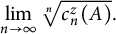
. Hence, it is natural to ask whether it is possible to prove an analogous version of Amitsur’s conjecture for central polynomials. In [Reference Giambruno and Zaicev14], Giambruno and Zaicev gave a positive answer to this question in case A is an associative PI-algebra over a field of characteristic zero: the limit
 $$\begin{align*}\exp^z(A) := \lim\limits_{n \to \infty}\sqrt[n]{c_n^z(A)} \end{align*}$$
exists and it is called the central exponent of A.
Considering algebras with additional structures, the existence of the corresponding exponent and central exponent has already received positive answer in several settings, such as algebras with involution (see [Reference Giambruno, Polcino Milies and Valenti12, Reference Martino and Rizzo23]), group graded algebras [Reference Aljadeff, Giambruno and La Mattina2, Reference Giambruno and La Mattina11, Reference La Mattina, Martino and Rizzo22] and superalgebras with graded involution [Reference Cota, La Mattina, dos Santos and Vieira6, Reference dos Santos, dos Santos and Vieira9, Reference Gordienko16].
In this article, we focus our attention on the class of finite-dimensional superalgebras endowed with a superinvolution. A superalgebra A is an associative algebra graded by
 $\mathbb {Z}_2$
, the cyclic group of order
 $2$
. Hence, A presents a vector space decomposition
 $A=A_0\oplus A_1$
, where the homogeneous components
 $A_0$
and
 $A_1$
satisfy the following properties:
 $A_0 A_0 + A_1 A_1 \subseteq A_0$
and
 $A_0 A_1 + A_1 A_0 \subseteq A_1$
. Furthermore, we assume that A is endowed with a graded linear map
 $\diamond \colon A \rightarrow A$
of order at most
 $2$
such that
 $$\begin{align*}(ab)^{\diamond} = (-1)^{\vert a \vert \vert b \vert} b^\diamond a^\diamond, \end{align*}$$
where
 $\vert a \vert $
and
 $\vert b \vert $
denote, respectively, the degrees of the homogeneous elements
 $a,b \in A_0 \cup A_1$
.
Superalgebras with superinvolution play a prominent role in the setting of Lie and Jordan superalgebras: in fact, the skew-symmetric elements form a Lie superalgebra with respect to the super-commutator product, while the symmetric elements form a Jordan superalgebra with respect to the super-symmetrized product. More details can be found, for instance, in [Reference Kac20, Reference Racine and Zelmanov25].
Within the theory of polynomial identities, the significance of superalgebras with superinvolution was highlighted in
 $2017$
by Aljadeff, Giambruno, and Karasik. In [Reference Aljadeff, Giambruno and Karasik1] they proved that any algebra with involution has the same identities as the Grassmann envelope of a finite-dimensional superalgebra with superinvolution. This result establishes a relationship similar to that demonstrated by Kemer between algebras and superalgebras, and it has led to a thorough study of this kind of algebras and their corresponding identities (see, for instance, [Reference Centrone, Estrada and Ioppolo4, Reference Costa, Ioppolo, dos Santos and Vieira5, Reference Ioppolo18, Reference Ioppolo and Martino19] and the references therein).
According to [Reference Gordienko16, Example 6], any superalgebra with superinvolution can be seen as an algebra with a generalized H-action, where
 $H=F(\mathbb {Z}_2\times \mathbb {Z}_2)$
. As a consequence, in the finite-dimensional case, the existence of the corresponding exponent (called
 $\diamond $
-exponent) can be deduced by the results established by Gordienko in [Reference Gordienko16] for the broader class of algebras with a generalized H-action.
Here, we prove the existence of the so-called central
 $\diamond $
-exponent in the setting of finite-dimensional superalgebras with superinvolution. Moreover, we show that it coincides with the
 $\diamond $
-exponent, provided that the last one is
 $3$
or greater than
 $4$
. In all the other cases, if the
 $\diamond $
-exponent is
 $0$
,
 $1$
,
 $2$
, or
 $4$
, then the central
 $\diamond $
-exponent will take a value among
 $0$
,
 $1$
,
 $2$
,
 $3,$
and
 $4$
, not exceeding the value of the
 $\diamond $
-exponent.
2 Superalgebras with superinvolution
Throughout this article, F will denote a field of characteristic zero. An associative F-algebra A is called a superalgebra if it is graded by
 $\mathbb {Z}_2$
, the cyclic group of order
 $2$
. Given the lack of ambiguity, we will simply use “grading” or “graded” implying that the grading group is
 $\mathbb {Z}_2$
. A superalgebra A admits a vector space decomposition
 $$\begin{align*}A=A_0\oplus A_1 \end{align*}$$
such that
 $A_0 A_0 + A_1 A_1 \subseteq A_0$
and
 $A_0 A_1 + A_1 A_0 \subseteq A_1$
. The elements of
 $A_{0}$
are called homogeneous of degree
 $0$
and those of
 $A_{1}$
homogeneous of degree
 $1$
. An element w of A is homogeneous if it is homogeneous of degree
 $0$
or
 $1$
and we denote its degree by
 $\vert w \vert $
.
We define an elementary grading on the matrix algebra
 $A=M_n(F)$
as a grading induced by
 $g=(g_1,\dots ,g_n) \in \mathbb {Z}_2^n$
and such that
 $$\begin{align*}A_0=\text{span}_F\{e_{ij}\text{ }|\text{ }g_j-g_i=0 \; (\text{mod} \; 2)\}\;\;\; \text{and}\;\;\; A_1=\text{span}_F\{e_{ij}\text{ }|\text{ }g_j-g_i=1 \; (\text{mod} \; 2)\}. \end{align*}$$
In particular, if a string of
 $0$
’s or
 $1$
’s appears in a given n-tuple we will write
 $0^k$
, or
 $1^k$
to represent
 $k 0$
’s or
 $1$
’s appearing in a row. In this way, for
 $k> 0$
and
 $l\geq 0$
such that
 $n=k+l$
we denote by
 $M_{k,l}(F)$
the superalgebra with elementary grading given by
 $(0^k,1^l)$
. Hence, we have the following decomposition:
 $$ \begin{align*} \begin{split} M_{k,l}(F)_{0} &= \left \{ \begin{pmatrix} X & 0\\ 0 & T \end{pmatrix} \text{ }|\text{ } X\in M_k(F),T\in M_l(F)\right \}, \\ M_{k,l}(F)_{1} &= \left \{ \begin{pmatrix} 0 & Y\\ Z & 0 \end{pmatrix} \text{ }|\text{ } Y\in M_{k\times l}(F),Z\in M_{l\times k}(F)\right \}. \end{split} \end{align*} $$
Notice that, since F is a field of characteristic zero, any
 $\mathbb {Z}_2$
-grading on
 $M_n(F)$
is isomorphic to
 $M_{k,l}(F)$
for some k and l (see [Reference Wall28]).
Now recall that a superinvolution on
 $A= A_0 \oplus A_1$
is a graded linear map
 $\diamond \colon A \rightarrow A$
such that
-
1.
 $(a^\diamond )^\diamond = a$
, for all
$a \in A$
,
-
2.
$(ab)^{\diamond } = (-1)^{\vert a \vert \vert b \vert } b^\diamond a^\diamond $
, for any homogeneous elements
$a,b \in A_0 \cup A_1$
.


We shall refer to a superalgebra with superinvolution simply as a
 $\diamond $
-algebra.
A subalgebra or an ideal
 $I \subseteq A$
is homogeneous or graded if
 $I=(I\cap A_{0})\oplus (I \cap A_{1})$
. Also, an ideal (subalgebra) I of a
 $\diamond $
-algebra A is a
 $\diamond $
-ideal (subalgebra) of A if it is a graded ideal (subalgebra) and
 $I^\diamond = I$
. The
 $\diamond $
-algebra A is a simple
 $\diamond $
-algebra if
 $A^2 \neq 0$
and A has no non-trivial
 $\diamond $
-ideals. The structure of a finite-dimensional
 $\diamond $
-algebra is known due to a generalization of the Wedderburn–Malcev decomposition (see [Reference Giambruno, Ioppolo and LaMattina10, Theorem 4.1]).
Theorem 2.1 Let A be a finite-dimensional
 $\diamond $
-algebra over a field F of characteristic
 $0.$
Then, there exists a semisimple
 $\diamond $
-subalgebra B such that
 $$ \begin{align*}A=B\stackrel{.}{+} J \end{align*} $$
as vector spaces and the Jacobson radical J is a
 $\diamond $
-ideal of A. Moreover,
 $$\begin{align*}B \cong B_1 \oplus \cdots \oplus B_q, \end{align*}$$
where
 $B_1, \ldots , B_q$
are simple
 $\diamond $
-algebras.
We can further refine this decomposition since the classification of the
 $\diamond $
-simple algebras is known (see [Reference Bahturin, Tvalavadze and Tvalavadze3, Reference Gomez-Ambrosi and Shestakov15, Reference Racine24]). Before presenting such a classification, we first need some information concerning examples of superinvolutions. In [Reference Racine24], Racine described all types of superinvolution on
 $M_{k,l}(F)$
.
-
• The orthosymplectic superinvolution
$osp$
can be defined on
$M_{k,l}(F)$
if and only if
$ l = 2s $
: where t denotes the usual transpose,
$$ \begin{align*}\begin{pmatrix} X & Y\\ Z & T \end{pmatrix}^{osp} = \begin{pmatrix} I_k & 0\\ 0 & Q \end{pmatrix}^{-1} \begin{pmatrix} X & -Y\\ Z & T \end{pmatrix}^t \begin{pmatrix} I_k & 0\\ 0 & Q \end{pmatrix},\end{align*} $$
$ Q = \begin {pmatrix} 0 & I_s\\ -I_s & 0 \end {pmatrix} $
, and
$ I_k$
,
$ I_s $
are identity matrices of orders
$k, s$
.
-
• The supertranspose superinvolution
$trp$
can be defined on
$M_{k,l}(F)$
if and only if
$ k=l$
by the formula
$$ \begin{align*}\begin{pmatrix} X & Y\\ Z & T \end{pmatrix}^{trp} = \begin{pmatrix} T^t & -Y^t\\ Z^t & X^t \end{pmatrix}. \end{align*} $$


Now, given a superalgebra A, define the corresponding superalgebra
 $A^{sop}$
having the same graded vector space structure as A and product given on homogeneous elements
 $a,b \in A^{sop}$
by
 $$ \begin{align*}a \circ b = (-1)^{\vert a \vert \vert b \vert }ba. \end{align*} $$
Moreover
 $\mathcal{B}= A \oplus A^{sop}$
is a superalgebra with
 $\mathcal {B}_0 = A_0 \oplus A^{sop}_0 $
and
 $\mathcal {B}_1 = A_1 \oplus A^{sop}_1$
and it becomes a
 $\diamond $
-algebra since it is possible to define the so-called exchange superinvolution
 $ex$
as below
 $$ \begin{align*}\left ( a,b \right )^{ex} = \left ( b,a \right ). \end{align*} $$
For example, considering the superalgebra
 $Q(n) = M_n(F \stackrel {.}{+} cF)$
, where
 $c^2 = 1$
, with grading
 $Q(n)_0 = M_n(F)$
and
 $Q(n)_1 = cM_n(F)$
, then
 $Q(n) \oplus Q(n)^{sop}$
is a
 $\diamond $
-algebra with exchange superinvolution.
The following theorem gives the classification of the finite-dimensional simple
 $\diamond $
-algebras presented in [Reference Bahturin, Tvalavadze and Tvalavadze3].
Recall that if A and B are two superalgebras endowed with superinvolutions
 $\diamond $
and
 $\star $
, respectively, then
 $ (A,\diamond ) $
and
 $(B,\star )$
are isomorphic, as
 $\diamond $
-algebras, if there exists an isomorphism of superalgebras
 $ \psi \colon A \rightarrow B $
such that
 $ \psi (x^\diamond ) = \psi (x)^\star $
, for all
 $ x \in A $
.
Theorem 2.2 Let A be a finite-dimensional simple
 $\diamond $
-algebra over an algebraically closed field F of characteristic different from
 $2$
. Then
 $ A $
is isomorphic to one of the following
-
1.
$M_{k,k}(F)$
with supertranspose superinvolution, -
2.
$M_{k,2s}(F)$
with orthosymplectic superinvolution, -
3.
$M_{k, l}(F) \oplus M_{k,l}(F)^{sop} $
with exchange superinvolution, -
4.
$Q(k) \oplus Q(k)^{sop}$
with exchange superinvolution.


3 Polynomial identities and central polynomials
In this section we aim to introduce some notions concerning the theory of polynomial identities in the setting of
 $\diamond $
-algebras. Let A be a
 $\diamond $
-algebra. Since
 $\text {char} F=0$
, we can write
 $$\begin{align*}A=A_0^+ \oplus A_0^-\oplus A_1^+\oplus A_1^-, \end{align*}$$
where for
 $i=0, 1, A_i^+=\{a\in A_i \ | \ a^{\diamond }=a\}$
and
 $A_i^-=\{a\in A_i \ | \ a^{\diamond }=-a\}$
denote the sets of symmetric and skew elements of
 $A_i,$
respectively.
In particular, we can see the free superalgebra with superinvolution (free
 $\diamond $
-algebra), denoted by
 $F \langle Y \cup Z, \diamond \rangle $
, as generated by symmetric and skew variables of even and odd degree. We write
 $$ \begin{align*}F\langle Y \cup Z, \diamond \rangle = F\langle y^+_1, y^-_1, z^+_1, z^-_1, y^+_2, y^-_2, z^+_2, z^-_2, \ldots\rangle,\end{align*} $$
where
 $y_i^+$
stands for a symmetric variable of even degree,
 $y_i^-$
for a skew variable of even degree,
 $z_i^+$
for a symmetric variable of odd degree and
 $z_i^-$
for a skew variable of odd degree. In order to simplify the notation, sometimes we denote by y any even variable, by z any odd variable and by x an arbitrary variable. The elements of
 $F\langle Y \cup Z, \diamond \rangle $
are called
 $\diamond $
-polynomials.
A
 $\diamond $
-polynomial
 $f(y^+_1,\ldots ,y^+_n, y^-_1,\ldots ,y^-_m, z^+_1,\ldots ,z^+_t, z^-_1,\ldots ,z^-_s) \in F\langle Y \cup Z, \diamond \rangle $
is a
 $\diamond $
-identity of the
 $\diamond $
-algebra
 $A = A_0^+ \oplus A_0^- \oplus A_1^+ \oplus A_1^-$
, and we write
 $f\equiv 0,$
if, for all
 $u^+_1, \ldots , u^+_n \in A_0^+$
,
 $u^{-}_1, \ldots , u^{-}_m \in A^{-}_0, v^{+}_1, \ldots , v^{+}_t\in A^{+}_1$
and
 $v^{-}_1, \ldots , v^{-}_s \in A^{-}_1$
, we have
 $$ \begin{align*}f(u^+_1, \ldots, u^+_n, u^-_1, \ldots, u^-_m, v^+_1, \ldots, v^+_t, v^-_1, \ldots, v^-_s) = 0. \end{align*} $$
We denote by
 $\operatorname {\mathrm {Id}}^{\diamond }(A)=\{f\in F\langle Y \cup Z, \diamond \rangle \mid f\equiv 0 \text { on } A\}$
the ideal of
 $\diamond $
-identities of A. Notice that
 $\operatorname {\mathrm {Id}}^{\diamond }(A)$
is a
 $T_2^{\diamond }$
-ideal of
 $F\langle Y\cup Z, \diamond \rangle $
, i.e., an ideal that is invariant under all graded endomorphisms of the free superalgebra
 $F\langle Y \cup Z \rangle $
commuting with the superinvolution
 $\diamond $
.
We denote by
 $\langle f_1, \ldots , f_n \rangle _{T_2^{\diamond }}$
the
 $T_2^{\diamond }$
-ideal generated by
 $f_1, \ldots , f_n \in F\langle Y \cup Z, \diamond \rangle $
.
Since we are in characteristic zero, as in the ordinary case, it is easily seen that every
 $\diamond $
-identity is equivalent to a system of multilinear ones. Hence if we denote by
 $$ \begin{align*}P^{\diamond}_n=\text{span}_F\Bigl\{w_{\sigma(1)} \cdots w_{\sigma(n)}\mid \sigma \in S_n, \ w_i \in \left \{ y^{+}_i, y^{-}_i, z^{+}_i, z^{-}_i \right \}, \ i=1, \ldots, n\Bigr\} \end{align*} $$
the space of multilinear polynomials of degree n in
 $y^{+}_1, y^{-}_1, z^{+}_1, z^{-}_1, \ldots , y^{+}_n, y^{-}_n, z^{+}_n, z^{-}_n\,$
(i.e.,
 $y^{+}_i$
or
 $y^{-}_i$
or
 $z^{+}_i$
or
 $z^{-}_i$
appears in each monomial with degree 1), the study of
 $\operatorname {\mathrm {Id}}^{\diamond }(A)$
is equivalent to the study of
 $P^{\diamond }_n\cap \operatorname {\mathrm {Id}}^{\diamond }(A)$
, for all
 $n\geq 1$
.
The non-negative integer
 $$ \begin{align*}c^{\diamond}_n(A)=\dim_F\frac{P^{\diamond}_n}{P^{\diamond}_n\cap \operatorname{\mathrm{Id}}^{\diamond}(A)},\ n\geq 1, \end{align*} $$
is called the n-th
 $\diamond $
-codimension of A. In [Reference Giambruno, Ioppolo and LaMattina10], the authors proved that the sequence of
 $\diamond $
-codimensions is exponentially bounded, provided that the
 $\diamond $
-algebra satisfies a non-trivial ordinary identity.
In case A is a finitely generated superalgebra with superinvolution and satisfies a non-trivial ordinary polynomial identity, it was proved in [Reference Ioppolo17] that there exist constants
 $C_1>0,C_2,t_1,t_2$
and a non-negative integer d such that
 $$\begin{align*}C_1n^{t_1}d^n\leq c_n^{\diamond}(A)\leq C_2n^{t_2}d^n. \end{align*}$$
Thus we can conclude that
 $$\begin{align*}\displaystyle{\lim_{n \to \infty} \sqrt[n]{c_n^{\diamond}(A)}}=d\end{align*}$$
and so we define the
 $\diamond $
-exponent of A to be this limit and we denote it by
 $\exp ^{\diamond }(A)$
. Also, it is important to mention that the class of
 $\diamond $
-algebras satisfying the identities in the
 $T_2^{\diamond }$
-ideal
 $\operatorname {\mathrm {Id}}^{\diamond }(A)$
is called the variety generated by A and denoted by
 $\operatorname {\mathrm {var}}^\diamond (A)$
. If
 $\mathcal {V}=\operatorname {\mathrm {var}}^\diamond (A)$
, then we consider that
 $c_n^{\diamond }(\mathcal {V})=c_n^{\diamond }(A)$
and
 $\exp ^{\diamond } (\mathcal {V})=\exp ^{\diamond } (A)$
.
In [Reference Ioppolo17], the author showed how to explicitly compute the
 $\diamond $
-exponent of a
 $\diamond $
-algebra.
Let
 $A = \bar {A} + J = A_1 \oplus \cdots \oplus A_n + J$
be a finite-dimensional
 $\diamond $
-algebra, with the
 $A_i$
’s
 $\diamond $
-simple. A
 $\diamond $
-subalgebra B is admissible if either
 $B=B_i$
or if
 $B=B_1\oplus \cdots \oplus B_r$
where
 $B_1, \ldots , B_r$
are distinct subalgebras taken from the set
 $\{A_1, \ldots ,A_n\}$
and
 $$ \begin{align} B_1JB_2J \cdots J B_r\neq 0. \end{align} $$
The
 $\diamond $
-exponent
 $\exp ^\diamond (A)$
is the maximal dimension of an admissible
 $\diamond $
-subalgebra of A:
 $$ \begin{align*}\exp^\diamond(A)= \text{max} \left \{ \dim_F B \mid B \text{ admissible} \right \}. \end{align*} $$
It easily follows that, for a finite-dimensional
 $\diamond $
-algebra A,
 $$ \begin{align*}\exp^{\diamond}(A) \leq \dim_F \bar{A}. \end{align*} $$
In case
 $ \exp ^{\diamond }(A)= \dim _F \bar {A}$
the
 $\diamond $
-algebra is called reduced.
Now we will define central polynomials, the main object of study of this paper.
Let us denote by
 $Z(A)$
the center of an algebra A.
Definition 3.1 We say that
 $f \in F\langle Y\cup Z, \diamond \rangle $
is a central
 $\diamond $
-polynomial of a
 $\diamond $
-algebra A if
-
(1)
$f(a_1,\dots , a_n)\in Z(A)$
, for any
$a_1,\dots ,a_n$
homogeneous elements of A; -
(2) its constant term is zero.


It is easy to see that all
 $\diamond $
-identities of A are central
 $\diamond $
-polynomials. A central
 $\diamond $
-polynomial f such that
 $f \not \in \operatorname {\mathrm {Id}}^{\diamond } (A)$
is called a proper central
 $\diamond $
-polynomial of A.
Here it is important to highlight that, even if a
 $\diamond $
-superalgebra A has a non-zero center, it can happen that A has no proper central
 $\diamond $
-polynomials. We will see some examples later on in this paper.
We will denote by
 $\operatorname {\mathrm {Id}}^{\diamond ,z}(A)$
the set of all central
 $\diamond $
-polynomials of a given
 $\diamond $
-algebra A and it will be called the
 $T_2^{\diamond }$
-space of A. In fact,
 $\operatorname {\mathrm {Id}}^{\diamond ,z}(A)$
is a vector subspace of
 $F\langle Y\cup Z, \diamond \rangle $
which is invariant by endomorphisms of
 $F\langle Y\cup Z, \diamond \rangle $
.
The main goal of this paper is to study the growth of the spaces of the central
 $\diamond $
-polynomials of a
 $\diamond $
-algebra and to compare it with the growth of the spaces of its
 $\diamond $
-identities. To this end, we define the n-th central
 $\diamond $
-codimension of A as
 $$\begin{align*}c_n^{\diamond,z}(A)=\dim_F\frac{P_n^{\diamond}}{P_n^{\diamond}\cap \operatorname{\mathrm{Id}}^{\diamond,z}(A)}. \end{align*}$$
Remark 3.2 Since
 $\operatorname {\mathrm {Id}}^{\diamond }(A)\subseteq \operatorname {\mathrm {Id}}^{\diamond ,z}(A)$
, then
 $c_{n}^{\diamond ,z}(A)\leq c_n^{\diamond }(A)$
.
By the previous remark and according to the fact that
 $c_n^{\diamond }(A)$
is exponentially bounded, it follows that
 $c_n^{\diamond ,z}(A)$
is exponentially bounded. So, a natural question that comes out is asking if the corresponding limit
 $$\begin{align*}\exp^{\diamond,z}(A) = \lim_{n\to \infty} \sqrt[n]{c_n^{\diamond,z}(A)} \end{align*}$$
exists. Note that, as
 $c_n^{\diamond ,z}(A)$
is exponentially bounded, then the following holds.
Remark 3.3 If A is a finite-dimensional
 $\diamond $
-algebra with
 $\exp ^{\diamond }(A) = d$
, then there exist constants
 $C_2>0, t_2$
, such that, for n large enough,
 $$\begin{align*}c_n^{\diamond,z}(A)\leq C_2 n^{t_2} d^n. \end{align*}$$
In Section 5, we will find a lower bound for
 $c_n^{\diamond ,z}(A)$
and conclude that for any finite-dimensional
 $\diamond $
-algebra A such that
 $\exp ^{\diamond }(A)\geq 5$
, the central
 $\diamond $
-exponent
 $\exp ^{\diamond ,z}(A)$
is equal to the
 $\diamond $
-exponent
 $\exp ^{\diamond }(A)$
. Also, we observe that the same is true in case
 $\exp ^{\diamond }(A) = 3$
. In Section 6, we study the remaining possibilities for
 $\exp ^{\diamond }(A)$
and prove the existence of the central
 $\diamond $
-exponent, presenting the possible values for
 $\exp ^{\diamond ,z}(A)$
.
For
 $n\geq 1$
, we can also define the sequence of proper central
 $\diamond $
-codimensions of A as
 $$\begin{align*}c_n^{\diamond,\delta}(A)=\dim_F\frac{P_n^{\diamond}\cap \operatorname{\mathrm{Id}}^{\diamond,z}(A)}{P_n^{\diamond}\cap \operatorname{\mathrm{Id}}^{\diamond}(A)}. \end{align*}$$
It is clear from the definitions of this objects that
 $c_n^{\diamond }(A)=c_n^{\diamond ,z}(A)+c_n^{\diamond ,\delta }(A)$
.
In [Reference La Mattina, dosSantos and Vieira21], La Mattina, dos Santos and Vieira provided information about the existence of the limit
 $$ \begin{align*} \lim\limits_{n \to \infty} \sqrt[n]{c_n^{\diamond, \delta}(A)}. \end{align*} $$
4 The
$\diamond $
-algebras
$UT^{\diamond }(B_1, \ldots , B_m)$


Let A be a finite-dimensional
 $\diamond $
-algebra. The goal of this section is to introduce a suitable
 $\diamond $
-algebra
 $UT_g^{\diamond }(B_{1},\dots ,B_{m})$
belonging to
 $\operatorname {\mathrm {var}}^{\diamond }(A)$
and having the same
 $\diamond $
-exponent as A. Such a construction was obtained by Di Vincenzo and Nardozza (see [Reference DiVincenzo and Nardozza7, Reference DiVincenzo and Nardozza8]).
Let
 $s_1, \ldots ,s_q$
be positive integers and denote by
 $UT(s_1, \ldots ,s_q)$
the upper block triangular matrix algebra of size
 $s_1, \ldots ,s_q$
over F, namely
 $$ \begin{align*}\left \{ \begin{pmatrix} B_{11} & B_{12} & \cdots & B_{1q} \\ 0 & B_{22} & \cdots & B_{2q} \\ \vdots & \ddots & \ddots & \vdots \\ 0 & \cdots & 0 & B_{qq} \end{pmatrix} \mid B_{ij} \in M_{s_i \times s_j}(F), \ 1 \le i \le j \le q \right \}. \end{align*} $$
As anticipated, the
 $\diamond $
-algebra whose construction we are recalling is built from
 $\diamond $
-simple algebras. As observed in [Reference DiVincenzo and Nardozza8], the idea of constructing
 $UT_g^{\diamond }(B_{k_1},\dots ,B_{k_m})$
is to find isomorphic matrix algebras with elementary grading and superinvolution given, up to sign, by reflection along the secondary diagonal for each simple
 $\diamond $
-algebra
 $B_1,\dots ,B_m$
.
First, we recall some preliminary notions and results from [Reference DiVincenzo and Nardozza7].
Let
 $g=(g_1,\dots ,g_p)$
be an elementary grading on
 $M_p(F)$
. Define
 $\text {Rev} g:=(g_p,\dots ,g_1)$
and
 $\mathscr {C} g:=(g_1+1,\dots ,g_p+1)$
the complementary word of g. We denote by
 $\theta _p$
the reflection involution along the secondary diagonal. Finally, define
 $\tilde g:= (g | \mathscr C({\text {Rev} g})$
), where
 $|$
denotes the juxtaposition of words.
From now on, assume the field F to be algebraically closed. We are ready to recall the
 $\diamond $
-embedding
 $\phi $
according to the specific type of simple
 $\diamond $
-algebra, according to Theorem 2.2.
Type 1-2: If A is isomorphic to either
 $M_{k,k}(F)$
with supertranspose superinvolution, or
 $M_{k,2s}(F)$
with orthosymplectic superinvolution, then it has an elementary grading given by
 $g=(g_1,\dots ,g_p)$
, where
 $p=k+l$
, with
 $l=k$
in the former case and
 $l=2s$
in the latter one.
Consider now
 $M_{2p}(F)$
with grading word
 $(g|\text {Rev} g)=(0^k,1^{2l},0^{k})$
and denote
 $L=\{i\in (g|\text {Rev} g) \colon g_i=0\}$
and
 $R=\{i\in (g|\text {Rev} g) \colon g_i=1\}$
. Then,
 $|L|=2k$
and
 $|R|=2l$
. The fiber L is divided into
 $L_1=\{1,\dots ,k\}$
and
 $L_2=\{k+2l+1,\dots ,2k+2l\}$
.
To construct a signed version of
 $\theta _{2p}$
, we assign a signature
 $\eta $
according to the following table (see [Reference DiVincenzo and Nardozza7], [Reference DiVincenzo and Nardozza8]):

Long description
The table has four columns labeled from left to right as eta, L sub 1, R, and L sub 2. The first row under the header contains L sub 1, plus 1, plus 1, and minus 1. The second row contains R, minus 1, plus 1, and plus 1. The third row contains L sub 2, minus 1, minus 1, and plus 1. Each cell is aligned centrally. The variable eta is used as the overarching header for the first column, with L sub 1, R, and L sub 2 as row labels. The numeric values in the table alternate between plus 1 and minus 1, distributed across the columns for each row.
Then, we define
 $\overline {\theta }_{2p}$
by
 $$ \begin{align*} e_{ij}^{\overline{\theta}_{2p}}\colon= \eta(i,j)e_{ij}^{\theta_{2p}}. \end{align*} $$
We call
 $\overline {\theta }_{2p}$
the orthosymplectic superinvolution for
 $(M_{2p}(F),g)$
. So, the embedding is described by the monomorphism
 $\phi $
from
 $A=M_{k,l}(F)$
to
 $ M_{2p}(F)$
with grading given by
 $(g| \text {Rev} g)$
and superinvolution
 $\overline {\theta }_{2p}$
:
 $$\begin{align*}a \longmapsto \begin{pmatrix} a & 0 \\ 0 & (a^{\diamond})^{\overline{\theta}_{p}} \end{pmatrix}, \end{align*}$$
where
 $\diamond $
denotes the superinvolution of
 $M_{k,l}(F)$
.
Type 3: If
 $A = M_{k,l}(F) \oplus M_{k,l}(F)^{sop}$
, then it has an elementary grading given by
 $g=(0^k,1^l)$
, where
 $p=k+l$
. In this case, we can consider the monomorphism
 $\phi $
from A to
 $M_{2p}(F)$
with elementary grading given by
 $(g|\text {Rev} g)=(0^k,1^{2l},0^{k})$
and superinvolution
 $\overline {\theta }_{2p}$
:
 $$\begin{align*}(a,b) \longmapsto \begin{pmatrix} a & 0 \\ 0 & b^{\overline{\theta}_{2p}} \end{pmatrix}, \end{align*}$$
where
 $\overline {\theta }_{2p}$
is defined as in the previous case.
Type 4: If
 $A = Q(k)\oplus Q(k)^{sop}$
, then it has an elementary grading given by
 $g=(0^k,1^k)$
, where
 $p=2k$
. In this case, we can consider
 $M_{2p}(F)$
with grading given by
 $(g|\text {Rev} g)=(0^k,1^{2k},0^{k})$
. The fibers L and R have the same cardinality (see [Reference DiVincenzo and Nardozza7]). So,
 $2k=|L|=|R|$
. We define the sign map (see [Reference DiVincenzo and Nardozza8])
 $\epsilon \colon [2k]\times [2k] \to \{\pm 1\}$
by
 $$ \begin{align*}\epsilon(i,j)=\begin{cases} -1 & \text{if }(i,j) \in L\times R\\ +1 & \mathrm{otherwise}.\\ \end{cases} \end{align*} $$
Then, the map
 $\overline {\theta }=\overline {\theta }_{2p}$
defined by
 $$ \begin{align*}e_{ij}^{\overline{\theta}_{2p}}\colon = \epsilon(i,j) e_{ij}^{\theta_{2p}} \end{align*} $$
is a superinvolution and it is called the supertranspose and the embedding is given by the monomorphism
 $\phi $
from A to
 $M_{2p}(F)$
with elementary grading given by
 $(g|\text {Rev} g)$
and superinvolution
 $\overline {\theta }_{2p}$
:
 $$\begin{align*}(a + cb, a' + cb') \longmapsto \begin{pmatrix} \begin{pmatrix} a & b \\ b & a \end{pmatrix} & 0 \\ 0 & \begin{pmatrix} a' & b' \\ b' & a' \end{pmatrix}^{\overline{\theta}_{p}} \end{pmatrix}. \end{align*}$$
For each type of simple
 $\diamond $
-algebras, any
 $a \in A$
gives rise to a pair of
 $p\times p$
matrices
 $(a', a")$
such that
 $$\begin{align*}\phi(a) = \begin{pmatrix} a' & 0 \\ 0 & a" \end{pmatrix} \in M_{2p}(F) \end{align*}$$
for the appropriate p, and in each case,
 $\phi $
turns out to be a
 $\diamond $
-embedding.
Now, let
 $(B_1, \ldots , B_q)$
be a sequence of simple
 $\diamond $
-algebras, each
 $B_u$
with size
 $p_u$
and grading word
 $g_u$
, chosen for the embedding
 $B_u \hookrightarrow M_{2p_u}(F)$
. Note that the size of
 $B_u$
is
 $$\begin{align*}p_u:=\!\begin{cases} k_u+2s_u \!&\text{if } B_u={ M_{k_u,2s_u}(F)}, \\ k_u+l_u\!&\text{if } B_u= M_{k_u,l_u}(F)\oplus { M_{k_u,l_u}(F)}^{sop} , \\ 2k_u &\mbox{if } B_u=M_{k_u,k_u}(F) \text{ or } B_u=Q(k_u)\oplus { Q(k_u)}^{sop}. \end{cases} \end{align*}$$
Moreover, set
 $\eta _{0}:=0$
and
 $\displaystyle \eta _{u}:=p_1 + \cdots + p_u $
, for any
 $u\in \{1, \dots , q\}$
.
Then, consider the semisimple
 $\diamond $
-algebra
 $B = B_1 \oplus \cdots \oplus B_q$
and set the size to
 $$\begin{align*}p := p_1 + \cdots + p_q. \end{align*}$$
Moreover, set
 $g:=(g_1|g_2|\cdots |g_q)$
, so that the algebra
 $M_{2p}(F)$
has grading induced by
 $\tilde g$
and it is endowed with the standard supertranspose
 $trp$
. Then, the map
 $\phi \colon B \to M_{2p}(F)$
defined by
 $$ \begin{align} \phi(a_1\dots,a_q)=\phi \left(\begin{pmatrix} a_1' & 0\\ 0 & a_1"\\ \end{pmatrix},\dots, \begin{pmatrix} a_q' & 0\\ 0 & a_q"\\ \end{pmatrix}\right) =\begin{pmatrix} a_1' \\ & \ddots \\ && a_q' \\ && & a_q" \\ & && & \ddots \\ && & & & a_1" \end{pmatrix} \end{align} $$
is a
 $\diamond $
-embedding of the semisimple
 $\diamond $
-algebra B into
 $M_{2p}(F)$
. We say that (M
2p
(F), α) is the simple enveloping
 $\diamond $
-algebra of the sequence (B
1, …, B
q
).
Now, for
 $i, j \in \{1,\dots , q \}$
, let
 $$ \begin{align} U_{ij}:=e_{ij} \otimes{M_{p_i \times p_j}}(F)\subseteq M_{2p}(F) \end{align} $$
and denote its
 $trp$
-image by
 $\overline {U_{ij}} := U^{trp}_{ij} \subseteq {M_{2p}}(F)$
.
Definition 4.1 If
 $(B_1, \ldots , B_q)$
is a sequence of finite-dimensional simple
 $\diamond $
-algebras, let
 $M_{2p}(F)$
be its simple enveloping
 $\diamond $
-algebra and define
 $$\begin{align*}UT^{\diamond}(B_1, \ldots, B_q) := \phi(B) \oplus \bigoplus_{\substack{1 \leq i<j\leq q}} (U_{ij} \oplus \overline {U_{ij}}) \subseteq U, \end{align*}$$
where
 $U \displaystyle := \bigoplus _{\substack {1 \leq i\leq j\leq q}} (U_{ij} \oplus \overline {U_{ij}}) \subseteq M_{2p}(F).$
Note that the Jacobson radical of
 $UT^{\diamond }(B_1, \ldots , B_q)$
is
 $$\begin{align*}J := \bigoplus_{\substack{1\leq i<j\leq q}} (U_{ij} \oplus \overline{U_{ij}}). \end{align*}$$
Finally, for any
 $\alpha \in \mathbb {Z}_2^q$
,
 $UT_{\alpha }^{\diamond } (B_1, \ldots , B_q)$
is the
 $\diamond $
-algebra
 $UT^{\diamond }(B_1, \ldots , B_q)$
with grading induced by
 $\alpha +\tilde g$
. We will call any algebra of this kind a triangular algebra.
We are in a position to state the following result.
Theorem 4.2 Let A be a finite-dimensional
 $\diamond $
-algebra of
 $\diamond $
-exponent d. Then, there exist finite-dimensional simple
 $\diamond $
-algebras
 $B_1, \ldots , B_m$
and an element
 $g\in \mathbb {Z}_2^m$
such that
 $\dim _F(B_1\oplus \cdots \oplus B_m)=d$
and
 $$\begin{align*}UT_{g}^{\diamond}(B_1,\ldots, B_m) \in \operatorname{\mathrm{var}}^{\diamond}(A). \end{align*}$$
As a final remark, we observe that if
 $\dim _F(B_1\oplus \cdots \oplus B_m)=d$
, then
 $$\begin{align*}\exp^{\diamond}(UT_{g}^{\diamond}(B_1,\ldots, B_m)) = d. \end{align*}$$
5 On the central
$\diamond $
-exponent

In this section, we aim to prove the existence of the central
 $\diamond $
-exponent
 $\exp ^{\diamond ,z}(A)$
for a finite-dimensional
 $\diamond $
-algebra A. To this end, we will need to examine the possible values of
 $\exp ^{\diamond }(A)$
. We start by considering the situations
 $\exp ^{\diamond }(A)\in \{0, 1, 3, d\},$
where
 $d\geq 5$
. In the next section, we treat the cases
 $\exp ^{\diamond }(A)=2$
and
 $\exp ^{\diamond }(A)=4$
.
 $\bullet \ \textbf {exp}^{\mathbf {\diamond }}\boldsymbol {(A)}\mathbf {=0}$
: In this case, A is nilpotent and clearly we have that
 $\exp ^{\diamond ,z}(A)=0$
.
 $\bullet \ \textbf {exp}^{\mathbf {\diamond }}\boldsymbol {(A)}\mathbf {=1}$
: There are two possibilities.
If
 $c_n^{\diamond ,z}(A)=0$
for some n, then we have that
 ${c_{k}^{\diamond ,z}}(A)=0$
for all
 $k\geq n$
and so
 $\exp ^{\diamond ,z}(A)=0$
.
If
 $c_n^{\diamond ,z}(A)\neq 0$
for all n then according to Remark 3.3, there exist constants
 $C_2,t_2$
such that, for all n,
 $$\begin{align*}1\leq c_n^{\diamond,z}(A)\leq C_2n^{t_2}. \end{align*}$$
Hence,
 $\exp ^{\diamond ,z}(A)=1$
.
 $\bullet \ \textbf {exp}^{\mathbf {\diamond }}\boldsymbol {(A)} \mathbf {> 1}$
.
First, we give an example, highlighting the important role that triangular algebras play in this situation.
Example 5.1 Let us consider the
 $\diamond $
-algebra
 $A=B_1\oplus B_2 + J$
such that
 $B_1JB_2\neq 0$
, where
-
-
$B_1=M_{2,0}(F)\oplus M_{2,0}(F)^{sop}$
with exchange superinvolution; -
-
$B_2= M_{1,1}(F)$
with transpose superinvolution.


Notice that
 $\exp ^{\diamond }(B_1)=8$
and, by [Reference Ioppolo17],
 $\exp ^{\diamond }(B_2)=4$
. Since
 $\dim _F(B_1\oplus B_2)=12$
, it follows that
 $$ \begin{align*}\exp^{\diamond}(A)=12. \end{align*} $$
Now, we want to construct
 $UT_g^{\diamond }(B_1,B_2)\in \text {var}^{\diamond }(A)$
, by following the steps explained in the previous section. We have
 $p_1=2$
,
 $ p_2=2$
,
 $ p=p_1+p_2=4$
and
 $2p=8$
. Hence,
 $$ \begin{align*}\tilde{U}=UT_g^{\diamond}(B_1,B_2) {:=} \begin{pmatrix} a & b & u_{11} & u_{12} \\ c & d & u_{21} & u_{22} \\ & & j & k\\ & & l & m\\ & & & & j & -k & \overline{u}_{11} & \overline{u}_{12} \\ & & & & -l & m & \overline{u}_{21} & \overline{u}_{22} \\ & & & & & & i & h\\ & & & & & & f & e\\ \end{pmatrix}\end{align*} $$
where
 $g=(0^3,1^2,0^3)$
,
 $\overline {u}_{rt}=u^{\overline {\theta }}_{rt}$
for
 $r,t=1,2$
and according to the notation established in (4.2),
 $$ \begin{align*}J(\tilde{U})=U_{12}\oplus \overline{U_{12}}. \end{align*} $$
Our next goal is to show that
 $J(\tilde {U})\cap Z(\tilde {U})=\{0\}$
. Consider
 $j\in J(\tilde {U})\cap Z(\tilde {U})$
. So
 $j\in U_{12} \cup \overline {U_{12}}$
. Moreover, since
 $j\in Z(\tilde {U})$
, we must have
 $a_1j=ja_1$
and
 $a_2j=ja_2$
, where
 $a_1 := \psi (1_{B_1})$
and
 $a_2 :=\psi (1_{B_2})$
. So,
 $$ \begin{align*}a_1=e_{11}+e_{22}+e_{77}+e_{88}\;\;\text{and}\;\;a_2=e_{33}+e_{44}+e_{55}+e_{66}.\end{align*} $$
An easy computation shows that
 $$ \begin{align*} \begin{split} a_1j &= u_{11}e_{13}+u_{12}e_{14}+u_{21}e_{23}+u_{22}e_{24}, \\ ja_1 &= \overline{u}_{11}e_{57}+\overline{u}_{12}e_{58}+\overline{u}_{21}e_{67}+\overline{u}_{22}e_{68}. \end{split} \end{align*} $$
Since
 $a_1j=ja_1$
, it follows that
 $u_{rt}= \bar {u}_{rt} =0$
, for all
 $r,t=1,2$
, and so
 $j=0$
, as desired.
Observe that, if f is a central multilinear
 $\diamond $
-polynomial, we may assume without loss of generality that every variable of f appears in every monomial of f. In fact, if
 ${f=\sum f_i}$
is a sum of monomials
 $f_i$
, where distinct sets of variables appear in each
 $f_i$
, then each monomial
 $f_i$
is also a central
 $\diamond $
-polynomial. In order to prove the last statement, fix an index k and take an arbitrary evaluation
 $\mu (f_k)$
. Now define the evaluation
 $\mu '$
of f such that
 $\mu '(f_k)=\mu (f_k)$
and all variables not appearing in
 $f_k$
are evaluated in zero. Since f is a central
 $\diamond $
-polynomial, we have that
 $\mu '(f)=\sum \mu '(f_i)=\mu '(f_k)=\mu (f_k)$
is a central element; thus,
 $f_k$
is also a central
 $\diamond $
-polynomial.
Now, let f be a multilinear central
 $\diamond $
-polynomial. As
 $ J(\tilde {U})\cap Z(\tilde {U})=\{0\}$
and
 $B_1\cap B_2=\{0\}$
, then we have to evaluate all the variables of f in the same simple component, either
 $B_1$
or
 $B_2$
. It follows that any evaluation
 $\lambda $
of f is such that
 $\lambda (f) = \alpha a_1$
or
 $\lambda (f) = \beta a_2$
, for some
 $\alpha , \beta \in F$
. Taking
 $m \in U_{12}$
, it follows that
 $ \alpha a_1 m= \alpha m = m \alpha a_1 = 0$
. Hence,
 $\alpha =0$
. Analogously, one gets
 $\beta =0$
. In conclusion,
 $$ \begin{align*}c_n^{\diamond, z}(\tilde{U})=c_n^{\diamond}(\tilde{U}). \end{align*} $$
Since
 $\tilde {U}\in \text {var}^{\diamond }(A)$
, according to [Reference Ioppolo17], there exist some constants
 $Q_1>0$
,
 $t_1$
such that, for all n,
 $$\begin{align*}c_n^{\diamond, z}(A)\geq c_n^{\diamond, z}(\tilde{U})=c_n^{\diamond}(\tilde{U})\geq Q_1n^{t_1}12^n. \end{align*}$$
Taking into account Remark 3.3, we can conclude that
 $\exp ^{\diamond ,z}(A)=12$
.
Now, let us show that the Jacobson radical of
 $UT^{\diamond }_{g}(B_1,\ldots ,B_m)$
has trivial intersection with its center.
Lemma 5.2
 $Z(UT^{\diamond }_{g}(B_1,\ldots ,B_m)) \cap J(UT^{\diamond }_{g}(B_1,\ldots ,B_m))=\{0\}.$
Proof It is sufficient to follow step by step the proof of [Reference dos Santos, dos Santos and Vieira9, Proposition 4.1], with the necessary changes.
Using the same arguments of [Reference dos Santos, dos Santos and Vieira9, Proposition 4.2], by Lemma 5.2, we get the following result.
Proposition 5.3 If
 $m \geq 2$
, then
 $UT^{\diamond }_{g}(B_1,\ldots ,B_m)$
does not have proper central
 $\diamond $
-polynomials.
Now, we are ready to prove the following result.
Corollary 5.4 Considering
 $\tilde {U}= UT^{\diamond }_{g}(B_1,\ldots ,B_m)$
with
 $m \geq 2$
, we have
 $ c_n^{\diamond ,z}(\tilde {U})=c_n^{\diamond }(\tilde {U}).$
Moreover, if A is a finite-dimensional
 $\diamond $
-algebra such that
-
•
$\exp ^{\diamond }(A)=d$
and -
•
$\tilde {U} \in \text {var}^{\diamond }(A)$
, with
$\dim _F(B_1\oplus \cdots \oplus B_m)=d$
,


then
 $\exp ^{\diamond ,z}(A)=d$
.
Proof As observed in Section
 $4$
, we have that
 $\exp ^{\diamond }(\tilde {U})=d$
and
 $\tilde {U} \in \text {var}^{\diamond }(A)$
. By Proposition 5.3, we get
 $$\begin{align*}c_n^{\diamond,z}(A) \geq c_n^{\diamond,z}(\tilde{U})=c_n^{\diamond}(\tilde{U}) \geq Q_1n^{r_1}d^n, \end{align*}$$
for some constants
 $Q_1, r_1$
. Using Remark 3.3, this implies that
 $\exp ^{\diamond ,z}(A)=d$
.
 $\bullet \ \textbf {exp}^{\mathbf {\diamond }}\boldsymbol {(A)}\mathbf {=3}$
.
Observe that there is no three-dimensional simple
 $\diamond $
-algebra. Hence, by Theorem 4.2, at least one of the triangular algebras
 $UT^{\diamond }_{g}(F,F,F)$
or
 $UT^{\diamond }_{g}(B,F)$
, where
 $\dim _F B=2$
, belongs to
 $\text {var}^{\diamond }(A)$
. Then, as a direct consequence of Corollary 5.4, we conclude that
 $\exp ^{\diamond ,z}(A)=\exp ^{\diamond }(A)=3$
.
 $\bullet\ \textbf {exp}^{\mathbf {\diamond }}\boldsymbol {(A)}\mathbf { \ge 5}$
.
Our main goal is to prove that, in this situation, the central
 $\diamond $
-exponent exists and it has the same value as
 $\exp ^{\diamond }(A)$
. To this end, we need a technical lemma.
Lemma 5.5 Let B be a finite-dimensional simple
 $\diamond $
-algebra such that
 $\dim _F B\geq 5$
. Then, there exists an element
 $b\in B$
such that, for all non-zero
 $a\in Z(B)$
, we have that
 $ab\notin Z(B)$
.
Proof According to Theorem 2.2, we have to consider the following possibilities.
-
•
$B\cong M_{k,l}(F)$
, with
$k+l \geq 2$
.The element we are looking for is
$b=e_{1,k+l}+I_{k+l}$
. In fact, taking
$a=\delta I_{k+l} \in Z(B)$
, we get
$$\begin{align*}ab=\delta(I_{k+l}+e_{1,k+l})\notin Z(B). \end{align*}$$
-
•
$B\cong M_{k,l}(F) \oplus M_{k,l}^{sop}(F)$
, with
$k\geq 2$
.The element we are looking for is
$b=(I_{k+l}+e_{1,k+l},I_{k+l}+e_{1,k+l})$
. -
•
$B\cong Q(k) \oplus Q(k)^{sop}$
,
$k \ge 2$
.In this case, we can consider
$b=(I_{k}+e_{1,k}, I_{k}+e_{k,1})$
.


Now, we are in a position to prove the main result of this section.
Theorem 5.6 Let A be a finite-dimensional
 $\diamond $
-algebra. If
 $\exp ^{\diamond }(A)=d \geq 5$
, then there exist non-zero constants
 $Q_1,C_2,r_1,t_2$
, such that, for n large enough,
 $$\begin{align*}Q_1n^{r_1}d^n \leq c_n^{\diamond,z}(A) \leq C_2n^{t_2}d^n. \end{align*}$$
Proof According to Remark 3.3, we already have the desired upper bound. In order to complete the proof, we need to find a suitable lower bound as well.
Let
 $\tilde {U}=UT^{\diamond }_{g}(B_1,\ldots ,B_m)$
be the
 $\diamond $
-algebra obtained according to Theorem 4.2. Since
 $\tilde {U} \in \text {var}^\diamond (A)$
, if
 $m\geq 2$
, we are done by Corollary 5.4.
Now, assume
 $m=1$
. Hence,
 $\tilde {U}=UT^{\diamond }_{g}(B_1)\cong B_1$
, that is,
 $\tilde {U}$
is a simple
 $\diamond $
-algebra with dimension
 $d\geq 5$
and
 $\exp ^\diamond (\tilde {U})=d$
. Recall that, since
 $\tilde {U}\in \text {var}^\diamond (A)$
, we have that
 $\operatorname {\mathrm {Id}}^{\diamond ,z}(A)\subseteq \operatorname {\mathrm {Id}}^{\diamond ,z}(\tilde {U})$
, and so
 $c_n^{\diamond ,z}(A) \geq c_n^{\diamond ,z}(\tilde {U})$
. Thus, we are left to find a lower bound for
 $c_n^{\diamond ,z}(\tilde U)$
. Fix n and write
 $c_n^{\diamond }(\tilde U):=N$
. This means that there exist
 $f_1,\dots ,f_N\in P_n^{\diamond }$
that are linearly independent
 $\diamond $
-polynomials modulo
 $\operatorname {\mathrm {Id}}^\diamond ( {\tilde {U}})$
.
We wish to prove that, in this situation,
 $c_{n+1}^{\diamond ,z}(\tilde U)\geq c_n^{\diamond }(\tilde U)$
. Consider the multilinear
 $\diamond $
-polynomial
 $$ \begin{align*}w(y_{n+1}^+,y_{n+1}^- , z_{n+1}^+ , z_{n+1}^-) = y_{n+1}^+ + y_{n+1}^- + z_{n+1}^+ + z_{n+1}^-. \end{align*} $$
It is clear that, for any element
 $u\in \tilde {U}$
, there must be an evaluation
 $\mu '$
such that
 ${\mu '(w)=u}$
. We will show that
 $f_1w,\dots ,f_Nw$
are linearly independent modulo
 $\operatorname {\mathrm {Id}}^{\diamond ,z}({\tilde {U}})$
.
Fix
 $\lambda _1,\dots ,\lambda _N$
not all zero scalars and consider the
 $\diamond $
-polynomial
 $f=\lambda _1f_1+\dots +\lambda _Nf_N$
. Since f is not an identity of
 $\tilde {U}$
, there exists an evaluation
 $\mu "$
of f such that
 $\mu "(f)\neq 0$
. We wish to show that
 $fw$
is not a central
 $\diamond $
-polynomial of
 $\tilde {U}$
. To this end, consider the evaluation
 $\mu $
of
 $fw$
such that
 $\mu (fw)=\mu "(f)\mu '(w)$
, where
 $$ \begin{align*}\mu'(w)= \begin{cases} 1_{\tilde{U}} & \text{if } \mu"(f)\notin Z(\tilde{U})\\ b\in \tilde{U} & \text{otherwise,} \end{cases} \end{align*} $$
where
 $b\in \tilde {U}$
is the element given in Lemma 5.5.
In both cases, the result of the evaluation
 $\mu (fw)$
does not belong to the center of
 $\tilde {U}$
and so we conclude that
 $fw$
is not central. A similar reasoning proves that each
 $\diamond $
-polynomial
 $f_i$
is also not central. Thus, we get that
 $f_1w,\dots ,f_Nw$
are linearly independent modulo
 $\operatorname {\mathrm {Id}}^{\diamond ,z} (\tilde {U})$
. This means that
 $c_{n+1}^{\diamond ,z}(\tilde {U})\geq N= c_n^{\diamond }(\tilde {U})$
. Since
 $c_n^{\diamond }(\tilde {U})\geq Q_1n^{r_1}d^n$
, for some constants
 $Q_1, r_1$
, we are sure that, for n large enough, we have
 $c_n^{\diamond ,z}(\tilde {U}) \geq Q_1n^{r_1}d^n$
. The proof is complete.
As a consequence, we immediately get the following corollary.
Corollary 5.7 If A is a finite-dimensional
 $\diamond $
-algebra and
 $\exp ^{\diamond }(A) \geq 5$
, then
 $\exp ^{\diamond ,z}(A)$
exists and
 $$\begin{align*}\exp^{\diamond,z}(A)=\exp^\diamond(A). \end{align*}$$
6 Particular cases
In this section, we shall treat the remaining possibilities for the
 $\diamond $
-exponent, that is,
 $\exp ^{\diamond }(A)\in \{2,4\}$
.
 $\bullet\ \textbf {exp}^{\mathbf {\diamond }}\boldsymbol {(A)}\mathbf {=2}$
.
Assume first that
 $UT^{\diamond }_{g}(F,F) \in \text {var}^{\diamond }(A)$
. By Corollary 5.4, we immediately get
 $\exp ^{\diamond ,z}(A)=2$
.
On the other hand, by Theorem 4.2, there exists
 $B_i\in \text {var}^{\diamond }(A)$
, where
 $B_i$
is a simple
 $\diamond $
-algebra with
 $\exp ^{\diamond }(B_i)=2$
. According to Theorem 2.2, up to isomorphism, we have that
 $B_i\cong F\oplus F$
with trivial grading and exchange superinvolution. Since the grading is trivial, the exchange superinvolution can be seen as a (graded) involution and so, as in [Reference dos Santos, dos Santos and Vieira9], we obtain the following result.
Proposition 6.1 Suppose that A is a finite-dimensional
 $\diamond $
-algebra, where
 $\exp ^{\diamond }(A)=2$
and
 $UT^{\diamond }_{g}(F,F) \notin \text {var}^{\diamond }(A)$
, then
 $\exp ^{\diamond ,z}(A)$
exists and
 $\exp ^{\diamond ,z}(A)\in \{0,1,2\}$
.
In conclusion, we have the following corollary.
Corollary 6.2 If A is a finite-dimensional
 $\diamond $
-algebra such that
 $\exp ^{\diamond }(A)=2$
, then
 $\exp ^{\diamond ,z}(A)$
exists and
 $\exp ^{\diamond ,z}(A)\in \{0,1,2\}$
.
 $\bullet\ \textbf {exp}^{\mathbf {\diamond }}\boldsymbol {(A)}\mathbf {=4}$
.
By Corollary 5.4, if
 $UT^{\diamond }_{g}(B_1,\dots ,B_m) \in \text {var}^{\diamond }(A)$
,
 $g\in \mathbb {Z}_2^m$
with
 $\dim _F(B_1\oplus \cdots \oplus B_m)=4$
and
 $m\geq 2$
, then
 $$ \begin{align*}\exp^{\diamond,z}(A)=4. \end{align*} $$
Otherwise, we have that
 $m=1$
. Consider
 $A= B_1\oplus \cdots \oplus B_r \stackrel {.}{+} J(A)$
. By Theorem 4.2, there exists
 $B_i\in \text {var}^{\diamond }(A)$
, where
 $B_i$
is a simple
 $\diamond $
-algebra with
 $\dim _F(B_i)=\exp ^{\diamond }(B_i)=4$
. According to Theorem 2.2, it follows that
 $B_i$
must be isomorphic to one of the following simple
 $\diamond $
-algebras:
-
-
$M_{2,0}(F)$
with trivial grading and orthosymplectic superinvolution; -
-
$M_{1,1}(F)$
with transpose superinvolution; -
-
$(F+ cF) \oplus (F + cF)$
, with grading
$(F\oplus F, cF\oplus cF)$
and exchange superinvolution.


In the first two cases, we can find suitable elements as those given in Lemma 5.5. Consequently, applying similar arguments as those used in the proof of [Reference dos Santos, dos Santos and Vieira9, Theorem 4.5], it is possible to find a lower bound for the central
 $\diamond $
-graded codimensions of A and conclude that
 $\exp ^{\diamond ,z}(A)=4$
.
From now on, we will focus our attention on the third situation.
Remark 6.3 The simple
 $\diamond $
-algebra
 $B=(F+ cF) \oplus (F + cF)$
has three distinct homogeneous elements
 $x_1, x_2,$
and
 $x_3$
such that
 $x_1^2=(1,1)$
and
 $x_i^2=(1,-1)$
, with
 $i=2,3$
. In fact, it is enough to consider
-
-
$x_1:=(1,-1)$
, a skew element of homogeneous degree
$0$
; -
-
$x_2:=(c1,c1)$
, a symmetric element of homogeneous degree
$1$
; -
-
$x_3:=(c1,-c1)$
, a skew element of homogeneous degree
$1$
.


Again we will follow a similar reasoning as the one presented in [Reference dos Santos, dos Santos and Vieira9]. First consider the case
 $r=1$
, that is,
 $B_1$
is the single simple component of the maximal semisimple subalgebra of A which is isomorphic to
 $(F+ cF) \oplus (F + cF)$
.
Proposition 6.4 Suppose that
 $A= B_1\stackrel {.}{+} J(A)$
, where
 $B_1 \cong (F+ cF) \oplus (F + cF)$
, then
 $\exp ^{\diamond ,z}(A)$
exists and it is either
 $0$
or
 $4$
.
Proof Assume first that for all
 $b \in A$
,
 $1_{B_1}b\in Z(A)$
. Then, for n large enough,
 $c_n^{\diamond ,z}(A)=0$
and so
 $$ \begin{align*}\text{exp}^{\diamond,z}(A)=0. \end{align*} $$
Now assume there exists an element
 $b\in A$
such that
 $1_{B_1}b\notin Z(A)$
, and we may assume it to be homogeneous without loss of generality. In order to show the existence of the central
 $\diamond $
-graded exponent, we will find a suitable lower bound for
 $c_n^{\diamond ,z}(A)$
.
Let us fix
 $n\geq 4$
and for
 $0\leq i\leq n-2$
with
 $n-i-2$
even, consider the following set of monomials:
 $$ \begin{align*}Q_{i}:= \{y_{q_1}^+\cdots y_{q_i}^+y_{r_1}^- \cdots y_{r_j}^-z_{s_1}^+ \cdots z_{s_k}^+z_{t_1}^- \cdots z_{t_l}^-w^{\prime}_{n-1}w_{n}\}\end{align*} $$
-
-
$w_n$
is a variable of the same homogeneous degree as the element b; -
-
$j,k,l$
run through all combinations of even non-negative integers such that
$j+k+l=n-i-2$
; -
-
$w^{\prime }_{n-1}=y_{n-1}^+$
if
$k+l\equiv 0 (\text {mod} \; 4)$
or
$w^{\prime }_{n-1}=z_{n-1}^+$
otherwise; -
-
$q_1<\cdots < q_i$
,
$r_1<\cdots < r_j$
,
$s_i<\cdots <s_k$
,
$t_1<\cdots <t_l$
; -
-
$ \{q_1,\dots ,q_i\} \cup \{r_1,\dots ,r_j\} \cup \{s_1,\dots ,s_k\} \cup \{t_1,\dots ,t_l\}=\{1,\dots ,n-2\}$
.


Also, we consider
 $Q:=\bigcup \limits _{n-i-2\text { even}} Q_i$
.
By following the same steps as in [Reference dos Santos, dos Santos and Vieira9], we can conclude that
 $|Q|\geq 4^{n-4}$
. In fact,
 $$ \begin{align*} \begin{split} |Q| &= 2^{2n-7}-2^{n-4} \geq 4^{n-4}, \text{ if } n \text{ is odd}, \\ |Q| &= 2^{2n-7}+2^{n-3} \geq 4^{n-4}, \text{ if } n \text{ is even}. \end{split} \end{align*} $$
We are left to show that the elements of Q are not central and linearly independent modulo
 $\operatorname {\mathrm {Id}}^{\diamond ,z}(A)$
.
Recall that
 $x_1, x_2,$
and
 $x_3$
are the elements given in Remark 6.3. We will consider an evaluation
 $\lambda $
such that
 $w_n$
goes in the element b and the remaining variables will be evaluated in
 $1_{B_1}$
,
 $ x_1$
,
 $ x_2,$
and
 $x_3$
according to their corresponding homogeneous degrees. It follows that
 $$\begin{align*}\lambda \left( y_{q_1}^+\cdots z_{t_l}^-w^{\prime}_{n-1}w_{n} \right) =\! \begin{cases} 1_{B_1}1_{B_1}b=1_{B_1}b \notin Z(A) \!&\text{if } k+l\equiv 0\quad (\text{mod} \; 4), \\x_1x_1b=1_{B_1}b \notin Z(A) \!&\mbox{if } k+l\not\equiv 0\quad (\text{mod} \; 4). \end{cases} \end{align*}$$
In conclusion, all the elements of Q are not central. The proof that they are linearly independent is identical to the one presented in [Reference dos Santos, dos Santos and Vieira9].
By putting all this together, for some constants
 $C_2$
and
 $t_2$
, the following inequality holds for all
 $n\geq 4$
:
 $$\begin{align*}{4^{n-4}}\leq c_n^{\diamond,z}(A)\leq C_2n^{t_2}4^n.\end{align*}$$
It follows that
 $\text {exp}^{\diamond ,z}(A)=4$
and the proof is complete.
According to the above proposition, we can apply the same steps as in [Reference dos Santos, dos Santos and Vieira9], to obtain the following result.
Proposition 6.5 Let
 $A=B \stackrel {.}{+} J(A)$
with
 $\text {exp}^{\diamond }(A)=4$
, where
 $B=B_1\oplus \cdots \oplus B_r$
,
 ${r\geq 2}$
, and
 $B_i\cong (F+ cF) \oplus (F + cF)$
, for some
 $i \in \{1, \ldots , r\}$
. Then,
 $\text {exp}^{\diamond ,z}(A)$
exists and
 $\text {exp}^{\diamond ,z}(A)\in \{0,1,2,3,4\}$
.
In the next corollary, we summarize all the above results.
Corollary 6.6 If A is a finite-dimensional
 $\diamond $
-superalgebra such that
 $\text {exp}^{\diamond }(A)=4$
then
 $\text {exp}^{\diamond ,z}(A)$
exists and
 $\text {exp}^{\diamond ,z}(A)\in \{0,1,2,3,4\}$
.
Finally, we provide an example that illustrates what can happen when the hypotheses of Proposition 6.4 are not satisfied.
Example 6.7 Let us consider the
 $\diamond $
-algebra
 $A=A_1\oplus A_2$
, where
-
-
$A_1=(F+cF)\oplus (F+cF)^{sop}$
; -
-
$A_2=UT^{\diamond }_{g}(F,F,F)$
, with
$g=(0^3)$
.


Notice that
 $A_1$
is a commutative algebra,
 $\exp ^{\diamond }(A_1)=4$
and
 $\exp ^{\diamond }(A_2)=3$
. Thus,
 $\exp ^{\diamond }(A)=4$
.
Now, let us compute the central
 $\diamond $
-exponent of A. Since
 $A_1$
is a commutative algebra, any polynomial with no constant term is central for
 $A_1$
. This implies that
 $$ \begin{align*}\operatorname{\mathrm{Id}}^{\diamond,z}(A)=\operatorname{\mathrm{Id}}^{\diamond,z}(A_1)\cap \operatorname{\mathrm{Id}}^{\diamond,z}(A_2)=\operatorname{\mathrm{Id}}^{\diamond,z}(A_2). \end{align*} $$
So
 $c_n^{\diamond ,z}(A)=c_n^{\diamond ,z}(A_2)$
. Moreover, we can apply Proposition 5.3 to
 $A_2$
and conclude that it has no proper central polynomials. Then,
 $c_n^{\diamond ,z}(A)=c_n^{\diamond ,z}(A_2)=c_n^{\diamond }(A_2)$
. This implies that
 $$\begin{align*}\exp^{\diamond,z}(A) = \lim_{n\to \infty} \sqrt[n]{c_n^{\diamond,z}(A)}=\lim_{n\to \infty} \sqrt[n]{c_n^{\diamond}(A_2)} = \exp^{\diamond}(A_2)=3.\end{align*}$$
We have proved that
 $\exp ^{\diamond }(A)=4,$
whereas
 $\exp ^{\diamond ,z}(A)=3$
.
Here, it is important to highlight that the previous example is not an isolated case but represents a general behavior. In fact, following step by step the arguments employed in [Reference dos Santos, dos Santos and Vieira9], it is possible to show that any
 $\diamond $
-algebra A satisfying
 $\exp ^{\diamond ,z}(A)<\exp ^{\diamond }(A)$
is a direct sum of a commutative
 $\diamond $
-algebra
 $A_1$
with
 $\exp ^{\diamond }(A)=\exp ^{\diamond }(A_1)$
and a
 $\diamond $
-algebra
 $A_2$
such that
 $\exp ^{\diamond }(A_2)<\exp ^{\diamond }(A)$
.



