1. The Grand Narrative Redirected
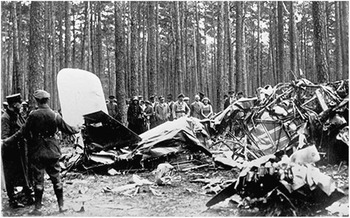
There is a notorious story about the transatlantic flight of the American-Lithuanian fliers Stephen William Darius and Stanley Girenas, who took off from New York heading for Kaunas and subsequently crashed, relatively close to their goal, near Soldin in north-eastern Germany (now Poland) on 17 July 1933 (Figure 1). 1 Their daring feat and dramatic fate seemingly conform to an ordinary pattern from a revolutionary era of the 1920s and 1930s – the period that is commonly regarded as the Golden Age of Aviation due to the outburst of individual visionaries’ pursuits and ground-breaking exploits, the technological achievements and the rise of the new global industry. However, it is remote from the way these pilots were remembered by generations of their countrymen – that is, by millions of people both in Lithuania and the Lithuanian diaspora around the world. In this popular account they were tendentiously mystified and victimised while being portrayed (in the media, literature, movies, arts or official ceremonies) variously as the ‘geniuses of the bright Lithuanian spirit’, ‘victims of German fascism and Lithuanian bourgeoisie’ or the ‘first heroes of our young modern nation.’Reference Bumblauskas, Eidintas, Kulakauskas and Tamošaitis 2 In different times and under particular circumstances, this peculiar memory of the two men’s ‘sublime’ past served as a universal tool for consolidation and, simultaneously, critical manipulation of the nation’s actual present.
The local residents and German officials at the Lituanica crash site in Dölziger Forst; photographed in the late afternoon of 17 July or early morning of 18 July 1933: wreckage is seen being piled up, the pilots’ bodies have been removed out from the scene. (Balzekas Museum of Lithuanian Culture, Chicago, IL.)

Only recently has research revealed how the story of these two aviators was detached from its original historical grounds, spontaneously adapted to public demands, and deliberately managed for political remembrance. 3 Over eight decades, the discourse on this commemorated past has repeatedly changed under strong influence or by direct stimulation of shifting ideologies and competing memory regimes.Reference Dénes 4 It was reshaped with no scruples except for maybe just two basic features: poor documentation and a sentiment of grievance remained overlooked at all times. The re-invented past was reassessed in a traditional national historiography, disseminated mainly through popular culture, and thus re-installed into historic consciousness as a uniquely sustainable Grand Narrative with a knowingly established myth at its core. This myth spanned contradicting beliefs and allowed for the following controversy about the pilots’ death: it mostly told that Darius and Girenas were (non)deliberately shot down by Germans; but it also left room for speculations about the severely adverse weather conditions at the time of the crash (effectively illustrated by drawings of the Grim Reaper lurking near the pilots’ airplane, Lituanica, in the Dölziger Forst), and even for a retrospective conspiracy that all these fantasies might be plotted out by some other gruesome baddies.
This collective memory was transformed, generally, through three stages. From 1933 to 1940, two major shifts occurred. The initial formation of the myth was conditioned by a lack of documentary evidence, suppressed official comments and the inaccessibility of the primary sources. Public attention was distracted from the legal and political interactions of American, German and Lithuanian official institutions and became an important element in the Grand Narrative which, by common and state assent, was used as substructure for a modern national identity-in-the-making. From 1940 to 1968, the original myth endured through the Nazi and the Soviet occupations. It was briefly and critically suppressed in the early post-war years, and then effectively managed by Soviet ideologists from 1958 onwards through a decade of ‘discovery’ and the final burial of the pilots’ biological remains. In 1968–1990 and then up to the present, the historical knowledge stagnated in spite of the rekindled commemoration activities, and the established pseudo-cognitive account led to a passive remembering of this glorious, but gloomy, impersonal, distant past.
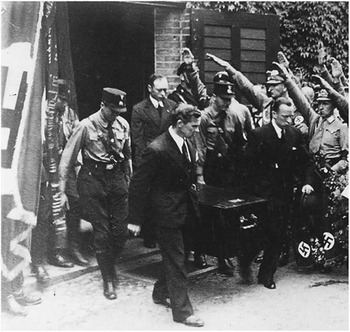
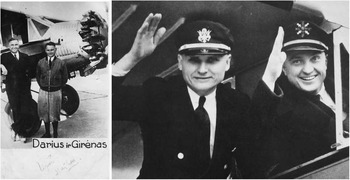
Today, the central figures of the story, S.W. Darius (1896–1933) and S. Girenas (1893–1933), are widely known as iconic heroes who embody the idea of the solidarity and unity of the nation (Figure 2). The duo’s image is a universally recognisable symbol, serving as an unequalled ‘logo’ of the Lithuanian identity (Figure 3). It is still fostered by state and public initiatives, regardless of its natural shift from representing ‘modern and progressive’ to rather ‘old-fashioned and obsolete’ in the present era of rapid technological advance, and also despite the new and ongoing search for a European identity in the general context of a vacillating European self-awareness ‘between the cultural identity of Europe and the political identity of the European Union; between the ideal of the eternal peace and reality.’Reference Putinaitė 5 The clearly manifested bias towards dwelling in the delusive safety of an old myth and withholding from active involvement in pressing social and cultural issues underscore the argument that the Lithuanian identity ‘feels much safer in the world of imagination’ and that its source is ‘poetical rather than political.’Reference Putinaitė 6 In other words, in the case of Darius and Girenas, the myth is what millions of people identify with and thus it is what they think they are. But is this what they want to be? Perhaps it has now lasted too long and gone too far.
The German and Lithuanian representatives carry the caskets with the airmen’s remains out of the chapel in Soldin on 19 July 1933. (Balzekas Museum of Lithuanian Culture, Chicago, IL.)

The world-famous promotional photographs of S. Darius and S. Girenas. (Balzekas Museum of Lithuanian Culture, Chicago, IL.)

This insight has inspired and propelled our research. In 2010, the first thorough investigation into the nature and structure of this Grand Narrative was launched. Ever since, it is being analysed not only in terms of the twisted logic behind its fractioned links to historical events in the United States of America, Germany and Lithuania, but also by questioning its links to factual reality itself by asking just how much (if at all) this narrative is ‘based on a true story’.
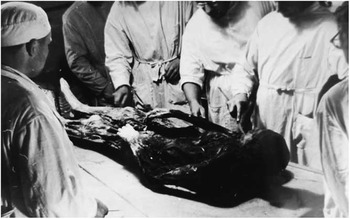
So far, the revelations are stunning. For instance, it emerged that for the American-Lithuanians Darius and Girenas, their transatlantic flight in the midsummer of 1933 resulted in anything but what they had planned for. If these Chicagoan flyers had wanted to end up in history text books, they had certainly not imagined the Nazi swastika or Soviet hammer and sickle on the same pages. Instead, they would have thought about the American stars and stripes, and also, perhaps, as a tribute to their patriotic feelings, the Lithuanian tricolour. And no matter how responsibly they had calculated the risks they were taking, they could never have thought that their physically decaying bodies would be displayed in open caskets, examined for months in laboratories by forensic and embalming experts, then concealed and abandoned for almost 20 years in the basement of a medical faculty’s neighbouring crematorium before being ‘discovered’ and examined once again, buried, and later exhumed again (Figure 4).
The Soviet forensic experts examined the bodies of the pilots, which were embalmed, concealed and ‘discovered’ in Kaunas, Lithuania, and then buried in August 1964. The experts concluded that the mummies of S. Darius and S. Girenas were in too poor condition and could not be restored. (Author’s archive.)

According to official findings of investigations into the crash of the Lituanica, their transatlantic flight lasted a total of 37 hours and 11 minutes. After the crash, the journey of their remains to their final resting place was prolonged by a further 35 years. The passage of their exploits to historic memory still continues, more than 80 years later…
The surprising turns in the aftermaths of these fliers’ deaths illustrate that a hero is not necessarily someone who voluntarily walks into the unknown; rather, a hero is someone whose fate it is to remain virtually unknown. In terms of Hollywood simplicity or even Aristotelian classics, the case of Darius and Girenas might be ranked as a typical story of ‘tragic heroes’ and be deemed worthy of the big screen or a great political thriller novel. However, it stands out due to its evident conceptual complexity. For this reason, it is worthy of not only this study but also of further exploration.
To summarise our findings, we will refer to the aforementioned three stages of the period 1933–2014. A reversed chronological pattern is followed in order to reveal the layers of transformed memory as they appear at present. We will start by measuring the current state of the Grand Narrative and the related memory manifestations, before continuing with Stage Two, stressing the underestimated role of the communist administration and the KGB of Soviet Lithuania in the fundamental (re)modification of the central myth. Finally, we will review the disregarded basic aspects of law and politics in 1933 and reveal the factual roots of a truly great story, without which no myth could ever endure.
2. Close to Ridiculous
How did we get there? In the case of Darius and Girenas the ‘performance of the past’ seems, in a word, odd.Reference Tilmans, van Vree and Winter 7
After Lithuania regained its independence, Darius and Girenas have been continually remembered for three basic things: their bright personalities, their unprecedented exploit, and, most of all, their heroic deaths. Since 1990, their fame has flourished at the social, cultural, and political levels. The Lithuanian parliament has twice named years of commemoration for Darius and Girenas’ flight (in 1993 and 2013). In addition, the Lithuanian parliament restored World Lithuanians Unity Day, which was introduced by Chicagoan Lithuanians in 1934 and is celebrated on 17 July. The 60th anniversary of their death was commemorated with a range of publications, with a monument finally built in the centre of Kaunas (the second largest city in Lithuania), and the creation of a commemorative state decoration, The Medal of Darius and Girenas. Numerous special Lithuanian postage stamps commemorate the two pilots. Their portraits appeared on the 10 LTL banknote and on commemorative coins from 1992 until 2015, when the country adopted the euro. Various public buildings, institutions and organisations, a village in the north-west of the country, and 78 to 118 streets (according to different sources) are named after them. The first name Darius is frequently given to new-born boys; to name just a few – it is the name of the author’s cousin, husband, ten-year-old son and her son’s best friend, not to mention the less common cases when twin boys are named Darius and Girenas.
Yet at the same time, ‘Darius and Girenas’ has become a well-worn, blurred and poorly comprehended phrase. Fewer and fewer people are able to distinguish Steven from Stanley and comprehensively explain who was who or who did what in this pair of ‘well-known all over’ heroes. There are countless cases in books, the media and ceremonial venues when Darius has been taken for Girenas or the other way around. On one occasion an official even made a public reference to the next-of-kin of Stephen Darius as ‘a daughter of Darius and Girenas’. During the 70th and 80th anniversaries of the flight, as late as in 2014, the national media spread sensational ‘revelations’ that were close to absurd. There was an interview with a ‘source’ about a net supposedly thrown by a Nazi aircraft onto the Lituanica, causing the plane to fall from the sky and explaining why no bullets were found. Then there was a publication about the remains of the pilots: they were purportedly cremated by the Soviets and replaced with the bodies of some other men. This kind of ‘news’ perfectly echoed the Lithuanian, Latvian, and Polish newspaper publications of 1933: back then there was a short yet high-powered buzz about the ‘death rays’ from a (fictional) secret Nazi anti-aircraft gun by which the Lituanica would have been brought down, and there was even talk of some mystical Spanish pilots that were supposedly buried instead of Darius and Girenas, who in reality would have drowned and whose bodies would never have been found.
How could the great story of Darius and Girenas come to this? What turned it into this historically inappropriate, pseudo-cognitive account, which eventually led to passive remembering, or rather latent cultural forgetting in contemporary post-soviet society and the Lithuanian diaspora in present-day democratic countries?
During the restoration of an independent Lithuanian state and the formation of a free society in the late 1980s and early 1990s there was a great demand for heroes. However, this was once again approached unambiguously. Contemporary Lithuanian historians had left the ‘first heroes of the modern nation’ to rest under the aureole of an old myth, in an unclarified historic background. A so-called ‘testament’ of Darius and Girenas, a manifest to ‘Young Lithuania’ of symbolic meaning but with no juridical force, continued to be the most quotable document. However, the business agreement of the pilots, a legal document which described their personal input into the project of a transatlantic flight and the projected shares of its successful outcome, was never published and remained unknown to the public. In spite of new opportunities offered to researchers by both Lithuanian archives and Western sources now being accessible, accurate historical research stagnated for another two decades. Scholars were detoured by more urgent issues, and an abandoned Grand Narrative drifted in the periphery of the flow of topicalities.
Of late, the idea that it would have been a Nazi conspiracy that brought down the plane of Darius and Girenas has lost some ground. It has now to a certain extent come to be overshadowed by the so-called ‘Darius and Girenas complex’: the ‘not just yet achievement’ of the airmen is occasionally mentioned publicly to illustrate the various ups and downs of present-day Lithuanian society. As such, it is used to deal with the unease of a people who confess to being almost the unhappiest people on the continent according to some polls, and who see themselves as being at best only ‘almost Europeans.’ 8 But in general, the Grand Narrative continued to dwell in the realm of an old legend in which the supernatural ‘geniuses of the nation’ were meant to gloriously succeed but were dispatched by Nazi villains. This version was first introduced by the French and Belgian leftist media in 1933. It was propagated by Soviet ideologists as ‘the most likely’ hypothesis 35 years later, in the 1960s, and became embedded as a comforting explanation of the tragedy, meaning simply that ‘we’re good, they’re bad, and that’s so sad’.
For all these reasons, it could be argued that the durability of the myth ought to be related to not only insufficient, corrupted or ignored historical knowledge, but also to the traumatic sensibility and irrational mentality of post-soviet Lithuanian society. In addition to its ‘beneficial’ function of offering ‘comforting safety’ and to its (fading, yet remaining) consolidating power, this myth has simply had a perfect structure: it integrated classical themes such as the glorious beginnings of a modern nation and the cruelly disrupted process of modernisation, charismatic heroes and supernaturally gifted geniuses, conspiracy and victimhood. It is no wonder that accurate historical explanations were not in high demand: who would ask for documents when there was a drama to read, a movie to watch or a song to sing along to?Reference King 9
And yet, there was something to consider: ‘the national revival of 1988–1990 revealed the impotence of the Lithuanian configurations of identity, and pressed the discovery and the buttressing of the identity of exclusiveness as an alleged solution.’Reference Putinaitė 10 Yet how exactly does the ‘exclusive’ correlate to the factual in the discussed case? What was behind this odd unwillingness to admit that it is but one step from the sublime to the ridiculous? Further analysis reveals that more was going on than a mere simplistic lack of common sense.
3. The Weapon of Ideology
Recent studies about the ‘peculiarities’ of Soviet Lithuanian historiography and its totalitarian conception of history as an ‘ideological weapon’ tell us that 1944–1956 was a time of great tension during which official discourse was formed. Notably, ‘the year 1956 and the 20th congress of the Communist Party of the Soviet Union were for historians not so much the beginning of the Krushchev Thaw but the formation of the status quo.’Reference Švedas 11 These periods of establishing and maintaining the official discourse, by which a history of Lithuania was ‘reflected and falsified at the same time,’ almost perfectly coincide with the process of the striking modification of the discussed Grand Narrative, its skilful implementation as a part of mass culture, and the subsequent major transformation of the memory of Darius and Girenas.
All major efforts at commemorating Darius and Girenas in pre-war independent Lithuania were low-key except for the massively attended state funeral. 12 In the first months of occupation, in late 1940, the embalmed bodies of the airmen still lay in a chapel of Vytautas Magnus University’s Faculty of Medicine. The Committee of Darius and Girenas hesitated about finding ‘the right place’ for their yet unbuilt monument. The Lithuanian Air Club, a public institution for the promotion of civil aviation, had still not managed to publish their promised ‘explicit monograph’. Meanwhile, in Chicago, the American Lithuanian community had built in 1935 a solid monument and published the best rated monograph about Darius and Girenas.Reference Jurgėla 13 The 1940s meant the end of all these prolonged commemoration efforts. During the Second World War, the first Soviet occupation and the German occupation, the Grand Narrative remained generally unchanged, but was largely kept out of the public eye. In 1943, a controversial bas-relief of Darius and Girenas was engraved on a huge boulder near a small provincial town. The German administration closed the university. Soldiers were quartered in the Faculty of Medicine. The mummified bodies of the pilots were concealed in a basement. Soon, the Germans fled, the Soviets returned, and the war was over. By then, in 1945, the great change had begun.
The exhibition of the transatlantic flight of the Lituanica was dismantled. The wreckage of the plane was shut away in a museum storage facility. The initiator of a bas-relief and a participant in the concealment of the pilots’ bodies in 1944, who was the head (and the only representative left) of the Darius and Girenas Committee, was arrested by the NKVD and later sentenced to seven years in prison for ‘treason’. Almost simultaneously, for other things but under the same universal article, a 16-year-old boy was arrested. In 1968, this ‘boy’ would become famous as the architect of the funeral monument of Darius and Girenas. After Lithuania regained its independence, he was rehabilitated and decorated for his works of art and dissident activities. Recently, however, it was discovered that he also worked as an active informant for the KGB. In retrospect, it was indeed a rather unlikely coincidence that the communist party elite and the KGB began plotting the scenario for the resurrection of the ‘Peoples’ heroes’ so soon after these men had endured numerous interrogations and returned from the Gulag to Lithuania. 14
A coordinated collaboration between the KGB, the Lithuanian Communist Party and the subordinated system of institutions responsible for the official discourse was vindicated with great success. In the years after 1958, not only was an exhibition about the flight of the Lituanica remounted for the Peoples’ good, but the whole concept of the heritage of Darius and Girenas was re-invented. Soviet ideologists took advantage of the pre-war media falsifications and upgraded a myth about ‘the working-class heroic victims’. It went like this: there were these two boys, who were raised by hard working poor Lithuanians in tsarist Russia but who somehow came to live in America. However, they so hated the imperialist regime over there and so much loved working mankind that they bought a little airplane and flew across the big ocean from capitalist America back home, inspiring the masses and exposing the selfishness of the Lithuanian bourgeoisie (which did not support them financially and stinted investigation into the crash of the Lituanica in order to save money) and the dreadfulness of the German fascists (who deliberately shot down the Lituanica and killed the working class representatives).
For those who knew at least something about the true past of Darius and Girenas, this had to sound somewhat like a psychedelic drama. In fact, both pilots neither self-identified with nor represented anybody in Lithuania, let alone the communist-supported ‘working-class’. They were both veterans of the American Army, naturalised citizens of the United States, and certified American pilots. The Lituanica, the aircraft they flew, was registered and technically approved for transatlantic flight by the United States Department of Commerce. The flight itself was organised in compliance with federal law at the Department of State and, although the flight was abruptly interrupted, remained de jure at the disposal of these two federal institutions. The property, a Bellanca CH-300 ‘Pacemaker’ monoplane, was bought by the private means of the pilots and their relatives in Chicago and remodelled for the aimed distance record flight almost entirely from donations by thousands of American Lithuanians. Darius and Girenas never asked for financial support or any other substantial assistance from the Lithuanian government or its public organisations, nor had they any intention of making any material offerings to the Lithuanian government, except for the symbolic dedication of the flight, which was promoted as an inspirational gesture to the ‘Young Lithuania’ from American-Lithuanians ‘to imbue with strength Thy spirit and confidence in Thy power and talent’. As a result, they were by no means formally related to Lithuania… at least, until they crashed in Germany.
Still, the entire American context was obscured, even the general concept of the Golden Age of Aviation was obscured. Capitalist ideas such as ‘self-made men’, competition, individualism, charisma, racing, technological progress and commerce were left out of the story, as were all hints about progress of any kind in an independent Lithuania. Furthermore, Soviet ideologists re-invented the identities of the pilots down to their very childhood. Girenas was the easy part: he was an orphan and he and a brother and a sister of his were the only surviving children from a family of 18. Darius’ relatives, however, ran a family business in Chicago and were relatively wealthy. Darius himself was a decorated veteran of the American Army and a Captain in the Lithuanian Air Force (he emigrated from Lithuania to the United States in his teens and revisited his motherland in 1920–1927 to serve as a volunteer), and also a participant in the American national air race who was publicly referred to as ‘our Lindy’ by American-Lithuanians. Thus, when necessary, it was highlighted that Captain Darius was in opposition to his commanders in the Lithuanian Army and willingly resigned from bourgeois military service. Darius’s wife and daughter, whom he left behind in Kaunas in 1927 and never revisited, became the famous stand-ins for a resurrected hero.
Along the same lines, popular remembrance of the pilots as fashioned by Soviet ideology excluded all particulars about the pilots being American citizens, their closest relatives in Chicago, their private businesses, mutual business agreements or their obligations to regulations under US Federal Law, the Department of State and the Department of Commerce of the United States. This discourse was closely adhered to in media propagandist publications and in two books published in the 1960s. The ‘discovery’ of the pilots’ concealed remains in 1963, the second forensic investigation, and the 1964 funeral of Darius and Girenas were tightly controlled and manipulated, as was their last exhumation and reburial in 1968. It sent a sharp message to the masses that, contrary to bourgeois Lithuania, the ‘Soviet People do respect and cherish their remembrance’. However, the capstone to this version of the myth was still to come: in 1983, three extraordinarily popular films – a movie drama, a documentary and an amateur feature about the German conspiracy – embedded the myth of the greatness of the ‘victims of fascism, peasant-raised ordinary Lithuanians’. The job was done. The effect on memory was imminent and, alas, permanent.
4. Disregarded Politics and Law
In 1933, Lithuania was the birthplace of the Grand Narrative and original myth about Darius and Girenas. But in fact it is not easy to explain exactly why this should have been so. The earliest known report from the crash site by German police clearly indicates, yet leaves unexplained, the sudden involvement of the Lithuanian representatives into this matter; nor are there any ‘hints’ about the reactions from the American side. 15
Traditional historiography asserted that the technologically advanced feat, internationally acclaimed achievement, and tragic death of two Lithuanian emigrants instantly turned them into national heroes and, purportedly, that that was the reason why their biological remains, documentation, the wreckage of their airplane and other physical remains were brought to Lithuania. Consequently, the centre of instant memory formation was set in Kaunas, the then provisional capital of Lithuania. But this straightforward proposition or, rather, convenient simplification of the past, lacked rationalisation, and was not based on more persuasive evidence or proof. It was like turning a blind eye to the actual situation in 1933 which was determined by many aspects, but most importantly by the political situation and by regulations of law.
Indeed, fresh icons of a new technocratic order were in high demand in Lithuania, mainly because, as Michael Walzer proposes, ‘the state is invisible, it must be personified before it can be seen, symbolised before it can be loved, imagined before it can be conceived.’Reference Walzer 16 However, a further point Walzer makes, namely that the proper personification and heroic image of statehood should provide a starting point for political thinking, did not even enter into the picture in this particular case. The process for setting a clear cultural and political agenda stagnated at the primal phase. The strategy of strengthening statehood and the nation failed to take root in solid argumentation and adequate reflection of the past. Instead, it floated on a loose platform of careless play of the imagination. Thence, the remains of Darius and Girenas and of their flight could hardly serve the aforementioned noble purpose.
Such being the case, we should change focus and ask the following questions: were the pilots brought to Lithuania because of the geopolitical situation, sensitive legal aspects, and conflicting ideologies or practical political interests, because of realpolitik? And if so, how was the mythology powered by these interactions? Data lately obtained allow for a thorough analysis of the aftermath of Darius and Girenas’ flight and for these questions to be addressed.
The ill-fated take-off from New York on 15 July of Darius and Girenas, and their deadly crash near Soldin in Germany (now Mysliborz in Poland) on 17 July was, so to say, a better part of the unexpected. The pilots knowingly accepted an ‘all inclusive’ package: racing the world’s best aviators, challenging flight records, accomplishing a difficult technological tour de force, and exploring technical and human limitations. In their attempt to ‘hop the ocean’ they risked either winning celebrity status and entering upon great careers or meeting a tragic end on the runway of their home airport, trapped and burned alive in the cockpit of a heavily overloaded machine, as would actually happen to their comrade, the Italian air ace Francesco de Pinnedo, who crashed and died in flames at the same Floyd Bennet Field seven weeks later on 2 September 1933. As Darius and Girenas succeeded in completing 9/10ths of their planned flight and went down relatively close to their goal, the international media were impressed by how they ‘braved the Atlantic’ and summed up their daring pursuit as a ‘tragic victory’. Two official investigations carried out in Germany and Lithuania proved wrong rumours that the technical preparations had been at fault or that the pilots had lacked the proper qualifications for the flight. Instead, they suggested that unfavourable weather conditions, a possible malfunction of the aircraft due to congested fuel filters, an attempted forced landing due to lack of fuel, or simply the human factor of fatigue, might have been the reasons for the crash. 17 In all, this sounded like a pretty fair evaluation of these exemplary American ‘self-made men’ and their ambitious project, not backed by any government or sponsored by any commercial company, and fully supported their moderate standing in the general context of the Golden Age of Aviation.
However, events took a rather unexpected course on 18–19 July, when the damaged aircraft and the remains of the pilots were transported from Soldin to Kaunas. Kaunas was the clearly marked destination point on Darius’ navigation charts. In Kaunas, the airmen were proclaimed national heroes, decorated for outstanding bravery by the then President, Antanas Smetona, and given a state funeral attended by government ministers, the diplomatic corps, and some 50,000 to 60,000 people. The pompous commemoration reached heights similar to sanctification. Amid all this glory, unearthing the plain facts about knowingly unfinished procedures of legal formalities in Washington or other displays of human imperfection and weakness, or simply determining the natural causes of the crash, seemed less and less possible, or too hard to believe. The image of the two aviators was turned into an icon, and their fate became a never-ending riddle.
On 18 July, the United States Department of State waived the formalities that might have stood in the way of giving the American pilots a state funeral in Lithuania and silently withdrew from having any further part in the process. 18 The resolute and venturesome gesture on the part of the Lithuanian government was internationally appraised and diplomatically accepted with gratitude in official condolences, which were sent to Kaunas from Berlin almost immediately and from Washington a week later. The general public embraced the idea of a state funeral with the simplistic logic that burying the pilots in Kaunas was the only right thing to do, as both airmen had been born in Lithuania and had died on their flight to their Motherland. Only a few months later, when the first shock waned, some people began to question why the remains of American citizens, along with their properties, had been expedited to Kaunas instead of to Chicago where, arguably, they belonged. There came no answer to that question. It was too late. History – and the subsequent process of memory transformation – was already set on a different path.
Paradoxically, the major de jure shift from the United States of America to Lithuania was barely noticed. If it did cause some unrest, this was only post factum. Two emotional peaks, the ‘mysterious’ circumstances of the crash on German soil and the pomp of the state funeral held in Lithuania, attracted most international media coverage. They also led to a number of mass gatherings, including various commemorative events on both sides of the Atlantic, beginning with the Lithuanian Days in the Century of Progress International Exposition in Chicago. The primary sources of information were kept away from the public eye. The general public, so to speak, was kept on a diet of spare information. After the newspapers spread sensational, ungrounded reports that the Lituanica had been shot down by the Nazis, officials in Berlin and Kaunas issued strong denials, but refused to comment. Later, the findings of the official investigations in Germany and Lithuania left certain gaps. They neither denied nor directly contradicted allegations. Ever since, the so-called ‘Mystery of the Soldin forest’, an axis of the Grand Narrative, began to spin. As a result, the crucial aspects of law and the politics involved were inevitably understated and, later, simply ignored and then erased from memory.
This attitude is clearly illustrated in numerous archival records. For example, in one letter, the Lithuanian Minister Plenipotentiary in Washington, Kazys K. Balutis, writes a reminder to the General Consulates in Chicago and New York and to the editorial offices of American-Lithuanian newspapers that the flight was not formally linked to the government of Lithuania. It is one of the best testimonies about a phenomenal massive ‘amnesia’ just two weeks after the crash of the Lituanica. Another four weeks later, in his report to the Lithuanian minister of foreign affairs, Balutis describes critical tensions within the American-Lithuanian community, repeatedly begs for news about the official investigation, and warns about the consequences of silence, writing that ‘the mob has to be fed with facts; if not, the facts will be invented and rumours will be spread.’ The government in Kaunas would not react. ‘The mob’, however, reacted exactly as Balutis had feared.
In 1933 and later, the specifics of the legal and political reaction to the flight and death of Darius and Girenas were publicly disregarded or left unresolved. Only recently has the sequence of involvement, the pattern of interaction between numerous institutions in the United States of America, Germany and Lithuania, been revealed. There are grounds to assume, for instance, that in the long-term perspective the United States deliberately and resolutely withdrew from the investigation of the death of these American citizens. The Department of State declined at least 13 inquiries, petitions and resolutions from various American institutions and organisations, and, last but not least, Darius’ family members in Chicago. In a document from 1935, US State Secretary Cordel Hull made the observation that there were some ‘objectionable factors’ related to the case of Darius and Girch – namely, that ‘The crash which caused the deaths of these aviators has been the subject of much controversy in newspapers throughout the world’. Another ‘objection’ was related to the possibly illegal status of the Lituanica flight, which, according to officials of the Department of Commerce, ‘could prove embarrassing for the United States’. In addition, public opinion and US international politics were heavily influenced by the mood of isolationism dominant in the US at the time. These reasons firmly steered the United States away from any kind of conflict, even a potential one, in the Old World. Thus, in the words of a standard bureaucratic cliché (which was repeated more than 20 times in the ‘Darius & Girch’ file of the Department of State), ‘this government had no possibilities’ to even start thinking about the question, asked many times in many ways, but summed up pretty clearly in 1934 by Popular Aviation, as follows: ‘Did Nazis Shoot Down Yank Transatlantic Flyers?’ For this government, accepting the exemplary, generous, but alas politically short-sighted initiative of the Lithuanian officials to ‘finally bring the heroes home’, has to have come somewhat as a relief. 19
Almost nothing of these official interactions was known to the public prior to recent research. In America, people were relatively well-informed as to how Darius and Girenas began their project, but knew almost nothing about the later developments in Europe. In Europe, people were aware of the findings of the Lithuanian investigation (the German findings seem not to have been published in their entirety), but didn’t know much about the start and end points in America. At the time, accessibility to primary sources was limited; some documentation was classified or restricted. Sporadic initiatives of research were concentrated in Chicago, Darius and Girenas’ second home (in the 1990s, more exploratory initiatives were projected in Kaunas), they were thematically fragmented and regionally limited, and without the information from Berlin and Washington the factual story of the flight of the Lituanica simply could not be told.
5. Furtive Bullets, Storm and… Tale to be Continued
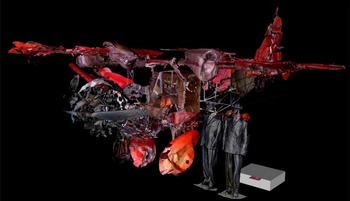
To finally tell the whole story, a lot has yet to be done. New techniques and methods should be applied. Several interdisciplinary projects have been launched to clear up old controversies and to thoroughly analyse freshly obtained archival data. In 2014, yet another falsification of the myth was revealed by combining a comparative historiographical analysis and meteorological reanalysis data.Reference Sviderskytė, Rimkus and Stankūnavičius 20 It had been commonly believed that the Lituanica crashed in or due to a storm. However, the study showed that the crash had happened in a vicinity of relatively better weather conditions: there, the pilots would have encountered no rain or stormy winds, but mostly reduced visibility due to low ceilings, a moonless night and possibly rising fog. Another project revealed the even more astonishing fact that it was unclear precisely what kind of an airplane the Lituanica actually was.Reference Sviderskytė and Silva 21 It was traditionally believed that a popular replica built in the 1980s was similar to the original, but the documentation of the remodelled aircraft Darius and Girenas actually flew, and a precise list of its examined wreckage, were missing, and no proof was ever found of the complete technical expertise carried out in Germany or Lithuania after the crash. The completion of the first full scale three-dimensional model of the remodelled Bellanca CH-300 and the damaged Lituanica is now underway, made possible by the application of historiographical data and three-dimensional scanning of the original remains of the aircraft. Needless to say, no sign that the airplane could have been shot down by Nazis has been detected so far (Figure 5).
The digital full-scale, three-dimensional model of the damaged aircraft and the pilots’ clothing was constructed in 2013 by combining 3D scanning, video/photography, computer modelling and historiographical analysis. (Author’s archive.)

The main question now is what the next move of collective memory will be: will it stick to the fictional, traumatising, but universalist myth, and continue to prefer this delusive ‘safety’ to a less comfortable, but more solid understanding of what most likely happened?
The monitoring of current commemorative activities confirms that their main function is to channel collective sentiments, foster dreams of national dignity and, perhaps most of all, lay to rest anxiety – ‘an excruciating neurosis’ of a people that has been trained for decades to think about, look into and adopt just one side of a story, even if that side never existed in the real, physical world.Reference Tismaneanu 22 People were ‘deprived from own memory’ for 50 years and became accustomed to relying on and living in a single ideological certainty. Apparently, they tend to delude themselves with that old realm of ‘safety’ – partly in fear of the discontinuity, fragmentation and unpredictability of the future. Scholars have warned that in such a society it is not enough to simply expose the inconsistency of a myth: ‘One needs to discover what these myths try to explain, what passions and anguish they appeal to, and why they enjoy credibility.’ They argue that the function of a myth in a non-totalitarian system is crucially different, that ‘in democracies, its power is curtailed by the existence of communities of reflexive communication, the rational organisation of political structures, and the universality of legal arrangements.’ Presumably, in the case of Darius and Girenas, the myth’s monopoly is already decaying: according to sociological studies, a significant shift has occurred in the years following 1991 in individualising the interpretations of national narratives. ‘Tendencies of erosion of traditional myths’ as well as ‘tendencies of hybridisation of popular myths’ were observed in a process of ‘the symbolic re-imagination of the nation.’Reference Sutiniene 23 Thus, hope remains that an open, democratic society will move forward, holding on to its past in a wholly different way.
Meanwhile, the soft, if not careless, dealing with the Grand Narrative reveals a rather poor understanding of memory regimes or memory management in general. The current state of social (dis)ability to reflect the past and insufficient or even absent strategy of cultural politics could be enormously disadvantageous in the context of the ongoing process of Europeanisation and the related shift in national identity. Additionally, it exposes society to even more unwanted impacts or potentially dangerous threats. When war broke out in Ukraine a few years ago, analysts from the Eastern Europe Studies Centre in Vilnius publically warned that it is crucial for Lithuanians to start strengthening and managing their own historic memory more carefully now: if they do not do so, others will do it for them. In these aspects, the case analysed here is correlative to the topical issues of the search for a new conception, or sense, of history in Lithuania, as well as in some other Eastern European countries.
Grazina Sviderskytė is an award-winning journalist and a PhD candidate at the Faculty of History of Vilnius University. She is writing her dissertation on ‘The “Darius and Girenas” case: historical event and an evolution of the narrative’ and she edits the website www.lituanica-documentica.lt. She teaches history in a private secondary school, and published her first book about a key member of the ‘Great Escape’, the Lithuanian and RAF fighter pilot Cpt. R. Marcinkus in 2004 (English edition 2006). She dedicates herself to writing about, making documentaries on, and looking into contradicting international stories of the twentieth century. This led her to the highest professional achievements and awards. In 2010, she launched an investigation into the story of Darius and Girenas. Its scope exceeded the limits of investigative journalism and developed into a scientific project, which received a high assessment by the Research Council of Lithuania in 2012.