


INTRODUCTION
After the March 2010 elections in Iraq, political cooperation among Sunni and Shia Iraqi Arabs seemed more likely than cooperation among Arabs and Kurds (who are not Arab), despite the fact that Sunni and Shia Arabs had just fought a sectarian war whereas the Kurd-Arab conflict did not escalate to the level of a war. Why did the ethnic conflict between Kurds and Arabs in Iraq seem harder to overcome than the sectarian conflict, which was much bloodier? Iraq presents another puzzle about social identification and ethnic conflict: it took years of insurgent violence to bring Iraqi Sunnis and Shia to fight a sectarian war, whereas in other cases, conflict between competing ethnic groups escalates rapidly. In Yugoslavia in the early 1990s, tensions between Serbs and Croats quickly came to a boil. Groups of radicals were able to generate hostility and suspicion among ordinary people who might have continued to live peacefully with their neighbors who were not their coethnics or coreligionists. In Iraq, Yugoslavia, and many other cases, the relationship between social identification and ethnic conflict is complex, variable, and historically contingent. This article proposes a simple model that can help make sense of it.
Ethnic conflicts account for 50–75% of civil wars in the post 1945 period (Doyle and Sambanis Reference Doyle and Sambanis2006; Fearon and Laitin Reference Fearon and Laitin2003). These conflicts are long (the mean duration is over six years), deadly (over twelve million people have been killed), and often have devastating economic consequences.Footnote 1 But what explains the emergence and persistence of ethnic conflict? The explanatory variables proposed in the empirical literature (per capita income, terrain, resource dependence, ethnic structure, regime type) can explain rather little of the variation in the intensity of ethnic conflict. Countries that are similar on these dimensions can still exhibit very different levels of conflict. Further, most correlates of civil war are not robust to small changes in the model specification (Hegre and Sambanis Reference Hegre and Sambanis2006). With respect to ethnic heterogeneity, there is no robust correlation between civil war and ethnic fractionalization (many small groups), whereas there is a statistically significant positive correlation between civil war incidence and ethnic polarization (few large groups).Footnote 2 Yet, as illustrated in Figure 1, polarization per se—computed without taking into account the (partly endogenous) salience of ethnic cleavages—is a rather poor predictor of civil war incidence. Countries like Angola, Burma, Burundi, Chad, Indonesia, and Sudan have spent half or more of their histories as independent states fighting civil wars at least partly along ethnic lines, whereas Benin, Eritrea, Gambia, Guinea, Malaysia, Niger, and Zambia have managed to avoid the escalation of ethnic conflicts to civil war. All these countries have a relatively high ethnic polarization index, between 0.6 and 0.8. Ethnic cleavages do not always increase the risk of violent political conflict.
Ethnic Heterogeneity and Conflict Intensity 1945–2006
Notes: Conflict intensity is measured here as the proportion of years a country has experienced civil war from 1945 (or year of independence, if after 1945) until the end of 2006. Civil war data are from Sambanis and Schulhofer-Wohl (Reference Sambanis and Schulhofer-Wohl2009). Ethnic fractionalization data (panel (a)) are from Fearon and Laitin (Reference Fearon and Laitin2003). Ethnic polarization (panel (b)) data are computed using raw data on group size from Fearon (Reference Fearon2003); see Montalvo and Reynal-Querol (Reference Montalvo and Reynal-Querol2005) for the specification and discussion of the two measures of heterogeneity.

Most extant models of ethnic conflict and civil war assume that ethnic divisions imply the potential for conflict due to incompatible preferences. We present a model in which compatible preferences, in the form of a strong common identity, can also emerge. This can happen even in an ethnically divided society, reducing the risk of conflict. The crucial feature of the model is that while patterns of social identification shape conflict risk, conflict also shapes patterns of social identification.
Formal theories of conflict typically focus on interactions between players who care only about their own payoffs. Even when the modeler allows players to care about other things, these preferences are exogenously fixed. We depart from this tradition in two important ways. First, since ethnic conflict takes place between groups, it is important to take into account the possibility that people are not only motivated by self-interest, but also care about their group. Second, consistent with constructivist theory, we allow these social preferences to vary with the social environment. The fact that a U.S. national is black or white does not automatically imply that he will identify with his racial group. In pre-war Yugoslavia, a Serb or a Croat might have identified as a Yugoslav rather than as a member of his ethnic group. Even if group membership is fixed, whether or not an individual identifies with a given group depends on the characteristics of this group and on how closely they match his own characteristics. Both these departures from standard approaches to modeling ethnic conflict are grounded in empirical work studying individual behavior in groups. A major lesson from this work is that individuals care about their group even absent any strategic considerations. Thus, our contribution is not in the setup of the model of conflict (the players, payoffs, information, sequence of moves). We use a simple, static contest model with complete information. Rather, the contribution is in attempting to introduce specific insights from social psychology and behavioral economics into the formal analysis of ethnic conflict to capture the endogeneity of social identification to conflict. Once we make this shift in how we think about conflict and social identification processes, many seemingly disjointed (and possibly discordant) phenomena almost immediately fall into place.
Following Shayo (Reference Shayo2009), we define social identification in terms of preferences. We say that an individual identifies with group J if he cares about (a) the status of group J (and in particular the payoffs of ingroup members relative to the payoffs of outgroup members); and (b) his similarity to other members of that group. Such behavior captures a substantial body of evidence on allocation decisions and contributions to public goods, as well as on conformity and social influence (see next section). However, individuals do not identify to the same extent with any group they belong to. Rather, they tend to identify more with a group the more similar they think they are to other members of that group and the higher the status of that group. This forms the basis of our notion of Social Identity Equilibrium. An equilibrium is a profile of both actions and identities, such that (a) each individual's action is optimal given his identity; (b) each individual's identity is optimal given the social environment; and (c) the social environment is determined by the individuals’ actions.
We apply this general framework to a simple setting where two ethnic groups contest resources that can be used to fund group-specific club goods. In this model, individuals can take costly actions to support their group's struggle. While individuals belong to ethnic groups, they also belong to the “nation,” which we define as the union of the ethnic groups living in a given country. Hence, identification is not straightforward: individuals might identify with their ethnic group, but they might identify with their nation.Footnote 3
An individual's social identity affects his decision on how much effort or resources to contribute to fighting. For example, since identifying with a group means caring about the status of that group (and not only about one's own material payoffs), ethnic identification tends to increase fighting while national identification tends to reduce it. But at the same time, the intensity of the conflict obviously affects the individuals’ social environment. In particular, ethnic conflict tends to make ethnic differences more prominent, thereby reducing perceived similarity to the nation as a whole. Further, fighting can affect the relative status of the ethnic groups (a winning group enjoys higher payoffs and hence higher status) and since it destroys national resources it depresses national status. Hence the pattern of conflict at the aggregate level also affects individual social identities. Our equilibrium concept allows us to study which configurations of conflict intensity and identification patterns can endure under different circumstances.
We begin by examining the case of ethnic divisions that cut evenly across the society, creating two homogeneous, equally sized groups. This highly simplified setup helps clarify many of the seemingly intractable processes involving conflict and social identification. First, the fact that social identities are sensitive to group status and to perceived similarity strongly suggests the possibility of multiple equilibria: some with ethnic identification and a high level of ethnic conflict, others relatively peaceful with national identification (i.e., individuals identify with the country as a whole). This result from the model can help us understand how countries that are similar in terms of underlying risk factors for civil war may end up with either a prolonged peace or recurrent conflict and how conflict and identification patterns persist long after the original circumstances that brought them about have disappeared. Second, the model can accommodate two seemingly inconsistent characteristics of ethnic identities. As scholars in the constructivist school emphasize, identity can be very malleable, shaped by events and institutions. And yet, identity is often very durable, creating lasting attachments and strongly affecting individual behavior. Third, the model shows how processes of social identification can amplify the effect of institutional change. Institutions that reduce the level of conflict by limiting the resources that can be appropriated by force and used to benefit one group over another may also lead to a shift in identification patterns, thereby leading to further reductions in the intensity of conflict. Finally, the model allows us to analyze the effects of factors that have often been invoked in case studies of conflicts—such as group status or the relative salience of ethnic attributes—but have been absent from formal models.
Next, we consider intragroup cleavages. Specifically, we examine the case where members of a given ethnic group vary in their distance from the other group. For lack of a better term, we call these subgroups “core” and “noncore,”where core group members possess attributes that the rest of the nation does not share, which increases their distance from the nation. If not well integrated, core members of a group are more likely to identify with their ethnic group than the other members of their group, and tend to devote more resources to confronting the other ethnic group. They can hence be thought of as radicals or extremists. If these extremists have sufficient fighting resources or capabilities, this in itself might lead to a level of conflict that is beyond what the moderate members would prefer. In this type of conflict only extremist members of the group devote any resources to fighting. However, if the extremists are sufficiently potent, their actions can shift others in their group (and possibly the other group) towards ethnic identification, eliminating the prospects for a peaceful equilibrium. Again, this polarizing effect arises quite naturally from the introduction of behavioral regularities concerning social identification into a simple model of conflict. Importantly, it can arise even if players face little uncertainty about each other's preferences or capabilities (which seems likely in protracted conflicts) and even if the radicals are not terribly strategically sophisticated. While formal models of conflict have considered mechanisms of radicalization, they invariably privileged strategic or instrumental motives. We point out that psychological mechanisms may be just as powerful.
The remainder of this article is organized into six sections. The next discusses how our article relates and contributes to the extant literature. We then present the baseline model of conflict, our formulation of social identity, and our solution concept. The following two sections present the analytical results and discuss them in relation to specific historical cases and the empirical literature on the correlates of civil war. The analysis then turns to intragroup cleavages and discusses this case in relation to the war in Yugoslavia. We conclude with a discussion of potential extensions, avenues for empirical research, and the model's implications for theories of civil war and policies of peace building. Proofs are in the Appendix.
RELATED LITERATURE
Group Membership and Individual Behavior: Microevidence
The general model of social identity we employ takes seriously a body of empirical work, mostly in economics and social psychology, which examines how group membership affects individual behavior (see Sambanis et al. Reference Sambanis, Schulhofer-Wohl and Shayo2012 and Shayo Reference Shayo2009 for reviews). This work documents a widespread tendency for ingroup bias (preferential treatment of members of one's group); higher levels of cooperation with ingroup than with outgroup members; and conformity to ingroup norms. This type of behavior corresponds to what we call social identification. However, identification is not automatic even when it comes to ethnic groups. Consider giving in dictator games. While ingroup bias has been shown to follow even an arbitrary assignment to groups (Chen and Li Reference Chen and Li2009), Habyarimana et al. (Reference Habyarimana, Humphreys, Posner and Weinstein2007) who study ethnic groups in Uganda, observe ingroup favoritism only under conditions of mutual knowledge of co-ethnicity. Fong and Luttmer's (Reference Fong and Luttmer2009) study of giving to Hurricane Katrina victims is illuminating in this respect. While on average they find no significant evidence for racial bias in giving, individuals (both whites and blacks) who “feel close” to their racial group bias their giving in favor of their racial group. Accordingly, our model seeks to go beyond demographics denoting group memberships and to incorporate the factors that affect the extent to which individuals identify with their groups.
What factors affect identification? This question has been studied intensively using the Minimal Group Paradigm (Tajfel et al. Reference Tajfel, Billig, Bundy and Flament1971)—experiments in which subjects are assigned to groups and then make anonymous allocation decisions between an ingroup and an outgroup member. The categorization into groups in these experiments often consists of highlighting a common (usually trivial) trait of the ingroup while contrasting it with the corresponding trait of an outgroup. Consequently, participants tend to indicate that they are more similar to their anonymous ingroup members than to the outgroup members. This very weak treatment is enough to lead subjects to systematically favor their ingroup members (see Brewer Reference Brewer1979 and Bourhis and Gagnon Reference Bourhis, Gagnon, Brown and Gaertner2001 for reviews). A large number of studies further vary group status. A meta analysis of 92 experimental studies of status effects (including 145 independent samples, employing both allocation decisions and reported attitudes as dependent variables) concludes that high-status group members favor their ingroup over the outgroup significantly more than do low-status group members (Bettencourt et al. Reference Bettencourt, Charlton, Dorr and Hume2001). Finally, factors that induce members of different groups to recategorize themselves as members of the same, more inclusive group can reduce intergroup bias (see Dovidio et al. Reference Dovidio, Gaertner, Shnabel, Saguy, Johnson, Stürmer and Snyder2009 for a review).
In our model, we assume that identification can be affected by the intensity of interethnic conflict. Empirical support for this assumption is found by Shayo and Zussman (Reference Shayo and Zussman2011) who study allocation decisions in naturally occurring data. The analysis is based on judicial decisions in Israeli small claims courts (where the assignment of a case to an Arab or Jewish judge is effectively random), during the period of the second Palestinian Intifada. While there is overall evidence for judicial ingroup bias, this bias is strongly associated with conflict intensity in the vicinity of the court in the year preceding the trial. Both Arab and Jewish judges display more bias towards litigants from their ethnic group as the intensity of (ethnically based) terrorism around the court increases. A complementary observation comes from Bosnia-Herzegovina during the postconflict state-building period. Alexander and Christia (Reference Alexander and Christia2011) examine behavior in a public goods game (where the dominant strategy for a purely selfish individual is to contribute nothing). Comparing students from recently integrated (Croat-Bosniak) and segregated schools, they find that while for students from segregated schools contributions are significantly higher in ethnically homogeneous groups than in mixed groups, no such difference is observed among the students from integrated schools.
Ethnicity, Identity, and Conflict
The formal depiction of identities in our model is quite abstract, but it is consistent with an understanding of social identities as labels that people can adopt subject to some constraints: they must share common attributes with other members of a social (identity) group and others must recognize them as plausible members of that group (Laitin Reference Laitin1998, 17). For ethnic identities, the literature usually assumes that these attributes are descent-based and relatively visible, therefore hard to change in the short run (Chandra Reference Chandra2006). Nonetheless, the salience of these attributes can change even in the short run (see Horowitz Reference Horowitz1985). Consistent with that understanding of ethnic identity, we assume that the number of social groups is fixed, as are the boundaries of those groups (the groups are characterized by a set of attributes that are exogenously assigned to each individual). However, categorization need not imply identification: an individual may possess attributes that place him in more than one social group, but in a given context, he may identify with only a subset of those groups.Footnote 4 Our depiction of identification as caring about a group's status and about one's similarity to the group is reminiscent of the commonly made assumption in political economy applications, that there is a commonality of tastes within a given ethnic group. But in contrast to standard political economy approaches, we do not assume that individuals automatically identify with any group they belong to and seek to endogenize this process.Footnote 5
In accordance with the behavioral evidence mentioned in the previous subsection we assume that, other things being equal, individuals will tend to identify more with higher-status groups. But status is not the only factor determining identification. In some cases, we may observe strong identification with low-status ethnic groups if perceived distance from the nation is large.Footnote 6 Our assumption that ethnic distance makes identification with the nation less likely (other things equal) is consistent with considerable empirical evidence. Across many countries, minorities tend to identify less with the nation than do majorities (Smith Reference Smith1986). This is also evident in empirical studies showing that members of a majority subgroup within a superordinate category are more likely than minority subgroup members to perceive their subgroup as representing the norms and values of the superordinate category (Lipponen, Helkama, and Juslin Reference Lipponen, Helkama and Juslin2003; Mummendey and Wenzel Reference Mummendey and Wenzel1999). Staerkle et al. (Reference Staerklé, Sidanius, Green and Molina2010) provide evidence from 20 countries to support this claim, as well as the more general point that subgroup identification comes at the expense of identification with the superordinate group. Manning and Roy (Reference Manning and Roy2010) study the extent to which people living in Britain think of themselves as British or if there is another identity that competes with their national (British) identity. They find that members of nonwhite ethnic groups are much less likely to think of themselves as British than are whites. But distance is not the only factor. Immigrants from poorer and less democratic (i.e., lower status) countries assimilate faster into a British identity than do immigrants from richer countries. Laitin (Reference Laitin1998) finds evidence that Russian minorities in the near-abroad shortly after the Soviet Union's collapse were more open to assimilation to the majority culture of the titular nation if the state they lived in was richer (more in Latvia and Estonia than in Kazakhstan). Yet social distance from the majority population also seemed to matter (more assimilation in Ukraine than in Kazakhstan). These empirical results highlight the importance of taking into account both distance and status effects, as well as the basic tradeoff between ethnic and national identities.
While distance and status affect identification, in the context of ethnic conflicts these factors cannot be taken as exogenously given. Conflict destroys and reallocates national resources between groups, which can directly affect both national and group status. Furthermore, an intense conflict fought along ethnic lines is likely to make ethnic attributes more salient to individuals. Indeed, Appadurai (Reference Appadurai2006) analyzes the genocide in Rwanda as a form of “community building”—a strategy designed to strengthen the identity of the perpetrators’ group; and Kaufman (Reference Kaufmann1996) goes so far as to argue that ethnic war causes permanent mistrust among ethnic groups.Footnote 7 While Manning and Roy (Reference Manning and Roy2010) find that in general whites are more likely than nonwhites to identify as British, national identification appears to be sensitive to patterns of conflict: Catholics from Northern Ireland rarely think of themselves as British while a majority of Protestants do.
Our model captures key insights of Horowitz's (Reference Horowitz1985) classic work Ethnic Groups in Conflict. Although Horowitz does not develop a formal model, he traces out carefully the implications of social identity theory for ethnic conflict. We share with Horowitz assumptions about the importance of status-seeking, group-derived self-esteem, and cognitive-psychological mechanisms in ethnic identification. Our arguments stand in contrast to purely instrumental theories of identity change, particularly as they apply to the relationship between conflict and ethnic identification (e.g., Kalyvas Reference Kalyvas2008). While we do not dispute the empirical relevance of minimum winning coalition arguments about how ethnicity can structure sometimes violent competition over resources (Bates Reference Bates, Rothchild and Olorunsola1983, Caselli and Coleman Reference Caselli and Coleman II2013, Fearon Reference Fearon1999, Posner 2004), we do not think that they capture all aspects of the process of social identification even where instrumental motives can be shown to be relevant.Footnote 8 Some empirical cases that are commonly interpreted as supportive of instrumental theories of ethnic mobilization are also consistent with the psychological mechanism that we propose. For example, Eifert, Miguel, and Posner (Reference Eifert, Miguel and Posner2010) use Afrobarometer survey data to show that electoral competition increases ethnic identification in ten African countries. However, as the authors note, the data do not allow them to attribute this pattern to mobilization of ethnic identities by elites in pursuit of electoral advantage. In fact, the results are also consistent with a noninstrumental, social identification mechanism: ethnicity might become more salient during periods when political events are likely to affect the relative status of ethnic groups. Yet in this and many other studies, the psychological mechanism is simply assumed away.
Within political science and sociology, scholarly debates between “primordialists,” who view ethnicities as fixed, acquired by birth, and “instrumentalists,” who argue that individuals can choose their ethnic identity according to their self-interest, have shifted the focus away from the basic fact that ethnicity is both malleable and strong. Donald Horowitz (Reference Horowitz2001, 52) best captures this view of ethnicity as “inspissate: a thickened version of a substance, the origins of which are invariably much thinner, a substance that a profound change of context may thin out yet again. A view of ethnicity as a strong affiliation is not incompatible with variation in the boundaries of groups and in their political saliency.” Pure instrumentalists emphasize individual calculus in an identity marketplace in which ethnic entrepreneurs can create and sell new identity categories to willing buyers. The usual implication here is that ethnicity does not matter; material interests do. Constructivist scholars share with instrumentalists an understanding of ethnic identity as flexible and changing, but unlike instrumentalists they do not focus on identity change as an individual choice as much as the result of a shifting social context, which shapes identity alternatives for individuals. Both approaches reflect the new consensus: “construction and choice, rather than blood and inheritance, is now the standard story line about identities” (Laitin Reference Laitin1998, 12). Our approach captures some key features of the new consensus, such as the instrumentalists’ assumption that the material benefits of social identity matter: in our model, individuals want to identify with high-status groups. However, unlike purely instrumental accounts, we show how ethnic attributes constrain identity choice and model a social identification process in which individuals also take into account how closely their attributes match the average attributes of the group they would like to identify with.
A related perspective on identity formation and change is Laitin's (Reference Laitin1995; Reference Laitin1998) tipping model in which “a critical mass of individuals [must] assimilate successfully before it is rational for any individual to do so” (Laitin Reference Laitin1995, 54). In that model, assimilation resembles a coordination problem. The problem is more severe for extremely marginalized minorities (e.g., Gypsies in Spain; Untouchables in India; Jews in medieval Europe). Laitin (Reference Laitin1995) argues that marginal groups choose not to assimilate because of economic benefits that only accrue to them by virtue of their ethnic minority status. Laitin's informal theory explains how this process can generate multiple equilibria: if the tipping point is not reached, ethnic group boundaries remain intact; if the balance tips toward assimilation, then the minority group can disappear. The logic of this argument is powerful, though one can conceive situations in which different incentives prevail and instead of a tipping model we observe competitive assimilation if, for example, there are first mover advantages to switching identities and early switchers benefit materially from erecting a wall to block further assimilation once they themselves have switched. Where we differ from Laitin is that we view identity as not just a focal point around which people coordinate. Rather, the desire for higher status in our model is counterbalanced by an individual's ethnic distance from the group that he would prefer to identify with. Multiple equilibria can arise endogenously as the result of uncoordinated action through a mechanism that puts ethnic attributes and psychological attachment at the forefront while also allowing for instrumental motives rather than the other way around.
In Laitin's theory, a social hierarchy generates disincentives for identity change through policing of boundaries or social stigma attached to those who switch and social (religious, linguistic) distance also influences decisions to assimilate, as his analysis of Russians living in the near abroad has shown. Minority group elites do much of the work, driven by how the assimilation process affects their own material interests. Elite preferences are exogenous and the theory concentrates on the elites’ material interests over emotional attachment to the group. This is common to most other models of ethnicity and conflict, where elite preferences drive outcomes. In de Figueiredo and Weingast's (Reference De Figueiredo, Weingast, Walter and Snyder1999) model of ethnic war, ethnic “entrepreneurs” use violence to create fear among their co-ethnics so that they can manipulate them and mobilize them in a fight that serves the elites’ material interests and political aspirations. This is perhaps the dominant narrative of violent ethnic conflict—from war to riots.Footnote 9 Fear of a hostile other, combined with strategic vulnerability, is also what drives Posen's (Reference Posen and Brown1993) ethnic security dilemma, according to which any action that a vulnerable ethnic group might take to improve its security in an environment of emerging anarchy is likely to generate a preemptive strike by members of the outgroup as it increases fear. Such violence generates incentives for members of the outgroup to work together so as to make their group more defensible. In effect, violence confirms individuals’ worse fears and leads to ethnic polarization (Kaufmann Reference Kaufmann1996).
All of these accounts must assume that individuals are easily manipulated by elites. While we acknowledge that fear might push people to make the “wrong” decisions and bargaining failure between elites is often an important cause of conflict, our focus here is on understanding processes operating at the individual level, so we want to relax the assumption that elites are rational and maximize their selfish interests, whereas the masses are susceptible to biases.Footnote 10 We therefore choose not to rely on an assumed asymmetry between elites and masses and rather try to map out a set of conditions that would constrain the elites’ ability to sway the public. While elites may well understand the way conflict can affect identification patterns and try to use violence strategically, what our analysis suggests is that the unravelling of a peaceful equilibrium can occur even without such an understanding. This opens the way for models of conflict in which elites are fully endogenous and rise to protect the group's interests when those are threatened.
Finally, by modeling an endogenous process of social identification, we can suggest a new mechanism for how extremists can escalate conflicts, dragging moderates into the fight. This mechanism is distinct from coordination models of revolution (e.g., Kuran Reference Kuran1989) as well as models in which vanguard violence provides information about the parties’ preferences or relative strength or the extent of public opposition to a regime, thereby shaping the public's estimates of the probability of success of a revolution (Baliga and Sjöström Reference Baliga and Sjöström2012; Bueno de Mesquita Reference Bueno de Mesquita2010, Reference Bueno de Mesquita2011; Lohmann Reference Lohmann1993, Reference Lohmann1994). While these informational mechanisms are important and can illuminate how some conflicts erupt, they are less relevant as explanations of conflict intensity or duration since uncertainty about type or preferences should be resolved with fighting. In the section on intragroup cleavages we examine the possibility that an ethnic group gets divided into extremists and moderates, but the extremists do not possess any private information that they may signal to the rest of the population. Nor does violence itself convey information to group members who would like to join the fighting if they only knew that a sufficient number of people would also join. Rather, violence changes the actual social environment individuals operate in, and thereby affects their preferences. Furthermore, the extremists themselves may be motivated by more than just material gains. Indeed, it is hard to make sense of nationalist leaders such as Milosevic or Tudjman, or terrorist vanguard groups such as Hezbollah or Hamas, and to understand their impact, without reference to their ethnic identification. Thus in our model the vanguard does not necessarily act purely instrumentally and violence cannot effectively mobilize co-ethnics if they do not have any emotional attachment to their ethnic group.Footnote 11
While our model departs in important ways from conventional ways to analyze conflict, we want to emphasize that information, fear, elite manipulation, and strategic or instrumental motives are all important explanations for ethnic mobilization and conflict. Our contribution is to highlight an additional, psychological, explanation that has been neglected thus far, especially in formal equilibrium models. We do this by means of a simple model that combines behavioral regularities at the individual level—based on microlevel research in psychology and economics—with the tools of equilibrium analysis.
A BASELINE MODEL
We begin by describing a model of conflict and then add social identity concerns. To focus on the implications of social identity, we keep the depiction of conflict as stylized and simple as possible, using a stripped down version of the Hirshleifer (Reference Hirshleifer, Hartley and Sandler1995) and Skaperdas (Reference Skaperdas1992) framework. Throughout, we use lowercase characters to denote individual-level variables and uppercase characters to denote group-level variables.
Conflict
Consider a country inhabited by a set N of individuals, half of whom are members of group A and the other half are members of group B.Footnote 12 Later on, we allow for subgroups with potentially different interests, but for now think of the groups as homogeneous.
The two groups are contesting a resource of value V. This resource is divided between the two groups according to a standard contest success function and can support consumption of group-specific (club) goods. V can be actual “lootable” resources, e.g., natural resources that are not effectively controlled by the state and can be captured by the use of force. But V can also be thought of as those policies or government resources that can, given the institutional setting, be used to exclusively benefit a specific group and whose distribution can be influenced by the use of force.Footnote 13 Finally, while the state is not modeled as a separate actor, one could think of this setting as describing group competition over capture of the state (or competition in a near-anarchic, weak state environment). One could also consider the state as being dominated by one of the groups.
Let yi > 0 be individual i’s exogenous resource endowment and denote by fi individual i’s contribution to his group's struggle or his “fighting effort.” Individual i’s fighting effort is constrained to fi ∈ [0, yi ]. This restriction will not be particularly interesting in the baseline model, but will play an important role once we consider intragroup cleavages. Denote the aggregate effort of each side by FJ = ∑ i ∈ J fi for J = A, B and let F = FA + FB . Similarly, denote Y = YA + YB where YJ = ∑ i ∈ J yi for J = A, B. We assume YJ ≥ V/2 to ensure that a group's fighting effort is not simply determined by its resource constraint. Material payoffs when F > 0 are given by
 \begin{eqnarray}
\pi _{i}(f_{i},f_{-i})=y_{i}-f_{i}+\frac{F_{J}}{F}V\text{\ \ \ \ \ \ for \} i\in J,\text{}J\in \lbrace A,B\rbrace. \nonumber\\
\end{eqnarray}
F provides a straightforward measure of the intensity of the conflict. It should be interpreted broadly as the value of any resources devoted to capturing the contested resource—from demonstrations and strikes to armed combat. “Fighting” in this model should thus be thought of as encompassing both violent and nonviolent conflict, with violent conflict being more intense.
The model is solved by assuming that individuals decide simultaneously on their fighting effort, taking as given the decisions of other individuals in the country.Footnote 15 This provides a simple framework for thinking about conflict as a phase of social life in which members of each group shift some of their productive capacities to appropriative struggle against the other group and resources are destroyed. We do not consider in this article the question of why conflict arises in the first place (Fearon Reference Fearon1995; see Jackson and Morelli Reference Jackson and Morelli2011 for a recent review). Rather, we assume that this can occur for a number of reasons, such as informational asymmetries or credible commitment problems. Our analysis allows, however, for some variation in the severity of the bargaining failure, which can be captured by variations in V, namely how large are the resources that are in fact up for grabs.
Absent any social identity considerations, one can verify that any pure strategy Nash equilibrium has FA = FB = V/4 and the intensity of conflict is F = V/2.Footnote 16
Social Identity
The model of social identity has three building blocks. First, a specification of the social groups or categories that exist in a given society. Second, the perceived distance between each individual and the typical member of his group. And third, the relative status of each group.
Social Groups . A society is characterized by a given set of social groups G. Social groups are categories that individuals learn to recognize as a result of being socialized in a given context. In principle, any combination of attributes could result in a social group, but in a given political context only some of these are likely to be relevant. We do not model the cultural or sociological process by which these categories evolved. Rather, we focus on the process of identification with a given set of social groups. For the issue at hand, a potentially important source of identification in addition to the two ethnic groups A and B is the country or the nation as a whole, N. The two groups together make up the nation, but not all countries will have a strong national identity. The set of social groups is thus G = {A, B, N}. Denote by Gi the set of social groups to which agent i belongs. Thus, Gi = {A, N} for i ∈ A and Gi = {B, N} for i ∈ B.
Perceived Distance . Each individual is characterized by a vector of attributes (or qualities). Assume, for now, that there is no within-group heterogeneity. Thus, there is a set of attributes shared by all residents of the country and a set of group-specific attributes shared by all the members of each ethnic group. For simplicity we can write all the country-wide or group-specific attributes as a single binary variable:
 \begin{eqnarray*}
q_{i}^{n}=\left\lbrace \begin{array}{l@{}l}1 & \text{if}i\in N \\
0 & \text{otherwise} \end{array} \right. \ \ \text{and}\ \ \ q_{i}^{e}=\left\lbrace \begin{array}{l@{}l}1 & \text{if}i\in A \\
0 & \text{if}i\in B \end{array} \right.{\!\!}.
\end{eqnarray*}
 \begin{eqnarray}
d_{iJ}^{2}=w_{n}\big(q_{i}^{n}-q_{J}^{n}\big)^{2}+w_{e}\big(q_{i}^{e}-q_{J}^{e}\big)^{2}, \text{\ \}J\in \lbrace A,B,N\rbrace, \nonumber\\
\end{eqnarray}
The concept of perceived distance and the associated attention weights originate in the study of categorization in cognitive psychology (see Nosofsky Reference Nosofsky1986). The idea there is that a stimulus i is less likely to be categorized as a member of category J the larger the perceived distance between them. Following Turner et al. (Reference Turner, Hogg, Oakes, Reicher and Wetherell1987) we adopt this idea to the process of categorizing oneself into a group. The weights capture the way attention is divided between the different dimensions involved in this categorization process. Importantly, which dimensions are more salient may depend heavily on the context in which judgements are made.Footnote 17 As we shall see, this helps us analyze a central insight of the political science literature on ethnicity and nationalism, which is that not all social groupings are pertinent at any given moment in time.Footnote 18 It should be clarified, however, that “salience” in our model means that certain attributes (e.g., the attributes that distinguish ethnic groups) are cognitively more important—it does not mean that people will necessarily identify ethnically in equilibrium, which is what salience often implies in other comparative politics studies of ethnicity and conflict.
Notice that since we are representing all common national (ethnic) attributes by a single variable, these weights capture not just the attention paid to one particular attribute, such as speaking the common national language, but the overall salience of all such common national (ethnic) attributes.
As we are interested in ethnic groups, for the most part we take the attributes themselves as fixed.Footnote 19 However, we allow their salience to change. In particular, the relative salience of ethnicity may increase with the intensity of conflict between the two ethnic groups. To keep the model simple, we assume a linear relation.
Assumption 1 . The salience of ethnic attributes weakly increases with the intensity of interethnic conflict. Specifically, we = η0 + η1 F where η0 ∈ [0, 1], η1 ≥ 0, and η0 + η1 Y ≤ 1.
The parameter η0 is the relative salience of ethnic attributes (and 1 − η0 is the relative salience of common national attributes) under zero conflict. It captures the various factors—other than the intensity of conflict itself—which affect the attention paid to ethnic versus national attributes. The parameter η1 ≥ 0 captures the sensitivity of the salience of the ethnic cleavage to the intensity of conflict.Footnote 20 Finally, to keep attention weights between 0 and 1, η0 and η1 are restricted so we ≤ 1 even at the maximal possible level of fighting.
Group Status . Social identification involves more than perceptions of similarity to other group members. It also includes an affective component that relates to the “value” or status of the group. And the evaluation of groups is often determined through social comparisons to other groups along valued dimensions of comparisons (Tajfel and Turner Reference Tajfel and Turner1986). Let −J be the reference group of group J and assume that one of the dimensions for evaluating groups is their material payoffs. Specifically, let Π J measure group J’s total resources:
 \begin{eqnarray*}
\Pi _{J} &=&Y_{J}-F_{J}+\frac{F_{J}}{F}V\quad \text{for}J=A,B, \\
\Pi _{N} &=&Y-F+V.
\end{eqnarray*}
 \begin{equation}
S_{J}=\sigma _{J}+\Pi _{J}-\Pi _{-J},\text{\ \}J\in \lbrace A,B,N\rbrace,
\end{equation}
Social Identification . We now come to our definition of social identification. We say that individual i identifies with social group J if (a) he prefers outcomes where group J’s status is high to ones where it is low; and (b) he prefers outcomes where his perceived distance from group J is low to ones where it is high. In other words, social identification is taken to mean caring about one's group and seeking to resemble other members of that group. The latter may be interpreted as a cognitive cost of categorizing oneself as a member of a group that is different from oneself, as the cost of being less well accepted by other group members the more different one is from that group, or as intragroup difference aversion.
The utility function of an agent i that identifies with group J takes the form
 \begin{equation}
U_{i}(f_{i},f_{-i};\, J)=\pi _{i}-\beta d_{iJ}^{2}+\gamma S_{J},
\end{equation}
Three points concerning this formulation are worth highlighting. First, the specific group with which an individual identifies is going to be determined in equilibrium. In this sense (and despite the linear specification), diJ will mediate the extent to which individual i cares about group J’s status, since (other things being equal) high perceived distance from group J will make identification with J less likely. And similarly, SJ is going to mediate the desire to reduce the perceived distance from group J. But this is an equilibrium phenomenon: individuals may well see their commitment to a particular group as fixed, even if over time it is fluid. We return to this point when discussing our equilibrium concept. Second, we use the concept of utility as it is used in standard economics, namely as an ordinal index that describes how the individual ranks alternatives (i.e., whether alternative X is preferred to alternative Y or alternative Y is preferred to alternative X). Different identities mean different rankings of alternatives: identifying ethnically and identifying with the nation will imply different desired levels of fighting. Our focus is on which of these rankings prevails. While an individual might feel some attachment to both his nation and his ethnic group, what concerns us here is what he chooses to do, whether or not he supports intense fighting by his ethnic group. Third, since identities are defined by preferences, they can be inferred empirically by revealed preference: not from what people say but from observing what they choose to do (Klor and Shayo Reference Klor and Shayo2010).
Equilibrium
We employ a variant of the concept of Social Identity Equilibrium developed in Shayo (Reference Shayo2009). This concept takes into account the empirical observation that individuals are more likely to identify with a given group the more similar they perceive themselves to be to that group, and the higher the status of that group. Formally, an equilibrium is a profile of fighting efforts (fi ) i ∈ N and a profile of social identities (gi ) i ∈ N such that for all i ∈ N we have fi ∈ [0, yi ], gi ∈ Gi and
 \begin{eqnarray*}
(i)\text{\}U_{i}(f_{i},f_{-i}g_{i}) \ge &U_{i}(f_{i}^{\prime},f_{-i}g_{i})\text{\ for all}f_{i}^{\prime}\in [0,y_{i}], \\
(ii)\text{\}U_{i}(f_{i},f_{-i};g_{i}) \ge &U_{i}(f_{i},f_{-i}g_{i}^{\prime})\text{\ for all}g_{i}^{\prime}\in G_{i}.
\end{eqnarray*}
The first condition has to do with choice of actions (fighting efforts) under a given pattern of social identities. It is the standard Nash condition. The second condition is about the process determining the pattern of social identities. Formally, it requires that each individual's social identity be “optimal” given the social environment, i.e., given the status and perceived distances resulting from the pattern of fighting. We stress, however, that while we are using the language and tools of optimization, condition (ii) is not meant to describe some deliberative process in which individuals “choose” their social identities optimally. Rather, condition (ii) is a way for the modeler to capture the forces that have been found to shape social identification. Thus, our solution concept only requires that actions be optimal given current identities and that identities be optimal given current actions.Footnote 22 In particular, when an individual chooses his fighting effort, he takes his identity (preferences) as given. If he identifies with, say, his ethnic group then he behaves accordingly and does not consider the possibility that changes in the environment can lead him to change his identity. This is another way of saying that an individual is committed to his identity.
ANALYSIS
Our analysis proceeds in two steps. We begin by examining the pattern of conflict (how intensely each group fights) under a given profile of social identities. We then examine what profiles of identities can be sustained in equilibrium. That is we ask whether, in the social environment associated with a particular pattern of conflict, individuals can be expected to identify in a way that would indeed lead to this particular pattern of conflict. For example, if under the pattern of conflict that is consistent with individuals holding a national identity, group status and perceived distances are such that individuals would in fact identify ethnically, then this pattern of conflict cannot be an equilibrium.
Consider then the choice of fighting effort under a given social identity. Start by assuming ethnic identification. The interior optimum for individual i who belongs to group J ∈ {A, B} and identifies with it, can be written as
 \begin{equation}
f_{i}=\sqrt{\delta VF_{-J}}-F_{-J}-F_{J-i},
\end{equation}
 $\delta \equiv \frac{1+2\gamma}{1+\gamma}$
and F
J−i
is the total fighting effort of all group J members excluding i.Footnote
23
Notice that, for given F −J , many profiles (fi ) i ∈ J can satisfy equation (5) for all i ∈ J. For example, it may be possible that only a small fraction of J members devote any resources to fighting. Nonetheless, in any equilibrium where all members of J identify ethnically, the total fighting effort by group J must be
 \begin{equation}
F_{J}=F_{J}^{ethnic}\equiv \sqrt{\delta VF_{-J}}-F_{-J},\quad J=A,B.
\end{equation}
Consider now national identification. In an equilibrium where all members of J identify with the nation it turns out that
 \begin{equation}
F_{J}=F_{J}^{nation}\equiv \sqrt{\frac{1}{\psi}VF_{-J}}-F_{-J},\quad J=A,B,
\end{equation}
The total fighting efforts of the two groups are illustrated in Figure 2, each being a function of the other group's fighting effort. Relative to the case without social identity (γ = β = 0), ethnic identification shifts each group's fighting effort outward whereas national identification shifts it inward. The equilibrium intensity of fighting thus depends on the pattern of social identification.
Conflict Under National and Ethnic Identification
Notes: The figure depicts aggregate best response functions under different social identities. For example, the FA ethnic curve shows, for each level of F B , the aggregate fighting effort by all members of group A when they identify ethnically. FA nation shows that aggregate effort when all A members identify with the nation. Similarly, the backward bending curves show the aggregate fighting effort of group B for each level of F A , under national and ethnic identification. The intersections of the curves show the equilibrium levels of fighting that correspond to a particular profile of identities. For example, the intersection of the FA nation curve and the FB ethnic curve shows the levels of F A and F B in an equilibrium in which A members identify with the nation and B members identify ethnically (the sum of F A and F B in this case is denoted F NB in Lemma 1).
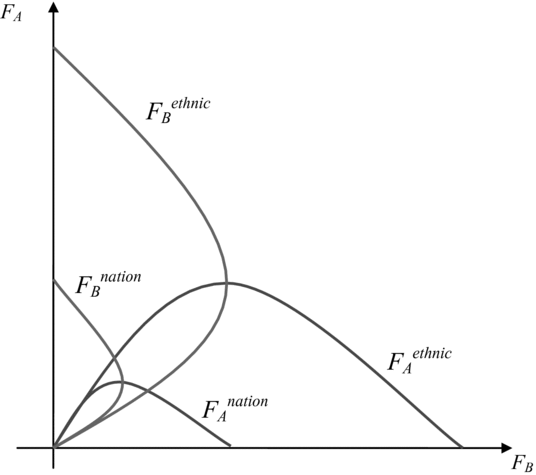
As the figure suggests, the intensity of fighting in equilibrium is highest when both groups identify ethnically, lowest when both identify with the nation, and intermediate when members of one group identify with the nation and members of the other group identify ethnically. Specifically, denote by Fxy the overall intensity of fighting (FA + FB ) in an equilibrium where members of group A identify with group x and members of group B identify with group y.
Lemma 1 . FNN < FNB = FAN < FAB < V.
If social identities were fixed, the equilibrium intensity of fighting would be unique. Identities, however, are not fixed and we now turn to their determination.
Social Identity Equilibria
In equilibrium, an individual i identifies with the nation only if
 \begin{eqnarray*}
U_{i}(f_{i},f_{-i};N)\ge U_{i}(f_{i},f_{-i};J)\quad\text{for}i\in J,\text{} J=A,B.
\end{eqnarray*}
 \begin{equation}
\gamma (S_{N}-S_{J})\ge \beta (d_{iN}^{2}-d_{iJ}^{2})\quad \text{for}i\in J, \text{}J=A,B.
\end{equation}
Both sides of inequality (8) can be affected by the intensity of conflict F. This is illustrated in Figure 3 for a benchmark case, in which the two ethnic groups are identical in resources and in any other exogenous determinants of status (YA = YB ; σ A = σ B ). The solid upward sloping line shows the right-hand side of (8). To the extent that the intensity of fighting between the groups affects the salience of ethnic attributes (η1 > 0), it increases the perceived distance from the nation relative to distance from own group. The dashed line represents what the left-hand side of (8) looks like if FA = FB = F/2. It is downward sloping since fighting destroys national resources, thereby reducing national status. The actual γ(SN − SJ ) may diverge from this line if FA ≠FB . For example, if FB > FA , then group B is winning the contest, which in general implies SB > SA .Footnote 28 The four dots in the figure depict γ(SN − SA ) and γ(SN − SB ) for the particular fighting configurations illustrated in Figure 2, resulting in total fighting intensities FNN , FNB , and FAB (the FAN case is analytically the same as the FNB case). Notice that, generically, the two sides of (8) are not equal (in other words, one identity is strictly preferred to the other). Since the groups are homogeneous, this means that in equilibrium all members of a given ethnic group hold the same social identity. This will not necessarily be the case once we allow attributes to vary within ethnic groups.
Social Identity Equilibria (symmetric groups)
Notes: The figure depicts the difference in national and group status (dots) and the difference in distance to the nation and to own group (upward sloping line), for the possible configurations of fighting illustrated in Figure 2.
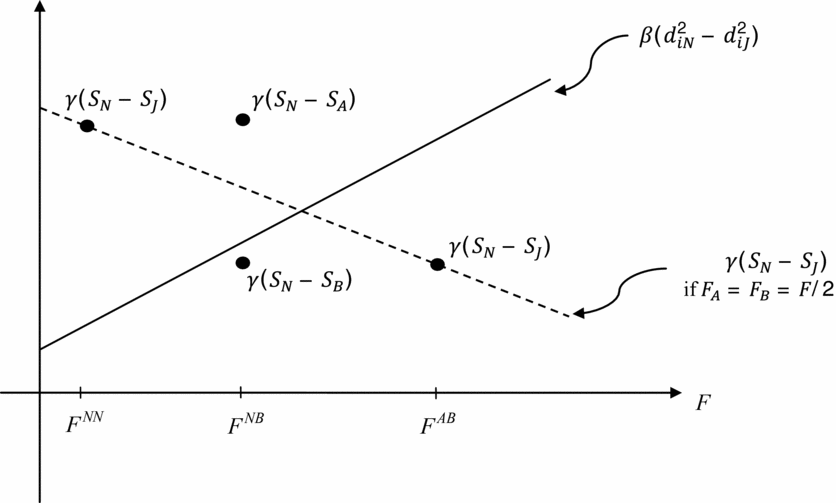
Recall that in a Social Identity Equilibrium, two conditions must hold. First, each individual's contribution to the fighting effort must be optimal given his social identity and others’ fighting efforts. Second, social identities must be optimal given the configuration of fighting. For national identity to be optimal for members of ethnic group J, it must be the case that γ(SN − SJ ) ≥ β(d2 iN − d2 iJ ) for i ∈ J. In the situation depicted in Figure 3, this is true for both groups when F = FNN , but only for group A when F = FNB and for neither when F = FAB . Conversely, for ethnic identity to be optimal for members of J, it must be the case that γ(SN − SJ ) ≤ β(d 2 iN − d2 iJ ) for i ∈ J. In the figure, this holds for both groups when F = FAB , but only for group B when F = FNB and for neither when F = FNN . The figure thus depicts a case of multiple equilibria. If FA = FB = FAB /2 (hence F = FAB ), then it is optimal for members of both groups to identify ethnically, and if everyone identifies ethnically then a profile of fighting efforts such that FA = FB = FAB /2 represents individually optimal fighting efforts. But if FA = FB = FNN /2 then it is optimal for all members of society to identify with the nation which in turn sustains FA = FB = FNN /2. Finally, a situation in which A members identify with the nation, B members identify ethnically and F = FNB is also an equilibrium.
The precise condition for the existence of multiple equilibria is given in equation (15) in the Appendix. Essentially, when status and distance parameters are at intermediate levels, both a high-intensity conflict and a low intensity conflict can be an equilibrium. If, for example, some historical conditions result in peaceful relations between the groups, this can lead to both a relatively high status of the nation and to the blurring of intranational cleavages. Thus, national identification and low conflict (F = FNN ) is an equilibrium. In other words, relatively peaceful intergroup relations can persist, even when the original conditions which prevented high intensity conflict are gone. But this same country can also find itself in a situation where an intense conflict both degrades national status and accentuates ethnic differences, to the point where ethnic identification on both sides (and continued conflict) is an equilibrium. Conflict—and peace—can be self-reinforcing.
Proposition 1 (Multiplicity) . There exist conditions such that both an ethnic identification equilibrium with high-intensity conflict ( F = FAB ), and a national identification equilibrium with low-intensity conflict ( F = FNN ) exist.
As mentioned in the Introduction, one of the most persistent findings in the study of ethnic conflicts is that countries that are fairly similar in terms of their ethnic diversity, geography, and even economic endowments and political institutions, can find themselves in very different equilibria: some with years of persistent ethnic conflict, others with generally peaceful relations between a country's different ethnic groups. As we argue in the next section, Proposition 1 may help us understand this fact.
But while historical contingencies can matter and can persist, the model points to several other factors that facilitate or inhibit high levels of ethnic conflict (an important additional factor, namely the fighting capacity of radicals, will be examined when we analyze intragroup cleavages). Consider first exogenous variations in national status, due either to dimensions of comparison other than material payoffs (captured by σ N ) or to the material payoffs of reference groups (captured by Π−N ). In Figure 3, these are reflected in the intercept of the γ(SN − SJ ) line. If, for example, national status is sufficiently high that both groups would identify with the nation even at FNB and FAB , then in equilibrium everyone must identify with the nation and the unique level of conflict is low at FNN . Similarly, but perhaps more interestingly from a policy perspective, if national status is sufficiently low (and group status sufficiently high) such that individuals would identify with their ethnic group even when there is little fighting and F = FNN , then such low level of fighting cannot be an equilibrium. Even if a halt to the violence could somehow be reached, absent other changes (e.g., significant nation building), the groups will end up at either the intermediate FNB or the full-blown FAB levels of conflict. This has implications for strategies of international peace building that we return to briefly in the Conclusion.
Proposition 2 (National status) . Ethnic identification coupled with high-intensity conflict is more likely, and national identification coupled with low-intensity conflict is less likely, the weaker are exogenous sources of national status (lower σ N , higher Π−N ).
A complementary observation pertains to perceived distance. Suppose that even in the absence of conflict, the attributes that distinguish members of the two ethnic groups are very salient relative to common attributes (namely, η0 is high). Graphically, this would mean the intercept of the β(d2 iN − d2 iJ ) line is “high.”Assuming national status is not very high relative to group status, this can eliminate FNN as an equilibrium, while making FAB an equilibrium.
Proposition 3 (Salience of ethnic attributes) . Ethnic identification coupled with high-intensity conflict is more likely, and national identification coupled with low-intensity conflict is less likely, the higher is η0 .
The model makes an important point with respect to the contestability of national resources. Specifically, consider the effect of reducing the share of national resources that can be captured to benefit one group over the other, that is, reducing V from, say, Vhi to Vlow while keeping total national resources (Y + V) constant. For example, better political and legal institutions are generally believed to limit both the share of national resources that are potentially expropriable through fighting and the extent to which they can be used to favor one group over the other (see Besley and Persson Reference Besley and Persson2011). As in other models of conflict, if there is less to fight over, the level of fighting under any given profile of identification goes down. In Figure 3, FNN , FNB , and FAB all shift to the left. Notice however, that if this reduction in violence is large enough, it can lead to a shift in the identification profile. Specifically, it may be the case that while ethnic identification is an equilibrium under Vhi , it is no longer an equilibrium under Vlow . This means there will be an additional reduction of conflict intensity: not just from FAB (Vhi ) to FAB (Vlow ), but to the (potentially much lower) level FNN (Vlow ).
Proposition 4 (Contestable resources) . For a given level of national resources (Y + V), ethnic identification is more likely, and national identification is less likely, the higher the share of national resources that are contestable.
Figure 4 provides a graphical summary of Propositions 1–4 for the case of symmetric groups (YA
= YB
; σ
A
= σ
B
). On the horizontal axis we have V, the value of the contestable resources. On the vertical axis we have the exogenous sources of the difference between national and group status, SN
− SJ
. The latter include total national resources absent any fighting (Y + V), resources of the nation's reference group (Π−N
), and any other determinants of national status (σ
N
) and ethnic group status (σ
J
, J = A, B). Finally, the intercept of the two upward sloping lines (labeled NN and EE) is given by
 $\frac{\beta}{4\gamma}\eta _{0}$
(recall that η0 is the relative salience of ethnic attributes absent any fighting). The region below and to the right of the EE line shows the combinations of parameter values for which an all-ethnic identification equilibrium exists. The region above and to the left of the NN line shows the parameter values for which an equilibrium with a common national identity exists. The intersection of the two regions is where both types of equilibria exist.
National and Ethnic Equilibria as a Function of Contestable Resources, Status and Distance Parameters
Notes: Regions in the parameter space in which national identity and ethnic identity equilibria exists, for the case of symmetric groups (σ A = σ B = σ J ; YA = YB ).

For national identity to be an equilibrium, national status needs to be sufficiently high and the relative salience of ethnic attributes needs to be sufficiently low. The reverse is true for ethnic identity. If V = 0 then social identities are completely determined by the exogenous parameters affecting national and group status and perceived distances. As V increases (more resources to fight over), these parameters continue to be important, but status and distance are also affected by the level of violence and there is more scope for vicious and virtuous cycles (multiple equilibria). Notice, however, that V appears on both axes: while higher V leads to an increase in the intensity of conflict under any given profile of identities, it can also boost national status. Thus, an increase in V with Y held constant does not necessarily lead to an ethnic equilibrium.Footnote 29 But if more of the national resources are contestable—if V increases while Y + V is fixed—this can move the nation to a region where having a common national identity is no longer an equilibrium.
So far we focused on symmetric all-ethnic or all-national equilibria, but the model also allows for the possibility of asymmetric equilibria, where members of one group identify with the nation and members of the other group identify ethnically. Consider the case where the two groups vary in their status (for reasons other than their fighting efforts and the resulting division of the contested resources). For concreteness, suppose that relative to the benchmark case of Figure 3, σ A decreases and σ B increases. The relatively low status of group A means SN − SA shifts up for any given configuration of fighting. If this shift is large enough, then ethnic identification of A members is no longer possible in equilibrium, even if F = FAB . At the same time, the increase in B’s status shifts SN − SB down, possibly eliminating the FNN equilibrium (ethnic identification is more attractive for B members even if there is little conflict). This can result in a unique equilibrium level of conflict, where the high status group (B) identifies ethnically and devotes substantial resources to contesting national resources, while the low status group (A) identifies with the nation and holds back its fighting efforts.
Proposition 5 (Asymmetric conflict) . Let J and J′ be the two ethnic groups. If σ J is sufficiently low and σJ′ is sufficiently high, then in equilibrium J members identify with the nation, J′ members identify with their ethnic group, and FJ′ > FJ .
A final point to note is that differences in group resources (YA and YB ) essentially combine the effects in Propositions 3 and 5. Starting from a situation with equal endowments, an increase in |YA − YB | would increase both perceived distances between the groups, and status differences.Footnote 30 It would thus tend to reduce the likelihood of a peaceful, common-identity equilibrium, but also increase the likelihood of an asymmetric conflict.
Endogenous Attributes
Our model takes ethnic attributes as exogenously fixed. This conforms to the way they are defined in the literature: descent based, fixed in the short run. However, even when group membership is fixed by birth, some attributes that characterize ethnic groups can be changed. A common way by which one expresses one's identity is, for example, to wear the clothes that characterize the group one identifies with. In Appendix A we therefore analyze the case where the ethnic attribute qe i is completely flexible and freely chosen by individual i.Footnote 31 Specifically, we consider the case where each individual chooses not only a fighting effort fi , but also an attribute qe i ∈ [0, 1]. This does not change the results in Propositions 1–5, except that Proposition 3 needs to be modified (as explained shortly). The main implications for the preceding analysis can be summarized in three points.
-
1. If an all-ethnic equilibrium exists under fixed attributes, then an all-ethnic equilibrium also exists under endogenous attributes.
-
2. If an all-national equilibrium exists under fixed attributes, then an all-national equilibrium also exists under endogenous attributes. Furthermore, there exist conditions such that an all-national equilibrium exists under endogenous attributes but not under fixed attributes.
-
3. An asymmetric equilibrium may not exist under endogenous attributes even if such an equilibrium exists under fixed attributes.
Roughly speaking, if individuals can change their attributes, this makes a national identity (low conflict) equilibrium easier to sustain.Footnote 32 The reason is that national identification leads to the adoption of common attributes throughout the nation, thereby reducing perceived distances across ethnic groups. (The NN line in Figure 4 shifts down.) Furthermore, if everyone identifies with the nation, then even if there is some conflict over resources across subnational groups, this conflict has less of an effect on perceived distances, as differences are smaller to begin with. (The slope of the NN line flattens.) The same is true with respect to other factors that affect the salience of ethnic attributes (captured by η0): while such factors continue to be important under ethnic identity, they are no longer important under national identity. This is the modification of Proposition 3: while an ethnic identity equilibrium is more likely to exist the higher is η0, a national identity equilibrium is no less likely to exist.
At the same time, if an ethnic identity (high conflict) equilibrium exists under fixed attributes, such an equilibrium can also be sustained when ethnic attributes are flexible and costless to change (the EE line in Figure 4 does not move). The reason is that if everyone identifies ethnically, the two groups can settle on the two extremes of the attribute interval (with all members of a given ethnic group choosing the same attribute), thereby keeping the differences across groups just as high as in the fixed attribute case.Footnote 33 However, some asymmetric equilibria, where, for example, A members identify with the nation and B members identify ethnically, may not carry over to the endogenous attributes case. National identification would lead A members to adopt the attributes of the B members, thereby shrinking perceived distance from the nation also among these B members, possibly ruling out their holding an ethnic rather than a national identity.
DISCUSSION
An important feature of the model is that it points to the possibility of multiple equilibria as a natural implication of what we know about social identification from microlevel behavioral observations (Proposition 1). This could shed some light on the significant path dependence observed in patterns of war and peace. Angola, Afghanistan, Burma, Burundi, Chad, and other countries are caught in a vicious cycle of conflict that on the one hand makes ethnic cleavages salient and on the other makes it almost impossible for individuals to think of themselves as citizens of their nation. By contrast, Tanzania, Burkina Fasso, Zambia, and other countries with similarly high levels of ethnic fragmentation and similar risk factors for conflict (including the main culprit—low per capita income) find it possible to sustain a low-conflict and relatively stronger national identification equilibrium. Econometric models of civil war generally cannot explain why political disputes in roughly similar countries sometimes escalate to civil war and sometimes stay nonviolent, or why ethnicity becomes important in some conflicts but not in others.Footnote 34 Our model illustrates how countries that look fairly similar in terms of resources, geography, and patterns of social fragmentation may find themselves in very different equilibria. Further, it addresses a key question in the political science literature on identity, by explaining how ethnic identity can be socially constructed yet also resistant to change.
Consider the case of Tanzania and Kenya, two poor and highly fractionalized East African countries.Footnote 35 Conflict intensity and identification patterns are very different in these countries. In Tanzania, national identification is exceptionally high in comparison to other East African states,Footnote 36 and the country has experienced little conflict. By contrast, neighboring Kenya has seen a persistence of ethnic identification and a high degree of conflict, punctuated by episodes of mass violence among rival ethnic groups. Of the 13 most ethnically diverse districts in Kenya, 12 had violent conflicts since 1991, with the violence falling along ethnic lines. This difference is largely due to historical contingencies and the experience of ethnic violence—not to vast differences in wealth, geography, or ethnic diversity. In the early postindependence period, Tanzania has built a strong national identity anchored on the teaching of a common language (Kiswahili) and on equitable redistribution of state resources.Footnote 37 While these policies reduced interethnic distances in Tanzania and helped push it to the relatively peaceful national identity equilibrium, in Kenya policies did little to reduce interethnic differences which were made salient by preindependence policies and patterns of intergroup (land) inequality, partly created by colonial policies (Kimenyi and Ndung'u Reference Kimenyi, Ndung'u, Collier and Sambanis2005).Footnote 38
It is worth repeating that our concept of the nation is simply the union of the groups living in a country. In some cases, what is commonly referred to as “the national identity” is synonymous with the identity of a dominant ethnic group, so it is not available to members of other ethnic groups. In terms of our model, however, such ethnic cultural dominance is an endogenous outcome. Countries where members of some groups cannot think of themselves as part of the nation are in an ethnic identity equilibrium. Ethnic fractionalization in and of itself need not preclude the possibility of national identification.Footnote 39
Proposition 2 (national status) offers a new perspective on the negative relationship between levels of conflict and per-capita income. Empirical studies of civil war have interpreted country income as either a proxy for the opportunity costs of violence, or as a measure of state capacity. While not disputing such explanations, our model posits a different, potentially complementary, mechanism: in the absence of strong status differences across groups, higher national status can mitigate conflict by discouraging identification with subnational ethnic groups. Thus, the proposed model could help explain why virtually all cases of conflict over self-determination in advanced industrial democracies are relatively nonviolent, whereas higher levels of conflict—to the point of separatist wars—are more common in poorer countries. In rich countries, even where ethnic cleavages are salient, national status competes with (and often dominates) group status. It is worth noting that, by modeling a process in which national status can influence domestic conflict, we create a bridge between the comparative politics literatures on ethnicity and civil war and the international relations literature on national status, which have been heretofore considered unrelated to each other. The model can be usefully extended to capture the effects of outcomes of interstate war on domestic social conflict and, in turn, to consider how social (class, ethnic) divisions influence a country's foreign policy in an anarchic international system (people identifying ethnically might worry less about the country's international status, for example).
National income is not the only—or even the most important—determinant of national status. Military power is another, as well as a country's overall influence in the international system. International prestige can unify a country's population and loss of status can have the opposite effect. “Cambó, a charismatic figure and one of the founders of the Lliga Regionalista [the first Catalan nationalist party], notes in his memoirs that the chief reasons for nationalism's emergence and success in Catalonia were the Spanish state's loss of prestige once the last major Spanish colonies (Cuba and the Philippines) had achieved independence and the Catalans’ pride in the rapid economic development of their region” (Diez Medrano Reference Diez Medrano1995, 3).
The logic underlying Proposition 2 is familiar to statesmen who play to the psychological effects of victory in foreign wars. The Russo-Japanese War of 1904–05 was at least partially motivated by an attempt to strengthen Tsar Nicholas II's regime. Facing increasingly serious domestic challenges, the Russian Minister of the Interior Vyacheslav von Plehve proclaimed that “What this country needs is a short, victorious war to stem the tide of revolution.” The outcome of that war was of course not what von Plehve had hoped for, but a different war by Bismarck's Prussia was indeed successful in unifying the Germans under a new, dominant state.
Bismarck “knew he needed a crisis with France and possibly even a war to overcome the resistance of southern German states to a final unification under Prussian leadership” (Steinberg Reference Steinberg2011, 281–2). He was right. Prussia's victory over France raised its status among nationalists who had earlier pinned their hopes of German unification on Austria. Austria was weakened after the Crimean War and faded after its loss to Prussia in 1866. “The liberal-nationalist reimagining of the Prussian state and its relation to the nation reached its apogee with the Franco-Prussian war” (Breuilly Reference Breuilly2005, 111). The war of 1866 had undermined pan-German unity. “Historically and sentimentally” states still looked to Austria, but “were bound to Prussia by military alliances as well as commercial ties” (Blackbourn Reference Blackbourn1998, 243). The establishment of the North German Confederation “left southern states in limbo” (Blackbourn Reference Blackbourn1998, 243) and Prussian dominance created growing resentment. In Bavaria, regional sentiment was particularly strong and the Bavarian Patriots’ Party gained strength, controlling half the seats in the Landstag. However, after the Prussian victory over France, the party divided and pro-Prussian sentiment grew (Fink Reference Fink, Breuilly and Speirs2005, 161). The Bayerische Lehrerzeitung [Bavarian Teacher's Journal], as well as many other regional publications, expressed nationalist sentiments, such as the conviction (as early as 1871) that “schools must take up the task of cultivating a sense of Germanness, to which Bavarian history must take a backseat” (Kelly Reference Kelly1993, 43). Public opinion across German states turned on the side of the Liberals, who favored German unification, as the war “aroused genuine national sentiment and fellow feeling” (Walser Smith Reference Walser Smith, Breuilly and Speirs2005, 173). In non-Prussian states like Hanover, middle-class nationalists “looked to Berlin to counterbalance local particularism” (Blackbourn Reference Blackbourn1998, 164). Saxony, a state where regional identity was so strong as to lead it to fight a war against Prussia, became an “example of German radical nationalism as early as 1878–79” (Weichlein Reference Weichlein and Retallack2000, 170). The war of 1870–71 replaced “a language of exclusion” with an inclusionary one, as Saxons celebrated their role in the war and competed with other states “to decide who had contributed the most to German Unification” (Weichlein Reference Weichlein and Retallack2000, 177). In these developments, political parties were not the main exponents of nationalism as there were no national political bodies before 1867; instead it was suprastate pressure groups, the press (and bourgeois readers), and cultural associations (Breuilly Reference Breuilly2005, 108), bolstered by “political poetry that helped shape German national consciousness” (Vanchena Reference Vanchena2000, 170). The French “needed a beating” and giving it to them caused “national exultation” (Steinbach Reference Steinbach2002, 23). Victory established Prussia as a great European power and inflated German pride, boosting national identity at the expense of regional, state nationalisms.Footnote 40
Proposition 3 highlights the importance of factors (other than fighting itself) that affect the relative salience of ethnic versus common national attributes (captured by η0). This relative salience can be affected by such factors as linguistic distance between groups, which Esteban et al. (Reference Esteban, Mayoral and Ray2012) have shown correlates with the risk of conflict. Relative salience can also change over time in a number of ways that political scientists and sociologists have considered at length: through conquest, assimilation, or mass schooling and the introduction of a common language and culture. Growing intragroup (for example, class) divisions can reduce the salience of common ethnic attributes.Footnote 41 A national education system is perhaps the most important mechanism through which national, as opposed to ethnic, regional, or other parochial identities have prevailed across countries.Footnote 42 The drawing of national borders can redefine ethnic loyalties over time by creating new nations.Footnote 43
These changes take time, but changes in η0 can also occur quickly. Wilkinson (Reference Wilkinson2004) provides a catalogue of tactics used by Hindu politicians to elevate the salience of the Hindu-Muslim cleavage: from proposing to rename a town with a Muslim origin name (Ahmedabad, Allahabad) with a Hindu name, to organizing religious processions that pass through Muslim neighborhoods. In Croatia, the reclassification of Serbs as “minorities” (down from their previous status as “constituent nationalities”) was widely perceived as a hostile and provocative act by Croat nationalists who played to Serb fears rooted in memories of Serb-Croat violence during World War II (Petersen Reference Petersen2002). Such actions often lead to ethnic violence that in turn further accentuates this cleavage. Conversely, interstate wars can diminish the salience of intrastate cleavages, leading to what is often referred to as a rally-around-the-flag effect. The state itself might try to generate such an effect. While Charles Tilly's famous dictum “the state made war, and war made the state” referred mainly to the need to build administrative capacity to fight wars, internal unity is clearly a component of a state's ability to wield an effective force in the battlefield. Where external threats to national borders are absent or minimal, internal ethnic conflicts can more easily arise.Footnote 44
The Mexican revolution provides an example of a watershed event that can shift the country from an ethnic identification equilibrium to a low-conflict, national identification equilibrium. According to Wimmer (Reference Wimmer2008, 1006) “the revolutionary wars mobilized large segments of the indigenous population, leading to their integration into a new network of clientelist relationships managed and controlled by the emerging one-party regime.” These new national networks supported a new concept of the Mexican nation (Wimmer Reference Wimmer2008; cf. also Mallon Reference Mallon1995). Wimmer explains that, in the prerevolutionary period, the Mexican identity was reserved for Criollo elites and excluded the indigenous population, which they considered inferior. Joint participation in the revolution helped create a new “amalgam” of the Mexican people that combined Indian and Spanish cultures. The experience of fighting together in the war and integration in the power apparatus helped indigenous villagers to begin thinking of themselves as Mexicans (cf. Friedrich Reference Friedrich1970). Ethnic divisions between Spanish elites and indigenous people are widespread in Latin American countries, and they have often resulted in armed conflict, even genocide (in Guatemala). But the intensity of ethnic conflict in Mexico is substantially lower than in other countries with significant ethnic polarization such as Guatemala, Bolivia, and Peru (see Mallon Reference Mallon1995).Footnote 45
Proposition 4 (contestable resources) points to the potentially polarizing effect of natural resource endowments in countries with a weak state. Consider for example the long cycles of conflict in the Democratic Republic of the Congo. The country's riches contributed to several bouts of ethnic violence, starting immediately after independence, when tribal divisions emerged in a competition over mineral deposits in Katanga and Kasai, and ethnic violence claimed the life of the country's first and only nation builder, Patrice Lumumba. Katanga, which tried unsuccessfully to secede in 1960, produced 75% of the country's mineral output and was controlled by ethnic groups that claimed to be under-represented in the central government. Recursively, the “strangers” from diamond-rich Kasai region tried to secede from Katanga in another clear example of tribal divisions, fueled by resource wealth. The Kwilu and Eastern rebellions followed—four different wars in a span of as many years as an independent state—with recruitment and fighting always along ethnic lines. As Ndikumana and Emizet (Reference Ndikumana, Emizet, Collier and Sambanis2005) show, the competition over natural resources fueled conflict and undermined any effort at building a common identity. The conflict was exacerbated by the gradual decline of the country's GDP, which dropped by about 80% from the mid-1970s until the mid-1990s. Declining national status, lack of a common national identity, and heavy resource dependence combined with discriminatory nationality laws and demographic shocks (influx of 1.2 million Rwandan Hutu refugees in 1994), contributed to the latest round of civil war.
The link between resource wealth and state failure has been analyzed extensively, flagging political corruption as an important mechanism (Keen Reference Keen2012; Reno Reference Reno1995). Most of the literature does not address the effect of resource competition on conflict via the mechanism of social identification. Some recent works exploit exogenous variation in commodity prices to show that a positive relationship exists between contestable resource wealth and conflict. In their study of Colombia, Dube and Vargas (Reference Dube and Vargas2013) find that the relationship depends on the type of commodities. In the case of agricultural commodities (e.g., coffee) which are labor intensive, increased commodity prices means higher wages and less conflict. Note that these agricultural prices do not necessarily capture the parameter V in our model as they largely affect individual income (Y). By contrast, in the case of natural resources (e.g., oil), higher prices mean there is more to fight over and indeed there is more conflict. Consistent with our model, Dube and Vargas’ results suggest that the percentage of country wealth that is under potential control of the state leads groups within the state to arm themselves, but there is nothing about identity there.Footnote 46 The effect of expropriable resource wealth on conflict through the channel of social identification is a rich open empirical question.
Proposition 4 suggests a potentially important “multiplier effect” of institutional change. If the extent of national resources that can be seized by force to benefit one group is successfully limited, then the resulting reduction in violence can lead to a decline in ethnic identification. This means there will be an additional reduction of conflict intensity. This suggests a way of thinking about the effect of institutions on ethnic identification in resource-rich countries. A plausible application is a country such as Iraq, where violent conflicts have become ethnicized in the context of competition over control of the country's oil wealth. While oil (among other things) stands in the way of constructing a unified Iraqi identity out of rival Kurdish, Sunni, and Shiite group identities, an institutional solution that involves making oil rents less easily appropriable by a single ethnic group or an unrepresentative political coalition should not only reduce conflict over oil, but also help diffuse ethnic tensions and strengthen a common Iraqi identity.Footnote 47
The Iraqi case is of course complicated by the presence of two simultaneous and overlapping ethnic conflicts (Sunni-Shia and Arab-Kurd) as well as the counter-American insurgency. But the conflict between Kurds and Arabs—the two main ethnicities in Iraq—since 2003 offers a good illustration of the workings of the model. In line with Proposition 3, the Kurds’ historical geographic, political, and cultural separation from Baghdad, as well as their institutional autonomy since the end of the First Gulf War in 1991 have all contributed to the salience of Kurd-Arab differences (high η0) and to the Kurds’ strong ethnic (rather than national-Iraqi) identity in 2003. This was reinforced by the decline of Iraqi national status accompanying the defeat in 1991 and the ensuing sanctions regime (Proposition 2). Further contributing to the conflict and to the Kurds’ strong ethnic identity was the sharp increase in the contestability of national assets—land, oil, and autonomy—since the 1991 Gulf War, but especially since the fall of Saddam and since the Kurds’ main constitutional partner, the Shia party ISCI, has diminished in power (Proposition 4). Finally, Kurdish status has risen significantly after the fall of Saddam and later with the gaining of autonomy and increased control over territory and oil rents. By contrast, while Arab identity has been quite salient historically—in the form of pan-Arabism under the monarchy and revolutionary period and during the Iran-Iraq war—it has diminished for Iraqis since the Gulf War. Non-Kurdish Iraqis (especially Shia) do not identify as Arabs; sectarian and tribal identities have been more important than the “Arab” identity, and historically Iraqi national identity has also been strong for them.Footnote 48
National identification declined during the period of sectarian (Sunni-Shia) war from 2005 to 2007, but it took an enormous amount of violence to shift Arab Iraqis to sectarian identification after the 2005 elections and cross-sectarian politics with national agendas emerged very quickly in early 2008 among Iraqi Arabs (as compared to the more parochial aims of the Kurds and ISCI) with key examples including the passage of the provincial powers law on February 13, 2008 and the provincial elections law on July 22 (Visser Reference Visser2010, chap. 3). A movement by Shia Arab groups led by ISCI to achieve similar autonomy in southern Iraq, around the oil-rich Basra region, met with no support among ordinary Iraqi Shia. The March 2010 elections affirmed voter support outside the KRG for nationalist platforms of Maliki and Allawi. More recently, Sunni Arabs have supported Shia Prime Minister Maliki's statements about the Iraqi character of Kirkuk.Footnote 49 Overall, Iraqi national identity has been important among most (non-Kurd) Iraqis both before and after the U.S. invasion of 2003, despite the rise of sectarianism. The Arab-Kurd conflict therefore has an asymmetric aspect to it. Consistent with Proposition 5, the Kurds have made their fight with Baghdad their top political priority as indicated by their per capita expenditures on their military defense forces and their efforts to achieve political and legislative cohesion between the two rival Kurdish parties, PUK and KDP, which gave them favorable constitutional and resource outcomes. In contrast, there has been no comparable or consistent Arab political platform to counteract the unified Kurdish position. Restraint among the Arab Iraqis is at least partly related to the desire to avoid another war that can break down Iraq and lead to the secession of KRG.
INTRAGROUP CLEAVAGES
So far we have been assuming a sharp distinction between the two ethnic groups: all members of a given ethnic group share the same attributes, and hence are equally different from the other group. However, ethnic divisions are often more nuanced. In this section, we maintain the framework of two ethnic groups, but consider the possibility that some members of group A share more attributes with group B than do other members of A.Footnote 50 The simplest example is some regional cleavage that makes some members of A (physically) closer to members of group B than other members of A. Alternatively, one could think of differences in the degree of expression of attributes that uniquely characterize one ethnic group. Thus a local dialect might divide native speakers of a given language or differences in skin tone might divide a racial group (say, between light-skinned and dark-skinned blacks). Religious or ideological differences can similarly cut across one of the ethnic groups. As we show in this section, this type of intragroup heterogeneity can lead to the unravelling of a relatively peaceful equilibrium.
Consider then a binary attribute (or set of attributes) shared by all members of the nation except for some fraction of the A group. Equivalently, one may think of an attribute that characterizes some members of group A, and none of the members of group B. Let qc i = 1 for those individuals i ∈ A who share this attribute and qc i = 0 for all others. We refer to individuals with qc i = 1 as the “core” members of group A. Notice however that “core” members are not necessarily a majority within their ethnic group and may not be closer than other members to the typical or modal member of that group.Footnote 51 “Coreness” in our model only refers to the greater distance between that subgroup and the rest of the nation. It should not be understood as implying that core members are “truer” members of the social group. Denoting the attention weight on this attribute by wc , the perceived distances are now given by
 \begin{eqnarray}
d_{iJ}^{2}&=&w_{n}\big(q_{i}^{n}-q_{J}^{n}\big)^{2}+w_{e}\big(q_{i}^{e}-q_{J}^{e}\big)^{2}\nonumber\\
&&+\,w_{c}\big(q_{i}^{c}-q_{J}^{c}\big)^{2}, \text{\ \}J\in \lbrace A,B,N\rbrace,
\end{eqnarray}
Recall that Assumption 1 maintains that fighting between the two ethnic groups can increase the relative salience of ethnicity, thereby reducing the relative salience of nationality. We now need to specify how this increase in the relative salience of ethnicity affects the relative salience of core attributes. Assumption 2 allows fighting between the ethnic groups to also reduce wc . Again, to keep the model tractable, we assume a linear relationship.
Assumption 2 . The salience of the intragroup cleavage weakly decreases with the intensity of intergroup conflict. Specifically,
(a) wc = ρ0 − ρ1 F where ρ0 ∈ (0, 1] and ρ1 ∈ [0, η1),
(b) ρ0 ≥ ρ1 Y and η0 + ρ0 + (η1 − ρ1)Y ≤ 1.
The parameter ρ0 represents the relative salience of core attributes in the absence of fighting between the ethnic groups. We assume a positive ρ0 to ensure that the core attributes have some salience. If core members are perfectly integrated into their group (ρ0 = 0), then we are effectively back to the homogenous case analyzed in the previous sections.Footnote 52 The parameter ρ1 captures the sensitivity of wc to the intensity of intergroup fighting. We assume that ρ1 ≥ 0, i.e., the salience of the intragroup cleavage cannot increase with intergroup fighting. This is a natural assumption for the present extension of the model, which maintains the structure of a two-group conflict. In a setting where the fighting could take place at the subgroup level (e.g., intragroup fighting in A or if the B group can target only the core members of A) this assumption would probably need to be modified. The assumption that ρ1 < η1 ensures that if fighting increases the salience of ethnicity then it also decreases the salience of common national attributes, i.e., that it does not decrease only the salience of the core attributes.Footnote 53 Part (b) is a technical restriction to ensure that wc ≥ 0 and we + wc ≤ 1 even at the maximal possible level of fighting.
We begin the analysis by noting that core members of A are more likely to identify ethnically than noncore members of A.
Lemma 2 . In any equilibrium where the noncore members of A identify ethnically, so do the core members; but there can exist equilibria where the core members identify ethnically and the noncore identify with the nation.
In other words, heterogeneity in attributes can lead to heterogeneity in preferences within the ethnic group, and this heterogeneity takes a particular form (the core identifying ethnically, the noncore nationally). What would FA , the fighting effort of group A, be when its members hold these different identities?
Consider first the decision of a core A member who identifies ethnically. His utility is given by Ui = π i − βd2 iA + γSA where from equation (9) we have d2 iA = wc (1 − μ)2. Simple manipulation shows that for core members,
 \begin{eqnarray}
\frac{\partial U_{i}}{\partial f_{i}}=-(1+\gamma)+\left(1+2\gamma \right) V \frac{F_{B}}{F^{2}}+\beta \rho _{1}\left(1-\mu \right) ^{2}. \nonumber\\
\end{eqnarray}
 \begin{eqnarray}
f_{i}=\big[ \sqrt{\delta ^{\prime}VF_{B}}-F_{B}\big] -F_{A-i}\equiv F_{A}^{\text{\it core},\text{\it ethnic}}-F_{A-i}, \nonumber\\
\end{eqnarray}
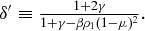 $\delta ^{\prime}\equiv \frac{1+2\gamma}{1+\gamma -\beta \rho _{1}(1-\mu)^{2}}.$
FA core, ethnic can be interpreted as the desired overall level of fighting by A, from the perspective of a core member who identifies ethnically: if FA = FA core, ethnic then i doesn't want to increase nor decrease his contribution to the fighting. It may be interesting to note that this desired level of fighting is (weakly) higher the lower is μ, i.e., the smaller is the core relative to the rest of the ethnic group. The intuition is simple: other things being equal, a smaller core is in greater danger of being perceived as different from the rest of its ethnic group, and hence has a higher stake in minimizing intragroup cleavages.
Next, consider a noncore member of A who identifies with the nation. Utility is given by Ui = π i − βd2 iN + γSN where d2 iN =¼(we +μ2 wc ). It follows that for noncore members, the interior solution is
 \begin{eqnarray}
f_{i}=\left[ \sqrt{\frac{1}{\psi ^{\,\,\,\,\prime}}VF_{B}}-F_{B}\right] -F_{A-i}\equiv F_{A}^{\text{\it nc},\text{\it nation}}-F_{A-i}, \nonumber\\
\end{eqnarray}
What is the actual FA ? Denote by Ycore the total resources available to core members:
 \begin{eqnarray*}
Y_{core}=\sum\limits_{i\in A\text{s.t.}q_{i}^{c}=1} y_{i}.
\end{eqnarray*}
Lemma 3 . Suppose core A members identify ethnically and noncore A members identify with the nation. Then
-
1. If Ycore ≥ FA core, ethnic then FA = FA core, ethnic and fi = 0 for all noncore i ∈ A.
-
2. If FA nc, nation < Ycore < FA core, ethnic then FA = Ycore and fi = 0 for all noncore i ∈ A.
-
3. If Ycore ≤ FA nc, nation then FA = FA nc, nation , fi = yi for all core i ∈ A and fi < yi for at least some noncore i ∈ A.
In words, when core members have sufficient fighting capabilities to sustain their desired fighting effort, they do that. This means, however, that for noncore members ∂Ui /∂fi < 0 even at fi = 0 and they take no part in the fighting. If the core's fighting capabilities are not sufficient to sustain their desired level of fighting, then they are at a corner solution, devoting all their available resources to fighting. However, as long as the core are able to stage more fighting than what the noncore see as desirable, the core remain the only members of A participating in the fighting. Finally, even when the core have very limited resources and fighting is at the (relatively low) level desired by the noncore, contributions to the fighting effort are likely to be unevenly distributed within the ethnic group, as core members devote all of their resources to fighting.
Figure 5 illustrates the FA curve for a particular value of Ycore . For very low levels of FB the core are able to set FA at the optimal level from their perspective. Thus the overall level of fighting FA coincides with the FA core, ethnic curve. The same would be true for very high levels of FB (not seen in the figure). For intermediate levels of FB , group A’s total fighting effort is determined either by the core's resource constraint or by the noncore's optimal level of fighting FA nc, nation . This, together with Lemma 2, suggests the existence of situations in which it is the core's fighting capacity which determines how hard group A fights group B. And if the core has the resources to stage enough violence, this can lead to an identity shift in the rest of the population and to the unravelling of a relatively peaceful equilibrium.
Conflict with Heterogeneous Identities in A and National Identity in B
Notes: The FB nation curve shows the aggregate fighting effort by B members, whereas the solid F A curve shows the aggregate fighting effort by A members when the core identify ethnically and the noncore identify with the nation. Ycore is the aggregate fighting resources available to the core A members.

Proposition 6 . Under certain conditions, a relatively peaceful equilibrium in which both B members and noncore A members identify with the nation exists if and only if the resources available to core members are sufficiently low.
The precise conditions are given in equation (20) in the Appendix. Essentially, they require two things. First, that the parameters affecting status and distance (discussed in Propositions 2–5) are at “intermediate” levels, such that an equilibrium with heterogeneous identities in A and national identity in B is possible. For example, they preclude situations in which national status is so high (low) that every individual in the country always (never) identifies with the nation, regardless of intragroup differences or the intensity of fighting. Second, that the value of the contestable resources V is sufficiently large to induce significant changes in the intensity of fighting when the core's capacity changes.
Under these conditions, Proposition 6 says that a relatively peaceful equilibrium is possible, but only as long as the fighting capacity of core members is not high. To see why, consider Figure 5 again. The backward-bending curve shows FB when B members identify with the nation. In this case, the equilibrium is as peaceful as it can get since fighting levels are determined by the noncore A’s and by the B’s, all of whom identify with the nation.Footnote 54 This remains the case as long as Ycore is lower than the intersection of FB nation and FA nc, nation (so the noncore determine A’s fighting effort).
Consider, however, what happens if the core's fighting capabilities increase. Once Ycore reaches the intersection of FB nation and FA nc, nation , any further increase in Ycore leads to an increase in A’s total fighting efforts. This leads to some decrease in FB but to an increase in the overall intensity of fighting. Now consider the equilibrium. Focusing on the noncore members of A, there are three effects. First, a higher F is associated with an increase in d2 iN − d2 iA : with more fighting along the ethnic divide, noncore individuals are perceived as further away from their nation and as closer to their ethnic group. Second, if B members continue to identify with the nation and seek a relatively low level of conflict, group A devotes more resources to fighting than group B, and is winning a larger share of the contested resource. This tends to increase its status, SA . Third, more fighting leads to the destruction of national resources, eroding national status, SN . Each of these effects makes it less and less likely that noncore A members will continue to identify with the nation. It is also worth noting that, except for the second effect, similar forces operate on the B group: distance from the nation increases and national status is eroded, rending national identification harder to sustain.
Next, we turn to a discussion of a case that illustrates the logic of core violence as outlined in the model. We focus on the war in Yugoslavia because it is a familiar case that others have used to illustrate different arguments. We show that the case is also consistent with the psychological mechanisms proposed by our model. This is an example where fighting and intense ethnic identification occurred as the result of violence by an ethnic “core.” Although this case does not constitute a hypothesis test, it does provide an empirical context that suggests the plausibility of our arguments as alternative—or complementary—explanations for ethnic conflict that have to date been overlooked in the literature.
Yugoslavia
In 1985, the Serbian Academy of Sciences published a memorandum condemning Tito and the Yugoslav Communist Party state for three decades of “anti-Serb policies” that left Serbia poorer than other Republics, and denouncing “genocidal” anti-Serb policies by Albanians in Kosovo. The next year, a prominent Serb politician, Slobodan Milosevic, became head of the Serbian Communist Party with an agenda to restore the Serbs’ lost status in the federation. To that end in 1989, on the 600th anniversary of the Battle of Kosovo, Milosevic visited the Kosovo province to deliver a speech rife with symbolism. Kosovo is an Albanian-majority region, claimed as the spiritual home of the Serbs. Milosevic spoke about restoring the dignity of Serbia and fostering intra-Serbian unity in the face of new challenges that he paralleled to the challenges (slavery) created by the Ottoman Muslim victory in the battle of 1389.
That speech marked the beginning of a process of ethnic mobilization and conflict escalation. Yugoslavia was an uneasy amalgam of mostly territorially concentrated ethnic groups, which Communism had pulled together into a single nation. The collapse of Communism was followed by manifest ethnic identification among large segments of the population and fueled aspirations to self-determination in Yugoslavia's constituent Republics as well as smaller regions. The elections of 1990 “proved an ethnic census” (Mann Reference Mann2005, 367). Nationalist parties (expressions of ethnic identification, in terms of our model) gained ground. Leaders like Tudjman in Croatia, Izetbegovic in Bosnia, and Seselj and Draskovic in Serbia had “moral authority” due to their imprisonment and torture for inciting ethnic conflict under Communism (Mann Reference Mann2005). Serbian reformers like Stambolic were forced off the stage by the public, which rallied around nationalists like Milosevic (Petersen Reference Petersen2002). For the most part, Serbian voters agreed with the memorandum of 1985, which had been signed by 216 Belgrade intellectuals and reflected the ideas of Serbia's ethnic core, which included the Serbian Orthodox Church, academics, intellectuals, and ordinary people without a political agenda (Milisevic Reference Milisevic2004, 119–130; Petersen Reference Petersen2002, 222–3). Milosevic stoked the flames of ethnonationalism by dissolving the Kosovo assembly, revoking the province's autonomy. In response, ethnic Albanian legislators declared Kosovo a Republic. The League of Communists split along ethnic lines. Newly elected nationalist leaders claimed the right to a nation state, even in Bosnia, where there was no ethnic majority.
In Croatia, the situation was similar. Tudjman, with greater nationalist credentials than Milosevic, gained two thirds of parliamentary seats while calling the Serbs “Turks” (Cohen Reference Cohen1995, 211) and drawing support from Croats who felt ethnically victimized and resented outgroup privileges (Mann Reference Mann2005, 375; Siber Reference Siber, Seroka and Pavlovic1993, 152–3). One after the other of Yugoslavia's ethnic republics seceded, starting with Slovenia (the richest and most ethnically homogenous one). Croatia followed suit in 1991 and the Serbs in Croatia's Krajina region (having lived there since the 17th century), agitated for a separatist bid of their own, demanding to be unified with Serbia. Krajina Serbs were part of the Serbian ethnic core and were the first to mobilize for violence. Local Serb militias were formed with help from Belgrade ultranationalists like Vojislav Seselj, a former political science professor, “Chetnick Vojvoda,” and President of the Serbian Radical Party.Footnote 55 Paramilitaries and volunteers from Serbia joined, some of them organized by the Serb security police (SDB).Footnote 56 Krajina Serbs set up roadblocks to prevent Croatian state officials from interfering in a planned referendum on independence. Milosevic supported the Krajina Serbs’ right to independence and argued for the unification of all Serb territories. Seselj pursued his long-standing goal of forming a homogenous “Greater Serbia” by stoking Serb fears of victimization by fascist Croat hordes and ultimately recruiting and deploying thousands of “Seseljevci” to fight for the separation of Serbs from other Yugoslavs.Footnote 57 Tudjman spurred the Seseljevci with his words and deeds, helping to polarize the Serbs (Petersen Reference Petersen2002). In Krajina, Serb militants were able to play into Serbs’ fears of Croatian aggression by pointing to Croatian provocative actions, such as the adoption, by Croatia, in July 1990, of the sahovnica, the traditional red and white checkerboard symbol that was identified with the Ustasha state during World War II; or the downgrading of Serbs in Croatia from a “constituent nation” to a “national minority.”Footnote 58 Croatian militias and local Serbs engaged in guerrilla battles, leading to engagements by Yugoslav army units.
The Croatian conflict spilled over to neighboring Bosnia, where a Muslim majority voted for independence, and the Serbs dissented. As soon as the votes were counted, Serbs set up roadblocks around major cities (which were heavily populated by Muslims), cutting them off from the mostly Serb-controlled countryside. Serbs began to leave the cities with the help of Serb-controlled Yugoslav National Army units. A Bosnian Serb parliament was set up and Serb paramilitary units formed, targeting Muslims. The violence in both Croatia and Bosnia ended in 1995 with heavy international diplomatic involvement and peace enforcement. What started as militia violence by a core group of extremists ended up as a multiyear war that killed more than 100,000 people and displaced around 2.5 million.Footnote 59
Yugoslavia in Light of the Model . This pattern of conflict escalation in Yugoslavia is rarely explained without reference to the “actions of recently empowered and unpoliced thugs” who were able to “whip up a fair amount of hatred” (Mueller Reference Mueller2000, 47) and many see it as the result of elite manipulation of the masses (De Figueiredo and Weingast Reference De Figueiredo, Weingast, Walter and Snyder1999). But this was not an elite conspiracy. Ethnicity had been made salient by the collapse of Communism, the economic crisis, and the political power grab that followed, as well as by recalling memories of violence at the hands of the Croat Ustasha, the Serb Chetnicks, and Sandzak SS regiments during World War II (Glenny Reference Glenny1992). The Yugoslav case had several of the risk factors for conflict escalation that we model: declining international status; high value of contestable resources (the state itself was up for grabs and could be exploited for the benefit of the group, excluding non-co-ethnics); and high salience of ethnic attributes. Moreover, the trajectory of the conflict was shaped by radicals with sufficient resources to fight hard; and these radicals were not simply opportunists. Many—if not most—identified ethnically and shared a commitment to enhance the relative status of their group.
In the academic literature as well as in press reports on Yugoslavia, Milosevic is widely seen as “the paradigmatic case [of] a nationalist of convenience, rather than conviction” (Brubaker Reference Brubaker and Hall1998, 289).Footnote 60 This has supported the view of Yugoslavia's violent unravelling as the result of elite manipulation. But Milosevic rode a wave of nationalist mobilization and he spoke directly to the “core constituencies of Greater Serb nationalism—Serb refugees, Serbs in threatened areas, especially Kosovo, and some rural Serbs who expected more economic development” (Mann Reference Mann2005, 370). His opposition was actually even more nationalist than him, with Vuk Draskovik calling for “unity of all Serb lands” with grassroots support from Orthodox cultural-educational societies (Mann Reference Mann2005, 372). Even as we acknowledge the fact that elites can be strategic and manipulative, we must also acknowledge that “the elite manipulation thesis fails to specify the particular conditions that make key segments of the Yugoslav population especially responsive to elite manipulation. . . [it] overpredicts the severity and violence of ethnic conflict” (Brubaker Reference Brubaker and Hall1998, 291).
Accounts differ as to the degree of ideological commitment and ethnic identification of Serb paramilitaries.Footnote 61 Some, like Seselj, had a long history of ethnic identification and fought to reclaim the Serb's lost status. Others were more opportunistic and might have been motivated by the desire for personal profit. But while the violence did involve elements of criminality,Footnote 62 this was not a war caused by “a few bad guys.”Footnote 63 The violence was set in motion by politicians who identified with, drew support from, or acted on behalf of an ethnic core. The identity of the early movers is consistent with the predictions of our model. They were dominated by ultranationalists, who made use of people with proclivities or specialization in violence to pursue their aims. Zeljko Raznatovic (Arkan), who is usually described as an opportunistic thug, actually organized soccer fans for Red Star Belgrade into an ethnonationalist group that provided a pro-Milosevic militia and had worked for the Serbian Secret Service (SDB) in the past (Mann Reference Mann2005, 404). Milisevic (Reference Milisevic2004) argues that the perception that the paramilitaries were out of control criminals was deliberately cultivated by Serbian leaders so as to more plausibly deny their involvement in the war. The White Eagles, the paramilitary group attached to the Serbian Radical Party, was led by Mirko Jović, who called for “a Christian, Orthodox Serbia with no Muslims and no unbelievers” (Velikonja Reference Velikonja1992, 268). Vuk Draskovic, leader of Serbian Renewal Movement, organized the Serbian Guard; Seselj, leader of ultranationalist Serbian Radical Party, formed the Chetniks. In Croatia, the ultranationalist Croatia Party of the Right, led by Dobrosav Paraga, organized the Croatian Defense League (HOS), followed by the Zebras and Black Legions, two other militias formed by right-wing groups (Sikavica Reference Sikavica, Udovicki and Ridgeway1997, 141). These groups identified ethnically and their leadership drew strength from the popular appeal of their message. Thousands of volunteers joined the fight: “these men from Serbia [who] decided to cross the rivers Sava and Drina to join the war. . . were the core constituencies of support for pro-nationalist and pro-war politics” (Milisevic Reference Milisevic2004, 17).
As the model would predict, violence perpetrated by the ethnic core intensified ethnic identification among moderates. Although many—perhaps most—people in Yugoslavia identified ethnically prior to the war (most selected only one ethnic category in the census and fewer than 10% identified as “Yugoslavs”), it was not until the outbreak of violence that the masses became radicalized. There is evidence of substantial interethnic cooperation and exogamy in Yugoslavia (Petrovic Reference Petrovic1986, Bromlei and Kashuba Reference Bromlei and Kashuba1982), but in the 1991 census—the year of Croatia's declared independence—the share of “Yugoslavs” in the population dropped to its lowest level in decades. In Croatia it declined from 8.2 to 2.2% (Botev Reference Botev1994; Burg and Berbaum Reference Burg and Berbaum1989; Woodward Reference Woodward1995). The lack of strong ethnic identification capable of supporting violence prior to the start of the violence was evident in the mass-level defections and draft dodging that occurred in the Serb Army (Milisevic Reference Milisevic2004, 16). In Croatia in 1990, Tudjman's party (HDZ) received 1.2 million votes, whereas the reformed communists and allies who preferred a stronger Yugoslav federation received almost as many votes (1 million) and most Croatian Serbs did not vote for Serb nationalists, but rather supported the Communists or centrist parties. A year later, almost all Croats voted for independence and almost all Serbs boycotted the vote and favored independence for Serb Krajina (Obserschall Reference Oberschall, Chirot and Seligman2001).
The conflict over Croatian independence was quick to turn violent (the first incident in Plitvice occurred at the end of March 1991) and violence escalated quickly. The indiscriminate retaliation by Croats helped mobilized moderate Croatian Serbs. While at first the violence was the work of a select few, later on there was widespread support in retaliatory mass killings (Sudetic Reference Sudetic1998, 350–2). “Most of those indicted by the ICTY committed atrocities in their own home areas [and] locals were the most radicalized” (Mann Reference Mann2005, 418–420). Killers and torturers knew their victims.Footnote 64 Former army officers and police were over-represented among violence perpetrators and they identified more ethnically than the rest of the population.Footnote 65 The Serbian Volunteers Guard and other militias cultivated the ethnicization of violence by adopting religious rituals as part of the enlistment procedure. Soldiers had to be baptized and prayed together (Milisevic Reference Milisevic2004, 73–4) and the Guard offered an attractive combination of religion and “national mythology” that drew many volunteers who responded to reports of war atrocities against Serbs and joined to defend Serbia and Yugoslavia (Milisevic Reference Milisevic2004, 74; 85; 97).
Eventually, “elites, militants, and ordinary people were all involved” (Mann Reference Mann2005, 360). A Croatian Catholic priest who witnessed atrocities in his village testified before the International Criminal Tribunal that “There had been no tensions before. . . Orthodox children would attend the Sunday School. . . [but] when the war started. . . the local Serbs became the main killers” (Bottica 1992, 253). This pattern, which identifies a sharp increase in ethnic identification sparked by violence, was apparent to other observers at the time. A UN report noted that “in places where the local Serb population was initially fairly friendly, once Arkan's thugs arrived the situation changed” and Muslims were ostracized and treated with hostility.Footnote 66 This change in behavior is consistent with a shift in preferences, although other explanations, such as intimidation, are also possible. The pattern of violence-induced polarization describes not only the escalation of the Croatian war of 1991, but also subsequent Croat-Serb violence in Croatia and Bosnia, as well as Croat-Muslim violence. An influential anthropological study of Visnjica, a mixed Muslim/Croat village in Bosnia, clearly illustrates how the war “start[ed] out as a war waged by outsiders [and] developed into one where neighbor was pitted against neighbor after the familiar person next door had been made into a depersonalized alien, a member of the enemy ranks” (Bringa Reference Bringa1995, xvi). In Croatia, interethnic relations were peaceful until the spring of 1991, when the actions of Serb paramilitary groups caused a rapid polarization and ethnic mobilization for war.Footnote 67 Extremism was cultivated by the state, including the Serb radio, which served as the primary media outlet for most of the rural population in Serbia and Croatia.Footnote 68
Ethnic polarization in Serbia was widespread and persisted through the 1990s, as evidenced in the large-scale participation of Serbs in the cleansing of the Albanian population from Kosovo in 1999 and in the apparently little remorse they displayed after the fact (Petersen Reference Petersen2002, 242–3). Even after Dayton, ethnic identification persisted: police and paramilitary units were ethnically homogeneous; expulsions of Muslims continued two years after the accords; Muslims have been reluctant to return to their villages; and Croatian initiatives for repatriation have preferred monoethnic cantons (Petersen Reference Petersen2002, 234–5).
The Yugoslavia case demonstrates the key mechanism of the model in that a subset of the ethnic group, who have the will and resources to fight hard on behalf of their ethnic group, can destabilize a relatively peaceful equilibrium. Conflict escalation was made possible by the fact that extremists had sufficient resources to fight.Footnote 69 By most accounts, most citizens of Yugoslavia did not support the dissolution of the federation before 1990. Ethnic identities did not dominate other social and political cleavages (Petersen Reference Petersen2002, 208–210). Class, political party, and urban/rural divides constituted important social identities in prewar Yugoslavia that mattered just as much—if not more—than ethnic identities. This all changed with the outbreak of ethnic violence. Not only did violence reduce the salience of a common Yugoslav identity but, consistent with the model, it was also effective in reducing the salience of intragroup cleavages. The socially and politically important differences between rural and urban Serbs ceased to matter (Bennett Reference Bennett1995) as did a number of previously salient political cleavages within each group, and the violence had the effect of “switching off” a host of alternative social identities (Yugoslav, Reformist, Pluralist, Liberal) that had been resurgent with the collapse of Communism (Gagnon Reference Gagnon2004). As stipulated in the model, ethnic violence accentuated intergroup divisions while narrowing intragroup distances, leading to increased ethnic identification and escalating conflict.Footnote 70
Finally, the case of Yugoslavia also suggests that the strategic use of violence (to the extent that core group violence was strategic) is more likely to be effective in societies with pre-existing ethnic divisions. While we do not model elites, we can help elucidate the mechanisms which allow them to be effective in mobilizing moderates (noncore group members). But, as in our description of Yugoslavia, the vanguard does not necessarily act purely instrumentally and violence cannot effectively mobilize co-ethnics if they do not have any emotional attachment to their ethnic group. Rather, core members are often motivated by ethnic differences or ideological fervor and have an interest in minimizing intragroup divisions.
CONCLUSION
This article proposes a framework that can help researchers think about the complex processes of ethnic identification and conflict. While the proposed model is broadly applicable to many different types of social conflict, we have focused on ethnic conflict by assuming, along with the rest of the literature on ethnicity, that membership in an ethnic group is exogenously given. But our model differs from most other formal models of ethnic conflict by endogenizing the process of identification with an ethnic group.
The model is cast at a high level of abstraction, so as to clarify the basic workings of social identification in the presence of contested resources. Many extensions thus seem fruitful. For example, one might consider groups of different size, or a larger number of groups. In our setup, national identification always discourages fighting. But if there are several groups, one may want to consider the possibility that acquiescence to one ethnic group's demands could lead to further challenges by other groups. Perhaps more importantly, our analysis shows how political institutions can mediate the relationship between ethnicity, identification, and conflict. But we have avoided explicitly modeling the role of the state. A particularly important extension might therefore examine how specific political institutions—representative vs. exclusionary, democratic vs. autocratic—can mediate the effect of conflict on patterns of identification.Footnote 71 Our modeling of the contested resource as financing group-specific public goods also abstracts from the determinants of the intragroup distribution of resources. Such distributive processes likely affect individual incentives to fight and examining them might add important insights. But this is for the future. In the present article we have attempted to develop a coherent, microevidence based, and yet parsimonious language for thinking about these difficult issues.
Our analysis offers four general lessons. First, that taking seriously what we know about processes of social identification strongly suggests the possibility of multiple equilibria in conflict and identification patterns. Historical contingencies can place similar countries in qualitatively different self-sustaining steady states. Second, that nation building (both by advancing national status and by cultivating common attributes) is important for avoiding internal conflict. Third, that identification processes can significantly amplify the importance of effective institutions that limit the size of national resources which can be captured to benefit one group over another. And, finally, that even absent incomplete information or sophisticated leaders, small groups of radicals can pull moderates into the fray if these groups are not well integrated and have sufficient resources.
One of the important contributions of the model to the literature on ethnicity and conflict is that it reconciles two disparate but recurring themes: that, on the one hand, ethnic identities are socially constructed and, on the other hand, histories of animosity and ethnic hatreds are apparently important as explanations of group conflict. These explanations are usually thought of as mutually exclusive, but our model shows that they are consistent with each other. Countries can sometimes become trapped in recurrent conflict because of the way that the history of group interactions affects individual social identification. This can explain why primordial notions of identity are frequently accepted at the popular level, even as scholarly explanations of how identities are constructed proliferate.
Our approach also links a large number of empirical findings on resources as a cause of conflict with a new perspective on the role of ethnicity in these conflicts. While competition over resources drives conflict in our model as in many others, we show that the deeper source of conflict is the way in which the presence of resources affects ethnic identification. This flags processes surrounding social identity as the root cause of conflict, but at the same time captures empirical observations of a correlation between resources and conflict.
The model opens up a new avenue for empirical research on the effects of conflict on individual preferences. Specifically, the model predicts that intense ethnic conflict makes people care more about their ethnic group relative to other groups, and seek to resemble it more. This is quite different from elite-driven or information-based accounts in which conflict can affect individual incentives or beliefs, but preferences remain constant. Our prediction can be readily tested using the tools developed over the past decade for empirically identifying social preferences (e.g., using incentivized games). At the aggregate level, our model points to several variables (national and group status; salience of ethnic versus common attributes; expropriability of national resources) that should affect both conflict intensity and identification patterns. One testable hypothesis that we explored in reference to the Arab-Kurd conflict in Iraq is that institutions that reduce the amount of appropriable resources should reduce conflict via their interaction with social identification. The challenge here is to find sources of exogenous variation in resource wealth or determinants of relative group status that can be exploited to study the effect of status change on conflict via the social identity mechanism.
Finally, our model's explanation for the persistence of conflict has policy implications for international peace-building strategies. A reasonable extrapolation from our discussion is that, if national status is low and differences across ethnic groups are much more prominent than similarities, then limited military interventions will be ineffective in establishing peace. What is needed in such cases is the combination of strategies to increase the status of the nation, through economic growth that reduces the relative value of resources that can be expropriated by the state; full and respectful engagement by the international community; and strategies to reduce disparities across groups and the salience of ethnicity so as to cultivate allegiance to a common superordinate identity—the nation. The standard counterinsurgency toolkit is just not enough. The dark side of a strong national identity might, however, be a greater predisposition to conflict with other nations. The more a nation cares about its relative position, the greater the risk of international conflict, other things being equal. At some point, there may be a tradeoff between internal and external conflict.
APPENDIX A: ENDOGENOUS ATTRIBUTES
Consider the baseline model, but let qe
i
∈ [0, 1]. The utility function of individual i that identifies with group J takes the same form as before, but it will be convenient to write it explicitly as a function of qe
i
, that is,
 $\widetilde{U} _{i}(f_{i},f_{-i},q_{i}^{e},q_{-i}^{e};J)=\pi _{i}-\beta d_{iJ}^{2}+\gamma S_{J}.$
An equilibrium is a profile of fighting efforts (fi
)
i ∈ N
and ethnic attributes (qe
i
)
i ∈ N
and a profile of social identities (gi
)
i ∈ N
such that for all i ∈ N we have fi
∈ [0, yi
], qe
i
∈ [0, 1], gi
∈ Gi
and
 \begin{eqnarray*}
&&(i)\text{\}\skew4\widetilde{U}_{i}(f_{i},f_{-i},q_{i}^{e},q_{-i}^{e}g_{i}) \ge \skew4\widetilde{U}_{i}(f_{i}^{\prime},f_{-i},q_{i}^{e\prime},q_{-i}^{e}g_{i})\\
&&\quad\text{\ for all}f_{i}^{\prime}\in [0,y_{i}],q_{i}^{e\prime}\in [0,1], \\
&&(ii)\text{\}\skew4\widetilde{U}_{i}(f_{i},f_{-i},q_{i}^{e},q_{-i}^{e}g_{i}) \ge \skew4\widetilde{U}_{i}(f_{i},f_{-i},q_{i}^{e},q_{-i}^{e}g_{i}^{\prime}) \\
&&\quad\text{\ for all}g_{i}^{\prime}\in G_{i}.
\end{eqnarray*}
 $\widetilde{F}^{xy}$
the equilibrium intensity of fighting FA
+ FB
(under endogenous attributes) when members of group A identify with group x and members of group B identify with group y.
1. All-ethnic Equilibrium
. Consider the choice of fi
and qe
i
under ethnic identity. Individual i ∈ J ∈ {A, B} seeks to maximize
 $\skew4\widetilde{U}_{i}(f_{i},f_{-i},q_{i}^{e},q_{-i}^{e};J)=\pi _{i}-\beta d_{iJ}^{2}+\gamma S_{J}=\pi _{i}-\beta (\eta _{0}+\eta _{1}F)(q_{i}^{e}-q_{J}^{e})^{2}+\gamma S_{J}$
where π
i
and SJ
are the same as in the benchmark case (footnote 23) and we have used Assumption 1. The first order condition with respect to qe
i
implies qe
i
= qe
J−i
and hence qe
i
= qe
J
. The first order condition with respect to fi
is
 $\frac{\partial}{\partial\, f_{i}} (\pi _{i}+\gamma S_{J})-\beta \eta _{1}(q_{i}^{e}-q_{J}^{e})^{2}=0,$
but since qe
i
= qe
J
this yields the same solution as in equation (5). If all i ∈ J identify ethnically we have
 $ F_{J}=F_{J}^{\text{ethnic}}$
as in equation (6). Thus,
 $\widetilde{F} ^{AB}=F^{AB}.$
For an all-ethnic equilibrium to exist it must be the case that γ(SN
− SJ
) ≤ β(d2
iN
− d2
iJ
) for J ∈ {A, B} when attributes and fighting efforts satisfy these optimality conditions ∀ i ∈ N. Using equation (13) from the proof of Proposition 1 and the fact that FA
= FB
if all identify ethnically, this means
 $\gamma (X_{J}-\widetilde{F}^{AB})\le \beta (d_{iN}^{2}-d_{iJ}^{2})=\beta d_{iN}^{2}=\beta (\eta _{0}+\eta _{1} \widetilde{F}^{AB})(q_{i}^{e}-q_{N}^{e})^{2}.$
Notice that while in an all-ethnic equilibrium qe
i
= qe
J
∀ i ∈ J, qe
J
is not pinned down and could take any value in [0, 1]. In particular, the following profile of attributes is individually optimal: qe
i
= 1 ∀i ∈ A and qe
i
= 0 ∀i ∈ B. In this case (qe
i
− qe
N
)2 = 1/4 and since
 $\widetilde{F}^{AB}=F^{AB},$
the condition for existence of equilibrium is identical to the condition under fixed attributes (equation (16)). This is summarized in point 1 on page 15. Further, all the comparative statics regarding ethnic equilibria in Propostions 2–4 continue to hold under endogenous attributes.
2. All-national Equilibrium
. Individual i who identifies with the nation seeks to maximize
 $\skew4\widetilde{U} _{i}(f_{i},f_{-i},q_{i}^{e},q_{-i}^{e};N)=\pi _{i}-\beta d_{iN}^{2}+\gamma S_{N}=\pi _{i}-\beta (\eta _{0}+\eta _{1}F)(q_{i}^{e}-q_{N}^{e})^{2}+\gamma S_{N}$
where π
i
and SJ
are the same as in footnote 26. The first order condition with respect to qe
i
implies qe
i
= qe
N
. The first order condition with respect to fi
then implies
 $f_{i}=\sqrt{\frac{1}{1+\gamma}VF_{-J}}-F_{-J}-F_{J-i}$
(this differs from the fixed attributes case). By a similar argument to footnote 24, if all i ∈ J identify with the nation then
 $F_{J}= \sqrt{\frac{1}{1+\gamma}VF_{-J}}-F_{-J}.$
It follows that
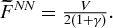 $\widetilde{F} ^{NN}=\frac{V}{2(1+\gamma)}.$
For an all-national equilibrium to exist it must be the case that γ(SN
− SJ
) ≥ β(d2
iN
− d2
iJ
) for J ∈ {A, B} when attributes and fighting efforts satisfy these optimality conditions ∀ i ∈ N. Using equation (13) this means
 $\gamma (X_{J}-\widetilde{F}^{NN})\ge \beta (d_{iN}^{2}-d_{iJ}^{2})=0$
(since attributes are identical ∀ i ∈ N), or:
 $X_{J}\ge \widetilde{F}^{NN}=\frac{V}{2(1+\gamma)}.$
By contrast, under fixed attributes the condition for existence of an all-national equilibrium is
 $X_{J}\ge \frac{\beta}{4\gamma}\eta _{0}+(1+\frac{\beta}{4\gamma}\eta _{1}) \frac{V}{2(1+\beta \eta _{1}/4+\gamma)}\ge \frac{V}{2(1+\gamma)}$
where the first inequality is obtained by plugging
 $F^{NN}=\frac{V}{2\psi}$
into equation (17). The last inequality is strict if either η0 > 0 or η1 > 0. This gives us point 2 on page 15. Furthermore, the comparative statics with respect to σ
N
and Π−N
(which are included in XJ
) and with respect to V are the same as in Propositions 2 and 4. However, η0 no longer constrains the possibility for a national identity equilibrium, since under national identification all interethnic differences are eliminated.
3. Asymmetric equilibrium . Consider without loss of generality an equilibrium where all A members identify with the nation and all B members identify ethnically. For B members to identify ethnically it must be the case that for i ∈ B, γ(SN − SB ) ≤ β(d2 iN − d 2 iB ). The easiest way to see that this condition might hold under fixed attributes but not under endogenous attributes is to consider the case where η1 = 0. In this case the aggregate best response functions FB and FA are exactly the same as in equations (6) and (7), respectively, and SN − SB is the same under fixed and endogenous attributes. However, from the first-order conditions with respect to qe i we have qe i = qe B ∀i ∈ B and qe i = qe N = (qe A + qe B )/2 ∀i ∈ A, hence qe A = qe B = qe N and diN = 0 ∀i ∈ N. Thus d2 iN − d 2 iB = 0 under endogenous attributes while d2 iN − d 2 iB > 0 under fixed attributes as long as η0 > 0.
APPENDIX B: PROOFS
Proof of Lemma 1
. Solve for the pure strategy Nash equilibrium under each identification profile using (6) and (7) and noting that F > 0 in equilibrium to obtain
 $ F^{NN}=\frac{V}{2\psi};$
 $F^{NB}=F^{AN}=\frac{\delta V}{1+\delta \psi};$
 $ F^{AB}=\frac{\delta V}{2}.$
The first two inequalities in the lemma follow from the fact that δ > 1 and ψ > 1. The last inequality follows from δ < 2. ▪
Proof of Proposition 1 . By equation (3) and the specification of Π J ,
 \begin{eqnarray}
S_{N}-S_{J}=X_{J}-F-(F_{J}-F_{-J})(V/F-1)\text{\ for}J\in \lbrace A,B\rbrace, \nonumber\\
\end{eqnarray}
 \begin{equation}
d_{iN}^{2}-d_{iJ}^{2}=w_{e}/4=(\eta _{0}+\eta _{1}F)/4.
\end{equation}
 \begin{equation}
F^{NN}\le \frac{\gamma X_{J}-\beta \eta _{0}/4}{\gamma +\beta \eta _{1}/4} \le F^{AB}\quad\text{for}J\in \lbrace A,B\rbrace.
\end{equation}
 \begin{eqnarray}
\gamma (X_{J}-F^{AB}) &\le &\beta (\eta _{0}+\eta _{1}F^{AB})/4,
\end{eqnarray}
 \begin{eqnarray}
\gamma (X_{J}-F^{NN}) &\ge &\beta (\eta _{0}+\eta _{1}F^{NN})/4.
\end{eqnarray}
Suppose everyone uses the “national” best response such that FJ=FJnation for J ∈ {A, B}, FA = FB and F = FNN . Then by (17), γ(SN − SJ ) ≥ β(d2 iN − d2 iJ ) for J ∈ {A, B} and condition (ii) of our equilibrium concept is satisfied when everyone identifies with the nation. Again, condition (i) is satisfied since every individual is behaving optimally given his national identity. ▪
Proof of Propositions 2 and 3 . From equations (6) and (7) and the proof of Lemma 1 we have that σ N , Π−N and η0 do not affect FNN , FNB , FAN , FAB , or FA and FB when one group plays FJ=FJnation and the other plays FJ=FJethnic. Since XJ is strictly increasing in σ N − Π−N , from equations (13) and (14) we have that the lower is σ N − Π−N the less likely it is that the condition for national identification (8) holds for any given levels of F, FA , and FB and the more likely it is that the condition for ethnic identification holds. In particular, the lower is σ N − Π−N the more likely it is that (a) γ(SN − SJ ) < β(d2 iN − d2 iJ ) for J ∈ {A, B} at F = FNN , so national identification is not an equilibrium, and (b) γ(SN − SJ ) ≤ β(d2 iN − d2 iJ ) for J ∈ {A, B} at F = FAB , so ethnic identification is an equilibrium. This proves Proposition 2. Using the fact that by (14), d2 iN − d2 iJ is increasing in η0, a similar argument proves Proposition 3. ▪
Proof of Proposition 4 . Fix the level of national resources (Y + V) and the difference in group resources (YA − YB ). >From the proof of Lemma 1, both FNN and FAB are increasing in V. Thus from equations (13) and (14) we have that the higher is V the more likely it is that (a) γ(SN − SJ ) < β(d2 iN − d2 iJ ) for J ∈ {A, B} at F = FNN , so national identification is not an equilibrium, and (b) γ(SN − SJ ) ≤ β(d2 iN − d2 iJ ) for J ∈ {A, B} at F = FAB , so ethnic identification is an equilibrium. ▪
Proof of Proposition 5
. Solving for FJ
and FJ′
when FJ=FJnation, FJ′
=FJ′
ethnic
and F > 0 using equations (6) and (7) yields
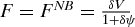 $F=F^{NB}=\frac{\delta V}{1+\delta \psi}$
and FJ′
= δ ψFJ > FJ
. Notice from this and from the proof of Lemma 1 that FJ
and FJ′
are not functions of either σ
J
or σJ′ under any given profile of identification. From equations (13) and (14), if σ
J
is sufficiently low then γ(SN
− SJ
)>β(d2
iN
− d2
iJ
) at any of the fighting configurations in Lemma 1. Hence it is never an equilibrium for J members to identify ethnically. If σJ′ is sufficiently high then γ(SN − SJ′
) > β (diN
2 − diJ′
2
) at any of these fighting configurations. Hence it is never an equilibrium for J′ members to identify with the nation. Finally, these inequalities imply that it is an equilibrium for J members to identify with the nation and for J′ members to identify with their ethnic group when FJ′ =δ ψFJ
and F = FNB
. ▪
Proof of Lemma 2 . Equation (9) implies
 \begin{eqnarray*}
d_{iN}^{2}&=&\left\lbrace \begin{array}{l@{}l}w_{e}/4+w_{c}(1-\mu /2)^{2} & \text{if}i\in A\text{and}q_{i}^{c}=1 \\
w_{e}/4+w_{c}(\mu/2)^{2} & \text{if}i\in A\text{and}q_{i}^{c}=0 \end{array}\right. \\
d_{iA}^{2}&=&\left\lbrace \begin{array}{l@{}l}w_{c}(1-\mu)^{2} & \text{if}i\in A\text{and}q_{i}^{c}=1 \\
w_{c}\mu ^{2} & \text{if}i\in A\text{and}q_{i}^{c}=0 \end{array} \right.{\!\!}.
\end{eqnarray*}
 \begin{equation}
\Delta (\text{core},F) =\left[ w_{e}(F)+\mu (4-3\mu)w_{c}(F)\right] /4,
\end{equation}
 \begin{equation}
\Delta (\text{nc},F) =\left[ w_{e}(F)-3\mu ^{2}w_{c}(F)\right] /4,
\end{equation}
 $\Delta (\text{nc},F)\ge \frac{\gamma}{\beta}(S_{N}-S_{A}).$
By Assumption 2 wc
(F)>0 at all feasible levels of F. Thus Δ (core, F) > Δ (nc,F) and hence
 $\Delta (\text{core},F)>\frac{\gamma}{\beta}(S_{N}-S_{A})$
. Thus the core must also identify ethnically. But the converse does not hold. Consider a profile of fighting efforts obtained when core members choose optimal fighting efforts under ethnic identification and noncore members choose optimal fighting efforts under national identification. From equation (13) and the fact that optimal fighting efforts under a given identity profile are not affected by σ
N
, there exist values of σ
N
(and hence of SN
− SA
) such that
 $\Delta (\text{nc},F)<\frac{\gamma}{\beta}(S_{N}-S_{A})\le \Delta (\text{core},F)$
. ▪
Proof of Lemma 3
. From equation (10), Ui
is strictly concave in fi
for the core members. For noncore A members who identify with the nation
 $\partial U_{i}/\partial\, f_{i}=-(1+\gamma)+V\frac{F_{B}}{F^{2}}-\beta (\eta _{1}-\rho _{1}\mu ^{2}) /4$
and again Ui
is strictly concave in fi
. 1. Suppose Y
core≥ FA
core, ethnic. If FA < FA
core, ethnic
there exists a core member i with fi
< yi
and ∂Ui
/∂fi
> 0. If FA > FA
core, ethnic
then there exists a core member i with fi
> 0 and ∂Ui
/∂fi
< 0. Finally, since FA
core, ethnic > FA
nc, nation
, if
 $F_{A}=F_{A}^{\text{\it core},\text{\it ethnic}}$
then ∂Ui
/∂fi
< 0 for the noncore. 2. Suppose
 $ F_{A}^{\text{\it nc},\text{\it nation}}<Y_{\text{\it core}}<F_{A}^{\text{\it core},\text{\it ethnic}}.$
If FA < Y
core there exists a core member i with fi
< yi
and ∂Ui
/∂fi
> 0. If FA > Y
core there exists a noncore member i with fi
> 0 and ∂Ui
/∂fi
< 0. If FA = Y
core then all A members are at a corner solution (∂Ui
/∂fi
< 0 for all noncore and ∂Ui
/∂fi
> 0 for all core). 3. Suppose
 $Y_{\text{\it core}}\le F_{A}^{\text{\it nc},\text{\it nation}}.$
By a similar argument, FA=FA
nc, nation
and the core are all at a corner solution with fi
= yi
. Finally, from equation (12) it follows that
 $ F_{A}^{\text{\it nc},\text{\it nation}}<V/4$
for any FB
. Since YA
≥ V/2 there exists a noncore member i with fi
< yi
. ▪
Proof of Proposition 6 . Define F* = V/2ψ ′. From the proof of Lemma 2 there exist values of XA and XB such that
 \begin{equation}
\left\lbrace \begin{array}{c}\Delta (\text{nc},F^{\ast})\le \frac{\gamma}{\beta}(X_{A}-F^{\ast})<\Delta (\text{core},F^{\ast}) \\[8pt]
\Delta (b,F^{\ast})\le \frac{\gamma}{\beta}(X_{B}-F^{\ast}) \\[8pt]
\frac{\gamma}{\beta}(X_{A}-F^{\ast})-\Delta (\text{nc},F^{\ast})<\theta V \end{array} \right.
\end{equation}
We first show that if Ycore
is sufficiently low and condition (20) holds then an equilibrium in which B members and noncore A members identify with the nation exists. Consider a member of B who identifies with the nation. Utility is given by Ui
= π
i
− βd2
iN
+ γSN
where d2
iN
= ¼(we+μ 2wc). Comparing this to our analysis of noncore members who identify with the nation (equation (12)) we see that the problem has the same form and hence the level of FB
desired by a B member who identifies nationally is
 $F_{B}^{b,\text{\it nation}}=\sqrt{\frac{1}{\psi ^{\,\,\,\,\prime}}VF_{A}} -F_{A}.$
Solving for the fighting levels when FA=FA
nc, nation
and FB=FB
b, nation
we obtain FA
= FB
= V/4ψ ′ and F = F*. By equation (13) and the first two lines of condition (20) we know that under this level of fighting it is optimal for noncore A members to identify with the nation, for core A members to identify ethnically, and for B members to identify with the nation. The latter implies that indeed FB=FB
b, nation
. Finally, by Lemma 3 if Ycore ≤ V/4ψ′ then indeed FA = FA
nc, nation
.
We now show that if Ycore
is sufficiently high and condition (20) holds then an equilibrium in which B members and noncore A members identify with the nation does not exist. Assume to the contrary that B members and noncore A members identify with the nation. Then FB=FB
b, nation
. Suppose first that the core identify with the nation. In this case their desired level of fighting is
 $F_{A}^{\text{\it core},\text{\it nation}}= \sqrt{\frac{1}{\psi ^{\,\,\,\,\prime \prime}}VF_{B}}-F_{B}\ge F_{A}^{\text{\it nc},\text{\it nation}}$
where ψ ′′ ≡ 1 + γ + β[η1 − (2−μ)2ρ1]/4 ≤ ψ ′. By a similar argument to Lemma 3, if Ycore
is sufficiently high then FA=FA
core, nation
. Solving for the equilibrium fighting levels we obtain
 $F=\frac{V}{\psi ^{\,\,\,\,\prime}+\psi ^{\,\,\,\,\prime \prime}}\ge F^{\ast}$
and FA
− FB
≥ 0. By equation (13), SN
− SA
≤ XA
− F*. But by condition (20)
 $\ \frac{\gamma}{\beta}(X_{A}-F^{\ast})<\Delta (\text{core},F^{\ast})$
and hence
 $\frac{\gamma}{\beta}(S_{N}-S_{A})<\Delta (\text{core},F^{\ast})$
in contradiction to the core identifying with the nation.
Suppose the core identify ethnically. By part 1 of Lemma 3 we know that if Ycore
is sufficiently high then FA=FA
core, ethnic
. Solving for the equilibrium fighting levels (with FB=FB
b, nation
. we obtain
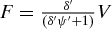 $F=\frac{\delta ^{\prime}}{\left(\delta ^{\prime}\psi ^{\,\,\,\,\prime}+1\right)}V$
and
 $F_{A}-F_{B}=\frac{\delta ^{\prime}(\delta ^{\prime}\psi ^{\,\,\,\,\prime}-1)}{\left(\delta ^{\prime}\psi ^{\,\,\,\,\prime}+1\right) ^{2}}V.$
Plugging these into equation (13) we obtain
 \begin{eqnarray*}
S_{N}-S_{A}&=&X_{A}-\frac{\delta ^{\prime}}{\left(\delta ^{\prime}\psi ^{\,\,\,\,\prime}+1\right)}V\nonumber\\
&&-\,\frac{\delta ^{\prime}(\delta ^{\prime}\psi ^{\,\,\,\,\prime}-1)}{\left(\delta ^{\prime}\psi ^{\,\,\,\,\prime}+1\right) ^{2}}V\left(\frac{\left(\delta ^{\prime}\psi ^{\,\,\,\,\prime}+1\right)}{\delta ^{\prime}} -1\right)
\end{eqnarray*}
 \begin{eqnarray}
&&\frac{\gamma}{\beta}\left[ X_{A}-F^{\ast}-\left(S_{N}-S_{A}\right) \right]\nonumber\\
&&\quad =\frac{\gamma}{\beta}\left(\frac{\delta ^{\prime}\psi ^{\,\,\,\,\prime}-1}{2\psi ^{\,\,\,\,\prime}\left(\delta ^{\prime}\psi ^{\,\,\,\,\prime}+1\right)}+ \frac{(\delta ^{\prime}\psi ^{\,\,\,\,\prime}-1)\left(\delta ^{\prime}\psi ^{\,\,\,\,\prime}+1-\delta ^{\prime}\right)}{\left(\delta ^{\prime}\psi ^{\,\,\,\,\prime}+1\right) ^{2}}\right) V\equiv \theta V. \nonumber\\
\end{eqnarray}
 \begin{eqnarray*}
\frac{\gamma}{\beta}(X_{A}-F^{\ast})-\Delta (\text{nc},F^{\ast})<\theta V.
\end{eqnarray*}
 \begin{eqnarray*}
\frac{\gamma}{\beta}\left(S_{N}-S_{A}\right) <\Delta (\text{nc},F^{\ast}).
\end{eqnarray*}
 $F=\frac{\delta ^{\prime}}{\left(\delta ^{\prime}\psi ^{\,\,\,\,\prime}+1\right)}V>F^{\ast}$
we must have
 \begin{eqnarray*}
\frac{\gamma}{\beta}\left(S_{N}-S_{A}\right) <\Delta (\text{nc},F),
\end{eqnarray*}


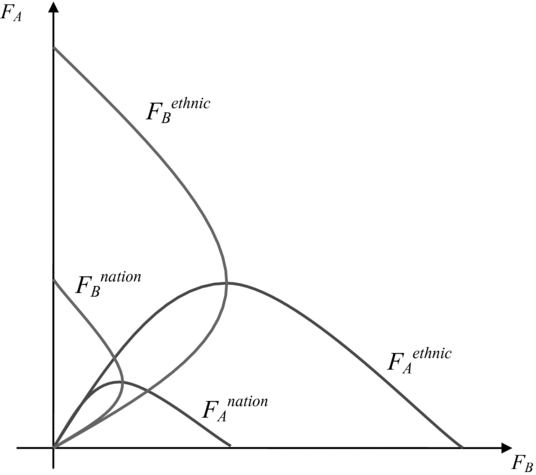
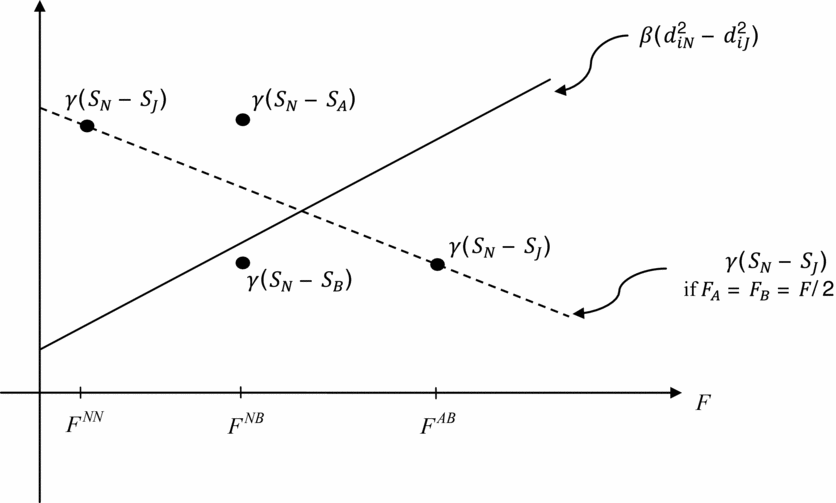
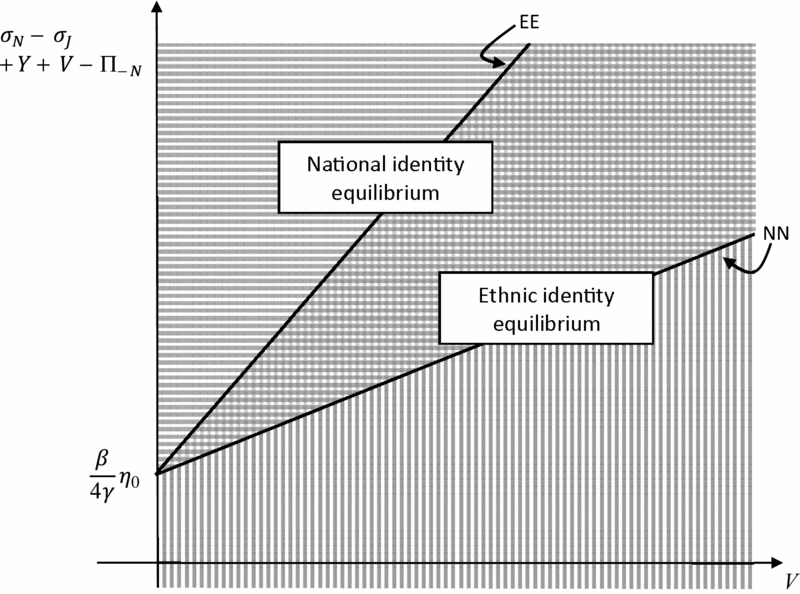
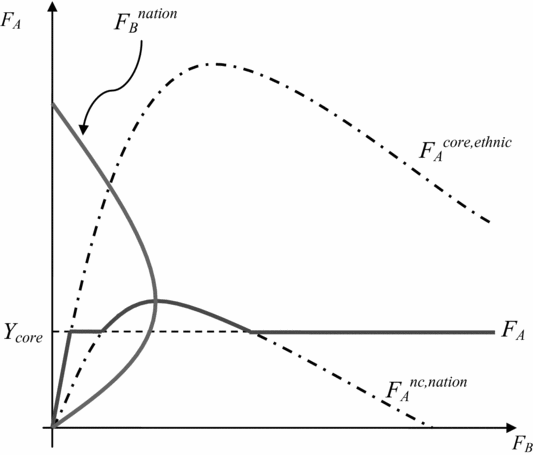



Comments
No Comments have been published for this article.