Present people with statistics or stories: stories are more basic to who we are.
– Margaret Atwood
Inspired by the power and influence that Charles Darwin attributed to heredity in On the Origin of Species (1859), Francis Galton developed a program of eugenics that he believed could shape Britain's progress as a nation by managing the evolutionary development of the British race. In Inquiries into Human Faculty and its Development (1883), Galton summarizes this aim as “to learn how far history may have shown the practicability of supplanting inefficient human stock by better strains, and to consider whether it might not be our duty to do so by such efforts as may be reasonable, thus exerting ourselves to further the ends of evolution more rapidly and with less distress than if events were left to their own course” (1–2). While this project, Galton's life's work, was largely a process of analysis and the development of dictates that could be put in place to shape the reproduction of the nation, it was also a project of imagination; not only was Galton himself imagining a different future for Britain, but in promoting his program, he appealed to the imaginations of his readers in an attempt to get them to share his vision.
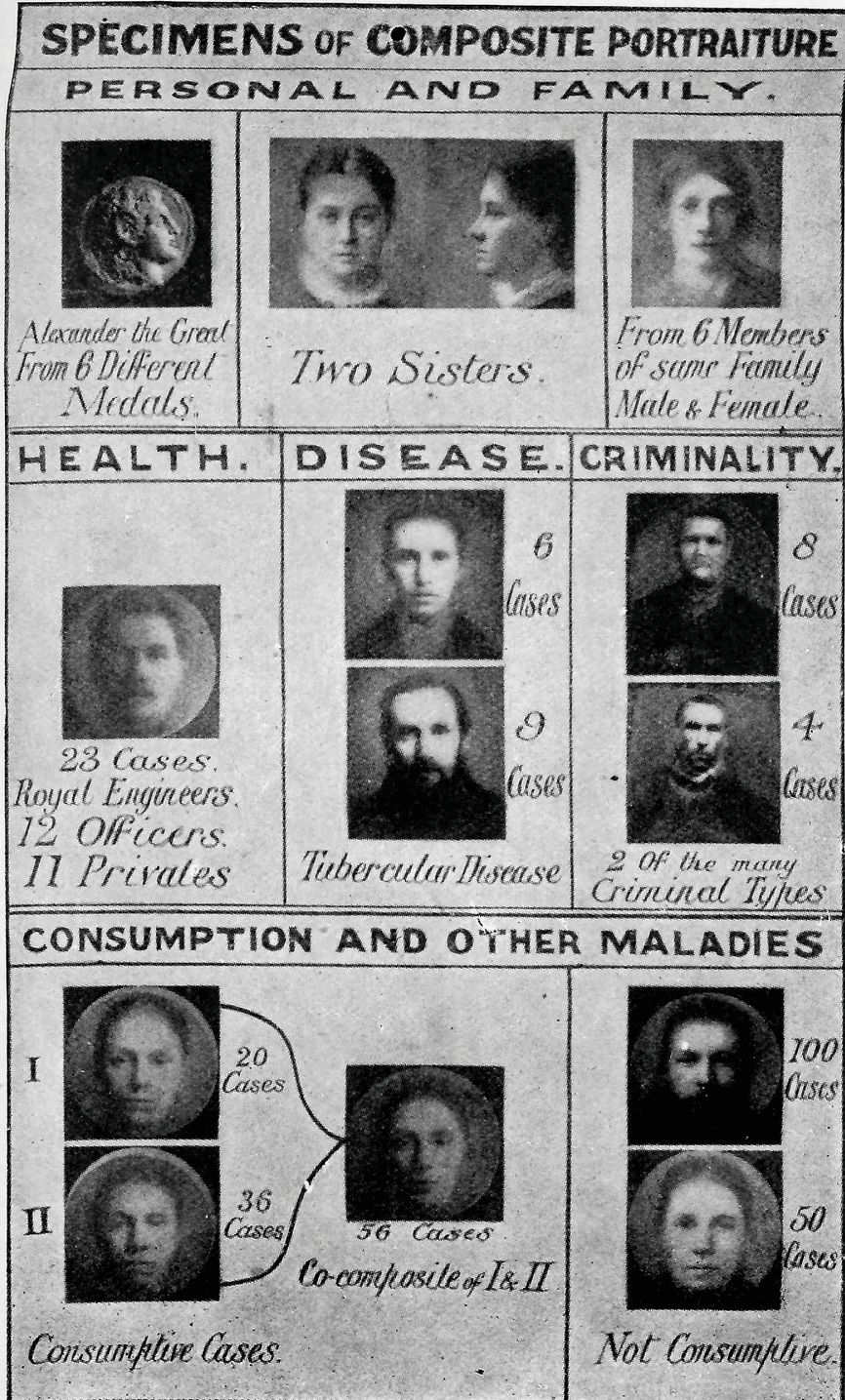
Only a few pages into Inquiries, Galton assists his readership in imagining what the British race might look like if the nation were to subscribe to his program by providing them with the image of an idealized Briton derived using his technique of composite photography. Galton developed this technique by exposing image after image of human faces on the same plate for the same amount of time, creating a portrait that encompassed the mean characteristics of the group. The purpose of this exercise was to help identify the visual markers of inherited qualities, both good and bad. Included in his book are images of “disease,” “criminality,” and “consumption.”Footnote 1 However, in keeping with his primary goal of creating a better, stronger British race, Galton begins his discussion of the photographs by explaining the image of “health” (Figure 4) to his readers:
Francis Galton. “Specimens of Composite Portraiture.” Inquiries into Human Faculty and its Development. (1883. 2nd ed. London: J. M. Dent & Sons, 1907).

The individuals from whom this composite was made . . . differed considerably in feature, and they came from various parts of England. The points they had in common were the bodily and mental qualifications required for admission into their select corps, and their generally British descent. . . . This face and the qualities it connotes probably gives a clue to the direction in which the stock of the English race might most easily be improved. (Inquiries 14)
These diverse men, authorized as good stock by their admittance into the Royal Engineers, are compiled into a single image, an image that enables Galton's audience to visualize the product of the eugenic program for which he is campaigning, allowing them to imagine a future for Britain that is shaped by such superior men.
What Galton gives his readers in this image of Britain's future is notably different than that to which the nation had previously been encouraged to aspire. Rather than an honorific of a great man, Galton offers a statistically derived image of above-average men, condensing them into a type. This, Galton suggests, is a means of accessing a vision of a eugenically superior man through statistical methodology: “[a]n assurance of the truth of any of our pictorial deductions is to be looked for in their substantial agreement when different batches of components have been dealt with, this being a perfect test of truth in all statistical conclusions” (“Composite Portraits” 140). This project of composite photography gives life to Galton's vision of the hero that will continue to usher Britain forward in the future: not an individual, but a race of individuals capitalizing on their hereditary gifts. Yet long before he employed the technology of photography, Galton had already been compositing a vision of the ideal Briton.
In his first book-length study of heredity, Hereditary Genius (1869), Galton aimed to examine exceptional men not at the level of the individual, but at the level of population. In doing so, he believed he could demonstrate a correlation between eminence and mental characteristics that appeared in families as a result of the workings of Darwin's laws of inheritance and variation. In order to demonstrate the influence of heredity on an individual's path in life, Galton turns to the lives of those who were already familiar to his readers, figures whose eminence was beyond doubt: the great men immortalized in biography. However, in order to support his hypothesis that the qualities that enabled men to rise to eminence are inherited, he had to posit a new way of reading biography, undoing the individualistic and didactic qualities with which it had been inscribed in the Victorian era, and instead reading biographies of eminent men as a collective by employing statistical analysis.
Though perhaps best known as the “father of eugenics,” Galton contributed to a wide range of scientific fields. However, following his reading of Darwin's work on natural selection, Galton's focus shifted to an interest in heredity that would shape the rest of his scientific efforts. He was at times incredibly methodical and innovative, responsible for important developments in statistics and fingerprinting. Yet while he engaged in diverse scientific research throughout his career, after becoming interested in heredity, his research increasingly reflected his concern for developing a new national narrative for Britain, one in which the nation would embrace its hereditary gifts by implementing a program of eugenics.Footnote 2
Though certainly shaped by concerns about degeneration, Galton's vision of eugenics was primarily hopeful and forward-looking. Nevertheless, this hope depended upon diminishing the bad as much as it did on increasing the good. However, Galton did not foresee the darker side of programs of racial hygiene or forced sterilization that were to be undertaken in the twentieth century in the name of eugenics. For as much as Galton recognized the potential efficacy of state programs to make his eugenic dreams a reality, his own efforts were primarily focused on developing the kind of scientific research that would convince the public of the importance of taking eugenic measures, believing that individuals would readily accept following eugenic precepts as their national duty. Galton's focus was not on policy but on research, reflecting an awareness that, as Darwin states, “such hopes [of individuals making sound hereditary choices] are Utopian and will never be even partially realised until the laws of inheritance are thoroughly known” (The Descent of Man 688). This statement highlights the impetus behind Galton's own work: to make the laws of inheritance known in order to persuade an informed audience to make rational reproductive choices.
Throughout the latter half of the nineteenth century, and particularly at the point when Galton wrote Hereditary Genius, the laws of inheritance remained unknown. While Darwin's theory of natural selection stressed the importance of inheritance, without a connection to Mendelian genetics, which would not be rediscovered until the turn of the century, there was no sense of the mechanism by which it worked.Footnote 3 Lacking established parameters, the effect of heredity on the individual remained unclear. Galton was, however, adamant in his belief that most characteristics were inborn. Certainly common sense dictated the outcomes of inheritance and familial resemblances were often undeniable, but considerations of anything beyond this were primarily speculative. Galton's project in Hereditary Genius was to expand understandings of inheritance to show “that a man's natural abilities are derived by inheritance, under exactly the same limitations as are the form and physical features of the whole organic world” (1). Galton took a strongly hereditarian position, “set[ting] himself apart from the mainstream of British thought in the nineteenth century” as “‘mental heredity’ was not a commonly recognized truth in the 1860s; the dominant ideological current at that time, both in England and in the United States, was environmentalism, the conviction that environmental conditions were the prime determinants of mental ability” (Cowan 139, 136).Footnote 4 Yet the role of heredity in shaping more than physical characteristics was increasingly clear to alienists such as Bénédict Augustin Morel who observed the way mental illness seemed to cling to families: “a simple neuropathic state in the parents could cause a natural predisposition in the children that results in mania and melancholy” (565, translation mine). Nevertheless, while some scientists may have been aware of the power of inheritance, it was difficult for the public to adopt such views as they were at odds with the key cultural narratives of identity that had been in place since the enlightenment.
Galton's arguments about the shaping force of heredity on the individual contradicted the prevailing construction of an individual as a Lockean tabula rasa. To view an individual as a blank slate necessitates a foreclosure on the possible effects of heredity. All differences that emerge between individuals in this environmentalist construction are understood as being shaped by social encounters: “[t]he appearance and behavior of the body consequently came to serve as outward and visible signs of the knowledge acquired and judgement developed from firsthand experience” (Armstrong 4). This worldview was particularly appealing in an era bent on progress and development as it suggested that the individual, and by extension the nation, might be able to shape his or her own role in life. If there was room for inheritance, it was through the inheritance of acquired characteristics, the dominant understanding of how evolution worked before, and even after, Darwin's publication of On the Origin of Species. While heredity might affect subsequent generations, it remained subservient to the experiences of the individual, which could not only shape that person, but even his or her offspring.
Our current understanding of inheritance excludes the possibility of understanding human beings as blank slates, lending credence to Galton's belief in the power of inheritance. Certainly, current genetic research suggests that, as Galton believed, it is more than physical traits that are influenced by genetics, that “genetic factors [play] a significant role in individual differences in the liability to show almost all human psychological traits” (Rutter 3). But whereas for a time the mapping of the genome and other research into genetics seemed to offer the possibility of fully understanding how inheritance shapes all aspects of individuals, there are limitations to what can be determined simply by genetic make-up. Even Galton conceded, “[i]t is needless to insist that neither [nature nor nurture] is self-sufficient,” though nature would, for him, always surpass nurture in its influence (English Men of Science 12). The field of epigenetics, “the set of modifications to our genetic material that change the ways genes are switched on or off, but which don't alter the genes themselves,” likewise suggests that the role of nurture is only played in deference to genetics (Carey 7). The environment thus plays a role, but not an unlimited one. Still, it is a surprising one, as the epigenetic effects in one individual's lifetime seem to remain, in certain cases, heritable by his or her offspring in something that is oddly similar to the kind of inheritance of acquired characteristics that Lamarck suggested.
Our contemporary view remains blended, much as it was at the beginning of the twentieth century when Darwin's theories of inheritance and Mendel's discoveries about genetic expression were united at the very same time that Freud suggested the way in which our early life experiences affected us through adulthood. However, the mode and balance of this blending continues to shift as new scientific discoveries shape our understanding of how nature and nurture work. Galton's hereditarianism is thus perhaps most important in this historical context not because it convinced his audience about the ultimate power of nature, but because his belief that heredity shaped more than the physical aspects of the person opened new areas of debate around the workings of nature and nurture.
Despite Galton's strong hereditarian slant, the data that he used to support his hypothesis of inherited genius – biography – was generally read in accordance with – and even in support of – an environmentalist perspective. Galton's audience would have been well acquainted with his subject matter as biographies were a staple of the home library and lending libraries, prompting Richard D. Altick to term the Victorian era the “age of biography.” Biography “was immensely popular in a period when the reading aloud of improving and uplifting literature was a significant middle-class family leisure activity,” suggesting that the role of biography was primarily not to reveal unbiased truth, but to teach (Fraser and Brown 134). Indeed, at a time of great social mobility, biography was commonly interpreted didactically to trace the connection between the moral choices made by an exemplary figure and his achievements in life. Eminent men were often cast as self-made men who succeeded due to “purpose and persistent industry,” and the stories of their lives were conceived of as “most instructive and useful, as helps, guides, and incentives to others” (Smiles 80, 5). The eminent man was not simply an individual to be admired, but one whose actions were potentially repeatable.
Yet such a strict belief about the function of biography necessarily shaped not only its reading but its writing. This desire for morally uplifting reading material by the Victorian public resulted in biographies that were made to fit into a pre-determined story arc, one of growth, education, and development.Footnote 5 While biography was by no means limited to – or even necessarily primarily about – class mobility, it was most often conceived of as an expression of the optimistic yearning of the period that highlighted the lack of stability in the increasingly permeable class system of Victorian England.
Given the aspirational way in which biography was made to function in the Victorian era, it is unsurprising that it would often be shaped around ideas of individualism. The connection between individual aspiration and brief biographical sketches, “illustrations of character and conduct,” in Samuel Smiles's Self-Help (1859) illustrates the logical conclusion of reading biography as an instructive form. As a work specifically designed to help its readers with self-improvement, Self-Help necessarily rests on the premise that one can improve through individual effort. Smiles's work is, indeed, highly individualistic, with little attention paid to the context out of which its subjects emerged. He tells his readers that “it is not to one rank or class alone that this spirit of free action is confined, but it pervades all ranks and classes; perhaps its most vigorous outgrowths being observable in the commonest orders of the people” (8). Such a vision coincides with the increasing social mobility of Smiles's age and serves to suggest the unfettered possibilities of any man who should wish to strike out to make a name for himself: “[i]t is not accident, then, that helps a man in the world” (80). In Smiles's view, the “accident” of birth into one class or another, or to one family or another, cannot make a man great nor impede his greatness, eschewing both the cultural and natural forces that might shape one's life. In this framework, greatness is achieved by individual intention rather than anything inherent.
For those crafting lives as clear moral stories, such an individualist approach empowers readers to feel their choices affect outcomes, but such distinctions were not always so clear-cut in personal histories. Indeed, it is often the role of biography to seek out the cause for the direction an individual chose in life, and such causes might suggest the effect of external stimuli. This approach, nevertheless, was not the primary way in which biographical narratives were read. Though novelists might wish to explore the impact of cultural forces on creating men of eminence, the prevailing mode of biography in the Victorian era followed the model of Plutarch, with “[a]n emphasis on individual human qualities rather than the influences on a life” (Nadel, Biography 17). Biography was thus more interested in the way an individual shaped his own world than the way in which he was shaped by it, suggesting that, despite a general belief in environmentalism, the impact of culture was downplayed in the lives of great men.
Neither was biography particularly concerned with inborn characteristics. To acknowledge the role of heredity would be to undermine the didactic and hopeful qualities of biography. The desire to see the effects of individual effort generally prevented biography from being read as reflective of natural predispositions, yet Galton insisted that this tendency in the reading of biography was dangerous.
Misreading biography was dangerous because the way in which biography was read in the nineteenth century had implications for the nation's character and future. By reading the eminent man as a self-made man, Britain could extrapolate a narrative for the entire nation wherein its progress and superiority were affirmed by the hard-working individual who was made to stand in synechdochically for the nation. Individuals might figure prominently in shaping the story of the nation since “[t]he strength, the industry, and the civilisation of nations – all depend upon individual character; and the very foundations of civil security rest upon it” (Smiles 315). To read the success of the hero of biography as a result of hard work is to imply that the strength of the nation lies in application. Following this view, many Victorians believed themselves to be a part of a great nation, not due to inborn superiority, but because of the “industry, energy, and the spirit of independence” of the British people (Smiles 133). In order to capitalize on the progress that had come to characterize the Victorian era, Britain thus had to continue to seize this spirit of self-improvement; if it did so, it would continue to write its national narrative as one of progress and supremacy through each citizen's individual effort.
But Galton was concerned about how this reading that moralized biography led to a false impression of the possibilities borne in the individual and misdirected British progress toward self-help rather than eugenics. Galton argues that to reject history and heredity is to overlook what distinguishes the truly eminent man. He contests the correlation between the eminent man and the self-made man, suggesting that this narrative offers nothing more than a fantasy, positioning individual effort as paramount and discounting the forces of nature as embodied in heredity. Too close a focus on the circumstances and choices of great individuals, he believed, had blinded people to the breadth of hereditary characteristics that were at work in shaping eminent men and that might in turn shape the nation. Galton hoped to reappropriate the eminent man from the singular man of achievement and effort lauded in biographies and to insert him into a new narrative for Britain that placed its emphasis on inborn qualities and the progress of the nation rather than the individual. Nevertheless, while Galton aimed to expose the fiction inherent in reading the lives of great men through a lens of self-improvement, at the same time, he himself practised a kind of criticism that, while claiming objectivity through employing statistical methodology, was just as guilty of creating fiction as it moralized biography in a new way.
In Hereditary Genius, after briefly outlining his hypothesis and approach, Galton immediately launches into a form of literary critique levelled at stories of self-made men. He disparages the morals implied by such narratives as a misreading of what makes men great:
I have no patience with the hypothesis occasionally expressed, and often implied, especially in tales written to teach children to be good, that babies are born pretty much alike, and that the sole agencies in creating differences between boy and boy, and man and man, are steady application and moral effort. It is in the most unqualified manner that I object to pretensions of natural equality. (14)
Galton's critique cuts to the heart of his problem with reading the eminent man as a product of self-help. In such a trajectory, the protagonist is not born great but must, instead, be common.Footnote 6 But for Galton, common characteristics, even if combined with uncommon effort, could not lead to an extraordinary life. Such an idea is so comic to him that he rewrites the story of the common man in his own retelling of a narrative of development.
Galton follows his critique of the underlying assumptions of self-help with a short synopsis of the life of an average upper-middle-class man. To support his argument that intellectual capabilities are inherent and not developed, Galton narrates a generic coming-of-age narrative in which a man comes to grips with his advantages and his limitations:
The eager boy, when he first goes to school and confronts intellectual difficulties, is astonished at his progress. He glories in his newly-developed mental grip and growing capacity for application, and, it may be, fondly believes it to be within his reach to become one of the heroes who have left their mark upon the history of the world. The years go by; he competes in the examinations of school and college . . . he leaves his University and enters a larger field of competition. (Genius 15–16)
Galton here employs the markers of development common to many narratives of eminent men, but unlike the stories in which such dreams of the common boy can come true, the boy in this story meets not only with success but also with failure. In reaching manhood, he does not achieve the status of hero, even with steady application and moral effort. His development is into one who knows himself, but he knows himself to be mediocre: “he limits his undertaking to matters below the level of his reach, and finds true moral repose in an honest conviction that he is engaged in as much good work as his nature has rendered him capable of performing” (16). In this sense, the model that Galton espouses reads much like a fatalistic story or even a fairy tale; the narrative of discovery is thus about discovering the limits of one's inborn talents, not about unearthing the immeasurable amount of talent to be found in every man and realized through will and work.
Yet this is not to suggest that biography is not rich with meaning for Galton. Rather, it is to point to how biography is commonly fictionalized as it is made to conform to an inspirational message. In attempting to shape a new direction for Britain, Galton not only needed to forward his own progressive vision for the nation, but he also needed to address how the form of biography had hitherto shaped British identity. Too great a focus on social mobility implies change as a product of individualism, and for Galton, the possibility of change is only viable in the race. Yet in distinguishing his ideal class of men whose hereditary gifts might be used to shape the nation in the future, Galton demonstrates a concurrence with the idea of the eminent man found in biography. Nevertheless, he responds to the fantasy he sees circulated through these accounts where greatness is marked by social mobility and is the result of hard work and good choices in order to support his hypothesis that greatness is an effect of hereditary gifts.
Though biography was often read as a narrative to be emulated, Galton believed that biography could offer a counter-narrative to the self-made man, providing it was read correctly. However, while writers like Smiles suggest the way in which great men are constructed through experience, in Galton's estimation, men of eminence were born and not made. His turn to biography rested on the premise that “high reputation is a pretty accurate test of high ability” (Genius 2). Underlying this examination of biography is the supposition that fame and success rise out of intellectual gifting rather than experience or social position. However, these eminent men were not subjects to be emulated, but rather subjects to be studied in accordance with recent scientific developments.
Galton's reading of Origin not only directed his interest toward heredity, but also illuminated the relationship between the individual and the population in directing the shape of the species since “Darwin found that population was the medium between the milieu and the organism, with all the specific effects of population: mutations, eliminations, and so forth” (Foucault 78). Though Darwin highlights the competition between each individual organism in the struggle for survival, survival does not come down to active, individual effort, but rather hereditary characteristics that fit organisms for their environment. Galton incorporates these implications from Origin in his approach to understanding biography, considering how it might direct the population and the nation as a whole rather than the lives of individuals who, in this schema, could not effect change in themselves. In Hereditary Genius, Galton combats the fiction of self-help through the statistical analysis of great men, suggesting that their lives must be read differently, not as exemplary individuals, but as members of a population, and that if this is to inspire change in his audience, it cannot happen at the level of the individual but must instead take effect at the level of the nation.
Understanding individuals as members of a population also allows them to be quantified and counted and considered statistically. The field of statistics was rising in importance and power in the Victorian era, and it interested Galton for the purposes of shaping his eugenic program. This is unsurprising as it “appealed to the same spirit of rationality that lead the educated to believe in science, progress, and the perfectibility of man,” and, indeed, Galton believed that progress relied upon perfecting man through science (Headrick 84). But statistics were also important for Galton for how they could counteract the idea that a great man's life could be read through a narrative of self-help and moral effort. From the early establishment of statistical societies in Britain, statistics claimed a sense of truthfulness rooted in facts and objectivity. The Prospectus of the Objects and Plans for the Statistical Society of London, which would later become the Royal Statistical Society, were laid out in 1834: “[t]he Statistical Society will consider it to be the first and most essential rule of its conduct to exclude carefully all opinion from its transactions and publication, – to confine its attention rigorously to facts, – and, as far as it may be found possible, to facts which can be stated numerically and arrayed in tables” (British Association for the Advancement of Science 492). As such, in turning to statistics in his reading of biography, Galton conceived of the possibility of reading biography for the facts it revealed rather than as a fantastical narrative of hoped-for progress.
While Galton's turn to the literary form of biography for source material may seem at odds with his insistence on the preference of fact over opinion, his belief in the authority conferred by the genre is a reflection of its position in the Victorian era. In this “age of biography,” to view biography as an unbiased historical document could be supported since, “insofar as encyclopedias reflect standard current opinion, it remained for many years ‘only a branch of history,’ as the Penny Cyclopaedia (1835) called it” (Altick 79). While Galton's analysis of biography occurred later in the century when single-subject biographies were increasingly understood as a literary genre, he relied on the emerging form of multibiography that could more properly claim objective detachment.
Multibiographies were indeed very popular in the Victorian era, prompting Alison Booth to refine the Altick's phrase to state that “the Victorian age was prosopographical,” interested in lives collected as groups in multibiographies or series (41). Though the most important of the Victorian multibiographies, the Dictionary of National Biography (1885–1901) appeared too late to act as a sourcebook for Galton's initial studies, the position of this text speaks to the place that multibiographies occupied in the literary culture of the Victorian era: “[t]he Dictionary of National Biography bore witness to the importance of the fact in an age whose values and methodologies were shaped by the developing disciplines of science and history” (Fraser and Brown 135). The multibiography, even at the end of the century, bore a kind of detachment better associated with history and science than with literature. Prior to the emergence of historiography as a discipline and a widespread awareness of the workings of discourse, it was possible, and indeed common, to believe in the objectivity of biographies even at the very moment that those writing and reading them were discussing the need to edit out displeasing facts.Footnote 7 Thus, Galton's turn to pre-existing collections of the lives of great men at his disposal – Biographie Universelle des Musicians (8 vols., 1835–44), Dictionary of Painters (2 vols., 1813–16), Men of the Time (1852), and The Judges of England (9 vols., 1848–64)Footnote 8 – did lend a degree of scientific credibility to his work, removing his own viewpoint and giving the “objective” viewpoint of an editor of a multibiography (and by extension “the common judgement of the leaders of opinion”) (Genius 7). The measure of greatness of the subjects of his study is thus not the fictional construct of a single author, but a consensus of other men of eminence. Multibiographies were able to speak more greatly to the life of the nation, the real object of Galton's studies.
The claims to scientific detachment that the multibiography suggested are furthered by Galton's own scientific approach. The majority of Hereditary Genius focuses on the statistical analysis of the familial relationships between men of great achievement including judges, “Commanders, men of Literature and of Science, Poets, Painters, and Musicians” (2). Since “characteristics cling to families,” Galton argues, there will be an increased probability of biological relationships between eminent men in a field (v). He applies statistical analysis to the relationships between those men who have made notable accomplishments in various sectors of society, employing mathematics to eliminate any remaining traces of literariness from his project.
The foundation that underlies Galton's book is the connection between reputation and natural gifts. He begins by establishing the relevance of reputation in his chapter “Classification of Men According to Their Reputation” to confirm the usefulness of biographical dictionaries in his research. His premise is that, like the examinations held at Cambridge, “[t]he world, in the same way, but almost unconsciously, allots marks to men” (7). These “marks,” unconscious as they are, can be best seen through high reputation, and Galton clarifies, “[b]y reputation, I mean the opinion of contemporaries, revised by posterity – the favourable result of a critical analysis of each man's character, by many biographers” (37). The end result of this consideration is that, using Men of the Time as a marker of greatness, Galton establishes that the kind of genius that leads to eminence is found in 250 out of one million men.
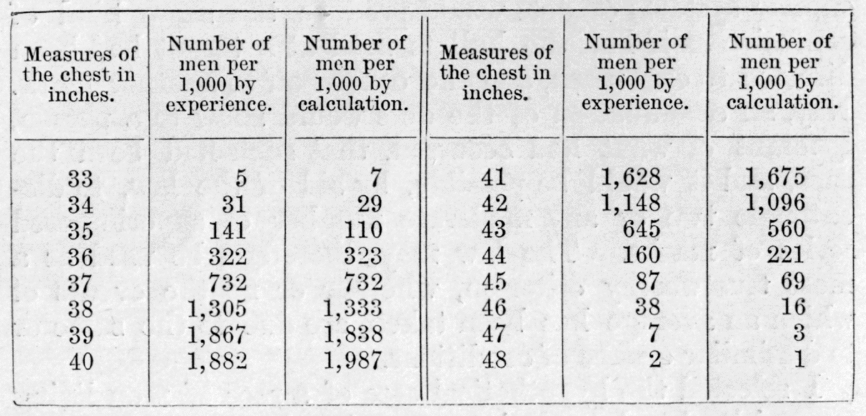
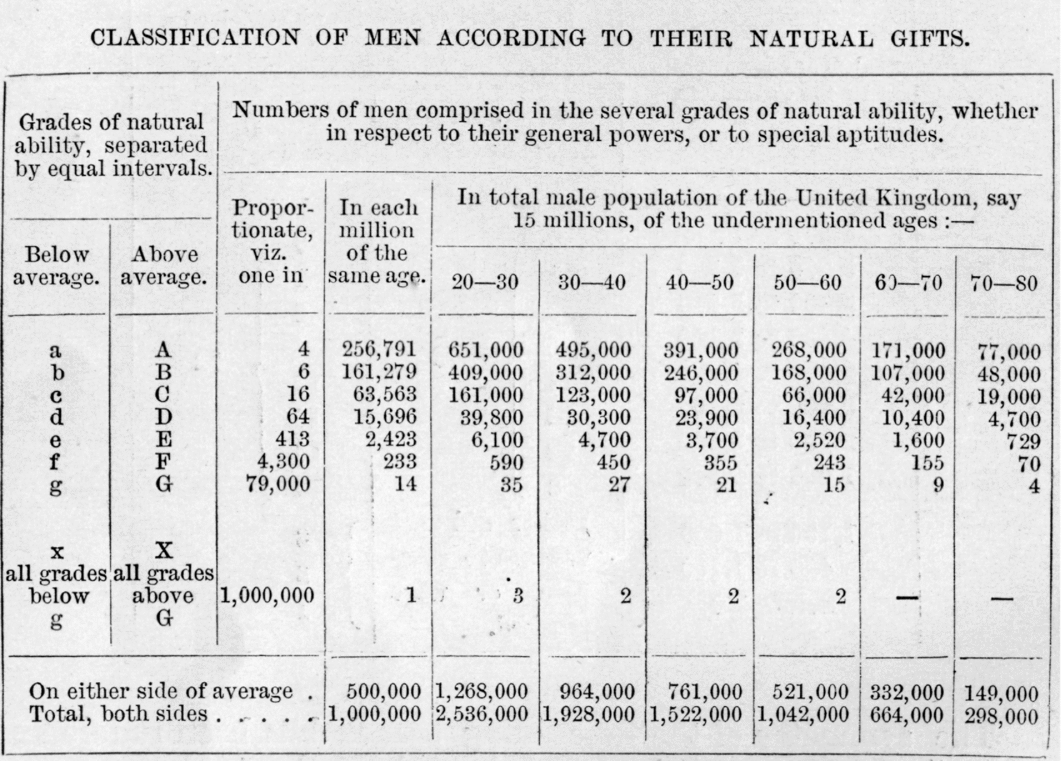
His next chapter, “Classification of Men According to Their Natural Gifts” introduces his statistical method. Borrowing Adolphe Quetelet's tables of measurements of height and chest circumference, Galton draws his readers' attention to the way in which physical characteristics congregate around an average and get more and more uncommon the further away from the average one proceeds in either direction (Figure 5). This establishes the notion of deviations from the average that he will use to mark eminence as a statistically uncommon characteristic by transposing these numbers as recognizable in characteristics of intelligence: “there must be a fairly constant average mental capacity in the inhabitants of the British Isles, and that the deviations from the average – upwards towards genius, and downwards towards stupidity – must follow the law that governs deviations from all true averages” (32) (Figure 6). However, this leap is pure conjecture on Galton's part with little supporting data, and the result is a table that is entirely fictional:
Francis Galton. Hereditary Genius: An Inquiry into its Laws and Consequences. (1869. 2nd ed. London: MacMillan, 1892), 26.
Francis Galton. “Classification of Men According to their Natural Gifts.” Hereditary Genius: An Inquiry into its Laws and Consequences. (1869. 2nd ed. London: MacMillan, 1892), 30.
The number of grades into which we may divide ability is purely a matter of option. We may consult our convenience by sorting Englishmen into a few larges classes, or into many smaller ones. I will select a system of classification that shall be easily comparable with the numbers of eminent men, as determined in the previous chapter. We have seen that 250 men per million become eminent; accordingly, I have so contrived the classes in the following table that the two highest, F and G, together with X (which includes all cases beyond G, and which are unclassed), shall amount to about that number – namely, to 248 per million. (33–34)
These conclusions are not based on mathematical calculations of the data, for indeed, Galton has no data whatsoever to populate his table, which is an imaginative extension based on the assumption derived from his reading of biography. Likewise, his conclusion about this imagined statistically rare genius's connection to eminence is pure conjecture: “[t]o conclude: I feel convinced that no man can achieve a very high reputation without being gifted with very high abilities; and I trust I have shown reason to believe, that few who possess these very high abilities can fail in achieving eminence” (49). Galton's beliefs thus not only drive his hypothesis, but the very data that he analyzes, drawn from both biography and his own imagination.
His first chapter on “The Judges of England Between 1660 and 1865” analyzes the data of biography, establishes his methodology, and sets a pattern that will be followed in subsequent chapters about men of eminence in other fields. Galton takes up Edward Foss's The Judges of England Footnote 9 and identifies 286 judges to study. He establishes that “[o]ut of the 286 Judges, more than one in every nine of them have been either father, son, or brother to another judge, and the other high legal relationships have been even more numerous. There cannot, then, remain a doubt but that the peculiar type of ability that is necessary to a judge is often transmitted by descent” (69). Yet Galton realizes that this may not sway his readers who might believe that this connection is purely nepotistic or due to the cultural influences of the family. In order to convince his audience that they “did not hold their high positions by mere jobbery, nor obtain their reputations through the accident of birth or circumstance,”Footnote 10 Galton does not point to his statistical tables, but instead resorts to narrative (72). While his analysis of statistics is meant to show the truth of his assertions, these assertions only seem to gain rhetorical sway insofar as they can be incorporated into a narrative framework: “It is necessary to analyse characters, and to go a little into detail. I will do this, and when it is concluded I believe many of my readers will better appreciate than they did before, how largely natural intellectual gifts are the birthright of some families” (72). This turn suggests that, as much as Galton's work is statistical, he ultimately cannot escape the narrative nature of his data and the imaginative underpinnings of his eugenic project.
Though Galton's plethora of examples and statistical tables suggest the rigorous scientific methodology of his own biological relation, Charles Darwin, Hereditary Genius remains more an act of statistical literary criticism than of science. Galton's turn to statistics is not divorced from opinion in the way that the Statistical Society of London's framing of the work of statistics suggests. While Galton's work with statistics was incredibly important in shaping the discipline as he was one of the early statisticians that Stephen Stigler identifies as the “idea man” who “helped create a statistical revolution,” Galton's approach to statistics is not without bias (266). It is important to note that for Galton (and his protégé Karl Pearson), “eugenics did not merely motivate their statistical work but affected its content. The shape of the science they developed was partially determined by eugenic objectives” (Mackenzie 12). In this way, in his attempt to reread biography through statistics, Galton does not offer an objective perspective, but rather uses statistics to convince his reader of the importance of harnessing the nation's hereditary gifts.
In addition, though Galton claims his turn to multibiography is a removal of his critical voice from the selection of the men (and occasionally, though to a far lesser extent, women) whose lives form the basis of the study, he continues to insert himself as critic of the works that he draws from. He announces that Men of the Time “fairly and honestly” carries out its intention “to include none but those whom the world honours for their ability” but insists “I do not mean to say that Sir Thomas Phillips's selection [in The Million of Facts]Footnote 11 is the best that could have been made, for he was a somewhat crotchety writer” (Genius 7; “Talent” 159). Yet it is not merely that Galton critiques these biographies themselves; his act of statistically analyzing their content also bears the mark of criticism. Although Levine recognizes the way in which the following equation simplifies the relationship between disciplines, he states that “it probably makes sense to think of science being on an analogy more with criticism than with ‘literature.’ That is, as science attempts to understand nature, so criticism attempts to understand literature” (“One Culture” 5). If science takes nature as its object of study, by taking biography as his object of study, Galton reverts to a form of criticism even as he is expounding the strength of his scientific method.
Additionally, even though Galton states that he puts his trust in other editors who have compiled the multibiographies that he draws from, he also occupies the position of editor of what is reproduced in his own volume. Hereditary Genius may be focused on tables and analysis, but it is also replete with brief biographical sketches, sketches that, due to their secondary role in the book, have been edited for brevity to bring out those points that Galton presumably deems most important in supporting his argument. Try as he might to insist on his scientific objectivity (it is worth noting that Galton did exclude himself from the great men of science in his study),Footnote 12 this is at odds with the findings that Galton draws from the biographies that he includes.
Galton's project to identify genius is skewed toward elevating the overall fitness of the class of men to which he belongs. In supporting his endeavours to create a hierarchy of talent, he contests such anecdotal wisdom that operates in opposition to his claims: “[t]here has been a popular belief that men of great intellectual eminence are usually of feeble constitution, and of a dry and cold disposition. There may be such instances, but I believe the general rule to be exactly the opposite. . . . There is no reason to suppose that, in breeding for the highest order of intellect, we should produce a sterile or feeble race” (“Talent” 164). Galton's assertion that it is the opposite, that intellectuals are in fact strong, is supported by his descriptions of the strong constitutions and long lives of many of the scientists that he writes about. However, in doing so, Galton passes over just as many scientists that are, by his own admission in the included brief biographies, feeble and ill. According to Galton, Sir Isaac Newton was “exceedingly puny as a child,” James Watt “[w]as very delicate as a child” and “ailed continually,” and Edward Forbes “died young, aet. 39, of kidney disease” (220, 223, 211). William Harvey, M.D., Albert von Haller, Augustin Pyrame De Candolle, and George, Baron de Cuvier all have similar health ailments. Of the forty-five entries on scientists, seven are noted to have questionable heath, a number that is comparable to those noted to have strong constitutions, suggesting that both exceptional illness and health are outliers rather than the norm. Nevertheless, in order to further a program of eugenics that emphasizes the propagation of intellectual gifts, Galton must insist on findings that support the association between intellectual gifts and overall fitness.
Similarly, since Galton frames the implementation of eugenic programs as a moral imperative, he necessarily excludes what his middle-class Victorian readers might deem to be moral weaknesses in the lives of the men he profiles. In much the same way that he draws attention away from their physical weaknesses, Galton continues to abide by established editorial practices in the recounting of biographies: “[t]he practice of excluding reference to sexual irregularities, alcohol and drug dependence, mental instability and other such skeletons in the cupboard of the life under investigation was in the interests not only of the biographical subject and his surviving family and associates but also of the reading public” (Fraser and Brown 137). There is, for example, no mention of Benjamin Franklin's frequenting of prostitutes, something that is well documented in Franklin's own autobiography. Such editorial interventions contradict the supposed scientific disinterest of Galton, speaking to the way in which literary choices continue to impact Galton's own biographical depictions. While Galton challenges the moralizing of Smiles, he also takes advantages of the well-established conventions of biography that contribute to such moralization insofar as they support his own project's dependence upon the portrayal of eminent men as wholly superior.
While the narratives of individuals are more skewed to presenting them as exemplars, even multibiography, while claiming a closer correlation to science and history, is influenced by a narrative structure that belies its supposed objectivity. National biographies, “[c]ollected lives of national heroes, along with portraits and statues, were a stock way of forging national identity and generating national pride”; these aspects of national biographies meant they were perfectly suited to contribute to the kind of narrative that Galton imagines (Thomas 14). Taken as a whole, the collective biography of men of achievement in sciences, politics, and the arts can create a picture of a better Britain since prosopography serves as a “positivist methods of composing the history of elite groups through comparative life narratives” (Booth 41). This is not merely a composite elaboration of the synechdochic move by which great individuals are meant to represent the nation, but rather, given the breadth of the multibiography, a means of establishing a sense of national character and eminence through the examination of the kind of citizens the nation begets. According to Booth, the creation of multibiographies is at its heart a politicized move since “[e]very literate society has generated multibiographies or prosopographies with more or less overt aims of propagating civility” (41). As Galton engages with the biographies of his day, he takes up the aim of propagating civility, or more accurately, the betterment of the English race. Rather than encouraging his readers to see the virtues of individual men, Galton sees within these multibiographies a vision of what England could look like if all its citizens capitalized on their hereditary gifts.
The way in which multibiographies reflect markers of achievement rather than rank supports Galton's vision of recognizing and propagating the best of the British race. As the preface to the 1872 edition of Men of the Time states, “[w]e have records of the aristocracy of birth and wealth, in the form of Peerages and Histories of the Landed Gentry . . . but the aristocracy of intellect had been left, until this work first appeared, without any special record” (iiv).Footnote 13 Galton's turn to Men of the Time is thus no mistake since, as Michael Rogin puts it, “Galton rejected the aristocracies of title and wealth in favor of an aristocracy of talent” (79). While those of aristocratic birth may merit a mention in multibiographies (and certainly, high birth guaranteed one entry into the Dictionary of National Biography regardless of accomplishment),Footnote 14 biography as a form, particularly in the Victorian period, depended on exceptional accomplishments rather than the mundane. This focus on accomplishments – due, in Galton's mind to hereditary genius – rather than mere aristocratic ancestry suggests that this is the sphere of the increasingly powerful middle class, but more properly of the professional classes: the judges, the lawyers, the doctors, and, most importantly, the scientists with whom Galton identifies.
By choosing biographies as his source material, Galton ends up drawing on material that has already been sifted through by an editor, shaping the conclusions he is able to make about the relationship between social position and hereditary genius. Choosing the subjects of biography for the purpose of studying hereditary gifts naturalizes the idea that greatness can only be found in certain classes, most particularly the upper middle class and those of the upper class that have chosen to apply themselves to properly professional or artistic pursuits:
In starkly political terms, biography is a tool by which the dominant society reinforces its values. It has ignored women; it ignores the poor and the working class; it ignores the unprivileged; it ignores noncelebrities. Such a formulation is useful only up to a point, because in fact biography ignores almost everyone. As a genre, it is much more elitist than the novel, which has always taken middle-class and middling characters as subjects. (Rose 191–92)
This exclusion of wide swaths of the public traces back to the kind of moral story of application found in Smiles: “[n]ineteenth-century biography valorises precisely those experiences which were denied to women, the poor, and the working class: self-determination and self-development, personal heroism of a kind that gains public recognition, a significant destiny considered worthy of the recording” (Fraser and Brown 137). The characteristics recorded in biography and respected by Galton are not easy to find within the working class; thus, Galton can project the idea that its members do not possess them due to their inferior heredity rather than because they are subject to a social structure that, despite its seeming openness, still limits those on the bottom rungs of the ladder, precluding the possibility of education and the freedom to pursue intellectual activities.Footnote 15 Galton can thereby proceed to create a new narrative for Britain by interpolating from the multibiographies he is reading, effectively ignoring the lower classes and even the non-professional middle-class subjects who are more properly at home in the novel.
In identifying those individuals whose hereditary gifts the nation might capitalize on, Galton reverts to earlier means of ordering bodies with the result that issues of heredity and class become intertwined. Just as the success of the self-made man is measured by wealth and position, so too does Galton's project for an improvement of the race rely on the authority of the social order. For him, however, rather than attesting to one's personal success, class and social eminence are markers of great hereditary gifts. By invoking heredity as the determiner of success, Galton offers a means of stabilizing the class system at a time when it had become increasingly unstable. As wealth had been passed along roughly hereditary lines to maintain aristocratic rank in England, so too could intellectual gifts form a new means of securing a family's position in society as hereditary gifts are passed down through the generations. Galton focuses his attention on the middle class who have most fully embodied the ideals of self-help, but concentrates on their intellectual abilities rather than on the idea of hard work. In this way, Galton's narrative still appeals to Britain's increasingly most powerful citizens, yet offers something even more appealing than Smiles's vision as he asserts the naturalness of their position.
Galton's investment in the analysis of multibiographies, much like his work with composite photography, aims to establish a national narrative that is to be guided by scientific goals rather than the optimism of progress, yet his reliance upon science does not diminish the fictional nature of this aspect of his project. This vision of genius that emerges from his investigation of biographies gains a kind of veracity through its creation from real-life components, yet its end goal is the imaginary future race of Britain. Allan Sekula notes that for Galton, “[e]ugenics can be seen as an attempt to push the English social average toward an imaginary, lost Athens, and away from an equally imaginary, threatening Africa” (44). This foundation in imagining the future undercuts the scientific distance that he suggests underlies his statistical project. Indeed, it is its very inspiration. As Daniel Novak suggests of Galton's composite photographs, “Galton's scientific ‘realism’ and the racial identity captured (or rather created) by photography are only made possible by and defined through their opposite – abstraction, anonymity, and fiction” (93). The statistical reading that Galton provides of the biographies he reads is similarly made possible by the imaginative drive toward eugenics and improving the British race.
Galton's final project at the end of his life demonstrates the way in which, despite his scientific investigations, his lifelong project was more properly fictional than factual. Rooted most deeply in a vision for Britain's hereditary progress that would never be realized, Galton has from the very first imagined a vision of the future. His final work, “Kantsaywhere,” (1910) an incomplete eugenic utopia, lays out the drive behind all Galton's research, the means of understanding and bettering the human race. This cannot, nor should it, be seen as a late blooming idea in Galton's life, but rather as the narrative that underlies his entire life's work. For even in his first article on heredity, “Hereditary Talent and Character” (1865), the testing ground for the methods that he would put into greater application in Hereditary Genius, Galton imagines the potential of harnessing hereditary talent by the practice of eugenics. He does not trust his audience to extrapolate the possibilities themselves. Rather, he impels them to “give reins to [their] fancy, and imagine a utopia – or a Laputa if you will,” which he then lays out in surprising detail, given the limited space (165).Footnote 16 He describes a society organized by eugenic principles where “a system of competitive examination for girls, as well as for youths, had been so developed as to embrace every important quality of mind and body, and where a considerable sum was yearly allotted to the endowment of such marriages as promised to yield children who would grow into eminent servants of the State” (165). This is not merely a proposal of dictates that can be put into practise (though it undoubtedly was intended to serve that function as well) but a society that is peopled with “deeply-blushing young men” and a “Senior Trustee of the Endowment Fund” who proceeds to issue a long speech at an annual ceremony (165). In putting words in the mouths of such imagined characters, Galton's article reveals its narrative tendencies even as it attempts to assert its reliance on statistical fact. Despite his aversion to the moralistic interpretation of biography and his own attempt to read biography statistically, Galton's writing in Hereditary Genius is inherently fictional and moral, but the moral of his reading of biography still stands at odds with that of standard Victorian means of reading biography: that the greatness of a man rests on the hereditary gifts that he is born with, and that the nation, should it wish to progress, should record and develop those gifts through a regulated program of eugenics.