


Introduction
Obsessive compulsive disorder in children and young people is similar in presentation to OCD in adults (March and Leonard, Reference March and Leonard1996) and is often chronic, disabling and severe, disrupting children's academic, social and family functioning (Piacentini, Bergman, Keller and McCracken, Reference Piacentini, Bergman, Keller and McCracken2003). Between 50–80% of adults with OCD identify their onset of symptoms before the age of 18 years (Pauls, Alsobrook, Goodman, Rasmussen and Leckman, Reference Pauls, Alsobrook, Goodman, Rasmussen and Leckman1995).
Behaviour therapy involving exposure and response prevention (ERP) is the dominant psychological treatment for children and adolescents with OCD (March, Reference March1995). This involves exposure to the feared obsessive situations, while simultaneously preventing the compulsive behaviours. There is evidence that ERP is effective for childhood OCD (e.g. Knox, Albano and Barlow, Reference Knox, Albano and Barlow1996). However, it can be experienced as demanding and aversive and is associated with a high drop-out rate (Allsopp and Verduyn, Reference Allsopp and Verduyn1990). It has been suggested that cognitive techniques may help engage patients in ERP and be a viable alternative method of treatment where ERP is not acceptable (Salkovskis, Reference Salkovskis1999).
There is some evidence that cognitive therapy is at least as effective as ERP for adults with OCD. Van Oppen et al. (Reference Van Oppen, De Haan, Van Balkom, Spinhoven, Hoogduin and Van Dyck1995) found that cognitive therapy led to a higher percentage of “recovered” patients than ERP. Whittal, Thordarson and McLean (Reference Whittal, Thordarson and McLean2005) found that cognitively focused individual treatment was at least as effective as ERP. By extension from the adult literature, cognitive therapy is a promising development for treating children with OCD and some preliminary case reports suggest that cognitive therapy is appropriate and effective for young people (Williams, Salkovskis, Forrester and Allsopp, Reference Williams, Salkovskis, Forrester and Allsopp2002).
A number of cognitive models of OCD in adults have been proposed. These include inflated responsibility (Salkovskis, Reference Salkovskis1999), thought-action fusion (TAF; Rachman, Reference Rachman1993) and meta-cognitive beliefs (Wells and Papageorgiou Reference Wells and Papageorgiou1998). Each of these models assume that an individual's appraisal of their obsessional thoughts and their response to such thoughts contribute to OCD. However, each model emphasizes different types of beliefs and some unique processes in the development and maintenance of OCD.
Salkovskis (Reference Salkovskis1999) proposed that people with OCD interpret their intrusive thoughts as meaning that they would be responsible for harm to self or others, unless they take action to avoid that harm. The model proposes that people with OCD try to reduce or neutralize their intrusions and take steps to minimize the possibility of harm coming to others (Salkovskis, Richards and Forrester, Reference Salkovskis, Richards and Forrester1995). Numerous studies with varied methods (e.g. experiments and correlational studies) with adults have found a cognitive responsibility bias in adults with OCD (e.g. Ladouceur et al., Reference Ladouceur, Rheaume, Freeston, Aublet, Jean, Lachance, Langlors and de Pokomandy-Morin1995).
Rachman (Reference Rachman1993) proposed that TAF underlies OCD. TAF is a cognitive process where a person interprets their own thoughts and their actions as equivalent. Rachman identified two types of TAF: (a) TAF-Morality, which is the belief that having an intrusive thought about an unacceptable behaviour is morally equivalent to carrying out that behaviour (e.g. thinking about hitting someone would be deemed to be as bad as actually hitting them); and (b) TAF-Likelihood, which is the belief that thinking about a bad situation will increase the probability that the situation actually occurs (e.g. thinking about a family member having an accident would make it more likely they would have an accident). There is some empirical support for the role of TAF in the exacerbation of intrusive thoughts as seen in OCD (e.g. Rassin, Merckelbach, Muris and Spaan, Reference Rassin, Merckelbach, Muris and Spaan1999). In children the phenomenon of “magical thinking” is sometimes seen as parallel to TAF in adults (Bolton, Dearsley, Madronal-Luque and Baron-Cohen, Reference Bolton, Dearsley, Madronal-Luque and Baron-Cohen2002).
The meta-cognitive beliefs model of OCD (Wells and Papageorgiou, Reference Wells and Papageorgiou1998) proposes that obsessional thoughts are negatively interpreted because of meta-cognitive beliefs about the meaning and/or dangerous consequences of having the thought. The model emphasizes two broad domains of belief: (a) beliefs about the importance, meaning and power of thoughts; and (b) beliefs about the need to control thoughts and/or perform rituals. According to the meta-cognitive model, neutralizing and avoidance behaviours increase awareness of intrusions and prevent the testing of dysfunctional beliefs. Empirical support for the meta-cognitive approach comes from evidence that meta-cognitive beliefs predict obsessions (Wells and Papageorgiou, Reference Wells and Papageorgiou1998), and that meta-cognitive beliefs are positively associated with symptoms of OCD (Janeck, Calamari, Riemann and Heffelfinger, Reference Janeck, Calamari, Riemann and Heffelfinger2003).
Investigating whether cognitive models of OCD apply to children is of clinical importance because of the potential to apply treatment methods developed for use with adults to the treatment of OCD in children. The primary aim of this review is to examine if cognitive models of OCD apply to children and adolescents. A secondary aim is to identify areas where future research may be prioritized.
Method
Inclusion criteria
The review was restricted to papers written in English and published in peer-reviewed journals between 1996 and 2007. Articles were included if they offered data regarding specific cognitive processes or cognitive models of OCD or obsessive-compulsive symptoms in children or adolescents (i.e. under 18 years). Any cognitive processes related to OCD in children and young people were of interest and the key constructs of responsibility appraisals, thought-action fusion or meta-cognition were specified.
Search methods
Computerized searches were undertaken on Psycinfo (1996 to date), Medline (1996 to date), Embase (1996 to date) and the Cochrane database. The search terms included: “child or children or adolescent or adolescence or young people or juvenile”, “obsessive-compulsive symptoms or obsessive-compulsive disorder”, “cognitive models or cognitive processes or cognitive appraisals”, “meta-cognition or meta-cognitive beliefs”, “responsibility appraisals or inflated responsibility”, and “thought-action fusion or magical thinking”. Additionally, the names of key authors and the reference lists of relevant journal articles were searched. Hand searches were also conducted on the following journals: Behavioural and Cognitive Psychotherapy (1996 to 2007), Behaviour Research and Therapy (1996 to 2007), The Journal of Anxiety Disorders (1996 to 2007), and The Journal of Child Psychology and Psychiatry (1996 to 2007). We did not contact authors to identify unpublished studies.
Results
The search identified 122 studies, 11 of which met the inclusion criteria. Ninety-five articles were excluded because they were not specific to cognitive models of OCD and 16 articles were excluded because they were not specific to children under 18 years of age.
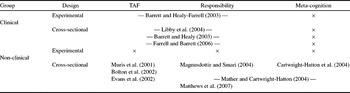
The 11 studies reviewed are structured by their sample (clinical or non-clinical) and their design (observational or experimental). The majority of studies recruited non-clinical samples of children and examined correlations between various OCD cognitions and symptoms of OCD. Table 1 classifies the studies identified by their methodology and theoretical focus. Of note is the absence of any experimental studies with non-clinical children.
Current research examining cognitive models of OCD in children and young people

NB: X = no study identified in that cell.
Studies with non-clinical samples and correlational designs
Seven studies examined associations between responsibility, TAF and meta-cognitions and OCD symptoms in non-clinical samples of children and adolescents. Three studies examined the role of TAF and OCD symptoms in children. Muris, Meesters, Rassin, Merckelbach and Campbell (Reference Muris, Meesters, Rassin, Merckelbach and Campbell2001) found that TAF was significantly associated with symptoms of OCD (r=.34), anxiety (r=.31), and depression (r=.33). Evans, Milanak, Merdeiros and Ross (Reference Evans, Milanak, Medeiros and Ross2002) examined the link between magical beliefs and rituals in 31 non-clinical children, aged 3 to 8 years. Children's magical beliefs were significantly correlated with their rituals (r=.43) and compulsions (r=.36). Similarly, Bolton et al. (Reference Bolton, Dearsley, Madronal-Luque and Baron-Cohen2002) found a relationship between levels of TAF and obsessive-compulsive thoughts (r=.43) and behaviours (r=.36) in a non-clinical sample of 127 children aged 5 to 17 years.
Magnúsdóttir and Smári (Reference Magnúsdóttir and Smári2004) investigated the relationship between responsibility attitudes and obsessive-compulsive symptoms in 202 non-clinical children, aged 10 to 14 years. After controlling for age, gender, and depression, responsibility attitudes added significantly to the prediction of obsessive symptoms (β=.23). Cartwright-Hatton et al. (Reference Cartwright-Hatton, Mather, Illingworth, Brocki, Harrington and Wells2004) examined the prevalence and emotional correlates of meta-cognition in adolescents. The results indicated a significant relationship between meta-cognitive beliefs and obsessive-compulsive symptoms (r=.65).
Two studies have investigated whether meta-cognition or inflated responsibility are better predictors of obsessive compulsive symptoms in non-clinical samples of adolescents. Mather and Cartwright-Hatton (Reference Mather and Cartwright-Hatton2004) found that obsessive-compulsive symptoms were significantly correlated with lower responsibility attitudes (r = −.50) and greater meta-cognitive beliefs (r=.65) in 166 non-clinical adolescents. However, when age, sex, depression, and responsibility were controlled, only meta-cognition remained an independent predictor of obsessive-compulsive symptoms (β=.46 in the final equation). The authors concluded that meta-cognition was a better predictor of obsessive-compulsive symptoms than responsibility. Using a similar research design, Matthews, Reynolds and Derisley (Reference Matthews, Reynolds and Derisley2007) examined the relationship between inflated responsibility, TAF, meta-cognitive beliefs, and obsessive-compulsive symptoms in 223 non-clinical adolescents and also aimed to test the proposed mediating relationships of the different models. Higher levels of obsessive-compulsive symptoms were significantly associated with inflated responsibility (r=.56), TAF (r=.41), and meta-cognitive beliefs (r=.59). However, inflated responsibility completely mediated the effect of TAF (TAF β=.12, responsibility β=.48) and partially mediated the effect of meta-cognitive beliefs (meta-cognitive beliefs β=.38, .responsibility β=.31).
These seven studies suggest that the cognitive constructs of TAF, meta-cognitive beliefs and responsibility appraisals are all associated with OCD symptoms in adolescents and children and that the relationships between the variables are of a moderate size. Inevitably, the designs of these exploratory studies are problematic. They are cross-sectional designs so that causal relationships cannot be inferred, and the participants are not experiencing problems with OCD symptoms so the extent to which the results can be generalized to clinical samples is unclear.
Studies with clinical samples
A smaller number of studies have recruited clinical samples of children and young people with OCD, and used clinical controls (children with other anxiety disorders) and non-clinical controls. In the studies identified, diagnoses were also made using the ADIS-C and ADIS-P, the gold standard diagnostic tool. Barrett and Healy (Reference Barrett and Healy2003) compared cognitive appraisals of responsibility, probability, severity, TAF, self-doubt, and cognitive control using individualized constructs (rather than standardized measures), in children with OCD (N = 28), anxious children (N = 17), and a non-clinic control group (N = 14). Children with OCD reported significantly higher ratings of responsibility, severity, TAF, and less cognitive control than non-clinic children. Effect sizes were large (range d=.75 to 1.04). However, cognitive control was the only cognitive process that clearly differentiated between OCD children and anxious children (d = 1.1).
Libby, Reynolds, Derisley and Clark (Reference Libby, Reynolds, Derisley and Clark2004) examined cognitive appraisals in young people aged 11 to 18 years, with OCD (N = 28), other anxiety disorders (but not OCD: N = 28)) and non-clinical controls (N = 28). Young people with OCD had significantly higher scores on inflated responsibility and TAF (likelihood other) than the other groups and effect sizes were large (i.e. d > 1.0). Additionally, inflated responsibility was the only significant predictor of OCD (β=.49). Thus cognitive models of OCD appeared to be applicable to young people with OCD, with inflated responsibility a key domain.
Farrell and Barrett (Reference Farrell and Barrett2006) investigated developmental differences in the cognitive appraisals of responsibility, probability, severity, TAF, thought-suppression, self-doubt, and cognitive control in a sample of 34 children, 39 adolescents, and 38 adults with OCD. Responsibility biases were evident across all age groups, although children with OCD reported significantly less responsibility than adolescents and adults with OCD who did not differ from each other. The effect sizes of the differences between children compared to adolescents and adults was large (i.e. d > 1.2). There were no age-related differences on ratings of TAF. Effect sizes for the differences between the three groups ranged from d = 0.35 to 0.51. The authors concluded that, whilst there was some support for the homogeneity of cognitive appraisals across age groups, developmental differences were also important.
One study that used an experimental design and a clinical sample was identified. Barrett and Healy-Farrell (Reference Barrett and Healy-Farrell2003) investigated the role of responsibility in 43 children and young people with OCD (aged 7 to 17 years). Responsibility was manipulated during a behavioural avoidance task in which participants exposed themselves to a situation that resulted in compulsions. Each participant engaged in the task three times, once in each of the experimental conditions (high, moderate, and low responsibility). Responsibility was manipulated by varying the presence of others during the task and assigning responsibility using signed contracts between the child and the experimenter. Ratings of perceived responsibility were significantly higher in the high responsibility condition compared to the moderate and low responsibility conditions, which did not differ significantly from each other.
Unexpectedly inflated responsibility did not increase ratings of distress, perceptions of probability or severity for harm, avoidance behaviours, or ritualizing and effect sizes were small for distress, probably of harm, avoidance and severity of harm (i.e. d<.2) to moderate (for ritualizing). The authors concluded that inflated responsibility may not be a particularly important cognitive process in childhood OCD. However, it was uncertain whether the experimental manipulation was a success as participants were reluctant to accept responsibility in the high-responsibility condition and the experiment failed to differentiate between the moderate and low responsibility conditions. Thus participants’ ratings of responsibility may have been inflated due to social desirability bias and not the experimental manipulation.
Discussion
A systematic search of the literature identified 11 peer-reviewed research studies that examined cognitive models of OCD in relation to children and young people. All were published after 2000; the majority used non-clinical samples and were cross-sectional in design. There was only one experimental study, and this was with a clinical sample; no published studies have manipulated putative OCD cognitions in children and young people.
The available research suggests that cognitive models of OCD do apply to children and adolescents (only Barrett and Healy-Farrell, Reference Barrett and Healy-Farrell2003 reported contrary results) and some support was found for each of the three models of increased responsibility, thought-action fusion and meta-cognition. There was limited evidence about the relative influence of the different models and conflicting findings around the centrality of responsibility appraisals and meta-cognitive beliefs. Adaptations of adult oriented measures of cognition were used in most studies. These appear to have been applicable to the young population and Farrell and Barrett (Reference Farrell and Barrett2006) demonstrated that cognitions observed in adults with OCD are also characteristic in children and adolescents with the disorder. Developmental differences in severity and distress, as well as responsibility appraisal, were observed but these were relatively minor.
Because the majority of studies used a non-clinical sample generalization to clinical samples is problematic. However, non-clinical samples may have particular relevance to aetiological processes that clinical samples cannot offer and the use of non-clinical samples offers the opportunity to examine cognitive processes across a much less restricted range than would be possible in a clinical sample. All but one study (Barrett and Healy-Farrell, Reference Barrett and Healy-Farrell2003) used a cross-sectional observational design meaning that causal relationships between cognitive processes and obsessive-compulsive symptoms cannot be assumed.
An important aspect of this review is the identification of areas where research is currently absent as well as promising research avenues. The complete absence of experimental studies that manipulate levels of putative OCD cognitions, e.g. responsibility appraisals, TAF and meta-cognition in children who do not currently have OCD symptoms, has obvious relevance for illuminating possible causal mechanisms of OCD. If children who experience increased responsibility, TAF or meta-cognition begin to exhibit the behavioural, cognitive, and affective symptoms of OCD this would be of great interest.
The three cognitive models of OCD are typically presented as if they are independent. Matthews et al. (Reference Matthews, Reynolds and Derisley2007) and Cartwright-Hatton et al. (Reference Cartwright-Hatton, Mather, Illingworth, Brocki, Harrington and Wells2004) have examined relations between the different models and arrived at contrasting conclusions. Reasons for this are not completely clear but the role of low mood in combination with OCD cognitions and OCD symptoms requires further examination. OCD is commonly co-morbid with mood disorders and anxiety disorders and understanding any common cognitive pathways in aetiology and maintenance would potentially be of great clinical benefit.
The overlapping domains of general cognitive and emotional development and the emergence of disorder related cognitive styles or beliefs have not attracted much research attention. Farrell and Barrett's cohort study demonstrated that children, adolescents, and adults with OCD have similar levels of TAF but that responsibility appraisals were significantly lower in children than in adolescents and adults. The impact of cognitive development on the emergence of appraisals which are associated with maintaining psychological distress, for example worry, rumination, responsibility appraisals, and meta-cognition has important implications both for understanding how psychological problems emerge, develop and are maintained, as well as for the development of practical intervention strategies with children and adolescents. One area that would be valuable to examine is the extent to which specific levels of cognitive development are required before certain cognitive processes (e.g. meta-cognitive appraisals) can emerge.
The key finding of this literature review is that 10 out of 11 studies found that cognitive models of OCD are applicable to children and adolescents. This is consistent with the fact that the presentation and phenomenology of OCD in children and young people is similar to that in adults and suggests that cognitive models of treatment that have been developed for use with adults may be appropriate for children and young people. It is not clear what adaptations are necessary; however, these would need to accommodate the developmental level of the child or young person (e.g. in terms of their cognitive development and level of independence) and their particular family context. The use of careful case formulation that incorporates developmental stage and family system is likely to be a pre-requisite for successful adaptation.



Comments
No Comments have been published for this article.