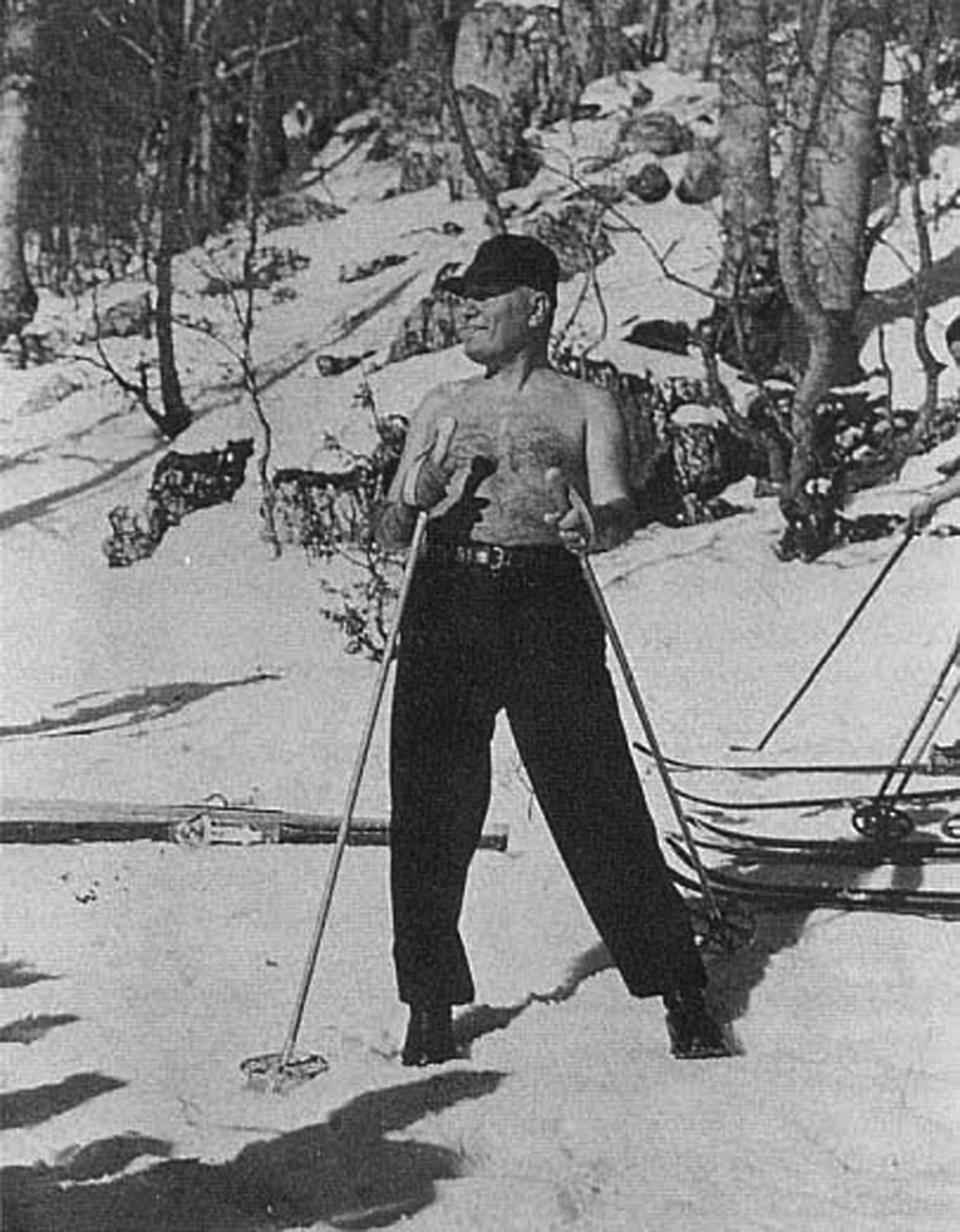
In 1932, author and outdoorsman Carl Luther diagnosed the pathologies of modern life and prescribed their ideal cure, writing:
Because our work in the daily routine and in the cities, in factories, and in offices has become prosaic, atomizing, and devoid of adventure—because we live faster and must demonstrate greater resistance—because we do not wish to age, but rather wish to remain young, fresh, and slender—because we are anxious and know that only new thrills and new visions can rejuvenate us . . . Spring, summer, and fall, the former seasons of relaxation, no longer suffice for us . . . We have also discovered the winter, the most alien to us of all manifestations of nature, thus for us nature in its most modern and most youthful form . . . The ski entered into the world . . . to allow men to flee excessive snow and cold. Today, however, skiing is also flight, but flight from the metropolis [in search of] all remote winter environments . . . Fortune is with the skis, because they overcome the awkwardness of nature-estranged urbanites and have so evaded natural [limits upon] speed, that in them man and speed become consubstantial.Footnote 1
Luther, the doyen of German ski culture before World War II, idealized Alpine skis as both an ancient instrument and a modern cultural necessity. For all Alpine skiers, regardless of nationality, class, or gender, the appeal of their sport in the early twentieth century lay in its incomparable combination of sublime nature and superhuman speed, or, put more generally, of the timeless and the modern, through which skiers transcended the seemingly intractable boundaries erected by urban modernity. Skiers of a less philosophical bent than Luther often described the sport's unique appeal more concisely as “fun.”
Regardless of its more poetic or prosaic articulations, the combination of speed and nature in skiing proved too attractive to resist, and the number of skiers on Alpine slopes grew exponentially in the first decades of the twentieth century.Footnote 2 And yet, Carl Luther's paean to Alpine skiing neglected the class- and gender-based exclusivity of the sport that he believed would save humanity, its dependence on the very modern technologies and processes skiers aimed to escape, and the environmental implications of hordes of skiers taking to nature to escape the pollution and crowds of Europe's metropolises. In both theory and practice, deep contradictions marked Alpine skiing. It was in the Germanic Ostalpen that a transnational group of skiers first defined and practiced this nature-inflected form of modern leisure and attempted to balance its universal, humanistic claims against its often sybaritic and elitist reality.
Before the nineteenth century, European cultures understood mountains—and the forbidding landscape of the Alps in particular—to be the antithesis of civilization. The Romans described the Alps and their peoples as ugly and barbaric, and during the Middle Ages, the Alps housed evils both imagined and real, from witches and dragons to bandits and wolves.Footnote 3 Although Romantic artists and authors beginning in the late eighteenth century sidestepped the accrued myths and memories of many centuries to proclaim the mountains sublimely beautiful, they retained the belief that the mountains somehow lay beyond the reach of civilization; indeed, for the Romantics, the Alps had value precisely because they offered a striking counterpoint to an increasingly urban, industrial civilization.Footnote 4 Beginning in the mid-nineteenth century, a rapidly growing, socially elite group of hikers, mountain climbers, cure seekers, ice skaters, holiday-makers, Sommerfrischler, and spa patrons, all of whom drew inspiration from Romantic landscape aesthetics, sought to escape urban life in “the playground of Europe,” imagining the Alps as a landscape apart in which individuals could reinvigorate and transform themselves among jagged peaks and noble savages.Footnote 5
Around 1880, these Alpine tourists discovered a new outlet for their leisure time, the Scandinavian sport of skiing, which revolutionized tourism practices by making the Alps accessible and desirable year-round, particularly in the Ostalpen among German speakers and British tourists. The strength of Alpinist culture in German Europe in the second half of the nineteenth century engendered a popular appreciation for both Alpine aesthetics and mountain recreation, while upper-class British citizens played an outsized role in Alpine skiing culture in the first half of the twentieth century from their winter bases in Bernese Oberland villages such as Mürren, Wengen, and Adelboden.Footnote 6 It was not until the French and Italian governments initiated concerted programs to attract leisure skiers and to exploit the growing market for Alpine resorts in the 1930s that these countries began to exert significant influence over Alpine skiing culture, a shift that only became apparent after World War II. Before World War II, Alpine skiing culture was largely Anglo-German in nature and had its geographical center of gravity at the intersection of Germany, Austria, and the German-speaking portions of Switzerland and South Tirol, whereas west-Alpine French and Italian skiers generally consumed, rather than directed, Alpine skiing culture.Footnote 7
This article argues that Alpine skiing in the early twentieth century was not just another leisure activity in the dawning age of mass culture, nor was it just a new variant of “back-to-nature” movements such as alpinism, hiking, vegetarianism, and nudism, all of which grew markedly in popularity in the fin de siècle. Rather, Alpine skiing was unique in the way that it blended modern mass culture and nature appreciation, leading skiers to elaborate a novel and influential ideology between 1900 and 1939 that I label “Alpine modernism.”Footnote 8 This article advances two principal claims. First, cosmopolitan cultural motivations that emerged from the German Ostalpen at the turn of the century and transformed over the subsequent four decades spurred the meteoric growth of Alpine skiing and other modern leisure pursuits in this era, rather than local or national social concerns. The cultural appeal of Alpine skiing remade the sport from a trivial leisure activity practiced by elites in a peripheral landscape—in the late nineteenth century, tourists in St. Moritz mocked skiers as “plank-hoppers”—into an influential component of European mass culture.Footnote 9 When describing the significance of sports in modern societies, historians and sociologists have generally given more weight to the social motivations and effects of modern sports, highlighting the relationship between sports and the definition of social categories such as class, gender, race, and nation.Footnote 10 Alpine skiers certainly enjoyed the sociable aspects of the sport and, whether consciously or unconsciously, used skiing as a way to define social difference, as the expense and danger of the sport proved formidable barriers to popular practice. Leisure practices of all types were socially motivated in this era, however. Like other leisure pursuits, Alpine skiing gained in popularity as conjunctural cultural, economic, and political trends in the first half of the twentieth century combined to democratize leisure time and to lower the cost of equipment and transportation.
But a transnational group of Alpine skiers based in the eastern Alps argued that skiing was distinctive because it was particularly modern: at once reflective of the dynamics and velocity of modern times and yet uniquely suited to cope with these very same modern conditions. According to the transnational discourse of Alpine skiers, modern individuals sought meaning and transcendence in a disenchanted world but were stifled by the institutions, practices, and mores of modern civilization, which conspired to force individuals into unnatural and unfulfilling modes of existence.Footnote 11 The rapid growth in the ranks of skiers and the expanding cultural influence of the sport in the early twentieth century stemmed from the distinctive ideology that motivated skiers and the aesthetic principles that they developed and then disseminated throughout European societies. Alpine skiers believed that their sport allowed them to master time and space, thus re-enchanting an increasingly banal and instrumental world by returning agency to individuals through an act of heroic self-assertion. Simultaneously, however, skiers claimed to escape the crowds and materialistic concerns of the lowlands by reconnecting with nature in its most arresting form, engaging in a flight from civilization that had its roots in the eighteenth-century mountain sojourns of proto-Romantics such as Jean-Jacques Rousseau and Johann Wolfgang von Goethe. Thus, as I argue, the motivations for Alpine skiing (and, by extension, other leisure pursuits in the age of mass culture) were as much cultural as social, and these cultural beliefs that inspired leisure demand more serious scholarly attention.
Given skiers' distinctive synthesis of modern forces and Alpine nature, the cultural ideology that motivated Alpine skiers across Europe is best characterized as Alpine modernism. By taking to their skis in the Alps, moderns endeavored to reclaim their roles as agents of modernity, rather than its passive objects. Alpine skiers identified their sport with art in both implicit and explicit terms, describing their experiences within the aesthetic framework of modernism. Drawing a distinction between the Romantic aesthetics that inspired nineteenth-century tourists and their own motivations, Alpine skiers argued that their sport and the cultural landscape they fashioned were not antimodern, but were instead exceptionally modern.Footnote 12 Both Alpine skiers and modernist artists celebrated the modern cult of speed and formalistic and functional movements and representations. More importantly, both groups critiqued modernity in order to save it, attempting to employ modern ideas, goods, and practices to make modernity more responsive to human needs. Similarly, both Alpine skiers and artists forged transnational connections based on their common aesthetic principles and a shared worldview. The history of Alpine skiing before World War II thus demonstrates how leisure practices are reflective and interpretive, and how their combination of sociability, introspection, and physical activity served as a conduit through which individuals defined, challenged, and disseminated cultural practices and ideologies in the modern era.Footnote 13
This article's second claim is that the relationship between Alpine skiing and modernism increases our understanding of how this amorphous cultural movement impacted everyday life. Historians usually characterize modernism, whether understood narrowly as the (high) cultural modernism of artists and philosophers or more broadly as “social modernism,” which includes professional groups such as engineers, bureaucrats, and scientists, as an urban, socially elite movement.Footnote 14 Although economic barriers and ingrained social practices discouraged the working classes from practicing the sport, skiers of varied nationality, social standing, and gender vernacularized cultural modernism before World War II. This act of vernacularization occurred among skiers and nonskiers alike, thanks to the symbiotic relationship between the sport and the international mass media (particularly the sporting press and the film industry). As a mass phenomenon, Alpine skiing extended modernist ideas and practices beyond the socially circumscribed milieu of high culture into the realm of popular action and experience.Footnote 15 Simultaneously, Alpine skiers transported modernism from the rarified air of metropolises such as Berlin, Vienna, and Zurich to the undeveloped landscapes at the continent's geographical heart, which urban Europeans had long imagined to be peripheral and backward.Footnote 16 The modernism of skiers is best described as Alpine modernism because, unlike the contextless pure formalism of most urban modernists, the modernism of Alpine skiers was meaningless without reference to the distinctive landscape of the Alps. In the decades before World War II, the practices and writings of Alpine skiers transformed the common perception of the Alps from a benighted landscape into a modern, progressive realm.
Alpine skiers were not doctrinaire modernists and as a result, Alpine modernism was a hybrid ideology that illustrates how individuals seized high-cultural ideologies from the socially segregated realm of aesthetes and philosophers and combined them with a wide array of seemingly unrelated practices and ideas in the age of mass culture.Footnote 17 Alpine modernism had vernacular appeal because it synthesized the pastoralism and nature-worship of Romanticism with the celebration of modernity seen in modernist sub-movements such as Futurism. Both Romantics and modernists critiqued modernity, but whereas Romantics celebrated sublime, pristine natural landscapes as the antithesis of industrial society, various modernist movements embraced modern technologies and ideas to emancipate themselves from an increasingly banal existence. The ability of Alpine skiers to reconcile the seemingly irreconcilable, to weather and even savor modern existence without recourse to reductive Arcadian myths, provided the cultural basis for the rapid increase in the popularity of skiing between 1900 and 1939. Alpine skiers embraced modern ideas and practices but leavened them with the elemental, eternal power of the Alpine landscape in an attempt to fashion modernity—and modernism—with a human face. By translating aesthetic abstractions into practices that stimulated both body and mind, Alpine skiers acclimated doctrinaire modernism to the realm of lived experience. It was the distinctive combination of the modern medium of sports and the timeless milieu of the Alps that allowed Alpine skiers to achieve such a synthesis.
This article begins by demonstrating how commentators understood Alpine skiing not as mere sport, but as art. It then examines how Alpine skiers viewed their unique bodily movements as the basis for a healthier life and a stronger connection with the natural environment. Next, it describes how this kinesthetic, or aesthetic of movement, led Alpine skiers to understand the sport as a harmonizing influence that reconciled seemingly unbridgeable modern divisions between body and mind and between nature and culture. Simultaneously, Alpine skiers celebrated speed, and their precise control and visceral experience of this speed became the cardinal appeal of the sport in the early part of the twentieth century. The visceral appeal of speed led skiers to interpret their sport as an act of mastery, both of oneself and of the natural environment.
Obviously, the discourses of harmony and mastery were deeply contradictory. These tensions and antinomies defined Alpine modernism and indeed were a major source of the sport's appeal in this era; Alpine skiers celebrated, rather than lamented, this contradiction. Nevertheless, the fragile compound of nature and culture in Alpine modernism was never a stable one. From the dawn of the century through the end of the Great War, Alpine skiers, while celebrating speed, generally emphasized harmonizing with nature, a product of the sport's outgrowth from more Romantic, nineteenth-century forms of Alpine leisure and prevailing critiques of modern urban “tempo” during the fin de siècle. In the interwar period, however, Alpine skiers began to minimize their connection with nature in favor of a celebration of speed and mastery, part of the broader cultural shift to a “heroic” form of modernism that prevailed in the wake of wartime destruction and the feeling of impotence in the face of interwar economic and political crises.Footnote 18
The Art of Alpine Skiing
A 1909 article by a Bavarian Alpine enthusiast, Eugen Oertel, described the contradictory cultural motivations that animated Alpine skiers in the early twentieth century, while simultaneously outlining the Alpine modernist aesthetic that would gain prominence in the coming decades.Footnote 19 As Oertel understood them, mountain sports, and Alpine skiing in particular, were more than mere diversions; they were as significant and potentially transcendent as art. Oertel attempted to place the popularity of sports in the context of European modernity at the turn of the century. This was a vital issue for Oertel and other committed skiers, as many traditionalist Alpine enthusiasts lamented the invasion of modern sports into the Alps, which they viewed as a welcome retreat from the competitive ethos that governed modern, capitalist societies. Socially elite and highly educated Alpine skiers such as Oertel who worked as university professors, medical doctors, lawyers, and businessmen in central and western Europe, and who imbibed the avant-garde ideologies of cultural modernism without themselves becoming committed modernists, provide evidence of the vernacularization of modernist ideals through Alpine skiing.
In his article, Oertel attempted to make sense of the civilizing processes of the fin de siècle, arguing that despite human endeavors to advance, “civilization has not eliminated the human struggle for existence, but has systematically reshaped it.”Footnote 20 In fin-de-siècle central Europe there was a common perception that the myriad “civilizing” forces of the late nineteenth century solved a number of vexing problems but created newer, more burdensome ones. No longer was the struggle for existence a conflict with nature's vicissitudes; instead, it had transformed into something more insidious. The antagonist in the modern struggle for survival was not nature but man himself. The novel and rapidly changing practices, institutions, and processes that constituted modern civilization, which were ostensibly developed to make individuals more prosperous and secure, instead made them acutely aware of their own insecurity and lack of agency.
The accelerating pace of change in central Europe beginning in the second half of the nineteenth century had a destabilizing effect, as a number of conjunctural shifts merged to transform everyday life by the dawn of the twentieth century. The second phase of the Industrial Revolution (centered particularly in Germany) and the liberalization of European economies wreaked havoc on long-established institutions of economic production such as guilds, family businesses, local market economies, and artisanal modes of production, and in the process transformed the social hierarchies generated by traditional networks of economic activity. Simultaneously, the economic cycle slipped into a prolonged bust phase in the Long Depression of 1873-96, creating hardship for workers and the middle classes alike.Footnote 21 Significant social upheaval accompanied these economic changes, as rapid urbanization transformed cities into havens of disease and incubators of social unrest. Democratization produced both mass politics and mass culture, leading to numerous ethnic-, class-, and gender-based conflicts, while the unification and centralization of states established potent solidarities as well as volatile new divisions in Europe. The growing power of the state and the rapid changes wrought by capitalist economic practices produced a disconcerting sense of individual helplessness.
Cultural changes compounded the sense of disorientation. Citizens and subjects of modern European states considered their lives progressively circumscribed by the disembodied world-historical forces of modernity, be they the tyranny of capital (Karl Marx), the iron cage of rationality (Max Weber), the herd mentality of mass man (Gustave Le Bon), or the subconscious workings of the human mind (Sigmund Freud). In an era of relative peace and economic prosperity, material and intellectual innovations revolutionized nearly every aspect of everyday life in short order, leaving the impression that all that was solid was evaporating into the miasmas of Europe's teeming metropolises. It is little wonder, then, that contemporary commentators described a conflicted European cultural mentality in the fin de siècle. Never before had human faculties developed so fully, but optimism and excitement coexisted uneasily with anxiety and nervousness.
Commentators lamented how modernization destroyed social connections in Europe's cities at the turn of the century. In 1903, Georg Simmel wrote in his seminal study of urban culture, “The Metropolis and Mental Life,” that “one never feels as lonely and as deserted as in this metropolitan crush of persons.”Footnote 22 The literal and figurative rhythm of modern urban life was staccato (“detached”). The cacophony of omnibuses, streetcars, footsteps, and voices echoing through the streets and alleys made the modern metropolis a deafening and unpredictable landscape.Footnote 23 Many modernist artists made a point of imitating the staccato rhythm of urban life in sound, image, and word, as seen in the harsh cuts of Sergei Eisenstein's montage editing and the asymmetry of Georges Braque's cubism. A perception of increasing social dissonance exacerbated the staccato rhythms of the city, as atomization and alienation replaced an idealized (and perhaps imagined) social harmony. In the fin de siècle, a variety of intellectuals and politicians reconceived human nature as fundamentally “psychological” and introverted, rejecting the earlier conception of “social,” extroverted human nature.Footnote 24 Whether “politics in a new key,” in which a new breed of politician described unbridgeable social divisions and appealed to the emotions and instincts of his constituents, or the tempestuous Freudian interrelationship between the id, ego, and superego, social and psychological experiences in the urban sphere decidedly lacked harmony.Footnote 25
Eugen Oertel argued that, when viewed in the context of these dramatic and often troubling changes, the parallel development of modern sports (a process dating from the mid-nineteenth century in continental Europe) was far from accidental—it was providential.Footnote 26 Sports developed a broader social base and widespread popularity precisely because they were necessary in the modern world. Modern societies adhered to an instrumental rationality to increase productivity, ignoring what Oertel described as the common man's “natural needs” for spiritual edification, mental well-being, and physical vigor. Sports, implied Oertel, brought body, mind, and spirit back into balance by satisfying the human desire for spontaneity, movement, and creative action. In light of these beneficent effects, Oertel believed that it was erroneous to describe sports as a “hobby” or mere diversion. Instead, moderns desperately needed sports to satiate their innate and often unconscious desire for certain experiences that modern society eliminated or trivialized.Footnote 27
Practicing sports allowed modern individuals to release pent-up energy and distracted them from the drudgery of modern life. Whereas the drunk and the gambler amused themselves by surrendering to morally suspect and ultimately unfulfilling distractions, Oertel believed that the sportsman shared more in common with the artist, because both individuals “search for and find their satisfaction in the performance itself.”Footnote 28 Artists and sportsmen both responded to modern conditions in creative and spiritually edifying ways. Although thrill-seekers and glory-hunters certainly became athletes and artists, both sports and art possessed endogenous value that existed independent of outside acclaim and monetary rewards. Oertel's identification of sports with art reflects that, ideally, both artists and modern sportsmen adhered to modernist aesthetic principles in the early twentieth century. Both groups found beauty in and derived merit from the sporting/artistic act itself. Modernists rejected the mid-nineteenth century liberal belief in innate individual “character,” instead arguing that individuals defined their identity through artistic expression.Footnote 29 For the modern athlete and the modern artist alike, neither audience nor convention defined the creative act; rather, the act of creation itself bestowed pleasure, enlightenment, and agency upon the creator. Oertel contended that even in sporting competitions that required an adversary, such as an automobile race or a soccer match, the athlete's internal struggle with his own corporeal, cognitive, and spiritual limits was the true source of joy, as opposed to the act of vanquishing his opponent. In the field of sporting action, the opponent stood apart as something impersonal, an abstract “sum of resistances” to be overcome.Footnote 30
Although all sports, to a certain degree, addressed the modern need to restore atrophied muscles and to engage in recreation, some sporting disciplines provided a more potent antidote to modernity because they more effectively reconstituted the fractured modern self.Footnote 31 Oertel believed that those sports that individuals performed in nature were especially salubrious because they combined the physical benefits of sports with the spiritual rewards of encountering nature. And just as some sports proved more therapeutic than others, certain landscapes were more beneficial to modern individuals than others. The mountains possessed the highest potential in this regard, because it was among the peaks that moderns could experience “nature's most meaningful side.”Footnote 32
Although Romanticism faded as a dominant artistic movement in the second half of the nineteenth century, Oertel and hundreds of thousands of other Alpine enthusiasts in the fin de siècle continued to interpret the mountain landscape through the lens of Romantic aesthetics. Romantics and mountain sportsmen described the mountains as not merely beautiful, but sublime; their beauty overawed observers and arose from the individual's terror at their age and mass. Romantics celebrated the mountains because the permanence and immensity of the peaks revealed the hubris of human attempts to master and subjugate nature. Taking to the mountains allowed individuals to escape the constrictions of modernity because their “sublimity” revealed the transitory nature of human institutions and conventions. Thus, the Alps were not only aesthetically beautiful, but they also had an important moral effect in an era in which human powers expanded greatly through revolutionary technologies and the coordination and centralization of powers in the public and private spheres.Footnote 33
Oertel contended that the desolation of the mountains allowed moderns “the possibility to cast off the shackles and chains of our civilized life,” while their sublime combination of danger and beauty “reveal to us the man as he is and what is inside him, without masks and makeup.”Footnote 34 Because the new sport of skiing allowed Alpine skiers to escape the crowds of the summer and literally to go off the beaten path, Oertel and other early skiers perceived the mountains as elemental, desolate, and isolated, requiring sportsmen to ignore modern social customs and to reconnect with more natural modes of existence to survive. Similarly, the beauty of the Alps could not be understood from afar, but instead had to be experienced firsthand. Like modernist artists, mountain sportsmen purged their bodies and minds, discarding artifice and constraint in the face of conventions to fulfill the Nietzschean dictum to “become who you are” and, in the process, rediscovered their “true,” pre-social selves.Footnote 35
Oertel asserted that hiking and mountain climbing provided vital physical exercise while simultaneously fostering engagement with the landscape. But the relatively novel practice of skiing offered something greater still: “Skiing calls forth in us a feeling that we perceive in no comparable way in alpinism: the mastery over time and space . . . It comes not only from the speed of movement, but also is borne by the infinitude of the snowfield, which builds an uninterrupted bridge from mountain to valley and from valley to mountain, which covers colors and possesses no color itself, which blurs all borders and knows no borders itself.”Footnote 36 Skiers effortlessly ascended mountains atop snow that had once formed an impenetrable barrier and had long sequestered the mountains (and their inhabitants) from civilization. The descent conveyed a more striking sense of mastery by blurring time and space, as the skier traversed kilometers and condensed hours into a matter of minutes, allowing him to perceive the landscape in a new light. The Alps were no longer to be feared or passively observed, but experienced and consumed by skiers who had mastered the forces of nature. Paradoxically, Oertel considered the simple planks of wood strapped to the feet of the skier to be the epitome of modernity, not only because of their swift and recent rise to popularity in central Europe, but because they “correspond to the modern spirit, which cowers before no natural obstacle.”Footnote 37
Clearly, contradictory impulses motivated Alpine skiers. Skiers wished to commune with nature and appreciated the sublime and primitive beauty of the mountains, but they wanted to experience this beauty on their own, distinctively modern terms by mastering time and space. Like Romantics, Alpine skiers permitted the Alps to conquer their souls, but skiers' spiritual connection with the landscape was forged in a particularly modern act of conquest. But whereas the Alps in summer had become overcrowded and commodified, skis allowed moderns “to uncover the frontier [Neuland] of winter.” Skiers' obliteration of the premodern perception of time and space, made clear by Oertel's juxtaposition of spatial (“frontier”) and temporal (“winter”) terms, made Alpine skiers seem less an outgrowth of the nineteenth-century alpinist movement and more like twentieth-century “cousins of the automobile and the airship.”Footnote 38 Yet, unlike these contemporary means of mobility, the skier conquered time and space through the direct linkage between his body and the landscape, not through the mediation of mechanical appendages. Thus, skiing appeared uniquely positioned to return agency and health to exhausted and defeated modern individuals, and yet on distinctively modern terms. No other field of experience or form of locomotion so directly synthesized the appreciation of nature's raw power with man's ability to master that very nature and use it to his advantage.
This antinomy inspired early Alpine skiers, but also laid bare troubling contradictions in Alpine skiing. Skiers celebrated an ostensibly pristine landscape, their enjoyment of which was highly dependent on human interventions from railroads and motorways to hotels and, beginning in the late 1920s, ski lifts. In the era before the profusion of ski lifts and the expansion of skiing to the masses that began in the late 1920s and ignited after World War II, however, skiers and others managed to reconcile nature appreciation and mountain modernization. As Marco Armiero has written, “romantic appreciation and modernization of nature were two sides of the same coin” and were not perceived to be contradictory before World War II, and this same balance of nature and modernity inspired Alpine skiers.Footnote 39 Increasingly, however, skiers disrupted this delicate balance. Their mastery of nature through speed came to dictate the practice of the sport beginning in the interwar era, and by the dawn of World War II, the appreciation of sublime, elemental nature in Alpine skiing had largely faded from the public discourse.
The Alpine Kinesthetic and Natural Harmony, 1900–1918
Regardless of their nationality, Europeans were remarkably unified in their descriptions and interpretations of Alpine skiing between 1900 and 1918. This constellation of transnational skiers who traversed the Germanic Ostalpen defined the particular kinesthetic of Alpine skiing, demonstrating the connection between Alpine skiing and modern art outlined by Eugen Oertel in 1909. The sport's beneficent synthesis of nature and modern culture began at the most basic of levels: the movement of the human body. Alpine skiers claimed that the constant, rapid movements of skiing accorded both with the modern spirit and with fundamental human needs because they were instinctive, functional, and rhythmic, and that these characteristics made the sport potentially transcendent. In the early part of the twentieth century, Alpine skiers developed a distinct Alpine modernist kinesthetic that responded directly to the Alpine landscape and to modern conditions in equal measure.Footnote 40 The danger of the Alps in winter demanded an instinctive and entirely functional approach to movement, while balance and fluid movement were necessary to control the skis at high speeds.
These characteristics assured the safety of Alpine skiers, but the Alpine kinesthetic was not merely instrumental; it was also expressive. In response to the staccato rhythms of modernity, many longed for its opposite: a legato, or “connected,” cadence. In the modern period, as argued by Sigmund Freud, Georg Simmel, and others, individuals became alienated from themselves and from one another, as the real or imagined former foundations of society—be they a relationship with nature, social unity, or harmony between mind and body—evaporated. The kinesthetic of Alpine skiing was distinctly modernist in that it simultaneously reflected and critiqued modernity. Alpine skiers celebrated the pragmatism and rationality of their sport, elucidating an almost Taylorist ideology. The instrumentalism of the Alpine kinesthetic was of a different sort, however. Unlike the industrial applications of Taylorism, in which rationalization led to heightened productivity at the expense of individual freedom, skiers connected the utility of Alpine skiing to a liberating celebration of balance and fluidity of movement, which fulfilled a longing, expressed by many modern individuals, for equilibrium and a closer connection to nature.
The transcendent potential of movement in the Alpine landscape lay particularly in its form and motivations, implicitly connecting the kinesthetic of Alpine skiers with formalist modern aesthetics. In 1908, the founder of the modern Olympic Games, Pierre de Coubertin, praised the graceful, balanced, and fluid movements demonstrated by skiers, which were marked by “moderated energy . . . without jerks or thrashes.” The temperance and relaxed nature of movement in skiing, argued Coubertin, made it particularly suited to calming modern anxiety and nervousness.Footnote 41 Whereas many Europeans of the fin de siècle and commentators since believed that the modern kinesthetic was a stilted reflection of mechanized modernity, as illustrated by the staccato aesthetic of modernist artists, cultural historian Hillel Schwartz has countered convincingly that it promoted free-flowing, harmonious movement. Proponents of the modern kinesthetic, including choreographers and physical education pedagogues, believed that mental and emotional well-being could be fostered by changing the nature of movement. Schwartz traces how commentators interpreted torsional movements beginning in the upper body and “spinning out from a soulful center” as a physical expression of internal fluidity, rhythm, spontaneity, and harmony.Footnote 42
Alpine skiers of the early twentieth century praised the torsional kinesthetic, describing it as a direct response to the extreme danger posed by the Alps in winter. In 1917, British ski pioneer Arnold Lunn wrote to a friend of the danger of the Alps in winter, “break your leg on the Gabelhorn [Switzerland] in February and you will probably die before they can get you down,” as unforgiving weather, isolation, and the brevity of daylight would make evacuation difficult.Footnote 43 In this early era before the profusion of ski lifts, the Alpine winter inspired caution and respect, an attitude shaped by the desolation of the Alps in winter and the residue of centuries of cultural memory, which construed the winter landscape as barren and deadly.Footnote 44 For this reason, Europeans of the fin de siècle viewed skiing as a sport for (implicitly male) hardy adventurers, regardless of the presence of scattered female practitioners.Footnote 45
To survive the Alps in winter, skiers had to call upon their instincts. The scourge of the Alpine skier, the avalanche, was dependent on such a complex relationship among snow composition, weather, wind, and terrain that it was impossible to define objectively when the mountainside could be considered safe. Instead, skiers had to cultivate an instinctive understanding of snow conditions based on “feeling” and experience. Skiers needed instinct not only to avoid natural disasters, however, but also simply to descend the mountain safely and efficiently. The masterful skier knew that sound knowledge and preparation could not replace instinct, but rather had to be internalized to inform instinct.Footnote 46 The immense danger of early skiing reinforced its bourgeois character, as only men of leisure possessed both the knowledge necessary to navigate the Alpine winter safely and the expendable income to procure a lengthy list of equipment.Footnote 47
Skiers shared this celebration of instinct with modernist artists, philosophers, and politicians, who similarly glorified instinctive action.Footnote 48 Like modernist creative and political endeavors, Alpine skiing addressed a common anxiety that modern society dulled individuals' natural instincts and rendered them passive theorists and philosophizers, rather than men of action. To ski required great will and bravery, and the hazards of the Alps in winter placed skiers in such danger that only instinctive action, stripped of any unnecessary or energy-draining motion, could safeguard their lives.
Alpine ski outings in this era before ski lifts bore much in common with what today is called “cross-country” or Nordic skiing. In the early twentieth century, the skier traversed all types of terrain—uphill climbs, flat stretches, and downhill runs—on tours that would last for hours or even days. The danger of the Alps in winter led expert skiers to argue that no objective, universally applicable definition of mountain skiing style existed. A diverse group of Alpine skiers agreed that the Alpine winter required the skier to be a stylistic pragmatist as opposed to an ideologue.Footnote 49 Alpine skiers critiqued decadence by rejecting artifice and baroque ornamentalism in favor of simple movements, in much the same way that cultural modernists celebrated pure form and despised ostentation and extravagance in art; for modernist artists working in various media and Alpine skiers alike, form was to follow function, emancipating the artist and athlete from superfluous conventions.Footnote 50
The correct style glorified an economy of effort and motion, which allowed the skier to achieve, in the words of one Norwegian practitioner of Alpine skiing, “the greatest results with the least effort.”Footnote 51 Thus, the kinesthetic of skiing paralleled the prevailing Taylorist logic of European society in the early decades of the twentieth century. But whereas many critics argued that Taylorism alienated and inhibited individuals by objectifying and abstracting their labor, the utilitarian kinesthetic of Alpine skiing liberated its practitioners because it was natural, intuitive, and, paradoxically, nonutilitarian. Alpine skiers, rather than rejecting the Taylorist logic of modern production, stripped it of its nihilistic and exploitative implications and imported it into the Alpine landscape, where its means-ends rationality allowed them to traverse the extreme winter landscape safely for recreation and aesthetic fulfillment. By transporting the functional rationality of Taylorism to the realm of leisure, where the “economy of energy” allowed modern individuals to survive and even delight in a dangerous landscape, Alpine skiers offered a humanistic reinterpretation of modern practices that originated in an attempt to boost economic productivity. In the process, skiers consummated what Marshall Berman described as the modernist vision “to get a grip on the modern world and make themselves at home in it.”Footnote 52
The connections between Alpine skiing and the modernist project extended to their shared celebration of a certain primitivism as a revolt against the sober, contrived conventions of contemporary European societies. Alpine skiers interpreted their cultivation of instinct and their development of a pragmatic, even Taylorist kinesthetic as a response to the decadence of fin-de-siècle “intellectualism.” If Alpine skiing was to be an escape from a surfeit of civilization, skiers argued that the sport must not be theorized and philosophized into meaninglessness. In this vein, many literary-minded Alpine skiers invoked Goethe's aphorism “All theory is gray, but the golden tree of life springs evergreen.” In 1908, the editors of the Revue Olympique described Alpine skiing as a field of decisive, instinctive action, in which “neither explanations nor theories are worthwhile.”Footnote 53 Unlike other winter sporting disciplines such as figure skating or ski jumping, Alpine skiing required no list of rules or codes to judge beauty; instead, the kinesthetic of Alpine skiing stressed functional efficiency. Indeed, in the same year, the Revue Olympique declared other snow sports such as tobogganing and bobsledding to be inferior because they possessed “a complete lack of utility.” This contrasted sharply with the functionality of skiing, which existed for “the good of humanity.”Footnote 54 The excessively rational and analytical modern individual needed skiing as a realm of intuition and experience. The form of Alpine skiing matched its function; it was a deliberately simple and instrumental activity that served as a foil to the growing artificiality and labyrinthine complexity of modern life. In paradoxical terms, Alpine skiers rejected the functional rationality of modern capitalism in favor of a sport that demanded functional and rational responses to natural obstacles. It is thanks to such apparent contradictions that Alpine modernism must be described not as antimodern, but as differently and, in the minds of its practitioners, more benevolently modern.
Echoing the modernist rejection of artistic convention and the movement's appeal to primitive instinct, Alpine skiers believed that the instinctive connection between mind and body and the engagement between man and nature could not be taught or practiced. In their 1907 instructional guide, Englishman E. C. Richardson and German Henry Hoek wrote that to stimulate instinct and intuition, the overly intellectualized modern individual had to shun the role of the pedant, who was conversant in the “dry grammar” of skiing, but lacked in experience and improvisational spirit. Instead, the successful Alpine skier executed “unknown, instinctive, sudden adjustments to unforeseen situations” and, like a great conversationalist, deftly supplied “the ‘clever answer to the unexpected joke.’”Footnote 55 To become an expert skier, the civilized man had to shed his systematic, grammarian inclinations for a more subtle, unconscious, and vernacular form of knowledge fostered by instinctive movement and direct contact with the Alps.
Instinctive responses to natural conditions defined the Alpine kinesthetic, producing rhythmic movements that were spontaneous, unaffected, and expressive. The celebration of rhythm and primitive instinct in the Alpine kinesthetic closely parallels these same characteristics in modernist art. For example, Vaslav Najinsky's choreography and Igor Stravinsky's music for the modernist ballet Le sacre du printemps celebrated primitivity through rhythmic music and crude movements as a critique of artistic conventions and conservative cultural orthodoxy.Footnote 56 At a formal level, Alpine skiing was characterized by the unique “fusion of movement and equilibrium” that differentiated it from other sports. Viennese professor Oskar Ewald described skiing as a cultural necessity in 1913, the same year that Le sacre du printemps premiered in Paris, writing that if modernity was defined “above all [by] its rhythm, the incomparable acceleration of its tempo,” then “a true overcoming of turbulence and discontinuity is only possible if one seeks equilibrium in movement itself.”Footnote 57 Whereas the instinctive imperative of Alpine skiing might be construed as a desire for a “return to nature,” or tradition, or simplicity, it is here that we see that skiers engaged not in a flight from modernity, but in its embrace. Through the practice of Alpine skiing, enthusiasts sought to make the modern kinesthetic values of fluidity, harmony, and equilibrium operative in their own lives. This was not a struggle against the powerful current of modern forces, but the complete acceptance of rhythm, acceleration, and movement. The difference, echoing Marshall Berman's construction of modernity, was that skiers celebrated and wielded these forces, rather than lamenting their effects.Footnote 58
Alpine skiers argued that the rhythm that distinguished their movements reflected their close relationship to nature. If modernity was something mechanical and artificial, Alpine skiers claimed to reestablish the organic harmony between humans and nature by reviving mimetic forms of mobility. The ski presented moderns with an opportunity to escape the dull uniformity of industrialized forms of transportation. Whereas premodern forms of transport depended upon and responded to the rhythms and movements of nature, made tangible in a ship's list or the reverberations of a horse's gallop, the industrialization of mobility dissolved the mimetic relationship between nature and movement, making motion regular and predictable, but also dull and alienating.Footnote 59 Unlike industrialized forms of transport, which transformed the landscape into nondescript, interchangeable space to be consumed, the kinesthetic of skiing responded directly to the Alpine environment, liberating skiers and allowing them to reconnect with nature. Skiers thus imagined the Alps as a heroic cultural landscape that, through its danger, inspired instinctive, fluid, and natural movements.
The instinctive, rhythmic kinesthetic of Alpine modernism led skiers to describe their sport as a harmonizing influence in a dissonant era. Many argued that Alpine skiing initiated a process of inner harmonization by nurturing the Dionysian and Apollonian features of the human character in equal measure. Similarly, the dependence of the skier upon the Alpine environment and the feelings of awe engendered by the sheer size and incomparable beauty of the mountains suggested a harmonization between the modern individual and the natural environment. The ability of Alpine skiers to bridge the stark binaries of modern society—instinct and rationality, action and contemplation, culture and nature—constituted one of the cardinal appeals of the sport, as they established a healthy balance between instinct, sociability, and intellect (not coincidentally, the three divisions of Freud's tripartite model of the mind), as well as between nature and modern culture. In its celebration of these contradictions and ambiguities, vernacular Alpine modernism proved less doctrinaire and therefore more widely appealing than avant-garde movements such as Futurism.
Alpine skiers softened the totalizations and polarities of cultural modernism with an Alpine modernist kinesthetic that, through its balance and rhythm, suggested harmony. Alpine skiers described an inner harmonization that occurred while skiing, a synthesis first of bodily movements with an active mind, and second of instinctive gestures with deep intellectual and spiritual contemplation. Nineteenth-century industrialization and bureaucratization promoted the intensive cultivation of specialized practices and knowledges, encouraging great physical feats and intellectual advances. Contemporaries lamented that as an unforeseen consequence, the number of well-rounded men with a wide array of physical and mental aptitudes declined. Pierre de Coubertin (among others) established the modern Olympic Games in 1896 partially as an attempt to reunite physical and intellectual activities. Coubertin insisted that the quadrennial sporting competitions be paired with exhibitions of art and literature, conceiving of the Olympic Games as “‘the spring of mankind,’ a festival of supreme efforts, multiple ambitions, and all forms of youthful activity.”Footnote 60 By juxtaposing sports and art, Coubertin aimed to create a particularly modern Gesamtkunstwerk that blended action with contemplation to celebrate youth and improve society.Footnote 61 Alpine skiers saw in their sport a unique opportunity not merely to juxtapose sports and art but also to fuse them, fulfilling Coubertin's (and Richard Wagner's) vision of the Gesamtkunstwerk, which would unify heroic deeds with introspection, the Dionysian with the Apollonian.
Enthusiasts argued that the kinetics of Alpine skiing, the goals of its practitioners (whether in sporting performance or nature appreciation), and the spiritual relationship the skier developed with the Alpine landscape fostered a unique combination of proficiencies and aptitudes that elevated skiing above ostensibly less profound modern sports such as soccer or boxing. By combining instinct and action with the contemplation of nature and spiritual reflection, the Alpine skier became a harmonized philosopher-athlete, guaranteeing both safety and enjoyment in the extreme Alpine terrain. As Eugen Oertel argued in 1908, this celebration of apparent contradictions branded skiers as particularly modern, and corresponded “in high measure to every facet of modern cultural development, which demands spirituality through athletic activity and values body-strengthening deeds as much as the world of abstract thought.”Footnote 62 Alpine skiing served to reconstitute the fractured modern subject by harmonizing the individual's various mental, spiritual, and physical functions in the heroic Alpine landscape.
Because Alpine skiers harmonized nature and culture, they reestablished the bond between individuals and nature that many believed had been severed by modernization processes such as urbanization, industrialization, and mechanization. These processes opened a lacuna in the human experience that skiers argued their sport and its Alpine stage filled admirably. Historian Joachim Radkau has written that it is “only in a society that has overcultivated wide swathes of its environment” that an untamed and savage landscape can become culturally valuable: “only a social stratum that hardly knows hunger any more has an eye for the aesthetic of the wasteland, the panorama of rocky crags.”Footnote 63 In a modern world in which all seemed to have been systematized and made predictable, the Alps provided a service by forcing moderns to encounter the overwhelming and unpredictable power of nature, challenging man's hubris. The desolate beauty of the Alpine winter represented to a class of elite Europeans who no longer depended on their bodies for daily survival a return to the harmony between body and mind and between man and nature. The Alps in winter appeared particularly valuable in their liberation from the rationalism and materialism of modern western society. But whereas elites embraced primitive simplicity by skiing in their free time, mountain peasants had little use for “the panorama of rocky crags,” and social customs and economic barriers blocked urban laborers from the sport. Alpine skiers' directive to return to nature, while purportedly universal, reflected the cultural values of elites.
By harmonizing modernity with the timeless Alps, skiers generated a modern vision of paradise. Many authors spoke of Skiparadies; the concept was first invoked in skiing literature in 1913 and became increasingly popular over the course of the 1920s and 1930s. In 1935, Carl Luther wrote in his study of the “weiße Reich” that the ski paradise was characterized by abundant snow, diverse terrain, stunning vistas, clear skies, and still air, with few “modern human ingredients” in the form of crowds, trains, and hotels.Footnote 64 Ancient societies imagined paradise as a verdant refuge from the dangers of nature and human corruption, a mythical cultural landscape free from want and harmful influences. The “ski paradise” was no less a product of mythology, but it reflected the more modern concerns implied by Joachim Radkau: it was not an escape from want, but a privileged escape from excess. In similar terms, fin-de-siècle skiing pioneer Wilhelm Paulcke argued in 1936 that while all people celebrated the Heimat of their youth, skiers of his generation discovered in the mountains “a wonderful second Heimat.” This Heimat served all skiers as something “infinitely beautiful and great,” a counterpoint to the social and national divisions that plagued modern societies.Footnote 65 In this manner, the Alpine cultural landscape imagined by skiers fulfilled the longings of modern individuals who inhabited societies wracked by national conflicts, volatile gender relations, and class divisions. In the Alpine Heimat, skiers reestablished an internal equilibrium and created social unity thanks to their unique partnership with the Alpine environment.Footnote 66 Simultaneously, the ski paradise was an idealized, imagined landscape that required skiers to turn a blind eye to social conflicts, unequal gender relations, and environmental degradation, both in their sport and in the world at large.
As Alpine skiers conceived of them, both the “ski paradise” and the “second Heimat” were not merely escapes for modern individuals from the concerns and problems of metropolitan civilization, but they also reflected the idealized harmonization between nature and modern culture. Central European skiers imagined their relationship with the Alps as a symbiosis in which both partners performed separate functions to create a perfect whole. This was not just the passive appreciation of a fully formed, timeless landscape on the part of the skier, but was instead an active, eternally renewable act of artistic creation. In 1910, German alpinist Dr. F. Siebert described the aesthetic appreciation of the mountain landscape as “a creative construction of the world according to the aesthetic values within us, and the creator flows together with the creation as one . . . [in] a purely artistic act.”Footnote 67 Thus, in the minds of skiers, Alpine modernism comprised an evolutionary step beyond both Romanticism and urban cultural modernism. Alpine skiers did not merely observe natural panoramas, but also experienced nature beneath their feet and all around them. In the process, Alpine skiers broke down the wall between the artist and the observer by performing both roles simultaneously.
Alpine skiing appeared distinctive in the way that it created harmony between body and mind and between the skier and the landscape. Whereas other pleasure-seekers, from drunks and gamblers to tourists and athletes, often appeared hedonistic and uninterested in mental or spiritual stimulation, skiers claimed to leaven their instinctive action with contemplation and spiritual engagement, while at the same time fostering an intense connection to the Alps. The perception of harmony in Alpine skiing held sway through the end of World War I, when events and the unstable dynamics of Alpine modernism itself effected a shift toward new understandings of the sport.
The Cult of Speed and Mastery, 1918–1939
The end of World War I marked a rupture in skiing practices and ideologies, as in nearly every other aspect of European society. The war calls to mind images of immobile soldiers suffering in the mud and trenches of northern France, but as Tait Keller has shown, some of the fiercest and most mobile fighting of the war occurred on the Alpine front between Italy and Austria-Hungary.Footnote 68 The Great War had two major effects on the practice of Alpine skiing. First, the Germans, Austrians, French, and Italians each expanded ski battalions (as did the Swiss to patrol their neutral borders), rapidly swelling the ranks of skiers in each country and centralizing training to propagate a universal Alpine technique.Footnote 69 The ski battalions laid the foundation for an immense growth in the ranks of leisure skiers in the 1920s and 1930s, beginning a slow democratization process in the formerly elite sport. Second, the cultural effects of wartime destruction had a tremendous impact on the meaning of Alpine skiing. As a variety of scholars have argued, World War I represented both “the birth of the modern age” and a validation of speed as a modern cultural value.Footnote 70 Similarly, the destruction of the war and the crises of the interwar era suggested the powerlessness of the individual and led many to lionize war heroes, politicians, athletes, and movie stars as the great men and women who embodied the agency of individuals in a tumultuous time. These two threads combined to shift the discourse of Alpine skiing in the interwar era away from the harmonious kinesthetic of the previous decades.
Tourists and mountain climbers had long taken to the Alps to experience the beauty of nature, but dating back to their earliest tours in the Alps, Alpine skiers introduced a novel and volatile element into the landscape: speed. Alpine skiers, aided by the natural force of gravity and the low friction of snow, reached seemingly superhuman speeds. Although these speeds could be interpreted as a harmonization of human action with the natural environment, as they were between 1900 and 1918, Alpine skiers in the interwar period increasingly understood their manipulation of speed as a heroic domination of nature, significantly altering the cultural meanings of the sport and its effects on the Alpine landscape.
In the abstract, speed can be described as a dynamic, mutually dependent relationship between space and time.Footnote 71 Modern technologies and modern thought made the boundary between these two fundamental and universal realms of human experience appear increasingly blurry and contingent by the beginning of the twentieth century. In the modern era, speed is more than a material measure; according to one succinct formulation, “speed is not so much a product of our culture as our culture is a product of speed.”Footnote 72 Since the mid-eighteenth century, western cultures have been defined by a logic of acceleration, as speed became a cultural value with connotations of progress and evolution.Footnote 73 Perhaps the most notable celebration of speed in the modern era was Futurism, which peaked in the half-decade preceding World War I and helps to explain the context in which Alpine skiers' lust for speed arose. Filippo Tommaso Marinetti's 1909 “Manifesto of Futurism” declared that “the beauty of the world has been enriched by a new form of beauty: the beauty of speed.”Footnote 74 Moderns reimagined speed in this period not as a means to an end, but as an end in itself.Footnote 75
Speed not only defined modern culture, but also had noteworthy effects on the individual. In the fin de siècle, inventions such as the automobile and the telephone, as well as the Taylorist acceleration of production processes in the name of efficiency, had the cumulative effect of democratizing speed, making it accessible first to elites and later to the masses. The democratization of speed accelerated in the interwar period and speed morphed into a stimulant, consumed by individuals for what Jeffrey Schnapp has described as its “erotico-transcendental” effects. And yet, despite the increased availability of speed across the social spectrum, it still represented the mystical and the supernatural. In short, “speed was the distinctive drug of modernity” from the eighteenth century forward, an addiction that escalated markedly in the twentieth century.Footnote 76
Individuals developed a profoundly ambivalent relationship with speed. As modern technologies and practices democratized speed, its dynamics became progressively tyrannical, and the logic of speed and acceleration infiltrated everyday life in both the public and private spheres. Many found the experience of this modern drug to be intoxicating, while speed induced nervousness and panic in others.Footnote 77 Speed thus symbolized the positive and negative potential of modernity. It could be, in the words of cultural historian Peter Borscheid, either a “salubrious lucky charm” or “a sickening virus.”Footnote 78 Often, in particularly modern fashion, it was both simultaneously. Regardless, speed offered individuals a visceral experience of modernity, allowing them “to feel modernity in their bones . . . as a physical sensation.”Footnote 79 Alpine skiers were not immune to the allure of speed and in fact were among the greatest proponents of its consumption. Although skiers claimed that they could temper the volatility of speed by pairing it with nature appreciation in Alpine modernism, speed proved so intoxicating in the interwar context as to alter the meanings of the sport.
In the early twentieth century, many commentators considered speed to be particularly modern because they associated it with progressive, “modern” technological developments such as the train, the automobile, and the airplane. In 1925, Briton Arnold Lunn described skiing as one of many sports that responded to “the primitive passion for speed.” It differed from many of its cousins, however, in the way that it navigated the complicated modern relationship with speed. As Lunn wrote, “mere speed is not enough. An urchin sliding along on a scooter enjoys a finer thrill than a traveller in a modern aeroplane de luxe which averages more than a hundred miles an hour between Croydon and Paris. To secure the fine unspoiled flavor of pace you must eliminate mechanism, retain the sense of personal control, and preserve the ever-present risk of a fall.” As “the simplest of all servants of speed,” skis balanced these requirements beautifully by bridging the often alienating separation between the individual and the means of locomotion.Footnote 80 By harnessing the kinetic potential of gravity, Alpine skiers experienced what German philosopher Ernst Bloch described in 1930 as “a paradoxically liberated encounter with gravity, a dance of effortlessness” without parallel.Footnote 81
Alpine skiers considered their experience of speed to be unique because the skier and the ski formed an indivisible pair. The Futurists understood the relationship between the driver and the automobile, or the pilot and the airplane, as transcendent man/machine complexes, through which machines were endowed with powers of agency, intuition, and moral autonomy.Footnote 82 For many individuals who were less enamored with machines and technology than the Futurists were, however, the dependence of speed upon nonhuman locomotive power proved alienating. In Alpine skiing, the drawbacks of these mechanized pairs evaporated. Lunn argued that “a man and his horse are two distinct personalities, but an expert ski-runner and his ski form an indivisible unit. The motorist imposes his will through an elaborate mechanism of pedals and levers, but the ski seem to belong to their owner just as wings belong to the bird, so intimate is the connection, so instantaneous their response to the command of mind and body. No form of swift movement gives a sense of personal control so complete.”Footnote 83 Frenchman André Teissier echoed Lunn when he averred that Alpine skiing was the most transcendent means of experiencing speed. It produced the sensation of “a force that I bear that seems to emanate from within me, propels me, seizes me, and launches me into space,” while simultaneously “[reducing] to a minimum the importance of the auxiliary motor; it eliminates all machinery, nearly all materials outside of ourselves, and leaves us alone with speed . . . The virtuosos attain the speed of a great machine. All thanks to only four or five kilograms of added weight.”Footnote 84
Alpine skiers achieved speeds unmatched by all but the most technologically advanced forms of transport, allowing the skier to become a manifestation of what Sigmund Freud termed a “prosthetic God.”Footnote 85 Freud noted that modern technological prostheses were often unwieldy and difficult to control, but skiers were able to handle their instruments without the drawbacks (e.g., pollution, traffic congestion) of other transport media while maintaining a much greater sense of personal agency. Alpine skiing offered more than mere acceleration, which could be matched and even surpassed by other transport media, but instead provided unparalleled individual control of speed.
Because skiers bound themselves to a primitive and relatively “natural” implement, the pleasure derived from speed in Alpine skiing was well earned and deeply cathartic, rather than alienating. With only their courage to guide them and two planks of wood lashed to their feet, Alpine skiers tamed time and space. As Arnold Lunn wrote in 1925,
The worst and best moments in skiing are often separated only by seconds. You are standing at the top of some fierce slope which you have vowed to take straight. You look at the line and observe with sick disgust that the change of gradient is abrupt at the bottom, and that the slight bump half-way down will probably send you into the air . . . And then suddenly, before you quite realize what has happened, you are off. The wind rises into a tempest and sucks the breath out of your body . . . Your knees are as wax, and your stomach appears to have been left behind at the top . . . And now comes the supreme crisis—the run-out where the gradient suddenly changes. You throw your weight forward, and mutter “Hold it, hold it.” You clench your teeth, and make strange noises as the shock drives up through your legs . . . and you realize to your intense astonishment that you have not fallen. The pace relaxes. The hurricane dies away. You are drunk with the wine of speed, and you marvel at the faint heart which so nearly refused the challenge. You glory in the sense of control which you have recaptured over your ski, no longer untamed demons hurrying you through space, but the most docile of slaves. You are playing with gravity. You are the master of the snow. You can make it yield like water or resist like steel.Footnote 86
“Drunk with the wine of speed,” Alpine skiers could fulfill Charles Baudelaire's early modernist prescription for coping with the pressures of modernity: “il faut être toujours ivre.”Footnote 87 The skier was an alchemist who mastered nature without subjugating it, developing the courage and willpower that had atrophied due to the relative security of modern life. In the process, skiers experienced the ecstasy of a healthy and liberating form of intoxication.
The experience of speed in Alpine skiing proved immensely popular in this time period, but its effects were not uniformly positive. If speed was “the newest god of modern man,” as Henry Hoek wrote in 1933, it was not always a benevolent god, but instead could be “a god of incorruptible, soulless, and entirely inhuman numbers.” The god of speed was “insatiable . . . feed him 100 kilometers per hour, and he will want to have 120 at once.”Footnote 88 Like modernity itself, the dynamics of speed in Alpine skiing obeyed an escalatory logic of acceleration. As with other drugs, the human body and mind quickly acclimated themselves to the experience of speed, requiring higher and higher levels of stimulation.Footnote 89
As a result, the experience of speed in skiing made everyday life appear rather dull and empty by comparison, and skiers had to approach higher speeds and experience greater danger to feed their addiction. As early as 1912, when skiers were still required to perform exhausting climbs before taking a downhill run, German guidebook authors Carl Luther and G. P. Lücke recognized that the “ecstasy of speed” often created a false sense of security. This in turn “produce[d] an enthusiasm that leads to carelessness” and resulted in spectacular crashes, from which Alpine skiing gained a reputation as a daredevil sport of shattered limbs.Footnote 90 In theorizing the speed addiction loop, Jeffrey Schnapp argues that the crash played a necessary role by legitimizing speed, marking its absolute limit.Footnote 91 For some skiers, this heightened the “erotico-transcendental” thrill of Alpine skiing, whereas for others it sapped the joy from the sport. Those who probed the limits of the sport most often, downhill ski racers, were also most familiar with the “comedown” of speed intoxication. Arnold Lunn's son, the British racer Peter Lunn, noted in 1935 that
Gradually . . . the skier becomes hardened to the thrill of speed, and he must ski ever faster if he wishes to enjoy it. Thus the minimum speed at which he begins to be interested by, and to draw active pleasure from, ski-ing becomes steadily higher . . . the minimum speed at which a skier can enjoy ski-ing increases more rapidly than the maximum speed at which he can ski without being frightened. As soon as the day comes that the minimum speed at which he begins to draw pleasure from ski-ing is faster than the maximum speed at which he can ski without being frightened, he will cease to enjoy ski-ing.Footnote 92
Skiing was thus dependent on the frisson of risk, but ultimately required security in speed. Many Alpine skiers learned to their frustration that as speeds increased, fear rapidly outpaced pleasure.
The visceral stimulation of speed not only produced individual euphoria and terror in equal measure, but it also simultaneously created new ways of seeing and altered the perception of the Alps. Countless skiers described how speed multiplied the beauty of the Alps in a way unknown to nonskiers. For mountain climbers, reaching the summit of the mountain was the zenith of their encounter with the Alps, and knee-straining, brain-jarring boredom defined the descent. In skiing, the joy of the descent created a more satisfying dramatic arc to the day's activity, in which the anticipation and suffering of the ascent gave way to the cathartic ecstasy of the descent, with none of the anticlimax of mountain climbing. Arnold Lunn, an avid mountain climber until a violent fall in 1909 permanently damaged his leg, believed that skiers experienced the Alpine landscape as no one else could, writing in 1925, “when every pulse is throbbing with the thrill of a swift descent on ski, the mind is alert to observe and to record a thousand delicate beauties which are missed in a weary tramp [downhill] . . . [The landscape] never seems more beautiful than when it borrows from the ski something of the ski's own magic motion.”Footnote 93 For Lunn, speed, far from dulling the sensation of beauty or distracting from the aesthetic appreciation of the Alps, in fact sharpened the mind and the senses. In this manner, skiers revolutionized the panoramic landscape aesthetic that first developed among train travelers, alpinists, and other tourists in the nineteenth century.Footnote 94 Whereas train travelers observed the landscape while passively moving through the landscape in crowded railcars and alpinists trudged uphill slowly, the Alpine skier controlled speed while enjoying the Alpine panorama, experiencing what Enda Duffy has termed an “adrenaline aesthetics,” in which the objectivity of Kantian aesthetics is rejected in favor of pleasure “that is effected first on the body and its sensorium.”Footnote 95 By bringing the Alps and speed together, Alpine skiers claimed to combine Romantic panoramas with a distinctly modern “adrenaline aesthetics” through which the heroic individual wielded complete control.
Although speed had been democratized in the early twentieth century, skiers believed that the personal control of speed in Alpine skiing and the danger that this speed entailed differentiated skiers from the urban masses. Many cultural modernists and members of the political and social elite understood political democratization and the commodification of culture as deleterious modern trends that led to banality and a “race to the bottom” mentality to garner popularity and/or turn a profit.Footnote 96 In response to these trends, many modernists nurtured a cult of individual heroism to critique the anonymity and perceived helplessness of individuals in modern society.Footnote 97 By exerting his will and achieving heroic acts, the modernist individual would serve as a beacon to humanity, a modern avatar who illustrated the transcendent possibilities of the human form. In similar terms, Alpine skiers imagined themselves to be superhuman thanks to their control of speed, illustrating the implicit elitism of speed in Alpine skiing: speed was power, and bourgeois, male power in particular.Footnote 98 Stefan von Dévan, a German guidebook author and skiing enthusiast, argued in 1938 that by constantly commanding speed, Alpine skiers “[grew] beyond the capabilities of average men and can accurately be regarded as Übermenschen” who welcomed danger and transcended the mundane through the force of their will.Footnote 99 The association of the Alpine skier with Nietzsche's Übermensch echoes the philosopher's critique, developed in Thus Spake Zarathustra, of the decadence of modern civilization and the passivity of the individuals nursed therein. Through their courage and their will to power, Alpine skiers abandoned the prosaic practices of the metropolis to refashion themselves through speed, thus creating an aristocracy of the will.
Stefan von Dévan's evocation of the Übermensch demonstrates how the experience of speed in Alpine skiing, fueled by the proliferation of ski lifts in the Alps beginning in the late 1920s and the wider popularization of “heroic” modernism that both reflected and informed the rising popularity of interwar fascisms, led skiers to understand their sport in new ways. Nietzsche's Übermensch escaped the “muddy stream” that was common man not by seeking out harmony, but by mastering himself and the world around him through the exercise of his will.Footnote 100 The Alpine kinesthetic reflected the harmonization of skier and nature, but once the novice skier became proficient, the speed of Alpine skiing engendered feelings of omnipotence. Increasingly, skiers understood the act of Alpine skiing not solely in terms of synthesis and harmonization, but as a process of mastery and domination. At the individual level, Alpine skiers mastered their bodies and minds, cultivating an intense discipline to survive the Alps and in an attempt to overcome the perceived apathy and torpor of modern urban life. This sense of mastery extended to the relationship with nature, as many interpreted Alpine skiing not as the harmonization of man and nature, but as man's domination over natural forces and the dangerous and untrodden Alpine winter landscape. Like fin-de-siècle imperialists, Alpine skiers described themselves as explorers who heroically entered the barren waste and tamed it using only the simplest of tools.
This rhetoric of mastery clearly illustrates the contradictions that lay at the heart of Alpine skiing, and indeed of modernism, in both its “Alpine” and common forms. Early Alpine skiers complained that modern urban life was unnatural and that the modern ethos of rationality and control over nature's forces exhibited great hubris. In response, skiers entered into a landscape—the Alps in winter—that they deemed particularly natural and untamed, arguing that their “back-to-nature” movement allowed skiers to rebalance themselves internally and to experience a more harmonious relationship with nature. What made Alpine skiing distinct from other leisure activities that took place in nature, however, was its combination of nature with modern speed and the simultaneous sense of both harmonization with and mastery over nature and the self. By harmonizing with nature in its most extreme form, Alpine skiers mastered it, flouting geographical and climatic barriers, as well as the laws of time and space. By the beginning of World War II, mastery dominated both the discourse and practice of Alpine skiing, as skiers altered the practice of the sport and engineered the landscape to ease the pursuit of speed in the downhill, at the expense of harmonizing with nature in Alpine touring.
Mastery in Alpine skiing began internally, as skiers claimed to develop a self-discipline that eluded their contemporaries. Pierre de Coubertin's advocacy of modern sports, already shown above as an attempt to harmonize body and mind, evinced the same ambivalence and contradiction that characterized Alpine modernism. For a modern society that seemed sickly and anxious, Coubertin averred that sports allowed individuals “to defend man and to achieve self-mastery, to master danger, the elements, the animal, life.”Footnote 101 For Coubertin and others, sports were not merely a means of harmonizing body and mind, but they were also a process of mastery, meant to elevate athletes over what Nietzsche derisively termed “the last man”: the apathetic, decadent, overly secure modern individual. Through sports, and especially the test of courage and the will in Alpine skiing, moderns could master themselves and engage with modernity as physically healthy and intellectually centered individuals. The shift in the humanistic Coubertin's interpretation of sports between the fin de siècle and the interwar period demonstrates how the meaning of sports changed in response to wider cultural trends.
Alpine skiers experienced an even more profound sense of mastery through their domination over time and space. Time and space had long served as intractable barriers to human ambitions, but this acquiescent relationship to the tyranny of time and space shifted markedly in the modern era, as new technologies and cultural changes—particularly in the last decades of the nineteenth century—“annihilated” time and space.Footnote 102 Marinetti and the Futurists proclaimed that “Time and Space died yesterday. We already live in the absolute, for we have already created velocity which is eternal and omnipresent.”Footnote 103 Although skiers could not attain such speeds without the help of the climate and terrain of the Alps and the force of gravity, the sheer mass of the Alps and the millennia of cultural memory that identified the Alpine winter with danger and primitivity led many Alpine skiers to adopt the rhetoric of mastery and conquest.
Alpine skiers conceived of their sport as a mastery of time and space in tandem because they conquered the Alps in winter, which many Europeans viewed as the last remaining frontier on the European continent. Alpine enthusiasts were dispirited when, in 1890, two Austrian climbers summited what many considered to be the last great unconquered peak in the Alps, the Fünffingerspitze of the South Tirolean Dolomites.Footnote 104 As a time-space, however, the Alpine winter was an uncharted frontier that demanded innovation and courage.Footnote 105 The Alps in winter were a blank canvas onto which Europeans projected their values and ambitions, while they also constituted an extreme “heroic landscape” in which men could prove their mettle. As a “modern space of experience,” the Alps in winter fulfilled the role of a frontier as an experiential outlet for modern, urban European society in which skiers pioneered new ways of living and perceiving the world.Footnote 106 The Alpine winter frontier thus provided the context for Alpine modernism.
Alpine skiers became pioneers and heroes through their conquest of the last internal European frontier (although many Germans and others perceived eastern Europe to be a frontier in its own right during the interwar period). In 1930, German ski enthusiast Kurt Seeger contended that the skier broke the shackles of modern life, with its dearth of heroic possibilities, to devour the empty Alpine landscape with “unmistakable instinct.” In the process, the skier “uncovers and obtains virgin soil and in doing so, he becomes a discoverer, a trailblazer, a pioneer—a ski-Columbus, a ski-Viking.”Footnote 107 With skis on their feet and a particularly enterprising spirit, Alpine skiers removed the veil from the oppressive mountain winter and heroically mastered the elements. Paul Dinckelacker, a successful German industrialist as well as an avid Alpine skier and mountaineer, argued in 1933 that the skier “experiences something that was beyond the grasp of all preceding generations.” The intense pleasure derived from this act of discovery allowed skiers to “reconcile [their] existence with these oppressive times.”Footnote 108 In the context of the socioeconomic and political upheaval that plagued Europe after World War I (and the death and destruction of the war itself), commentators increasingly described the heroism of Alpine skiing and the sense of mastery it afforded Alpine skiers as a cultural necessity, shifting away from the earlier interpretation that skiing performed the vital task of reconnecting modern individuals to nature. By the 1930s, that connection to nature was implied, and Alpine skiers understood their sport as a salubrious and vital act of self-assertion.
The mastery of nature through time- and space-obliterating speeds was not only culturally necessary, but it also produced feelings of ecstasy and intoxication among skiers. In 1933, Carl Luther argued that through the combination of the Alpine landscape, the winter season, and man's ingenuity, the Alpine skier gifted himself the “highest mobility . . . the speed of the gods.” With skis on his feet, “every constraint, and not merely physical limitations, seems neutralized.”Footnote 109 The act of self-deification was exceptionally modernist and, as Figure 1 shows, the mastery of time and space experienced by Alpine skiers found its match only in the most advanced technologies of the early twentieth century. Strikingly, this advertisement shows Mercedes-Benz invoking the cultural cachet of Alpine skiing to market its automobiles. Whereas skiers had long been forced to concoct analogies to automobiles and airplanes to describe the sensation of skiing, by the interwar period the basis for comparison had shifted, and Mercedes-Benz attempted to connect its new model to the feeling of mastery experienced by Alpine skiers. If skiers were “drunk with the wine of speed” and were able to experience torsion at great speeds thanks to the control they wielded over their implement, Mercedes-Benz suggested that their automobiles afforded the same rush of pleasure and the intense sensation of personal control over the most universal features of nature—time and space.Footnote 110 In the interwar period, then, Alpine skiing and Alpine modernism, once foreign to all but an elite few, became part of the vernacular of modern mass culture, while paradoxically symbolizing luxury (particularly when paired with the automobile).
(Color online) Mercedes-Benz Advertisement, 1925. Courtesy of the Beekley Family Foundation, Hartford, CT.

The source of this vernacularization illustrates further tensions in Alpine modernism, as skiers' attempts to escape the drawbacks of everyday life and the decadence of mass culture depended upon the explosive growth of mass culture in the interwar period: mass sports, mass tourism, and the mass media. Although many Alpine skiers and other modernists critiqued mass culture as an affront to Kultur, skiing (like other modernist-inflected cultural and political movements) benefited immensely from its symbiotic, though conflicted relationship with mass culture. The sporting press reported on races, club events, and Alpine resorts, while advertisers flooded print media with announcements of new hotels, expanded rail services, and skiing equipment. But skiers' obsession with speed found its ideal analogue in another modern medium: film. Whereas alpinists circulated panoramic photos of the Alps and celebrated photography as a means to demonstrate climbing techniques, skiing demanded a more kinetic medium of representation.Footnote 111 Alpine skiers often struggled to evoke the ecstasy of speed in written form, but discovered in film the perfect representational medium, demonstrating both the mutually beneficial relationship between forms of modern mass culture such as sports and film, as well as how modernist ideals—and speed culture in particular—were most effectively vernacularized not through avant-garde art, but rather through mass-cultural spectacles.Footnote 112
Beginning in the 1920s and accelerating in the 1930s, ski films emerged as a popular offshoot of the Bergfilm genre.Footnote 113 The collaboration between German director Arnold Fanck and Austrian ski instructor Hannes Schneider produced numerous ski films, including Das Wunder des Schneeschuhs (1920), Der heilige Berg (1926), and Der weiße Rausch—neue Wunder des Schneeschuhs (1931). The scenes that involved Schneider and a young Leni Riefenstahl in Der weiße Rausch, an action-comedy that culminates in a dramatic and elaborate “fox chase” in which Schneider and Riefenstahl flee their pursuers on skis, highlight the importance of film in the transmission of Alpine modernism—its speed and its kinesthetic—to the masses. During the climactic fox chase, Riefenstahl (wearing a blouse monogrammed LR—lest we forget who is the star) grins in ecstasy as she skis. As dozens of skiers clad in black chase Schneider, the mountains that comprise the striking landscape surrounding St. Anton am Arlberg (Austria) remain merely a backdrop, an obstacle. Fanck prefers to pull the camera in tight to focus on the glory of movement and speed in Alpine skiing and the athletic prowess of Schneider, Riefenstahl, and their pursuers, largely eschewing panoramic shots that would depict the sublimity of the Alpine landscape. Skiers whizz through the frame, flying snow accentuating their velocity, but the camera rarely lingers on the landscape (see Figure 2). Fanck uses rapid cuts, dramatic angles, and ski-mounted cameras to depict the kinetics that differentiated Alpine skiing from other Alpine leisure cultures. Thus, unlike other Bergfilme, ski films generally minimized a pastoral mountain Heimat in favor of representations of speed and movement; it is the skiers, not the mountains, who were the stars. The celebration of speed, the cult of the movie star, and the glorification of the transcendent athlete displayed in ski films helped to shape the interwar era of “heroic” modernism in mass culture. In short, ski films and the celebration of speed in interwar skiing reinforced one another and minimized the importance of nature to the sport.
(Color online) Film still from Der weiße Rausch, 1931. Courtesy of the Archiv des Deutschen Alpenvereins, Munich.
The apotheosis of interwar Alpine modernism is impeccably illustrated by a photograph of one of the progenitors of heroic modernism, Benito Mussolini. In 1937, the Fascist regime circulated a photograph of the Italian dictator, shirtless, on a ski outing at Mount Terminillo outside Rome (see Figure 3).Footnote 114 As the leader of a Fascist regime bent on returning glory to the Italian people, this photograph of Mussolini highlighted the masculinity of Il Duce while implicitly associating the dictator with the concepts of mastery, discovery, and decisive action that the act of skiing embodied in the 1930s (despite the fact that he posed without skis actually attached to his feet). This was not Mussolini communing with nature in an act of harmony, but instead a reflection of his domination of the elements and an exhibition of virility implied by his command of speed. The dissemination of this photograph by the Italian media demonstrates that the Fascist government knew that even those who did not ski would interpret Il Duce as instinctive, commanding, and youthful thanks to the deployment of Alpine skiing imagery. Further, it reflects the decisive shift in Alpine modernism away from the place-specific celebration of the mountain landscape and toward a placeless mythification of speed.Footnote 115 If an aging politician who was by all accounts a poor skier could pose with skis not in the Alps but on a mountain outside Rome and reap the benefits of its cultural associations, then surely Alpine modernism no longer required the Alps or even skiing itself to transmit its cultural messages. Indeed, both Italy's Fascists and the Nazis found in mountain sports a symbol of an ideal combination of body cultures, heroism, and glorification of the natural landscape of the fatherland.Footnote 116 Alpine skiing was not universally celebrated by fascist regimes, however. Although Mussolini's compatriot, Adolf Hitler, stood and cheered Germany's victorious skiers at the Winter Olympic Games in Garmisch-Partenkirchen in 1936 and various officials in the Nazi hierarchy glorified Alpine skiing as a historically Germanic Volkssport that trained body and mind, the Nazis expressed significant misgivings about the sport's apparent bourgeois vacuity and egoism, which ran counter to the development of the Volksgemeinschaft.Footnote 117 Truly, Alpine skiing conveyed complex and contradictory messages in this era.
Benito Mussolini skiing outside Rome, 1937. Source: Rivista mensile del Club alpino italiano, vol. LVI, no. 3 (1937).
In the interwar period, Alpine skiers celebrated their mastery of themselves and nature, and they deemed this sense of mastery more pure and complete because skiers traversed time and space by manipulating the distinctively “organic” speed afforded by skis. As Hannes Schneider and Arnold Fanck asserted in 1925, Alpine skiers not only equalled the feats of the most advanced technologies, but surpassed them: “What no mechanical device can achieve, is achieved by human beings simply standing on their two legs on such a primitive invention as two boards curved upward at their points. In the ski-runner is embodied the triumph of the living trained body over mechanical matter” (emphasis in original).Footnote 118
Concluding Remarks
Between 1900 and 1939 Alpine skiers based in central Europe understood their sport, paradoxically, in terms of both harmonization and mastery. Although tensions certainly existed between these two discourses in this period, Alpine skiers interpreted their sport's imperfect combination of nature and modern culture as an asset rather than a burden, reflecting the antinomial, “both/and” (as opposed to “either/or”) values of Alpine modernism.Footnote 119 The ambivalent synthesis skiers effected suited the needs of modern individuals, many of whom desired both a stronger connection with nature and to experience the discovery, mastery, and speed celebrated by cultural modernists and modern mass culture. Taken in isolation, both speed and Alpine aesthetics were immensely pleasurable. In concert, however, they produced feelings of ecstasy and intoxication, inspired rhapsodies, and offered the potential for transcendence. In 1964, German historian of skiing Erwin Mehl succinctly described the appeal of Alpine skiers' distinctive, antinomial blend of nature and modern culture, stating that “the joy of skiing is the joy of the mountains multiplied by the joy of the downhill.”Footnote 120
Through their interpretation of Alpine skiing as concurrent processes of harmonization and mastery made possible by the combination of the Alpine kinesthetic and organic speed, Alpine skiers imagined the Alps as a synthetic landscape. That is, the mountains provided a space in which the many, often antagonistic, ideas and trends of modern society could be reconciled and combined. But the Alps were also synthetic in another sense: they constituted a fabricated space—a cultural landscape—that moderns invented and elaborated, whether consciously or unconsciously, to fulfill the needs of modern western societies. Because of this hybrid genesis, Alpine skiing and the symbiotic, reciprocal relationship that skiers forged with the Alpine cultural landscape were at once counter-modern and exceptionally modern. Alpine skiers sought to cope with modernity not by fleeing from it entirely, but by developing a more humane and nuanced form of modernity in the Alpine winter, which represented to them a snow-covered blank canvas. Once there, they found that Alpine skiing allowed them to realize goals of liberation and transcendence not by slowing down the pace of life, but by accelerating it and harnessing that speed as active subjects.
Alpine skiers thus vernacularized modernism, making its ideals operative in everyday life for tens and eventually hundreds of thousands of skiers in the first decades of the twentieth century by glorifying speed, articulating new practices and identities, and transcending national divisions. Cultural modernism was generally inflexible and doctrinaire; this feature of modernist movements fascinated contemporaries but also scared off all but the most committed adherents to the ideology. For less-committed individuals, modernists' responses to modernity, such as the Futurists' aggressive misogyny and antibourgeois diatribes, appeared excessive. The phenomena described in this article, including the skiing kinesthetic, the joy of speed, and the discourses of harmonization and mastery, comprised Alpine modernism, a strain of modernism that Alpine skiers experienced and formulated rather than observed, in marked contrast to most modernist movements, which remained quarantined in the realm of “high culture.” By grounding modernist ideals in nature—and more specifically, in the vast and timeless Alpine landscape—Alpine skiers grafted avant-garde modernist sentiments onto the authenticity of nature. Skiers claimed to balance these paradoxes and to synthesize various dichotomies that were thought to be unbridgeable (e.g., nature-culture, mind-body, modern-traditional, Dionysian-Apollonian), thus positioning Alpine skiing as an ideal response to modern conditions, because the sport was hypermodern and innovative, yet familiar and innocuous.
Yet, Alpine skiers always idealized their sport and minimized the tensions and divisions among skiers and within their motivating ideology. The universal rhetoric of Alpine modernism ignored unequal access to the sport for urban workers, agricultural laborers, and women. Alpine skiers described their sport as a panacea in the years before World War II, but it was a panacea defined largely by the perceptions of bourgeois males. It is this relatively narrow outlook that explains the shifting meanings of the sport between 1900 and 1939. Although skiers claimed to synthesize nature and culture, bourgeois perceptions of alienation and urban decadence defined the years before 1918, leading skiers to highlight a connection with nature and the harmonizing effects of their sport. Between 1918 and 1939, as a reaction to the destruction of the Great War, the crises of the interwar period, and the confluence of democratizing trends in both the sport and wider mass culture, skiers increasingly weighted their understanding of the sport in favor of speed, mastery, and heroism.
Finally, Alpine skiing in this period problematizes the usual understanding of the relationship between modernist movements and modernity. Even when construed as an active and creative response to modern conditions, cultural modernism remains epiphenomenal in most studies of the movement. By these readings, modern conditions inspired modernism and the latter comprised a defensive response to the changes wrought by modernization. Alpine skiing certainly depended on modernization processes such as industrialization and democratization to be conceivable and derived much of its particular power from the way it addressed the perceived deficiencies of modern life. Once Alpine modernism infiltrated the Alpine winter landscape, however, it became a propulsive, rather than reactive force. Alpine skiing thus illustrates the role of everyday practices in the definition and vernacularization of modernism, which has been broadly and incisively defined by Susan Stanford Friedman as “the expressive dimension of modernity” (emphasis in original).Footnote 121 Alpine skiers gave shape to Alpine modernism, and their modernism affected both European societies and the Alpine landscape itself.
Beginning in the late 1920s and accelerating markedly in the postwar era, the popularity of Alpine modernism produced significant material effects, as state officials and private businessmen built thousands of ski lifts, engineered the mountainside to create ideal downhill ski runs, and constructed a dense network of transportation, communications, and accommodations infrastructure to serve the burgeoning (and lucrative) Alpine skiing market.Footnote 122 Although World War II forced a reconsideration of the value of transcendent, “heroic” modernism and the postwar democratization of Alpine skiing reduced the elitist undertones that made Alpine modernism so desirable in the early twentieth century, Alpine modernism laid the foundation for postwar Alpine modernity. It was the growing popularity of Alpine skiing, stimulated by the allure of Alpine modernism, that encouraged the continued modernization of the Alps. The trajectory of the sport from the late 1920s onward, and in particular its rapid popularization and expansion in the context of western Europe's postwar economic recovery, proves that Alpine modernism was not merely the province of intellectually minded skiers, but that the ideology instead animated skiers from a wide array of social backgrounds across Europe.