During his time as president of the Republic of China (ROC), Chen Shui-bian 陳水扁 achieved international notoriety for his promotion of “Taiwan independence.”Footnote 1 With the taut strategic conditions prevailing in the Taiwan Strait, Chen was routinely depicted in international media as being provocative and quixotic.Footnote 2 Nor was his portrayal as an irresponsible adventurer bent on independence limited to popular literature. A classic example of the “reckless adventurer” narrative can be found in Robert Ross's article on “Taiwanese revisionism.”Footnote 3 Writing in 2006, Ross declared that “Taiwan has taken incremental steps that signal its intention to declare independence” and left no doubt that it was Chen, a “risk acceptant leader” with a “personal commitment to independence,” who was instrumental in this process. Ross concluded that “the level of the individual is the most persuasive explanation for Taiwan's revisionism.”Footnote 4
The purpose of this article is not to dispute such characterizations of Chen's presidency. Instead its objective is to develop an operational understanding of Chen's presidential discourse and to explicitly measure the content of his rhetoric. In doing so we will try to demonstrate that the idea that Chen expressed a constant level of independence rhetoric is not supported by systematic large-scale analysis of his speeches. Cross-Strait relations, under any ROC president, involve a multi-layered set of issues and interrelated discourses that should not be reduced to ill defined notions of “Taiwan independence.” We argue that a minimum requirement for analysing Chen's discourse is to distinguish language relating to Taiwan sovereignty from less threatening expressions of Taiwanese identity and pro-democracy rhetoric. Furthermore, the majority of commentators disturbed by Chen's seemingly erratic discursive behaviour fail to recognize a fundamental logic of democratic political communication. Democratically elected leaders are obliged to look for support from multiple constituencies to achieve their policy goals.Footnote 5 Chen was no exception,Footnote 6 and since the numerous dimensions of Taiwan's national status involve a complex of issues and multiple stakeholders with whom he had to engage, the content of his statements can be expected to contain substantial variation. Simply put, different constituencies vary in their concerns and politicians are often required to make strategic decisions about which issues to emphasize and what kinds of language to generate in order to appeal to that constituency.Footnote 7 By recognizing that audiences provide the immediate strategic context within which Chen operated and by exploring the variation in the content of his rhetoric over a large number of speeches, this article attempts to give a more balanced picture of Chen's presidential discourse.
Disaggregating Cross-Strait Discourse
As shown by the excitement that Chen and his predecessor's “provocative statements” generated in Beijing and Washington, the public assertions of the ROC president are a matter of major importance. Under both Lee Teng-hui 李登輝and Chen, the ROC president was the most volatile actor in cross-Strait relations and for better or worse, rhetoric emanating from the presidential palace came to be interpreted as an indicator of Taiwan's underlying preferences and policy positions.Footnote 8 In the absence of unforeseen developments, the attention and importance attached to Lee and Chen's statements also holds true for Ma Ying-jeou 馬英九, and indeed for any future president. A systematic investigation of Chen Shui-bian's public statements is thus an important undertaking not solely for its historical interest but as an exercise that is relevant for the study of any ROC president's rhetoric.
Our point of departure is the contention that, just as “national identity” measured at the individual level requires separation into its conceptual parts,Footnote 9 so it is necessary to unpack what is meant by “independence” discourse. Drawing on the large body of Taiwan studies literature that has dealt with this issue, we provide a framework for analysing Chen's statements by identifying three salient dimensions: sovereignty, Taiwanese identity and pro-democracy.
Formal independence and Taiwan sovereignty
One thing that stands out when surveying the literature on cross-Strait relations is that Taiwan scholars seldom appear pre-occupied by the prospect of independence, at least when independence is defined as the formal declaration of an independent Taiwanese state. For example, Shelley Rigger observes that “the idea has become so marginalized that overt promotion of independence within the political arena has all but disappeared.”Footnote 10 Whether as a result of China's explicit equation of independence with war or because of a positive preference for the status quo, the configuration of Taiwanese public opinion is stable and unequivocally against an immediate declaration of formal independence.Footnote 11 The marginalization of support for independence has effectively rendered the issue “electoral poison.”Footnote 12 Given the PRC's intractable opposition and the ROC's diplomatic isolation, Taiwan would gain nothing and risk losing its existing autonomy and more, just to make “a futile gesture ignored by the international community.”Footnote 13 As Edward Friedman puts it, “even if the Taiwan president, after a popular referendum, announced to the world ‘I now declare the existence of a sovereign Republic of Taiwan and ask the world community to establish full diplomatic relations,’ so what?”Footnote 14 It is inconceivable that any nation would turn away from the PRC in order to recognize and support a Republic of Taiwan.Footnote 15 Apart from a small minority, elites and voters in Taiwan are well aware of this and, as Friedman concludes, “de jure independence is going nowhere.”Footnote 16
Nevertheless, the sovereignty question constitutes an important dimension of discourse on cross-Strait relations. Alan Wachman observes how the contest to exercise sovereignty over Taiwan has been “displaced to the rhetorical arena where the disputants tangle over slogans, concepts and labels.”Footnote 17 In this sense, a crucial development within the Democratic Progressive Party (DPP) in the mid-1990s was the ideational and rhetorical shift from the pursuit of a chimerical Republic of Taiwan to Taiwanese self determination within the status quo framework of the ROC.Footnote 18 The basic position is virtually identical to Lee Teng-hui's statement that “the ROC has been a sovereign state since it was founded in 1912 [and] consequently there is no need to declare independence.”Footnote 19 This “repackaging of independence” made the DPP more credible at the pollsFootnote 20 and freed the party to pursue its localization programme once in power without escalating tensions in the Strait to the point of military conflict.Footnote 21 Chao notes that the DPP was able to “redefine the terms of independence by stressing preservation of the status quo over reconstruction of a new entity.”Footnote 22 This version of “independence” was apparently less threatening to the PRC. How else, asks Kenneth Lieberthal, can we explain the fact that “for more than a decade Taiwan's leaders have declared Taiwan to be an ‘independent sovereign country’ without dramatic consequences”?Footnote 23 There is also a stronger, though naturally contested, basis for the ROC's sovereignty claim.Footnote 24
The evolution of the DPP's position is consistent with Lowell Dittmer's observation that “the overall pattern of political movement, whether public opinion or macro political narratives, is from one China to a two sovereign states position.”Footnote 25 The central feature of this position, which Gunther Schubert calls an “overarching consensus” shared by both major parties,Footnote 26 is that the ROC on Taiwan is an independent sovereign entity and that the ROC state must be maintained. To this end, Taiwan should try to bolster the ROC's sovereignty claim by maintaining its small number of diplomatic allies and expanding its role in international society by applying for membership of international organizations and maintaining substantive links with any country willing to do so. Taiwan should also “avoid picking fights with China, by not directly challenging China's sovereignty claim over Taiwan.”Footnote 27 Like his predecessor, Chen managed to avoid picking the ultimate fight, but his proclamations on sovereignty and explicit rejection of “one China” hardened the PRC's position on Taiwan's participation in the international arena and won him few friends in the United States. Sovereignty was doubtless an important part of Chen's ideology, but international conditions and public opinion were such that the range of potential actions open to him on this front was limited. On the domestic stage, however, in spite of fierce opposition and institutional constraints, Chen enjoyed greater freedom to pursue a nation-building project rooted in a particular conception of national identity.
Taiwan identity
If sovereignty is the external dimension of Chen's “independence discourse,” national identity, specifically Taiwanese identity, is the internal dimension. It is well known that national identity has long been “the dominant cleavage underpinning Taiwan's party situation,”Footnote 28 and though Chen did not create this situation, his tenure certainly exacerbated it. What distinguished Chen from more moderate elements in the DPP and the domestic opposition was his “insistence on a specific Taiwanese national identity.”Footnote 29 Though the DPP wriggled free from earlier commitments to Taiwan independence, it retained a preference for advancing an explicitly Taiwanese, as opposed to Chinese, identity for Taiwan. Taiwan identity has an element of ethnic distinction within the domestic context, but more pertinent to the focus of this article is that it also forms the basis of attempts to establish or consolidate, depending on one's viewpoint, Taiwan's distinctiveness from China. Amongst other things this distinctiveness is based on the community of diverse ethnic groups that live in Taiwan and a historical and cultural specificity that makes it quite distinct from the PRC. The degree of separation is maintained by Taiwan's experience as a democracy and by PRC hostility, particularly its refusal to renounce the use of force and its aggressive efforts to limit Taiwan's activities in the international realm, which many Taiwanese believe should be concomitant with the island's level of economic development and status as a liberal democracy.Footnote 30
However, Chen's project went further than merely emphasizing differences with the PRC. As Daniel Lynch observed in 2004, Chen oversaw an attempt to “imagine a completely new and genuinely autonomous Taiwan,” noting that “Taiwan already has territory, a government and a people: the challenge remaining is to construct a strong collective identity.”Footnote 31 Though the project dominated most of Chen's tenure, particularly after re-election, it was “inhibited domestically by split sub-ethnic identities.”Footnote 32 Construction of an exclusively Taiwanese national identity at the expense of any residue of Chinese-ness was controversial with Taiwanese who identified politically with Taiwan, but did not necessarily want to deny their Chinese cultural heritage. Nevertheless, and with ever fewer options open to him, Chen pursued his “deliberate nation building effort,”Footnote 33 enacting aggressive programmes of symbolic Taiwanization and de-Sinification. Without question, China feared the potential of this project to consolidate and normalize Taiwan's de facto separation from the mainland.Footnote 34 Trends in national identity at the individual level support this view, with a majority of Taiwanese claiming Taiwan-centred identities by 2004.Footnote 35 However the rise in Taiwan-centred identifiers did not translate into a preference for formal independence,Footnote 36 another indication that national identity and sovereignty should be treated as distinct, albeit linked, concepts. Indeed Cabestan argues that “Taiwanese nationalism” was fed by the competing identities of domestic sub-ethnic groups, rather than a desire to separate from the Chinese nation.Footnote 37 There is some evidence that Chen and other DPP figures, particularly during the re-election campaign in 2004, sought to tie sub-ethnic identity to preferences on national status.Footnote 38 Similarly, Chen made a major effort in both of his presidential campaigns to frame himself as the embodiment of an essential Taiwan.Footnote 39
Democracy
The ideas of democracy, ethnic justice and self determination have been intertwined since the first stirrings of democratization in the 1970s. Many opposition activists, who joined in 1986 to form the DPP, explicitly linked the goal of democratization to “the issue of Taiwanese identity and the principle of self-determination.”Footnote 40 In this way the Dangwai 黨外 and subsequently the DPP were able to gather support for “ethnic justice internally and independence from China externally”Footnote 41 whilst simultaneously countering the KMT's successful socio-economic programmes and uniting activists with disparate agendas. In the 1970s and 1980s the ruling KMT also saw democratization not only as a “pressure valve” to release growing discontent but as a crucial means of legitimating their rule both domestically and abroad. Thus there has long been a “symbolic dimension to democratization” in Taiwan.Footnote 42 Naturally, Taiwan's democracy is also a source of pride and identification for many Taiwanese; another practical and psychological element in their estrangement from the PRC.
Given this background, and the context of Chen's initiation into politics as a defence attorney for the Meilidao 美麗島 activists, it was no surprise that, as a presidential candidate and president, he campaigned vigorously for democratic and institutional reforms.Footnote 43 Indeed, during his re-election campaign Chen portrayed himself as a democratic champion, juxtaposed with opponents who were framed as denying the people direct democracy. Part of Chen's emphasis on institutional reforms was purely practical: Taiwan's experience of divided government, particularly during the early part of his first term, was a complete and debilitating breakdown of executive–legislative relations.Footnote 44 The remainder was perhaps part genuine commitment to democratic reform combined with making use of supposed democratic reforms for political ends, both domestically and with respect to China. Accusations of heavy-handedness and financial corruption during Chen's second term did not help the perception of the balance of these two motivations.
Two of Chen's “democratic” initiatives, referenda and constitution reform, were the cause of much controversy. The “defensive referendum” held in 2004 has been decried as a ploy to build momentum for Chen's re-election bid and to increase the feeling of danger from China's missile build-up across the Strait, rather than promoting the stated goal of “direct democracy.”Footnote 45 Whilst Chen was assiduous in framing referenda as a democratic reform giving “power to the people,” given the content of the defensive referenda held in 2004 and 2008 concurrent with presidential elections – from which the DPP would theoretically gain advantage by ensuring the salience of the accompanying democracy and national identity discourses on which they relied for electoral success – one cannot ignore the probability that referenda were used as election tools.Footnote 46 Another suspicion, albeit one we find less convincing, was that referenda were “a ploy to take Taiwan one step further towards outright independence by introducing a procedure through which constitutional changes could be sanctioned.”Footnote 47 Constitution reform was similarly framed as a crucial institutional reform, one that was undeniably needed.Footnote 48 Yet when Chen made writing a new constitution the goal for his last two years in office, it raised considerable anxiety that he was “gearing up to formally cement the achievements of the localization movement,” perhaps by touching on the taboo constitutional issues of sovereignty and territory.Footnote 49
Audiences as an Indicator of Strategic Context
Taiwan under Chen Shui-bian was the most dynamic actor in cross-Strait relations. Like his predecessor Lee Teng-hui, Chen apparently employed “creeping independence and provocative brinkmanship [to] redefine the direction and purpose of change.”Footnote 50 In this sense Taiwan played a clear role in setting the cross-Strait political agenda and was largely responsible for the cyclical trend in relations that veered between acceptable stalemate and periodic spikes in tension.Footnote 51 After displaying moderation and flexibility in the first two years of his tenure,Footnote 52 beginning in the summer of 2002 Chen “reprised Lee's pattern of provocative statements.”Footnote 53 A second element to Chen's discourse was that it was highly erratic, veering between opposing positions, sometimes from one speech to the next. As Lieberthal observed, “Chen has created a record that seems to support almost any position on the spectrum.”Footnote 54 Though it is hard to argue with Sheng's depiction of Chen's eclectic statements as “ambiguous, evasive and contradictory,”Footnote 55 the concept of “strategic ambiguity” is perhaps more useful. Cal Clark notes two discrete facets of Chen's strategically ambiguous statements: elucidating different positions at different times, and making different appeals on the same issue to disparate constituencies.Footnote 56 Whilst this apparent inconsistency might be damning, in fact these two patterns are consistent with democratic politics in almost any context. Issues and policy stances evolve, problems and new actors emerge, and politicians have no choice but to engage with and appeal to a wide range of stakeholders with varied agendas.Footnote 57
Given this fundamental feature of bureaucratic and electoral politics, we hypothesize that the content of Chen's speeches on sovereignty, Taiwan identity and democracy may vary according to the particular strategic relationship that he has with his immediate audience. Specifically, Chen will modify the content of any speech towards the perceived preference of his primary audience. Naturally speeches may be expected to reach other audiences,Footnote 58 perhaps ones that do not share the same preferences as the primary audience. There is a risk therefore that any advantages gained by “playing to the crowd” might be cancelled out when the same message reaches another audience. In this scenario, the safest option for a speaker would be to pitch the speech in a way that neither fully enthused nor completely enraged both audiences.Footnote 59 We do not deny the likelihood of Chen's speeches reaching audiences other than the primary one he was addressing. However we do argue that the probability of this happening falls short of inevitability, freeing Chen to some extent to adjust the content of his speeches in accordance with his primary audience. We make this claim based on the observation that the majority of Chen's speeches received little television or print coverage. They were made available online, but we feel confident that the information costs incurred to find, access and process the transcripts would deter all but the most dedicated. Furthermore, the advantage of the method we introduce below is that if our argument and assumptions are fundamentally misguided, the data will unequivocally reveal our mistake.
The significant variation in the kinds of relationships Chen “enjoyed” with business interests, the military, his own party, indeed different factions within the DPP, the foreign media, pro-independence groups overseas, diplomatic allies and so on,Footnote 60 reinforces our decision to treat the primary audience as a strategic contextual indicator. Unavoidably, as president in a democratic society, Chen was obliged to appeal to, mobilize and persuade a wide range of actors whose positions on, for example, cross-Strait relations varied. It would be sensible, indeed rational, therefore, if Chen decided to modify the content of his speeches to some extent, to account for this strategic context. Our argument leads us to believe that it was not a coincidence that Chen's “one country on each side” speech was delivered to a pro-independence support group overseas. Nor was it a matter of chance that Chen's inauguration speeches, where we can assume that other international actors were the de facto audience, were noted for their comparatively moderate content.
Methods and Data
In this study we use computer-assisted content analysis (CCA)Footnote 61 to identify the presence and estimate the amount of presidential language that reflects our three discursive categories of sovereignty, identity and democracy. CCA assumes that theoretically relevant categories of content are not directly observed, but that particular words and phrases reflect them in a systematic way. Specifically, the speaker's choice of words and the frequency with which they are used provide multiple indicators of latent content. Any particular word or phrase may be an unreliable indicator of a complex concept, but when such indicators are combined into a theoretically informed category structure to form a content analysis dictionary, this can generate a reliable mechanism for tapping content.Footnote 62 Political speeches are well suited to CCA because the speaker cannot make strong assumptions about the extent to which an audience shares the nuances of their vocabulary choices. One solution to this problem is thus for the speaker to use relatively unambiguous keywords and simple imagery. CCA has been successfully applied to political party manifestos, parliamentary speeches and even legal briefs.Footnote 63
Naturally CCA cannot replicate the nuances of an in-depth discourse analysis, but it does have two important advantages. First, a CCA dictionary is transparent and replicable. Second, it is possible to apply CCA on a much larger scale. This was an important consideration for us; in the period under investigation Chen gave 2,236 speeches over the course of 2,255 days.
Measures of sovereignty, identity and democracy
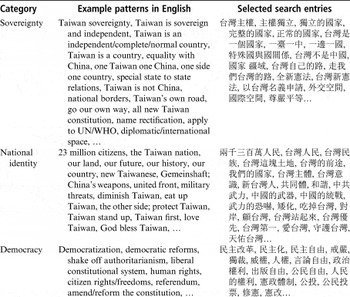
Our three categories were determined by literature review as outlined above. The sovereignty category is intended to cover references to Taiwan's existing independent status, its claim to sovereignty, boundary distinctions between Taiwan and China, and advocacy of actions that reinforce these ideas, such as strengthening the sovereignty claim by expanding Taiwan's international role and writing a new constitution. The national identity category covers signifiers of a distinct collective identity based on common points of identification, references to a distinctive and predominantly hostile “other,” and endorsements of or duties to the identifying collectivity. The democracy category covers references to democratic achievements and the existence of rights and freedoms. We privilege Chen's own framing of the referendum and constitution reform issues by including them in the democracy category along with other proposed democratic reforms. Whilst we acknowledge that these two issues have been interpreted as impinging on sovereigntyFootnote 64 and could be included in our sovereignty category, we also note that Chen was assiduous in decoupling referenda and constitution reform from sovereignty.Footnote 65
We selected indicators of these three categories inductively through a manual analysis of a sample of 200 of Chen's speeches. Table 1 shows our framework with example indicators. The dictionary contains 120 patterns, 45 each in the sovereignty and identity categories and 30 in the democracy category.Footnote 66 Purely for the purpose of comparison we also constructed an economics category. The economics dictionary is made up of 20 generic economic terms such as “banking” and “stock market” and in this article we attach no theoretical or substantive importance to them.Footnote 67
Organization of Dictionaries

Data
In this article we analyse the 2,236 speeches given by Chen Shui-bian between 7 June 2000 and 18 October 2006 that were available at time of writing.Footnote 68 The speeches were downloaded from the Office of the President website,Footnote 69 verbatim and in Chinese, using computer scripts. The texts were then converted into machine-readable form for subsequent analysis. To construct the content dictionary we use the Yoshikoder,Footnote 70 an open-source software package developed by the second author.Footnote 71 The Yoshikoder is a desktop application that runs on any operating system and can deal with text documents in any natural language.
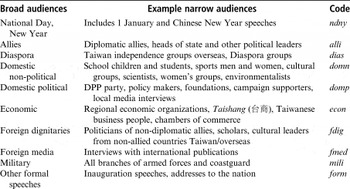
In addition to the content of the speeches, we are also interested in a strategic dimension, that is, Chen's decision to emphasize or de-emphasize language related to a certain category in accordance with his relationship to a particular audience. We have again drawn on the literature as a guide to the type of groups Chen had to engage and their possible different interests and agendas relating to cross-Strait relations. We identified 34 different groups which we aggregate into ten broad categories. These are shown in Table 2, with examples of finer grained audience distinctions. With audience categories established, we assigned an audience to each speech using information attached to the speeches provided by the Office of the President.Footnote 72
Audience Categories

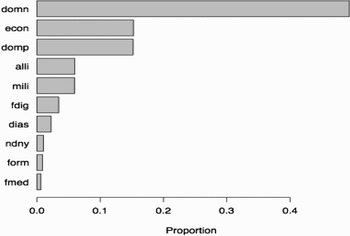
Figure 1 shows the proportion of speeches that Chen gave to different audiences. Domestic non-political audiences constituted approximately half of his speaking engagements, with the smallest amount of attention paid to foreign media (fmed). The number of speeches to overseas support groups (dias) is also very small. This distribution forms the background to understanding the importance of strategic factors in Chen's discourse, because it is partly on the basis of his engagements with foreign media and pro-independence groups that analysts formed their perceptions of his positions.Footnote 73 If Chen's emphases on sovereignty, Taiwan identity and democracy are different when faced with a less rare audience then we may reasonably conclude that it is his opinions to pro-independence groups that need to be discounted in favour of those to local audiences with whom he more frequently engaged.Footnote 74
Proportion of Speeches to Different Audiences

Although it is not the central focus of the article, we also suspect that Chen may have altered the content of his speeches in reaction to important external events. To test this supplementary hypothesis we analysed speech content relative to a set of international and domestic political events that we considered might affect his emphasis on our three discursive categories. Initially we used 21 events such as presidential and legislative elections. Of these 21 events only three had a discernable (and statistically significant) impact on the levels of our categories: Hu Jintao and Wen Jiabao's accession to the PRC leadership, the passing of the anti-secession law, and Chen's re-election. These three events are thus included in the following analysis.
Results and Discussion
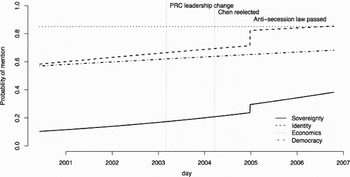
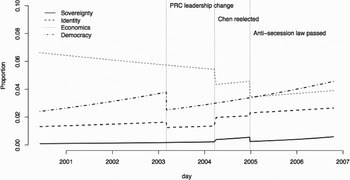
The first question we are interested in is the frequency with which Chen makes reference to sovereignty, Taiwan identity or democracy. To see how often each of the three categories is covered in a speech it is sufficient to code whether at least one pattern from a category is matched by any sentence in a speech – a “mention.” If a speech has mentions of a category then we can infer that the topic was addressed, although we cannot yet say how much coverage it was subsequently given. Figure 2 shows the results of a logistic regression model of mentions over time for each category. Each line in the figure is a fitted probability of mentioning one of our three categories, and, for comparison, general economic themes. Although we are ultimately interested in the effects of individual audiences, we first aggregate all audiences to show the general category trends over time. The three external events that served to raise or lower the probability of Chen mentioning each category are shown as labelled vertical lines at the appropriate point in time. The vertical axis indicates the probability of any speech containing any one of the search terms in our content dictionaries.
Probability of Mentioning Any One Category

Figure 2 shows that the probability of Chen mentioning three of the four categories is high and increasing over time. His speeches are least likely to contain references to the sovereignty issue, but the probability of a mention does increase with time. At the beginning of his term about 10 per cent of speeches mention the topic, but by the time he is re-elected this has more than doubled. There is also a discernable bump in sovereignty talk after the anti-secession law passed, although we can't be sure that this is uniquely attributable to this event. By the end of our time period the proportion of speeches touching on sovereignty is approaching 40 per cent. In contrast, democracy and Taiwan identity are mentioned in approximately 60 per cent of speeches when Chen takes office and this proportion rises slowly at a similar rate until the anti-secession law is passed, when identity issues jump to being mentioned in 80 per cent of speeches. There is a constant 80 per cent chance of any of Chen's speeches mentioning economics, although we show below that this belies a decreasing emphasis on the topic. Including the economics category here is intended to show that increases in our three main categories are not a result of Chen simply talking more.Footnote 75
Examining mentions is a measure of how often Chen covers one of the categories, but we are more interested in how much emphasis he subsequently provides. To see this, we examine the proportion of each speech devoted to each category. Figure 3 shows the results of a similar logistic regression model fitted to the amount of sentences in each speech attributable to each of our categories. Again, we measure this over time, include external events and aggregate the audiences. The vertical axis shows the proportion of sentences in any speech that contain words or phrases in our content dictionary.
Proportion of Matched Patterns in Each Category

It is clear that the proportions involved are small. At its highest point, words and phrases in the democracy category make up just 5 per cent of any speech, nearly doubling from just under 3 per cent at the beginning of the period. However, given that not all speeches can be solely about the virtues of democratic governance, these proportions may actually be quite high. Nevertheless it is clear that sovereignty issues take up the smallest proportion of any of Chen's speeches: on average less than 1 per cent. Interestingly, external events have more effect on the emphasis Chen places on each category than on whether or not he decides to mention them. For example, we see all of the accumulated increase in the proportion of each speech concerning democracy removed after the change of leadership in China. Chen's re-election generates a brief increase in both Taiwan identity and sovereignty, but the subsequent anti-secession law has the opposite effect, leading him to de-emphasize sovereignty topics and slightly increase the proportion of Taiwanese identity rhetoric. Finally, although Figure 2 showed a constant high probability of mentioning economic themes, Figure 3 reveals a steady decrease in the proportion of each speech devoted to economics. This decrease is hastened in Chen's second term, and again on the passing of the anti-secession law.
Audience effects
The previous analyses aggregated all audience types in order to show large-scale variation in our categories. However we are also interested in the effects of individual audiences on the content of Chen's speeches. In the subsequent analysis, we concentrate on the proportion of each speech devoted to each category over time, separated by different audiences. If Chen's message is consistent, regardless of the audience he is addressing, then there should be, at most, random variation in the proportion of each speech he devotes to each category. Over more than 2,000 speeches such as we analyse here, random variation would average out, recreating in the figures below the same shape as the aggregated lines shown in Figure 3. If that were the case, our argument about Chen adjusting the content of speeches to different audiences would fall down.
The next three figures show the results of fitting logistic regression models to the proportion of each category. This is done over time and disaggregates audiences. The vertical axis indicates the proportion of sentences in a speech with indicators in our content dictionaries. Contrary to the previous two figures, for clarity of interpretation we do not include external events, but this does not affect our argument.Footnote 76
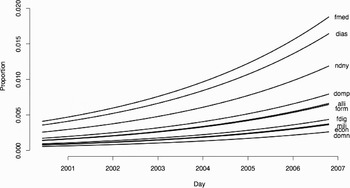
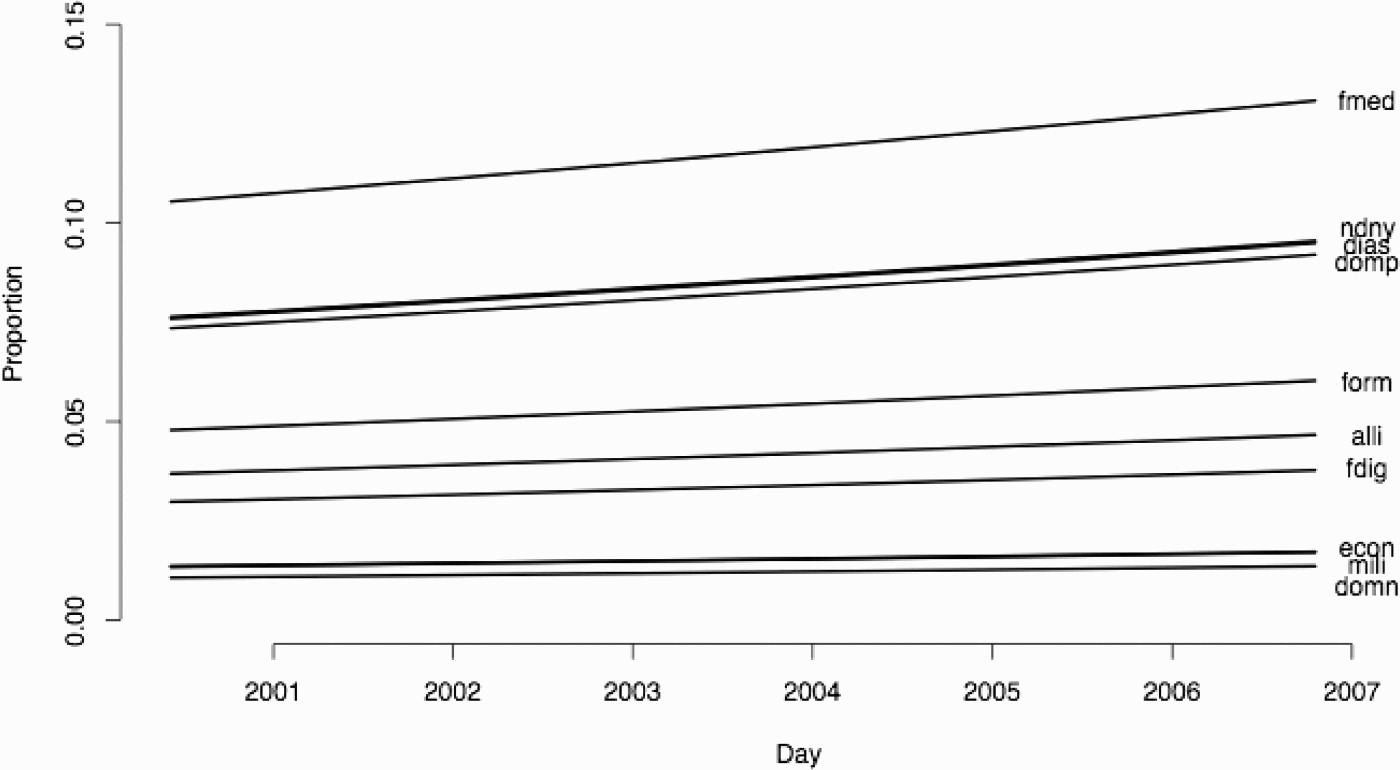
Figure 4 deals with sovereignty. Far from averaging out to replicate the aggregate proportion, each audience has a visible effect. Moreover this effect is highly robust. Audience effects are statistically significant in all of the underlying models presented in this section, a strong indication that we are looking at systematic rather than random variation. Overall, the proportion of each speech devoted to sovereignty increases visibly over time, from a uniformly low level when he took office. This suggests that Chen did indeed become more preoccupied with sovereignty over time. In addition to this general increase, however, Chen's audiences have a strong effect in determining the extent of the increase. From highest to lowest proportion, we see that speeches to foreign media and Diaspora groups contain the largest amount of sovereignty discourse. Domestic non-political and economic audiences receive the least. Since around two-thirds of Chen's speeches were addressed to these latter two audiences, it is clear that the aggregated proportion line in Figure 3 has been strongly dampened by the block of speeches given to domestic non-political and economic audiences. Consider that the average proportion of sovereignty language for all audiences together was around one-tenth of a per cent, whereas foreign media and Diaspora groups hear between 1.7 and 1.9 per cent. In short, and as we predicted, there are reliable differences in emphasis in Chen's speeches to different audiences. Specifically, foreign media and pro-independence groups overseas, which constitute a relatively small proportion of Chen's primary audiences, receive much more sovereignty language.Footnote 77
Proportion of Sovereignty Language, by Audience

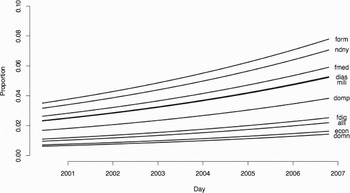
We now examine whether the same degree of audience effect holds for Taiwan identity content (Figure 5). Audience effects again have a demonstrable (and again, in statistical terms, robustly significant) effect on the proportion of Taiwan identity language in Chen's speeches. Again we can infer that the large number of economic and domestic non-political audiences, who get the least amount of identity discourse in their speeches, dampened the aggregated proportion line in Figure 3. Interestingly, Chen reserved for New Year, National Day and other formal speeches the greatest proportion of Taiwan identity language. This is not surprising, in that these occasions afforded him the highest profile opportunity to promote the “Taiwanization” agenda at the forefront of his administration.
Proportion of Taiwan Identity Language, by Audience

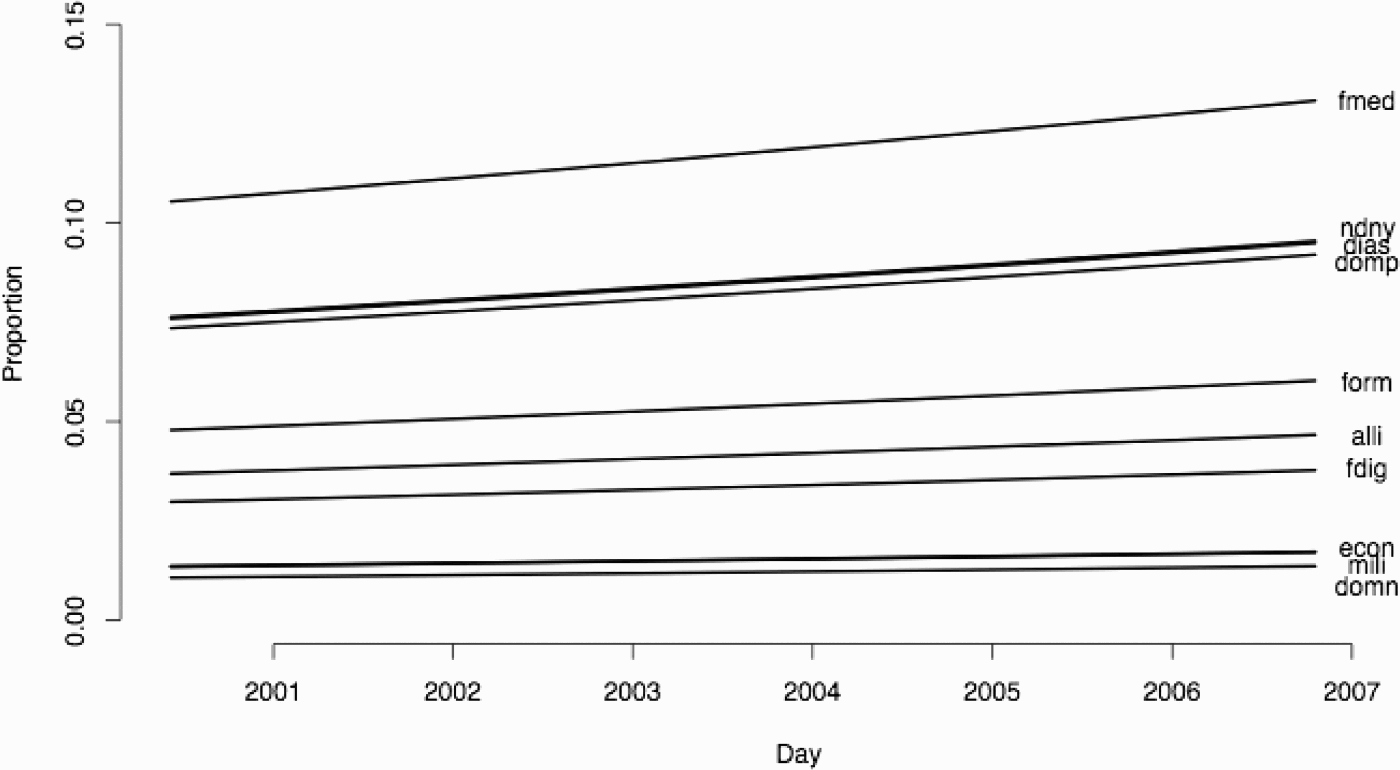
Finally we turn to pro-democracy language. Figure 6 once again shows that individual audiences have a strong effect on the proportion of democracy content. In a similar way to the sovereignty and Taiwan identity themes set out above, domestic non-political and economic audiences, along with the military, receive the lowest proportion of democracy content. By contrast, democracy is an almost constant theme in foreign media appointments, accounting for between 11 and 13 per cent of any such engagements throughout the period. This finding is in keeping with Chen's motivation to project Taiwan's democratic successes to the world, in contradistinction to the PRC, and as a way of highlighting the injustice of Taiwan's exclusion from “official” international affairs. Democracy is a strong theme in New Year speeches and to pro-Taiwan support groups overseas and domestic political audiences.
Proportion of Democracy Language, by Audience
Conclusion
We began this article by pointing out that Chen Shui-bian earned an international reputation as a dedicated promoter of “Taiwan independence” during his tenure as president of the ROC. Critiquing the tendency of the international media, and some scholars, to propagate this conventional and seldom questioned notion, we argued that a more useful approach to understanding Chen's rhetoric is to decompose cross-Strait discourse into its discursive component parts. Applying this approach to the analysis of over 2,000 of Chen's speeches, we arrived at empirical estimates of the comparative frequency and amount that Chen talks about sovereignty, national identity and democracy that challenge the conclusions of analyses based on a small number of selected speeches.Footnote 78 Methodologically, we have demonstrated that systematic large-scale analysis reveals an alternative reading of Chen's rhetoric, which may be a useful complement to more detailed analyses. Substantively, we have shown that Chen addressed sovereignty, the category that contains the discursive markers most likely to connote independence, much less often and much less proportionally, than Taiwan identity, democracy or the economy. Moreover, the content of Chen's speeches, or more specifically Chen's emphasis on particular discursive categories, varied substantially and significantly according to the primary audience to whom he delivered the speech. For instance, foreign media and pro-Taiwan Diaspora groups were much more frequently exposed to sovereignty language than any other audience. This finding is of substantive importance for both scholars and policy makers, since the strategic conditions faced by Chen are likely to influence ROC presidents for the foreseeable future. While exploration of the link between Chen's underlying preferences, strategic choices and rhetoric awaits further investigation, the findings presented here challenge conventional portrayals of former president Chen and provide a context for analysing democratic communication in Taiwan.