Introduction
In the last few days of the 2012 US Presidential election, 20% of traffic to the New York Times website went to Nate Silver’s blog analysing opinion polls (Tracy, Reference Tracy2012). For some this was a trivialization of an important decision that the nation was making (Gerson, Reference Gerson2012). It reflected a mania for measurement that ignored the substance of the election. Poll analysis is usually thought of as treating an election or politics as a game or sport and is discussed in the same way. In this article we ask why do newspapers cover elections the way they do, and in particular what causes an emphasis on polls or electoral strategy as opposed to substantive policy?
It is a question that goes to the heart of democratic theory. Amartya Sen (Reference Sen1999) made the connection between the debates a country conducts and its social outcomes. He argues that democratic policy debate prevents famine and other disasters. Sen is not alone. Keane (Reference Keane1993) sees that a good-quality public service media and a variety of media outlets are essential to the proper functioning of democracy.
If the media are covering the ‘wrong’ aspects of electoral campaigns then it might have a negative impact on the functioning of democracy. Cappella and Jamieson (Reference Cappella and Kathleen1997) found that the media fuel public cynicism in politics through the way they cover politics, a position supported by other observers (Patterson, Reference Patterson1994; Fallows, Reference Fallows1997; Downie Jr. and Kaiser, Reference Downie and Kaiser2002). Cappella and Jamieson (Reference Cappella and Kathleen1997) specify the type of coverage they worry about as game-framed coverage; that is, coverage that frames political debate as a game played between politicians and not one in which important policy issues are debated. They argue that the media’s focus on the ‘game’ of politics to the detriment of the substance of policy issues is at the root of voter cynicism and disengagement. This result is not conclusive as de Vreese and Semetko (Reference de Vreese and Semetko2002) found that while framing in terms of strategy did increase cynicism, it did not affect turnout.
If this is a problem, it might also be one that is getting steadily worse. One of the main arguments for why the media have moved towards covering politics as a game is due to commercial pressures (Patterson, Reference Patterson2000). Competition between the press and broadcast media could have caused a shift to focus on campaign events and stories at the expense of substantive policy issues. According to Iyengar and McGrady (Reference Iyengar and McGrady2007: 62), writing about the United States, ‘no matter what the medium, the public affairs content of the news has been diluted’. More recent changes, including the advent of free sheets (newspapers usually handed out at transport hubs in urban areas) and free access to internet news sources, see newspapers competing for fewer paying readers. The 24-hour news cycle increases the pressure on news outlets to produce copy, reducing the time journalists have to make considered judgements on policy issues (Conboy, Reference Conboy2011: 99).
In this article, we accept that any move towards game-oriented coverage of election campaigns is in part due to commercial pressures and changes in medium, especially as the internet changes how, and how quickly, news can be gathered and disseminated; but other factors, unrelated to media structure, will also be important. The social, economic, and political context in which an election takes place must surely matter. We specifically argue that when an election takes place at a time of crisis – that is, when there is an unexpected negative change in some aspect of the state’s affairs, which causes a debate on the failure and how the state might react – the media revert to more issue or policy-based coverage. The post-2008 economic crisis in Europe offers an opportunity to test this thesis. Using original data we study the case of Ireland, which from 2008 suffered a particularly severe economic shock that ultimately saw the country enter an external support programme in November 2010 backed by the International Monetary Fund (IMF), the European Central Bank (ECB), and the European Union (EU). The external intervention caused the fall of a government and early elections. We study how the print media covered that 2011 ‘crisis’ election and look at how it compares with other recent elections held against a buoyant economic backdrop. We find that the press focus is related to how important policy is to voters and to the sense of crisis in the country. The concept of ‘crisis’ elections and that elections vary in importance is also useful. This allows us to examine other variables, such as economic growth, or war, that can explain variation in the media approach to politics.
In the following sections, we discuss how we might explain variation in media coverage of elections. We consider a number of independent variables that might be influential and we evaluate them in the Irish case. Looking at the context of Irish elections between 1997 and 2011, we then set out our research design, in which we can hold all but one of these variables constant. After discussing the data collection, we present our findings and conclude with a discussion.
Explaining variation in election coverage
There are many ways of measuring how elections are covered in campaigns. One is to look at the amount of coverage elections are given as a percentage of total space (McMenamin et al., Reference McMenamin, Flynn, O’Malley and Rafter2013). Another is to look at the ratio of soft news to hard news, however, defined (Scott and Gobetz, Reference Scott and Gobetz1992). A third way is to look at the relative attention to episodic (stories) compared with thematic (general) frames (Iyengar, Reference Iyengar1991). Possibly the most commonly used is to look at policy-focussed news and that which relates to the game of politics (Cappella and Jamieson, Reference Cappella and Kathleen1997; see also Aalberg et al., Reference Aalberg, Strömbäck and de Vreese2012 for a comprehensive review of literature on strategy and game frames in political coverage). For instance, the debate in the United States on ‘Obamacare’ could be approached in two ways: the media could cover the substance of the debate on health policy or they could discuss the strategic game of how likely it is that the policy will become law. If indeed framing is the appropriate term, this is an example of ‘emphasis framing’ (Chong and Druckman, Reference Chong and Druckman2007).Footnote 1 Strömbäck and van Aelst (Reference Strömbäck and van Aelst2010: 48) understand ‘the game’ to refer to the ‘strategy of political campaigning,…the horserace and battle for voters,…the images of politicians…political power as a goal in and of itself, or…politicians and persons rather than as spokespersons for certain policies’. More recently scholars have distinguished between the game frame (which focuses on polls and who will win) and the strategy frame (which focuses on the motives and tactics of parties and candidates; Aalberg et al., Reference Aalberg, Strömbäck and de Vreese2012).
Modern election coverage is both a political and a media phenomenon. Therefore, it is expected that variation in election coverage is a function of both media and political variables. We discuss a range of such variables, not in order to provide definitive tests of their importance, but rather to demonstrate that omitted variable bias is a minor concern in our study of Ireland. The first media factor is commercial pressure. Scholars argue that the increasing commercialization of the media explains the increasing focus on the game (Strömbäck and van Aelst, Reference Strömbäck and van Aelst2010). Media outlets should find it easier to generate advertising revenue and attract audience share/readers by covering politics as a game; an exciting contest, akin to sport, with winners and losers, rather than policy debates, filled with jargon, statistics, and caveats. The greater the pressure to generate profits, the more likely the media is to cover politics as a game. In electoral contexts, the game frame might treat elections as a ‘horse race’, where the audience is interested in who is winning, losing or, who has fallen at a hurdle (a political scandal), rather than looking at the substantive issues at stake in the campaign. Elections are especially easy to cover as a game because there is an eventual winner. They are analogous to sports events – some electoral contests are foregone conclusions and so less interesting, whereas some are competitive and hence exciting affairs. Media outlets can drive this coverage by encouraging or commissioning certain campaign events. Some campaign events, such as leader debates or opinion polls, facilitate commercially driven media to game frame election coverage. Therefore, we should see that when leader debates are introduced, game framing of election coverage increases.
An alternative hypothesis might be that media fragmentation means that those who had no interest in politics could easily avoid news coverage. This could allow newspapers to become more policy driven as they could target specific types of readers who shared a policy outlook, and remain commercially competitive. We will deal with this possibility empirically below.
The second media factor is professional norms. In some media systems and outlets, professionalism is defined in terms of an absence of partisan bias (for instance, the BBC), whereas in others professionals are less inclined to separate fact from opinion and give the need for balanced debate a lower priority (Fox News). In reporting substantive policy debates, journalists might find it more difficult to remove their own values, and their analysis almost inevitably involves some judgement on the desirability of the policies in question (Cushion, Reference Cushion2012). Where a norm exists against partisanship, we are most likely to see elections portrayed as a game, as this makes it easier to avoid the appearance of favouring one side over another (Hallin, Reference Hallin1994: 25). Those who strive to avoid accusations of bias might concentrate instead on the likelihood of the policy being passed. The decline of political parallelism where newspapers were linked to specific parties and the acceptance of professional norms of objectivity can explain the increasingly game-oriented framing of elections.
Although they should have substantial effects on election news coverage, political variables appear to be somewhat less prominent in the literature. First, the basic institutional structure makes a difference to the nature of elections and should therefore influence how the media portray them (Binderkrantz et al., Reference Binderkrantz and Green-Pedersen2009). In consensual political systems, many actors, partisan, institutional, and civil society, have an important role in policy-making. By contrast, in majoritarian democracies decisions tend to be centralized in an executive controlled by one party. In consensual countries, elections rarely lead to a clear turnover in power. Indeed, it is often policy-oriented coalition negotiations, rather than elections, that bring about shifts in power. On the other hand, in majoritarian systems, elections can transfer power to a totally different set of actors. Therefore, election coverage in majoritarian elections is likely to be much more game oriented as elections usually have clear winners and losers. Lawrence (Reference Lawrence2000) hypothesizes a related explanation based on the decision-making capacities of different political institutions. She finds in her case study of US welfare reform in the mid-1990s that the game frame should be more likely where there is policy conflict with a clear ‘winner’.
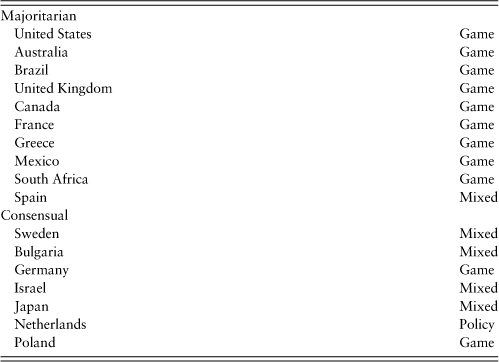
The available evidence strongly favours this hypothesis. The case-study literature clearly identifies majoritarian institutions with the game frame. Dimitrova and Kostadinova (Reference Dimitrova and Kostadinova2013) make a big step forward in leveraging two decades of political change in Bulgaria to show that two indicators of majoritarianism, the number of parties and the electoral system, can explain variations in newspaper framing of elections. In most countries such basic variables vary little over time. Nonetheless, it is possible to undertake a preliminary cross-national test. Kaid and Strömbäck (Reference Kaid and Strömbäck2008: 424) summarize existing research on election coverage in 22 countries. While acknowledging differences in the source case studies, they identify the type of coverage as game, policy, or mixed for 17 of the 22 countries covered. Of these in only one (the Netherlands) are substantive issues dominant and then in just two more (Japan and Sweden) do we see issues dominate coverage in the press, but not in the broadcast media (see Table 1).Footnote 2
Patterns of democracy and type of election coverage

Sources: Lijphart (Reference Lijphart1999); McMenamin (Reference McMenamin2004); Kaid and Strömbäck (Reference Kaid and Strömbäck2008).
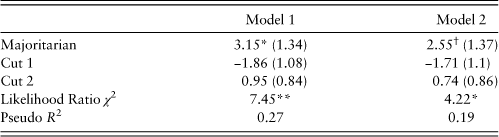
Using empirical work that classifies regimes as predominantly consensual or majoritarian (Lijphart, Reference Lijphart1999: 248; McMenamin, Reference McMenamin2004: 269) we can see if there is a systematic difference according to political decision-making structures.Footnote 3 Coding game as zero, mixed as one, and policy as two, we can perform an ordinal logit to estimate coverage framing using a dummy variable for majoritarianism as the predictor. As Table 2 shows, the coefficient is in the right direction and significant at 5%, in spite of the small number of observations. We classified Bulgaria, South Africa, Brazil, and Mexico qualitatively according to the criteria of Lijphart’s first dimension. If these are excluded, the majoritarianism coefficient still explains much of the variation in framing and is significant at 10%.
Ordinal logit regression of media framing

†Significant at 0.1, *Significant at 0.05, **Significant at 0.01.
A second political variable is more prominent in the literature. It is often argued that a narrowing of the terms of political competition has pushed election coverage towards the game frame (Binderkrantz and Green-Pedersen, Reference Binderkrantz and Green-Pedersen2009; Strömbäck and van Aelst, Reference Strömbäck and van Aelst2010). The narrower are the ideological and policy differences between parties, the more the game frame dominates. Many argue that there has been a shift towards valence competition in recent decades (Clarke et al., Reference Clarke, Sanders, Stewart and Whiteley2004). Parties and voters agree on the ends of politics. Parties compete only in terms of the likelihood of achieving these ends (Stokes, Reference Stokes1963; Green, Reference Green2007). This is usually interpreted as resulting in a focus on the characteristics of leaders and politicians, rather than policy choice.
A third political variable is the competiveness of a specific election. A competitive election is more exciting and easier to characterize in game terms, so we would expect that close elections or those with uncertain outcomes will have more game-oriented coverage. To date the literature offers speculation rather than analysis on this question (Strömbäck and Aalberg, Reference Strömbäck and Aalberg2008), perhaps because measuring closeness across countries is not always straightforward. While in countries with plurality electoral systems and two-party systems, we can measure it as the difference between the top two parties, in proportional representation systems competiveness is not so easily quantified. The parties’ support may not appear balanced on a knife edge, but the possible coalition outcomes might.
Our final political variable is the type of election. Reif and Schmitt (Reference Reif and Schmitt1980), noting different voting behaviour in elections to the European Parliament compared with national elections, conceived the first-order and second-order election models. First-order and second-order elections are usually distinguished in terms of the importance of the office being elected. Where the election is important, that is, to the primary policy-making institutions, voters are thought to concentrate on the intrinsic choice at stake in the election. In second-order elections, voters are less concerned by the formal focus of the election but instead use it to, perhaps, express dissatisfaction with the government or signal to the government the wish to move in a certain policy direction. Second-order elections tend to have lower turnout while smaller parties do well and government parties do worse than we would otherwise expect.
In distinguishing electoral contests in this way, elections to the same office in the same country, for example elections to the US Presidency or UK general elections, are essentially invariable. While politicians frequently talk of ‘this’ election as one where a vital choice must be made, even within a country, elections to the same office vary in importance over time. An election at a time of crisis should matter more because the disorder caused by the crisis necessitates vital decisions. This contrasts with elections during periods of contentment where politicians might compete on who is best able to maintain and manage the status quo. It has been found that elections are better conceived on a continuum between first and second order (van der Eijk et al., Reference van der Eijk, Franklin and Marsh1996) and in the real world there is certainly no dichotomy between crisis or contentment. The level of a crisis or failure – when there are unexpected negative changes to the political, economic, or social affairs of a state bringing uncertainty – will vary. When there is a great sense of crisis or system failure, we expect that the election will be treated in a qualitatively different way by competing parties and the voters they aim to convince. The election will be about more that just the choice between the parties; it will be about policy choices. Certain policy issues are nearly always important, for instance the economy, but only at times are these issues regarded as important problems (see Wlezien, Reference Wlezien2005 for a discussion). When issues can be conceived of as problems facing society and when those problems are great, then we should see a greater policy focus by politicians and policy interest from the general public. As well as demand from the public driving a greater policy focus, which we regard as the main causal mechanism, parties may have less money to spend on marketing and so may have to rely on policy for attention. Similarly, newspapers may have less money to spend on opinion polls.
We also have expectations about media coverage where there are these greater levels of uncertainty and disorder. The electorate will expect that the media reflect this debate in their electoral coverage to a greater extent than in a contentment election. This is consistent with Zaller’s (Reference Zaller2003) idea of a ‘burglar alarm standard of news quality’ in which he proposes that modern mass media cannot and need not be expected to provide high-quality coverage of all relevant political events on a routine basis. Instead, he argues that soft-news coverage, which emphasizes drama, the game and strategy frame, is appropriate for the coverage of ‘non-emergency but important events’ while the ‘burglar alarm’ will be rung and citizens be alerted ‘to matters requiring urgent attention’ (2003: 122). The concept of a crisis election constitutes a special case of this burglar alarm notion. We propose that, in a crisis, media coverage will shift from game and strategy frames that the media utilize to generate attention to a routine process to emergency coverage that refocuses on the political issue underlying the crisis.
Thus, we hypothesizeFootnote 4 that:
Everything else being equal media frames of elections will become more policy-focussed during periods of unexpected negative change in economic, political or social affairs.
The context of the 2011 Irish general election
Elections to Dáil Éireann – the Irish lower house – in 2002, 2007, and 2011 represented interesting contrasts, though these contests were to fill the same offices and broadly the same parties contested. The 2002 and 2007 elections can be regarded as unusually contented elections, whereas in 2011 the country was dealing with the repercussions of a severe economic shock. The election in 2011 was called before the parliamentary term had finished as the incumbent government’s majority ended due to Ireland’s entry into an external funded programme. The election was the third most volatile in terms of changes in party support in post-war European history and the most volatile in which no new party emerged (Mair, Reference Mair2011).
Up to 2008, Ireland had enjoyed the epithet ‘Celtic Tiger’ as its economy had grown at remarkable rates from 1995 to 2007. Unemployment had fallen to close to 4%; employment had doubled; and Ireland, traditionally a country of emigration, saw its population rise through a combination of high immigration and high fertility rates. Initial growth was caused by a significant inward-investment boom and a strengthening of the domestic economy but after 2002 there was an unsustainable property boom. Irish banks fed the property bubble through lax lending funded by cheap credit available on international markets. The very weak regulation of those banks became apparent in late 2007 as the implications of the international ‘credit crunch’ impacted on the Irish financial sector. The situation came to a head in September 2008 when the Irish banks could not access money on the financial markets, and their loan books were increasingly troubled as more loans defaulted. The Irish government guaranteed the debt of all Irish banks as it believed that they were solvent but suffering from a short-term liquidity problem. In fact, the banks were insolvent and the €70bn bank rescue was the result of what was, given the size of the country, the biggest banking failure in world financial history.
At the same time Irish tax revenues fell dramatically. Irish governments had increased state spending in the previous decade, and were now under pressure to reduce this quickly. A number of emergency budgets followed that reduced government spending, but the deficit remained stubbornly high at about 10% of gross domestic product (GDP). Between 2008 and 2011 real GNP declined by 11.9%. General government debt increased from 25% of GDP in 2007 to 107% of GDP in 2011. The unemployment rate had averaged 4.5%. This increased substantially, estimated at 14.4% in 2011. Although Ireland had seen recessions before, particularly in the 1980s, none had seen as sharp a drop in economic activity. We can see that if we are measuring the independent variable of election type as a dichotomy between crisis and contentment the three elections in 2002, 2007, and 2011 represent extreme cases.
Research design
In order to investigate whether the election context, and specifically the economic crisis, is a significant variable in explaining the framing of election coverage by media outlets we ideally want to compare a large number of elections in a number of countries where there is variation on this. There is a dearth of comparative research in political communication in large part because of the differences in coding. This means there is a lack of cross-nationally comparative data (Norris, Reference Norris2009; Aalberg et al., Reference Aalberg, Strömbäck and de Vreese2012). Indeed, there is also very little in the way of comparable time-series within countries. However, single-country cases can make a significant contribution to comparative research in political communication (see for instance Wilke and Reinemann, Reference Wilke and Reinemann2001).
In this section, we analyse the Irish case in terms of the previous theoretical discussion. In doing so, we consider cross- and intra-case perspectives. We are able to demonstrate that the Irish case is a least-likely case for a policy framing of elections compared with many other countries. Moreover, we argue that the 2011 election was a least-likely case for policy-focussed coverage in all but one respect, that of the unprecedented crisis the Irish economy, polity, and society faced.
First, commercial pressures in the Irish newspaper business are very high. The Irish newspaper market is highly competitive. The press is small, crowded, and unsubsidized, and Irish-based newspapers must compete with localized editions of British newspapers. Commercial pressure in 2011 was probably greater than at any other point in the newspapers’ history. Like newspapers elsewhere, Irish papers lost circulation, which fell by 22% between 2007 and 2011. The economic crisis put much greater pressure on newspaper advertising revenues, which fell by 56% in the same period.Footnote 5 Thus, sales have come to constitute a greater share of revenue. In particular, the papers shared in the Irish property bust. Some of the papers had become dependent on lucrative property supplements during the boom, and like the Irish state itself, faced a massive shortfall in revenue when the property market crashed. Even those papers that remained profitable were left with large boom-era debts. These commercial pressures should have increased their incentive to reduce costs and sell more papers, which the literature suggests can be achieved by framing the election as a game. Indeed, unprecedented numbers of opinion polls and leaders debates on television in 2011 made it easier than ever for the papers to provide game-oriented coverage.
The alternative hypothesis is that media fragmentation would allow newspapers to become more policy driven because they could target specific types of readers who shared a policy outlook. So the introduction of the Daily Mail and the Sun in Ireland might have meant these papers could have safely increased policy coverage that was populist in tone and right-wing in outlook. There are two problems with this explanation. The media fragmentation that took place did so before the 2007 election. Also (as we see below) the trends we observe are uniform across all newspapers, including those that are ideologically pluralist.
Second, Ireland reflects the liberal model of media systems (Hallin and Mancini, Reference Hallin and Mancini2004), which has a norm of impartial reporting and a rigorous distinction between ‘hard news’ and commentary. Papers are not now clearly associated with parties and seem to endeavour to contain a plurality of opinion. Indeed, there is very good evidence that Irish journalists do not generally express their political opinions through their reporting. Survey responses suggest that Irish journalists are much more (socially) liberal and (economically) left-wing than their paper’s editorial stances and indeed Irish society in general (Corcoran, Reference Corcoran2004). We see no evidence to suggest that this variable is not constant across the three elections included in this study.
Third, Ireland is not a consensual democracy. Lijphart places it on the border between consensus and majoritarianism, but Irish political scientists would argue that it is much closer to the Westminster model. In particular, the Irish executive is very much dominant, even outdoing the British exemplar in government domination of the legislature (O’Malley and Martin, Reference O’Malley and Martin2010). Admittedly, Ireland has had coalition governments in recent decades, but power is not shared with the opposition. Ireland has also given a significant role to interest groups, known as the ‘social partners’. The system of social partnership largely collapsed as a result of the economic crisis, returning much power to the core executive. Generally, Ireland’s institutional structure suggests a tendency towards the game frame.
Fourth, Ireland is known for its non-ideological politics. While social and ideological patterns are discernable, they are subtle and apparently ephemeral compared with those in other established democracies (although see Byrne and O’Malley, Reference Byrne and O’Malley2012). Fianna Fáil and Fine Gael, two pragmatic, conservative, nationalist parties, have dominated Irish politics since the 1920s. The small Irish Labour Party is one of the most centrist left-wing parties in Europe. At the national level, this ideological consensus makes Ireland a most likely case for game framing, as parties and leaders compete on valence issues. At the constituency level, the electoral system produces relatively candidate-centred competition, which focuses on the representation of local interests at the expense of national policy. In fact, it could be argued that Ireland’s entry to the external funding programme in late 2010 further reduced the scope for policy debate, as so little remained to be decided by the Irish political system, though many commentators and some politicians advocated rejection or renegotiation of the bailout deal. An analysis of the parties’ manifestos shows no significant widening or contraction of the policy space (Suiter and Farrell, Reference Suiter and Farrell2011).
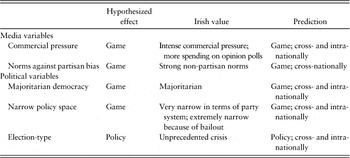
We have argued that Ireland was a least-likely case for a policy-oriented framing of election coverage in 2011. The commercial pressure on newspapers, journalistic norms, pattern of democracy, and the nature of party competition all point towards a system in which elections are likely to be framed as a game. Moreover, these variables also point towards a more game-oriented coverage than in recent Irish elections, except for professional norms which are neutral. Table 3 summarizes these arguments.
Summary of theoretical expectations and the Irish case

This brings us to the final variable, election context, or more specifically for this case: the economic situation. The 2011 election clearly represents an extreme case where the value observed in the key independent variable being tested ‘lies far away from the mean of a given distribution’ (Gerring, Reference Gerring2007: 101–102). The systemic crisis in Ireland points towards policy framing, both in comparison to Ireland’s past, and previously studied elections in other countries because the policy choices Ireland faced seemed to matter more than ever. As such Ireland provides an interrupted time-series where we see a ‘treatment’ administered, presenting itself as a sharp change in an independent variable in one point on a time-series (Gerber and Green, Reference Gerber and Green2008). We use a series of observations on the policy/game-dependent variable, and see if the ‘treatment’ of the financial crisis, caused an interruption to the dependent variable, while other potentially influential variables are held constant. The advantage of having this extreme treatment is that it will be easier to observe the impact of the variable and make inferences to where the values on the variable are more moderate. Having outlined the research design, in the next section we describe the sources of the data, the coding scheme, sampling, and inter-coder reliability tests.
Data
We coded newspaper articles from each of the official election campaigns in 2002, 2007, and 2011. In 2002, we undertook a content analysis of four newspapers (Irish Times, Irish Independent, Examiner, and Evening Herald), while in 2007 five newspapers (the above plus the Irish Sun) were included. The analysis of 2011 election includes 12 national newspapers including Sunday broadsheets and tabloids. Papers in Ireland tend to be internally pluralist (i.e., offer space to a range of opinions in their comment pages) and non-ideological, though the Irish Times is generally regarded as liberal and some of the local editions of the UK paper tend to be more likely to have declared policy positions. We coded all weekday issues throughout the short campaign, 25 April–17 May in 2002, 30 April–26 May in 2007, and all issues published from 2 February to 25 February 2011. All articles from the news section, comment pages and editorials with reference to the election, the campaign, or political parties, were included and coded line by line. Letters to the editor, e-mails or extracts from web coverage, such as ‘tweetwatch’ were excluded. The coding did include reviews of TV programmes on the election, including leader debates. In 2011, a random number generator was used to select 40% of the articles. This ensured that an even coverage of front page and inside page articles was included in the sample.Footnote 6 This procedure was followed for each issue in each newspaper.
This resulted in a total of 1217 articles from the 2002 election, 2095 articles from 2007 and 1440 articles from 2011. We used the same coding scheme in all three elections (see detailed codes in Supplementary Appendix); in the following, we focus on descriptive statistics from the 2007 dataset as detailed information about the 2002 dataset can be found in Brandenburg (Reference Brandenburg2005) and details of coding of articles from the 2011 election can be found in McMenamin et al. (Reference McMenamin, Flynn, O’Malley and Rafter2013).
There are a number of ways we can measure these frames. One is to take the whole article as the unit of analysis and code according to the dominant frame in the article (Aalberg et al., Reference Aalberg, Strömbäck and de Vreese2012). However, it is possible that a number of frames are contained in a single article (Farnsworth and Lichter, Reference Farnsworth and Lichter2011), and if one were studying the effect of an article one might assume that longer articles should be more heavily weighted. Using just a dominant frame could misestimate the level of coverage of issue, strategy or game frames, if for instance strategy framing dominates an article but it covers certain policy issues as well we would incorrectly estimate 100% strategy coverage and no issue coverage. These errors might cancel one another out over a large number of articles such as we have, but we cannot be certain this would be the case. An alternative is to code articles as whether a given frame is present or not; but this is an imprecise measure that loses information. We use text segments instead of full articles because they give a more precise and nuanced measure of the frame, which can be aggregated to article level for comparative purposes. For a discussion of the coding and reliability tests, see the Supplementary Appendix (available online).
Results
There has been a steady increase in the volume of electoral coverage in Irish media over time (Farrell, Reference Farrell1978; Bowman, Reference Bowman1987). Though analysis of media coverage of elections before 2002 is patchy, we have some data for the Irish Times and Irish Independent, respectively, the liberal ‘newspaper of record’ and a more populist broadsheet (Farrell, Reference Farrell1993, Reference Farrell1990). The proportion of election coverage framed as policy decreased from 59.2 to 30.7% between 1973 and 2007, while the level of game-framed coverage increased. This trend is consistent with the arguments made that there has been an ‘Americanization’ of media across the world (Hallin and Mancini, Reference Hallin and Mancini2004).
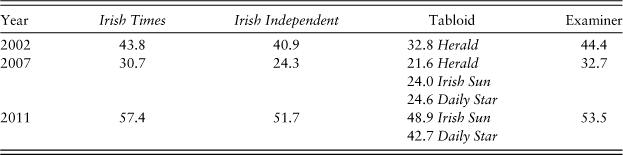
Using our data, this trend is observable across all types of newspapers from 2002 to 2007 (see Table 4). In 2007, we see a dramatic decrease in policy coverage, in the broadsheets as well as the tabloid for which we have comparative data. This may have been because 2007 was a much closer election than in 2002, which was seen as something of a foregone conclusion (Murphy, Reference Murphy2003: 17–18). Across all papers, policy-framed election coverage drops by between 10 and 15 points. In 2007, the Irish Independent carries as little policy coverage as the tabloids (as a proportion of each paper’s election coverage).
Campaign coverage of substantive policy issues, 2002–2011

In 2011, though all other variables point to no change or a continuing fall in policy coverage, our theoretical expectation is that the sharp deterioration in the performance of the Irish economy will cause an increase in issue-framed coverage. This is what we see in dramatic fashion. The tabloids see a large rise in policy-framed coverage of the 2011 election – to almost 50% for one [though it should be noted that the amount of coverage tabloids devote to election coverage was very small (see McMenamin et al., Reference McMenamin, Flynn, O’Malley and Rafter2013)]. The increase for the broadsheets is even greater (by between 20 and 30 points); so most election coverage was policy focussed in 2011.
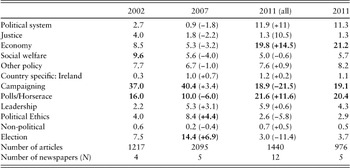
If the increased policy coverage in 2011 is related to the crisis, then we expect that within the policy coverage, the subject of the crisis – the economy – would feature heavily. Voters clearly identify the economy as important in 2011. When asked the single most important issue or problem, 35.6% mentioned the economic crisis and a further 13.5% mentioned related economic issues, such as unemployment (Marsh and Cunningham, Reference Marsh and Cunningham2011: 187). The crisis had an impact on people’s vote choices. The proposed Taoiseach (prime minister) and the set of ministers were important criteria for 35% of voters in choosing how to vote in 2007. This dropped to 20% in 2011. Meanwhile the criterion of ‘policies set out by the parties’ increased from 25% to 43% over the two elections (Marsh and Cunningham, Reference Marsh and Cunningham2011: 185). Table 5 breaks down the election coverage in the three elections. We observe a large increase in the coverage of the economy from 5.3% in 2007 to almost 20% in 2011. Two-thirds of the articles that make any reference to the economy in 2011 also explicitly refer to an economic crisis. When we make a direct comparison with just the newspapers coded in 2007 (final column in Table 5), we see a similar shift to policy-framed coverage. So this finding is not an artefact of the additional newspapers coded.
Election coverage in 2002, 2007 and 2011, % of total coverage (point change since earlier election)

The three most common types of coverage (biggest changes) are in bold.
Interestingly, the trend in strategic and game-framed coverage is not uniform. Strategy-framed coverage halves – from 40% to <20% – but the horserace coverage actually increases quite significantly. This probably reflects the increase in opinion polling at the election. It also shows that suggestions that game and strategy framed should be separated are correct (Aalberg et al., Reference Aalberg, Strömbäck and de Vreese2012). However, this result does not contradict our expectations, which relate to overall policy-framed coverage. This still records a huge increase in 2011.
Another issue that voters mention relates to the political system. This was identified as the most important issue by 36.3% of the electorate (Marsh and Cunningham, Reference Marsh and Cunningham2011: 187). This may seem surprising but there was a strong sense in Ireland that the political system had failed and needed to be reformed. This issue was given much greater prominence in the manifestos of all the main political parties (Suiter and Farrell, Reference Suiter and Farrell2011). This increased priority was reflected in newspaper coverage. The political system code rose from negligible levels in 2007 to account for almost 12% of coverage in 2011. While we can see that the increase in policy focus by the press is reflected in the priorities of voters and presumably readers, our data can offer no indication as to any causal direction.
Because of the very high number of observations, even substantively uninteresting changes in coverage shown in Table 5 are statistically highly significant. We therefore use a more conservative test of whether changes are statistically significant where we take the percentage coverage of each newspaper for which we have data common across the 2007 and 2011 elections and conduct a two-tailed, paired t-test on the differences of the mean coverage over these elections. This makes for a much more strenuous test of difference, yet we still see that the following changes between 2007 and 2011 are statistically significantFootnote 7 : Political System (P=0.00015), Economy (P=0.0031), Campaigning (P=0.0066), Polls/Horserace (P=0.011), Political Ethics (P=0.0033) and Election (P=0.0087, n is 5 for all). We can also see that the differences between 2002 and 2011 are significant; so 2007 is not an aberration. Substantively and statistically there is a significant jump in policy-framed coverage for the 2011 election. The only independent variable pointing towards such a change is the context in which the election took place: economic crisis.
Furthermore, the similarities between the newspapers in 2011 are greater than those similarities within the newspapers and between the crisis election and the 2002 and 2007 ‘contentment’ elections. Table 6 reports correlations both within and between newspapers and years for the newspaper agendas across each of the 19 policy and non-policy coding categories (see online Supplementary Appendix) in the election news coverage. We can see from the left-hand section that the correlations between the papers in any year are very strong and positive. Though the mean of the correlations between the newspapers in 2011 (0.847) is lower than for 2002 and 2007 it is a mean of a larger number and greater diversity of newspapers in 2011. These are much higher than the mean correlations of each of the papers between 2011 and the other two election years. The relationship between the newspapers’ election coverage in the 2002 and 2007 contentment elections is higher (0.904). We can see that the relationship between each paper’s coverage in 2007 and 2011 is much lower. These relationships show that coverage in 2011 was very different to that in the other elections, and the coverage in 2011 was consistent across all the newspapers.
Correlations between agendas of newspapers between and within election years

Cells report mean correlation coefficient based on (N) pairwise correlations, so cell (2007) reports the correlations of the five available papers’ correlations with each other in 2007; we obviously exclude correlations of the same paper within a year. For inter-year correlations on the right, these are based on pairwise correlations where we have the same newspapers available in both years.
Conclusion
This paper has argued that factors additional to the media context will be an important determinant of the way the media chooses to frame an election. Specifically we say that some elections take place in a climate of contentment and some in a sense of crisis. We expect the strategy/game frame to be more common in ‘contentment’ elections, whereas there should be a greater emphasis on policy in crisis elections.
Policy coverage at Irish elections from 1973 to 2007 fell continuously – consistent with the experience elsewhere as reported in much of the literature. Yet 2011, an election at a time when external bodies were required to fund the Irish state, saw policy coverage of the contest increase markedly. Ireland represents a least-likely case where all other variables pointed to reduced policy coverage. The effect of election type was remarkable and consistent across different types of newspapers. Furthermore, we observe that within the policy coverage, the press covers those policy areas related to the crisis.
This finding is of particular interest to scholars of media and political communications. First it adds another, very powerful, variable to the list of explanatory variables used to explain media coverage of politics and in particular elections. The 1979 British General Election could be regarded as having taken place in an economic crisis, as would the 2012 Greek election. While it will often relate to economic performance, it should not be limited to it. There are other causes; a country newly in a state of war might be judged by the electorate to be in a state of crisis. The 2001 Israeli election that took place during the second Intifada is a good example. Sheafer et al. (Reference Sheafer, Weimann and Tsfati2008) graph a spike in press coverage of policy issues in the 2001 election there, to mid-40s from just over 20% in 1999. Other types of crisis can also be identified, such as the 1994 and 1996 Italian elections that took place under the shadow of the Tangentopoli corruption allegations, which was a systemic crisis and saw the move from the First to Second Italian Republic.
A second conclusion is a more general one on the nature of media coverage. This case shows that when it matters the media can shift focus quite dramatically and concentrate on policy – in Zaller’s (Reference Zaller2003) words, they raise the ‘alarm’ and move to lessen dramatic and entertaining routine coverage to more focused coverage that alerts the otherwise ‘monitorial citizen’ whose urgent attention is required. In a country that had shown evidence of the hypothesized ‘dumbing down’ of news coverage, we observe that, in special circumstances, that trend can be reversed and in a dramatic fashion. Specifically the data on the 2002, 2007, and 2011 elections in Ireland show that media focus on the election tends to follow predictably the context of the elections. This outcome questions the argument that media drives the public agenda more than real-world indicators (Funkhouser, Reference Funkhouser1973; Dearing and Rogers, Reference Dearing and Rogers1996).
A third theoretical conclusion relates to the qualities of democracy. Sen (Reference Sen1999) and many others argue that democracy can prevent catastrophes because policies are observed and questioned earlier by a free press and other institutions. That the Irish press moved so firmly to cover policy in the 2011 election might support Sen’s (Reference Sen1999) argument. So we could have a less pessimistic outlook on the press than other commentators have had: the media can be responsive and responsible. Unfortunately this attention came too late to prevent the economic collapse as, like elsewhere, the Irish media did not discuss or question the policies that ultimately provoked the crisis.