


[T]he descent from that ingenious automaton, Detective Dupin, to such a prince of duffers and dullards as Sherlock Holmes …
Eight years after the death of Queen Victoria, the prolific but now largely forgotten magazine author Brinsley Moore began a six-part short-story series, Chander Rao, Criminal Expert.1 Throughout the series, Rao (a middle-aged Indian twice denied a Bachelor of Arts by the University of Calcutta) uncovers various minor criminals through the sleights of hand that his celebrated travelling exhibition of “Eastern Magic” enables.2 While this initially entertaining central conceit quickly risks becoming predictably repetitive, the third story in the series – “The Automaton Detective” – introduces a new element by infusing Rao’s occult performance with a bravado display of mechanical science.3 In an effort to identify a boarding school thief, Rao agrees to perform at the school’s graduation ceremony, where he unveils the latest addition to his theatrical repertoire: the automaton Khokan, “an almost life-size representation of an Indian fakir,” supposedly endowed with not just reason and intelligence but second sight (see Figure 9.1).4 While Khokan appears to locate the thief during his pseudo-séance performance, Moore’s series consistently rejects melodrama and the supernatural in favor of realism and logic (“Where common sense baffles crime,” declares an American title page);5 and Rao ends this instalment by confiding in the series’ narrator: “Why, surely you must see for yourself that a clockwork thing like that could discover nothing. Khokan is but the outward means adopted to cover my methods. It was I who found that miserable, dishonest youngster.”6
Simon Schaffer has written of automata’s centrality to the various discourses working to conceal global capitalism’s subaltern labor.7 Here, though, in a remarkably powerful symbolic moment, Rao becomes not a passively exploited colonial victim but rather the master of his own automaton doppelgänger and exoticized persona. Indeed, Rao begins his performance by introducing himself as “a humble citizen of the British Empire,” having “exactly gauged what was required of him” and “the tricks” necessary to appeal to his audience.8 In so doing, Moore’s story reinforces its essential retrospection, subverting as it does Maelzel’s Chess-Playing Turk and the many works of fiction that real-life hoax automata inspired over the course of the long nineteenth century.
Rao and his automaton-double, Khokan

Yet Moore’s story – with its eccentric genius detective and its reliably dull doctor-narrator – also looks back to Moore’s literary precursors and the history of detective fiction more broadly. Today, the journal in which Moore’s story first appeared (The Royal Magazine) is primarily remembered as one of The Strand’s many imitators9 – as an outlet for detective fiction that introduced the world to Baroness Orczy’s vaguely Holmesian detective “The Old Man in the Corner” (1901–5) and, in 1927, Agatha Christie’s Miss Marple. Early detective fiction’s anxious obsession with constructing a respectable canonical lineage ensured that texts in the genre are typically both explicit and repetitive in their intertextual referencing, and early detective fiction stories tend to link themselves back to a fairly limited set of precursor texts and tropes.10 As this chapter will argue, the automaton became one of detective fiction’s central recurring symbols in the Victorian period, a contested figure lying at the heart of a struggle over the genre and the worldview that it contained.
Poe’s Ingenious Automaton
As John T. Irwin has noted, scholars frequently point to Edgar Allan Poe’s 1836 essay “Maelzel’s Chess-Player” as “a prefiguration of the analytical method of the Dupin stories and a trial run of Dupin’s ‘voice’.”11 In highlighting the influence of this essay’s ratiocinating rhetoric on detective fiction, however, this scholarship typically overlooks the extent to which the thematic subject of Poe’s essay – automata – also came to shape the burgeoning genre. Poe famously begins “The Murders in the Rue Morgue” (1841) with a densely philosophical rumination on the nature of “analytical power” and its superiority to mere “calculation,” before claiming that the story which follows will act as an illustration of this juxtaposition.12 By this stage, however, Poe has already illustrated this juxtaposition by way of another analogous example, differentiating the merely “attentive” and “calculating” abilities required to play chess from the true observational analysis honed by playing draughts and whist.13
In part, the strangely vitriolic tone of Poe’s opposition to “the elaborate frivolity of chess” – “in nine cases out of ten,” Poe scoffs, “it is the more concentrative rather than the more acute player who conquers”14 – suggests a somewhat petty ego-biographical motive may have made its way into Poe’s story. Beyond this, however, the philosophical mini-treatise that begins “The Murders in the Rue Morgue” replicates a structure that was established in “Maelzel’s Chess Player” and that will appear again in Poe’s subsequent fiction: that of an ontologically exalted human using observational analysis to uncover what Paul Grimstad has called the “non-reasoning creatures” that populate Poe’s writing, whether “the blindly calculating automaton, the motiveless ape, [or] the bird that speaks by rote.”15 In this, then, Poe seems to be positioning his proto-detective in opposition to the figure of the automaton. Yet, as John Tresch has noted, in debunking Maelzel’s chess player, Poe “used machinelike logic to prove that a machine could not think”;16 and, as would become typical of much nineteenth-century detective fiction, the fictional investigator’s true relationship with mechanicity is more complex and ambivalent than this initial reading might suggest.
One of the key attributes Poe ascribes to machines, in his 1836 essay, is their dependence on action-reaction determinism:
Certain data being given, certain results necessarily and inevitably follow. These results have dependence upon nothing, and are influenced by nothing but the data originally given. And the question to be solved proceeds, or should proceed, to its final determination, by a succession of unerring steps liable to no change, and subject to no modification. This being the case, we can without difficulty conceive the possibility of so arranging a piece of mechanism, that upon starting it in accordance with the data of the question to be solved, it should continue its movements regularly, progressively, and undeviatingly towards the required solution, since these movements, however complex, are never imagined than to be otherwise than finite and determinate.17
Five years later, when Poe’s detective famously follows the train of his silent narrator’s thoughts, Dupin becomes remarkably reminiscent of the “pure machine” outlined in Poe’s earlier essay, unerringly moving from one unspoken thought to the next. Indeed, in moments such as this, Poe’s “frigid and abstract”18 protagonist really does seem to be what George Bernard Shaw called an “ingenious automaton”: a “superperceiver” (to use Struan Sinclair’s term) “who sees – and knows – all,”19 never failing, just as Poe reasons that a true chess-playing machine “would always win.”20
The Doll and its Maker
While Holmes’ similarity to Dupin has been discussed ad nauseam, by Doyle scholars and fans alike, relatively little attention has been paid to the specificity of those moments in which Doyle explicitly foregrounds this literary influence. Within the Holmes canon, the two main references to Dupin both center upon the just-noted silent thought-following scene in “The Murders in the Rue Morgue.” Upon being told that he reminds Watson of Dupin, soon after they first meet in A Study in Scarlet (1887), Holmes declares Dupin “a very inferior fellow. That trick of his of breaking in on his friends’ thoughts with an apropos remark after a quarter of an hour’s silence is really very showy and superficial.”21 Six years later, though, in “The Adventure of the Cardboard Box” (1893), Doyle gaslights the reader with a bizarre rewriting of this scene:
“You remember,” said [Holmes], “that some little time ago when I read you the passage in one of Poe’s sketches in which a close reasoner follows the unspoken thoughts of his companion, you were inclined to treat the matter as a mere tour-de-force of the author. On my remarking that I was constantly in the habit of doing the same thing you expressed incredulity.” “Oh no!” “Perhaps not with your tongue, my dear Watson, but certainly with your eyebrows. So when I saw you throw down your paper and enter upon a train of thought, I was very happy to have the opportunity of reading it off, and eventually of breaking into it, as a proof that I had been in rapport with you.”22
One might speculate as to the changing authorial psychology that produced these strikingly different accounts of a single fictional moment: the earlier account produced by a then-unknown Doyle, anxiously attempting initial product differentiation; the later account created by a now-commercially proven Doyle, increasingly enmeshed in the cyclical self-cannibalizing logic of never-ending sequels in which innovation means only revision.23 Regardless of motivation, however, the combined effect of these opposing accounts is, once again, duality and ambivalence: are we to emphasize Holmes’ initial rejection of Dupin’s mechanical philosophy, or are we to trust Holmes’ subsequent demonstration of a worldview in which not only Holmes’ “rapport” with Watson but the entire cosmos resembles a pre-wound clockwork automaton?
Even twenty years later, the figure of the automaton continued to haunt how Doyle publicly negotiated his relationship with Poe. In 1912, the American humorist Arthur Guiterman wrote a comic poem for Life magazine in which he critiqued both Doyle’s much earlier defense of Britain’s imperial forces in South Africa and Holmes’ impoliteness towards Emile Gaboriau’s detective Lecoq, before conceding that Doyle’s harmless writing was at least morally preferable to that of the Decadents and early modernists. Wedged within Guiterman’s forty-eight-line poem was a two-line objection to Holmes’ initial dismissal of Dupin as “very inferior.”24 In response, Doyle – completely ignoring the content of the poem’s other forty-six lines (some of which was surely far more consequential!) – wrote a comic poem of his own for London Opinion, “To the Undiscerning Critic,” in which he sought to differentiate himself from his literary creation:
These lines are frequently quoted in (one would hope) unnecessary popular reminders that Holmes was, indeed, a fictional character rather than an actual person.26 What these open-barn-door-rushers also rush past, however, is the specificity of Doyle’s rhetoric in these lines. For, here, Doyle again seems unable to resist a metaphoric lexicon tying Holmes and Dupin’s chain of influence to equally uncanny reembodiments of the automaton: to the doll and the puppet.
The Logical Machine and “The Automaton Detective”
This metaphoric lexicon became increasingly overt in early detective fiction. “You really are an automaton,” declares Watson in Doyle’s 1890 novel The Sign of the Four, when Holmes ignores the beauty of Mary Morstan, Watson’s future wife.27 “He was,” reflects Watson the following year, at the beginning of “A Scandal in Bohemia,” “the most perfect reasoning and observing machine that the world has seen.”28 Ronald Thomas and others have emphasized the latter analogy, relating Holmes to nineteenth-century developments in photography and Holmes’ now-metonymic magnifying glass.29 However, Holmes can also be read alongside Victorian-era mechanical innovations that might remind latter-day readers of the “extended mind” theory articulated by Andy Clarke and David J. Chalmers a century later: in other words, of the idea that the external world plays “an active role … in driving cognitive processes.”30 In the later Victorian period, a number of attempts were made to create actual reasoning machines.31 At the time, perhaps the most widely discussed of these contraptions was the “logical machine” built by William Stanley Jevons in 1869 and described by Jevons in a speech to the Royal Society in 1870. Through a system of pins, rods, levers, and a “key board,”32 the machine, Jevons claimed, embodied “the proper condition of a mind exempt from mistake,” and showed “that mechanism is capable of replacing for the most part the action of thought required in the performance of logical deduction.”33
In the decades that followed, the logic machine became a touchstone in a much broader debate about the nature of industrialized humanity. In 1888, the Oxford tutor Bernard Bosanquet emphasized the ontological hybridity of logic machines, reminding readers that “in any logical engine … we have to make the conclusion.”34 Somewhat less subtly, in 1890, The Speaker dismissed Jevons’ invention, comparing it to “an ingenious contrivance for spreading butter on bread by steam or electricity: when we have got the bread and the butter, we can do that for ourselves without artificial aid.”35 In 1898, however, the American psychiatrist Joseph T. O’Connor went beyond even Jevons’ claims for his invention, suggesting that the machine modelled how “brain cells … digest information and attendant propositions brought into them, and [then] present to consciousness results that are practically mechanical solutions of problems.”36
While early detective fiction clearly operates within this broader (Huxley-inflected) milieu, the genre’s references to automata also remain very specific in their remarkably narrow and consistent intertextuality. Thus, when the American author Jacques Futrelle created “The Thinking Machine,” in his 1905 story “The Mystery of Cell 13,”37 we hear echoes of O’Connor’s language of brain cells digesting information in the detective’s brainy efforts to first be admitted into and then break out of a prison cell. More than this, though, the backstory that Futrelle provides his unusually sobriquet-ed detective is strikingly familiar:
The world at large had heard vaguely of Professor Van Dusen as The Thinking Machine. It was a newspaper catch-phrase applied to him at the time of a remarkable exhibition at chess; he had demonstrated that a stranger to the game might, by the force of inevitable logic, defeat a champion who had devoted a lifetime to its study. The Thinking Machine! Perhaps that more neatly described him than all his honorary initials, for he spent week after week, month after month, in the seclusion of his small laboratory from which had gone forth thoughts that staggered scientific associates and deeply stirred the world at large.38
Again, then, we return to detective fiction’s relentlessly self-fashioned origin story – to Poe, and Maelzel’s chess-playing automaton. Indeed, Futrelle even underlines his self-conscious participation in a tradition of set texts by echoing Doyle’s rewriting, presenting readers with this scene not once but twice: three years later, the second collection of “Thinking Machine” stories will begin with a sketch, entitled simply “The Thinking Machine,” in which the foundational chess game is renarrated.39
On first reading, Futrelle’s stories seem like immoderate outliers in their extreme insistence on Van Dusen’s cold mechanicity and in their apparent jettisoning of representational ambivalence. However, Futrelle’s stories are also imbued throughout with an air of self-parody: a number of the Thinking Machine stories revolve around the “Hotel Teutonic,” and the first “Thinking Machine” collection of 1907 bore the faintly absurd title The Thinking Machine: Being a True and Complete Statement of Several Intricate Mysteries which came under the Observation of Professor Augustus S. F. X. Van Dusen, PH.D., LL.D., F.R.S, M.D., etc. These stories, then, can be seen as early twentieth-century reflections on the nineteenth-century tradition that they flow out of, self-consciously playing with both the discourse surrounding material Victorian contraptions and detective fiction’s early tropes.
And perhaps this is also how we should read the Brinsley Moore story with which this chapter began, “The Automaton Detective” – a title that itself contains hints of metatextual retrospection. In one of the John Cameron illustrations accompanying this story (see Figure 9.1), the automaton Khokan sits cross-legged on top of a tall glass cylinder, which in turn sits on top of a small, cabriole-legged, timber table. By the time Moore’s story was first published, in 1909, the “royal illusionists and anti-spiritualists” Maskelyne and Cooke had spent three and a half decades exhibiting a much-publicized real-life hoax automaton of their own that bore an uncanny resemblance to the automaton in Cameron’s image.40 “Psycho,” the turbaned “Hindoo whist-player,” also spent performances sitting cross-legged, on top of a pointedly transparent glass cylinder, which in turn sat on top of a long-legged timber table.41 Indeed, before identifying the schoolboy thief, Psycho performs displays of complex arithmetic – an ability Psycho also routinely used in his warm-up act.42
Of course, Moore’s story reworks this performative structure – most pointedly, by shifting from a diminutive Indian automaton controlled by a white European to a diminutive Indian automaton controlled by an Indian man (a shift redolent of a new kind of colonial agency).43 Through Maskelyne’s whist-playing machine, however, Moore’s story also draws an oblique reference back to that story so often cast, in the nineteenth century, as the origin of the detective fiction genre: Poe’s “The Murders in the Rue Morgue.” While “the best chess-player in Christendom may be little more than the best player of chess,” declares Poe in the introduction to this story, “proficiency in whist implies capacity for success in all those more important undertakings where mind struggles with mind.”44 Even if Moore’s protagonist does ultimately work to dispel the idea of an automaton detective suggested by Moore’s title, the materio-literary network of references that hovers behind Moore’s story again introduces an element of ambivalence about how Rao and Khokan should be seen.
Conclusion
Reflecting on Holmes, in his 1924 autobiography, Doyle explained that he
did not wish to be ungrateful to Holmes, who has been a good friend to me in many ways. If I have sometimes been inclined to weary of him it is because his character admits of no light or shade. He is a calculating machine, and anything you add to that simply weakens the effect.45
This chapter has explored the curious ambivalence with which early detective fiction related its protagonists to automata. We would suggest the inconsistency in the genre’s characterization stems from the genre’s dual imperatives. On the one hand, detective fiction seemed to require a clockwork world, in which clues can be traced back with absolute hermeneutic certainty through linear historical moments. At the same time, however, there was an assumption that the genre’s readers (and even writers) required protagonists who were “friends” rather than simply coldly “calculating machines” if their interest was to be sustained.
In attempting to reconcile these dual imperatives, early detective fiction also reworked a broader paradigm. Automata typically inhabit Victorian literature as agents of death, chaos, and destruction.46 The automaton detective amplifies a very different set of symbolic resonances by building on the clockwork automaton’s inherent ties to ideas of time, order, fate, memento mori, and divine retribution. These associations were largely lost in the twentieth-century shift to the computer-chipped and electronically circuited robot – a figure with a strikingly distinct range of cultural registers. As a result of this – and, as Maurizio Ascari points out, of the twentieth century’s two cataclysmic, technology-fueled, world wars47 – much detective fiction from the 1920s onwards creates a very different relationship with notions of mechanicity and automation, by privileging instead (often gendered) displays of domestic intuition and emotional intelligence. After the Victorians, creating an automaton-like detective would become the opposite of automatic.
[O]ne would have preferred to think that the invertebrate figure which had been subjected to such novel treatment had been that of an automaton. It was not nice to think it was the body of a living woman.
With a grim sense of impending doom, the narrator echoes the reader’s mind as Lazarus mesmerizes Maud into automatized submission in this ghastly scene, parading her by the arm, and compelling her to kiss him as her future husband. Tracing the complexity of such representations, I study Richard Marsh’s unexplored fiction on criminal mesmerism – focusing on The House of Mystery (1898), and briefly examining “A Psychological Experiment” (1900), “How He Passed” (1900), “The Woman with One Hand” (1899) – and referring to the widely discussed novel, The Beetle. I analyze the way these works portray the mesmerized subjects as automatons, seemingly devoid of agency and power. Drawing both on the long and complex material history of automaton-objects and nineteenth-century psychological theories of automatized human behavior, the figure of the mesmerized automaton in these texts complicates the usual association of the automaton with technophobic anxiety – a direction significant in my own previous study of the nineteenth-century automaton-idol.1 Furthermore, these works also complicate the already fraught issue of criminal responsibility, given the difficult questions of volition and power that inhabit the crimes/injustices committed or enabled through an automaton. Instead, in these texts the mesmerized automaton-like humans fracture the established nineteenth-century connection between mesmerism and painlessness, underscoring the inner (moral) agony of the mesmerized automatons – usually class or gender outsiders who writhe in torment under the imposition of the mesmerist’s cruel power – and projecting this pain as both the automatized subjects’ expression of suffering and their protest against socioeconomic injustices. As such, Marsh’s texts on criminal mesmerism frequently stage an ethical intervention by portraying the automaton’s internal pain and its societal implications.
Tales of Mesmeric Horror
In this section I will summarize the plots of the tales under study, given that they are relatively unknown. In The House of Mystery, we meet Madeleine Orme, a penniless orphan who is barely able to support herself with her typing skills and is tormented by her employers, and her lookalike, Maud Dorrincourt, a wealthy, talented, and capricious woman set to inherit the fortunes of her grandmother, the Countess of Staines, if she were to agree to marry the countess’s grandnephew (Conrad, the Earl of Staines). Uninterested in this matrimonial proposition, when Maud goes into hiding within her sprawling mansion – the eponymous “house of mystery” that is a maze of grand rooms, endless halls, and unexpected hiding places – Mr. and Mrs. Singleton (the house help) appoint Madeleine from the streets, despite Madeleine’s earnest protest, to playact as Maud in order to preserve the alliance proposed by the countess. Madeleine and Conrad fall in love with each other and get engaged, even as Madeleine remains in a constant state of irreparable doubt and guilt and doubt. Meanwhile Maud stays in hiding in her secret room in the mansion. Thrilled to finally be independent of her family’s pressures and secretly in love with Bianchi, the house musician, Maud happily confides in Madeleine and blesses her matrimonial union. The plot turns grim when Bianchi, passionately in love with Maud and outraged at her apparent engagement to Conrad, recruits Lazarus, a mesmerist, to hypnotically compel Maud into stabbing Conrad, without realizing the full implication of this arrangement. This deadly plan unfolds with the gruesome scene in which the mesmerized Maud mechanically stabs Conrad through the ribs, an attack he fortunately survives. Soon after, through confidences between Maud and Madeleine, the latter uncovers Lazarus’s evil plot. With the help of Bianchi, Lazarus is tracked down to the room where he has imprisoned the hypnotized Maud with the intention of marrying her and exhibiting her as a mesmerized subject in his freak shows. While Lazarus dies in the ambush, Maud is left seriously injured as a result of the hypnotic trances to which Lazarus has subjected her and the last fatal stroke in which he has sucked the life out of her. She dies soon after, urging Madeleine and Conrad to begin their lifelong journey of happy matrimony.
“A Psychological Experiment” is the story of Andrew Rolt’s punishment for his attempted murder of his partner, Douglas Colston. We watch how Rolt (using the alias Howitt) is exposed through the gradual and terrifying mind games of an apparent stranger who is later revealed to be Colston. Colston appears on the scene as a gigantic bearded man and strips his layers of padding in phases, unleashing “creeping things” (reptiles like “efts, and newts, and snakes, and lizards”) across the room while a petrified Rolt huddles up in fear on a chair to get away from the abhorrent creatures.2 Having reduced Rolt to a frozen lump, Colston executes a “psychological experiment” in which he uses fear to control Rolt, compelling him to walk toward and open an ominous package placed in the center of the room after informing him that it contains that which will kill him. Colston announces that he will put an end to Rolt’s life in a way that leaves no incriminatory traces, and increases Rolt’s level of panic by striking the package from time to time so that it produces a “discord of sounds, cries, yelpings, screams, snarls,” the “tumult dying away in what seem[s] to be an intermittent, sullen roaring” that “serve[s] to rouse the snakes, and efts, and lizards to renewed activity.”3 Colston finally gets to exact vengeance when Rolt dies through paralyzing fear as he follows Colston’s orders without choice – marching toward and opening the deadly package in question, dropping dead even before a harmless squid-shaped “toy” falls out of the package clasping his face in its tentacles.4
“How He Passed” is the story of how two schoolmasters, Tyrrel (the narrator) and Martin, confront Stanbrough, a rich heir, to find out how he has been able to pass his university exams. Stanbrough declares that he dreamt about the questions on the papers even before taking the exam. The truth is revealed later when Lansberg, a mesmerist, visits Tyrrel and discloses the secret that he had procured the list of questions and answers for Stanbrough by hypnotizing the proofreader at the press that printed the question papers. To prove his claim to Tyrrel, Lansberg hypnotizes Stanbrough and instructs him to write a truthful account of the earlier episode, sticking a knife into his thigh to demonstrate to Tyrrel the effectiveness of the mesmeric spell. Tyrrel is baffled by the episode he witnesses. He is informed by Stanbrough soon after this incident that Lansberg is dead, although the veracity of this claim remains shrouded in mystery.
“The Woman with One Hand” tells the story of James Southam, who is caught in a strange predicament when a mysterious letter informs him of advantages he will receive if he meets a man named Duncan Rothwell at an inn. While at the inn, the innkeeper (Mrs. Barnes) complains to Southam about her mesmerist husband (Mr. Barnes) who had hypnotically forced her into marrying him, and describes one of his sleepwalking incidents during which she had found a decorative box in which her husband had hidden away a woman’s chopped-up hand and fingers. Rothwell is found murdered at the inn, and Mrs. Lascelles-Trevor appears on the scene, offering Southam the prospect of secretarial employment. The mystery is unraveled at the end when it is revealed that Mr. Barnes is a mesmerist who has violently chopped off the hand of Amelia Martin (disguised as Mrs. Lascelles-Trevor) while holding her captive in a mesmeric spell. It also becomes clear that Amelia’s partner-in-crime Jonas Hartopp (disguised as Duncan Rothwell) had conspired with Amelia against Mr. Barnes, and that later Amelia murdered Hartopp/Rothwell and tried to transfer blame to Southam.
Structured around nineteenth-century British–Egyptian imperial tensions, The Beetle tells the tale of Britain’s invasion by a shape-shifting, gender-ambiguous invader – a priestess of the Egyptian goddess Isis – that seeks vengeance upon Paul Lessingham, a member of the House of Commons, whom it had held under captivity in Egypt before Lessingham managed to attack the creature and escape. The hybrid colonial figure mesmerizes and arguably rapes the homeless and destitute Robert Holt in order to use him as a pawn in its mission of vengeance against Paul. It also attempts to mesmerize, control, and violate Paul’s fiancée Marjorie Lindon. Ultimately, however, the Beetle is (seemingly) overcome by the combined efforts of the British protagonists, including Paul, Marjorie, Marjorie’s friend Sydney Atherton, and the private detective Augustus Champ Nell.
In the next section, I trace the long and complex history of the automaton as a cultural object that informs the characterization of pain and justice in the texts.
The Emerging Automaton and Mesmerism
Historians of culture and technology such as Minsoo Kang, John Tresch, Adelheid Voskuhl, Jessica Riskin, and Fiona Roisin Coll trace the history of the automaton as an object and a concept through history. Kang explains how the automaton went from being seen as a “wondrous object of natural magic in a pantheistic world” to being understood as “the very image of the well-ordered universe” and “the central emblem of the mechanistic cosmos” in the “rationalistic” seventeenth century, to acquiring pejorative connotations from the 1740s (when the “automaton-man idea [began to be] … used in a negative fashion … [as] denoting a person who lacks the principle of freedom”).5 Subsequently, in the Romantic period the “literary icon of the uncanny automaton appears” as “anxiety-inducing” and “tinged with the supernatural.”6 Examining the state of automatons in pre-1848 France and discussing these shifts, which were common to Western Europe, Tresch notes that in the early nineteenth century a “new generation of fantastic automatons”7 came to be associated “with the physics of ethers, conversions, steam, … electricity, … animal magnetism” and also frequently with the “magical and religious”8 – emerging as “symbols and tools for the realization of mind, soul, or spirit in the world”9 – representing “contrasting strands of mechanical romanticism,”10 which involved reacting against mechanized industry and “the soulless mechanism of the eighteenth century” while not “rejecting mechanical science or technology outright.”11 According to Tresch, these automatons of the early nineteenth century that represented the “fantastic merger of mind and machine”12 – “embody[ing] technological control and reduction, as well as channeling supernatural powers that defied clockwork rationality”13 – came to figure both in scientific discourses and in fantastic literature (crucial examples include works by J. J. Grandville and E. T. A. Hoffmann) – the latter being a genre closely associated with Marsh’s texts. Kang explains that in the second half of the nineteenth and the early twentieth centuries, with “cultural responses to the Industrial Revolution” and the “rapid transformation of social and economic life in Europe” that accompanied the rise of modernity and new technology, “automatons began to be seen as not only uncanny but as possessing “a life of their own … – living, superhuman beings driven by irrational will.”14 Marsh’s texts draw on this set of complex connotations that the fin-de-siècle inherited, signifying technophobic anxiety, affective charge, supernatural force, self-activated volition, and expansive socioeconomic shifts.15
Additionally, as remarked on by various scholars such as Jessica Riskin, Laura Otis, Richard Menke, Linda Austin, and others, the second half of the nineteenth century was marked by the rise of the “physiological and often experimental ‘new psychology,’” represented in the work of scientists such as T. H. Huxley, Alexander Bain, William James, William Benjamin Carpenter, Henry Maudsley, and Théodule Ribot, which “concentrated on … automatic actions and, in doing so, acknowledged life in human beings, not just lower animals, without significant or any cerebral involvement.”16 Austin notes that from 1870 to 1911 the “idea of animating mechanisms as the fundamental, generating force of living organic beings” was not just “confined to scientific and philosophic circles” but had “infiltrated almost every aspect of literary and artistic culture.”17 Austin does not contest the technophobia that is generally associated with the age in scholarly conversations but tries to “recapture the conversations among artists and scientists when living being and moving machine were still nominally oppositional but functionally collapsing,” just as my earlier exploration of automaton-like colonial idols in Marsh suggests both a fear of and fascination for automatons, with idol-automatons distinct from but gradually blending into humanity.18 The automaton-like mesmerized characters in Marsh evoke both the material history of the automaton with its clockwork mechanism – the Hindu idol in The Goddess is “set in motion by clockwork machinery”19 and Maud follows Lazarus’s instructions “like some clockwork figure” in The House of Mystery – as well as the contemporary psychological theories of automatized human behavior, combining the element of visual display characteristic of the physical automaton-as-collectible and the ethical fears surrounding ambiguous volition in new theories of automatized behaviors.20 As such, the characters function as automatons on display, staging the larger ethical quandaries and anxieties of the age.
The complex portrayal of the woman as an automaton, such as in the case of Maud Dorrincourt or Amelia Martin, has also received scholarly attention in the work of Julie Wosk, Gaby Wood, Adelheid Voskuhl, Minsoo Kang and Marisa Knox.21 M. Norton Wise explores the implications of Darwinian evolution for Victorian ideas about women, as instantiated in the proliferation of female automata, and further explains how nineteenth-century discourse associated machines with progressive action and masculinity while connecting automatons with mere repetition and femininity.22 As an example, Katherine Inglis focuses on the figure of the mother as a “ghastly automaton” in James Hogg’s The Three Perils of Woman (1823), and studies “the conjunction of maternity, madness and mechanization” in a text in which “the maternal body is represented as a defective machine.”23 In cases such as Hoffmann’s “The Sandman,” “Hogg’s machinic maternal body,” or E. E. Kellett’s “The Lady Automaton,” we encounter the “association of femininity with artificiality” and the “negative suggestion that woman is an inherently unnatural form.”24 This conventional association between femininity on the one hand and artificiality/mechanicality on the other becomes critical in the charged use of this connection in discourses of mesmerism that portray hypnotized women as mechanical and inert.
The overlap between mesmerism and automatism was well established in nineteenth-century psychological and scientific discourses and discussions of mesmerism, and has also been studied in modern scholarship on mesmerism. Digging into the history of representations of mesmeric situations, Tresch notes that the “inheritors of Mesmer contributed to automaton imagery through their frequent superimposition of humans and machines” such as when “commissioners observed scenes in which patients became immobile, and then awoke, with their actions placed under the control of the magnetizer; their gestures and speech were said to be ‘mechanical.’”25 Martin Willis, studying Hoffmann’s stories, notes how the automaton-like mesmerized subject, Olympia, in “The Sandman” (1817), and the mechanical “Talking Turk” in “Automata” (1814), emerge as crucial figures at this time.26 The character of Olympia, who, as Willis notes, is described as “some kind of clockwork” that demonstrates how “[t]he mastery of the mesmerizer over the mesmeric subject turns the young woman into an unthinking machine, entirely at the mercy of the experimenter” – easily manipulable and unable “to resist his orders or even to register any opposition” exactly as if she were “a clockwork doll”27 – anticipates nineteenth-century mesmerized heroines, including Marsh’s Maud Dorrincourt, Amelia Martin, and Marjorie Lindon, who are shown as similarly entrapped in their mesmerizer’s spell. What this literature on mesmeric automatism does not sufficiently emphasize is the way the mesmeric situation opens up a space for moral contemplation. As I will demonstrate, critics have ruminated at length about the interface of mesmeric automatism and morality in their analyses of nineteenth-century criminal mesmerism, examining the perils such villainy sets loose. However, this scholarship has not dealt with the morally recuperative possibilities of the mesmeric state that become available through Marsh’s recognition of inner pain – an aspect I will demonstrate at length in the following sections. I will finally argue how, by foregrounding the violent hypnotic control of the mesmerizer on the one hand and the diminution of the mesmeric subject to automaton-like inertness on the other, mesmeric automatism in Marsh’s texts becomes a site where the illegitimate authority and indefensible power of sociopolitical structures is discussed as a starting point for ethically charged introspection.
Anxieties of Mesmeric Play, Criminal Responsibility, and the Automaton
Marsh’s texts stage the spectacular power play of criminal mesmerism – itself associated in nineteenth-century discourse with sexual violence – foregrounding its underlying threats of structural violence and averted responsibility.28 As I show in an earlier article, this aspect has been discussed at length in the context of The Beetle by critics such as Julian Wolfreys, Roger Luckhurst, and Natasha Rebry. However, Marsh’s other texts that I discuss have been relatively unexplored.29 In “A Psychological Experiment,” although the mind-control exercise is not explicitly labeled as mesmerism, the description of it is suggestive of ominous hypnotic control. As Rolt is instructed by Colston to walk toward and open the box, he freezes “like some lunatic deaf mute” who “[i]t seemed … could not move, save at the bidding of his master” – while the “master [Colston] was careful not to loosen, by so much as a hair’s-breadth, the hold he had of him.”30 In “How He Passed,” we learn that Leonard Stanbrough surrenders to Lansberg’s suggestive criminal spell that “exercised the proverbial fascination of the snake” over him.31 Helpless in the face of this power, Stanbrough enters a state of “complete unconsciousness,”32 his “muscles seemed fixed and rigid,” “[a]ll expression had disappeared” from his face, and “the eyes were staring wide open.”33 In “The Woman with One Hand,” Mr. Barnes is not only discovered to have put Amelia Martin in a mesmeric sleep and chopped off her hand with which she was going to stab him to free herself, he is also reported to have similarly overpowered Mrs. Barnes. It is alleged, the narrator (James Southam) tells us, that he played “mesmeric tricks” with women, “throw[ing] … [Amelia] into a mesmeric sleep” for whole weeks, causing her to “los[e] large slices out of her life.”34 In The House of Mystery, we see Lazarus meticulously exercise an evil mesmeric spell over Maud. He uses “his long, tentacle-like arm”35 till she was left “look[ing] half-stupefied, half imbecile, a phlegmatic fool,” while “the colour … faded” from her cheeks, “the light from her eyes, the merry curves from about the corners of her mouth.”36 Soon after, with his “eyes … opened at their widest” and the “tips of his fingers rest[ing] lightly on her shoulders,” he “twirled her unceremoniously round” and his “concentrated glare … seemed as if it threatened to devour her by its sheer intensity.” Eventually she becomes “motionless, even breathless” till “[b]y degrees … [t]he muscles of her face became rigid, her jaw dropped a little open, her eyeballs turned convulsively round in their sockets.” Assured of her entrancement, “he pushed her from him as if she were some senseless thing,” and dispatched her to stab Conrad in the chest.37
Mesmerized by criminal agents, these individuals in Marsh’s texts are stunted into unthinking machines, automatized in the service of their operators’ evil schemes. In The Beetle, Robert Holt remarks that he was “invertebrate” while under the mesmeric control of the creature, obeying its commands “mechanically, like an automaton.”38 In “How He Passed,” after having completed the assigned task of writing a brief account of the crime, Stanbrough reports to his hypnotist (Lansberg) “very much as we might imagine that an automaton would.”39 In The House of Mystery, the narrator observes that after being mesmerized by Lazarus, Maud “stood up with automatic suddenness,” and answered with “automatic clearness”40 in “dull, mechanical fashion,”41 and when instructed by him to sing three times as loudly as she can, she “held her head straight, opened her lips, and went thrice up and down the scale … [and] then, like some clockwork figure, her lips reclosed, her head sank forward, she became all limp again.”42 Bianchi explains to Madeleine and the other members of the family that Lazarus has “cast on her [Maud] the evil eye,” leaving her with no “free will” so that she is “in his hands like a doll, a dummy, a nothing!”43 Lazarus boasts: “You will be like an automaton which will only work in response to the movements of a key. And the key – I shall be the key.”44 In “A Psychological Experiment,” when instructed by Colston to get off the chair on which he is cowering for fear of the creeping reptiles, Rolt “did as he was told” just “[l]ike some trembling automaton,”45 “moving with a curious, stiff gait, such as one might expect from an automaton,” not heeding the “creatures writhing on the floor” even while he “trod” on them.46 Furthermore, the story literalizes the presence and fear of the automaton through the box that is unpacked – a device that is “hideously [painted in] alternating stripes of blue and green and yellow,”47 reverberates with “strange tumult of discordant sounds,”48 and falls to pieces “like a conjurer’s trick” while “some dreadful thing” springs from it into Rolt’s face “enfold[ing] his head in its hideous embraces.”49 Offering a terrifying parallel to Marsh’s The Goddess where the idol-automaton is discovered to be a hideous and unfamiliar toy that leaves Lawrence’s corpse mutilated with multiple stabs, the “toy” in this story turns out to be “[a] development of the old-fashioned jack-in-the-box,” “[a] dreadful development, and a dreadful toy” made “in the image of some creature of the squid class, painted in livid hues, provided with a dozen long, quivering tentacles, each actuated by a spring of its own,” which clasped Rolt’s “head in their embraces.”50
With this repeated evocation of the two-pronged lineage – that of the mechanical automaton as well as automatized human psychology – in the mesmeric situations of reduced volition and brutal crime, what emerges are complex questions of criminal responsibility. The issue of criminal responsibility in relation to hypnotism became central to nineteenth-century discussions, with the most complex ones in the fields of psychiatry/psychology and the law. Several critics study this nineteenth-century interface. Stefan Andriopoulos, for example, examines nineteenth-century and modernist connections between legal, medical, and literary discourses of hypnotism, and the birth of cinema. Mary Elizabeth Leighton notes that the cultural authority of literary narratives that showed the male mesmerist as exploiter of the helpless hypnotic subject committing criminal acts made it impossible to recuperate mesmerism’s authority as a therapeutic technique within the medical community – a position it had gained by the last two decades of the nineteenth century. Roger Smith and Joel Eigen are of particular significance as they focus on insanity, mesmeric automatism, and culpability. Smith examines nineteenth-century medicolegal history, studying how criminal responsibility worked at the interface of psychiatry and law in insanity defenses. Eigen researches medicolegal defenses in the mid- to late nineteenth-century courtroom, discussing the complexity of criminal responsibility in the case of automaton-like mesmerized defendants – those caught in situations of altered consciousness or “double consciousness” in any of the multiple sites that characterized the era (mesmerism, hypnotism, dreaming, somnambulism) – and how this differed from other kinds of insanity pleas in that here the defendant was found to be completely missing from the scene of crime psychologically. Eigen notes how these criminal cases where the defendant completely disavowed authorship of their acts presented not just a challenge to Western rationality but to the conventional Western legal conception of the person – “a sentient being capable of maintaining a continuous awareness of who he was.”51 These cases necessitated conversations between medicine and the law, requiring the fields to grapple with the notion of the “unconscious criminal,” and led to a discursive shift for future insanity defenses.
Other scholars show how the assignation of criminal responsibility is always founded on societal hierarchies of race, gender, or class. Paul Johnson discusses how the “class bias in both the criminal and civil law” of eighteenth-century England “included discrimination in the definition of crimes and misdemeanors, in the prosecution of defendants from different socio-economic backgrounds, and in the corrective treatments of offenders.”52 Lucia Zedner examines the way nineteenth-century British jurisprudence and women’s prisons attempted to punish and redress what they considered to be female criminals’ serious breach of their “natural femininity,” arguing that Victorian ideas of criminality and organization of punitive/reformatory institutions can only be completely understood through a gendered lens. Discussing female miscreants who tended to be classified as “feeble-minded” or “dangerous female defectives”53 – their crime being understood more as female deviance/insanity than as legal offence – Zedner also notes the gendered construction of criminality and the discursive effects of changing gendered social control practices. Focusing on race, Catherine L. Evans examines detailed accounts of nineteenth-century homicide cases across three continents under the British Empire and highlights the way the British debated whether the mentally ill or allegedly “uncivilized” people could be held criminally liable. Preeti Nijhar demonstrates how the creation of nineteenth-century notions of criminal responsibility was mediated through British race- and class-based prejudices that manifested in the rule of law – the criminal stereotyping of “lower” classes as a collective instead of individuals based on their associations of morality and pathology, the racialized categorization of colonial races through census surveys, and British partisan crime control.
Located against this nineteenth-century backdrop, the mesmerized automatized subject becomes the site where the complexity of criminal responsibility is acknowledged. Marsh references these contemporary assumptions and debates when, in “The Woman with One Hand,” during the trial of Amelia Martin for the murder of Jonas Hartopp, “medical evidence” is produced “to show that she suffered from periodical attacks of mania” probably as a result of “Mr. Barnes’s mesmeric experiments,” due to which, acting in an automaton-like manner, “she could not justly be held responsible for her actions” and was “sentenced to be confined as a criminal lunatic.”54 In The House of Mystery, Lazarus trumpets Maud’s absence of volition and his enveloping control over her: “I will soak you in the ocean of my will; I will impregnate you with my own personality; absorb you in myself. There will be left to you no individuality, no separate existence, no instincts of your own. You will be like an automaton.”55 When Madeleine worries over Maud’s condition in Lazarus’s captivity, panicking and saying that they “dare not think of what she must be suffering each second she stay[s] … in his hands,”56 Bianchi explains that she does not suffer, implying, her complete lack of knowledge of the crime and therefore culpability: “She does not suffer – she knows nothing.”57 Projecting confusion about criminal intent, will, agency, autonomy, culpability, and responsibility, Lazarus and Bianchi have an extended conversation about the former’s evil plan for Maud. Lazarus promises to “[m]ake her kill him [Conrad],”58 elaborating thus:
I will use this force I have – it is called odic force;59 and, by the use of it, I will try to bend her to my will. I will say nothing, not a word, but when I have brought her to a state in which she will do just as I choose, in my own thoughts I will think to myself, “I would like you, my girl, to go and look for Milord Staines, and when you have found him, to take a knife … and drive it to the hilt deep into his heart.”60
Clarifying the full dereliction of criminal responsibility and the planned transference of blame, Lazarus reassures Bianchi that after he would “make her kill him,” “she would be hung … without any trouble to … [Bianchi], or any risk.”61 Distilling the serious ethical anxiety about this shifting of blame to the blameless, Bianchi asks: “Will she know what it is that she is doing?” To this, Lazarus responds by confessing his villainous pleasure in the entrapment of the other through the implication of their criminal responsibility: “No, she will know nothing at all. That is where the joke will be.” Appalled at this, Bianchi exclaims that a jury could “hang her for having done a thing when she did not know what it was that she was doing.”62
Building on these complexities of criminal knowledge and responsibility, and expressing indignance at its inherent hierarchical injustices, Marsh’s mesmerically automatized characters offer a deeper ethical commentary by displaying their own awareness of and pain at the exploitative criminal manipulation to which they are subjected.
Automaton, Agony, and Affect
Having outlined the issues underlying criminal responsibility, Marsh’s texts transition to their larger role when they stage ethical introspection through the mesmeric scenes of human automatization. The usual mechanized representation of the automaton-criminal (the mesmerized Holt, Maud, Stanbrough, and Rolt) – that seems to partly dismiss the seriousness of crime by suggesting that crime itself is mechanical and partly dilutes moral implications by suggesting the unconscious mesmerized subjects’ immunity to pain – is problematized when Marsh’s texts reveal the tortured consciousness of the subject that stays alert to pain and injustice beneath the automatized exterior. Marsh achieves this effect through an interesting narrative maneuver. While mesmerism was primarily associated in the popular perception and in medical practice with the alleviation of pain during surgeries or therapy, Marsh often portrays his mesmeric automatized subjects in states of inner turmoil and conscientious pain. Thus, in opposition to the insensibility that was associated with mesmerized automatons – immunity to physical pain and by extension, numbness to ethical qualms – Marsh offers a foil in his subjects, who suffer internal pain and torment despite their automaton-like exterior/actions because of the criminal injustices to which they become witness and subject. The automaton emerges not as a site of mechanized violence but as the ambivalent symbol of moral consciousness that is characterized by both pain and guilt – the pain of the mesmerized subject and the guilt of criminal complicity.
The intensity of pain that is concentrated in the automaton becomes apparent in “A Psychological Experiment” when the automatized Rolt proceeds to open the box and “his distorted visage” begins to reflect “an agony of supplication which it was terrible to witness.”63 The undetectable but very real nature of this pain is evident in Tyrrel in “How He Passed,” when he watches horrified as Lansberg stabs Stanbrough in the thigh to demonstrate Stanbrough’s automaton-like inertness to physical sensation when under a mesmeric spell. Tyrrel, however, declines the offer when Lansberg proposes to prove further the effectiveness of his mesmeric powers by pinning Stanbrough’s hand to the table using a knife. Shocked at the viscerality of Stanbrough’s pain and his oozing blood, Tyrrel introduces doubt about the subject’s complete immunity to pain when he declares skeptically that he does not approve of such experiments “[w]hether the unconsciousness was real or fictitious.”64
The two longer texts, however, offer the most extended demonstration both of the internal pain of the mesmerized automaton-like subjects as well as the systemic nature of the oppression that elicits this agonized awareness – as a form of both suffering and protest. In The House of Mystery, Lazarus expresses the full extent of his treacherous plans to reduce people to automatized obedience: “All my life I have been looking for a man or woman … into whom I can project my own personality so completely that he or she shall become the reflection of myself, the creature of my will, the slave of my desire.”65 His dark desires – a combination of the invasive and mercenary – become evident when he muses that, as “the greatest mesmerist that ever lived,” he would finally be able to demonstrate the best exhibit in his freak shows – “[t]he mesmerised lady – the only genuine article that has ever been exhibited!”66 That his devious exploitative project is a reflection of the oppressive societal structures becomes obvious when Lazarus connects his mesmeric spell and the marriage he would extract from it to a misogynist disciplinary exercise. He declares to Maud that “[t]here must be discipline, especially must there be discipline where a woman is concerned,” and instructs her:67
In all things be obedient; do not spare yourself in anything; make of yourself a willing slave, as becomes a wife…. [F]rom you I shall expect everything; from me you have to expect nothing.… You will be like the dutiful dog to whom, sometimes, is thrown a crumb from the table.68
Lazarus’s rapacious relish of his control over Maud and her choiceless, automaton-like surrender – a common fear surrounding criminal mesmerism in nineteenth-century writings – becomes evident when Lazarus hypnotizes Maud the second time in order to elicit information from her, saying: “You will deliver yourself into my hands before I have done with you, body, soul and spirit, to do with as I please.… To bring such a lovely creature into subjection is always amusing, and the more she rebels the more it is amusing.”69
However, as Lazarus continues to humiliate Maud – “pull[ing] her hair close to the skin, twist[ing] her ears, fillip[ing] his fingers against her nose, pinch[ing] her neck and arms” – intensely “amuse[d]” at her “lifeless[ness]” and “inanimation” as he “flung at her his flaming matches,” and while “she seemed to be indifferent whether they did or did not strike her; continuing motionless even when the burning missiles were flirted against her face,”70 and “evince[ed] not the slightest consciousness of either the pain or the indignity to which he was subjecting her,”71 her agony is revealed to be internal. As mentioned, mesmerism was predominantly associated in popular and medical discourse with claims of alleviating pain – a central tenet of the practice voiced by mesmerists and implemented by practitioners like John Elliotson and James Esdaile, who introduced the use of mesmerism during medical surgery as a way of rendering the patient insensible to pain and demonstrated the success of this technique in the University College Hospital (London) and Hooghly Native Hospital (Calcutta) respectively before it lost credence and favor due to the rise of chemical anesthetics like ether. Alison Winter discusses the centrality of pain alleviation to the history of mesmerism, noting how mesmerists practically tortured their patients in trying to prove to an unbelieving audience the effectiveness of the mesmeric trance by demonstrating the absence of pain in the mesmerized individual. She also explains mesmerism’s role in unsettling surgical authority in mid-nineteenth century by ameliorating surgical pain – an experience on which conventional medical surgical authority rested in many ways at this time. In fact, as Winter observes, mesmerists opened up new surgical possibilities by offering mesmerism as a procedure for medical anesthetization and thus encouraging research in chemical anesthesia.72 Examining this history, Elizabeth Todd notes how the claim of mesmerism as anodyne was greeted with considerable disbelief from both the medical and lay communities, and how despite this and even after the arrival of inhalation anesthetics like ether or chloroform, mesmerism’s use in surgery for pain alleviation continued in the mid-nineteenth century.73 It is in this regard that Marsh’s mesmerically automatized subjects offer a crucial departure and commentary. Though physically inert to the pain inflicted by the hypnotist, some of the most crucial subjects in Marsh writhe in internal pain, agonizingly aware and conscious as they are automatized and instrumentalized. Thus, as Lazarus robs the hypnotized Maud of her jewelry, delineates his horrifying plan of marrying her, explains his intention of exploiting her musical talent, and asks her for her formal consent to these plans, the personal torment underneath her monosyllabic and mechanical “[y]es” is obvious – “the very dulness [sic] seemed to suggest an intensity of pain.”74 The narrator remarks that “[f]rom her look of agony it seemed as if she were making a violent effort to free herself from the unseen bonds which held her as in a vice, and striving in vain.” This is followed by her going into a “convulsive fit of shuddering” when Lazarus grins, maliciously refusing to release her from his hold; and as he “pace[d] backwards and forwards … eyeing her continually, sideways, as a cat might a mouse,” she “quivered, as with a twinge of pain” each time he passed her.75 Clearly aware of the injustices of this infliction and the horror that Lazarus is also likely to unleash on others, Maud’s hidden agony and ethical protest becomes evident.
Staging a similar ethical protest in The Beetle, the subject (Robert Holt) explains his reduction to a mesmerized automaton also as a form of hierarchical oppression, materializable as a result of his class position. As the novel commences, Holt describes his poverty-ridden struggles, noting that not only had he “tramped about all day looking for work; … beg[ging] even for a job which would give … money enough to buy a little food … in vain” but he had to endure much worse – “sick at heart, depressed in mind and in body, exhausted by hunger and fatigue, … [he had] been compelled to pocket any little pride … [he had] left, … to solicit … in vain!”76 And then “penniless, hopeless, hungry, out in the cold and the rain,” as he enters the house and the mesmeric trap of the beetle that awaits him, inexplicably, succumbing to the call of “the inviting window, the tempting window, the convenient window”77 that lays open for him – a path that leads him toward a “sudden paralysis” of his “mental organisation”78 and incarceration as a mesmerized “automaton”79 – he confesses in despair:
Ordinarily I believe that I have as high a spirit as the average man, and as solid a resolution; but when one has been dragged through the Valley of Humiliation, and plunged, again and again, into the Waters of Bitterness and Privation, a man can be constrained to a course of action of which, in his happier moments, he would have deemed himself incapable.80
Holt, however, rebels against his choiceless mechanical complicity in societal inequities by expressing conscientious and painful psychological awareness of the wrongs at play even while his body remained trapped in the grip of mesmeric automatism. While he lies under the thumb of the mesmerizer throughout the night with, as he says, “my brain awake, my body dead,” he attests that “to the best of [his] … knowledge and belief, [he] … never once lost consciousness during the long hours which followed.”81 Revealingly, Holt confesses to the agonies of countenancing such structural violence, and announces his own knowledge of his suffering as a form of ethical protest: “I did know it, and the knowledge of my impotence was terrible.”82
In addition, characters like Marjorie Lindon or Maud Dorrincourt even draw on the full spectrum of fraught and rich connotations available through the figure of the automaton, cited for instance in Tresch or Kang at the start of the chapter, when they cross the limits of inert mechanicality and express the cry of a soul within. Marjorie, gradually in the throes of mesmeric control, “struggled to ask help of God, … [as she] was wrestling with something evil, … but could not” because she “was helpless – overmastered.”83 As such, the automaton consolidates its ethical claim in this climactic gesture, not only speaking as a conscience in indignance and pain but as a soul in distress and yearning. This becomes evident when the automatized Maud sings in agonized and anguished desperation. We learn that “in the midst of her state of complete subordination to this demoniac will, she was conscious of her overwhelming need of help.”84
What emanates from this mesmeric subject is the “wailing of a soul in agony, th[e] heartrending flight of song beating against the bars of Heaven,” and she “crie[s] straight from her heart to God”:
Deflecting attention from the narrative’s focus on mesmeric trickery and its attribution of blame onto others that is sometimes crafted to entertaining purpose by Charles Dickens, Bram Stoker, George Eliot, George du Maurier, or Wilkie Collins86 – where the spectacle is often suspense-ridden, thrilling, and entertaining – Marsh’s narratives stage the automatized subjects’ rebellion against and conscientious awareness of societal injustices and cruel power through their painful awareness of their own powerlessness. The readers themselves are led down the path of ethical introspection culminating in relief when the plots end with what is to all appearances a narratorial reassurance of restorative justice. At the end of The House of Mystery, the ethical equilibrium is restored when Madeleine Orme is installed as the Countess of Staines and the reigning lady of the household for she is, as the final passage declares, “a true great lady, whose riches … [were] as notorious as her benevolence; a leader in all good works, who … [was] held in high honour, for sufficient, righteous and valid reasons, the whole world over.”87 At the end of The Beetle, assurance of stability, justice, and righteousness is provided as Marjorie Lindon’s return to sanity after her travails is described. Furthermore, silence and discretion is assured to the reader as if to suggest that the reign of evil forces is at an end and need not ever be evoked again, in reality or in speech, except in the form of the current version that Lindon has penned as a form of honest purge after her suffering as a mesmerized automaton: “Miss Lindon’s contribution towards the elucidation of the mystery was written with her own hand.… She told, and re-told, and re-told again, the story of her love, and of her tribulation so far as it is contained in the present volume. Her MSS … have all … been destroyed, with one exception. That exception is herein placed before the reader.”88 The reader feels tasked with the upkeep of this just order and is called upon to rejoice with a sense of relief as the automatized subject is released into full personhood and restful sleep in death, as in The House of Mystery: “Maud was dead; asleep in the Eternal Arms…. It seemed as if she had stood up to sing, holding out her hands, perhaps, to meet the advancing angel.… She seemed a tired, happy child at rest.”89 Portraying mesmerism as a metaphor for social exploitation, whether along class or gender lines, Marsh’s texts draw on the mesmerically automatized subjects as vehicles for ethical commentary, revealing how they challenge contemporary understandings of mesmeric insensibility and their implication for wrongful criminal responsibility by expressing inner moral pain, and offering the reader the onus and respite of ethical accountability as justice is conditionally restored with the freeing of entranced subjects.
Late nineteenth-century popular fiction reflects a fascination – shared with the mind sciences, occultism, and psychical research – with the supernatural powers and experiences of psychical automatism. This fiction often sensationalizes imbalances of power between entranced or somnambulized minds and the minds of those instigating or controlling them. These mind-control fictions were productive spaces in which to examine the common perception that the minds of women, children, people with disabilities, and the subaltern were more passive and susceptible to psychical automatism than those of white men, particularly those attributed with an educated scientific objectivity. Scholars have explored gendered aspects of this power imbalance in late-century fiction,1 including texts like George du Maurier’s Trilby (1894), which reiterates it, Arthur Conan Doyle’s “John Barrington Cowles” (1888) and The Parasite (1894), which feature powerful female characters who subvert it,2 and Bram Stoker’s Dracula (1897), which, as Nina Auerbach argues, begins with the male psychic dominance of Dracula and ends with the triumph of the New Woman Mina Harker.3 Critics have also shown how views on mental illness and criminality are reflected in reiterations of mind control,4 and Daniel Pick has provocatively tied the trope to contemporaneous fears of mental susceptibility made visible by the allure of popular fiction, public entertainments, advertising, and other sources of mass persuasion.5 Laura Habbe has shown how the trope can represent epistemological control, analyzing the example of the overthrow of Western rationalism by the villainous, colonially located mesmerist Penclosa in Doyle’s Parasite.6
This chapter builds on Habbe’s observation to analyze the power dynamics of mind control in relation to race, racial hierarchy, and racialized knowledge in the late nineteenth century. Mind-control fictions frequently upheld the sociopolitical dominance of the white male mind, reflecting assertions by mental physiologists that such minds possessed a unique ability to resist trance states. Conversely, they also reflected the common (though by no means universal) assumption in occultism, mesmerism, and hypnotism that white males were most likely to possess the strong, active mind required to instigate trance states and control the automatist mind. This chapter explores a contrasting subset of mind-control reiterations in late-century popular fiction that I call “mind invasion.” In these texts, the subaltern and similarly othered beings – the extraterrestrial and the future human – psychically dominate educated white men. I argue that these depictions dialogue with concepts of evolutionary mental hierarchy proposed by the very white male experts represented in these stories. Reversions of the normal power dynamics of mind control sometimes maintained the white expert’s claim to be positioned at the top of such hierarchies. However, they also enabled subversion of this claim, a collapsing or inverting of hierarchy with disparate but often related aims, including antimaterialism, a defense of occult experience, and a decolonizing attack on the very concept of racial hierarchy. Reiterations of mind invasion thus reflect both fear and desire that the knowledge or psychical power of the subaltern mind would undermine the dominance of Euro-American mental science and the colonial right to rule that it was perceived to uphold.
Researchers have shown that the unconscious mind played a key role in differentiating race in the period, particularly in America,7 and that it served as a site for imagining reversals of colonial hierarchy and oppression in well-read mind-control fictions like The Parasite and Richard Marsh’s The Beetle (1897).8 However, while much attention has been paid to the often monstrous orientalism of subaltern minds in such texts, there has been little discussion of the whiteness and white supremacy of the Euro-American minds involved, or of the scientific racisms that underpin this supremacy. Some reiterations of mind invasion uphold colonial power dynamics; others subvert them. In both cases, distinct racist biases are embedded in these stories as a result of their dialogue with scientific theories that associated subaltern minds with the powers and experiences attributed to automatist mental states, and white expert minds with a lower susceptibility to automatism and higher resistance to its delusive effects.
Scientific Racism and the Automatist Mind
These theories were formed in a context in which automatist mental states acted as a nexus for competing views of the mind, its neurological connection to brain and body, and its potential for paranormal psychical abilities. Though largely marginalized in terms of medical and physiological respectability by this period, mesmerism had transformatively revealed the existence of unconscious mental states, unknown and unremembered by the conscious self but accessible through artificial trance states, most often instigated and controlled by white male operators. Mesmerism impacted a number of late-century currents centrally imbricated in mind-control fictions to this day. Occultist currents like Theosophy, Spiritualism, and ritual magic embraced mesmerist theories of the unconscious, the trance state, and the various psychical powers associated with this state, including automatic writing, spirit mediumship, divination, clairvoyant vision, and mind-reading. Mesmerism also gave rise to hypnotism, which, following founder James Braid, stripped away the magical and spiritual associations of its predecessor, attributing trance states and their effects solely to automatic processes in the brain. Hypnotism theorists were closely networked to psychical research, which saw automatist mental states as a likely site in which to discover scientific explanations for a wide range of psychical and paranormal phenomena. Fictional reiterations of the mind-invasion trope dialogue with all of these framings of the automatist mind and its potential abilities in an overlapping manner that reflects the frequent real-life blurring of different backgrounds and approaches. Following mesmerist tradition and reflecting the racial and gender dynamics of the period, all these currents tended to view the white male mind as less prone to automatist states and more likely to instigate and control them, potentially unlocking psychical powers like clairvoyance and spirit communication in the more receptive minds of others. The mind-invasion trope often reverses this normative understanding by attributing subaltern characters with occult power and psychic control.
I want to focus, however, on how mind invasion reverses the white supremacist assumptions behind the framing of the automatist mind in mid- to late-century mental physiology. This naturalistic current of mental science, sometimes called “psycho-physiology,”9 was motivated by a series of discoveries which established that many thoughts and actions could be attributed to the automatic functions of what W. B. Carpenter called “unconscious cerebration,”10 diminishing the idea, dominant in mental physiology to that point, of the mind as an autonomous, soul-like entity, controlling the body through faculties like reason and will.11 Most psychophysiologists accepted the existence of an unconscious mind that could be accessed through artificial trance states, but they opposed the use of these concepts to legitimate paranormal experience or advanced psychic powers. They pathologized both automatist mental states and the occult experiences and abilities they were perceived to unlock. For Carpenter, they were unconscious “self-delusion” resulting from suspension of “the will and discrimination”;12 for American neurologist William A. Hammond they were the result of “cerebro-spinal” disease.13 Though some researchers found therapeutic and diagnostic value in hypnotic practices, others, like American physician George M. Gould, saw artificially induced trance as a “mental vivisection” that cut away at the proper relations between the conscious mind and its automatic processes.14
This imbalance between conscious and unconscious mind in automatist states was held responsible for the delusions of paranormal experience. When not ruled by higher conscious functions like “judgment, comparison, reality, logic, etc.,” said Gould, the mind became susceptible to “acceptance of the most astounding nonsense” and “the inability to distinguish between subjective and objective fact.”15 Gould, writing in 1890, was worrying along a path already inscribed by psychophysiologists including Braid, Carpenter, George Beard, and Henry Maudsley. All assigned the belief that the self had experienced occult phenomena like ghost-sightings and clairvoyant visions to hallucinations experienced in automatist states brought on by trance, dream, illness, or insanity, when the rational faculties were at their weakest.16 The mind control of mesmerist somnambulism and hypnotic suggestion was not required for these automatist hallucinations to take place, but it had a central place in this pathology of paranormal experience because of its rebalancing of the relationship between conscious and automatist mental processes. Indeed, Maudsley specifically described the delusions associated with automatism in the discourse of mind control. Even without an external operator or supernatural influence, he argued, paranormal experiences like hearing voices are, for a person capable of rational thought, “forced into his mind against his will,” producing ideas and experiences that do not match the experience of his conscious self. He is left “possessed by a mysterious power which subtracts it from his real self, dominates it, and thrusts it into the operations of the latter with the sort of impish perversity and persistence of a demon in possession of him.”17
Both the inability to control the automatist mind and the paranormal delusions associated with it were implicitly racialized. Accepting Herbert Spencer’s theory that species teleologically advance in progressively more complex forms, psychophysiologists assumed that reason represented the highest degree of mental complexity, and tended to attribute the most capacity for reason to themselves.18 An evolutionary hierarchy of mind was created, with the reason, logic, and empirical knowledge of the educated white male at the pinnacle and automatist concepts like reflex, instinct, habit, trance, and paranormal experience at the bottom. These latter traits and mental states were perceived to dominate the “primitive” mind, not yet evolved to the level of conscious control found in modern Euro-American civilization.19 This primitivity could still be found in Euro-American societies, as an atavistic recursion to which the weaker minds of women, children, the lower classes, and those with mental illness or disability were prone, but its best survivals were believed to be found, to varying extents based on perceived levels of civilizational development, in the “savage” or “barbarian” minds of racialized populations around the globe. This colonial hierarchy of mind was just one of a number of scientific racist hierarchies that explained, and were explained by, the widespread view that Europeans were furthest advanced along a teleological evolutionary timeline toward mental, physical, moral, and cultural perfection.20 Mental science thus upheld the assumption of superiority required to legitimize colonialism, while at the same time, as Nancy Stepan observes, colonially motivated racial biases were “constituent elements of that science.”21 Graham Richards emphasizes the vital centrality of such projects to white supremacy, arguing that in the wake of abolition they replaced “older means of colonial/slavery-oriented subjugation and white hegemony.”22
This colonial mental hierarchy enabled psychophysiologists to link the paranormal theories and experiences of mesmerism, Spiritualism, Theosophy, New Thought, and other esoteric currents to “primitive” recursions in Western societies. This link is only implicit in the work of theorists like Beard and Carpenter, but others more explicitly racialized automatism and its paranormal delusions. “Evolutionally,” Gould argued, “hypnotism is an atavistic return to primitive and savage mental processes. All barbarous and semi-civilized peoples exemplify an hypnotic state of mind … the lower in the evolutionary scale, the greater the automatism and mechanicalism of mind that offers itself as the readiest tool of the hypnotizer.” Gould explicitly connected this atavistic automatism to the “chronicled delusions, tyrannies, manias, and inexplicable aberrations” of history.23 Similarly, Maudsley argued that “spirit-forms that are evoked and exhibited at so-called spiritual séances” were not at the developmental level of other modern conceptions of the soul, but of the “savage,” who did not possess the faculties to determine that “the ghost so seen is a trick of the nerves, a hallucination of sense.” “[I]n his undeveloped mind,” said Maudsley, “with its few and child-like ideas of the concrete … he is at the same time more susceptible to hallucinations and less capable of correcting them.”24
Conversely, Maudsley and other psychophysiologists racialized themselves as both more capable of judging the reality of occult phenomena and much less likely to experience them. In addition to the evolutionary superiority of the Euro-American male mind, they also believed themselves advantaged by what neurologist George Beard called the “trained intellect” of the “expert” scientist.25 The trained expert filtered valid experiences from impossible illusions with a faculty Carpenter called “an enlightened ‘common sense,’”26 a trained, automatic habit with which the scientist could develop, in Alison Winter’s phrase, an “automatic sense of what was right and sensible.”27 The expert was thus reliable not just as a reasoning scientific thinker but as an objective instrument of observation. The concept of the trained expert was rooted in a longstanding objectivist ideology in which the scientist himself was idealized as automaton – an “epistemological ideal of self-sacrifice, or even self-annihilation,” which would distance the observing researcher from emotion, belief, identity, and cultural influences.28 Carpenter defined common sense as “the intelligent embodiment of the general experience of mankind,”29 but the trained expert was implicitly racialized. As Richards observes, “Apparently at the pinnacle of the evolutionary, political and social scales [white male psychologists] inevitably viewed the rest of the species as from an Olympian height, and, thus centered, could not differentiate this viewpoint from ‘scientific objectivity’ itself.”30 This perception of the self-mastery of the educated white male over his own automatist mind directly recapitulated the logic of empire. English physician J. J. G. Wilkinson made this explicit, arguing that reason “govern[s] the modes of the brain … governs its imaginations, and, in a word, civilizes the savage countries of the original head.”31 Thus, both the automatic processes in the brain and the automatons found outside in the “irrational” and “superstitious” reaches of colonized spaces were believed to be better off controlled by the rational faculties of the educated white male. The hierarchical dichotomies constructed by nineteenth-century mental science – expert–amateur, male–female, active–passive, reason–automatism, white–subaltern – created spectrums of human possibility along which educated white researchers could locate the minds and capabilities of all humanity: their own on the side of reason and accurate perception, and everyone else’s on the side of delusions and superstitions that suggested a need for guidance and control.
Invasions of the White Expert Mind
In the best-known fictional reiterations of mind invasion, subaltern minds undermine empire at the same time as they subvert white male reason and common sense. Marsh’s shape-shifting Beetle, who is manifoldly “oriental to the fingertips,”32 easily controls white male minds, though notably the novel’s genius engineer character, Sydney Atherton, is able to resist their mesmerist powers where others are not. Helen Penclosa of The Parasite is similarly described as a “monstrous parasite,” able to “dominate [Dr. Gilroy’s] nervous organism” with mesmerist powers acquired in Trinidad.33 As Habbe argues, Gilroy’s defining weakness is precisely his belief that his scientific expertise will enable him to resist Penclosa’s forced automatism.34 The Jamaican Harriet Brandt of Florence Marryat’s Blood of the Vampire (1897) does not consciously control her seductive, vampiric power over the minds of young white men, but her victims are powerless to resist it. Marsh, Doyle, and Marryat embed these mind invasions in a gothic context. The depraved Penclosa, villainous Beetle, and succubus Harriet derive their hypnotic power from subaltern knowledge, and the minds of the latter two are explicitly racialized. Their underminings of the evolutionarily superior white mind are visually presented in nightmarish terms. Each is a creature of psychical otherness; they represent the colonized other that, if not dominated and controlled, threatens to establish itself as equal to, perhaps even superior to, colonizing elites.35 Each character must be forced back into the exotic terra incognita from which they have escaped in order for the novel to reach a satisfying conclusion for the colonizer reader.
I want to examine a group of novels that represent the automatist control and associated psychical power of the subaltern mind invader in a more nuanced manner, undermining, to varying extents, both colonial hierarchies of mind and the trained expert claim to onto-epistmological authority. Of these, Pauline Hopkins’ Of One Blood; or, The Hidden Self (1902–3) most radically rebalances the racial dynamics of automatism. The novel depicts a number of imbalanced mind-control relationships between three children, born, unbeknownst to each other, to a white plantation owner, Aubrey Livingston Sr., and Mira, a Black woman under his physical and psychical control. Aubrey Sr. is a mesmerist author and practitioner; Mira his suitably passive automatist subject, whose clairvoyant and prophetic abilities he unleashes as a parlor trick for guests. Fast-forward a few decades and the children meet in Boston. Reuel Briggs – who is aware of his mixed-race heritage – and Aubrey Livingston Jr. – who is not – are junior doctors who both fall in love with Dianthe, eventually revealed to be their sister. Reuel wins Dianthe’s hand but Aubrey, aware of Reuel’s blackness (but not his own), secretly uses this knowledge to prevent him from getting medical jobs in America. He encourages Reuel to travel to Africa on an archaeological mission to find a lost city of ancient Ethiopia. With Reuel gone, he uses his mesmerist abilities to enslave Dianthe’s mind and marry her.
Interpretation of Hopkins’ novel has focused on its representations of Black minds, finding both emblematic suppression and the potential for a regenerating sublimation of the Black unconscious in Hopkins’ reiteration of the mind-control trope.36 Indeed, for Caroline Levander, “African American consciousness” is Hopkins’ “exclusive focus.”37 However, Of One Blood also has much to say about white minds. Hopkins subverts the trained expert claim to mental superiority by representing the white male as susceptible to mind control and elevating the present strength and future potential of the subaltern unconscious. This subversion is particularly evident in the moral degeneracy of Aubreys Sr. and Jr., who combine the roles of slave owner and trained medical man. The Livingstons are white male conquerors of the unconscious in both the psychophysiological sense – the trained expert resistant to trance – and in an occultist vein – the active male mesmerist exerting psychical power by virtue of superior will. They use this power to enslave and control the Black unconscious of Mira and Dianthe. However, the penalty for this misuse of white expert knowledge and mesmerist control is severe. After Aubrey Jr. psychically forces Dianthe to drink poison she had intended for him, judgment is meted out on him by the very African mind that the white expert profiled as primitive. Reuel arrives back in America, having discovered and been crowned king of the hidden Ethiopian kingdom of Telassar. He has Ai, a leader of this advanced African kingdom, hypnotize Aubrey and psychically force him to seek “death by thine own hand.”38 Whatever Aubrey’s power over the minds of others, and whatever the trained common sense and rational faculties he possesses as a Harvard-trained medical doctor, they are insufficient to defend him from the specifically African mind that strips him of his volition and forces him to suicide. Ai’s dominance reverses the Livingstons’ pattern of enslavement, while also undermining both the presumed superiority of the white mind and perceived primitivity and automatism of the subaltern.
Reuel is also a “man of science” (471), a “recognized power in the medical profession” and an “authority” on “brain diseases” (462). In specific contrast to Aubrey, however, Reuel also pursues knowledge of psychical abilities, some rooted in automatism, and develops them in himself. Joshua Lam shows how Reuel’s psychical experiences exemplify the “compromised agency” of “the black automaton.” In the balance though, Reuel’s unconscious is, as Susan Gillman argues, less hereditarily submissive than “racially evolutive” thanks to his “‘blood’ inheritance and the occult sciences he studies.”39 Indeed, the utopian arc of Reuel’s psychical and intellectual development brings together the racialized associations of the white and Black unconscious. The sources of his research are those of white mental science – he marvels over extracts about trance phenomena from a psychical research essay called “The Unclassified Residuum” (442), attributed to Alfred Binet but actually quoted verbatim from William James’ “The Hidden Self” (1890).40 Reuel develops new knowledge of the unconscious mind from this and other sources that helps save Dianthe from a coma-like “dual mesmeric trance” after she is involved in a train wreck (472). His white expert superiors at Harvard have already left Dianthe for dead; Reuel’s apparent reanimation upends their existing common sense, representing a subversion of post-Enlightenment rational materialism.
There is more to Reuel’s achievements than a simple triumph of (passing) white expert over white expert, however. The trained expert mind is also undermined within Reuel himself. In addition to his scientific genius, he is capable of self-induced trance states that enable clairvoyant vision. The two halves of Reuel’s mind – the scientific, rational medical man and the “far-seeing” automaton (524) – are explicitly racialized. His rational mind is structured by his Harvard training and his reading of mental physiological texts, but his “mysticism and his occult powers” are genetically inherited from his mother and grandmother – well versed in “voodoo” and African folklore (603).41 Reuel’s training and mental strengths thus unify the faculties and abilities artificially aligned with the whiteness of the trained expert – rationalism, scientific training, resistance to delusion – and the Black unconscious of his African heritage – automatist clairvoyance, unconscious intuition, self-mastery.
This unification is displayed in Reuel’s approach to the power dynamics of mind control. Unlike any other character in the novel, he resists exercising mind control over others, even when Dianthe begs him to amplify her clairvoyant powers with the “benefit of your powerful will” (475). Moreover, it is not Aubrey, passing as the trained white expert, who possesses the strength of will to avoid being automatized by others, but Reuel, who embraces both racialized aspects of mind. The Ethiopians of Telassar manage to render him unconscious but Hopkins pointedly depicts them using narcotics rather than mental powers to do so. Avoiding such imbalanced psychic relations, the only person who can mesmerize Reuel – and the only person he casts into a trance state – is himself. Sitting in the desert on his journey to Telassar, Reuel hears Dianthe calling for help. Combining his intellectual knowledge of mesmerism with his hereditary abilities, Reuel is eventually, “after several ineffectual attempts,” able “to concentrate his powers for the exercise of the clairvoyant sight of the hypnotic trance.” “Sitting statuesque and rigid beneath the magnetic spell,” Reuel is able to remotely view Aubrey’s nefarious actions far away in America (525). A number of racialized concepts and structures of automatism can be read into this self-hypnosis. It could be interpreted as Reuel’s active white mind transfixing the easily automatized mind of the “primitive,” reiterating the power imbalance sought by the white supremacist mesmerism of his father and brother. Alternatively, we could read the subverting power of his mother’s Black unconscious into Reuel’s unlocking of latent psychical ability. Ultimately, however, his achievement reflects an autonomy of mind gained from the unification of primeval African power and wisdom with the mental scientific training and aptitude associated with whiteness. Hopkins collapses racialized psychological distinctions in Reuel to dispense with the hierarchies of nineteenth-century science and imagine an advanced, futuristic mind that supersedes the limitations of mental or epistemological racialization.42
The Past Invades the Future
Reuel’s harmonization of materialist science, Western esoteric concepts like clairvoyance and mesmeric control, and African religion and folklore indicates that reiterations of mind invasion were as much epistemological as they were psychical. In addition to dialoguing with the asserted superiority of white expert minds, mind invasion depicts a clash between white expert epistemological frameworks and subaltern knowledge perceived to be as irrational and supernaturalist as the “primitive” minds who formed it. Of One Blood undermines this perception by locating the superior, futuristic knowledge of the Ethiopians in an occult substratum shared with Western culture, but ultimately antecedent and still in advance of it. As a number of critics have discussed, Hopkins’ novel rewrites the European track of history, placing Africa, via Egypt and an even more ancient kingdom of Ethiopia, at the epistemological and evolutionary center of human development.43 The rediscovered Ethiopians of the novel remain culturally, spiritually, technologically, and mentally advanced over the industrialized West, which, as Ai assures Reuel, “is yet in its infancy” (551).44 Reuel sees something similar to the “abstract science of occultism” in Telassar’s scientific supremacy (574). As Gillman illustrates, occult knowledge thus acts as a mediating forum in which the novel “twins rather than opposes Euro-American science and African spiritualism,”45 parallel to the way in which the mind of the trained white expert and the Black unconscious converge within Reuel. Hopkins believed, as did a number of Black activists in the period, that Western esoteric sciences like mesmerism vindicated the knowledge of African and African American magical traditions.46
This was a consciously racialized version of a futurist atavism common in nineteenth-century occultism. Esoteric thinkers portrayed paranormal phenomena like occult mental powers as facts which, while empirically elusive in the present, would be borne out by future scientific discoveries.47 At the same time, however, occultists also found existing evidence for these phenomena in historical testimonies.48 In contrast to psychophysiologists like Carpenter, who sarcastically observed that “‘occult’ agencies” had been cited from “the very earliest times” to substantiate “ideal marvels possessing no foundation whatever in fact,”49 occult scientists and psychical researchers found empirically verifiable explanations for antique esoteric experiences in modern “agencies” like animal magnetism and automatist mental states. Thus, for example, English mesmerist William Gregory argued that phenomena once confined to “priests, adepts, magicians, sorcerers, and perhaps astrologers and physicians” could now “be referred to natural causes, connected with mesmerism in some of its innumerable developments.”50
This futurist atavism undermined the connection between “primitive” minds and supernatural belief assumed in anthropology, mental physiology, and other sciences. If the supernaturalist claims of earlier developmental stages of European civilization were given back the epistemological respectability denied them by modern-day materialist science, then the knowledge of subaltern civilizations could, by extension, be similarly valuable for understanding the nature and potential abilities of the automatist mind. To take another example from the influential mesmerist tradition, Frenchman Baron Dupotet offered reams of evidence to prove that the Egyptians, Greeks, and Romans were “well acquainted with the phenomena of somnambulism,”51 but also allowed that “it would appear as if all nations – the most unlettered and barbarous” seem to have relied on mesmerist principles in “their charms, their incantations, their ceremonies, however whimsical.”52 Hopkins deploys the link between the Euro-American and subaltern mind made possible by futurist atavism to overturn European civilizational hierarchies. Of One Blood reiterates the mind-invasion trope in order to launch the past into the future, placing not just the “primitive” minds but also the knowledge of Africa at the pinnacle of future scientific achievement.
Edward Bulwer-Lytton’s A Strange Story (1861–2)53 also represents futurist atavism in mind invasion, though it is less intent on undermining the white expert and post-Enlightenment knowledge frameworks. The imbalanced automatist relationships of this sprawling novel are between white minds, but knowledge of the occult unconscious and how to control it is imported from colonized spaces. Mind invasion and its occult effects are focalized by the novel’s trained expert hero, Allen Fenwick, a medical doctor. He begins the novel as a strict materialist, rejecting the possibility of phenomena like magic and mesmerist clairvoyance. As he battles the villainous occultist Margrave for control of the mind of his beloved Lilian, however, Fenwick experiences mental states and occult events he cannot explain within his materialist paradigm. Among other experiences, he is placed into trance states by Margrave and Fenwick’s friend Sir Philip Derval. Both have gained their abilities from “occult studies [in] those Eastern lands in which they took their origin, and still retain their professors” (I, 310), including one Haroun of Aleppo, who possesses “truths of nature” which are “despised as dreams in Europe” but “revered as truths in Asia” (I, 146).
Margrave’s ability to automatize him leads Fenwick to doubt the reliability of both his expertly trained mind and scientific common sense: “I, unimaginative disciple of austere science, should be the last to become the sport of that witchcraft which … science casts aside into the mouldy lumber-room of obsolete superstition” (II, 16). Struggling to find physiological explanations for what he has seen and experienced, Fenwick turns to his mentor Dr. Faber – another white expert – who proposes that the solution might rest entirely in automatism – in the control or suggestion the minds of those with “peculiar and rare temperaments” might exert on others (II, 213). “The old tales of magic and witchcraft” could then be explained by the ability of one mind to imprint impressions on the unconscious of another.54 This concept merges occultist and mesmerist ideas of automatist control with the psychophysiological idea that occult experience can be traced to the hallucinatory tendencies of the unconscious. The result is a fiction-based theory very similar to the theory of telepathy proposed by members of the Society for Psychical Research in 1882. This explanation for occult experience proposed that esoteric experiences and events were the result of images and sensations received telepathically (whether purposefully sent by another mind or just intercepted from the ether), then processed automatically by the unconscious before being manifested to the conscious mind as actual events and perceptions.55 Faber’s evidence for his theory of telepathy avant la lettre is found in mesmerist writings by Dr. John Elliotson and Chauncy Hare Townshend (II, 211),56 but he also cites the knowledge and experience of the “savages”: the “native tribes of Australasia,” the Laplanders, and the Obi of Africa (II, 216). A Strange Story would thus seem to repeat Hopkins’ subversion of the white expert via knowledge and abilities sourced in a futurist atavism that brings together non-European epistemology with the modern sciences of the automatist mind.
However, A Strange Story resists Of One Blood’s guillotining of the white expert. Fenwick sees Faber’s attribution of occult experience to telepathized impressions on the unconscious mind as a theory in which “we get back into the legitimate realm of physiology” (II, 217). Bulwer’s text does undermine the white expert claim to resist trance states and their delusions, but this naturalistic explanation for occult experience ultimately comes close to the psychophysiological tendency to assign the paranormal to automatist delusion. In the end, the legitimacy of Faber and Fenwick’s theory is connected to their white expert perspective rather than the “oriental” knowledge of Margrave. This is made clear as Fenwick rediscovers his common sense at the same time as he successfully defends himself and Lilian from Margrave and his Arab and Indian accomplices in an encounter in the Australian outback. Western rationalism and scientific naturalism carry the explanatory day against various subaltern representatives, on the geographical terrain of Aboriginal peoples Europeans assumed to be at a decidedly lower stage of mental and cultural evolution.
Anthrofuturism: The Expansion of Evolutionary Mental Hierarchy
The relationship between the othering of race science, the occult phenomena made possible by automatist mental states, and the power dynamics of automatist control is perhaps most clear in nineteenth-century texts that depict invasions of the unconscious by extraterrestrials. White identity is often projected into these imagined beings, but their invasion of the human unconscious via advanced mental powers also recapitulates the logics of colonialism while representing a dramatic reversal of the colonial fate of European subjects. As John Rieder has shown, this reversal is a common ingredient in reiterations of extraterrestrial encounter, which “estrang[e] the colonial gaze by reversing the direction of the gaze’s … anachronism of anthropological difference.”57 The invasion and automatization of the white mind provides the mechanism for this reversal in a number of late-century extraplanetary adventures. Mirrikh, or a Woman from Mars (1892), by prolific pulp novelist Francis Worcester Doughty, is an example that explicitly racializes both automatism and extraterrestrial mind invasion by connecting them to the mystical powers of South Asian fakirs and lamas, both connected to automatist states and abilities by Western occultists and mental physiologists alike.58
Two young American men, George and Maurice, are joined on an adventure in South Asia by the novel’s white expert, a British medical doctor named Philpot, who also works as a Christian pastor. Philpot is the novel’s representative of empiricist mental science – both knowledgeable about the phenomena experienced at Spiritualist séances and mesmerist demonstrations, and dismissive of them. Indeed, his two professions combine scientific and Christian establishment skepticism toward the occult. After the three men experience a number of paranormal phenomena, his initial explanation aligns with mental physiologists who accepted the reality of hypnotic control but feared its ability to cause delusion through automatism: “There is a power existing in certain mental organizations enabling them to control weaker ones, and to deprive them for the time being of their individuality; to make them believe that black is white” (73). However, this attribution of occult experience solely to the delusions of automatized minds is challenged. The three men encounter a Martian named Mirrikh, who, in addition to a proven ability to levitate and communicate telepathically, can control the minds and bodies of the three men. Notably, Mirrikh is not the only one who can perform this feat. As the party proceeds into the fastness of the Himalayas, they meet Tibetan lamas who are capable of the same degree of mind invasion. This psychical similarity to powerful subaltern minds enhances the figurative connection between extraterrestrial and racialized other. The dual color of Mirrikh’s face, “black below, yellowish white above” (56), contributes to this racialization. Notably, his connection to the colonized other and their mental powers is based in Western fantasies rather than any sort of scientific or observational representation. Both Mirrikh and the encountered lamas resemble the Mahatmas that Theosophists believed to have astrally communicated secret occult knowledge to Madame Helena Petrovna Blavatsky and others from unknown Himalayan locales.59 Moreover, Mirrikh’s complexion is adopted from the visions of Martian physiognomy experienced by eighteenth-century Swedish seer, Emanuel Swedenborg in a dreaming trance state (78).60 Doughty thus attributes the automatist capabilities of the subaltern to the extraterrestrial in order to reiterate the subversion of nineteenth-century scientific racism endemic to the mind-invasion trope, but draws on the previously racialized knowledge of Western occultism to do so. Despite his extraplanetary origins, Mirrikh’s automatist control over the three white adventurers undermines colonial mental hierarchy to the same degree as Reuel Briggs.
Gustavus W. Pope sets the moment of first contact between Martians and Earthlings in a similarly combined context of colonialism and automatism in his 1894 Journey to Mars. The encounter is predicated on racial difference. The Martians observe that the novel’s narrator, Frederick Hamilton, is “white … of the Earth born race,” while the complexions of the strange visitors are “of red, yellow and blue colors.”61 Rather than dominating the mysterious new race he has encountered as an American in the exotic locale of Antarctica, Hamilton is forcibly cast into a trance state by an alien named “Phero zar Hypnotos,” who is racialized as “red like Indians” (45) and described as one of the Martians’ “most distinguished mesmerists or magnetizers as you call them” (58). Upon feeling “a wonderfully magnetic and soothing influence” under the alien’s “remarkably penetrating” gaze, Hamilton attempts to “resist his powerful influence.” His efforts, however, are in vain: “my will was held captive” (51). Zar Hypnotos then places Ascopion, a blue Martian, into a “mind reading trance” (58), allowing Ascopion to form an automatist link with the forcibly somnambulized Hamilton, in which he reads his “mind and memory” and learns his language (58). Significantly, Ascopion is able to translate the power unleashed in his unconscious trance into an ongoing conscious ability to read Hamilton’s mind. He assures the “terrestrian” that other Martians are able to do so as well, and that some “possess far greater powers” (66).
Hamilton recognizes something similar in all this to “a few experiments in what is called mind reading by self styled professors of mesmerism, psychology, etc.” (59), but Ascopion’s power seems “outrageously incredible” (60). “That is quite beyond the abilities of any mesmerized or clairvoyantized subject I ever heard of,” he protests. “They can only manifest the power while in the clairvoyant trance” (60). He approaches the problem with the psychical researcher’s mix of curiosity and skepticism, demanding proof of Ascopion’s claims, which is duly provided. Hamilton, not yet aware that Ascopion is an extraterrestrial, is forced to admit with amazement, “I never dreamed it possible that any human being could be endowed with such powers” (66). This amazement, however, is localized in the secular materialist expectations of modern America. The response of Hamilton’s aide John, an Indigenous Pacific islander, suggests the association in the minds of white intellectuals like Pope, an American physician, between automatist psychical power and the “primitive” mind. “He be terrible witch man,” shudders John, connecting the mesmerist powers of these extraterrestrials to the automatist abilities of the shamans and sorcerers of colonized spaces (58).
The encounter with the Martians thus has the structure of reverse colonialism; yet, the novel represents this psychic invasion in terms of utopian possibility rather than gothic menace. Hamilton is not consulted before his mind is seized or interrogated and is initially threatened by the idea that an entire race can read his inmost thoughts. Upon consideration, however, he concludes that a more utopian Earth might result if such “tremendous psychological power” could be developed “by the cultivation and advancement of psychological science among us terrestrians” (66). This utopian musing is a direct reminder that whether the extraterrestrial is imagined as a hideous degenerate or advanced superbeing, it is always, as John Rieder argues, “a version of the human race’s own future.”62 Journey to Mars and Mirrikh are examples of science fictional texts of the period that bring together anthropological and psychophysiological attributions of occult powers to the colonial other with contemporaneous theories that alternate or future evolution would produce beings with enhanced psychical powers. These ideas were widely floated in occultism,63 but also in psychical research, where Frederic W. H. Myers wondered if the tendency for hysterical automatist states might be a “progenerate” sign of human evolution,64 and psychology, where Richard Bucke argued that humanity was in a process of psychical evolution that might result in “not one superior race only, but … several,” one with “clairvoyant powers,” another with “miraculous healing powers; and so on.”65 These conceptions represent an inversion of colonial hierarchies of mind based in futurist atavism. The automatist states and associated mental powers of the “primitive” are projected into the future-human, expanding humanity’s evolutionary horizon in order to relegate the rational consciousness of the white expert to the bottom of the developmental ladder.
Bulwer-Lytton’s second-last novel, The Coming Race (1871), explicitly finds this anthrofuturism within the extraterrestrial in its depiction of an evolutionarily superior race that threatens a rather less utopian future for humanity. The “Vril-ya” rule the world inside the hollow-earth, a popular nineteenth-century fictional space in which to imagine the encounter with the alien other. They share a primeval evolutionary ancestor with humans, but radically expand the nineteenth-century evolutionary horizon because they have evolved to be able to psychically manipulate “vril” – a universal, electromagnetic force similar to that which Bulwer believed to mediate occult impressions between minds.66 Their ability to control this occult force makes them telepathic and telekinetic, but it is their ability to forcibly automatize humans that makes clear the evolutionary imbalance between the two. The Vril-ya easily control the mind of Tish, an American who has fallen into their world. The power dynamics of mind invasion precisely represent Tish’s new place in the evolutionary hierarchy, as “repeated trances” are inflicted on him without his consent or conscious awareness: to learn his language, to heal him, and to control him when his emotions are heightened.67 The degree of psychical difference between the two species is emphasized when “all power of volition” is taken from Tish by a Vril-ya child (179). Relative to such evolutionarily superior beings, Tish is little advanced past the “savage” and “barbarous” hollow-earth races (82, 123), or even the actual machines that he sees the Vril-ya control with their minds, “automaton figures” that he finds it “scarcely possible to distinguish … from human forms endowed with thought” (127).
The Vril-ya are not just figuratively anthrofuturist – they literally threaten the future of humanity. As a result of the occult power of their hyperevolved brains, they are “destined to return to the upper world, and supplant all the inferior races now existing therein” (91), just as Maudsley and other intellectuals of the period imagined that the mental and moral development of advanced Euro-American peoples would result in the “degeneration and extinction of the inferior races.”68 The Coming Race thus reflects entangled anxieties surrounding psychical and colonial power, a fear in the dark fictionalizing unconscious of the white male that the assumed superiority of the Euro-American mind and its knowledge might one day be undermined, taking with it the colonial dominance this mental hierarchy upheld. Whether utopian or dystopian, all three of these extraterrestrial fictions dialogue with this anxiety of dominance by redrawing the period’s hierarchies of mind. They display the contingency and artificiality of the white male claim to evolutionary superiority by expanding the horizon of mind to include abilities linked to or anchored in automatist mental states.
Yet, at the same time as these texts seem to undermine the claimed superiority of the white mind, they also project normative assumptions of whiteness into space or inside the Earth, lessening their potential to subvert contemporaneous racism and racial hierarchy. There are a number of potential explanations for this paradoxical willingness to undercut white expertise while maintaining whiteness, but one visible motivation, uniformly discoverable in all the texts I have discussed, is a resistance to the reductionism of scientific materialism. These extraplanetary fictions root this antimaterialism in an orientalist ennoblement of the subaltern. Even as they assume whiteness in anthrofuturist beings and civilizations, their futurist atavism projects back into these beings the psychical knowledge and ability that the white expert associated with lower levels of mental evolution. The subaltern is thus recruited as a new front in a widespread war on materialism waged by a diverse group of artists, intellectuals, and religious leaders in the period. There is a liberation offered here – a weakening of the alliance between the white expert claim to mental superiority and the materialist structures that both emerged from and supported it. However, subaltern mind control in most mind-invasion reiterations ultimately serves the purposes of what Russ Castronovo calls the “white unconscious” – the inward-looking spiritual gaze of the Euro-American mystic69 – rather than a reconstitution of subaltern minds or ideas. White authors who envisioned the subaltern mind automatizing the white expert seem to have been more interested in accentuating magical knowledge or mediumistic minds that had been present in Euro-American culture all along, rather than actually discovering, as Hopkins did, new sources of power or new ideas in the mind of the subaltern.
Conclusion: Different Kinds of Reading
Late nineteenth-century reiterations of the mind-invasion trope thus offer mixed results in terms of potential resistance to scientific racist perspectives, consistent with the trope’s fluid, multivalent history of reiteration and interpretation. Yet it might be said, adopting Edward Said’s hopes for literary interpretation, that these depictions of white expert automatism allow a “different kind of reading,” in which an “interpretative change of perspective allows us to challenge the sovereign and unchallenged authority of the allegedly detached Western observer.”70 Mind invasion provides direct opportunity for this different kind of reading by satirizing the white expert claim to common sense, detached objectivity, and the ability to resist automatist mental states. An additional, more complex “interpretive change” can be achieved by expanding our view past individual texts to assess the trope of mind invasion as an intertextual series of reiterations. The biases and hierarchies of nineteenth-century scientific racism can be found in a variety of tropes that developed in the popular fiction of the period, from the extraterrestrial to the vampire. Mind invasion, however, is particularly useful for understanding and deconstructing embedded race-based assumptions because it explicitly presents the reversal of epistemological and mental slavery. Even when mind invasion upholds the white expert and his knowledge, it can still promote critique of the very concept of a race-based hierarchy of mental ability. In the process, the dichotomies of nineteenth-century race science – “primitive” and “modern”; “savage” and “civilized”; “irrational” and “rational”; and, in this case, automaton and automatizer – are inverted, unbalanced, and sometimes even collapsed.
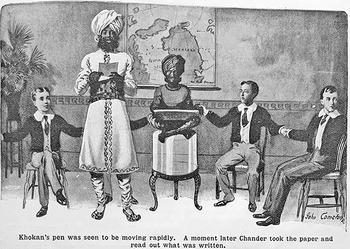

 Open access