


1. INTRODUCTION
In 1796, the syndic of Santiago's merchants' guild, Manuel de Salas, submitted a report to the Spanish crown on the economic conditions of the Kingdom of Chile. In his remarks on regional commerce, Salas referred to the African slaves who had been brought to Chile over time, noting that very few of them remained in the areaFootnote 1. Those who did, he stated, were largely occupied in «the service of persons who cannot serve themselves, nor deserve to be served by free men». Salas, who would later spearhead the project to abolish slavery in newly independent Chile, pointedly said of these masters that «their cruel nature and bad manners can only be endured under conditions of coercion» (Salas Reference Salas1910, p. 167). He continued with a summary economic explanation of the gradual demise of the institution, observing that the service of enslaved men and women was more costly than that of day labourers given their purchase price, lifetime maintenance costs, clothing and illnesses. As a result of these factors, concluded Salas, slavery was increasingly becoming nothing more than the fulfilment of a taste for prestige and ostentation. Soon, he argued, «this horrible practice» would disappear entirelyFootnote 2.
Salas' observations were quite likely one of the cornerstones of the narrative of mestizo nationhood crafted in the 19th century, a view of the Chilean colonial past that minimised the presence of slaves (Barros Arana [1830-1907] Reference Barros Arana1999-2001, 3: 99-100, 7: 117-119). Throughout the 20th century, a number of historians echoed the view that the occasional acquisition of bonded men or women was mostly a means for Santiago's elites to establish social prestige, a view that has been overwhelmingly disproved by newer research (Villalobos Reference Villalobos1961, p. 51; Cussen Reference Cussen2006; Del Río Reference Del Río2013). However, Salas' brief discussion of the costs, benefits and motives of slaveholding in late-colonial Santiago may continue to hold value if only because it invites us to consider the economics of urban bondage in a setting where, even if production did not depend overwhelmingly on the work of slaves, they nonetheless participated in myriad productive activities. As will be discussed in further detail below, studies of slavery on the continent, especially those for Brazil, have analysed the profitability of slavery in labour-intensive rural productive activities, but there have been few attempts to consider systematically the economics particular to urban slavery. This gap is especially striking given the enormous relevance of slave labour in many cities in the region in the late-colonial period, such as Lima, Rio de Janeiro, Buenos Aires and SantiagoFootnote 3. Thus, in this study we attempt to reexamine the profitability of slave ownership for one city in southern Latin America, with the expectation that our methods and conclusions may open a path of inquiry for research of other settingsFootnote 4.
Working from a modern economic approach, this paper analyses a set of 4,000 notarial records of slave sales as well as tax registries to demonstrate that, beyond whatever non-monetary benefits may have been conferred on masters, such as prestige or an aura of prosperity, slave ownership was sustainable on the basis of its economic profitability. Even when evaluated using very conservative assumptions, the ownership of enslaved men and women was an economically attractive undertaking in late-colonial urban Santiago, despite the growing availability of free labourers.
2. SLAVERY IN AN IMPERIAL OUTPOST
Chile has an old, if often unacknowledged history of African slavery. While, as Salas points out, by the late-colonial period slaves were most often to be found in households and workshops in urban Santiago, enslaved men and women had played a variety of productive roles in the region over time, from auxiliaries in battle to orchard hands or miners. According to Rolando Mellafe, one of the pioneering historians in the field of slavery in Chile, a number of enslaved Africans accompanied the earliest Spanish expeditionaries to the region, some of them achieving recognition for their vital importance in the battles to subjugate the local indigenous population. The first truly significant wave of enslaved migrants began to arrive in the area in 1580; by 1600 the number of Africans and their descendants had grown to an estimated 22,500, almost 30 per cent of the conquered area's non-indigenous population, and 4 per cent of its total inhabitants (Mellafe Reference Mellafe1959, pp. 199, 224-225, 247). In this period, the demand for slave labour grew in response to the demographic decline of the native population in Chile's central valley and the arid zone to its north, areas with a strong need for labour for agricultural and mining endeavours. The Captaincy General of Chile was frequently not a final destination for slaves; during the 17th and 18th centuries, Santiago and its port, Valparaiso, figured as stops on the overland and sea routes that moved merchandise, including human beings, from Atlantic ports to the prosperous viceregal capital, Lima. For example, ship registers and customs receipts testify to the importance of Chile as a transit point for slaves during the period when the English South Sea Company held the Spanish royal monopoly on the African slave traffic to Río de la Plata. Between 1715 and 1738, 38 per cent of the nearly 10,000 slaves transshipped from the port of Buenos Aires to the western interior were destined for Chile and from there to Peru. Many of these were consigned to residents of Santiago who relied on the commerce in human beings to cover a contraband traffic in cloth and other goods (Villalobos [1968] Reference Villalobos1990, pp. 47-56). Alex Borucki has examined the regional slave trade from 1776, when the Crown established the Viceroyalty of Río de la Plata, until the wars of independence. He estimates that just over 70,000 slaves reached the ports of Buenos Aires and Montevideo during the period. Eleven thousand of these men and women arrived at the Rio de la Plata between 1777 and 1791, and evidently more than half of them were subsequently transshipped to Lima via Santiago (Borucki Reference Borucki2011, p. 88). Customs documents reviewed by Gonzalo Vial confirm that, during the lapse between 1769 and 1790, more than 5,100 slaves were embarked in Valparaiso for the 3-month voyage to the Lima market (Vial Reference Vial1957, p. 89)Footnote 5.
Within Chile, the presence of African slaves and, more particularly, their enslaved and free offspring was felt most strongly in the city of Santiago, the administrative capital of the Captaincy General. For example, local parish registers studied by Jean-Paul Zúñiga demonstrate that more than 25 per cent of the children baptised in the city in the mid-17th century were described by record-keepers as being of African descent (Zúñiga Reference Zúñiga2002, p. 178). A little over a century later, an inventory of the property of the Society of Jesus revealed that at the time of their expulsion, in 1776, the Jesuits held some 1,200 slaves on their haciendas scattered throughout central Chile (Barros Arana Reference Barros Arana1999-2001, 6, pp. 185, 215). Furthermore, during the economic expansion of the five decades prior to the abolition of slavery in 1823, notaries of the capital city registered some 3,800 sales transactions involving more than 4,500 slaves (Cussen et al. Reference Cussen, Llorca-Jaña and Droller2016, p. 6). Clearly, not all these slaves were transacted in Chile only to be sent on to the Lima market; our review of parish registers in Santiago for 1777 and 1778 shows that 12 per cent of the children baptised during those years were born into slaveryFootnote 6.
This incontrovertible evidence of the relevance of slavery in Chile requires us to reexamine Salas' assertion regarding the lack of an economic rationale for slave owning. Written against the backdrop of an expanding economy and a robust local market for slaves, his pioneering view of the profitability of the ownership of enslaved persons may be assessed by means of a modern economic approach that focuses on slavery in the context of local labour prices and intercontinental commerce (Cussen et al. Reference Cussen, Llorca-Jaña and Droller2016). Such an analysis can expose the underlying economic significance of enslaved workers in Santiago in the late-colonial period, when the (free) mestizo population, forged in the rural areas during the 17th century, began to expand the urban labour pool (Araya Reference Araya1997; Carmagnani [1963] Reference Carmagnani2006; Quiroz Reference Quiroz, Quiroz and Bonnet2009; Quiroz Reference Quiroz2012; Llorca-Jaña and Navarrete-Montalvo Reference Llorca-Jaña and Navarrete-Montalvo2015). This economic perspective allows us to understand more clearly why, given the availability of other forms of manpower, men and women in Chile often chose to acquire a human being whose labour was extracted by forceFootnote 7.
Stefano Fenoaltea has proposed a model for understanding the central role of coercion to slaveholding and the forms it can take in different contexts. He suggests that labourers involved in the «effort intensive» tasks of plantation agriculture achieved greater productivity when they were subjected to «pain incentives» and a great deal of supervision (Fenoaltea Reference Fenoaltea1984)Footnote 8. In contrast, he argues, workers in «care intensive» activities, most of these carried out in urban work spaces, such as households and workshops, responded best to a system of incentives that minimised the need for supervision and created good will between them and their employers. Stuart Schwartz makes much the same argument in his discussion of the variations between field hands and mill workers on Bahian sugar plantations, pointing out that the whip was commonly applied in the field but it was rarely used to discipline the more skilled slaves manning the machines used to produce sugar. The men assigned to the more complex tasks, in which sabotage was always a possibility, were induced to work carefully by enticements such as more time to dedicate to their independent production for the market economy, or even cash rewards (Schwartz Reference Schwartz1996, pp. 39-63).
Slave work exacted in the households and workshops of Spanish American cities would presumably have followed the pattern of coercion by reward. Thus, slaves who laboured as shopkeepers, artisans or servants would generally escape the lash and presumably refrain from all but the most subtle forms of resistance because, by performing well, they might aspire to more favourable life conditions and even, perhaps, a path to freedom. Manumission was, of course, an incentive with no equivalent among free wage labourersFootnote 9. It follows that the possibility of freedom enhanced the quality of the slave's work to a master's advantage, especially in complex and less easily supervised occupations, such as cooking for a family, caring for their children or crafting metal objects. Numerous studies on manumission in colonial Latin America would seem to bear this out; the attainment of personal freedom was highly correlated with a slave's proximity to his/her master, and it tended to occur most especially among enslaved women and their children who served in the intimacy of the home (Proctor Reference Proctor2006)Footnote 10. The chance for enslaved men and women to learn marketable skills in the workshop or household, or rent out their labour for wages or their handiwork for sale (assuming most, but not all of it, was transferred to an owner), enhanced the chances for freedom by self-purchase. Thus, Santiago's urban slaves, presumably spurred on by the hope of attaining liberty, toiled diligently in households, purveyed their masters' wares in taverns and the city square and hunched over workbenches at the manual trades (Vicuña Mackenna Reference Vicuña Mackenna1926, 2, pp. 491-492; Feliú Reference Feliú1942, pp. 40-41; Vial Reference Vial1957, pp. 22-31, 33-43, 51-56; Mellafe Reference Mellafe1959, pp. 154-55; Soto Reference Soto1988, pp. 52-55; Barros Arana Reference Barros Arana1999-2001, 6, pp 156, 264; 7, p. 319).
Evidence also suggests that some residents of Santiago preferred slaves to free labourers because they felt comfortable placing their trust in these men or women, who laboured without direct supervision at high value tasks but whose life conditions could be controlledFootnote 11. For example, in 1737, the concessionaire of the city's mint, Francisco García Huidobro, expressed his predilection for slaves as a means of avoiding the thefts and simple errors often committed by free mestizo workers (Cussen Reference Cussen, Geler and Guzmán2013, p. 50). The notable preference for slave labour in the mints throughout Spanish America suggests that African-descended slaves, who lived on the premises, were indeed considered more trustworthy, and thus more attractive to masters, than free workers (Lane Reference Lane2015, pp. 97-101)Footnote 12.
The coercive aspects of slaveholding form the backdrop for our study that seeks to characterise the investment in enslaved men and women throughout their «able-bodied» life by quantifying the principal economic variables in play when residents of late-colonial Chile chose to acquire or maintain a slave. Based on these factors, we seek to visualise the subsequent concrete costs and benefits of such an act. Although slavery in Chile was abolished in 1823, this study only extends as far as the beginning of the independence process in Chile in 1810. We limited our analytical timeframe because the Free Womb Law of 1811 and the prospect of abolition produced significant effects on the local slave market as demonstrated by a decline in prices and a reduction in the number of transactions (Cussen et al. Reference Cussen, Llorca-Jaña and Droller2016, Figure 1, pp. 23-25). Our goal is to determine the profitability of slavery in a scenario in which the value of a slave was determined by his or her expected lifecycle rather than by impending political events and deepening antislavery debates.
Our perspective seeks to account for slavery as an alternate labour source to free workers whose labour costs, Salas tells us, were relatively low compared with the overall costs of owning slavesFootnote 13. One further comment before presenting our model for calculating profitability: it is worth noting that the calculation of their profitability was implicit in the struggles that slaves endured at the time when, for example, they brought suit against their masters for reneging on the agreed upon terms of manumissionFootnote 14. To take one example from Santiago, in 1775 a master smith, Francisco Cortés, and his wife, Leonarda Baras, sued their master for selling them despite an explicit agreement that allowed the couple to purchase their freedom at a stipulated price. Indeed, they had already made partial payments towards the agreed value of their liberty. The trial records establish that Cortés was capable of earning a daily wage of up to ten reales (which, for 280 days, would be the equivalent of 350 pesos per year), although at the time of the trial he was earning only six reales (210 pesos per year) as a builder on the new cathedral. The litigants presented arguments regarding their market value, wages, value and ownership of the tools Cortés used (he alleged that they belonged to him), and the costs of the couple's maintenance. The case brought by this domestic servant and her talented smith husband (whom their defence lawyer described as a «Vulcan in the forge») ended favourably for them; the court held that both slaves should be freed at the price originally agreed upon with their masterFootnote 15.
For their part, masters never lost mind of the commercial value and productive role of their slaves. The decision to sell, rent, bequeath or manumit a slave was inextricably linked to the perceived value of the slave, which was itself the function of his or her age, skills, sex and perceived personal qualities. These factors are difficult to assess from a historical distance but the analysis of a series of almost 4,000 local sales operations establishes quite clearly the existence of a market that structured the exchange of slaves (Cussen et al. Reference Cussen, Llorca-Jaña and Droller2016).
3. SLAVE PRICES AND THE WAGE MARKET IN SANTIAGO, 1773-1810
In 1778, Santiago, the administrative outpost of Spanish rule in the Kingdom of Chile, was a city of some 18,000 souls with a hinterland of 20,000 more; the total population of the area would reach as many as 60,000 in 1810 (Carmagnani and Klein Reference Carmagnani and Klein1965; De Ramón Reference De Ramón2007, pp. 91, 185). The expanding economy of the city and its environs was largely agricultural, the farms producing cereals for export and livestock for domestic and regional consumption (De Ramon and Larraín Reference De Ramón and Larraín1982; Carmagnani Reference Carmagnani2001, pp. 179-207; Martínez Reference Martínez2015). A number of public building projects—bridges, the mint, a new cathedral, roads—reflected and reinforced the region's growing commerce and wealth, especially in the last three decades of the 18th century (De Ramón Reference De Ramón2007, pp. 118-129, 269). Peasants were pushed off their small plots on the fringes of Central Valley haciendas as the export market for cereals became more developed, and many of them migrated to Santiago where they were hired as day labourers, peones, on public infrastructure projects. As mentioned earlier, the city was home to a number of slaves at the time, although it appears that they were not often occupied in these large-scale enterprises, but rather principally engaged in providing services in homes, workshops and local commerce.
Regardless of the economic sphere in which they were engaged, enslaved men and women at this time were a valuable asset. To gain a sense of relative prices for marketable assets, the average amount paid for slaves (262 pesos) in Santiago during the period 1773-1810 was equivalent to the value of 95 head of cattle at local prices, more than 320 sheep or a little more than 4 tonnes of jerked beef at the consumer price, or 15 years of a licence to sell alcohol at the retail level (Cussen et al. Reference Cussen, Llorca-Jaña and Droller2016, p. 18)Footnote 16. When we consider alternatives on the labour market, the purchase price of a slave, before taking into account the additional costs such as health care, food and clothing, was enough to hire and maintain a peón for almost 4 years or to employ a physician or surgeon for nearly a yearFootnote 17. A total of 262 pesos would cover more than 2 years of the cash wages of a head nurse, 3 years and 2 months of an assistant nurse and nearly 6 years of a semi-skilled nurse's assistantFootnote 18. Therefore, the acquisition of a slave represented a relatively important outlay of cash, one that few residents of the city were equipped to make.
Two aspects of the local slave market should be clarified at this point. First, male slave prices moved downwards in tandem with the falling real wages of unskilled workers in Santiago during the 1790s, as did the prices of female slaves, although with much less intensity. This suggests a high level of substitution between a free wage earner and a slave, especially in the case of men. Second, female slaves were consistently more expensive than males, a situation to be found in Mexico as well, but which was otherwise not common in Latin America (Proctor Reference Proctor2006, p. 333). This result might be explained by one or more of several factors, including an interest in close control over the lives of women working in the household. In addition, and especially towards the end of the period examined here, a female slave might bear offspring at a time when supplies of slaves were threatened by British pressures on the transatlantic trade (Cussen et al. Reference Cussen, Llorca-Jaña and Droller2016, pp. 11, 15-17, 24-25). These factors are probably far less significant, however, than the relatively meagre supply of adult women brought to America via the transatlantic slave trade. For example, during the first few decades of the 17th century, fewer women than men were shown to be among the human cargo of the ships arriving at the port of Buenos Aires. Ships' registries from the South Sea Company, which held the asiento, the crown-assigned monopoly of the time, show that only 30 per cent of the more than 10,000 individuals unloaded between 1722 and 1738 were women (Studer Reference Studer1984, p. 234). We found roughly this same proportion in the traffic that crossed the Andes to Chile between 1773 and 1778 to reach Pacific markets, principally Lima, and to a lesser extent, SantiagoFootnote 19. Finally, Eltis and Engerman (Reference Eltis and Engerman1992, p. 241) have shown that the disproportionate number of men and children brought to continental America surged during the late 18th and early 19th centuries; women constituted only 29 per cent of the human cargo during the 18th century and a meagre 17 per cent from 1801 to 1864Footnote 20. Even if most slaves transacted in Chile were locally born, where the number of females to male babies would have been approximately uniform, the demographic imbalance in regional imports would undoubtedly have influenced local prices.
4. METHODS
To explore the economic factors that may have determined the choice to own a slave in late-colonial Chile, we apply the method proposed by Alfred Conrad and John Meyer to documentation on the local market for slaves and the costs of free labour in Santiago (Llorca-Jaña and Navarrete-Montalvo Reference Llorca-Jaña and Navarrete-Montalvo2015; Cussen et al. Reference Cussen, Llorca-Jaña and Droller2016). In applying this economic evaluation model to the acquisition of slaves in particular, the variables involved are: (i) the purchase price of the slave; (ii) the value of the wages of an unskilled free labourer; (iii) the maintenance cost of the slave and (iv) the service period based on the slave's life expectancy at purchase. Thus, to determine the rate of return for the acquisition of a slave, it is necessary to find an interest rate that gives the following equivalence;
 $$P = \displaystyle{{\sum\nolimits_0^t {\lpar I\ndash C\rpar } } \over {{\lpar 1 + r\rpar }^t}}$$
where P = purchase price of the slave; I = income (value of the wages of a free labourer executing the same task); C = maintenance cost of the slave; r = internal rate of return and t = expected useful life of the slave.
Intuitively, the rate of return is that rate which equalises the price of the slave at the time of purchase with the expected total net value of his or her labour. If the rate of return for the purchase of a slave is greater than the interest rate available on an alternative investment, the acquisition is not only profitable but relatively attractive.
In their study, Conrad and Meyer applied this model to estimate the economic returns on slaveholding on the antebellum plantations of the southern United States. Their results showed that slavery was part of a profitable economic system which, in general, reached rates of return between 5 and 8 per cent, depending on the physical yield per hand and the price of cotton (Conrad and Meyer Reference Conrad and Meyer1958, p. 107)Footnote 21.
Studies for the Latin American case, especially plantations in Brazil, use variations of this model to analyse the profitability of slavery in labour-intensive productive activities. Among them, Pedro Carvalho de Mello tested the profitability of slavery in the process of coffee production in Rio de Janeiro during the 1870s; he concluded that the purchase of an adult male slave, at market price, generated at least the same rate of return on invested capital as any other investment alternative, that is, between 11.5 and 15.0 per cent per annum. In addition, he established that the fall in the demand for slaves after 1880 was the result of the anticipation of abolition (Carvalho de Mello Reference Carvalho de Mello1978). The same scholar, in collaboration with Robert Slenes, also examined the prevailing notion that slavery was less economically rational than the wage system of labour. From estimates of the profitability of slavery on coffee plantations during the second half of the 19th century, these authors concluded that Brazilian slavery was not incompatible with capitalist economic rationality (Carvalho de Mello and Slenes Reference Carvalho de Mello, Slenes and Neuhaus1980). For his part, Leonardo Monasterio questioned the assumption that slavery was a pre-capitalist labour system. He evaluated the microeconomic basis for acquiring slaves by the jerked beef producers (charqueadas) of the province of Rio Grande do Sul in the 19th century. Monasterio concluded that given favourable conditions in the market for meat, coupled with labour shortages, captive labour provided masters with high rates of return (Monasterio Reference Monasterio2005).
Despite the acknowledged significance of the methodology proposed by Conrad and Meyer, few researchers have sought to consider the economic particulars of Latin American urban slavery, despite its often enormous presence in the late-colonial periodFootnote 22. Therefore, on the basis of the methods proposed by the above-mentioned researchers, who measured values for the slave plantation system, this work focuses on an urban economy where slaves were occupied mainly in unskilled or semi-skilled jobs and household services.
5. SOURCES AND VARIABLES
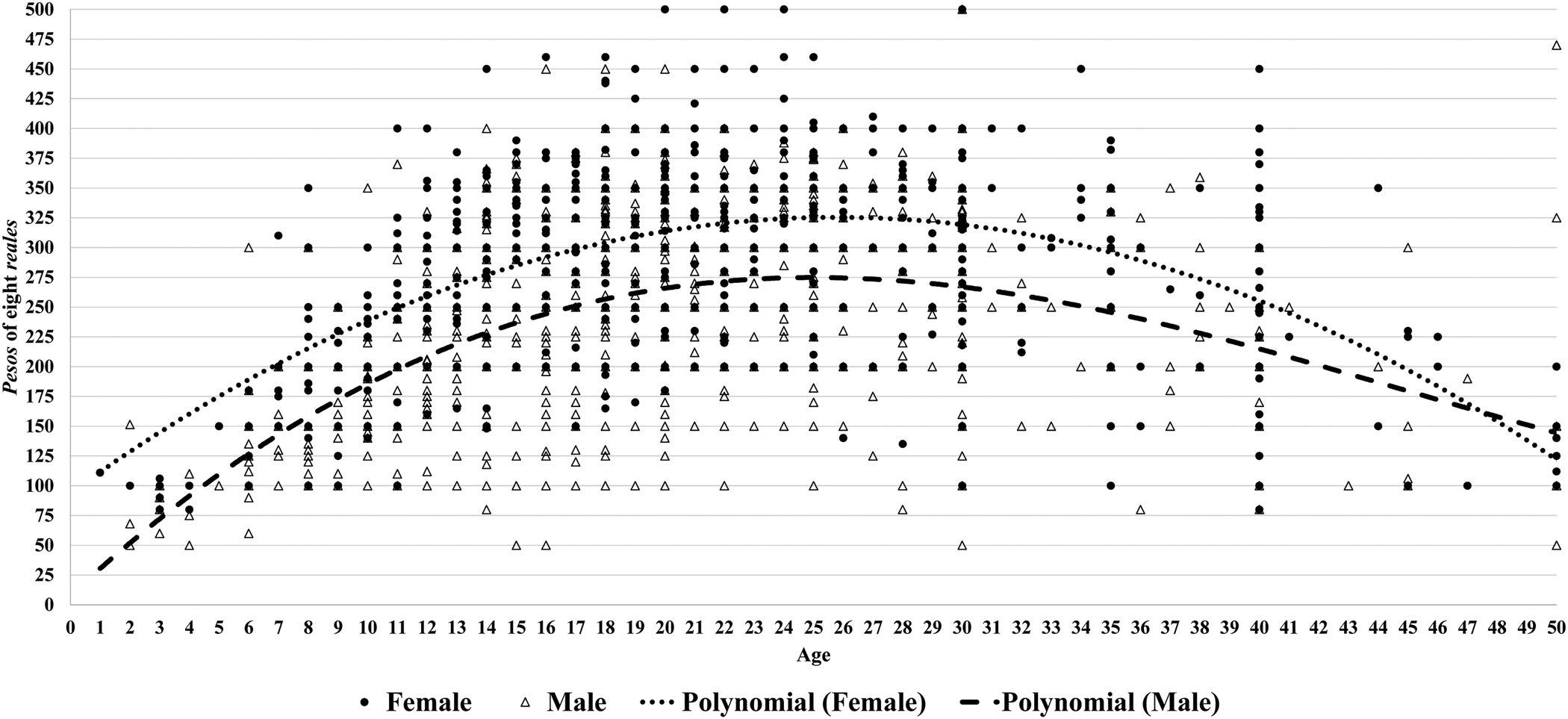
In order to evaluate the profitability that resulted from the ownership of slaves of both sexes throughout their productive life, one first must consider the distribution of their purchase prices. We have used two sources for validating this distribution: the notarial records for slave purchases in Santiago and the records for duty charged on slaves carried into the city from routes that crossed the Andes during the five decades prior to abolitionFootnote 23. Both sources indicate that approximately 80 per cent of the slave trade was concentrated among slaves between 10 and 29 years of ageFootnote 24. Taking into consideration the relative stability of prices over the period, we arrived at average prices for each age range by sex (Figure 1)Footnote 25.
SLAVE PRICE DISTRIBUTION BY AGE AND SEX, SANTIAGO, 1773-1810.
Sources: ANCH, Fondo Escribanos de Santiago, vols. 4-17, 19-37, 45, 717-719, 785-786, 788-801, 813-816, 820-821, 823-833, 835-836, 838, 840, 842-854, 857-858, 861-875, 877-889, 891-894, 896-906, 908-910, 912-915, 918-922, 924-925.

According to these data, the average price of a male slave was significantly lower than that of a female slave, a result that extends across all age groups, even among women who were presumably too young or too old to bear children (Cussen et al. Reference Cussen, Llorca-Jaña and Droller2016, pp. 6-19)Footnote 26.
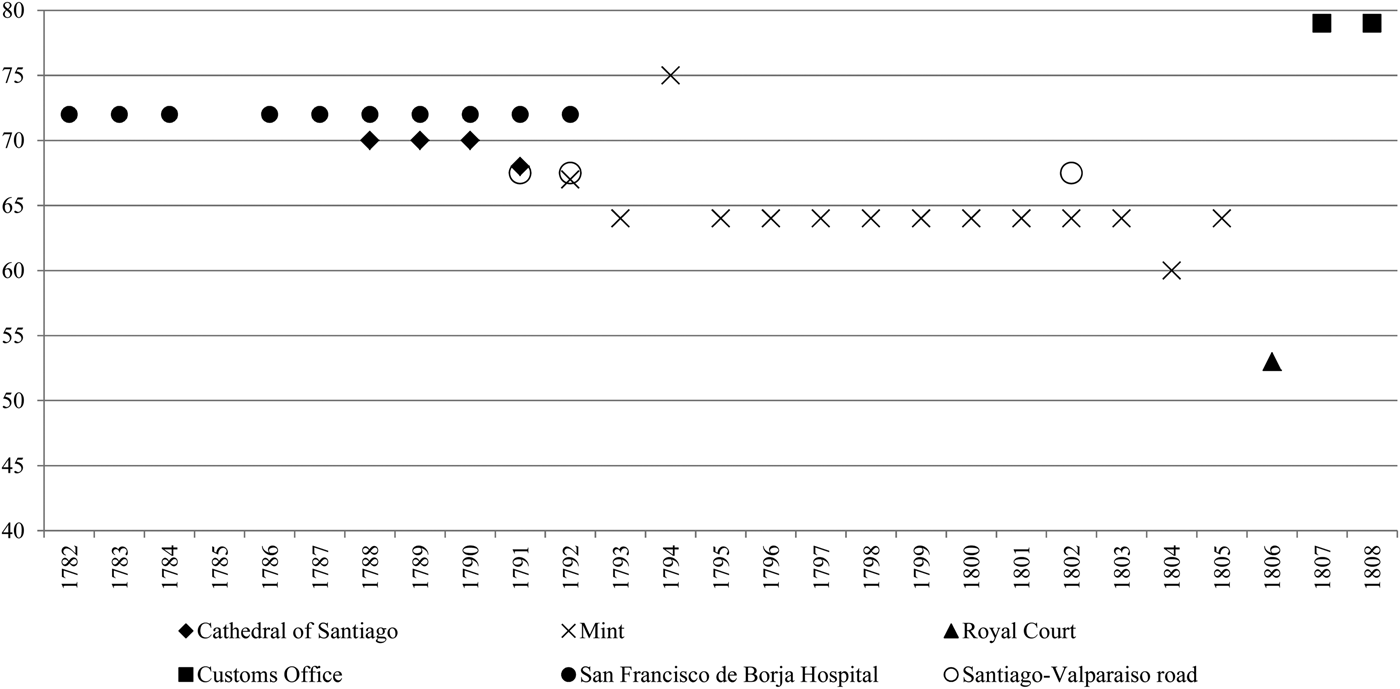
The second variable for computing the profitability of slaves is the expected benefits from the work of a slave over his or her useful life. Based on the evidence and Manuel de Sala's assertion of a direct relationship between slave prices, especially those of men, and the wages of unskilled free workers, we assume here that the work produced by slaves and free workers were substitutes in Santiago (Salas Reference Salas1910, p. 167)Footnote 27. Accordingly, we have assigned to the enslaved men and women a «cash wage», that is, one that does not include the value of his or her sustenance at work, equivalent to the salaries of free workers who were paid to discharge the same tasks. Figures for income earned by male unskilled workers are taken from the construction records of several public buildings and the road between Santiago and Valparaiso, and the registers of the salaries paid to employees of the San Francisco de Borja Hospital (Figure 2).
NOMINAL ANNUAL WAGE (PESOS OF EIGHT REALES), UNSKILLED MALE LABOURER (PEÓN), SANTIAGO, 1782-1808.
Sources: Llorca-Jaña and Navarrete-Montalvo (Reference Llorca-Jaña and Navarrete-Montalvo2015, pp. 82, 84); ANCH, FHSFB, Serie Estados Financieros, vol. 1, docs. 5, 52, 65, 125, 143, 163, 178, 188, 211, 215-216, 231; Pinto (Reference Pinto1976, p. 85).

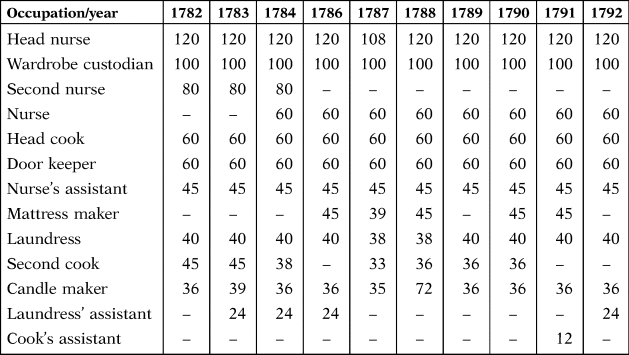
According to this evidence, the wage level for an unskilled male labourer in Santiago showed very little variation between 1782 and 1805. The few available sources for successive years suggest that wages plunged to 53 pesos in 1806 before climbing to 79 pesos in 1807-08. The average wage for the entire period, as well as for the period of greatest wage stability, is 68 pesos, which we may plausibly use as a proxy for slave earnings during the period of our study. However, we must consider two important questions regarding the representativeness and significance of this figure. First, as mentioned above, available evidence suggests that urban male slaves were generally engaged in care-intensive activities, not in the type of unskilled labour carried out by peons. Second, free labourers on construction projects in the city of Santiago worked an estimated 280 days a year, whereas a slave presumably was obliged to work every day but Sundays and religious feasts (Llorca-Jaña and Navarrete-Montalvo Reference Llorca-Jaña and Navarrete-Montalvo2015, p. 84). Nonetheless, for the sake of conservatism, we use here the daily wages and the annual average income of a free labourer. For children less than 10 years old, we impute no salary whatsoever, despite evidence that they carried out minor domestic tasks. For adolescent male slaves, we use 48 pesos, the annual wage of an apprentice apothecary at San Francisco de Borja Hospital. For the case of female workers, the expense records of the same institution likewise provided us with salaries for a wide range of posts (Table 1).
AVERAGE ANNUAL NOMINAL WAGES (PESOS OF EIGHT REALES) OF FEMALE WORKERS, SAN FRANCISCO DE BORJA HOSPITAL, 1782-84, 1786-92

Sources: ANCH, FHSFB, Serie Estados Financieros, vol. 1, docs. 4, 5, 50-52, 65, 124-125, 141, 143-144, 162-163, 177, 187-188, 215-216, 230.
Once again, these data indicate that wages for any given task were quite stable throughout the period. They also reveal that women working at the hospital were charged with a wide array of occupations at a variety of salary levels. For the purposes of this study, we have chosen to use the mode, or most frequent salary, 60 pesos per year, which is the amount earned by a nurse, head cook and doorkeeper, positions that involved tasks roughly equivalent to those carried out by enslaved domestics. Given the general stability of these salaries for the period, and the lack of other sources for female wage earners, we apply this figure for the entire period of study. Again, for girls under ten we do not impute any salary, whereas for teenagers we apply the annual wages of a laundress' assistant.
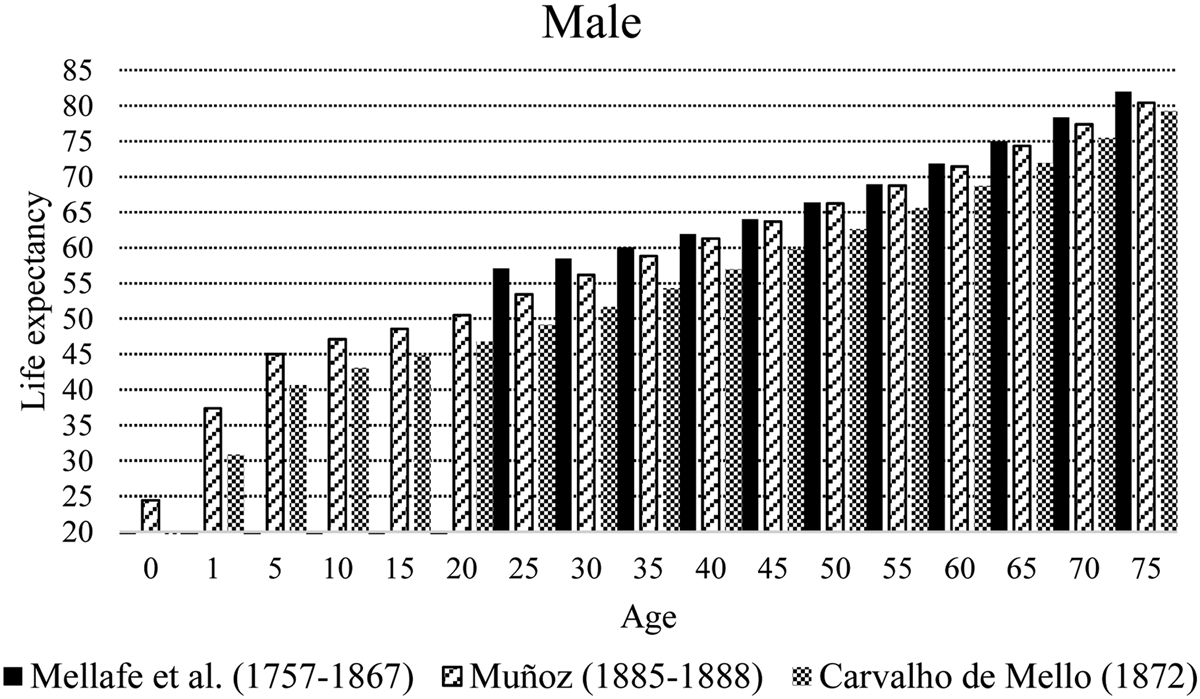
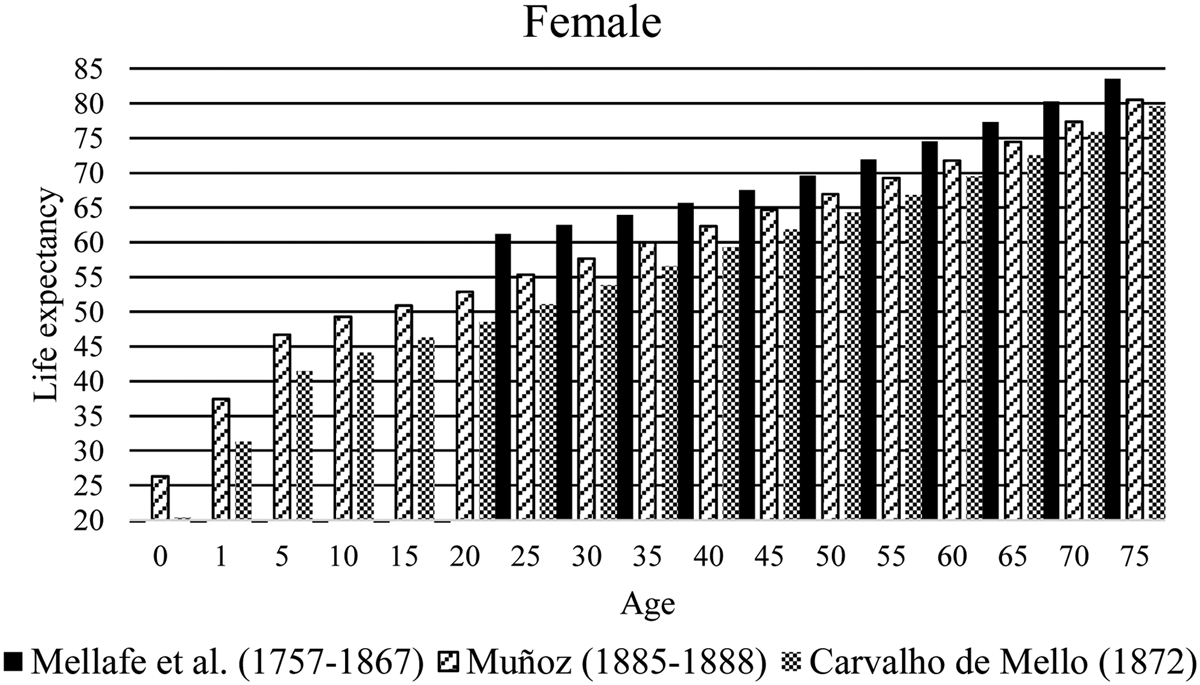
It was more challenging to determine the period of service; there is very little information on life expectancy for colonial Chile in general, much less for the enslaved population. The only study for the colonial period is that of Mellafe, Arretx and Somoza, who constructed life expectancy for a total of 585 young men and women who took religious orders in three of Santiago's convents from 1757 to 1867 (Mellafe et al. Reference Mellafe, Arretx and Somoza1983, p. 80)Footnote 28. Although in general life expectancy for slaves has been found to follow closely that of the free population, this work continues to be of limited utility, given that it excludes individuals under 25 years of age, and tends to disregard indigenous, African-descended and mixed-race individuals who were rarely permitted to profess religious vows. Another study, by Francisco Muñoz, uses census data to construct mortality tables for the broader Chilean population, albeit for later periods, years after abolition (1865-1907) (Muñoz Reference Muñoz, Odilon, Marcílio and Pillati1990, pp. 53, 60). In order to surmount the shortcomings of these studies we have chosen to rely on the life expectancy research conducted by Carvalho de Mello for the slave system on Brazil's coffee plantations in 1872 (Carvalho de Mello Reference Carvalho de Mello1977). If we compare the Brazilian case with the two studies for Chile we find that, although the nominal data are quite different, they form similar curves (Figures 3 and 4).
LIFE EXPECTANCY BY SEX (MALE) AND AGE, CHILE AND BRAZIL, 1757-1888.
Sources: Mellafe et al. (Reference Mellafe, Arretx and Somoza1983, p. 94); Muñoz (Reference Muñoz, Odilon, Marcílio and Pillati1990, p. 60); Carvalho de Mello (Reference Carvalho de Mello1977, p. 123).

LIFE EXPECTANCY BY SEX (FEMALE) AND AGE, CHILE AND BRAZIL, 1757-1888.
Sources: Mellafe et al. (Reference Mellafe, Arretx and Somoza1983, p. 94); Muñoz (Reference Muñoz, Odilon, Marcílio and Pillati1990, p. 60); Carvalho de Mello (Reference Carvalho de Mello1977, p. 123).

Notably, all three studies show that, overall, women had a longer life expectancy than men in all age groups. While a man between 10 and 30 years old was expected to live until 58, 51 and 47 years, according to Mellafe et al. (Reference Mellafe, Arretx and Somoza1983), Muñoz (Reference Muñoz, Odilon, Marcílio and Pillati1990) and Carvalho de Mello (Reference Carvalho de Mello1977), respectively, in these studies women reached 62, 53 and 49 years of age. This suggests a consistent difference of slightly more than 10 years between the estimated mortality rate for colonial Santiago and that of 19th-century Brazil in each age category. On the other hand, an average life expectancy of about 50 years for those men and women who reached age 20 has been widely used to evaluate the profitability of slavery in other regionsFootnote 29. Given the scarcity of demographic data for colonial Chile and other Spanish colonies, the high correlation between the available statistics for Chile and Brazil in the late 19th century, and the adoption by many researchers of various regions, including Conrad and Meyer, of figures similar to those of Carvalho de Mello, we have chosen to adopt these more conservative mortality tables for this study as well.
We now turn to the maintenance costs of a slave. Unfortunately, it is difficult to surmise how many of the slaves who laboured in Santiago's households and workshops lived under their owners' roofs and how many kept their own residences and simply deducted their living costs from the daily wage (jornal) turned over to a master. In keeping with the conservative nature of this study, it is assumed that all slaves, men and women, incurred the costs of an independent household. The abstraction that all slaves lived in an independent household, though, is very unlikely; it is certain that more enslaved people in Santiago lived with their masters than in a separate household, just as they did everywhere in Latin America. Nonetheless, and at the risk of giving weight to a highly unlikely situation, we have relied on the cost of a bare-bones basket, a concept widely employed in economic historiography to evaluate the material wellbeing of a given population relative to others (Allen et al. Reference Allen, Murphy and Schneider2012). Based on this method, we assume that, in the case of Santiago, the maintenance cost of a slave who lives independently from his/her master is equivalent to that of a bare-bones basket for an adult male labourer. During the period 1788-1808 this cost oscillated between 14 and 21 pesos per year, including food, clothing, firewood and basic household articles, and thus we use the average, 17.5 pesos (Llorca-Jaña and Navarrete-Montalvo Reference Llorca-Jaña and Navarrete-Montalvo2015, pp. 85-86). For those younger than 15 years of age we assume a cost of half a basket. This method feels adequate to us and, once again, probably rather conservative.
6. PRINCIPAL FINDINGS
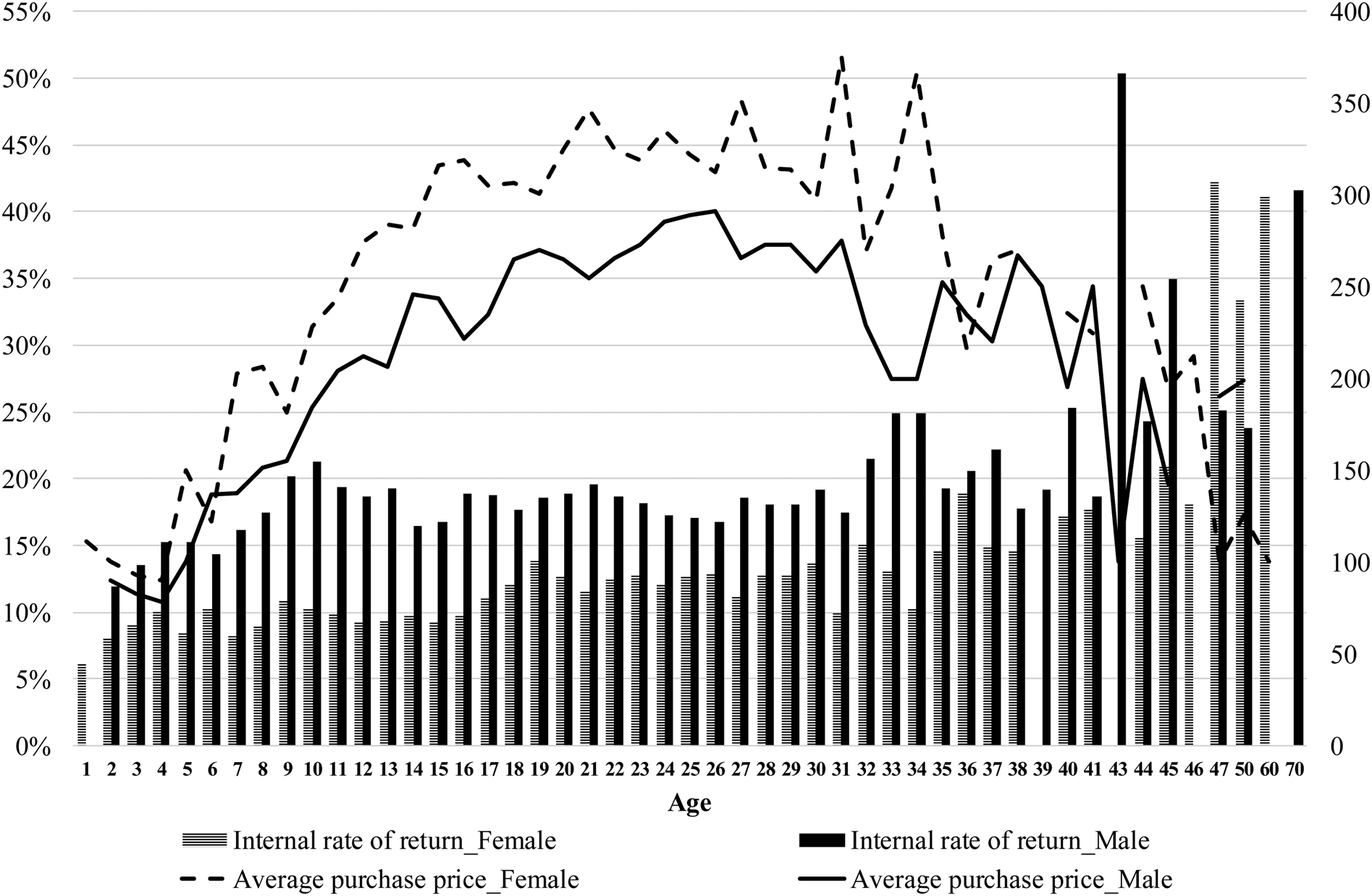
The model and variables described above lead us to conclude that slaveholding was a profitable endeavour in late-colonial Santiago. For example, the acquisition of a male child (1 to 9 years of age) who served for 40 years (his expected lifespan) generated an average weighted return to his owner of 16.5 per cent. The purchase of a male slave between 10 and 30 years of age brought even greater rewards to his master (18.3 per cent), because he effectively avoided the maintenance costs and mortality risks associated with early childhood. This may explain why this is precisely the age range with the consistently highest sales prices and the greatest number of transactions. Overall, on average, between 1773 and 1810, the acquisition of a male slave furnished an 18.6 per cent internal rate of return on investment.
As for the purchase of enslaved women, the average profitability ran from 9.5 per cent for a slave acquired in childhood to 11.7 per cent at prime age and a notable 16.7 per cent for women purchased at age 31-60, a group that comprised 13 per cent of the transactions at the time. On average, the purchase of an enslaved woman returned 12.4 per cent on her master's investment.
Although slave women had a longer life expectancy than their male counterparts, the acquisition of a male slave was almost 50 per cent more profitable than that of a female during the whole period of serviceFootnote 30. This striking difference is, in part, attributable to the higher prices fetched for female slaves in a market with limited supplies but it is also the result of the very cautious assumptions behind our analysis, an aspect of the results which deserves further comments (Figure 5).

Our study uses very conservative wage estimates, for both male and female workers. For men, the salaries used in the calculations were for unskilled labourers whereas, as we saw earlier, male slaves sometimes at least worked as trained artisans, earning 6-10 reales per day, about four to five times more than an unskilled labourer. However, if we take the lowest registered salary for peones, 53 pesos in 1806, the average rate of return on a male slave of any age is 13.8 per cent. In the case of women in domestic service, our estimates do not take into account the fact that they were often carrying out more than one productive activity during their long shift; qualitative sources show that slave women toiled ceaselessly, washing clothes, tending to sick or elderly family members, and preparing sweets and food for the household as well, perhaps, as for the neighbourhood, all within the span of a single day (Soto Reference Soto1988, pp. 52-55; Araya Reference Araya, Sagredo and Gazmuri2001, pp. 186-193; Mejías Reference Mejías2007, pp. 119-150; Cussen et al. Reference Cussen, Llorca-Jaña and Droller2016)Footnote 31. In fact, our earlier findings that women consistently fetched higher prices than men on the slave market, even beyond their child-bearing years, suggests that women were indeed fulfilling multiple roles (Cussen et al. Reference Cussen, Llorca-Jaña and Droller2016)Footnote 32.
A couple of cases from our database bear out the numbers. The first of them, Isabel, was 24 years old at the time of her sale in 1782. Her original owner, Francisco Elisalde, a lawyer in the royal court, described Isabel as a cook and washerwoman. If we combine those two daily activities, Isabel's sale price of 300 pesos represents an expected return to her new owner of more than 20 per cent on his investment. José Antonio Rodriguez, the new owner of another young woman, 20-year-old Petronila, would have obtained a similarly high payoff in 1811. She, like Isabel, spent her time cooking and washing clothes for her master's family. Her sale price of 350 pesos promised a 19 per cent internal rate of returnFootnote 33. Thus, one might plausibly aggregate the wages of a laundress, a nurse's assistant and a cook to get the true value of an enslaved woman's labour, an exercise that would ramp up considerably the return on investment for even a childless slave woman. Finally, these women often produced offspring, who represented a windfall to their masters; our model shows that the return on the ownership of a male infant born in a master's home was 20.8 per cent, and a female 12.3 per cent, results which increase the profitability of their female slave mother by an average of 16.3 per centFootnote 34.
As mentioned above, these results show that the returns on slave owning in this urban setting were significantly higher than those found by researchers of slavery in agricultural areas. However, arguably a more relevant comparison is between these results and the expected returns on alternative forms of investment in urban Santiago. María Eugenia Horvitz has demonstrated that the cycle of economic expansion in Chile in the late 18th century produced an important growth in the availability of commercial credit. After analysing 900 debt instruments generated in Santiago between 1779 and 1798, she found that rates over the period fell from an average of 8 to 5 per cent (Horvitz Reference Horvitz1966, Figures 5 and 6)Footnote 35. Her study allows us to conclude that, with the single exception of the purchase of a female infant, which resulted in slightly more than a 5 per cent return on investment, the acquisition of a slave of either sex and in any age bracket produced higher returns than those earned by commercial credit instruments at the timeFootnote 36. If Manuel de Salas was correct in his observations of the society that surrounded him, the purchase of an enslaved man or woman in late 18th-century Santiago provided a way to secure the kind of personal service that free men and women were unwilling to provide. We would add, however, that their acquisition was also a good investment, a finding that holds true even if one assumes higher maintenance costs. If, for example, a slave's maintenance is assumed to be 50 per cent more costly than the bare-bones basket, the ownership of a man or woman produced a weighted average return of 15.2 and 9.3 per cent, respectively, well above prevailing interest rates.
7. CONCLUSIONS
It is clear that in the city of Santiago, Chile during the final 50 years of slavery, the purchase of a slave of either sex and any age was virtually always a rational investment when compared with other alternatives, including money lending, as seen above, and reportedly even agricultureFootnote 37. This conclusion is derived from the pattern of wages for unskilled workers over the course of the period, the average lifespan of a slave and the sum of all costs involved in his or her maintenance. For those who could afford the sizeable initial investment, a male slave could produce average returns of 18.6 per cent, while a woman returned 12.4 per cent on her purchase price. Any offspring produced by a female slave represented a windfall to her owner; this at a time when the customary interest rate on loans fluctuated between 5 and 8 per cent per year. Only the purchase of a female infant would have been an unattractive investment at the time, which may explain why such purchases were quite rare. Based on the premises used here, a master recovered the investment in an economically active male slave (20 years old or older) in less than 6 years, while in the case of a childless woman who carried out a single task the investment was recovered after 8 years of her labour. The revelation of these significant returns, calculated on the basis of very conservative historical evidence, demonstrates the profitability of slave ownership even before one considers the undeniable social prestige that masters gained by their mere presence in the householdFootnote 38.
One might ask why, given the high returns on slave ownership, the demand for slaves would not have driven prices up until returns were similar to the prevailing rates earned on other investments. In addition to high barriers to entry (all transactions were made in cash), one must consider the confined spaces of homes and workshops and their relatively limited labour requirements. Slaves in these settings were particularly valued for activities that required high degrees of careful work and autonomy and, as Manuel de Salas affirms, in which coercion, or we would argue, inducements, especially the prospect of manumission, could produce results that salaries could not. However, it can be established with certainty that slaveholding in Chile was a profitable investment for those with access to the sizeable cash outlay posed by the purchase of an enslaved man or woman. Slaves fetched consistently strong resale values that more than offset the costs of their maintenance over a lifetime. Therefore, far from the insignificant, exclusively status-driven institution that many historians described it to be, slavery in late-colonial and early republican Chile thrived and endured at least in part because it offered attractive economic benefits.
Our conclusions demonstrate the profitability of slave ownership beyond the realm of export-oriented plantation agricultureFootnote 39. This study also offers broader implications for the structure of the late-colonial urban labour market. Our work has shown that slaves were widely held in Santiago, Chile, a small city characterised by growing local production and commerce, where they may have provided relief to what recent studies have revealed to be a relatively tight labour market (Quiroz Reference Quiroz, Quiroz and Bonnet2009, Reference Quiroz2012; Llorca-Jaña and Navarrete-Montalvo Reference Llorca-Jaña and Navarrete-Montalvo2015). As we have argued here, despite the initial large outlay required to purchase a slave and the complexities of housing and otherwise providing for their support, masters often preferred an enslaved man or woman over a free labourer for relatively care-intensive activities or tasks that called for an important degree of autonomy. Colonial Chilean sources tell us that Africans and their descendants were held in higher regard than people of indigenous origins, and their presumed reliability and efficiency would be enhanced by the prospect of manumission. Therefore, slave labour persisted alongside free labour in this period and probably even predominated in certain segments of the economy, including household service and the lower echelons of the mechanical arts. Enslaved men and women represented a highly attractive component of a segmented labour market during the late 18th century, one whose appeal would only be diminished by the impending threat of abolition, a menace to slaveholders that was triggered by the circumstances of the independence movement and the abolitionist pressure exerted throughout the Atlantic world.
When, in 1823, Chile became the second republic in the Americas after Haiti to abolish slavery, the debate in the senate pitted economic considerations against a growing belief in the immorality of human bondage. Now, years after making the remarks that opened our discussion, Manuel de Salas returned to the palestra to argue that, for the governing elite, it was a struggle between «the sacred right to [private] property» and the «dishonor» that slaveholding posed for humanity (Feliú Reference Feliú1942, pp. 55, 102-103). Recent research is beginning to reveal other kinds of nudges towards abolition, not the least of which were the actions of slaves who resisted their condition through flight or judicial action (Mariete Reference Mariete2019). Taken together, these elements created a context in which slavery, and the kind of inhuman profits it generated for slaveholders, would be banished from the economic landscape in the young republic.
ACKNOWLEDGEMENTS
The research for this paper was made possible by a grant from the Comisión Nacional de Investigación Científica y Tecnológica de Chile (CONICYT), Fondecyt Regular 1130585. We gratefully acknowledge research assistance from Valentina Bravo and Fernanda Barrera and the valuable commentaries by Herbert Klein, Stanley Engerman, Alex Borucki, Javier Sadarangani, Luis Benedicto Juárez and the anonymous readers of this journal.
SOURCES AND OFFICIAL PUBLICATIONS
Archivo Nacional de Chile:
-
Fondo Contaduría Mayor, Serie 2, vols. 643-647, 651-654, 3199, 3201, 3372.
-
Fondo Hospital San Francisco de Borja, Serie Estados Financieros, vol. 1.
-
Fondo Escribanos de Santiago, vols. 4-17, 19-37, 45, 717-719, 785-786, 788-801, 813-816, 820-821, 823-833, 835-836, 838, 840, 842-854, 856-858, 861-875, 877-889, 891-894, 896-906, 908-910, 912-915, 918-922, 924-925.
-
Fondo Notariales de Santiago, vol. 27.
-
Fondo Real Audiencia, vols. 102, 708, 1746.
Archivo Histórico Arzobispado de Santiago, Fondos Parroquiales:
-
Parroquia El Sagrario, libros 24-25.
-
Parroquia Inmaculada Concepción de Colina, libro 5.
-
Parroquia Niño de Dios Malloco, libro 2.
-
Parroquia de La Calera, libro 3.
-
Parroquia San José de Melipilla, libro 3.
-
Parroquia de Santa Ana, libros 4-5.
-
Parroquia San Isidro, libro 3.
-
Parroquia San Lázaro, libro 1.
-
Parroquia Nuestra Señora del Carmen de Ñuñoa, libro 3.
-
Parroquia Cristo Crucificado de Renca, libros 7-9.