Centerand periphery are popular concepts to describe geographical, political, or economic power relations. Both are mostly perceived as strict and mutually exclusive categories. This article examines a Galician border town whose history illustrates the complexities of conceptualizing center and periphery relations. At first glance, nineteenth-century Brody (in today's Ukraine) would seem to qualify as a peripheral town located on the Galician border between the Austro-Hungarian and Russian Empires. An analysis of this city under Habsburg rule (1772–1918), however, shows us that during that period it constituted both an important center and a declining periphery, not only consecutively, but also simultaneously. Its situation on the country's physical and political periphery did not harm Brody's central role in Europe's East-West trade until the first twenty years of the nineteenth century. Only in later decades did the city lose its place within a modernizing commercial system, and eventually it declined in importance. If we leave aside the economic aspect and take a closer look at Brody's mostly Jewish inhabitants, we see that for centuries this city functioned as an important center for Eastern and Central European Jewry. Even though the town's centrality for Jewish history also changed over time, Brody nevertheless kept its place on Jewish mental maps, whether as a center of religious learning, as a pioneering site of political emancipation, or as a safe haven for Jewish refugees.
In the history of the Austro-Hungarian Empire, Galicia is the embodiment of periphery. Acquired in 1772, Galicia found itself at the eastern fringes of the monarchy. Not only geographically, but also economically the new Crownland was far away from the empire's core provinces such as Bohemia, Inner Austria, or even Hungary. Politically, Vienna used Galicia as a laboratory for enlightened reforms. Strategically, the region was a military buffer area; and in the empire's geopolitical calculations, Galicia served as a pawn that could be traded away in exchange for other territory.Footnote 2
Galicia's reputation as the incarnation of periphery largely originated in its relative economic backwardness. In Europe's west-east development gradient, Galicia found itself on the eastern end of an empire that was already less developed than other European states.Footnote 3 Especially in the non-Polish narrative, any positive development that occurred in this region was attributed to the beneficial activity of the enlightened Austrian administration.Footnote 4 However, there is no consensus on whether Galicia economically and socially caught up with the central provinces of the empire.Footnote 5 Poverty and backwardness, however, were not the only elements that shaped perceptions of Galicia then and now. This Crownland was always viewed as different from the rest of the country. What appeared to be an exotic quality inherent to the region was strongly linked to its ethnoconfessional composition of Roman Catholic Poles, Greek Catholic Ruthenians,Footnote 6 and a considerable Jewish minority. In retrospect, Galicia often was perceived as a kind of anachronistic multiethnic Arcadia lost in the twentieth century's atrocities. Galicia hence evokes both positive and negative associations, but it was definitely perceived as “non-center.”Footnote 7
But what makes a periphery? Wallerstein's center-periphery model would classify the Austrian Empire itself as semiperipheral, although several parts of the country could certainly compete in the modern capitalist world system.Footnote 8 Several authors tried to apply Wallerstein's paradigm to the regional level and treat the Habsburg lands as a micro world system, where in the domestic market a center dominates its peripheries.Footnote 9 Assuming that Galicia as a province was Austria's periphery, L'viv (Ger. Lemberg, Pol. Lwów)Footnote 10 and Cracow definitely must be seen as semiperipheral in Wallerstein's sense, as, according to Stichweh, towns in general and regional capitals in particular always play the role of centers in relation to their hinterlands.Footnote 11 But what is even more important in the Galician case is the transformation of Austria's center-periphery relations over the longue durée.Footnote 12
Maria Theresa and Joseph II centralized the empire by reducing, if not eliminating, corporative rights in the Crownlands. They strengthened the Vienna-based authorities and unified the administrations in the provinces. However, in the second half of the nineteenth century, the unifying tendencies within the state loosened and gave way to an increasingly polycentric empire, reflected most obviously (but not exclusively) in the Compromise with Hungary of 1867. The louder German nationalists claimed the city of Vienna as their political and cultural center, the less the capital was accepted as an undisputed supranational imperial center. For the Hungarian, Czech, Polish, or Ukrainian national movements, other cities began to play a more central role.Footnote 13 Irrespective of whether it advanced economically or fell behind in comparison with Austria's core provinces, Galicia had gained a new political place within the empire by the beginning of the twentieth century. This changing position was not only true in terms of Galicia's self-perception, but also in terms of how the empire's core provinces viewed Galicia.Footnote 14
In contrast to Galicia's alleged peripheral position in terms of physical geography and economic development, this Crownland was central to the national master narratives of Poles and Ukrainians alike. Galicia gained considerable political self-rule thanks to several concessions the central government made to the local, mostly Polish national elites between 1867 and 1872, allowing them power over internal administration and representation, language use, education, and cultural matters. In the long run, this so-called “Galician Autonomy” strengthened this region's role in the Polish perception of the time, as well as after the restoration of Polish independence in 1918.Footnote 15
The same is true for the historical and contemporary Ukrainian national perception of Habsburg rule. Even though Ruthenians were definitely economically and politically underprivileged in comparison to the Poles, they also saw Galicia as a kind of Piedmont for their national aspirations. One factor strengthening Ruthenian self-esteem was the Galician Greek Catholic Church. Another was the liberal political environment in the Austrian Empire after 1860 that allowed communal autonomy, freedom of the press, freedom of association, and, in principal, education in the mother tongue. Although many more Ukrainians lived in the Russian Empire than in Austria, the national movement could develop more freely in the Habsburg Empire.Footnote 16
If we now turn our attention to the Galician borderlands, center-periphery relations become even more multifaceted. For the earlier decades of Austrian rule, we might expect towns on the eastern frontier of these formerly Polish territories to be even more peripheral. However, a closer look at the city of Brody shows that matters are much more complex: Being on the political and physical periphery does not necessarily mean economic and intellectual marginality. The city had become a border town only after the First Partition of Poland in 1772. Until 1795, it was adjacent to the remnants of the Polish-Lithuanian Commonwealth, and then to the Russian Empire until the end of World War I. As Brody was predominantly Jewish, it played a minor role for the Polish and Ukrainian national movements starting in the last decades of the nineteenth century, but a major role in Galician Jewish political, economic, and intellectual life. The city's Jews were mostly Hassidic, but its community institutions were dominated by either Orthodox or enlightened Jews. With its modern and progressively German-speaking Jewish elite and its proximity to a negligently guarded border, Brody became a major component of the Galician myth—still prevalent in the Western mind.
The novelist Josef Roth (1894–1939)—one of the city's most famous sons—repeatedly used Brody as a blueprint when describing the peripheral settings of his short stories and novels. In his book Radetzky March, Roth describes Brody as the Habsburg monarchy's final and easternmost station, where even the spring is belated in comparison with the empire's center—which obviously is not meant to be a solely meteorological description. Chirruping frogs and circling storks are the embodiment of its peripheral setting:
Seventeen hours Lieutenant Trotta sat in the train. In the eighteenth, he reached the most easterly station in the Austrian monarchy. There he alighted… . It was morning. Spring, already well established in the interior of the Empire, had only just arrived here. The laburnum was agleam on the railway sidings. Violets sprang up in the damp forests. Frogs chirruped in the endless swamps. Storks circled over the low thatched roofs of the village huts, looking for the old cartwheels that were the basis of their summer quarters.Footnote 17
However, if we plunge deeper into Brody's history, we see that even this story is not so clear-cut. We will identify two intertwining parameters that place Brody in the framework of center and periphery. The first one is time, as the factors that constitute a center or periphery can change. Secondly, we have to get away from the idea that there is only one geography. Political, economic, religious, ethnic, and mental maps have their own borders and, consequently, their own centers and peripheries, not necessarily congruent with the physical maps. Multiple geographies in longue durée processes hence challenge the classification of Brody as a peripheral town.
The Economic Rise and Fall of the City of Brody
When the city fell under Austrian domination at the end of the eighteenth century, Brody was the region's major trade junction, connecting Western and Central Europe with the continent's east and southeast. Manufactured goods such as silk fabric from Lyon, handcrafts from Nuremberg, and Styrian scythes were exchanged for primary products like wax, honey, and rawhides from Poland or Russia. The city's main trading partners with important fairs were Leipzig in Saxony and Berdyčiv (Russ. Berdičev, Pol. Berdyczów) in the Polish-Lithuanian Commonwealth. Brody's merchants played such an important role that their presence or absence could decide the relative success or failure of these fairs.Footnote 18
The new political borders established in 1772 threatened Brody's role as a hub of European trade. Before, as Poland's import tariffs were very low and Berdyčiv was also part of the Polish-Lithuanian Commonwealth, Brody's merchants had been able to transport their goods between the various partner cities almost without paying duties. Now the traders had to clear their wares at the Silesian-Galician border, bring them to Brody where they would be unpacked and sold further, because few of the goods were intended for consumption in the city itself or in Galicia. When leaving Brody, merchants once again had to pass a customs boundary—this time between Austrian Galicia and Polish Volhynia. Transport of goods through Galicia hence became very expensive after 1772.
The government in Vienna quickly realized the city's importance and granted Brody a free-trade privilege in 1779. This turned the town and its environs into a duty-free zone, where merchants could bring their goods, exchange them, and trade them further without paying entrance or exit duties.Footnote 19 The state benefitted from the increase in tax-income, as merchants continued to travel through Habsburg territory, spending money on their journeys and employing locals for transport and other logistical needs.Footnote 20 For the first fifty years of Austrian rule, the free-trade privilege indisputably helped to assure Brody's position in international trade. Not all merchants, however, supported this status. Many retailers, almost all of whom were Jewish, complained that it only helped the approximately seventy wholesale traders. The number of the latter remained stable until 1840 (no data available for later years), and 90 percent of them were Jewish as well (although the two biggest trading companies were in Christians hands).Footnote 21
Brody's heyday was the last decade of the eighteenth and the first decade of the nineteenth century, when the city enjoyed an extremely strong position in European trading networks. The political upheavals in the vanishing Polish-Lithuanian Commonwealth gave Brody's leading businesses almost a monopoly in the transfer of goods from Western Europe to Russia and to the Ottoman Empire; their connections reached as far as the Crimea, the Caucasus, Persia, and Central Asia.Footnote 22 After Napoleon introduced the Continental System in 1806, Brody also became a hub for smugglers. When the Austrian Empire had to give up all of its coastal territories following the disastrous 1809 campaign against Napoleon, Brody became the monarchy's main entry point, a quasi “inland harbor.” New key trading lines from Russia through Austria to the German states developed via Brody. The most important of these were the routes that linked Odessa (Ukr. Odesa), and to a lesser extent the route from Riga, via Brody, to Central Europe. Besides legal merchandise such as wax, suet, furs, and other raw products, British colonial goods such as sugar and coffee also arrived via these axes. On the other hand, because France desperately needed colonial goods, especially cotton, and as the British navy blocked French ports, the chief channel through which Ottoman cotton reached Continental Europe ran through Odessa and Brody.Footnote 23 Furthermore, it was not simply that colonial wares were smuggled into the countries controlled by Napoleon, but French manufactured goods were also illicitly exported to Russia. The most valuable of this illicit merchandise was French silk that accounted for a quarter of France's total exports in these years. Two-thirds of these exports went first to German fairs, Leipzig being the most important of these markets apart from Frankfurt. In some years merchants from Brody bought almost all silk supplies available at the Leipzig fairs in order to export them to Russia.Footnote 24 The French state hence faced a dilemma with respect to Brody, which was not only a nuisance, but also offered needed opportunities. The fact that Napoleon was directly informed from time to time by secret police daily bulletins about smuggling activities in and around Brody reflects the international importance of this border town.Footnote 25
The end of Brody's dominant position as a route for European trade was inaugurated when Russia left the Continental System in January 1811 and switched to a protectionist economic policy. In the initial years after this development, Brody's merchants compensated for the declining official exports by intensifying their smuggling activities. In particular, they could easily transport lightweight products such as French silk across the official customs lines between the Habsburg and Romanov Empires; moreover, the Russian border-control had a reputation for being easily bribable.Footnote 26 Smuggling was extremely well organized. Insurance companies even offered protection against confiscation. Aware of Brody's crucial role in external trade, the Austrian authorities did not fight smuggling too actively. Nevertheless, they felt the need to shut down an insurance company in Brody in 1813 that operated too openly in neighboring Russian towns.Footnote 27
The years following the Congress of Vienna mark the beginning of Brody's long economic stagnation. Both Austria and Russia pursued a protectionist customs policy in the first half of the nineteenth century. The exchange of goods between the two countries expanded only slowly, whereas the German and Italian lands rapidly gained importance for Austria's trade, as did Great Britain and Prussia for Russia's imports and exports. As the Habsburg and the Romanov Empires became less and less important to each other economically, Brody's trade shrank as well, if not in absolute numbers then in relative significance. In the early 1820s, Brody's share in Austria's total imports and exports was still 2.5 percent; but by the 1830s, it had already fallen to 1 percent. Only in years of crisis did it regain its former importance, as during the Revolution of 1848/1849 or during the Crimean War 1853–1856, when the British and French fleets blocked the Black and Baltic seaports and Russia could only rely on overland trade. In the transit trade between Russia and Western Europe via Austria, Brody's share, however, remained more stable and even in the 1840s still accounted for between 80 and 90 percent. Almost all goods transported from Western Europe to the Russian Empire via the Habsburg monarchy and vice versa passed through Brody.Footnote 28 The town hence remained the most important border-crossing between these two countries and, thanks to its long-established international networks, continued to be an eminent transfer zone for European trade.
Only in the second half of the nineteenth century did Brody's stagnation at a high level turn into a rapid decline. The fire that devastated two-thirds of the town in May 1859Footnote 29 could be seen as the symbolic beginning of the city's demise. To cover the costs of rebuilding the burned houses and streets, the municipality of Brody took out a loan from the Austrian National Bank that eventually could not be repaid. After the Austrian parliament abrogated the city's free-trade privilege at the end of 1879, Brody went bankrupt and was put under sequestration between 1883 and 1888.Footnote 30
The indebtedness and the withdrawal of the free-trade status were not the only reasons for the city's decline. The worsening political and economic relations between Austria and Russia echoed in a border town squeezed between the two states. For too long, Brody's elite had concentrated almost exclusively on trade, neglecting investment in crafts and industry. After fifteen years of discussions, the railway finally reached Brody in 1869; but even then the main railroad connecting Galicia with the region's most important harbor in Odessa was established some 100 kilometers farther south in Pidvoločys'k (Pol. Podwołoczyska).Footnote 31 It is not very likely, though, that an earlier and more advantageous railroad connection would have saved Brody; as in a modernizing economic system, Brody's function in the international trading networks became increasingly obsolete. For centuries the city specialized not in the selling of goods, but in supplying services as a broker on the road between the place of origin and the final destination. In the age of railroads, such an intermediary halfway between East and West was no longer needed. Now only workers were engaged at the border, who had to reload products such as grain or eggs (and, by the way, not high-value commodities as in earlier times) because of the change from the Russian to the European gauge on the railway. Brody continued to be a passageway for East-West trade but lost its role as a commercial hub.
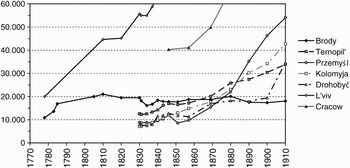
Brody's decline in the European trading networks and its general economic demise is reflected in the population rankings (see Figure 1). In 1830, it had been among the twenty-five largest cities in the whole Austrian Empire (including the densely urbanized Italian provinces). With 20,000–25,000 inhabitants, it was approximately the size of European cities such as Leicester, Pisa, Grenoble, Düsseldorf, or Göteborg, as well as non-European towns such as Washington, DC, Montréal, or Sydney, and its population definitely outnumbered those of Toronto or Chicago at that time.Footnote 32 Whereas Brody was Galicia's third largest city after L'viv and Cracow until the 1860s, it had fallen to the eleventh position on the eve of World War I. With unemployment and local taxes on the rise, more and more people left during the last two decades of the nineteenth century, which led to a demographic decrease in a time when urbanization gained momentum in the rest of Europe.
Demographic development of selected Galician towns, 1778–1910.*

A Jewish Hub for Eastern Europe
Closely connected with Brody's role as a trans-European trade junction was the town's Jewish population. Brody was the Habsburg monarchy's most Jewish city, with Jews numbering between 85 percent (1770s–1840s) and 65 percent (after 1900) of all inhabitants. This numeric predominance allowed local Jews a political scope unknown in the rest of the empire. Brody occupied a central place in Jewish economic, social, political, and intellectual history. “It would be difficult to find a Jew—not only from that region but also from Ukraine, Lithuania, Poland and a good part of Germany—to whom ‘Brody’ could be mentioned who would not recall or associate at least something with this name.”Footnote 33 On Jewish mental maps, Brody was always core and not periphery. Even before Austria annexed Galicia, the city had been known for more than a century for its Rabbinic-Talmudic scholarship, and rabbis educated in the local beit-midrash worked over all of Europe.Footnote 34 For centuries in the world of Ashkenaz, state-boundaries were perceived as onerous hindrances but not as religious or cultural barriers; only in the nineteenth century did acculturation and nationalism begin to draw new lines between the various Central and Eastern European Jewish communities. Brody's fundamental centrality for Jewish mental maps rested on three roles or stages—the Haskalah movement, local Jewish political participation, and a place of refuge.
The city's above-mentioned role as a trade junction rested largely on the close connections Jewish merchants enjoyed with Saxony and Prussia. During their stays in those countries, these merchants came into contact with the vibrant Jewish Enlightenment—the Haskalah—and introduced its ideas back home. Together with these new ideas, standard German progressively found its way into the private houses of Brody's wealthy Jewish merchants. According to a legal provision dating to 1789, the official accounting of trading companies had to be kept in German.Footnote 35 The supporters of the Haskalah, the Maskilim, soon dominated among the city's wealthier strata and made Brody one of the three centers of this movement in Galicia, together with L'viv and Ternopil' (Pol. Tarnopol).Footnote 36
The lines of religious division, though, were not always drawn as sharply as would be postulated in later decades. Many members of Brody's intellectual and economic elite pragmatically supported both the Maskilim, as well as the Orthodox rabbinate.Footnote 37 We can assume the same pragmatism in their usage of German and Yiddish. Because they considered a thorough knowledge of German to be indispensable for their children, most wealthy merchants supported the foundation of a secular German-Jewish school in 1818. We cannot say, however, how long they continued to communicate at home in Yiddish. With their domestic employees, they definitely had to speak Yiddish, because the majority of Brody's Jewish population, especially the lower strata, was and continued to be Hassidic, even though the Kahal's executives had officially anathematized them twice, once in 1772 and again in 1781.Footnote 38
Eastern European Maskilim wrote mostly in Hebrew. They perceived Hebrew to be the language of the modern Jewish intellectual, as well as the language of religious and cultural heritage. Admiring and studying German intensely since the early nineteenth century, Maskilim preferred this language over Yiddish, which they considered as a vulgar jargon. The Brody Maskilim not only absorbed enlightened ideas, but they also adapted them to local needs. Menachem Mendl Lefin Satanover (1749–1826), for example, not only wrote in German and Hebrew, but also supported the use of Yiddish. He argued that this mother tongue of Central and Eastern European Jewry was necessary to promote the Haskalah among unlearned Jewish men and especially among women. Not all Galician Maskilim agreed with him, though. When he published the first part of his Yiddish translation of the Bible, enlighteners from Ternopil' attacked him strongly.Footnote 39 Nevertheless, Brody was an undisputed center of the Haskalah, and almost all Galician Maskilim had some relationship with Brody. They originated from, lived in, or at least corresponded with others in this Austrian border town.
In the same way the Jewish Enlightenment was brought to Brody by merchants staying in the German lands, the Haskalah was “traded” farther eastwards in the first half of the nineteenth century. When Russia began to allow the toll-free storage of goods in Odessa in 1803, about 300 “Brody Jews” settled in the Black Sea city and opened branch offices of their trading companies there. Although the name “Brody Jew” was attached to every Jewish immigrant from Galicia or Germany in the Odessa region, merchants from Brody were in fact among the most prominent. Wishing to foster their language, culture, and confessional convictions, they founded a German school in 1826 that combined religious learning with the teaching of secular subjects. In 1841, they established a reform synagogue and invited a German rabbi for this so-called “Broder shul” (Brodskaja sinagoga). Although the Brody Jews predominantly belonged to Odessa's tiny elite and clashes with the local traditional Orthodox and Hassidic communities occurred regularly, the immigrants from Brody founded a self-confident and very active Jewish reformist community that reached far beyond the city itself.Footnote 40
An important Maskil from Russia, Isaac Levinsohn, also spent several years in Brody. Born in Kremenec' (Pol. Krzemieniec, Russ. Kremenec), he moved after his marriage in 1806 to Radyvyliv (Pol. Radziwiłłów, Russ. Radzivilov), Brody's neighboring town on the Russian side. He crossed the border originally only to visit a doctor, but came into contact with Brody's Maskilim and eventually spent almost fifteen years acquainting himself with the Brodyite version of enlightened scholarship. In Levinsohn's works, published after his return to Russia in 1820, he propagated typical Maskilic ideas formed during his years in the Austrian border town. He argued for the necessity of a complementary secular education for Jews and their engagement in agricultural and manual work, but he never took a negative stand on Yiddish as the vernacular language of the Jewish popular masses.Footnote 41 Hence, Brody continued to be an intellectual hub for Jewish thought in East Central and Eastern Europe throughout the nineteenth century.
Brody Jews' eminent role in trans-European trading networks, as well as the links between the city's elites and the Haskalah movement, helped form a large, wealthy, and self-confident Jewish community. As Brody's Jewish bourgeoisie had such a strong national and international standing and the numerical predominance of Jews in the city was so vast, Jewish claims for political participation could not be ignored. In general, Jews did not enjoy full civic rights in the Habsburg monarchy before the constitution of 1867. In Brody, however, Jews astonishingly had already constituted 50 percent of the municipal council's members since 1798, a singular case not only for Galicia, but for the entire Habsburg monarchy. It is even more surprising that the Christian counselors explicitly supported their Jewish colleagues when the Galician provincial administration challenged Brody's representative system in 1826. This controversy continued for more than five years. The defenders of Brody's joint Christian-Jewish municipal council produced three arguments to support their arrangement, based on legal, moral and pragmatic principles.Footnote 42
The Josephine patent for Jews (Judenpatent) from 1789 had in principle already foreseen electoral rights and communal citizenship for Jews, but a supplementary provision kept Jews from becoming local citizens “for the moment” (einstweilen). The decree of 1792 enfranchised burghers (Stadtbürger) regardless of religious denomination. As the town of Brody was noble property—it belonged to the Potocki family—there were hardly any communal citizens even among the Christian population. So Brody's argument in defense of Jewish suffrage in local elections was that individuals of both groups, Jews and Christians, could vote and be elected to the municipal council if they fulfilled the principal legal requirement, which was either to own a house in the city or be a master craftsperson.
The second argument put forward by the Christian council members in favor of their Jewish colleagues was the moral obligation to give Jews equal representation in a town where they made up almost 80 percent of the city's total population—a quantity that simply could not be ignored. Furthermore, they stressed the brotherly concord between the two religious groups:
The general idea of a [city] council is to promote the common interest of the citizens through useful measures with respect to order and security. Since the Jewish inhabitants, who despite their religious difference live in brotherly concord with the Christian inhabitants [underlined in the original], contribute to these noble aims as much as the latter it is obvious that, if the council consisted of Christian inhabitants only, it would by far not be able to contribute as much to the city's wealth as it is able to do right now, consisting as it does of an equal number of members of both nations, because the [city's] prosperity is the consequence of a unified determination supported by mutual concord and common spirit.Footnote 43
In their own letter to the emperor in 1830, the Jewish council members worried that “if a difference between citizens was introduced, the good understanding between them would disappear; the Christian inhabitant, especially of the lower strata, having realized the public affront accorded his Jewish fellow citizen, would see himself authorized to behave with less respect and esteem toward the aforementioned.”Footnote 44
Finally, the Brody municipal council argued pragmatically that Jews were generally more experienced in debating and defending privileges, as the Jewish community had always had to protect its special legal provisions against the noble landlord. The Jewish council members hence could and did lend their expertise to the city's general interests. The counselors also mentioned the fact that among the Polish and Ruthenian populations not enough qualified representatives could be found who had a sufficient command of German to defend the town's concerns.
The outcome of this ongoing dispute in the late 1820s and early 1830s between the city of Brody on the one side and the Galician governor and the Court Chancellery (Hofkanzlei) at Vienna is unknown. Although it is likely that Jews continued to account for half of the city's council members, this can only be proved for the period following the Revolution of 1848.Footnote 45 However, during the reactionary period of the reign of Emperor Francis I (1792–1835), Brody's Jews were not only morally, but also legally accepted as equal partners and were equally represented in the municipality for at least thirty years. The fact that Christians actively supported this policy shows that, on the local level, inter-religious cooperation worked quite well. This successful local experience could have served as a key argument for the possibility and necessity of Jewish legal emancipation in Galicia and the entire Habsburg monarchy. Interestingly, no Jewish politicians, be it assimilationist or Zionist, used Brody as a representational model for their political claims.
The last argument underpinning Brody's central role on Jewish mental maps takes us to the final third of the nineteenth century. The city unexpectedly gained new importance for European Jewry when anti-Semitic pogroms in the tsarist empire drove thousands of Russian Jews out of their country in 1881 and 1882. With the arrival of the first refugees in Brody, local dignitaries set up an aid committee that was more or less identical to the branch office of the Israelitische Allianz zu Wien founded in this border town in 1880. The Brody committee immediately activated its national and international partners for financial and logistical support. The Paris based Alliance Israélite Universelle instantly sent a representative to Brody, as did the Israelitische Allianz zu Wien and the Leipziger Hilfskomitee in the following months. Together they coordinated the emigration of between 1,600 and 1,800 of these refugees to Western Europe and eventually to North America.Footnote 46 Even more returned to Russia; but at the end of the year, 2,300 refugees were still living in Brody under difficult circumstances.Footnote 47
In the spring of 1882, further Russian pogroms sent a new and even bigger wave of refugees into Brody. In the beginning of May, 12,474 people were officially registered as refugees, and in mid June the number had grown to 14,534.Footnote 48 As almost all European Jewish communities were reluctant to admit Russian Jews permanently into their countries and American-Jewish relief organizations insisted that any potential immigrant be able to work, approximately two-thirds of the refugees had to return to their homes by the end of 1882.Footnote 49
Although many Jews from southern Russia—and even from Galicia—saw Brody's relief organizations as a stepping stone for emigration in general,Footnote 50 most refugees had in fact faced direct physical threat. Austrian officials understood the humanitarian dimension of the problem and did not interfere in the committees' activities, especially as they were aware of Brody's excellent international Jewish networks. They tried nevertheless to maintain control over the incoming and outgoing Russian Jews and definitely wanted to prevent any refugees from staying in the Habsburg Empire. The Austrian border-patrols hence sent refugees arriving in other cities on the country's eastern border in convoy to Brody.Footnote 51 This turned Brody into an enormous refugee camp. At the peak of the anti-Jewish violence in Russia, the city's population temporarily almost doubled. In the long run, none of the refugees seems to have stayed in the town, as the total number of Brody's inhabitants shrank from 20,071 in 1880 to 17,534 in 1890.Footnote 52
The waves of refugees and emigrants gathered in Brody after the pogroms of 1881/1882—which continued to a lesser extent until 1914—brought about a change in Brody's place on Jewish mental maps: For the first time, it became associated as a border town in the Jewish mind.Footnote 53 Still, the city remained central to Jewish history, and for this reason most people held a positive or negative association with the word “Brody.” At the same time, it was the beginning of Brody's decline from a Jewish hub to a Jewish transit station between two empires.
Brody as a Regional Educational Center—Shifting National Identities
Closely linked to Brody's importance in international trade and with respect to the Haskalah movement was Brody's role as a regional educational center. The Maskilic elite founded a secular secondary school for Jews in 1818, which was financed entirely by Brody's Jewish community, although almost 20 percent of the students were Christians.Footnote 54 Brody's wealthy merchants were interested in having a school in town where their children would receive a secular education in subjects such as mathematics, geography, or bookkeeping—subjects indispensable to a career in trade. This private Israelitische Realschule was turned into a publicly maintained school in 1853 and was eventually upgraded to a full-fledged high school in 1879 and named the k. k. Rudolfsgymnasium after the Austrian crown prince.Footnote 55 This name and the German language of instruction indicate Brody's orientation toward the empire's center and the town's self-perception as part of a wider, supraregional network.
The fact that gymnasiums were rare institutions in the Habsburg monarchy underlines Brody's importance here as well. The example of Brody confirms historian Gary Cohen's argument that, despite Austria's generally weak economic situation in the 1870s and 1880s, the expansion of the state-sponsored educational system slowed but did not fully stop.Footnote 56 Beginning in 1853, the municipality of Brody contributed about a third of the gymnasium's budget (some 5,000 gulden), and it constructed a new schoolhouse in the early 1880s. The city assumed this enormous financial burden despite the community's sequestration in 1883. In an agreement signed between the city and the Austrian government in the same year, Brody's representatives were assured that the language of instruction in the school could not be changed as long as the municipality contributed its share to the school's budget.Footnote 57 As a result of this convention, Brody was able to resist the Polish-Galician authorities' polonization efforts. By the turn of the century, only two German language gymnasiums remained in the entire Crownland—one in L'viv and the Rudolfsgymnasium in Brody.
In the 1890s, however, changing attitudes became noticeable within local politics and among Brody's elite. More and more teachers—and not only those of Polish descent—expressed doubts about whether it was sensible to maintain German as the school's language of instruction. Defending the necessity of the gymnasium's German language preparatory class, teacher Emil Pelikan implicitly criticized the current state of things: “If we don't want to block access to the gymnasium to a large number of Christian students, we have to maintain the preparatory class as long as German continues to be the language of instruction in our institution, where there are barely 45 percent of students with German mother tongue (and these mostly Galician Jews).”Footnote 58
The rapid decline in the city's wealth had led to an ever-increasing municipal debt. To reorganize its finances, the city council finally voted in December 1896 to polonize the school in exchange for a release from its obligation to make financial contributions. Public discussions of the school's language issue mentioned the financial question but generally emphasized the need for Brody's future generation to integrate itself into (Polish) Galician society. The local newspaper Gazeta Brodzka printed a speech given during the discussion in the municipal council by the city counselor Feliks West (1846–1946), co-editor of the newspaper and owner of Brody's only publishing house:
With respect to its civic duties towards the country [he meant the Crownland] Brody has always been an exception among other towns of the province, an exception that has always been to our detriment. Maintaining German language instruction at our gymnasium has cast more than one cloud over our city. It is high time, Gentlemen, to take a step forward today and to prove that we realized on our own the necessity of this reform and that we consider it as our duty towards the country—let us carry it out as good citizens… . Parents complain that teenagers leaving our institution cannot find a job in the country! And that is totally normal—he who does not master the languages of the country will hardly find work.—After their graduation exams Jewish students mostly dedicate themselves to medicine; it's clear that they can't attend the medical faculty in the country because their Polish is not good enough. Under harsh financial expense they move to Vienna or Graz—where many do not succeed—we all know this very well. And this today, when a second medical faculty has been installed in the capital of Ruthenia [L'viv], only a three hours' ride from our city.—How convenient, how beneficial to visit one's son and be back home in one day!”Footnote 59
The financial question and the potential threat to transfer Brody's chamber of commerce to Ternopil', however, must have been the crucial points. If not, it would have been almost impossible to explain the unanimity of the city council's decision. Not only would some Jewish representatives have opposed this proposition, but the Ukrainian national deputies in the city council would also have hardly voted in favor of polonization. The local Ukrainian national movement demanded instead the ukrainianization of the Rudolfsgymnasium. The Seljans'ka Rada demanded that the Brody representative to the Galician diet, Oleksandr Barvins'kyj, intervene on their behalf: “We ask you as the deputee of the county of Brody to raise your voice in the Sejm in the case of the polonization of the Brody gymnasium and speak up for the introduction of Ruthenian as the language of instruction.”Footnote 60 In general Ukrainian national activists preferred German to Polish-language instruction in Galicia's schools. In their eyes, German had a higher standing and German-speaking teachers could be expected to be more nationally neutral and less anti-Ukrainian than Polish instructors:
We Ruthenians have to protest strongly against the transformation of the gymnasium into a Polish one. If already our brethren are forced to study in a foreign language, than they should do so at least in a language of culture… . Furthermore this school should employ teachers with complete command of the German language and free of any chauvinism, in order to prevent the school from becoming a political institution.Footnote 61
Eventually, the changeover took more than ten years of negotiations with the respective authorities in L'viv and Vienna, because Brody not only sought release from any financial obligations to the school but also demanded the restitution of the school's reserve fund endowed with 38,125 gulden. According to the agreement of 1883, Brody would only have been entitled to this money if the city had founded another German-language school in the town. Because Brody did not plan to do this, it finally had to accept L'viv's and Vienna's argument.Footnote 62 In September 1907, the Rudolfsgymnasium began teaching the first grade in Polish, whereas students already in the higher classes were allowed to complete their education in German. Consequently, in June 1914, on the eve of World War I, the last Matura (Austrian high school diploma) was given in German.
Students themselves had not been actively involved in the discussions about changing the Rudolfsgymnasium's language of instruction. To obtain a better understanding of their views on the language issue, we can examine the school's statistics.Footnote 63 This allows us to delve deeper into questions of ethnic self-identification in times of increasingly active national movements in general. To do so, however, we have to clarify the categories involved in the making of these statistics. After 1848, statistics in the Austrian Empire became more comprehensive and surveyed not only subjects' religion, but eventually also their linguistic practices. Jews were registered in both categories as a distinct group, even though surveyors knew about the challenges of classifying Israelites in terms of language use. So they added a footnote explaining that “it is difficult to evaluate them by language.”Footnote 64
The Austrian constitution of 1867 recognized Jews as a confessional group but not as a distinctive ethnic group (Volksstamm). In the official statistics, however, there were no surveys of these Volksstämme, and even the earlier language group (Sprachstamm) category was later abandoned. Starting with the census of 1879, statisticians in the Austrian part of the empire surveyed people's “language of daily use” (Umgangssprache). Because neither Yiddish nor Hebrew was included among Austria's officially recognized languages, Yiddish-speakers had to choose to report one of the other languages. The same is true for the official school statistics in Cisleithania, where Jewish students also had to decide in which language group they wanted to be included. In contrast to the censuses, however, official school statistics surveyed mother tongue (Muttersprache) and not the language of daily use. When Galicia's gymnasia were polonized, their annual reports were now published in Polish, and the formerly German statistical category Muttersprache (mother tongue) was replaced by narodowość (nationality). In 1890 and 1900, additional surveys by the central state also evaluated the degree of multilingualism in Austrian primary schools. For these surveys, pupils could also declare nonofficial languages like Yiddish, and it was also possible to declare several languages, which was not allowed in the official censuses or school statistics.Footnote 65
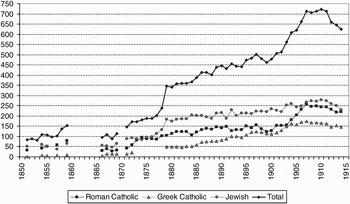
In Figure 2, we see that Jews made up a large part of the students even after the Israelitische Realschule was transformed into a public high school in 1853. By the turn of the century, they numbered a little more than a third. For decades almost all Christian students were Roman Catholics, besides a negligible number of Greek Catholics and Protestants. At the beginning of the twentieth century, the share of Roman Catholic students varied at around 35 percent. After the 1870s, however, we see a constant increase in the number of Greek Catholic students, who can largely be identified with the Ukrainian-speaking population. This development reflects the growing literacy rates of east Galicia's Ruthenian population. In 1900, Greek Catholics represented about a quarter of the Rudolfsgymnasium's students, whereas Greek Catholics numbered only a little more than 10 percent of the townspeople. This means that parents from the surrounding villages and districts, and in very rare cases even from neighboring Russia, must have sent their children to Brody's high school and underlines the city's role as a regional educational center.Footnote 66
Students at Brody's Gymnasium (and its predecessors) according to religious denomination.*

On the other hand, the native language statistics give us an entirely different picture that points up the ambiguity of allegedly neutral statistics and the difficulty of measuring ethnicity or national developments.Footnote 67
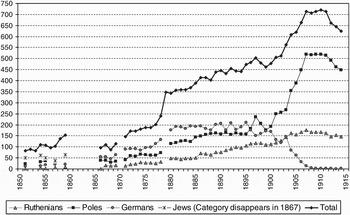
Whereas Figure 2 suggests that the numbers of the three main groups increasingly equalized at the beginning of the twentieth century, Figure 3 shows something totally different. In 1896, when Brody's municipal council voted for a change of the language of instruction, the Polish-speaking students for the first time held a slight majority over the German-speakers. The German-speaker category is a very delicate and volatile one. As long as Jews were listed both in the confessional and official statistics of the Habsburg Empire (until 1867), the little numerous category of “Germans” at the Rudolfsgymnasium comprised only Christian German-speakers. As there was no reported influx of Christian Germans into Brody, the large group of German-speakers during the 1870s, 1880s, and 1890s must be associated with the Jewish students.Footnote 68 Within ten years these German-speakers almost completely disappeared, although the school's only language of instruction continued to be German until 1907. After the gymnasium's polonization, Poles henceforth accounted for more than 70 percent of all teenagers at the Rudolfsgymnasium.
Students at Brody's Gymnasium (and its predecessors) according to mother tongue/nationality.

As languages do not die out within a decade, something else must have been happening in those years. These statistics might tell us that Brody's Jewish students switched from a German to a Polish public identity. This assumption is certainly correct insofar as the students could freely indicate their mother tongue for the statistics, and we should refrain from classifying people today according to supposedly true nationalities. On the other hand, these data give us no reliable information on what language these students spoke at home and how—or if at all—they identified themselves nationally in the private sphere.
First, in the official school statistics, there was no category of bi- or multilingualism to reflect widespread practices among the Galician population in general and among Galician Jews in particular. A snapshot of this practice is provided by a survey on multilingualism in primary schools in 1890. It shows that in fact more than 80 percent of all pupils in Brody knew at least two languages.Footnote 69 The same is true with respect to multiple personal identities: Recent studies on the Austro-Hungarian monarchy demonstrate that national identities were still indefinite at the turn of the twentieth century, especially for people living on the empire's fringes where “national thinking” was imported from the centers of national activism.Footnote 70 Secondly, Brody's Jewish students could not chose the category “Yiddish” or “Jewish nationality” because, according to the Austrian constitution of 1867, Jews were not considered a nationality, but solely a confessional group.Footnote 71 Although the Zionist newspaper Die Welt repeatedly complained that Brody's elite in general was not very receptive to Zionism, some students had founded a Zionist club as early as 1890; and eight years later, Jewish students from Brody complained that the gymnasium's principal had denied them permission to enter “Jewish” in the national category for the school statistics.Footnote 72 In 1907, Brody's citizens even elected a Zionist as their representative to the Austrian Parliament, although he was not reelected in 1911.Footnote 73 Hence, for some Jews in Brody, especially students, Jewish nationality definitely was an option for their personal identification.
These different statistics suggest that private and public identity was not necessarily congruent and that general political tendencies had an impact on public perceptions. Although Galicia legally never received any particular autonomous status, Vienna's 1867–1873 concessions had allowed the Polish elites to exert power in almost all spheres of provincial administration.Footnote 74 The Ruthenians, though recognized as one of the province's constituent ethnic groups, played only a marginal role in provincial administration. Modern Galician Jews for whom acculturation or assimilation was an option gradually changed from a pro-German to a pro-Polish orientation in the 1870s and 1880s. The Jewish communities corresponded in Polish with the provincial authorities, and their internal administration was progressively conducted in Galicia's dominant language as well.Footnote 75
In Brody, these things happened with a delay of two or three decades and only after the town had lost its position in trans-European trade. Only at the turn of the century did Brody's public sphere become increasingly polonized, whereas German had prevailed for more than a hundred years. For the hundredth anniversary of the birth of the Brody-born Polish-national writer Józef Korzeniowski (1797–1863), patriotic circles erected a monument on one of the city's main squares in 1897, which quickly became an important object of Polish identification in Brody.Footnote 76 The polonization of the public sphere was a slow process though, as a letter to the editor of Brody's local Polish newspaper indicates. Under the title “Deutschland, Deutschland über alles,” a reader complained that some craftspeople, businesspeople, and doctors (all typical “Jewish” professions) still used German signboards on the streets.Footnote 77
While the multilingualism of Jews (Yiddish, German, and Polish) presumably continued, they pragmatically declared Polish as their vernacular or native language in public and in official documents. As language statistics constituted the principal weapon in nationalist struggles in Galicia, Jews accepted their absorption into the Polish cause. The city council's decision to polonize the high school and the public switch of Jewish students to a Polish nationality allow us to assume that Brody's inhabitants mentally accepted the fact that they were, first of all, a part of Galicia.
Conclusions
Center and periphery relations are not only multilayered, but also subject to chronological factors (parameter of time) as we could see in the case of Brody. Although challenged by the new geopolitical order after 1772, Brody's new situation on the fringe of the Austrian Empire did not disrupt the existing international trading routes in which it played a key role. For at least another seventy years, Brody kept its place in European networks of commercial exchange. Besides the political need to establish good relations with the empire's administration in Vienna, Brody focused on relations with international commercial hubs like Leipzig, Berdyčiv, or Odessa. Only when these connections rapidly declined during Brody's severe economic crisis in the last decades of the nineteenth century did Galicia's political and administrative capital, L'viv, become increasingly important for the city's elite.
The same is true for Jewish mental maps. The borders of the world of Ashkenaz did not run along political boundaries for centuries, and centrality was constituted by the weight of religious scholarship in a given place. The year 1772, hence, did not challenge Brody's standing as a central place of Jewish learning in this part of Europe. The Vienna authorities certainly strengthened their efforts to expand the Haskalah movement in Galicia, but the main factor for the rapid expansion of the Jewish Enlightenment among Brody's elite were the close commercial ties with the centers of the Haskalah in Prussia and Saxony.
In the last third of the nineteenth century, Brody's intellectual importance shrank as the Haskalah movement slowed down, the importance of Maskilim declined, and those still active did not necessarily live in Brody. This was also true of representatives of Orthodox Jewish learning, who in earlier decades had been well-known authorities in the world of Ashkenaz. Assimilation was evident among Brody's elite, although there were no explicitly assimilationist circles in the city (whether pro-German or pro-Polish). The city did preserve its fame, however, if not as a center of Jewish learning, then as a place of Jewish transit from Eastern Europe to the West. Because the migration processes of the late nineteenth and early twentieth centuries constitute a central part of the Jewish historical narrative, Brody continues to be anchored on Jewish mental maps until now.
The economic and the religious dimensions show us that it was time that shaped Brody's place in regard to center and periphery. An examination of Brody as a regional educational center in a multicultural setting allowed us furthermore to state that the changing economic and religious geographies shaped the local mental maps at the end of the nineteenth century as well. With a vanishing commercial importance and a decentralizing Austrian domestic policy that increasingly left inner Galician affairs to the Polish elite, Brody's Jews looked more and more toward the regional capital L'viv. This meant that they not only accepted its status as an Austrian-Galician border town, but also that they sided with the socially dominant ethnic group in the region's national conflict, as the transformation from a German-Jewish to a Polish-Jewish public identity suggests.
Given Brody's subjection to these peripheralizing processes, we might, in retrospect, perceive the town's development in the long nineteenth century as a history of failure. However, by the beginning of the twentieth century, new regional centers had emerged that served as proto-capitals for potential future nation-states. From the Galician perspective at that time, the economic transformation of Brody was desirable, because the city's former international orientation had isolated it from its Galician surroundings. From a regional or especially from a Polish national point of view, Brody's decline facilitated the city's successful integration into the social and political realities of the Crownland. Calling this integration the embodiment of periphery reproduces the center's view of this development, but we could also see it as the end of a longue durée process that brought economic and mental geographies into line with the changing political map.