Introduction
Recent advances in machine learning, the wider availability of large annotated corpora for corpus-based synthesisFootnote 1 and the development of systems for real-time musical interaction have opened new perspectives on how sound models and their mimetic reinterpretation may be conceived and realised in contemporary practice. This article advances the thesis that these developments extend spectralist compositional tendencies into new computational and performative territories. Whereas instrumental resynthesis originally operated through the reconstruction of analysed sound spectra via vocal-instrumental or electronic means, contemporary AI frameworks substantially broaden its scope.
This evolution can be understood as an ongoing transformation of spectralist practice under new computational conditions, unfolding along three interrelated axes: first, an expansion of the operational radius of resynthesis, insofar as large corpora and learned embeddings permit denser, more systematic mappings between target sounds and resources of resynthesis; second, a shift in temporal modality, with resynthesis moving from isolated, score-bound reconstructions towards adaptive processes capable of re-orchestrating evolving spectral material and third, an extension into real-time improvisatory practice, where corpus navigation, multi-agent interaction and self-referential listening generate forms of co-creative improvisation between human performers and algorithmic agents.
To make these claims concrete, two complementary implementations of external packages within the Max environment will be analysed: Orchidea, a framework for target-based, computer-assisted dynamic orchestration that combines forecasting and constrained optimisation to render spectral targets as scoreable orchestrations and Somax2, a slice-based, multi-agent environment for live co-improvisation that realises adaptive, self-referential interaction. Although both systems operate on the principle of corpus-based synthesis, their applications diverge significantly: Orchidea applies it to orchestrational resynthesis, whereas Somax2 implements it as real-time corpus navigation for improvisation. These systems will be related to examples from compositional practice to demonstrate how historical techniques of instrumental resynthesis are being reinterpreted and extended within contemporary AI-driven workflows.
Theoretical background: spectralism and instrumental resynthesis
The term musique spectrale, first introduced by Hugues Dufourt (see Dufourt Reference Dufourt1979), refers to a compositional orientation grounded in the conviction that the acoustic spectrum of sound – its partial structure, formant architecture and temporal envelopes, among others – can function as a generative model for musical form. Practitioners associated with this lineage, notably the composers of the group L’Itinéraire such as Gérard Grisey and Tristan Murail, developed procedures in which spectral analysis provided parametric models that, when mapped onto instrumental technique, generated new timbral morphologies and large-scale formal operations. The harmonic, inharmonic and noise-like properties of sound were investigated through spectral analysis, and the transcriptions of this data served as the basis for further compositional work.
A distinctive feature of spectral music is the compositional process known as instrumental resynthesis.Footnote 2 Here, a pre-existing model sound is reassembled through specific vocal–instrumental scorings, often supplemented by electronics. The process begins with an acoustic or electronic sound source whose spectral structure is decomposed into sinusoidal components by FFT analysis; this internal organisation then serves as a model for recomposition by a freely chosen ensemble. In its simplest form, instrumental resynthesis assigns individual frequencies or partials, together with their dynamic envelopes, to different instruments or voices. The spectrum thereby becomes the basis for a novel conception of sonic material from which melodic, harmonic, rhythmic or timbral structures may be derived. Building on different types of spectra and their sonic properties, composers can unfold structural, energetic or timbral processes whose form mirrors the processual character of acoustic phenomena. Spectral models are typically developed over time through targeted transformations, such as filtering specific frequency bands, shifting formant-rich regions, transposing the entire spectrum or gradually introducing non-spectral tones (see Fineberg Reference Fineberg2000: 93–9).
A frequently cited example is Grisey’s Partiels for 16 (or 18) instruments (1975), whose point of departure is the spectrum of the pitch E (41.2 Hz), derived from the analysis of a trombone sound.Footnote 3 This initially harmonic model is subjected to a gradual interpolative transformation, in which the spectral structure shifts towards inharmonic configurations characteristic of percussive resonant bodies such as the gong or tam–tam. The transformation of the spectrum thus becomes a carrier of form, articulating the temporal unfolding of the work at the level of perceptually traceable sonic parameters.
A comparable form of interpolative thinking within instrumental resynthesis is further developed in the work of Murail. In Gondwana (1980) for orchestra, Murail works, among other approaches, with material derived from manually calculated frequency-modulation processes. The resulting spectral configurations function as initial chordal models, subsequently realised orchestrally through instrumental resynthesis. Beyond spectral organisation, temporal interpolation becomes structurally decisive: amplitude profiles shape the orchestral material through transitions between two envelope types – a percussive model with an instantaneous attack and rapid exponential decay, and a brass model characterised by gradual attack, delayed peak and extended sustain. In Désintégrations (1982) for large ensemble and fixed media, Murail further differentiates his approach to instrumental resynthesis, working with concrete spectral models derived from static analyses of instrumental sounds. These models are conceived as parametric fields subjected to systematic transformation over time through processes such as spectral distortion or frequency shifting. Crucially, instrumental resynthesis is here closely integrated with electronics: a shared spectral model underpins both the orchestral writing and the tape part, establishing continuity between acoustic and electronic domains. With L’Esprit des dunes (1994) for 11 instruments and synthesised sounds, Murail shifts instrumental resynthesis from static spectral models towards fully dynamic acoustic models based on analyses of the temporal evolution of sound. The primary material is no longer constituted by isolated spectral snapshots, but by partial-tracking analyses of complex sonic phenomena – such as Mongolian overtone singing, the Tibetan horn or monastic chant – carried out in AudioSculpt and further processed in PatchWork. These analyses capture changes in frequency, amplitude and spectral distribution over time and serve as a data foundation for both instrumental resynthesis and electronic synthesis. Within this framework, dynamic models function as musical objects with recognisable identities, whose internal evolution is projected onto both instrumental and electronic domains (see Murail Reference Murail2005; Hirs Reference Hirs2007).
These practices serve as examples of how different structural facets of a model can be emphasised, or how alternative versions of its sonic identity may be explored. Resynthesis thus operates as a transformative or translatoric generative act. From this perspective, spectral aesthetics emerge as an evolving field in which the mimetic relation between a sound source – whether acoustic, electronic or virtual – and its resynthesis is continually reconfigured. What comes into focus is not only the relation between an original sound and its transformation but also the shifting tension between listening expectations and modelled structures. This mimetic interplay between origin and transformation keeps spectral aesthetics in continual flux, aligning it with shifting cultural and technological horizons rather than stabilising it in a fixed form. Accordingly, imitation models and techniques evolve with machine capacities – greater memory, faster processing of complex data – which extend the mimetic range of spectralist concepts and reshape paradigms of imitation.
In this regard, spectral analysis occupies a central position in spectralist thinking – not merely as a technique for decomposing sound but as an epistemic tool that affords insight into the micro-properties of a sound’s internal organisation and their translation into compositional relationships and formal processes. This microscopic perspective also demonstrates that sound cannot be meaningfully reduced to isolated parameters, since it unfolds within transitional zones in which pitch, timbre, dynamics, articulation and rhythmic components mutually induce and overlap. From this vantage point, the ambiguity at the level of imitation and modelling reappears as a more fundamental aesthetic dimension: the permeability of parameters – not only in the frequently discussed tension between harmony and timbre but also in less clearly delineated relationships between melody and harmony, rhythm and texture or in the blurred status of the sound source itself.
It is at this point that Grisey’s concept of musique liminale becomes particularly relevant. The term designates a compositional focus on threshold states and intermediate zones in which conventional parametric categories begin to dissolve. Instead of clearly separated components, sound unfolds as networks of correlations and transitional thresholds that resist precise naming yet cohere perceptually as a process of becoming. Grisey articulates this orientation through a triad of concepts – differential, liminal and transitory: differential thinking foregrounds relationships between parameters while maintaining their distinction; liminal refers to states of fusion and transitory designates their temporal animation, that is, processuality as a form-generating principle (Grisey Reference Grisey and Lelong2008: 291–6).
Grisey’s term may also be understood as an alternative to the designation musique spectrale, derived from Dufourt’s programmatic, quasi-manifesto text, which can appear reductive or even misleading (cf. Lepany Reference Lepany2005: 3–4; Haselböck Reference Haselböck2009: 18). Spectralist practice in fact encompasses models distributed along a continuum of harmonicity, inharmonicity and noise and is grounded primarily in processuality and the dynamic interplay of transitions. From this perspective, musique liminale more precisely captures what is decisive in practice: working at the edges between components and within mutable threshold states, in which parameters are not hierarchised but continually reconfigure their functions within form. Liminal aesthetics also presupposes an active, shifting mode of listening, in which sonic entities are not given in advance but emerge as perceptual constructions depending on the listener’s focus.
Within contemporary technological contexts, this liminal perspective becomes computationally instantiated: AI-based systems translate the spectral reconceptualisation of sound as a relational field into computational terms. Just as spectral models function as generative matrices through which micro-acoustic properties are projected into compositional structure and temporal form, AI frameworks model sonic material as a multidimensional feature space in which transitions, proximities and continuities can be algorithmically navigated.
AI and corpus-based orchestration: representation, retrieval and optimisation
Both contemporary AI-inflected orchestration and co-creative systems rely on corpus-based orchestration as a core procedural framework. This practice consists in constructing a navigable memory of annotated features (the corpus), from which procedures of retrieval, recombination and (re)rendering select sonic material to meet perceptual targets or interactional constraints (see Carpentier et al. Reference Carpentier, Cont, Nouno and Harvey2009). It extends a historical trajectory from early spectralist and algorithmic experiments – based on manual FFT transcriptions, hand-crafted instrumental surrogates and rule-based generative grammars – through hybrid environments such as PatchWork and OpenMusic (see Bresson et al. Reference Bresson, Agon and Assayag2011: 743), where symbolic operations were automated yet remained under direct human control. This development culminates in contemporary AI-driven frameworks, in which learning-based models navigate high-dimensional descriptor spaces and forecast timbral outcomes in real time (see Assayag et al. Reference Assayag, Bonnasse-Gahot and Borg2022). On this basis, corpus-based orchestration can be described in terms of three technical pillars:
-
Representation, i.e. how sounds are described – from early spectrograms and hand-drawn transcriptions to high-dimensional feature spaces combining spectral, temporal and perceptual descriptors. Engineered descriptors offer interpretability rooted in classical spectral practice, whereas learned embeddings provide compact, task-specific representations capturing complex timbral and contextual relations. This choice shapes not only technical performance but also the system’s aesthetic transparency for the composer.
-
Retrieval and forecasting, i.e. how candidate material is selected or its behaviour approximated (from look-up tables and similarity metrics to neural prediction and probabilistic modelling). Retrieval ranges from direct similarity matching to predictive approximation, in which models estimate features without rendering all possibilities – an essential strategy for navigating combinatorially large orchestral spaces.
-
Optimisation and selection, i.e. how combinations are chosen under symbolic and perceptual constraints (from ad hoc instrumental groupings to evolutionary search, constraint solving and reinforcement-style feedback loops). Optimisers balance perceptual targets with playability and notation constraints using evolutionary or hybrid heuristics, with fitness functions that both estimate perceptual outcomes and enforce compositional limits.
It is precisely along these three axes – representation, retrieval and optimisation – that spectralist resynthesis is extended and transformed, shifting it from a largely static translation of spectral data into a dynamic, adaptive field of orchestral and performative possibilities. Crucially, corpus-based systems transform not only what is orchestrated but how time itself is conceived. While dynamic resynthesis can already be compositionally specified as a temporal process, it remains compositionally scripted rather than adaptively generated. In corpus-based and optimisation-driven systems, by contrast, dynamism operates at the level of the process itself: orchestrational solutions emerge sequentially, with earlier choices shaping subsequent ones. Time thus ceases to function merely as a parameter of the sonic model and becomes an active dimension of the system, within which resynthesis unfolds as an open, adaptive process.
At the same time, these systems redistribute agency. Instead of a lone algorithm executing a fixed plan, we find ensembles of interacting processes – agents that listen, predict and respond not only to the performer but also to one another. In Somax2, this takes the form of a self-listening, multi-agent environment in which timbral fragments circulate and are recombined in real time, producing a kind of polyphony of behaviours. Orchidea, conversely, models continuity across successive targets, forecasting how each orchestrational decision will resonate with the next. In both cases, temporality becomes sculptural and agency becomes plural: orchestration is no longer a static assignment but an evolving interplay, a choreography of sounds and decisions unfolding across time.
Orchidea: an instrument for orchestration
The current implementation of Orchidea as an external library for the Max environment builds on a longer development lineage at IRCAM. The first prototype, Orchidée,Footnote 4 was developed in connection with the genesis of Jonathan Harvey’s Speakings (2008) for orchestra and electronics, in which fragments of human speech were analysed and their spectral characteristics mapped onto orchestral combinations. In this early context, the system functioned as an intermediary between sound analysis and instrumental reinterpretation, though it operated exclusively with static orchestrational solutions. A second prototype, Orchids (2013), introduced dynamic analysis and enabled a more accurate representation of sonic morphology. The current version, Orchidea (2022), extends this trajectory by offering broad applicability through its integration into the modular Max environment.Footnote 5
In its most recent version, the paradigm of target-based computer-assisted orchestration is extended by a machine-learning component, integrated locally in the form of a neural predictive model (LSTM),Footnote 6 which estimates the spectral features of candidate instrumental combinations during the optimisation loop. This model serves to enable a more efficient evaluation of solutions within combinatorial optimisation (cf. Cella Reference Cella2022: 55–56). In this sense, Orchidea is best understood as a hybrid system in which algorithmic optimisation and symbolic musical reasoning are complemented by locally applied machine-learning techniques.
Orchidea may be approached not simply as a software routine but as an instrument-like environment that reshapes orchestration into a domain of exploratory interaction. It constructs an evolving corpus of instrumental sounds that can be searched, combined and transformed in relation to a target sonority. In this sense, the system extends the spectralist idea of instrumental resynthesis: sound is not passively reproduced, but imaginatively reconfigured through the resources of an instrumentarium, and this reconfiguration can even unfold live, responding in real time to the input of a microphoned instrument.
Equally important is Orchidea’s treatment of time. Instead of segmenting the process into discrete chordal instants, it maps continuous trajectories across successive states, favouring gradual transformation over abrupt juxtaposition. Timbral structures are thus articulated as evolving lines, whose identity is shaped as much by their transitions as by their momentary states. This temporal awareness aligns orchestration more closely with performance practice. And while the tool’s primary output is a written score, the resynthesised audio material can also function autonomously – as a medium for exploring new networks or constellations of musical association that emerge from the interplay between timbre, algorithmic process and auditory perception.
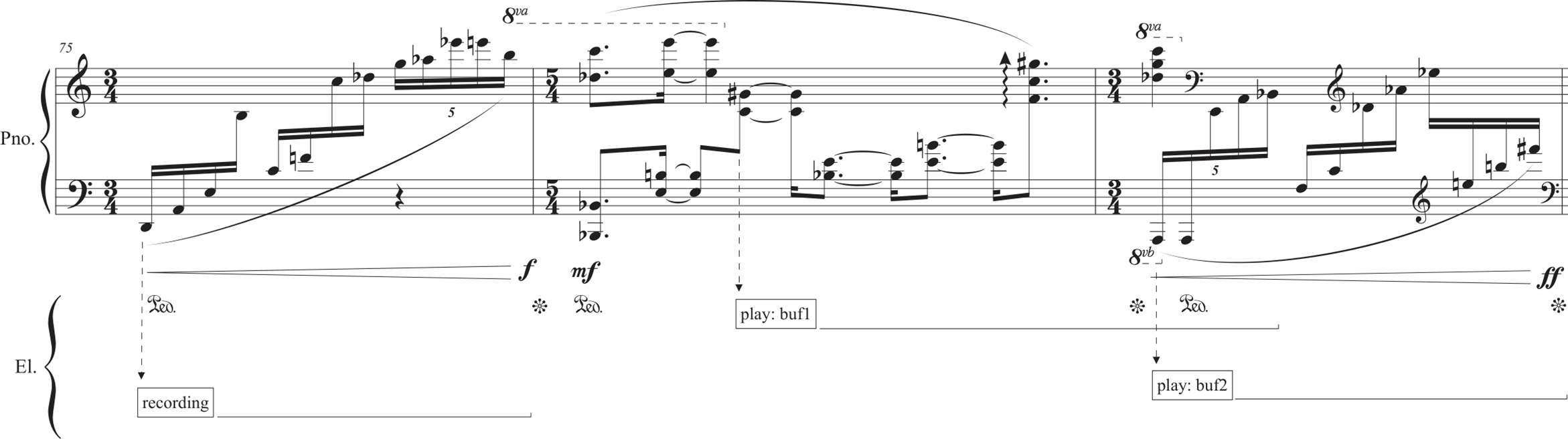
My own composition Nexus (2025) for piano and live electronics exemplifies this approach and can be understood as an instance of hyperinstrumental thinking, in which the piano is dynamically extended through live resynthesis. Within a Max environment, I adapted Orchidea’s library as a generator for live electronics: instead of the default orchestral library, the resynthesis draws on a sample library created from my recordings of a prepared piano. Through this interaction an ambiguity emerges, as the live piano part itself remains unprepared while its gestures are reconstructed into distorted timbral extensions (see Figure 1).
Recording of the piano and the immediately following playback of the resynthesis. Wanke (Reference Wanke2025), Nexus, bars 75–77 (figure created by the author of the article).

Figure 1 Long description
A musical score with annotations for piano and electronic playback. The score includes detailed notes and instructions for the pianist and electronic components. The top section shows the piano notation with various musical notes, dynamics, and tempo markings. The bottom section includes annotations for electronic playback, indicating recording and playback of specific segments. Arrows and brackets indicate the flow and interaction between the piano and electronic components.
Two principal modes of interaction structure these resyntheses. In the first, the Max patch records, analyses and immediately resynthesises the pianist’s gestures, fusing them with their original form so that both planes coalesce into a single, augmented piano. In the second, Orchidea records longer temporal spans, from which subsequent algorithmic processes extract and reconfigure fragments; here the instrumental and electronic layers function as a duo, each producing lines that interweave into a polyphony of processes.
In this work, I also make use of the modularity of the Max environment and its relatively recent Multichannel ExpansionFootnote 7 functionality, which allows a single process to be multiplied and run in parallel across multiple instances. Each instance corresponds to a virtual instrument employed for resynthesis – specifically, samples of a prepared piano. The resulting parallel layers are processed through an implementation of Trevor Wishart’s waveset technique in the gen∼ environment, yielding a multi-layered transformation in which instrumental gesture is fragmented, reconfigured and reintegrated into an extended hyperinstrumental behaviour of the system.
This dialogue can also be taken in a more speculative direction, as illustrated by my second example, Cycling II (2024) for fixed media, in which I again draw on my own sample library as the source for resynthesis. In this case, however, the library does not consist of instrumental sounds but of gestural artefacts arising from the non-linear feedback behaviour of my Eurorack system, built around self-patched wavefolders, multimode filters or comparators, with a particular emphasis on Serge-inspired system architectures.
In this context, the conventional taxonomy based on instruments and playing techniques – which underpins Orchidea’s default hierarchical organisation when working with orchestral corpora – proves insufficient to capture the perceptual and morphological specificity of the material. Instead, the sounds are mapped onto categories derived from Denis Smalley’s vocabulary of spectromorphology (see Smalley Reference Smalley and Emmerson1986). Samples are not classified by source identity but by spectromorphological attributes: profiles of onset, continuant and termination; modes of textural motion such as streaming, flocking or granularity and characteristic processes of motion and growth, including convergence and divergence, dilation and contraction or agglomeration and dissipation.
The resulting corpus functions as a repertoire of behavioural archetypes, extending timbral cataloguing towards perceptually grounded, morphologically defined categories. From these segments, I resynthesise a recording of a lecture by Karlheinz Stockhausen in which he discusses his use of feedback. This mapping establishes a closed conceptual relation in which feedback operates both as the object of discourse and as an operative compositional principle. The resynthesis thus functions less as imitation than as spectromorphological commentary – an associative re-casting of semantic content into behaviour, motion and energy. While the plasticity of this approach is necessarily constrained, these limitations open up new and productive associative possibilities within the compositional process (see Audio Example 1).
The final example of my use of automated orchestration is my orchestral work Micrographies (2023), in which I explore different degrees of sonic mimesis. Here, spectral resynthesis functions as a transformative mirror: the dialogue between an original sound and its reconstruction becomes a structural axis of the composition, generating successive layers of resemblance and distance.
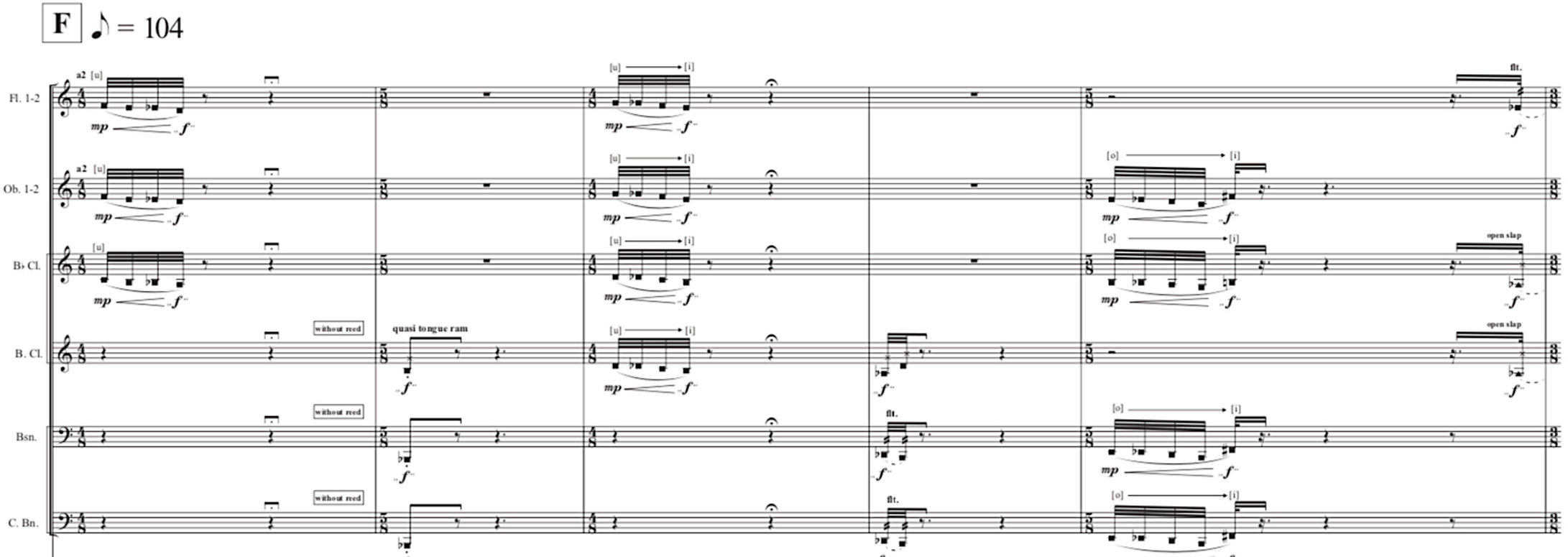
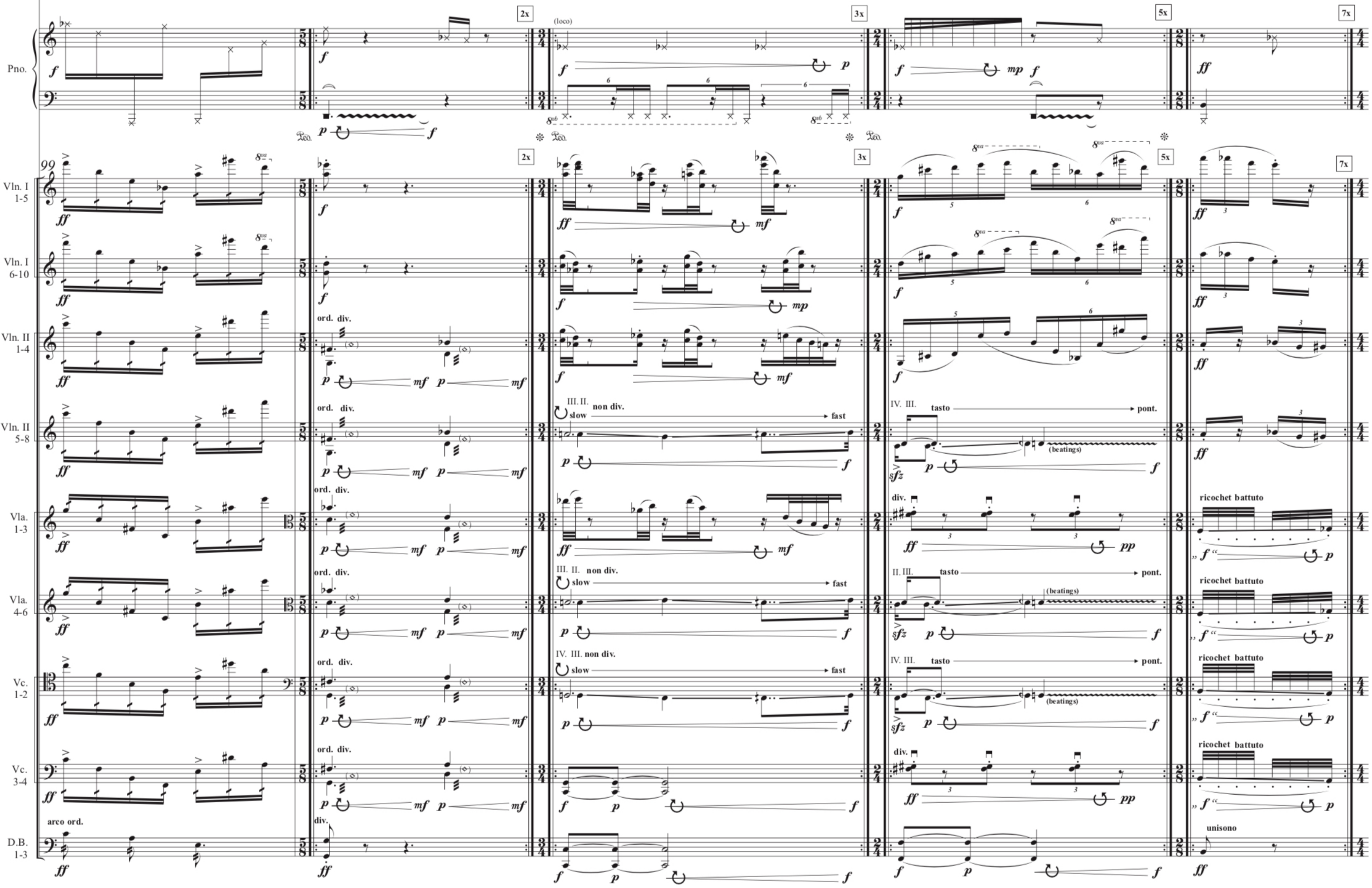
In the first score example I present an orchestral resynthesis of a bass clarinet air tone, where a very small gesture is expanded into a broader orchestral field (see Figure 2). This does not simply magnify the source but re-situates it in a new timbral environment. In the next step, I move this typical spectralist procedure to another level: I analyse the orchestral resynthesis itself and create further secondary resyntheses that are then distributed across the next passage of the piece (see Figure 3).
The sound model of a bass clarinet resynthesised through the orchestra. Wanke (Reference Wanke2023), Micrographies bars 28–32 (figure created by the author of the article).

Segments of the previous resynthesis analysed and redistributed within the composition. Wanke (Reference Wanke2023), Micrographies, bars 99–103 (figure created by the author of the article).

Figure 3 Long description
Panel A: A musical score for piano, violin, viola, cello, and double bass. The score includes various musical notations such as dynamics (p, mp, f), articulations (staccato, legato), and tempo markings. Panel B: A continuation of the musical score with similar notations and instruments. Panel C: Further continuation of the score with additional dynamics and articulations. Panel D: The final section of the score, showing a complex arrangement for the orchestra.
This strategy of repeated resynthesis is applied throughout the composition at different scales and in different contexts. The process of analysis followed by resynthesis becomes a method of repeated zooming into the sonic structure: at times it proceeds from very short, microscopic sound events, while at others it operates on longer, temporally extended passages. In this way, chains of successive transformations emerge, in which the individual stages of secondary, tertiary and further resyntheses relate not only to the original model but also to the intermediate stages of the process.
This recursive strategy becomes, in effect, an analogue of variation technique, allowing the material to fold back on itself while continually transforming. In this sense, the process traces a kind of genealogy of sound, each resynthesis moving further from the original while still carrying its imprint. Resynthesis here functions as a means of tracing and developing sonic identity across time: each iteration preserves certain structural features of its predecessor while simultaneously shifting, deforming or accentuating them in new ways.
Seen from this perspective, composition is less concerned with arriving at a single orchestrational outcome than with navigating a continuum of transformations. Orchidea proposes timbral morphologies that the composer can shape, edit or reject, fostering experimentation with unfamiliar instrumental groupings and revealing latent affinities between instruments and timbres. Orchidea does not replace orchestration but provides a lens that magnifies timbral space – an ally in discovering how instrumental resources may be resynthesised in novel ways.
Somax2: from orchestration to co-creation
The multivalent space – between a model and its transformation, recognition and deviation – can once again be associated with Grisey’s concept of musique liminale, which functions as a productive conceptual framework across all of the examples just discussed. Rather than delineating a stylistic category, it articulates a mode of working at threshold levels – between parameters, between sound sources and between perceptual experience and the analytical construction of sound. Liminality here does not function as an aesthetic label; rather, it designates the processual character of a compositional practice oriented towards unstable and mutable relationships. When extended into algorithmic and real-time contexts, this liminal logic operates not only at the level of sonic structure but also at the level of interaction and agency itself.
Within Somax2, this threshold logic is further articulated through the system’s handling of memory, sources and temporality. Ambiguity is no longer located solely in spectral attributes, but also in the operational status of sonic material itself: corpus fragments are not unambiguously tied to an original source or predefined function, but are activated within a relational network in which identity is continually recontextualised. The concurrent operation of multiple agents, their mutual listening and their heterogeneous temporal horizons produces intentionally unstable boundaries between input and output, reaction and initiation imitation and autonomous generation.
Whereas in instrumental resynthesis, liminality primarily concerns transitions between sonic parameters, in Somax2, it shifts into the temporal domain: musical presence is continually permeated by traces of past gestures and anticipations of possible continuations. In this sense, Somax2 can be understood not as a departure from spectralist thinking, but as its displacement onto a new plane, in which the spectral emphasis on relations, continuity and perceptual ambiguity is enacted at the level of interactional processes. Rather than constituting a historical continuation of spectralism in a narrow sense, this shift can be read as aligning with post-spectral modes of thought, in which its core epistemic principles are rearticulated within algorithmic interaction and real-time systems.
If Orchidea reimagines orchestration as a timbral search-space, Somax2 transfers and further develops this relational framework within the sphere of real-time performance. Whereas Orchidea culminates in a musical score and an audio rendering of its resynthesis, Somax2 unfolds directly in performance: it constructs a corpus-based memory not only as a repository of sounds but as a dynamically evolving stylistic landscape. Incoming audio or MIDI is continuously compared to this landscape, generating shifting activation patterns that function less as static matches and more as trajectories or attractors. This dynamic mapping provides the ground on which multiple software agents operate, each with its own temporal horizon, its own selection bias and its own sensitivity to gesture and continuity. The result is an improvisational environment whose texture emerges from prediction, feedback and adaptation rather than from a predetermined sequence.
At the heart of Somax2 lies a navigation model that perceives the time axis not as a linear path, but as a field of branching possibilities. Each agent listens outward to the live performer and inward to its own output, engaging in a recursive loop of monitoring and response. Peaks of similarity between input and corpus do not simply trigger playback; they open regions of potential from which agents may choose, delay, overlap or abandon material. This continuous negotiation produces emergent ensemble behaviours: cross-rhythms, layered echoes and timbral drifts. Improvisation here is less an act of free spontaneity than a probabilistic negotiation between memory, prediction and the micro-decisions of each agent, converging and diverging from moment to moment.
In this way, Somax2 extends the spectralist idea of instrumental resynthesis into the immediacy of co-creation. What in Orchidea appears as timbral morphologies projected onto a timeline takes the form here of a responsive counterpoint between human and algorithmic participants. Musical behaviour unfolds as a fluctuating network of tendencies, shaped by listening, response and the persistence of prior gestures. Somax2 thereby situates improvisation at a liminal threshold between analysis and invention, opening an aesthetic space where corpus-based techniques cease to be ends in themselves and instead become vehicles for distributed, collective imagination.
Somax2 does not primarily aim at resynthesising a sound model in the narrow sense of first-generation spectralism, although its architecture does not in principle exclude the use of spectrally defined criteria. With appropriately chosen input data, corpus structure and agent configuration, it would be possible to realise more conventionally sound-oriented forms of resynthesis; these, however, do not constitute the system’s main methodological ambition. Its dominant domain remains the handling of stylistic continuity and context-sensitive real-time response. This shift from the sound object to musical behaviour marks a change in the level at which the concept of resynthesis is applied in Somax2. The output does not emerge as a strict realisation of a target sound, but rather as an emergent result of continuous comparison between the input and the stored material, its selective updating and redistribution in real time. The resynthetic aspect thus manifests itself primarily in the organisation of temporal processes that preserve structural, perceptual or behavioural relations to the model.
In this conception, a comparable principle of instrumentally mediated engagement with spectral resynthesis is at work: the original sound model – which need not be directly present as an audible object – is reproduced in Somax2 through a different sonic material. Already in classical spectral practice, resynthesis is understood as a process of interpretation or translation of an original sound model. Its realisation through a vocal–instrumental apparatus is inevitably shaped by the acoustic properties of specific instruments. In this sense, resynthesis operates as a process in which the original spectral model is projected into temporally unfolding musical behaviour and structural relations. What is decisive, therefore, is the manner in which the model organises behaviour over time, rather than its literal sonic representation. This perspective can be applied directly to Somax2 as well, where resynthesis likewise does not function as the reconstruction of a stable sound object, but rather as a process in which the analysed model is projected into the system’s temporally unfolding musical behaviour.
This understanding of resynthesis is also reflected in the system’s internal analytical structure. Somax2 segments musical material into short units and analyses it in parallel across multiple layers, such as pitch, harmony, timbre or continuity. These layers do not form a spectrum in the acoustic sense, but function as perceptually and structurally relevant dimensions for modelling relationships and continuities over time. What matters here is not the analytical distinction of these layers as such, but their function in modelling relationships, similarities and continuities over time.
Within this framework, the resynthetic principle in Somax2 operates at the level of musical behaviour, gesture and stylistic relations unfolding over time. Spectral thinking is thereby reconfigured from a materially oriented compositional technique into a broader aesthetic of process, memory and perceptual coherence. In this sense, Somax2 exemplifies a post-spectral mode of thought in which resynthesis operates primarily at the level of relational organisation rather than sonic material.
A set of performative strategies can be proposed for working with Somax2. (1) The corpus may be pre-shaped so that the machine’s continuations remain within a chosen idiom. (2) Agent roles can be configured to articulate specific ensemble behaviours. (3) Memory, decay and self-listening parameters may be adjusted to balance stylistic continuity against divergence. (4) Somax2 may also be coupled with external processing, allowing its output to be sonically transformed prior to re-entry into the system, thereby creating an additional feedback layer beyond the internal decision process.
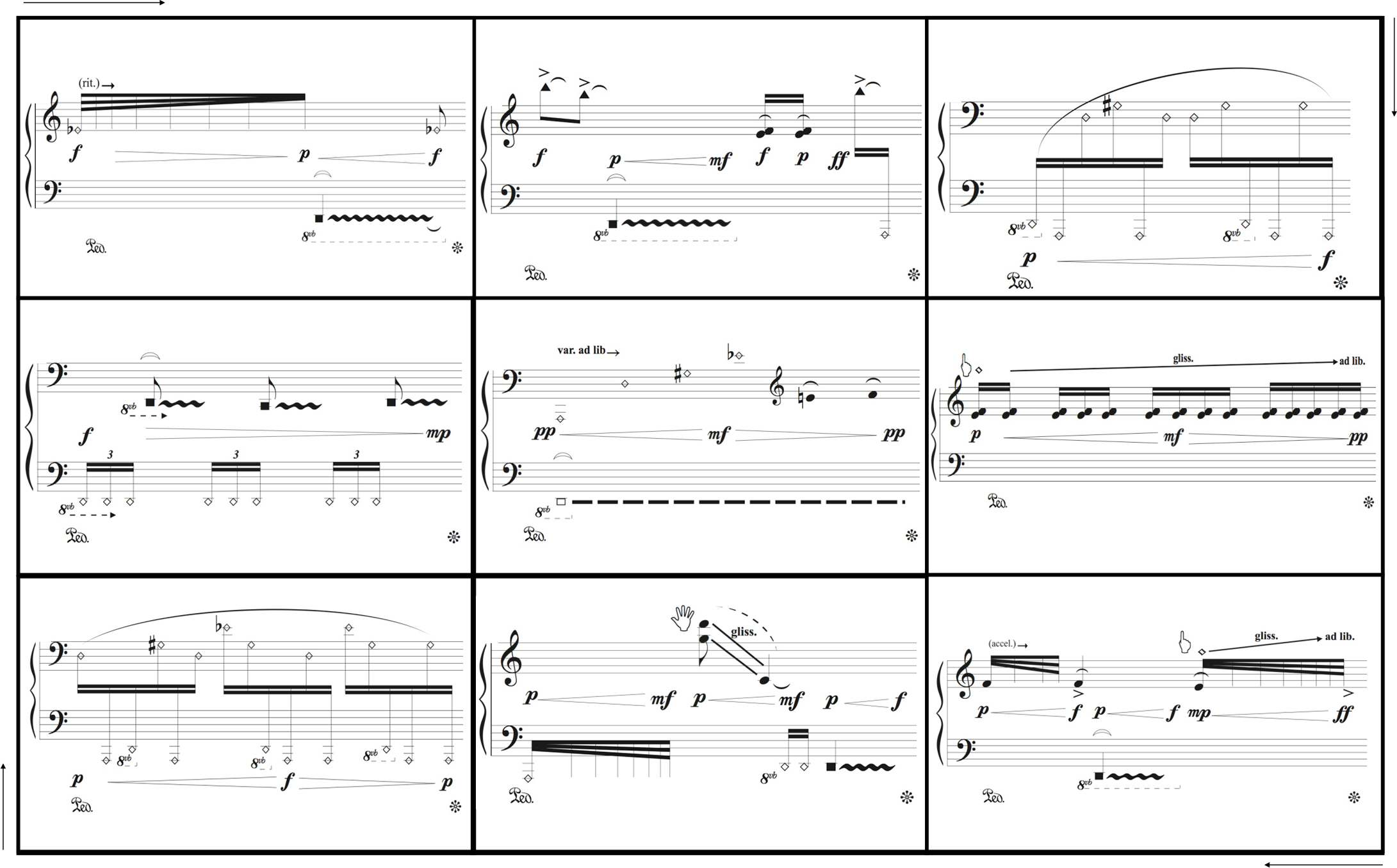
As a concrete example, this approach has been explored in my composition cycle In Broken Images (2018–2025) for variable chamber ensembles (2–8 players). The initial material is generated through an L-system,Footnote 8 a strictly deterministic procedure. This material is then organised via a mobile structure, inspired by the work of Alexander Calder, in which fixed iterations of the L-system are grouped into cells that can be reinterpreted according to further playing rules (see Figure 4). The interplay between determinism and indeterminacy here reflects a fundamental dialectic already present in early algorithmic composition – for instance, in Gottfried Koenig’s Project 1 and Project 2, whose structural generators explicitly distinguished between ‘alea’ and ‘seria’ modes (see Koenig Reference Koenig1991: 179).
Mobile for piano, constructed from iterations generated by an L-system. Wanke (Reference Wanke2025) In Broken Images, figure created by the author of the article.

This same dialectic is inscribed into the electronic part, realised through AI improvisation. Although Somax2’s core retrieval mechanism is exemplar-based, its selection policies incorporate probabilistic weighting and stochastic sampling, which means that identical influencer inputs may produce variant outputs across performances. The probabilistic component is tuned to preserve stylistic coherence (via the corpus) while avoiding deterministic repetition; in other words, the system operationalises a constrained randomness that privileges statistically likely continuations but permits creative variance. This design mirrors long-standing compositional concerns with the balance between determinacy and indeterminacy, yet relocates them within a machine-mediated interactional topology.
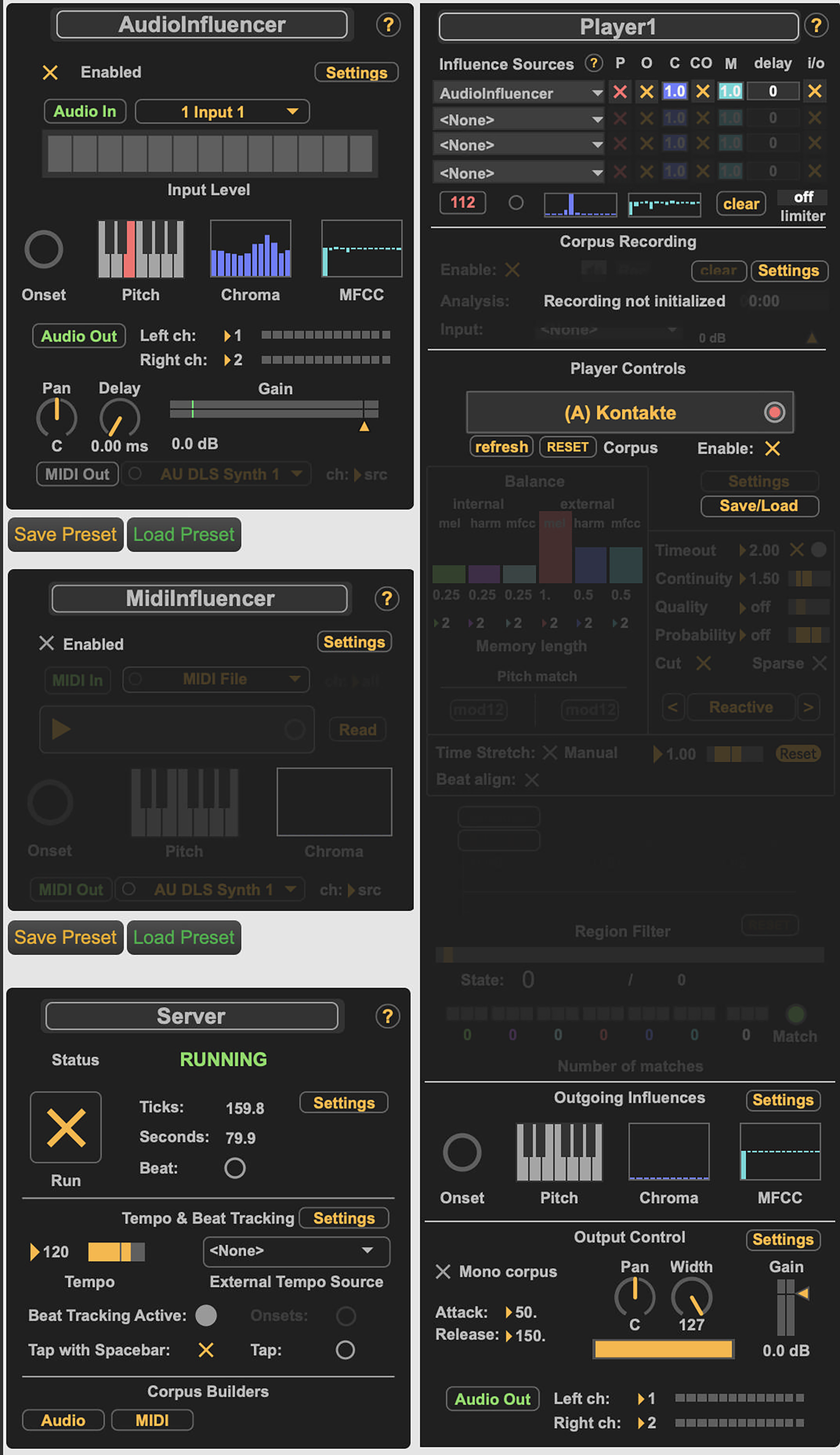
The number of electronic agents in this example matches that of the live performers; just as the instrumentalists must respond to one another within the rules of the mobile, so too are the electronic agents programmed to interact both among themselves and with the instrumentalists (see Figure 5). A multi-layered network of interactions thus emerges: between the acoustic instruments, among the electronic agents, across the acoustic and electronic strata and, finally, between individual performers and their algorithmically assigned partners. This distribution of relationships is further refined through weighted assignments of importance, allowing differentiated patterns of responsiveness across the ensemble.
Example of an interaction mediated by Somax2. Wanke (2025), In Broken Images, figure created by the author of the article.

Beyond compositional applications, Somax2 has also been employed in my own performance practice, particularly in a minimalist duo setting where a modular synthesiser is paired with an AI partner (see Audio Example 2). In this configuration, the only input to the system is my live playing, which gives rise to several implications for improvisation:
-
Planning the input. Since the corpus is generated in real time, careful consideration must be given to the material introduced at each stage of the performance. The corpus functions as a continuously expanding memory, becoming increasingly diverse and variable as the performance unfolds. Selective erasure of the corpus during the set further enables formal articulation, allowing sections to be opened or closed by reshaping the system’s memory.
-
Principle of repetition. Somax2 reacts on the basis of similarity and difference, making it possible to evoke reminiscences of earlier material by timbrally approximating it. This establishes a deliberate play with memory and recall, where echoes of the past are woven back into the present.
-
Buffer as electronic memory. The evolving corpus can be understood as a buffer that embodies the system’s electronic memory. This memory is ambivalent: it may accumulate and saturate, producing dense networks of recall, or it may be rendered porous and volatile, gradually leaking and vaporising its content. Such manipulation of memory creates trajectories in which distinctions between live and mediated gestures blur, as sonic identities dissolve into a shifting reservoir of traces.
-
Runtime dynamics. Because Somax2 agents recursively incorporate their own outputs into subsequent activations, the ensemble exhibits mobile behaviour: elements drift, aggregate and fragment according to tuned decay rates and transition probabilities. This recursive process produces a layered improvisational texture, in which the performer navigates a constantly evolving field of machine responses.
These performative scenarios illustrate how Somax2 can be approached both compositionally and in live improvisation, with strategies ranging from corpus design and agent configuration to the cultivation of memory, repetition and recursive dynamics. Together, these scenarios illustrate how the system negotiates between determinacy and indeterminacy, between recall and transformation and between individual and distributed forms of agency.
Viewed from the perspective developed earlier in the paper – instrumental resynthesis as an analytic–representational loop – Somax2 transposes, and further extends, the resynthesis imperative into a performative register. Spectral analysis and slice-level descriptors function here as low-level reference points for analogical matching, while the recursive cycle of listening, generation and self-analysis forms a dynamic mechanism that continually reorganises material in time. In this sense, Somax2 may be understood as part of a broader conceptual continuum in which earlier resynthetic approaches are further transformed and reconfigured. Rather than aiming at the reconstruction of a stable sonic object, resynthesis operates here through the organisation of relationships, temporal processes and zones of liminality, in which musical material continuously shifts between memory, anticipation and emergent behaviour. The crucial difference lies in the fact that Somax2 realises these processes live, adaptively and in a distributed manner, thereby situating resynthesis within a post-spectral aesthetic of process, interaction and co-creative agency.
From instrumental resynthesis to algorithmic agency
Tracing the line from late-twentieth-century spectral practice to today’s data-driven compositional tools reveals a continuity of concern rather than a single aim: a sustained interest in deriving structural procedures from the analysed properties of sound. What has shifted are the computational modalities by which this ambition is pursued and the distribution of decision-making they entail. Whereas spectral composers relied on explicit, human-interpretable descriptors (partials, formants and envelopes) and manual mappings to instrumental technique, contemporary AI systems displace much of this interpretive work into learned representations, forecasting engines and heuristic optimisers.
Technically, algorithmic agency refers to the capacity of computational subsystems to generate, evaluate and iterate proposals within optimisation or generative loops according to criteria not reducible to direct human intervention. A forecasting module may predict spectral vectors and pre-select candidate orchestrations; a recurrent network trained on feature trajectories may propose temporally coherent continuations and a genetic optimiser may recombine solutions through algorithmic crossover and mutation. In tools such as Orchidea, these operations shift the locus of creative contingency: what was once the composer’s manual trial-and-error with combinations becomes an interaction with a system that proposes and filters solutions under algorithmic criteria.
Somax2 relocates the resynthetic principle into the temporal and performative dimension: instead of seeking an instrumental analogue to a given spectral snapshot, it continuously navigates a corpus, matches live input to multi-layer slice descriptors and generates outputs that both reflect and reshape the ongoing musical situation. Crucially, this is done in a self-referential loop – self-listening – that conditions future activations on the system’s own emissions, thereby establishing a recursively autopoietic dynamic in which machine decisions acquire a temporally extended agency that may rival, and at times lead, human initiative.
From an aesthetic vantage point, three interlinked phenomena arise from this technological reconfiguration and merit careful conceptual unpacking.
-
The availability of large, annotated corpora and high-dimensional embeddings dramatically expands the operational radius of resynthesis and spectral transformation: whereas spectralists worked with single or a few target models, modern systems may draw on thousands of annotated slices or samples, creating dense regions in timbral space that the optimiser navigates. This informational saturation mitigates some of the interpretive brittleness of earlier methods (more data often stabilises perceptual matches) but also produces a new kind of aesthetic opacity – decisions emerge from high-dimensional interactions that resist straightforward hermeneutic interpretation.
-
Recursion and temporal depth. The incorporation of memory mechanisms – LSTM states in Orchidea’s predictive pipelines, short-term memory and self-listening in Somax2 – renders a process that operates both in the immediate present and across extended temporal spans: the system’s outputs feed back into subsequent processing and thereby instantiate a form of algorithmic temporality that can accumulate stylistic tendencies, selection bias and gradual drift over time. This recursive depth also implies that even seemingly minor parameter adjustments may, through iterative self-reinforcement, result in substantial changes.
-
Distributed agency. In some cases, as systems assume capacities for forecasting, selection and iterative refinement, the composer’s role may become increasingly meta-procedural: selecting corpora, weighting objective functions, specifying constraint grammars and tuning agentic affordances; these meta-decisions are themselves compositional acts, but of a different order – less notational, more infrastructural – so that the locus of creative labour expands from the singular act of writing notes to the plural practices of designing datasets, sculpting loss functions and orchestrating interactional grammars.
Conclusion
In this paper, I have advanced the thesis that contemporary AI-based compositional environments – exemplified by Orchidea’s optimisation-driven orchestration and Somax2’s corpus-guided, agentic co-improvisation – represent a continuation and further development of spectralist compositional tendencies. AI technologies have transposed the analytic-resynthetic loop into algorithmic terms: spectral descriptors are embedded in high-dimensional spaces, forecasting engines predict outcomes without exhaustive synthesis and optimisers and agents enact selections that embody a novel form of computational judgement. The aesthetic and practical consequences of this transposition are manifold: an expanded operational radius of resynthesis, temporally recursive generation and new performative ecologies in which human and algorithmic processes intersect, overlap and continually reshape one another.
Supplementary material
The supplementary material for this article can be found at https://doi.org/10.1017/S1355771826101289