Introduction
The World Health Organization (2015) claims that mobility is vital to healthy ageing and is the best guarantee of older adults being able to cope and remain in their homes and communities. Mobility enables older adults to maintain their physical health, independence and participation in society (Webber, Porter and Menec Reference Webber, Porter and Menec2010). Mobility is the ability and the opportunity to physically move oneself, either independently or by using assistive devices or transportation, to get to places one wants or needs to go (Mollenkopf, Hieber and Wahl, Reference Mollenkopf, Hieber and Wahl2011; Webber, Porter and Menec Reference Webber, Porter and Menec2010). Mobility has predominantly been understood in functional terms (i.e. as a physiological ability to move) (Pahor et al. Reference Pahor, Guralnik, Ambrosius, Blair, Bonds, Church, Espeland, Fielding, Gill, Groessl, King, Kritchevsky, Manini, McDermott, Miller, Newman, Rejeski, Sink and Williamson2014). However, in recent years, the ‘mobility turn’ has expanded this approach by arguing that in addition to physical movement – getting from one place to another – mobility is characterised by the representations of movement that give it a shared meaning and the experiences and embodied practice of movement (Cresswell Reference Cresswell2010; Frello Reference Frello2008). These subjective facets affect older adults’ judgements and actions, and have a significant impact on why older adults choose to physically move themselves throughout their communities (Chudyk et al. Reference Chudyk, Winters, Moniruzzaman, Ashe, Gould and McKay2015; Fleig et al. Reference Fleig, Ashe, Voss, Therrien, Sims-Gould, McKay and Winters2016; Goins et al. Reference Goins, Jones, Schure, Rosenberg, Phelan, Dodson and Jones2014; Mokhtarian, Salomon and Singer Reference Mokhtarian, Salomon and Singer2015; Mollenkopf, Hieber and Wahl Reference Mollenkopf, Hieber and Wahl2011; Rantakokko et al. Reference Rantakokko, Iwarsson, Vahaluoto, Portegijs, Viljanen and Rantanen2014; Ziegler and Schwanen Reference Ziegler and Schwanen2011). For example, Ziegler and Schwanen (Reference Ziegler and Schwanen2011) found that an ‘openness to engagement’, defined as a mental disposition of willingness to connect with the world, is a crucial driver of mobility and wellbeing. It leads individuals to desire engagement both ‘mentally and socially with “difference”, to develop and maintain relations with other people and affairs, both at the level of the local community and more widely’ (Ziegler and Schwanen Reference Ziegler and Schwanen2011: 774). This desire to remain engaged and connected to the outside world allows older people to physically get out and meet others and in this way, fulfill social and physical roles, and maintain their inner mental and emotional wellbeing (Metz Reference Metz2000).
Mobility framework
Mobility research is a multi-disciplinary field and a number of conceptual frameworks have been developed that relate directly or indirectly to mobility issues relevant to older adults (for an overview of frameworks, see Webber, Porter and Menec Reference Webber, Porter and Menec2010). Webber, Porter and Menec (Reference Webber, Porter and Menec2010) were the first to develop a socio-ecological framework that aimed to bridge disciplines and move beyond the predominant focus on functional aspects of mobility. Webber, Porter and Menec (Reference Webber, Porter and Menec2010) define mobility as the:
ability to move oneself (e.g., by walking, by using assistive devices, or by using transportation) within community environments [both built and social] that expand from one's home, to the neighborhood, and to regions beyond … Mobility may take many forms, including, but not limited to, walking, using a wheelchair, driving, and using alternate forms of transportation. (Webber, Porter and Menec Reference Webber, Porter and Menec2010: 443–5)
Their framework incorporates intrapersonal, interpersonal, community and broader socio-demographic elements. In addition to the built and social environments framed as integral to mobility, they suggest that multiple facets of the individual (e.g. physical, cognitive and psychological characteristics) are also integral to mobility.
Webber, Porter and Menec's (Reference Webber, Porter and Menec2010) framework was a much-needed advance in the field of mobility research. A growing body of literature supports the framework and its inherent notion that mobility determinants are interrelated. For example, built and social environments have been shown to play an important role in facilitating mobility (Chudyk et al. Reference Chudyk, Winters, Moniruzzaman, Ashe, Gould and McKay2015; Gardner Reference Gardner2011; Hanson et al. Reference Hanson, Winters, Ashe and Mckay2012; Rosso, Auchincloss and Michael Reference Rosso, Auchincloss and Michael2011; Yen, Michael and Perdue Reference Yen, Michael and Perdue2009). A neighbourhood built environment includes features such as destinations, transportation and street layout (Frank et al. Reference Frank, Sallis, Conway, Chapman, Saelens and Bachman2006; Van Cauwenberg et al. Reference Van Cauwenberg, Van Holle, De Bourdeaudhuij, Clarys, Nasar, Salmon, Maes, Goubert, Van de Weghe and Deforche2014). A number of recent studies (Kerr, Rosenberg and Frank Reference Kerr, Rosenberg and Frank2012; Marmot Reference Marmot and Bell2011; Rantakokko, Mänty and Rantanen Reference Rantakokko, Mänty and Rantanen2013; Sallis et al. Reference Sallis, King, Sirard and Albright2007; Thompson et al. Reference Ward Thompson, Curl, Aspinall, Alves and Zuin2014) ‘identified that specific elements of the community supported increased walking. These included streets with more businesses, the presence of malls and trails, parks and green space, retail destinations, and amenities in general’ (Hanson et al. Reference Hanson, Winters, Ashe and Mckay2012: 4). The built environment can either be designed to foster spaces for social and physical activity or it can be designed to foster spaces for isolation and immobility.
Social capital is a popular concept used in research and policy to stress the value of the social environment and social contacts for the health and wellbeing of older adults. The social environment includes social spaces, social relationships and cultural milieus (Gardner Reference Gardner2011, Reference Gardner2014; Guell et al. Reference Guell, Shefer, Griffin and Ogilvie2016; Mahmood et al. Reference Mahmood, Chaudhury, Michael, Campo, Hay and Sarte2012). For people who are less mobile, such as older adults, local social contacts may be an important resource to receive social support and stimulate ongoing mobility (Gray Reference Gray2009). Culture has a significant impact on social capital and social capital on social supports; all of which have an influence on opportunities and desire to remain engaged and mobile (Webber, Porter and Menec Reference Webber, Porter and Menec2010). For example, ageism may influence how public spaces are funded (e.g. playgrounds, waterparks, recreation programmes versus seniors’ programmes). A culture with underlying ageist assumptions may dictate that priority be placed on funding infrastructure and activities for younger segments of the population, therefore limiting opportunity for the older segment of the population to engage in meaningful formal and informal social connections in the community. Culture also plays a critical role in influencing mobility choices at the individual level. Choice of mobility mode (i.e. walking, taking the bus, driving a car) is influenced by perceptions and norms within local culture (Green, Jones and Roberts Reference Green, Jones and Roberts2014; Langzaam Verkeer 2010). ‘Many older people's perceptions of what the older body should and should not do, are fueled by their understanding of the biological processes of ageing as well as pervasive ageist social and cultural attitudes, expectations and prejudices’ (as cited in Griffin and Phoenix Reference Griffin and Phoenix2014: 393). ‘Older people are often assumed to be frail or dependent, and a burden to society … these and other ageist attitudes, can lead to discrimination, affect the way policies are developed and the opportunities older people have to experience Healthy Ageing’ (World Health Organization 2015). In the systematic review by Franco et al. (Reference Franco, Tong, Howard, Sherrington, Ferreira, Pinto and Ferreira2015) on ageing and perspectives of physical activity, 74 studies (56%) report that older adults believe that symptoms and physical limitations caused by existing comorbidities prevent them from exercising, and that age-related deterioration is unavoidable and unpreventable.
Moreover, older adults with low incomes have a greater susceptibility to limited mobility (both physiological ability and travel behaviour) than those with higher incomes (Chetty et al. Reference Chetty, Stepner, Abraham, Lin, Scuderi, Turner, Bergeron and Cutler2016; Koster et al. Reference Koster, Bosma, Broese van Groenou, Kempen, Penninx, van Eijk and Deeg2006; Nordstrom et al. Reference Nordstrom, Diez Roux, Schulz, Haan, Jackson and Balfour2007). This susceptibility puts them at an increased risk for decreased individual capacity and increased risk of morbidity, poor physical function and incident mobility impairment over time (Huisman, Kunst and Mackenbach Reference Huisman, Kunst and Mackenbach2003; Koster et al. Reference Koster, Bosma, Broese van Groenou, Kempen, Penninx, van Eijk and Deeg2006; Shumway-cook et al. Reference Shumway-Cook, Ciol, Yorkston, Hoffman and Chan2005). Despite the fact that older adults with low incomes experience significant physical and social health disparities which influence their mobility, this group is under-represented in research (Schnirer and Stack-Cutler Reference Schnirer and Stack-Cutler2011), including mobility research (Hughes et al. Reference Hughes, Leith, Marquez, Moni, Nguyen, Desai and Jones2011). The scarce literature on older adults with low income tends to focus on older adults who have limited mobility or who are inactive (Koster et al. Reference Koster, Bosma, Broese van Groenou, Kempen, Penninx, van Eijk and Deeg2006), pinpointing disparities. To the best of our knowledge no studies have looked at active, mobile, older adults with low income over time, in order to understand factors that facilitate their continued mobility patterns.
Though Webber, Porter and Menec's (Reference Webber, Porter and Menec2010) framework was a notable contribution to the field of mobility research, in general, mobility is examined objectively, from a quantitative perspective where mobility is measured as physical movement (e.g. physical activity) and/or travel behaviour (e.g. trips, modes and distances). The predominant focus on the functional aspects of mobility tends to overlook the subjective (e.g. perceptions, attitudes and motivations) dimensions of older adults’ mobility experiences (Schwanen and Ziegler Reference Schwanen and Ziegler2011). Moreover, the temporal dimensions of older adults’ mobility are even more scarcely given attention. The failure to focus on the temporal aspects of older adults’ mobility treats older adults’ transactions with their ‘environments, settings, or situations as merely contextual snapshots or temporally static episodes rather than frames of an ongoing environmental movie’ (Golant Reference Golant2003: 639). For example, time as a component of older adults’ attachment to place where familiarity with place establishes itself through length of residence in the community (Rowles Reference Rowles1978, Reference Rowles1983) may influence mobility. Of those that have explored time and mobility, familiarity with the physical and social structure of the neighbourhood has been shown to be important for older adults. Furthermore, familiarity can facilitate adaptive strategies for older adults with mobility impairments and confer a sense of belonging, independence and subjectively experienced autonomy (Wiles et al. Reference Wiles, Leibing, Guberman, Reeve and Allen2012; Ziegler and Schwanen Reference Ziegler and Schwanen2011). Mobility, much like place attachment, is not a static state but rather a process that evolves throughout life.
Purpose of the study
We aim to advance mobility research by utilising a constructivist grounded theory (CGT) approach to understand the mobility experiences of active older adults with low income, and their attitudes, meaning and motivations of mobility in order to provide insight into how they overcome physical and social health disparities and remain active over a period of four years. Thus, this study is guided by the following questions: (a) How do active older adults with low income experience mobility? and (b) What influences older adults’ mobility choices over time?
Methods
Design
We used a CGT methodology. A CGT methodology is appropriate for this study as it provides the opportunity to explore individual processes, interpersonal relations, and the reciprocal effects between individuals and larger social processes. ‘CGT methods are useful for studying typical social psychological topics such as motivation, personal experience, emotions, identity, attraction, prejudice and interpersonal co-operation and conflict’ (Charmaz Reference Charmaz, Smith, Harre and Van Langenhove1996: 29). Additionally, CGT approaches data collection and data analysis as integrated elements of a research process, constantly informing each other. Charmaz (Reference Charmaz2014: 344) defines a process as consisting of ‘unfolding temporal sequences in which single events become linked as part of a larger whole and lead to change’. A process may have identifiable markers with clear beginnings and endings and benchmarks in between or may be much more diffuse and less visible, but nonetheless evident when comparisons are made over time.
Participants and recruitment
For CGT studies, it is important to start data collection with a group of participants who have experienced the phenomenon under study. There were two stages of sampling in this study. First, we used purposeful sampling to achieve maximum variation in neighbourhood walkability, age and gender. Second, we utilised maximum variation sampling to examine and reflect diverse perspectives (Creswell Reference Creswell2013). Participants were drawn from the Walk The Talk study (WTT), a cross-sectional study of adults over the age of 65 (N = 161) who receive rental subsidies through British Columbia (BC) Housing. WTT participants live in eight municipalities in Metro Vancouver, BC. Metro Vancouver has 21 communities, and a population of 2.5 million people (Statistics Canada 2012). We excluded individuals who self-reported that they were diagnosed with dementia; left their home to go into the community less than once in a typical week; were unable to understand or speak English; were unable to walk ten minutes with or without a mobility aid (e.g. cane, walker); and/or were unable to participate in a mobility assessment involving a four-metre walk. Full details of the WTT study and the inclusion/exclusion criteria for sampling were previously reported (Chudyk et al. Reference Chudyk, Winters, Moniruzzaman, Ashe, Gould and McKay2015).
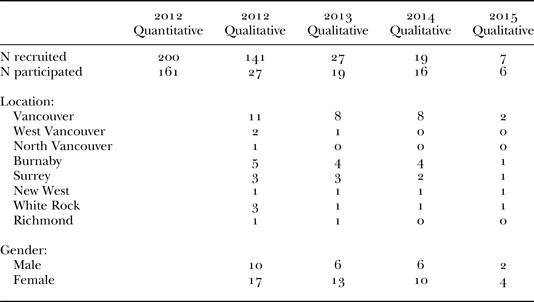
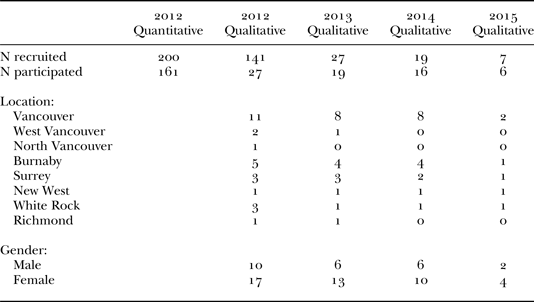
Upon approval (H12-00033) from the University of British Columbia ethics board, introduction letters and consent forms were provided to 141 of 161 WTT participants who consented to future follow-up. Based on age, race, ethnicity, geographic location of residence within Metro Vancouver and neighbourhood walkability (high, medium, low), we purposefully invited 27 women (17) and men (ten) to participate in in-depth interviews. Participants were invited for follow-up interviews each year (2012–2015) (Table 1).
Recruitment and sampling
Theoretical sampling
For the purpose of this study, 24 interviews with six individuals were theoretically sampled and used for analysis (Kathy Charmaz, personal communication, 2016). The goal of theoretical sampling in this study is to gain a greater understanding of the mobility experiences of older adults with low income who maintained activity levels over time. Theoretical sampling is purposeful selection of a sample based upon the developing categories (Charmaz Reference Charmaz1990). For theoretical sampling to be implemented successfully, concurrent data collection and analysis is required (Glaser Reference Glaser1978). The six individuals theoretically sampled describe, over the period of four years, maintaining high levels of mobility, including walking and using public transportation, and engaging in various forms of physical and social activities. Participants varied in age, gender and geographic location.
Procedure for each interview
Participants were interviewed at the time and location of their choosing. They were provided with a Can $20 grocery gift card in recognition of their time. Interviews lasted approximately 60–90 minutes and were supported by a semi-structured interview guide. The questions in the interview guide were informed by Webber, Porter and Menec's (Reference Webber, Porter and Menec2010) conceptual framework of older adults’ mobility. Participants were asked about their health, physical activity, travel behaviours, and the local built, social and natural environments. All interviews were audio recorded and transcribed (verbatim) by a professional transcription agency. Data were saved using identification numbers and transcripts were de-identified using pseudonyms to ensure anonymity, and were uploaded into the qualitative software analysis program NVivo 11. As data were analysed, the interview guide changed slightly to follow up on and/or explore areas that emerged or were not discussed in initial interviews. At the beginning of each interview, detailed information was provided about the study, such as the purpose, procedures and methods to help ensure confidentiality, and potential risks and benefits of the research. Participants who agreed to participate in the study signed a consent form at the beginning of each interview.
Analysis
CGT data analysis procedures of immediate and constant data analysis were followed. Data collection and analysis occurred concurrently, as this iterative process inspires deeper questions and analysis (Charmaz Reference Charmaz2006). Researchers enter an interactive phase with their data as they analyse it and themes begin to emerge, they go back to their participants and explore the emerging themes, new ideas, and confirm or refute themes that emerged. Codes, much like participants’ lives, may change or be refined over time with the analytic process. By constantly analysing and collecting data over time, we were able to construct, refine and/or qualify codes, themes and categories (Charmaz Reference Charmaz and Ritzer2007; Charmaz and Mitchell Reference Charmaz, Mitchell, Atkinson, Coffey, Delamont, Lofland and Lofland2001). Our work aimed to understand participants’ views and actions from their perspectives and ground the codes in these perspectives, all whilst realising and being open to the ongoing shifting and refining process. Over the four-year period, the three-step coding process in data analysis identified by Glaser (Reference Glaser1978) and (Charmaz Reference Charmaz, Smith, Harre and Van Langenhove1996, Reference Charmaz2006, Reference Charmaz2014) was followed: first stage: Open Coding (initial coding) stick to the data; second stage: Focused Coding; and third stage: Theoretical Coding. Additionally, the constant comparative analysis method was used (Sandelowski et al. Reference Sandelowski, Voils, Leeman and Crandell2012). Constant comparative analysis unfolds the meaning after the data has been collected. In our study, the interviews were compared with each other. Each interview was examined to see what similarities and differences it contained in relationship to the other interviews.
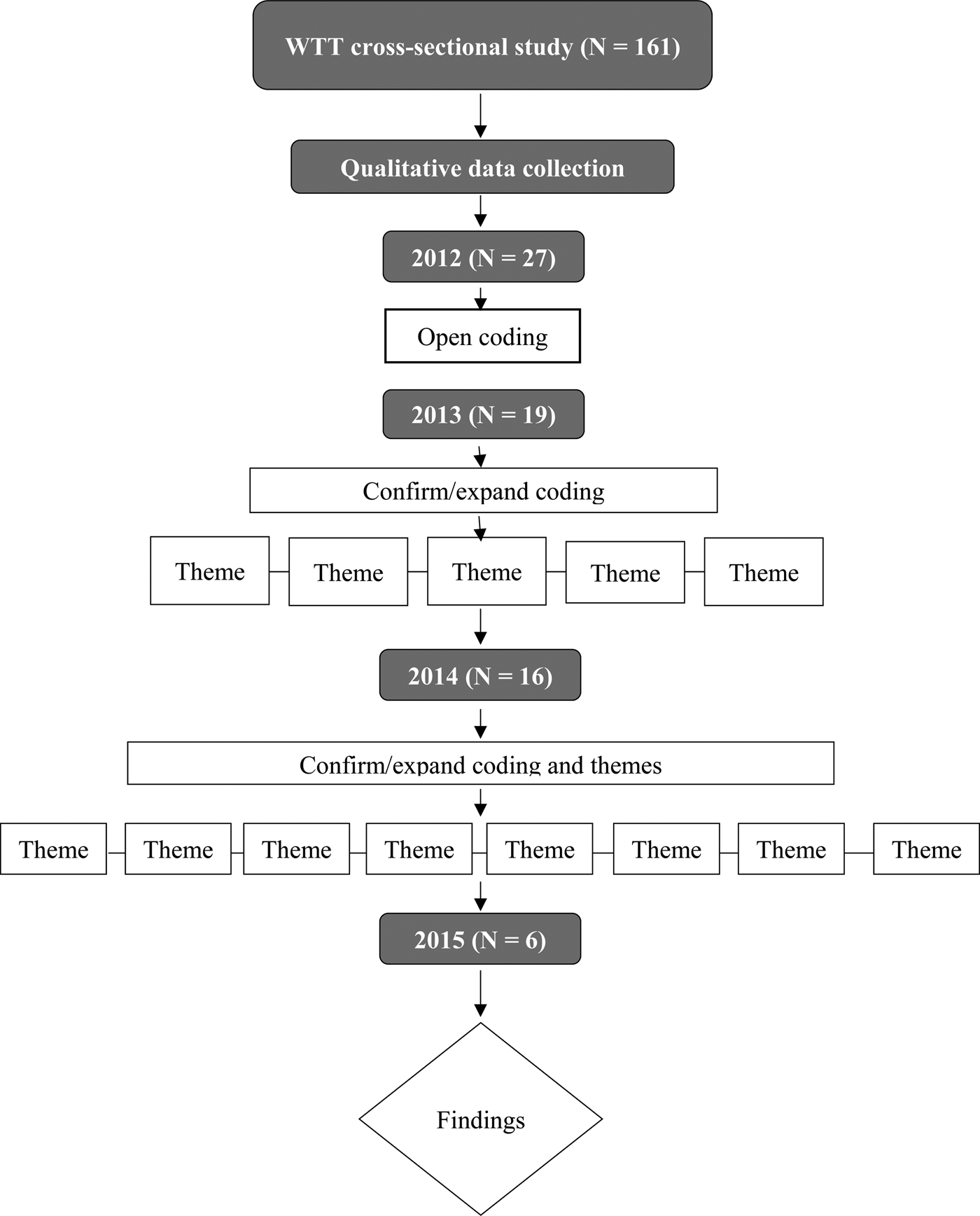
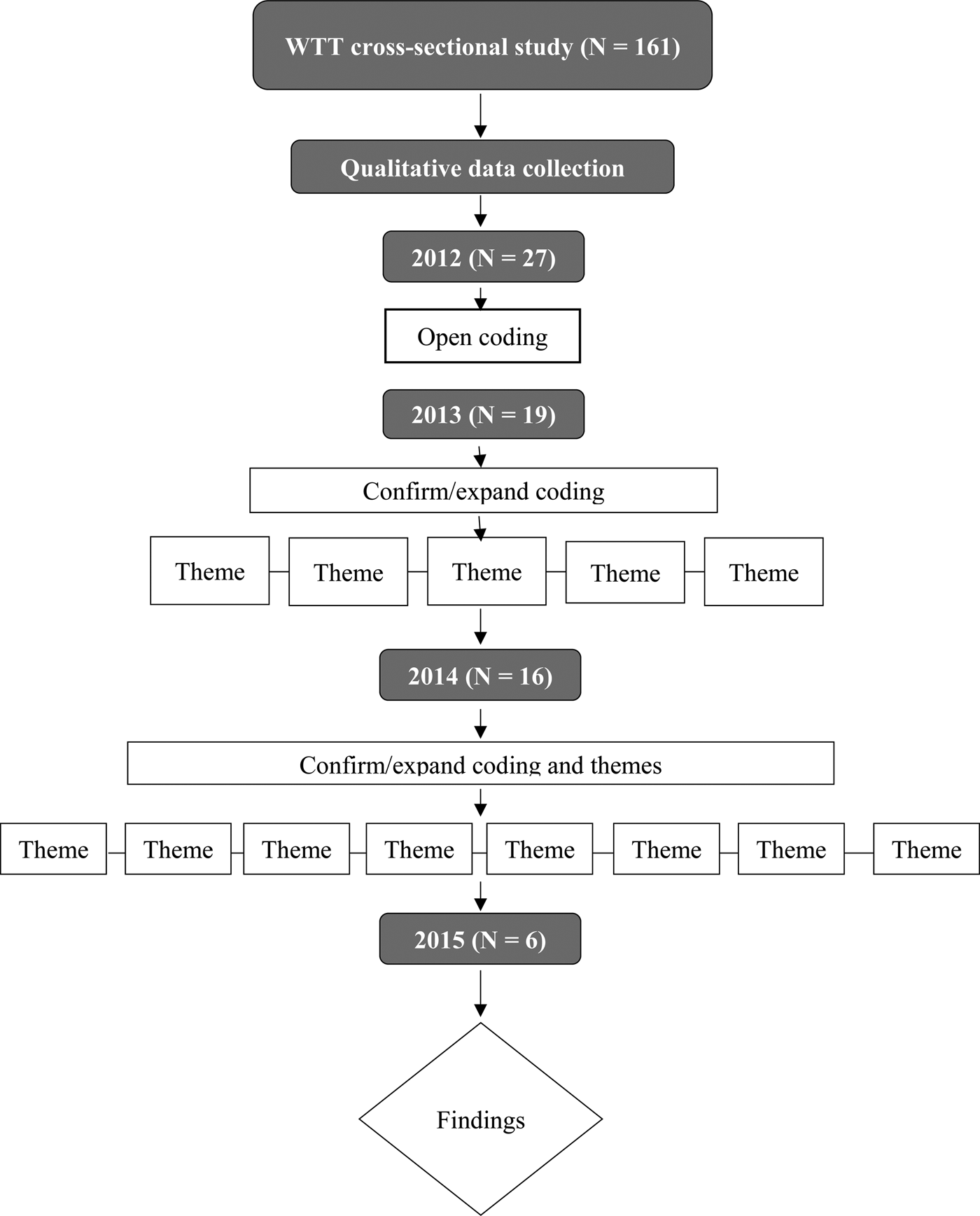
Analysis (in 2012) began with an open coding method to organise data. In this initial phase the lead author identified cases that were related across emerging codes and cases that did not ‘fit’ within codes (Franke et al. Reference Franke, Tong, Ashe, McKay and Sims-Gould2013). This stimulated additional data gathering (in 2013) that either expanded the codes or confirmed the codes that were developed. As the lead author coded, she grouped related codes into themes. A theme is an outcome of coding and analytic reflection (Saldaña Reference Saldaña2013). The themes and codes stimulated further sampling to confirm and expand (in 2014 and 2015). Through constant comparison of themes and codes across interviews, the lead author began to organise the data as a means of data reduction (for a visualisation of the process of data collection and analysis, see Figure 1).
The process of data collection and analysis.
During the analysis process, the team compiled a list of cases that were well suited to inform the development of vignettes. The literature demonstrates the ability of this technique to capture how meanings, beliefs, judgements and actions are situationally positioned (Barter and Renold Reference Barter and Renold2000). The choice of two vignettes included in this paper helps to illustrate the intersection of the various themes that were identified among the transcripts and how they are positioned (Barter and Renold Reference Barter and Renold2000). The two vignettes are both non-fictional; each vignette represents a specific participant in the study and uses their own words in quotes. We used a number of strategies to reinforce the rigour of our study: cross-checking full transcripts against original audio files for quality and completeness; reflexive memoing throughout the data generation and data analysis process; and ‘member checking’ through preparation and circulation of summary reports each year (Lincoln and Guba Reference Lincoln and Guba1985).
Findings
Based on interview analyses, we identified multiple themes that influence mobility choices over time: maintaining a sense of self, being resourceful, openness to engagement, engaging in superficial contact, experiencing social capital, accessing transportation, leaving the immediate neighbourhood and facing affordability. The themes are dynamic, interrelated and overlapping in nature, and we present them in relation to the multiple levels of influence outlined in Webber, Porter and Menec's (Reference Webber, Porter and Menec2010) mobility framework (i.e. intrapersonal, interpersonal, community and broader socio-demographic elements).
To highlight the interrelated nature of the themes, we present ‘Rose’. The vignette ‘Rose’ presents mobility as not only an outcome of functional capacity but also a temporal process comprised of individual-level elements (attitudes, meanings and motivations). Both the outcome and the process of mobility are influenced at multiple levels (i.e. intrapersonal, interpersonal, community and broader socio-demographic elements).
Vignette 1: Rose
Consider this story. A 76-year-old women weighs 90 pounds, she is five feet and seven inches tall and she lives on a low income. She has arthritis, osteoporosis, asthma, chronic obstructive pulmonary disease (COPD), heart disease, anxiety and degenerative disease. She has been denied heart surgery for the second time. The doctors tell her she is too frail, and not stable enough to survive surgery. This woman, named Rose, migrated from England to Alberta, Canada back in 1970 with her husband whom she later divorced. After divorcing her husband, Rose moved to Vancouver and worked as a waitress. She struggled to find affordable accommodation and eventually rented a 450 square foot basement suite in a suburban neighbourhood. Her landlady reduced the price of rent for Rose in exchange for walking her dog daily. The neighourhood is considered low walkable with few pavements, few dropped curbs, no buffers, few street lights, limited signage and virtually no intended crossings. There are massive, lush trees lining the streets, enclosing the entire neighbourhood in their canopy. However, two blocks away is a busy four-lane road, a lot of noise, pollution and other unpleasant smells. This road is the main arterial that connects Rose to the bus routes to access shops and services. Rose cannot afford a car, so she walks and takes public transportation.
Though it would seem the odds (physical and environmental) are against her, Rose surpasses the physical activity levels of her counterparts in better health and more-walkable neighbourhoods. She averages 8,000 steps a day, the equivalent of four miles. Besides the fact that she cannot afford a car and she has to walk for transportation, Rose believes that walking is important if she is to continue performing her daily activities independently. Remaining mobile gives her a sense of self-validation that she is able to maintain her independence and has control over her choices. She brags about how her doctor is amazed by her ability to remain so actively mobile:
Dr Bond says to me, ‘you know, you're a complete contradiction, because the people I look at in your position, they can only walk a block’. I said, ya well, I push myself. Which I do.
Though at times having to adapt her daily routine in order to accomplish everyday tasks, Rose continues to feel a sense of autonomy. She does not like to be helped by others, but rather prefers to perform activities on her own:
I've got no cartilage left on my shoulder and so if I'm carrying things, it's really hard … What I'm best to do is pick up a couple of things each day and do as much as I can that way instead of trying to carry a whole bunch.
Interestingly, Rose enjoys walking, but ‘hates’ exercise. She perceives walking as part of her daily routine, but exercise as a necessary ‘chore’ to conduct. Rose believes she must force herself to exercise, otherwise she fears that she may succumb to the ‘inevitable’ physical deterioration of ageing, to the point of dependence and restriction:
I think there are things, okay, not necessarily with anything that you don't particularly like, that you don't want to do, but you know it's – like exercise, if you're conscious of it and definitely more conscious as you get older. They're always telling people to do exercises and that's the best, you know, the healthy way to.
Rose despises being perceived as ‘old’ and is vastly motivated by her drive to maintain her independence and continued sense of self:
I mean, it never fails. Somebody always jumps up and say, ‘Would you like a seat, ma'am.’ And I say, ‘No, I'm fine.’ I think, ‘Do I look this old and decrepit?’ Oh, my God, just having a hard time with that.
Intrapersonal elements
Maintaining a sense of self
Like Rose, all of our participants assume that later life is inevitably a time of physical decline and dependence. However, it is not the physical changes that participants fear the most, but rather the loss of a sense of self. Participants are able to accept their changing physical circumstances, and many find ways to adapt in order to retain their independence, self-confidence and sense of self. Elizabeth (75 years) explains how the loss of self is the ultimate factor in determining age and decline:
I don't know what my age is. You see I've always been me, so I don't – you don't judge what – if you're still yourself, the age is – doesn't come in. It's when you are not able to be yourself that you've always been, that age is a factor. (Elizabeth)
Over the years, participants experienced periodic episodes of decline in their physical health, such as having low vitamin B12 levels making them dreadfully lethargic, or suffering a pulled muscle in the back. Additionally, all participants have a diagnosis of at least one chronic disease and some have as many as five. However, participants adamantly express that the presence of chronic conditions is not tantamount to losing the ability to perform their daily activities. For example, James (70 years) has both visual constraints and arthritis, he believes his loss of visual acuity does not prevent him from continuing to engage in the physical and social activities he enjoys:
I have cataracts and something called blepharitis, which is a blurriness on the surface of the eye that makes things blurry. I'm learning to accept that the equipment package isn't what it used to be, and it's never going to be that again. And it doesn't really matter that much to me, to tell the truth. (James)
Maintenance of daily activities that invoke a sense of self (i.e. independence, confidence, enjoyment) facilitate continuation of mobility patterns over time. For example, activities such as walking to a bus to go grocery shopping or meeting friends at the community centre. Though physically active, participants perceive ‘exercise’ negatively and do not perceive themselves to be ‘exercisers’, some proclaiming that they ‘hate exercise’. For participants, exercise is widely perceived as something one ‘should’ do or ‘has to’ do, like Rose, it is seen as a chore. However, daily tasks that are active in nature, are not perceived as ‘exercise’. For example, Gloria (69 years) volunteers five days a week to go door-to-door canvassing. She also cleans a house once a week for a family that owns a multi-storey four-bedroom home. Gloria is the only participant who owns a car and she opts to drive most places. Being able to continue doing her daily activities independently helps Gloria to facilitate her continued maintainance of her high levels of physical activity. Gloria does not perceive these activities as ‘exercise’. To Gloria, ‘exercise’ means an aerobics class, playing basketball or going for a run:
Physical activity, like, washing my car, washing my windows, vacuuming, doing my floors. But the fact that I wash my car, I really don't consider that physical activity. I guess because I used to play sports. But I do know – I can feel that I'm a little bit tired after doing – it's not like – physical activity. (Gloria)
Being resourceful
Participants’ ability to maintain a sense of self and continue their daily activities, despite physical and social disparities (i.e. comorbidities and low income), is facilitated by their resourcefulness. Franke et al. (Reference Franke, Tong, Ashe, McKay and Sims-Gould2013) initially captured participants’ resourcefulness in 2012. The three dimensions captured include: (a) self-efficacy, (b) self-control and (c) adaptability (Rosenbaum Reference Rosenbaum1990; Zauszniewski Reference Zauszniewski1996). These initial findings explained participants’ belief in their ability to cope and to conquer challenges; their ability to be realistic and in control of their actions; and their ability to adapt and change their course of action as necessary. Building upon these findings, in the following three years participants’ resourcefulness surfaced as an important intrapersonal attribute that facilitated participants’ maintenance of a sense of self over the years. By believing in one's ability to control and adapt to changing physical circumstances participants felt continually motivated to maintain their daily activities. This intricate relationship between a desire to maintain an inner sense of self and having resourceful capacities to do so worked together to facilitate ongoing daily activities.
Openness to engagement
Participants’ motivation to adapt to maintain their daily activities stemmed from their desire to remain engaged and/or connected to the outside world. We call this ‘openness to engagement’. James lives alone in a small one-bedroom apartment. He lives atop a steep hill and enjoys spending the majority of his time alone. James spends most days reading books on meditation, Buddhism and practising inner enlightenment. However, like the rest of our participants, James desires to remain engaged. He describes himself as desiring connections with ‘difference’ and it is his continued openness to seek engagement that stimulates him both mentally, physically and socially. James often spoke about avoiding what he called the ‘worldview of most people who are in this society’ and the social and cultural norms and values they abide by. James finds that his local farmers’ market and yoga classes are places where he can connect with like-minded people:
Not ordinary run-of-the-mill people. Not fully – what would you say, I was going to say fully socialised but that's not the word I'm looking for. Hmm. Not people whose minds seem like they came out of an assembly line, stamp, stamp, stamp, stamp. Who have original thoughts and see things on their own, rather than just quoting the propaganda they get from the television. (James)
Vignette 2: Ava
To highlight the interrelated nature of the themes further, we present ‘Ava’. The vignette ‘Ava’ represents the quintessential active older adult with low income.
Ava is 77; she has arthritis, osteoporosis, gastrointestinal issues, low blood sugar, COPD and suffers from deterioration in her eyesight. She also has an overactive bladder. Although Ava has more recently been diagnosed with these chronic conditions, she would not describe herself as being in poor health. Ava feels as though her health has actually improved over the years, because in her past she spent very little time looking after herself. Ava spent 15 years caring for her husband who died in the early 1990s from a brain disease:
We were doing things just to keep alive. And one of the things we did was deliver community newspapers, flyers and whatnot to rural areas – we were sitting in the car about 23 hours out of a day. We did that for 15 years in the cold. I was just so down that I wasn't looking after myself.
After her husband died, Ava moved to Vancouver (urban city) with her son from Abbotsford (suburban city) in the late 1990s. She chose to live near Commercial Drive, as she was seeking a diverse and vibrant, multicultural neighbourhood with storefronts, shops and services nearby. Ava was living in a basement suite and had to move out as the owners sold their house and the new owners no longer wanted a renter in the basement. As a widowed, retired female with a low income, Ava struggled to find safe and affordable housing. Everything within her budget was located on the back of an alleyway, which made her feel unsafe. One day at the local recreation centre that Ava attends twice a week, a woman mentioned to her an assisted-living residence offering suites at a reduced price. Ava felt too young to be with the ‘old folks’. However, she went to have a look. Ava decided it would be best as it was clean, safe, affordable and within a 20-minute walk of her favourite neighbourhood.
Ava walks every day. She fears that if she does not get out of her home she will wind up like her mother – a hermit, stuck inside. In order to motivate herself Ava shops every day. She separates her grocery lists so as not get all her items on one day, which gives her a reason to go back out the next day. Although Ava now lives 200 metres away from a brand new community centre, she chooses to walk 20 minutes to the community centre she first attended upon arriving to Vancouver:
I'm happier at Acadia Gym. I don't know why. I just – it's older and the equipment isn't as good and it's grungy and people break into it all the time. But I just like it there. And Keefer Centre, I think it's intimidatingly new and shiny.
Ava does not have a robust social network. She organises the majority of her social life around her son, whom she sees once a week. Her son lives about an hour commute by bus. Because her son is gay, Ava became an active volunteer with PFLAG (Parents For Lesbians and Gays). Her volunteer role is a key cornerstone to Ava's sense of self. Although Ava does not have a large social network of friends, she has numerous social interactions daily, in particular along her walks. She greets and converses briefly with neighbours on porches or in gardens, children and parents playing at the park, and those who are homeless and sit by the SkyTrain. Ava enjoys local activities in her community. She is vibrant and energetic when talking about her involvement in public space activities such as Jane's Walk, offered by a local group in Vancouver:
Jane's Walk? Oh, it's named after Jane Jacobs, the city planner. She was wonderful. So it's in her honour that people walk in their cities, and there's always somebody who volunteers to lead a group, because they know that particular part of the city. And over the years I've learned tons about – I wish I could remember everything I heard, about various neighbourhoods in Vancouver, because they take you on a tour. So the most recent tour I went on was Commercial Drive.
This vignette of Ava illustrates how intrapersonal, interpersonal, community and broader socio-demographic elements interconnect to facilitate mobility over time in diverse and complex ways. For example, a sense of belonging, connectedness and engagement in places and spaces is critical for Ava's physical and social wellbeing. Ava enjoys the diversity and life-filled streets of her neighbourhood and its residents as they allow her to cultivate connections, though not deeply intimate, and provide her with a sense of familiarity and social satisfaction. Her sense of social satisfaction supports her desire to remain both physically and socially engaged in the world. Lastly, Ava demonstrates how mobility is not a static outcome but rather a dynamic process that fluctuates depending on individual living situations (i.e. built, social and cultural environment).
Interpersonal elements
Social ties were important to participants over time. For participants, the majority of social ties stem from relationships outside the immediate family. Only two participants (Ava and Gloria) spoke with family members on a consistent basis. Other participants rarely see family, and only speak with them occasionally on the telephone. Limited visitation with family is not due to geographical constraints, as all participants have family members living within a 90-minute bus ride from their home. It is that family members are perceived to be ‘too busy’ to visit or telephone, and participants express not wanting to burden family members by initiating further contact.
Engaging in ‘superficial’ contact
Many participants describe themselves as ‘hermits’, ‘loners’ and/or not having many friends. However, all participants continued to be satisfied with the extent of their social interactions and connections over the years. Participants felt that superficial contacts facilitated their sense of social connectivity. Superficial contacts are the everyday encounters people have with others they do not know while out in the community. For example, James enjoys a more reclusive lifestyle and speaks about the ‘superficial contacts’ he engages in throughout his local community:
I get out of the house to break my hermitage to talk to people, to – and I do that a lot. People come up and talk to me a lot, too. Strangers … Just somebody on the sidewalk or waiting to cross the street or clerks in stores or people in the park resting. People on the bus. At the bus stop. (James)
Community elements
Experiencing social capital
The extent to which a local environment provides the opportunity for social connections is embedded within the concept of social capital. Social capital has been defined as resources that are available to members of communities and other social contexts (e.g. workplaces) by virtue of the existence of a rich network of social interactions (Kawachi et al. Reference Kawachi, Kim, Coutts and Subramanian2004). We found that most participants’ social interactions stem from participation in social activities within their local communities. For example, Elizabeth spoke about the value of being able to continue to engage in an exercise class at her local community centre. For Elizabeth, the community centre offers her a physical space that offers the opportunity to build social connections that provide her with personal meaning. Elizabeth explains the value of having the opportunity to engage with familiar faces in a familiar environment. She has been exercising with the same individuals for 20 years, they know one another's life stories and the group offers her a sense of comfort and belonging:
When my daughter committed suicide and when my husband died of a long illness first, that's a place you can go that everyone has had some tragedies and very serious events in their life … And so they're not there patting your back or comforting you continually, it's just they're tactful, gentle, and knowing, understanding. (Elizabeth)
Gloria describes the value of living within a 15-minute walk to her local Kingdom Hall and the importance of this to her as it is the place where she spends the majority of her time:
It makes your life worthwhile. It gives you a purpose in living. You have your friends. You have your community. (Gloria)
Daily activities vary depending on individual interest. For example, Elizabeth enjoys aerobics and volunteering (gardening), Gloria enjoys volunteering (Jehova's Witness), James enjoys yoga, Keshan enjoys Scrabble and Chinese checkers. Opportunities and environments that cultivate ongoing connections in the community support participants to remain physically and socially engaged:
I go to Chinese checker next week. Next week … For elder people – free food. Free food … Chinese Culture Centre next month for elder people, this year maybe I go there more than last year. (Keshan)
Accessing public transportation
Participants speak about the importance of public transportation in the maintenance of mobility patterns over time. Specifically, they discuss affordability and ease of access as essential to their ability to maintain activities independently.
There's a seniors’ yoga programme that's very cheap and good, too … It's a half an hour walk, yet it's really accessible to people in this area through the bus. (James)
Public transportation has been termed ‘a walk interrupted’ (Voss et al. Reference Voss, Winters, Frazer and McKay2015), whereby physical activity is achieved through walking to and from public transportation, this was true of participants. Most participants walk 10–15 minutes to reach a public transit stop, and again at the end of their trip. In Metro Vancouver, public transportation includes a bus system, SeaBus – a system of ferries that links Vancouver to the North Shore, and SkyTrain – light rapid transit that largely operates above ground. The following quote by Elizabeth highlights her ability to adapt to no longer being able to afford a car through having access to affordable alternatives such as public transportation. The quote also highlights the importance of enjoying the journey itself as a key motivator:
I just found that I didn't miss it [owning a car]. The thing with having a car there is you start doing a lot of sort of impulsive things that you don't – necessarily don't need to do. And where now I think about where I'm going and what I'm going to buy or what I'm doing a little bit more than before. You just sort of got in the car and you went someplace, and it didn't matter if you bought too much stuff ’cause you could throw it in the car. Now I think about what I'm carrying home. If you're coming home with 40 pounds of groceries, then you got to think about it. But I haven't missed it. That's the thing that I guess is paramount in my mind. We think we need things, and then we discover that we really don't. And my life has not diminished because of it. I think in many ways maybe it's actually improved … If you're taking public transit, you just sit there nice and calm and you look out at the scenery. You enjoy things. (Elizabeth)
Leaving the immediate neighbourhood
Participants who live in low-walkable environments seek neighbourhoods that are more conducive to walking with affordable shopping and where they can accomplish multiple activities in one place. Walkability has been characterised by residential density, intersection density, land-use mix and design (Cerin et al. Reference Cerin, Conway, Saelens, Frank and Sallis2009; Frank et al. Reference Frank, Sallis, Conway, Chapman, Saelens and Bachman2006). James explains why he chooses to leave his immediate neighbourhood environment and bus to a more-walkable neighbourhood 20 minutes from his home:
I like to shop in the little shops and things there. Along the Commercial area, the grocery stores are quite unique there. They have non-standardised products compared to what's in Safeway or Save-on-Foods. (James)
Although participants live in both high- and low-walkable settings and many seek other neighbourhoods to do their grocery shopping and activities, all participants reflected positive perceptions of their immediate environments. Many are confident in their ability to navigate their environments and speak about the lengthier distances and/or challenging topography as beneficial:
Oh, yeah. That's not even a long walk. Twenty-five to thirty minutes, I walk very fast. (James)
Safety concerns such as weather, theft, fast drivers and poor pavements are not discussed as barriers to daily activities, but rather attention is placed on strategies used to mitigate risk of falls and theft. These strategies help participants to continue to maintain their daily activities over the four years. For example, Elizabeth explains how she adapts to the circumstances and environmental context using her own strategies to overcome barriers, such as poor weather conditions, in order to maintain going to her volunteer activity through the winter time:
There's snow and ice, I've got a cane with a big rubber gripper on it. And since I have to walk the mile to the station on Sunday mornings and then the mile at GreenLeaf Garden or so, I take that [inaudible] the third leg. And then I feel more secure in snow and ice. (Elizabeth)
Socio-demographic elements
Facing affordability
All but one participant do not identify as always being of low income, but rather describe their current financial situations due to happenstance (e.g. widowhood, financial market, housing losses) later in life. Despite the strains of their financial circumstances, all continue to engage with their communities and maintain a sense of self through their activities. For example, participants’ adaptability strategies and desire to remain engaged facilitate their ability to find classes that they can afford:
I go to the Hillside Centre, there's a seniors’ yoga programme that's very cheap and good, too … Its excellent … Well, I'm totally impressed with the city's facilities for senior citizens. Absolutely – I had no idea what was available. And all the different things it has are really valuable. (James)
Although resourceful, participants admit that affordability often prevents them from participating as much as they would like in the activities they enjoy. Affordability is also a determinant of where they shop and how they shop. For example, Gloria explains how she chooses to use her car for grocery shopping, as the closest grocery store that is affordable is too far to walk:
I get the flyers, and then I decide what I want. But quite often it may mean a trip to Thrifty Foods or Safeway, and then it's the car, otherwise I'd have to take the whole afternoon off because it's quite a ways. (Gloria)
Discussion
We sought to understand better the mobility experiences of active older adults with low income and their attitudes, meaning and motivations of mobility in order to provide insight into how they overcome physical and social health disparities, such as low income and comorbidities, in order to continue to engage in physical and social activities over a period of four years. Participants’ sentiments advance our knowledge about how intrapersonal factors, in addition to functional and social factors, influence why older adults choose to move themselves physically throughout their communities over time. For example, similar to Dionigi, Horton and Baker (Reference Dionigi, Horton and Baker2013), participants engage in activity to remain independent and maintain activities that contribute to ongoing inner equilibrium. Being ‘able to be yourself’ was a prime motivator for getting participants up and out the door each day over the four years. Our findings highlight that an individual's intrapersonal factors may be more influential when it comes to mobility motivators than a target of improved physical health and/or satisfying what Musselwhite and Haddad (Reference Musselwhite and Haddad2010) call utilitarian needs (i.e. shopping, appointments, services). For example, the decision to be mobile may be instrumental or experiential, depending on the motivation. Instrumental choices to be mobile serve as a means to satisfy pre-existing needs (e.g. grocery shopping). We know much about how particular destinations facilitate active modes of instrumental mobility (Chudyk et al. Reference Chudyk, Winters, Moniruzzaman, Ashe, Gould and McKay2015). On the other hand, when a decision is intrinsically motivated, the process serves as its own end. In the latter case, mobility is experiential as it does not satisfy an external need but fulfils the purpose of expressing one's desires and satisfying an individuals’ affective (i.e. independence, control, maintaining status) and aesthetic (travel for its own sake, viewing life and nature) needs (Musselwhite and Haddad Reference Musselwhite and Haddad2010).
Our findings contribute to the existing literature as we demonstrate that one's desires (i.e. maintain a sense of self) are interwoven with the socio-cultural context, which shapes attitudes and expectancies in regards to mobility choices (LeBlanc et al. Reference LeBlanc, Berry, Deshpande, Duggan, Faulkner, Latimer-Cheung, O'Reilly, Rhodes, Spence and Tremblay2015; Sarkisian et al. Reference Sarkisian, Prohaska, Wong, Hirsch and Mangione2005). Participants’ desire to remain engaged and connected to the outside world and their ability to be resourceful allowed participants to maintain a sense of independence and sense of self, helping them to avoid the pitfalls of self-identifying with ageist stereotypes and storylines that equate their increasing physical frailty with personal competence. For example, both Rose and Gloria indicate that although they are physically active by accomplishing daily activities (e.g. walking for groceries, walking the dog and cleaning houses), they perceive ‘exercise’ as a feat to be completed by structured activities such as lifting weights and aerobic classes. The focus on ‘exercise’ in the ageing population results in misrepresentations of what physical activity entails and how to achieve it. Physical activity includes exercise, which is planned and structured, but it also includes other activities which involve bodily movement and are done as part of playing, working, active transportation, house chores and recreational activities (Caspersen, Powell and Christenson Reference Caspersen, Powell and Christenson1985). We argue the need for researchers, policy makers and service providers to create a constructive discourse on ageing and activity that is more relatable and does not restrict physical activity to ‘exercise’ for the management and prevention of ill-health and dependency (Tulle and Phoenix Reference Tulle and Phoenix2015).
A constructive discourse on ageing and activity will also resist dominant messages about ageing that often allude to an incompatibility between chronic illness and engagement in activity. Resistance to this discourse emerges in the present study as participants with comorbidities engage in physical activities such as walking, washing the car, yoga and aerobics. Although low-income older adults experience health and environmental conditions that may potentially influence everyday decisions about activities (Deeg and Thomése Reference Deeg and Thomése2005; Nordstrom et al. Reference Nordstrom, Diez Roux, Schulz, Haan, Jackson and Balfour2007), our findings highlight counter-narratives that suggest physical frailty, low income and personal competence, though related, should not be seen as synonymous. Schwanen and Ziegler (Reference Schwanen and Ziegler2011) highlight that we need to understand that mobility depends critically on embodied capacities and that embodied capacities are dynamic and heavily influenced by cultural imaginaries and practices through which old age is governed. Embodied capacities refer to ‘what people can do with their bodies in relation to the social and physical environments in which they are situated’ (Schwanen and Ziegler Reference Schwanen and Ziegler2011: 724).
Resourcefulness played a key role in how participants’ compensated for low income and increasing comorbidities in order to maintain their physical activity and remain socially engaged and connected. As was highlighted in the vignettes ‘Rose’ and ‘Ava’, participants spoke about grocery shopping multiple times a week in order to be able to take transportation and carry home items, as well as to motivate themselves to get out of the home. The concept of resourcefulness has been differentiated from other related concepts, including coping, self-regulation, mastery, self-coherence, hardiness and resilience (Rosenbaum Reference Rosenbaum1990; Rotegaard et al. Reference Rotegaard, Moore, Fagermoen and Ruland2010; Zauszniewski Reference Zauszniewski1996). Resourcefulness consists of self-help strategies that maintain independence in daily tasks despite adverse situations (Rosenbaum Reference Rosenbaum1990; Zauszniewski Reference Zauszniewski1996; Zauszniewski, Lai and Tithiphontumrong Reference Zauszniewski, Lai and Tithiphontumrong2006). Resourceful persons have better self-assessed physical health (Zauszniewski Reference Zauszniewski1996), more adaptive functioning (Rotegaard et al. Reference Rotegaard, Moore, Fagermoen and Ruland2010), a positive affect and better coping skills leading to longer, healthier lives (Jang et al. Reference Jang, Poon, Kim and Shin2004; Levy et al. Reference Levy, Slade, Kunkel and Kasl2002; Stahl and Patrick Reference Stahl and Patrick2011).
Our study also extends previous research by exploring the relationship between older adults’ subjective perceptions of social networks and relationships and mobility. Participants’ openness to engagement is fuelled by a desire for a sense of belonging and stimulation. These elements are attained through informal, more so than formal, social interactions. Our findings highlight the value of day-to-day interactions and casual encounters (superficial contact) that provide a sense of social connection and motivate older adults to get out of their home to sustain physical and social connectedness. These findings further emphasise the findings in the cross-sectional WTT study that found that social cohesion seemed to play a bigger role than features of the built environment (Engel et al. Reference Engel, Chudyk, Ashe, McKay, Whitehurst and Bryan2016). Our findings also highlight recent work presented by Montgomery (Reference Montgomery2016) and Ottoni et al. (Reference Ottoni, Sims-Gould, Winters, Heijnen and McKay2016) that suggest that not all older adults are looking for extensive and robust social networks; often chance encounters on the street are sufficient in providing the necessary sense of social connection/engagement. Our findings suggest that the decision to be active is an expression of an individual's intrapersonal traits but also determined by interpersonal and community-level (built, social and cultural) elements. For example, as families become busier, a shift in support from family ties to local communities may become increasingly important in supporting older adult's mobility. Indeed, a recent report on the state of health and social services suggested the need for greater social interaction among older adults, requiring public and private spaces to facilitate this engagement (Verbeeten, Astles and Prada Reference Verbeeten, Astles and Prada2015).
Gray (Reference Gray2009) defines social support not as an element of social capital itself, but as an outcome of social capital. Participants in our study demonstrate that the support available to them depends on the availability and affordability of resources and opportunities for social connections (both formal and informal) over time in their communities. City-wide facilities and programmes (i.e. community centres, Jane's Walk, Chinese checkers) that stimulate social capital create an opportunity for social connection amongst participants. Maintaining these programmes over the years is important in order to allow connections to develop and a sense of familiarity and attachment in older adults. Not only do these programmes stimulate social connections, but by getting older adults out of the home, they also create opportunities for physical activity, such as walking to the bus to get to the programme. Although participants differ in what they consider an engaging programme, all programmes that faciliatated mobility are affordable, available in their neighbourhoods, available for many years and cultivate social connections. Our findings highlight the essential role that community and social planners can play in cultivating spaces that promote older adults’ mobility by stimulating their desire to remain engaged. Additionally, urban and regional planners need to consider community designs that support walking to affordable destinations and transportation, and provide access to recreational amenities in order to influence physical and social activity opportunities for older adults.
Although all participants perceive their immediate neighbourhoods positively, most of them seek out more-affordable and accessible neighbourhoods where they can accomplish multiple activities in one place. A recent study by Fleig et al. (Reference Fleig, Ashe, Voss, Therrien, Sims-Gould, McKay and Winters2016) showed that environmental perceptions are positively linked to older adults’ confidence in walking. Participants do not perceive environments to be a barrier to their mobility because of their confidence in accessing the neighbourhoods they seek. This has important implications for future research, in that there is a need to understand better older adults’ intrapersonal factors for engaging with their local environments, or immediate and more distant neighbourhoods; also, understanding that as older adults age they may begin to prioritise destinations that allow them to do multiple activities.
Turning to the limitations of this study, it should be stressed that the individuals in this study were chosen specifically for being socially and physically active. These individuals may differ from less- or non-active older adults in regards to our findings of facilitators to mobility. For example, the environment was not seen as a deterrent for participants which may be attributable to their perceived self-efficacy, openness to engagement and adaptability. We cannot distinguish the extent to which the findings are generalisable to other low-income populations. Other studies may focus on a diversity of populations, such as comparing cases across high-income older adults with those of low income, and inactive low-income older adults with those that are active. Keeping such limitations in mind, we believe that our findings are relevant for both policy and further research. Subjective dimensions of mobility provide information about the context and various meanings and motivations related to mobility in older adults, a level of detail and nuance which objective data typically do not address.
Conclusion
We contribute to a scarce body of literature that looks at the subjective dimensions of active older adults with low-income mobility experiences. We utilised a CGT methodology to gain insight into how active older adults with low income overcome physical and social health disparities and remain physically and socially active over a period of four years. From this vantage point we examine older adults’ mobility from a qualitative perspective and look beyond the physical aspects of the person and/or the environment, to provide insight into the individual- and societal-level factors that play a key role in facilitating/inhibiting mobility. For example, an older adults’ self-confidence in their ability to adapt to ongoing physical challenges can support their continued engagement in physical and social activities. Additionally, planning for the social and cultural environment, in addition to the built environment, merits greater attention and resources as the population demographic shifts.
Overall, this study illuminates the complex notion of mobility in the lives of active older adults with low income. Our findings generate a deeper understanding of how the physical capacity to be mobile is a function of interwoven processes. These processes are, in turn, influenced by multiple layers of elements that are constantly shifting depending on an individual and their living situation (i.e. built, social and cultural environment). Participants in our study illustrate that the multiple elements of mobility do not act in isolation. Rather, each element affects and is affected and influenced by other elements. The cultural atmosphere that participants inhabit has a significant influence on mobility. Our findings provide theoretical concepts that can be transported and tested in other empirical studies as well as entering theoretical discourse about mobility. Our findings not only extend the understanding of how mobility is enacted but also expands our awareness of the conditions under which mobility takes place and is reproduced. We recommend future studies across populations of diverse older adults to explore the complexity of mobility further.
Acknowledgements
We extend sincere thanks to our study participants for generously sharing their experiences. This work was supported by a team grant from the Canadian Institutes of Health Research (AAM-108607). Thea Franke's work is supported by the Canadian Institutes of Health Research Doctoral Award and the University of British Columbia's Four Year Fellowship. Joanie Sims-Gould is supported by a Canadian Institutes of Health Research New Investigator award and a Michael Smith Foundation for Health Research Scholar award. Meghan Winters is supported by a Scholar Award from the Michael Smith Foundation for Health Research. Franke, Sims-Gould, Chaudhury, Winters and McKay developed the study concept and design. Franke acquired data. All authors contributed to analysis and interpretation of data, and preparation of the final manuscript. The authors claim no perceived conflict of interest.