


In his study Finance and the Good Society, Robert J. Shiller points out that the democratization of financial innovation ‘proceeds at a snail's pace, often over centuries. Progress in finance can seem excruciatingly slow’. This slowness in financial development is due to the ‘demand for conventionality and familiarity and an overreliance on tradition, both of which continue to inhibit financial innovation’ (Shiller Reference Shiller2012, pp. 106 and 194).
Financial innovation can be defined as the ‘act of creating and then popularising new financial instruments as well as new financial technologies, institutions and markets’. Financial innovation is sometimes divided into product – new products, securities or pooled investment products – and process innovation – ways to distribute securities, process and price transactions (Tufano Reference Tufano, Constantinides, Harris and Stulz2003, pp. 2-3). The literature on financial innovation attempts to understand how imperfections (such as incomplete markets, information asymmetries or high transaction, search and marketing costs) stimulate financial innovation, though these deficiencies may prevent participants in the economy from efficiently obtaining the functions they need from the financial system (Merton Reference Merton1992; Goetzmann and Rouwenhorst Reference Goetzmann, Rouwenhorst, Goetzmann and Rouwenhorst2005, pp. 4-9). Financial innovation tries to provide solutions to these imperfections and responds to changes in the economic environment; indeed, the innovation itself reveals changes in that environment (Tufano Reference Tufano, Constantinides, Harris and Stulz2003, pp. 5-7).
This article draws on the history of bills obligatory in sixteenth-century Antwerp to show that financial innovation does not need to be sudden or revolutionary but can happen through piecemeal, gradual (but not necessarily slow) adaptation and improvement – or ‘tweaking’, as it is called in the title of this article – of existing instruments and practices. Recent research has similarly shown that the Dutch East India Company, which many have dubbed the first modern corporation, took shape rather gradually, as the result of a process of piecemeal engineering executed by its directors (Gelderblom, de Jong and Jonker Reference Gelderblom, De Jong and Jonker2013). In the case of bills obligatory, gradual innovation was shaped by the economic environment – in the sense of the economic structure and its dynamics, the institutional structure of the economy and the regulatory agencies – as well as the (sometimes different) demands of those using the financial instrument or technique in question. The article at hand maps this innovation by analysing laws and customs, discussions among legislators, and a large data set of bills obligatory drawn from Antwerp secretaries’ and notaries’ acts and from merchant account ledgers. It not only studies the process of innovation but also considers the implications for users of the financial instrument, the options and strategic choices enabled by financial innovation, and the influence and opinions the users themselves had on the process of financial innovation. In so doing, this article builds further on the earlier literature by De Smedt, Brulez, Van der Wee and Munro and presents a large and new data set on bills obligatory (Brulez Reference Brulez1959; O. de Smedt Reference De Smedt1940-1; Munro Reference Munro, Blondé, Greve and Stabel2000, Reference Munro2003; Van der Wee Reference Van der Wee, Fackelman and Van der Wee1993).
In sixteenth-century commercial cities like Antwerp, merchants had a wide range of methods to execute payments and to finance their businesses: goods could be paid for in cash, by a promissory note or a bill of exchange, by mutual or multilateral account ledger clearing and through a giro transfer via a bank. Long-term financing of commercial enterprise was structured by partnerships, deposits, annuities and the reinvestment of profits (Gelderblom Reference Gelderblom2003, 2010; Gelderblom and Jonker Reference Gelderblom and Jonker2004; Neal Reference Neal, Floud and McCloskey1994). Historians have mainly focused on long-term financing through loans and annuities, on the one hand, and on one particular payment and short-term credit instrument, the bill of exchange, on the other hand (Hoffman, Postel-Vinay and Rosenthal Reference Hoffman, Postel-VInay and Rosenthal2000; Santarosa Reference Santarosa2015). Different European trading cities offered merchants different solutions for their payments and finance as a result of different traditions, institutional trajectories, and the scale and scope of the cities’ markets (Gelderblom Reference Gelderblom2003).
The present investigation intends to broaden the debate on financial instruments and singles out the relatively simple bill obligatory or IOU in sixteenth-century Antwerp. The bill obligatory was anything but new or revolutionary by the sixteenth century. Economic and legal historians have pointed out novel and modern uses of bills obligatory such as discounting and endorsement. Yet not much attention has been paid to the actual use of the instruments and frequency of the new techniques in handling them, or to their impact on the daily operations of merchants (Van der Wee Reference Van Setter1993). Bills obligatory frequently show up in recent reconstructions of early modern portfolios – based either on inventories or taxed assets (Deneweth Reference Deneweth2011; Ogilvie, Küpker and Maegraith Reference Ogilvie, Küpker and Maegraith2012; Oldland Reference Oldland2010). This article will argue that the bill obligatory in sixteenth-century Antwerp developed into a convenient, multifunctional and versatile financial instrument. Its contents, clauses and use were subject to the preferences of its users, who could construct the bill to suit their individual needs within the limits of the laws and customs governing the bill and its use. As such, the bill obligatory became a one-size-fits-all solution for different transactions, remaining popular in Antwerp until at least the eighteenth century (Willems Reference Willems2009, pp. 108-12).
The first section defines what constituted a bill obligatory and briefly presents the sources used in this article. The development towards the transferability and negotiability of bills obligatory and how these affected the use of bills is the subject of Section ii; by juxtaposing the evidence from account ledgers and other documents with the legal texts, the speed and shape of financial innovation is uncovered. Section iii provides evidence for how the transfer of a bond was proven and how there were critical reactions against the IOU payment system. In the next section the role of intermediaries in the IOU payment system and the evolution of that system into a fully developed financial instrument are described. Section v turns from laws to contract enforcement; it demonstrates that the central government, too, played an important role in providing a legal structure and contract enforcement framework for the IOU payment system. Subsequently, the actual bonds themselves are examined. These quantitative analyses show that the bond was a versatile financial instrument that could be tailored to the needs of the contracting parties.
I
Before proceeding, a clear definition of what is understood as a so-called IOU is needed, given the more specific terminology used in English language and law for different forms of such contracts (Holden Reference Holden1955; Kerridge Reference Kerridge1988; Postan Reference Postan1974; Rogers Reference Rogers1995). The Antwerp sources use the terms obligatie, obligasi, obligacie, obligation, schuldbekentenisse, schuldbrief and hantschrift to denote what today is understood to have been a contract between a debtor and a creditor, in which the debtor promised to pay the creditor a specified sum of money on a specified date. The sum had to be paid in local currency; in this sense, the bill obligatory differed from a bill of exchange. The obligation was a credit instrument granting deferred payment and, when transferable, it became a means of payment, thus obtaining the status of currency. It could be registered by an authority, such as the city's aldermen or a notary, or it could be a private instrument, signed only by the debtor. In England, only higher-value bonds were registered (Munro Reference Munro, Blondé, Greve and Stabel2000, p. 243). In sixteenth-century Antwerp sources there was no separate terminology used to designate transferable and/or registered IOUs (De ruysscher Reference De Ruysscher2009, pp. 236-47). Therefore, this article treats IOUs, bonds, promissory notes, obligations and bills obligatory as synonyms and distinguishes between transferable and non-transferable debt where necessary. It will deal with private IOUs only, although it should be noted that city and provincial governments and the central government in the Low Countries also issued obligations (Van der Wee Reference Van der Wee1963b, pp. 354-5; Zuijderduijn Reference Zuijderduijn2010). The 1567 trial proceedings concerning a bond between Coenraerdt Schetz and Jan Spierinck provide a full-text copy of a typical bond:
I, Jan Spierinck, confess and declare by my own hand toowe the honourable lord Coenraerdt Schetz the sum of four hundred pounds Flemish groat and this on the account of the equal sum I have received from himto my satisfaction. I promise to fully pay the afore-mentioned lord CoenraerdtSchetz or the bearer hereof on the fourth day of the coming month of Augustwithout any delay, committing my person and all my possessions now and in thefuture. In the year 1565 11 JuneFootnote 1
Five different types of Antwerp sources have been examined in search of bills obligatory (subject to the availability of the extant sources) (see appendix). The data set of bills obligatory that will be used to demonstrate the process of financial innovation and the preferences and options of the users not only includes bonds written within the mercantile community; IOUs by non-merchants are found as well in the certification records, aldermen's registers, civil rulings, notarial acts and the lists of lost bonds. Law texts, proposals and notes by government administrators, and court cases provide additional details on the evolution of the IOU payment system and the financial innovation it engendered.
II
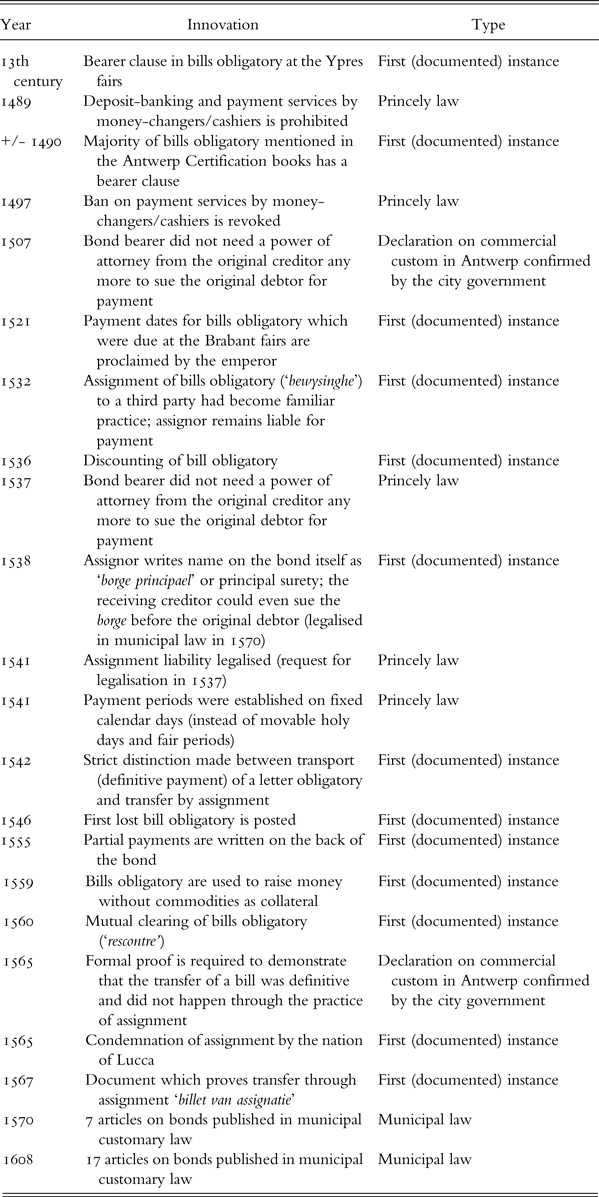
Innovations, new practices and unrealised ideas on bills obligatory took place within four fields: the transfer and negotiation of bills, guarantees, registration of bills and their enforcement. As a result, the bill obligatory evolved into a widely used, negotiable and transferable financial instrument from the late fifteenth and early sixteenth century onward (de Roover Reference De Roover1953; De ruysscher, Reference De Ruysscher2011; Puttevils, Reference Puttevils2015b; Van der Wee, Reference Van der Wee, Fackelman and Van der Wee1993). The first instances of tweaks in the design of and the new legal rules concerning the bill obligatory are summarised in Table 1, drawing on previous (archival) research.
Chronology of financial innovations in bills obligatory

Sources: Aerts 2011; De ruysscher Reference De Ruysscher2009, Reference De Ruysscher2011; O. de Smedt Reference De Smedt1940-1; Munro Reference Munro, Blondé, Greve and Stabel2000; Puttevils Reference Puttevils2015b, pp. 109-35; Van der Wee Reference Van der Wee, Fackelman and Van der Wee1993.
Antwerp's economic golden age took off as a fair-based market, much like the thirteenth-century fairs in Champagne and Flanders where bills obligatory or fair letters (marktbrieven) were frequently used and registered by public authorities (Wyffels and des Marez Reference Wyffels and Des Marez1991). From the beginning of the Antwerp fairs in the fourteenth and fifteenth centuries such instruments were present, drawn up by buyers and sellers for payment at the next fair in Antwerp or Bergen-op-Zoom (roughly every three months) (Doehaerd Reference Doehaerd1962-3; Van der Wee Reference Van der Wee1963b, p. 338). Hence, bills obligatory were a fundamental part of the Antwerp fair system and would continue to function as such even after its transition into a permanent market.
Bills obligatory could circulate because of the possibility of including a (mixed) bearer clause: ‘payable to X (name of the creditor) or to bearer’ (De ruysscher Reference De Ruysscher2011, p. 505). The bearer clause already existed in thirteenth-century Flanders; in these early documents the bearer clause merely indicates that an agent of the creditor would collect the debt (Munro Reference Munro, Blondé, Greve and Stabel2000, p. 133; Van der Wee Reference Van der Wee, Fackelman and Van der Wee1993, p. 151). The Antwerp certification books and aldermen's registers show that the bearer clause had already become an established practice at the Antwerp fairs by the 1490s. In fact, by this time there were more bonds with a bearer clause than without. Interestingly, in the period 1479-1514, bonds with a bearer clause had a higher average (and median) value than bills without such a clause.Footnote 2 The higher nominal value may have increased the need to make the bond transferable. Merchants needed to be able to transfer the larger sums in case of liquidity problems, but transferring bonds also entailed sizeable risks for the new creditor. In 1507 the Antwerp municipal government ruled by a ‘turbe’ – a declaration by jurists and lawyers on legal and commercial practice – that a bearer had full legal powers without having to prove his ownership of the bill, rendering the bill more secure for a third party who would receive such a bill.Footnote 3 By doing so, Antwerp followed the precedents on the legal powers of bond bearers created in England (the Burton vs Davy case on a bill of exchange in 1436) and in Lübeck (1499 and 1502) (Munro Reference Munro, Blondé, Greve and Stabel2000, pp. 144-51; North Reference North and Caprio2013, pp. 163-4). The central government issued an ordinance in 1537, thereby establishing what had already been accepted in Antwerp much earlier (Laurent, Lameere and Simont Reference Laurent, Lameere and Simont1893-1922).
This chronology clearly indicates institutions moving at different speeds: the local government starkly outpaced the central authorities. The ordinances of the central government allowed for bearer rights in the entire territory of the Low Countries, but the bearer clause in bonds did not become standard practice outside the commercial gateways of the Low Countries: in Liège, for instance, the bearer clause was used very infrequently and the circulation of bonds remained limited. The customary laws of the cities of Aalst, Brussels, Leuven and Mechelen did not recognise the rights of a bond bearer (de Roover Reference De Roover1953, p. 94; Lejeune Reference Lejeune1939, p. 65). This variation indicates the different needs of commercial cities like Antwerp as well as the faster pace of financial innovation in centres of long-distance commerce. The commitment of the Antwerp municipal government in providing legal rules in line with the demands of the mercantile community is corroborated by the subsequent editions of the municipal customary laws (the Costuymen) in 1572, 1582 and 1608: the number of articles on bonds increased, namely, from seven to 17 (Van der Wee Reference Van der Wee, Fackelman and Van der Wee1993, p. 161).
Besides the juridical powers and legal rights of the bond bearer, the liability of the transferring creditor was at stake. The transfer of a bond by a creditor to a new creditor could be executed through the legal concepts of ‘transport’ (conveyance in English), or ‘cession’, and through assignment, or ‘bewysinghe’. The older concept of transport definitively transferred all legal rights from the old creditor to the new one; the transfer dismissed the former from all claims by the latter.Footnote 4 Conveyance was needed for the new creditor to obtain all legal rights to pursue a debtor and was usually accompanied by a power of attorney (Van der Wee Reference Van Setter1993, pp. 151-2). Transports were often registered by notaries or by the aldermen; oral testimony on the conveyance was also considered as legal evidence (Van der Wee Reference Van der Wee, Fackelman and Van der Wee1993, pp. 155-6).
In case of an assignment, the ceding creditor retained liability if the debtor did not pay (De ruysscher Reference De Ruysscher2009, pp. 242-4). In the 1582 edition of the Costuymen – again: the customary law – this principle was made explicit in the ruling ‘assignment is not a payment’.Footnote 5 The ceding creditor was relieved of this liability only when the debtor had fully satisfied the new creditor. This assignment originated in the late medieval practice of a payment order (De ruysscher Reference De Ruysscher2009, pp. 233, 236, 242-4; Van der Wee Reference Van Setter1993, pp. 152-3). The debtor was only acquitted of the new creditor's claim when he could prove that he had already paid his due. The practice of transferring bonds through assignment quickly became popular in the first half of the sixteenth century (Brulez Reference Brulez1958, pp. 183-4, 189; Van der Wee Reference Van der Wee, Fackelman and Van der Wee1993, pp. 153, 155). In 1539 the financier Erasmus Schetz wrote to the Antwerp municipal government representative in Brussels insisting that ‘the central government would receive God's blessing when it would legalise and regulate the practice of assignment and would equate paying by assignment with paying in cash’ (O. de Smedt Reference De Smedt1940-1, pp. 25-6; Van der Wee Reference Van Setter1993, p. 153). The central government did so, convinced by Schetz's request, in an ordinance in October 1541 (Laurent et al. Reference Laurent, Lameere and Simont1893-1922, iv, pp. 329-31).
Every time an IOU was passed on, the security for the eventual creditor increased. This liability chain, enforced by municipal law, turned the obligation into legal tender. The 1608 Costuymen explicitly regulated these assignment chains and documented that a bond could be passed on to ‘four or five persons and more’; all ceding persons remained liable and linked to the original debtor of the bond (de Longé Reference De Longé1870, iv, pp. 380).Footnote 6 The bills could change hands several times before their maturity. The sources – especially the merchant account ledgers – abound with evidence of this high degree of circulation. Yet it is hard to measure exactly and systematically how many times a bond was passed on, since only the original creditor and debtor are named in the bond itself. According to Frans de Pape's account ledger, 69 of his bonds were paid out to his original creditor; in 52 cases the beneficiary was not the original creditor and hence de Pape's bond was transferred or assigned. Unregistered debts (for which de Pape did not write out any IOU) were much less likely to be paid out to a third party than debts paid for by a bond.
III
Sixteenth-century Antwerp witnessed a strong development of its market and an equally strong increase in population. The mercantile population grew from a few hundred merchants (and a larger but seasonal crowd who visited the fairs) to more than 1,500 by the middle of the sixteenth century (Gelderblom Reference Gelderblom2013, p. 33). In this climate of growing anonymity – and as a result of the increasing transferability of bills obligatory – longer and longer chains of interdependence were created. Consequently, creditors could not know every party involved in the bond and gauge the credit risk to which they were exposed. Additional legal and personal guarantees were necessary to secure the bill.
The series of transferring creditors could be recorded either on the bond itself, on a separate document or in a particular register administered by a public authority. Interestingly, only one of these became an established practice in Antwerp – and only fairly late, for that matter (namely, recording the transferring creditor on the bond itself) (Brulez Reference Brulez1959, p. 402; Van der Wee Reference Van der Wee, Fackelman and Van der Wee1993, p. 158). An official and specific registry could have been used to record bond transfers. In Reference Malynes1622 Malynes makes mention in his Consuetudo, vel lex mercatoria of the existence of an official IOU transfer registry system in Rouen and Lisbon (Malynes Reference Malynes1622, p. 100). No such system existed in Antwerp, though. On the one hand, registering a transfer would have increased transaction costs, thereby impeding the flexibility offered by trading bonds. On the other hand, this registration would have increased the security of the final creditor who, in the Antwerp scenario, could only either hope that the debtor would pay or appeal to the person from whom he had received the bond. Merchants always had the option to have their bond or its transfer recorded by public authorities such as the city clerk or a notary (see infra). This fits in with the commercial laissez-faire policy of the Antwerp municipal government: it provided a basic legal framework, offered services to those who required them but did not make registration compulsory (Gelderblom Reference Gelderblom2013). The flexibility of the Antwerp assignment system did not go unnoticed: Tommaso Contarini described the assignment system in his proposal to the Venetian senate for establishing a public bank. According to Contarini, the Antwerp market was successful due to abundance of trust and the scarcity of fraud, which obviated the need for public records (Lattes Reference Lattes1869, pp. 122-3).
Yet not all merchants were equally convinced of the advantages to the bond assignment system; especially foreign traders active in sixteenth-century Antwerp had different attitudes towards assignment and transport. Italian and Spanish traders were often suspicious of IOU assignments (Van der Wee Reference Van der Wee1963b, p. 343). The notarised transports in 1540 almost exclusively concern French and Spanish merchants. Local merchants were using notaries as intensively as these merchant groups but registered fewer transports. Hence, French and Spanish merchants seem to have preferred definitive transport over assignment.Footnote 7 When the Antwerp magistracy, in an attempt to benefit its own secretaries, tried to curtail the practices of notaries in the city in 1565, the ‘nation’ (or merchant guild) of Lucca argued in favour of the notaries, whose services they used to record powers of attorney and transports (Goris Reference Goris1925, pp. 111, 339; Oosterbosch Reference Oosterbosch1995). The ‘nation’ explicitly condemned assignment, or, as they called it ‘transportz privez de main a main’: they claimed it caused collusion and fraud involving substantial sums, which had ruined several merchants. The English practice of assigning bills within the community of Merchant Adventurers differed from Antwerp customs, too. When a member of the Merchant Adventurers transferred a bond to a colleague, he was acquitted fully and could not be held liable any more (O. de Smedt Reference De Smedt1950, ii, pp. 583). By 1555, though, the Antwerp city government no longer tolerated the difference between English and Antwerp customs.
Besides the guarantees of the creditor who passed a bill on through assignment, goods could be used as collateral and third parties could stand surety to secure the bond. In most cases, the IOU was based on a commodity transaction and the constitutive goods acted directly as a collateral; they could be returned or arrested when the bond was not paid. In the first half of the sixteenth century, IOUs were still intimately connected with the commodities trade. This is evidenced by the implicit contingency clause that the IOU was valid only when the goods were delivered to the buyer and when the goods’ quality was satisfactory. The collateral of a bond was a general one; it involved the pledging of person and goods, now and in the future. This could raise potential problems, since liquidation of a bad debt could be problematic with such general collateral (Gelderblom Reference Gelderblom, Landes, Mokyr and Baumol2010, p. 167). Merchants sometimes supplied additional and specific security measures: deeds to real estate and annuities could be offered, and bonds could act as security for new letters obligatory.
The timeline in Table 1 shows that between the 1490s and 1565 several piecemeal adaptations were made to the simple instrument of the bill obligatory in order to make it transferable, negotiable and enforceable in a court of law. Imperfections such as insufficient rights for bond bearers and the unclear liability of assignors were solved by financial innovation, first in practice, then in municipal and finally in princely law. To do so, Antwerp drew on and learned from European precedents. Financial innovation itself thus can be said to react to changing economic circumstances which generate imperfections; in the case of Antwerp these changes involved the growth of the market, the increase in the number of market participants (both merchants and non-merchants) and the transition from a periodic, fair market to a year-round, permanent market. As a result of innovation, the bond remained important and retained its various functions (moving funds across time and space; addressing moral hazard and asymmetric information problems; and facilitating the sale or purchase of goods and services through a payment system as described in the functional scheme in (Merton Reference Merton1992)). At the same time, the very occurrence of financial innovation itself reveals changes in the Antwerp market. The changes made in the design of the bond were mainly process innovations; the nature of the bond, a simple loan, did not really change (no product innovation). The conventionality and tradition of the bill obligatory did not really hinder innovation, and neither was financial innovation slow. By 1582 – although probably well before then already, given the presence of many non-mercantile bonds in prior sources and years – the bond had become a democratised innovation: the Antwerp Costuymen explicitly stated that everyone, not only merchants, could make use of the instrument.Footnote 8 The innovations in the design of the bill obligatory caused important spill-over effects for the bill of exchange.
IV
The previous section described how the IOU payment system was tweaked over time into a flexible and decentralised system relying on chains of interdependence. This system had the potential for rescontre – a periodic meeting, often embedded in a fair – where all merchants cleared mutual debts and organised clearing chains so that only the net amounts of money needed to be settled (Boerner and Hatfield Reference Boerner and Hatfield2014). However, no signs of organised rescontre sessions involving large groups of merchants could be found for sixteenth-century Antwerp. There is only evidence for the mutual clearing of merchant-to-merchant debts (Van der Wee Reference Van der Wee, Fackelman and Van der Wee1993, p. 151).
IOU creditors could not only turn to acquaintances or business colleagues in the payment system; there were also intermediaries such as money-changers, cashiers and brokers. In fourteenth-century Bruges, Antwerp's commercial predecessor, money-changers accepted deposits, executed giro-payments on behalf of their clients (cashiering), co-operated with other money-changers and extended credit through fractional reserves; they had become bankers (Aerts Reference Aerts2011, pp. 94-5; de Roover Reference De Roover1948; Murray Reference Murray2006). Letters obligatory were also very much present in the Bruges probate inventories of the middle of the fifteenth century (Stabel Reference Stabel2008); money-changers/bankers could thus co-exist with the IOU payment system. The Brabant fairs were another arena where these money-changers/bankers were active (Van der Wee Reference Van der Wee1963b, pp. 355-7). Even so, economic crisis and monetary disorder led the Burgundian dukes to prohibit the execution of payments and acceptance of deposits by money-changers (most strongly in 1489). Still, the ban was revoked in 1497 and gradually money-changers offered cashier services again, although they did not engage in extensive credit extension (Aerts Reference Aerts2011; Munro Reference Munro, Puncuh and Felloni1991, p. 66; Reference Munro2003, pp. 549, 562; Van der Wee Reference Van der Wee, Rich and Wilson1977, pp. 323-4; 1993, pp. 150-1). The few extant indications of money-changers/cashiers in sixteenth-century Antwerp do show active cashiers working either independently or as employees. The Low Countries did not witness the creation of a public bank prior to the beginning of the seventeenth century, so such an institution could not centralise payments, either. Lacking a central institution for payments such as the southern-style banks or the Bank of Amsterdam, financial instruments thus circulated privately in sixteenth-century Antwerp. This private circulation was reinforced by government interventions that set the rules.
Bill-holders could also turn to third parties to negotiate or discount their bonds, i.e. selling a bond before maturity at a price (premium) lower than the bond's nominal value. Such discounting of debts originated in the medieval practice of creditors who, when in need of cash, requested an earlier payment from their debtor in exchange for a rebate (Kohn Reference Kohn1999, p. 27; Van der Wee Reference Van der Wee1963b, p. 349). The earliest reference of discounting a bill obligatory in Antwerp is dated 1536 and can be found in the papers of the English merchant Thomas Kitson (Van der Wee Reference Van der Wee1955). Merchants such as Daniel de Bruyne or Jan Spierinck turned to discounting when they needed ready cash.Footnote 9 For wealthy merchants, discounting could become a lucrative activity. Jan Gamel even organised a partnership to buy bills obligatory from third parties. Because most bonds were short-term debt (with no significant risk of the death or insolvency of the debtor in the long run) and because they could be assigned to a third party (recouping the full value of the bond), it is probable that discounting was not a common choice for merchants (Brulez Reference Brulez1959, pp. 403-4; Van der Wee Reference Van der Wee1963b, p. 351; 1993, p. 163). Yet they always had the option, when in need of cash, to discount the bond.
In late sixteenth-century Amsterdam the letter obligatory developed as a means to finance enterprise and became detached from actual commercial transactions in commodities (Gelderblom Reference Gelderblom2003, pp. 627-30; Gelderblom and Jonker Reference Gelderblom and Jonker2004, pp. 647-8, 663). Hence, the bill evolved into a full-fledged financial instrument. In fact, early signs of this detaching of bonds from commodity transactions are already visible in Antwerp: a 1559 ordinance refers to ‘lettres d'obligations, tant de finances, changes que marchandises’. IOUs could thus be used for both commodity transactions and for pure finance (Laurent et al. Reference Laurent, Lameere and Simont1893-1922, pp. v, 30). Bills obligatory were crucial to (re)starting mercantile companies: during the military offensive of 1576 called the ‘Spanish Fury’, Christophe Plantin had to pay a large ransom and afterwards needed to repair his printing enterprise. Hence, Plantin turned to bills obligatory from his former partners Charles, Daniel and Frans van Bombergen to finance the continuation of his firm. In October 1582, none of £1,600 Fl. gr. was repaid to the Van Bombergens and a new, complex IOU contract was drawn up: Plantin was to repay the Van Bombergens or third parties to whom parts of the debt were assigned in instalments of six months. All capital was paid back by September 1588.Footnote 10
V
The path of development of the bill obligatory as a financial instrument was the result of a dynamic and continuous tweaking process and subject to negotiation between urban and princely legislators and the users of the IOU payment system. In sixteenth-century Antwerp, merchants pushed for the legal recognition of their commercial practices and enforcement of their contracts. The Antwerp municipal government was quick to respond, pressured by inter-city competition for the gains of trade, often at the request of the mercantile community (Gelderblom Reference Gelderblom2013). Sixteenth-century Antwerp lawmakers combined and integrated learned Roman law, city customs and mercantile practices from foreign traders into a coherent body of municipal law (De ruysscher Reference De Ruysscher2009, Reference De Ruysscher2011). In seventeenth-century England, while the Common Law Courts did not recognise the transfer through assignment of bills obligatory (since these served both commercial and non-commercial purposes, mercantile custom could not be invoked), the Promissory Notes Act ultimately established the legality of transfer of said notes in 1704. London merchants, however, who had witnessed the practice of intense bill circulation in Antwerp and Amsterdam, had been using and transferring bonds for a while, albeit without legal protection (Holden Reference Holden1955; Rogers Reference Rogers1995).
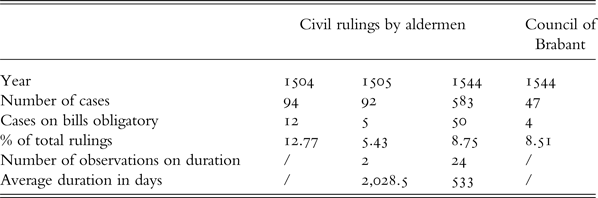
The Antwerp municipal government provided the legal structure and contract enforcement in which the IOU payment system could flourish. Section ii above has already documented how the city acknowledged the rights of a bond bearer (thirty years earlier than the central government) and how a set of rules for bond use materialised into the city's customary laws. Both the city and the princely courts (Council of Brabant) judged in court cases concerning bonds. Table 2 shows the number of legal cases on bonds handled by both courts in a number of sample years.
Rulings by the Antwerp aldermen and the Council of Brabant
Sources: CAA, Vierschaar, Rulings books, V 1233 and V 1238-1240; RAB, Council of Brabant, Rulings books, 589.
These numbers may seem low at first sight, given the wide variety of cases dealt with by these courts, but bond disputes constituted an important aspect of their jurisdiction. The number of disputed bond cases grew quickly as a result of both the burgeoning market and increased litigation over credit transactions, which has also been documented for England (Kerridge Reference Kerridge1988, p. 72). The only available proxy to verify the courts’ efficiency in handling such cases is the duration of the case (the difference in days between the final ruling and a clear starting date). This duration is not always calculable for every case; only the 1544 sample of the aldermen's court rulings offers enough data. It took a year and a half on average for the court to reach a decision in 1544 in these obligation cases. Unfortunately, the lack of comparative data makes it impossible to judge whether Antwerp's court was quick or slow for its time. Even so, one and a half years for a case on a bond, a fairly simple issue, does seem quite long. The plaintiffs in the legal cases of 1544 were mostly the original creditors suing their debtors (74 percent); a quarter of the cases concerned a bond that was passed on. Judges could not rely on an official registry of the bonds, but there was more than just the bond itself, which could serve as evidence. Judges or arbiters inspected account ledgers and correspondence and in the process they accepted private documents as legal proof (Gelderblom Reference Gelderblom2013). By doing so, both formally registered and informal contracts could be enforced when necessary.
The municipal government went one step further in securing the IOU payment system: starting in 1546, it announced and cancelled lost bills obligatory, an early modern Card Stop. All these descriptions were given in city announcements registered in the Gebodboeken, records that also contained all the other public proclamations and municipal orders.Footnote 11 The obligations announced as lost were often declared missing by debtors who feared that they would be addressed by an unknown bearer, especially when the bill had already been paid. Because bonds were highly liquid assets, they were an easy target for thieves and mutineers: for example, during the sack of Antwerp in 1576, a horde of more than 5,000 mutinous Spanish and German soldiers descended on Antwerp and plundered the city. After the pillagers had left, a series of announcements by the Antwerp government posted and cancelled IOUs stolen during the pillage.
Not only the municipal government listened to the needs of IOU users, the princely government, too, sought to remedy flaws in the design of the IOU payment system at the request of the users. The exact periodization of the fair payments became a matter of contention several times throughout the sixteenth century. In the 1521 ordinance the emperor declared that the presentation days of bills obligatory with a fair as maturity date would commence on the twenty-seventh day of the freedom of the fair and would last through the thirtieth. Payments had to take place from the thirty-first day to the thirty-seventh (Laurent et al. Reference Lejeune1893-1922, pp. iv, 329-31).
Because several of the fairs (Easter and Pentecost) were structured around movable holy days, the exact dates of the fairs and their payment periods differed from year to year. This was remedied in October 1541: the four payment periods were to last ten days and started on 31 October, 31 January, 1 May and 1 August (Laurent et al. Reference Laurent, Lameere and Simont1893-1922, pp. iv, 329-31). These fixed dates brought an end to the shifting fair periods linked to changing holy days. From then on, payment periods were at three-month intervals. The development of fixed payment periods mirrors the growing permanence of the Antwerp market throughout the year (O. de Smedt Reference De Smedt1940-1, pp. 22-31; 1950, pp. 574-81). Clearly, financial innovation and the tweaking of the IOU instrument was the result of negotiations between users, city and princely courts and governments. Table 1 shows, then, that practice and custom mostly preceded legislation. Nowadays, the reverse is often true: practices change and innovation happens as a response to regulation (and taxes) (Tufano Reference Tufano, Constantinides, Harris and Stulz2003, p. 320). Sixteenth-century legislation, in the end, made the financial instrument safer and more reliable.
VI
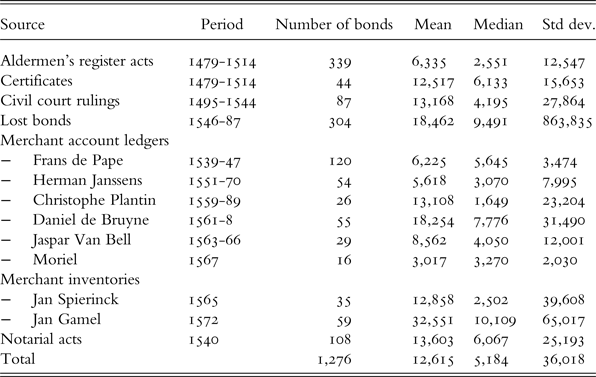
This section considers the actual bonds, their values, payment terms and duration, and the various ways they could be registered if the user deemed it necessary. Bond values (always given in money of account, such as pounds Flemish groat or guilders) and information on the identities of the debtors and creditors could be collected for 1,276 bonds, which were drawn from the rather heterogeneous collection of sources. To adjust for currency differences and for sixteenth-century inflation, which account for IOUs having (slightly) higher nominal values as the century proceeded, nominal values were recalculated and deflated to their value in (grams of) silver.Footnote 12
Table 3 demonstrates that there was remarkable variety in bond values, pointing to a diversified market for such instruments; while these bills obligatory may seem similar in their wording, they clearly served different needs. The values of bills obligatory registered in different sources could differ significantly.Footnote 13 Bills registered by the aldermen had substantially lower values. That is, formal registration of a bill could even be made for low denominations, which indicates a relatively efficient urban bureaucratic apparatus. Bills posted as lost mostly – and unexpectedly – had a relatively high value. Bills in merchant inventories, too, had a higher value on average, especially the valuable bonds of the financier Jan Gamel. The bills obligatory mentioned in the account ledgers of Frans de Pape and Herman Janssens derived from commodity transactions; Christophe Plantin was owed small amounts of money by his workers and was indebted, through bills obligatory, for substantial sums to his financiers. For the period 1540–4, we have the largest number of bills for three source categories: civil court rulings, bonds from Frans de Pape's account ledgers and bonds in the notarial deeds. Bonds disputed in a civil court case or registered by a notary were more valuable than those written in an account ledger (disputing and registering these bonds makes sense given their higher value).Footnote 14 Clearly, different bills obligatory served different needs and were subject to different degrees of contractual security.
Antwerp bills obligatory sample 1479–1587, values in grams of silver
Source: see data appendix.
The best and most substantive information on how and when bills obligatory were used comes from the rudimentary account ledger of Frans de Pape, a trader in English and Flemish textiles (1539-47). The ledger records all of de Pape's purchases (N = 274) at the Brabant fairs and how he would pay for them (in cash, with an IOU or in goods).Footnote 15
Figure 1 shows that de Pape mostly paid his larger debts (starting at £30 Fl. gr.) with an IOU. This proves that bonds were used to secure larger debts. De Pape's foreign creditors, mostly English Merchant Adventurers, preferred to receive a bond from de Pape rather than an unregistered debt; his domestic creditors were less discriminatory (perhaps they knew de Pape better).Footnote 16 Notably, this preference for bonds by the foreign creditors was not due to a higher value of the debts owed to them.Footnote 17
De Pape's bond and non-bond payments
Because de Pape meticulously recorded the payment dates (both the ones written in the bond and the actual payment dates), it is possible to investigate the relation between the timing of the debt, whether it was embedded in a bond or not, and its value. The mean expected duration of debts paid for with a bond was 27 days longer on average than non-bond debts. No relation could be observed between both the expected and the real duration of the payment and the value of the debt, and between the duration of delays and the value of the debt.Footnote 19 The number of payments executed was positively correlated with the value of the debt.Footnote 20 De Pape did not need more time for larger debts but he did adopt different payment policies for them: more individual payments were executed on higher-value bonds. For 334 bonds in the entire data set the expected duration is known: 88.6 per cent of the bonds had to be repaid within a year, 70.7 per cent within six months.Footnote 21 Hence, IOUs were used mostly to structure short-term debt.
Not all creditors and debtors were punctual in the payment of their bonds: in 1585 a widow discovered a small silk bag containing an IOU owed to her late husband which was six weeks in arrears.Footnote 22 For 95 bonds from the mercantile account ledgers of de Pape, Moriel, Plantin and Van Bell, the difference between the stipulated payment deadline and the actual last payment could be calculated:Footnote 23 16.8 per cent of the bonds were paid before the specified deadline, 29.5 per cent with less than one month delay; 80 per cent within two months after the original deadline. On average, bonds were paid within 41 days after the deadline.Footnote 24 Gerard Malynes wrote in his Consuetudo, vel lex mercatoria, ‘if within one month after, it is accounted very good payment’ (Malynes Reference Malynes1622, p. chapter xii). Explicit terms were more advantageous than such open-ended contracts because a merchant was always aware of upcoming bond payments; however, open-ended loans, often extended by family members, could be withdrawn at quick notice (Gelderblom Reference Gelderblom, Landes, Mokyr and Baumol2010, pp. 166-7; Kole and Van Bochove Reference Kole and Van Bochove2014, p. 50).
Perhaps surprisingly, the de Pape account ledger does not offer any indication of interest rates paid on the debts; the purchase price almost always matches the amount paid afterwards. Interest rates on bonds were mostly hidden in the value of the bond or covered up as a fee for not paying immediately in cash. The central government set the legal maximum interest at 12 per cent; all interest rates above this ceiling were considered usurious (Laurent et al. Reference Laurent, Lameere and Simont1893-1922, iv, 4 October 1540). In 1582 Antwerp law prescribed that creditors were free to set the interest rates on bonds, provided they were not usurious.Footnote 25 In a few cases implicit interest rates on bonds could be found. For example, Franchois van Lare had borrowed £100 gr. Fl. from Daniel de Bruyne in January 1561, and had to pay £106 gr. Fl. back six months later (12 per cent per annum). The account ledgers of Van Bell, Moriel and Plantin provide explicit interest rates between 6 per cent and 16.6 per cent (the latter rate well above the legal ceiling).Footnote 26 This variation goes to show that interest rates depended on the person and the required term. The Costuymen from 1582 stipulated that the rate for bonds specifying the maturity date was 6.25 per cent.Footnote 27 Falling interest rates may have had a psychological effect on investments throughout the sixteenth century: smaller merchants used short-term bonds to finance their enterprise (Van der Wee Reference Van der Wee1967, pp. 230-2).
VII
The bill obligatory underwent piecemeal tweaking and process innovation in the city of Antwerp during the first part of the sixteenth century. This age-old, traditional and conventional instrument acquired new features and became an efficient modus operandi for executing three functions key to the financial system: moving funds across time; addressing moral hazard and asymmetric information problems; and facilitating the sale or purchase of goods and services (Merton Reference Merton1992). The innovative process of the bill obligatory should be seen, then, in light of the genesis of these inclusive, efficient and transparent institutions that first came about in sixteenth-century Antwerp (Gelderblom Reference Gelderblom2013; Ogilvie Reference Ogilvie2011; Puttevils Reference Puttevils2015a, Reference Puttevils2015b). Antwerp's starting conditions made the difference for the trajectory of innovation: the city's commercial growth started off, namely, within the context of fairs hosting a fairly large group of traders, where the bill obligatory had already been in use for centuries, and where money-changers executed payment services but did not provide extensive credit. Later, the feverish commercial growth of Antwerp caused imperfections for the use of the bill obligatory: because the volume of trade and the group of traders grew, a process of anonymisation set in and the chains of interdependence of those who were transferring bonds grew longer. These growing pains were resolved by an active municipal government, which set the rules for the transfer of bonds, often at the request of bill users and by looking at precedents in other commercial cities. To be sure, the municipal government was incentivised to do so, given inter-city competition as well as the ability of traders to move to another place when circumstances were not deemed beneficial for their trading operations. For its part, Antwerp had the financial resources and the legal power to modify the rules, which then yielded the continuous adaptation of institutional arrangements and process innovations (Gelderblom Reference Gelderblom2013). As the sixteenth century progressed, the municipal government also strived for uniform rules and no longer tolerated the divergent practices of particular merchant groups active in the city (the English Merchant Adventurers, for example). The municipal government, however, could not and in fact did not act as a cavalier seul: its new rules for bonds were ratified by the central government, and the central government established rules for payment dates. As such, the legislation on bonds was the result of negotiation between bond users, the city and the central government – a multilateral process similarly observed in the legislation on Antwerp marine insurance as well (De ruysscher and Puttevils Reference De Ruysscher and Puttevils2015). Moreover, these rules and practices that had crystallised in sixteenth-century Antwerp were copied and adapted further in Amsterdam and London in subsequent years.
Thus, the Antwerp municipal government, in close cooperation with the central government, provided a framework of rules that allowed the efficient use of bonds. Not only merchants but also other entrepreneurs and citizens relied on this financial instrument. The legislators, however, did not overextend their authority by creating a too rigid framework; rather, the city pursued a laissez-faire commercial policy by providing a minimal framework, leaving ample options open for the bond users. The bill obligatory had become a multifunctional and versatile instrument which the users could tailor to their own needs choosing from a menu of available options: to draw up a bond or not, for instance, depending on the value of the debt and the relationship between debtor and creditor; to have the bond registered by the city secretary or a notary or not (a note in the account ledger was deemed sufficient and increasingly became legal proof); to transfer the bond (through assignment or transport) or not; to make use of intermediaries such as money-changers, other money-dealers or brokers or not; to discount the bond (when one needed quick cash) or not; and, finally, to use the bond only for commodity transactions or to realise its purely financial potential. The micro-analysis of de Pape's and other traders’ accounts has shown how merchants used bonds in day-to-day transactions. Merchants like de Pape issued several dozen promissory notes each year. Yet bonds were but one of several instruments which merchants could use to fund their enterprise; accordingly, future research would be well served by looking deeper into mercantile documents to determine why merchants used one or the other financial instrument or technique, in addition to why authorities came to develop particular institutional arrangements governing trade.
Data appendix
Five different types of Antwerp sources have been examined in search of bills obligatory.
1. Antwerp certification books and aldermen's registers (1490-1514): the Antwerp magistracy produced certificates (written declarations) on behalf of private persons, often local and foreign merchants, concerning various commercial and/or juridical issues. I used Renée Doehaerd's publication of the certification books (1488-1513). She summarised all certificates with references to ‘international trade’, and I have selected all ‘lettres obligatoires’, which provided 189 cases between 1479 and 1514 (Doehaerd Reference Doehaerd1962-3, pp. 17-18). Doehaerd's selection criteria are: (1) all certificates making reference to foreigners doing business in Antwerp (from abroad); (2) all certificates making reference to Low Countries merchants active abroad; (3) documents making reference to distribution and consumption of foreign goods in the Low Countries; and (4) documents making reference to distribution and consumption of Low Countries products abroad. Some ‘mandats et procurations’ contain quantitative information on debts, but Doehaerd's abbreviated notes specify whether the debt is in fact a bill obligatory. The Antwerp aldermen's registers are preserved in their entirety from 1394 to 1797. All transactions concerning immovable goods had to be registered in these ledgers. A large variety of other contracts could also be registered by the aldermen's clerks. The sheer size of these ledgers (roughly between 2,000 and 4,000 deeds per year) renders this source problematic for an individual historian. Fortunately, Doehaerd also recorded all aldermen's deeds concerning international trade. Moreover, I have used a database constructed by Tim Bisschops and his students, in which they digitised written summaries of the aldermen's registers for several years in the period 1490-3. I would like to express my gratitude to Tim Bisschops for letting me use his data. All bonds have been drawn from the Doehaerd and Bisschops records; these have been double-checked to eliminate double entries.
2. Civil rulings pronounced by the Antwerp aldermen in cases of litigation (1504-1505 and 1544): in 1488 the bench of aldermen adopted a written procedure for registering its rulings in civil cases (De ruysscher Reference De Ruysscher2009, pp. 22-7, 101). Litigants could request a copy of the ruling, which was then reproduced in a vonnisboek. Not all of these ledgers have been preserved. Hence, I have chosen three sample years: 1504 (94 rulings), 1505 (92 rulings) and 1544 (583 rulings). In 1504, 12 per cent of all pronounced rulings concerned bills obligatory; 5.4 per cent did so in 1505 and 9 per cent in 1544.Footnote 28
3. Notarial acts by Zeger Adriaan 's Hertoghen and Willem Stryt (1540): merchants frequently used the services of notaries to register their obligations and operations concerning these obligations (transports, procurations, receipts). I have selected 1540 as a sample year; the deeds of two notaries have been preserved for that year. A total of 74 acts (9.8 per cent) of all the notarial acts recorded by Adriaen Zeger 's Hertoghen and Willem Stryt in 1540 mentioned a bond.Footnote 29
4. Post-mortem inventory of Jan Gamel (1572): according to the inventory of a textile trader and financier, his estate was owed more than £20,000 gr. Fl. in bonds, and half of his wealth consisted of such obligations. Registered on 11 August 1572 by the notary Henrick van Uffele (De Smedt Reference De Smedt1970).
5. Bankrupt merchant's inventory of Jan Spierinck (1565): in 1565 the merchant Jan Spierinck was sued by his creditor Coenraerd Schetz over a £400 gr. Fl. obligation and imprisoned. Spierinck wished to prove that he was not insolvent and thus could not be detained as a bankrupt. He argued that he was ‘not so godless that he wanted to deny his debt’ and had an inventory drawn up to prove that he was still creditworthy.Footnote 30
6. Account ledgers of Frans de Pape (1539-47): cloth trader Frans de Pape bought most of his merchandise from English or Antwerp merchants. He organised his account ledger around the four fairs, noting from whom he had bought the textiles, providing specific details (description and price) and the credit terms (usually payable at the next fair or the following). He also noted the bonds he had drawn up (‘hantscrift’).Footnote 31
7. Account ledgers of Herman Janssens (1551-70): Herman Janssens co-operated with his sister Anna and several of his brothers in the trade with England, Portugal, Spain and the Canary Islands. His journal in which he recorded costs and yields of his enterprises documents his operations between 1551 and 1570.Footnote 32
8. Notes and accounts of printer and bookseller Christophe Plantin (1559-89): Christophe Plantin moved to Antwerp in 1549 and started his own printing company in 1555. In two volumes of Plantin's accounts, several bonds can be found.Footnote 33
9. Account ledgers of Daniel de Bruyne (1561-8): Daniel de Bruyne was a jeweller and was also active in real estate speculation, maritime insurance and organising lotteries. His double-entry journal has been preserved because it was confiscated when de Bruyne and his patron, Christoffel Pruynen were implicated in a large-scale government fraud case. De Bruyne noted 55 bonds in this journal.Footnote 34
10. Account ledgers of Jaspar Van Bell (1563-6): the 's-Hertogenbosch merchant Jaspar van Bell sold locally bleached linen, pins and knives to Antwerp merchants and in Spain (Formsma and Pirenne Reference Formsma and Pirenne1962).
11. Account ledgers of Jehan and Mathieu Moriel 1567: The two nephews traded in textiles and grain and had agents in Lyon and Danzig (Van Den Brulle Reference Van den Brulle2010).
12. Notices given for lost obligations (1546-87).Footnote 35
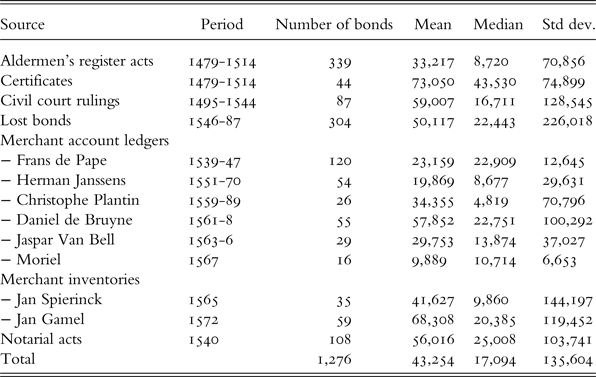
Antwerp bills obligatory sample 1479–1587, values in litres of rye (Antwerp prices)