Introduction
Sugarcane is an important crop cultivated on organic soils in the Everglades Agricultural Area (EAA) and adjacent mineral soils in south Florida. Approximately 74% of the 166,000 ha of sugarcane in south Florida is on organic soils and 26% is on mineral soils (USDA-NASS 2018; VanWeelden et al. Reference VanWeelden, Swanson, Davidson and Rice2018). Organic soils or Histosols of the EAA are characterized by organic matter content as high as 80% to 90% and very low clay and mineral content (Snyder et al. Reference Snyder, Burdine, Crockett, Gascho, Harrison, Kidder and Mishoe1978; Wright and Hanlon Reference Wright and Hanlon2009; Zelazny and Carlisle Reference Zelazny, Carlisle, Stelly and Dinauer1974). The mineral soils are predominantly Spodosols and Entisols that contain 0.5% to 5% organic matter with no significant silt or clay (McCray et al. Reference McCray, Morgan, Baucum and Ji2014; Wright and Hanlon Reference Wright and Hanlon2009). Over the past two decades, there has been an increase in sugarcane production on mineral soils with expansion into abandoned citrus (Citrus spp.) groves and conversion from other cropping systems to sugarcane (VanWeelden et al. Reference VanWeelden, Swanson, Davidson and Rice2018). This trend will most likely continue and accelerate sugarcane production on mineral soils, making it important to advance research on these soils to mitigate potential production problems, including weed management.
Sugarcane production in Florida can be adversely affected by weed interference early in the season before canopy closure, primarily from annual grasses. Fall panicum (Panicum dichotomiflorum Michx.) is the most prevalent and problematic annual grass species that causes significant yield losses in Florida sugarcane (Odero and Dusky Reference Odero and Dusky2014, Reference Odero, Duchrow and Havranek2016). Fall panicum is an aggressive, sprawling to ascending, annual bunchgrass with stems up to 200-cm tall, native to the eastern United States and West Indies (Bryson and DeFelice Reference Bryson and DeFelice2009; McCarty and Hall Reference McCarty and Hall2018). In the subtropical climate of south Florida, fall panicum is found year-round, with the highest occurrence between September and May during planting (August to January), harvesting (October to May), and early-season development of sugarcane (DCO, personal observation). Fall panicum control is required within 6 to 8 wk after sugarcane emergence in Florida to reduce yield loss, which can be up to 60% with season-long interference (Odero et al. Reference Odero, Duchrow and Havranek2016).
PRE herbicides at planting and following ratoon cane (subsequent regrowth crops) harvesting are used to provide residual control of weeds, including fall panicum, early in the season before POST weed control programs in sugarcane. Pendimethalin has been the foundation for PRE fall panicum control in Florida sugarcane. However, rapid dissipation of pendimethalin occurs when applied with no incorporation under dry conditions associated with sugarcane planting and harvesting in Florida, resulting in half-lives as low as 8 d and a concomitant loss of fall panicum control (Odero and Shaner Reference Odero and Shaner2014a). Recently, a premix of S-metolachlor, atrazine, and mesotrione was registered in the United States for PRE and POST control of annual grasses such as fall panicum in sugarcane (Anonymous 2018b). Atrazine and mesotrione components of the premix have been used for several years in sugarcane in the United States, primarily to target broadleaf weeds (Shaner Reference Shaner2014). S-metolachlor has been used in sugarcane in countries such as Brazil and Australia for PRE control of many annual grasses and nutsedges (Correia et al. Reference Correia, Perussi and Gomes2012; Ross and Fillols Reference Ross and Fillols2017) but not in the United States before registration of the premix. The efficacy and duration of control of annual grasses, particularly fall panicum, in Florida sugarcane provided by S-metolachlor in the premix will depend on its dissipation and persistence in organic and mineral soils under field conditions.
S-metolachlor, a chloroacetanilide, has moderate water solubility (488 mg L−1 at 20 C), low volatility (vapor pressure of 1.73 × 10⁻³ Pa at 20 C), and low Koc (200 ml g−1), which increase its potential for movement in the soil profile (Caracciolo et al. Reference Caracciolo, Giuliano, Grenni, Guzzella, Pozzoni, Bottoni, Fava, Crobe, Orru and Funari2005; Shaner Reference Shaner2014). It readily adsorbs to muck or clay soils (Shaner Reference Shaner2014). Adsorption of S-metolachlor to soil particles is related to organic matter and clay content (Frank et al. Reference Frank, Clegg and Patni1991; Weber et al. Reference Weber, McKinnon and Swain2003), and binding is primarily through physical forces between herbicide molecules and soil constituent surfaces (Peter and Weber Reference Peter and Weber1985; Weber and Peter Reference Weber and Peter1982). S-metolachlor more readily adsorbs to organic matter than to clay, probably because of greater bonding to lipophilic surfaces of organic matter compared with polar surfaces of clay minerals (Shaner Reference Shaner2014; Weber et al. Reference Weber, McKinnon and Swain2003). The mobility of S-metolachlor in soil is inversely related to adsorption, implying that it may be leached into or below the crop zone in coarse-textured soils low in organic matter and clay content (Obrigawitch et al. Reference Obrigawitch, Hons, Abernathy and Gipson1981).
Under field conditions, S-metolachlor is primarily degraded microbially (Bouchard et al. Reference Bouchard, Lavy and Marx1982; Caracciolo et al. Reference Caracciolo, Giuliano, Grenni, Guzzella, Pozzoni, Bottoni, Fava, Crobe, Orru and Funari2005; Kotoula-Syka et al. Reference Kotoula-Syka, Htzios, Berry and Wilson1997; LeBaron et al. Reference LeBaron, McFarland, Simoneaux, Ebert, Kearney and Kaufman1988; Miller et al. Reference Miller, Wollum and Weber1997; Rice et al. Reference Rice, Anderson and Coats2002). However, abiotic factors such as temperature and soil moisture have been reported to influence S-metolachlor degradation (Frank et al. Reference Frank, Clegg and Patni1991; Zimdahl and Clark Reference Zimdahl and Clark1982). S-metolachlor losses as soil moisture increases under constant temperature have been reported, indicating that it can persist for a longer period under unsaturated conditions compared with saturated conditions (Dinelli et al. Reference Dinelli, Accinelli, Vicari and Catizone2000; Gish et al. Reference Gish, Prueger, Kustas, Daughtry, McKee, Russ and Hatfield2009; Rice et al. Reference Rice, Anderson and Coats2002; Sahid and Wei Reference Sahid and Wei1993; Walker and Brown Reference Walker and Brown1985; Zimdahl and Clark Reference Zimdahl and Clark1982). Constant moisture levels and decreasing temperatures also reduce S-metolachlor degradation (Braverman et al. Reference Braverman, Lavy and Barnes1986; Walker and Brown Reference Walker and Brown1985; Zimdahl and Clark Reference Zimdahl and Clark1982). In field studies, the half-life of S-metolachlor can be up to 142 d depending on the soil type and properties, and the prevailing environmental conditions (Frank et al. Reference Frank, Clegg and Patni1991; Huang et al. Reference Huang, Cui, Zhou, Miao and Feng2017; Martínez et al. Reference Martínez, Lechón, Sánchez-Brunete and Tadeo1997; Mueller et al. Reference Mueller, Shaw and Witt1999; Shaner Reference Shaner2014; Shaner and Henry Reference Shaner and Henry2007; Westra et al. Reference Westra, Shaner, Westra and Chapman2014; Wu et al. Reference Wu, Long, Li, Li, Liu and Li2015). Currently, no information is available on field dissipation and persistence of S-metolachlor on organic and mineral soils used for sugarcane cultivation in Florida. Understanding the dissipation rate and persistence of S-metolachlor in these soils is important to provide information for formulating weed management programs, particularly for fall panicum in Florida sugarcane, and rotational crop restrictions. Therefore, the objective of this study was to determine field dissipation and persistence of S-metolachlor on organic and mineral soils used for sugarcane production in Florida.
Materials and Methods
Study Location
Field studies were established on organic and mineral soils in Florida between 2013 and 2016. Studies on organic soil were conducted in 2013 to 2014 (26.66°N, 80.63°W) and 2014 to 2015 (26.65°N, 80.63°W) sugarcane-growing seasons at the Everglades Research and Education Center (EREC) in Belle Glade, FL. The soil type at the EREC was a Dania muck (euic, hyperthermic, shallow Lithic Haplosaprists) with an organic matter content of 75% and pH of 7.3. Studies on mineral soil were conducted in 2014 to 2015 (26.76°N, 80.39°W) and 2015 to 2016 (26.81°N, 80.44°W) sugarcane-growing seasons at a grower’s farm near Loxahatchee, FL. The soil type at the mineral soil location was a Holopaw fine sand (loamy, siliceous, active, hyperthermic Grossarenic Endoaqualfs) with an organic matter content of 1.6% and pH of 7.5. Soil pH was measured in 1:2 soil/water suspension using an electronic pH meter (FiveEasy Plus™, Mettler Toledo, Columbus, OH), and organic matter content was determined using the loss-on-ignition method (Schulte and Hopkins Reference Schulte, Hopkins, Magdoff and Tabatabai1996; Wright et al. Reference Wright, Wang and Reddy2008). Both organic and mineral soil study locations were on fields used for sugarcane production and not previously treated with S-metolachlor. The fields were fallow for 10 and 12 mo following 3-yr crop cycles on the mineral and organic soil locations, respectively. Sugarcane was harvested once annually over the 3-yr period before the fallow period. All fields were plowed, disked, and leveled to bury any plant residue after the fallow period before planting sugarcane stalks in rows spaced 1.5 m apart.
Herbicide Treatment Application and Soil Sampling
A premix of S-metolachlor (2,270 g ai ha−1), atrazine (853 g ai ha−1), and mesotrione (227 g ai ha−1) (Lumax® EZ, Syngenta Crop Protection, Greensboro, NC 27409) was applied PRE after sugarcane planting at all study locations. Treatments on organic soil were applied on December 10, 2013 (2013 to 2014 season) on a field with two rows each of sugarcane ‘CP96-1252’ and ‘CP88-1762’, and on November 27, 2014 (2014 to 2015 season) on a field with one row each of sugarcane ‘CP00-1101’, CP96-1252, CP88-1762, and ‘CP89-2143’. For the mineral soil locations, fields planted with sugarcane ‘CPCL97-2730’ and ‘CPCL00-4111’ were treated on November 27, 2014 (2014 to 2015 season) and December 17, 2015 (2015 to 2016 season), respectively. The herbicide premix was applied using a CO2-pressurized backpack sprayer calibrated to deliver 187 L ha−1 at 276 kPa with TeeJet® XR11002-VS nozzle tips (Spraying Systems, Wheaton, IL 60187). Plots consisted of two and four sugarcane rows wide by 9-m long for the organic soil locations in the first and second seasons, respectively, and two sugarcane rows wide by 9-m long for the mineral soil locations. For the organic soil locations, each plot (two sugarcane rows wide) in the first season consisted of one row each of sugarcane CP96-1252 and CP88-1762, while each plot (four sugarcane rows wide) in the second season consisted of one row each of sugarcane CP00-1101, CP96-1252, CP88-1762, and CP89-2143. Soil samples were collected from bare ground between the sugarcane rows within each plot, and varieties were not considered an experimental factor. The experiment was a randomized complete block design with four replications for both soil types at all study locations.
Soil samples were collected from all locations at 0, 7, 14, 21, 28, 35, 42, 49, 56, 63, 70, 77, and 84 d after treatment (DAT). Three soil cores 3 cm in diameter from the top 7.5 cm of soil from the surface were taken randomly for each plot from bare soil surfaces between sugarcane rows and composited. Plastic pot-marker stakes were placed at each sampling point to ensure no repeat sampling. Samples were then placed in coolers filled with ice immediately after collection from the field before transportation and storage within 1 to 2 h at −18 C until analysis.
S-Metolachlor Extraction and Analysis
S-metolachlor was extracted using toluene according to Shaner and Henry (Reference Shaner and Henry2007). Soil samples were thawed at room temperature, composited, and wet sieved. Ten grams of the sieved soil from each sample was placed into a 50-ml polypropylene tube, and 10 ml of distilled water and 10 ml of water-saturated toluene (Aqua UNI002, Aqua Solutions, Deer Park, TX 77536) were added to the soil. The tubes were shaken horizontally for 2 h in an Eberbach shaker (E6010, Eberbach, Ann Arbor, MI 48103) and then centrifuged at 1,800 × g for 25 min. Two milliliters of the toluene phase was transferred to a 2-ml vial. The concentration of S-metolachlor in the toluene phase was determined using a gas chromatograph–mass spectrometer (Shimadzu GCMS QP2010 SE, Shimadzu Scientific Instruments, Columbia, MD 21046) operated in scan monitoring mode. The quantifier m/z, which monitored for S-metolachlor, was 162, while m/z 238 and m/z 240 were used as qualifiers. An Rtx-5MS column, 30-m long, 0.25 µm df, and 0.25-mm internal diameter (Restek Corporation, Bellefonte, PA 16823) was used with helium as the carrier gas. The injection mode was splitless for 1 min with an injector temperature of 240 C and an injection volume of 1 µl. The GC oven program was as follows: initial temperature 90 C (hold 1 min), ramped at 30 C per min to 240 C (hold 1.5 min), with a total run time of 10 min. The ion source and transfer-line temperatures were held at 250 C. Under these conditions, the retention time for S-metolachlor was 7.07 min. Quantification was done using an external standard of S-metolachlor (S-metolachlor technical grade, 99% purity, Chem Service, West Chester, PA 19381) with six calibration points. The minimum detection limit was 0.05 ppm (5 µg kg−1). The extraction efficiency of S-metolachlor was 81% and 94% for organic and mineral soils, respectively.
Statistical Analysis
Data were analyzed separately by soil type due to differences in chemical and physical properties of the soils. ANOVA was performed on all data for each soil type using the R program (R v. 3.4.1; R Core Team 2017) at the 5% level of significance. Data were analyzed separately by growing season for each soil type because of significant growing season effect. S-metolachlor dissipation for the organic soils was fit using a linear decay model (Equation 1). The linear decay model was performed on log-transformed herbicide concentration using the nlme package (v. 3.1-137) of R.
 $$Y = a + bt$$
where Y is S-metolachlor amount (log (µg kg−1)) in soil at time t, a is initial S-metolachlor amount (log (µg kg−1)) in soil at the first sampling time (t = 0), b is first-order rate constant or slope, and t is time in days after treatment. Dissipation of S-metolachlor on mineral soils was fit using an exponential decay model (Equation 2) using the drc package of R (v. 3.0-1; Ritz and Streibig Reference Ritz and Streibig2005).
 $$Y = a{e^{ - tb}}$$
where Y is S-metolachlor amount (µg kg−1) in soil at time t, a is initial S-metolachlor amount (µg kg−1) in soil at the first sampling time (t = 0), and b and t are the same as in Equation 1. Half-life (DT50) values for each soil type were calculated using Equation 3:
 $${\rm{D}}{{\rm{T}}_{50}} = {\rm{In}}(0.5)/b$$
where b is the first-order rate constant estimated from Equation 1 or 2. Root mean-square error and R2 were calculated using the qpcR package (v. 1.4-1) of R to test the goodness of fit of the exponential and linear models, respectively.
Results and Discussion
Organic Soils
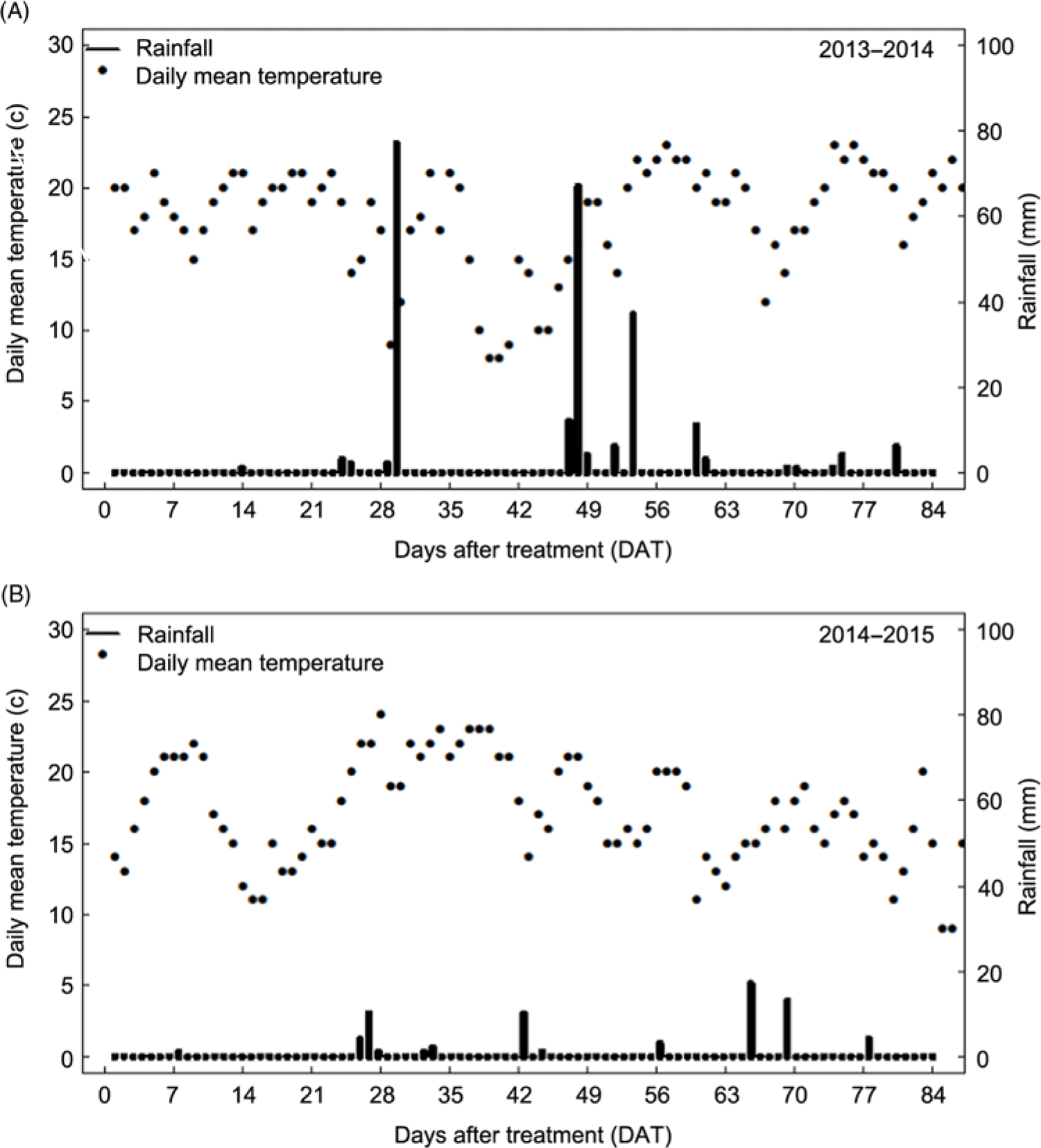
Field dissipation of herbicides can be significantly affected by occurrence of precipitation following herbicide application. Totals of 232 and 67 mm of rainfall were received in the 2013 to 2014 and 2014 to 2015 growing seasons, respectively, in the organic soil locations (Figure 1). Limited rainfall was received in the first 28 d for both growing seasons. However, 205 mm of rainfall was received in the first season between 35 and 63 d compared with 18 mm over the same period for the second season. The amount of rainfall received was not atypical for the region, which is usually low and varies with a 30-yr average total of 136 mm over the duration of the experiments (Anonymous 2019). The experiments were conducted during sugarcane planting and harvesting season in Florida that coincides with the period of reduced precipitation in the region.
Daily mean temperature and rainfall for organic soil locations at the Everglades Research and Education Center in Belle Glade, FL, for the 2013 to 2014 and 2014 to 2015 sugarcane-growing seasons. Totals of 232 and 67 mm of rainfall were received in the 2013 to 2014 and 2014 to 2015 growing seasons, respectively. From RainwiseNet: https://rainwise.net/weather/erec133430.

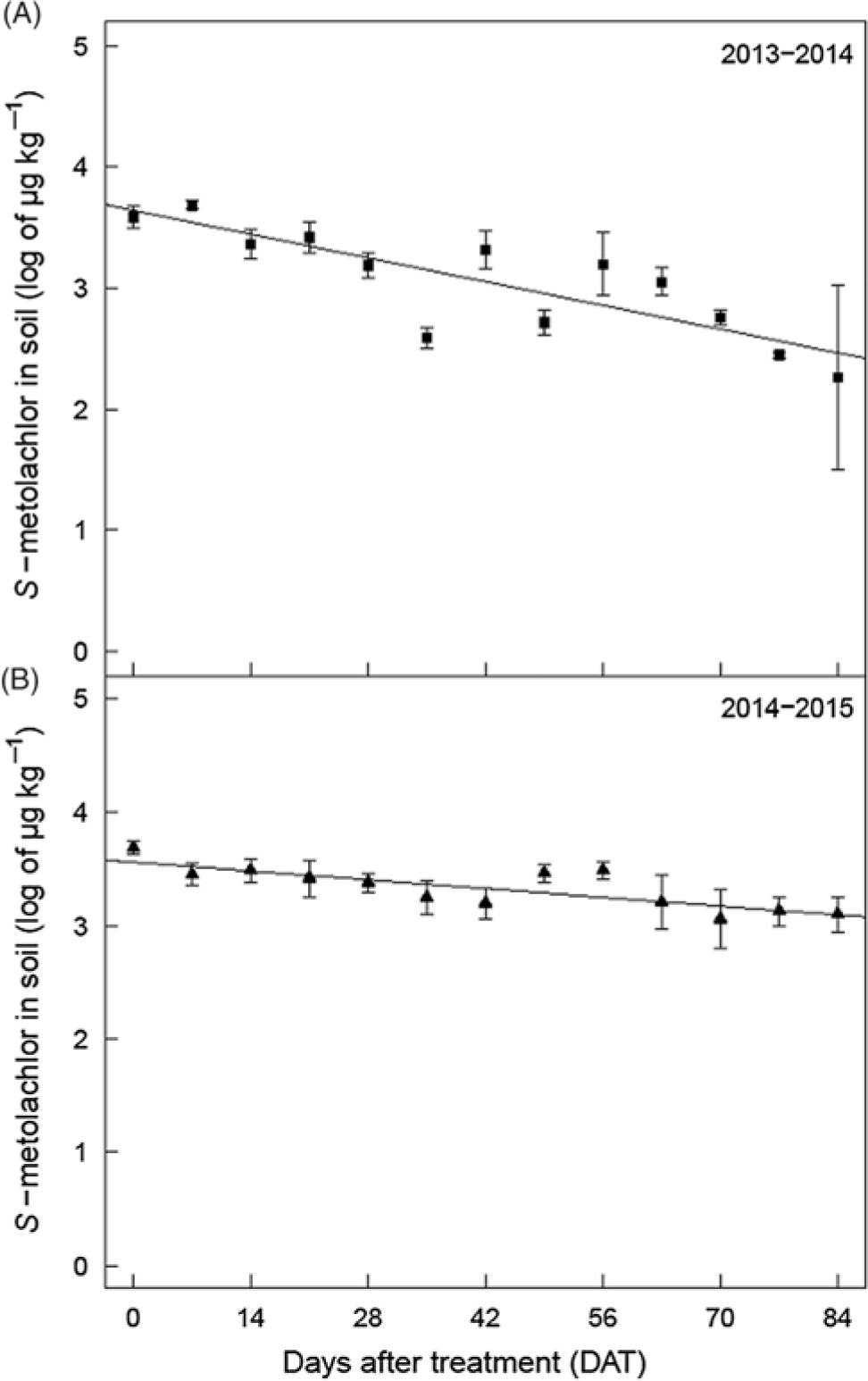
Dissipation of S-metolachlor on organic soils over time followed a negative linear trend whereby the amount of herbicide in the soil was reduced as the duration of time increased (Figure 2). Initial concentrations of S-metolachlor in the soil estimated from nontransformed data were 3,769 and 3,793 µg kg−1 in the first and second seasons, respectively (log-transformed data are presented in Table 1). The rate of dissipation of S-metolachlor was higher in the first season (b = 0.014) compared with the second season (b = 0.006), resulting in half-lives of 50 and 126 d for the first and second seasons, respectively (Table 1). This shows that persistence of S-metolachlor in the second season was 2.3-fold that of the first season. S-metolachlor half-lives of 13 to 142 d under field conditions depending on soil type and prevailing environmental conditions have been previously reported (Frank et al. Reference Frank, Clegg and Patni1991; Huang et al. Reference Huang, Cui, Zhou, Miao and Feng2017; Martínez et al. Reference Martínez, Lechón, Sánchez-Brunete and Tadeo1997; Mueller et al. Reference Mueller, Shaw and Witt1999; Shaner and Henry Reference Shaner and Henry2007; Shaner et al. Reference Shaner, Brunk, Belles, Westra and Nissen2006; Westra et al. Reference Westra, Shaner, Westra and Chapman2014; Wu et al. Reference Wu, Long, Li, Li, Liu and Li2015). An exponential decay model, with the exception of Shaner et al. (Reference Shaner, Brunk, Belles, Westra and Nissen2006) and Westra et al. (Reference Westra, Shaner, Westra and Chapman2014), described dissipation dynamics of S-metolachlor in these previous studies. The exponential decay model has also been used to describe dissipation of other herbicides over time under field conditions (Mueller and Senseman Reference Mueller and Senseman2015). Similar to our study, dissipation of S-metolachlor reported by Shaner et al. (Reference Shaner, Brunk, Belles, Westra and Nissen2006) and Westra et al. (Reference Westra, Shaner, Westra and Chapman2014) followed a liner decay model. In addition, dissipation rates (b = 0.005 to 0.012) under field conditions similar to our study have been reported (Shaner and Henry Reference Shaner and Henry2007; Westra et al. Reference Westra, Shaner, Westra and Chapman2014).
Dissipation of S-metolachlor in the top 7.5 cm of organic soil in sugarcane fields in 2013 to 2014 and 2014 to 2015 growing seasons at the Everglades Research and Education Center in Belle Glade, FL. Regression line represents log-transformed data. Error bars represent the SE of the log-transformed mean of four measurements and do not appear when smaller than the symbol of the mean.

Model parameters and SEs in parenthesis for lineara and exponentialb decay models for organic and mineral soils, respectively, half-life, and goodness of fit for dissipation of S-metolachlor in Florida sugarcane fields.

a Linear model on log-transformed data: Y = a + bt, where Y is S-metolachlor amount (log(µg kg−1)) in soil at time t, a is initial S-metolachlor amount (log (µg kg−1)) in soil at the first sampling time (t = 0), b is first-order rate constant or slope, and t is time in days after treatment.
b Exponential model: Y = ae −tb, where Y is S-metolachlor amount (µg kg−1) in soil at time t, a is initial S-metolachlor amount (µg kg−1) in soil at the first sampling time (t = 0), b is the first-order rate constant, and t is time in days after treatment.
c Abbreviations for goodness of fit: R2, coefficient of determination; RMSE, root mean-square error.
d Half-life calculated using: DT50 = ln(0.5)/b, where b is first-order rate constant estimated from the linear or exponential models.
Degradation of herbicides in soil greatly depends on soil microbial activity and bioavailability of the herbicides. Optimal microbial degradation of herbicides occurs in the top 20 cm of the soil profile, where microbial activity is highest, and declines with soil depth (Ghiorse and Wilson Reference Ghiorse, Wilson and Laskin1988; Miller et al. Reference Miller, Wollum and Weber1997). Organic soils used for sugarcane production in Florida have large microbial populations, and microbial activity in these soils decreases with increasing depth of soil (Schueneman and Sanchez Reference Schueneman, Sanchez, Bottcher and Izuno1994; Tate Reference Tate1979). S-metolachlor degradation in soil is a biological process attributed to soil microorganisms (Accinelli et al. Reference Accinelli, Dinelli, Vicari and Catizone2001; LeBaron et al. Reference LeBaron, McFarland, Simoneaux, Ebert, Kearney and Kaufman1988; Miller et al. Reference Miller, Wollum and Weber1997). Degradation and transformation of S-metolachlor in soil can occur under aerobic and anaerobic conditions (Accinelli et al. Reference Accinelli, Dinelli, Vicari and Catizone2001; Krause et al. Reference Krause, Hancock, Minard, Freyer, Honeycutt, LeBaron, Paulson, Liu and Bollag1985; Liu et al. Reference Liu, Zhang and Bollag1988; Miller et al. Reference Miller, Wollum and Weber1997; Saxena et al. Reference Saxena, Zhang and Bollag1987). Hydroxylation, dechlorination, dehalogenation, dealkylation, and amide bond cleavage are the dominant transformations involved in metabolism of S-metolachlor by adapted soil fungi and bacteria (Elsayed et al. Reference Elsayed, Maillard, Vuilleumier and Imfeld2014; Liu et al Reference Liu, Freyer and Bollag1991; McGahen and Tiedje Reference McGahen and Tiedje1978; Krause et al. Reference Krause, Hancock, Minard, Freyer, Honeycutt, LeBaron, Paulson, Liu and Bollag1985; Sanyal and Kulshrestha Reference Sanyal and Kulshrestha2002; Saxena et al. Reference Saxena, Zhang and Bollag1987; Wu et al. Reference Wu, Long, Li, Li, Liu and Li2015). Repeated application of herbicides can result in enhanced degradation by adapted soil microorganisms (Barriuso and Houot Reference Barriuso and Houot1996; Krutz et al. Reference Krutz, Shaner, Weaver, Webb, Zablotowicz, Reddy, Huang and Thomson2010; Shaner and Henry Reference Shaner and Henry2007). Enhanced degradation of S-metolachlor by adapted microbial populations may occur in soils with repeated S-metolachlor use (Liu et al.Reference Liu, Zhang and Bollag1988; Sanyal and Kulshrestha Reference Sanyal and Kulshrestha1999, Reference Sanyal and Kulshrestha2002). Liu et al. (Reference Liu, Zhang and Bollag1988) reported that indigenous soil microbial populations enhanced degradation of metolachlor after 5-yr acclimation to the herbicide in a soil perfusion experiment (Liu et al. Reference Liu, Zhang and Bollag1988). In contrast, Kotoula-Syka et al. (Reference Kotoula-Syka, Htzios, Berry and Wilson1997) reported no relationship between metolachlor use history and enhanced degradation in field studies. In our study, enhanced degradation of S-metolachlor observed in the first season compared with the second season was not likely attributable to an adapted microbial population, because the herbicide had not been previously used in the field where the study was conducted. Other chloroacetanilides were not used in previous crop cycles in both fields. Herbicides previously used in the fields included atrazine, metribuzin, ametryn, pendimethalin, mesotrione, trifloxysulfuron, and asulam. Sugarcane production soils in Florida exhibit enhanced atrazine degradation and cross adaptation with ametryn, another s-triazine (Odero and Shaner Reference Odero and Shaner2014b; Shaner et al. Reference Shaner, Krutz, Henry, Hanson, Poteet and Rainbolt2010). Chloroacetanilides have not been reported to be cross adapted with other herbicides (Harvey Reference Harvey1987; Kotoula-Syka et al. Reference Kotoula-Syka, Htzios, Berry and Wilson1997; Shaner and Henry Reference Shaner and Henry2007). For example, Shaner and Henry (Reference Shaner and Henry2007) reported no relationship between dissipation rate of S-metolachlor and atrazine use history, suggesting that no cross adaptation would have occurred in the present study because of the previous triazine use history. Similarly, previous repeated application of EPTC enhanced biodegradation of other thiocarbamates but not metolachlor, alachlor, and atrazine (Harvey Reference Harvey1987).
Soil moisture and temperature are key environmental factors that influence degradation of S-metolachlor (Bouchard et al. Reference Bouchard, Lavy and Marx1982; Long et al. Reference Long, Li and Wu2014; Rice et al. Reference Rice, Anderson and Coats2002; Zimdahl and Clark Reference Zimdahl and Clark1982). Microbial activity and abundance important for degradation of herbicides can be affected by changes in soil moisture content and temperature, which are key for their optimal growth and utilization of herbicides. Soil moisture also affects diffusion of herbicides. Diffusion is a physical mechanism by which herbicides move through the soil, thereby affecting their persistence (Scott and Phillips Reference Scott and Phillips1972). The diffusion pathway of a herbicide depends on the nature of pore spaces formed by soil particles and on moisture content, that is, diffusion pathlengths shorten with increasing soil moisture, and a greater rate of diffusion occurs in shorter pathlengths (Scott and Phillips Reference Scott and Phillips1972). In addition, higher moisture content favors more herbicide partitioning in the aqueous phase and the amount of water competing with the herbicide for adsorption sites becomes greater (Long et al. Reference Long, Li and Wu2014; Scott and Phillips Reference Scott and Phillips1972). The herbicide in the aqueous phase would then be readily subject to biotic and abiotic degradation (Long et al. Reference Long, Li and Wu2014). Degradation of S-metolachlor increases with increasing field capacity (Zimdahl and Clark Reference Zimdahl and Clark1982), and rapid degradation occurs in warm moist soils (Bouchard et al. Reference Bouchard, Lavy and Marx1982; Saxena et al. Reference Saxena, Zhang and Bollag1987). The rate of S-metolachlor dissipation is significantly faster in saturated soils than in corresponding unsaturated soils, resulting in substantially shorter half-life values (Rice et al. Reference Rice, Anderson and Coats2002). More rainfall received in the first season compared with the second season probably resulted in the rapid dissipation of S-metolachlor observed in the first season. Rice et al. (Reference Rice, Anderson and Coats2002) reported that saturated soils favored dissipation of S-metolachlor primarily with increased formation of more soil-bound residues than in unsaturated soils. Mueller et al. (Reference Mueller, Shaw and Witt1999) similarly reported that rapid degradation of acetanilide herbicides, including metolachlor, occurred in soils with adequate to excessive soil moisture. Although volatilization of S-metolachlor is generally low due to its low vapor pressure (Shaner Reference Shaner2014), Gish et al. (Reference Gish, Prueger, Kustas, Daughtry, McKee, Russ and Hatfield2009) reported that S-metolachlor volatilization increased significantly with increasing surface soil water content. It is conceivable that volatilization could have also played a role in S-metolachlor loss in the first season, particularly in relatively warm days (temperatures >20 C) following rainfall (Figure 1).
Although the physiochemical properties of the organic soil is different from soils in previous S-metolachlor field dissipations studies, the half-life of 50 to 126 d is within the range of 13 to 142 d reported in previous field studies (Frank et al. Reference Frank, Clegg and Patni1991; Huang et al. Reference Huang, Cui, Zhou, Miao and Feng2017; Martínez et al. Reference Martínez, Lechón, Sánchez-Brunete and Tadeo1997; Mueller et al. Reference Mueller, Shaw and Witt1999; Shaner Reference Shaner2014; Shaner and Henry Reference Shaner and Henry2007; Westra et al. Reference Westra, Shaner, Westra and Chapman2014; Wu et al. Reference Wu, Long, Li, Li, Liu and Li2015). S-metolachlor adsorption is highly correlated with soil organic matter (Braverman et al. Reference Braverman, Lavy and Barnes1986; Kozak Reference Kozak1983; Shaner Reference Shaner2014), and humic substances are the most important soil organic matter fraction involved in its adsorption (Kozak Reference Kozak1983). Humic substances form a higher fraction of organic matter in the Histosols in our study, because these soils were predominantly formed from plant organic material (Wright and Hanlon Reference Wright and Hanlon2009). Therefore, S-metolachlor was probably highly adsorbed to organic matter (75% organic matter) in the present study, resulting in relatively longer half-life values, particularly in the second season with limited soil moisture, compared with previous studies with much lower (<5.6%) organic matter (Braverman et al. Reference Braverman, Lavy and Barnes1986; Dinelli et al. Reference Dinelli, Accinelli, Vicari and Catizone2000; Sahid and Wei Reference Sahid and Wei1993; Shaner and Henry Reference Shaner and Henry2007; Walker and Brown Reference Walker and Brown1985; Westra et al. Reference Westra, Shaner, Westra and Chapman2014; Zimdahl and Clark Reference Zimdahl and Clark1982). Obrigawitch et al. (Reference Obrigawitch, Hons, Abernathy and Gipson1981) found S-metolachlor to be sufficiently mobile in low organic matter soils, illustrating the role of organic matter on its sorption. Based on our results, we can attribute organic matter content and water solubility of S-metolachlor in the presence of soil moisture to be important factors in its persistence on organic soils used for sugarcane production in Florida. Because the organic soils used in the present study were Dania series, which have no clay content (Anonymous 2011), organic matter was the only sorbent of S-metolachlor. Organic matter rather than clay is usually the primary adsorbing surface for S-metolachlor and its metabolites (Miller et al. Reference Miller, Wollum and Weber1997).
Mineral Soils
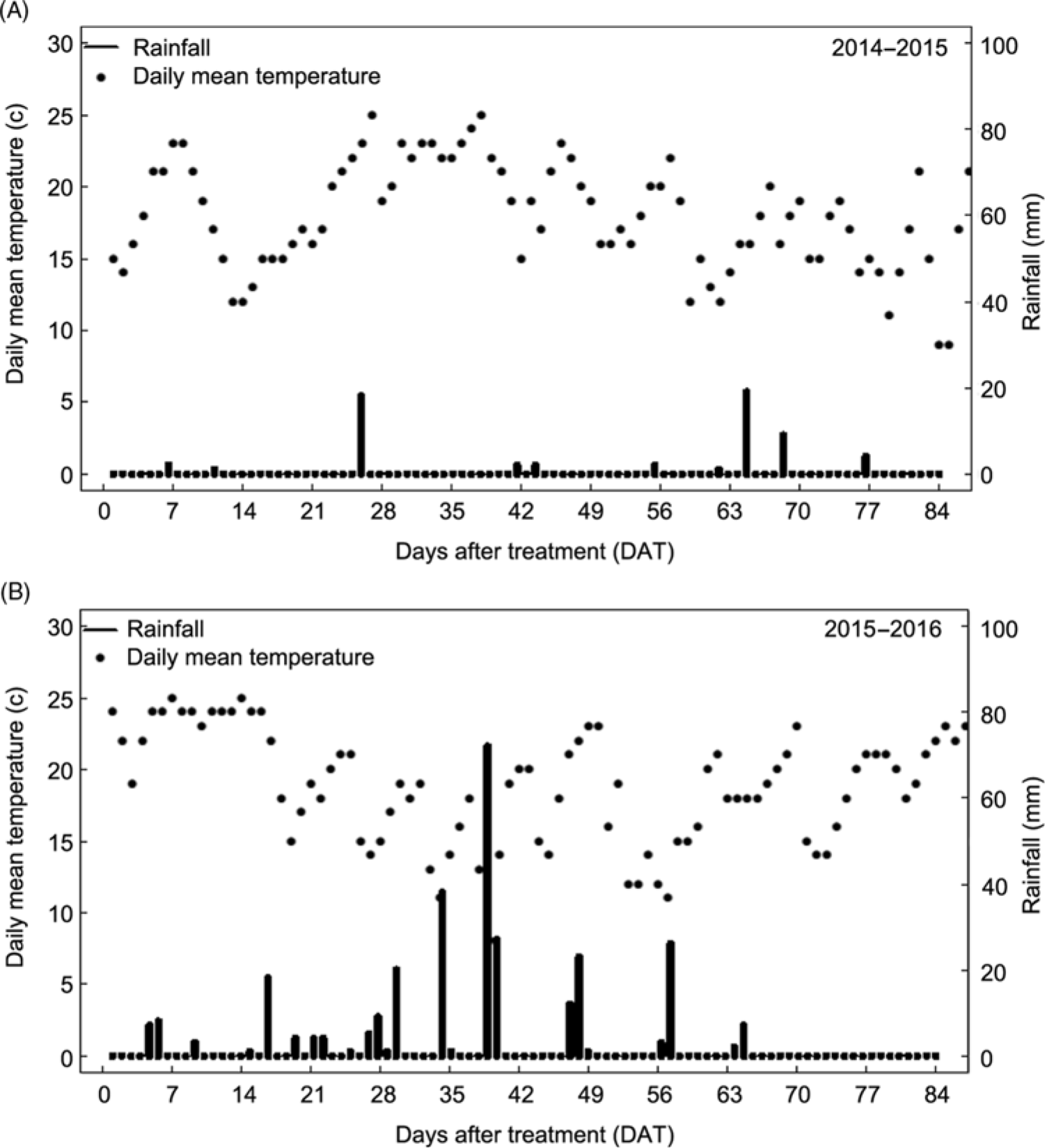
The total amount of rainfall received in the first season was 60 mm compared with 297 mm in the second season in the mineral soil locations (Figure 3). The rainfall totals for the first 14 d were 3 mm in the first season and 21 mm in the second season. Most of the rainfall in the second season, totaling 269 mm, was received between 18 and 62 d. In contrast, in the first season, 24 mm of rainfall was received over the same period. Similar to organic soil locations, precipitation was not atypical for the region, which is usually low and varies, with a 30-yr total of 157 mm over the period when the experiments were conducted (Anonymous 2019).
Daily mean temperature and rainfall for mineral soil locations at a grower’s field near Loxahatchee, FL, for the 2014 to 2015 and 2015 to 2016 sugarcane-growing seasons. Totals of 60 and 297 mm of rainfall were received in the 2014 to 2015 and 2015 to 2016 growing seasons, respectively. From RainwiseNet: https://rainwise.net/weather/erec233430.

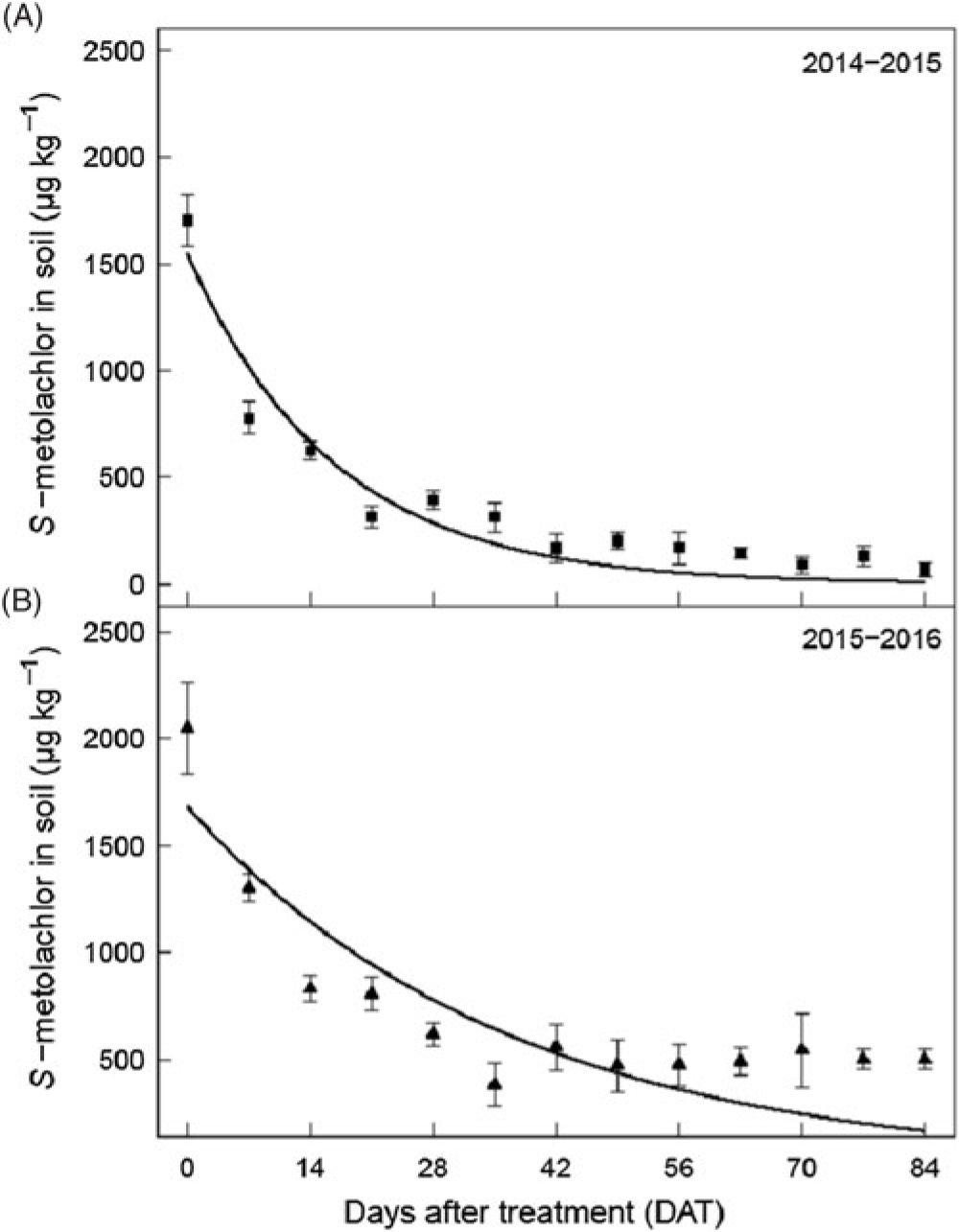
Dissipation of S-metolachlor on the mineral soils followed an exponential decline (Figure 4) with first-order rate constants of 0.06 and 0.03 in the first and second growing seasons, respectively (Table 1). Initial concentrations of S-metolachlor estimated from the exponential decay model were 1,548 and 1,721 µg kg−1 of soil for the first and second growing seasons, respectively (Table 1). S-metolachlor had a biphasic rate of dissipation both years (Figure 4). There was an initial rapid rate of dissipation within the first 28 d followed by a slow rate of dissipation both years. The DT50 of S-metolachlor was 12 and 24 d for the first and second seasons, respectively, indicated by a higher first-order rate constant in the first compared with the second season.
Dissipation of S-metolachlor in the top 7.5 cm of mineral soil in sugarcane fields in 2014 to 2015 and 2015 to 2016 growing seasons at a grower’s field near Loxahatchee, FL. Error bars represent the SE of the mean of four measurements and do not appear when smaller than the symbol of the mean.

The mineral soils in this study, the Holopaw series, had 1.6% organic matter content and no clay content. The Holopaw series consist of deep, very poorly drained soils that formed on sandy and loamy marine sediments, with the upper 114 cm of soil containing fine sand and no clay particles (Anonymous 2018a). Greater adsorption of S-metolachlor occurs on organic matter and clay constituents of soil (Shaner Reference Shaner2014), and its characteristic movement is related to the content of these constituents in soil (Obrigawitch et al. Reference Obrigawitch, Hons, Abernathy and Gipson1981). There appears to be a relationship between organic matter content of the mineral soils and the rate of S-metolachlor dissipation, whereby the low organic matter content with limited adsorptive capability resulted in short persistence of the herbicide (DT50 of 12 to 24 d) compared with the organic soils.
Photodegradation can be a major contributor of field dissipation of S-metolachlor, particularly under prolonged dry conditions with no incorporation (Shaner Reference Shaner2014). Minimal photolysis of S-metolachlor, approximately 6% degradation over a month, occurred when incorporated into the top 5 cm of soil compared with 50% degradation after 8 d on sunlit soil when surface applied (Rivard Reference Rivard2003). In our study, it is likely that photodegradation of S-metolachlor occurred following application with no incorporation and very limited or insignificant moisture in the first 21 DAT, particularly in the first season (Figure 3), resulting in the initial rapid dissipation observed. Occurrence of rainfall immediately following herbicide application is important, because it moves the herbicide in the soil and markedly alters the dissipation process (Mueller et al. Reference Mueller, Shaw and Witt1999). With herbicide movement in the soil after rainfall, processes such as photodegradation that could rapidly reduce herbicide concentration become minimal (Mueller et al. Reference Mueller, Shaw and Witt1999). In the second season, it is likely that photodegradation played a limited role in S-metolachlor dissipation because of the significant rainfall received following application compared with the first season (Figure 3). Also, leaching of S-metolachlor was probably a factor in its persistence in the mineral soils, particularly in the second season, when a significant amount of rainfall was received. Obrigawitch et al. (Reference Obrigawitch, Hons, Abernathy and Gipson1981) reported that S-metolachlor was highly mobile in soils containing <1% organic matter. In contrast, Shaner and Henry (Reference Shaner and Henry2007) reported that leaching was probably not a major factor in dissipation of metolachlor in soils with 0.6% to 5.6% organic matter content. In their study, 90% of metolachlor were extracted from the top 15 cm of soil.
It is important to determine how the dissipation rate of S-metolachlor and half-life values relate to control of fall panicum and other weed species on organic and mineral soils used for sugarcane cultivation in Florida. With half-life values of 50 to 126 d on organic soils, it would be expected that S-metolachlor would probably provide residual weed control further in the season compared with the level of control on mineral soils. Therefore, it is also important to determine the bioavailable fraction of S-metolachlor in each type of soil and relate it to weed control, because it is probable that the high amounts of S-metolachlor detected on the organic soils was adsorbed to organic matter and would likely result in lower weed control. Further studies are also required to determine how incorporation mechanically and by rainfall or irrigation would affect dissipation of S-metolachlor on both soil types. Understanding how S-metolachlor dissipation rates are affected by incorporation will provide sugarcane growers with information on the level of weed control to expect following application of the herbicide.
Acknowledgments
The authors which to thank Raphael Negrisoli (University of Florida–Everglades Research and Education Center) for his help with the project. We acknowledge Syngenta Crop Protection for partially funding the project. No conflicts of interest have been declared.