It is becoming increasingly evident that the nature and quantity of input children are exposed to during early language acquisition can play an important role in their language development and even ultimate attainment (e.g., Hoff, Reference Hoff2006). In particular, it has been found that input during episodes of joint attention (JA) between children and their parents plays a role in children's early language learning (e.g., Dominey & Dodane, Reference Dominey and Dodane2004; Tomasello & Farrar, Reference Tomasello and Farrar1986). At the same time, input during JA is subject to variation that is linked on one hand to the learning environment and on the other hand to characteristics of language learners themselves. However, the nature of this variation, as well as its potential effect on language learning, has received little attention to date. In the present study, we sought to examine potential differences in JA linked to variation in the learning environment associated with differences between mothers’ and fathers’ communication styles. Virtually all children, with the possible exception of children in one-parent families, learn language from both parents; thus, differences in how mothers and fathers engage in JA are important to consider (e.g., Davidson & Snow, Reference Davidson and Snow1996; Döpke, Reference Döpke1992; Leaper, Anderson, & Sanders, Reference Leaper, Anderson and Sanders1998). However, possible mother–father differences in input during episodes of JA have not been investigated to date because there is no research that has examined JA in fathers, the focus of the present study. We concomitantly examined differences in JA linked to differences in learners’ backgrounds. We did this by studying parental interactions between young children learning language from their birth parents in contrast to internationally adopted (IA) children acquiring a second first language from adoptive parents. IA children are interesting because they experience delayed exposure to the adopted language and, as a result, have levels of proficiency in that language that are lower than their chronological and mental age. Thus, we were able to examine how parents adjust their language input in general and their JA strategies in particular as a function of reduced language exposure and proficiency.
JA AND MONOLINGUAL LANGUAGE DEVELOPMENT
JA is defined as the ability to coordinate attention between people and objects for social purposes (Tomasello, Reference Tomasello1988). Typical JA behaviors include general abilities such as following an adult's gaze or drawing attention to an object by pointing (Watt, Wetherby, & Shumway Reference Watt, Wetherby and Shumway2006). The emergence of JA generally occurs between 9 and 18 months of age and is associated with early-stage language learning, when children quickly acquire the vocabulary of their native language (Carpenter, Nagell, & Tomasello, Reference Carpenter, Nagell and Tomasello1998). It has been argued that joint focus of attention between a child and an adult acts as a scaffold for children's early language development, particularly lexical acquisition, because JA provides children with an environment rich in vocabulary related to their current focus of attention during a period of development when they are in the early stages of language acquisition. Several theoretical accounts posit that JA may even be a necessary precursor for the earliest phases of word learning, arguing that when a child and a caregiver jointly focus on an object or event, the child learns both what words refer to and how they are used within a communicative context (Akhtar & Tomasello, Reference Akhtar, Tomasello and Golinkoff2000; Tomasello, Reference Tomasello1988; Tomasello & Farrar, Reference Tomasello and Farrar1986; Tomasello & Todd, Reference Tomasello and Todd1983).
There is some evidence to support this argument in studies that have examined the relationship between children's early JA experiences and their subsequent language abilities, especially their vocabulary development. For example, Tomasello and Farrar (Reference Tomasello and Farrar1986) showed that the more often mothers referred to objects that were the focus of their 15-month-old children's attention, and the longer they spent within each of these JA episodes, the larger their children's vocabulary size 6 months later. This was also found to be true for children's ability to learn novel words. That is to say, children remembered novel words presented in the context of JA more often than those presented outside of the child's attentional focus. Similarly, Tomasello and Todd (Reference Tomasello and Todd1983) found that the longer the duration of mothers’ JA episodes with their 1-year-old children, the larger their children's vocabulary sizes 5 months later. However, simply providing longer episodes of JA may not be sufficient to enhance lexical acquisition. Morales et al. (Reference Morales, Mundy, Delgado, Yale, Messinger and Neal2000) found that children's responsiveness to JA is also important. More specifically, they showed that children between 6 and 18 months of age who were more likely to turn their head or gaze toward their mother's voice or actions also had greater expressive and receptive vocabulary abilities at 24 and 30 months of age. Moreover, the 12- to 16-month-old children who were better able to direct their caregiver's attention had greater expressive language abilities between 18 and 22 months. In contrast, it has been found that children who are impaired at engaging in JA, or who spend shorter amounts of time engaged in JA, not only have smaller vocabularies but also exhibit slower syntactic development (e.g., Dominey & Dodane, Reference Dominey and Dodane2004; Harris, Kasari, & Sigman, Reference Harris, Kasari and Sigman1996; Tomasello & Farrar, Reference Tomasello and Farrar1986).
Although there is evidence supporting the association between JA and language development in general, evidence also indicates that the nature of parent–child interactions during JA vary and can be differentially influential in their children's development. In particular, parental use of the “follow-in” style, which occurs when caregivers follow children's attentional focus and comment on or label the object present in their environment, is generally associated with larger vocabularies in children, at least in families with Western cultural backgrounds. In contrast, the use of “redirect strategies,” wherein caregivers attempt to redirect a child's attention from their current focus of attention to another object or event, has been associated with lower vocabulary scores (e.g., Tomasello & Farrar, Reference Tomasello and Farrar1986). Arguably, the follow-in strategy is more “child-centered” in that it supports and builds on the child's current focus of attention and/or engagement (e.g., Döpke, Reference Döpke1992). However, there is evidence that the use of redirections does not always impede vocabulary acquisition. Shimpi and Huttenlocher (Reference Shimpi and Huttenlocher2007) found that successful redirections were positively associated with children's language outcomes, while unsuccessful redirections, when parents were not actually able to change their child's attentional focus, were negatively associated with children's vocabulary outcomes.
CULTURE AND JA
At the same time, there is evidence that parental choice of specific attention regulation strategies may depend on the cultural background of the family. In a study that examined interactions between caregivers and their 9- to 12-month-old children, Vigil (Reference Vigil2002) found that mothers who had immigrated to Britain from China preferred redirection strategies for establishing JA, while native-born British caregivers relied predominantly on follow-in strategies, in line with what has typically been found with other families with Western cultural backgrounds, as reported earlier. It is important to note that Chinese-born parents’ use of redirection and UK-born parents’ use of follow-in strategies were both associated with similar vocabulary outcomes for their children. Despite different experiences with JA, both groups of children had the same vocabulary size at 18 months of age, indicating that use of redirections in this case was not detrimental to children's vocabulary acquisition. In a similar vein, Vigil, Tyler, and Ross (Reference Vigil, Tyler and Ross2006) found that 15- to 21-month-old children in the United States whose parents had immigrated from Mexico actually benefited from parents’ use of redirection by learning more words in a novel word learning task than when follow-in strategies were used. In contrast, children of US-born parents learned more novel words when their parents used a follow-in strategy. Clearly, each form of attention regulation was differentially influential depending on the cultural background of the parents.
LEARNER CHARACTERISTICS
It has also been reported that the use of specific JA strategies is linked to learner factors, including the developmental level or linguistic ability of the children. More specifically, notwithstanding positive associations between use of follow-in JA strategies with typically developing children, a redirection strategy is actually preferred by parents whose children have special needs or language delays, particularly by mothers of deaf children or children with Down syndrome (Cheskin, Reference Cheskin1982; Harris et al., Reference Harris, Kasari and Sigman1996; Henggeler & Watson, Reference Henggeler and Watson1984; Mahoney, Fors, & Wood, Reference Mahoney, Fors and Wood1990; Marfo, Reference Marfo1991; for a review, see Paparella & Kasari, Reference Paparella and Kasari2004). One explanation for this is that redirections may be used to facilitate attentional engagement of children who have difficulty focusing their attention on their own (e.g., Bell, Reference Bell1979). Landry and Chapieski (Reference Landry and Chapieski1989) provided evidence for this claim by demonstrating that mothers of children with Down syndrome were more likely to redirect their children's attention, not when it meant diverting their focus, but rather when their children were not engaged in any other activity. In this way, these mothers promoted interactions that may not have otherwise occurred.
Findings such as these highlight differences in interaction between mothers and their children depending on the nature of each individual child's needs. This appears to be the case not only for children with developmental disorders (for a review, see Paparella & Kasari, Reference Paparella and Kasari2004) but also for those with language difficulties as well. For example, Conti-Ramsden (Reference Conti-Ramsden1990) examined the intelligibility of children with specific language impairment and their mothers’ use of recasts. Although not usually considered a JA strategy, recasts allow caregivers to follow into their child's attentional focus by repeating a child's utterance along with corrections, providing a learning opportunity. In this sense, recasts may be considered a type of follow-in strategy insofar as they are contingent on the child's behavior and do not require an attentional switch. Conti-Ramsden found that the more adept children were in their communication abilities, the more their mothers were able to use recasts, ultimately promoting language development further. However, this pattern was less likely to happen when children's language abilities were less developed. In this case, children who were unable to provide sufficient linguistic input were actually unable to elicit recasts from their mothers.
This finding is particularly relevant when considering the use of follow-ins for children with linguistic delays. Very limited and inadequate output from children may actually result in fewer opportunities for parents to support their children's communicative efforts, resulting in lower linguistic gains. In the case of children with limited linguistic abilities, redirection strategies may actually be beneficial. Parents may use redirections to elicit children's attention and engage them in interactions that promote language learning (Conti-Ramsden, Reference Conti-Ramsden and Gallaway1994; Conti-Ramsden & Friel-Patti, Reference Conti-Ramsden and Friel-Patti1983). Lyon (Reference Lyon1985) reported that mothers initiated conversations more frequently with children who initiated conversations relatively less frequently. Although this study did not examine JA, this finding is particularly important to consider in the case of IA children. Upon adoption, IA children's language abilities are necessarily lower than typically developing nonadopted children their age because they have not yet been exposed to the adopted language, and thus, redirections may actually provide the support they need to “catch-up” to their peers. We return to this point later.
MOTHERS AND FATHERS
It might also be expected that there would be differences in mothers’ and fathers’ JA patterns with their children. This has not been examined in parental language use specifically during JA interactions; however, other aspects of language use have been shown to differ between mothers and fathers (Conti-Ramsden, Reference Conti-Ramsden and Gallaway1994). For example, mothers have been shown to speak more to their children, take longer conversational turns, and cover a greater number and variety of topics during conversations with their children than do fathers. In contrast, fathers’ conversations with their children are typically shorter (Killarney & McCluskey, Reference Killarney and McCluskey1981), and fathers have been shown to talk less with their children overall (Davidson & Snow, Reference Davidson and Snow1996). There is evidence that mothers interact with their children using strategies that are considered to be more “child-centered” than fathers. Mothers tend to use less directive forms of speech as well as language that is more supportive of their children's vocabulary use (e.g., Döpke, Reference Döpke1992; Leaper et al., Reference Leaper, Anderson and Sanders1998). Moreover, mothers adjust aspects of their language to match the linguistic abilities of their children more than do fathers (e.g., Gleason, Reference Gleason and Dato1975). For example, Rondal (Reference Rondal1980) examined conversations between parents and their 18- to 36-month-old children and showed that, even though both mothers and fathers simplified their language when speaking to their children, fathers took fewer conversational turns than mothers and made more requests for clarification. There is also evidence that fathers use more directives and ask fewer questions when talking with their children than do mothers (Andrews & Bernstein-Ratner, Reference Andrews and Bernstein-Ratner1987; Malone & Guy, Reference Malone and Guy1982).
However, there is also evidence that fathers’ language use may be beneficial to children's language learning in ways that differ from mothers. For example, fathers have been shown to use a greater number of different and uncommon words than mothers (Masur & Gleason, Reference Masur and Gleason1980; Ratner, Reference Ratner1988), request more object labels from their children (Masur & Gleason, Reference Masur and Gleason1980) and use more extensive vocabulary when it is specifically relevant to a task (Brachfeld-Child, Simpson, & Izenson, Reference Brachfeld-Child, Simpson and Izenson1988). Some theories suggest that this arguably more demanding use of language functions to extend and broaden children's language (i.e., “bridge hypothesis”; Gleason, Reference Gleason and Dato1975). In support of this, Masur and Gleason (Reference Masur and Gleason1980) found that when fathers used relatively complex and demanding language with their children their children responded with more varied vocabulary and higher mean length of utterances. Thus, evidence suggests that fathers provide children with a challenging and rich verbal environment that may facilitate their language development over time in a manner that differs from that of mothers.
Although mother–father differences have been observed, there is also evidence that such differences may be mitigated in some contexts. More specifically, it has been shown that mother–father differences in child-directed language use are modulated by children's language-learning circumstances. Tucker, Hughes, and Glover (Reference Tucker, Hughes and Glover1983) found that mothers and fathers of deaf children used very similar strategies when interacting and talking with their children, and both parents adjusted their language level to that of their child equally. Goodz, Goodz, and Green (Reference Goodz, Goodz and Green1991) showed that when fathers in bilingual families were solely responsible for teaching their native language to their children, they maintained conversations longer and made similar language modifications as mothers. There is thus reason to believe that mother–father differences might be diminished in certain atypical language-learning situations, particularly when the need to aid or support children's language development is enhanced. This may be particularly relevant for families with IA children, who may require extra support for their early language acquisition.
IA CHILDREN
As noted earlier, the present study was undertaken to examine possible differences between mothers and fathers in JA strategies with their biological children and to examine the effect of learner-related factors on mother/father differences. In order to examine learner-related factors, the present study examined the attentional regulation strategies of adoptive parents of children from China in comparison to those of birth parents. The findings on mothers of adopted children have been reported previously; thus, the present results extend that study by including results for adoptive and birth fathers (Gauthier, Genesee, Dubois, & Kasparian, Reference Gauthier, Genesee, Dubois and Kasparian2011).
IA children are of particular interest for this purpose because they are in the exceptional position of having to learn a second first language (Glennen, Reference Glennen2002) from a young age when they are adopted into families whose language differs from that of their birth families. Children from China are usually adopted prior to the age of 24 months, as was the case of the children who participated in the present study. As a result, the language-learning process is disrupted during a time when JA abilities are typically established. This may affect the way in which IA children engage in JA. At the time of adoption, IA children typically have limited mastery of their birth language while lacking any knowledge of the adoption language. Delayed exposure to the adoption language means that their skills in that language do not line up with their cognitive abilities and, arguably, their communicative needs. This initial inability to verbally communicate with their adoptive parents may result in differences in interaction strategies in comparison to what is typically observed for children of the same age and developmental level living with their birth parents. There is some evidence that mothers interact with their IA children in a manner that is similar to that found for mothers with younger children or children with developmental delays (Gauthier et al., Reference Gauthier, Genesee, Dubois and Kasparian2011)
In an in-depth examination of adoptive mothers’ interactions with their IA children, Gauthier and colleagues (Reference Gauthier, Genesee, Dubois and Kasparian2011) found that adoptive mothers played an active role in promoting and maintaining JA with their 15-month-old children and that their children were not significantly delayed in engaging in JA in comparison with nonadopted controls. They also found that the adoptive mothers’ interactional strategies differed from those of the birth mothers. More specifically, the adoptive mothers talked more than the birth mothers and used more repetitions. This was likely to encourage JA with their children who were at a relatively young level of linguistic ability relative to their chronological age. The adoptive mothers were also more likely than birth mothers to redirect their child's attention during episodes of JA, and use of this redirective strategy with their 15-month-old children was positively correlated with their children's vocabulary development at 20 months of age. As discussed, this pattern has also been observed for mothers of children with language delays and developmental disorders (e.g., Mahoney et al., Reference Mahoney, Fors and Wood1990).
The finding that mothers of IA children use more redirective strategies than do mothers of nonadopted children suggests that these mothers are in tune with their children's unique stage of language development and alter their behavior in a way that seems to facilitate language learning. The question arises whether adoptive fathers would differ from adoptive mothers in the same way that birth mothers and fathers differ or whether adoptive fathers would actually resemble mothers because of the additional linguistic support required by their children, as was reported for bilingual families and those with atypical language learners.
THE PRESENT STUDY
The present study was designed to examine differences in JA strategies between mothers and fathers. By examining the interaction strategies of both IA and birth mothers and fathers we were also able to explore how mother–father differences might interact with learner-specific factors to influence parents’ attentional regulation strategies and, in turn, their child's language acquisition. One might expect fewer differences between IA mothers and fathers than between birth mothers and fathers because the former might be particularly sensitive to the unique language-learning situation of their adopted children. Thus, the present study addressed (a) whether mothers and fathers in general typically employ different JA strategies, (b) whether adoptive parents employ different interaction strategies than birth parents, and (c) whether there are differences between adoptive and birth mothers and fathers with respect to general patterns of language use that might reflect differences in adopted and nonadopted children's level of linguistic development. Finally, we also examined whether and how any of adoptive and birth fathers’ language usage patterns were related to their children's language outcomes 5 months later.
Method
Participants
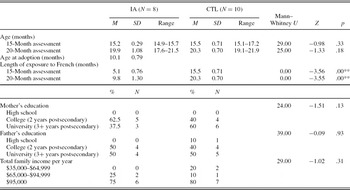
The participants included two groups of parents and their children: 8 IA children from China and their French-speaking mothers and fathers and 10 monolingual French-speaking nonadopted children and their French-speaking biological mothers and fathers. The IA children and parents had participated in the study by Gauthier and colleagues (Reference Gauthier, Genesee, Dubois and Kasparian2011); however, only data from mothers were reported there. The children were all girls. The average age of the IA children was 15.2 months (range = 14.9–15.7, SD = 0.29) at the time of the first session, and 19.9 (range = 17.6–21.5, SD = 1.1) at the second session. The mean age at adoption was 10.1 months (range = 9.0–11.5, SD = 0.79), and the average length of exposure to French was 5.1 months (range = 3.9–6.0, SD = 0.76) at the first session and 9.75 months (range = 7.6–11.5; SD = 1.3) at the second. The mean age of the control children was 15.5 (range = 15.1–17.2, SD = 0.71) at the first session and 20.27 (range = 19.1–21.9, SD = 0.70) at the second session.
The children did not differ statistically for age, sex, or socioeconomic status (SES). They did differ significantly on length of exposure to French, with IA children having less exposure at both sessions (see Table 1). Controlling for SES is important because it has been shown that families who adopt internationally tend to be of relatively high SES (e.g., Tan & Yang, Reference Tan and Yang2005), and SES is positively correlated with language development (e.g., Arriaga, Fenson, Cronan, & Pethick, Reference Arriaga, Fenton, Cronan and Pethick1998; Hoff, Reference Hoff2006). Detailed demographic information of the participants is presented in Table 1.
Demographic data on the adopted and control groups at initial and follow-up assessments

Note: IA, Internationally adopted children; CTL, control children.
**p < .001.
Procedures
The study took place over two sessions, roughly 5 months apart, in the participants’ homes to ensure that the children were at ease. During the first session, the procedure and objectives of the study were explained to the parents, and their informed consent was obtained. One of the parents was then asked to complete a developmental questionnaire that included information about (a) the child's health and development and their medical condition, before and after adoption (for the IA children); (b) the parents’ education and income; and (c) the language environment of the home. This information was used to document the children's past exposure to French, English, and other languages. The mothers and fathers were then separately asked to interact with their children as they typically would using toys that they would normally use during play sessions. These sessions lasted for 30 min per parent and were video recorded for later transcription, coding, and analysis.
During the second session, both questionnaires were updated, and children's vocabulary was assessed using the French version of the MacArthur Communicative Development Inventory (MCDI; Fenson et al., Reference Fenson, Marchman, Thal, Dale, Reznick and Bates2007).Footnote 1 Parents completed the Mots et Gestes form at 15 months (words and gestures; Trudeau, Frank, & Poulin-Dubois, Reference Trudeau, Frank and Poulin-Dubois1997) and the Mots et Enonces form at 20 months (words and sentences; Frank, Poulin-Dubois, & Trudeau, Reference Frank, Poulin-Dubois and Trudeau1997). At 15 months, the dependent variables extracted from the MCDI were the number of words understood and produced and communicative and symbolic gestures they tried or completed. At 20 months, expressive language ability was determined by parental reports of the number of words their children produced and whether or not they were combining words (yes/no response).
CODING PROCEDURE
The taped sessions at 15 months were transcribed and coded according to the CHAT format (MacWhinney & Snow, Reference MacWhinney and Snow1990). Only the 20 min of each recording session following the first 5 min were analyzed; the first 5 min were not analyzed to ensure the parent and child were comfortable with the procedure and were not attending to the examiner or video camera. Caregiver utterances were coded for JA episodes according to Tomasello and Todd's (Reference Tomasello and Todd1983) guidelines (identical to those used in Gauthier et al., Reference Gauthier, Genesee, Dubois and Kasparian2011): (a) A JA episode begins with one person initiating interaction with the other, and episodes were coded as being initiated by the child or the parent; (b) both participants must visually focus on a single object or activity for at least 3 s (though they can look away shortly during long interactions); and (c) to show that the child is aware of the interaction taking place, the child must, at some point during the interaction, direct some behavior toward the caregiver (e.g., looking at his face). Episodes between JA were coded as non-JA episodes. Percentage of JA episodes was calculated as the number of JA episodes divided by the total number of episodes in the transcript. Percentage of child-initiated JA episodes was calculated as the number of JA episodes initiated by the child divided by the total number of JA episodes initiated by parents and children combined in the transcript. The length of each JA episode was measured in seconds. Inside JA episodes, parents’ utterances were coded as (a) following-in, that is, the parent attended to an object or activity already being attended to by the child; (b) successful redirection, the parent successfully directed the child's attention to an object or activity that they were not already attending to; and (c) unsuccessful redirection, a failed attempt by the parent to direct the child's attention to a new object or activity. Percentages for use of each attention regulation strategy were calculated as the number of utterances employing a particular strategy (i.e., successful or unsuccessful redirection, or follow-in) divided by the total number of utterances within JA.
Twenty percent of the transcripts were recoded entirely by a second coder in order to assess coding reliability. The percentage of agreement was between 90.4% and 98%.
Results
Children's language outcomes at 15 and 20 months
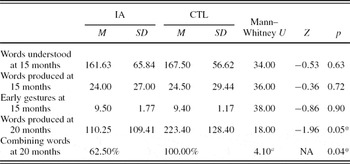
Table 2 summarizes the results from the MCDI at 15 and 20 months. There were no significant differences between the IA and nonadopted children with respect to number of words produced (Mann–Whitney U = 36.00, z = −0.36, p = .72) or understood (Mann–Whitney U = 34.00, z = −0.53, p = .63) at 15 months. The children in both groups were similar in the number of communicative gestures they tried and/or completed (Mann–Whitney U = 38.00, z = −0.86, p = .90). However, there was a moderately significant difference between the two groups with respect to the number of words their parents reported that they produced at 20 months (Mann–Whitney U = 18.00, z = −1.96, p = .05). Chi-square tests indicated that there were significantly fewer IA children combining words at 20 months compared to the nonadopted children (χ2 = 4.10, p = .04). In general, the language abilities of the IA children were very similar to those of the nonadopted children even though the IA children began to acquire French later than the nonadopted children. This supports previous findings that IA children adopted from China at young ages make rapid initial progress in learning their new language following adoption (e.g., Geren, Snedeker, & Ax, Reference Geren, Snedeker and Ax2005; Glennen, Reference Glennen2005; Pollock, Price, & Fulmer, Reference Pollock, Price and Fulmer2003; Tan & Yang, Reference Tan and Yang2005).
Results on the MacArthur Communicative Development Inventory at 15 and 20 months

Note: IA, Internationally adopted children (n = 8); CTL, control children (n = 10); NA, not applicable.
aPearson chi-square.
*p < .05.
Mothers’ and fathers’ general language use
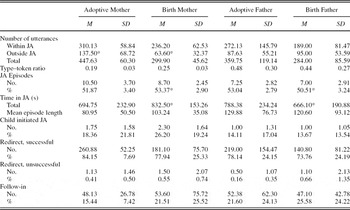
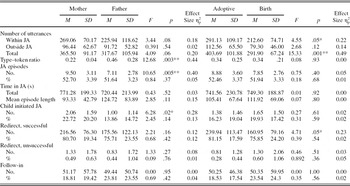
In order to examine the nature of the parents’ general language use with their children, we examined the number of parents’ utterances within and outside episodes of JA, as well as in total. We also examined parent type/token ratios in order to get a measure of the variety of words that parents used with their children. These indices of parent language use were compared across mothers and fathers using repeated measures analyses of variance with parent (mother or father) as a within-subjects factor and birth status (adopted or birth) as a between-subjects factor. Partial eta squared (η2p) is reported as a measure of effect size for all comparisons. A value greater than 0.2 indicates a meaningful effect for significant differences. Results for each individual group are observed in Table 3, results for mothers and fathers collapsed across birth status, and adopted and birth families collapsed across parents are in Table 4.
Means of variables computed during adoptive and birth mothers’ and fathers’ interactions with their children at 15 months

Note: JA, Joint attention. No., the number of instances in transcript; %, percentage of instances on total utterances in transcript.
*p < .05. Asterisks represent which groups differ from each other following post hoc comparisons.
Means of variables computed during mother and father, and adoptive and birth parent interactions with their children at 15 months

Note: JA, Joint attention; No., the number of instances in trancript; %, percentage of instances on total utterances in transcript.
**p < .01. *p < .05.
For total number of utterances (within and outside of JA combined), there was a trend for mothers to produce more utterances than fathers, F (1, 16) = 4.09, p = .060, η2p = 0.20, and there was a main effect of birth status, F (1, 16) = 15.33, p = .001, η2p = 0.49, with adoptive parents using more utterances with their children than birth parents. The Parent × Birth Status interaction was not significant F (1, 16) = 1.98, p = .179, η2p = 0.11. For number of utterances inside JA, there was no main effect of parent, F (1, 16) = 3.44, p = .082, η2p = 0.18; however, there was a main effect of birth status, F (1, 16) = 4.55, p = .049, η2p = 0.22, indicating that adoptive parents used more utterances within JA episodes than did birth parents. The interaction was not significant, F (1, 16) = 0.040, p = .844, η2p = 0.11, η2p = 0.00. A different pattern was observed for number of utterances outside of JA, with no main effect for either parent, F (1, 16) = 0.391, p = .541, η2p = 0.02, or birth status, F (1, 16) = 2.68, p = .121, η2p = 0.14, but a significant Parent × Birth Status interaction, F (1, 16) = 7.56, p = .014, η2p = 0.32. Post hoc comparisons revealed that this was due to adoptive mothers using more utterances than birth mothers (p < 0.01). The difference between adoptive and birth fathers was not significant, nor was the difference between parents in each group. Finally, when examining type/token ratios, there was a significant main effect of parent, F (1, 16) = 12.68, p = .003, η2p = 0.44, with fathers producing a higher type/token ratio than mothers. There was no main effect of birth status, F (1, 16) = 0.008, p = .928, η2p = 0.00, and the interaction was not significant, F (1, 16) = 0.529, p = .478, η2p = 0.03.
Overall, these results indicate certain mother–father differences (see Table 4) in that mothers in both groups tended to talk more to their children than did fathers, both inside JA and in total. At the same time, the type/token ratio of fathers in both groups was higher than that of mothers so that fathers were potentially providing more varied vocabulary for their children than were mothers. Outside of JA, IA mothers in particular used more utterances than nonadoptive mothers (see Table 3). This may indicate a general increase in use of language by IA mothers in particular in order to support their children's language acquisition.
Time in JA
In order to examine the extent and nature of parent–child JA interactions in detail, several behaviors were examined: number of JA episodes, percent of JA episodes (number of JA episodes divided by total number of episodes in the transcripts), total time (s) spent in JA, mean length of JA episodes (seconds spent in JA divided by number of JA episodes), number of child-initiated JA episodes, and percentage of child-initiated JA episodes (number of child-initiated JA episodes divided by number of JA episodes). For these variables, we examined both number and percent as there is evidence that sheer volume of input plays a role in language development (e.g., Huttenlocher, Haight, Bryk, Seltzer, & Lyon, Reference Huttenlocher, Haight, Bryk, Seltzer and Lyons1991); we also included percentages in order to control for differences in the volume of language used. Results for each individual group are observed in Table 3, results for mothers and fathers collapsed across birth status and adopted and birth families collapsed across parents are in Table 4.
For number of JA episodes, there was a significant main effect of parent, F (1, 16) = 10.65, p = .005, η2p = 0.40, with mothers engaging in a greater number of episodes than fathers, but there was no main effect of birth status, F (1, 16) = 0.748, p = .400, η2p = 0.05, and the interaction was not significant, F (1, 16) = 1.04, p = .322, η2p = 0.06. For percent of JA episodes, however, there was no main effect of parent, F (1, 16) = 0.840, p = .373, η2p = 0.05, or birth status, F (1, 16) = 0.175, p = .681, η2p = 0.01, but the interaction was significant, F (1, 16) = 4.85, p = .043, η2p = 0.23. Post hoc comparisons revealed that the birth mothers engaged in a higher percentage of JA episodes than birth fathers (p < 0.05), but IA mothers and fathers did not differ significantly. It is interesting that IA fathers actually engaged in a numerically higher percentage of JA episodes than IA mothers. Although this difference was not statistically significant, it contrasts with the pattern observed for birth mothers and fathers.
With respect to total length of time (s) spent in JA, there was no main effect of parent, F (1, 16) = 0.431, p = .521, η2p = 0.03, or birth status, F (1, 16) = 0.010, p = .922. η2p = 0.00, but there was a significant Parent × Birth Status interaction, F (1, 16) = 5.50, p = .032, η2p = 0.26. Post hoc comparisons revealed that birth mothers spent more time engaged in JA than did the birth fathers (p < 0.05), but this difference was not significant for adoptive mothers and fathers. In terms of mean length of JA episodes, neither main effect, parent: F (1, 16) = 2.85, p = .111, η2p = 0.15; birth status: F (1, 16) = 0.065, p = .803, η2p = 0.00, nor the interaction, F (1, 16) = 0.646, p = .433, η2p = 0.04, was significant.
For number of child-initiated JA episodes, there was a main effect of parent, F (1, 16) = 6.28, p = .023, η2p = 0.28, with children initiating more JA episodes with mothers than with fathers, but there was no main effect of birth status, F (1, 16) = 0.270, p = .610, η2p = 0.02, and the interaction was not significant, F (1, 16) = 0.452, p = .511, η2p = 0.03. However, in terms of percentage of child-initiated JA episodes, there was no main effect of either parent, F (1, 16) = 2.54, p = .137, η2p = 0.13, or birth status, F (1, 16) = 0.311, p = .585, η2p = 0.02, and the interaction was not significant, F (1, 16) = 0.596, p = .451, η2p = 0.04.
Overall, these results indicate certain differences in mothers’ and fathers’ engagement in JA. Mothers engaged in a greater number of JA episodes with their children than did fathers (see Table 4), and children also initiated JA more often with mothers than with fathers. It appears that at least some of the differences between mothers and fathers were driven by differences between birth mothers and fathers in particular (see Table 3). Birth mothers spent a greater percentage of time engaged in JA than did birth fathers, and each JA episode was longer for birth mothers than for birth fathers. In contrast, IA mothers and fathers spent an equal amount of time within each JA episode, and IA fathers actually engaged in a higher percentage of JA episodes than IA mothers, although this difference was not statistically significant. This indicates that IA fathers in particular may have altered their behavior to support their children's unique language-learning circumstances.
Mothers’ and fathers’ attention regulation strategies
In order to investigate specific strategies used by parents within JA interactions, we examined parents’ use of both successful and unsuccessful redirections, as well as follow-ins. Results for each individual group are observed in Table 3, results for mothers and fathers collapsed across birth status, and adopted and birth families collapsed across parents are in Table 4.
In terms of percentage of successful redirections, there was no main effect of parent, F (1, 16) = 0.68, p = .422, η2p = 0.12, or birth status, F (1, 16) = 0.394, p = .539, η2p = 0.02, and the interaction was not significant, F (1, 16) = 0.022, p = .884, η2p = 0.05. For percentage of unsuccessful redirections, there was no main effect of parent, F (1, 16) = 0.094, p = .763, η2p = 0.01, or birth status, F (1, 16) = 0.889, p = .360, η2p = 0.05, and the interaction was not significant, F (1, 16) = 0.624, p = .441, η2p = 0.04. With respect to percentage of follow-ins, there was no main effect of parent, F (1, 16) = 0.686, p = .420, η2p = 0.04, or birth status, F (1, 16) = 0.352, p = .561, η2p = 0.02, and the interaction was not significant, F (1, 16) = 0.029, p = .867, η2p = 0.00.
In terms of actual frequencies of each type of attention regulation strategy, for number of successful redirections there was no main effect of parent, F (1, 16) = 2.21, p = .157, η2p = 0.12, but there was a main effect of birth status, F (1, 16) = 4.71, p = .045, η2p = 0.23, with IA parents engaging in a greater number of successful redirections than birth parents; the interaction was not significant, F (1, 16) = 0.001, p = .978, η2p = 0.00. For number of unsuccessful redirections, there was no main effect of parent, F (1, 16) = 1.33, p = .266, η2p = 0.08, or birth status, F (1, 16) = 0.456, p = .509, η2p = 0.03, and the interaction was not significant, F (1, 16) = 0.064, p = .804, η2p = 0.00. Similarly, for number of follow-in utterances, there was no main effect of either parent, F (1, 16) = 0.004, p = .948, η2p = 0.00, or birth status, F (1, 16) = 0.000, p = .996, η2p = 0.00, and the interaction was not significant, F (1, 16) = 0.102, p = .754, η2p = 0.00.
Overall, these results indicate mother–father differences in the use of specific interaction strategies within JA as mothers were better at redirecting their children's attention than fathers. This was similar to the differences observed between IA and birth parents (see Table 4), except that IA parents used an even greater number of redirections than birth parents and more of these were successful. Thus, it appears that IA parents, including fathers, were more likely to rely on redirective strategies, perhaps as a means to support their children's early language acquisition. In general, however, mothers were more successful in this regard than fathers.
Relationship between JA strategies at 15 months and child outcomes at 20 months
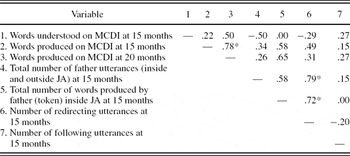
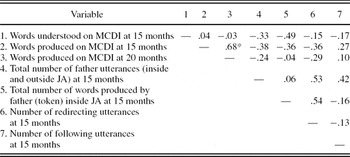
In order to examine the relationships between fathers’ attention regulation strategies and general language use at 15 months versus the IA children's vocabulary development at 20 months, Spearman correlations were calculated. Only the fathers’ results are reported here because these correlations were reported for mothers by Gauthier and colleagues (Reference Gauthier, Genesee, Dubois and Kasparian2011). Gauthier and colleagues had previously shown that the number of redirective utterances used by IA mothers when their children were 15 months was significantly and positively correlated with their children's expressive vocabulary scores on the MCDI at 20 months, r (10) = .57, p < 0.01. Following Gauthier and colleagues, correlations were calculated between adoptive and nonadoptive fathers’ language and attention regulation strategy use at 15 months (number of total utterances, number of follow-in utterances, number of total redirections, and ratio produced by father) and children's language outcomes (the number of words understood and produced by the children at 15 months and the number of words produced by the children at 20 months according to the MCDI).
No significant correlations occurred between adoptive or birth fathers’ language and attention regulation strategies at 15 months and their children's language outcomes (see Tables 5 and 6).
Correlations between vocabulary scores, attention regulation strategies, and adoptive fathers’ language use with their IA children (n = 8)

Note: The values are Spearman correlations. IA, Internationally adopted children; MCDI, MacArthur Communicative Development Inventory; JA, joint attention.
*p < .05.
Correlations between vocabulary scores, attention regulation strategies, and birth fathers’ language use with their birth children (n = 10)

Note: The values are Spearman correlations. MCDI, MacArthur Communicative Development Inventory; JA, joint attention.
*p < .05.
DISCUSSION
The present study sought to examine how language use with children and, in particular during episodes of JA, might differ in mothers and fathers and with children with different learner characteristics (IA vs. birth children). We examined whether (a) fathers employ different interaction strategies than mothers; (b) adoptive parents employ different interaction strategies than birth parents; (c) there are differences between mothers and fathers in adoptive families in comparison to the parents in birth families, potentially because of differences in children's level of linguistic development; and (d) any of these differences relate to children's language outcomes. Each of these questions is discussed in turn.
Mothers Versus Fathers
A key comparison in the present study was between mothers and fathers, regardless of the birth status of the child. The question addressed in these comparisons was how fathers engage linguistically with their children, especially with respect to JA, and how their interaction styles are the same or different from those of mothers. Our results indicate that mothers and fathers were similar in a number of respects. They spent a similar amount of time engaged in JA, both in total and per JA episode, and their use of redirections and follow-ins during episodes of JA, measured as total amount of actual time and percentage time, was similar. At the same time, some noteworthy differences were observed. Mothers tended to use more utterances than fathers, both inside JA as well as in total, although these differences were only marginally significant. Mothers also engaged in a greater number of JA episodes with their children than did fathers, and the children themselves initiated JA more often with their mothers than with their fathers. These findings are consistent with previous research, which has shown that mothers talk more with their children and are more likely than fathers to engage their children in JA, a strategy that some have argued is favorable for language learning (Cherry & Lewis Reference Cherry and Lewis1976; Leaper et al., Reference Leaper, Anderson and Sanders1998; Stoneman & Brody Reference Stoneman and Brody1981).
In contrast, the fathers in the present study, as a group, had a higher type/token ratio when speaking with their children, although mothers spoke more. These findings are consistent with previous research (Ratner, Reference Ratner1988) and suggest that fathers are less child centered and provide their children with a more complex source of vocabulary and possibly, as a result, more cognitively challenging activities (Kornhaber & Marcos, Reference Kornhaber and Marcos2000). That mothers had relatively low type/token ratios implies that they used a more restricted range of words and more lexical repetitions than did fathers. This is consistent with previous research showing that mothers tend to adjust their vocabulary and sentence length to match that of their children (e.g., Döpke, Reference Döpke1992; Leaper, et al., Reference Leaper, Anderson and Sanders1998). In contrast, fathers’ use of more varied vocabulary with their children may be beneficial in a different way as it provides children with cognitive challenges and, more specifically, may prepare them for interactions outside the home (e.g., Tomasello & Barton, Reference Tomasello and Barton1994; Gleason, Reference Gleason and Dato1975; Tenenbaum & Leaper, Reference Tenenbaum and Leaper1998).
Thus, although there are similarities in the ways mothers and fathers in general interacted with their children, noteworthy differences emerged, leading to the conclusion that parents provide different linguistic environments for their children in some respects from an early age. Because of the crucial role that JA is thought to play in early language acquisition, as well as the fact that the majority of children learn language from fathers as well as mothers, these comparisons are important but often unexplored.
Adoptive Versus Birth Parents
Another important set of comparisons addressed was between adoptive and birth parents. Here the question was whether adoptive and birth parents use language in the same ways with their children. By examining similarities and differences in these parent groups, we were able to investigate how learner-specific factors might influence parent–child interactions, particularly JA. Our results provide evidence that both adoptive mothers and fathers are child centered and actively engaged in the language development of their children, arguably in an effort to help their IA children “catch-up” in their newly adopted language. This is consistent with the child-centered behavior of mothers in general and with patterns typically observed for mothers in comparison to fathers (Cherry & Lewis Reference Cherry and Lewis1976; Leaper et al., Reference Leaper, Anderson and Sanders1998; Stoneman & Brody Reference Stoneman and Brody1981). More specifically, adoptive parents considered as a group used a greater number of redirections, and specifically successful redirections, than did birth parents. As discussed earlier, redirections are typically used to a greater extent with younger children and with children with special needs or developmental delays (e.g., Mahoney et al., Reference Mahoney, Fors and Wood1990). Although these IA children did not differ significantly from the nonadopted children in terms of language development at the time of testing and therefore would not be considered clinically delayed, perhaps their delayed exposure to French motivated the adoptive parents to talk with them as they would younger children in order to facilitate their acquisition of the adopted language. It is possible that it was use of this strategy that explains why the IA children scored as well as the birth children at the time of the first testing, shortly after their adoption. Gauthier and her colleagues found that the adoptive mothers used significantly more utterances than birth mothers in and even outside of JA. More language input is typically associated with greater vocabulary development (e.g., Huttenlocher et al., Reference Huttenlocher, Haight, Bryk, Seltzer and Lyons1991), and adoptive mothers’ use of redirections in particular has been associated with vocabulary size in adopted children (Gauthier et al., Reference Gauthier, Genesee, Dubois and Kasparian2011). Thus, it appears that adoptive parents may be responding to the specific needs of their children, or at least what they perceive to be needs, for extended or enriched input in order to catch up to their nonadopted peers.
Adoptive Mothers and Fathers in Comparison to Birth Mothers and Fathers
Notwithstanding differences in language use that have been found to characterize mothers and fathers in general, as discussed earlier, research also suggests that mothers and fathers tend to use language more similarly under certain conditions and, in particular, that fathers adopt more active and child-centered patterns of language use with their children under certain circumstances. This has been found in cases where children require additional support for language acquisition because of disorders or delays (e.g., Tucker et al., Reference Tucker, Hughes and Glover1983) or in bilingual families where the father is the sole source of input for his language (Goodz et al., Reference Goodz, Goodz and Green1991). Results from the present study indicate that not only did the adoptive parents as a group tend to use the active, child-centered patterns that are typical of mothers in general, but that adoptive fathers in particular were more likely than birth fathers to use such strategies, resulting in adoptive fathers and mothers being more similar than birth fathers and mothers (see Table 3). For example, while birth fathers spent less total time in JA (666.1 s on average) than birth mothers (832.5 s on average) and engaged in a lower percentage of JA episodes (birth fathers = 50.51%, birth mothers = 53.37%), these differences were not significant in the case of adoptive fathers and mothers. Rather, adoptive mothers and fathers spent the same total time in JA (adoptive mothers: 694.75 s on average; adoptive fathers: 788.38 s on average) as birth mothers and, overall, more than was observed for birth fathers. Adoptive fathers actually spent more time on average in JA than adoptive mothers, and they had a higher percentage of JA episodes (53.05% on average) than adoptive mothers (51.87% on average), although these differences were not statistically significant. It is arguable that large within-group variance accounts for the lack of significance in these results.
Examination of numerical differences between adoptive and birth fathers indicates that the adoptive fathers scored higher than birth fathers on a number of measures, indicating more active and child-centered language use (see Table 3). For example, adoptive fathers used a greater number of total utterances, as well as utterances within JA, than either birth mothers or fathers; they engaged in both a greater number and percentage of JA episodes than birth fathers; they spent a longer total amount of time in JA than birth fathers; and they had longer JA episodes, on average, than both birth mothers and fathers. They also had a greater number and percentage of successful redirections and fewer unsuccessful redirections than birth mothers and fathers. Admittedly these differences were not statistically significant, although some of these differences might be statistically significant with larger sample sizes. Arguably, the adoptive fathers were motivated to use language with their children in these ways in order to promote their language development so that they can catch-up with age-expected norms.
JA and Language Outcomes
The final question addressed in the present study concerned the relationship between fathers’ use of language and their children's later vocabulary development. We found that none of the indices of language use for the adoptive or birth fathers, including the types of attention regulation strategies they used, were significantly correlated with their children's expressive vocabulary at 20 months. This contrasts with the results reported by Gauthier and colleagues (Reference Gauthier, Genesee, Dubois and Kasparian2011), who found that adoptive mothers’ use of redirecting strategies at 15 months was significantly and positively correlated with the number of words produced by their children at 20 months. That this was not the case for the adoptive fathers is particularly interesting because both adoptive parents favored use of redirections during episodes of JA. The differential relationship between adoptive mothers’ and fathers’ use of redirections and their children's subsequent vocabulary development may be partially attributable to differences in the nature of the mother/father–child relationship and partly to differences in the amount of time each parent spends with his or her children; more specifically, fathers may spend insufficient time with their children to make a significant difference in this respect. An interesting follow-up would be to examine the amount of time parents spend with their children and in what capacities to determine whether this changes the nature and effect of fathers’ input. Another possible explanation for these results is that the complexity of the fathers’ language posed a linguistic challenge that made it difficult for their children to learn from them. It could also be that fathers’ language use is associated with aspects of children's language development that are not assessed by the MCDI. For example, no measures of grammatical complexity were examined here. Rondal (Reference Rondal1980) found that this aspect of language was associated specifically with fathers’ language use.
Limitations and conclusions
There are limitations to this study. The sample size is small and limits the generalizability of the findings and may have limited the statistical findings. The study is also limited to the specific indices of child language development it examined and in the time over which effects were examined. Our results are also limited to observations of parents who have adopted children from China who were adopted between 12 and 24 months of age; it is possible that longer delays before adoption may affect how parents interact with adoptive children and, in particular, how they engage them in JA.
Notwithstanding these limitations, the findings from the present study corroborate previous studies, which have shown that the language parents use to address their children and, specifically, the way in which parents engage children in JA, may be shaped in significant ways by children's specific language-learning needs or characteristics. The present study corroborates these previous findings by showing that not only adoptive mothers but also adoptive fathers tailor aspects of their language use with their children in accordance with their unique language-learning situation. The present results with respect to fathers also argue, by extrapolation, that fathers in general, like mothers in general, alter their linguistic interactions with their children in cases where their children are delayed or require additional support, or are perceived to require additional support. Of particular note, the results from this study suggest that mothers and fathers may adopt similar patterns of language use, patterns that resemble those of mothers, in circumstances where children need or are perceived to need more support in language learning. At the same time, the present study raises the broader questions of how much fathers influence their children's language development and under what circumstances. There has been a general lack of attention to fathers’ language. The present results call for more research in this domain and, in particular, research on fathers of children with atypical or special language-learning needs or backgrounds in contrast to fathers of children who are learning language under typical circumstances. The results from such studies would have both interesting theoretical and practical implications.
ACKNOWLEDGMENTS
This research was supported by a grant (to F.G.) from the Social Sciences and Humanities Research Council of Canada (SSHRC); scholarships from the Natural Sciences and Engineering Research Council of Canada (to K.G. and L.P.) and from the Fonds de la recherché en sante du Quebec (to K.G.); and the Centre for Research on the Brain, Language, and Music. We thank Yuriko Oshima-Takane for her help in the design of this study, as well as Elisa-Maude McConnell, Valerie Sami, and Saashi Bedford for their help with data transcription and coding. We are also greatly appreciative of the parents and children who generously participated in this research.