Introduction
The interaction of uranium phases with water is an important topic as it is closely linked to nuclear fuel storage, repository research, and environmental concerns of nuclear waste contamination. Water can interact with actinides in multiple ways, including sorption, radiolysis, and hydrothermal chemical reactions, which result in numerous interesting and important phenomena.
Specifically, water may participate as a catalyst in the oxidation of U(IV) [and Pu(IV)] binary oxides where molecular oxygen alone hardly oxidizes the dioxides [Reference Eriksen, Eklund, Werme and Bruno1, Reference Wronkiewicz, Bates, Wolf and Buck2, Reference Sunder, Shoesmith and Miller3, Reference Christensen and Sunder4, Reference Haschke, Allen and Morales5, Reference La Verne and Tandon6, Reference Senanayake, Waterhouse, Chan, Madey, Mullins and Idriss7, Reference Senanayake, Waterhouse, Chan, Madey, Mullins and Idriss8, Reference Idriss9, Reference Donald, Dai, Davisson, Jeffries and Nelson10]. Water also enhances the corrosion rate of actinides and associated fission products [Reference Haschke, Allen and Morales5, Reference Haschke, Allen and Morales11, Reference Xu, Navrotsky, Nyman and Nenoff12, Reference Balmer, Su, Xu, Bitten, McCready and Navrotsky13, Reference Skomurski, Shuller, Ewing and Becker14, Reference Guo, Ushakov, Labs, Curtius, Bosbach and Navrotsky15, Reference Guo, Wu, Xu, Burns and Navrotsky16]. For instance, rates of corrosion increase greatly when metallic plutonium is exposed to moisture instead of dry air [Reference Haschke, Allen and Morales11, Reference Haire and Haschke17]. In the nuclear energy industry, water plays influential roles in the corrosion and degradation of nuclear fuel [Reference Guo, Ushakov, Labs, Curtius, Bosbach and Navrotsky15, Reference Sattonnay, Ardois, Corbel, Lucchini, Barthe, Garrido and Gosset18, Reference McNamara, Buck and Hanson19, Reference Guo, Szenknect, Mesbah, Labs, Clavier, Poinssot, Ushakov, Curtius, Bosbach, Ewing, Burns, Dacheux and Navrotsky20], since H2O provides energetically favorable pathways toward more soluble species, such as metastudtite, uranyl peroxide clusters, or other uranyl ions [Reference Guo, Ushakov, Labs, Curtius, Bosbach and Navrotsky15, Reference Guo, Wu, Xu, Burns and Navrotsky16, Reference Kubatko, Helean, Navrotsky and Burns21, Reference Hanson, McNamara, Buck, Friese, Jenson, Krupka and Arey22, Reference Armstrong, Nyman, Shvareva, Sigmon, Burns and Navrotsky23, Reference Tiferet, Gil, Bo, Shvareva, Nyman and Navrotsky24]. Within used nuclear fuel (UNF) repositories, water also participates in multiple processes including dissolution, hydrogen production, and phase alteration [Reference La Verne and Tandon6, Reference Taylor, Lemire and Wood25, Reference Abramowski, Redfern, Grimes and Owens26, Reference Jonsson, Nielsen, Roth, Ekeroth, Nilsson and Hossain27, Reference Jegou, Caraballo, De Bonfils, Broudic, Peuget, Vercouter and Roudil28, Reference Timofeev, Migdisov, Williams-Jones, Roback, Nelson and Xu29]. The fate of uranium in a nuclear plant accident is also subject to its interaction with water. For instance, during and in the aftermath of the Fukushima Daiichi nuclear disaster, UO2 can react with high temperature steam and alkaline sea water to form complex solid phases and solutions [Reference Armstrong, Nyman, Shvareva, Sigmon, Burns and Navrotsky23, Reference Grambow and Poinssot30, Reference Burns, Ewing and Navrotsky31]. One of the current research efforts in nuclear industry is to develop accident-tolerant fuels such as U–Si phases [Reference Guo, White, Nelson, Migdisov, Roback and Xu32]. Furthermore, water contributes significantly to the formation of many uranyl minerals as weathering products [Reference Finch and Murakami33]. The chemical and physical sorption of water onto and into minerals and actinide-mineral surface reactivity in aqueous solution are also important [Reference Icenhour, Toth and Luo34, Reference Geckeis, Lutzenkirchen, Polly, Rabung and Schmidt35]. In addition, in the hydrothermal geological settings, water facilitates the alteration of uranium minerals [Reference Guo, Szenknect, Mesbah, Labs, Clavier, Poinssot, Ushakov, Curtius, Bosbach, Ewing, Burns, Dacheux and Navrotsky20, Reference Janeczek and Ewing36, Reference Deditius, Utsunomiya and Ewing37], such as the generation of uranyl oxyhydroxides and peroxides in natural U deposits [Reference Sattonnay, Ardois, Corbel, Lucchini, Barthe, Garrido and Gosset18, Reference Guo, Szenknect, Mesbah, Labs, Clavier, Poinssot, Ushakov, Curtius, Bosbach, Ewing, Burns, Dacheux and Navrotsky20, Reference Kubatko, Helean, Navrotsky and Burns21, Reference Frondel38, Reference Deliens and Piret39].
Because of the daunting issues and needs stated above, investigations of the influence of water on actinide oxides and their potential reactions have increased rapidly during the past decades from both experimental and computational perspectives. Computational techniques can provide insights about the structures and energetics of actinide dioxide–water interfaces [Reference Skomurski, Shuller, Ewing and Becker14, Reference Tan, Grimes and Owens40, Reference Hay41, Reference Skomurski, Ewing and Becker42, Reference Alexandrov, Shvareva, Hayun, Asta and Navrotsky43, Reference Rak, Ewing and Becker44, Reference Bo, Lan, Wang, Zhao, He, Zhang, Chai and Shi45, Reference Maldonado, Evins and Oppeneer46, Reference Tian, Wang, Xiao and Gao47], which were also studied by advanced structural characterization techniques in recent years [Reference Senanayake, Waterhouse, Chan, Madey, Mullins and Idriss7, Reference Senanayake, Waterhouse, Chan, Madey, Mullins and Idriss8, Reference Idriss9, Reference Donald, Dai, Davisson, Jeffries and Nelson10, Reference Senanayake and Idriss48, Reference Idriss and Senanayake49, Reference Espriu-Gascon, Llorca, Domínguez, Giménez, Casas and de Pablo50, Reference Stubbs, Chaka, Ilton, Biwer, Engelhard, Bargar and Eng51, Reference Shelly, Schweke, Zalkind, Shamir, Barzilai, Gouder and Hayun52]. However, related experimental thermodynamic investigations [Reference Alexandrov, Shvareva, Hayun, Asta and Navrotsky43, Reference Shelly, Schweke, Zalkind, Shamir, Barzilai, Gouder and Hayun52, Reference Paffett, Kelly, Joyce, Morris and Veirs53] are still scant. A solid set of calorimetric data about surface interactions is therefore of great importance in (i) serving as experimentally determined benchmarks for future computational studies and (ii) illustrating how water starts interacting with UNF and U-based nuclear wastes under a variety of geological environments.
Thus, in this work, we performed direct calorimetric measurements of water adsorption on the surfaces of UO2, anhydrous γ-UO3, amorphous UO3, and amorphous U2O7 at room temperature, using a microcalorimeter coupled with a gas adsorption analyzer. Among these samples, we placed a special emphasis on UO2 due to the significant relevance of its hydration energetics in the storage of UO2-based fuels and raw materials, and the permanent disposal of UNF. Previously, its isostructural (fluorite-structured) oxides, CeO2, Ce1−xUxO2+δ and ThO2 have been studied computationally [Reference Alexandrov, Shvareva, Hayun, Asta and Navrotsky43, Reference Shelly, Schweke, Zalkind, Shamir, Barzilai, Gouder and Hayun52], and HfO2, ZrO2, CeO2, Ce1−xUxO2+δ, and UO2 have been investigated using calorimetry [Reference Shelly, Schweke, Zalkind, Shamir, Barzilai, Gouder and Hayun52, Reference Ushakov and Navrotsky54, Reference Hayun, Shvareva and Navrotsky55]. Uranyl-containing oxides, unlike UO2, containing highly soluble uranyl ions and are much more susceptible to the release of radionuclides into the environment. Last, amorphous uranyl phases, mostly originating from the thermal deposition of studtite or metastudtite, can also provide pathways for mobilizing uranium in the form of uranyl species from the corroded surface of UNF [Reference Guo, Ushakov, Labs, Curtius, Bosbach and Navrotsky15, Reference Guo, Wu, Xu, Burns and Navrotsky16, Reference Kubatko, Helean, Navrotsky and Burns21, Reference Odoh, Shamblin, Colla, Hickam, Lobeck, Lopez, Olds, Szymanowski, Sigmon, Neuefeind, Casey, Lang, Gagliardi and Burns56]. For instance, metastudtite and amorphous U2O7 have been discovered as products of the alteration of UNF or from precipitation during mining and storage [Reference Guo, Wu, Xu, Burns and Navrotsky16, Reference Sattonnay, Ardois, Corbel, Lucchini, Barthe, Garrido and Gosset18, Reference Hanson, McNamara, Buck, Friese, Jenson, Krupka and Arey22, Reference Odoh, Shamblin, Colla, Hickam, Lobeck, Lopez, Olds, Szymanowski, Sigmon, Neuefeind, Casey, Lang, Gagliardi and Burns56].
The samples in the present study cover almost all important basic uranium-containing phases encountered in the nuclear industry. We report hydration energetics measured by water adsorption calorimetry to address the following three questions: (i) what are the enthalpies of water—uranium oxides interfacial interactions? (ii) what are the differences among the phases? and (iii) how do intrinsic structural variations and/or surface chemistry govern such differences?
Results and discussion
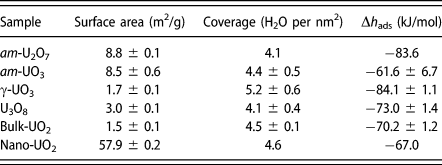
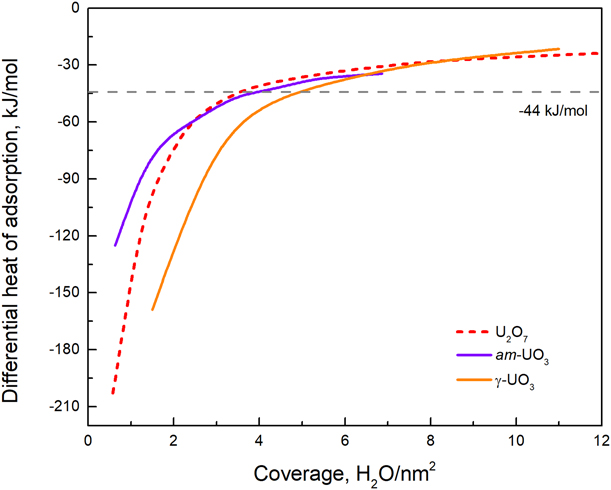
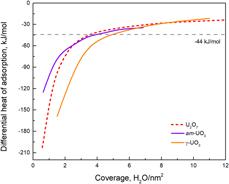
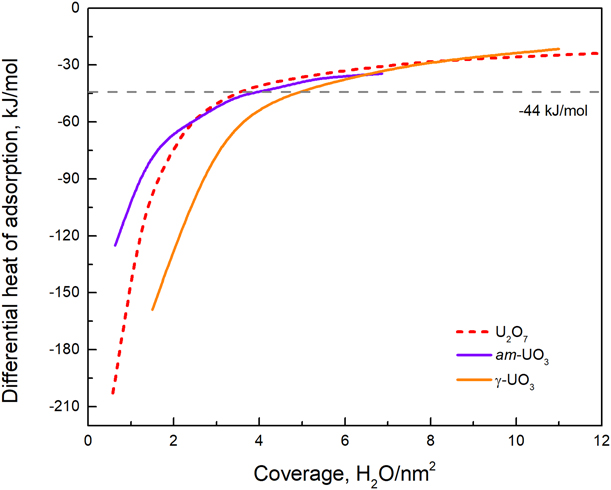
Table I summarizes the measured data. The surface area of anhydrous γ-UO3, 1.7 m2/g, is close to those of bulk UO2 and U3O8, 1.5 and 3.0 m2/g, respectively. Nano-sized UO2 has a much larger surface area (57.9 m2/g). The amorphous compounds (am-UO3, am-U2O7) have similar surface areas, 8.5, and 8.8 m2/g, respectively. We noticed that these decomposed phases have larger surface areas by 7–11% compared to that of metastudtite, and almost quadruple those values of other bulk-sized uranium oxides. All three U(VI)-containing oxides show large values of water adsorption enthalpies for the first dose at near zero coverage: −156.1, −125.1, and −202.9 kJ/mol water, for γ-UO3, am-UO3, and U2O7, respectively. Generally, the enthalpy of adsorption becomes less exothermic as water coverage increases (see Figs. 1–3). In the adsorption enthalpy curves, as the water coverage increases, differential enthalpies of water adsorption (Δh ads) at −44 kJ/mol water define the end of the investigation of adsorbed water on these samples. This is because −44 kJ/mol water is the heat released when water vapor condenses to the liquid phase at 25 °C. If the hydration energy appears less exothermic than −44 kJ/mol water, it is very likely that additional dosed water molecules barely interact with the sample surface, rather tending to self-interact by forming clusters [Reference Wu, Guo, Sun and Navrotsky57, Reference Li, Sun, Xu, Guo and Wu58]. Such behavior is not relevant to the present study and will not be further discussed. Thus, we can derive the integral water adsorption enthalpy by integrating all Δh ads smaller than −44 kJ/mol and the obtained results are shown in Table I.
Integral enthalpies of water adsorption (Δh ads) on U-containing compounds.

Differential enthalpies of water adsorption (Δh ads) as a function of water coverage on U6+-containing compounds.
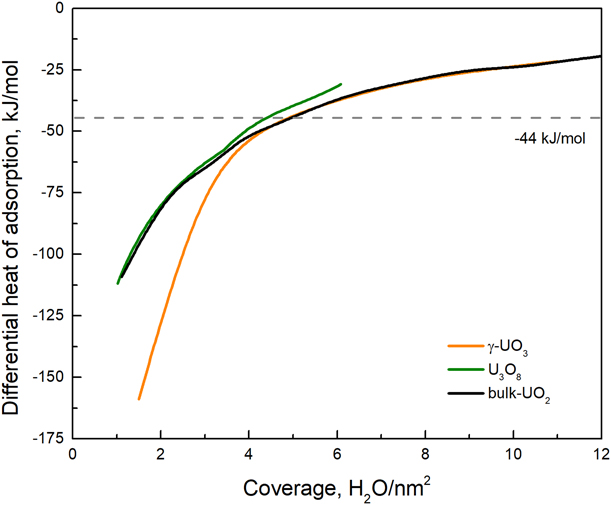
Comparison of differential enthalpies of water adsorption and water coverages among γ-UO3, U3O8, and UO2.

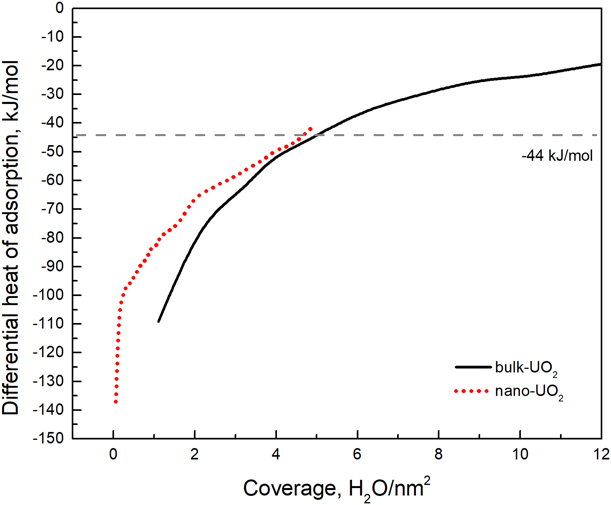
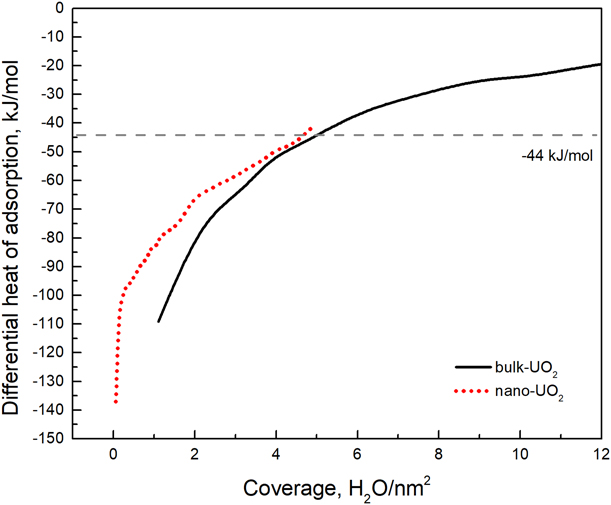
Differential enthalpies of water adsorption as a function of water coverage on bulk-UO2 and nano-UO2.
Starting from UO2, increasing the valence of U will be accommodated by excess oxygen existing as clusters in the interstitial sites of the fluorite structure till the formation of intermediate phases, such as U3O7 and U4O9 [Reference McEachern and Taylor59, Reference Leinders, Bes, Pakarinen, Kvashnina and Verwerft60]. Exceeding O/U = 2.33 will break the fluorite-derived arrangement of cations and lead to the emergence of U3O8 phase [Reference Leinders, Bes, Pakarinen, Kvashnina and Verwerft60, Reference Desgranges, Baldinozzi, Simeone and Fischer61]. Such oxidizing transitions are the combination of diffusion-controlled processes and nucleation reactions, which has impacts on the hydration energetics of the forming phases. Moving from tetravalent U to mixed valence states, then to hexavalent U, the hydration profiles of the crystalline oxide phases (UO2, U3O8, and UO3) shift accordingly (Fig. 1), with an increasingly exothermic trend. Compared with U4+ in UO2, U5+ and/or U6+ in U3O8 and UO3 provide increased electronic attractions to the negatively charged oxygen in water molecules, leading to more stable U–O bonding [Reference Leinders, Bes, Pakarinen, Kvashnina and Verwerft60, Reference Kvashnina, Butorin, Martin and Glatzel62]. Particularly, the integral enthalpy of water adsorption of UO2 is −70.2 ± 1.2 kJ/mol water, relatively close to that of CeO2 (−59.8 ± 0.7 kJ/mol water) or ThO2 (−65.0 ± 1.2 kJ/mol water) [Reference Alexandrov, Shvareva, Hayun, Asta and Navrotsky43], both of which also crystalize in the fluorite structure, but Ce or Th cannot be further oxidized.
The oxidation of UO2 in humid conditions may result in oxidation of the near surface (up to 1 μm) and/or formation of surface hydroxyls, observed by XPS and Raman spectroscopy [Reference Senanayake, Waterhouse, Chan, Madey, Mullins and Idriss7, Reference Senanayake, Waterhouse, Chan, Madey, Mullins and Idriss8, Reference Senanayake and Idriss48, Reference Idriss and Senanayake49]. Water vapor alone has only minimal (catalytic) impacts on the surface oxidation of UO2 [Reference Donald, Dai, Davisson, Jeffries and Nelson10, Reference Skomurski, Shuller, Ewing and Becker14, Reference McEachern and Taylor59]. In Fig. 2, there is a relatively sharp transition of the differential enthalpy of adsorption curve of UO2 from overlapping that of U3O8 (step i) to that of γ-UO3 (step ii). U3O8 is the weathering product of uraninite and it is kinetically and thermodynamically stable. Previously, it has shown that the oxidation and hydration of U3O8 to schoepite can occur only after long storage time (2–3.5 years) in humidity [Reference Tamasi, Boland, Czerwinski, Ellis, Kozimor, Martin, Pugmire, Reilly, Scott, Sutton, Wagner, Walensky and Wilkerson63], suggestive of a very slow reaction rate. Therefore, U3O8 samples under current experimental periods should not have any noticeable bulk-scale structural alterations. Thus, we conclude before the coverage of 3 water per nm2, water adsorption on UO2 behaves similarly to that on the reduced U oxide. Suggested by DFT calculations and experimental observations, the (111) surface of UO2 has the lowest surface energy [Reference Alexandrov, Shvareva, Hayun, Asta and Navrotsky43, Reference Rak, Ewing and Becker44, Reference Allen, Tempest and Tyler64, Reference Allen, Tempest and Tyler65] that has the highest possibility to stabilize the molecular or dissociated water molecules. Thus, the interaction enthalpy from the initial water dosage Δh ads = −103.4 ± 7.7 kJ/mol can be attributed to the interaction between the (111) surface and water consistent with calculated results (−90.7 ∼ –106.1 kJ/mol) [Reference Alexandrov, Shvareva, Hayun, Asta and Navrotsky43, Reference Rak, Ewing and Becker44, Reference Bo, Lan, Wang, Zhao, He, Zhang, Chai and Shi45, Reference Maldonado, Evins and Oppeneer46]. The difference may be due to the energetic contributions from other planes or defective adsorption sites. U3O8 can be viewed as the high temperature phase resulting from the shear transformation of the UO2 lattice along the (111) planes [Reference Desgranges, Baldinozzi, Simeone and Fischer61, Reference Allen and Holmes66]. Thus, UO2 and U3O8 have similar atomic arrangements in (111) layers which could lead to the similarity in adsorption behavior and integral water adsorption enthalpies (−70.2 versus −73.0 kJ/mol). However, as the water coverage increases into the “step 2” regime, additional water molecules may interact with the altered surface modified by previous adsorbed water that comprised higher valence U and hydroxyl groups, which could resemble the surface of γ-UO3 under the same water coverage (Fig. 2). Therefore, the measured water adsorption enthalpy of UO2, Δh ads = −70.2 ± 1.2 kJ/mol, includes the energetic terms from the oxidation of U4+ and the interaction of water with modified surfaces. This explains that why Δh ads(UO2) is higher than that of CeO2 (−59.8 ± 0.7 kJ/mol) [Reference Hayun, Shvareva and Navrotsky55] or ThO2 (−65.0 ± 1.2 kJ/mol) [Reference Alexandrov, Shvareva, Hayun, Asta and Navrotsky43], where Ce4+ and Th4+ cannot be further oxidized. The Δh ads of UO2 from this work is also consistent with a recently published Δh ads of UO2+δ by Shelly et al. (−68 ± 7 kJ/mol) [Reference Shelly, Schweke, Zalkind, Shamir, Barzilai, Gouder and Hayun52]. The observation of stepwise behavior is consistent with previous reports on the humidity-dependent influence of water vapor on the surface of UO2 where three processes were identified in the alteration of fresh UO2 fuel under aerated water and high-temperature conditions [Reference Taylor, Wood, Owen and Park67].
For nano-sized UO2, the enthalpy of water adsorption for the first dose is almost 30 kJ/mol more exothermic than for bulk UO2 (−137.1 kJ/mol), presumably due to the much higher surface area with more distributed defects and active sites available for bonding. Yet there is a convergence of their adsorption curves at −44 kJ/mol that yields similar water coverages before condensation (Fig. 3): 4.5 and 4.6 H2O per nm2 for bulk-sized and nano-sized UO2, respectively. This could suggest that despite having a higher surface area, nano-UO2 still has a hydrophobic surface; and after saturating all active sites by water molecules, the continuing adsorption behavior after around 5 H2O per nm2 coverage will be similar between nano- and bulk-UO2. Therefore, the hydration process of nano-UO2 may not differ too much from its bulk counterpart under a high humidity environment.
Conclusions
In this work, we performed direct calorimetric measurements of hydration energetics of nano-sized, bulk-sized UO2, U3O8, anhydrous γ-UO3, amorphous UO3, and U2O7, and obtained their water adsorption enthalpies to be −67.0, −70.2, −73.0, −84.1, −61.6, and −83.6 kJ/mol water, with water coverage of 4.6, 4.5, 4.1, 5.2, 4.4, and 4.1 H2O per nm2, respectively. Particularly, the hydration behavior of UO2 was deconvoluted to a two-step process with the first part overlapping that of U3O8 then transiting to the second part resembling that of γ-UO3. The difference between hydration energetics of nano- and bulk-UO2 resides mostly in low water coverages and diminishes at high water coverages where the two water adsorption energetic profiles converge, which indicates the hydration of UO2 in the environment over the long term is less dependent of the particle size.
Methods and approaches
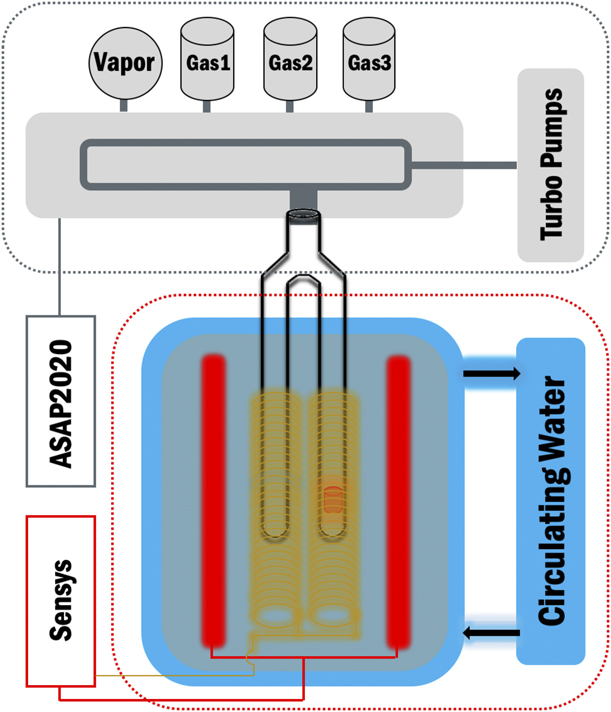
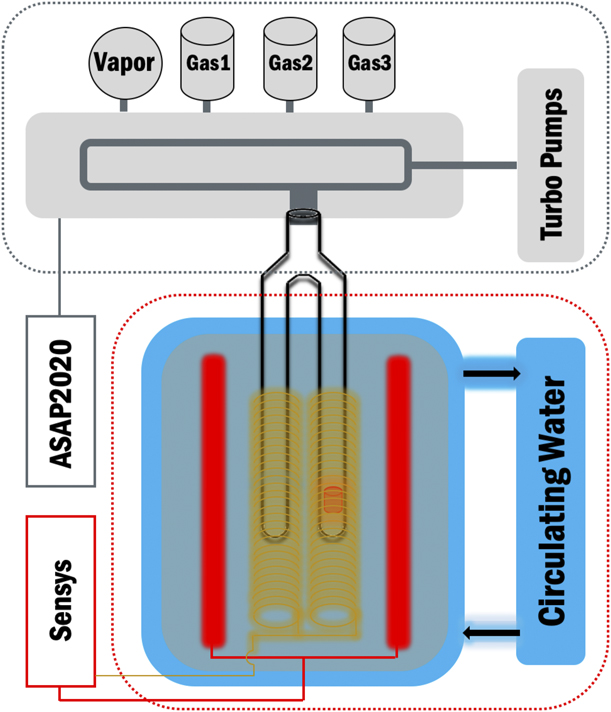
The calorimetric experiments were accomplished by a gas adsorption calorimetric method using a Calvet-type microcalorimeter unit (Setaram SenSys) coupled with a commercial gas adsorption analyzer with a gas dosing system (Micromeritics ASAP 2020, Micromeritics, Norcross, Georgia) [Reference Li, Sun, Xu, Guo and Wu58, Reference Ushakov, Dalalo and Navrotsky68] (see Fig. 4). The experiments were performed in four steps. First, a ∼80 mg sample was placed in a silica-glass forked tube and degassed under vacuum (<10−3 Pa) for 24 h using the Micromeritics ASAP 2020 instrument. Second, the free space of the sample tube and the surface of the sample were determined by Brunauer–Emmett–Teller (BET) analysis of nitrogen, argon or krypton adsorption. Third, the forked tube was inserted into the calorimeter at 25 °C, and water adsorption experiments were programmed with the Micromeritics instrument using 1 μmol of water vapor dose amounts and 1.5 h equilibration time after each dose. The actual adsorbed amounts were obtained from the measured adsorption isotherm. Each dose produced an exothermic peak recorded by the calorimeter software. The integration of the peak provided the enthalpy of adsorption for each dose using a calibration factor based on the enthalpy of fusion of gallium.
Schematics of gas/water adsorption calorimetry by coupling Calvet-type microcalorimeter with a gas dosing and adsorption analyzer.
The degas temperature prior to the adsorption experiments was selected to retain the structure of studied samples. The UO2 sample, confirmed to be stoichiometric, was provided by Los Alamos National Laboratory. γ-UO3 and U3O8 were obtained from International Bio-Analytical Industries. am-UO3 and U2O7 were obtained by the thermal decomposition of metastudtite [Reference Guo, Wu, Xu, Burns and Navrotsky16, Reference Odoh, Shamblin, Colla, Hickam, Lobeck, Lopez, Olds, Szymanowski, Sigmon, Neuefeind, Casey, Lang, Gagliardi and Burns56]. Preheating and degassing treatments were performed in the forked tube using the Micromeritics instrument. UO2 and U3O8 samples were degassed at 400 °C for 4 h. Anhydrous UO3 was formed by heating hydrated UO3 and degassing at 350 °C for 5 h am-U2O7 and am-UO3 were pretreated at 80 °C for 5 h in vacuum.
Acknowledgments
This work was supported by the Materials Science of Actinides (MSA), an Energy Frontier Research Center (EFRC), funded by the U.S. Department of Energy, Office of Science, Office of Basic Energy Sciences under Award Number DE-SC0001089, and the Laboratory Directed Research and Development (LDRD) program (Project #20180007 DR) of Los Alamos National Laboratory (LANL). We thank Peter Burns for his support of this work through leading the MSA EFRC, and X.G. acknowledges support through a LANL Seaborg postdoctoral fellowship and, later, institutional funds from the Department of Chemistry at Washington State University. D.W. was also supported by the institutional funds from the Gene and Linda Voiland School of Chemical Engineering and Bioengineering at Washington State University. D.W. and X.G. acknowledge the fund of Alexandra Navrotsky Institute for Experimental Thermodynamics. LANL, an affirmative action/equal opportunity employer, is managed by Triad National Security, LLC, for the National Nuclear Security Administration of the U.S. Department of Energy under contract 89233218CNA000001.