INTRODUCTION
Giardia is a genus of intestinal flagellates that infects a wide range of vertebrate hosts. The genus currently comprises 6 species, namely Giardia agilis in amphibians, Giardia ardeae and Giardia psittaci in birds, Giardia microti and Giardia muris in rodents, and Giardia duodenalis in a wide mammal spectrum including humans (Adam, Reference Adam2001). These species are distinguished on the basis of the morphology and ultrastructure of their trophozoites, yet the taxonomy of the genus is still undergoing revision, particularly in the case of the G. duodenalis species complex (Monis et al. Reference Monis, Cacciò and Thompson2009).
Giardia duodenalis (syn. G. intestinalis, G. lamblia) is the only species found in humans, although it is also found in other mammals, including pets and livestock (Thompson, Reference Thompson2004). A considerable amount of data has shown that G. duodenalis should be considered as a species complex whose members show little variation in their morphology, yet it can be assigned to at least 7 distinct assemblages (A to G) based on genetic analyses (Monis et al. Reference Monis, Andrews, Mayrhofer and Ey2003).
Due to the interest in unraveling the complex epidemiology of human infections, methods targeting polymorphic genes were developed in recent years to allow more informative comparison of isolates from various hosts (Cacciò and Ryan, Reference Cacciò and Ryan2008). The applicability of these methods to species other than G. duodenalis has not been carefully evaluated. Indeed, only the assays targeting the small subunit ribosomal DNA (ssrRNA) are known to amplify all G. duodenalis assemblages and other Giardia species in a reliable manner. To date, no sequence data are available for G. agilis and only a partial (513 bp) ssrRNA sequence (GenBank AF473853) has been determined from G. psittaci (van Keulen et al. Reference van Keulen, Macechko, Wade, Schaaf, Wallis and Erlandsen2002).
In the present work, we have investigated the usefulness of the region comprising the 5.8S rDNA gene and the 2 flanking internal transcribed spacers (ITS1 and ITS2) to distinguish isolates of different Giardia species, including all G. duodenalis assemblages.
MATERIALS AND METHODS
Source of isolates
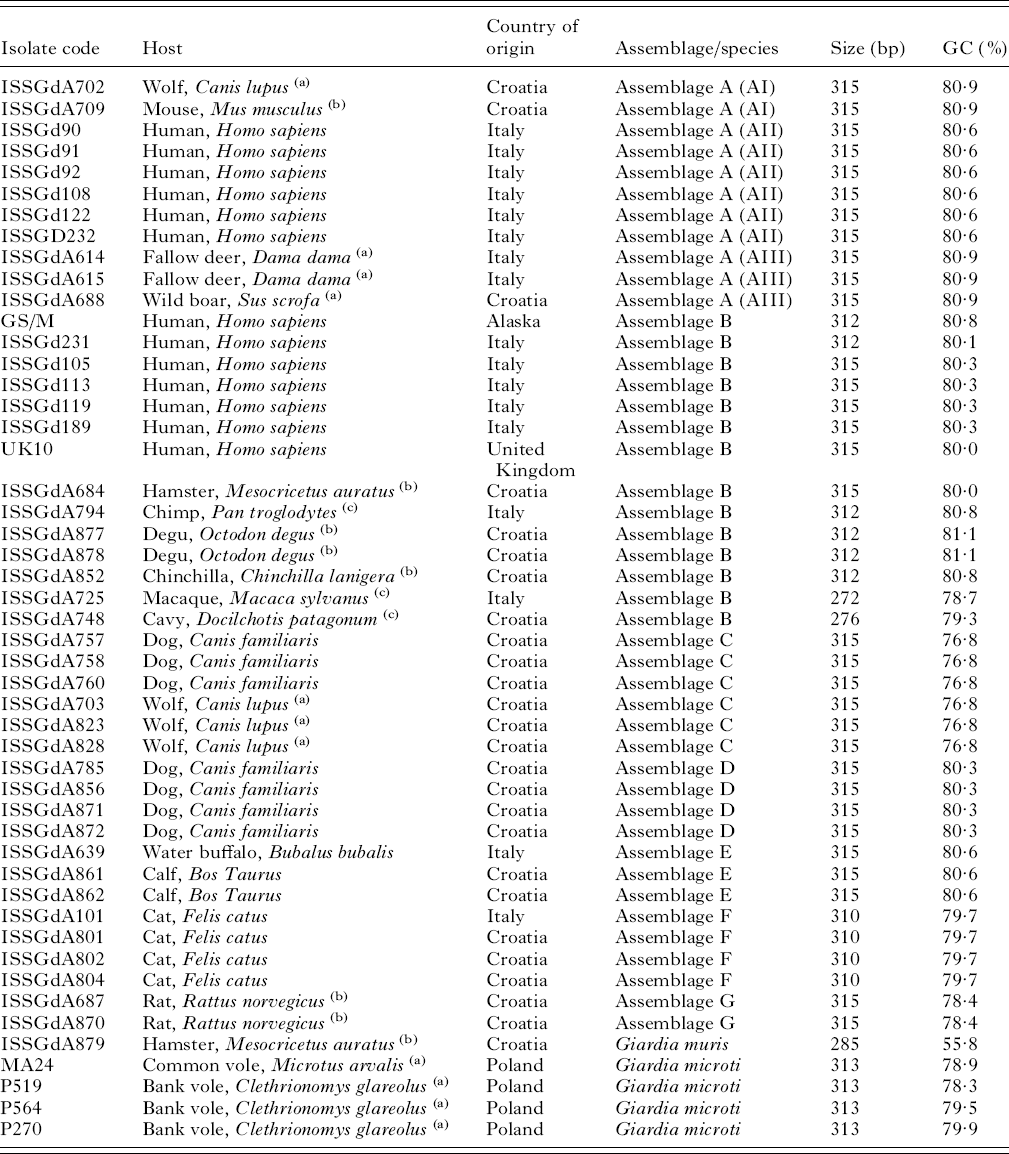
The 49 isolates used in this work, which are listed in Table 1, were selected to represent all G. duodenalis assemblages (A to G), as well as G. microti and G. muris. All isolates were previously characterized at the species level using established PCR assays targeting the small subunit ribosomal DNA (Hopkins et al. Reference Hopkins, Meloni, Groth, Wetherall, Reynoldson and Thompson1997) and the triose phosphate isomerase genes (Sulaiman et al. Reference Sulaiman, Fayer, Bern, Gilman, Trout, Schantz, Das, Lal and Xiao2003) (data not shown).
List of the isolates used in the present study
(Isolate code, host, geographical origin, G. duodenalis assemblages (or Giardia species), size and GC content are indicated.)

(a) Isolated from wild animal.
(b) Isolated from pet animal.
(c) Isolated from Zoo animal.
Molecular analysis
A nested PCR protocol was developed. For the primary reaction, the forward primer (5′-TGGAGGAAGGAGAAGTCGTAAC-3′), which binds to the 3′ end of the small subunit ribosomal DNA gene, and the reverse primer (5′-GGGCGTACTGATATGCTTAAGT-3′), which binds to the 5′ end of the large subunit ribosomal DNA gene were used. For the nested reaction, the forward primer (5′-AAGGTATCCGTAGGTGAACCTG-3′), and the reverse primer (5′- ATATGCTTAAGTTCCGCCCGTC-3′) were used. Identical conditions were used for the primary and nested amplification: 35 cycles (94°C for 30 sec, 59°C for 30 sec and 72°C for 1 min) in an Applied Biosystem 9700 thermocycler (Life Technologies, Carlsbad, CA, USA), with an initial hot start at 94°C for 2 min and a final extension at 72°C for 7 min. The PCR mix consisted of 1X buffer containing 1·5 mm MgCl2, 200 μm of each dNTP, 10 pmol of each primer, 1·5 units of Taq DNA polymerase (Promega, Milan, Italy), 5% (v/v) dimethyl sulfoxide (DMSO) and 1–5 μl of purified DNA in a final volume of 50 μl. PCR products were separated by electrophoresis on 2% agarose gel, and revealed after ethidium bromide staining.
PCR products were purified using spin columns (Qiagen, Milan, Italy) and sequenced from both strands. The PCR products were purified using the QIAquick_PCR purification kit (Qiagen) and fully sequenced using the Big-Dye® Terminator V3.1 Cycle Sequencing Kit (Applied Biosystems, Life Technologies, Carlsbad, CA, USA). Sequencing reactions were analysed on a 3100 Genetic Analyzer (Applied Biosystems, Life Technologies, Carlsbad, CA, USA), edited using the software SeqMan 7.0 (DNASTAR, Madison, WI, USA) and aligned using Clustal X (Thompson et al. Reference Thompson, Gibson, Plewniak, Jeanmougin and Higgins1997). The phylogenetic analysis was performed using the MEGA program version 4.0 (Tamura et al. Reference Tamura, Dudley, Nei and Kumar2007). All available homologous sequences were retrieved from GenBank and included in the analysis. This corresponded to isolates of G. duodenalis assemblage A (X52949, X05396, M35013, M73686), assemblage B (U09491, U09492), assemblage E (AF239840, AF239841, and DQ157272), G. ardeae (M73684 and X58290) and G. muris (X65063 and M73682). Neighbour-joining and maximum likelihood methods were applied to this set of data. Bootstrap values were calculated by the analysis of 1000 replicates.
RESULTS
Characterization of 5.8S rDNA and ITS sequences from Giardia duodenalis isolates
A total of 44 isolates, representing all G. duodenalis assemblages (Table 1), were submitted to PCR amplification and sequencing.
For assemblage A, information was generated from 6 human and 5 animal isolates (Table 1) and the sequences were compared with those from axenic strains of human origin, all belonging to the AI group (GenBank Accession numbers X52949, X05398, and M35013). Single nucleotide polymorphisms (SNPs), specifically associated with subgroups AI, AII and AIII, were found in the ITS1 and 5.8S sequences, but not in the ITS2 sequence (Fig. 1). The sequences representing subgroups AI, AII and AIII have been deposited in GenBank (Accession numbers GU126431, GU126432 and GU126433, respectively).
Multiple alignment of the ITS1, 5.8S and ITS2 sequences from Giardia duodenalis, G. muris, G. microti and G. ardeae. Dots indicate identity to the sequence of the AI genotype; dashes indicate insertions/deletions. The forward and reverse primers used for nested PCR are shown as bold, underlined characters.

For assemblage B, sequence information was collected from 7 human (including the reference strain GS/M) and 7 animal isolates (Table 1), and a comparison was made with the 2 human-derived sequences (strains AMC-4 and CM, GenBank U09491 and U09492). Observed polymorphisms included an SNP and a 3 bp deletion in the ITS1, a SNP in the 5.8S gene, and 2 SNPs in the ITS2 sequence. Notably, 1 isolate from a captive Barbary macaque has a 40 bp deletion spanning parts of the 5.8S gene and of the ITS-2 region, and 1 isolate from a Patagonian cavy has a 36 bp deletion in the ITS2 region (Fig. 1). These unusual variants were confirmed by PCR and sequencing of 3 independent reactions. Interestingly, a 3 bp deletion in the ITS1 sequence distinguishes the GS/M and CM reference strains from the AMC4 reference strain, and clusters all human isolates (except 1) with the AMC4 strain, and all animal isolates (except the hamster isolate) with the GS/M and CM strains. The sequences corresponding to the different variants within assemblage B have been deposited in GenBank (Accession numbers GU126436 to GU126442).
For assemblage C, sequencing of 3 isolates from dogs and 3 from wild wolves, revealed an identical sequence in all the isolates. Similarly, no variation was observed in the sequences obtained from 4 dog isolates belonging to assemblage D. Assemblages C and D, however, are distinguished by 10 SNPs distributed in the ITS1 (2 SNPs), 5.8S gene (4 SNPs), and ITS2 (4 SNPs) regions (Fig. 1). The sequences representing assemblages C and D have been deposited in GenBank (Accession numbers GU126443 and GU126444, respectively).
Two isolates from calves and 1 isolate from a water buffalo, previously typed as assemblage E, were sequenced, and the sequences were compared with those present in GenBank (AF239840, AF239841, and DQ157272), which were of calf origin. This revealed the presence of 2 subtypes that only differ by a SNP in the 5.8S rDNA gene, whereas no differences were found in the 2 ITS sequences. A representative sequence for assemblage E has been deposited in GenBank (Accession number GU126434).
For assemblage F, information was collected from 4 isolates from domestic cats, and no variation was found in the 4 sequences (Fig. 1), albeit the isolates were collected in Croatia and in Italy (Table 1). A representative sequence for assemblage F has been deposited in GenBank (Accession number GU126435).
Finally, 2 isolates from pet rats, previously typed as assemblage G, were analysed and found to have an identical sequence (Fig. 1). A representative sequence for assemblage G has been submitted to GenBank (Accession number GU126445).
Characterization of 5.8S rDNA and ITS from Giardia muris
A single G. muris isolate from a pet hamster was amplified and sequenced, and the sequence was compared with those deposited in GenBank (X65063 and GIARGSL) that are of mouse origin. This comparison revealed 1 SNP and 1 deletion in the ITS1 sequence, and 1 deletion in the ITS2 sequence of the hamster isolate compared to those from mice (Fig. 1). The G. muris sequence from the pet hamster has been deposited in GenBank (Accession number GU126450).
Characterization of 5.8S rDNA and ITS from Giardia microti
Three isolates from bank voles and 1 isolate from a common vole (Table 1), previously identified as G. microti, were submitted to PCR amplification and sequencing. Remarkably, the 4 sequences were all different, and SNPs were scattered along the ITS1, 5.8 and ITS2 regions (Fig. 1). All sequences from G. microti isolates have been deposited in GenBank (Accession numbers GU126446 to GU126449).
Phylogenetic analysis
A phylogenetic analysis was performed based on a multiple alignment of all sequences determined in this work, along with those retrieved from GenBank. The Neighbour-joining tree (Fig. 2) shows that G. duodenalis assemblages have a monophyletic origin, that G. microti is the sister group to G. duodenalis, and that G. muris occupies a basal position.
Neighbour-joining tree based on the ITS1, 5.8S and ITS2 sequences of isolates from Giardia duodenalis, G. muris, G. microti and G. ardeae. Only bootstrap values >70 are indicated. Sequences retrieved from GenBank are indicated by their Accession numbers.

DISCUSSION
An accurate and reliable identification of Giardia species from infected hosts and from water and food samples is necessary to understand the transmission patterns and elucidate the complex epidemiology of giardiasis. Compared to other protozoan pathogens, genotyping techniques for Giardia spp. are not particularly advanced, and studies have relied on the analysis of few genes, i.e., the small subunit ribosomal RNA (ssrRNA), the β-giardin, the glutamate dehydrogenase, the elongation factor 1-alpha, the triose phosphate isomerase, and the GLORF-C4 genes (Wielinga and Thompson, Reference Wielinga and Thompson2007).
An aspect that has received little attention is the ability of the developed primers to amplify consistently G. duodenalis isolates belonging to different assemblages. It is quite easy to understand that the ssrRNA PCR has the highest sensitivity, due to the multicopy nature of the target, and specificity, due to the strong sequence conservation of the target. On the other hand, amplification of single copy genes appears to be more erratic, and it has been reported that certain isolates could be amplified at one locus but not at another, whereas other isolates may just show the opposite behaviour (reviewed by Cacciò and Ryan, Reference Cacciò and Ryan2008). Thus, greater sequence variability may be present in those genes, and excessive mismatches in the binding regions of the primer(s) can prevent their successful amplification. This issue is likely to be even more complex when Giardia species other than G. duodenalis are concerned.
In the present work, we have shown that it is possible to detect and distinguish Giardia species and G. duodenalis assemblages by sequence analysis of the region of the ribosomal unit that spans the 5.8 S and the two ITS. To amplify this region, primers were designed to bind extremely conserved regions at the 3′ end of the ssrRNA (forward primers) and at the 5′ end of the lsrRNA (reverse primers), using the sequences of G. duodenalis, G. ardeae (van Keulen et al. Reference van Keulen, Horvat, Erlandsen and Jarroll1991) and G. muris (van Keulen et al. Reference van Keulen, Gutell, Campbell, Erlandsen and Jarroll1992) available in GenBank. We have determined the sequence of this region from 49 isolates, representing all G. duodenalis assemblages as well as G. muris and G. microti. The sequence analysis, in agreement with previous data on the organization of the Giardia ribosomal repeat (Edlind and Chakraborty, Reference Edlind and Chakraborty1987; Boothroyd et al. Reference Boothroyd, Wang, Campbell and Wang1987), confirms a reduced size (ITS1 is ~40 bp, 5.8S gene is ~130 bp, and ITS2 is ~60 bp), and a composition strongly biased towards GC-richness (72–84%), with the notable exception of G. muris (55%). As shown in Figs 1 and 2, the 3 Giardia species and each of the 7 assemblages within G. duodenalis have a distinct sequence. Notably, isolates of G. microti from 2 wild rodent species have a larger number of SNPs compared to G. muris isolates or to G. duodenalis isolates from single assemblages, and this is in agreement with the large genetic variability observed at the ssrRNA gene in muskrat isolates infected with G. microti (Sulaiman et al. Reference Sulaiman, Fayer, Bern, Gilman, Trout, Schantz, Das, Lal and Xiao2003).
When compared to the widely used assay targeting the ssrRNA gene, which is based on polymorphisms in a 300 bp region at the 5′ end of the gene (Hopkins et al. Reference Hopkins, Meloni, Groth, Wetherall, Reynoldson and Thompson1997), the 5.8S-ITS assay has the advantage of a higher level of polymorphism among G. duodenalis assemblages, which facilitates their identification. Indeed, the 5′ end ssrRNA sequences of assemblages A, E and F are extremely similar, and only 1 SNP allows to distinguish assemblage A from assemblage E, or assemblage A from assemblage F. A similar situation occurs when comparing 5′end ssrRNA sequences of assemblages C and D (2 SNPs), and these two with assemblage B (2–3 SNPs). Furthermore, very little, if any, variation has been reported among isolates of the same assemblage (intra-assemblage variability) in this region, and this has limited its usefulness in molecular epidemiological studies (Wielinga and Thompson, Reference Wielinga and Thompson2007). By contrast, the 5.8S-ITS region displays a much higher variability, including both SNPs and indels, as a specific 5 bp deletion in assemblage F. In particular, specific SNPs were found associated with the major subgroups within assemblage A (AI, AII and AIII), thus the sequence analysis of this region can also be used to distinguish human pathogens (AII and, to a lesser extent, AI) from animal-specific pathogens (AIII and AI). A higher variability was observed among assemblage B isolates, including 2 large (40 and 36 bp) deletions in the ITS2 sequence from 2 animal isolates, and a 3 bp deletion in the ITS1 sequence that could be useful to distinguish human-derived versus animal-derived assemblage B isolates.
In view of these results, it is surprising that only a single study has used sequence analysis of 5.8S and ITS regions to genotype G. duodenalis isolates of calves from New Zealand (Hunt et al. Reference Hunt, Ionas and Brown2000), despite the extensive application of this region as a tool for molecular diagnostics in eukaryotes (e.g., Coleman, Reference Coleman2007). In short, the 5.8S-ITS assay represents a versatile tool for molecular epidemiological investigations, as it combines an excellent robustness, due to the use of primers that bind to very conserved regions, with a high level of genetic variability both among Giardia species and G. duodenalis assemblages.
ACKNOWLEDGEMENTS
This work has been partly supported by the European MED-VET-NET project (S. M. C., contract FOOD-CT-2004-506122). We thank Daniele Tonanzi for his excellent technical support, and Dr Staffan Svard for the genomic DNA of the GS/M strain.