


The emergence of modern Hebrew literature has too often been represented as a straight line from Enlightenment authors' meliẓa to “Mendele's nusaḥ” in S. Y. Abramovitsh's fiction.Footnote 2 If we are to move beyond this one-dimensional geometry, we must add additional lines of development: from traditional rabbinic writing in postmishnaic Hebrew, branching out to hasidic narratives and parodies of hasidic Hebrew, and gradually leading toward a more vernacular Hebrew style. Once we have recognized the inadequacy of the older model, which culminates in hyperbolic claims for Abramovitsh's short stories (1886–96), we can better appreciate the contributions of diverse authors such as R. Nathan (Nosn) Sternharz (1780–1845), Mendel Lefin (1749–1826), and their successors.
While conflicting ideologies of the Jewish Enlightenment and of Hasidism are reflected in many of their writings and in scholarship about them, the literary contributions of these writers have been undervalued and are seldom understood. Accepted wisdom in Hebrew literary history tells us that the maskilim favored a neobiblical style, which they considered to be “pure” (lashon ẓaḥ or ẓeḥa); in contrast, the hasidim wrote a kind of “low Hebrew” or “folk Hebrew,” which many nonhasidic readers have scorned for the past two centuries because it was based on postbiblical Hebrew, included grammatical errors, and was tinged with Yiddish.Footnote 3 This simplistic opposition has seldom been questioned, although some linguists have challenged the claim made by the maskilim that they were writing “pure” biblical Hebrew.Footnote 4 Intellectual historians have emphasized the antihasidic polemics,Footnote 5 and maskilic satires have been studied in depth,Footnote 6 but other literary genres have been neglected. Moreover, not all maskilim embraced biblical Hebrew and meliẓa; Lefin, for example, favored mishnaic Hebrew.
The genre of travel narrative merits closer attention,Footnote 7 and we can learn a great deal from Hebrew narratives of sea travel that were written and translated at the start of the nineteenth century.Footnote 8 It is significant that, in spite of their ideological disparities, both hasidic and maskilic authors actively contributed to the evolution of this popular genre. R. Nathan was a pathbreaking author in his own right, apart from his role as R. Nahman of Bratslav's scribe, and his 1815 account of R. Nahman's pilgrimage to the Holy Land was a milestone of sorts in Hebrew literary history. In a different vein and across a cultural divide, Lefin's translations from German (ca. 1815–23), based on Joachim Heinrich Campe's stories of adventure at sea, are stylistically as significant as any original Hebrew prose of the time. While R. Nathan worked from oral Yiddish sources and Lefin translated from printed German texts, a kind of indirect dialogue took place between their Hebrew publications. This battle of books expressed contrary ideologies and the authors' efforts to win over readers. Both writers contributed to the evolution of modern Hebrew narrative in ways that are seldom acknowledged by literary historians.
Alongside the well-known ideological encounters, then, literary skirmishes took place. From the standpoint of literary history, Lefin and R. Nathan were two leading figures in the intertextual battleground of early nineteenth-century Hebrew prose. Their competing narratives of sea voyage tested the authors' ability and readiness to convey concrete descriptions of nature in Hebrew. At the same time, their travel literature conveyed attitudes toward natural science, geography, and the non-Jewish world.
In spite of obvious differences, Lefin and R. Nathan had much in common. Because R. Nathan was raised in an antihasidic family in Nemirov, his early Hebrew education may not have been so different from that of Lefin in Satanov. Neither was an original thinker in his own right; both responded to inspiration from other sources. The turning point for Lefin came when he met Moses Mendelssohn and his circle during a sojourn in Berlin in 1780–84, whereas R. Nathan's life changed after he met R. Nahman in 1802. There was a wide gap between their goals, as between their intellectual and religious milieux, yet some of their literary means were similar.
As a basic premise, I assume the relevance of Harold Bloom's ideas of intertextuality and literary influence, circling around the question, how do authors experience “the anxiety of influence” and attempt to achieve “strength” in relation to their precursors and contemporary rivals?Footnote 9 Joseph Perl's Megale temirin (1819), his posthumously published manuscripts, and his Boḥen ẓadik (1838) show clearly that Perl was jealous of the success of hasidic works such as Shivḥei ha-Besht.Footnote 10 At the same time, R. Nathan read his opponents' works, feared their criticisms, and directly attacked specific authors, usually without mentioning their names.
It is also helpful to draw from Linda Hutcheon's studies of parody. Hutcheon shows how parody, understood in its most general sense, functions in the form of “repetition with difference”: “A critical distance is implied between the backgrounded text being parodied and the new incorporating work, a distance usually signaled by irony.”Footnote 11 Although ridiculing parody is not central to the narratives that are analyzed in this paper, it is possible to interpret some of these works—including translations and adaptations—as genre parodies. In some instances, they reappropriated the genre of travel narrative in ways that altered Hebrew and Yiddish literary history.
There are ample historical clues of possible connections between the Hebrew narratives of sea travel written by R. Nathan and Lefin. As Haim Liberman and Mendel Piekarz show, hasidic authors left compelling accounts of R. Nahman's and R. Nathan's meetings with maskilim in Uman. Before and after 1810, R. Nahman and R. Nathan met with Haikl Hurwitz (1749–1822) and his son Hirsh Ber Hurwitz (1785–1857).Footnote 12 The most astonishing record of these meetings appears in Avraham Hazan's Kokhevei ’or. Hazan writes, for instance,

After the departure of our Rebbe, of blessed memory, they [the maskilim] were dear friends of our Breslov circle, and especially of R. Nathan z”l. And R. Nathan had a command from our Rebbe z”l that he should speak with them, and so every time he was in Uman, he had a visit at their house and spoke with them. And once he entered into such deep philosophical questions [ḥakirot gedolot] with them that he cried out, What did our Rebbe want from him?Footnote 13
During the period in which these meetings occurred, sea travel accounts became a popular genre in Hebrew literature, and the Jewish community of Uman provided a direct link between maskilic and hasidic travel writing. In 1817, two years after R. Nathan had printed his first account of R. Nahman's pilgrimage to the Holy Land, Haikl Hurwitz published a Yiddish translation of Campe's Die Entdeckung von Amerika.Footnote 14 According to some unconfirmed accounts, Haikl Hurwitz's son Hirsh Ber (later known at Cambridge University as Hermann Bernard) had translated Campe's book into Hebrew around 1810.Footnote 15
Although the maskilim and the hasidim represented two opposing camps, they were well aware of each other's actions. Khone Shmeruk and Shmuel Werses point to evidence that R. Nathan knew his opponents were reading and scrutinizing his writings. Not only does he caution his son to guard his letters “because they are forbidden to strangers, who make a mockery of truthful words,”Footnote 16 but also the second edition of Sippurei ma‘asiot corrects an error that Perl mocked in Megale temirin.Footnote 17 A manuscript including omitted passages from the letters that were printed as ‘Alim le-trufa contains additional evidence of R. Nathan's fear that his letters might be read by people outside the Bratslav community. He repeatedly urges his son to keep many things secret, and he asks him to send a special stamp to seal his letters.Footnote 18 In one excised letter from 1841, R. Nathan writes to R. Shmuel Weinberg, “For God's sake, carefully warn anyone who is informed about this matter that he should conceal and hide the thing away, lest it become known to strangers, God forbid [שיודיעו עסק ישועה הזאת שיצפון הדבר ויגנוז מאד לבל יודע לזרים ח”ו למען השם יזהיר מאד את כל מי].”Footnote 19 And at the end of a letter in 1841, R. Nathan asks his son to “hide these things away from the mockers [לגנוז דברים האלה מפני הליצנים]”Footnote 20
In a seminal article, Shmuel Feiner moves beyond restating the familiar maskilic polemics. Instead, he turns the tables and shows how a hasidic writer such as R. Nathan studied and railed against maskilic ideas.Footnote 21 Following Liberman and Piekarz, Feiner mentions the intriguing accounts of R. Nahman's and R. Nathan's meetings with maskilim in Uman. He then demonstrates that R. Nathan responded to the ideology of the Haskalah, specifically attacking works such as Shmuel Romanelli's Masa ba-‘arav.Footnote 22 Although Romanelli was a Sephardic Jew living in Italy,Footnote 23 he published his travel narrative in Berlin, at the press affiliated with the Jüdische Freischule (or Knabenschule, 1778–1825).Footnote 24 This was also the press—Defus Ḥevrat Ḥinukh Ne‘arim—that had published Lefin's book Mod'a le-vina in 1789. R. Nathan expressed his rejection of the Berlin Jewish school in his Likutei halakhot, in which he referred to groups of “completely wicked and notorious people, who have made for themselves a Society for the Education of Youth [חינוך נערים רשעים גמורים מפורסמים ۰ ועשו לעצמן חברת].”Footnote 25
One might even find evidence of a literary rivalry in the repeated choice of titles. For example, the name Sefer ha-midot—which appears as the title of a Yiddish book in the sixteenth century—was adopted by Isaac Satanov (1784, and used again for his book-length translation of Aristotle's Ethics in 1790) and by Naftali Herz Wessely (1786, reprinted 1818–19). In 1811 and 1821, R. Nathan—or, previously, R. Nahman himself—recycled the title as a second name for Sefer ha-alef-beit. It is no coincidence that the books by Satanov and Wessely (like Romanelli's and Lefin's) were published by the Ḥinukh Ne‘arim Press at the Jüdische Freischule.Footnote 26 R. Nathan knew of Romanelli's book from Berlin, as Feiner discusses, and he undoubtedly also knew of books published in Berlin under the title Sefer ha-midot. Maskilim and hasidim even fought over the title Mase‘ot ha-yam, as the publication history shows: After Lefin's book was published under this title in 1818 and 1823, R. Nathan's account of R. Nahman's journey to ’ereẓ yisra'el—originally called “Seder ha-nesi‘a shelo le-’ereẓ yisra'el” when it was included in Sippurei ma‘asiot of 1815—was reprinted under the title Mase‘ot ha-yam in 1846 and 1850.Footnote 27 Lefin's sea narratives were then republished in 1854 and 1859, followed by reissues of R. Nathan's Mase‘ot ha-yam in the 1870s.
Hillel Levine prepared the groundwork for the current analysis when he uncovered Lefin's concealed polemic against hasidim in Ḥeshbon nefesh of 1808. According to Levine, “Lefin preferred the indirect attacks, and for this reason he does not identify the hasidim directly, by name, but instead uses a fairly systematic form of allusive denominations, such as shote and peti.”Footnote 28
Nineteenth-century hasidic authors seldom described the natural world in detail, as an end in itself; when nature does appear in hasidic narratives and commentaries, it is often ascribed spiritual or allegorical meaning. Hence, travel narratives fall into a contested area, on which I want to trace a particular arc. Starting in 1807, as Israel Bartal and Zohar Shavit show, the sea travel narrative became a popular genre among maskilic Hebrew authors.Footnote 29 This was a belated response to widely distributed narratives of sea travel in eighteenth-century English and German literature.Footnote 30 Hebrew sea narratives range from accounts of pilgrimages to the Holy Land to tales of adventure, discovery, and shipwreck.
Because R. Nahman had traveled to Palestine in 1798–99, three years before R. Nathan met him, R. Nathan gathered oral history from other Bratslav hasidim—especially R. Nahman's fellow traveler R. Shim‘on—to document this pilgrimage.Footnote 31 Virtually all of R. Nathan's sources, including R. Nahman's teachings and tales, were in Yiddish. Hence his work as R. Nahman's scribe often began with the translation of an oral Yiddish narrative, which was charged with religious significance, into Hebrew. In contrast, maskilim translated many secular travel narratives from German literary sources.
As published by R. Nathan in 1815, the volume of R. Nahman's Sippurei ma‘asiot describes sea travels both in fantastic tales (especially tales 2 and 10) and in the appended description of R. Nahman's pilgrimage to ’ereẓ yisra'el. Among the many surprising features of R. Nahman's tales are descriptions of adventurous voyages, including accounts of pirates, cross-dressing, and one orgy on board.Footnote 32 In the hagiographical Shivḥei ha-Ran (not yet bearing this title, but already appearing in full form in 1815), moreover, R. Nathan introduced vivid Hebrew descriptions of sea travel. R. Nathan also wrote an account of his own stormy voyage to the Holy Land in 1822, part retrospective narrative and part in the form of a contemporary journal, included in the second part of the posthumously published autobiographical work Yemei Moharnat.Footnote 33
Without a comprehensive history of Hebrew travel narratives, in the hasidic and maskilic accounts of sea travel it is still possible to find elements of an intertextual dialogue or literary struggle. At the end of Megale temirin, Perl mocks one of R. Nathan's descriptions; Perl's main accomplishment lay in the realm of parody—mimicking and caricaturing hasidic writing for satiric effect. Similarly, on the visual level, Lefin mimics the bilingual format of Sippurei ma‘asiot (with Hebrew on top, Yiddish on the bottom of the page) in the first edition of his book ‘Onia so‘ara.Footnote 34 But Lefin reached for another solution: With his sea narratives translated from Campe, Lefin charted a route to surpass the hasidic writers. Lefin countered the Bratslav literature by translating German travel narratives into equally effective and more grammatically correct Hebrew.
I. Sippurei Ma‘asiot, Shivḥei ha-Ran, and Megale Temirin
R. Nahman's allegorical tales in Sippurei ma‘asiot sometimes resemble folktales but probably have most in common with the parable (mashal) in rabbinic midrash (culminating in the Tale of a Jerusalemite).Footnote 35 In keeping with the traditional rabbinic mashal or drash, R. Nahman's oral storytelling makes the tales a vehicle for expressing religious ideas. The allegorical content of Sippurei ma‘asiot usually relates to Lurianic kabbalistic ideas.Footnote 36
R. Nahman's stories, like many folktales, often lack specific names, dates, or places. In contrast to the generality of R. Nahman's Sippurei ma‘asiot, however, R. Nathan's independently written Shivḥei ha-Ran has the specificity of a spiritual biography. R. Nathan's Hebrew in Shivḥei ha-Ran is as graphic and descriptive as that of Shivḥei ha-Ari (known in various late eighteenth-century editions) and Shivḥei ha-Besht (published only months before Shivḥei ha-Ran).
Even in the cases where R. Nahman narrated his stories orally, R. Nathan seems to have been responsible for most of the published Hebrew and Yiddish. Although the present study cannot dwell on the Yiddish text of Sippurei ma‘asiot, it is worth noting that it shows the modernizing and Easternizing features characteristic of leading Yiddish stylists such as Eliezer Pavir, Mendel Lefin, and Haikl Hurwitz.Footnote 37
The most obvious feature of R. Nathan's narrative Hebrew is its simplicity, as it takes a form that emulates the oral style of R. Nahman's Yiddish tales. His preferred vocabulary is narrow, and his phrases are usually short and paratactic. I say “phrases” rather than “sentences,” because the early editions of Bratslav writings (like those of Shivḥei ha-Besht and many other books of the time) do not use commas or periods; instead, they contain something like a spaced “bullet” in the middle of lines.Footnote 38 Emulating printed texts of the Tanakh, they also use the double point that resembles a colon or sof pasuk to show the end of a textual unit (not to say paragraph). Punctuation may seem to be a minor point, but the effect of hasidic Hebrew writing cannot be separated from its grammar and punctuation. For this reason, it is unfortunate that virtually all twentieth-century editions and translations imposed European grammar on these texts, which did not adhere to Western grammatical rules. In part because they were based on oral sources, R. Nahman's narratives as conveyed by R. Nathan create a distinctive, oral-style impression. For example, a mixture of simple and run-on sentences breaks our expectations and gives an aura of spontaneity.
That the use of full Western punctuation was a novelty among Hebrew readers in the late eighteenth century is evident from an unusual passage contained in Lefin's Mod‘a le-vina. At the end of this volume, which includes “Iggeret ha-ḥokhma” and a small part of “Sefer refu'at ha-‘am,” Lefin adds the following note:
For the benefit of the readers (and especially of medical books where it is suitable to be very precise) … we are presenting in the manner of cantillation signs: Two points like this (:) indicate a full stop, like sof pasuk in the Holy Scriptures: One dot like this (۰) indicates a smaller stop, like etnaḥta: One dot and under it a small apostrophe like this (;) is smaller than the ethnaḥta and similar to segol: A crooked mark like this (,) is the smallest of all, and its force is like that of zakef katan….Footnote 39
Western punctuation was so unfamiliar to some readers that it appeared necessary to explain it by reference to the Masoretic tropes.
The style of Shivḥei ha-Besht has been studied in some detail, with attention to its reliance on Yiddish words.Footnote 40 As Lewis Glinert states, in Shivḥei ha-Besht, “parataxis is considerably more common than in other pre-modern Hebrew genres, with particularly repetitive use of ve-. This would appear to relate to the oral or casual style of the prose, which is less inclined to vary and to avoid repetition.”Footnote 41 The same holds true for many of R. Nahman's tales and for the independent narratives by R. Nathan. The Hebrew style of R. Nathan has not, however, been analyzed in depth.Footnote 42
In his second introduction to Sippurei ma‘asiot, R. Nathan began a response to his critics. He apologizes for the coarse language (leshonot gasim) used in the stories. The editor of the 1850 edition explains the reason for this: R. Nahman “told the tales in the Yiddish [leshon Ashkenaz] used in our land,” and R. Nathan “translated them into the Holy Tongue and deliberately lowered himself to a simple language—in order that the matter would not be changed for a person reading them in the Holy Tongue [leshon ha-kodesh].”Footnote 43 This suggests that the Yiddishized Hebrew is deliberate and intended to resemble the style of R. Nahman's Yiddish storytelling.Footnote 44 The preface to the second edition of Sippurei ma‘asiot acknowledges the criticisms that had been leveled at its Hebrew, but its “low Hebrew” enabled R. Nathan the translator to remain as close as possible to R. Nahman's own words.Footnote 45
When R. Nathan translated from R. Nahman's oral Yiddish, he retained Yiddish and Slavic words in the Hebrew text, including terms such as kretshme (inn), portreit (portrait), zump (swamp), hormates (cannon), katoves (jokes), komedies (comedies), umpit (storm), and matros (sailor).Footnote 46 Perl mocked this practice and, to draw attention to it, at the end of Megale temirin included a glossary of foreign words used by his hasidic characters. R. Nathan also incorporated many Yiddishized Hebrew words and phrases (e.g., ḥokhmes, yishev ‘aẓmo [from er hot zikh meyashev geveyn], medabrim shidukhim, yesh raḥmones ‘alav, nafal ḥaloshes, tolesh kvorim, leiẓones).Footnote 47 In addition, he relied heavily on Hebrew words that had become established in Yiddish.Footnote 48 Another sign of R. Nathan's translation from Yiddish to Hebrew can be found in his heavy use of reflexives.Footnote 49 A parallel to the Yiddish reflexive zikh often shows up in Hebrew as et ‘aẓmo, a turn of phrase that seldom appears in Lefin's Hebrew.Footnote 50 For example, in a typical phrase of encouragement ascribed to R. Nahman in Likutei Moharan and elsewhere, R. Nathan writes that a person is forbidden from abandoning hope and despairing (today Israelis say lehitya'esh, but R. Nathan writes leya'esh ‘aẓmo, based on the Yiddish zikh meyaesh zayn).Footnote 51 Translating implicitly or explicitly from Yiddish, R. Nathan writes a Hebrew for Yiddish speakers, favoring Hebrew words that were already present in Yiddish.
I will focus on the second section of Shivḥei ha-Ran, entitled “Seder ha-nesi'a shelo le-’ereẓ yisra'el.”Footnote 52 Immediately we find a precise intertextual link between R. Nathan and Perl. Preserving the original absence of Western punctuation, I quote from the first description of a sea journey in R. Nathan's narrative:

And when they came to the ship and started to go on the Black Sea ۰ immediately in the first day there was a great firtina that is a great storm ۰ until the waves leaped onto the ship ۰ and they were forced to be in a closed and sealed room because of the water so that it wouldn't get in to them ۰ And there were thunder and lightning and high winds without measure ۰ and there was great fear from the sound of the thunder and the rain and the roar of the waves ۰ and because of fear it was not possible to sleep at night and so on and after four days they came to Istanbul and sat on the shore.Footnote 53
Run-on sentences add to the breathless effect of R. Nathan's descriptions. Although he received the details secondhand, R. Nathan successfully evokes the intensity of the experience. Then, in what seems like an anticlimactic moment, four days suddenly pass and the travelers have arrived safely and are sitting on the shore in Istanbul.Footnote 54
At the end of Megale temirin, Perl took R. Nathan's third-person description and ascribed it to hasidic travelers who wrote while fleeing crimes and scandals.Footnote 55 However, the parody cuts out much of the description—an abbreviation that causes the text to sound simplistic rather than intense:

And we came on the ship, and we started to go on the Black Sea, and in the first day there was a great storm, until the waves leapt onto the ship, and there was great fear.Footnote 56
This excerpt from the final letter, written by “The Travelers to the Holy Land” (no. 151), undoubtedly refers to the account in Shivḥei ha-Ran. Apart from Perl's omissions, an obvious difference is that the description purports to be a first-person plural narrative by the travelers themselves, while R. Nathan's description is third-person narrative. Perl's parody eliminates the charm and suspense of the original by paring it down to only the vaguest phrases.
Perl's quasi-hasidic passage is distinctive for another reason as well. In most of the letters in Megale temirin, hasidic characters express their views and (according to the literary fiction) Ovadia's footnotes document that the views expressed in the letters conform to existing hasidic sources. In this case, the quotation from R. Nathan occurs in the body of the text and is ascribed to the fictional hasidic characters. Perl uses and parodies the passage in the body of his text instead of merely citing it in his footnotes. Not only do the characters' ideas follow hasidic traditions, but their description of sea travel also echoes R. Nathan's. Thus, Perl parodies hasidic writing while simultaneously satirizing hasidic behavior and their sea voyage (which has been transformed from a spiritual ascent into a flight from scandals).Footnote 57
In a somewhat similar vein, the drafts that were posthumously published as Ma‘asiot ve-iggerot contain a letter by Perl that purportedly was written by R. Nathan himself.Footnote 58 This parody uses phrases taken directly from the introduction to Likutei Moharan. In addition to ridiculing R. Nathan's language, Perl tries to show that he could do better by “completing” one tale (111–17) and writing a new tale about “The Lost Prince” (117–222). His narrative parodies in Ma‘asiot ve-iggerot fall short, however, and there is no evidence that Perl ever tried to publish the work. Only when he fully embraced the epistolary form did Perl succeed in satirizing and parodying hasidic life and letters.
This ongoing intertextual battle between hasidim and maskilim may have been one impetus for Lefin's decision to publish non-Jewish travel narratives. The broader cultural project of the Haskalah encouraged him to emulate German literary traditions. Hence, Lefin translated the narratives in Mase‘ot ha-yam (1818) and Oni'a so‘ara (ca. 1815–23) from three books for young readers by Campe using an effective Hebrew style: unpretentious, based on mishnaic Hebrew, following the grammar of modern European literature, and incorporating German or Yiddish words where necessary. The sentences are short and direct. Lefin's prose has the clarity and directness of R. Nathan's narratives even as he uses less Yiddishized grammar and a richer vocabulary. Before we look more closely at the interrelations between hasidic and maskilic travel writing, it is necessary to retrace some pertinent biblical sources, traditional rabbinic interpretations, and kabbalistic commentaries.
II. Traditional Hebrew Sources of Sea Narratives
To contextualize nineteenth-century Hebrew sea narratives, we need to understand the significance of Psalm 107 for hasidic and maskilic authors. References to this psalm are prominent in both R. Nathan's and Lefin's works. One of R. Nathan's most graphic descriptions of a storm at sea is framed by quotations from this psalm. Moreover, Lefin refers to Psalm 107 at the beginning of his Mase‘ot ha-yam.Footnote 59
In the traditional text, the verses of Psalm 107:23–29 are set off by inverted Hebrew letter nuns, marking what appear to be cadenced poetic lines:

Those who go down to the sea in ships, making it their trade in vast seas,
They have seen the works of the Lord and His wonders in the depths.
He speaks, and a storm wind arises and lifts up the waves.
They rise to the heavens and fall into the abyss, their souls melt away in calamity.
They circle and lurch like drunks, all of their wisdom is swallowed up.
They shout to the Lord in distress, and He removes them from their affliction.
The storm becomes silent and the waves become still.
And they rejoice.…Footnote 60
Psalm 107 presents a storm at sea as an exemplary instance in which God's power and goodness are revealed. The key verse for the overall theological message is repeated four times almost verbatim, with variation only in the final verb:
.ויצעקו אל-יהוה בצר להם וממצוקתיהם יצילם\יושיעם\יושיעם\יוציאם
They shout to the Lord in distress, and He rescues/redeems/removes them from their affliction.Footnote 61
The apparently simple notion that people are saved from danger when they cry out to God raises a contested issue: To what extent does petitionary prayer have the power to alter nature?
The surprising turn of verse 26, in the middle of a phrase, from physical description to a psychological dimension—“They rise to the heavens and fall into the abyss, their souls melt away in calamity [nafsham be-ra‘a titmogeg]”—leaves room for an allegorical interpretation that was accepted by many hasidic readers. But the description is also sufficiently graphic to serve as a model for descriptions of actual sea travel. Although hasidic authors often referred to Psalm 107 as a prooftext showing the supernatural power of prayer, Lefin seems not to have followed this line of thinking.
Another strong biblical echo arises from R. Nathan's use of the term ruaḥ sa‘ara. While this phrase occurs in Psalms 107 and 148, an equally important prooftext can be found in the book of Ezekiel. At the beginning of Ezekiel, the prophet gives his account of how “the heavens were opened, and I saw visions of God.”Footnote 62 This is the start of the well-known passage that became the basis for Merkava mysticism,Footnote 63 a tradition central to the Zohar and its use by hasidic authors. The vision begins, “And I looked, and behold, a storm wind [ruaḥ sa‘ara] came from the north.”Footnote 64
Hence ruaḥ sa‘ara is a key phrase because it suggests a rationale for R. Nathan's detailed descriptions of the storms in Shivḥei ha-Ran, Ḥayei Moharan, and Yemei Moharnat. These storms are not random and natural; they are the travelers' significant encounters with God's power, on their way to the Holy Land. In a sense, the storms are theophanies, for when a pilgrim survives a ruaḥ sa‘ara, the outcome is regarded as a manifestation of God's protective providence. While Campe and Lefin in some ways agree with R. Nahman's and R. Nathan's belief in Divine Providence (das Vorsehen or ha-hashgaḥa), salvation from storms at sea takes on allegorical meaning and has the aura of a mystical event in the narratives of R. Nathan.Footnote 65 Accordingly, during R. Nahman's return journey, a ruaḥ sa'ara strikes with such force that “the waves rose almost to the heavens [עלו הגלים כמעט עד לב השמים].”Footnote 66 When R. Nahman expresses his confidence that the travelers will be saved, he echoes Moses leading the Israelites in their miraculous crossing of the Red Sea: “Israel was on the sea and did not drown,”Footnote 67 he says, just before Passover arrives.
A way to oppose R. Nahman and R. Nathan was to work from a different textual tradition, and Lefin sometimes chooses to echo the Book of Jonah. In one translation, for example, he uses the unusual phrase ha-'onia ḥishva lehishaver, alluding to the more naturalistic description of a storm—also sent by God—in Jonah 1:4.Footnote 68 This phrase from Jonah may also be found in prehasidic Hebrew accounts of sea travel, suggesting that Lefin was writing out of another literary tradition.Footnote 69
While Ezekiel, Exodus, and Jonah provided some phrases, Psalm 107 exerted the strongest influence on modern Hebrew descriptions of sea travel. With reference to that Psalm, Nancy Sinkoff describes part of the ideological battle surrounding sea narratives in Hebrew. Hasidim often followed a kabbalistic interpretation of the psalm; according to her paraphrase, which is based on works by Rivka Schatz-Uffenheimer, Isaiah Tishby, and Joseph Dan, “the mystical interpretation of verses 23–26 glosses the verbs ‘descend’ and ‘ascend’ in the psalm to address the dilemma faced by human souls inextricably mired in sin.”Footnote 70 Sinkoff argues that maskilim rejected this interpretive tradition, as is indicated by a parodic passage by Perl, which she quotes from the Perl Archive:
In my limited opinion, it seems that the interpretation of ‘they ascend to the Heavens, they go down again to the depths’ (Psalm 107:26) is that sometimes the tsadik descends to katnut [smallness]… in order to raise up the evil ones.Footnote 71
This is Perl's paraphrase of the mystical reading of Psalm 107, precisely the sort of hasidic view he attacks in Megale temirin. Sinkoff stresses the maskilic rejection of hasidic commentary:
While the Ba‘al Shem Tov and his disciples used the psalm to encode the biblical text with the religious significance specific to hasidism and its leaders, Lefin cast it as an invitation for traditional Jews to gain a broader appreciation of the non-Jewish world, which he believed shared with them such fundamental beliefs as the concept of divine providence. He read the psalm literally, that is as a pashtan, using its lyrical biblical poetry to introduce his translations of two treacherous sea-journeys.Footnote 72
In short, the hasidic tendency was to allegorize the psalm,Footnote 73 while Lefin literalized its metaphor of sea travel in his Mase‘ot ha-yam. Sinkoff discusses an introduction that Lefin wrote to his Mase‘ot ha-yam, but that was not published: “In an introduction to Masaot hayam which remained in manuscript, Lefin informs his readers that he intended his translation to remind those who had fallen into dire straits, like the sailors of Campe's tales, of God's eternal vigilance.”Footnote 74 This, however, is only part of the story. Even as Lefin emphasizes divine providence in his sea narratives, he also points to the importance of human ingenuity. As Sinkoff observes, one of Lefin's key words is taḥbula, which refers to a strategy, stratagem, ruse, or tactic. Possibly the most striking element of Lefin's travel narratives, translated from Campe, is the ingenuity and resourcefulness of the sailors who survive a shipwreck.
Lefin expresses his distinctive ideological positions between the lines of his translated and adapted travel narratives. Sinkoff paraphrases a continuation of the pious ideology contained in his draft of the unpublished introduction: “He urged those who had been saved from danger to spread the story of their salvation as widely as possible.”Footnote 75 But the beginning of Lefin's unpublished “Translator's Introduction to Mase‘ot ha-yam,” not quoted by Sinkoff, points in another direction:

A person should never expect that nature will change for him by means of a clear miracle, and a person should not despair when the sword hangs over his neck; instead he should prepare a plan [or tactic, taḥbola], pray, and work always.…Footnote 76
Lefin uses the hitpael form in ’al yitya'esh, instead of the Yiddishized reflexive form leya'esh ‘aẓmo that is found in R. Nathan's writings. Apart from grammatical improvements of this kind, Lefin responded to hasidic texts on a broad scale, and in particular to the writings of R. Nathan. In contrast to typical maskilic shibuẓ, where biblical allusions and quotations predominate, sometimes a matrix of postbiblical literary relationships lies behind Lefin's writing. The connection between his opening sentence and traditional commentaries brings out another dimension of the unpublished text.
Lefin's phrase “a person should not despair when the sword hangs over his neck [אל יתייאש אדם כשהחרב מונחת על צווארו]” echoes traditional commentaries.Footnote 77 The basic prooftext is in the Babylonian Talmud:
.אפילו חרב חדה מונחת על צוארו של אדם אל ימנע עצמו מן הרחמים
Even if a sharp sword hangs over a person's neck, he should not deny himself [God's] mercy.Footnote 78
Quoting B. Berakhot 10a, Seforno writes, “Even if a sharp sword hangs over a person's neck, he should not deny himself [God's] mercy [אפ’ חרב חדה מונחת על צוארו של אדם אל ימנע עצמו מן הרחמים].”Footnote 79 Lefin's use of ’al yityaesh instead of ’al yimn‘a ‘aẓmo may be traced to R. Yona Gerondi's commentary on Proverbs 14:32, in which he writes, “Even if a sword hangs over a person's neck, he should not despair of [God's] mercy [אפ’ חרב מונחת בצוארו של אדם אל יתיאש מן הרחמים].”Footnote 80 The most striking precursor of Lefin's text, however, is a passage in Rabbenu Baḥye, which includes the two key phrases (and also refers to Psalm 107):

And you must know that the power of prayer is so great that it can even change nature.… Even if a sword hangs over a person's neck, he should not deny himself [God's] mercy.Footnote 81
Lefin directly contradicts one aspect of this line of commentary, writing that people should not expect to be able to change nature by means of prayer. Although he accepts the notion of divine providence, he rejects the supernatural powers that are sometimes associated with prayer. This belief in the power of petitionary prayer is an example of the antiscientific, mystical thinking that became common in hasidic circles, and that Lefin opposed. His unpublished introduction to Mase‘ot ha-yam therefore asserts that “a person should never expect nature to change for him by means of a clear miracle” and should rely on planning or tactics “when the sword hangs over his neck.”Footnote 82 Although Lefin echoes a line of gemara and medieval commentaries, he transforms his sources to create new meaning.Footnote 83 This rejection of hasidic belief in miracles was already present in Lefin's early “Essai d'un plan de réforme” (1791–92), in which he attacks members of the “new sect” for their faith in miracles performed by their leaders.Footnote 84
As stated earlier, the biblical psalms influenced early modern descriptions of sea travel. In “Seder ha-nesi‘a shelo le-'ereẓ yisra'el,” R. Nathan uses Psalm 107 to frame the description and subsiding of a storm. This passage follows his earlier storm description that was parodied by Perl:

When they went onto the [Mediterranean] sea, there was a very great storm (which is called a very great firtina) and the ship was in great danger. They rose to the heavens and fell into the abyss. And not a person among them expected to be saved from death. And they all cried out to God. And one night was just like Yom Kippur, when everyone was weeping and confessing and begging forgiveness for their souls. And they said the Penitential Prayers and the rest of the prayers and supplications. And our Rebbe z”l was sitting and was silent. And some people began to ask him why he was silent in such a time of distress, and he didn't reply. But the wife of the rabbi from the community of Hattin, who was educated and wept and cried out all night, also began to say things like this to him. Why was he silent? And it seems to me that he cursed her. And he said to her, If only all of you would also be silent, it would turn out well. And in this you shall be tested: if you will all be quiet, the sea will also be quiet before you. And that is what happened. They stopped crying out and became quiet. And then immediately when daylight came, He made the storm become silent and the waves became still, and they rejoiced.Footnote 85
The scene of prayer and salvation appropriates Psalm 107, framing the dramatic scene by citing biblical verses.Footnote 86 R. Nathan's narrative has this feature in common with maskilic meliẓa, a characteristic that stands apart from the straightforward, Yiddishized style of his usual Hebrew narrative prose.
What is the meaning of this incident for R. Nahman and R. Nathan? At odds with his fellow travelers' expectations, R. Nahman does not cry out to God. Instead, he calls for silence. R. Nathan's narrative asks us to believe that, in this instance, silence rather than outcry is the effective response. The climactic phrase “He made the storm become silent” refers to God in Psalm 107. In this passage, however, there is a hint that the powerful “he” who calmed the storm was R. Nahman. Crying out to God is not effective; only the silence that R. Nahman proposes leads to a diminution of the storm.
Also pertinent to Levin's antimystical message is the sea narrative tradition reflected in B. Bava' Batra' 73b and R. Nahman's commentary near the beginning of Likutei Moharan. This talmudic passage was essential to R. Nahman's mystical thinking in that it presents Raba Bar bar Hana as a visionary traveler.Footnote 87 Following a mishnaic passage regarding the sale of ships, the Gemara describes visions of sea creatures, which R. Nahman interprets allegorically. Along with the mystical reading of Psalm 107, then, Lefin also counters R. Nahman's interpretation of the Raba Bar bar Hana passages.
III. Hebrew in Translation from Yiddish and German
After Lefin published his Yiddish translation of Proverbs in 1814,Footnote 88 a scandal emerged in Galicia's maskilic circles. It was learned that Tuvia Feder had written and planned to publish a virulent attack on Lefin's book in a satire called Kol mehaẓeẓim. According to Zalman Reyzn, Feder's satire was suppressed by Lefin's friends in Brody and not published until 1853, but in its wake, Lefin “did not have the courage to go further with his undertaking of a complete, new Yiddish translation of the Tanakh.”Footnote 89 This debacle—together with R. Nathan's publication of Shivḥei ha-Ran at the end of Sippurei ma‘asiot—may help to explain why Lefin suddenly turned to translating secular travel narratives into Hebrew in about 1815. He continued translating into Yiddish—assuming that the attribution of ’Onia so‘ara to Lefin is correct—but published no further translations from the Hebrew Bible.Footnote 90 Moreover, his masterpiece in narrative translation is Mase‘ot ha-yam (1818), his Hebrew rendering of one of the accounts from Campe's twelve-volume Sammlung interessanter und durchgängig zweckmäßig abgefaßter Reisebeschreibungen für die Jugend (1786–93; hereafter referred to as Reisebeschreibungen.)
From a literary perspective, it is worthwhile to examine the stylistic differences between R. Nathan's Hebrew narratives and Lefin's translated Hebrew versions. To do this, we need to acknowledge that most of R. Nathan's Hebrew was also translated, implicitly or explicitly, from Yiddish. As a result, the vocabulary, grammar, and idiomatic expressions in his Hebrew are heavily Yiddishized. In his autobiographical Yemei Moharnat, R. Nathan describes his method of recording R. Nahman's teachings in 1803:
And this was the manner of my writing before him. The Teaching [torah] that he spoke at a certain time, such as on the Shabbat before Hanukkah, he would afterward repeat when I was writing it down, saying it to me sentence by sentence. That is, he would speak a few phrases to me in Yiddish [leshon Ashkenaz], and I sat before him and wrote the things in Hebrew [leshon ha-kodesh] until I had finished writing the entire Teaching. And usually I read it back to him after I finished writing it.Footnote 91
A basic difference between Lefin's and R. Nathan's Hebrew narratives, then, is that Lefin translated from (written) German, whereas R. Nathan translated from (oral) Yiddish.
In the early nineteenth century, modern literary models were available to maskilim for describing sea travel; eighteenth-century British and German travel literature provided an essential source. As Zohar Shavit demonstrates, early Hebrew children's literature—including stories of sea travel—was heavily influenced by German-language children's literature. She also notes that “the writer most translated into Hebrew at the time was Heinrich Joachim [sic] Campe, who was regarded by Jewish writers as the most important German writer for children of the Enlightenment.”Footnote 92 Lefin participated in this trend when he published his accounts of sea journeys that were based on Campe's travel descriptions.
This is an example of innovation by translation. As part of the maskilic tendency to emulate Prussian sources, Lefin was not alone in drawing from German. Israel Bartal writes, for example, that Mordechai Aaron Günzburg “saw the influence of German as a major factor in the expansion of Hebrew.”Footnote 93 In one metaphorical passage, Günzburg describes the difference between him and his father: “I conceive German ideas and clothe them in the purity of the Holy Tongue, and he gives birth to his ideas in the lap of that language.”Footnote 94 Lefin's translations of books by Campe inspired him to develop a more varied Hebrew prose style: sophisticated yet unpretentious, based on mishnaic Hebrew, but also incorporating Yiddish or German words where necessary. His short and direct sentences often simplify the German syntax. Inspired by Campe, Lefin wrote some of the most successful early narratives in modern Hebrew. Israel Zinberg astutely argues that “Lefin very successfully employed the rich treasures of the clear, pithy mishnaic Hebrew, and thereby his writing became fresh and vivid.”Footnote 95 Joseph Klausner and other critics also regarded Lefin as an important Hebrew stylist who offered an alternative to maskilic meliẓa.Footnote 96 Nevertheless, his narrative writings are unknown to most readers.
Lefin adapted Mase‘ot ha-yam (1818) from Campe's series, Reisebeschreibungen, Part 9.Footnote 97 Campe's adaptation was, in turn, based on a British travel report by George Keate, An Account of the Pelew Islands in the Western Part of the Pacific Ocean, and the Shipwreck of the Antelope, East-India Packet, There.Footnote 98 Campe's narrative contains a message of divine providence, at the same time that it praises the virtues of hard work, ingenuity, and perseverance. Even more importantly, perhaps, Campe provides concrete descriptions of sea travel and introduces the reader to an unspoiled, distant tribe.
By 1779–80, Campe had written an adaptation of Daniel Defoe's Robinson Crusoe, called Robinson der Jüngere, that was very popular and was translated into many languages, including Hebrew.Footnote 99 Another frequently translated work by Campe was Die Entdeckung von Amerika (1782).Footnote 100 Campe's twelve-volume series of Reisebeschreibungen is openly didactic and aims to teach German youth while attracting their attention with adventure stories. His message is not original, and is linked to the social and educational ideals of the Philanthropist movement.
Because Campe's work was translated into Hebrew as early as in 1807, Lefin clearly was not innovative in his choice of author to translate.Footnote 101 It is also pertinent that Campe and Moses Mendelssohn shared a friendship, as did Mendelssohn and Lefin. Campe directly influenced the Haskalah; as Bartal shows, his works allowed authors such as Günzburg “to convey to his readers geographical and historical information in a moderate maskilic vein. The German author, moreover, was an intimate of Moses Mendelssohn, and in the maskilic consciousness was stamped as a proponent of the universal brotherhood of the enlightened intellectuals of all nations.”Footnote 102
In the preface to volume 9 of the Reisebeschreibungen (1791), Campe explains his decision not to continue publication of his Paris Diary from volume 8. He comments that the public has been flooded with writings about France in the previous two years and that he does not want to contribute any more to this excess. He deliberately turns away from describing revolutionary developments in Paris, choosing instead to tell the story of a sea adventure that contains a conservative message. The maritime equivalent of revolution was mutiny, but Campe avoids that topic; instead, he shows a captain and crew who survive adversity by means of reason, ingenuity, and teamwork. He underplays the element of insubordination (and completely excludes any mention of desire or sexuality).
Accounts of sea voyages had been a popular genre for a century,Footnote 103 and the lines between nonfiction and fiction were frequently blurred.Footnote 104 Indeed, with Defoe's Robinson Crusoe (1719), sea adventure found a potent fictional expression. But 1790 was a red-letter date for writing about maritime events, for in this year “Lieutenant William Bligh miraculously returned to London and published A Narrative of the Mutiny on HMS Bounty.”Footnote 105 This occurred soon after Campe's English source was published in 1788.
In his introduction to volume 9 of the Reisebeschreibungen, Campe further explains how he understands the message of Captain Wilson's travel narrative, as rendered by Keate.Footnote 106 The encounter with Pacific Islanders in Palau—about 500 miles southeast of the Philippines—becomes the basis for a reflection on the “noble savage.” As one critic notes, “Keate's Account is the most thoroughgoing and elaborate presentation of the noble savage in the literature of the South Seas.”Footnote 107 But Campe takes the British source one step further: A comparison to the original volume shows that he expanded the description of the people of Palau as “noble savages.” In his introduction, for instance, Campe writes that the natives’ behavior “appears to justify completely our highest notions of the original goodness of human nature.”Footnote 108 Moreover, it teaches that education is not necessarily at odds with virtuous simplicity. Campe states explicitly that this example supports the social goal of educating the lower classes.Footnote 109
One of Lefin's stated motives for translating Mase‘ot ha-yam was to prepare people to endure adversity without losing faith. In the unpublished manuscript of his introduction, he writes, “Whoever does not educate himself to gird up his loins in the days of his tranquility, does not have in him the strength to withstand a trial on a bad day.”Footnote 110 In the midst of his many biblical and talmudic quotations, Lefin also inserts a universalistic message drawn from the commentary Eliahu Raba: “Whether gentile or Jew, whether slave or servant, the holy spirit rests on him in accordance with his deeds [בין עבד ובין שפחה רה”ק שורה עליו לפי מעשיו].”Footnote 111 By recounting the exemplary conduct of ordinary British sailors who survived shipwreck, Lefin prepares his readers for setbacks, emphasizing the virtues of “perseverance and wisdom.”Footnote 112 For unknown reasons, Lefin's introduction was not published.
His published translation from Campe thus begins without any introduction:
In the year 1783 in the month of Sivan, Captain Wilson—of the boat Antelope, loaded with about 600,000 pounds, and with a crew of about fifty men, including sixteen from the people of China—came to the city of Macao, and after three weeks they were ordered to return from there to his country, the land of England, by means of the South Sea. Immediately, from the start, this journey appeared difficult to them, subject to very dangerous hardships. Day by day a storm wind was awakened, with thunder and lightning and a great amount of rain, until the waves of the sea rose up with great fury and the ship was on the verge of breaking. The rainwater entered from above and the seawater from below until everything was wet, and the boat quaked and stormed until all of the animals and other living things around it were beaten and died.Footnote 113
Translating from German, Lefin turns away from the allegorized and biblicized sea narratives and instead describes an actual sea voyage with a real shipwreck:

…in a short time the skies were covered over by dark clouds and there arose a great tumult of rains, thunder, and lightning.… Suddenly there was heard a shout from the scout at the top of the mast, saying: Breakwater! Breakwater!… and at exactly the same moment the boat thrust into the rocks with great force.
Trembling and fear gripped all of the people and also the Captain, who had fallen asleep in the depths of the ship.Footnote 114
This vivid description is a captivating narrative on its own terms, and it is not merely intended to convey a message or a mystical allegory. In contrast, as we have seen, R. Nathan's account of a storm at sea culminates in R. Nahman's suggestion that leads to the calming of the storm. In his introduction to Shivḥei ha-Ran, R. Nathan writes that his purpose is not to tell of miraculous events but to teach musar. The events are significant for their exemplary character and for their portrayal of R. Nahman's spiritual journey. Lefin's graphic Hebrew description, in contrast, is a continuation of the maskilic emphasis on the importance of learning about nature and geography.Footnote 115 This direction in his writing is evident in some of his earliest Hebrew writing, which was published in Ha-me'asef.Footnote 116
Prominent in Lefin's translation is the element of divine providence. While Campe admires members of the ship's crew for their ingenuity and perseverance, he also sees God's supporting hand in their survival. For this reason, it is interesting to look more closely at Campe's translation of Captain Wilson's speech to his crew, in which the captain advises them that “they could not count on any means of salvation, other than those which they find in themselves.”Footnote 117 This statement of self-reliance seems to have been a bit too extreme for Lefin, who added, “Apart from salvation from above [milvad ha-teshu‘ah mi-marom], you cannot count on any help except that which is in your own hearts and in the exertions of your hands.”Footnote 118
Because of the dominant, universalist ideology of the Enlightenment, the particularity of separate religions never becomes an issue. In one passage, Campe describes Christian prayer:
In the evening of this fortunately passed day, the Captain called the entire crew into the largest tent, in order to express the thanks of their moved hearts—in a collective prayer to the Creator of their existence, who had kept them alive until then. Never was there a more heartfelt and intimate prayer to God. At the end of this pious act it was established that in the future, every Sunday evening, it would be repeated.Footnote 119
This is Lefin's rendering:

And in the evening the Captain gathered all of the people in the largest of the tents, in order to pray a short prayer giving thanks to Providence from Above, which had helped them until then, and to beg for His mercy in the future; after they finished it, they agreed to commune thus every Sunday, and from that day they were bound together as one person.Footnote 120
Lefin emphasizes how the social effect of prayer strengthens the bond among members of the crew. All religious sentiments are merged; the writer does not note denominational differences. In contrast, R. Nathan's accounts are limited almost entirely to Jews. Lefin includes Campe's extensive passages about the natives' customs and religion,Footnote 121 although he strengthens the flow of the narrative by moving these parts to the end of the book.Footnote 122
From the standpoint of literary history, Lefin's most significant contribution might be his efforts to convey dialogue. For example, when the ship is endangered early in Campe's Reisebeschreibung of Wilhelm Isbrand Bonteku's merkwürdige Abentheuer auf einer Reise aus Holland nach Ostindien, the sailors cry out simply, “Wir sinken! Wir sinken!”Footnote 123 But in ’Onia so‘ara, Lefin expands Campe's version, imagining the sailors in extremity saying,
.הן גווענו אבדנו כולנו אבדנו, נטבענו, נטבענו
“Behold, we're finished, we're lost, all of us lost, we're sunk, we're sunk.”Footnote 124
Through repetition, Lefin suggests a chorus of voices and the pathos of trying to come to terms with imminent death. At the same time, he quotes the first part of this phrase from the complaint of the Israelites in the desert: “Behold, we're finished, we're lost, all of us lost [הן גוענו אבדנו כלנו אבדנו].”Footnote 125 He thus succeeds in using a biblical phrase yet making it sound modern.Footnote 126
IV. God in Nature?
Near the end of R. Nahman's extraordinary tale 6, “Of the Humble King,” the hidden king disappears while being praised because of his humility. In R. Nahman's tales, kings often appear to represent God, but the vanishing act of tale 6 is unique. To explain how this is effected, the narrator in R. Nahman's story alludes to a talmudic passage about God, saying that “in the place of His greatness, there is His humility [במקום גדולתו שם ענוותנותו].”Footnote 127 As Zvi Mark notes, this phrase derives from the passage in B. Megillah 31a, “In every place where you find the might of the Holy One, blessed be He, there you find His humility [בכל מקום שאתה מוצא גבורתו של הקב”ה שם אתה מוצא ענוותנותו].”
Decades earlier, in an introductory passage prefacing his accounts of nature in Ha-me'asef, Lefin also quoted this passage from tractate B. Megillah (but without mentioning its talmudic source). Lefin takes the allusion in a very different direction:

And thus it is explained in natural science that God, may He be exalted, formed all of Creation with his power • (A) That it is like a shining mirror to reveal His perfection: There you find His greatness [gedulato] in the place of His humility; where His wisdom and His dominion are, there are His mercy and compassion toward His creatures • And so on, and so on, without end. (B) And from this it has been said that there are two purposes in the intention of the Creation • To reveal His perfection; and to perfect His creations.Footnote 128
Lefin anticipates R. Nahman's use of the talmudic quotation when he substitutes the reference to God's “greatness” (gedulato) for the original “might” (gevurato).Footnote 129 Yet Lefin and R. Nahman interpret this passage in radically different ways. The notion of a shining mirror, in which nature reflects God, is rejected by R. Nahman in “Of the Humble King.” Instead of a homology or resemblance between God and the world, in R. Nahman's allegory, there is a break or discontinuity because the truthful king is surrounded by a kingdom of lies. In many passages, R. Nahman and R. Nathan flatly reject the God-in-nature concept.
Whereas R. Nahman represents the material world as degraded and falling short of imitatio Dei, Lefin expresses his sense of the perfection of nature. For this reason, in one of his early articles, he chose to describe the astonishing orderliness of a beehive.Footnote 130 Thirty years later, his translated account from Campe described Pacific Islanders in a kind of natural state, a state that conforms to the notion of the “noble savage” associated with Rousseau.
For R. Nahman and R. Nathan, the opposite of simple faith was philosophy or sophisticated inquiry (ḥakirot or, in the Ashkenazic pronunciation, ḥakires). Feiner gives many examples from R. Nathan's writings—including Makhni‘a zeidim and Kin'at H' ẓeva'ot, two anonymously published works that have not been absolutely identified as his—to illustrate this.Footnote 131 According to Feiner, in Likutei halakhot R. Nathan “expresses total scorn for the natural sciences.”Footnote 132 Feiner points out that maskilim such as Shimon Bloch and Perl “recommended the study of the sciences in general, and of the natural sciences in particular.”Footnote 133 In Ẓir ne'eman, a supplement to his Luaḥ ha-shana of 1814–15, Perl alludes to Psalm 19:
The Creator is exalted above our vision and our other senses, because He is holy and not visible to all living things, and so the Heavens and the Earth are full of his deeds, and they tell his honor and greatness.Footnote 134
Feiner adds that, for Perl, “science is therefore a first tool in the ascent to recognize the hidden God, distant unto Himself.” In rejecting the natural sciences, R. Nathan seems to have responded directly to Perl in referring to “their calendars [luḥot shelahem], which they put together in their schools.”Footnote 135 R. Nathan also polemicized against Romanelli, the author of the travel narrative Mas'a be-‘arav, who defended the sciences and philosophy. In one of his published letters to his friend Shmuel Weinberg, R. Nathan discusses R. Nahman's views, writing, “His intention was not, God forbid, to know the natural world in accordance with the wisdom of the philosophers [meḥakrim] like Aristotle and Plato, may their names be blotted out.”Footnote 136 Some critics had mocked a passage on da‘at in Sefer ha-midot (Sefer ha-alef beit, part 2), and R. Nathan sets the record straight: “His only intention was to know the secret of nature, whence comes its root in the letters of the Torah and in their combinations.”Footnote 137
R. Nathan penned vivid accounts of R. Nahman's and of his own journey to ’ereẓ yisra'el. But R. Nathan never described nature for its own sake, an undertaking that he might have seen as a step in the direction of idol worship. R. Nahman's travels were worth telling, in R. Nathan's worldview, because of their deeper significance. For example, R. Nahman emphasized that before he could “ascend” and reach the Holy Land, he had to experience a descent into smallness (katnut); as part of this process, he exposed himself to humiliation and mockery during his stay in Istanbul.Footnote 138 In essence, along with all of the concrete scenes of travel, Shivḥei ha-Ran remains a hagiography.
V. Conclusion
Lefin's innovation or advance beyond hasidic Hebrew writing was not just that he literalized where they allegorized. He transcended the emphasis of the Berlin Haskalah on “pure” biblical Hebrew and provided a new interpretation of what “pure” Hebrew could be. The title pages of his books announced that they were written “in our pure and beautiful Holy Tongue [lashonenu ha-kadosha ha-ẓaḥa ve-yafefia],”Footnote 139 “in a simple and clean mishnaic language [lashon ha-Mishna ha-kala ve-ha-nekia],”Footnote 140 or “in a pure and simple language [be-lashon ẓaḥ ve kal].”Footnote 141 Lefin was able to write a clear narrative Hebrew, based heavily on mishnaic Hebrew but also including biblical and postbiblical allusions. While Lefin was not an original thinker or author of Hebrew fiction, he was an original Hebrew writer.Footnote 142 He also showed that maskilim could match and outdo hasidim in the realm of Hebrew narrative. Hasidic narratives focused on spiritual events, ascent, and pilgrimage. In contrast, Lefin's translated narratives emphasized human ingenuity and the wider world, including an appreciation of distant cultures. Expanding far beyond a worldview that places Jews and Zion at its center, Lefin published sea narratives that broaden horizons, and he adapted German travel books to support his ideals. In place of narratives that offer hasidic praises of the Rebbe, or that describe Jewish pilgrimages to the Holy Land, Lefin praises unpretentious sea travelers who work together to overcome adversity. R. Nathan's disinterest in landscapes and local populations is countered by Lefin's colorful descriptions of distant places and people.
Translation played a central role in the reinvention of Hebrew as a modern literary language. R. Nathan developed something like oral-style Hebrew by emulating Yiddish; Lefin also worked from a living language, German, at the same time raising the level of grammar and cultural sophistication. At odds with the ethnocentric narratives of pilgrimage to the Holy Land, Lefin injected universalistic tales of adventure, adversity, and survival.Footnote 143
In connection with R. Nathan's and Lefin's Hebrew narratives, I conclude that there was an indirect dialogue and debate between hasidic and maskilic authors such as R. Nathan and Lefin; their narratives of sea travel represent an important genre in the history of Hebrew literature, both stylistically and in their contents. The contributions of R. Nathan and Lefin to the history of modern Hebrew narrative are, in part, the result of their translations from Yiddish and German; working in translation from living languages, both R. Nathan and Lefin succeeded in writing a simpler and more readable Hebrew, which calqued contemporary vernaculars; one of the lasting accomplishments of R. Nathan and Lefin was their ability to write Hebrew in what sounds like an oral style, creating the illusion that spoken Hebrew existed in 1815–23. Whereas Perl parodied hasidic authors, Lefin outdid them by moving beyond tales of pilgrimage to ’ereẓ yisra'el—expanding horizons and breaking the ethnocentrism of traditional Hebrew narratives. In a sense, Lefin's translations from German were genre parodies that countered the genre of Hebrew narratives of pilgrimage.
The writings of Mendel Lefin and R. Nathan Sternharz directly influenced the course of modern Hebrew literature, as Perl's antihasidic parodies were a conduit that carried “folk Hebrew” into the stream of secular Hebrew literature.Footnote 144 In Megale temirin, Perl made a parody of hasidic letters by using them as the basis for an epistolary novel. At the same time, Lefin's sea narratives helped create the context that made possible a new kind of mimesis in Hebrew. Influenced by Lefin's translated narratives and by I. B. Levinson's Divrei ẓadikim (1820–30), in Boḥen ẓadik (1838), Perl showed that it was possible to create the illusion of an oral-style Hebrew that could convey spoken dialogue. Even Abramovitsh followed this tradition in Mase‘ot Benjamin ha-shlishi (1878/1896), by parodying hasidic narratives of pilgrimage, while later authors such as I. L. Peretz and M. Y. Berdichevsky saw hasidic narrative as an alternative source of modern Hebrew literature.
Israeli Hebrew fiction and drama have also emerged under the star of translation, explicitly or implicitly, from European languages.Footnote 145 From another perspective, then, hasidic and maskilic writing may be understood as more than a neglected origin of modern Hebrew narrative. Authors such as R. Nathan and Lefin anticipated the twentieth-century linguistic processes by which Israeli Hebrew emerged—adopting, adapting, and translating phrases from other languages.
Appendix I
Mendel Lefin's “Note” on Punctuation, from Mod'a le-vina (1789)

For the benefit of the readers (and especially of medical books where it is suitable to be very precise), to make it easier to understand the true intent in each passage, we are presenting in the manner of cantillation signs: Two points like this (:) indicate a full stop, like sof pasuk in the Holy Scriptures: One dot like this (۰) indicates a smaller stop, like etnaḥta: One dot and under it a small apostrophe like this (;) is smaller than the ethnaḥta and similar to segol: A crooked mark like this (,) is the smallest of all, and its force is like that of zakef katan: A straight line and under it a point like this (!) indicates exaggeration or declaration: A cursive Dalet and under it a point like this (?) indicates questioning or wonderment:
Appendix II
Facsimile of Mendel Lefin's “Translator's Introduction to Mase‘ot ha-yam”
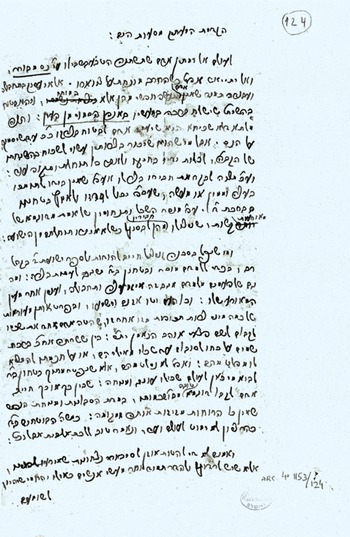
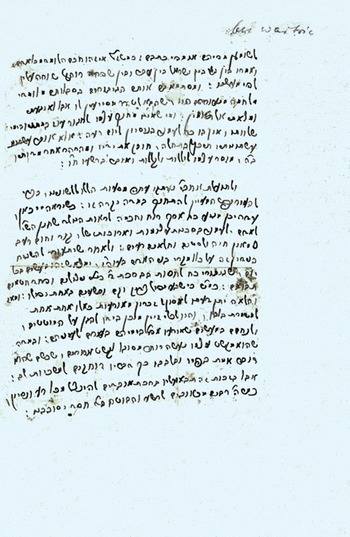
Reproduced from folder 124 in the Joseph Perl Archive, by permission of the Jewish National and University Library, Jerusalem. A transcription and a translation may be found in appendix III.
Appendix III

Mendel Lefin, Unpublished Translator's Introduction to Sea Travels Footnote 157
A person should never expect that nature will change for him by means of a clear miracle,
and a person should not despair when the sword hangs over his neck;Footnote 158 instead he should prepare a plan, pray
and work always—for a person is not made free of them except by his death, and he should trust
that the Holy One, Blessed be He, will send a blessing on his deeds, in a manner that is hidden from the eye:
5 And the rabbis taught that it is an uncommon thing that a person dares to be so confident of His goodness that he trusts
in the miracle. For a person who is drunk with his troubles may forget God's Providence,
crossing his hands in his lap and losing all hope and expectation.
Therefore, it is a commandment to visit one's friend in adversity, even if it is not in one's power to support him
with advice and money or deeds, because in any case one can encourage him and strengthen his faith
10 in God's blessings—by means of moral words and his true consolation on the example of
harsh occurrences from which his friends were ultimately saved when they did not lose hope of salvation:
And the person who has fallen into danger and been saved is obliged to give thanks and publicly tell of God's salvation,
in order to teach them morality and faith in God, praised be He, in times of trouble.
And what's more, sometimes one incidentally gives advice or teaches a plan of action regarding a similar situation:
15 And all of the people will bend their ears and hear, especially regarding events
when several kinds of misfortune come in succession, and in which a person put his shoulder to the wheel
and accepted them as wounds delivered by the loving, faithful God: Whether Heaven's blessing will rest on him afterward
by virtue of his being able to withstand them until they pass, or by his wisdom in finding
a refuge from them: And even if he did not find refuge from them, but perished with faith in God's assistance,
20 coming from here to a world that is all delight and comfort: For either this way or that, a person is obliged
to receive a good example from other people like him, with a measure of patience and spiritual calm–
such that all of the winds do not move his soul from its place. As it is written, “Those who trust in the Lord
are like Mount Zion, and will never be moved for all eternity,”Footnote 159 and it is said, “Better to go to a house of mourning.…”Footnote 160
And indeed it is not enough to bend one's ear to stories of victory that have occurred before us;
25 instead one should chase after and exalt, always speaking of the deeds of such people, whoever they are,
to listen to them from their mouths or from their writings. As the sages said, “Who is wise? The one who learns from everyone.”Footnote 161
And they said, “Whether Gentile or Jew, whether slave or servant, the holy spirit rests on him
in accordance with his deeds.”Footnote 162 And doubtless it was also about those heroes with their sufferings, the teachers of war
from their youths, [that it is said] “The one who comes to purify is supported.”Footnote 163 But do not believe [those who say], “I did not toil, and I found.”Footnote 164
30 Whoever does not educate himself to gird up his loins in the days
of his tranquility, does not have in him the strength to withstand a trial on a bad day: But he will lose
his strength immediately, from the beginning, sit idle, and reflect on His qualities
blessed be He; he gives himself up to wailing and curses and is lost in his wickedness, God forbid:
For the good of our brethren, the Children of Israel, these Travels have now been translated into our language, in order
35 to awaken the soul of the reader to train himself in this precious quality: In order that he will see from this
to what lengths the force of perseverance and wisdom go—foreseeing the consequencesFootnote 165 with which God has graced
human beings—toward withstanding tremendous and enduring dangers, of cold and heat and hunger,
thirst, wild animals, bandits, and severe illnesses. And after he awakens to be aware
in this regard, about all that happens to people in this world, he will find that these are everyday events,
40 when heroes of strength take shelter in God's blessing and are all saved, while fear overtakes sinners.
As it is written, “For the righteous person falls seven times and stands up, while the wicked” fall at once:Footnote 166
And from that time on, he [the reader] will put his mind to collecting memories of events like this, one by one
to guard in his heart, and they will become weapons, ready to hand, to protect people from breakdowns,
consoling them with events that have occurred even in their days and in their cities, before their eyes. And to the extent
45 that he adorns himself, he is made more capable of adorning others, for just as he is
a speaker of truth in his mouth and heart, so do his words touch the depths of the heart:
But by virtue of this there will come to him the blessing of the lost, to be saved from all evil and temptation,
As it is written, “Many are the sufferings of the wicked, but the person who trusts in the Lord will be surrounded by mercy.”Footnote 167



