INTRODUCTION
Parasite abundance and pattern of distribution often vary between younger and older hosts of different taxa (Henricson, Reference Henricson1977; Goater and Ward, Reference Goater and Ward1992; Fichet-Calvet et al. Reference Fichet-Calvet, Wang, Jomaa, Ben Ismail and Ashford2003; Hawlena et al. Reference Hawlena, Abramsky and Krasnov2005; Krasnov et al. Reference Krasnov, Stanko and Morand2006). Studies of a variety of host-parasite systems demonstrated that relationships between host age and parasite abundance may be linearly positive, asymptotic, hump-shaped or convex (see review by Hudson and Dobson, Reference Hudson, Dobson, Grenfell and Dobson1995), with each of these patterns being generated by different mechanisms (Woolhouse, Reference Woolhouse1998). For example, parasite load-dependent host mortality may lead to a decrease in mean parasite abundance in young and aged host cohorts and thus represents a mechanism behind the hump-shaped relationship between parasite abundance and host age (Rousset et al. Reference Rousset, Thomas, de Meeûs and Renaud1996). It is commonly thought that this pattern arises due to age-dependent development of host defence mechanisms (Pacala and Dobson, Reference Pacala and Dobson1988; Gregory et al. Reference Gregory, Montgomery and Montgomery1992; Grenfell et al. 1995). Indeed, if the level of acquired resistance against parasites is low either in young (by definition) and old hosts (due to immunosenescence) (Gryseels, Reference Gryseels1994; Møller and de Lope, Reference Møller and de Lope1999; Klein, Reference Klein2004; Gruver et al. Reference Gruver, Hudson and Sempowski2007), then heavily infected individuals of these age cohorts would be lost from a population. However, if the defence abilities of young and old hosts are inferior to those of adult hosts, but parasites either cause weak host mortality or do not cause host mortality at all, then the shape of the parasite abundance-host age curve would be convex. Anyway, in both cases, parasites are expected to perform better on young and old hosts than on hosts of ‘middle age’ (further referred to as ‘adult hosts’) due to lower defences of the two former categories.
The majority of studies of anti-parasitic resistance are generally host-focused. In these studies, the success of a host to defend itself against parasites is measured via host responses. In contrast, the responses of parasites have been largely neglected, although they are crucially important from the ecological perspective of host-parasite relationships (Combes, Reference Combes2001). Fleas (Siphonaptera) represent a convenient model for studies of parasite responses to host defences. Although they are obligatory haematophagous and spend more time on their hosts than mere feeding requires, they also spend substantial time off their hosts. This allows the design of a variety of experiments in which fleas are forced to feed on hosts belonging to various categories (species, genders or age cohorts) and to monitor their responses over time.
In this study, we tested for the effect of host age on feeding variables of flea parasites. Bloodmeal size, the proportion of highly engorged fleas, the rate of blood digestion and time of survival after a single bloodmeal in the flea Xenopsylla ramesis parasitizing juvenile, subadult, adult and old Meriones crassus were determined. In the wild, M. crassus harbours several flea species, with X. ramesis being the most abundant one in loess habitats of the Negev desert (Krasnov et al. Reference Krasnov, Shenbrot, Medvedev, Vatshenok and Khokhlova1997).
Bloodmeal size and digestion rate are useful measures of flea feeding success (Vaschenok and Solina, Reference Vashchenok and Solina1969; Vashchenok, Reference Vashchenok1988; Krasnov, Reference Krasnov2008; Khokhlova et al. Reference Khokhlova, Serobyan, Krasnov and Degen2009a). For example, faster digestion of blood taken by a flea from one host species as opposed to another host species was found to be associated with better reproductive performance of the flea on the former (Krasnov et al. Reference Krasnov, Sarfati, Arakelyan, Khokhlova, Burdelova and Degen2003; Khokhlova et al. Reference Khokhlova, Ghazaryan, Krasnov and Degen2008). The same appeared to be true for comparison of flea feeding and reproductive performance between genders of conspecific hosts (Khokhlova et al. Reference Khokhlova, Serobyan, Krasnov and Degen2009a, Reference Khokhlova, Serobyan, Krasnov and Degenb). Another useful, but indirect indicator of flea performance is the time that a flea survives after a single bloodmeal taken from a host. Obviously, longer survival of a flea on the resources extracted from blood of a certain host would indicate a relatively better quality of this host. Consequently, we predicted that fleas would take larger bloodmeals, digest blood faster and survive longer after a single bloodmeal when they are allowed to feed on juvenile (20–21 days old) and aged (>4 years old) rodents than on subadult (45–60 days old) and adult (6–12 months old) rodents. Furthermore, given that the effect of host gender on parasite performance has been shown to be associated with gender differences in hormonal environment (e.g. Zuk, Reference Zuk1996), we predicted that this effect would be manifested stronger in subadult and adult hosts because of (a) under-development of characteristic hormone profiles in juvenile hosts and (b) general decrease of sex hormones in old hosts (see review by Arlt and Hewison, Reference Arlt and Hewison2004).
MATERIALS AND METHODS
Fleas
Fleas from our laboratory colony started in 1999 from field-collected specimens on M. crassus were used. Fleas were maintained on M. crassus that were raised individually in plastic cages with a wire mesh floor over a pan with a mixture of sand and dried bovine blood at 25°C and 75% relative humidity with a photo-period of 12:12 (L:D) h. Every 2 weeks, all substrate and bedding material from the rodent's nest box and the pan were collected and transferred to an incubator (FOC225E, Velp Scientifica srl, Milano, Italy; 25°C air temperature and 75% relative humidity) where the fleas developed. Further details on breeding and maintenance of fleas can be found elsewhere (e.g. Krasnov et al. Reference Krasnov, Khokhlova, Fielden and Burdelova2002a, Reference Krasnov, Khokhlova, Burdelova, Mirzoyan and Degen2004; Khokhlova et al. Reference Khokhlova, Ghazaryan, Krasnov and Degen2008, Reference Khokhlova, Serobyan, Krasnov and Degen2009a, Reference Khokhlova, Serobyan, Krasnov and Degenb, Reference Khokhlova, Serobyan, Degen and Krasnov2010). All fleas used in experiments were newly-emerged and were selected randomly from a colony.
Rodents
Rodents were maintained in plastic cages (60×50× 40 cm) at 25°C and 75% relative humidity with a photo-period of 12:12 (L:D) h, and with sawdust and dried grass as bedding material. They were offered millet seed and fresh alfalfa (Medicago sp.) ad libitum daily. No water was available as the alfalfa supplied enough for their needs. A male and a female rodent born from different parents were in each cage initially. Young individuals were transferred to a new cage at 1 month of age.
In this study, we used sexually-naïve juvenile, subadult, adult, and old M. crassus (72 and 47 males and 62 and 39 females for measurements of bloodmeal size and the rate of digestion, respectively). Adult rodents (mean body mass 140·2 g and 107·7 g for males and females, respectively) were 6–12 months old and were randomly selected from a laboratory colony. Old rodents (mean body mass 119·2 g and 86·1 g of males and females, respectively) were maintained individually from 2 months age during 4 years. To obtain juvenile and subadult rodents, a female and a male rodent were placed together for 1 week. The length of the oestrous cycle of M. crassus averages 4·5 days (range 4–6 days), while pregnancy lasts for 20–21 days (Khokhlova et al. Reference Khokhlova, Kam, Gonen and Degen2000). Juvenile rodents (mean body mass 25·8 g of both males and females) were 20–21 days old and pre-weaned. Subadult rodents (mean body mass 65·6 g of both males and females) were 45–60 days old and weaned at 30 days of age. In total, we used 21 and 7 juvenile, 40 and 35 subadult, 53 and 30 adult and 20 and 14 old rodents for measurements of bloodmeal size and the rate of digestion, respectively. No sibling rodents were used in the same treatment. For biological reasons juvenile and subadult rodents were never parasitized by fleas, while adult and old rodents were exposed to fleas on at least 5 occasions previously.
Experimental procedures and design
Rodents were placed individually in wire mesh (5×5 mm) tubes (15 cm length and 4 cm diameter for juvenile rodents and 18 cm length and 6 cm diameter for subadult, adult and old rodents) which prevented movement and self-grooming. Then, the tubes were placed in individual white plastic pans and 10, 20 or 30 fleas (equal number of males and females) were placed on each rodent (juvenile, subadult and adult/old, respectively) for 1 h. We brushed the fur of the rodent several times with soft custom-made forceps until all fleas were recovered. We weighed fleas (males and females separately) (±0·01 mg, 290 SCS Precisa Balance, Precisa Instruments AG, Switzerland) before and immediately after feeding. The level of midgut engorgement of the fleas after feeding was assessed by viewing them under a light microscope (without dissection) and considered those with more than 50% of midgut filled with blood as being highly engorged.
To estimate the rate of digestion, we used newly emerged 3-day-old fleas that had not been fed prior to experiments. After feeding on a host, we examined fleas under light microscopy and selected individuals with fully engorged midguts. This resulted in the selection of 173 male and 210 female fleas. They were placed individually into 20 ml glass vials covered by a 5×5 cm nylon screen and maintained them at 25°C and 75% relative humidity in incubators. Flea midguts were examined under light microscopy every 2 h and ranked blood digestion status following a modified classification of Ioff (1941) and used in our earlier studies (Krasnov et al. Reference Krasnov, Burdelova, Shenbrot and Khokhlova2002b; Khokhlova et al. Reference Khokhlova, Serobyan, Krasnov and Degen2009a). We distinguished 3 stages of digestion as follows: (a) early – stretched midgut, fully filled with light scarlet or dark red blood; (b) middle – the content of the midgut is dark brown or black; and (c) late – empty midgut or remnants of digested blood. We measured the duration of each stage. After completion of digestion, fleas were left in their vials. The vials were then checked twice a day (at 08:00 and at 20:00) and the time of death of each flea was recorded. The number of fleas that fed on the same rodent, were fully engorged and completed digestion ranged from 1 to 13.
Each of the two experiments (estimation of bloodmeal size and estimation of blood digestion rate) comprised 8 experimental treatments (4 host ages×2 host genders). However, we analysed data as 16 treatments (4 host ages×2 host genders×2 flea genders), replicated 8–30 times (estimation of bloodmeal size) and 3–22 times (estimation of digestion rate) (see below).
Data analysis
In the analysis of data on bloodmeal size, a replicate represented a group of fleas feeding simultaneously on a rodent. We calculated the amount of blood consumed by a flea (=mean bloodmeal size) as the difference in mass before and after feeding; this value was divided by total mass of fleas prior to feeding taking into account engorged fleas only. Mean bloodmeal size and proportion of highly engorged fleas were analysed using 3-way ANOVAs with host age, host gender and flea gender as independent variables.
In the analysis of data on digestion rate, a replicate represented an individual flea. During digestion rate measurements, some fleas (107 males and 100 females) died before completion of digestion; these individuals were excluded from the analysis. We analysed data on the remaining 66 male and 110 female fleas (from 3 to 22 fleas per treatment). For each flea that completed digestion, we calculated: (a) time required to complete each digestion stage; (b) total time of digestion; and (c) time from completion of digestion to death. The digestion rate (duration of each stage separately and total time of digestion) and time to death under starvation using 3-way ANOVAs with host age, host gender and flea gender were analysed as independent variables. Univariate tests of significance for planned comparisons were used to compare dependent variables within host age, host gender or flea gender.
Prior to the analyses of digestion rate and to account for repeated use of some of the rodents cases were selected in which at least 2 fleas fed on the same rodents. We performed mixed-model ANOVAs for all dependent variables related to the rate of digestion using host age as a fixed factor and rodent identification number as a random factor separately for male and female fleas digesting blood of a male or a female rodent. No among-rodent difference was found in any dependent variable (F=0·41–0·90; P>0·15 for all) which suggests no effect of host individuality on feeding performance of fleas. All measurements, except for proportion of engorged fleas, were log-transformed prior to analysis. Angular transformation was applied to the proportion of engorged fleas. Figures represent non-transformed data.
RESULTS
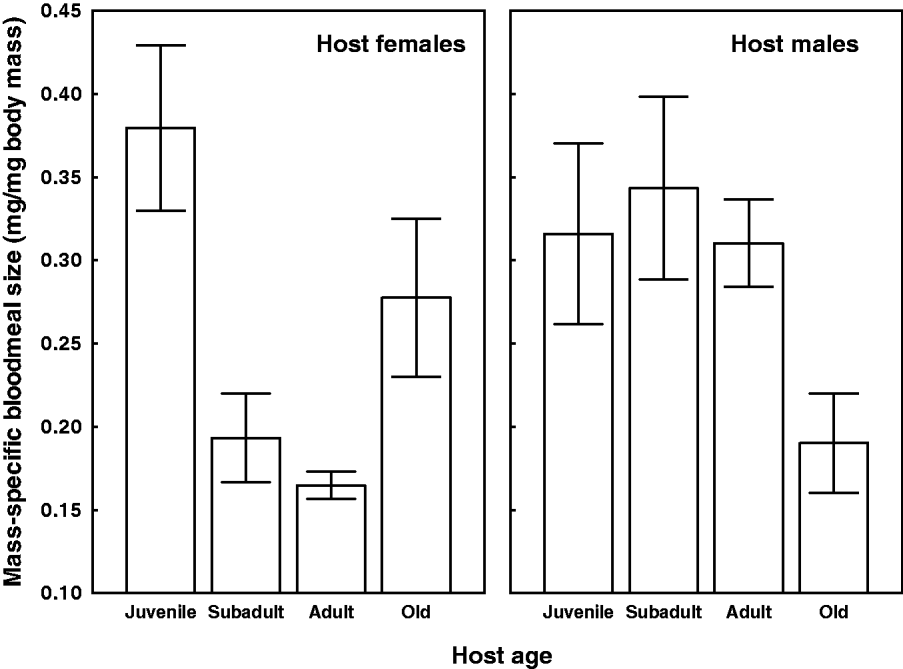
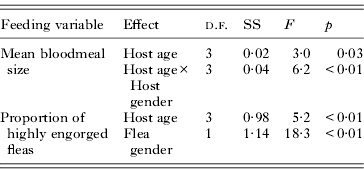
The effects of host age, host gender and flea gender on mean bloodmeal size and proportion of highly engorged fleas are presented in Table 1. A significant independent effect was found for host age, but not for host or flea gender on the mass-specific amount of blood taken by a flea. In addition, interaction between host age and gender was significant suggesting that the effect of host age on bloodmeal size of a flea was manifested differently in male and female hosts. Indeed, when fleas fed on female hosts, they took relatively less blood from subadult and adult rodents than from juvenile and old rodents (F=16·1, P<0·01; Fig. 1). In contrast, when fleas fed on male hosts, they took relatively less blood from old hosts than from younger hosts (F=7·4, P<0·01; Fig. 1). Comparison of bloodmeal size between host genders within age cohorts demonstrated that fleas took more blood from subadult and adult males than from females (F=10·6 and F=15·1, respectively; P<0·001 for both; Fig. 1), while no effect of host gender was found when fleas fed on juvenile and old rodents (F=1·2 and F=2·0, respectively; P>0·15 for both; Fig. 1).
Mean (±s.e.) mass-specific bloodmeal size in Xenopsylla ramesis that fed on juvenile, subadult, adult and old males and females of Meriones crassus.

Summary of significant effects in 3-way ANOVAs of mean bloodmeal size and the proportion of highly engorged fleas, respectively, in male and female Xenopsylla ramesis feeding on male and female M. crassus hosts of different ages

The proportion of highly engorged fleas after 1 h of feeding depended on host age and flea gender only, while interactions between factors were non-significant (Table 1). The proportion of highly engorged female fleas was the highest when they fed on subadult hosts (F=7·8, P<0·01), while the rate of engorgement of male fleas was significantly higher when they fed on hosts belonging to the two younger cohorts than when they fed on adult and old hosts (F=5·0, P=0·03).
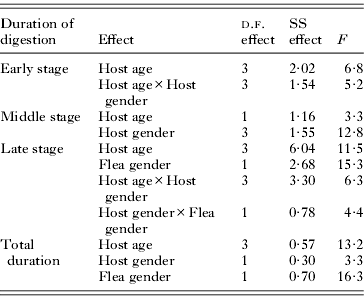
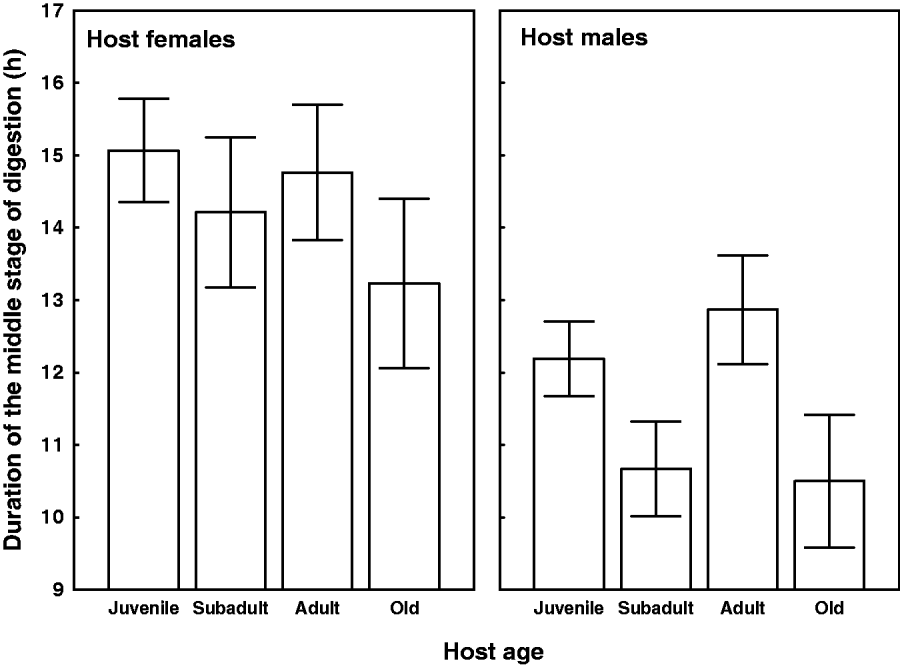
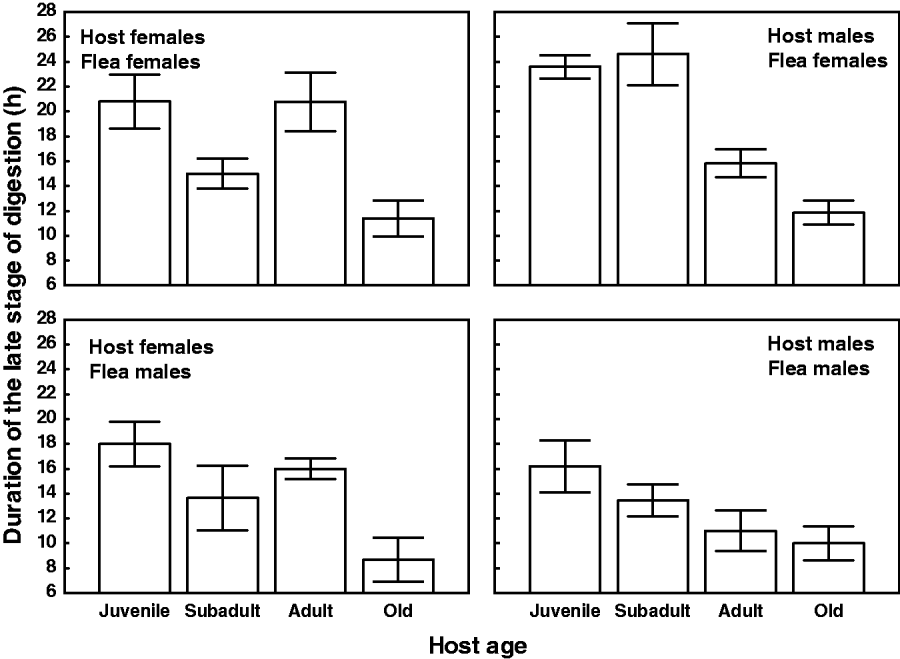
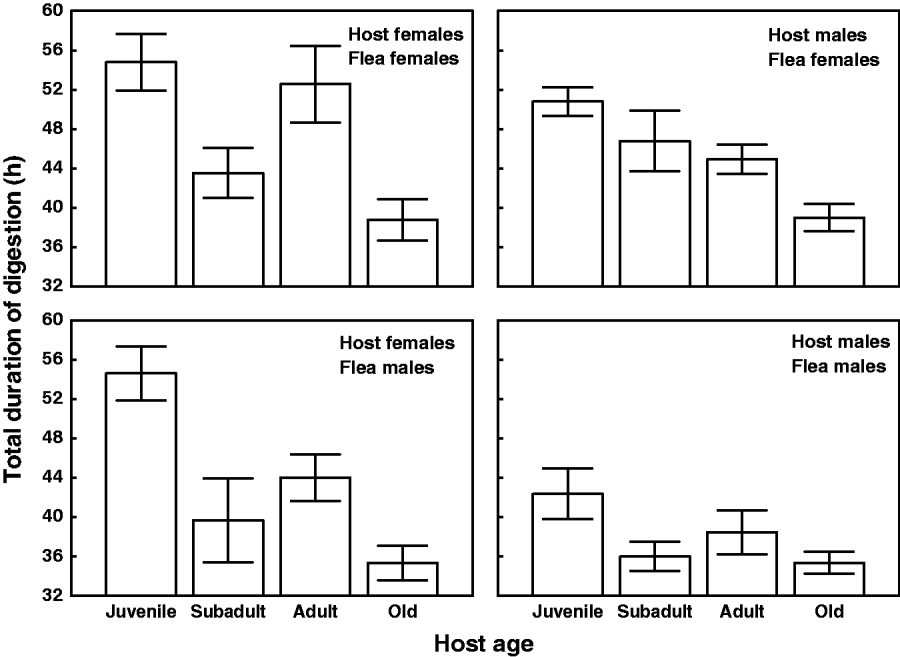
The effects of host age, host gender and flea gender on duration of blood digestion are presented in Table 2. Duration of digestion at all 3 stages differed significantly among host ages. Durations of the middle and late stages of digestion were affected also by host and flea genders, respectively. In addition, interaction between host age and host gender had a significant effect on the duration of early and late stages of digestion, whereas the latter was also affected by the interaction between host and flea genders. The net result of the somewhat different patterns of the effect of independent variables on duration of the 3 stages of digestion was independent of the effects of host age, host gender and flea gender on total duration of digestion.
Summary of significant (P<0·05) effects in 3-way ANOVAs of the duration of early, middle and late stage of blood digestion in male and female Xenopsylla ramesis feeding on male and female Meriones crassus hosts of different ages

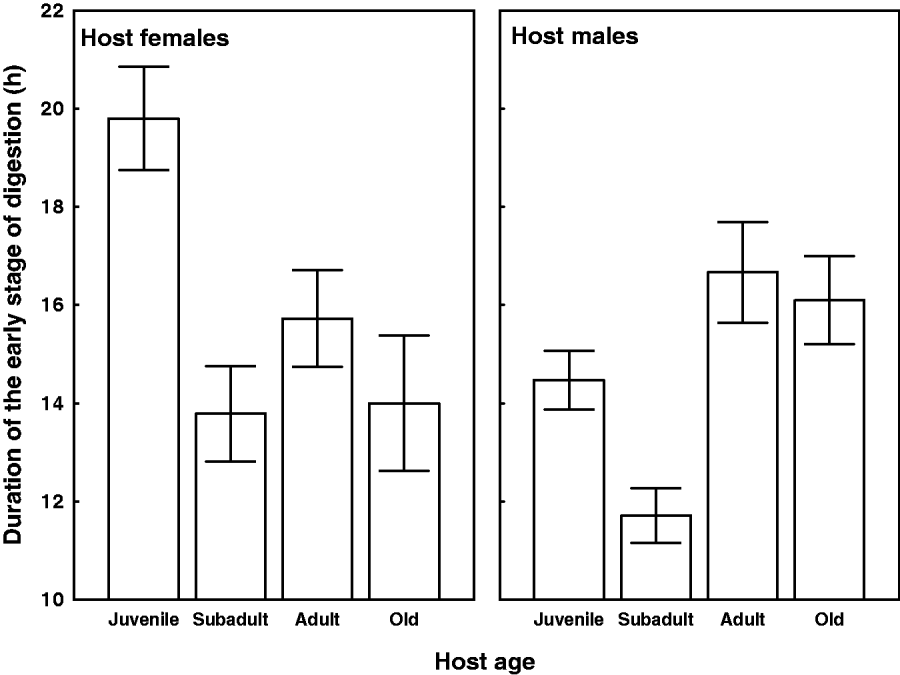
During the early stage of digestion, fleas digested blood from juvenile female hosts significantly slower than blood from subadult, adult or old females (F=10·7–18·7; P<0·001 for all) (Fig. 2). When fleas fed on male hosts, duration of the early stage of digestion was shortest in subadult hosts (F=5·5, F=13·7 and F=10·9 for contrasts between subadult and juvenile, adult or old hosts, respectively; P<0·001 for all), while it did not differ significantly among hosts of the remaining age cohorts (F=0·1–1·8, P>0·20 for all). The duration of the middle stage of digestion did not differ among female hosts of either age (F=0·2–1·5, P>0·20 for all), but it was significantly shorter when a flea fed on old and subadult than on juvenile and adult males (F=4·3–6·2, P<0·05 for all) (Fig. 3). The late stage of digestion was the shortest when a flea fed on an old host (F=4·2–33·0, P<0·04 for all) (Fig. 4). In addition, the pattern of host age effect differed between male and female fleas and depended on whether fleas fed on a male or a female host (Fig. 4), which explained the significance of two 2-way interactions (Table 2). The effect of host age on the total duration of digestion reflected the strongest effects revealed at separate stages of digestion. In particular, blood of juvenile hosts was digested the slowest (F=8·7–27·5, P<0·005), while blood of old hosts was digested the fastest (F=9·5–25·7, P<0·005) except for male fleas exploiting male hosts which digested blood from subadult and old hosts at similar rates (F=2·4, P=0·12) (Fig. 5).
Mean (±s.e.) duration of the early stage of digestion in Xenopsylla ramesis that fed on juvenile, subadult, adult and old males and females of Meriones crassus.

Mean (±s.e.) duration of the middle stage of digestion in Xenopsylla ramesis that fed on juvenile, subadult, adult and old males and females of Meriones crassus.

Mean (±s.e.) duration of the late stage of digestion in male and female Xenopsylla ramesis that fed on juvenile, subadult, adult and old males and females of Meriones crassus.

Mean (±s.e.) total duration of digestion in male and female Xenopsylla ramesis that fed on juvenile, subadult, adult and old Meriones crassus.

The effect of host gender on duration of digestions was either separate or interacted with either host age or flea gender. At the early stage of digestion, this effect was manifested in faster digestion of blood from juvenile male than juvenile female hosts (F=18·6, P<0·001), but this was not the case for the remaining host cohorts (F=1·7–2·1, P>0·15 for all). At the middle stage, fleas digested blood of male hosts faster than that of female hosts of the same age (F=3·9–5·4, P<0·05 for all). The late stage of digestion was shorter when a flea fed on a male than a female adult host (F=8·8, P<0·01) and longer when a flea fed on a male than a female subadult host (F=5·5, P<0·05), although the latter was true for female fleas only. No difference between host gender was found in the duration of the late stage digestion for juvenile and old hosts (F=0·4–0·12, P>0·70 for both). Total duration of digestion was significantly shorter when fleas digested blood from subadult and adult male than from female hosts (F=5·3 and F=7·1, respectively; P<0·05 for both), but total duration of digestion was not affected by host gender in juvenile and old rodents (F=1·9 and F=0·9, respectively; P>0·16 for both; Fig. 5).
An effect of flea gender on the duration of digestion was found at the late, but not the early or middle stage of digestion which then was reflected in differences between male and female fleas in total digestion time. The late stage of digestion of blood from juvenile, subadult and adult hosts took significantly longer in female than male fleas (F=6·1–8·9; P<0·05 for all), while no flea gender differences were found in old hosts (F=0·4, P=0·53). Total time of digestion was longer in female than male fleas when blood from subadult and adult hosts was digested (F=6·3 and F=11·32, respectively; P<0·01 for both), but this was not the case for blood from juvenile and old hosts (F=2·3 and F=1·1, respectively; P>0·10 for both).
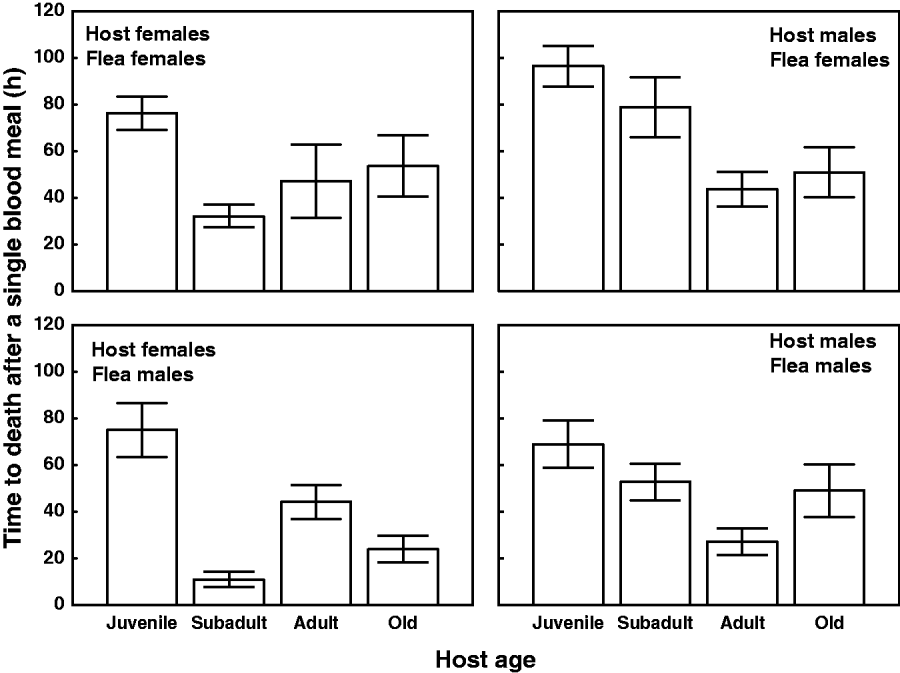
Time to death of fleas after completion of digestion was affected by host age and flea gender (F 3,160=12·6 and F 1,160=11·2, P<0·001 for both) and also differed between male and female hosts (F 1,160=6·1, P< 0·05). In addition, interaction between host gender and age was significant (F 3,160=2·43, P<0·05), suggesting a complicated manifestation of the pattern of resistance to starvation after a single bloodmeal. In general, fleas survived the longest after a bloodmeal taken from a juvenile host (F=33·7, P<0·001), while they survived for a similar time after feeding on hosts from the remaining age cohorts (F=0·2–1·0, P>0·60 for all) (Fig. 6). Furthermore, fleas survived longer after feeding on subadult male than on subadult female hosts (F=30·1, P<0·01), but this was not the case for juvenile, adult and old rodents (F=0·1–0·7, P>0·40 for all). An effect of flea gender on resistance to starvation was found for subadult hosts only. After a single bloodmeal and completion of digestion, female fleas survived significantly longer than male fleas (F=8·2, P<0·001).
Mean (±s.e.) time to death after completion of digestion of a single bloodmeal in male and female Xenopsylla ramesis that fed on juvenile, subadult, adult and old male and female Meriones crassus.

DISCUSSION
Results of this study indicated that the effect of host age (a) differed among measures of feeding performance and (b) was mediated by the effect of host and gender. Measures of feeding performance considered in our study can be envisaged as indicators of patterns of resource acquisition (bloodmeal size and proportion of highly engorged fleas), resource processing (rate of digestion) and resource value (time that fleas survive after a single bloodmeal).
Fleas took more blood from juvenile and old than from subadult and adult gerbils. However, this was true for female hosts only. In contrast, bloodmeals taken from old males were smaller than those from younger males. In other words, from the perspective of resource acquisition, juvenile and old females represented higher quality hosts than subadult and adult females, while old males represented lower quality hosts than young males. In addition, subadult and adult males were higher quality hosts than females of the same age, while juvenile and old rodents did not differ in their quality, independent of gender.
Among digestion variables, duration of the middle stage of digestion seemed to be the best indicator of a pattern of resource processing. This is because this digestion stage includes haemolysis and digestion of blood to haematin and, in contrast to early and late stages, is mainly indicative of biochemical rather than mechanical processes; Vaschenok, 1988; Krasnov et al. Reference Krasnov, Sarfati, Arakelyan, Khokhlova, Burdelova and Degen2003). Thus, from the perspective of resource processing, subadult and old male hosts were of higher quality than juvenile or adult male hosts, while the quality of female hosts was not age dependent. Regarding host gender, higher male than female quality was characteristic for juvenile, subadult and adult but not old rodents. From the perspective of resource value, the highest quality hosts were juvenile rodents, while male host quality was superior to female host quality in subadults only.
The observed patterns can be explained in terms of changes in a host's immune defences and the nutritional quality of blood during its individual life. We will consider possible relationships between flea feeding, host defence and nutritional value of host's blood for each individual host age cohort.
Juvenile hosts
Larger bloodmeals taken from juvenile hosts could indicate that they have low immune defences. For example, juvenile M. crassus have been found to be less immunocompetent than adult individuals (Hawlena et al. Reference Hawlena, Krasnov, Abramsky, Khokhlova, Gouey de Bellocq and Pinshow2008). However, slow digestion of blood of juveniles contradicts this explanation and suggests that they possess some protective immunity that was transferred from their mothers during pregnancy and lactation. Maternal transfer of immunity against parasites is well known (Carlier and Truyens, Reference Carlier and Truyens1995; Hasselquist and Nilsson, Reference Hasselquist and Nilsson2009), although its protective effect is limited (Knopf and Coghlan, Reference Knopf and Coghlan1989). Furthermore, an indication of maternal transfer of immunity against fleas was reported for M. crassus (Khokhlova et al. Reference Khokhlova, Spinu, Krasnov and Degen2004). In other words, blood of juvenile rodents could carry some defence mechanisms that slow down its digestion by fleas, while larger bloodmeals taken from juveniles might be associated mainly with their underdeveloped skin immunity. For example, the network of Langerhans cells in neonatal mice was found to be poorly developed and functionally immature (Dewar et al. Reference Dewar, Doherty, Woods, Lyons and Muller2001). In adult mammals, an extensive network of these intra-epidermal dendritic cells is formed throughout the epidermis and is aimed to capture cutaneous antigens (Shelley and Juhlin, Reference Shelley and Juhlin1976). Nevertheless, although digestion of blood from a juvenile host took a relatively long time and, thus, might have high metabolic cost (see Krasnov et al. Reference Krasnov, Sarfati, Arakelyan, Khokhlova, Burdelova and Degen2003 and Sarfati et al. Reference Sarfati, Krasnov, Ghazaryan, Khokhlova, Fielden and Degen2005), fleas would benefit from high nutritional value of this blood as indicated by their relatively long survival after a bloodmeal from a host of this age category.
Subadult and adult hosts
Subadult and adult rodents supposedly have developed both blood and cutaneous defence tools. As a result, fleas took less blood from females of these ages than from younger or older females, while this was not the case for males. The latter possess high levels of androgens which are thought to have an immunosuppressive effect (Zuk, Reference Zuk1996; but see Castro et al. Reference Castro, Nolan and Ketterson2001 and Rolff, Reference Rolff2002). This might counterbalance their anti-parasitic immunity in terms of the amount of blood that fleas are able to consume from these animals. Nevertheless, age-dependent differences in the immune defences of females were not reflected in the duration of digestion of their blood by fleas. In contrast, blood of subadult males was digested at a faster rate than that of adult males suggesting that, perhaps, immune defence of subadults, albeit being relatively well developed, was inferior to that of adults because they (a) already lack protective maternal immunity and (b) still have not acquired full anti-parasitic immunity. This is supported by (a) a higher proportion of engorged fleas after 1 h of feeding on subadult hosts than on hosts of the other age groups; (b) faster digestion of blood from subadult than adult males; and (c) longer survival of fleas after a bloodmeal taken from subadult than adult males. In addition, time of survival after a bloodmeal indicated that the nutritional value of blood of subadult and adult hosts was lower than that of juvenile hosts, although biochemical reasons for this difference remain to be identified.
Old hosts
Immune defences deteriorate with age (Gruver et al. 2007), so anti-parasitic defence in old animals was expected to be weak (Klein, Reference Klein2004). Weak immunocompetence of aged gerbils was translated partly into patterns of resource acquisition (relatively large bloodmeals taken from female but not male hosts) and resource processing (relatively high rate of digestion of blood from male but not female hosts) by fleas. Time of survival of fleas after a bloodmeal suggested that, in general, host senescence was not accompanied by deterioration of nutritional value of their blood for fleas.
Overall, our observations suggested that a host of a particular age could not be unequivocally predicted to be more or less beneficial for a parasite than younger or older hosts. Instead, exploitation of a host belonging to each age cohort represents a trade-off between certain benefits and certain costs. For example, a flea feeding from a juvenile host benefited from a large bloodmeal, but it invested relatively much time to digest this amount of blood. A flea feeding on an old host spent relatively little time (and presumable energy) for blood digestion, but time of its survival after a feeding event was short.
Interaction between host age and gender
Host gender-bias in flea feeding was manifested differently among host ages. In other words, the effect of host gender was mediated by host age. Fleas performed better on male than on female hosts within subadult and adult age cohorts in terms of bloodmeal size and digestion time. In juvenile and old hosts, this gender difference affected the duration of digestion (early and middle stages or middle stage, respectively) only. Better performance of ectoparasites on male rodent hosts has been reported earlier (Khokhlova et al. Reference Khokhlova, Serobyan, Krasnov and Degen2009a, Reference Khokhlova, Serobyan, Krasnov and Degenb). However, the previous studies used adult rodents, while this study demonstrated that host male-biased performance of fleas is age dependent. The effect of host gender on parasite performance can be manifested (a) in some but not other performance variables and/or (b) in some but not other age cohorts. If the difference in parasite suitability of male and female hosts stems from their difference in immunocompetence due to difference in hormonal environment, then similarity in, for example, the size of bloodmeals taken by fleas from pre-pubertal and aged hosts regardless of gender can be attributed to their low levels of sexual hormones.
From the ecological perspective and at the level of host populations, interplay between host gender and host age effects on feeding performance of parasites may cause variation in gender- and age-related patterns of parasite infestation in dependence of demographic composition of a population. This can be one of the reasons behind spatial and temporal variations of these patterns (Krasnov et al. Reference Krasnov, Morand, Hawlena, Khokhlova and Shenbrot2005, Reference Krasnov, Stanko and Morand2006; Krasnov and Matthee, Reference Krasnov and Matthee2010).
ACKNOWLEDGEMENTS
This study was supported by the Israel Science Foundation (Grant no. 27/08 to B.R.K., I.S.K. and A.A.D.). The experimental procedures complied with the laws of the State of Israel. This is publication no. 731 of the Mitrani Department of Desert Ecology.