Implications
Organic trout farming is a small but growing industry. In the near future, it is anticipated that all ingredients in feeds for this segment should be organically approved. Organic plant oils may be suitable alternatives to fish oil (FO), but may cause lower utilization and growth because of lack of long-chain polyunsaturated fatty acids and may be prone to oxidation as supplementation of antioxidants is not allowed. The tested organic plant oils could all replace FO, as they showed a higher digestibility in rainbow trout and were very resistant to oxidation due to the presence of high levels of natural antioxidants.
Introduction
Fishmeal and fish oil (FO) are important constituents of feeds for aquaculture because of the high protein content, optimal amino acid composition and as supplier of healthy n-3 long-chain polyunsaturated fatty acids (LC PUFAs). Owing to the global shortage of marine fishmeal and FO, optimized utilization and intensive search for alternative protein and lipid sources in diets for farmed fish is urgently needed. Organic aquaculture is an alternative way of production driven by the growing interest of sustainable utilization of resources (Mente et al., Reference Mente, Karalazos, Karapanagiotidis and Pita2011). Following the European Union Commission Regulation (EC) No. 710/2009 (European Union, 2009) for organic aquaculture, detailed rules have been laid down on organic aquaculture production including the compliance with the principles to minimize the use of protein and lipids from unsustainable sources and it is not allowed to add synthetic amino acids to the feed or to use chemically solvent purification methods. Oils from particularly leguminous and oilseed plants are potential sources for replacement of FOs in aquaculture diets given the steadily increasing production, high availability, relatively adequate nutritional quality and better economic value (Fountoulaki et al., Reference Fountoulaki, Vasilaki, Hurtado, Grigorakis, Karacostas, Nengas, Rigos, Kotzamanis, Venou and Alexis2009). The use of these vegetable oils has gained enormous interest over the past decades. However, most terrestrial vegetable oils possess nutritional drawbacks owing to a lack of LC PUFAs. The substitution of FO with vegetable oils and the concomitant replacement of fishmeal with plant meals may cause essential fatty acid (EFA) deficiency in salmonids. Furthermore, it may affect lipid deposition, resulting in enlarged livers and an increase in the hepatosomatic index (HSI). A few plants contain considerable proportions of the shorter-chain, essential PUFA α-linolenic acid (18:3n-3). Linseed oil (LO) in particular but also rapeseed oil are relatively rich in this fatty acid (FA), and both oils are therefore considered applicable alternative candidates to FOs in feeds for farmed fish.
Oils with a relative high content of PUFAs are more susceptible to oxidation (Koshio et al., Reference Koshio, Ackmann and Lall1994) than oils characterized by more saturated shorter-chain FAs, and lipid auto-oxidation may occur during feed processing and storage. The oxidative process is accelerated at higher temperatures, and oxidative changes may cause formation of low-molecular-weight carbonyl compounds, which may give rise to unpleasant off flavours known from rancid oils (Kaitaranta, Reference Kaitaranta1992). Dietary supplementation of synthetic antioxidants is not allowed in feed for organic fish (Mente et al., Reference Mente, Karalazos, Karapanagiotidis and Pita2011), and even though recent studies have investigated the possible use of natural antioxidants more information is needed on the nutritional consequences of auto-oxidation in unprotected organic plant oils. Even moderate lipid auto-oxidation may thus affect the dietary nutritional value, as well as nutrient utilization, health and growth of fish (Peng et al., Reference Peng, Chen, Qin, Hou, Yu, Long, Li and Ye2009). Only few studies have addressed possible additional effects of lipid peroxidation on gustatory palatability and feed intake in fish (Jacobsen et al., Reference Jacobsen, Lund, Birk and Kristensen1995), despite the fact that the taste of feeds may significantly influence feed consumption (Takeda and Takii, Reference Takeda and Takii1992; Kasumyan, Reference Kasumyan1997). In addition to this, the use of different vegetable oils such as LO, sunflower oil (SO) or rapeseed oil in feed for rainbow trout has caused discrimination between feeds (Geurden et al., Reference Geurden, Cuvier, Gondouin, Olsen, Ruohonen, Kaushik and Boujard2005).
The objectives of this study were therefore twofold: first to test the influence of complete substitution of FO with either organic rapeseed oil (RO), LO, SO or grapeseed oil (GO) on nutrient digestibility and growth evaluated against FO as lipid source in diets in which 47% fishmeal protein was replaced by a matrix of organic plant proteins (Lund et al., Reference Lund, Dalsgaard, Rasmussen, Holm and Jokumsen2011). Second, to investigate the susceptibility of moderate oxidation of these oils and how this affects the dietary plant oil FA composition, diet palatability (feed intake), as well as lipid digestibility and utilization in juvenile rainbow trout (Onchorhynchus mykiss).
Material and methods
Diet preparation and force-oxidation
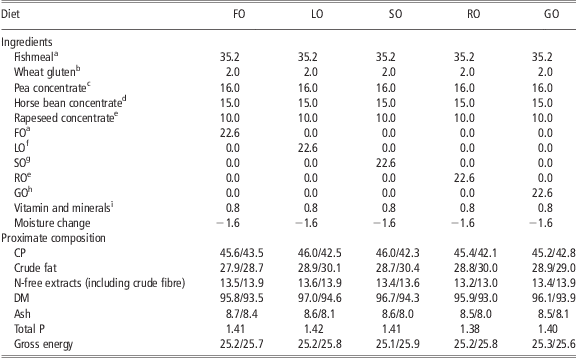
Five iso-energetic and iso-nitrogenous diets were formulated by BioMar Ltd, substituting 47% fishmeal protein by a fixed matrix of three organic plant protein concentrates as described in Lund et al. (Reference Lund, Dalsgaard, Rasmussen, Holm and Jokumsen2011; Table 1). The diets were coated with either commercial fish oil (FO; serving as control diet), or one of the following four cold-pressed organic oils: LO, SO, RO and GO. The diets were prepared by the Danish Technological Institute (Kolding, Denmark) using a twin-screw Werner & Pfleider 37 extruder (Werner and Pfleiderer Gmbh, Stuttgart, Germany) and fabricated as 3.0-mm pellets. After pelletizing, each batch of pellets was divided into two portions and stored at 2°C until vacuum coated with oil using a non-industrial coater with variable speed and a maximum of 11.6-psi vacuum. One half of the pellet portion was coated with freshly prepared oils and immediately used in feeding studies. The other half was vacuum coated with force-oxidized oils. The latter was obtained by storing the oils in closed buckets for 7 months at room temperature (18°C to 20°C). Before the start of the experiment, the oils were force-oxidized by placing them in 1-l glass beakers on an IKA C-MAG magnetic stirrer/hotplate (IKA, Germany) at a light intensity of 3400 lx (OSRAM L Lumilux 36 W/840 warm white) under continuous heating at 48°C to 49°C. Pure oxygen was continuously added as a slow flow through the oils by glass pipettes (0.2 l/min for 120 h), slightly modified from a previous description (Koshio et al., Reference Koshio, Ackmann and Lall1994).
Diet formulation (% inclusion) and proximate composition (% ww) of the five test diets
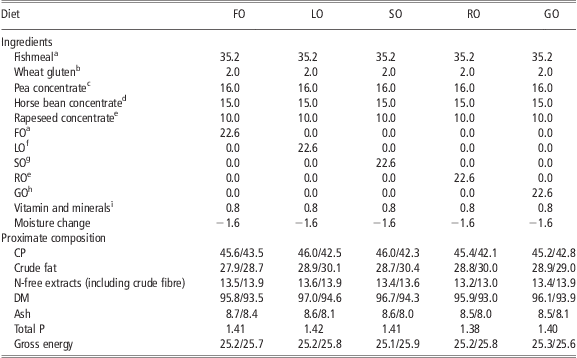
FO = fish oil; LO = linseed oil; SO = sunflower seed oil; RO = rapeseed oil; GO = grapeseed oil; LT = low temperature; DM = dry matter.
Values for both non-oxidized and oxidized diets shown (X/X). Gross energy given as MJ/kg.
aSprat (Sprattus sprattus), fishmeal: LT Supreme, FF Skagen, Denmark
bBioMar, Brande, Denmark.
cPeas (Pisum sativum), Toft Food A/S, Denmark.
dHorse beans (Vicia faba), DLF-Trifolium A/S, Roskilde, Denmark.
eRape seeds (Brassica napus), Lehnsgaard, Aakirkeby, Denmark.
fLinseed (Linum usitatissimum), Nyborgaard, Vildbjerg, Denmark.
gSunflower (Helianthus annuus), Urtekram International, Mariager, Denmark.
hGrape (Vitissp.), Earthoil, Bury St. Edmunds, United Kingdom.
iBioMar, Brande, Denmark; the following were supplied (mg/kg except as noted): vitamin A 3750 IU; cholocalciferol 750 IU; α-tocopherol, 131.3; thiamine, 7.5; riboflavin, 15; pyridoxine, 7.5; vitamin B12, 0.002; vitamin K3, 7.5; zinc, 75; iodine, 0.9; copper, 3.75; manganese, 22.5; cobalt, 0.75; selenium, 0.19.
Experimental design and procedures
Three experimental studies were carried out: (1) a digestibility study to determine the apparent digestibility coefficients (ADCs) of dietary nutrients in the four, non-oxidized organic plant oil-based diets and the conventional FO control diet; (2) a growth study to evaluate the specific growth rate (SGR) and feed conversion ratio (FCR) of the five diets; and (3) a digestibility study to determine the effects of force-oxidation in nutrient digestibility. The studies were carried out by DTU Aqua (Hirtshals, Denmark) using juvenile organic rainbow trout obtained from Sejbæk Trout Farm (Sjørup, Denmark).
Digestibility and growth study of non-oxidized plant oil diets (experiments 1 and 2)
Experiment 1 lasted 12 feeding days and was designed as a fully random, single factorial experiment with three replicate tanks for each diet (i.e. n = 3, 15 tanks in total). Fish with an initial mean weight of 82.2 ± 2.4 g were sorted from a larger batch of fish and randomly distributed among 15, 189 l, cylindrical–conical, flow-through, thermoplastic tanks at a stocking density of 20 per fish tank. The tank set-up ensured that all faecal particles were collected in separated sedimentation columns submerged in ice water, as previously described (Dalsgaard and Pedersen, Reference Dalsgaard and Pedersen2011). The tanks were supplied with 10°C tap water at a flow rate of 40 l/h. A 15-h light : 9-h dark diurnal photoperiod was maintained throughout the trial, and oxygen saturation levels were kept between 70% and 100% during the experiment. The fish were acclimatized to the experimental conditions and to the diets for 8 days before commencement of the experiment. They were individually weighed at the start of the experiment (day 0) and subsequently fed 1.5% of the estimated biomass per day (calculated based on an expected FCR) for 9 days. The daily ration was divided into two equal portions, which were fed at 1000 and 1400 h, respectively. Feed waste was registered and counted throughout the trial to derive the exact feed intake. All faeces were collected daily before feeding at 1000 h, and samples from each 3 consecutive days were pooled (i.e. yielding three faecal sampling periods) and stored at −20°C until chemical analysis was carried out. Faeces from the second and third sampling periods were analysed for protein, lipid, dry matter (DM) and ash. The fish were individually weighed at the end of the digestibility trial (day 10).
The growth study (experiment 2) was designed as a fully random, single factorial experiment with two replicate tanks for each experimental diet (i.e. n = 2, 10 tanks in total). It was carried out in a recirculation freshwater system consisting of 1.18 m × 1.18 m fibreglass tanks with an average water depth of 0.55 m, a mechanical filter (Hydrotech AB, Vellinge, Sweden), a submerged biofilter and a trickling filter (both BioBlok 150-200, EXPO-NET, Hjørring, Denmark). A 14-h light : 10-h dark regime was maintained throughout the experiment. Fish from the same batch as in experiment 1 were randomly distributed among the 10 tanks. The fish were acclimatized to the system and experimental diets for 12 days. The density in each tank was adjusted to 13 kg/m3 at the start of the study, and the fish with an initial mean weight of 78.8 ± 12.2 g were fed 1.5% of the estimated biomass per day (calculated based on an expected FCR) for 57 days. The feeding period was divided into three growth periods of 19 days, each followed by weighing all individuals and adjusting the feed ration. Daily feed waste was collected in swirl unit separators mounted to the tanks and counted to derive the exact feed intake. Dissolved oxygen levels were kept above 70% saturation at all times during the experiment, and the water temperature was maintained at 15.6 ± 0.5°C. Ammonium-nitrogen (NH4-N) was kept below 0.5 mg/l, nitrite-nitrogen (NO2-N) below 1 mg/l, nitrate-nitrogen (NO3-N) between 0and 25 mg/l and pH ranged between 7.82 and 8.06. At the end of the study, the fish were slaughtered for further sensory analyses (Petersen et al., Reference Petersen, Hyldig, Jacobsen, Baron, Lund, Nielsen and Jokumsen2012) and dressing percentage (i.e. organs + gastrointestinal content) was measured from 15 fish per tank. Similarly, hepasotomatic index (HSI) was calculated from 10 fish per tank (liver weight/BW × 100).
Digestibility of oxidized plant oil diets (experiment 3)
A digestibility study by use of oxidized oil diets was carried out similarly as described for the non-oxidized diets, but using another batch of rainbow trout. The fish were supplied with 9°C tap water and a flow rate and oxygen content similar to experiment 1. The fish, with an initial mean weight of 103.7 ± 1.5 g, were acclimatized to the experimental conditions for 14 days before the study. During the study, they were fed 1.3% of the estimated biomass per day.
Chemical analysis
Samples of non-oxidized and forced-oxidized oils were analysed for FA composition. Sample preparation trans-esterification and gas chromatography–mass spectrometry (GC-MS) FA analyses were carried out as previously described (Lund et al., Reference Lund, Steenfeldt and Hansen2007). Hence, in brief, samples of FOs and plant oils were collected in pre-weighed glass vials and weighed, followed by trans-esterification by a reagent solution (∼1 ml) of acetyl chloride in toluene : methanol (40 : 50 : 10, HPLC quality). The FA methyl esters were analysed by GC-MS on an Agilent 6890 series gas chromatograph equipped with a programmed temperature vaporization (PTV) inlet and an Agilent 5973 mass selective detector. Peaks were quantified by means of the target response factor of the FAs relative to a 23 : 0 internal methyl ester standard from Sigma-Aldrich. FAs are expressed as percent of the total FA composition.
Feed samples were homogenized using a Krups Speedy Pro homogenizer and analysed for DM and ash (Kolar, Reference Kolar1992), CP (International Organization for Standardization (ISO), 2005; CP = Kjeldahl N × 6.25) and crude lipid (Bligh and Dyer, Reference Bligh and Dyer1959). Nitrogen-free extract (NFE) was calculated as DM less the sum of CP, crude lipid and ash. All diets were analysed for their oxidation stability and resistance to oxidation by FA analyses: that is, peroxide value (POV, meq O2/kg oil; Shantha and Decker, Reference Shantha and Decker1994) and anisidine value (p-AnV; American Oil Chemists’ Society (AOCS), 2009). POV indicates initial formation of hydroperoxides during early oxidation; the formation accelerates until the decomposition of hydroperoxides outweighs the formation causing POV to decline. The p-AnV method measures spectrophotometrically the content of aldehydes during decomposition of hydroperoxides (secondary products of oxidation). The free FA (FFA) content was analysed according to AOAC procedure 940.28 (Association of Official Analytical Chemists (AOAC), 1995).
Oxidized feed samples were analysed for antioxidants, that is, α-β-γ-δ tocopherol (E vitamin; AOCS 1990) and ethoxyquin (Ping and Ackman, Reference Ping and Ackman2000).
Faecal samples from sampling periods 2 and 3 in experiments 1 and 3 were thawed, homogenized using an Ultra Turrax and analysed for DM, ash, protein and lipid as described for the diets.
Calculations
ADCs (%) of dietary nutrients and minerals were calculated according to the direct collection method (Jobling, Reference Jobling1994), requiring knowledge of all feed consumed and collection of all faeces produced:
 $${\rm ADC}_i=100 \times (C_i-F_i)/C_i,$$
where i corresponds to a dietary macronutrient or mineral (i.e. protein, lipid, NFE or ash), C is the consumed amount of i and F is the faecal loss of i.
FCR (g/g) was calculated based on the biomass weight gain and feed intake:
 $${\rm FCR} = {\rm feed \ intake/weight \ gain}$$
SGR (%/day) was calculated based on the overall biomass gain in the tanks during the duration of growth:
 $${\rm SGR}=100\times ({\rm ln}\, W_t-{\rm ln}\, W_{t0})/\rDelta t,$$
where Wt refers to weight at day t, Wt 0 refers to weight at day t 0 and Δt is the number of days.
HSI was calculated based on the weight of sampled fish and the weight of their liver:
$${\rm HSI}={\rm (liver \ weight/fish \ BW) \times100.$$Statistical analysis
Experimental data were subjected to a single or two-factor ANOVA or t-test (analytical data) using Sigma Stat 3.5 to detect statistically significant differences between treatment means. In case of two-factor ANOVA, dietary lipid origin and oxidation, as well as their interactions, were used as factors. Levene's test was used to check for homogeneity of variance within the treatment groups, and Holm–Sidak all-pairwise multiple comparison of means test was applied for testing significance of mean differences between the treatment groups where applicable. Data expressed in percentages were arcsine-transformed before analysis. The significance level was set at P < 0.05.
Results
Dietary proximate and FA composition
The protein, lipid and NFE content were similar between the five non-oxidized and oxidized diets, respectively (Table 1). However, the protein content was slightly higher in the non-oxidized diets than in the oxidized diets, whereas lipid content was highest in the oxidized diets. These minor differences most likely reflected discrepancy in processing techniques during vacuum coating the oils onto the diets.
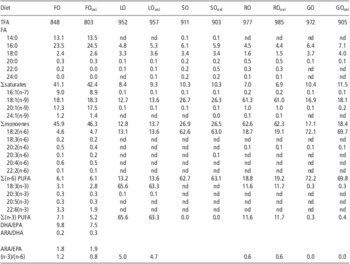
The total dietary FA content (TFA) was slightly lower in FO than in the plant oil-based diets (Table 2). The content of identified FAs and FA classes reflected the origin of the oils (Table 2), with FO containing more FAs than the plant oils. LO contained 66% 18:3n-3, SO and GO contained 63% and 72% 18:2n-6, respectively, whereas RO contained 61% 18:1n-9. FO was the only oil containing n-6 and n-3 highly unsaturated EFAs (LC PUFAs), including 20:4n-6 (arachidonic acid), 20:5n-3 (eicosapentaenoic acid (EPA)) and 22:6n-3 (docosahexaenoic acid (DHA)). The FA composition was almost identical between non-oxidized and force-oxidized diets, but data revealed slightly lower values of 18:3n-3 in the oxidized LO diet and lower values of 18:2n-6 in the oxidized GO diet. The main difference observed was a much lower content of DHA in the force-oxidized FO diet compared with the non-oxidized FO diet, which affected the sum of n-3 PUFAs (Table 2).
TFA content (mg g/dw) and analysed FA composition (% TFA) of non-oxidized and oxidized oils (mean)

TFA = total FA; FA = fatty acid; FO = fish oil; oxi = oxidized oil equivalent; LO = linseed oil; SO = sunflower seed oil; RO = rapeseed oil; GO = grapeseed oil; PUFA = polyunsaturated FA; DHA = docosahexaenoic acid; EPA = eicosapentaenoic acid; ARA = arachidonic acid.
FAs below 0.1% are referred to as non-detected (nd).
Mean values, n = 2.
Digestibility in experiments 1 and 2 (non-oxidized diets)
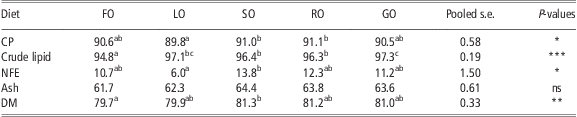
The apparent protein digestibility coefficients of both the RO and SO diets were marginally but significantly higher (P < 0.002) than that of the LO diet (Table 3). The lipid digestibility of all plant oil-based diets was significantly higher (P < 0.007) than the lipid digestibility of the FO-based control diet. In addition, the lipid digestibility of the GO was higher than that of the SO diet (P ⩽ 0.01).
Effects of diets on ADC (%) of protein, lipid, NFE and ash in fish (experiment 1)
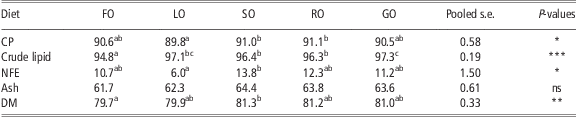
ADC = apparent digestibility coefficients; NFE = nitrogen-free extracts; FO = fish oil; LO = linseed oil; SO = sunflower seed oil; RO = rapeseed oil; GO = grapeseed oil; DM = dry matter
Mean values, n = 6.
ns = non-significant (P > 0.05); *, **, *** refer to significance levels P < 0.05, P < 0.01, P < 0.001.
Values not sharing a common superscript letter abc in a horizontal row are significantly different (P < 0.05).
The digestibility of NFE was low for all diets, presumably because of the high plant concentrate inclusion level (see also Lund et al. Reference Lund, Dalsgaard, Rasmussen, Holm and Jokumsen2011). It was significantly lower for the LO than for the SO diet (P < 0.005). DM digestibility, reflecting the sum of protein, lipid and NFE digestibility values, was significantly higher (P < 0.004) for the SO diet than for the FO diet.
Digestibility in experiment 3 (force-oxidized oil diets)
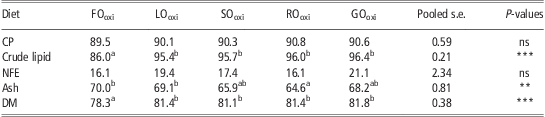
The digestibility coefficients of protein were similar between all diets tested (P > 0.05), whereas the digestibility of lipid was much lower in the FO dietary treatment group than in the four plant oil-based diets (P < 0.001; Table 4). The apparent NFE digestibility coefficients were similar between the tested oil types (P > 0.05), and slightly higher than in experiment 1. DM digestibility was lowest in the FO diet (P < 0.001), consistent with the much lower lipid digestibility for this dietary treatment group. Ash digestibility was lowest for fish on the RO diet as compared with the FO and LO diets (P < 0.01).
Effects of diets on ADC (%) of protein, lipid, NFE and ash in fish (experiment 3)
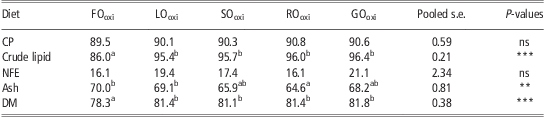
ADC = apparent digestibility coefficients; NFE = nitrogen-free extracts; FO = fish oil; oxi = oxidized oil equivalent; LO = linseed oil; SO = sunflower seed oil; RO = rapeseed oil; GO = grapeseed oil; DM = dry matter.
Mean values, n = 6.
ns = non-significant (P > 0.05); *, **, *** refer to significance levels P < 0.05, P < 0.01, P < 0.001.
Values not sharing a common superscript letter abc in a horizontal row are significantly different (P < 0.05).
Fish performance (experiments 1 to 3) and dressing percentage (experiment 2)
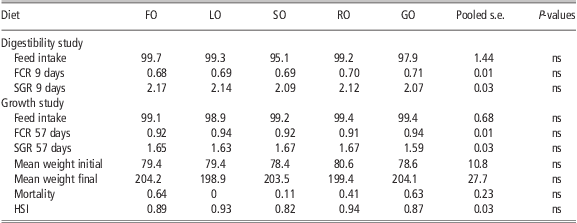
All dietary groups of fish consumed on average >97.8% of the offered feed in both experiments 1 and 2 with no significant differences (Table 5), whereas in experiment 3 the feed intake varied to some extent between dietary treatments (Table 6). Hence, between 17% and 30% of the feed offered was either not ingested or was rejected, but the differences between dietary treatment groups were not statistically significant (P = 0.154). The average feed intake was much lower in experiment 3 than in experiment 1 (i.e. 24%), but a further comparison was not possible because of differences in fish size and feeding level.
Effects of diets on feed intake (% of offered feed), FCR and SGR (%/day) in fish shown for digestibility study (experiment 1) and growth study (experiment 2)
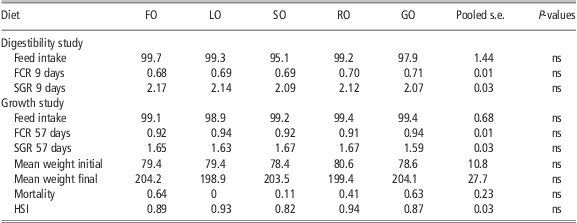
FCR = feed conversion ratio; SGR = specific growth rate; FO = fish oil; LO = linseed oil; SO = sunflower seed oil; RO = rapeseed oil; GO = grapeseed oil; HSI = hepatosomatic index.
Mean initial and final weight (g/fish), total mortality (% final biomass) and HSI (% BW) are presented for each diet in growth study.
Mean values, n = 3.
ns = non-significant (P > 0.05).
Effects of diets on feed intake (% of offered feed), FCR and SGR in fish shown for digestibility experiment using oxidized diets (experiment 3)

FCR = feed conversion ratio; SGR = specific growth rate; FO = fish oil; LO = linseed oil; SO = sunflower seed oil; RO = rapeseed oil; GO = grapeseed oil.
Mean values, n = 3.
ns = non-significant (P > 0.05).
Growth rate was higher and FCR was lower in experiment 1 than experiment 3 most likely related to the use of different batches of fish and size differences. There were no differences in SGR or FCR between treatments in the digestibility studies (experiments 1 and 3) or in the growth study (experiment 2; P ⩾ 0.05; Tables 5 and 6). Dressing percentage (% BW) was similar in all groups of fish sampled at the end of the growth study (i.e. from 12.9 ± 1.2% to 14.2 ± 2.1%, data not shown). Similarly, there were no significant differences (P = 0.07) in HSI between treatments (Table 5).
Antioxidants and auto-oxidation (experiment 3)
The content of tocopherol (α,β, γ, δ) was highest in the RO diet, followed by the SO-, LO-, GO- and FO-based diets (i.e. only oxidized diets analysed; Table 7). The content of ethoxyquin was relatively higher in the FO diet than in the RO diet and tended to be higher than in the other partly plant-based diets consistent with the fact that ethoxyquin is conventionally added to fishmeal and FO after processing (Table 7). The main effects of dietary oil source and oxidation could not be properly interpreted because of interactions between the two factors. However, storing the plant oils for 7 months and force-oxidizing them for 5 days seemed to have only minor effects on oil oxidation levels. Hence, each organic plant oil-based diet showed no or very minor signs of oxidation, as illustrated by almost similar p-AnV and POV values before and after oxidation (Table 7). The FO-based diet was moderately affected by storage and force-oxidation of the FO, as indicated by higher POV, p-AnV and FFA values than before storage and oxidation (Table 7).
Analytical content of (αβγδ) tocopherol (μg/g); ethoxyquin (ppm); POV (meq O2/kg oil), p-AnV (absorbance units/g of oil) and FFA (%) in non-oxidized and oxidized diets

POV = peroxide value; p-AnV = p-anisidine value; FFA = free fatty acids; FO = fish oil; LO = linseed oil; SO = sunflower oil; RO = rapeseed oil; GO = grapeseed oil; oxi = oxidized oil equivalent.
1Analysed for oxidized diets only.
Mean values, n = 2.
ns = non-significant (P > 0.05). *, **, *** refer to significance levels P < 0.05, P < 0.01, P < 0.001.
Mean values not sharing a common superscript letter abc in a horizontal row are significantly different (P < 0.05).
Discussion
Growth and digestibility
The growth results are in accordance with several previous studies finding no effects on growth or feed utilization of rainbow trout or Atlantic salmon (Salmo salar) when partly or completely substituting FO with non-organic vegetable oils such as rapeseed oil, LO or SO (Bransden et al., Reference Bransden, Carter and Nichols2003; Bell et al., Reference Bell, Henderson, Tocher and Sargent2004; Petterson et al., Reference Petterson, Johnsson, Brännäs and Pickova2009). To our knowledge, substituting FO with GO in diets for salmonids has not been reported previously.
The improved lipid digestibility of the tested organic vegetable oils as compared with FO may have been too marginal (i.e. 1.5% to 2.5%) to support a measurable effect on growth in the growth study or masked by the formulation of diets optimal in dietary protein content. Dietary methionine level was slightly lower than recommended for rainbow trout (Lund et al., Reference Lund, Dalsgaard, Rasmussen, Holm and Jokumsen2011), which may also negatively have affected additional protein synthesis and growth in diets with an improved lipid digestibility. Metabolic energy expenditures in fish may increase by elongating and desaturating 18 carbon n-3 and n-6 PUFAs from plant oils to long-chain LC PUFAs such as EPA and DHA (Geurden et al., Reference Geurden, Cuvier, Gondouin, Olsen, Ruohonen, Kaushik and Boujard2005). However, levels of EPA and DHA in diets fed on plant oils were probably sufficient to sustain physiological requirements in fish, as only part of the fishmeal (i.e. with a content of 8% to 10% FO) was substituted by plant protein meals. Long-term performance studies have shown that high dietary inclusion levels of vegetable oils may negatively affect growth and feed utilization because of accumulation of lipid droplets in intestinal cells and hepatocytes (Caballero et al., Reference Caballero, Obach, Rosenlund, Montero, Gisvold and Izquierdo2002). Data on SGR and FCR, as well as dressing percentage and HSI, were similar between dietary treatment groups in the present growth study, suggesting no such accumulation or differences in lipid deposition and utilization efficiency.
The lipid class and FA composition of the organic plant oils were all within the range previously reported. The apparent lipid digestibility of all vegetable oils was surprisingly similar while taking into account that lipid or FA digestibility may relate to the origin of oils and their chemical and physical properties. The degree of unsaturation, chain length or melting points may thus affect digestive processes (Caballero et al., Reference Caballero, Obach, Rosenlund, Montero, Gisvold and Izquierdo2002; Ng et al., Reference Ng, Sigholt and Bell2004), and different FAs may compete for the same transport mechanism in case of protein-mediated transport (Geurden et al., Reference Geurden, Jutfelt, Olsen and Sundall2009). High levels of saturated FA may negatively affect the formation of micelles in the intestinal lumen and hence reduce the FA uptake by enterocytes (Menoyo et al., Reference Menoyo, Lopez-Bote, Bautista and Obach2003). As saturated FA in the FO diet comprised ∼41% of TFA, far higher than the 7% to 10% in the vegetable oil-based diets, this may potentially explain the relatively lower FO lipid digestibility.
The low NFE digestibility coefficients in experiments 1 and 3 reflected the high anti-nutritional content in the supplemented plant protein concentrates, which has been previously discussed and reported (Lund et al., Reference Lund, Dalsgaard, Rasmussen, Holm and Jokumsen2011).
Oxidation of lipids, feed intake and digestibility
Feed intake of the oxidized feed types was lower than that for the comparable non-oxidized feed types, but direct comparison was hampered by the use of larger size fish from another batch. The feed intake was not affected by dietary lipid type or by lipid oxidation, as the moderately oxidized FO diet was accepted similarly to the plant oil-based diets for which oxidation had limited effect. The effect of oxidization of residual lipids in fishmeal on feed intake by rainbow trout has been examined in a previous study, where fresh fishmeal was packed in bags with air and stored at 21°C for 52 weeks before incorporating it into the feed (Jacobsen et al., Reference Jacobsen, Lund, Birk and Kristensen1995). Feed rancidity caused the fish to reject a significantly higher amount of administered feed (28.6 ± 5.2%) compared with fish fed a diet with non-oxidized fishmeal (11.0 ± 3.9%). POVs were 4 times higher in the referred study and the levels of free FAs were 1.6 times higher than the results obtained for the FO-based diet in the present study. Differences in methods may explain these results, as FO was stored and oxidized separately from fishmeal in the present study. A combination of lower freshness of the fishmeal and higher levels of total volatile nitrogen, combined with the fact that auto-oxidation and secondary oxidation products may react with amino acids of the fishmeal protein causing a reduction in the nutritive quality (Laohabanjong et al., Reference Laohabanjong, Tantikitti, Benjakul, Supamattaya and Boonyaratpalin2009), may further have affected palatability negatively in the study by Jacobsen et al. (Reference Jacobsen, Lund, Birk and Kristensen1995).
In the present study, auto-oxidation values of the plant oils were only slightly affected by storage for 7 months and subsequent force-oxidization for 5 days, explaining why lipid digestibility seemed not affected. In comparison, lipid digestibility of FO decreased significantly, indicating a potential deterioration of FO quality by mild auto-oxidation. The marked decrease in DHA content of the oxidized FO diet may suggest that oxidation caused a transition of n-3 LC PUFAs to other less polyunsaturated derivatives, but changes probably too small to be demonstrated. The decline in the content of DHA in the oxidized FO compared with the lack of changes in the content of less unsaturated plant oil FAs are in accordance with previous findings, showing that LC PUFAs are more susceptible to oxidation than less unsaturated FAs because of their chemical structure (Tyl et al., Reference Tyl, Brecker and Wagner2008; Sun-Waterhouse et al., Reference Sun-Waterhouse, Zhou, Miskelly, Wibisono and Wadhwa2011). Thus, oxidized LC PUFAs will result in metabolites with lower unsaturation index and a diminished nutritional value, likely as part of explanation for the negative effect on lipid digestibility.
Previous studies have thus shown that n-3 LC PUFA levels in FOs decreased following oxidation (Børsting et al., Reference Børsting, Engberg, Jakobsen, Jensen and Andersen1994; Koshio et al., Reference Koshio, Ackmann and Lall1994). In the present FO diet, DHA was the only LC PUFA to show this decline. Thus, data indicated that measurement of changes in FA composition may be a less sensitive way of assessing oxidative deterioration compared with POV, which is in accordance with that previously suggested (Shahidi and Wanasundara, Reference Shahidi and Wanasundara2002).
The resistance of organic plant oils to auto-oxidation may be explained by the lack of LC PUFAs, as well as the fact that plant oils are known to contain high levels of natural antioxidants such as tocopherol (E vitamin) and phenols protecting the oils. Consistent with this, higher levels of tocopherol were found in the plant-based diets (especially RO and SO) comparable to the FO diet. Various antioxidants are used in the food industry, as well as supplemented in manufacturing of fishmeal and FO and may be added to prolong oxidative stability, and are often chemically synthesized (Singh et al., Reference Singh, Marimuthu, de Heluani and Catalan2005; Lutterodt et al., Reference Lutterodt, Slavin, Whent, Turner and Yu2011). Conventional vegetable oils may be heated, solvent-extracted and refined during processing, whereas in contrast organic vegetable oils are extracted by cold pressing, a method that involves no heat or chemical treatment, and hence may retain a high level of natural antioxidants removing the concern of solvent residues (Lutterodt et al., Reference Lutterodt, Slavin, Whent, Turner and Yu2011). Consequently, the incidence of feed rancidity may be substantially reduced by the use of organic plant oils. Feeds in which fishmeal and FOs have been replaced by organic plant protein concentrates and plant oils may therefore be stored for longer time and at higher temperatures while maintaining freshness and palatability as compared with fishmeal and FO-based diets. As a further advantage, natural plant phenolic antioxidants possess diverse consumer health-promoting properties including antioxidant activity and protection against cardiovascular diseases as opposed to health risks by supplementing synthetic antioxidants (Sun-Waterhouse et al., Reference Sun-Waterhouse, Zhou, Miskelly, Wibisono and Wadhwa2011).
In terms of growth performance and utilization of rainbow trout the present studies suggested that the tested organic plant oils are all candidate alternatives to similar non-organic plant oils or to FOs added synthetic antioxidants. The absence of LC PUFAs in plant seed oils, however, necessitates the use of finisher diets with a certain content of LC PUFAs in order to secure a healthy LC PUFA composition in terms of human dietary recommendations (Pickova and Mørkøre, Reference Pickova and Mørkøre2007), and a more balanced n-3/n-6 ratio due to the high n-6 contents of some of the tested oils (e.g. SO and GO). Furthermore, data on the slaughtered fish indicated that the vegetable organic oils had significant effects on filet lipid content, FA composition, texture and sensory quality (see Petersen et al., Reference Petersen, Hyldig, Jacobsen, Baron, Lund, Nielsen and Jokumsen2012).
Conclusion and recommendations
Organic LO, RO, SO or GO may all be potential sustainable alternatives to FO or non-organic plant oils in diets for organic rainbow trout juveniles. The tested plant oils were all very resistant to auto-oxidation, and no deterioration of lipid quality or FA composition was observed, which was probably due to the high content of natural antioxidants. Supplementation of non-organic, synthetic antioxidants may consequently be omitted during diet preparation, which is very promising in terms of use in organic aquaculture. Costs of these organic oils compared with non-organic oils are higher, but future scenarios may include production volume and market demands.
Acknowledgements
This study was funded by the Danish Ministry of Food, Agriculture and Fisheries under the research program: Research in Organic Food and Farming, International Centre for Research in Organic Food Systems (ICROFS), grant number 3304-FOJO-05-35-01.