Introduction
Irish English (IrE) was initially learned as a second language as a result of the successive colonizations of Ireland by speakers of English and Scots dialects that began in the Middle Ages and reached a peak during what is termed ‘The Plantation Period’ of Irish history. The scheme persuaded English and Scottish settlers to colonize the island of Ireland, hailing from urban centres like London as well as more rural areas like Norfolk and Galloway. This intensive colonization process created the possibility that a novel type of English could emerge. This new variety is characterized by: (i) innovative forms; (ii) the incorporation of features drawn from Irish, the indigenous language prior to colonization, and (iii) other characteristics caused by the mixing of Irish with the regional Scots and English vernaculars of the new settlers. Interestingly (and not uncommonly when migratory movements of these kinds arise), modern varieties of IrE still retain this mixed heritage. Moreover, the colonization is preserved culturally – particularly in the north of Ireland – by ethnic divisions between the descendants of the migrant and indigenous populations. Thus, Catholics, who reflect the latter group, celebrate events like ‘St Patrick's Day’ while their Protestant neighbours commemorate ‘The Glorious Twelfth’ each July, celebrating the day in 1690 when King William III's victory at the Battle of the Boyne ensured the ultimate success of the Plantation scheme in which their forefathers participated. The linguistic consequences of this contact permeate all aspects of the speech used within these communities (accent, grammar and vocabulary). Moreover, some of the grammatical features that are the focus of this article have travelled to regions that have been intensively settled by Irish migrants. Hence, these features also have important implications for the study of transported dialects, which has recently become very topical and is the focus of a new strand of research in English variation studies typified by the publication of Hickey (ed. Reference Hickey2004).
The language contact model
The historical language contact sketched above, which Filppula (Reference Filppula, Hickey and Puppel1997: 944) has described as ‘“two-language contact” involving relatively persistent ethnic communities’, creates a well-recognized difficulty with respect to the analysis of any resultant linguistic structure. The key problem lies in determining the extent to which a grammatical structure has (i) been influenced by the indigenous language Irish; (ii) derives from retained features of the English vernaculars spoken by the colonials or (iii) evolved from the second language acquisition process intrinsic to the contact situation itself (cf. Filppula, Reference Filppula1999; Odlin, Reference Odlin1989; Kallen, Reference Kallen and Kallen1997 and Thomason & Kaufman, Reference Thomason and Kaufman1988). With regard to the latter, in isolated, naturalistic settings where the transitional bilingual phase is prolonged, transfer from the native language causes imperfect learning on a community-wide scale so that, as Romaine (Reference Romaine1989) argues:
the target language has innovations forced upon it by the shifting speakers…these features persist in the speech of monolinguals long after a period of active bilingualism has disappeared from the community. This happens especially where there is a homogeneous subgroup living in relative geographic isolation. (Romaine, Reference Romaine1989: 71)
Early treatments of IrE such as Bliss (Reference Bliss1972) emphasized the crucial role played by Irish in the development of the contemporary dialects while later accounts like that of Harris (Reference Harris, Trudgill and Chambers1991) highlighted the importance of diffusion from Early Modern English vernaculars. Indeed, there are other more extreme versions of this ‘retentionist’ position such as that of Lass (Reference Lass1990: 148) who argues that Southern IrE exhibits ‘only marginal contact effects.’ Although Kallen (Reference Kallen and Kallen1997) notes that, apart from Corrigan (Reference Corrigan1993), Filppula (Reference Filppula1993) and Kallen (Reference Kallen1988, Reference Kallen1990), there has been much less research in the IrE context on the effects of transitional bilingualism, he suggests that it may well be a significant line of enquiry as:
the search for at least some of the distinctive features of IrE may lie not in British English or Irish sources (or even in the overlap between the two), but in linguistic universals activated by the language contact process itself. (Kallen, Reference Kallen and Kallen1997: 4)
The remainder of this article explores three grammatical features of contemporary IrE which have been taken in the literature to exemplify the processes outlined here, namely, the so-called ‘After Perfect’, which appears to be a calque on a similar Irish expression; ‘Double Modals’ which are a reflection of earlier forms of English; and aspects of relativization which would seem to reflect neither of these sources but instead appear to be universal in certain respects.
The After Perfect
The After Perfect is also often described as the ‘Hot News’ Perfect on account of the fact that it can be used to describe an event that occurs at a point in time that is temporally very near the moment of speaking but nevertheless refers to an action that is complete. As (1a–d), from various IrE dialectal sources, demonstrate, the structure is formed by combining a form of be with the preposition after and a continuous verb form in (1)
(1)
a. I'm after giving her some custard. [Corrigan (2010: 62)]
b. He's after having a lot of setbacks. [Hickey (2007: 198)]
c. You're after ruinin' me. [Filppula (1999: 90)]
d. Glenn's just after being on to me. [Kallen (1991: 62)]
Kallen (Reference Kallen1990, 1991) has found considerable evidence in contemporary Dublin and the Early Modern IrE corpus of Bliss (Reference Bliss1979) that ‘after covers the range of semantic functions for the perfect as described in languages generally’ (Kallen, Reference Kallen and Cheshire1991: 62) and exemplified in (2a–c) below. Example (2a) is a ‘Universal Perfect’, i.e. the expression reflects a state that persists for an interval of time between the past and the moment of speaking. (2b) is an ‘Existential Perfect’ on account of the fact that it denotes the fact that past events have existed prior to the present time and example (2c) is a ‘Stative Perfect’ which captures the interpretation that a past event still has consequences at the moment of speaking. What is common to all these uses is the high informational value of the statement for the discourse in question and this feature would seem to be prototypical for after-perfects as proposed by Hickey (Reference Hickey and Tristram2000; Reference Hickey2007: 285–9) in (2).
(2)
a. All the week is after being cold. [Kallen (1991: 62)]
b. The traffic is after being fierce. [Kallen (1991: 62)]
c. He's after taking the child up the North. [Kallen (1991: 63)]
The most frequently occurring After Perfects in contemporary corpus data such as that of Corrigan (Reference Corrigan2010), however, appear to be those that categorically encode the ‘Hot News’ notions of recency and completion as (1a–d) do.
As Hickey (Reference Hickey2007: 198–206) notes, there has been considerable debate as to the origin of this contemporary IrE structure in the literature, though the weight of evidence points to a borrowing from Irish structures like those in (3a + b) below cited in Ó Sé (Reference Ó Sé2004: 189) and Ó Corráin (Reference Ó Corráin and Tristram2006: 161) in which forms of the Irish verb for be combine with ar/tar éis Footnote 1 ‘after’ and a continuous form of the verb (example (3))
(3)
a. d'iarraidh a thréada do bhí ar ndul amugha
seeking his flock that were after going astray
‘seeking his flock that had (just) gone astray’
b. …agus é tar éis a theacht ó fhionnadh mairt
and him after coming from flaying (a) cow
‘and he (just) coming from flaying a cow’
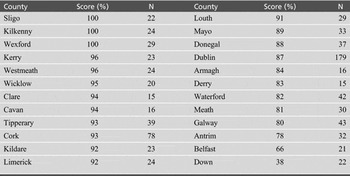
The After Perfect is recorded in IrE from the end of the seventeenth century onwards. Bliss (Reference Bliss1979) and more recently McCafferty (Reference McCafferty2004, Reference McCafferty2005) both demonstrate that these early attestations appear to incorporate both past as well as future reference (a semantic interpretation which its equivalent in earlier Irish also possessed according to Ó Corráin, Reference Ó Corráin and Tristram2006: 154–6 and Tristram, Reference Tristram, Penttilä and Paulasto2009: 113). There appear to be no regional differences with respect to variation in the structure of the After Perfect in contemporary IrE varieties, though social differences can be discerned in terms of the frequency with which certain strata of society use the feature and there is evidence in Hickey (Reference Hickey2007: 207) reproduced in Table 1 below that there are regional differences too. Thus, the lowest acceptance rates in a survey seeking acceptability ratings for She's after spilling the milk were all in Ulster and this was particularly marked in those areas of east Ulster (Antrim, Belfast and Down) which were predominantly settled by Scottish rather than English migrants during the Plantation period.
Acceptance rates for She's after spilling the milk

Double modals
The combining of two modals within the same verb phrase as in the Northern Irish-English example (4a) below cited in Montgomery and Nagle (Reference Montgomery and Nagle1993: 103) demonstrates the kind of IrE feature which is clearly inherited from the colonial varieties brought to Ireland in the Early Modern period. Irish does not have ‘double’ modals in this fashion. Indeed, Hickey (Reference Hickey, Penttilä and Paulasto2009: 263) confirms that ‘it does not have a group of formally identifiable modal verbs.’ Denison (Reference Denison, Fischer, Rosenbach and Stein2000: 113) remarks that double modals are so common in earlier forms of English that the investigation of the phenomenon typified in (4b–d) below from the Middle English period onwards has become ‘a much-tilled field’ of scholarship.
(4)
a. We don't have that, but you might could find that across the street
‘We don't have that, but you might be able to find that across the street’
b. (c1180) Orm. 2958 … . Đatt I shall cunnenn cwemenn Godd
that I shall have-ability please God
‘… . that I shall have the ability to please God’
c. (c1463) Paston 66.16 … . I chal not conne answere him
I shall not have-ability answer him
‘….I shall not be able to answer him’
d. (1532) Cranmer. Let. In Misc. Writ. (Parker Soc.) II.233
I fear that the emperor will depart thence. Before my letters shall may come unto your grace's hands.
Although the Double Modal appears to have been a widespread feature of all regional Englishes in the Middle Ages, it seems to have become confined to Northern and Scottish varieties by the time the Plantation of Ireland was in full swing. Consequently, only those regions of Ireland where large numbers of Scottish and Northern English migrants settled appear to have retained the feature today.Footnote 2 Thus, it has been claimed to be extant only in the Ulster Scots areas of Counties Down and Antrim which were noted earlier as communities that disfavoured the After Perfect (see Corrigan, Reference Corrigan2000a; Hickey, Reference Hickey, Penttilä and Paulasto2009; Mishoe and Montgomery, 1992; Montgomery and Nagle, Reference Montgomery and Nagle1993). As (5a–c) demonstrate, the feature is also still retained in those dialect areas of Northern England and Scotland that provided immigrant groups for the plantation of East Ulster (see Montgomery and Nagle, Reference Montgomery and Nagle1993; Nagle, Reference Nagle1993).
(5)
a. He should can go tomorrow
He ought to be able to go tomorrow
[Scottish English: Brown (1991: 74)]
b. He wouldn't could have worked, even if you had asked him
He wouldn't have been able to work even if you had asked him
[Tyneside English: cited in McDonald (1981: 186)]
c. Theaw must ’ave for t’ be clever for t' go to t' university
You have to be clever in order to go to university
[Bolton English: cited in Shorrocks (1999: 193)]
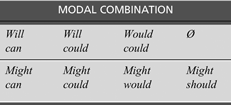
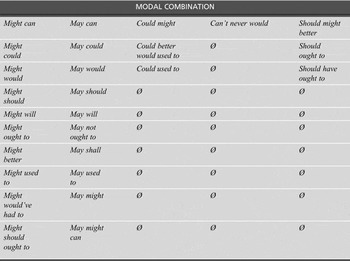
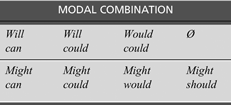
The subsequent emigration to North America of large numbers of the inhabitants of these counties as ‘Scotch-Irish’ in the eighteenth century was a key factor in the transportation of the Double Modal feature beyond Ireland in particular and the British Isles more generally (Corrigan, Reference Corrigan2010: 123–4 and Fitzgerald and Lambkin, Reference Fitzgerald and Lambkin2008: 274–6). Indeed, as a comparison of Tables (2a) and (2b) suggest, the possible orderings of modals permitted in British Isles and North American varieties (Appalachian English) is quite different, with the former being considerably more conservative than the latter with respect to their inventories of combinations (see Beal, Reference Beal, Milroy and Milroy1993; McDonald and Beal, Reference McDonald and Beal1987; Brown, Reference Brown, Trudgill and Chambers1991; Fennell and Butters, Reference Fennell, Butters and Schneider1996; McDonald, Reference McDonald1981; Mishoe and Montgomery, 1992; Montgomery and Nagle Reference Montgomery and Nagle1993).
Inventory of modal combinations in northern English and Scottish dialects.
Inventory of modal combinations in Appalachian English.

At the simplest level, the greatest difference between Tables (2a) and (2b) is the far higher number of combinations attested in North America than in Britain. There is also the fact that might could is common to and frequent in all observed regional varieties that permit serial modality. There are, however, more subtle differences too of the kind which Barbiers (Reference Barbiers, Cornips and Corrigan2005) has recently reported for modals in dialects of Dutch. For instance, in the British Isles, the order will can is most frequent. In North America, by contrast this combination is not well attested and, instead, might could, might can, used to could and might would are the four combinations most frequently noted in observational and elicitation studies of the phenomenon. In all varieties, can and could most often occupy the second modal position. In North America, the first slot is usually restricted to might and may while in the British Isles the second slot is even more frequently filled by can and could.
There are also differences between the two regions with respect to the ordering of modals in negative and interrogative contexts suggesting perhaps more deep seated and interesting variation between the systems of these two kinds of English. In negative contexts with narrow scope, for example, the marker not and its equivalents (no, nae) usually follow the first modal in British Isles varieties (6a), but they can also float towards the main verb (6b) or cliticize (become attached) to the first modal (6c) (example (6))
(6) a. He might no could have done it
He might not have been able to do it
[Scots English: cited in Brown (1991: 98)]
b. He might could no have done it
He might not have been able to do it
[Scots English: cited in Brown (1991: 98)]
c. He mightnae could have done it
He might not have been able to do it
[Scots English: cited in Brown (1991: 98)]
However, in North America, either the first modal (7a), the second modal (7b), or, less frequently, both modals (7c) may be negated. Moreover, as (7a) demonstrates, the negative not is normally uncontracted after the first modal but it is normally cliticized when it occurs after the second as in (7b + c):
(7)
a. She might not should leave by five
She might not have to leave by five
[US English: cited in Montgomery & Nagle (1993: 97)]
b. She might should'nt leave by five
She might not have to leave by five
[US English: cited in Montgomery & Nagle (1993: 97)]
c. She might not should'nt leave by five
She might not have to leave by five
[US English: cited in Montgomery & Nagle (1993: 97)]
As far as the Ulster Scots Double Modal structure is concerned then, it is a good exemplar of a retentionist feature in the sense of Lass (Reference Lass1990: 148). It is most unlikely to have been a case of structural transfer from Irish as there are no parallels. There are, however, numerous congruencies between the usage of this construction at exactly the right time and place in Northern Britain for the feature to have been brought over during the plantation of Ulster. Moreover, the Double Modal phenomenon provides an interesting demonstration of the extent to which structures can innovate when transported to communities in which new varieties have the opportunity to develop (Hickey, Reference Hickey2004: 51).Footnote 3
Relative clause formation
Although relative clauses in other vernacular Englishes can be marked by at, as, what, these are generally not reported to be productive in any contemporary variety of Irish English except Ulster Scots which only has at (8a) (Filppula Reference Filppula1999: 185, Reference Filppula, Kortmann, Schneider, Burridge, Mesthrie and Upton2004: 84; Hickey Reference Hickey2007: 260; Montgomery Reference Montgomery2006: 305–6; Robinson Reference Robinson2007: 104–5). Instead, as Corrigan (Reference Corrigan2010: 70–3) notes, relative marking is principally achieved using zero (8b) alongside TH- forms like that (8c) and WH- pronouns such as who (8d). There are also two additional strategies, namely, resumptive pronoun marking as in (8e) where she here acts like a relative pronoun referring back to cousin and a construction known as ‘Subordinating And’ (a transfer feature from Irish) in which and has a subordinating rather than co-ordinating function. Thus (8f), given the context in which it occurs, should be glossed as You'll see a wee clock in the window whichis still going.
(8)
a. The girl at saw me [Adapted from Montgomery 2006: 306]
b. MD …because of all the paedophilia ø went on in the church.
c. AB …most of the working class that lived on the street was like that.
d. AE there was a very domineering lady on it who called herself ‘a Professor’.
e. CMcG I've a cousin ø a nurse, she lives in Ederney.
f. You'll see a wee clock in the window and it goin' yet
All of the research to date notes that, in line with the situation cross-dialectally in the vernacular anglophone world, WH-forms are the least favoured strategy in all varieties of Irish English. There are, however, interesting local differences suggesting that the distribution of the marking in (8a–f) is constrained by both social and linguistic factors.
Corrigan (Reference Corrigan, Filppula, Klemola and Paulasto2009) has explored the origins of relative marking strategies in dialects of Irish English, arguing that zero, WH- and TH- forms have an origin in the input varieties of English rather than in Irish. The Resumptive Pronoun (RP) strategy as well as the ‘Subordinating And’ type exemplified in (8e + f), which are generally used in more complex relative clauses where zero is dispreferred, have certain parallels in both Irish and earlier forms of English (Corrigan, Reference Corrigan and Tristram2000b). Hence, (9a + b) cited in Filppula (Reference Filppula1999: 189–90) illustrate the fact that a comparable resumptive pronoun strategy is obligatory in Irish:
(9)
a. An feari a raibh mé ag caint leisi
the man REL was me talking (RP)with + him
‘The man who I was talking to’
b. *an fear a bhí mé ag caint le
the man RE was me talking with
Similarly, Irish uses its equivalent of ‘and’, namely, agus, in a relativizing function as (10) from Ó Siadhail (Reference Ó Siadhail1989: 197) indicates:
(10) Bhí bean ann agus í ag coladh
was woman there and her sleeping
‘A woman who was sleeping was there’
In addition it should be mentioned that examples like (8e) and (9a) in particular are also known in non-Celtic influenced Englishes like South African varieties (Hickey, Reference Hickey and Tristram2006 and Mesthrie, Reference Mesthrie1992). Moreover, as the French example in (11a) and the Brazilian Portuguese (11b) illustrate, the IrE constructions are replicated cross-linguistically. Corrigan (Reference Corrigan, Filppula, Klemola and Paulasto2009) demonstrates that such constructions are governed by identical general principles relating to issues of syntactic complexity. Hence, when the noun to be relativized is not a subject but is an object or genitive, then these strategies are more likely to be invoked. As such, this would seem to be an excellent candidate for a construction that is subject to linguistic universals in the sense of Kallen (Reference Kallen and Kallen1997: 4) rather than one which has been either calqued on Gaelic or owes its origins directly to Englishes of the Plantation period.
(11)
a. voici l'hommei que Marie luii a parlé
here is the man that Marie (RP)to-him talk.Past Part.
‘here is the man that Marie has talked to’ [Zribi-Hertz (Reference Zribi-Hertz1984: 27)]
b. Vocé acredita que um dia teve mulheri que elai
you believe that one day there-was a woman who (RP)her
queria que a gente entrevistasse ela pelo interfone
wanted that to interview herthrough the intercom
‘You believe that one day there was a woman that she wanted us to interview her through the intercom’ [Tarallo (Reference Tarallo, Guy, Feagin, Schiffrin and Baugh1996: 205)]
Conclusion
The grammatical systems of English dialects have a common core of features. Hence, there are many aspects of IrE grammar that are not especially unique and which have their origins in earlier forms of English (like the Double Modal) that are simply no longer represented in Modern Standard varieties like those captured in the well-known International Corpus of English-Ireland initiative described in Kallen and Kirk (Reference Kallen, Kirk, Beal, Corrigan and Moisl2007) and at <http://www.qub.ac.uk/sites/ICE-Ireland/>. By contrast, the regional varieties of Ireland also incorporate constructions such as the After Perfect which are unique amongst those dialects of Britain and Ireland which have no Celtic substrate in that they have been borrowed from Irish. IrE also has features like those aspects of its relativizing system outlined here that are replicated in other languages and which appear to be neither retentions nor calques but are engendered instead by universal processes.
 KAREN CORRIGAN is Professor of Linguistics and English Language at Newcastle University and has previously held a Leverhulme Trust Fellowship as well as lectureships at University College, Dublin and the Universities of Edinburgh and York, UK. She is currently Principal Investigator on the Diachronic Electronic Corpus of Tyneside English project (http://research.ncl.ac.uk/decte/). Recent publications include Syntax and Variation (with L. Cornips); Creating and Digitizing Language Corpora, Volumes 1 and 2 (with J. C. Beal and H. L. Moisl) and Irish English, Volume 1: Northern Ireland. Email: k.p.corrigan@ncl.ac.uk