INTRODUCTION
For analyses of (pre)historic materials, analytical chemistry has mainly focused on the study of organic remains such as food residues, medicines, balms, archaeologically found adhesives, and binders or varnishes in paintings. These are complex mixtures originating from ancient recipes and technologies. Later anthropogenic or environmental modifications often hamper the characterization of such samples. The combination of chromatography with mass spectroscopic detection, in particular gas chromatography (GC-MS) and high-performance liquid chromatography (HPLC-MS), provides the most suitable tools for analytical investigations of the said materials (Colombini et al. Reference Colombini and Modugno2009). An example is the detection of specific molecular markers for archaeological subsistence (Evershed Reference Evershed2008). It is a good practice that investigation of such materials should be performed by a multidisciplinary team of experts, taking into account also the historical/archaeological evidence. This is particularly relevant when dealing with the analyses of relics, where questions of authenticity are usually raised.
Here we present and discuss the analytical results obtained by radiocarbon (14C) dating and GC-MS analyses of a relic in the form of several fragments of a sack made of textile that supposedly contained bread sent by St Francesco of Assisi. The textile has been kept in the Franciscan Friary of Folloni near Montella in Southern Italy since the winter of AD 1224 (Guerruccio Reference Guerruccio1741). Fragments of the sack have survived to this day and are still kept as a relic in the friary.
The textile was used as an altar cloth in the friary for the first three centuries after its appearance. During this time, several smaller fragments were cut from it and distributed to various churches and religious institutions in Italy as objects of devotion. Following destruction by an earthquake in 1732 a new friary was built on the site. A new chapel for the sack was erected and the remainder of the textile was immured in order to protect and preserve it. In 1807, during the French oppression, the textile was secured and moved to a safer location in the main church, Santa Maria del Piano, of the nearby village of Montella. When the friars returned to the Folloni Friary in 1817 following the Vienna Conference, they tried to reacquire the textile, but managed to obtain only half of it, which was then immured in the friary. In 1999 the remaining half of the textile was transferred from the Santa Maria del Piano church and is today kept in a reliquary in the newly restored friary (Torino et al. Reference Torino, Boldsen, Tarp, Rasmussen, Skytte, Nielsen, Schiavone, Terrasi, Passariello, Ricci and Lubritto2015).
A sample of the textile has been 14C dated by accelerator mass spectrometry (AMS) to ascertain its historical date. We also used GC-MS to identify any organic materials that may have left their traces on the textile. An identical analytical procedure was applied to two reference textile samples and to two samples of environmental blanks. Ergosterol was detected in the relic, but was absent in the environmental blanks. This compound is indicative of alcohol fermentation by means of yeast, which can in turn be related to the presence of bread (Isaksson et al. Reference Isaksson, Karlsson and Eriksson2010). The detection of ergosterol in itself is not sufficient evidence to irrefutably prove the existence of bread in the sack; however, we present experimental data that further substantiate the versatility of ergosterol as a biomarker for bread. Together with the 14C date this gives credence to the relic indeed being authentic.
EXPERIMENTAL METHODS
Samples and Sample Treatment
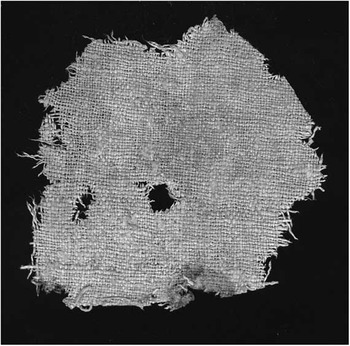
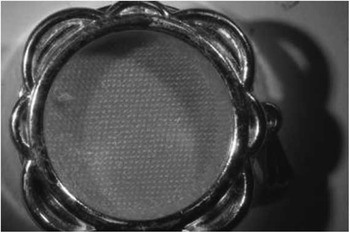
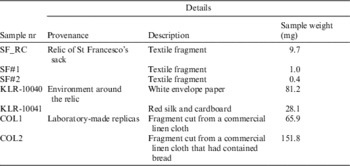
Descriptions of the samples used in our study can be found in Table 1. Three textile samples taken from the relic were provided by Father Agnello Stoia, Guardian of the Montella Friary. One sample was a subsample cut from the large remaining textile (Figure 1), referred to as SF_RC in Table 1. This is the sample that was 14C dated. Two other samples (SF#1 and SF#2 in Table 1) had previously been cut from the textile and stored ever since in a gold medallion (Figure 2) and in a paper envelope, respectively. Samples of the paper envelope and the interior textile mounting of the medallion can be considered environmental samples and were taken in order to assess any possible environmental contamination (samples KLR-10040 and KLR-10041, respectively).
The large piece of the sack of Saint Francesco of Assisi that was kept at the Franciscan friary in Folloni, Montella, southern Italy (photo by A Stoia).

The gold medallion that contained one of the samples analyzed in this study; from the friary in Folloni. The sample from the red textile in the back mounting is termed KLR-10041 (photo by K L Rasmussen).

Sample descriptions.

Two pieces of a sheet of new clean modern linen were used in order to verify the versatility of ergosterol as a biomarker specifically for the past presence of bread. One piece was wrapped around half a loaf of (Italian) bread and left in an otherwise empty drawer for 2 weeks (COL2). The other piece was kept in another empty drawer for 2 weeks (COL1).
Chemical Analysis
The GC-MS instrumentation consists of a 6890N Network GC System (Agilent Technologies, Palo Alto, CA, USA) equipped with a PTV injector and coupled to a 5973 MS detector with quadrupole analyzer.
GC separation was performed on a HP-5MS column (J&W Scientific, Agilent Technologies, stationary phase 5% phenil–95% methylpolysiloxane, 30 m length, 0.25 mm inner diameter, 0.25 μm film thickness) connected to a deactivated fused silica pre-column (J&W Scientific, Agilent Technologies, 2 m length, 0.32 mm inner diameter). The PTV injector was used in splitless mode at 300°C and the chromatographic oven was programmed as follows: 80°C for 2 min isothermal, 10°C min–1 up to 200°C, 4 min isothermal, 6°C min–1 up to 280°C, 40 min isothermal; constant He flow 1.2 mL min–1, injector temperature 280°C. The MS parameters were electron impact ionization (EI, 70 eV) in positive mode; ion source temperature 230°C; scan range 50–700 m/z; interface temperature 280°C. Peak assignment was based on a comparison with mass spectra libraries (NIST 1.7, WILEY275) or with literature data.
All the solvents were Carlo Erba (Italy) pesticide analysis grade. Hexadecane and tridecanoic acid, used as internal standards, and N,O-bis(trimethylsilyl)trifluoroacetamide (BSTFA) containing 1% trimethyl-chlorosilane were purchased from Sigma (Italy). All reagents and chemicals were used without any further purification.
The GC-MS sample preparation was performed as follows: after cutting the paper and textile samples in small pieces, 1 mL of a mixture of chloroform and methanol (2:1, v:v) was added and the lipid residues were extracted through sonication (2×15 min). The samples were then centrifuged (3000 rpm, 30 min). The clear extracts were transferred to vials and the solvent evaporated under a gentle flow of nitrogen. The analytes were treated with 20 µL of N,O-bis(trimethylsilyl)trifluoroacetamide containing 10% trimethylchlorosilane in 50 µL of isooctane at 60°C for 30 min in order to produce trimethylsilyl derivatives. 2 µL of the derivatized extracts were analyzed by GC-MS. Experimental blanks were run in parallel with the samples. Hexadecane was used as internal standard for injection (IS1), while tridecanoic acid was used as internal standard for the derivatization (IS2). The same sample preparation was applied to all the samples listed in Table 1.
Radiocarbon Dating
Successful dating depends on the samples being cleaned thoroughly of foreign carbon compounds with a different 14C-content, such as carbonate, humic substances, plant remains, etc. These contaminants must be removed in order to obtain the correct 14C age of the sample itself.
The routine (standardized) treatment of samples is referred to as the AAA treatment (Mook and Streurman Reference Mook and Streurman1983) and consists of the following three steps: (1) with acid (HCl) in order to remove soil carbonate and possibly infiltrated humic acids; (2) with alkali (NaOH) to remove e.g. soil humates; and (3) with acid (HCl) to remove any CO2 absorbed during step (2). Additionally, the samples were cleaned in a Soxhlet type cleaning apparatus, using solvents that dissolve most customary conservation chemicals. This method is described in detail in Bruhn et al. (Reference Bruhn, Duhr, Grootes, Mintrop and Nadeau2001).
After the chemical pretreatment, the samples were combusted and turned into CO2 by an elemental analyzer (EA), coupled on-line with a stable isotope ratio mass spectrometer (IRMS). The EA consists of a combustion tube, a purification furnace, a Cu reduction tube, and a water trap. The pure CO2 is cryogenically trapped for further processing (Aerts-Bijma et al. Reference Aerts-Bijma, van der Plicht and Meijer2001). In addition, the EA/IRMS system enables precise measurements of the δ13C-values, based on 13C/12C ratios measured for the samples.
The CO2 is reduced to graphite by reacting under excess H2 gas, using Fe powder as a catalyst at a temperature of about 600°C. The graphite was pressed into target holders for the ion source of the AMS. The Groningen AMS is based on a 2.5 MV Tandetron manufactured by High Voltage Engineering Europa. The AMS measures the 14C/12C and 13C/12C isotope ratios in the graphite (van der Plicht et al. 2000). These are converted to conventional 14C dates in BP (van der Plicht and Hogg Reference van der Plicht and Hogg2006). These conventional 14C dates are calibrated into calendar dates using the recommended calibration curve IntCal13 (Reimer et al. Reference Reimer, Bard, Bayliss, Beck, Blackwell, Bronk Ramsey, Buck, Cheng, Edwards, Friedrich, Grootes, Guilderson, Haflidason, Hajdas, Hatté, Heaton, Hoffmann, Hogg, Hughen, Kaiser, Kromer, Manning, Niu, Reimer, Richards, Scott, Southon, Staff, Turney and van der Plicht2013).
The analytical background of the total 14C-system (laboratory+AMS) corresponds to ages older than 45,000 BP.
RESULTS AND DISCUSSION
Radiocarbon Dating
The C content was determined to be 41.8%; the δ13C value was measured as –25.58‰ (VPDB). Both numbers are within the expected range of textile samples and are indicative of good quality materials for 14C-dating. There are no signs of any nondetected carbon contamination, not removed by the Soxhlet treatment or the AAA, as has been reported for other samples of similar material by e.g. Rasmussen et al. (Reference Rasmussen, van der Plicht, Doudna, Nielsen, Højrup, Stenby and Pedersen2009).
The result of the 14C dating is 740±35 BP (GrA-53911). Using the IntCal13 calibration curve (Reimer et al. Reference Reimer, Bard, Bayliss, Beck, Blackwell, Bronk Ramsey, Buck, Cheng, Edwards, Friedrich, Grootes, Guilderson, Haflidason, Hajdas, Hatté, Heaton, Hoffmann, Hogg, Hughen, Kaiser, Kromer, Manning, Niu, Reimer, Richards, Scott, Southon, Staff, Turney and van der Plicht2013) this calibrates to 1255–1285 AD (1σ) and 1220–1295 AD (2σ). All dates are rounded to the nearest 5 yr. The 2σ calibrated age range is in temporal accordance with the legend of St Francesco’s sack.
Gas Chromatography-Mass Spectrometry
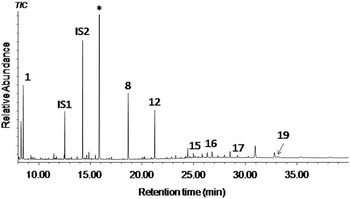
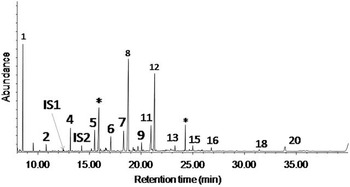
In the GC-MS chromatograms of the two samples of the sack retrieved from the gold medallion and the paper envelope, SF#1 and SF#2, several organic compounds were identified, one of which is ergosterol (5, 7, 22-ergostatrien-3b-ol) (see Table 1 and Figure 3).
Total ion gas chromatogram of one of the samples of the sack SF#2. The peaks are attributed in Table 2. IS1 and IS2 are internal standards added to the run. * are phthalates. Ergosterol is number 19.

Ergosterol has been identified as a potential biomarker for brewing, baking, or agriculture by Isaksson et al. (Reference Isaksson, Karlsson and Eriksson2010), thus the identification of ergosterol in both samples of the sack that were analyzed could point to the past presence of bread in the sack. The other compounds identified are not unexpected for a medieval textile sample. The blank chromatogram only contains the ubiquitous laboratory contamination of phthalates.
Ergosterol is a sterol specific for the fungal kingdom and is encountered in several types of mold. It was therefore important to rule out the presence of sources other than bread for this compound. Therefore, environmental blanks were analyzed. In order to exclude contamination due to burial conditions, soils samples are currently employed as environmental blanks in these kinds of studies. Due to the unavailability of soil/dust samples for the fragments under study, we chose to analyze objects that were in direct contact with the specimens at the time of sampling.
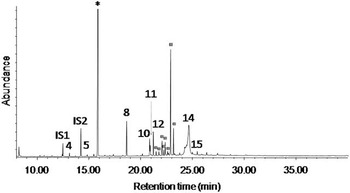
The two environmental blanks were subjected to the same analytical procedure as the target samples and the obtained chromatograms are shown in Figures 4 and 5.
GC-MS total chromatogram of environmental blank sample KLR-10040 of paper envelope.

GC-MS total chromatogram of environmental blank sample KLR-10041 consisting of red silk from the back mounting of the gold medallion. Dots correspond to terpenoid compounds.

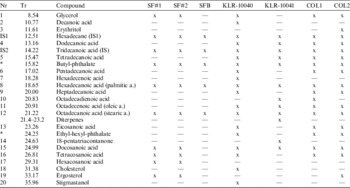
The chromatograms of the two analytical blanks highlighted the presence—as expected—of fatty acids and lipid compounds. In sample KLR-10041 there was found diterpenes typical of Pinaceae resin, they are probably due to the treatments applied to the cardboard backing the red silk. Most important was, however, that ergosterol was absent in both environmental blanks. The compounds identified in each analyzed extract are listed in Table 2. SFB represents the analytical blank (shown in Figure 6 as spectrum nr 1).
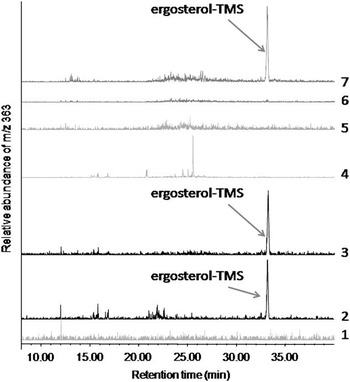
Extracted ion chromatograms of the analyzed samples; m/z 363 was chosen as the most abundant peak in the mass spectrum of ergosterol (see Isaksson et al. Reference Isaksson, Karlsson and Eriksson2010). 1=analytical blank (SFB); 2=SF#1 sample of the sack; 3=SF#2 sample of the sack; 4=KLR-10040 environmental blank paper envelope; 5=environmental blank red textile from gold medallion; 6=COL1 modern linen without contact with bread; 7=COL2 modern linen that was in contact with bread for 2 weeks.

List of compounds identified in the chromatograms of the historical samples, in the blanks (KLR-10040 and KLR-10041) and in the reference materials (COL1 and COL2) by GC-MS analysis. Acids, alcohols, and sterols are detected as their TMS derivatives. Compounds labeled with * are ubiquitous laboratory contaminants.

A comparison of the results obtained for the ergosterol content for all the analyzed samples in this study is shown in Figure 6, where the extracted ion chromatograms referring to m/z=363 are shown.
To further evaluate the feasibility of using ergosterol as a biomarker for bread, suitable laboratory replicas were prepared and analyzed. A more detailed study is ongoing at present, but some preliminary results were obtained on two reference specimens prepared in the lab as described above. No ergosterol was observed in COL1, which was the linen sample without bread; while substantial amounts of ergosterol were identified in COL2, which was the linen wrapped around a loaf of bread, see Figure 6 spectra nrs 6 and 7. These results are consistent with the interpretation of ergosterol as a biomarker for the past presence of bread, although not uniquely conclusive. Further studies are going on in order to deepen this topic.
However, even though the presence of ergosterol has been proved in the textile and the present work has made it more likely that ergosterol can be regarded as a biomarker for the past presence of bread, it does not constitute a proof that the exposure to bread took place in AD 1224. The exposure of the textile to bread could possibly have taken place at other times, the most likely period being the three centuries after 1224, when it served as an altar cloth. Again, it is also possible that the exposure did indeed take place in AD 1224.
CONCLUSIONS
Scientific measurements cannot prove a legend or a belief. What they can do is either de-authenticate the object or show accordance between the physical/chemical evidence and the legend. We have done the latter for the bread sack relic of St Francesco of Assisi. The calibrated 14C date of 1220–1295 (2σ) is in accordance with the legend. Ergosterol was identified in the textile. Further, we have substantiated the use of ergosterol as a biomarker for the past presence of bread. However, we cannot ascertain exactly when the textile was exposed to bread—it could be from the time of St Francesco, but also could be from any of the following three centuries when it was used as an altar cloth. Later exposures are unlikely because the textile has been immured most of the time since then.
We conclude that the sack of St Francesco of Assisi has been authenticated as far as its age and the past presence of bread are concerned. It would be advantageous if the textile sometime in the future were subjected to a technical weave analysis in order to cast further light on the authenticity and possibly its provenance.
ACKNOWLEDGMENTS
We are greatly indebted to Friar Agnello Stoia for providing the samples analyzed in this study and for permission to publish our results.