Introduction
Predation has been considered an important interaction in marine environments throughout Phanerozoic history, and as a key driving force in evolution (Vermeij Reference Vermeij1987). Compared to other mechanisms of predation in benthic communities, such as crushing, suffocation or complete consumption, drilling predation on marine invertebrate shells has a high likelihood of preservation in the fossil record, thereby enabling the study and understanding of biotic interactions in the past. In this sense, drilling predation data (e.g. drilling frequency, failure/success ratio, size of drill holes and site selectivity) from different case studies are increasingly relevant in long-term trend analyses of predator–prey interactions (e.g. Allmon et al. Reference Allmon, Nieh and Norris1990, Huntley & Kowalewski Reference Huntley and Kowalewski2007). Moreover, there have been debates on the nature of the predation intensity gradient. According to Vermeij (Reference Vermeij1987), predation intensity is extremely high in the tropics relative to the Polar Region. To support this theory, more comparisons among data from different latitudinal records of drilling predation is needed. Kelley & Hansen (Reference Kelley and Hansen2007) reported temporal and latitudinal patterns in drilling predation by naticid gastropods, including an increase in drilling with latitude. However, Kelley et al. (Reference Kelley, Thomann, Hansen, Aronson and Blake1997) compared drilling frequency for the upper Eocene age between the US Gulf Coast and Antarctica, and the results do not support the previously observed latitudinal gradients in predation, at least for the Eocene.
It is important to recognize that patterns of predation could be altered by taphonomic processes and lead to misinterpretation of drilling frequency data (Chattopadhyay et al. Reference Chattopadhyay, Rathie, Miller and Baumiller2013 and references therein). To avoid this, a taphonomic analysis of mainly the fragmentation of shells is needed in drilling predation studies (Roy et al. Reference Roy, Miller and Labarbera1994). Most of the studies that focus on this topic evaluate taphonomic effects on bivalve shells; it would be interesting to study these effects on gastropod shells to identify how extensively drilling data is altered by taphonomy.
The fossil record of the drilling predator–prey system involving naticid and muricid gastropods preserves cases of confamilial predation that extend back to the Early Cretaceous (Kelley Reference Kelley1991), and its frequency has increased since (Kelley & Hansen Reference Kelley and Hansen2007). The distinction between both confamilial predation and conspecific cannibalism in Naticidae can be difficult since different species of naticids may make similar drill holes (Kelley Reference Kelley1991). However, it can be achieved using Zlotnik’s data as documented by Chattopadhyay et al. (Reference Chattopadhyay, Sarkar, Dutta and Prasanjit2014). Furthermore, if only one naticid species occurs in an assemblage (or is overwhelmingly dominant) the case for conspecific cannibalism is easier to establish.
Several works on benthic communities on the Antarctic Peninsula during the Eocene have focused on the community structure and how it is affected by climate change (e.g. Ivany et al. Reference Ivany, Lohmann, Hasiuk, Blake, Glass, Aronson and Moody2008 and references therein). Correlating this information with drilling predation registered in molluskan accumulations may be useful. Nagel-Myers et al. (Reference Nagel-Myers, Dietl and Aronson2014) studied cannibalistic drilling in naticids during the Eocene. They identified a tendency to shift to smaller, thinner prey in response to an acclimation to colder environments, reflecting a combination of changes in prey-handling and feeding efficiency (Nagel-Myers et al. Reference Nagel-Myers, Dietl and Aronson2014). However, the study of predation intensity in other naticid species from the Middle Eocene of Antarctica has not been performed until now.
Polinices marambioensis Stilwell & Zinsmeister is a naticid gastropod which is the most common constituent of fossil accumulations in the upper section of the Cucullaea I Allomember (Middle Eocene), La Meseta Formation, James Ross Basin, Antarctic Peninsula. This species was most probably an important predator of infaunal bivalves and gastropods, including other naticids, due to its abundance.
Since cannibalism has been reported in other naticid gastropods, our hypothesis was that this species also displayed cannibalistic behaviour, and its effectiveness as a cannibal was evaluated. Additionally, the pattern of predation on P. marambioensis was assessed using drilling frequency data as a proxy for predation intensity. The effects of preferred prey on cannibalism and on the ontogenetic stage of the predator was also studied.
Geological and palaeontological settings
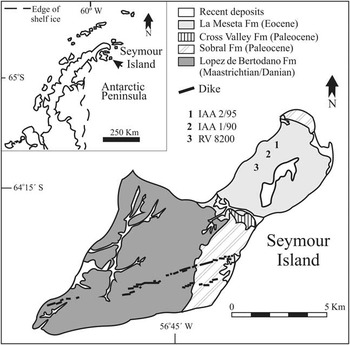
The La Meseta Formation (Eocene) exposed on Seymour Island (Fig. 1) and a small sector of Cockburn Island, located on the northern tip of the Antarctic Peninsula, is the upper part of the filling of James Ross Basin. This unit represents a composite incised valley, filled with nearly 250 m of deltaic, estuarine and shallow-marine deposits (Marenssi Reference Marenssi2006). The formation is known worldwide for its shell beds dominated by molluscs but also containing a unique fauna of Antarctic Palaeogene terrestrial vertebrates that includes mammals (marsupials, edentates and ungulates) and birds (Zinsmeister & Camacho Reference Zinsmeister and Camacho1982, Feldmann & Woodburne Reference Feldmann and Woodburne1988, Stilwell & Zinsmeister Reference Stilwell and Zinsmeister1992, Goin et al. Reference Goin, Case, Woodburne, Vizcaíno and Reguero1999, Hara Reference Hara2001, Taylor et al. Reference Taylor, Casadío and Gordon2008).
Map of Seymour (Marambio) Island showing the study area. 1, 2 and 3 indicate the naticid shell collection sites.

Marenssi et al. (Reference Marenssi, Santillana and Rinaldi1998) subdivided the La Meseta Formation into six allomembers. From bottom to top these are the Valle de las Focas, Acantilados, Campamento, Cucullaea I, Cucullaea II and Submeseta allomembers.
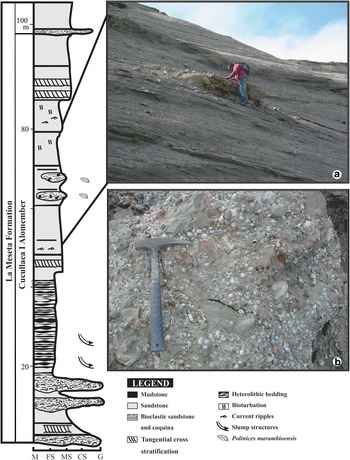
The specimens studied here come from the upper part of the Cucullaea I Allomember (Fig. 2). This unit begins with a shell concentration of several densely to poorly packed and poorly sorted, laterally continuous beds, or lenses ranging from 0.5–1.5 m thick, with sharp undulose and bioturbated bases and sharp tops, and trough cross bedding. The densely packed beds are dominated by the bivalve Cucullaea spp. This concentration represents shells infilling tidal channels in the outermost part of an estuary. Infaunal mollusc assemblages in the inter-channel areas are mostly represented by Cucullaea spp.
Stratigraphical log of La Meseta Formation at the studied section. a. Filled tidal channels mostly with Polinices marambioensis fossil accumulations. b. Detail of the deposit.

The upper part of the Cucullaea I Allomember includes facies of fine sandstone with mudrock intercalations. Flaser, wavy and lenticular bedding are frequent. This facies contains few invertebrate remains. The small grain size and sedimentary structures suggest relatively low energy conditions. The unit was deposited in a sandy to muddy-sandy tidal flat environment. This facies is associated with lenticular beds with erosive bases interpreted as the infilling of small tidal channels. These deposits comprise densely packed shell concentrations dominated by well-preserved specimens of P. marambioensis, suggesting that they were living in the inter-channel areas and they were concentrated in the channels. Other mollusc representatives of the community are Lahillia sp., which are found in very low numbers with high fragmentation, associated with Thalassinoides isp.
The age of the middle part of the La Meseta Formation (Cucullaea I and Cucullaea II allomembers) according to Askin (Reference Askin1997) is Middle Eocene. This age is supported by Dutton et al. (Reference Dutton, Lohmann and Zinsmeister2002) who provided 87Sr/86Sr derived ages of 44.54 or 47.35 Ma for this part of the formation.
Material and methods
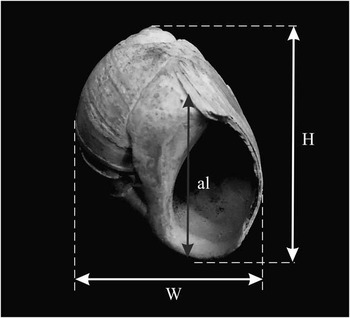
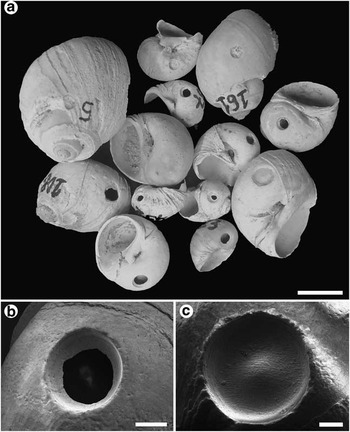
Three samples, almost consolidated, were collected randomly using 0.25 m2 grids from the localities IAA 1/90 (M10; n=1037), IAA 2/95 (M12; n=980) and Rv 8200 (M13; n=631) (Fig. 1). A total of 2648 specimens of P. marambioensis were observed under binocular microscope, and were housed in the Museo Paleontológico Egidio Feruglio (MPEF), Trelew, Argentina. Each specimen was examined for perforations and the borings classified as drill holes made by naticids. For all specimens, linear dimensions were measured using dial callipers (± 0.1 mm): shell height (H) and shell width (W) (Fig. 3). In addition, each drill hole was classified as either i) complete, i.e. drill holes defined as borings that penetrated the shell wall completely and displayed a substantial inner opening, or ii) failed, i.e. drill holes defined as borings that either did not penetrate the shell wall or had very small inner openings as described by Kitchell et al. (Reference Kitchell, Boggs, Rice, Kitchell, Hoffman and Martinell1986) (Fig. 4).
Morphometric measurements of the Polinices marambioensis shells. H=maximum shell height, W=maximum width, al=maximum apertural length.

Drilled shells of Polinices marambioensis. a. An arbitrary selection of specimens with complete and incomplete drill holes. b. Complete drill hole under scanning electron microscope, MPEF-PI 6129.2. c. Incomplete drill hole under scanning electron microscope, MPEF-PI 6129.1.

The recognition of taphonomic bias due to fragmentation is crucial in studies of drilling predation (Roy et al. Reference Roy, Miller and Labarbera1994, Chattopadhyay et al. Reference Chattopadhyay, Rathie, Miller and Baumiller2013). For this reason, and following the recommendations of these authors, this attribute and sedimentary features were registered and analysed.
To evaluate size preference, a correlation was made taking a random subsample (n=227), and using outer borehole diameter (OBD) as a proxy for predator size and length as a proxy for prey size, according to Carriker & Gruber (Reference Carriker and Gruber1999).
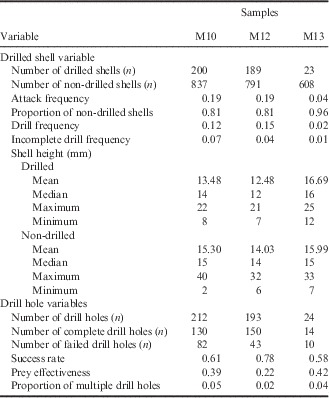
Drill hole and drilled shell variables are shown in Table I. The attack frequency (AF), defined as the proportion of the prey population that is attacked, was calculated as the proportion of drilled shells (complete and incomplete holes) in the sample (Stafford & Leighton Reference Stafford and Leighton2011). Drilling frequency (DF) was calculated by dividing the total number of drilled shells with complete holes by the total number of individuals examined (Kowalewski Reference Kowalewski2002). Incomplete drilling frequency (IDF), considered as a proxy for prey effectiveness (Kelley & Hansen Reference Kelley and Hansen2003), was calculated by dividing the total number of incomplete drill holes by the number of shells examined (Kowalewski Reference Kowalewski2002). The success probability of predation event depends on the prey:predator size ratio (Kelley Reference Kelley1988). For this reason, and to study the role of size selectivity in successful predation, the success rate (SR) was calculated by dividing the number of complete holes by the total number of holes (complete plus failed drill holes) (Kelley Reference Kelley1988). Following Vermeij (Reference Vermeij1987), a relative frequency of failed attacks referred as prey effectiveness (PE) was calculated as the number of incomplete drill holes divided by the total number of attempted drill holes (complete and incomplete). Finally, following Kelley & Hansen (Reference Kelley and Hansen1993) multiples drill holes (MULT) were calculated as the proportion between multiples drill holes and the total borings. According to these authors, this relative frequency represents unsuccessful drilling attempts, due to interruption of the drilling process by physical or biological factors.
A summary of univariate parameters for drill holes in specimens of Polinices marambioensis estimated for each of the three samples.

All statistical analyses were performed using the software Statistica 8.0. and R 3.2.0 (2015).
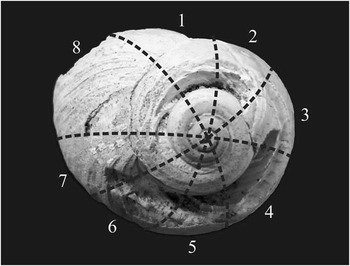
Each drilled shell was divided into eight sectors (i.e. with different areas according to the morphological features of the shell), and perpendicular to the coiling axis following the methodology in Kelley (Reference Kelley1991) (Fig. 5). The position of a drill hole (either complete or incomplete) was considered to calculate the likelihood of being drilled and then the expected frequencies were generated. Sites were not determined for specimens with broken apertures, because accuracy in those cases was limited.
Eight sector grid for determining the position of drill holes in naticid gastropod shells. The area percentages of each sector are: 1: 8%, 2: 1%, 3: 12%, 4: 13%, 5: 14%, 6: 18%, 7: 18%, 8: 7%.

Goodness of fit test and exact confidence intervals for the binomial distribution were performed in order to assess possible preference of predators for different areas of the shells. The null hypothesis was that the distribution of drill holes on shells is at random at the significance level α=0.05.
Results
The analysis of borings using an optical microscope and scanning electron microscope (Fig. 4) allowed the recognition of drilling traces assigned to Oichnus paraboloides Bromley. Taphonomic analysis revealed poor fragmentation in the fossil accumulations and also in the samples. Imbricated grains, aligned shell, or ripple marks, as indicators of hydrodynamic forces, were not observed in the accumulation.
Comparison of specimens between samples
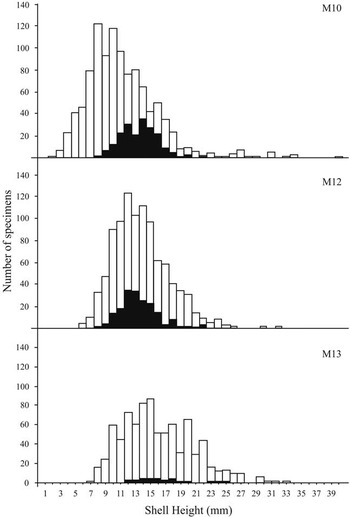
Comparison of the three samples (Table I, Fig. 6) showed a statistically significant variation in central tendency. For shell height, the parametric and non-parametric test results are: i) mean: F=33.005, P<0.000000 (one-way ANOVA), and ii) median: chi-square=102.8401, P<0.0000 (Kruskal-Wallis test). Tukey’s test unequal N, HSD (P<0.05 in all cases), indicating that the shell height are statistically distinguishable among the three samples. As the datasets are statistically distinguishable, analyses were carried out separately for each one.
Size frequency distributions of drilled (solid bars) and undrilled (unfilled bars) specimens of Polinices marambioensis for the three samples.

Drilling frequency
Drilled shell variables and drill hole variables are pooled in Table I. For drilled shells variables, AF was ~20% for M10 and M12, whereas M13 was smaller, <5%. The DF was ~15% for M10 and M12. For all samples IDF was <7%.
For drill hole variables, SR was similar between M10 and M13 (~60%), but higher in M12 (~80%). For all samples, PE reached low values (<42%), and MULT was also quite low (<6%).
Size selectivity and comparison of drilled and undrilled specimens
The size of drilled (complete and failed) and undrilled individuals were compared for each sample. In M10 and M12, both drilled and undrilled shells showed a significant difference in median shell height (M10: drilled=14 mm, undrilled=15 mm, W=103760, P=1.236e-07; M12: drilled=12 mm, undrilled=14 mm, W=93434, P=5.54e-08, Wilcoxon test with normal approximation) and in mean shell height (M10: drilled=13.48 mm, undrilled=15.30 mm, t=7.8834, P=1.679e-14; M12: drilled=12.48, undrilled=14.03, t=6.6952, P=7.331e-11, t-test for unequal variances). In M13, both drilled and undrilled shells showed no statistically significant difference in median shell height (drilled=16 mm, undrilled=15 mm, W=6392, P=0.3302, Wilcoxon test with normal approximation) and in mean shell height (drilled=16.69 mm, undrilled=15.99 mm, t-test for unequal variances). In this case, a lack of a statistically significant difference is probably due to a reduced sample size (see Table I, which includes shell height undrilled and drilled maximum and minimum ranges).
Comparisons were made between specimens with complete drill holes and a significant correlation was found between prey size and OBD for samples M10 and M12 (M10: P<0.01, rs=0.51; M12: P<0.05, rs=0.26, Spearman rank correlation coefficient). The test of correlation for M13 offers very limited statistical power due to a reduced sample size.
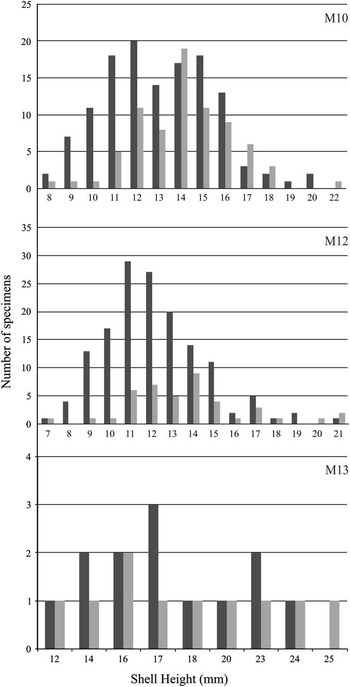
For both M10 and M12 the shell height with failed drilled holes is significantly larger than those successfully drilled (M10: median shell height with a failed drill hole=14 mm, median shell height for successfully drilled=13 mm, W=7312, P=0.0009212; M12: median shell height with a failed drill hole=13.5 mm, median shell height for successfully drilled=12 mm, W=2066, P=0.0009823; Wilcoxon test with normal approximation; M10: mean shell height with a failed drill hole=14.09211 mm, mean shell height for successfully drilled=13.05469 mm, t=-3.4202, P=0.0008311; M12: mean shell height with a failed drill hole=13.66667 mm, mean shell height for successfully drilled=12.13605 mm, t=-3.0798, P=0.003174, t-test for unequal variances). Consequently, failed drill holes are common in shells of larger size and are absent in smaller shells, whereas successful drill holes are frequently present in smaller individuals on samples M10 and M12. However, a trend could not be observed for M13 (see Fig. 7).
Distributions of drill holes (complete indicated by dark grey bars and incomplete by light grey bars) in Polinices marambioensis with respect to prey shell size, plotted separately for the three samples.

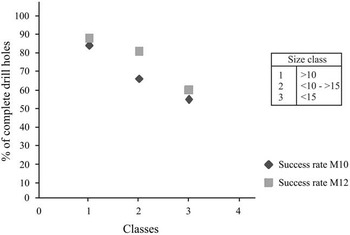
This pattern becomes even more striking when specimens are grouped into size classes and attack SR is evaluated for each size class (Fig. 8). Drilled holes were successful in ~80% of cases for prey with shell height <10 mm. The rate of success drops as shell size increases. For the >15 mm size class, a substantial proportion of incomplete drilled holes (>40%) represent failed attempts.
The success rate of attack estimated by percentage of complete drill holes plotted against prey shell height with data binned into 5 mm intervals. The test of correlation for M13 offers very limited statistical power due to a reduced sample size so it is not included in this analysis.

Site selectivity
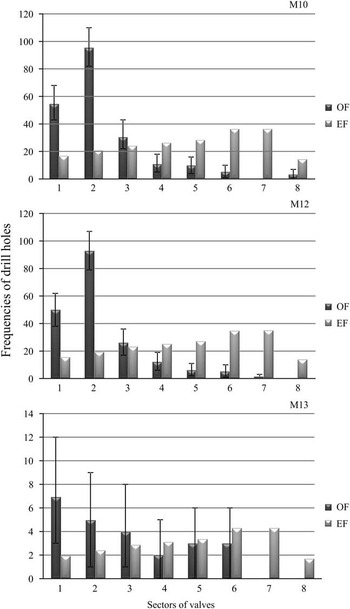
Goodness of fit analysis showed that the distribution of borings on shells is not random (P<0.0000). Drilling holes are located preferentially in sites 1 and 2, except for sample M13 which showed preferential location only for site 1 (Fig. 9). The results were similar upon analysis of the distribution of completed and failed drill holes in the shells.
Differential distribution of frequencies of drill holes in sectors of the shell. Note that there is a significant difference between expected frequencies (EF) and observed frequencies (OF) of drill holes in sites 1 and 2. Error bars represent confidence intervals.

Discussion
The morphology of the drill holes assigned to O. paraboloides is consistent with the features described for this trace such as paraboloid boring, often with a countersunk bevelled edge (Martinell et al. Reference Martinell, Domenech, Aymar and Kowalewski2010). According to these observations, a case of cannibalism is considered in this fossil accumulation.
The poor bioerosion and incrustation observed on the shells indicate that they were buried most of the time after a short post-mortem period, and poor fragmentation (both in the accumulation and in the shells) suggests very low hydrodynamic transport. In assemblages where post-mortem fragmentation is important, there is a preferential loss of the weaker drilled shells, thus significantly biasing the drilling frequencies, and hence, leading to underestimates in predation intensities (Roy et al. Reference Roy, Miller and Labarbera1994). In our study, fragments were rare compared to the unbroken shells, and most shells have intact drill holes. Patterns of drilling predation observed in this study would, therefore, not represent a taphonomically biased record of the original biological signal.
Although the main group of gastropods represented in the accumulation are naticids, Xymene marincovichi Stilwell & Zinsmeister (a muricid) is also present. In some cases, muricids make boring traces resembling those of naticids (Herbert & Dietl Reference Herbert and Dietl2002), but the holes differ in position on the prey shell or in size. This feature could not be recognized in P. marambioensis.
Drilling frequency
The DF allows assessment of predation intensity and PE indicates the relative performance of predator and prey, which are considered to be part of their intrinsic properties (Kelley & Hansen Reference Kelley and Hansen2003). In this case, DF allowed quantification of predation pressure by naticids on naticids.
There are some similarities between our results and those of other studies. Three bivalves species preyed upon by naticids from the upper Eocene of the La Meseta Formation exhibited 6% for DF (Kelley et al. Reference Kelley, Thomann, Hansen, Aronson and Blake1997), while our results are slightly higher (12% and 15% for M10 and M12, respectively). Also our outcomes are similar to those of Taylor (Reference Taylor1970) and Kelley & Hansen (Reference Kelley and Hansen2007) who found DF on naticids of ~10–20%. The higher DF found in this study could be related to a warmer climate registered during Middle Eocene. This idea is supported by Nagel-Myers et al. (Reference Nagel-Myers, Dietl and Aronson2014), who showed evidence of behavioural changes in drilling predation influenced by temperature. On the other hand, is important to notice that our results do not support previously observed latitudinal gradients in predation, in concurrence with Kelley et al. (Reference Kelley, Thomann, Hansen, Aronson and Blake1997).
Attempts to attack defined by AF are ~20% for samples M10 and M12. Kelley & Hansen (Reference Kelley and Hansen2007) obtained comparable findings for AF for samples of the same geological age, with 17.98% (Cook Mountain Fm) and 20% (Gosport Fm). This indicates that the AF on P. marambioensis is somewhat higher than in other naticids of early ages. Thus, these results contribute to the record of increasing cannibalism from the Cretaceous through Palaeogene which indicates an increase in predator capabilities through time as Kelley & Hansen (Reference Kelley and Hansen2007) have asserted.
The PE is 22–39% for M10 and M12, and MULT is very low (2–5%). These frequencies indicate that P. marambioensis seems very efficient as a prey. It is considered that naticids as prey are more difficult to subdue than most bivalve prey because of their greater degree of mobility (Kelley Reference Kelley1991). However, the relatively thin naticid shell can be penetrated more rapidly once the prey has been subdued (Kelley & Hansen Reference Kelley and Hansen2007). The SR showed high values (among 60% and 80%). This is indicative of high effectiveness as a predator.
The IDF showed low values (1–7% for the three samples). The incomplete drill holes might be a result of different causes such as predator inefficiency in the manipulation of the prey, mechanical limits to drilling thick shells or interruption of drilling activity (due to the presence of a second conspecific predator or prey escaping) (Kelley & Hansen Reference Kelley and Hansen2003). Furthermore, competitive interactions with a second predator, including grappling, prey theft and cannibalism, may also be considered (Hutchings & Herbert Reference Hutchings and Herbert2013). Some authors have considered that there are instances where prey can be suffocated after failed attacks (Kowalewski Reference Kowalewski2002, Visaggi et al. Reference Visaggi, Dietl and Kelley2013). But smothering is an alternative mode of naticid predation that may either accompany or occur without drilling of prey according to Visaggi et al. (Reference Visaggi, Dietl and Kelley2013). Furthermore, it was observed that shells with incomplete drill holes are larger than those with complete holes (see Fig. 7). According to Chattopadhyay & Dutta (Reference Chattopadhyay and Dutta2013), prey with larger and thicker shells are more likely to have incomplete holes because of the greater time required to penetrate the shell, which increases the probability of interruption of drilling by physical factors or prey escape behaviours. These authors argued that since incomplete drill holes are non-lethal, the prey is likely to grow after the failed attack, and therefore, the observed size does not represent the size at the time of the attack. In contrast, shell size with a complete drill hole represents the true size of the animal during a lethal attack (Chattopadhyay & Dutta Reference Chattopadhyay and Dutta2013).
Size selectivity
Prey size can affect predation frequency through predator selection of specific size classes (Kitchell et al. Reference Kitchell, Boggs, Rice, Kitchell, Hoffman and Martinell1986, Allmon et al. Reference Allmon, Nieh and Norris1990). In P. marambioensis the range of size preferences could be inferred from the frequency histogram (Fig. 6). The size of drilled shells (complete and incomplete drill holes) differs from the size of undrilled shells. A specific size range of preyed individuals was observed for the three samples (i.e. between 8 and 22 mm in shell height in both successful and failed attacks) (see Fig. 6) with the highest drilling frequencies between 12–14 mm. Also the significant correlation between prey size and OBD supports size selectivity. These outcomes indicate that the studied naticids, behaving as predators, preferred a size range of prey which represent juvenile individuals that are best handled (in the preference range, 11–15 mm of complete drill holes) for M10 and M12 (see Fig. 7), and represent the lowest cost–benefit ratio as Kelley (Reference Kelley1991) asserted. For M13 there was no correlation and a clear tendency cannot be observed in Fig. 7.
The SR of predation (Fig. 8) declines significantly with prey size in the samples. These results agree with those obtained by Martinell et al. (Reference Martinell, Domenech, Aymar and Kowalewski2010), who showed a gradual increase in failure rate as a function of prey shell size, suggesting the presence of a size refuge from attacks by confamilial predators. One possible explanation could be that the prey naticid, once it grows enough, can successfully escape because it is too big and unattainable for the manipulation of foot predator naticid (with enveloping strategies and/or immobilization) (see Kelley Reference Kelley1991, Dietl & Alexander Reference Dietl and Alexander2000). On the other hand, the SR of an attack differs with size of the predator, hence indicative of an ontogenetic improvement in predatory skills (Chattopadhyay & Dutta Reference Chattopadhyay and Dutta2013).
Site selectivity
The sector with the highest incidence of complete and incomplete drill holes was near the umbilical region and the whorl suture (sites 1 and 2). This pattern is related to the way in which the predator manipulates its prey (Pastorino & Ivanov Reference Pastorino and Ivanov1996, Signorelli et al. Reference Signorelli, Pastorino and Griffin2006). In this case the predator’s enveloping foot could counteract more effectively any egress of the prey’s foot, thereby blocking its efforts to dig, burrow, and possibly dislodge a mounted predator (Dietl & Alexander Reference Dietl and Alexander2000). The thicker part of the body whorl and the morphology of the shell also favour site selection (Dietl & Alexander Reference Dietl and Alexander2000) increasing the overall energy gain and SR (Kitchell et al. Reference Kitchell, Boggs, Rice, Kitchell, Hoffman and Martinell1986, Kelley Reference Kelley1988). Naticids are able to select an area near the umbilical region or in the centre, while muricids usually show no preferred site for drilling (Pastorino & Ivanov Reference Pastorino and Ivanov1996). But site selectivity of confamilial predation may be species specific because it could depend on naticid foot length (Das et al. Reference Das, Mondal and Bardhan2013). In modern naticids interspecific variability in foot size occurs even when species have similar body sizes, which might influence prey enveloping and thus site selectivity as a whole (Das et al. Reference Das, Mondal and Bardhan2013).
What leads to cannibalism in Polinices marambioensis?
The factors that control or initiate cannibal behaviour are not completely clear in recent drilling gastropods, so it is even more difficult to determine what they might be in fossil assemblages. However, experimental data support interesting conclusions that could explain some results in the fossil record. For example, predatory behaviours are only observed after gastropods reach a certain ontogenetic stage (Chattopadhyay et al. Reference Chattopadhyay, Sarkar, Dutta and Prasanjit2014). Some experiments have shown that older naticids exhibit a higher propensity for cannibalism compared to the young individuals (Chattopadhyay et al. Reference Chattopadhyay, Sarkar, Dutta and Prasanjit2014). In P. marambioensis, the size range preferably preyed is 12–14 mm which represents young individuals.
In many organisms, cannibalism is associated with a decline in alternative prey (Taylor Reference Taylor1970). During episodes of food limitation, cannibalism may increase because hunger changes the behaviour of predators (Chattopadhyay et al. Reference Chattopadhyay, Sarkar, Dutta and Prasanjit2014). For P. marambioensis, we cannot asseverate this fact, but the low relative abundance of other possible prey in the accumulation could have affected the naticid behaviour. On the other hand, Kelley & Hansen (Reference Kelley and Hansen2007) suggested that cannibalism might not be a ‘last resort’ of starving naticid according to their observations in other assemblages containing cannibalistic naticids with abundant drilled bivalves and other groups of gastropods. But this has been questioned by Das et al. (Reference Das, Mondal and Bardhan2013), who demonstrated the relative importance of hunger in guiding behavioural traits related to nutrient depleted conditions. Further, Stanton & Nelson (Reference Stanton and Nelson1980) argued that cannibalism results from absence of appropriately sized bivalve prey and have considered cannibalism to be anomalous. However, based upon laboratory observations, Kelley (Reference Kelley1991) concluded that cannibalism can be the result of selective predation to maximize energy gain, rather than ineptitude of the predator or absence of prey. Kitchell et al. (Reference Kitchell, Boggs, Rice, Kitchell, Hoffman and Martinell1986) proposed that it may serve as a means of population regulation because it eliminates both potential predators and potential competitors of individual naticids.
Cannibalism undoubtedly shapes the ecological structure in a community. It could be interpreted as a delicate balance between the efficiencies of naticids as predators and prey (Kelley & Hansen Reference Kelley and Hansen2007). This behaviour has been considered to be an evolutional stable strategy that helps to regulate population dynamics (Chattopadhyay et al. Reference Chattopadhyay, Sarkar, Dutta and Prasanjit2014).
Conclusions
The morphology of drill holes allowed assignment to the trace fossil O. paraboloides. It is inferred that this trace was made by the naticid P. marambioensis, which is the main gastropod species represented in the studied shell accumulation. According to this, a case of cannibalism is interpreted.
The predation intensity for P. marambioensis measured using DF data showed that the pattern of cannibalistic behaviour is comparable to other cases of intraspecific cannibalism of naticids from the Eocene. These results contribute to the record of increasing cannibalism from the Cretaceous through Palaeogene which indicates an increase in predator capabilities through time.
The high percentages of successful attacks and PE in P. marambioensis indicated that they are successful in both roles, as a prey and as a predator. Although as a predator it is considered more successful. The size ratio probably determines which gastropod individual in each interaction becomes the predator and which becomes the prey.
Predation SR declined with prey size, showing a gradual increase in failure rate as a function of prey shell size and suggesting the presence of a size refuge.
Polinices marambioensis had a preference for specific size range of preyed individuals (i.e. shell height 11–15 mm) which represents juvenile individuals. This indicates a range of size in which the prey was probably best handled (for complete drill holes) and represents the lowest cost–benefit ratio.
The shell sectors with the highest incidence of complete and incomplete drill holes (sites 1 and 2) provide evidence of selective behaviour for the areas where the shell is thinner to drill combined with the best way to manipulate the prey.
In conclusion, cannibalistic behaviour in these accumulations could be caused by many possible reasons (e.g. hunger guiding behavioural traits related to nutrient depleted conditions, absence of appropriately sized bivalve prey or a lack of bivalve prey, selective predation to maximize energy gain, among others). Polinices marambioensis is an efficient cannibalistic predator. As prey it shows size refuges, with attacks being unsuccessful or mostly lacking in very small and very large shell sizes due to a higher cost–benefit ratio, which would make them less attractive to drill. This selective cannibalistic prey behaviour registered in P. marambioensis affected not only the dynamics of their populations but the ecological structure of the community in which they lived.
Acknowledgements
We thank P.D. Taylor and C.E. Schweitzer for their constructive comments and suggestions, and also we are grateful for corrections and recommendations of the reviewers, P. Kelley and D. Chattopadhyay, which improved the final version of this paper. This study has been supported by projects granted by Universidad Nacional de Río Negro, Universidad Nacional de La Pampa, CONICET, Instituto Antártico Argentino and Agencia Nacional de Promoción Científica y Tecnológica.
Author contribution
S.B. and N.C. performed the comparative and analytical work, statistical analysis, wrote and edited the paper. D.M.S. collected the data. S.C. collected the data, wrote the paper and supervised the project. All authors discussed the results and commented on the manuscript.