Human rights treaties are frequently described as embodying new norms in international law, sometimes characterized as “emerging” norms. Yet “emerging” is a word that obscures as much as it reveals: from what exactly, do these norms emerge? How do norms with no previous expression in the international system become institutionalized? One way, we argue, is through the actions of strategically placed individuals who embed new norms in international law.
We explore these questions with what is perhaps one of the most puzzling of the human rights treaties, the Convention on the Elimination of All Forms of Discrimination Against Women (CEDAW). Despite demonstrable success in improving the political and social rights of women (Cole Reference Cole2013; Gray, Kittilson, and Sandholtz Reference Gray, Kittilson and Sandholtz2006; Hill Reference Hill2010; Englehart and Miller Reference Englehart and Miller2014), CEDAW is hard to explain. The treaty advances norms of gender equality through international law despite the fact that such norms neither serve the interests of any state nor represent the social values dominant in any state. CEDAW requires states to instantiate such norms domestically, ranging from eliminating all gender-based stereotypes in society to guaranteeing equal pay for equal work and ending gender-based discrimination in the public and private spheres.
International relations theory is not terribly helpful in explaining the emergence of CEDAW. It is difficult to see how realists could argue that a state improves its security by ratifying a treaty mandating equal treatment for women. Similarly, liberals would be hard-pressed to explain how CEDAW is the product of democratic political institutions when only two countries, Rwanda and Bolivia, have achieved gender parity in the lower house of their national legislatures (Inter-Parliamentary Union, 2018). CEDAW furthermore mandates a program of radical social change, requiring states to make progress toward a vision of women's rights which, arguably, is alien to every country in the world. For this reason, it cannot reasonably be described as expressing the identity of any state, as understood in constructivist theory. The English School's concept of solidarism is equally problematic because international society clearly had no pre-existing norm of gender equality as expressed in the treaty.
The problem encountered by each theory of international relations in explaining CEDAW is their insistence on states and the international system as the only relevant levels of analysis. Each ignores Waltz' (Reference Waltz1954) “first image” of international relations (i.e., the individual level) in favor of the second and third images (i.e., the domestic politics of states and structure of the international system). As such, they miss the impact of individuals whose efforts and influence reach across borders and may move states and the state systems in new directions.
Haas (Reference Haas1990) shows, for instance, how networks of scientific experts influenced environmental treaties governing the Mediterranean. Keck and Sikkink (Reference Keck and Sikkink1998) demonstrate how transnational activist networks influence the development of international norms. Finnemore (Reference Finnemore2003) shows how strategically placed individuals affect the justifications considered legitimate for intervention in other states. A new wave of research on diplomacy similarly emphasizes social interaction among small groups of diplomats (e.g., Hathaway and Shapiro Reference Hathaway and Shapiro2017; Mösslang and Riotte Reference Mösslang and Riotte2008; Neumann Reference Neumann2012; Sending, Pouliot, and Neumann Reference Sending, Pouliot and Neumann2015). Such studies suggest that social interactions between strategically placed individuals can create new transnational structures.
In keeping with this prior work, we argue that CEDAW is the product of a long chain of interactions initiated by early twentieth-century radical feminists and later advanced by well-placed activist officials at the United Nations. The norms embodied by CEDAW were radical and disputed when introduced but over time became legitimized and institutionalized, if not yet fully accepted or practiced. Tracing the causal process requires following the activities of such individuals rather than identifying the interests of states.
At the core of our argument is a relatively small set of secular, educated women linked through transnational women's groups and international institutions: the Women's International League for Peace and Freedom (WILPF), the Inter-American Commission on Women (IACW), and the League of Nations (Baldez Reference Baldez2014; Offen Reference Offen2000; Rupp Reference Rupp1997; Rupp and Taylor Reference Rupp and Taylor1999). However, at the United Nations, they were finally able to make common cause on gender equality in a context that afforded them a real chance at creating change.
Some of these women can rightly be described as “critical actors,” defined by Childs and Krook as individuals who “act individually or collectively to bring about women-friendly policy change” (Reference Childs and Krook2009, 127). The conditions under which they can be successful is a central question raised by Childs and Krook. We argue that a key to critical actor success in CEDAW case was “multipositionality,” to use Midtgaard's term (Reference Midtgaard2011). In short, they had one foot in the world of activism and the other in the world of diplomacy.
We combine the concept of critical actors with Giddens' (Reference Giddens1987) notion of structuration. Structuration describes the way in which social institutions, such as international law, provide the structure in which individual action occurs. Through their activity, individuals reproduce those structures. Using their agency, well-positioned individuals may transform the structure in which they operate in the process of reproducing it. Structuration helps to explain how a small group of multipositioned women was able to employ existing institutions of international diplomacy to create CEDAW. Structuration and the concept of critical actors help us understand the first image origins of CEDAW and its institutionalization through the UN machinery.
STRUCTURE AND AGENCY IN INTERNATIONAL RELATIONS
The dominant theories of international relations take states as the primary units of analysis. Realism and liberalism both depend on a conception of state interest, although they differ on how these interests are generated. Some constructivist theorists also regard the state as the primary level of analysis and treat states as unitary actors (e.g., Wendt, Reference Wendt1999). The English School is more diverse, but its classic expressions similarly treat norms and interests as something possessed by states (e.g., Bull Reference Bull1977; Wight Reference Wight1977). Finnemore (Reference Finnemore1996) specifically takes the English School to task for its excessive structuralism and lack of attention to agency; criticism could equally well be leveled at any of the classic theories of international relations. Each assumes the state to be the most significant level of analysis and typically struggles to explain how new norms like those expressed in CEDAW become institutionalized.
If we assume ideas and identities are important to the behavior of states, we must look to the individual agents who embody and enact them. The most successful empirical works on norms in the Constructivist tradition thus emphasizes the agency of individuals (e.g., Englehart Reference Englehart2010; Finnemore Reference Finnemore2003; Haas Reference Haas1990; Keck and Sikkink Reference Keck and Sikkink1998). Therefore, we must carefully consider Waltz' (Reference Waltz1954) “first image” of international relations: the individual level.
The sources of normative change expressed in CEDAW must similarly be understood by examining the behavior of individuals acting within the structures of international society to champion suffrage, legal emancipation, and improved conditions for women. Beginning with national and regional organizations, advocates for such change came together in transnational NGOs like the WILPF, where they fostered norm change in the international system.
Individuals operating in such NGOs are similar to Haas’ “epistemic communities” and Keck and Sikkink's networks of activists. They need not be technical specialists or norm entrepreneurs to have effects on the international system, however. Indeed, activists outside government may be less effective in the absence of individuals who are strategically placed within structures of power to advance movement views. Movement activists may benefit from collaboration with sympathetic government officials (Banaszak Reference Banaszak2010). Ignoring such individuals makes it difficult to explain the behavior of states and international organizations, as well as the emergence of new norms and international structures.
Because such actors are strategically placed in institutions, their agency can in turn reshape the structures in which they operate. Giddens' (Reference Giddens1987) notion of structuration is useful to describe their activities. Giddens addressed the structure-agency problem in sociology by focusing on the reproduction of social structure as an opportunity for the exercise of agency. Although they operate within existing structures, individuals have agency in the reproduction of those structures, in turn shaping them and altering the context in which subsequent individual action occurs and incentivizes others (Giddens Reference Giddens1987). Structure and agency are not distinct in this perspective: “Structure has no existence independent of the knowledge that agents have about what they do in their day-to-day activity,” and such activity “logically involves power in the sense of transformative capacity” (Giddens Reference Giddens1987, 11, 26).
Wedding structuration to the concept of critical actors helps to explain the emergence of CEDAW. Childs and Krook developed the concept of critical actors as a response to theories of legislative action on women's issues that they believe overemphasize the importance of “critical mass” (Childs and Krook Reference Childs and Krook2009). They argue that in most instances, “collective action occurs not as the result of the effects of the average group member, but rather through the work of a relatively small number of highly interested and resourceful individuals” (Childs and Krook Reference Childs and Krook2009, 136). A similar shift is useful for understanding normative change in international politics and, specifically, the development of CEDAW. Critical actors are, by definition, in a position to effect structuration.
In work that resonates with our argument here, Merry describes some of the cultural and social attributes of the people instrumental to CEDAW Committee's work on gender violence. “The central actors in this system are transnational cosmopolitan elites,” she writes. They are “people who have studied and lived in different countries, are fluent in more than one language, travel often, attend international meetings, and understand their own sociocultural world within the context of a transnational society” (Merry Reference Merry2006, 101). Much the same is true of the critical actors involved in the creation of CEDAW, beginning in the 1920s.
We argue that CEDAW was the product of a long chain of structuration initiated by early twentieth-century radical feminists who incubated a set of ideas about women's equal rights but who struggled to advance them as new norms in international law. Well-placed activist officials at the United Nations were subsequently able to use their positions to instantiate these new norms in institutions grounded in international law. The norms that CEDAW embodies were radical and disputed when introduced, but through the activity of multipositioned critical actors, they have become legitimated and institutionalized, if not yet fully accepted or practiced.
METHODOLOGY: TRACING CEDAW'S ORIGINS
Our interest here is CEDAW's origin, which was highly path dependent and contingent. Rather than emerging from a single causal process advanced by a homogenous set of actors, CEDAW emerged from a chain of causation, with a series of actors and strategies advancing the idea of an equal rights treaty at different times and in different fora. The process proceeded through three critical stages: (a) lobbying for an equal rights treaty by frustrated activists pursuing a radical strategy in the early twentieth century, (b) nurturing the idea in the UN's Commission on the Status of Women where a few multipositioned women carved out a safe space for discussion, and (c) becoming normalized through a series of piecemeal treaties that allowed CEDAW to be presented as a tidying up of existing international law.
Our emphasis on the role of individual agency in shaping structure commits us to following the interaction of a series of individuals over time. Their failures were as important as their successes for understanding the causal chain. For instance, frustration at the domestic level led activists to propose an international equal rights treaty. Their subsequent failure at the League of Nations later informed the efforts of women at the United Nations who held diplomatic credentials while sharing egalitarian norms with activists.
This complex chain of causal processes requires a methodology attuned to the connections between numerous microcausal processes. We have used a process-tracing approach, drawing on primary and secondary sources to explain the origins of CEDAW. Process tracing is well suited to understanding lengthy, path-dependent causal chains, as seen with CEDAW (Bennett and Checkel Reference Bennett and Checkel2015; Gerring and Thomas Reference Gerring and Thomas2007). Specifically, we employed “outcome-explaining” process tracing (Beach and Pederson Reference Beach and Pedersen2013) to understand how a series of interconnected causal steps led to an unlikely outcome: the codification of women's equal rights in international law.
Asking how CEDAW became law entails asking a series of linked causal questions: How did women at the United Nations become empowered to propose and draft the treaty? Why were they successful where earlier activists had failed? Where did this radical idea of changing norms through the structures of international law come from in the first place? From a process-tracing perspective, these questions might be addressed in any order, as each involves a somewhat different set of actors, different contexts, and different causal mechanisms. For purposes of exposition, however, it is most convenient to tackle them in chronological order.
CRITICAL ACTORS IN THE PRE-CEDAW ERA
The text of CEDAW was largely the work of the UN Commission on the Status of Women (CSW), a body that owes its existence to a group of women involved in negotiations about the creation of the United Nations, the San Francisco Charter, and the Universal Declaration of Human Rights (Laville Reference Laville2008; Miller Reference Miller1994). However, its roots extend back to equal rights activism by British and American feminists in the 1920s, who attempted to use international law to circumvent patriarchal conservatives and moderate feminists in their own countries.Footnote 1
Activist Origins
The idea for an international treaty guaranteeing legal equality between the sexes appears to have originated from frustrations shared by American and British feminists in the 1920s. The so-called “radical” wing of the US women's movement led by Alice Paul and the National Women's Party (NWP) failed to secure an equal rights amendment to the US constitution. Similarly, British feminists felt that they had reached an impasse domestically (Miller Reference Miller1994). As Vera Brittain, a British pacifist and feminist put it, “The time has now come to move from the national to the international sphere, and to endeavor to obtain by international agreement what national legislation has failed to accomplish” (Miller Reference Miller1994, 221). Lady Margaret Rhondda, chair of the British Six Point Group and editor of Time and Tide, wrote to Paul that the pursuit of an international equal rights treaty would provide “most valuable propaganda” for their shared goals (Miller Reference Miller1994, 220). Paul and the NWP likewise saw an opportunity: they believed that international pressure would mount on the US Congress if other countries began to adopt an international equal rights treaty (Miller Reference Miller1994; Offen Reference Offen, Grimshaw, Holmes and Lake2001; Pfeffer Reference Pfeffer1985).
With this in mind, the NWP sought to build alliances with sympathetic women's groups in the United Kingdom and elsewhere. The NWP proposed that the International Women's Suffrage Alliance (IWSA) adopt a demand for equal rights at its 1923 meeting in Rome. This would have obliged the IWSA's constituent women's groups to agitate for legal guarantees for gender equality in their home countries. In effect, the NWP attempted to use transnational suffrage networks to produce a “norm cascade,” in Keck and Sikkink's language. Their efforts failed, however, due to opposition from moderate groups led by the NWP's American rival, the League of Women Voters (LWV), which regarded the demand for equal rights as too radical. Antipathy between the two groups carried over from the US suffrage movement and complicated transnational feminist activism for many years (Becker Reference Becker1981, Reference Becker, Scharf and Jensen1983; Offen Reference Offen, Grimshaw, Holmes and Lake2001; Rupp and Taylor Reference Rupp and Taylor1999).
Having failed in Rome, the NWP turned to a new strategy, seeking to create international legal structures to pressure the United States to codify equal rights. Knowing that the US government had in the past enacted domestic laws based on treaties adopted by the Pan-American Union (PAU), the NWP proposed an equal rights treaty at the PAU 1928 conference. Although the PAU did not immediately adopt the treaty, the NWP and Latin American women's groups succeeded at getting the organization to form the Inter-American Commission of Women (IACW) to collect information on the status of women within member states, working toward a future treaty. The IACW provided an important site for feminist interaction in the Americas; Latin American IACW veterans later become important actors in the CSW. The NWP initially dominated the IACW, with Doris Stevens, a US citizen and NWP member, serving as first chair (Pfeffer Reference Pfeffer1985; Wamsley Reference Wamsley1998). In addition, the NWP often provided lodging, resources and letters of introduction to IACW members travelling in the United States, cementing the bond between the two organizations (Butterfield Reference Butterfield2012).
Not all important actors were happy with the NWP dominance over the IACW and its agenda, however. Some Latin American feminists saw American domination of the IACW, Stevens’ position as chair, and her advocacy of Paul's equal rights treaty as insensitive to the needs of Latin American women and a nongovernmental form of imperialism (Towns Reference Towns2010). For instance, Peruvian activist Zoila Aurora Cáceres, founder of the Peruvian suffrage group Feminismo Peruano ZAC saw Stevens as serving the interests of the NWP while ignoring the fact that most Latin American women had not yet achieved suffrage (Towns Reference Towns2010).
In addition, the Roosevelt administration proved an especially difficult obstacle in the 1930s for the equal rights agenda of the NWP, both in the United States and abroad. The Roosevelts were allied with moderate reformers including the US League of Women Voters. Frances Perkins, Franklin Roosevelt's appointee to the US Department of Labor's Women's Bureau, was also a major opponent. She feared that legal equality would undo many of the special protections for working women that Congress had recently enacted (Pfeffer Reference Pfeffer1996). The LWV-Women's Bureau axis was so consistent and unified in frustrating the NWP-led equal rights agenda that Laville (Reference Laville2008) refers to it as the “Women's Bureau coalition.”
In 1938, these US-based opponents of the NWP allied with Latin Americans who felt that the IACW's leadership should rotate among PAU members (DuBois and Derby Reference DuBois and Derby2009). Doris Stevens was forced to step down as Chair when the Roosevelt administration stripped her credentials as the US delegate to the IACW (Wamsley Reference Wamsley1998). Another US delegate, Mary Winslow, briefly succeeded her, followed by Argentine Women's Union founder Ana Rosa de Martínez Guerrero, a more moderate figure (Towns Reference Towns2010). However, Minerva Bernardino of the Dominican Republic, leader of that country's Acción Feminista and an ally and admirer of Stevens, became vice chair and in 1943 was elected chair.
Largely shut out of US politics under the Roosevelt administration, the NWP continued to follow its international strategy, forming the World Women's Party (WWP) in 1938 to advance the egalitarian agenda and oppose the growing fascist emphasis on traditional roles and motherhood for women (Becker Reference Becker1981; Pfeffer Reference Pfeffer1996). The WWP preserved an international presence for the NWP, which became the US national affiliate of the larger group (Becker Reference Becker1981).
Beginning in 1920, the League of Nations provided a potential forum for egalitarians to advance their cause, especially because the United States was not a member. However, infighting with protectionists limited their effectiveness here as well (Becker Reference Becker1981). Egalitarians saw the League as the last hope for an equal rights treaty in the increasingly conservative atmosphere of the Depression and the rise of Fascism. They formed an elite vanguard group, Equal Rights International, to advance the cause at the League. Meanwhile, LWV protectionists built connections with the newly formed International Labour Organization (ILO). In addition, a number of women's groups focused on peace and disarmament gravitated to Geneva. These various women's groups formed an umbrella liaison committee to advance common goals at the League, for instance a treaty guaranteeing the nationality of women who married nationals of other countries. However, their inability to cooperate led to its failure. Meanwhile, an equal rights treaty was blocked by the LWV (Becker Reference Becker1981). As a compromise, a League Commission was formed to study the legal status of women in member states (Lake Reference Lake, Grimshaw, Holmes and Lake2011; Miller Reference Miller1994; Pfeffer Reference Pfeffer1985; Rupp Reference Rupp1997). The compromise represented a triumph for the LWV, which employed the time-honored technique of defeating a proposal by creating a body to study it.
At the League of Nations, as at the PAU, an equal rights treaty was promoted by activists situated outside male-dominated organizations. They operated as norm entrepreneurs seeking to embed new norms in international law, but they were not critical actors with the institutional position or legal authority to realize that goal. At the League, in particular, the egalitarians were widely seen as radicals, an impression encouraged by the LWV.
Activism and institutional authority together were necessary to bring an equal rights treaty to fruition. These finally combined at the United Nations, where multipositioned women with a foot in each world could tap institutional power to advance their goal of an international treaty. It was the combination of egalitarian norms and embeddedness in international institutions that transformed these women into critical actors.
Critical Actors at the United Nations
The Second World War interrupted the work of the League's study commission. For the duration of the war, most women's organizations retreated from international work to focus on domestic war-related activities. But as the war ended, negotiations for the formation of the United Nations opened up possibilities to renew the campaign for an equal rights treaty.
Alice Paul campaigned for the WWP to obtain consultative status at the 1945 San Francisco conference, where the UN Charter was written. This was frustrated by the US government, which blocked the WWP's application while supporting five reliably protectionist US women's groups.Footnote 2 However, others picked up the egalitarian cause and succeeded in having gender equality written into the charter over the objections of Eleanor Roosevelt and the sole woman on the US delegation, Roosevelt's protégé, Virginia Gildersleeve.
Although Gildersleeve claimed to support gender equality, she opposed the treatment of women's rights as separate from human rights. In San Francisco, she complained of encountering “that old militant feminism” in other female delegates, particularly Brazilian delegate Bertha Lutz, who had been a leader of the suffrage movement in Brazil. Gildersleeve sought to defuse the tension by inviting Lutz and Australian delegate Jessie Street to tea, but proceeded to chide them for their “militant feminism.” The occasion broke up with bitter feelings all around (Sluga Reference Sluga, de Haan, Allen, Purvis and Daskalova2013, 48; Street Reference Street2004, 180).
Meanwhile, Roosevelt was appointed chair of the UN Human Rights Commission (UNHRC), and the WWP and Alice Paul all but disappeared from the scene. Paul was accused of financial mismanagement, including the diversion of NWP funds to support the WWP (Rupp and Taylor Reference Rupp and Taylor1987). However, European and Latin American activists who were not directly involved in the rivalry between the NWP and the Women's Bureau coalition stepped up.
Bertha Lutz of Brazil, with the support and encouragement of Minerva Bernardino of the Dominican Republic, proposed a Commission on the Status of Women at the San Francisco conference, with the idea that it would continue the work of the League's study commission. Like many of the Latin American activists, they did not see the stark opposition between protectionist and egalitarian approaches that the Americans did. The US delegation, following Gildersleeve's lead, immediately opposed such a commission, fearing that it would have the power to impose an equal rights treaty on the United States. As a compromise, a subcommission was formed under the UN Human Rights Commission (Garner Reference Garner2010; Laville Reference Laville2008). This was a crucial transitional moment, when the idea of an equal rights treaty passed out of the hands of outside activists and into those of multipositioned critical actors.
Critical Actors in the UN Subcommission on the Status of Women
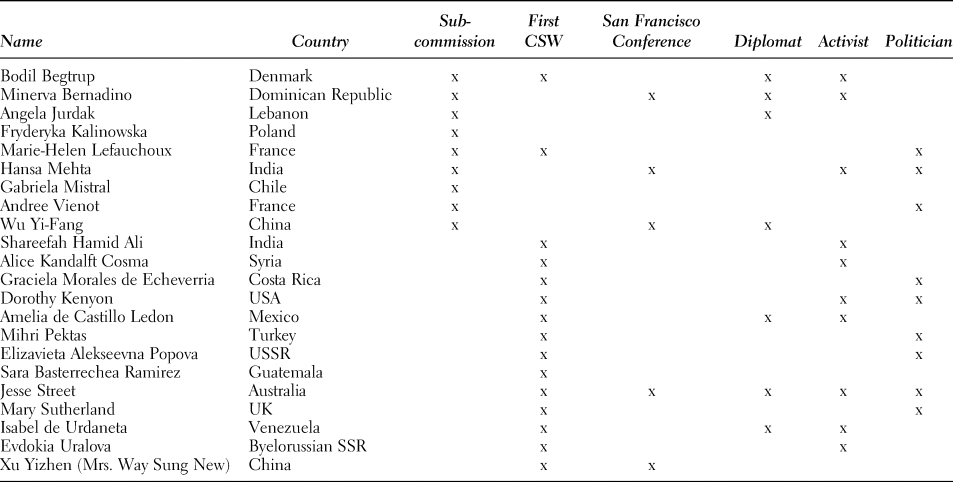
The subcommission was a group of experts, rather than government representatives, although a number were government officials and diplomats. It was comprised entirely of women. In terms of feminist credentials, they were a mixed group (Table 1). The most famous was Gabriela Mistral, a Chilean poet who had just won the Nobel Prize. However, she had not been involved in feminist activism or politics, and ultimately, she never attended a meeting. Marie-Helene Lefauchoux had been a prominent leader of the French underground during the war. Although she had no prior experience with feminist activism, she became an important member and remained on the CSW until her death in 1963. Hansa Mehta of India was a prominent educator and president of the All India Women's Conference (AIWC); she had also been a delegate to the San Francisco conference. Wu Yifang, also a delegate at the San Francisco conference, is not coded as an activist in Table 1 because she was primarily an educator, albeit in a context in which the education of women might itself be considered a form of feminist activism. Angela Jurdak of Lebanon was a professional diplomat. Overall, the group was much more geographically diverse than the primarily Anglo-American activists who had heretofore sought to advance the idea of an equal rights treaty.Footnote 3
Members of the UN Sub-commission on the Status of Women and the First Commission on the Status of Women

SOURCES: United Nations documents E/E/281/Rev.1 and E/HR/18/Rev 1. “Diplomat” indicates service as a credentialed diplomat prior to CSW service; “activist” indicates history of activism specifically in women's organizations; and “politician” indicates ran for office as member of a political party.
Bernardino of the Dominican Republic and Bodil Begtrup of Denmark both combined feminist and diplomatic credentials. Bernardino was a leader of the Dominican feminist group Acción Feminista, a mentee of Doris Stevens, long-term IACW member and current chair, and ally of Bertha Lutz at the San Francisco conference (Butterfield Reference Butterfield2012; DuBois and Derby Reference DuBois and Derby2009). Begtrup was the protégé of Henni Forchhammer, cofounder of the Women's International League for Peace and Freedom, head of the Danish National Women's Council, and a Danish delegate to the League of Nations from 1920 to 1937. After Forchhammer's retirement, Begtrup became the leader of the Danish National Women's Council, an official governing body. Following the precedent set by Forchhammer, Begtrup's expertise on women's issues qualified her to be selected by the Danish government as a delegate to the League of Nations and later the United Nations (Linder Reference Linder2001). She came to the United Nations with egalitarian convictions, but without the baggage of bitter domestic conflict that characterized US egalitarians. Although Begtrup's ideals were similar to those of Alice Paul, her personal relationships with Eleanor Roosevelt and other UN officials were less fraught.
Midtgaard (Reference Midtgaard2011) argues that Begtrup succeeded at the United Nations because she was “multi-positioned” as both an activist and a credentialed diplomat; the term could equally well describe Bernardino and many other women who served on the subcommission and, later, the CSW. This positioning was something that Alice Paul, Doris Stevens and other egalitarian activists had never achieved; the other women who had, including Eleanor Roosevelt and Henni Forchhammer, were never strong advocates for an equal rights treaty.
The absence of a subcommission member from the United States shocked and alarmed American protectionist groups, who were not mollified that Eleanor Roosevelt had an ex officio seat as Chair of the Human Rights Commission. Protectionist groups feared that the subcommission, which lacked an agenda imposed by the United Nations, would become a hotbed of egalitarian radicalism (Butterfield Reference Butterfield2012). American LWV member Dorothy Kenyon, who unsuccessfully sought nomination to the UN subcommission, wrote that it “has the whole broad field, with no holds barred, whatever it can get away with” (quoted in Garner Reference Garner2010, 148). In practice, as Garner notes, this meant that the subcommission had broad agenda-setting powers.
Begtrup was elected chair after some behind the scenes maneuvering by Bernardino to exclude Mistral.Footnote 4 Under Begtrup's leadership, often meeting in closed session in her hotel room, the subcommission produced its first report in the astonishingly short time of two weeks (E/281/Rev.1). It recommended that the UNHRC focus on four dimensions of women's rights: political rights, civil rights, employment rights, and equal access to education. This egalitarian agenda confirmed the worst fears of US protectionist groups, and did not meet with the approval of the male-dominated Commission on Human Rights or its chair, Eleanor Roosevelt.
The first item on the subcommission's agenda thus became getting out from under the UNHRC. Roosevelt and her allies in the US government were opposed, concerned that an independent commission would propose an equal rights treaty. Begtrup, however, cultivated a wide group of supporters at the United Nations, including the first UN Secretary-General, Norwegian Labour Party member Trygve Lie, with whom she was on a first-name basis (Linder Reference Linder2001). Shortly before assuming her position at the United Nations, Begtrup, in her role as head of the Danish National Women's Council, organized a meeting of Scandinavian women's organizations. She succeeded in getting the group to transmit to Lie a request to create an independent CSW.
Begtrup also developed a close working relationship with Ramaswamy Mudaliar, chair of the UN's Economic and Social Council (ECOSOC). He had been a supporter of women's rights in India and supported Lutz’ proposal for a commission at San Francisco. She also cultivated personal relationships with members of the press interested in women's issues and used public speaking engagements to advocate for the subcommission's proposals (Linder Reference Linder2001; Midtgaard Reference Midtgaard2011). Stymied by Eleanor Roosevelt and the UNCHR, Begtrup used these connections to successfully appeal to ECOSOC to give the subcommission full commission status, independent of the UNCHR (E/PV.4).
Critical Actors in the UN Commission on the Status of Women
On June 21, 1946, the subcommission officially became the Commission on the Status of Women (CSW), representing a victory for the egalitarian strategy. As Table 1 shows, personnel changed substantially. Only Begtrup and Lefauchoux carried over from the subcommission. Hansa Mehta moved to the Human Rights Commission and was replaced on the CSW by her colleague from the AIWC, Shareefah Hamid Ali. The new commission lost Bernardino, who was recalled after the fall of the Trujillo government in the Dominican Republic.Footnote 5 However, it added four IACW veterans, Amelia de Castillo Ledon of Mexico, who was IACW vice chair at the time, Graciela Morales de Echeverria of Costa Rica, Sara Basterrecha Ramirez of Guatemala and Isabel de Urdaneta of Venezuela. Jessie Street, the Australian activist who had been an ally of Bernardino and Lutz at the San Francisco conference, was also added. Wu Yifang of China was replaced by her close colleague from Ginling College, Xu Yizhen, who had attended the San Francisco conference as Wu's assistant (E/HR/18.Rev.1; E/406).Footnote 6
The new CSW members were all women, although Begtrup carefully specified that men were eligible to sit on the commission and serve in its secretariat (E/PV.4). Although they served as representatives of their states rather than as independent experts (Laville Reference Laville2008), the new CSW actually included a large group of activists, albeit not all egalitarians. For instance, Dorothy Kenyon of the United States was an LWV member who had served on the League of Nations’ study commission. The commission's report spent the war in her office safe, and she hoped that the CSW would begin by resuming the study commission's work (Eisenburg Reference Eisenburg2013).
Although some observers have argued that the separation of the CSW from UNCHR marginalized it within the United Nations (e.g., Zwingel Reference Zwingel2005), this separation also brought greater freedom of action and reduced oversight. Isolation may, in fact, have enhanced the CSW's effectiveness. A general lack of interest in the CSW and its work in the General Assembly, paralleled perhaps by a perception that they could not do much harm, may explain some of the CSW's remarkable achievements. For instance, as CSW's first chair, Begtrup was able to pursue an egalitarian agenda without significant oversight by her government. As Midtgaard puts it, Begtrup “could pursue her own interests [in the CSW because] … state interest in women's issues appears to have been limited” (Midtgaard Reference Midtgaard2011, 488). By contrast, Begtrup's other major initiative, on refugee rights, remained under tight control of the Danish government, due to the large number of German refugees on its soil after WWII. Begtrup's agency, in other words, was strongest where the interests of her Foreign Office superiors were weakest.
The CSW served as an institutional home for these multipositioned women, simultaneously activists and officials, where it was possible to balance the freedom to innovate with integration into the institutional structures of international society. This combination empowered the women of the CSW to become critical actors, who in their professional activity could instantiate emerging norms into international structures.
From DEDAW to CEDAW: Mainstreaming Radical Egalitarianism in the CSW
At its first meeting, the CSW laid out guiding principles, many including language taken verbatim from the preamble of the Indian Women's Charter, which Mehta had brought to the first meeting of the original subcommission.Footnote 7 Added to this was stronger egalitarian language about promoting equality between women and men and eliminating “all discrimination against women” —language that would later resonate in the name of CEDAW itself (DAW 2006, 3). Indeed, part II of the Commission's first report reads almost like an outline of CEDAW (E/281/Rev. 1). The CSW began the work of structuration, injecting norms that egalitarian activists had agitated for into the international system and institutionalizing them. The CSW began by sponsoring a resolution, framed in the language of the UN Charter and unanimously adopted by the General Assembly, urging member states to work toward equal political rights for women. It also lobbied aggressively to keep sexist language out of the UDHR with the assistance of the Soviet delegation (Butterfield Reference Butterfield2012, chapter 5; Morsink Reference Morsink1999, 117).
Yet individual multipositioned women within the CSW persisted in urging the United Nations to take a more assertive position on women's rights, sometimes in defiance of their own governments. Street was particularly assertive in this respect, so much so that her government refused to reappoint her to the Commission in 1948 (Street Reference Street2004). Even Kenyon began to defy State Department instructions, for instance, by nominating the Soviet delegate to the CSW, Elizivieta Popova, as vice chair (Butterfield Reference Butterfield2012, 330). John Humphreys, head of the Human Rights Division and no fan of the CSW, later wrote that commission delegates “were personally committed to its objectives” and that despite being representatives “they acted as a kind of lobby for the women of the world. There was no more independent body in the UN” (Humphreys Reference Humphreys1984, 30). This relative independence while holding positions of authority as UN delegates allowed the women on the CSW to enhance their agency.
Like many issues at the United Nations, women's rights became entangled in Cold War politics. The United States and the United Kingdom sought to keep women's social and economic rights off the agenda while emphasizing their civil and political rights. The USSR and its allies, on the other hand, sought to emphasize social and economic rights, areas in which they thought the West was weak. Although the CSW was a relatively free space within the United Nations, it could not avoid imbrication in the larger political environment of the Cold War (Baldez Reference Baldez2014, chapter 3).
An equal rights treaty might have become embroiled in Cold War politics; therefore, the CSW took a piecemeal approach, drafting a series of treaties in the 1950s and 1960s: an updated version of the treaty on trafficking in women and children (1947); a revision of the treaty on women performing night work (1948); and conventions on equal pay (1951), equal political rights (1953), the nationality of married women (1957), and equality in education (1960).
This piecemeal approach eventually led to CEDAW's immediate precursor. In 1963, the UN's Third Committee proposed, and the General Assembly endorsed, a plan for the CSW to draft a Declaration on the Elimination of Discrimination Against Women (DEDAW). The goal was to consolidate the various women's rights instruments that the CSW had produced in the preceding decades (UN Department of Public Information 1996, 30). The General Assembly approved the Declaration in 1967, but it lacked legal force. Reporting on progress was voluntary, and countries simply ignored DEDAW without consequence (Baldez Reference Baldez2014, 61).
Some activists became discouraged in the years that followed, which were marked by Cold War politics and the marginalization of women's issues. For instance, Romanian delegate Florica Andrei introduced a motion originally proposed by a socialist NGO, the Women's International Democratic Federation, to designate 1975 “International Women's Year.” It passed the CSW and was adopted as a resolution by the UN General Assembly (E/CN.6/NGO/244; E/CN.6/Min. 587; A/RES/3010; DAW 2006). However, an associated proposal to hold an international women's conference failed to pass the CSW initially (Baldez Reference Baldez2014, 74). Eastern European governments began organizing a conference to mark the occasion on their own in East Berlin (Schwelb Reference Schwelb1966). Pat Hutar, CSW's US delegate, noted the bad optics and proposed that the CSW revisit the issue (Schwelb Reference Schwelb1966). This second attempt succeeded, and the General Assembly approved what became the World Conference of the International Women's Year held in Mexico City in 1975 (DAW 2006).
However, the UN Secretariat provided no funds for the Mexico City conference, urging private donations instead (E/RES/1851). In a spectacular instance of personal commitment, CSW delegate Ashraf Pahlavi of Iran, twin sister of Shah Mohammed Reza Pahlavi, personally donated a million US dollars so that the conference could go forward (Olcott Reference Olcott, Chesler and McGovern2016).
A key outcome of the Mexico City conference was the adoption of the World Plan of Action for the Implementation of the Objectives of the International Women's Year. The WPA outlined a set of guidelines for the advancement of women through 1985. Delegates to the conference also adopted Resolution 25, calling for a Convention on the Elimination of All Forms of Discrimination Against Women (E/Conf./66/34).
In 1976, the Third Committee of the United Nations proposed such a treaty, which was largely written by the CSW. The text of CEDAW was rapidly adopted by the General Assembly, and the treaty was opened for signature in 1979. Jacobson observes that “such rapid speed can be explained either by the comprehensiveness of the preparatory work or by the Third Committee's relative lack of interest in the issue, or both” (Reference Jacobson and Alston1992, 446). Lack of interest by other male-dominated UN bodies and the marginalization of women's issues may have actually permitted the treaty to proceed where more careful scrutiny would likely have produced obstacles.
Relative disinterest in women's issues by the larger UN organization might not have been sufficient to finally convert DEDAW to CEDAW, however. After all, Begtrup and other women, as a tiny minority, might simply have been ignored by their male counterparts at the United Nations. However, these women had a number of resources available to them. Socially, they were generally from elite families and were extremely well educated. These two factors gave them class and intellectual advantages. They had all risen to prominent positions in male-dominated foreign offices, an experience which probably unified their thinking on gender relations despite the cultural differences that existed between them.
Further contributing to their success was their proximity to one another in the CSW, which allowed these women to develop their proposals. Fraser calls the CSW a “free space” for women who were both diplomats and feminists and “understood the advantage of off-the-record discussions … [to] carry out their governmental responsibilities and still uphold their personal convictions” (Fraser Reference Fraser and Winslow1995, 83). They adopted working methods that maximized their agency, for instance, avoiding the identification of representatives advocating particular points of view in the CSW's minutes. Fraser offers controversial article 15 of CEDAW, on women's legal capacity, by way of example. The Iranian representative, facing disapproval by her government for an Article she personally supported, proposed voting separately on each subparagraph in the article. “This gave members the right to express their nations’ disapproval of some clauses without destroying the essence of the particular article” (Fraser Reference Fraser and Winslow1995, 83).
After CEDAW
CEDAW was the last great achievement of the egalitarian agenda in the context of the CSW. After the treaty came into force CEDAW Committee took over as the primary UN organ, advancing an egalitarian, rights-based approach to improving the status of women; the CSW shifted its emphasis to development work. CEDAW Committee thus became the next link in the chain of structuration.
Like the CSW, CEDAW Committee has been driven primarily by highly educated, well-connected, activist officials. The drafters of CEDAW opted for a committee of independent experts to act as the treaty body rather than country representatives. According to Fraser, this reflected their “experience in the drafting committees and on working groups where they may have disagreed with their governments” (Fraser Reference Fraser and Winslow1995, 86). Making committee members independent experts freed them from such constraints while ensuring them an official role in enforcement.
CEDAW Committee naturally attracts those sympathetic to the goals of the treaty. Konjit Sinegiorgis of Ethiopia, committee member from 1985 to 2000, recalls that “being a member of the Committee was a mission; at the risk of being accused of exaggeration, one could say that the full implementation of all the rights and obligations enumerated in the Convention was intimately intertwined with the personal lives of the members” (Sinegiorgis Reference Sinegiorgis, Schöpp-Schilling and Flinterman2007, 277).
In addition, CEDAW's shadow reporting process has drawn activists and NGOs directly into the committee's work. As Zwingel argues, this has the effect of transforming CEDAW from an international legal document into a transnational network of activists, government officials, and delegates to intergovernmental organizations, all advocating for increased legal protection for women's rights at the local, national and international levels (Zwingel Reference Zwingel2005, Reference Zwingel2012). However, the egalitarian agenda has always been advanced by such actors; the difference now is that the treaty and CEDAW Committee have institutionalized the norms of gender equality. CEDAW has transformed these norms into structures in the international system.
CONCLUSION
The process by which CEDAW was created is puzzling from the perspective of third-image international relations theory. The interests of states, their identities, and norms did not drive this process. Instead, we must look to the individual level, where the activities of strategically placed activists have gradually institutionalized norms in the international system in a process of structuration.
A common normative commitment to women's rights has been the thread that connects all of CEDAW's individual advocates. Activists developed the radical idea of an equal rights treaty between the World Wars but had little success making it a reality. Multipositioned egalitarian feminists appointed to the United Nations spurred progress. They used their independence in an area of little immediate interest to their male colleagues to pursue their own normative goals. Their multipositioning maximized their agency and effectiveness. As critical actors, they used their solidarity on women's issues strategically, leveraging their institutional influence. Normative commitments alone were not sufficient to embed egalitarian norms in the structures of international society. Multipositioned critical actors embedded in and engaged in the reproduction of international institutions were empowered to effect normative change.
In the language of Giddens, these individuals engaged in the work of structuration. They used their positions in existing structures, exercising individual agency to modify those structures. This created institutions that reproduced the norms they championed, further reinforcing the institutionalization of gender equality in international law. Crucially, this work of structuration was the product of individual activity.
No state ever defined an equal rights treaty as a vital state interest, an element of national security, or an expression of the prevailing norms within its borders. State-centric explanations of CEDAW all ring hollow. The normative commitment of individual multipositioned actors transformed the radical idea of an equal rights treaty into an institutional structure in international law.