Introduction
In the animal, oxidation processes take place continuously, and are counterbalanced by a complex antioxidant mechanism aimed at minimising the effects of reactive oxygen species (ROS). Free radicals or organic peroxides are responsible for damage to lipids, proteins and DNA structures. This may lead to qualitative changes in animal products, including the structure and shelf life of meat, milk and eggs. The functioning of antioxidant mechanisms influences the state of health of the organism and growth performance.
Animals are equipped with complex systems that prevent uncontrolled reactions in which ROS are generated. Protective actions include processes associated with inhibition of free radical reactions. The enzymes superoxide dismutase, glutathione peroxidase, catalase and ceruloplasmin have an essential role in this system. Numerous low-molecular-weight antioxidants also serve this function, such as bilirubin and its oxidation product biliverdin, the reduced form of α-lipoic acid, α-keto acids (α-ketoglutarate), uric acid, melatonin, oestrone and oestradiol derivatives, ubihydroquinone (reduced coenzyme Q), glutathione, active forms of vitamins (E and C), and dissociated cations of metals (Cu, Zn, Mn, Fe and Se) (Caillet et al., Reference CAILLET, YU, LESSARD, LAMOUREUX, AJDUKOVIC and LACROIX2007; Ognik et al., Reference OGNIK, CZECH and BARAN2012). Full antioxidant protection can be ensured by the interaction of endogenous compounds and exogenous antioxidants, which should be supplied with the diet in appropriate amounts and proportions. The following review examines the role of plant extracts in antioxidant activity in poultry.
Means of enhancing antioxidant status
Due to exposure of animals to numerous stress-inducing factors and a high level of cellular metabolism resulting from intensive rearing, a common phenomenon is destabilisation of the redox balance towards excessive activity of free radical species. Enhancing the antioxidant status of the animal by optimising the level and quality of feeding, and supplementation with exogenous antioxidants can be an effective means of improving the health and productivity of animals (Ognik et al., Reference OGNIK, CZECH and BARAN2012; Ognik and Wertelecki, Reference OGNIK and WERTELECKI2012). Vitamins C and E, carotenoids, certain minerals, and plant antioxidants isolated from vegetables, fruits and herbs can be used to improve antioxidant defence mechanisms. Due to their wide activity, herbs have been used for hundreds of years for prevention and treatment of disease in both humans and livestock. In recent years interest in these raw materials has grown significantly, mainly due to the development of phytochemistry, which enables precise identification of the biologically active substances contained in them, and because of the ban introduced in the European Union in 2006 on the use of antibiotics as growth promoters in animal feed (Windisch et al., Reference WINDISCH, SCHEDLE, PLITZNER and KROISMAYR2008).
Herbs as stimulators of antioxidant mechanisms
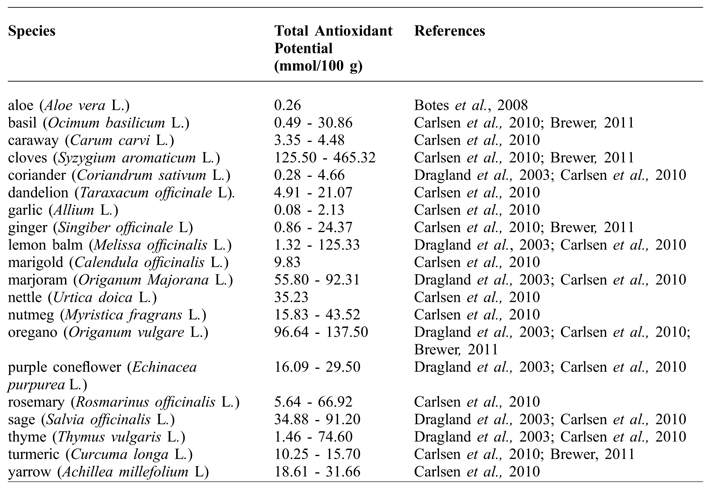
Herbs with antioxidant properties include both culinary herbs, such as rosemary, thyme and oregano, and medicinal herbs, such as dandelion and marigold (Table 1). The antioxidant properties of herbs are mainly due to the presence of polyphenolic compounds (flavonoids, tannins, proanthocyanidins undergoing hydrolysis, phenolic acids and phenolic terpenes), carotenoids, and vitamins E, C and A (Zheng and Wang, Reference ZHENG and WANG2001). Polyphenols exert a particularly strong antioxidant effect. They protect membrane lipids by preventing their oxidation, and are responsible for maintaining the correct level of glutathione in the cells. Flavonoids and their derivatives with the strongest antioxidant potential include hesperidin, diosmin, delphinine, epicatechin, kaempferol, quercetin and luteolin. They are present in considerable quantities in citrus fruits and grapes. It has been demonstrated that they can inhibit the generation of ROS and form permanent complexes (chelates) with transition metals (Cu2+ or Fe2+), thereby preventing Haber-Weiss and Fenton reactions (Caillet et al., Reference CAILLET, YU, LESSARD, LAMOUREUX, AJDUKOVIC and LACROIX2007). Flavonoids interrupt the cascade of free radical reactions (by capturing lipid and alkoxy radicals) leading to lipid peroxidation, thereby protecting other antioxidants (ascorbate in the cytosol and tocopherol in biological membranes). Particularly noteworthy among flavonoids is resveratrol, belonging to the stilbene class, as it is not only a powerful antioxidant but also a recognised anticancer agent (Kavas et al., Reference KAVAS, AYRAL and ELHAN2013). To evaluate and compare the properties of plants it is possible to determine the concentration of individual antioxidants, but it is much more useful to estimate their total antioxidant capacity (TAC) (Kowalski et al., Reference KOWALSKI, POMORSKA, GŁÓD and KONIOR2006). This is because different antioxidants interact, which can gives better protection than would be expected from individual compounds. One example is glutathione, which regenerates vitamin C, or ascorbate, involved in the regeneration of tocopherols. High TAC values are characteristic of cloves (465 mmol/100 g]), oregano (138 mmol/ 100 g) and sage (91 mmol/100 g), (Dragland et al., Reference DRAGLAND, SENOO, WAKE, HOLTE and BLOMHOFF2003; Carlsen et al., Reference CARLSEN, HALVORSEN, HOLTE, BØHN, DRAGLAND, SAMPSON, WILLEY, SENOO, UMEZONO, SANADA, BARIKMO, BERHE, WILLETT, PHILLIPS, JACOBS and BLOMHOFF2010).
Antioxidant potential of selected herbs.

One of the many advantages of plants is that their individual active substances can be extracted, which makes it possible to reduce the dosage of the supplement, especially where odour and taste in some cases (e.g. garlic) may not be tolerated by animals (Ao et al., Reference AO, YOO, ZHOU, WANG, MENG, YAN, CHO and KIM2011). Owing to the diversity of active substances, the effects of plant extracts on the animal are multiple and not limited to stimulation of oxidative defence. Research has confirmed the effectiveness of herbal preparations in improving animal health (Hashemi and Davoodi, Reference HASHEMI and DAVOODI2011), growth performance, and product quality (Windisch et al., Reference WINDISCH, SCHEDLE, PLITZNER and KROISMAYR2008). Plant extracts may exert a beneficial effect on the functioning of the digestive tract, stimulating the metabolism and digestion, and exhibiting anti-diarrhoeal, anti-inflammatory, anti-parasitic, anti-febrile and endocrine effects. Research results confirm other antioxidant, anti-bacterial, anti-fungal and anti-viral effects. Moreover, some have immunostimulatory properties, raising the response of animals to disease (Wang et al., Reference WANG, PIAO, KIM, PIAO, SHEN and LEE2008; Nasir and Grashorn, Reference NASIR and GRASHORN2010; Wallace et al., Reference WALLACE, OLESZEK, FRANZ, HAHN, BASER, MATHE and TEICHMANN2010; Voljč et al., Reference VOLJČ, LEVART, ŽGUR and SALOBIR2013)
The effect of herbs and their active substances on the redox status of poultry
There have been numerous reports indicating the positive effects of using plant-derived compounds to stimulate antioxidant mechanisms in livestock: poultry, pigs, cows and sheep (Gladine et al., Reference GLADINE, MORAND, ROCK, BAUCHART and DURAND2007; Wang et al., Reference WANG, PIAO, KIM, PIAO, SHEN and LEE2008). These are usually manifested as a modification of antioxidant enzyme activity, as well as a reduction in oxidation products, particularly of lipids, and an increase in the total antioxidant potential of the blood plasma (FRAP) or its components. An increase in the FRAP value in the plasma is desirable because it means that the cells and tissues are better protected against the toxic effects of reactive oxygen species.
Increased plasma antioxidants and a decrease in lipid oxidation have been observed in poultry, which has been confirmed in numerous experiments on chickens, quails and turkeys (Ognik, Reference OGNIK2013). Poultry trials have typically involved plant extracts containing polyphenolic substances, such as flavonoids, tannins and phenolic acids. Sahin et al. (Reference SAHIN, AKDEMIR, ORHAN, TUZCU, HAYIRLI and SAHIN2010), who administered resveratrol extracted from Polygonum cuspidatum to Japanese quails at 200 or 400 mg/kg of feed, found that the concentration of vitamins A and E in the blood plasma increased in proportion to the dose applied, while the level of MDA decreased. Similar effects in the form of an increase in FRAP and its components glutathione (GSH+GSSG) and vitamin E were noted in the blood plasma of turkey hens receiving 200 mg/kg feed (Ognik, Reference OGNIK2013). The inhibitory effect of resveratrol was confirmed by a decrease in conjugated dienes (CD) and lipid hydroperoxides (HPETE) in the birds. A reduction in conjugated dienes and lipid hydroperoxides inhibits the initiation of lipoperoxidation as early as the propagation stage (Gladine et al., Reference GLADINE, MORAND, ROCK, BAUCHART and DURAND2007). Administration of a mixture of antioxidants (50% coenzyme Q10 + 30% resveratrol + 20% RRR-d-alpha-tocopherol) at 200 mg/kg of feed resulted in a decrease in CD, HPETE and MDA in the blood of turkey hens. Similar results with this antioxidant mixture were obtained in chickens, but in this case the effect was achieved with a dose of just 100 mg/kg of feed (Ognik, Reference OGNIK2013). An increase in superoxide dismutase (SOD) activity and total antioxidant capacity in the blood plasma of turkey hens receiving aloe extract with resveratrol in their drinking water (0.35 ml/kg BW/day) was noted by Ognik and Czech (Reference OGNIK and CZECH2010a) and Ognik et al. (Reference OGNIK, SEMBRATOWICZ, CZECH, KULAK and MERSKA2015).
Beneficial effects have been observed with other biologically active flavonoids, including genistein and hesperidin. Kamboh and Zhu (Reference KAMBOH and ZHU2013) administered these compounds to broiler chickens at levels of 5 mg/kg genistein and 20 mg/kg hesperidin, as well as a mixture of the two compounds in the amount of 5 or 10 mg/kg genistein + 20 mg/kg hesperidin, and found that the total antioxidant capacity (T-AOC) in the blood plasma was significantly higher with all of the supplements tested. Moreover, they observed a substantial increase in SOD activity and a decrease in MDA production as the level of genistein and hesperidin increased, and particularly when both compounds were used together, indicating synergism. The synergistic effect of individual components has been exploited in the commercial product Bioaron C, which contains numerous components with antioxidant properties: aloe extract, elderberry juice and vitamin C. Ognik and Sembratowicz (Reference OGNIK and SEMBRATOWICZ2007) used this product in turkey hens feed at rates of 0.5 ml/mg BW/day and noted an increase in the activity of SOD and GSH-Px. An increase in the concentration of antioxidant vitamins (A, E and C) and a decrease in MDA were noted in the blood plasma of quails as a result of using green tea extract as a supplement (Tuzcu et al., Reference TUZCU, SAHIN, KARATEPE, CIKIM, KILINC and SAHIN2008). Shirzadegan and Falahpour (Reference SHIRZADEGAN and FALAHPOUR2014), in a study with chickens, used an mixture containing an extract of green tea, cinnamon, garlic and chicory in proportions of 25:15:45:14 in the amount of 2.5, 5.0 and 7.5 g/kg of feed. The experiment showed that including this mixture in feed substantially improved total antioxidant status and hepatic SOD activity, which has a role in protecting the liver against the detrimental effects of lipid peroxidation, whereby higher doses maximised its effectiveness. A positive effect on total antioxidant capacity was noted as a result of adding protein-xanthophyll (PX) concentrate from alfalfa to feed for male turkeys (Ognik and Czech, Reference OGNIK and CZECH2010b) and turkey hens (Czech et al., Reference CZECH, OGNIK and GRELA2012). According to Xie et al. (Reference XIE, HUANG, XU and JIN2008), proteins in alfalfa leaves exhibit the ability to donate electrons or hydrogen and therefore neutralise peroxide, hydroxyl and DPPH radicals. The high radical-scavenging activity of alfalfa proteins additionally enhances the antioxidant activity of the active compounds present in it. Roofchae et al. (Reference ROOFCHAE, IRANI, EBRAHIMZADEH and AKBARI2011), who supplemented chickens with an essential oil isolated from oregano at 300, 600 and 1,200 mg/kg of feed, found that the antioxidant activity of the blood serum was linearly dependent on the dose of supplement. The authors stated that a high concentration of unsaturated fatty acids in poultry meat increased the risk of their peroxidation and deterioration of the quality of the meat during storage; therefore higher doses should be applied in order to achieve significant antioxidant properties in the blood serum, and thus in the meat. An increase in the activity of SOD and GSH-Px and a decrease in the level of MDA in the liver and blood serum of chickens receiving thymol and carvacrol supplements (the main components of oregano oil) was noted by Hashemipour et al. (Reference HASHEMIPOUR, KERMANSHAHI, GOLIAN and VELDKAMP2013). Interesting data on the possibility of using plant antioxidants in combination with acidifying compounds were reported by Hashemi et al. (Reference HASHEMI, ZULKIFLI, DAVOODI, ZUNITA and EBRAHIMI2012). They gave chickens extract from Euphorbia hirta (7.5 g/kg of feed) and an acidifier (containing formic, phosphoric, lactic, tartaric, citric and malic acids) in the amount of 1.5 g/ kg of feed, and then both of these components together in the amounts given above. The results showed a decrease in MDA concentration in the blood of all the birds receiving the supplement, but the blood of the birds receiving the acidifier and the E. hirta extract together exhibited the highest antioxidant activity. The authors of the study attribute the strong antioxidant properties of E. hirta to the presence of numerous active substances, particularly polyphenols such as quercetin and myristicin. The acidifying agents used in the experiment activate primary antioxidants, which are scavengers of free oxygen, and inactivate pro-oxidants supplying hydrogen ions.
There are reports indicating that supplementation of animal feed with plant antioxidants can prevent lipid peroxidation in the muscles (Yasin et al., Reference YASIN, ASGHAR, ANJUM, BUTT, KHAN, ARSHAD, SHAHID, EL-GHORAB and SHIBAMOTO2012) and increase oxidative stability after slaughter (Bagh et al., Reference BAGH, THAKURTA, BISWAS, BEHERA and CHAKRABARTI2011). Autoxidation of meat lipids is an extremely complex cascade process resulting in the generation of numerous compounds responsible for a rancid, unpleasant odour and taste which is not acceptable to consumers (Mottram, Reference MOTTRAM1998).
In order to enhance the properties of plant antioxidants, some have been used in combination with vitamin E or coenzyme Q, whose beneficial effect on these processes has been well documented. An experiment by Ruiz et al. (Reference RUIZ, PEREZ-VENDRELL and ESTEVE-GARCIA1999) demonstrated that combined administration of vitamin E (200 mg/kg) and β-carotene (15 mg/kg) in chicken feed led to greater oxidative stability in the thigh muscle compared to vitamin E alone. Reduction of lipid autoxidation in the muscles has been improved by combining tocopherol with oregano (Young et al., Reference YOUNG, STAGSTED, JENSEN, KARLSSON and HENCKEL2003; Giannenas et al., Reference GIANNENAS, FLOROU-PANERI, BOTSOGLOU, CHRISTAKI and SPAIS2005), as well as with sage and rosemary extracts (López-Bote et al., Reference LÓPEZ-BOTE, GRAY, GOMAA and FLEGAL1998). Inhibition of lipoperoxidation in the muscles of turkeys following application of an antioxidant mixture (50% coenzyme Q + 30% resveratrol + 20% RRR-d-alpha-tocopherol) in the amount of 200 mg/kg of feed was noted by (Ognik, Reference OGNIK2013). Similar effects were noted in chickens for a dose of just 100 mg/kg of feed Ognik (Reference OGNIK2013). An increase in total antioxidant potential (FRAP) correlated with a decrease in the level of malondialdehyde (MDA) in the meat of birds receiving grape puree was noted by Brenes et al. (Reference BRENES, VIVEROS, GOÑI, CENTENO, SÁYAGO-AYERDY, ARIJA and SAURA-CALIXTO2008). The authors of the study emphasised that the stimulation of antioxidant status in the birds receiving the grape puree in their feed was probably due to the flavonoid resveratrol which is present in grapes.
The beneficial effects shown in these studies may lead researchers to attempt to use plant antioxidants independently, without combining them with tocopherols. Research by Ognik (Reference OGNIK2013) showed that the use of different flavonoid compounds, such as hesperidin, diosmin, quercetin or resveratrol, lead to a reduction in redox potential (ORP) in muscle tissues (mainly in the pectoral muscle). An increase in the oxidative stability of muscle tissues in chickens receiving different levels of polyphenolic compounds (catechins) extracted from green tea was noted by Tang et al. (Reference TANG, KERRY, SHEEHAN, BUCKLEY and MORRISSEY2001), which increased with the dose of extract applied (50, 100, 200 and 300 mg/kg). Polyphenolic compounds decreased the intensity of lipid peroxidation processes in the muscles of turkey in another study, in which the birds received a 10 g/kg supplement of rosemary in their feed. Rosemary consisted of flower leaves of cultivated Rosmarinus officinalis plants (Govaris et al., Reference GOVARIS, BOTSOGLOU, MOULAS and BOTSOGLOU2010).
Apart from polyphenolic substances, attempts have been made to use essential oils to minimise harmful changes resulting from lipid autoxidation. Positive effects in the form of a decrease in MDA in the meat of chickens receiving a supplement of oregano oil were noted by Botsoglou et al. (Reference BOTSOGLOU, GRIGOROPOULOU, BOTSOGLOU, GOVARIS and PAPAGEORGIOU2003). The level of this compound was tested in meat which was frozen and stored at 4°C. Hashemipour et al. (Reference HASHEMIPOUR, KERMANSHAHI, GOLIAN and VELDKAMP2013) fed chickens a preparation containing thymol and carvacrol - the main components of oregano oil - at levels of 60, 100 and 200 mg/kg of feed, and observed a linear increase in SOD and GSH-Px activity and a decrease in MDA in the thigh muscle, while no changes were seen in enzyme activity or MDA in the case of the pectoral muscles. The authors attributed this to different susceptibility of the muscles to oxidation. The strong activity of thymol and its isomer carvacrol is probably due to the presence of hydroxyl groups, which may serve as hydrogen donors for peroxides produced during the first stage of lipid oxidation, thereby delaying the formation of hydroxy peroxides. The inhibitory effect of thymol and carvacrol on lipid autoxidation processes, measured by a TBARS, was confirmed in a study by Luna et al. (Reference LUNA, LÁBAQUE, ZYGADLO and MARIN2010) in which chickens received these compounds at levels of 150 mg/kg of feed.
Conclusions
Plant extracts supplemented in diets for poultry can be used to enhance antioxidant defence mechanisms and reduce the intensity of oxidation processes, which negatively affect the quality of poultry products, i.e. meat and eggs. Analysis of the available studies shows that antioxidant processes in the organism of birds can be stimulated via supplementation with plant extracts and their active compounds, among which the highest antioxidant activity is found in resveratrol, hesperidin, genistein, thymol and carvacrol, and from garlic, aloe vera, oregano and rosemary.