INTRODUCTION
Strategic human resource management (SHRM) literature has shown that the adoption of high-performance human resource (HR) practices enhances organizational effectiveness (Kehoe & Wright, Reference Kehoe and Wright2013). Thus, both field research (e.g., Huselid, Reference Huselid1995; Delery & Doty, Reference Delery and Doty1996; Collins & Clark, Reference Collins and Clark2003) and subsequent reviews and meta-analyses (e.g., Combs, Liu, Hall, & Ketchen, Reference Combs, Liu, Hall and Ketchen2006; Mitchell, Obeidat, & Bray, Reference Mitchell, Obeidat and Bray2013; Posthuma, Campion, Masimova, & Campion, Reference Posthuma, Campion, Masimova and Campion2013) have provided strong support to the positive relationship between firm adoption of these HR practices and firm performance.
Practical implications of these insights have supported the essential role of HR practices adoption for firms to achieve sustainable competitive advantages. However, despite the evidence indicating a positive relationship between human resource management (HRM) and organizational outcomes, the mechanisms by which HRM influences performance remain unclear (Jiang, Lepak, Hu, & Baer, Reference Jiang, Lepak, Hu and Baer2012). Attempting to delve deeper into this relationship, literature has examined the link between high-performance HR practices and performance using different mediating variables.
For example, the conceptual work of Jiang and Liu (Reference Jiang and Liu2015) analyzes how high-performance HR practices influence organizational effectiveness, focusing on the mediating role of social capital. Chuang and Liao (Reference Chuang and Liao2010) found empirical evidence that the concern for employees mediates the effect of a high-performance work system on market performance in the service context. This is mainly due to the fact that this concern encourages employees to engage in cooperative behaviors with customers and coworkers, which are essential to achieving superior market performance. Van Esch, Wei, and Chiang (Reference Van Esch, Wei and Chiang2016) explore the mediating effect of employees’ competencies on the relationship between high-performance HR practices and firm performance, providing empirical evidence of partial mediation.
In addition, previous research has analyzed the mediating effect of different variables related to knowledge, such as knowledge exchange, knowledge combination or knowledge management capacity (e.g., Collins & Smith, Reference Collins and Smith2006; Chen & Huang, Reference Chen and Huang2009; López-Cabrales, Pérez-Luño, & Valle-Cabrera, Reference López-Cabrales, Pérez-Luño and Valle-Cabrera2009). These studies suggest the importance of a previously favorable environment to the knowledge exchange. This way, Chen and Huang (Reference Chen and Huang2009) indicate that managers first need to be aware of the importance of knowledge management capacity to facilitate the influence of HR practices on performance. The managers’ commitment to create a context that promotes the exchange of knowledge and the subsequent learning of the firm is an important dimension of the organizational learning capability (OLC) (Williams, Reference Williams2001; Jerez-Gómez, Céspedes-Lorente, & Valle-Cabrera, Reference Jerez-Gómez, Céspedes-Lorente and Valle-Cabrera2005a). Collins & Smith (Reference Collins and Smith2006) note that although HR practices may have direct effects on knowledge exchange and combination, it is more likely that they impact on other aspects that influence the exchange and combination process (e.g., an organizational climate with high levels of cooperation and shared codes among employees). Both cooperation and shared codes are important aspects that determine OLC (Senge, Reference Senge1990; Jerez-Gómez, Céspedes-Lorente, & Valle-Cabrera, Reference Jerez-Gómez, Céspedes-Lorente and Valle-Cabrera2005a).
Literature suggests the relevance of the environment promoting the learning of the organization. However, there are few empirical works that provide evidence of the role of the context that determines the organization’s capacity to learn as a mediator in the link between HR practices and firm performance (e.g., Kuo, Reference Kuo2011; Hooi & Ngui, Reference Hooi and Ngui2014). Research has emphasized the critical role of HR practices in developing effective organizational learning (e.g., Kamoche & Mueller, Reference Kamoche and Mueller1998; Lei, Slocum, & Pitts, Reference Lei, Slocum and Pitts1999; Kuo, Reference Kuo2011; López-Cabrales, Real, & Valle, Reference López-Cabrales, Real and Valle2011). It is asserted that OLC is a capability that promotes innovation and the continuous improvement in organizational processes and routines (Santos-Vijande, López-Sánchez, & Trespalacios, Reference Santos-Vijande, López-Sánchez and Trespalacios2012b). Thus, OLC strengthens other important capabilities, the strategic fit to the environment and, subsequently, the improvement of organizational performance (Mahoney, Reference Mahoney1995; Lei, Hitt, & Bettis, Reference Lei, Hitt and Bettis1996; Crossan, Lane, & White, Reference Crossan, Lane and White1999; Lähteenmäki, Toivonen, & Mattila, Reference Lähteenmäki, Toivonen and Mattila2001; Easterby-Smith & Prieto, Reference Efron and Tibshirani2008).
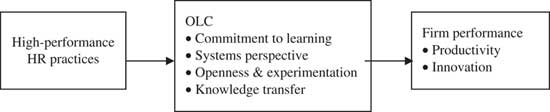
Drawing on these arguments, our study attempts to fill this gap by proposing a model to explore OLC as a mediator in the relationship between high-performance HR practices and organizational performance. Figure 1 summarizes our theoretical model. We suggest a direct mediating effect of OLC by analyzing the relationships from the firm’s perspective, using a partial least squares structural equation modeling method (PLS-SEM) on a sample of Spanish chemical firms.
Model linking high-performance human resource (HR) practices to firm performance. OLC=organizational learning capability

Our study contributes to current organizational learning and high-performance HR practices research twofold. First, we theoretically support the mediating role of OLC in the relationship between high-performance HR practices and the organizational performance. Previous research has highlighted the fact that despite the common idea that high-performance HR practices and OLC may be important enablers of a firm’s effectiveness, there appears to be no clear consensus in the literature on how both high-performance HR practices and OLC contribute to a better performance (Bapuji & Crossan, Reference Bapuji and Crossan2004; Paauwe, Reference Paauwe2009; Goh, Elliott, & Quon, Reference Goh and Ryan2012). Clarifying this issue is important for demonstrating that implementing specific HR practices does not necessarily contribute directly to generating competitive advantages, although its indirect contribution is rather significant through the development of strategic capabilities. Thus, OLC is considered to be a fundamental strategic capability (Lei, Slocum, & Pitts, Reference Lei, Slocum and Pitts1999; Easterby-Smith & Prieto, Reference Efron and Tibshirani2008; Brusoni & Rosenkranz, Reference Brusoni and Rosenkranz2014). It is also a key part of the basis for developing capabilities related to competitive advantage sustainability, because of that it can be categorized as a dynamic capability (Teece, Pisano, & Shuen, Reference Teece, Pisano and Shuen1997; Eisenhardt & Martin, Reference Eisenhardt and Martin2000). In this way, the present work contributes to expanding the HRM literature, focusing on the mechanism by which HR practices favor organizational learning and, consequently, influence performance.
Second, our study provides empirical evidence of the mediating effect of learning capability on the high-performance HR practices–performance relationship, using both financial and non-financial measures of performance. Previous studies have analyzed the mediating role of organizational learning by using perceptual measures of non-financial or financial performance. For example, the study of Kuo (Reference Kuo2011) focuses on perceptual measures of non-financial performance (product or service quality; employee attraction and retention; customer satisfaction and management/employee relationship). Hooi and Ngui (Reference Hooi and Ngui2014) use perceptual measures of financial performance (sales growth, market share, profitability and rate of new product development) to develop their study. Our findings may contribute to the research field by providing, on one hand, theoretical arguments which justify that OLC positively influences both non-financial (e.g., innovation) and financial performance (e.g., productivity), and, on the other hand, empirical evidence that HR practices can have a direct effect on specific performance variables and an indirect effect on others.
THEORY AND HYPOTHESES
OLC
Our study is framed in the prescriptive approach of organizational learning (see Nevis, DiBella, & Gould, Reference Nevis, DiBella and Gould1995; Tsang, Reference Tsang1997). From this point of view, there must exist a context that is propitious for learning, where the characteristics of this context determine the organization’s capacity to learn (Yeung, Ulrich, Nason, & Von Glinow, Reference Yeung, Ulrich, Nason and Von Glinow1999; DiBella, Reference DiBella, Nevis and Gould2001; Lähteenmäki, Toivonen, & Mattila, Reference Lähteenmäki, Toivonen and Mattila2001). Therefore, OLC can be assessed by examining the internal conditions which support learning (Goh, Reference Goh2003).
Based on the review of the prescriptive literature, Jerez-Gómez, Céspedes-Lorente, and Valle-Cabrera (Reference Jerez-Gómez, Céspedes-Lorente and Valle-Cabrera2005a, Reference Jerez-Gómez, Céspedes-Lorente and Valle-Cabrera2005b) developed a measurement instrument that understands OLC as a multi-dimensional concept. They identified four dimensions: commitment to learning, systems perspective, openness and experimentation, and knowledge transfer. These dimensions are fundamental enablers of the OLC of a firm, in such a way that an organization should show a high score in each of the dimensions to have a high OLC. Commitment to learning implies making organizational learning a key capability that influences long-term profits (Ulrich, Jick, & Von Glinow, Reference Ulrich, Jick and Von Glinow1993; Slocum, McGill, & Lei, Reference Slocum, McGill and Lei1994; Nevis, DiBella, & Gould, Reference Nevis, DiBella and Gould1995; Hult & Ferrell, Reference Hult and Ferrell1997), as well as understanding the importance of learning and actively being involved in achieving it (Senge, Reference Senge1990; Goh & Richards, Reference Goh, Elliott and Quon1997; Williams, Reference Williams2001). Systems perspective can be understood as the collective awareness that gathers the employees of an organization around a common identity (Senge, Reference Senge1990) and helps them understand how each individual can contribute to achieving organizational goals (DiBella, Nevis, & Gould, Reference DiBella1996; Goh & Richards, Reference Goh, Elliott and Quon1997; Hult & Ferrell, Reference Hult and Ferrell1997; Lei, Slocum, & Pitts, Reference Lei, Slocum and Pitts1999). Openness and experimentation refers to the ability to anticipate changes and question the current organizational system (Senge, Reference Senge1990; McGill & Slocum, Reference McGill, Slocum and Lei1993). This ability requires openness to new ideas and risk-taking, which in turn favors experimentation, that is, the search for innovative solutions to current and future problems (Leonard-Barton, Reference Leonard-Barton1992; Garvin, Reference Garvin1993; Naman & Slevin, Reference Naman and Slevin1993; Chiva & Camisón, Reference Chiva and Camisón1999). Finally, knowledge transfer implies the transfer of individual knowledge to the organization as a whole such that it can be integrated and applied in new situations (DiBella, Nevis, & Gould, Reference DiBella1996). In this context, work teams have been highlighted as a key factor in knowledge management, because they favor the internal transfer and sharing of knowledge (Senge, Reference Senge1990; Kofman & Senge, Reference Kofman and Senge1993; Nicolini & Meznar, Reference Nicolini and Meznar1995; Nonaka & Takeuchi, Reference Nonaka and Takeuchi1995; Lei, Slocum, & Pitts, Reference Lei, Slocum and Pitts1999).
OLC and organizational performance
According to the knowledge management approach, knowledge is seen as a core strategic resource for companies and a key element in obtaining competitive advantages (see Grant, Reference Grant1996; Spender, Reference Spender1996). As a result, the learning process, which implies the generation, development and application of knowledge, takes particular importance (Nonaka & Takeuchi, Reference Nonaka and Takeuchi1995), and a high OLC can allow organizations to improve their performance (Moingeon & Edmondson, Reference Moingeon and Edmondson1996; Crossan, Lane, & White, Reference Crossan, Lane and White1999; DiBella, Reference DiBella, Nevis and Gould2001; Shipton, Reference Shipton2006; Goh, Elliott, & Quon, Reference Goh and Ryan2012; Santos-Vijande, López-Sánchez, & Trespalacios, Reference Santos-Vijande, López-Sánchez and Trespalacios2012b).
OLC facilitates the firm to act ahead of changes, develop new resources and capabilities, and look for new ways to create value and implement new strategies before competitors (Santos-Vijande, López-Sánchez, & Trespalacios, Reference Santos-Vijande, López-Sánchez and Trespalacios2012b; Brusoni & Rosenkranz, Reference Brusoni and Rosenkranz2014). OLC becomes a capability that underlies other knowledge-based capabilities required to create and maintain competitive advantages (Teece, Pisano, & Shuen, Reference Teece, Pisano and Shuen1997; Zollo & Winter, Reference Zollo and Winter2002; Prieto & Revilla, Reference Prieto and Revilla2006a; Easterby-Smith & Prieto, Reference Efron and Tibshirani2008) and guarantees the viability of the organization by positively influencing the organizational outcomes (Goh & Richards, Reference Goh, Elliott and Quon1997; Kaiser & Holton, Reference Kaiser and Holton1998; Alegre & Chiva, Reference Alegre and Chiva2008).
Some studies have suggested that both financial and non-financial outcomes should be analyzed to evaluate the effect of OLC on firm performance, highlighting the necessity of balancing traditional financial indicators with non-financial indicators of organizational performance (e.g., Prieto & Revilla, Reference Prieto and Revilla2006a, Reference Prieto and Revilla2006b; Goh & Ryan, Reference Goh and Richards2008). The findings of the meta-analysis by Goh, Elliott, and Quon (Reference Goh and Ryan2012) support this argument, showing that empirical research provides evidence of the significant positive relationship between OLC and both financial and non-financial performance, with a stronger relationship to non-financial outcomes, such as organizational innovation, flexibility or job satisfaction. Drawing on this literature, we have selected two performance indicators that have been previously linked to OLC: one related to the results of innovation – as a non-financial indicator – (Goh, Elliott, & Quon, Reference Goh and Ryan2012) and one related to employee productivity – as a financial indicator – (Prieto & Revilla, Reference Prieto and Revilla2006a, Reference Prieto and Revilla2006b; Shin & Konrad, Reference Shin and Konrad2017). In addition, we have estimated a model with sales growth as indicator of financial performance, as a robustness check
The literature has pointed out the positive relationship between organizational learning and firm innovation. Some studies have found a positive and direct influence of the organizational learning as a process on innovation (e.g., Aragón-Correa, García-Morales, & Cordón-Pozo, Reference Aragón-Correa, García-Morales and Cordón-Pozo2007; Sanz-Valle, Naranjo-Valencia, Jiménez-Jiménez, & Pérez-Caballero, Reference Sanz-Valle, Naranjo-Valencia, Jiménez-Jiménez and Pérez-Caballero2011; Santos-Vijande, López-Sánchez, & González-Mieres, Reference Santos-Vijande, López-Sánchez and González-Mieres2012a). Other studies have provided evidence that product innovation (e.g., Alegre & Chiva, Reference Alegre and Chiva2008), process innovation (e.g., Murat & Baki, Reference Murat and Baki2011) or a multi-dimensional variable combining product and process innovation (e.g., Chung-Hsiung, Sue-Ting, & Guan-Li, Reference Chung-Hsiung, Sue-Ting and Guan-Li2011; Tohidi, Seyedaliakbar, & Mandegari, Reference Tohidi, Seyedaliakbar and Mandegari2012) are positively related to the OLC of a firm. Although these previous works focus on different aspects of the relationship between organizational learning and innovation, most agree on the positive nature of the link: OLC pushes firms to be open to new ideas and fosters experimentation, which might facilitate a climate of interchange of knowledge and innovativeness. Organizational learning is, therefore, one of the key factors that sustains an organization’s innovative capability through the renewal and improvement of its resources and capabilities (Crossan, Lane, & White, Reference Crossan, Lane and White1999; Lähteenmäki, Toivonen, & Mattila, Reference Lähteenmäki, Toivonen and Mattila2001; Prieto & Revilla, Reference Prieto and Revilla2006a, Reference Prieto and Revilla2006b; Kuo, Reference Kuo2011; Sanz-Valle et al., Reference Sanz-Valle, Naranjo-Valencia, Jiménez-Jiménez and Pérez-Caballero2011; Tohidi, Seyedaliakbar, & Mandegari, Reference Tohidi, Seyedaliakbar and Mandegari2012).
Rapid changes in the current environment have compelled firms to search for new competitive strategies because the conventional strategies have become obsolete. OLC allows firms to renew and improve their products and processes through improvements in workforce productivity. The literature on learning organization suggests that building a learning capability may help firms manage changes and find new and better ways for competing by favoring improvements in workforce productivity and, in consequence, better firm performance (Spicer & Sadler-Smith, Reference Spicer and Sadler-Smith2006; Wu & Fang, Reference Wu and Fang2010; Goh, Elliott, & Quon, Reference Goh and Ryan2012). OLC can be built only over the long term; from this long-term perspective, OLC supports the competencies that firms require to efficiently develop their products, processes and services, which leads to increases in productivity over time (Prieto & Revilla, Reference Prieto and Revilla2006a, Reference Prieto and Revilla2006b; Goh & Ryan, Reference Goh and Richards2008).
We thus propose the following hypotheses:
Hypothesis 1: OLC positively influences both non-financial and financial firm performance. In particular,
Hypothesis 1a: OLC positively influences firm innovation
Hypothesis 1b: OLC positively influences employee productivity
High-performance HR practices, OLC and organizational performance
SHRM literature identifies a set of HR practices that are more positively related to firm performance: high-performance work practices, commitment-based practices or high involvement work systems (see Arthur, Reference Arthur1994; Huselid, Reference Huselid1995; Delery & Doty, Reference Delery and Doty1996; Collins & Smith, Reference Collins and Smith2006; Posthuma et al., Reference Posthuma, Campion, Masimova and Campion2013). As opposed to more traditional practices, which emphasize individual short-term exchange relationships, high-performance practices are basically aimed at improving the HR capabilities of a firm by developing a long-term investment in its employees (Datta, Guthrie, & Wright, Reference Datta, Guthrie and Wright2005). Therefore, the organizations that best develop these practices are those that have a more advanced or proactive HR management strategy (Tsui, Pearce, Porter, & Tripoli, Reference Tsui, Pearce, Porter and Tripoli1997; Bayo Moriones & Merino Díaz de Cerio, Reference Bayo Moriones and Merino Díaz de Cerio2002; Hyondong & Kang, Reference Hyondong and Kang2013).
One important issue underlying research on SHRM is that HR practices do not influence performance directly, but they instead drive higher performance when they contribute to developing employee-based capabilities that are relevant for firm performance (Wright, Dunford, & Snell, Reference Wright, Dunford and Snell2001; Collins & Clark, Reference Collins and Clark2003; Bowen & Ostroff, Reference Bowen and Ostroff2004; Paauwe, Reference Paauwe2009). The meta-analytic investigation of Jiang et al. (Reference Jiang, Lepak, Hu and Baer2012) support this theoretical proposition, arguing that HRM first relates to those outcomes most directly related to HRM in an organization, such as employee skills and abilities, which further relate to non-financial outcomes, and finally to financial outcomes.
According to this perspective, Collins & Smith (Reference Collins and Smith2006) argued that commitment-based HR practices may affect firm performance by increasing employees’ willingness to work together to create and exchange knowledge. The idea that HR practices may influence positively the capacity of an organization to generate new knowledge and thus encourage learning has been suggested repeatedly in the literature (Ulrich, Jick, & Von Glinow, Reference Ulrich, Jick and Von Glinow1993; Jones & Hendry, Reference Jones and Hendry1994; Crossan, Lane, & White, Reference Crossan, Lane and White1999; López-Cabrales, Real, & Valle, Reference López-Cabrales, Real and Valle2011). Thus, HRM plays a key role in learning-oriented firms by becoming a fundamental tool to steer the firm towards a learning culture (McGill, Slocum, & Lei, Reference McGill and Slocum1992; Koch & McGrath, Reference Koch and McGrath1996; Kamoche & Mueller, Reference Kamoche and Mueller1998).
The literature suggests that high-performance practices help create a social climate that encourages the commitment of workers to their organization while also motivating them to work together to generate new knowledge (Kofman & Senge, Reference Kofman and Senge1993; Arthur, Reference Arthur1994; Tsui, Pearce, Porter, & Hite, Reference Tsui, Pearce, Porter and Hite1995; Collins & Smith, Reference Collins and Smith2006). In this way, high-performance HR practices foster a commitment to learning. Conversely, when such a social climate exists, it is more likely that employees regard the organization as a whole highly and work towards organizational goals, aligning their interests with those of the organization (Tsui et al., Reference Tsui, Pearce, Porter and Tripoli1997; Nahapiet & Ghoshal, Reference Nahapiet and Ghoshal1998; Reagans & McEvily, Reference Reagans and McEvily2003). Thus, high-performance practices advocate the integration of human resources in the organization’s strategic vision, thereby providing a system perspective (Roche, Reference Roche1999; Roca Puig, Escrig Tena, & Bou Llusar, Reference Roca Puig, Escrig Tena and Bou Llusar2002). In addition, high-performance HR practices promote employees’ autonomy over their work (Arthur, Reference Arthur1994), which favors experimentation and encourages employees to focus on the organization rather than their own interests, promoting internal communication and the exchange and transfer of knowledge among employees (Truss, Gratton, Hope-Hailey, McGovern, & Stiles, Reference Truss, Gratton, Hope-Hailey, McGovern and Stiles1997; Reagans & McEvily, Reference Reagans and McEvily2003; Smith, Collins, & Clark, Reference Smith, Collins and Clark2005).
It can be stated, then, that the development and application of high-performance HR practices would allow firms to differentiate themselves from competitors with regards to their learning capabilities. We therefore propose the following hypothesis:
Hypothesis 2: High-performance HR practices positively influence the development of OLC.
Although the literature provides empirical support for a positive relationship between HRM and organizational performance, exactly how HRM influences performance is a longstanding issue of debate. It is commonly asserted that high-performance HR practices are likely to influence internal resources and capabilities, and these interactions will eventually determine non-financial and financial outcomes (Combs et al., Reference Combs, Liu, Hall and Ketchen2006; Jiang et al., Reference Jiang, Lepak, Hu and Baer2012). This means that HRM influences organizational outcomes sequentially, and HR practices act as enablers of different internal variables that mediate the relationship between HR practices and firm performance (Paauwe, Reference Paauwe2009).
Previous works have developed models analyzing the mediating effect of knowledge and other variables related to knowledge, such as knowledge transfer or knowledge management capacity. For example, Collins & Smith (Reference Collins and Smith2006), using a sample of US high-technology firms, tested a model of how commitment-based HR practices affect the social climate that influences knowledge exchange and, thus, firm performance. Their results showed that the relationship between commitment-based HR practices and knowledge exchange is significant, and although reduced, is still significant after the introduction of the social climate variables in the model. This evidence support the idea that it is likely that HR practices first affect other aspects of the firms, that is other strategic capabilities, that subsequently influence the knowledge transfer and combination.
López-Cabrales, Pérez-Luño, and Valle-Cabrera (Reference López-Cabrales, Pérez-Luño and Valle-Cabrera2009) also tested an HR practices-firm performance model using a sample of innovative Spanish companies. Their results did not support the direct effect of HR practices on performances, but they provided evidence that unique knowledge mediates the effect of collaborative HR practices on a company’s innovative capability. Chen and Huang (Reference Chen and Huang2009) focused on the mechanisms that organizations use to acquire, share and apply knowledge and they developed a study with a sample of Taiwanese firms, providing evidence that knowledge management capacity plays a mediating role between a set of strategic HR practices and innovation performance. While they only found a direct effect of some HR practices on innovation performance, their results support the direct mediating role of knowledge management capacity.
The work of Kuo (Reference Kuo2011) introduces organizational learning as a mediating variable, but its findings, based on a sample of 208 employees of different Taiwanese technological companies, show only an indirect mediating effect of organizational learning in the relationship between HRM and perceptual measures of non-financial performance (product or service quality; employee attraction and retention; customer satisfaction and management/employee relationship). Hooi and Ngui (Reference Hooi and Ngui2014) provide evidence that HRM enhances the performance of small and medium manufacturing and service companies in Malaysia by strengthening their OLC. This work finds a direct mediating effect of OLC in the HRM-performance relationship using perceptual measures of financial performance (sales growth, market share, profitability and rate of new product development).
As discussed above, high-performance HR practices may lead to better firm performance because of their previous effect on employee-based capabilities and resources. Employees play, therefore, a key role in the processes of creation of new knowledge and its subsequence dissemination and storage within the organization (Collins & Clark, Reference Collins and Clark2003; Bowen & Ostroff, Reference Bowen and Ostroff2004; Collins & Smith, Reference Collins and Smith2006; Jiang et al., Reference Jiang, Lepak, Hu and Baer2012). These knowledge management processes underlie OLC. Therefore, those organizations that develop HR practices that promote continuous learning will develop their OLC to a greater extent and, consequently, obtain higher performance (Takeuchi, Wakabayashi, & Chen, Reference Takeuchi, Wakabayashi and Chen2003; Theriou & Chatzoglou, Reference Theriou and Chatzoglou2008). We then predict the following hypotheses:
Hypothesis 3: OLC acts as a mediating variable in the relationship between high-performance HR practices and both non-financial and financial firm performance. In particular,
Hypothesis 3a: OLC mediates the relationship between high-performance HR practices and firm innovation.
Hypothesis 3b: OLC mediates the relationship between high-performance HR practices and employee productivity.
METHODS
Sample and research procedures
We test our hypotheses by focusing on a population of Spanish chemical manufacturing companies with 50 or more employees. The SABI (The Iberian balance sheet analysis system) database, that provides balance sheet information for more than 1.25 million Spanish companies, was used to select our population.
The Spanish chemical sector generates 12.4% of industrial GDP, becoming the second largest industry of the Spanish economy, above the metallurgical sector (11.5%) and transport and automobiles (11.1%), and only behind food industry (22.5%). Therefore, the contribution of the chemical industry to GDP increased by 15% from 2007 to 2013 (FEIQUE, 2015). On the other hand, the chemical industry is undergoing a continuous process of modernization and competitive renovation, in which new products and processes are constantly being developed. According to the 2013 Report on CSR of the Spanish chemical industry, developed by FEIQUE in the period 2000–2011, the investment in R&D and innovation increased by 126%. The chemical industry, led by the pharmaceutical industry, is the largest investor, representing one quarter of the total investment of all Spanish manufacturing industries.
There was also a 143% increase in exports from the Spanish chemical industry from 2000–2012. This industry is currently the second largest one in terms of exports, after the automotive industry, with more than half of its total revenues. The internationalization strategy has made innovation, flexibility and knowledge key factors in helping companies remain competitive. As a consequence, HR policies such as recruiting, training or incentives have become important tools for the development of the companies’ strategies (Barcelona Treball, 2013; FEIQUE, 2013).
Two key informants, the CEO and the most senior HR manager, were selected because both of them had a general vision of the firm’s processes and sufficient knowledge of the key variables of the study (Gupta, Shaw, & Delery, Reference Gupta, Shaw and Delery2000). A questionnaire was sent to both key informants within each company, making clear that the unit of analysis was the employee level. Supervisors and top managers were excluded because HR practices may differ depending on the hierarchical level.
We obtained a sample of 85 companies from a population of 396 (response rate: 21.5%), by combining secondary data from the SABI database with the collected responses to our survey. For the companies that returned both questionnaires, we averaged the different items to represent the variable values of the company as a whole. The high values of inter-respondent reliability across all questions in the questionnaire and the relatively small size of the companies in the study suggest that using a single respondent is not an important source of measurement error. We checked for significant differences between companies that returned the questionnaire and those that did not, and the groups did not differ significantly.
Measurements
OLC scale
We used the OLC scale developed and validated by Jerez-Gómez, Céspedes-Lorente, and Valle-Cabrera (Reference Jerez-Gómez, Céspedes-Lorente and Valle-Cabrera2005a, Reference Jerez-Gómez, Céspedes-Lorente and Valle-Cabrera2005b), around the four dimensions of the OLC construct: commitment to learning, systems perspective, openness and experimentation, and knowledge transfer. A 7-point Likert scale was used, with 1 representing ‘completely disagree’ and 7 ‘completely agree’. A single indicator for each dimension was constructed from a factorial analysis that was carried out on the variables indicating the different dimensions.
High-performance HR practices
The HR variables from Delery and Doty (Reference Delery and Doty1996) were used as the basis to measure our high-performance HR practices. The work by Delery and Doty (Reference Delery and Doty1996) is conducted in the framework of SHRM literature and identifies a series of practices that are ‘theoretically and empirically connected to organizational performance’, which, according to Mitchell, Obeidat, and Brat (Reference Mitchell, Obeidat and Bray2013: 901), have been ‘consistently depicted as High-Performance HR practices’.
HR practices that fit better with the high-performance approach differ across studies, but a commonality in any high-performance approach is a focus on the AMO model – ability, motivation and opportunity – when deciding the HR practices to be included (Combs et al., Reference Combs, Liu, Hall and Ketchen2006; Kehoe & Wright, Reference Kehoe and Wright2013). Delery and Doty (Reference Delery and Doty1996) identified seven HR practices: internal career opportunities, training, results-oriented appraisals, employment security, participation, job descriptions and profit sharing. According to Delery & Shaw (Reference Delery and Shaw2001) and Mitchell, Obeidat, and Brat (Reference Mitchell, Obeidat and Bray2013) these seven practices are connected to the AMO model because they include practices related to ability, such as training systems; practices related to motivation, such as results-oriented appraisal, profit sharing, internal career opportunities or job security; and practices related to opportunity, such as employee participation and job design.
On the other hand, these seven HR practices of Delery and Doty can be labeled as ‘core’ or ‘broad’ practices, on the basis of the work of Posthuma et al. (Reference Posthuma, Campion, Masimova and Campion2013) about the centrality of high-performance work practices in the literature. This study analyzes the centrality of the HR practices based on their overall frequency and their application across different regions of the world. This means that the HR practices of Delery and Doty are stable or growing over time and are broadly applicable across different regions. Therefore, they can be considered as widespread high-performance HR practices.
Additionally, the scale by Delery and Doty (Reference Delery and Doty1996) is used as the basis of other notable works, such as that of Collins & Smith (Reference Collins and Smith2006), who specifically adapt the items of Delery and Doty to create a measure of what they refer to as commitment-based HR practices. Even though the term is not exactly the same, in keeping with Posthuma et al. (Reference Posthuma, Campion, Masimova and Campion2013), the research literature has often used varied and divergent terminology to name the same construct (e.g., high-performance work practices, high involvement work systems, high commitment-based HR practices). We have decided to use the original scale by Delery and Doty, instead of the adapted scale by Collins and Smith, based on the fact that it is a broader scale in terms of the number of HR variables considered and it also includes, to a greater extent, the variety of HR practices that can influence OLC – a multi-dimensional construct – and, subsequently, impact firm performance.
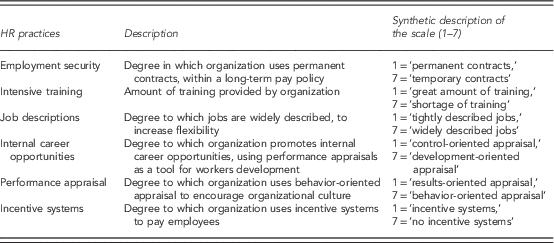
We rejected one of the variables of Delery and Doty’s scale, Participation, because participation in decision-making is included in our Commitment to learning dimension of OLC, as a factor favoring the identification and commitment of employees to the company. Therefore, our six HR variables are employment security, intensive training, job descriptions, internal career opportunities, performance appraisal and incentive systems. Employment security means the use of permanent contracts as a predominant link between employees and the organization. Intensive training refers to whether the firm offers good training opportunities to employees. Job descriptions refer to the degree to which jobs are widely described to encourage flexibility. Internal career development refers to the degree in which the organization encourages internal promotion, using performance appraisals as a tool for worker development. Performance appraisal refers to the use of evaluation criteria based on qualitative aspects which support the organizational culture. Finally, incentive systems imply the use of compensation by performance as a way of paying employees.
We measured each of the six HR variables using a 7-point semantic differential-type scale that allowed us to distinguish between the opposite strategic options for each variable. Table 1 shows a synthetic description of the measurement scale.
Measurement of high-performance human resource (HR) practices

Firm performance
We used two firm performance indicators: innovation and employee productivity. To measure the innovation variable, we developed five items based on the studies of Avlonitis, Kouremenos, and Tzokas (Reference Avlonitis, Kouremenos and Tzokas1994), Deshpande, Farley, and Webster (Reference Deshpande, Farley and Webster1993), Hollenstein (Reference Hollenstein1996), Karagozoglu and Brown (Reference Karagozoglu and Brown1988), Kleinschmidt and Cooper (Reference Kleinschmidt and Cooper1991), Miller and Friesen (Reference Miller and Friesen1982), and Subramanian and Nilakanta (Reference Subramanian and Nilakanta1996). Our five items refer to the number of innovations carried out in recent years, the speed with which they were transferred to the market, the degree of novelty, and being ‘the first comer’ in the market. These five items cover both product innovation and process innovation because innovation literature clearly differentiates these two areas (see Gobeli & Brown, Reference Gobeli and Brown1994; Yamin, Mavondo, Gunasekaran, & Sarros, Reference Yamin, Mavondo, Gunasekaran and Sarros1997).
Employee productivity has widely been depicted as an indicator of financial performance (see Shin & Konrad, Reference Shin and Konrad2017). In keeping with previous research (e.g., Datta, Guthrie, & Wright, Reference Datta, Guthrie and Wright2005, Shin & Konrad, Reference Shin and Konrad2017), we developed a variable that was built on the logarithm of the gross operating revenue divided by the number of employees for a period of three years (the year in which the questionnaire was sent and the two following years). We used sales growth as an additional financial performance variable to analyze the robustness of the results. Sales growth was measured as the average increase (or decrease) in sales for a period of 3 years (the year in which the questionnaire was sent and the two following years). Data for both variables was gathered from secondary sources (SABI database).
Control variables
Different variables might influence both the level of development of OLC and the firm’s performance. We controlled for age, size and a subsidiary variable. Subsidiary was measured through a dichotomic variable, taking 1 if the company is part of a foreign chemical group and 0 if not. The aim is to introduce the possible influence of corporate strategy on the decision-making process of the subsidiary. The previous literature correlates the firm’s age and its learning capability as a consequence of the cumulative effect of learning (DiBella, Nevis, & Gould, Reference DiBella1996). We measured the age variable by the number of years since a firm was founded. Finally, larger organizations have been linked to greater learning capability (Tsang, Reference Tsang1997; Lei, Slocum, & Pitts, Reference Lei, Slocum and Pitts1999). To measure the size variable, we used the logarithm of the volume of firm’s total assets and the logarithm of the number of employees.
Common method bias
As we used self-reported data to measure some independent and one dependent variable, common method bias may be a concern. We followed a series of steps in order to reduce the probability of this problem. First, the elaboration of the survey and the gathering of information were conducted following the suggestions of Podsakoff, MacKenzie, Lee, and Podsakoff (Reference Podsakoff, MacKenzie, Lee and Podsakoff2003). Second, a dependent variable (financial performance) and different control variables were measured based on secondary information sources in the estimated model. Finally, we performed Harman’s one factor test before estimating paths between constructs. Three factors were identified with eigen values>1. Each of these factors represents each one of the constructs (items corresponding to each construct tend to load in the same factor), and there was not a single factor that accounted for the majority of the variance (Factor 1, OLC: 25.5%; Factor 2, Innovation: 22.8%; Factor 3, High-performance HR practices: 14.43%).
In addition, we have controlled for the effects of an unmeasured latent method factor (Podsakoff et al., Reference Podsakoff, MacKenzie, Lee and Podsakoff2003). The differences in the standardized regression weights of our models with and without the factor range between −0.0517 and 0.079 for the model with Non-Financial Performance as dependent variable and −0.1369 and 0.1187 for the model with Financial Performance as dependent variable. These results suggest common method bias is not an issue in our models.
RESULTS
Data analysis was performed using partial least squares structural equation modeling method (PLS-SEMFootnote 1 ). The PLS-SEM is gaining increasing attention in the strategic management field (see Hair, Sarstedt, Pieper, & Ringle, Reference Hair, Hult, Ringle and Sarstedt2012), and has proved to be particularly useful because it does not require large sample sizes and allows researchers to work with more complex models than other causal modeling techniques (Barroso, Cepeda, & Roldan, Reference Barroso, Cepeda and Roldan2007). Moreover, PLS-SEM has been used, as a more flexible and proficient method, in recent studies that analyze mediating relationships (e.g., Castro & Roldán, Reference Castro and Roldán2013; Picón, Castro, & Roldán, Reference Picón, Castro and Roldán2014). Given the reduced sample size of our study and the characteristics of the model and hypotheses, showing direct and indirect relationships as well as mediating effects, we believe the flexible design of PLS offers the best fit to the research needs.
For hypothesis testing, PLS offers several options. Chin (Reference Chin1998) recommends the bootstrapping procedure. It consists of generating a large number of random samples (Chin [Reference Chin1998] suggests 500 samples) from the original data set by sampling with replacement (Efron & Tibshirani, Reference Easterby-Smith and Prieto1993). Path coefficients are estimated with each random sample, and the mean parameter estimates and standard errors are computed across the total number of samples.
PLS estimates parameters for both the links between measures and constructs and the links between different constructs at the same time. However, a PLS model is analyzed and interpreted sequentially in two stages (Barclay, Higgins, & Thompson, Reference Barclay, Higgins and Thompson1995): the assessment of the reliability and validity of the measurement model and then the assessment of the structural model.
This sequence ensures that the researcher has reliable and valid measures of constructs before attempting to draw conclusions about the nature of the construct relationships.
Measurement model
Common practices recommend that the assessment of the measurement model examine inter-construct correlations, construct-to-item correlations, Cronbach’s α, composite reliabilities, and average variance extracted (AVE) for each construct (Jones, Sundaram, & Chin, Reference Jones, Sundaram and Chin2002; Cepeda, Reference Cepeda2006). In PLS, reflective indicators are determined by the construct and therefore co-vary at the level of that construct (Hulland, Reference Hulland1999). In our model, all of the scales consisted of reflective items.
Individual item reliability is assessed in PLS by examining the loadings of the measures with their respective construct. A simple rule employed by many researchers is to accept items with loadings of 0.7 or more. Doing so ensures that there is more shared variance between the construct and its measure than error variance (Carmines & Zeller, Reference Carmines and Zeller1979). In other words, more than 50% of the variance in the observed variable is due to the construct.
In practice, it is common to find that several measurement items in an estimated model have loadings below the 0.7 threshold, particularly when new items or newly developed scales are employed (Hulland, Reference Hulland1999). Indeed, we can find several studies that, motivated by strong theoretical foundations, retain indicators scoring between 0.4 and 0.5 (Fornell, Lorange, & Roos, Reference Fornell, Lorange and Roos1990; Johansson & Yip, Reference Johansson and Yip1994).
In our models, all of the indicators composing OLC and performance constructs have loadings over 0.7(except innov3 with 0.66). When analyzing the HR practices dimension we find a different situation. ‘Job descriptions’ and ‘Performance appraisal’ indicators have a negative individual factor loading, which means that they are inversely correlated with the rest of the practices in the dimension. This may be the result of (Hulland, Reference Hulland1999) (1) a poorly worded item, (2) an inappropriate item, or (3) an improper transfer of an item from one context to another.
To avoid reliability and validity problems, these items have been removed from our model. All other items have positive loadings on the factor. Although ‘Career Opportunities’, ‘Employment Security’ and ‘Incentive Systems’ have individual factor loadings below 0.7, we decided to retain them because the potential loss of information derived from their deletion does not justify the improvement in terms of reliability.
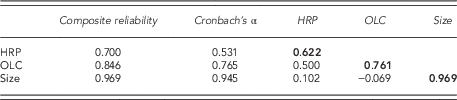
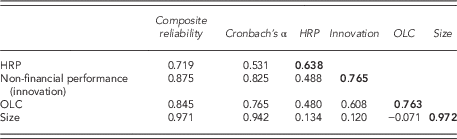
Construct reliability was assessed using two measures of internal consistency: Cronbach’s α and composite reliability. The interpretation of both values is similar, although composite reliability is a more accurate measure and does not assume equal item weighting (Barclay, Higgins, & Thompson, Reference Barclay, Higgins and Thompson1995). Nunnally (Reference Nunnally1978) suggests 0.70 as a benchmark for a ‘modest’ reliability applicable in the early stages of research and 0.80 as a more ‘strict’ reliability applicable in basic research. As shown in Table 2, the α and composite reliability of the reflective measures exceeded 0.70, except for the HR practices scale, which scored 0.53. However, internal consistency is ensured because the composite reliability is 0.72.
Intercorrelations and internal consistencies of constructs

HRP=human resource practices; OLC=organizational learning capability.
Discriminant validity represents the extent to which measures of a given construct differ from measures of other constructs in the same model. We assessed this in two ways (Chin, Reference Chin1998). First, we compared the square root of the AVE (shown on the diagonal in Table 2) with the correlations among constructs (represented by the off-diagonal elements in Table 2). Because AVE is an indicator of the amount of variance captured by the construct in relation to the variance due to measurement error, the values for AVE should exceed 0.50 (Barclay, Higgins, & Thompson, Reference Barclay, Higgins and Thompson1995). Table 2 shows that the square root of AVE for the reflective constructs is greater than the correlation between constructs, which suggests that on average, each construct relates more strongly to its own measures than to others.
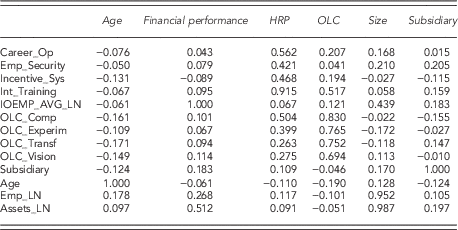
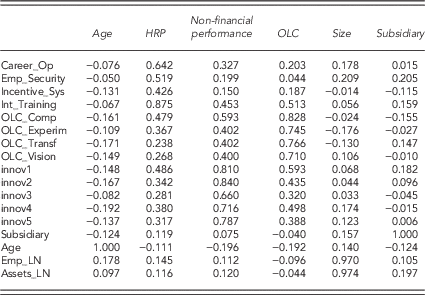
The second procedure used to assess discriminant validity consists of evaluating how each item is related to the latent constructs. For that purpose, we examined the construct-to-item loadings and cross-loadings of the reflective measures (see Table 3). All of the item loadings showed a higher loading on their own construct than on others. In addition, all constructs shared more variance with their own measures than with others. Thus, we can conclude that collectively, these results support the convergent and discriminant validity of the scales used.
Loadings and cross-loadings

HRP=human resource practices; OLC=organizational learning capability.
These data are the results of the estimation of the measurement model using productivity (in terms of incomes per employee) as the indicator of performance. Because the PLS methodology requires running the complete model to assess the reliability and validity, these figures may vary depending on the indicator chosen to represent the endogenous variables. Similar results can be found when using innovation as the key indicator of performance dimension (see Tables A1 and A2 in Appendix A).
Structural model
PLS has as its primary objective the minimization of error (or, equivalently, the maximization of explained variance) in all endogenous constructs. The degree to which any particular PLS model accomplishes this objective can be determined by examining the R 2 values for the dependent (endogenous) constructs. In addition, the relations between variables can be assessed through the path coefficients values and their significance.
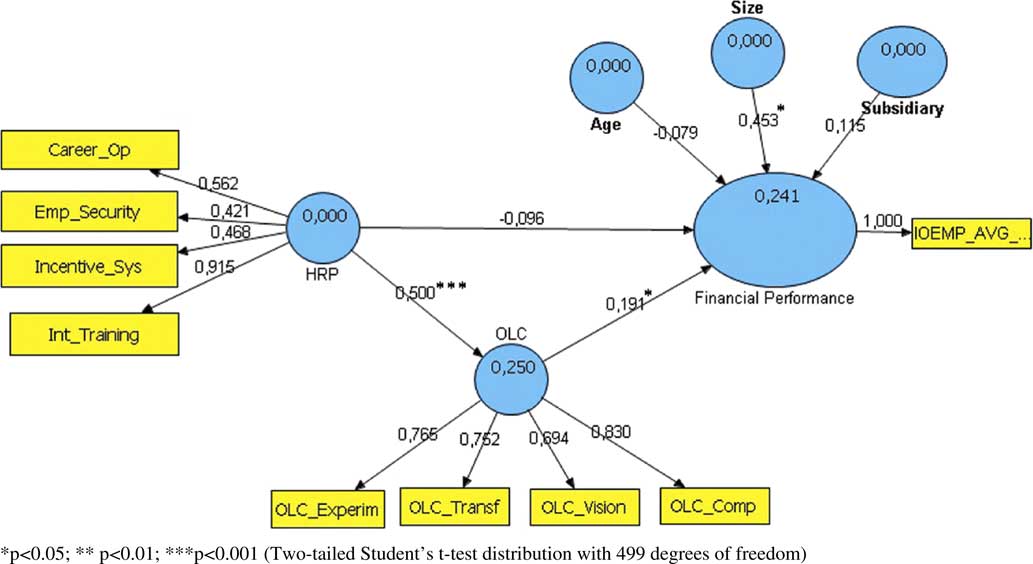
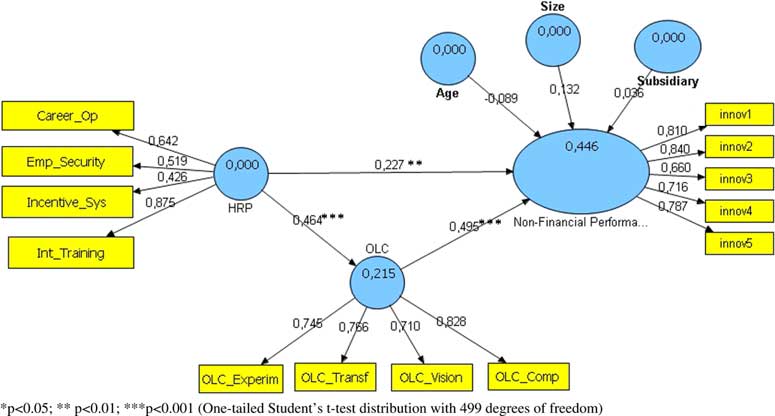
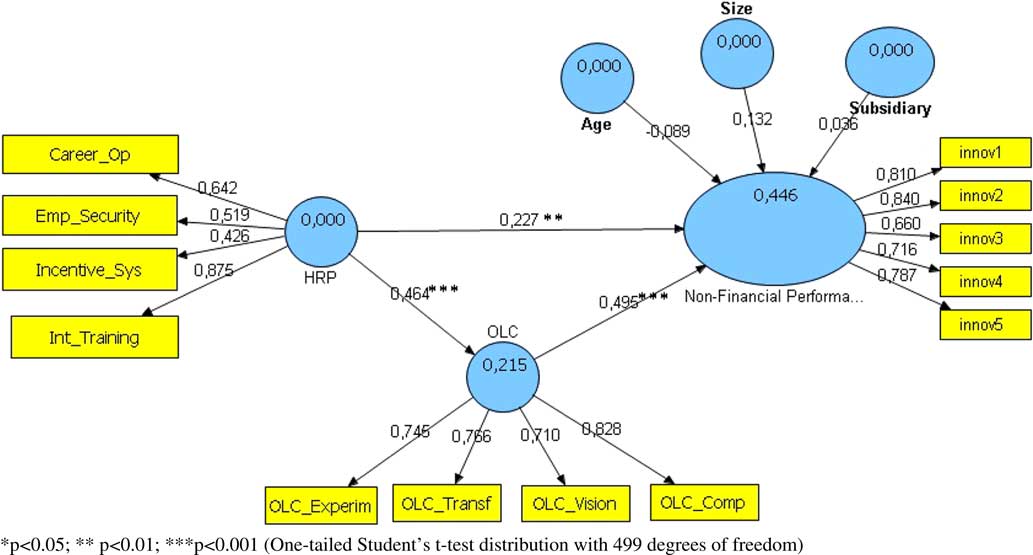
Two different indicators have been used to depict the performance dimension: productivity and innovation. The first one is represented in Figure 2. Figure 3 shows the structural model, using innovation as the indicator for the endogenous variable.
Results with productivity as the dependent variable (performance). *p<.05; **p<.01; ***p<.001 (two-tailed Student’s t-test distribution with 499 df). HRP=human resource practice; OLC=organizational learning capability

Results with innovation as the dependent variable (performance). *p<.05; **p<.01; ***p<.001 (one-tailed Student’s t-test distribution with 499 df). HRP=human resource practice; OLC=organizational learning capability
We replicated this model with sales growth as a dependent variable to conduct a robustness check for our financial performance model. As expected, results are similar to those obtained with employee productivity in the relationship with OLC (β=0.222, p≤.001) and with HR practice (β=−0.061, non-significant).
Hypothesis 1 suggested a positive relationship between OLC and the company’s performance. Our analysis supports this statement for both models. When performance is assessed in terms of innovation, this effect is clearly higher (β=0.495, p≤.0001) than in the model that considers employee productivity (β=0.191, p≤.05).
Hypothesis 2 predicted a positive relationship between high-performance HR practices and OLC. The results obtained in both models show a significant relationship between the practices depicted and the learning capability.
To test the mediation effect of OLC we followed Preacher and Hayes (Reference Preacher and Hayes2004, Reference Preacher and Hayes2008). This approach suggests bootstrapping the sampling distribution of the indirect effect. Bootstrapping is ‘perfectly suited for the PLS-SEM method’ (Hair, Hult, Ringle, & Sarstedt, Reference Hair, Sarstedt, Pieper and Ringle2016: 223) and shows higher levels of statistical power compared to Sobel test.
Following this procedure, mediation would exist when the coefficient of the direct path between the HR practices and performance is reduced because the indirect path via OLC is introduced into the model. This technique allows us to evaluate the size of the mediation effect in relation to the total effect through the variance accounted for. This way, it is possible to assess the extent to which the variance of the performance construct is directly explained by high-performance work practices and how much of performance’s variance is explained by the indirect relationship via OLC. Results show that when considering innovation as a measure for operational performance, OLC explains a 50.6% of total variance which points to the existence of partial mediation. Although the direct relationship between high-performance HR practices and productivity is non-significant in our model, there is a strong mediation effect on financial performance through OLC. These results provide support for Hypothesis 3.
DISCUSSION AND CONCLUSIONS
This study has focused on the link between high-performance HR practices and firm performance. We have suggested that this relationship is mediated by OLC. Overall, our findings provide support for the idea that high-performance HR practices lead to an improvement in both firm innovation results and employee productivity.
Previous works have found a positive relationship between high-performance HR practices and innovation (e.g., Chen & Huang, Reference Chen and Huang2009) and between OLC and innovation (e.g., Calantone, Cavusgil, & Zhao, Reference Calantone, Cavusgil and Zhao2002; Alegre & Chiva, Reference Alegre and Chiva2008; Tohidi, Seyedaliakbar, & Mandegari, Reference Tohidi, Seyedaliakbar and Mandegari2012). According to our results, since OLC exerts partial mediation on the relationship between high-performance HR practices and innovation, these results confirm the importance of considering both effects together (direct and indirect) when explaining innovation. Therefore, high-performance HR practices not only facilitate the development and direct implementation of employees’ innovative capacity, but favoring the necessary conditions to develop learning capacity. They also contribute towards improving the results of innovation. Our findings show the importance of considering HR practices as a consistent HR system, which contributes to the joint development of two connected strategic capabilities: innovation and OLC.
As a main contribution to the OLC literature, our study suggests that the analysis of the relationship between OLC and innovation should consider other possible antecedents of innovation. OLC is one of the key factors that supports the innovation performance of a firm through the constant renewal and improvement of the organizational resources, routines and capabilities (Lähteenmäki, Toivonen, & Mattila, Reference Lähteenmäki, Toivonen and Mattila2001; Prieto & Revilla, Reference Prieto and Revilla2006a, Reference Prieto and Revilla2006b; Sanz-Valle et al., Reference Sanz-Valle, Naranjo-Valencia, Jiménez-Jiménez and Pérez-Caballero2011; Goh, Elliott, & Quon, Reference Goh and Ryan2012; Tohidi, Seyedaliakbar, & Mandegari, Reference Tohidi, Seyedaliakbar and Mandegari2012). However, future works should pay attention to the fact that there are antecedents of OLC (i.e., high-performance HR practices) which also influence innovation results.
We did not find evidence of a direct relationship between high-performance HR practices and financial outcomes. These results are in line with the theoretical argument that the impact of HR practices on organizational outcomes is fundamentally indirect and, therefore, research should explore mediating firm capabilities to a better understanding of the role of HR practices on firm financial performance (Collins & Smith, 2009; Jiang et al., Reference Jiang, Lepak, Hu and Baer2012). Thus, our results support the idea that the effect of HR practices on firm performance is mediated by the development of HR-based strategic capabilities (e.g., OLC), which directly contribute to maintaining competitive advantage.
From an organizational learning perspective, the positive relationship between OLC and long-term employee productivity suggests that OLC may have effects on firm financial performance. Empirical evidence on this issue is of particular relevance. It helps raising awareness on the importance of developing a learning capability as a mean for renewing the organization’s products and processes and employee productivity (Spicer & Sadler-Smith, Reference Spicer and Sadler-Smith2006; Wu & Fang, Reference Wu and Fang2010; Goh, Elliott, & Quon, Reference Goh and Ryan2012). In addition, it shows how OLC may act as a strategic capability and, therefore, contribute to the development of firm competitive advantages (Prieto & Revilla, 2006a; Goh & Ryan, Reference Goh and Richards2008; Goh, Elliott, & Quon, Reference Goh and Ryan2012).
In sum, these results may also help to clarify the complex relationships between high-performance HR practices and organizational performance, a central topic in the SHRM literature (Wright, Dunford, & Snell, Reference Wright, Dunford and Snell2001; Boselie, Dietz, & Boon, Reference Boselie, Dietz and Boon2005; Paauwe & Boselie, Reference Paauwe and Boselie2005; Collins & Smith, Reference Collins and Smith2006; Jiang et al., Reference Jiang, Lepak, Hu and Baer2012). Thus, studies in the SHRM field must be cautious when offering theoretical arguments which link HR practices to various performance variables, since there might be a direct effect in some cases and a completely indirect effect in others. Similarly, the present work demonstrates the fundamental role of HR practices in the development of a key strategic capability – OLC, and, therefore, the need to include this learning capability in the theoretical SHRM models.
We acknowledge certain limitations of this study. These limitations may provide the starting point for further research. First, although we have used two different performance measures, both high-performance HR practices and OLC are quite likely to have an effect on other dimensions of firm performance, especially ‘soft’ outcomes related to HRM (e.g., employee turnover, retention, job satisfaction or organizational commitment and motivation). In turn, these variables may partially mediate the relationship between high-performance HR practices, OLC and ‘hard’ performance indicators (e.g., productivity, sales growth or ROA). Research has highlighted a lack of integration regarding how HR practices relate to different organizational performance measures. These studies note that different outcomes can be interconnected, so the influence of HR practices on ‘soft’ performance indicators may subsequently affect financial outcomes in the future (Jiang et al., Reference Jiang, Lepak, Hu and Baer2012). As a consequence, further research might analyze both direct effects of OLC on financial firm performance and indirect effects through ‘soft’ outcomes as mediating variables. Additionally, this study has not considered the possibility that the financial outcomes and the level of implementation of high-performance HR practices feedback each other (Shin & Konrad, Reference Shin and Konrad2017).
The empirical design of this paper is subject to some constraints related to the sample size and the methodological characteristics of PLS technique. For example, some authors (e.g. Hair, Sarstedt, Hopkins, & Kuppelwieser, 2014) have highlighted some limitations in terms of model fit assessment (as commonly done in covariance-based SEM) and consistency of the parameter estimates. In addition, the database used in our empirical study contains panel data with financial information, but it does not include indicators on management practices or innovation results. Panel data might become useful in analyzing this causal relationship in depth, with measures of high-performance HR practices, OLC and innovation at different moments in time.
Second, our results might show a high degree of context specificity. This issue is relevant because different studies have shown how culture-related variables can affect the level of development of different HR practices and their degree of interrelationship (Cabrera & Carretero, Reference Cabrera and Carretero2005). Although the management characteristics in the chemical industry can be considered relatively homogeneous in different countries (Jerez-Gómez, Céspedes-Lorente, & Valle-Cabrera, Reference Jerez-Gómez, Céspedes-Lorente and Valle-Cabrera2005b; Yu, Park, & Cho, Reference Yu, Park and Cho2007), especially in developed ones, if results obtained are to be generalized across other industries, cultural differences between countries and other contextual factors must be taken into consideration (Lodorfos & Boateng, Reference Lodorfos and Boateng2006). Studying a sample comprised of companies from different countries and industries may help clarify this question.
Despite the above-mentioned limitations, this study has relevant implications for both theory and practice. From a theoretical point of view, the results obtained show that a set of HR practices can contribute to making the system of HR practices into a strategic capability that is related to other complementary resources and capabilities and can have an effect on improving non-financial performance (i.e., innovation). We have also shown that these HR practices can facilitate the development of other basic strategic organizational capabilities, such as learning capability. As noted above, this mediating role is useful and should be considered in studies analyzing the link between HR practices and performance.
Another important implication of our study is that OLC should be considered an organizational strategic capability and a source of competitive advantages. Both normative and descriptive organizational learning literatures suggest this conceptualization (Goh, Elliott, & Quon, Reference Goh and Ryan2012; Santos-Vijande et al., Reference Santos-Vijande, López-Sánchez and González-Mieres2012a, Reference Santos-Vijande, López-Sánchez and Trespalacios2012b) but empirical evidence is scarce. Our results show that OLC is the basis of other related strategic resources and capabilities, is a source of superior performance, and may be developed through the implementation of high-performance HR practices.
From a practitioner’s perspective, this study provides indications that can help companies design suitable conditions in which to promote OLC, which is directly related to the development of HR systems. The application of certain high-performance practices, such as employment security, intensive training or incentive systems, may help develop these systems in a way that can contribute to improving innovation and long-term organizational performance.
Acknowledgements
The authors gratefully acknowledge financial support from the Spanish Ministry of Economy and Science and the European Regional Development Fund-ERDF/FEDER (National R&D Project ECO2015-66504-P).
This manuscript is an original work that has not been submitted to nor published anywhere else.
All authors have read and approved the paper and have met the criteria for authorship.