Introduction
In this era of functional endoscopic sinus surgery (FESS), only a select spectrum of pathologies still necessitates open cranialisation of the frontal sinus, including complex frontal sinus fractures, recurrent sinusitis, mucocele, benign and malignant neoplasms, and cerebrospinal fluid (CSF) leak. Key to the treatment of these pathologies is complete and permanent obliteration of the frontal sinus, which is often achieved by ‘plugging’ the defect with a mix of synthetic substrates and autogenous tissue. With time, however, resorption and degradation of these materials can lead to recanalisation and recurrent disease, which may result in significant morbidity and further surgical intervention.
Beta-tricalcium phosphate is a synthetic bone graft substitute, which has well-established applications in spinal,Reference Dai and Jiang1–Reference Epstein3 orthopaedic,Reference Galois, Mainard and Delagoutte4 and maxillofacial and dental surgery.Reference Guillaume5 It has a crystalline structure of macropores and micropores, which facilitates the ingrowth of adjacent blood vessels and bone tissue, concurrent resorption by osteoclasts, and replacement by native bone.Reference Bohner, Santoni and Dobelin6 These osteoconductive and osteo-inductive properties make beta-tricalcium phosphate an attractive adjunct in frontal sinus obliteration by encouraging native bone growth to permanently close the defect. Furthermore, its use negates the need for a second donor operative site, reducing morbidity and operative time.
The use of beta-tricalcium phosphate in frontal sinus obliteration was first described for the repair of a frontal sinus fracture in 2004;Reference Elahi, Vanduzer, Spears, Gibson and Mitra7 thereafter, it has been described only in one limited case series for the treatment of frontal mucoceles.Reference Andratschke and Hagedorn8 At our institution, beta-tricalcium phosphate granules have been used for frontal sinus obliteration in select patients over the last three years for the treatment of CSF leak, mucocele and refractory sinusitis.
This paper reports the surgical technique and outcomes of frontal sinus obliteration using beta-tricalcium phosphate performed at a single Australian centre over a three-year period. We describe the surgical technique and its efficacy, surgical complications, and long-term outcomes with the longest radiological follow up reported in the published literature.
Materials and methods
Study setting and participants
A retrospective audit was conducted on all patients undergoing frontal sinus obliteration using beta-tricalcium phosphate at Austin Health, Heidelberg, Victoria, Australia. All patients were treated by the same combined ENT and neurosurgery skull base team between 2018 and 2021.
Data collection and outcomes
For each patient, electronic medical records were reviewed to obtain data on patient demographics, history of previous sinonasal or intracranial surgery, surgical indication, operative details, post-operative follow up, and adverse events and complications. Patients were assessed with pre-operative, immediate post-operative and follow-up computed tomography (CT) imaging. Post-operative imaging was reviewed for osseointegration and subsequent replacement of beta-tricalcium phosphate by native bone. Research ethics approval from the Austin Health Human Research Ethics Committee was obtained.
Surgical technique
Patients underwent open craniotomy approach frontal sinus obliteration under standard neuro-anaesthetic, whilst pinned in a Mayfield® head clamp or on a horse-shoe headrest. Stereotactic navigation was used in all cases.
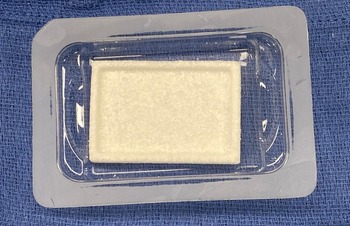
After standard cranialisation of the frontal sinus involving removal of the posterior table and frontal sinus mucosa, the cortical bony surface of the anterior table was partially decorticated with a high-speed round diamond burr. The frontal recess was then packed with mouldable Mastergraft Putty (Medtronic, Minneapolis, Minnesota, USA) (Figure 1), followed by standard peri-cranial flap, fascia lata or dural substitute overlay.
Mastergraft Putty (Medtronic), comprising beta-tricalcium phosphate/hydroxyapatite granules.

Mastergraft Putty comprises a resorbable osteoconductive cohesive scaffold composed of collagen (96.5 per cent ceramic and 3.5 per cent bovine type 1 collagen) mixed with Mastergraft Mini Granules (Medtronic). Each granule is composed of 85 per cent beta-tricalcium phosphate and 15 per cent hydroxyapatite. Only a small volume is required to obliterate the remaining sinus lumen without disrupting the soft tissue repair layer. The putty does not undergo an exothermic reaction, or require any additional preparation or precaution.
Additional intracranial or endoscopic sinonasal procedures were performed as required. The craniotomy was closed with titanium mini-plates and the scalp with layered suture closure. Post-operatively, CT of the brain with bone windows was performed to confirm obliteration of the sinus.
Results
A total of four patients (50 per cent female) underwent frontal sinus obliteration using beta-tricalcium phosphate during the study period. Indications for surgery included CSF leak and complex recurrent frontal sinusitis. All patients had simultaneous cranialisation of the frontal sinus.
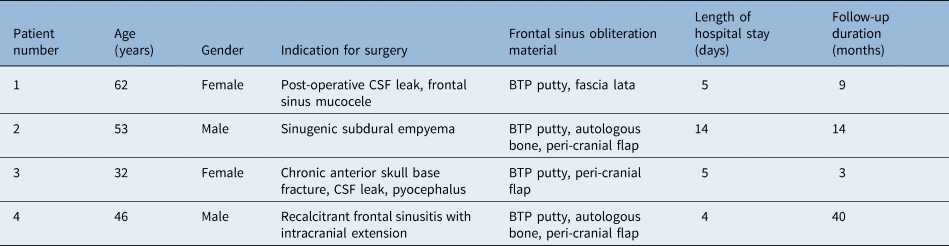
Post-operatively, mean in-patient stay was 7 days (range, 4–14 days) and mean follow up was 16.5 months (range, 3–40 months). Further demographic and surgical details are summarised in Table 1.
Summary of patient demographics

CSF = cerebrospinal fluid; BTP = beta-tricalcium phosphate
All patients tolerated their procedure, with resolution of symptoms and disease. There were no cases of recurrent sinus disease or CSF leakage at last follow up. There were no adverse events or complications. At the most recent follow up, all patients had radiological evidence of native bone obliteration of the frontal sinus and frontonasal ducts.
Patient one
A 62-year-old female with a significant neurosurgical history presented with both a right frontal sinus mucocele and a frontal subgaleal pseudo-meningocele. She had undergone a FESS polypectomy 13 years previously, resection of a World Health Organization (WHO) grade 2 olfactory groove meningioma with titanium plate cranioplasty 11 years previously, and resection of a WHO grade 1 right frontal convexity meningioma 10 years previously. The craniotomy in both meningioma resections involved breach of the frontal sinus.
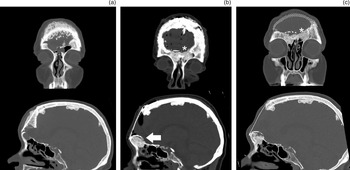
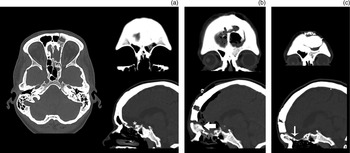
The patient presented to clinic with a progressively enlarging right frontal sinus mucocele on serial imaging, a fluctuant frontal swelling and a CSF discharging sinus from the midline of her previous bicoronal incision (Figure 2). Computed tomography and magnetic resonance imaging (MRI) demonstrated a communication between the right frontal sinus and intracranial space, and evidence of infection of the titanium cranioplasty plate.
Patient 1 – non-contrast, coronal and sagittal computed tomography bone window images of the frontal sinus and anterior skull base defect: (a) pre-operatively, (b) day 1 post-operatively and (c) 6 months post-operatively, demonstrating osseous integration (large arrow) of the beta-tricalcium phosphate/hydroxyapatite graft and resolution of the meningocele (asterisks).

The patient proceeded to revision bicoronal cranioplasty, titanium cranioplasty plate replacement, and frontal sinus obliteration with beta-tricalcium phosphate putty and fascia lata graft. The patient had an unremarkable post-operative admission and was discharged after 5 days. A subgaleal seroma developed in the weeks after discharge but resolved without intervention. There has been no recurrence of mucocele in nine months’ follow up.
Patient two
A 53-year-old male was transferred from an external hospital with a left frontal extradural empyema secondary to a frontal sinus abscess and dehiscence of the posterior table of the frontal sinus. Sixteen months previously, the patient had undergone a partial frontal sinus cranialisation and evacuation of sinugenic frontal intracranial empyema, followed by a long course of antibiotics.
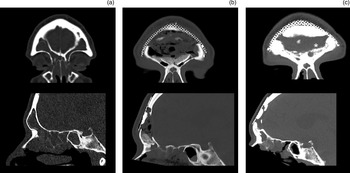
The patient underwent revision craniotomy, washout of empyema, completion of frontal sinus cranialisation, and frontal sinus obliteration with autologous bone, beta-tricalcium phosphate putty and overlain vascularised pericranium (Figure 3). The patient was discharged home after 14 days. He had no complications or disease recurrence at follow up 14 months post-operatively.
Patient 2 – non-contrast, coronal and sagittal computed tomography bone window images of the frontal sinus: (a) pre-operatively, (b) day 1 post-operatively and (c) 6 months post-operatively, demonstrating osseous integration of the beta-tricalcium phosphate putty (large arrow).

Patient three
A 32-year-old female was transferred from a rural hospital with meningoencephalitis and pyocephalus. The patient had suffered significant head trauma in a motor vehicle accident 11 years previously, which required a craniotomy and resulted in an acquired brain injury.
Computed tomography and MRI scanning showed an anterior skull base fracture with communication between the anterior cranial fossa and the left frontal and ethmoidal sinuses, presumed to be from her previous head trauma.
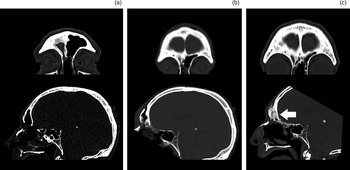
The patient underwent bicoronal craniotomy, anterior skull base repair, and left frontal sinus cranialisation and obliteration with beta-tricalcium phosphate putty and overlain vascularised pericranium (Figure 4). She had an uncomplicated post-operative course and was discharged home 5 days post-operatively. There were no complications of CSF leak recurrence or infection at follow up three months post-operatively.
Patient 3 – non-contrast, coronal and sagittal computed tomography bone window images of the left-sided frontal sinus fracture with extension to the anterior skull base (ethmoid) (asterisk): (a) pre-operatively (axial view), (b) day 1 post-operatively and (c) 6 months post-operatively, demonstrating osseous integration (large arrow) of the beta-tricalcium phosphate putty obliterating the left frontal sinus and sealing the anterior skull base defect posteriorly (thin arrow).

Patient four
A 46-year-old male was referred with refractory chronic rhinosinusitis with polyps. He had radiological evidence of dehiscence of the posterior table of the right frontal sinus but no intracranial disease.
The patient underwent FESS polypectomy and frontal recess clearance, bifrontal craniotomy, and frontal sinus cranialisation and obliteration with autologous bone, beta-tricalcium phosphate putty and overlain vascularised pericranium. He had an uncomplicated post-operative course and was discharged home 4 days post-operatively. After 40 months’ follow up, the patient has had no complications or disease recurrence (Figure 5).
Patient 4 – non-contrast, coronal and sagittal computed tomography bone window images of the frontal sinus: (a) pre-operatively, (b) day 1 post-operatively and (c) 40 months post-operatively, demonstrating osseous integration and persistence of bone union at the frontal sinuses bilaterally (asterisk).

Discussion
This study reports the outcomes of four patients who underwent frontal sinus obliteration with beta-tricalcium phosphate for a range of indications. Surgery was successful in all patients, and no immediate or delayed complications were reported. To our knowledge, our study is the first to report the use of beta-tricalcium phosphate scaffold grafts in the repair of skull base defects for CSF leak. In addition, it provides the longest radiological follow up and comparison available regarding its use in the treatment of frontal sinus disease.
Beta-tricalcium phosphate is a widely available product, with an excellent track record in spinal, orthopaedic and maxillofacial surgery. Its use in skull base surgery, however, is limited. Andratschke and Hagedorn demonstrated the use of pure beta-tricalcium phosphate in two patients undergoing frontal sinus obliteration with long-term follow up;Reference Andratschke and Hagedorn8 they reported shorter surgical times, avoidance of donor site morbidity, improvement in symptoms and no adverse events related to the beta-tricalcium phosphate. Our study provides the longest follow up of beta-tricalcium phosphate frontal sinus cranialisation for CSF leak and sinusitis, demonstrating persistent bone obliteration at up to 40 months, with no delayed complications. Importantly, our study is the first to demonstrate that the substrate is able to persist and integrate in the setting of CSF leak.
Conventional options for frontal sinus obliteration range from avascular autologous tissues, such as fat, muscle and cancellous bone, to synthetics, including hydroxyapatite cement. These are generally on-laid with free grafts such as fascia lata, collagen based dural substitutes (e.g. Duragen®) or vascularised peri-cranial grafts. Hardy and Montgomery reported a large case series of frontal sinus obliteration with autologous fat, demonstrating a complication rate of 18 per cent and a revision surgery rate of 6 per cent.Reference Hardy and Montgomery9 The use of autologous calvarial bone graft has also been shown to be effective, with low complication rates, and avoids the need for a second donor site.Reference Kang, Sng and Tay10,Reference Vironneau, Coste and Pruliere-Escabasse11 Hydroxyapatite cement has been described as an effective synthetic scaffold option for frontal sinus obliteration and has similar favourable properties to beta-tricalcium phosphate; it is an easily accessible autologous material with osteoconductive potential. Although hydroxyapatite has an overall robust safety profile, post-operative infection rates are reported to be up to 8 per cent,Reference Friedman, Costantino, Synderman, Chow and Takagi12–Reference Taghizadeh, Kromer and Laedrach14 and explantation of infected cement is occasionally required. To date, there have been no published comparative studies of the safety and efficacy of beta-tricalcium phosphate and hydroxyapatite cement in the craniofacial setting. Other synthetic frontal sinus obliteration substrates reported in the literature include acrylic bone cement with bovine pericardium,Reference Demir15 and antimicrobial bioactive glass.Reference Peltola, Aitasalo, Suonpaa, Varpula and Yli-Urpo16
Beta-tricalcium phosphate has a well-documented role as a bone graft substitute in a range of surgical applications. In spinal surgery, it is commonly used as an autograft extender,Reference Gunzburg and Szpalski2 with equivalent fusion rates to iliac crest harvest, without adverse events, significant donor site pain or donor site complications.Reference Dai and Jiang1,Reference Epstein3 In maxillofacial and oral surgery, beta-tricalcium phosphate has found a role in maxillary sinus lifting or augmentation procedures, with comparable results to autologous bone grafts in terms of bone resorption ratesReference Zijderveld, Zerbo, van den Bergh, Schulten and ten Bruggenkate17,Reference Gorla, Spin-Neto, Boos, Pereira Rdos, Garcia-Junior and Hochuli-Vieira18 and dental implant retention.Reference Uckan, Deniz, Dayangac, Araz and Ozdemir19 Similarly, in orthopaedic and trauma surgery, beta-tricalcium phosphate has been described as a safe and effective bone graft substitute in terms of: repairing defects following tumour resection,Reference Hirata, Murata, Takeshita, Sakabe, Tsuji and Kubo20 accelerating bone union after tibial wedge osteotomiesReference Jeon, Jang, Ro, Lee and Han21 and minimising bone defects in anterior cruciate ligament repair surgery.Reference Higuchi, Kobayashi, Ikeda, Hatayama, Yanagisawa and Kato22
As demonstrated in this study, beta-tricalcium phosphate putty fulfils the ideal characteristics for frontal sinus obliteration, as it does not require a separate donor surgical site, is well tolerated and widely available, and conforms to the complex shape of the frontal sinus. Furthermore, because of its osteoconductive and osteo-inductive properties, beta-tricalcium phosphate frontal sinus obliteration results in osseous integration that ensures persistent, secure closure of the intracranial space. Religious and ethical considerations are also simplified, as beta-tricalcium phosphate is a synthetic material not derived from human tissue.
The limitations of our study include low patient numbers, a lack of objective follow-up criteria and the inherent biases of retrospective data collection. The most significant disadvantage of the surgical technique itself is the financial cost. Prices of beta-tricalcium phosphate putty in the Australian market range from $AUD 808 for 3.0 cc to $AUD 1889 for 9.0 cc, although this varies from country to country.
• Traditional frontal sinus obliteration using fat or autologous bone may be complicated by disease recurrence and donor site morbidity
• Beta-tricalcium phosphate is an alloplastic bone graft substitute with established uses in craniofacial, orthopaedic and spinal surgery
• This case series established the effectiveness and safety of beta-tricalcium phosphate putty as an alloplastic option in frontal sinus obliteration
• It is the first to describe effective beta-tricalcium phosphate frontal sinus obliteration for cerebrospinal fluid leak and has the longest reported radiological follow up
• Long-term radiological follow up demonstrates beta-tricalcium phosphate putty replacement with native bone and persistent frontonasal duct obliteration
Given the long-term efficacy of this surgical technique, further large-scale prospective studies in beta-tricalcium phosphate frontal sinus obliteration are warranted, to confirm and expand on the current study's findings. The use of beta-tricalcium phosphate in other skull base surgical procedures should be investigated, particularly in procedures where bone loss is an inherent problem, such as pterional and retro-sigmoid craniotomies, or lateral skull base CSF leak repair.
Conclusion
Frontal sinus obliteration with beta-tricalcium phosphate granules is well tolerated, and highly effective in inciting bone obliteration of the frontal sinus and providing an enduring closure of the frontonasal duct. This substrate obviates the morbidity associated with harvesting autologous fat, muscle or bone. The complete ossification that beta-tricalcium phosphate facilitates may provide superior closure security to simple soft tissue ‘plugging’. Though our case numbers are limited, these data suggest a growing role for this novel and easily implemented technique in the treatment of complex frontal sinus disease.