1. Introduction
The Boca do Chapim locality, in the coastal cliffs just north of Cape Espichel, some 40 km south of Lisbon, has been known as a source of Early Cretaceous vertebrate remains since the late 19th century (Sauvage, Reference Sauvage1896, Reference Sauvage1897–1898, 1898). Among the material described by Sauvage were jaw fragments which he considered crocodilian and referred to a new species of Suchosaurus Owen, S. girardi. Re-examination shows that they actually belong to the theropod dinosaur Baryonyx. This is the first report of this spinosaurid dinosaur from Portugal.
2. Geological setting
The fossils described below, apparently collected by Choffat, come from marly sandstones which crop out in the sea-cliffs north of Cape Espichel at a place called Boca do Chapim (Lisboa e Setubal Province, formerly Estremadura. See locality maps in Rey, Reference Rey1972, Reference Rey1992). In the older geological literature, this formation was called the ‘grès marneux à grands sauriens’ (Choffat, Reference Choffat1904), or ‘grès marneux à dinosaures’. The more formal name ‘Papo Seco Formation’ was proposed by Rey (Reference Rey1992). Sauvage (Reference Sauvage1897–1898) and Choffat (Reference Choffat1904) considered these marly sandstones as belonging to the Almargem Beds, of Aptian to early Albian age. Rey (Reference Rey1972, Reference Rey1992, Reference Rey2006) showed that they are in fact early Barremian in age. They are considered as lagoonal sandstones (Rey, Reference Rey2006) filling a valley at the beginning of a transgressive phase (Rey, Graciansky & Jacquin, 2003). Choffat (Reference Choffat1904, p. 15) gave an accurate position for Sauvage's Suchosaurus material in layers 36–38 of his section of Boca do Chapim.
As described by Sauvage (Reference Sauvage1897–1898), the vertebrate assemblage from Boca do Chapim, identified mainly on the basis of isolated teeth, included a chimaeroid fish, the purported crocodilian Suchosaurus girardi, the theropod Megalosaurus superbus, the sauropod Pleurocoelus valdensis and the ornithopod Iguanodon mantelli. In addition, Choffat (Reference Choffat1904) mentioned the occurrence of chelonian remains. Later workers (Lapparent & Zbyszewski, Reference Lapparent and Zbyszewski1957; Galton, Reference Galton1994; Antunes & Mateus, Reference Antunes and Mateus2003; Ruiz-Omeñaca & Canudo, Reference Ruiz-Omeñaca, Canudo and Pérez-Lorente2003) have concentrated on dinosaurs but have added little to Sauvage's original list, beyond a re-evaluation of some taxon names. The hitherto described dinosaurs from Boca do Chapim can be listed as Iguanodon sp., Theropoda indet. and Astrodon cf. valdensis (see Carpenter & Tidwell, Reference Carpenter, Tidwell, Tidwell and Carpenter2005, about the validity of Astrodon). The material referred to Suchosaurus girardi seems to have been generally neglected, probably because its crocodilian nature was not questioned.
3. Baryonyx material from Boca do Chapim
Sauvage (Reference Sauvage1897–1898) erected the species Suchosaurus girardi (without providing any diagnosis) on the basis of two jaw fragments (Sauvage, Reference Sauvage1897–1898, pl. IV, figs 4, 5) and an isolated tooth (pl. V, fig. 6). The latter could not be located in the collection of the Museu Geologico during a recent visit, but a hitherto undescribed jaw fragment bearing tooth remains, which clearly belongs to the same taxon, was found. All bear the collective collection number 29. Letters have been added to distinguish the various specimens.
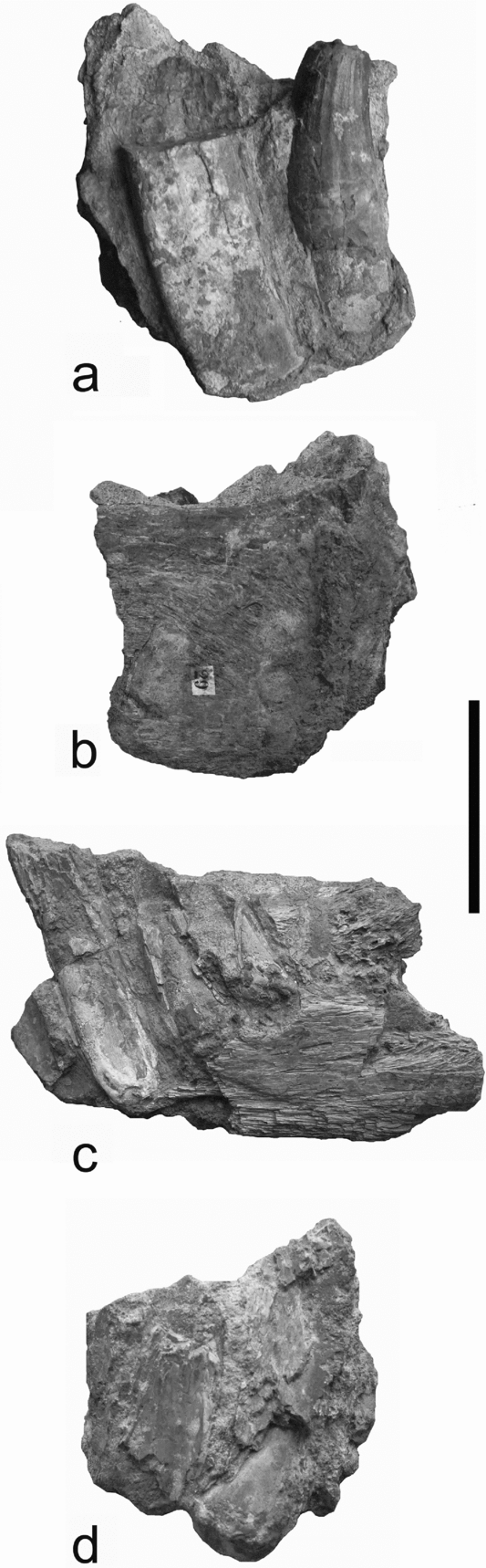
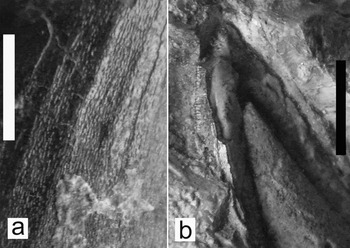
The most informative specimen (Fig. 1a,b) is a jaw fragment (29A, figured by Sauvage, Reference Sauvage1897–1898, pl. IV, fig. 4), apparently a portion of a right dentary, showing four incomplete teeth, which are largely exposed, including the roots, because the lingual part of the bone has been destroyed. The anterior break shows the tip of a replacement tooth, with wrinkled enamel and very fine serrations on the carina. The following tooth is represented only by its root, which is long and mediolaterally flattened. The best-preserved tooth is the third from the front; its apex is broken, revealing a nearly circular cross-section, the crown being only weakly compressed mediolaterally. The crown is slightly recurved and bears distinct ridges on both the lingual (8 ridges) and labial (7 ridges) faces. Anterior and posterior carinae are present, in the same plane as the curvature of the crown; because of wear, they show only faint indications of serrations. The surface of the enamel is distinctly wrinkled (Fig. 2a), as already noted by Sauvage (Reference Sauvage1897–1898). The posteriormost alveolus contains only fragments of a tooth. The labial face of the jaw fragment is more or less vertical, with a concave dorsal margin. Its surface is poorly preserved but shows a slightly rugose dorsoventral ridge in its anterior part.
Material of Baryonyx sp. from the Barremian of Boca do Chapim, Portugal, in the collections of the Museu Geologico, Lisbon. (a) Right dentary fragment 29A in lingual view, showing a tooth with an incompletely preserved crown and the root of another tooth. (b) Right dentary fragment 29A in labial view, showing vertical ridge. (c) Right dentary fragment 29B in lingual view, showing roots of broken teeth and a replacement tooth. (d) Left dentary fragment 29C in lingual view, showing roots of broken teeth. Scale bar=50 mm.

The other jaw fragment (29B, Fig. 1c) figured by Sauvage (Reference Sauvage1897–1898, pl. IV, fig. 5), also in all likelihood from a right dentary but probably from a more posterior region, bears three teeth. The anteriormost one consists only of the root, which is long and mediolaterally compressed. The following one is a poorly preserved root. The next one is the apex of a replacement tooth, split longitudinally, but still showing the anterior carina, which is clearly serrated, with 6 to 7 serrations per millimetre (Fig. 2b). The enamel surface is strongly wrinkled. The more or less vertical labial face of the bone is poorly preserved, but shows two large vascular foramina.
Enamel ornamentation in Baryonyx teeth from the Barremian of Boca do Chapim, Portugal. (a) Detail of the lingual surface of the large tooth in jaw fragment 29A, showing ribs and fine wrinkling. Scale bar=5 mm. (b) Replacement tooth in jaw fragment 29B, showing fine serrations on the anterior carina (left). Scale bar=5 mm.

The third, hitherto unreported, jaw fragment (29C, Fig. 1d) bears a dorsoventral ridge on its vertical lateral face and seems to be the counterpart of the above-described fragment (29A) on the left side. In labial view it shows remains of four close-set alveoli, two of them very incomplete, containing very poorly preserved tooth remains, with laterally compressed roots resembling those described above.
Although they cannot be fitted together, all three fragments bear teeth of similar size and may belong to a single individual.
Because of the poor preservation of the bones, any identification of this material has to be based on the teeth. They share the following characters with those of the spinosaurid dinosaur Baryonyx walkeri from the Barremian of England (as described by Charig & Milner, Reference Charig and Milner1997): conical, recurved crown with little labiolingual compression; labiolingually compressed root; carinae in the same plane as curvature of the crown; carinae bearing fine serrations (about 7 per millimetre); a few ribs on the lingual face of the crown; densely wrinkled or granular enamel.
The teeth from Boca do Chapim thus seem to differ little from those of Baryonyx walkeri, except possibly in the stronger development of ribs on the crown, especially on the labial side; the teeth of the holotype of Baryonyx walkeri usually have a smooth labial surface, with only extremely faint labial ribbing on some of them. Other baryonychine teeth from the Wealden of England show ribs on both the lingual and labial surfaces (Martill & Hutt, Reference Martill and Hutt1996; personal observations at Natural History Museum, London); the same applies to baryonychine teeth from the Wealden of Burgos Province, Spain (Torcida et al. Reference Torcida, Fuentes, Izquierdo, Montero and Urien1997). The Portuguese material is also reminiscent of the teeth of Suchomimus tenerensis (probably a species of Baryonyx: Milner, Reference Milner, Hurtado and Fernández-Baldor2003), from the Aptian of Niger (Sereno et al. Reference Sereno, Beck, Dutheil, Gado, Larsson, Lyon, Marcot, Rauhut, Sadleir, Sidor, Varricchio, Wilson and Wilson1998), in the shape of the teeth, their fine serrations and the wrinkling of the enamel; no ribbing is mentioned in Suchomimus tenerensis teeth, however. The teeth of the spinosaurid Spinosaurus aegyptiacus, from the Cenomanian of Egypt (Stromer, Reference Stromer1915), differ from those from Boca do Chapim in their weaker curvature, unserrated carinae and unribbed surface (it should be noted, however, that many isolated Spinosaurus-like teeth from the Albian of Tunisia and Cenomanian of Morocco show a distinct fluting of the crown: see Bouaziz et al., Reference Bouaziz, Buffetaut, Ghanmi, Jaeger, Martin, Mazin and Tong1988, about Tunisian specimens). In the spinosaurid Irritator challengeri, from the Albian of Brazil (Sues et al. Reference Sues, Frey, Martill and Scott2002; see also Kellner & Campos, Reference Kellner and Campos1996), the teeth are straight rather than recurved, with a wrinkled enamel and fluting on both the labial and lingual surfaces, but no proper serrations on the carinae. Among the abundant spinosaurid teeth from the lower Cenomanian of Brazil (Medeiros, Reference Medeiros2006), two morphotypes showing different kinds of ornamentation can be distinguished, but in both the carinae bear no denticles. The teeth from Boca do Chapim are rather similar to those of Siamosaurus suteethorni, from the Early Cretaceous of Thailand (Buffetaut & Ingavat, Reference Buffetaut and Ingavat1986), and to the Siamosaurus-like tooth from the Early Cretaceous of Japan described by Hasegawa et al. (Reference Hasegawa, Buffetaut, Manabe and Takakuwa2003) in general shape and wrinkling of the enamel, but their ribbing is less dense and their serrations more distinct. On the basis of these comparisons, the distinctive set of characters of the specimens from Boca do Chapim indicates that they can be referred to the genus Baryonyx. Because of their fragmentary condition and the above-mentioned slight differences with Baryonyx walkeri, it seems advisable to designate them as Baryonyx sp.
4. A note on Suchosaurus
It should be mentioned that Sauvage's attribution of the material from Boca do Chapim to the genus Suchosaurus was not completely unfounded, although placement among the crocodilians was wrong. The genus Suchosaurus, with Suchosaurus cultridens as type species, was erected (originally as a sub-genus of Crocodilus) by Owen (in the part published in 1841 of his Odontography, 1840–1845) for teeth from the Wealden of Tilgate Forest, Sussex, previously mentioned by Mantell (Reference Mantell1827) as gavial-like. Owen considered them as belonging to a crocodilian, but noted that they exhibited some resemblance with those of Megalosaurus, notably in showing a degree of lateral compression and in the position of the anterior and posterior carinae (Owen, Reference Owen1842). However, Suchosaurus teeth bear ribs which distinguish them from those of most theropods. As noted by Milner (Reference Milner, Hurtado and Fernández-Baldor2003), at least some of the teeth referred to Suchosaurus from the Wealden of England are identical or extremely similar to Baryonyx teeth. The type specimen of Suchosaurus cultridens (NHM, R36536, figured by Owen, Reference Owen1878, pl. IV, figs 5, 6) is a tooth from the Wealden of Cuckfield, Sussex, which shows marked ribbing on both the labial and lingual surfaces, wrinkled enamel, but no distinct serrations, apparently because of wear. It is generally similar to the larger tooth from Boca do Chapim (in specimen 29A), and Sauvage's attribution was therefore founded, as the only teeth with such characters known at that time were those referred to Suchosaurus. No reasons were given, however, for the erection of a new species, Suchosaurus girardi, as distinct from the type species S. cultridens.
Suchosaurus could be regarded as a senior synonym of Baryonyx. However, the type specimen of Suchosaurus cultridens has a strongly ribbed labial surface whereas the teeth of the holotype of Baryonyx walkeri are smooth, or nearly completely so, labially, so that it cannot be excluded that they belong to distinct taxa. Baryonychine teeth from England (Martill & Hutt, Reference Martill and Hutt1996) and Spain (Canudo & Ruiz-Omeñaca, Reference Canudo, Ruiz-Omeñaca and Pérez-Lorente2003) show a certain amount of variation, which, if not of an individual nature, may correspond to the occurrence of more than one taxon (the same occurs among Spinosaurus-like teeth from North Africa and Brazil, as mentioned above). Moreover, as the type specimen of Suchosaurus cultridens is a worn isolated tooth, whereas Baryonyx walkeri is based on a large part of a skeleton, for practical purposes it seems advisable to go on using the generic name Baryonyx instead of Suchosaurus.
5. Conclusion
The identification of Baryonyx at Boca do Chapim extends the distribution of this spinosaurid genus to Portugal. Baryonyx was originally described from England (Charig & Milner, Reference Charig and Milner1986), on the basis of a skeleton from the early Barremian Upper Weald Clay of Surrey. Additional material has since then been reported from various formations of the English Wealden, ranging in age from Hauterivian to Barremian (Martill & Hutt, Reference Martill and Hutt1996; Charig & Milner, Reference Charig and Milner1997; Milner, Reference Milner, Hurtado and Fernández-Baldor2003; Hutt & Newbery, Reference Hutt and Newbery2004; Naish & Martill, Reference Naish and Martill2007). The specimens from Boca do Chapim are not the first record from the Iberian Peninsula, since baryonychines have been reported from various Spanish Early Cretaceous localities (see reviews in Canudo & Salgado, Reference Canudo, Salgado and Pérez-Lorente2003; Canudo & Ruiz-Omeñaca, Reference Canudo, Ruiz-Omeñaca and Pérez-Lorente2003; Ruiz-Omeñaca & Canudo, Reference Ruiz-Omeñaca, Canudo and Pérez-Lorente2003), notably from the Hauterivian of Burgos (Torcida et al. Reference Torcida, Fuentes, Izquierdo, Montero and Urien1997), the Barremian of La Rioja (Viera & Torres, Reference Viera and Torres1995) and Teruel (Ruiz-Omeñaca, Canudo & Cuenca-Bescós, 1997; Infante, Canudo & Ruiz-Omeñaca, 2005; Sánchez-Hernández, Benton & Naish, 2007), and the Aptian of Burgos (Torcida et al., Reference Torcida, Fuentes, Izquierdo, Montero and Urien1997) and Castellon (Canudo et al. Reference Canudo, Gasulla, Ortega and Ruiz-Omeñaca2004). Clearly, baryonychines were a rather common element of the Early Cretaceous dinosaur assemblages of Europe, at least from the Hauterivian to the Aptian (they have so far never been reported from the Albian, despite the fact that Albian dinosaurs are known from several parts of Europe, including Britain and France).
In view of the presence of baryonychines in the Early Cretaceous of Africa (Sereno et al. Reference Sereno, Beck, Dutheil, Gado, Larsson, Lyon, Marcot, Rauhut, Sadleir, Sidor, Varricchio, Wilson and Wilson1998), the occurrence of Baryonyx in Portugal (and more generally in the Iberian Peninsula) may be of some palaeobiogeographical importance. Recent palaeogeographical reconstructions (Rey et al. Reference Rey, Dinis, Callapez and Cunha2006) show the Iberian plate in close proximity to the northern margin of Africa in the Early Cretaceous. This suggests that dispersal of baryonychines between Europe and Africa may have taken place via a route through Iberia, as already suggested by Milner (Reference Milner, Hurtado and Fernández-Baldor2003). Although Canudo (Reference Canudo, Fernández-Baldor and Hurtado2006) favours vicariant evolution for spinosaurids, the very close relationships between European and African baryonychines suggest that dispersal is a more likely explanation for the distribution of this particular sub-family. However, the biogeographical history of spinosaurids in general remains obscure (see Buffetaut & Ouaja, Reference Buffetaut and Ouaja2002, for a review) because of gaps in their fossil record, and whether possible dispersal via Iberia may have taken place from Europe to Africa, as suggested by Milner (Reference Milner, Hurtado and Fernández-Baldor2003), or the reverse, is still uncertain.
Acknowledgements
Thanks to Professor Miguel Ramalho for his kind welcome at the Museu Geologico in Lisbon and for access to the material described in the present paper, and to Dr Angela Milner (Natural History Museum, London) for access to Baryonyx and Suchosaurus material in her care and for helpful discussions. Professor Jacques Rey (Toulouse) provided useful information about the geology of the Boca do Chapim locality.