Introduction
Nasopharyngeal carcinoma (NPC) is a rare malignancy with an incidence of less than 1 per 100 000 person years in most parts of the world for both genders.Reference Parkin, Whelan, Ferlay, Raymond and Young1 However, studies show that it is common in a particular race, the Chinese, and more specifically, the Cantonese.Reference Huang2–Reference Li, Yu and Henderson4 Cantonese men and women from Guangdong show double the rates of this cancer compared with other dialect groups, including the Hakka, Hokkien and Chiu Chau peoples.Reference Yu, Ho, Ross and Henderson3, Reference Li, Yu and Henderson4 Moreover, Cantonese people who migrated to South East Asia continue to show double the risk of NPC, compared with other dialect groups of Southern China.Reference Yu and Yuan5 The highest incidences of NPC are in Southern China (as high as 20 to 50 per 100 000 person years) and South East Asia.Reference Parkin, Whelan, Ferlay, Raymond and Young1, Reference Yu and Yuan5, Reference Jeannel, Bouvier and Huber6
As the population dynamics of a country contribute to its levels of disease incidence, one important factor when assessing disease incidence in this review is migration of people from a high incidence country to a low incident country. It is now recognised that migration of populations may alter the immigrants' level of disease risk.Reference Yu, Ho, Ross and Henderson3, Reference Yu and Yuan5, Reference Buell7, Reference King, Li, Locke, Pollack and Tu8 Chinese people make up one of the world's largest migrant populations, as shown in Figure 1, and provide a good resource for epidemiologic investigation of changes in the risk and incidence of NPC.9
Ten largest ethnic Chinese populations outside China.

The majority of residents in any migrant Chinese community are known to share a common geographical origin and/or dialect. It is important to assess whether changes in environment and living circumstances have a substantial impact on cancer risks in migrant populations. Studies have found decreased mortality rates for certain cancers in Chinese migrants living in the USA, compared with Chinese residents in Hong Kong;Reference King, Li, Locke, Pollack and Tu8 however, the mortality rates of other cancers (i.e. colon, lung, leukaemia and female breast cancer) have increased. In particular, the incidence of NPC has been reported to have decreased in successive generations of Southern Chinese now living in countries with a low risk of this disease, such as the USA and Australia.Reference Yu, Ho, Ross and Henderson3, Reference Yu and Yuan5, Reference Jeannel, Bouvier and Huber6
An understanding that some Chinese immigrants may have originated from areas with a higher incidence of NPC (compared with other parts of China) will contribute to knowledge on NPC incidence in countries hosting migrant Chinese populations.Reference Parkin, Whelan, Ferlay, Raymond and Young1, Reference Yu and Yuan5, Reference Wang, Ramcharan and Love10
Emigration from China
The Chinese diaspora is extensive. Chinese civilisation has existed for more than 4000 years, allowing its citizens millennia to migrate to most parts of the world. Dudley and Mei divide the history of Chinese emigration into four periods.Reference Dudley and Mei11
The first is named the ‘ancient period’, and covers the Chinese dynasties of the previous 2000 to 3000 years up to the mid-Qing dynasty of the eighteenth century. During this period, most Chinese migration was to other Asian countries, mainly in South East Asia.
The second period of emigration spans from the nineteenth century to the late 1940s, and covers the decline of Imperial China and the Republican period. During this period, Chinese migrants travelled to most parts of the world rather than to a specific region, the so-called ‘coolie trade’ being an important influence.
The third period covers the first 30 years of the People's Republic of China (1949–1979). Chinese emigration during this period was severely restricted.
The fourth period of emigration is the contemporary period, which began with the opening of China to foreigners by the Chinese government.
It is instructive to study the Chinese immigration pattern in specific regions. Data are available for three defined destinations, as follows.
Chinese in Hong Kong
The first migration of Chinese to Hong Kong was reported during the Han dynasty (207BC to AD220). The continuous settlement of Chinese in Hong Kong began no later than the thirteenth century.Reference King and Haenzel12 The origins of Hong Kong residents are indicated by their dialects, as follows: Cantonese 79 per cent, Hakka 4.9 per cent, Hoklo 6.3 per cent, Si Yi 4.4 per cent and all others 5.4 per cent. The descendants of an aboriginal tribe known as the Tankas make up 4 per cent of the total population.Reference King, Li, Locke, Pollack and Tu8
Chinese in Singapore
Most of the Chinese in Singapore originate from the south-eastern Chinese provinces of Fukien and Kwangtung. The major dialect groups (1990 census) are Hokkiens (42.2 per cent), Teochew (21.9 per cent), Cantonese (15.2 per cent), Hakka (7.3 per cent) and Hainanese (7.0 per cent); others make up 6.4 per cent.Reference Parkin, Whelan, Ferlay, Teppo and Thomas16
Chinese in the USA
The majority of Chinese people entering the USA originated from two community groups in Guangzhou province before 1900.Reference King and Haenzel12 The first group comprised San Yi from the districts of Taishan, Kaiping and Enping. The second group consisted of Si Yi from Xihui, Shunde, Nanhai and Fanyu districts. In the early twentieth century, Chinese migrants from Zhongshan county emerged as a major contributor to the Chinese community in the US. The majority of Chinese Americans are concentrated in San Francisco, Los Angeles, New York City and Hawaii.Reference King, Li, Locke, Pollack and Tu8
Methods
We performed a systematic review, aiming to include all studies of nasopharyngeal carcinoma (NPC) incidence rates in Chinese populations between 1960 and 2008. An initial, broad search for all statistical and analytical reviews listed in the PubMed, Embase and Scopus electronic databases was performed, identifying all articles pertinent to the topic of ‘incidence of nasopharyngeal carcinoma in the Chinese’. The following search terms were used: ‘trends in incidence of nasopharyngeal carcinoma’, ‘nasopharyngeal cancer in Chinese migrants’ and ‘nasopharyngeal cancer incidence rates’.
Relevant articles focusing on the NPC incidence rates in Chinese populations were identified and reviewed. This was followed by a hand search of the reference lists of all retrieved papers, in order to identify any additional studies missed during the databases searches. Both unpublished studies and non-English publications were excluded in this review. We included studies covering countries with mainly Chinese populations and countries where the Chinese are in the minority, and studies assessing NPC incidence and mortality rates (including age-standardised and age-specific rates) which covered at least three time periods. Studies of the latter type were targeted because trends are not evident when just two time periods are evaluated.
We did not differentiate NPC by histological type for the purpose of incidence studies, as this would have greatly limited the data retrieved.
A total of 19 papers met the inclusion criteria.
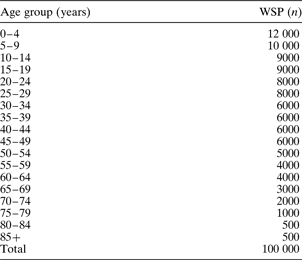
Our analysis used data from volumes II, III, IV, VII, VIII and IX of Cancer Incidence in Five Continents, in order to formulate incidence trends amongst Chinese populations in specific states and countries.Reference Parkin, Whelan, Ferlay, Raymond and Young1, Reference Doll, Muir and Waterhouse13–Reference Parkin, Whelan, Ferlay, Teppo and Thomas16, Reference Curado, Edwards, Shin, Storm, Ferlay and Heanue18 Data from other studies were also included.Reference Jia, Huang, Liao, Ye, Shugart and Liu19, Reference Seow, Koh, Chia, Shi, Lee and Shanmugaratnam20 We adjusted the age-standardised rates into world standardised incidence rates by direct standardisation in accordance with the World Standard Population.20 (World Standard Population according to age group. Table I), as Cancer Incidence in Five Continents volumes II (1970) and III (1976) do not report incidence rates based on world standardised incidence rates.Reference Chen, You, Lin, Hsu and Yang21
World standard population by age group

WSP = world standard population
Age-standardised rate =

Such that δ = each age group,
n δ = number of cases in the δ age group,
y δ = population size in the δ age group, and
w δ = proportion of the total world standard population in the δ age group.
n δ/y δ = age-specific rates for each δ age category, and the sum of w δ is equal to 100 000, to express the age-standardised rate per 100 000 person years.
Results
The collected data were compared, in order to analyse changes in nasopharyngeal carcinoma (NPC) incidence in various Chinese populations. The selected areas of interest were Singapore, the San Francisco Bay area (USA), Los Angeles County (USA) and Hawaii (USA). China, Hong Kong and Taiwan were included for comparison. Countries in South East Asia (e.g. Malaysia and Indonesia) which have significant Chinese populations could not be compared, as data from these countries were insufficient to tabulate a trend.
Figure 2 and Table II show that age-standardised incidence rates for NPC in Singaporean Chinese, assessed from 1960 to 2002, have steadily decreased from the 1973–1977 time period onwards in both males and females.
World age-standardised nasopharyngeal carcinoma (NPC) incidence rates in Singaporean and Hawaiian Chinese populations over time. (a) Males; (b) females.

Nasopharyngeal carcinoma incidence in chinese populations of singapore and hawaii, 1960–2002

Data represent world age-standardised incidence per 100 000 population. – = Data not obtained
The NPC incidence in the Hawaiian Chinese population, assessed over the same time period, showed a similar trend amongst females but no such decline amongst males. However, compared with Hawaiian data, the incidence amongst Singaporean Chinese was 3.2 (for males) and 4.7 (for females) times higher at the point of maximum difference.
A decreasing trend in age-standardised NPC incidence rates was also seen for both Chinese males and females living in San Francisco and in Los Angeles County, California, USA (Figure 3 and Table III).
World age-standardised nasopharyneal carcinoma (NPC) incidence rates in Chinese males and females over time, in (a) San Francisco Bay Area and (b) Los Angeles County, California, USA.

Nasopharyngeal carcinoma incidence in chinese populations of san francisco bay area and los angeles county, california, USA, 1969–2002

*San Francisco Bay Area data for 1973–1997; Los Angeles County data for 1972–1977. Data represent world age-standardised incidence per 100 000 population. San Fran = San Francisco; – = data not obtained
To enable comparison, we selected regions with a predominantly Chinese population and for which NPC incidence data were available. Figure 4 shows the age-standardised NPC incidence rates in these regions, compared with those of the Chinese populations in Singapore, Hawaii, San Francisco and Los Angeles.
Age-standardised nasopharyngeal carcinoma (NPC) incidence rates in selected countries with a dominant Chinese population (1998–2002): (a) males; (b) females. * = Chinese population

We also noted a trend towards decreasing NPC incidence the further the Chinese population had immigrated. The NPC incidence in Singaporean Chinese was higher than that in Hawaiian Chinese, and that in Hawaiian Chinese was higher than that in Californian Chinese.
Discussion
Chinese people living in different parts of the world show differing nasopharyngeal carcinoma (NPC) incidence rates. Historically, most Chinese migrants came from Southern China, where NPC is most prevalent. Chinese populations in Guangdong (especially the Cantonese subgroup), GuangXi, Hunan and Fujian are at highest risk.Reference Yu and Yuan5 Huang et al. described NPC mortality in Guangzhou (1970–1976) to be lower among migrants from outside the Guangzhou province, compared with local residents, even though the former may have resided in Guangzhou for many years.Reference Doll, Payne and Waterhouse22
The Singaporean Chinese population was chosen for comparison due to the accuracy of the data on this group (due to collection of NPC incidence data over recent decades).
The NPC incidence rate in Taiwan, the population of which is mainly Chinese, was not used, as data collection did not specify race and thus may have included races other than the Chinese.
However, we did use data on NPC incidence within the regions of China from which most Chinese migrants originate, to enable comparison with the NPC incidence of Chinese migrant populations.
Incidence rate: downward transition
Our results clearly demonstrate that the risk of NPC for Chinese migrants in the US (i.e. San Francisco Bay Area, Los Angeles and Hawaii) is lower than that for Singaporean Chinese. However, the age-standardised NPC incidence rate amongst Singaporean Chinese is lower than that in Guangzhou and Hong Kong.Reference Curado, Edwards, Shin, Storm, Ferlay and Heanue18 Chinese people living in areas of southern China (including Hong Kong) have a higher NPC incidence compared with Chinese migrants living overseas.
These results indicate that Chinese migrants in lower NPC risk countries have a substantially decreased NPC incidence rate.
Interestingly, Sihui, Cangwu, Hong Kong and Hawaii share the same latitude (Sihui is 23.75° north, Cangwu 23.25° north; Hong Kong 22.15° north and Hawaii 18°–22° north) but have different age-standardised NPC incidence rates.Reference Huang, Wang, Luo, Hu, Gu and Gu23
All Chinese migrant populations contain a mixture of dialect groups, and this creates a lack of specificity in the data obtained. We can only state approximately that Chinese migrants are descendants of Southern Chinese populations. While a large segment of Chinese Americans are descendants from the high NPC risk Zhongshan prefecture, there is a noticeable admixture of other migrants originating from parts of China with lower NPC risk. This may lower NPC incidence rates among the US Chinese, compared with their counterparts in China and South East Asia.
When we focused on individual areas, we found that the age-standardised NPC incidence in both males and females has decreased in Singapore, the San Francisco Bay Area and Los Angeles County. Decreasing trends have also been reported in Hong Kong, Shanghai and Taiwan.Reference Parkin, Whelan, Ferlay, Raymond and Young1, Reference Yu and Yuan5, Reference Seow, Koh, Chia, Shi, Lee and Shanmugaratnam20, Reference Lee, Foo, Mang, Sze, Chappell and Lau25, Reference Jin, Devesa, Chow, Zheng, Ji and Fraumeni26
The relationship between economic progress and NPC incidence is stark. Nasopharyngeal incidence rates in Hong Kong have been declining since the end of the Pacific War, due to the city's rapid economic development.Reference Geser, Charnay, Day, de The, Ho, de The and Ito27, Reference Yu, Ho, Lai and Henderson28 Singapore's economic boom followed 20 years behind Hong Kong's, following independence in 1965, and a declining NPC incidence trend is clearly seen (Figure 2).Reference Yu and Yuan5 Singapore, Hong Kong, Taiwan and the United States are included in the 2007 International Monetary Fund list of ‘advanced economies’. China is included in the International Monetary Fund ‘emerging market and developing countries’ list.29 The Financial Times and London Stock Exchange ‘developed countries’ list also includes Hong Kong, Singapore and the USA, among 21 other countries.30 Taiwan is included in the Financial Times and London Stock Exchange ‘advanced emerging countries’ list, and China features in the ‘secondary emerging markets’ list. Shanghai is one of the more developed areas in China, and has shown a trend towards decreasing NPC incidence: during 1973–1977, the reported incidence was 5.6 per 100 000 person years in men and 2.5 per 100 000 person years in women, but by 1988–1992 it had declined to 4.5 and 2.5 per 100 000 person years, respectively.Reference Parkin, Whelan, Ferlay, Raymond and Young1
Causes of nasopharyngeal carcinoma
Ho proposed that NPC resulted from a combination of genetic susceptibility, Epstein–Barr virus (EBV) infection and consumption of salted fish since childhood.Reference Ho31 Evidence for a disease susceptibility gene for NPC was first reported by Lu et al. Reference Lu, Day, Degos, Lepage, Wang and Chan32 Over the years, studies of genetic polymorphisms of some metabolic enzyme genes (CYP2E1 and GSTM1) and some DNA repair genes (hOGG1 and XRCC1) have found an association with increased risk of NPC.Reference Hildesheim, Anderson, Chen, Cheng, Brinton and Daly33–Reference Cho, Hildesheim, Chen, Hsu, Chen and Mittl36 Other gene linkage studies have mapped major susceptibility loci to chromosomes 3, 4 and 14.Reference Feng, Huang, Shugart, Lee, Zhang and Xia37, Reference Xiong, Zeng, Xia, Xia, Shen and Li38 In Asian Chinese, human leukocyte antigen alleles A2 and B46 are also associated with a high risk of developing NPC.Reference Goldsmith, West and Morton39, Reference Hu, Day, Li, Luben, Cai and Ou-Yang40
The factor discovered to have the strongest positive association with NPC is salted foods.Reference Yu, Ho, Ross and Henderson3, Reference Yu, Ho, Lai and Henderson28, Reference Armstrong, Armstrong, Yu and Henderson41–Reference Ning, Yu, Wang and Henderson45 Consumption of salt-preserved foods (e.g. fish, leafy vegetables, eggs and root vegetables), fresh pork and beef organ meats, beer, and liquor are all positively associated with NPC.Reference Armstrong, Imrey, Lye, Armstrong, Yu and Sani42 The presence of carcinogenic nitrosamines or nitrosamine precursors and EBV-activating substances have been found in salted foods.Reference Huang, Ho, Webb, Wood and Gough46–Reference Shao, Poirer, Ohshima, Malaveille, Zeng and de The48
Occupational hazards are related to a high risk of NPC, such as exposure to wood dust and industrial heat.Reference Armstrong, Imrey, Lye, Armstong, Yu and Sani49 Smoke, dust and chemical fumes have also been reported as causative agents.Reference Yu, Ho, Lai and Henderson28, Reference Ning, Yu, Wang and Henderson45
Yu suggested a possible link between burning incense sticks and NPC.Reference Yu, Garabran, Huang and Henderson50 Incense sticks are found to contain polycyclic aromatic hydrocarbon, a known carcinogenic.Reference Schoenotol and Gibbard51 Studies have shown that burning incense sticks, used in religious worship by the Chinese, is a highly possible risk factor for NPC.Reference Yang, Lin and Chang52, Reference Lin, Yang and Chang53
Epstein–Barr virus infection in nasopharyngeal carcinoma
Epstein–Barr virus infects B lymphocytes and epithelial cells, inducing growth transformation. This virus is commonly found in the saliva of healthy individuals. The source of the virus may originate from lymphocytes patrolling the oral mucosa, or from EBV replication in epithelial cells after reactivation from latently infected lymphocytes. The virus can be shed from the lymphocytes into the nasopharynx, or may stay to replicate in mucosal epithelial cells. This then induces an immunoglobulin A response. Increased viral shedding in combination with possible genetic changes (e.g. absence of p16 expression) causes a focus of latent infection in basal epithelial cells. This focus may rapidly become malignant and invade the basement membrane.Reference Raab-Traub54
Certain EBV strains have been found in the Chinese population, using restriction enzyme polymorphism methods. A strain prevalent in the southern Chinese has lost the BamHI restriction site, and the loss of an XhoI restriction enzyme polymorphism has also been found within the latent membrane protein 1 gene of the virus.Reference Raab-Traub54 Latent membrane protein 1 has profound growth-stimulating effects in vitro. Further studies on prevalent Chinese EBV strains have found distinct sequence variation in the amino terminus of latent membrane protein 1.Reference Raab-Traub54 These factors influence the viral replication process, leading to expression of latent transformed genes and causing infected cells to proliferate.
The EBV strain detected with higher frequency among Chinese NPC patients (i.e. the Cf strain) has been distinguished from that found in the majority of Caucasian NPC patients (i.e. the DF strain) in the USA, using polymorphisms in the BamHI F and I regions. Differences in EBV strains have been detected among US Chinese migrants. First and second generation Chinese migrants show retention of the Cf EBV genotype.Reference Lung, Chang, Miller, Wara and Phillips55
Environmental factors such as phorbol ester contamination in water supplies lead to increased reactivation and replication of EBV.Reference Raab-Traub54 Consumption of salted foods may cause the same results. Further studies are needed to investigate these links.
Conclusion
Migration to another country affects every aspect of the migrant's life. This review has shown that there is a decreasing trend in the incidence of nasopharyngeal carcinoma (NPC) in Chinese migrants who live in countries with a low NPC risk. The reasons for this are multifactorial. We recognise that Chinese culture itself may play a role in NPC development (incense sticks, salted food and organ meats have been implicated), and that the migration of Chinese people to another country may alter such practices. Further studies and lifestyle investigations of Chinese migrants are needed in order to investigate further their risk of developing NPC.
Acknowledgement
We would like to thank Mr Simon Ogston, Lecturer in Medical Statistics, Public Health Section, Community Health Sciences Division, Mackenzie Building, Dundee, for his help with statistics.