Introduction
Historical buildings constitute a significant part of the cultural heritage. Often, such structures do not have a chronological framework, and the method that would determine the time of construction of the buildings is not simple for various reasons; sometimes it is the lack of appropriate dating material, and in other cases, the available material requires special pretreatment adapted to the composition of the samples. Materials that are closely related to the moment of the building’s construction are mortars. The reliability of the radiocarbon age of mortars has been discussed since the 1960s (Baxter and Walton Reference Baxter and Walton1970; Folk and Valastro Reference Folk and Valastro1976; Labeyrie and Delibrias Reference Labeyrie and Delibrias1964; Stuiver et al. Reference Stuiver, Smith, Chatters and Olson1965) through the intercomparison project MODIS 1 and 2 (Hajdas et al. Reference Hajdas, Lindroos, Heinemeier, Ringbom, Marzaioli, Terrasi, Passariello, Capano, Artioli, Addis, Secco, Michalska, Czernik, Goslar, Hayen, Van Strydonck, Fontaine, Boudin, Maspero, Panzeri, Galli, Urbanová and Guibert2017; Hayen et al. Reference Hayen, Van Strydonck, Fontaine, Boudin, Lindroos, Heinemeier, Ringbom, Michalska, Hajdas, Hueglin, Marzaioli, Terrasi, Passariello, Capano, Artioli, Addis, Secco, Maspero, Laura Panzeri, Galli, Guibert, Urbanová, Czernik, Goslar and Caroselli2017; Michalska et al. Reference Michalska, Czernik and Goslar2017) and in recent studies (Barrett et al. Reference Barrett, Keaveney, Lindroos, Donnelly, Daugbjerg, Ringbom, Olse and Reimer2021; Caroselli et al. Reference Caroselli, Hajdas and Cassitti2020; Daugbjerg et al. Reference Daugbjerg, Lindroos, Hajdas, Ringbom and Olsen2021a, Reference Daugbjerg, Lindroos, Heinemeier, Ringbom, Barrett, Michalska, Hajdas, Raja and Olsen2021b; Hajdas et al. Reference Hajdas, Maurer and Röttig2020; Lindroos et al. Reference Lindroos, Ringbom, Heinemeier, Hodgins, Sonck-Koota, Sjöberg, Lancaster, Kaisti, Brock, Ranta, Caroselli and Lugli2018).
To obtain an accurate mortar production age, it is necessary to eliminate components that would cause a shift in 14C age, e.g., carbonate aggregate, not totally burnt fragments (dead carbon effect) or secondary crystallization (Nawrocka et al. Reference Nawrocka, Czernik and Goslar2009; Sonninen and Jungner Reference Sonninen and Jungner2001). Depending on the conditions, secondary crystallization may cause both the rejuvenation of the results and their apparent aging (Michalska and Mrozek-Wysocka Reference Michalska and Mrozek-Wysocka2020). Additional complications in the dating of mortars are also caused by admixtures of ceramic dust or terracotta (in the case of cocciopesto mortars; Hajdas et al. Reference Hajdas, Lindroos, Heinemeier, Ringbom, Marzaioli, Terrasi, Passariello, Capano, Artioli, Addis, Secco, Michalska, Czernik, Goslar, Hayen, Van Strydonck, Fontaine, Boudin, Maspero, Panzeri, Galli, Urbanová and Guibert2017), which make the resulting binder very reactive. Considering how many factors can influence the dating of mortars, much of the latest research has focused on preparation and reliability control (Hajdas et al. Reference Hajdas, Maurer and Röttig2020; Marzaioli et al. Reference Marzaioli, Lubritto, Nonni, Passariello, Capano and Terrasi2011; Ringbom et al. Reference Ringbom, Lindroos, Heinemeier and Sonck-Koota2014).
Here, we present results of radiocarbon dating of recently excavated (Reference Hajdas, Maurer and Röttig2020) Tyniec platform. The Tyniec hill on which the Monastery is located is surrounded by carbonate formations. The main challenge in the preparation of Tyniec mortars is the separation of “dead carbon,” which might be included in the binder due to incomplete burning or in the entire mortars by presence of carbonaceous aggregate. Therefore, the sequential dissolution has been used to eliminate the contaminants. It is based on the difference between the reactivity of the fast dissolving soft binder and the limestone aggregate.
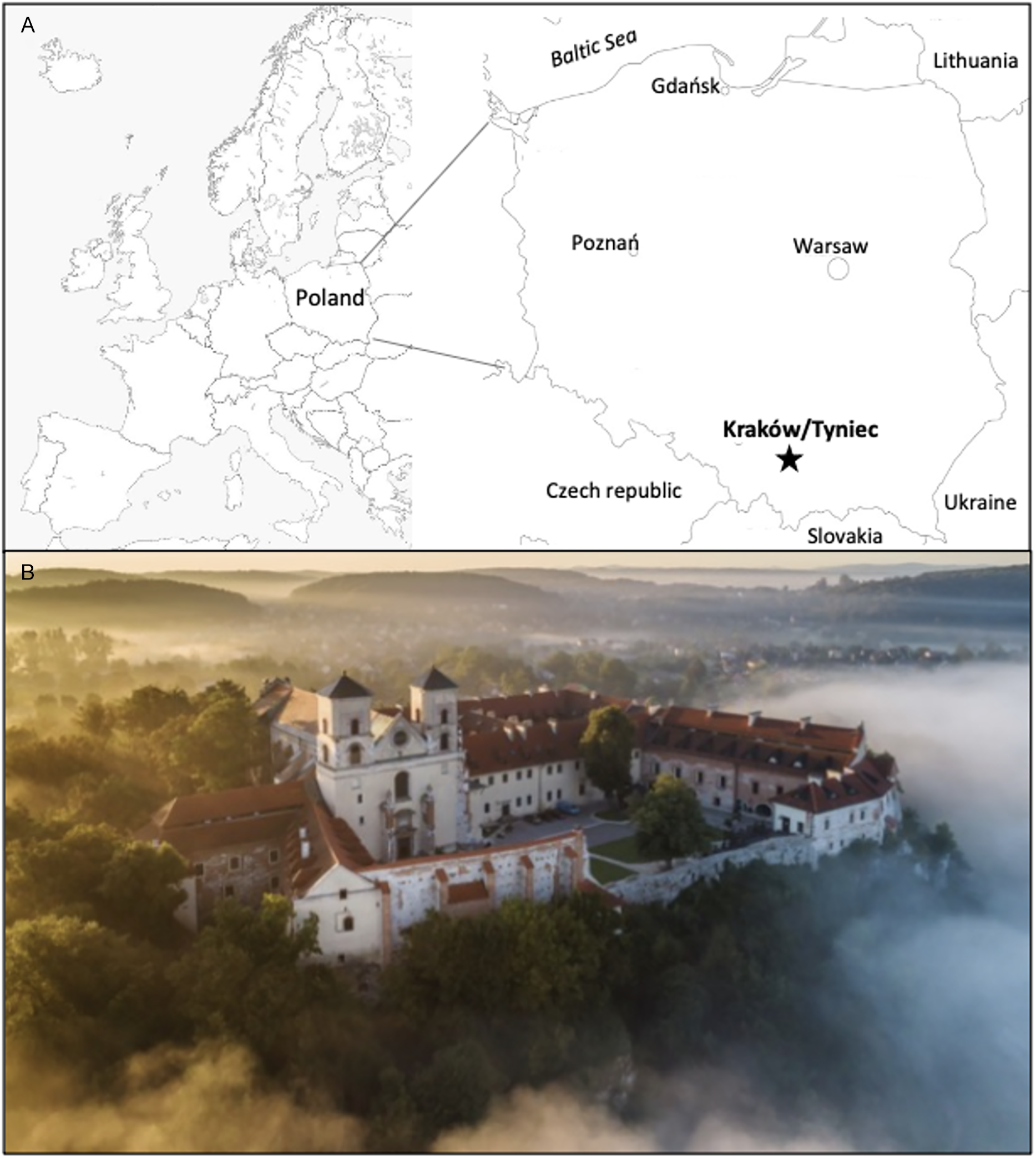
The Benedictine Abbey in Tyniec is the oldest existing monastery in Poland (11th cent. AD; Figure 1). Observations made during archaeological research in recent years, also because of preliminary geophysical research (carried out by F. Welc), have become an impulse for the development of the Tyniec chronology project. In view of the discoveries made, the priority research task to be undertaken to reconstruct the material history of the abbey is to prepare a new, updated (in relation to existing theories) scenario of the topographic and architectural changes of the Tyniec Hill during the expansion of the Romanesque monastery complex (11th–13th centuries).
The Benedictine Abbey in Tyniec: A) map of Poland and the location of the Kraków/Tyniec; B) monastery in aerial view (photo Paweł Krzan).

Geological background
The Benedictine Abbey in Tyniec (landscape of the Vistula River valley in the western part of Krakow) was founded onto the Upper Jurassic rocks forming a fragment of carbonate buildups complex. Geologically, Kraków/Tyniec is located within the Kraków-Silesia Monocline (Gradziński Reference Gradziński1972), a structure influenced by the tectonic evolution of the Carpathian foreland (Oszczypko et al. Reference Oszczypko, Krzywiec, Popadyuk, Golonka and Picha2006). The surrounding hills are composed of Upper Jurassic limestones (Oxfordian), primarily bedded limestones with cherts stone and massive limestones, overlain by Upper Miocene clay deposits (Alexandrowicz Reference Alexandrowicz1955; Krajewski et al. Reference Krajewski, Olchowy and Rudzinski2018). In their slopes numerous cliffs with karst features can be observed (Głazek et al. Reference Głazek, Pacholewski, Rózkowski, Back, Herman and Paloc1992; Matyszkiewicz Reference Matyszkiewicz2008). The local geological structure provides a potential source of raw materials for producing mortars, including both limestones and clays (Sanjurjo-Sánchez et al. Reference Sanjurjo-Sánchez, Trindade, Blanco-Rotea, Benavides Garcia, Fernández Mosquera, Burbidge, Prudêncio and Dias2010; Skuta et al. Reference Skuta, Antonkiewicz, Guzik and Kołodziej2024).
Site and material
According to written sources (Długosz, HP, III; idem, LB, III), the monastery in Tyniec was founded in 1044 by Prince Casimir I the Restorer, perhaps on the initiative of his mother, the German Princess (granddaughter of the Holy Roman Emperor Otto II) and Queen of Poland, Richeza; it was endowed by the King Bolesław II the Bold and the Princess Judyta Maria, wife of the Prince Władysław Herman (cf. Derwich Reference Derwich and Żurowska1995; Gieysztor Reference Gieysztor and Żurowska1995; Graczyńska and Kamińska Reference Graczyńska, Kamińska, Janiak and Stryniak2014; Kamińska Reference Kamińska and Małecki2014; Kwiatkowska-Baster and Baster Reference Kwiatkowska-Baster and Baster1994; Labuda Reference Labuda and Gadomski1986, Reference Labuda and Żurowska1995; Łuszczkiewicz Reference Łuszczkiewicz1875; Michałowski Reference Michałowski1989; Sczaniecki Reference Sczaniecki1978, Reference Sczaniecki and Żurowska1995; Reference Sczaniecki2008; Szczygielski Reference Szczygielski1668; Tomkowicz Reference Tomkowicz1901; Żurowska Reference Żurowska and Żurowska1995, Reference Żurowska, Bałus, Walanus and Walczak2007). As revealed during the archaeological and architectural research conducted since 2018, before (or during) the construction of the oldest church, large-scale engineering works were carried out, consisting of strengthening or even “extending” a fragment of the hill with an earth embankment several meters thick. It was secondarily reinforced with an extremely massive stone structure in a stepped form. In such a prepared area, on the northeastern edge of the hill, Benedictine monks erected a Romanesque, three-nave basilica, and a little further to the south—monastery buildings (Kalinowski Reference Kalinowski1971a, Reference Kalinowski1971b, Reference Kalinowski1971c; Kopera Reference Kopera1908; Leńczyk Reference Leńczyk1952, Reference Leńczyk1955, Reference Leńczyk1956; Łyczak et. al, Reference Łyczak, Bojęś-Białasik, Kamińska and Rodzińska-Chorąży2024; Piątkiewicz-Dereniowa Reference Piątkiewicz-Dereniowa1971; Szyszko-Bohusz Reference Szyszko-Bohusz1947; Woźniak and Zoll-Adamikowa Reference Woźniak and Zoll-Adamikowa1971; Żurowska Reference Żurowska1971, Reference Żurowska1974, Reference Żurowska and Gadomski1986, Reference Żurowska and Żurowska1995, Reference Żurowska, Bałus, Walanus and Walczak2007). From the very beginning of its existence, the church was the burial place of important persons, including Tyniec Abbots. The chronologically oldest grave, made in the form of a stone-built tomb, could even belong to the first head of the congregation, the abbot of Tyniec and bishop of Kraków, Aaron or his successor, abbot Anchoras (Zoll-Adamikowa Reference Zoll-Adamikowa1966, Reference Zoll-Adamikowa1977).
Over time, the abbey was expanded: economic and representative buildings were built, including the so-called “Castle” (now called Opatówka) or the so-called “Starosty” (Starostwo); in the 1st half of the 14th century, the church was rebuilt in the Gothic style, and then in the 17th century it was adapted in the Baroque style. The Benedictines (except for less than a century) are present in Tyniec to the present day.
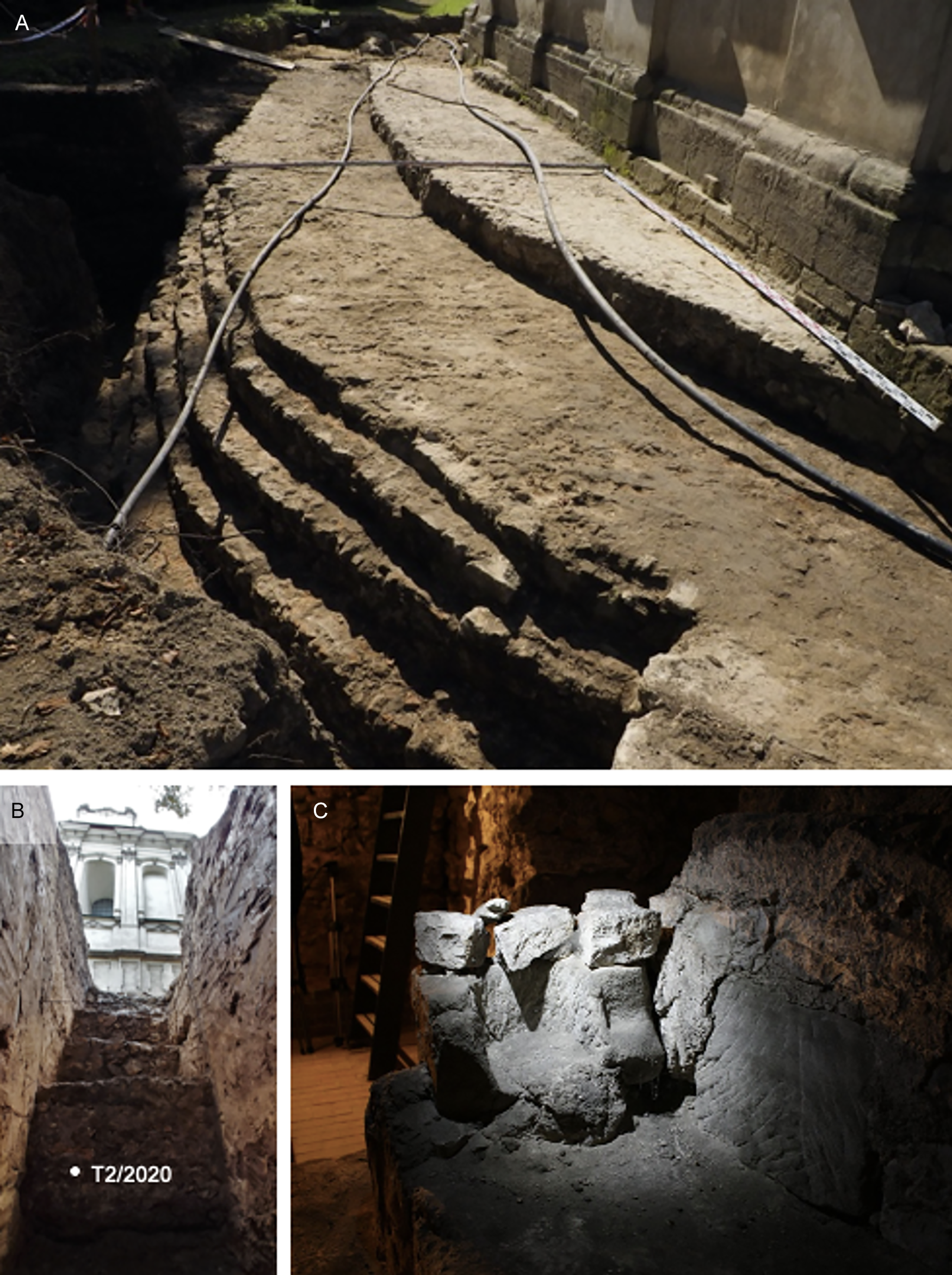
In this study, samples from the chronologically oldest layers were analyzed. The first of them— charcoal from the mortar—was taken from the lowest step of the stone platform, strengthening the edge of the hill on its eastern side (Figure 2); due to the removal of layers covering the structure in the modern period, it is not possible to date it based on stratigraphic analysis. The second sample—mortar—was taken from the aforementioned stone tomb, located in the northern aisle of the Romanesque Basilica. The relative chronology of the grave, resulting from the analysis of the surrounding strata and burial equipment, points to the second half (probably the fourth quarter; Zoll-Adamikowa Reference Zoll-Adamikowa1966) of 11th cent. AD.
Location of mortar. and charcoal samples analyzed in this study: A), B) earth embankment and stepped stone platform strengthening the edge of the hill. with a location of dated charcoal sample T2/2020 (photo M. and J. Łyczak 2020); C) interior of tomb no. 15, where the dated mortar sample TKS15 was collected (photo M. Kamińska 2022).

Methods
The mortar sample TKS15 was split into two subsamples A and B. Preparation of TKS15_A and TKS15_B (ETH-129548) from the oldest cultural layer at the Tyniec monastery for radiocarbon dating followed the protocol developed so far at the ETH Zürich Laboratory. The principle of the method is a separation of suitable grain size and discrimination between anthropogenic and geological carbonate by a sequential dissolution (Lindroos et al. Reference Lindroos, Ringbom, Heinemeier and Sveinbjörnsdóttir2007, Reference Lindroos, Ringbom, Heinemeier, Hodgins, Sonck-Koota, Sjöberg, Lancaster, Kaisti, Brock, Ranta, Caroselli and Lugli2018), a technique that targets the fast-dissolving component of the binder (Hajdas et al. Reference Hajdas, Lindroos, Heinemeier, Ringbom, Marzaioli, Terrasi, Passariello, Capano, Artioli, Addis, Secco, Michalska, Czernik, Goslar, Hayen, Van Strydonck, Fontaine, Boudin, Maspero, Panzeri, Galli, Urbanová and Guibert2017, Reference Hajdas, Maurer and Röttig2020). A grain fraction 45−63 μm was chosen for measurements. For each of the two samples, five subsamples (dissolution fractions) of CO2 were collected for the following time intervals: 1–3, 4–6, 7–9, 10–12 s, and the rest was left to dissolve until the end of the reaction.
Charcoal sample T2/2020 (MKL-A5119) was chemically pretreated with the acid-alkali-acid (AAA) method. In the next step, charcoal was combusted, purified, and transformed into graphite in a laboratory at the AGH-UST in Kraków (Krąpiec et al. Reference Krąpiec, Rakowski, Huels, Wiktorowski and Hamann2018).
The graphite and Fe powder mixture was pressed into a target holder and measured with the AMS system at the Center for Applied Isotope Studies at the University of Georgia, USA (Cherkinsky et al. Reference Cherkinsky, Culp, Dvoracek and Noakes2010).
Results
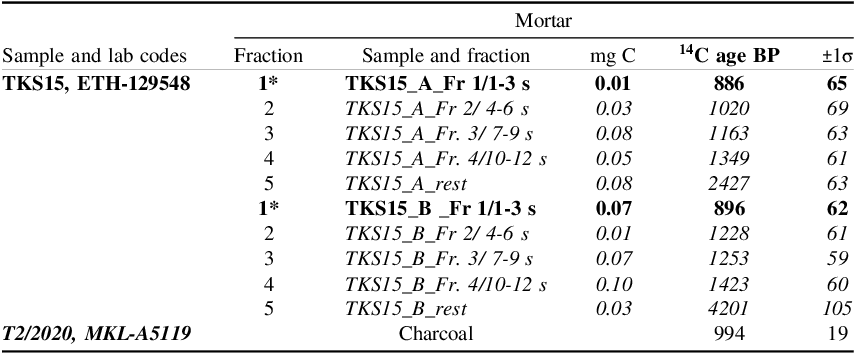
The outcome of the radiocarbon dating performed on samples from the Benedictine Abbey in Tyniec, for 10 portions of gas collected from the mortar samples, and for the charcoal sample, is summarized in Table 1. The radiocarbon age of the fast-dissolving fractions (Fr 1, i.e., 1–3 s) shows an age close to archaeological estimates based on recent excavation work.
Results of the 14C AMS analysis of mortar samples.

*Only first fraction (Fr 1) dissolved in 1-3 s is accepted as an accurate radiocarbon age (RA), the combined RA is 891±45 BP; mortars TKS15_A and TKS15_B, (ETH-129548) of- the oldest cultural layer at the Tyniec monastery. Charcoal sample T2/2020 (MKL-A5119); Fr 1/1–3 s. – time range of gas collection e.g., Fr 1, gas collected during the first 3 s of leaching reaction.
Based on the assumption that the fast-dissolving fraction is the anthropogenic binder, the fraction obtained from the first seconds of the sequential dissolution is considered the best estimate of 14C age. If it agrees with the second fraction, this 14C age can be regarded as the most accurate measurement of the moment of mortar production (Ringbom et al. Reference Ringbom, Lindroos, Heinemeier and Sonck-Koota2014). In the case of Tyniec, the slower fractions are significantly older than the first fraction. Therefore, only first fractions from the two independent preparations, A and B, were combined.
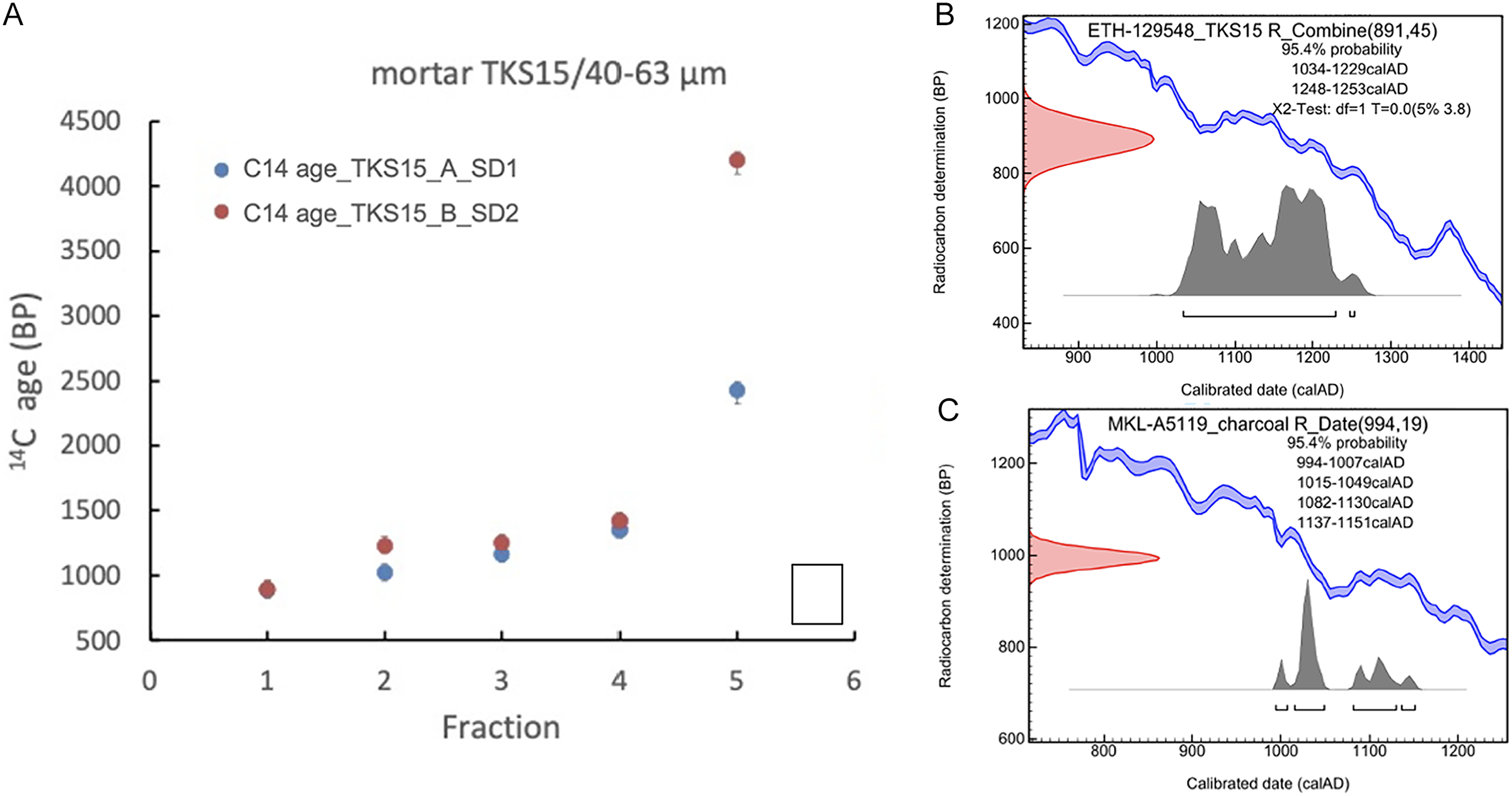
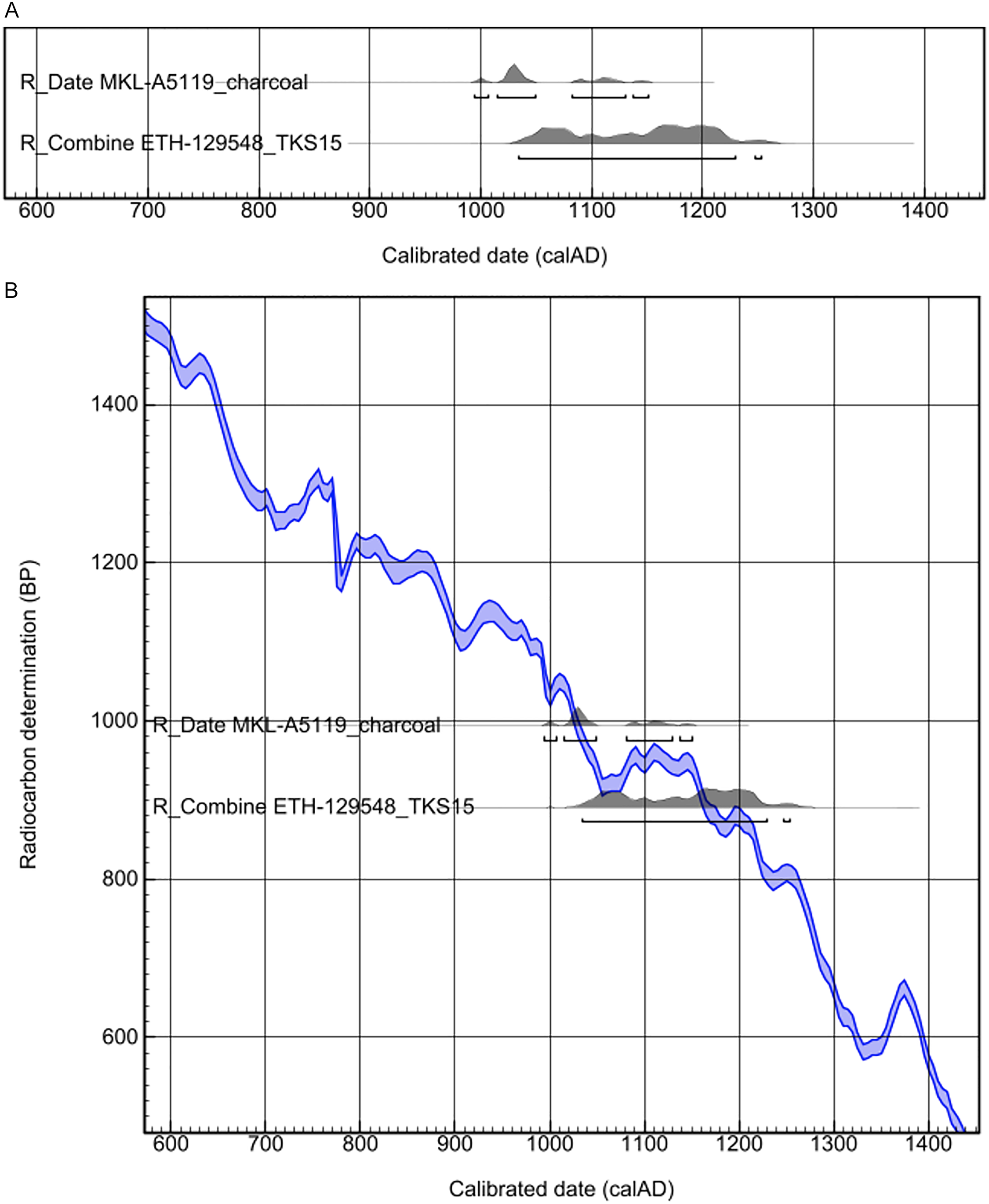
Figure 3 shows all the results of the radiocarbon dating of all the fractions from two independent sequential dissolutions (SD) of sample TK15. Following the procedure outlined in Hajdas et al. (Reference Hajdas, Maurer and Röttig2020), the radiocarbon ages of the fast-dissolving fractions, 1st: 1−3 s, have the potential to provide an accurate 14C signal for the time of mortar hardening. The increase in the ages of the slow fractions (2nd, 3rd and 4th, i.e., >7 s dissolution time) indicates the presence of the geological component (“dead carbon”) (Table 1, Figure 3). Calendar ages of mortar samples were obtained using OxCal v.4.4.4 online calibration software (Bronk Ramsey Reference Bronk Ramsey2021) with the INTCAL20 calibration data set (Reimer et al. Reference Reimer, Austin, Bard, Bayliss, Blackwell, Bronk Ramsey, Butzin, Cheng, Edwards and Friedrich2020). The two ages of the 1st fraction from the two independently prepared samples can be combined to 891 ± 45 BP (χ2-test: df=1 T=0.0 (5% 3.8)). The combined calibrated age (weighted mean) of the mortar sample from the Tyniec Abbey dates the mortar to 1034–1229 AD (Figure 3B) and the calibrated age of the charcoal is 994–1151 AD (Figure 3C).
A) Results of radiocarbon dating of two independent sequential dissolution (SD) of sample TKS15 (ETH-129548). Each SD has results of radiocarbon dating of 5 fractions (TKS15_A and TKS15_B). The first fraction was the collection of CO2 within the first 3 s and the consecutive fractions were collected in 3-s intervals. The x-axis shows dissolution fractions: 1st fraction: 1–3 s; 2nd fraction: 4–6 s; 3rd fraction: 7–9 s; 4th fraction: 10–12 s. The 5th fraction is CO2 collected after the rest of the sample dissolved entirely. The first red and blue fractions are superimposed. B), C) Combined (weighted mean) radiocarbon age of the first fraction from two separate preparations B), and the radiocarbon age of charcoal C), calibrated using OxCal 4.4.4 and INTCAL20 data set (Bronk Ramsey Reference Bronk Ramsey2009; Reimer et al. Reference Reimer, Austin, Bard, Bayliss, Blackwell, Bronk Ramsey, Butzin, Cheng, Edwards and Friedrich2020).

Figure 3 Long description
Panel A: A scatter plot shows radiocarbon dating results of two independent sequential dissolution (SD) of sample TKS15. The x-axis represents dissolution fractions, labeled as 1, 2, 3, 4, and 5. The y-axis represents the radiocarbon age in before present (BP) units. Two data series are plotted: C14 age TKS15 A SD1 in blue and C14 age TKS15 B SD2 in red. The first red and blue fractions are superimposed. Panel B: A line graph and histogram show the combined (weighted mean) radiocarbon age of the first fraction from two separate preparations. The x-axis represents the calibrated date in common era (calAD) units, and the y-axis represents the radiocarbon determination in BP units. The line graph shows the radiocarbon determination with a 95.4 percent probability range, and the histogram shows the calibrated date distribution. Panel C: Another line graph and histogram display the radiocarbon age of charcoal. The x-axis represents the calibrated date in calAD units, and the y-axis represents the radiocarbon determination in BP units. The line graph shows the radiocarbon determination with a 95.4 percent probability range, and the histogram shows the calibrated date distribution.
The archaeological chronology of this abbey points to the 11th/12th century AD, indicating a broad agreement of the obtained 14C chronology of mortar.
Discussion
The calibrated radiocarbon ages of the charcoal sample date the lowest “step”—the oldest part of the stone platform—to the period 1015–1049 AD (Figure 3C). This result makes it possible to initially associate its construction with the development of the hill for the construction of the oldest monastery buildings; the archaeological and architectural research conducted so far allowed only to determine the time of its creation in a broad framework between the 11th–12th and 17th–18th centuries. The combined age of the fast component of the mortar from the stone tomb results in 1034–1229 AD, confirming the relative chronology of the grave and archaeological expectation based on the dating of the funerary equipment. The wide range of calendar ages is partly due to the low precision of the mortar RA and partly due to the nature of the calibration curve between 1050 and 1200 AD (Figure 3B). The radiocarbon age of charcoal is only slightly older than the 1st fraction of mortar (Figure 3C and 4). The “wiggle” on the calibration curve also impacts the calibration of the charcoal age, despite the precision of the measurement (Figure 4). Nevertheless, this study adds information about the reliability of using the 1st, i.e., the fastest dissolving fraction.
Calibrated radiocarbon ages of combined date (ETH-129548) from the first fraction of two separate sequential dissolutions in 3-s intervals of the same mortar sample and radiocarbon age of charcoal (MKL-A5119), in a table (A) and on the calibration curve (B).

The construction chronology of the Tyniec monastic complex is often obscured by extensive transformations and unrecorded conservation, which have disrupted the integrity of the architectural stratigraphy. To address this, the radiocarbon dating of mortars serves as a key diagnostic parameter for establishing a robust temporal framework, thereby enabling a more precise interpretation of the site’s architectural history.
Conclusions
Radiocarbon dating of the mortar provides the potential to date archeological and historic buildings. This is particularly important in cases where there are no historical data on the examined objects (e.g., records in chronicles have been destroyed) and surrounding archaeological layers have been disturbed in later periods (e.g., mixing of deposits during various construction activities) or were completely removed (e.g., because of land leveling).
Mortar and charcoal dating were the first analytical methods used in the construction. Due to the platform’s unexpected (very early) nature, dating to the 11th–12th century, additional analysis of samples taken from other parts of the building is necessary to confirm this finding. In the light of the presented data, the chronology of development of Tyniec Hill still needs further investigation.
Acknowledgments
The research was financed by the National Science Centre, Poland grant no. 2023/49/B/HS3/02914.